Investigative reporter, Blaze Media LLC. Father of 3. Tradition-minded Catholic.
“Unless there is a Good Friday in your life, there can never be an Easter Sunday.”
—Archbishop Fulton J. Sheen
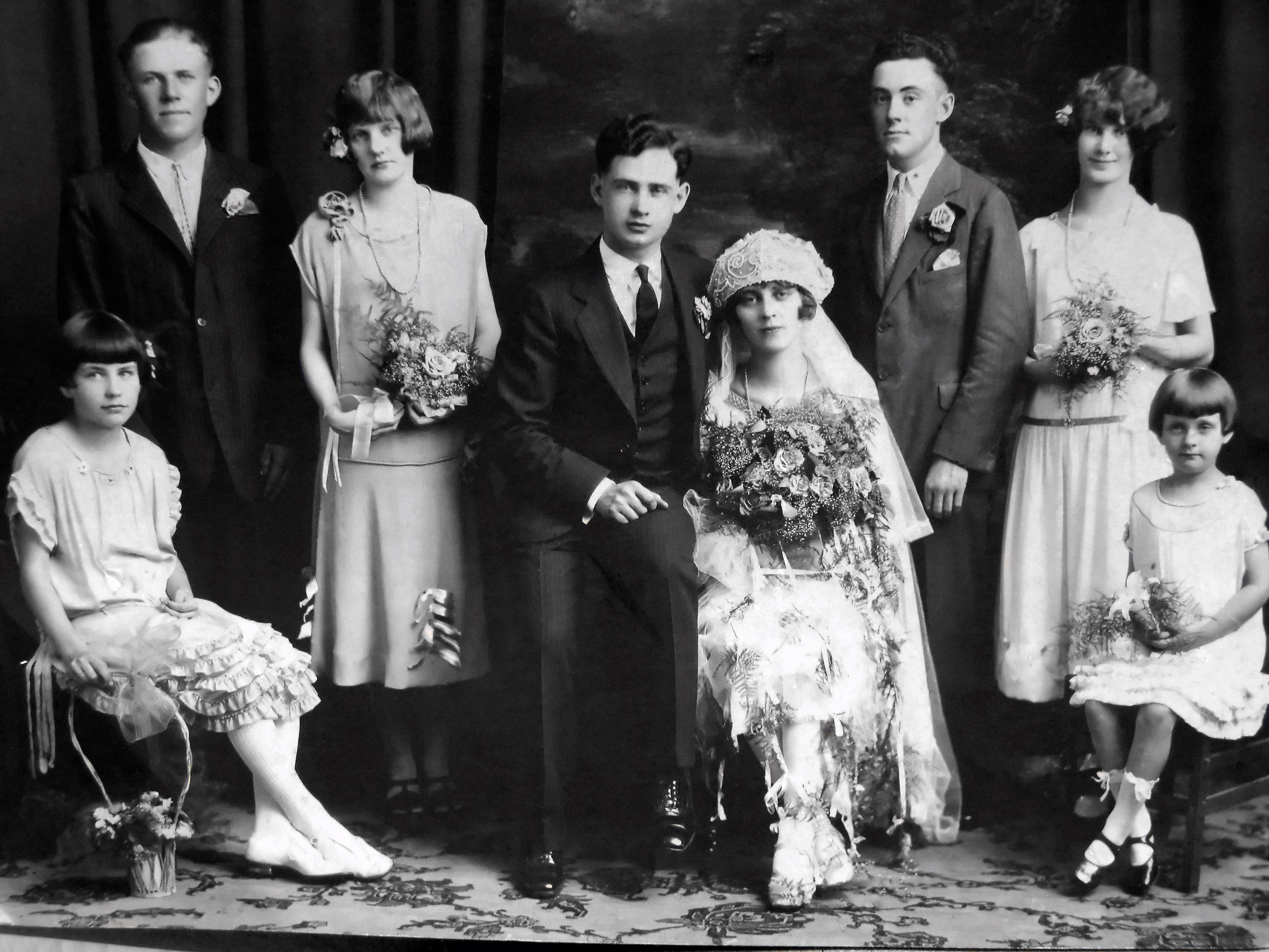
Judging by the turnout, the marriage of Joseph John Mras and Mary V. Sternot of the Town of Sigel in Wood County, Wisconsin, was the celebration of the year in 1913. The pair were married by the Rev. John Willitzer on October 21. The group portrait was taken outside the Sigel home of the bride’s parents, Jacob and Josephine Sternot. The reception had a big turnout from Sigel and the nearby village of Vesper.
Groom Joseph Mras and bride Mary Sternot are flanked by flower girls Ruby V. Treutel (left) and Gladys Cole. Back row (left to right) includes Joseph Sternot, Josie Leu, John Pyrch, Anna Sternot, John Yeske and Mary Billiet.
As with other large-group photos in our collection, it is fun to look for details in the sea of faces. Standing just right of center is my grandmother, Ruby V. (Treutel) Hanneman, who was a flower girl at the wedding. The bride and groom are tucked away in the upper right corner, looking a bit weary. The entertainers are in center front, one with a fiddle, one with an accordion and a third holding a pitcher of beer. Three things seem to link the men in the photo: hats, beer and cigars. Some things never change.
A studio photo of the wedding party provides additional details on the big day. Ruby Treutel and (we believe) her cousin Gladys Cole were the flower girls, while one brother and one sister of the bride were also in the wedding party.
Joe and Mary Mras had three children,Clarence, Earl and William. Joe was a crane operator for 31 years for the Frank Garber Iron & Metal Co. in Wisconsin Rapids. He retired in 1959. Joe died on April 10, 1961. Mary died September 20, 1977. Their son Clarence was killed in an auto accident in September 1956. Earl died October 18, 2001. William died February 18, 1997.
— This post has been updated with corrected identifications on the wedding portrait.
Leaving the family homeland to make a trans-Atlantic trip and emigrate to America would be an intimidating prospect under the best circumstances. When Michael Friedrich Ferdinand Hannemann brought his pregnant wife Mina and infant son Albert aboard the ship John Bertram in Hamburg, Germany in April 1863, he likely had no idea the horror they would face during 46 days at sea.
Fred Hannemann, as he was known to family and friends, was not the first in the family to leave Pomerania for Wisconsin. At least two sisters were already in central Wisconsin, so Fred may have heard stories from them about their travels to the American Midwest. But that likely would not have prepared him for the life-threatening conditions the 336 passengers faced en route to New York. One of the middle children of Matthias and Maria Caroline Hannemann of Meesow, Kreis Regenwalde, Pomerania, Fred was among at least eight children in the clan who would come to America between 1861 and 1882.
The John Bertram was a 1,060-ton clipper ship built in just 90 days in Boston in 1850 and placed into service in January 1851. At 180 feet long, the ship was initially employed to shuttle cargo from Boston around Cape Horn to San Francisco. It was later sold and pressed into service moving emigrants and cargo from Europe to America. Between 1860 and 1869, nearly 2,100 people were carried from Europe and elsewhere to America aboard the John Bertram.
About 10 days into the journey, the John Bertram encountered a violent gale that ripped at the sails and caused the ship to pitch up and down in the massive ocean swells. The winds raged at the ship for 48 hours, tossing drinking water casks overboard and destroying the storm sails. Conditions below deck were likely horrific, with the violent rocking causing seasickness and injuries. On deck, conditions were worse. Four crewmen were lost overboard and eight others were disabled. Once the storm passed, the ship was leaking badly, making it difficult to keep under sail. Mina Hanneman no doubt had to struggle to care for young Albert Hannemann, 1, in the chaos. The former Johanna Wilhelmine Florentine Glebke was nearly seven months pregnant during the voyage.
On May 4, still three weeks from docking in New York, the John Bertram hit dense fog and became trapped in a massive ice floe. For four days, the ship was surrounded by ice that scraped the planks of the hull and ripped at the cutwater. Four other ships in the area became snared in the ice. Eventually the clipper broke free, but had to steer 3 degrees to the east in order to escape the ice fields.
The trip took its toll. Eight infants died during the trip, although two babies were born. Along with the crewmen who were washed overboard, 12 people lost their lives. Thankfully, Fred, Mina and Albert Hannemann made it safely to Castle Garden in New York. Once they reached the Town of Grand Rapids in Wood County, Wis., they settled into farming. Eventually, seven children were born into the home, as yet another branch of the Hannemann family tree took root in central Wisconsin.
We only have two photographs that show Carl F. Hanneman at school, and both appear to be from the same year. In the first, Carl is the second pupil in the second row at a school in Grand Rapids, Wisconsin. Wearing a tie and cardigan sweater, Carl is one of a half-dozen or so boys in the class. The clock reads 11:59, so the class photo was scheduled just before the lunch break. It is a well-kept and neatly appointed classroom. The girl sitting in front of Carl could easily be mistaken for his future bride, Ruby V. Treutel, although she went to school in nearby Vesper.
Carl F. Hanneman is third from the left in the first row. The photo was taken circa 1910.
The second photo was taken outdoors at an entrance to the school. Carl is third from the left in the first row. At the time, the Hannemans lived on Baker Street in Grand Rapids, so the Howe School would have been the closest public school. But the building in the photo does not match exterior details of the Howe School, so it’s unclear where Carl spent his elementary school years.
During his nearly six decades as a pharmacist, Carl F. Hanneman got to know a lot of people. He forged good relationships with the many sales reps who called on him at the Mauston Drug Store. Some came to dinner at the Hanneman home, and a few even stayed at the house while in town. One of the long-lasting perks he received from Parke, Davis and Company was a stunning set of lithographs depicting the history of pharmacy. More than 30 prints still exist from Carl’s 1950s collection.
Parke-Davis commissioned artist Robert Thom to produce 40 illustrations for the series, “A History of Pharmacy in Pictures.” Each print came with a history article that explained the depicted scene and its place in history. Launched in 1957, the series was developed in cooperation with the Institute for the History of Pharmacy at the University of Wisconsin. Druggists were encouraged to display the artwork in their stores.
The series depicted such early topics as scientist Galen in the second century to later developments such as chemotherapy, antibiotics and pharmaceutical research. Parke Davis also commissioned Thom to paint a series of illustrations on the history of medicine. Thom (1915-1979) was well known as an illustrator of historical subjects, including great moments in baseball and the history of Illinois and Michigan.
The paintings from Carl Hanneman’s collection are in the gallery below, including the explanatory text from each image.
— This post has been updated with additional Thom paintings.
Man learned early of the prestigious advantage of trademarks as a means of identification of source and of gaining customers’ confidence. One of the first therapeutic agents to bear such a mark was Terra Sigillata (Sealed Earth), a clay tablet originating on the Mediterranean island of Lemnos before 500 B.C. One day each year clay was dug from a pit on a Lemnian hillside in the presence of governmental and religious dignitaries. Washed, refined, rolled to a mass of proper thickness, the clay was formed into pastilles and impressed with an official seal by priestesses, then sun-dried. The tablets were then widely distributed commercially.
In the evolution of all successful and enduring systems of knowledge there comes a time when the observations of many men, or the intensive studies of one, transcend from the level of trade or vocation to that of a science. Pedanios Dioscorides (first century A.D.), contributed mightily to such a transition in Pharmacy. In order to study materia medica, Dioscorides accompanied the Roman armies throughout the known world. He recorded what he observed, promulgated excellent rules for collection of drugs, their storage and use. His texts were considered basic science as late as the sixteenth century.
Of the men of ancient times whose names are known and revered among both the professions of Pharmacy and Medicine, Galen, undoubtedly, is the foremost. Galen (130-200 A.D.) practiced and taught both Pharmacy and Medicine in Rome; his principles of preparing and compounding medicines ruled in the Western world for 1,500 years; and his name still is associated with that class of pharmaceuticals compounded by mechanical means – galenicals. He was the originator of the formula for a cold cream, essentially similar to that known today. Many procedures Galen originated have their counterparts in today’s modern compounding laboratories.
Twinship of the health professions, Pharmacy and Medicine, is nowhere more strikingly portrayed than by Damian, the apothecary, and Cosmas, the physician. Twin brothers of Arabian descent, and devout Christians, they offered the solace of religion as well as the benefit of their knowledge to the sick who visited them. Their twin careers were cut short in the year 303 by martyrdom. For centuries their tomb in the Syrian city of Cyprus was a shrine. Churches were built in their honor in Rome and other cities. After canonization, they became the patron saints of Pharmacy and Medicine, and many miracles were attributed to them.
During the Middle Ages remnants of the Western knowledge of Pharmacy and Medicine were preserved in the monasteries (fifth to twelfth centuries). These scientists are known to have been taught in the cloisters as early as the seventh century. Manuscripts from many islands were translated or copied for monastery libraries. The monks gathered herbs and simples in the field, or raised them in their own herb gardens. These they prepared according to the art of the apothecary for the benefit of the sick and injured. Gardens such as these still may be found in monasteries in many countries.
The Arabs separated the arts of apothecary and physician, establishing in Bagdad late in the eighth century the first privately owned drug stores. They preserved much of the Greco-Roman wisdom, added to it, developing with the aid of their natural resources syrups, confections, conserves, distilled waters and alcoholic liquids. The apothecary is examining logs of sandalwood offered by a traveling merchant, while children indulge their taste for sweets with stalks of sugar cane. When the Moslems swept across Africa, Spain and southern France, they carried with them a new pattern of Pharmacy which western Europe soon assimilated.
Among the brilliant contributors to the sciences of Pharmacy and Medicine during the Arabian era was one genius who seems to stand for his time – the Persian, Ibn Sina (about 980-1037 A.D.), called Avicenna by the Western world. Pharmacist, poet, physician, philosopher and diplomat, Avicenna was an intellectual giant, a favorite of Persian princes and rulers. He wrote in Arabic, often while secluded in the home of an apothecary friend. His pharmaceutical teachings were accepted as authority in the West until the 17th century; and still are dominant influences in the Orient.
In European countries exposed to Arabian influence, public pharmacies began to appear in the 17th century. However, it was not until about 1240 A.D. that, in Sicily and southern Italy, Pharmacy was separated from Medicine. Frederick II of Hohenstaufen, who was Emperor of Germany as well as King of Sicily, was a living link between Oriental and Occidental worlds. At his palace in Palermo, he presented subject Pharmacists with the first European edict completely separating their responsibilities from those of Medicine, and prescribing regulations for their professional practice.
The idea of a pharmacopoeia with official status, to be followed by all apothecaries, originated in Florence. The Nuovo Receptario, originally written in Italian, was published and became the legal standard for the city-state in 1498. It was the result of collaboration of the Guild of Apothecaries and the Medical Society – one of the earliest manifestations of constructive interprofessional relations. The professional groups received official advice and guidance from the powerful Dominican monk, Savonarola, (seated, foreground) who, at the time, was the political leader in Florence.
Trade in drugs and spices was lucrative in the Middle Ages. In the British Isles, it was monopolized by the Guild of Grocers, which had jurisdiction over the apothecaries. After years of effort, the apothecaries found allies among court physicians. King James I, flanked by two “Beefeaters” wore heavily padded attire because of fear of stabbing. Upon persuasion by the philosopher-politician, Francis Bacon, the King granted a charter in 1617 which formed a separate company known as the “Master, Wardens and Society of the Art and Mystery of the Apothecaries of the City of London” over vigorous protests of the grocers. This was the first organization of pharmacists in the Anglo-Saxon world.
Young Parisian Apothecary Louis Hébert answered the call of the New World in 1605, when he helped de Monts and Champlain build New France’s first settlement, the Habitation, at Port Royal (Nova Scotia, Canada). Hébert looked after the health of the pioneers, cultivated native drug plants, and supervised the gardens. At the waterfront, he examined specimens of drug plants offered by Micmac Indians. These included Arum, (Jack-in-the-Pulpit), Eupatorium (Boneset), Verbascum (Mullein), and Hydrastis (Golden Seal). When the Habitation was destroyed by the English in 1613, he returned to his Parisian apothecary shop. The lure of Canada was strong, however, and in 1617, he and the family returned with Champlain to Quebec, where Hébert’s “green thumb” gained him lasting fame as the first successful farmer in what is now Canada.
Many Europeans “of quality and wealth, particularly those who were non-conformists in religion” were attracted to the possibilities of the American Colonies. From Britain came John Winthrop, first Governor of Massachusetts Bay Colony and founder of Boston. Governor Winthrop, unable to induce professionals to the Colony, sought advice from English apothecaries and physicians, and added to his small store of imported drugs those derived from plants native to New England. In his home (about 1640), he made available as best he could the “art and mystery” of the apothecary for his citizens.
Christopher Marshall, an Irish immigrant, established his apothecary shop in Philadelphia in 1729. During 96 years, this pioneer pharmaceutical enterprise became a leading retail store, nucleus of large-scale chemical manufacturing; a “practical” training school for pharmacists; an important supply depot during the Revolution; and finally, it was managed by granddaughter Elizabeth, America’s first woman pharmacist. Christopher earned the title of “The fighting Quaker” during the Revolution; his sons, Charles and Christopher, Jr., (shown as youths with their father, about 1754) earned individual fame and carried on his fine traditions.
Colonial America’s first hospital (Pennsylvania) was established in Philadelphia in 1751; the first Hospital Pharmacy began operations there in 1752, temporarily set up in the Kinsey house, which served until the first hospital building was completed. The ingenuity of Benjamin Franklin was helpful in both. First Hospital Pharmacist was Jonathan Roberts; but it was his successor, John Morgan, whose practice as a hospital pharmacist (1755-56), and whose impact upon Pharmacy and Medicine influenced changes that were to become of importance to the development of professional pharmacy in North America. First as pharmacist, later as physician, he advocated prescription writing and championed independent practice of two professions.
During his few short years, Carl Wilhelm Scheele gave to the world discoveries that have brought its people incalculable advantages. Yet he never forgot that he was, first of all, a pharmacist. Encouraged by enlightened preceptors, all of his discoveries were made in the Swedish pharmacists in which he worked, as apprentice, as clerk, and finally as owner, in Köping. He began in a corner of the stock room of Unicorn Apothecary in Gothenburg. With rare genius, he made thousands of experiments, discovered oxygen, chlorine, prussic acid, tartaric acid, tungsten, molybdenum, glycerin, nitroglycerin, and countless other organic compounds that enter into today’s daily life, industry, health, and comfort.
The first man to hold the rank of a commissioned pharmaceutical officer in an American army was the Bostonian apothecary, Andrew Craigie. His duties included procurement, storage, manufacture and distribution of the Army’s drug requirements. He also developed an early wholesaling and manufacturing business.
Swedish pharmacist Scheele paved the way for isolating organic plant acids; but it remained for a young German apothecary, Friedrich Wilhelm Adam Sertürner, to give the world opium’s chief narcotic principle, morphine; and to recognize and prove the importance of a new class of organic substances: alkaloids. His first announcements challenged, Sertürner in 1816 conducted a new series of bold, startling experiments in his apothecary shop in Einbeck, including a series of physiologic tests on himself and three young friends. Recognition and fame followed. Relocating in an apothecary shop in Hameln, Sertürner continued organic chemical experimentation and discovery throughout his life.
Taking their cue from Sertürner’s alkaloidal experiments, two French pharmacists, Messrs. Pierre-Joseph Pelletier and Joseph-Bienaimé Caventou, isolated emetine from ipecacuanha in 1817; strychnine and brucine from nux vomica in 1818; then, in their laboratory in the back of a Parisian apothecary shop, they tackled the problem that had baffled scientists for decades – wresting the secrets of the Peruvian barks that were so useful against malaria. In 1820 Caventou and Pelletier announced the methods for separation of quinine and cinchonine from the cinchona barks; prepared pure salts, had them tested clinically, and set up manufacturing facilities. Many other discoveries came from their pharmacy-laboratory; high honors were accorded them.
Faced with two major threats; deterioration of the practice of pharmacy, and a discriminatory classification by the University of Pennsylvania medical faculty, the pharmacists of Philadelphia held a tempestuous protest meeting in Carpenters’ Hall, February 23, 1821. At a second meeting, March 13, the pharmacists voted formation of: an association, which became The Philadelphia College of Pharmacy; a school of pharmacy; and a self-policing board. Sixty- eight pharmacists signed the Constitution of the first pharmaceutical association in the United States; American Pharmacy’s first educational institution, bearing the same name, opened November 9.
First U.S. industry in medicinal herbs was carried on by the United Society of Believers in Christ’s Second Appearing, commonly known as the Shakers. Begun about 1820, and commercially important by 1830, the medicinal herb industry grew, hit its peak in the 1860’s, then waned at the close of the century. The Shakers gathered or cultivated some 200 varieties; dried, chopped, and pressed them into “bricks”; wrapped, labeled, and sold them to pharmacists and physicians world-wide. Tons of solid and fluid extracts also were produced. The Shaker label was recognized for reliability and quality for more than a century.
Need for better intercommunication among pharmacists; standards for education and apprenticeship; and quality control of imported drugs, led to calling of a convention of representative pharmacists in the Hall of the Philadelphia College of Pharmacy, October 6 to 8, 1852. Under leadership of its first President, Daniel B. Smith, and first Secretary, William Procter, Jr., the twenty delegates launched The American Pharmaceutical Association; mapped its objectives; and opened membership to “All pharmaceutists and druggists” of good character who subscribed to its Constitution and to its Code of Ethics. The Association continues to serve Pharmacy today.
Over the years, no real discord has existed between representatives of European and American Pharmacy so far as ethical and scientific aims are concerned. But when the groups met for the first time, at the Second International Congress of Pharmacy in Paris, France, August 21 to 24, 1867, there was a great divergence of opinion on the subject of compulsory limitation of pharmacies. William Procter, Jr., leading the delegates of The American Pharmaceutical Association, told the international body that “Public opinion is in America a forceful agent of reform,” and that, in his country, “there is not the slightest obstacle toward a multiplication of drug stores save that a lack of success.” His declaration vividly documented the American Way of Pharmacy.
Rarely has a titular distinction been so deserved. William Procter, Jr., graduated from The Philadelphia College of Pharmacy in 1837; operated a retail pharmacy; served the College as Professor of Pharmacy for 20 years; was a leader in founding The American Pharmaceutical Association; served that organization as its first secretary; later, as its president; served 30 years on the U.S.P. Revision Committee; was for 22 years Editor of the American Journal of Pharmacy. In 1869, though retired, Procter continued to edit the Journal in a small publication office located beside the College’s Tenth Street building. From retirement he returned to P.C.P.’s chair of Pharmacy in1872; literally died “in the harness,” in 1874.
When Dr. Albert B. Prescott launched the pharmacy course at the University of Michigan in 1868, critical attention was aroused because he abandoned the traditional requirement of pregraduation apprenticeship. At the 1871 convention of the American Pharmaceutical Association, he was denied credentials and ostracized. However, the Michigan course pioneered other major changes: laboratory pharmacy, a definite curriculum that included basic sciences, and a program that demanded students’ full-time attention. During the next thirty years, Dr. Prescott had the satisfaction of seeing his once revolutionary innovations generally adopted by pharmaceutical faculties.
The first “United States Pharmacopoeia” (1820) was the work of the medical profession. It was the first book of drug standards from a professional source to have achieved a nation’s acceptance. In 1877, the “U.S.P.” was in danger of dissolution due to the lack of interest of the medical profession. Dr. Edward R. Squibb, manufacturing pharmacist as well as physician, took the problem to The American Pharmaceutical Association convention. Pharmacists formed a “Committee on Revision” chairmanned by hospital pharmacist Charles Rice, assisted by pharmacist-educator Joseph P. Remington, and by Dr. Squibb, their indefatigable collaborator. The “U.S. Pharmacopoeia” surged to new importance.
Despite the professional skill and integrity of 19th-century pharmacists, seldom did two preparations of vegetable drugs have the same strength, even though prepared by identical processes. Plant drugs varied widely in active alkaloidal and glucosidal content. The first answer to this problem came when Parke, Davis & Company introduced standardized “Liquor Ergotae Purificatus” in 1879. Dr. Albert Brown Lyons, as the firm’s Chief Chemist, further developed methods of alkaloidal assay. Messrs. Parke and Davis recognized the value of his work, and in 1883, announced a list of twenty standardized “normal liquids.” Parke-Davis also pioneered in developing pharmacologic and physiologic standards for pharmaceuticals.
Scientific explorers opened vast new horizons for Pharmacy late in the 19th century. Sent in 1885 to Peru, Dr. Henry H. Rusby crossed South America amid incredible hardships. He returned with 45,000 botanical specimens, including Cocillana Bark.
The French retail pharmacist, Stanislas Limousin, introduced many devices to Pharmacy and Medicine. His greatest contributions were invention of glass ampoules, the medicine dropper, and apparatus for inhalation of oxygen.
Biological products (made from micro-organisms) got their discovery of diphtheria antitoxin by the German, Behring, in 1894. Pharmaceutical manufacturers since have constantly improved serums, antitoxins and vaccines, which have saved countless lives.
One of the successful researchers in the development of new chemical compounds specifically created to fight disease-causing organisms in the body was the French pharmacist, Ernest Francois Auguste Fourneau (1872-1949), who for 30 years headed chemical laboratories in the world-renowned Institut Pasteur, in Paris. His early work with bismuth and arsenic compounds advanced the treatment of syphilis. He broke the German secret of a specific for sleeping sickness; paved the way for the life-saving sulfonamide compounds; and from his laboratories came the first group of chemicals having recognized antihistaminic properties. His work led other investigators to broad fields of chemotherapeutic research.
Research in some form has gone hand in hand with the development of Pharmacy through the ages. However, it was the chemical synthesis of antipyrine in 1883 that gave impetus and inspiration for intensive search for therapeutically useful compounds. Begun by the Germans, who dominate the field until World War I, the lead in pharmaceutical research passed thereafter to the United States. Research in Pharmacy came into its own in the late 1930’s and early 1940’s; has grown steadily since, supported by pharmaceutical manufactures, universities, and government. Today it used techniques and trained personnel from every branch of science in the unending search for new life-saving and life-giving drug products.
Pharmaceutical manufacturing as an industry apart from retail Pharmacy had its beginnings about 1600; really got under way in the middle 1700’s. It developed first in Germany, then in England and in France. In America, it was the child of wars – born in the Revolution; grew rapidly during and following the Civil War; became independent of Europe during World War I; came of age during and following World War II. Utilizing latest technical advances from every branch of science, manufacturing Pharmacy economically develops and produces the latest and greatest in drugs in immense quantities, so that everywhere physicians may prescribe them and pharmacists dispense them for the benefit of all mankind.
Antibiotics are not new. Their actions probably were first observed by Pasteur in 1877. However, the second quarter of the 20th century marked the flowering of the antibiotic era – a new and dramatic departure in the production of disease-fighting drugs. Fleming’s discovery of penicillin in 1929 went undeveloped and Florey and Chain studied it in 1940. Under pressure of World War II, the pharmaceutical manufacturers rapidly adapted mass production methods to penicillin; have reduced costs to 1/1000th the original. Antibiotic discoveries came rapidly in the ’40’s. Intensive research continues to find antibiotics that will conquer more of men’s microbial enemies.
Pharmacy, with its heritage of 50 centuries of service to mankind, has come to be recognized as of the great professions. Like Medicine, it has come through many revolutions, has learned many things, has had to discard many of its older ways. Pharmacists are among the community’s finest educated people. When today’s retail pharmacist fills a prescription written by a physician, he provides a professional service incorporating the benefits of the work of pharmacists in all branches of the profession – education, research, development, standards, production, and distribution. Pharmacy’s professional stature will continue to grow in the future as this great heritage and tradition of service is passed on from preceptor to apprentice, from teacher to student, from father to son.
It seems the entire village of Vesper, Wisconsin came out for a banquet or other big event, and stayed for a photograph. The image appears to date to about 1913 or 1914. The large crowd spilled out of the village hall for a photograph. What was the occasion? A wedding? A dance? It is fun to imagine. The portrait was taken by Moore Photo of nearby Grand Rapids (now called Wisconsin Rapids).
What makes this image especially interesting is to zoom in and look at the details. See the little girl with the Dixie Queen plug cut tobacco lunch box? It’s strange to imagine a lunch tin with smoking tobacco advertised on the side, but this was before the age of comic books or movie stars. Lunch pails with tobacco ads were common.
In the front at left/center left is my grandmother, Ruby V. (Treutel) Hanneman, who appears to be about 10 years old. That would date the photo to 1914. In the sea of men back near the stairs appears to be Ruby’s father, Walter Treutel. He is sporting a mustache, which is something I’ve not seen in any family photos.
On the building next to the window is a large thermometer with the name “Hlasatel” on it. That was the name of a Bohemian/Czech newspaper. Vesper had a large population from Bohemia, including the family of my great-grandmother, Mary (Ladick) Treutel. Her parents emigrated from Bilina in what is now the Czech Republic.
Most of the men wore hats, so it is not easy to make identifications.
One little girl has a Dixie Queen tobacco lunch pail.
Judging by the dress, this must have been an important event.
Young Ruby V. Treutel is in the front row right, leaning on her right hand and tilting her head to her left.
Much of the village of Vesper came out for the photo.
For 80 years, there has been a member of the Hanneman family in the Knights of Columbus, the world’s largest Catholic fraternal and charitable organization. The line of service runs from Carl F. Hanneman (1901-1982), who joined in 1934, to his son David D. Hanneman (1933-2007), who joined in 1953, to his son Joe Hanneman, who joined the order in April 2007.
The three generations share other things in common with respect to the K of C, based in New Haven, Connecticut, with more than 14,000 local councils across America. All three have been members of the Fourth Degree, which focuses on patriotism and love of country. All three served in the Fourth Degree Color Corps and Honor Guard. The Honor Guard, wearing tuxedos, colored capes, ceremonial swords and plumed chapeaux, is a ceremonial presence at Masses, funeral wakes, Flag Day ceremonies and other events. Joe Hanneman served on the Honor Guard for the installation of Archbishop Jerome Listecki in Milwaukee. Carl joined the Fourth Degree in the late 1930s or early 1940s, judging by the group portrait of his exemplification class. David joined in 1973 and Joe joined in 2008.
Carl F. Hanneman (left section, second row, second from center aisle), joined the Fourth Degree of the Knights of Columbus in the late 1930s or early 1940s. Exact date of this photo is unknown.
All three also served as Grand Knight of their respective local K of C council. The Grand Knight is leader of the local council. Carl Hanneman was Grand Knight of Solomon Juneau Council 2770 in Mauston, Wisconsin in the late 1960s. David Hanneman was Grand Knight of Holy Family Council 4879 in Sun Prairie, Wisconsin, from 2001 to 2003. Joe Hanneman was Grand Knight of Msgr. Stanley B. Witkowiak Council 697 in Racine in 2010 and 2011.
Altar server Joe Hanneman with his father David D. Hanneman (at right) and Bill Dziadosz.
The Knights of Columbus is a fraternal and charitable organization founded in 1882 by Venerable Father Michael J. McGivney, whose cause for sainthood is being considered at the Vatican. The Knights operate under the principles of charity, unity, fraternity and patriotism. Knights raise money and volunteer for a wide range of causes, from pro-life programs such as crisis pregnancy centers, to programs providing free wheelchairs to the disabled, to grants to local programs that support the mentally retarded. The K of C and local councils have provided more than 500 ultrasound machines to crisis pregnancy centers.
David D. Hanneman was part of a large class that became Fourth Degree Sir Knights on April 14, 1973 in Madison.
Knights provide free coats to needy children each winter. They run a variety of athletic events, including Punt, Pass and Kick, and a basketball free-throw competition. Knights also support and promote vocations to the priesthood, sponsoring seminarians and providing other material support for those studying for the priesthood. In 2013, Knights provided a record amount of charity, with over $170 million raised and 70.5 million hours of voluntary service provided. In 2014, the K of C provided more than $2 million to help persecuted Christians from Iraq and other Mideast countries being targeted by ISIS and other terrorist organizations.
Boy Scouts participate in a flag retirement ceremony run by Assembly 1207, the Fourth Degree Knights in Racine. Speaking at the podium is Deputy Grand Knight Joe Hanneman.
The Fourth Degree of the Knights is especially dedicated to patriotism and the idea that love of God and love of country go hand in hand. The Fourth Degree was founded in 1900 to combat the prejudiced notion that Catholics were not loyal Americans and could not be trusted in public office or with civic responsibility. The Fourth Degree provides free flags for schools and nonprofit organizations, supports veterans’ organizations, provides material needs to local veterans’ hospitals, and sends faith materials and other assistance to members of the military serving overseas.
Sir Knight Joe Hanneman (left) in an honor guard at St. Rita Catholic Church in Racine.
Famous Knights include Venerable Archbishop Fulton J. Sheen, one of the Catholic Church’s all-time great authors and communicators; former Green Bay Packers coaching legend Vince Lombardi; baseball’s Sultan of Swat, Babe Ruth; Supreme Court Justice Samuel Alito; Ray Flynn, former U.S. ambassador to the Vatican; Cardinal Francis George, former archbishop of Chicago; Saint Rafael Guizar Valencia; and six martyrs of the Cristero War in Mexico: Father Luis Bátis Sáinz, Father José María Robles Hurtado, Father Mateo Correa Magallanes, Father Miguel de la Mora, Father Rodrigo Aguilar Alemán and Father Pedro de Jesús Maldonado Lucero. The K of C operates in the United States, Canada, Mexico, the Philippines, Poland, the Dominican Republic, Puerto Rico, Panama, the Bahamas, the Virgin Islands, Cuba, Guatemala, Guam and Saipan.
A number of other members of the extended Hanneman family have been members of the Knights of Columbus: Earl J. Mulqueen Sr. (my grandfather), Earl J. Mulqueen Jr.,Donn G. Hanneman, longtime Wisconsin Rapids building inspector Arthur J. Hanneman, and former state representative Arthur Treutel.
— This post has been updated with a date correction and two new photographs.
Carl F. and Ruby V. Hanneman (at left) on the day Carl was made a Sir Knight in the Fourth Degree of the Knights of Columbus.
David D. Hanneman (third from left) on the day in April 1973 he became a Fourth Degree Sir Knight.
David D. Hanneman (left of center, dark hair), stands just behind his father, Carl, at the reception following the Knights of Columbus Fourth Degree exemplification.
Carl F. Hanneman with his son David (two at left) at the Hanneman home in Sun Prairie before David became a Sir Knight on April 14, 1973.
Carl F. Hanneman handmade the K of C logo for Solomon Juneau Council 2770 in Mauston, Wis.
Carl F. Hanneman was a delegate to the 1937 Wisconsin convention of the Knights of Columbus.
Carl F. Hanneman was a delegate to the 1937 Wisconsin convention of the Knights of Columbus.
Altar server Joe Hanneman with his father David D. Hanneman (at right) and Bill Dziadosz.
The Knights of Columbus Honor Guard at the 2007 funeral of David. D. Hanneman.
The Knights of Columbus sent scores of volunteers to Europe in World War I to operate recreation centers for soldiers and provide comfort at the front.
The Knights of Columbus Glee Club in Racine, Wis., provided entertainment around the city in the 1920s.
The K of C sponsored a “Keep Christ in Christmas” billboard on Interstate 94 near Racine.
K of C councils often hold Landing Day parties to celebrate Catholic explorer Christopher Columbus’ discover of the New World in 1492.
Father Mark Jones blesses the new home of the K of C in Racine, Wis., while Grand Knight Joe Hanneman (at right) looks on.
Wearing regalia and plumed chapeaux, the Knights of Columbus Fourth Degree honor guards often serve at funerals and other Masses.
K of C councils hold “Life Savers for Life” events to raise money for pro-life efforts such as crisis pregnancy centers.
Boy Scouts participate in a flag retirement ceremony run by the Knights in Racine. Speaking at the podium is Deputy Grand Knight Joe Hanneman.
Knights in Racine, Wisconsin honor members of the Catholic church who provide exemplary service with the Pro Deo Et Ecclesia award. The medal was designed by Joe Hanneman.
A young girl tries on a new coat provided by the Knights of Columbus at the HALO homeless shelter in Racine, Wis.
A young boy tries on a new coat provided by the Knights of Columbus at the HALO homeless shelter in Racine, Wis.
Knights and other Christian volunteers pray together after setting up a Nativity scene on Monument Square in Racine, Wis.
Every year the K of C helps set up a Nativity scene on Monument Square in Racine, Wis.
“Memory of the Day of Confirmation.” Those German words are written in ornate lettering across a beautiful certificate commemorating the confirmation of Karl (we know him as Carl) Hanneman on June 11, 1916. The roughly11×17 inch document, found among the papers and photographs of David D. Hanneman, is remarkably well preserved and speaks to a time before Carl’s conversion to Catholicism. The certificate is written entirely in German and reads:
“Karl Hanneman received instruction in the Word of God on 11 June 1916 in the First Moravian Church, Grand Rapids, Wis.” At the bottom of the certificate it reads: Gottes Furcht is aller Weisheit Anfang, which roughly means “All Wisdom Begins with Fear of God.” The document was signed by the Rev C.A. Meilicke.
The confirmation certificate for Carl F. Hanneman from the First Moravian Church.
We know Carl’s father, Charles Hanneman, was raised as a Lutheran, as were most of the Hannemans. The marriage certificate for Charles and Rosine Hanneman (nee: Ostermann) only says their wedding was a “Divine Service” and does not indicate a church. In 1907, Charles and Rosine and their four sons joined the First Moravian Church of Wisconsin Rapids, a congregation of some 450 people in a brick church on First Avenue South.
The Moravian Church is one of the oldest Protestant denominations and traces its roots to the 1450s in Bohemia and Moravia. The area is now part of the modern day Czech Republic. It is possible the family’s connection to the Moravian Church came from Rosine (Ostermann) Hanneman, whose father emigrated from Saxony in what is now eastern Germany.
Carl and Ruby Hanneman were both converts to Catholicism, but we’ll save those stories for another entry.
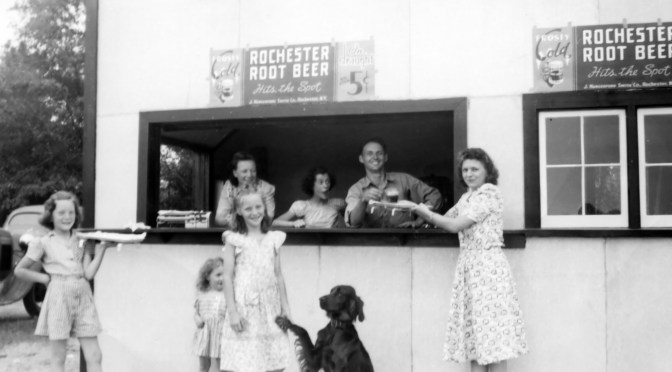
Marvin and Mabel Treutel operated a roadside root beer stand near their home on Wilhorn Road in Nekoosa, Wisconsin. Aside from 5-cent Rochester root beers, they served the “Best Roast Beef BBQ.” Pictured behind the counter in this late-1940s photo are Mabel Treutel (left), niece Lavonne Hanneman (center) and Marvin Treutel (right). Out front are daughters Bonnie Treutel (left), and Patricia Treutel (center, holding dog). The woman at right and the little girl at center are unidentified.
Nearly 90 years ago on a summer Tuesday morning, Ruby Viola Treutel and Carl Henry Frank Hanneman joined in marriage at St. James Catholic Church in Vesper, Wisconsin. The marriage, which would live on for more than 50 years and produce three children and 16 grandchildren, was described in detail in a story in the July 15, 1925 edition of the Wisconsin Rapids Daily Tribune:
TREUTEL-HANNEMAN One of the prettiest weddings of the summer was solemnized yesterday morning at nine o’clock at St. James church, Vesper, when Miss Ruby Treutel, daughter of Walter Treutel of Vesper, became the bride of Carl F. Hanneman, son of Mr. and Mrs. Charles Hanneman of this city. Rev. Father Gille officiated at the nuptial Mass.
The wedding party of groom Carl Henry Frank Hanneman, 23, and Ruby Viola Treutel, 21. Wedding was July 14, 1925 at St. James Catholic Church, Vesper, Wis. At front left is flower girl Nina Treutel, 11, sister of the bride. At front right is ring-bearer Elaine Treutel, 5, sister of the bride. Across the back, left to right, are Joe Ladick (bride’s cousin), Gladys Cole (bride’s cousin), groom Carl Hanneman, bride Ruby V. Hanneman, best man Wendell Miscoll, and maid of honor Esther Allbrecht.
The church was beautifully decorated with greens and the season’s flowers, making an appropriate setting for the wedding party. Miss Velma Doering of Stratford played the wedding march as the party entered the church and proceeded to the altar. Miss Gladys Cole of Nekoosa, and the groom’s attendant, Joseph Ladick, of Vesper, both cousins of the bride, were followed by two little sisters of the bride, Nina and Elaine, who acted as flower girl and ring bearer. The maid of honor, Miss Esther Albright, came next and was followed by the bride and her father, who gave her away.
Mr. Hanneman and his best man, Wendell Miscoll,awaited the party at the altar. The bride was very beautiful in her gown of white georgette trimmed with gold lace. She wore a coronet of pearls, with her veil falling from a beaded butterfly. She carried a shower bouquet of pink rose buds.
Rev. Charles W. Gille of St. James Catholic Church officiated at the wedding.
Miss Albright, the maid of honor, was gowned in orchid georgette and carried an arm bouquet of rose. Miss Cole, the bridesmaid, wore a gown of orange georgette, and also carried roses. Nina, the little flower girl, was in a little frock of yellow georgette, and Elaine completed the delightful color ensemble in a dress of pink georgette. She carried the ring in a white lily.
Following the service at the church, the bridal party and relatives came to this city, where the ten-thirty breakfast was served at the Witter Hotel. The bride is a graduate of Lincoln High School and the Stevens Point Normal. Since her graduation from the normal school she has been teaching at Vesper. The groom was graduated from Lincoln High and for some time following was employed at the Church Drug store. He later graduated from the pharmacy department of Marquette University at Milwaukee and is at present holding a position with Whitrock and Wolt.
Following a week’s outing in the northern part of the state, part of the time being spent as guests of Mr. and Mrs. Armand Bauer at their cottage at Hayward, they will return here and for the present make their home with Mr. Treutel at Vesper.
The bridal photo, hand retouched to restore color to the roses.
The bridal portrait of Ruby V. Hanneman in its original frame.
For their honeymoon in July 1925, Carl F. Hanneman (1901-1982) and Ruby Viola (nee: Treutel) Hanneman (1904-1977) took a camping trip to Wisconsin’s north woods. The couple are pictured at a camp site near Hayward, Wis. They were married July 14, 1925 at Vesper, Wis.
He could be carrying milk from the barn, but Carl F. Hanneman (1901-1982) is actually on a honeymoon camping trip in this July 1925 photo. Carl and bride Ruby (nee: Treutel, 1904-1977) took a camping trip near Hayward, Wis., after their wedding on July 14, 1925.
An unidentified boy sits outside of a cottage near Hayward, Wis., with Ruby V. (Treutel) Hanneman (1904-1977) in July 1925. Ruby and new husband Carl F. Hanneman (1901-1982) were on their honeymoon.
Carl F. Hanneman (at right) leans on his Ford near the camp where he and bride Ruby spent their honeymoon.
Carl F. Hanneman and an unidentified boy at the Hanneman picnic table.
The Hanneman honeymoon had a rustic theme at a cottage near Hayward, Wis.
Carl F. and Ruby V. Hanneman took these selfies on their honeymoon in July 1925.
Carl F. and Ruby V. Hanneman on their 25th wedding anniversary in July 1950.
Back of the photo: Carl F. and Ruby V. Hanneman on their 25th wedding anniversary in July 1950.
Carl F. and Ruby V. Hanneman on their 50th wedding anniversary, celebrated at Sun Prairie in July 1975.
It is the only known photograph showing six of the seven children of Christian and Amanda Hanneman, pioneers of Portage and Wood counties in Wisconsin. The undated photo was probably taken around 1915 at a family event. Left to right are:
William Friedrich Johann Hanneman (1856-1939)
Bertha Auguste Ernestine (Hanneman) Bartelt (1860-1945)
Albert Friedrich O. Hanneman (1863-1932)
Herman Charles Hanneman (1864-1945)
Carl Friedrich Christian Hanneman (“Chas,” 1866-1932)
The sibling not pictured is August Friedrich Ferdinand Hanneman (1858-1902).
Along with their parents, this group came to America in late November 1882 aboard the SS Katie. They were the last of the Matthias Hannemann family to come to America from the Baltic Duchy of Pomerania (now part of Poland and Germany). The Hannemann clan (the name was eventually shortened to Hanneman) settled in and around the hamlet of Kellner in central Wisconsin.
Family Line: Matthias Hannemann >> Carl Frederick Christian Hannemann >> Carl Henry Frank Hanneman >> David D., Donn and Lavonne Hanneman.








 The Hanneman Archive