Leaving the family homeland to make a trans-Atlantic trip and emigrate to America would be an intimidating prospect under the best circumstances. When Michael Friedrich Ferdinand Hannemann brought his pregnant wife Mina and infant son Albert aboard the ship John Bertram in Hamburg, Germany in April 1863, he likely had no idea the horror they would face during 46 days at sea.
Fred Hannemann, as he was known to family and friends, was not the first in the family to leave Pomerania for Wisconsin. At least two sisters were already in central Wisconsin, so Fred may have heard stories from them about their travels to the American Midwest. But that likely would not have prepared him for the life-threatening conditions the 336 passengers faced en route to New York. One of the middle children of Matthias and Maria Caroline Hannemann of Meesow, Kreis Regenwalde, Pomerania, Fred was among at least eight children in the clan who would come to America between 1861 and 1882.
The John Bertram was a 1,060-ton clipper ship built in just 90 days in Boston in 1850 and placed into service in January 1851. At 180 feet long, the ship was initially employed to shuttle cargo from Boston around Cape Horn to San Francisco. It was later sold and pressed into service moving emigrants and cargo from Europe to America. Between 1860 and 1869, nearly 2,100 people were carried from Europe and elsewhere to America aboard the John Bertram.
About 10 days into the journey, the John Bertram encountered a violent gale that ripped at the sails and caused the ship to pitch up and down in the massive ocean swells. The winds raged at the ship for 48 hours, tossing drinking water casks overboard and destroying the storm sails. Conditions below deck were likely horrific, with the violent rocking causing seasickness and injuries. On deck, conditions were worse. Four crewmen were lost overboard and eight others were disabled. Once the storm passed, the ship was leaking badly, making it difficult to keep under sail. Mina Hanneman no doubt had to struggle to care for young Albert Hannemann, 1, in the chaos. The former Johanna Wilhelmine Florentine Glebke was nearly seven months pregnant during the voyage.
On May 4, still three weeks from docking in New York, the John Bertram hit dense fog and became trapped in a massive ice floe. For four days, the ship was surrounded by ice that scraped the planks of the hull and ripped at the cutwater. Four other ships in the area became snared in the ice. Eventually the clipper broke free, but had to steer 3 degrees to the east in order to escape the ice fields.
The trip took its toll. Eight infants died during the trip, although two babies were born. Along with the crewmen who were washed overboard, 12 people lost their lives. Thankfully, Fred, Mina and Albert Hannemann made it safely to Castle Garden in New York. Once they reached the Town of Grand Rapids in Wood County, Wis., they settled into farming. Eventually, seven children were born into the home, as yet another branch of the Hannemann family tree took root in central Wisconsin.
During his nearly six decades as a pharmacist, Carl F. Hanneman got to know a lot of people. He forged good relationships with the many sales reps who called on him at the Mauston Drug Store. Some came to dinner at the Hanneman home, and a few even stayed at the house while in town. One of the long-lasting perks he received from Parke, Davis and Company was a stunning set of lithographs depicting the history of pharmacy. More than 30 prints still exist from Carl’s 1950s collection.
Parke-Davis commissioned artist Robert Thom to produce 40 illustrations for the series, “A History of Pharmacy in Pictures.” Each print came with a history article that explained the depicted scene and its place in history. Launched in 1957, the series was developed in cooperation with the Institute for the History of Pharmacy at the University of Wisconsin. Druggists were encouraged to display the artwork in their stores.
The series depicted such early topics as scientist Galen in the second century to later developments such as chemotherapy, antibiotics and pharmaceutical research. Parke Davis also commissioned Thom to paint a series of illustrations on the history of medicine. Thom (1915-1979) was well known as an illustrator of historical subjects, including great moments in baseball and the history of Illinois and Michigan.
The paintings from Carl Hanneman’s collection are in the gallery below, including the explanatory text from each image.
— This post has been updated with additional Thom paintings.
Man learned early of the prestigious advantage of trademarks as a means of identification of source and of gaining customers’ confidence. One of the first therapeutic agents to bear such a mark was Terra Sigillata (Sealed Earth), a clay tablet originating on the Mediterranean island of Lemnos before 500 B.C. One day each year clay was dug from a pit on a Lemnian hillside in the presence of governmental and religious dignitaries. Washed, refined, rolled to a mass of proper thickness, the clay was formed into pastilles and impressed with an official seal by priestesses, then sun-dried. The tablets were then widely distributed commercially.
In the evolution of all successful and enduring systems of knowledge there comes a time when the observations of many men, or the intensive studies of one, transcend from the level of trade or vocation to that of a science. Pedanios Dioscorides (first century A.D.), contributed mightily to such a transition in Pharmacy. In order to study materia medica, Dioscorides accompanied the Roman armies throughout the known world. He recorded what he observed, promulgated excellent rules for collection of drugs, their storage and use. His texts were considered basic science as late as the sixteenth century.
Of the men of ancient times whose names are known and revered among both the professions of Pharmacy and Medicine, Galen, undoubtedly, is the foremost. Galen (130-200 A.D.) practiced and taught both Pharmacy and Medicine in Rome; his principles of preparing and compounding medicines ruled in the Western world for 1,500 years; and his name still is associated with that class of pharmaceuticals compounded by mechanical means – galenicals. He was the originator of the formula for a cold cream, essentially similar to that known today. Many procedures Galen originated have their counterparts in today’s modern compounding laboratories.
Twinship of the health professions, Pharmacy and Medicine, is nowhere more strikingly portrayed than by Damian, the apothecary, and Cosmas, the physician. Twin brothers of Arabian descent, and devout Christians, they offered the solace of religion as well as the benefit of their knowledge to the sick who visited them. Their twin careers were cut short in the year 303 by martyrdom. For centuries their tomb in the Syrian city of Cyprus was a shrine. Churches were built in their honor in Rome and other cities. After canonization, they became the patron saints of Pharmacy and Medicine, and many miracles were attributed to them.
During the Middle Ages remnants of the Western knowledge of Pharmacy and Medicine were preserved in the monasteries (fifth to twelfth centuries). These scientists are known to have been taught in the cloisters as early as the seventh century. Manuscripts from many islands were translated or copied for monastery libraries. The monks gathered herbs and simples in the field, or raised them in their own herb gardens. These they prepared according to the art of the apothecary for the benefit of the sick and injured. Gardens such as these still may be found in monasteries in many countries.
The Arabs separated the arts of apothecary and physician, establishing in Bagdad late in the eighth century the first privately owned drug stores. They preserved much of the Greco-Roman wisdom, added to it, developing with the aid of their natural resources syrups, confections, conserves, distilled waters and alcoholic liquids. The apothecary is examining logs of sandalwood offered by a traveling merchant, while children indulge their taste for sweets with stalks of sugar cane. When the Moslems swept across Africa, Spain and southern France, they carried with them a new pattern of Pharmacy which western Europe soon assimilated.
Among the brilliant contributors to the sciences of Pharmacy and Medicine during the Arabian era was one genius who seems to stand for his time – the Persian, Ibn Sina (about 980-1037 A.D.), called Avicenna by the Western world. Pharmacist, poet, physician, philosopher and diplomat, Avicenna was an intellectual giant, a favorite of Persian princes and rulers. He wrote in Arabic, often while secluded in the home of an apothecary friend. His pharmaceutical teachings were accepted as authority in the West until the 17th century; and still are dominant influences in the Orient.
In European countries exposed to Arabian influence, public pharmacies began to appear in the 17th century. However, it was not until about 1240 A.D. that, in Sicily and southern Italy, Pharmacy was separated from Medicine. Frederick II of Hohenstaufen, who was Emperor of Germany as well as King of Sicily, was a living link between Oriental and Occidental worlds. At his palace in Palermo, he presented subject Pharmacists with the first European edict completely separating their responsibilities from those of Medicine, and prescribing regulations for their professional practice.
The idea of a pharmacopoeia with official status, to be followed by all apothecaries, originated in Florence. The Nuovo Receptario, originally written in Italian, was published and became the legal standard for the city-state in 1498. It was the result of collaboration of the Guild of Apothecaries and the Medical Society – one of the earliest manifestations of constructive interprofessional relations. The professional groups received official advice and guidance from the powerful Dominican monk, Savonarola, (seated, foreground) who, at the time, was the political leader in Florence.
Trade in drugs and spices was lucrative in the Middle Ages. In the British Isles, it was monopolized by the Guild of Grocers, which had jurisdiction over the apothecaries. After years of effort, the apothecaries found allies among court physicians. King James I, flanked by two “Beefeaters” wore heavily padded attire because of fear of stabbing. Upon persuasion by the philosopher-politician, Francis Bacon, the King granted a charter in 1617 which formed a separate company known as the “Master, Wardens and Society of the Art and Mystery of the Apothecaries of the City of London” over vigorous protests of the grocers. This was the first organization of pharmacists in the Anglo-Saxon world.
Young Parisian Apothecary Louis Hébert answered the call of the New World in 1605, when he helped de Monts and Champlain build New France’s first settlement, the Habitation, at Port Royal (Nova Scotia, Canada). Hébert looked after the health of the pioneers, cultivated native drug plants, and supervised the gardens. At the waterfront, he examined specimens of drug plants offered by Micmac Indians. These included Arum, (Jack-in-the-Pulpit), Eupatorium (Boneset), Verbascum (Mullein), and Hydrastis (Golden Seal). When the Habitation was destroyed by the English in 1613, he returned to his Parisian apothecary shop. The lure of Canada was strong, however, and in 1617, he and the family returned with Champlain to Quebec, where Hébert’s “green thumb” gained him lasting fame as the first successful farmer in what is now Canada.
Many Europeans “of quality and wealth, particularly those who were non-conformists in religion” were attracted to the possibilities of the American Colonies. From Britain came John Winthrop, first Governor of Massachusetts Bay Colony and founder of Boston. Governor Winthrop, unable to induce professionals to the Colony, sought advice from English apothecaries and physicians, and added to his small store of imported drugs those derived from plants native to New England. In his home (about 1640), he made available as best he could the “art and mystery” of the apothecary for his citizens.
Christopher Marshall, an Irish immigrant, established his apothecary shop in Philadelphia in 1729. During 96 years, this pioneer pharmaceutical enterprise became a leading retail store, nucleus of large-scale chemical manufacturing; a “practical” training school for pharmacists; an important supply depot during the Revolution; and finally, it was managed by granddaughter Elizabeth, America’s first woman pharmacist. Christopher earned the title of “The fighting Quaker” during the Revolution; his sons, Charles and Christopher, Jr., (shown as youths with their father, about 1754) earned individual fame and carried on his fine traditions.
Colonial America’s first hospital (Pennsylvania) was established in Philadelphia in 1751; the first Hospital Pharmacy began operations there in 1752, temporarily set up in the Kinsey house, which served until the first hospital building was completed. The ingenuity of Benjamin Franklin was helpful in both. First Hospital Pharmacist was Jonathan Roberts; but it was his successor, John Morgan, whose practice as a hospital pharmacist (1755-56), and whose impact upon Pharmacy and Medicine influenced changes that were to become of importance to the development of professional pharmacy in North America. First as pharmacist, later as physician, he advocated prescription writing and championed independent practice of two professions.
During his few short years, Carl Wilhelm Scheele gave to the world discoveries that have brought its people incalculable advantages. Yet he never forgot that he was, first of all, a pharmacist. Encouraged by enlightened preceptors, all of his discoveries were made in the Swedish pharmacists in which he worked, as apprentice, as clerk, and finally as owner, in Köping. He began in a corner of the stock room of Unicorn Apothecary in Gothenburg. With rare genius, he made thousands of experiments, discovered oxygen, chlorine, prussic acid, tartaric acid, tungsten, molybdenum, glycerin, nitroglycerin, and countless other organic compounds that enter into today’s daily life, industry, health, and comfort.
The first man to hold the rank of a commissioned pharmaceutical officer in an American army was the Bostonian apothecary, Andrew Craigie. His duties included procurement, storage, manufacture and distribution of the Army’s drug requirements. He also developed an early wholesaling and manufacturing business.
Swedish pharmacist Scheele paved the way for isolating organic plant acids; but it remained for a young German apothecary, Friedrich Wilhelm Adam Sertürner, to give the world opium’s chief narcotic principle, morphine; and to recognize and prove the importance of a new class of organic substances: alkaloids. His first announcements challenged, Sertürner in 1816 conducted a new series of bold, startling experiments in his apothecary shop in Einbeck, including a series of physiologic tests on himself and three young friends. Recognition and fame followed. Relocating in an apothecary shop in Hameln, Sertürner continued organic chemical experimentation and discovery throughout his life.
Taking their cue from Sertürner’s alkaloidal experiments, two French pharmacists, Messrs. Pierre-Joseph Pelletier and Joseph-Bienaimé Caventou, isolated emetine from ipecacuanha in 1817; strychnine and brucine from nux vomica in 1818; then, in their laboratory in the back of a Parisian apothecary shop, they tackled the problem that had baffled scientists for decades – wresting the secrets of the Peruvian barks that were so useful against malaria. In 1820 Caventou and Pelletier announced the methods for separation of quinine and cinchonine from the cinchona barks; prepared pure salts, had them tested clinically, and set up manufacturing facilities. Many other discoveries came from their pharmacy-laboratory; high honors were accorded them.
Faced with two major threats; deterioration of the practice of pharmacy, and a discriminatory classification by the University of Pennsylvania medical faculty, the pharmacists of Philadelphia held a tempestuous protest meeting in Carpenters’ Hall, February 23, 1821. At a second meeting, March 13, the pharmacists voted formation of: an association, which became The Philadelphia College of Pharmacy; a school of pharmacy; and a self-policing board. Sixty- eight pharmacists signed the Constitution of the first pharmaceutical association in the United States; American Pharmacy’s first educational institution, bearing the same name, opened November 9.
First U.S. industry in medicinal herbs was carried on by the United Society of Believers in Christ’s Second Appearing, commonly known as the Shakers. Begun about 1820, and commercially important by 1830, the medicinal herb industry grew, hit its peak in the 1860’s, then waned at the close of the century. The Shakers gathered or cultivated some 200 varieties; dried, chopped, and pressed them into “bricks”; wrapped, labeled, and sold them to pharmacists and physicians world-wide. Tons of solid and fluid extracts also were produced. The Shaker label was recognized for reliability and quality for more than a century.
Need for better intercommunication among pharmacists; standards for education and apprenticeship; and quality control of imported drugs, led to calling of a convention of representative pharmacists in the Hall of the Philadelphia College of Pharmacy, October 6 to 8, 1852. Under leadership of its first President, Daniel B. Smith, and first Secretary, William Procter, Jr., the twenty delegates launched The American Pharmaceutical Association; mapped its objectives; and opened membership to “All pharmaceutists and druggists” of good character who subscribed to its Constitution and to its Code of Ethics. The Association continues to serve Pharmacy today.
Over the years, no real discord has existed between representatives of European and American Pharmacy so far as ethical and scientific aims are concerned. But when the groups met for the first time, at the Second International Congress of Pharmacy in Paris, France, August 21 to 24, 1867, there was a great divergence of opinion on the subject of compulsory limitation of pharmacies. William Procter, Jr., leading the delegates of The American Pharmaceutical Association, told the international body that “Public opinion is in America a forceful agent of reform,” and that, in his country, “there is not the slightest obstacle toward a multiplication of drug stores save that a lack of success.” His declaration vividly documented the American Way of Pharmacy.
Rarely has a titular distinction been so deserved. William Procter, Jr., graduated from The Philadelphia College of Pharmacy in 1837; operated a retail pharmacy; served the College as Professor of Pharmacy for 20 years; was a leader in founding The American Pharmaceutical Association; served that organization as its first secretary; later, as its president; served 30 years on the U.S.P. Revision Committee; was for 22 years Editor of the American Journal of Pharmacy. In 1869, though retired, Procter continued to edit the Journal in a small publication office located beside the College’s Tenth Street building. From retirement he returned to P.C.P.’s chair of Pharmacy in1872; literally died “in the harness,” in 1874.
When Dr. Albert B. Prescott launched the pharmacy course at the University of Michigan in 1868, critical attention was aroused because he abandoned the traditional requirement of pregraduation apprenticeship. At the 1871 convention of the American Pharmaceutical Association, he was denied credentials and ostracized. However, the Michigan course pioneered other major changes: laboratory pharmacy, a definite curriculum that included basic sciences, and a program that demanded students’ full-time attention. During the next thirty years, Dr. Prescott had the satisfaction of seeing his once revolutionary innovations generally adopted by pharmaceutical faculties.
The first “United States Pharmacopoeia” (1820) was the work of the medical profession. It was the first book of drug standards from a professional source to have achieved a nation’s acceptance. In 1877, the “U.S.P.” was in danger of dissolution due to the lack of interest of the medical profession. Dr. Edward R. Squibb, manufacturing pharmacist as well as physician, took the problem to The American Pharmaceutical Association convention. Pharmacists formed a “Committee on Revision” chairmanned by hospital pharmacist Charles Rice, assisted by pharmacist-educator Joseph P. Remington, and by Dr. Squibb, their indefatigable collaborator. The “U.S. Pharmacopoeia” surged to new importance.
Despite the professional skill and integrity of 19th-century pharmacists, seldom did two preparations of vegetable drugs have the same strength, even though prepared by identical processes. Plant drugs varied widely in active alkaloidal and glucosidal content. The first answer to this problem came when Parke, Davis & Company introduced standardized “Liquor Ergotae Purificatus” in 1879. Dr. Albert Brown Lyons, as the firm’s Chief Chemist, further developed methods of alkaloidal assay. Messrs. Parke and Davis recognized the value of his work, and in 1883, announced a list of twenty standardized “normal liquids.” Parke-Davis also pioneered in developing pharmacologic and physiologic standards for pharmaceuticals.
Scientific explorers opened vast new horizons for Pharmacy late in the 19th century. Sent in 1885 to Peru, Dr. Henry H. Rusby crossed South America amid incredible hardships. He returned with 45,000 botanical specimens, including Cocillana Bark.
The French retail pharmacist, Stanislas Limousin, introduced many devices to Pharmacy and Medicine. His greatest contributions were invention of glass ampoules, the medicine dropper, and apparatus for inhalation of oxygen.
Biological products (made from micro-organisms) got their discovery of diphtheria antitoxin by the German, Behring, in 1894. Pharmaceutical manufacturers since have constantly improved serums, antitoxins and vaccines, which have saved countless lives.
One of the successful researchers in the development of new chemical compounds specifically created to fight disease-causing organisms in the body was the French pharmacist, Ernest Francois Auguste Fourneau (1872-1949), who for 30 years headed chemical laboratories in the world-renowned Institut Pasteur, in Paris. His early work with bismuth and arsenic compounds advanced the treatment of syphilis. He broke the German secret of a specific for sleeping sickness; paved the way for the life-saving sulfonamide compounds; and from his laboratories came the first group of chemicals having recognized antihistaminic properties. His work led other investigators to broad fields of chemotherapeutic research.
Research in some form has gone hand in hand with the development of Pharmacy through the ages. However, it was the chemical synthesis of antipyrine in 1883 that gave impetus and inspiration for intensive search for therapeutically useful compounds. Begun by the Germans, who dominate the field until World War I, the lead in pharmaceutical research passed thereafter to the United States. Research in Pharmacy came into its own in the late 1930’s and early 1940’s; has grown steadily since, supported by pharmaceutical manufactures, universities, and government. Today it used techniques and trained personnel from every branch of science in the unending search for new life-saving and life-giving drug products.
Pharmaceutical manufacturing as an industry apart from retail Pharmacy had its beginnings about 1600; really got under way in the middle 1700’s. It developed first in Germany, then in England and in France. In America, it was the child of wars – born in the Revolution; grew rapidly during and following the Civil War; became independent of Europe during World War I; came of age during and following World War II. Utilizing latest technical advances from every branch of science, manufacturing Pharmacy economically develops and produces the latest and greatest in drugs in immense quantities, so that everywhere physicians may prescribe them and pharmacists dispense them for the benefit of all mankind.
Antibiotics are not new. Their actions probably were first observed by Pasteur in 1877. However, the second quarter of the 20th century marked the flowering of the antibiotic era – a new and dramatic departure in the production of disease-fighting drugs. Fleming’s discovery of penicillin in 1929 went undeveloped and Florey and Chain studied it in 1940. Under pressure of World War II, the pharmaceutical manufacturers rapidly adapted mass production methods to penicillin; have reduced costs to 1/1000th the original. Antibiotic discoveries came rapidly in the ’40’s. Intensive research continues to find antibiotics that will conquer more of men’s microbial enemies.
Pharmacy, with its heritage of 50 centuries of service to mankind, has come to be recognized as of the great professions. Like Medicine, it has come through many revolutions, has learned many things, has had to discard many of its older ways. Pharmacists are among the community’s finest educated people. When today’s retail pharmacist fills a prescription written by a physician, he provides a professional service incorporating the benefits of the work of pharmacists in all branches of the profession – education, research, development, standards, production, and distribution. Pharmacy’s professional stature will continue to grow in the future as this great heritage and tradition of service is passed on from preceptor to apprentice, from teacher to student, from father to son.
It seems the entire village of Vesper, Wisconsin came out for a banquet or other big event, and stayed for a photograph. The image appears to date to about 1913 or 1914. The large crowd spilled out of the village hall for a photograph. What was the occasion? A wedding? A dance? It is fun to imagine. The portrait was taken by Moore Photo of nearby Grand Rapids (now called Wisconsin Rapids).
What makes this image especially interesting is to zoom in and look at the details. See the little girl with the Dixie Queen plug cut tobacco lunch box? It’s strange to imagine a lunch tin with smoking tobacco advertised on the side, but this was before the age of comic books or movie stars. Lunch pails with tobacco ads were common.
In the front at left/center left is my grandmother, Ruby V. (Treutel) Hanneman, who appears to be about 10 years old. That would date the photo to 1914. In the sea of men back near the stairs appears to be Ruby’s father, Walter Treutel. He is sporting a mustache, which is something I’ve not seen in any family photos.
On the building next to the window is a large thermometer with the name “Hlasatel” on it. That was the name of a Bohemian/Czech newspaper. Vesper had a large population from Bohemia, including the family of my great-grandmother, Mary (Ladick) Treutel. Her parents emigrated from Bilina in what is now the Czech Republic.
Most of the men wore hats, so it is not easy to make identifications.
One little girl has a Dixie Queen tobacco lunch pail.
Judging by the dress, this must have been an important event.
Young Ruby V. Treutel is in the front row right, leaning on her right hand and tilting her head to her left.
Much of the village of Vesper came out for the photo.
He came to the United States at age 19 and lived the life of an American frontiersman: shuttling cargo between U.S. outposts in the West and ferrying people and goods across the Missouri River. For all of his adventurous living, William Johann Heinrich Gaulke retained one lasting memory that his family in Wisconsin still talks about: being a friend of a very young William Frederick ‘Buffalo Bill’ Cody.
William Gaulke (standing) with his arm around William F. Cody, who later went on to international fame as “Buffalo Bill.” (Photo courtesy of Sue Alft)
Gaulke met the famed U.S. Army scout and buffalo hunter while Gaulke was working and exploring the frontier lands in Nebraska and the Dakotas in the 1870s. A photograph in the Gaulke family album shows a twenty-something Gaulke standing with his arm around a seated William Cody.
Gaulke’s frontier experience grew out of tragedy he experienced in his native Germany. Born on October 1, 1848, Gaulke lost his father, John, before he turned six months old. When he was 11, Gaulke became an orphan at the death of his mother Fredericka. He emigrated to America in 1867 and landed in Milwaukee. After a short stint as a farmhand, Gaulke landed a job aboard a Great Lakes steamer, where he learned to speak English. After another stint working on farms in Illinois, Gaulke went west.
After emigrating to America in 1867, William Gaulke spent a number of years exploring the wild frontiers. (Photo courtesy of Sue Alft)
Gaulke experienced the wilds of the frontier lands as a teamster for the U.S. government. He guided a six-mule team hauling goods between U.S. Army posts. He was based at Fort Buford in the Dakota Territory. After tiring of that job, he built a skiff and drifted down the Missouri River to what is now Bismarck, North Dakota. Along with a group of companions, he established the town of Carlington. There, Gaulke operated a ferry moving people, goods and horses across the Missouri River near Fort McKeen (later called Fort Abraham Lincoln). Fort Lincoln was the base of Gen. George Armstrong Custer.
Right alongside the Mighty Missouri River, Gaulke built himself a shanty, where he lived and operated his ferry business. He built an outdoor fireplace that was used for cooking and warmth. It was also a hiding place for the $2,200 Gaulke had saved from his business ventures. Gaulke’s shanty was a frequent target of would-be thieves, but none of them ever thought to look under the fireplace for the buried money.
In 1872, Gaulke returned to Wisconsin, securing work at Grand Rapids in Wood County. In July 1876, he married Augusta Henriette Charlotte Kruger. Her mother, Friedericke Kruger, was the daughter of Matthias Hannemann (1794-1879). A short time later, the Gaulkes bought their first land in the Town of Grant in Portage County, very near where the Hannemann family established its first homes in the early 1860s. Gaulke cleared the land and established a successful farm. He also helped build many of the farm houses and barns in the area.
William Gaulke and Augusta (Kruger) Gaulke and family. Rear, left to right: Ella (Wagner), William Jr., John, Henry, Minnie (Panter). Front, left to right: Mary (Eberhardt), William Gaulke Sr., Augusta (Kruger) Gaulke, Laura (Turbin). (Photo courtesy of Sue Alft)
Gaulke also became deeply involved in civic work, serving as school district clerk, drainage district commisioner and chairman of the Town of Grant. He and Augusta had eight children, born between 1878 and 1897. Augusta died in 1914, four years before her mother. William died on October 25, 1928 after coming down with pneumonia.
William F. “Buffalo Bill” Cody in a late-life portrait (Library of Congress Photo)
Confirmation of the friendship between Gaulke and Buffalo Bill came in the early 1900s, when Cody brought his Wild West show to Grand Rapids, Wisconsin. Gaulke brought his youngest son, John, to the grounds near Lincoln High School. They watched the white-suited Cody ride about the arena on his white horse. Gaulke led his boy up to Cody, introduced himself and asked the showman if he remembered him from their time out west decades earlier. He did. “Why sure, Bill and they had quite a talk,” John Gaulke later wrote. “Finally Buffalo Bill reached into his pocket and gave my Dad a handful of tickets, who the whole family saw the show for nothing.”
A popular poster showing Buffalo Bill Cody superimposed on an image of a buffalo. (Library of Congress Photo)
William Cody was a first-rate Indian scout and buffalo hunter whose life was romanticized in dime novels written by author Ned Buntline. The pair collaborated to create a show called “The Scouts of the Plains.” In 1883, Cody developed a live show spectacular called Buffalo Bill’s Wild West. The Library of Congress says Cody “was a major contributor in the creation of the myth of the American West, as seen in Hollywood movies and television.”
The Knights of Columbus has long championed the “Keep Christ in Christmas” message to remind the public that the “holiday season” is really about the birth of the Savior. Each year, the more than 14,000 local K of C councils promote the message with car magnets, yard signs, television ads and radio spots.
The Nativity mosaic was used on a billboard along Interstate 94 in 2009.
Back in 2010, I wanted to create a 30-second broadcast commercial with this message, but we had no production budget. I found a beautiful mosaic image from the Knights of Columbus Incarnation Dome at the Basilica of the National Shrine of the Immaculate Conception in Washington, D.C. The year before, I used that image to create a billboard we placed alongside Interstate 94 in Racine County, Wisconsin.
Many Knights of Columbus councils distribute “Keep Christ in Christmas” lawn signs.
For the TV spot, we planned to use that still image with a pan-and-zoom “Ken Burns effect,” but I still needed voice talent and music. I looked no further than my then 11-year-old daughter, Ruby. She only needed a couple of takes to nail the script voiceover. My other daughter, Samantha, 14, took to her keyboard and recorded a section of “Greensleeves.” That is the tune used for the hymn What Child Is This? Once I put it all together, we had a very nice broadcast commercial, quite beautiful in its simplicity. The finished spot ran hundreds of times on a wide variety of cable television networks throughout the Archdiocese of Milwaukee. You can watch the video in the player below.
In the winter of 1966 or 1967, a young father designed and hand-crafted an outdoor nativity scene to decorate the family home in Sun Prairie, Wisconsin. David D. Hanneman (1933-2007) painted the set freehand and put it on display just under the garage window of his home on Wisconsin Avenue. The nativity scene was a fixture at the home in those early years, but eventually was put in storage and forgotten.
The original Nativity scene as built by David D. Hanneman, circa 1967.
Forty years later, after David Hanneman died, the badly weathered Nativity figures were rescued from a trash can in the garage. Over the next 18 months they were restored to almost original condition and put on display in the Village of Mount Pleasant.
The original backers and braces were removed from the cutout figures of St. Joseph, Mary and Baby Jesus. New 1-inch-thick plywood backers were crafted with a jigsaw, then glued to the figures and anchored with wood screws. Heavy L-shape stabilizing braces were screwed into the backers to give the figures sufficient weight to withstand winter winds.
Samantha J. Hanneman retouches details on the Baby Jesus figure built by her grandfather, David. D. Hanneman.
Samantha J. Hanneman, David Hanneman’s granddaughter, did most of the paint restoration work. With a special set of art brushes, she applied metallic gold and flat black paint to maintain the original look. Touch up paint was applied sparingly to the faces and hands of the figures to keep the hand-drawn details.
The newly restored Nativity scene was put on display at the Hanneman home in Racine County in December 2008, making the old tradition new again for another generation. The crèche was displayed for several years, but had to again be put in storage when we lost our home. Now the figures again wait patiently to have a new home where their warm glow will fill the Christmas night.
St. Francis of Assisi is credited with creating the first Nativity crib or crèche on Christmas Eve 1223 in Greccio, Italy. St. Francis was eager to make the birth of Christ something tangible for the faithful. He had a manger built, brought animals to be part of the set, and had Holy Mass said before this representation of the birth of Christ. After the preparations were finished, St. Francis and some of his followers went to the crèche for the Mass. After a short prayer by Francis, a vision of the Christ child appeared on the hay.The miracle stirred the animals and greatly moved the faithful who witnessed it.
His death was given only passing notice in the Wisconsin State Journal, the state’s official newspaper. “May he rest in peace,” the brief item from April 9, 1864 read. So it was the unwritten that was truly remarkable in the all-too-brief life of James Moore, soldier of the Wisconsin 12th Infantry Regiment in the Civil War.
The son of Irish immigrants who settled to farming in the Town of Sun Prairie, Moore was just 14 when he enlisted in Company I of the 12th Infantry Regiment in late September 1862. Moore and Lemuel C. Neal of Sun Prairie enlisted together at Camp Randall on September 29, 1862. Moore was a boy who went to fight in a man’s war — a theme that would be repeated, most especially in the “war to end all wars,” World War I. His youth, just five months past his 14th birthday, seems quite remarkable for an infantry private. The sacrifice of his very young life in the fight to save the republic should always be remembered.
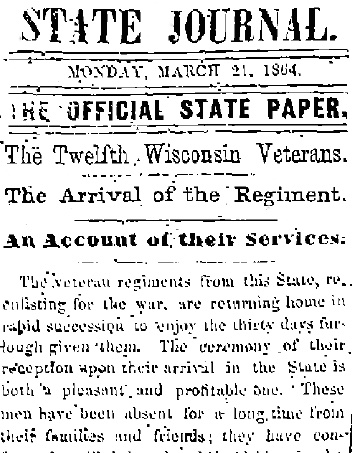
The Wisconsin State Journal covered the return of the 12th Infantry Regiment on March 21, 1864.
Moore saw combat and the horrors of America’s bloodiest war, although the 12th Infantry Regiment did not take part in the most famous battles of the Civil War. These men rebuilt and guarded key railroad lines, supported the battle of Vicksburg and took part in General Sherman’s Meridian Expedition in February 1864. That month they marched 416 miles, aiding in the capture and destruction of Jackson, Brandon and Decatur as they proceeded to Meridian. “A shell exploded in the ranks of Company I, killing Eugene Baldwin and W.H. Murray, wounding O. Lind, J.W. Dean, John Thorp and George Everett,” read the account in the 1866 Military History of Wisconsin.
The battle flag of the Wisconsin 12th Infantry Regiment is held by the Wisconsin Veterans Museum in Madison.
Shortly after the Meridian campaign, Moore was among some 700 men in the regiment sent home to Wisconsin on a 30-day furlough. After rolling into Madison via rail at 5 a.m. on March 21, the men ate a hearty supper at the Railroad Restaurant and then marched to their quarters at Camp Randall. The next day they were welcomed by Wisconsin’s newly minted governor, James Taylor Lewis. The Wisconsin State Journal published a chronicle of their service, noting the regiment had marched more than 2,000 miles to earn itself the nickname “the Marching 12th.”
The newspaper asked the community to be patient with these and other young soldiers, home from the stress of war with full bellies and money in their pockets. “Brave boys, they are going back, and the voice that now makes the night hideous with bawdy songs will utter its last accent in a victorious cheer upon some future battlefield,” the paper wrote. “Yes, they are going back, and he who is now a ‘drunken soldier’ will bear the dear old flag in triumph, amid the whistling bullets and screaming shell, to plant it on the battlements of the enemy.”
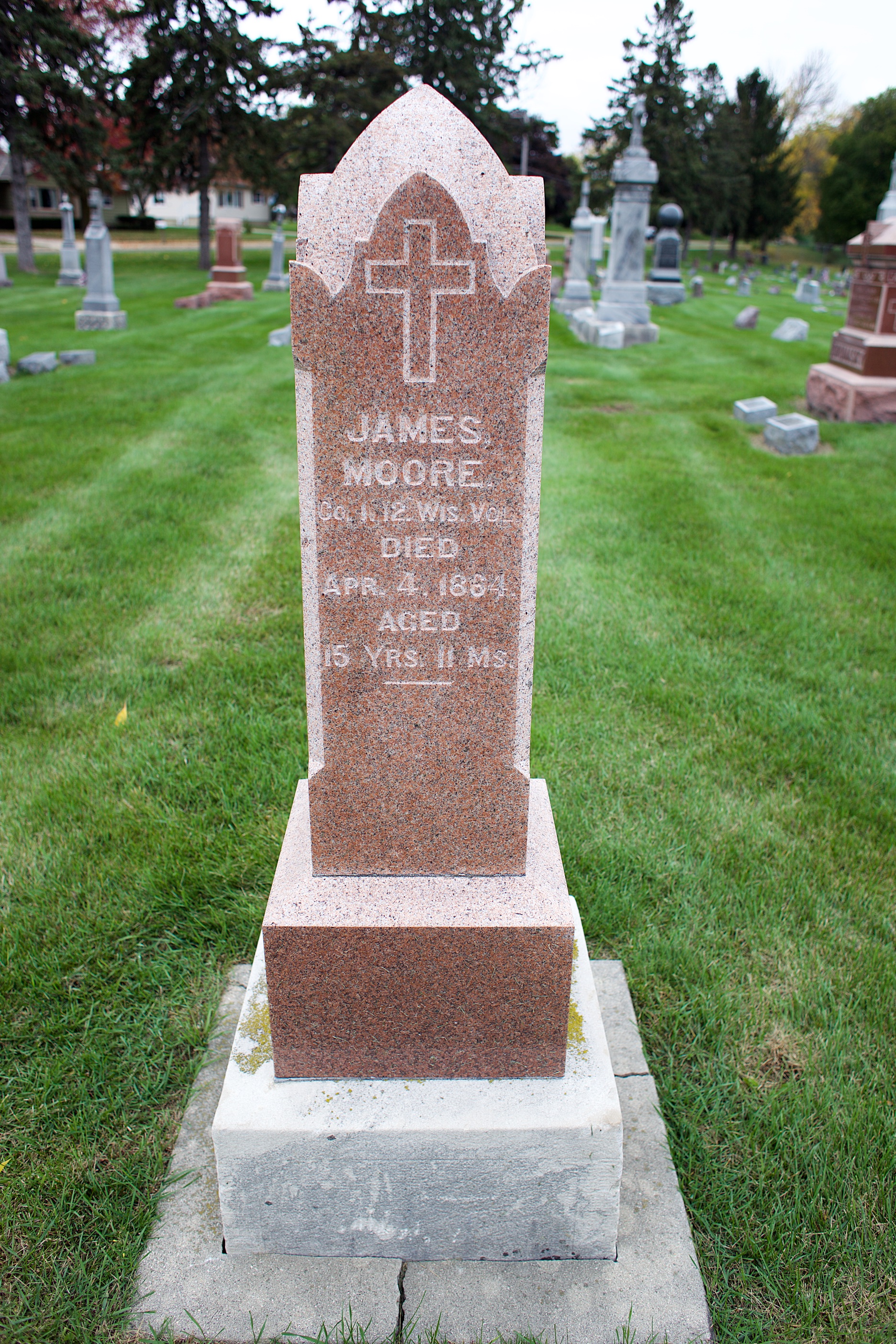
The grave marker of James Moore at Sacred Hearts of Jesus and Mary Catholic Cemetery in Sun Prairie, Wisconsin.
The soldiers of the 12th were discharged to their homes on Thursday, March 31. It is a safe assumption that Pvt. Moore was ill when he reached his family farm in the Town of Sun Prairie. He took to bed. His death on Monday, April 4 came before he had any chance to enjoy the well-deserved furlough. We don’t know what disease or illness claimed his life, or if he was exposed to it in battle, on the train ride home or at Camp Randall. His funeral Mass was held at Sacred Hearts of Jesus and Mary Catholic Church, which his father helped to build just a year before. His parents and two sisters had the sad duty of burying young James just as Wisconsin shook off the winter of 1864.
James Moore was born in Ohio on April 15, 1848, the only son of Mathew Moore and the former Catharine O’Neill. His parents emigrated from Ireland and spent some time in Ohio before settling on a 37-acre farm on the western edge of the Town of Sun Prairie in May 1850. Mathew and Catharine carried the loss of their son with them every day. Around 1875, the family left the farm and moved into the village of Sun Prairie, where Mathew died on April 28, 1891. Mrs. Moore died on Feb. 22, 1907 at age 93. Their daughters, Margaret Moore and Sara (Moore) Flavin, are buried near their parents — and their soldier brother — at Sacred Hearts of Jesus and Mary Cemetery in Sun Prairie.
Moore was among the more than 224,500 Union soldiers who died of disease, exposure or other non-battle causes in the Civil War. According to the Wisconsin Historical Society, the state sent more than 91,000 boys and men in 56 regiments to fight in the War of the Rebellion (1861-1865). More than 12,000 died, including nearly 8,500 from disease.
Lemuel C. Neal of Sun Prairie enlisted the same day as James Moore. Neal survived the war and lived until age 91. (Photo courtesy Wisconsin Veterans Museum)
His compatriot Lemuel C. Neal survived the war and went on to live a long, productive life. The son of Thomas Neal and the former Olive Dolley, Lemuel was one of nine children in the Neal farmhouse when he left home to enlist in the fall of 1862. He mustered out of service on May 31, 1865 and returned to Sun Prairie. His mother fell ill that fall and died on October 29 at age 45. The family left Wisconsin for Iowa, and eventually Lemuel settled in the Town of Turtle River, North Dakota. He married the former Ellen Forest and started a family. He kept moving west, later settling at Lewiston, Idaho. In 1896, he was awarded a patent for a clothespin by the U.S. patent office.
Neal again moved west, settling in Oceanside, California before eventually moving to Santa Ana. Neal and Ellen had two sons and two daughters. Ellen died in 1920. Neal remarried in February 1921, taking Clara Skelton Jones as his bride. Neal was hospitalized at the U.S. veterans hospital in Sawtelle, California in 1922, suffering from heart disease and high blood pressure. At the time, records listed his occupation as a merchant. He died at that same hospital on February 13, 1936. He was 91.
When David D. Hanneman was elected mayor of the city of Sun Prairie, Wisconsin in April 2003, it continued a Hanneman family tradition that stretches back more than 400 years to the county Regenwalde in the Baltic Duchy of Pomerania. Hanneman’s election as mayor on April 1, 2003 capped his nearly 40-year public service career — and put him in good family company.
The Hanneman family from Kellner, Wisconsin — from which David Hanneman descends — traces its roots to Pomerania, a picturesque land of Germanic peoples that dates to the 1300s. His earliest known ancestor, Matthias Hannemann, was from the village of Zeitlitz in the kreis, or county, of Regenwalde. Regenwalde means “woods of the Rega River,” referring to the picturesque waterway that ambles 100 miles through the county and empties into the Baltic Sea. This area has long been known for agriculture, fishing and forests, and it bears strong geomorphic similarities to the state of Wisconsin. The village of Zeitlitz covered about 2,200 acres and had approximately 100 households.
Mayor Dave Hanneman cuts the ribbon at opening of the Sun Prairie fire station. (Sun Prairie Star Photo)
Records trace the Hannemann (the original spelling had two ‘n’s at the end) family back at least to 1582 in Zeitlitz. The Hannemanns made up one of the predominant families in Zeitlitz, based on the number of entries found in the Lutheran church register. Many church records were destroyed in a fire in Stramehl in 1720, but the register from 1582 survived. At that time, there were a number of Hannemann families in Zeitlitz, and they owned some of the larger farms in the village. One of these men, likely the eldest brother, held the title of schulze, or mayor of Zeitlitz. Being the schulze was unlike the elected political position of mayor found in modern-day American communities. It was an inherited job, and the duties centered on making sure work was performed equitably in the village, and that the taxes of grain, goods or money were collected for the estate owner. The term schulze can have various related meanings, including “village headman,” mayor or even constable.
Mayor Hanneman speaks at a veterans’ event. (Sun Prairie Star Photo)
As farmers, the Hannemanns were also involved in providing financial support for the local minister and the church. Each tenant farmer paid his taxes in measurements of grain. The unnamed mayor Hannemann and Peter Hannemann were each responsible for taxes on two Hufen in Zeitlitz in the year 1582. A Hufe was the amount of land needed to sustain a family. There could have been more Hannemann families living on those four Hufen, but the church records only listed the major land tenants who paid taxes.
In the nearby village of Groß Raddow (about 6 miles from Zeitlitz), the Hannemann family had a similar history. A tax list from 1666 includes the names of Tews Hannemann (the schulze, or village mayor), Heinrich Hannemann, Chim Hannemann and Peter Hannemann. For at least several generations, it appears the Hannemann family inherited and passed on the office of mayor in Groß Raddow. In 1717, Hans Hannemann was the mayor, so we believe Hans is a descendant of Tews Hannemann.
Mayor Dave Hanneman cuts the cake at the 5th birthday of the new Sun Prairie Public Library.
The Matthias Hannemann family began emigrating to Wisconsin in 1861. Matthias left his home in 1866 and came to Wisconsin through Quebec. The family settled in and around Kellner, a tiny hamlet that straddles the Wood-Portage county line southeast of Wisconsin Rapids. At one time, the Hannemanns owned and farmed more than 1,000 acres in Wood and Portage counties. David’s great-grandfather, Christian Hanneman (Matthias’ son) was the last of this clan to come to America in November 1882.
Dave Hanneman (1933-2007) was first elected to public office on April 2, 1968 when he became Fourth Ward alderman in Sun Prairie. He served only one term as alderman, but stayed active in city politics, pushing the city to upgrade its sewer system to prevent backups into residential homes. He again ran successfully for alderman in 1988 and stayed on the Sun Prairie City Council until 1996, when he was elected to the Dane County Board of Supervisors. He held that post until being elected Sun Prairie mayor in 2003.
The Sun Prairie Star Countryman carried news of Hanneman’s election as Fourth Ward alderman in April 1968.
“Dave was involved in the growth of Sun Prairie and believed in progress for the community. He worked and helped champion the Highway 151/County Highway C project, which included working with the state Department of Transportation,” said Bill Clausius, who served on the city council and county board with Hanneman. “Dave was involved with the West Side Plan, which brought the Sun Prairie Community together to envision the future of the West Side. Dave supported and worked to begin the West Side Community Service Building. This facility includes a west side location for police, fire and EMS. His vision was to provide essential services to Sun Prairie residents and to shorten response times in case of an emergency.”
Clausius continued: “In 2003, Sun Prairie won the ‘Champions of Industry’ Award of Excellence as one of the best managed small cities in America. Dave personally raised $32,000 in donations from area businesses to fund production of a video featuring Sun Prairie, and highlighting Sun Prairie’s achievements.”
When the United States was drawn into World War II by the Japanese attack on Pearl Harbor, the war effort was put forth by everyone from soldiers at the front to school children at home. Young Edward J. Mulqueen of Cudahy, Wisconsin, wanted to do his part, so he donated his prized hunting knife to the U.S. military.
An 11-year-old student at St. Frederick’s Catholic School, Mulqueen read about the shortages of materials for the war effort. Newspapers carried pleas for donation of quality knives, since the hardened steel used in the blades was scarce. Eddie didn’t hesitate. In late 1942, he carefully packaged up his knife and mailed it to the address published in the newspaper. He was proud to do his part. After all, with two brothers headed for the Pacific theater (and later a third) he had a personal stake in the fight.
He might have forgotten about the donation, but two letters from the U.S. military, one from a general and one from a corporal, set his heart to soaring. The first letter, dated January 21, 1943, thanked Eddie for his thoughtfulness. “Words themselves cannot fully express our gratitude,” wrote Maj. Gen. Barney M. Giles, commander of the Fourth Air Force. “However, when the battles are over and our boys are home again, we all will thrill at the tales of how they were used.”
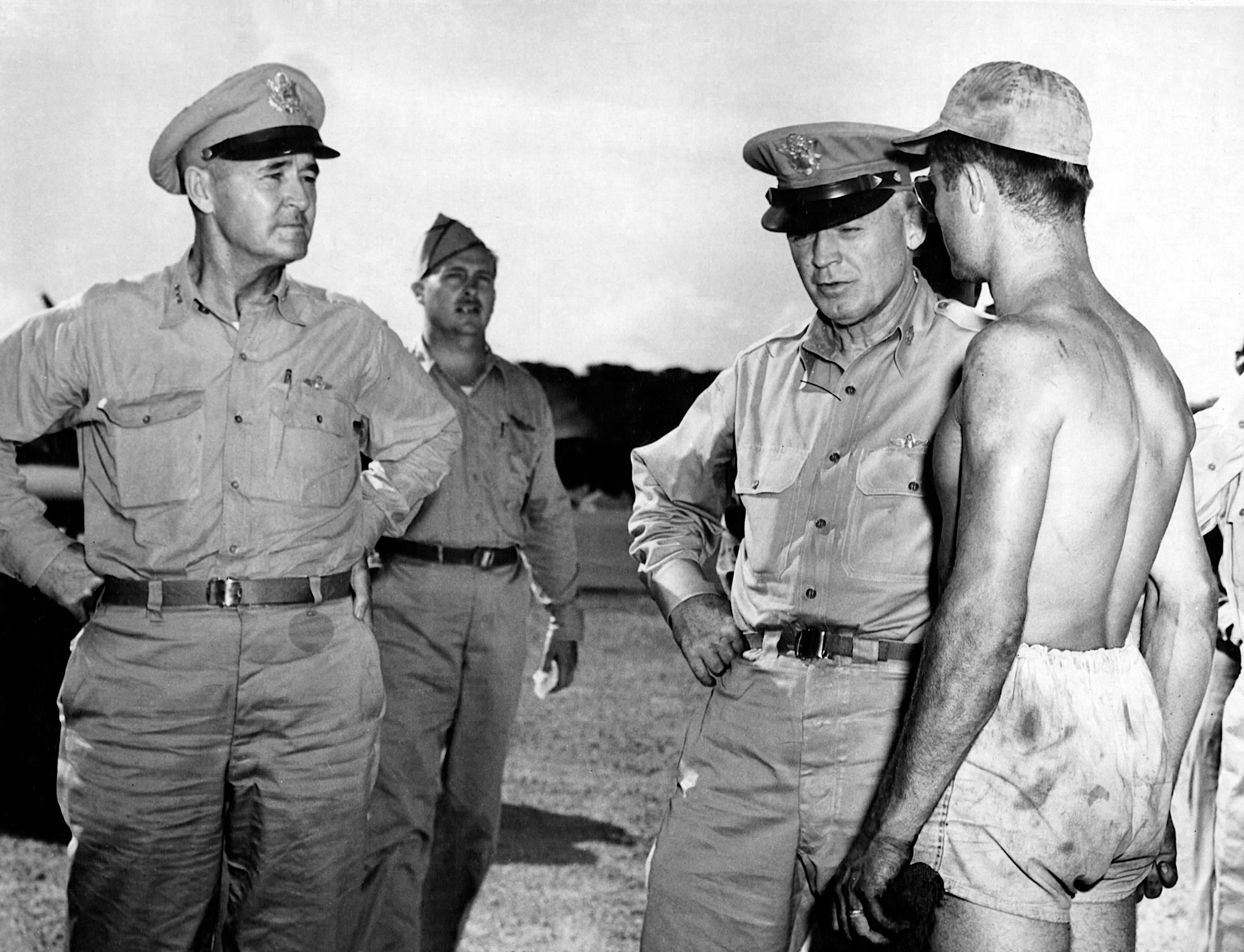
Gen. Barney M. Giles (left) sent a letter to Edward Mulqueen thanking him for donating a knife to the war effort. Here, he and Gen. Henry H. “Hap” Arnold speak with S/Sgt. Leo Fliess of Sturtevant, Wis., on Guam in 1945. (Army Air Force Photo)
Giles was not just some Army bureaucrat. He was commanding general of the U.S. Army Air Force in the Pacific, who later became deputy commander of the entire U.S. Army Air Force. Giles worked alongside legendary war heroes, including Adm. Chester Nimitz,Lt. Gen. James Doolittle and Gen. Henry H. “Hap” Arnold. He closed his letter to Mulqueen this way: “This much I know. With your gift goes another weapon that will certainly do much to help our boys slap the Japs into a complete and lasting tailspin.”
The next letter, from a U.S. Army Air Force officer in February 1943, was especially meaningful to Eddie. “He wished he had a hundred, yes even a thousand knives to donate,” read an article in the Cudahy Reminder/Enterprise. “His knife was seeing action and was being useful to one of our service men fighting in the Pacific.”
U.S. Army Air Force Cpl. Lucas R. Boyson wrote to thank Eddie Mulqueen for the donated knife in February 1943.
Stationed in the Fiji Islands, Cpl. Lucas R. Boyson was glad to receive the knife sent all the way from Wisconsin. Boyson, 29, was even more impressed that an elementary school student was behind the donation. “I was fortunate to receive your knife and to say it was a treat would be to put it mildly,” Boyson wrote in a letter to Mulqueen on February 14, 1943. “It is grand to cut stalks of sugar cane or bamboo sticks and for that matter general miscellaneous uses. I shall carry it with me always and each time I use it, I’ll whisper a ‘thanks to Eddie.’ ”
A married enlistee from Elyria, Ohio, Boyson was serving with the 375th Air Base Squadron, part of the U.S. Army air corps. He was among the first wave of men from Lorain County, Ohio to volunteer for service in January 1941. He wrote to Eddie that the natives on the islands were impressed with the knife, compared with the “hand-pounded, crude machetes they carry with them in the jungles.”
We don’t know if Boyson ever used the knife in combat, but we do know he survived the war and returned to Ohio, where he lived an exemplary life of faith and public service. On February 28, 1946, Lucas and WilhelminaBoyson welcomed a baby daughter, Mina. Lucas was an attorney who became actively involved with his American Legion post, St. Jude Catholic Church and a variety of civic groups and causes. At one time he headed the Lorain County Bar Association. He was also a Fourth Degree member of the Knights of Columbus, a group with a special focus on patriotism. Boyson died on December 5, 1992 at age 78.
Inspired by the wartime service of three brothers and one sister, Eddie joined the U.S. Navy and served during the Korean War. After the war, he got married and started a job at Wisconsin Electric Power Co. He was an electrician for many years. Eddie and his wife Marie had three children. The couple later moved to Michigan, where Eddie died in August 1991 at age 60.
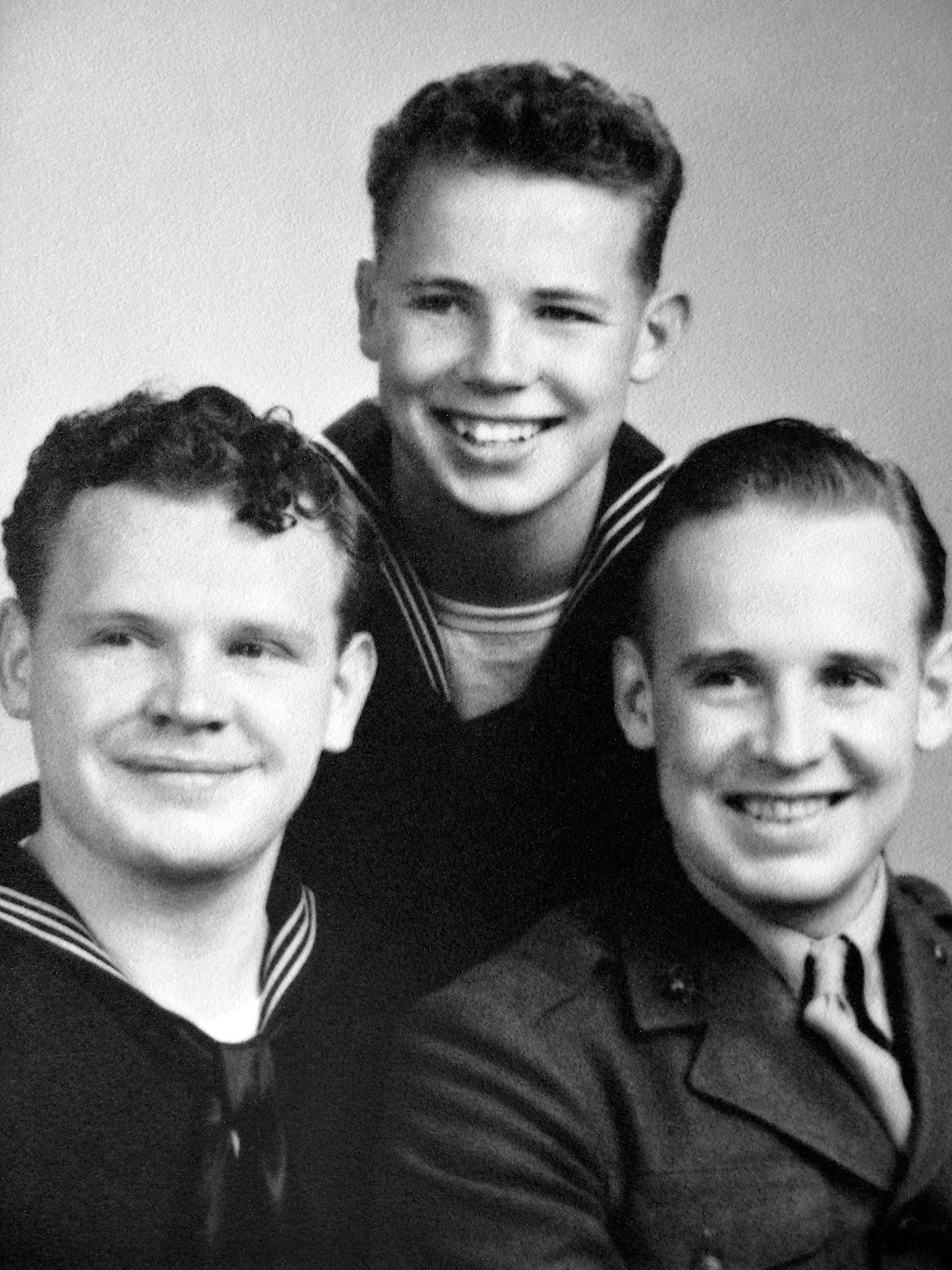
It was just the kind of wartime story that made an emotional impact on Milwaukee and the state of Wisconsin. Three Irish brothers serving in World War II appeared together to promote the sale of war bonds at a series of rallies in November 1944. Two were home on leave from the front and one was about to embark on his first overseas tour of duty.
There they stood on stage, the baby-faced Thomas “Tinker” Mulqueen still in naval training, the serious Marine Cpl. Earl J. Mulqueen Jr., on crutches due to the loss of his left leg above the knee, and the curly-haired redhead, Patrick J. Mulqueen, home from more than 18 months at sea with the U.S. Navy.
The Milwaukee Journal carried a front-page story on the Mulqueen brothers and the war bond drive in November 1944.
“Maybe it is because they are Irish, or maybe it is because they look so much like little boys—or maybe it is because everyone at one time or another, lost his heart to an Irish grin,” wrote The Milwaukee Journal in a front-page story on November 10, 1944. “But no matter what the reason, more and more persons every day are agreeing that the Mulqueen brothers, Tommy, Earl and Patrick, are among the greatest things which ever happened to Milwaukee.”
The impact the boys had was most evident at a bond rally at Schuster’s Department Store on Milwaukee’s North 3rd Street. The event got off to a slow start. Ben Barkin, head of the local war finance committee (later a legendary Milwaukee PR man and founder of the Great Circus Parade) was worried. That all changed when the Mulqueen boys took to the stage. “They are so cute,” one woman said. “They look like little boys playing soldier.”
Three Mulqueen brothers appear at a Milwaukee war bond rally in November 1944. Left to right are Michael Thomas Mulqueen, Earl James Mulqueen Jr. and Patrick Joseph Mulqueen. Behind the group is war bond chairman Ben Barkin.
Now the crowd was interested. Barkin introduced the lads. The 17-year-old Tommy was first to step forward and said simply, “You buy the bonds and the Mulqueens will win the war.” Considering he had yet to set foot in a combat zone, such as statement could have been viewed as a “wisecrack by a fresh kid,” The Journal wrote. But it wasn’t. “When Tommy said it, you knew he was telling the solemn truth,” the paper wrote. (Tinker went on to serve as a sailor on the fleet oiler USS Mattaponi.)
Earl talked about the war. At 21, he had seen more fierce combat than most would ever see. He fought at Guadalcanal and Tarawa with the 2nd Marine Division. Those were two of the bloodiest, deadliest battles of the entire Pacific war. Earl was a mortar crewman, so he was right at the front.
This hazy snapshot from the Pacific shows U.S. Marine Cpl. Earl J. Mulqueen Jr. next to the mortar he took into combat during World War II.
Earl was helping prepare an invasion fleet for the 1944 assault on the Mariana Islands when his landing ship-tank (LST) blew up at Pearl Harbor. The massive chain explosion caused the loss of many ships and resulted in hundreds of casualties. Because of the preparations underway for the invasion of Saipan, the Pearl Harbor disaster was a classified secret until the 1960s. So Earl was only able to say that he “almost made it to Saipan.” (Details of Earl’s war service and loss of his leg in the West Loch disaster will be the focus of a future Archive story.)
U.S. Marines storm Tarawa, Gilbert Islands, November 1943. (National Archives Photo)
Patrick spoke of his experience as a firemanaboard the light cruiser USS Concord (CL-10). He enlisted on August 7, 1942 and by March 1943 was among the compliment of 700 aboard the Concord. The ship escorted reinforcement convoys in the southern Pacific, and prowled the dangerous, icy waters of the north Pacific. The Concord was involved in numerous bombardments of the Kurile Islands. During 1943, the Concord was on a surveying mission of the South Pacific with retired Rear Admiral Richard E. Byrd, the famous explorer. The ship visited Tahiti, Bora Bora and the Easter Islands. A huge explosion onboard on October 7, 1943 took the lives of 22 crewmen. Caused by ignition of gasoline fumes at the rear of the ship, the explosion threw some men overboard, while others were killed from concussion, burns, fractured skulls and broken necks. On October 8, those men were buried at sea. After participating in bond rallies in Milwaukee, Patrick was assigned duty on the USS Crockett (APA148), a Haskell class amphibious attack transport. The USS Crockett had just been commissioned on November 28, 1944.
The crowd at Schuster’s quickly figured out that these “boys” had seen and experienced the horror of war. “It was simple and short,” The Journal wrote. “No frills. No hero stuff, no dramatics—nothing but a couple of kids, one on crutches, asking people to buy and sell bonds.” The stories of the Mulqueen boys had the desired effect. Barkin exclaimed, “You know, the bond drive is going to come out all right.” He was right, for the Schuster’s bond drive raised more than $500,000.
The Mulqueen brothers even appeared at war bond rallies with their mother, Margaret Mulqueen, who was active in the Marine Corps League.
Schuster’s was just one of many venues at which the Mulqueen boys spoke. At some rallies, they were joined by their mother, Margaret “Madge” Mulqueen, who was deeply involved with the war effort through the Wisconsin chapter of the Marine Corps League. She had four blue stars displayed in the window of the Mulqueen home at 3854 E. Cudahy Avenue in Cudahy — one for each of the three boys and one for her daughter Margaret, a Navy nurse based in San Diego.
The bond drives were a crucial part of the home-front effort in World War II. Across the nation, eight war-bond drives between 1942 and 1945 raised more than $190 billion. Investors purchased $25 bonds for $18.25. Bonds were redeemable after 10 years. Companies sponsored in-house bond rallies, and employees pledged purchases through payroll deduction. Children were encouraged to buy 25-cent war stamps to save up for their own war bond. Special sections of local newspapers were dedicated to promoting bond sales. On the radio, popular programs such as Fibber McGee and Molly dedicated entire episodes to war bonds and other home-front efforts.
Sgt. Louis C. Koth (left) and Marine Cpl. Earl J. Mulqueen Jr. are introduced by company president Earl W. Wyman at the Oshkosh B’Gosh Inc. bond rally on November 30, 1944.
Earl Mulqueen and Army T/Sgt. Louis C. Koth appeared at such a corporate event at Oshkosh B’Gosh Inc. on November 30, 1944. They were introduced by company president Earl W. Wyman. Koth was a radio operator aboard a U.S. Army Air Force B-17 bomber that was shot down during a mission over Schweinfurt, Germany. Koth was on his third mission in a B-17 Stratofortress when he was forced to parachute into enemy territory. Taken prisoner and repatriated 11 months later, Koth lost his right arm. Koth began participating in the bond tours shortly after being released from a hospital in Madison in the fall of 1944.
Koth and Earl Mulqueen toured Oshkosh Motor Truck Inc. and Universal Motor Co. Later they were interviewed live on radio station WOSH by local bond chairman Richard J. White. “Both of these boys are giving freely of their time to help the sixth war loan campaign,” White said. “They have made sacrifices beyond any that we are being asked to make, and although they will not see action again, they are both anxious to do whatever they possibly can to see that ammunition does not have to be rationed at the front.”
The bond rallies helped explain the costs of supplying the troops. Toothbrushes cost 8 cents each. A hand grenade was $1.56. An anti-tank shell cost nearly $3. A Garand rifle was $55. A 1,000-pound bomb cost $250, while a 75-mm Howitzer cost $11,350. A PT boat cost the military $145,000, while a 1,630-ton destroyer had a price tag of $10 million. A fully outfitted battleship cost $97 million. Bond drives supplied the U.S. government with needed cash, while giving ordinary citizens a concrete way to participate in the war effort.
Ads like this one from First Wisconsin promoted sale of war bonds during World War II.
Largely due to Barkin’s tireless efforts, Milwaukee’s World War II war-bond drives became a model for the nation. Described by The Milwaukee Journal as an “ace ward bond salesman,” Barkin was honored as Milwaukee’s man of the year in 1945 by the Milwaukee Junior Chamber of Commerce. For his $1 annual salary, Barkin popped up just about everywhere in Milwaukee: schools, churches, civic clubs and businesses. The 28-year-old was unable to enlist due to a disability, so he threw his energy into raising money for the war effort. Doctors told him to slow down, but the pitchman didn’t listen. He gave more than 1,000 speeches each year as head of the community division of the war finance committee.
“Let’s show Milwaukee what their money is buying,” Barkin said in 1943. He organized a “Wings for Victory” parade of tanks, jeeps, artillery and other hardware to do just that. Funds from the rally after the parade were used to buy military transport planes for Mitchell Field. Barkin convinced Milwaukee to rename Wisconsin Avenue “War Bonds Drive” for the duration of World War II, a practice later adopted in dozens of other cities. He understood the importance of having soldiers, sailors, airmen and Marines tell their stories. The results were often heart-rending. He told the story of a Milwaukee woman who stood in line for two hours to buy a war bond for her boy, serving in North Africa. Her husband had just died two days prior. “Doggone it,” Barkin told Walter Monfried of The Milwaukee Journal,“that kinds of gets you, doesn’t it?”
Three Mulqueen brothers served in World War II: Patrick (left), Thomas (center) and Earl.
So Barkin knew when the Mulqueen boys stepped on stage, the people would dig deeply into their pockets to support the war. “No matter what the mood of the meeting before the kids talk,” The Journal wrote, “when they finish, that meeting is sure of going over the top.
“Everyone who has heard the Mulqueen brothers agrees,” the paper wrote, “that the kids are among the best in the world.”










 The Hanneman Archive