Tag Archives: photos

Photo Detective: Finding Sammy Kaufman

It was a tiny photograph, not much larger than an oversized postage stamp. It showed two boys, identified on the back as Bob Firlus and Sam Kaufman. Of course I was very familiar with Bob, my Dad’s lifelong friend from Mauston, Wisconsin. But Sam did not ring a bell. However, his presence in my Dad’s photo collection meant that he was a friend and likely a frequent guest at the home of my grandparents on Morris Street in Mauston. I wondered, what became of Sam?

Bob Firlus (at left) and Sam Kaufman, circa 1940.
Bob Firlus (at left) and Sam Kaufman on Morris Street in Mauston, circa 1940.

The photo detective in me kicked into high gear. My first check was with Mr. Firlus, who had some distinct and humorous early memories of Sam:

They had a nice house on Tremont Street. One day Sammy and I walked out to Coon Rock Bluff a few miles west of Mauston. We were near the bluff and Sammy said that he had to take a pee but he asked me not to tell his dad because his dad told him he should not pee outdoors.

Ah, the troubles of youth! What a great story! Bob said he believed Sam had moved to Pennsylvania after leaving Mauston. I next dug out some of my Dad’s yearbooks and found Sam pictured with my Dad’s Mauston Grade School class in the late 1930s and early 1940s. He was one of the tallest boys in class, so was usually found in the back row. In the 1939 class photo, he was standing directly to my Dad’s right.
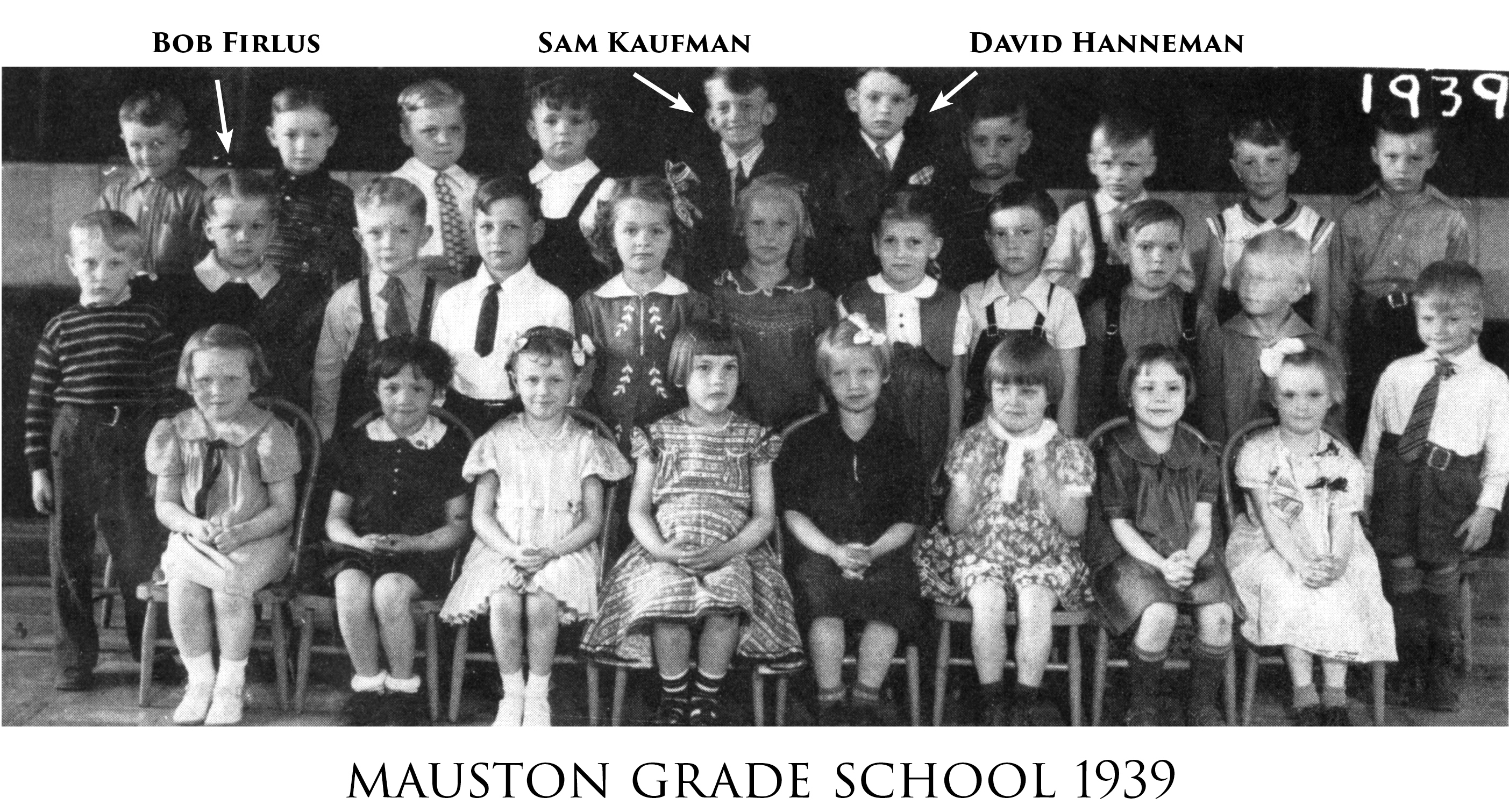
Bob Firlus, Sammy Kaufman and David Hanneman are shown in this early grade school photo.
Bob Firlus, Sammy Kaufman and David Hanneman are shown in this early school photo.

I checked the U.S. Census and military records on Ancestry.com and  found Sam’s father, Albert Ross Kaufman, a doctor at Mauston’s Hess Memorial Clinic. The elder Kaufman’s 1942 draft card showed he was 46 and living with his family at 214 Tremont Street in Mauston. That was fairly close to the Hess clinic, but not so close to the Hanneman house. So what was his connection to that photo taken on Morris Street? I looked up Sam’s mother, Ardis, and discovered her maiden name was Hess. OK, now we’re making progress. Hess was a very prominent name in Mauston, largely due to Dr. James Samuel Hess Sr., a pioneer doctor and founder of the hospital and clinic. Interestingly, Bob Firlus said he had recently thought about Sam and the name Ardis came to mind, although Bob hadn’t recalled that was Sam’s mother’s name.

Turns out that Dr. Ardis (Hess) Kaufman (also a physician) was the daughter of Dr. J.S. Hess Sr. and Maude (Robinson) Hess. She was the sister of Dr. J.S. Hess Jr., who lived directly across the street from the Hannemans. Dr. Sam, as the junior Hess was known, took over for his father at the hospital and clinic. That explained why Sammy was a frequent neighborhood visitor. My grandfather, Carl F. Hanneman, worked for Dr. Sam running the pharmacy attached to the Hess clinic. So it made sense that Bob Firlus and my Dad were buddies of Sam Kaufman. I dug into my photo archives and found another shot that appears to show Sam outside the Hess home around 1942.

A tall, thin young man believed to be Sam Kaufman outside the Hess home on Winsor Street.

Now that I had a good sense of Sam’s history in Mauston, I wanted to figure out where he went and what happened in his life. Again, Ancestry.com was a crucial source. I found listings for Dr. Albert R. Kaufman under city directories in New Kensington, Pennsylvania. Based on that, I ran search engine queries and located an obituary for Sam Kaufman. I reacted with sadness, since I always hope in doing this work to find a living person to track down. Sam died in October 2008 of lung cancer. Same cause as my Dad, and about 18 months later. From the obituary, it was clear Sam had lived an exemplary life.

The obituary described Sam’s college education, his longtime service in the U.S. Army, his 1957 marriage to Margaret “Meg” Floyd, and his career switch from salesman to high school teacher. He had a long teaching career at Baldwin High School in suburban Pittsburgh. The couple had two sons, James and Steve. From checking those names with search engines, it appears Steve has had a long career as an assistant U.S. attorney in Pittsburgh.

Even after I finished most of my research, Sam’s name stuck in my head. There was some other clue I was missing. Dad, could you give me some help here? Then it hit me. I vaguely recalled that Sammy accompanied my Dad’s family on one of their vacation trips to the Dakotas. But how to find the photo amidst the thousands in the archive? On this day, I had some help from above. The first archive box I opened had the photo for which I searched. The caption read: “Sammy Kaufman on right, David Hanneman on left.” It was in my Grandma Ruby’s handwriting.

David Hanneman and Sam Kaufman outside the Ortman Clinic in Canistota, S.D., circa 1944.
David Hanneman (left) and Sam Kaufman outside the Ortman Chiropractic Clinic in Canistota, S.D., circa 1944.

It took a few days of work, but with a little effort I went from a tiny photo print with lots of questions to a decent understanding of Sam Kaufman and his life in and beyond Mauston. Well done, Sam, and thank you.

©2014 The Hanneman Archive

President Truman Comes to Elroy

[The original version of this story posted in 2014 stated that President Truman visited Mauston, Wisconsin. A sharp-eyed former resident of Mauston noted in the comments section that Truman did not visit Mauston, but rather nearby Elroy. The Truman Presidential Library has now confirmed this, so the story has been corrected and expanded as of May 10, 2017.]

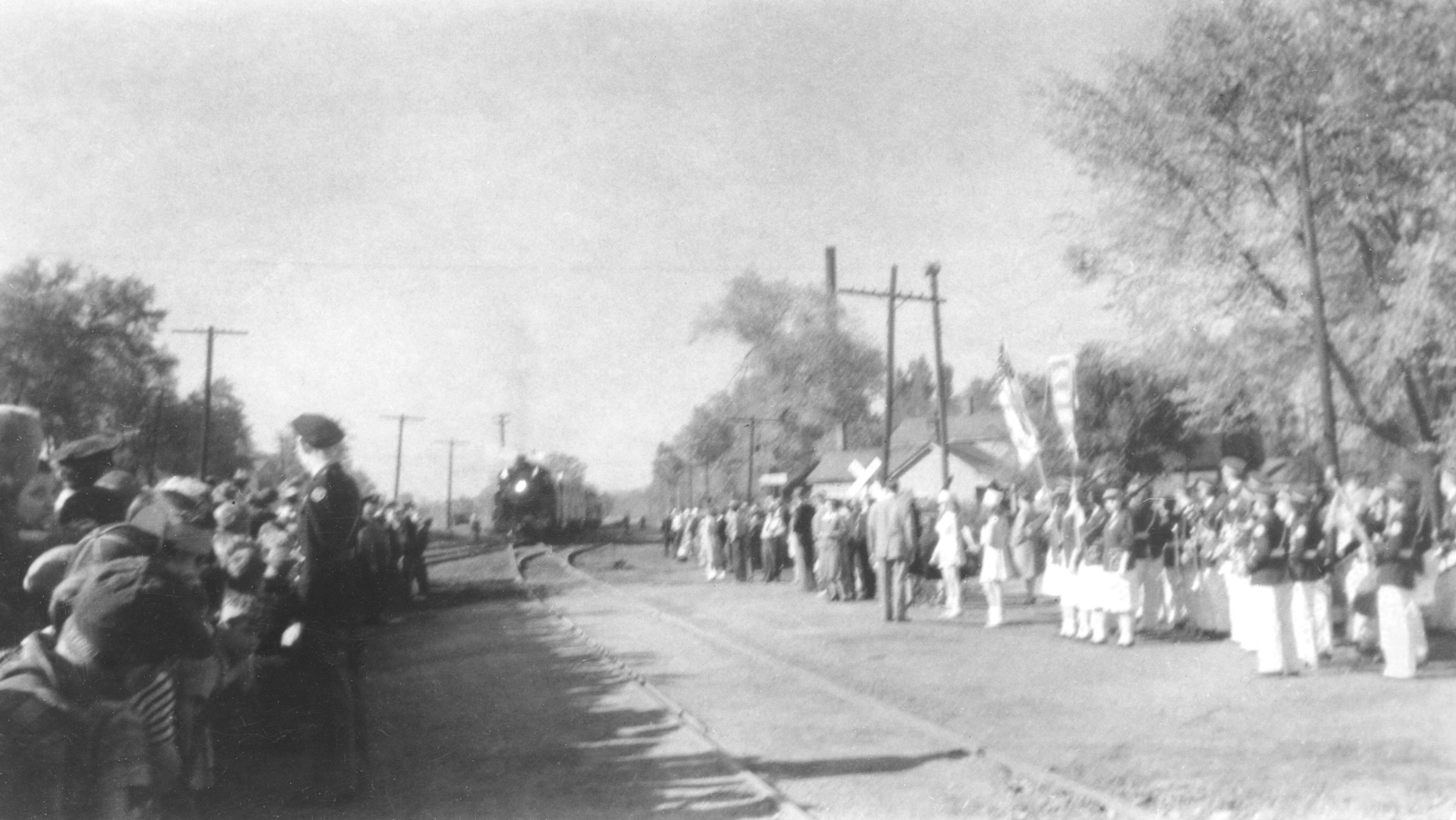
When President Harry S Truman pulled into tiny Elroy, Wisconsin on his rail tour of America in 1948, the Carl F. Hanneman family was at the station and captured several Polaroid images of the event. The grainy and out of focus photos are far from perfect, but they provide literal snapshots from one of the great political stories in American history.

The Harry S Truman express approaches Mauston during campaign season 1948.
The Harry S Truman express approaches Elroy, Wisconsin, on October 14, 1948.

Truman went on an 30,000-mile “whistle-stop” railroad tour of the nation, visiting large cities, small villages and everything in between. His 17-car train was called the Magellan. Much like his old boss President Franklin Delano Roosevelt had done, Truman made speeches from a presidential podium at the back of the train. The tour drew huge crowds wherever he went, and Mauston was no exception. According to the Truman Presidential Library, the president made up to eight speeches each day during the rail tour.

President Harry S Truman took his case directly to the people during his 1948 rail tour.

On this day, Truman started out with a speech in Mankato, Minnesota at 8:08 a.m. Other stops included Waseca, Rochester and Winona, Minnesota; and Sparta, Wisconsin. The train pulled into Elroy at 1:55 p.m. on October 14, 1948. Truman stepped to the podium and said:

I certainly do appreciate your coming out here. This was supposed to have been a water stop. I didn’t think that we would be here long enough for me to speak to you, but I am happy that we did stop long enough, and I appreciate your interest and I appreciate your coming out here to see the president.

I wish I had the chance to discuss with you all the issues in this campaign, but I haven’t the time now.

I hope you’ve been reading the speeches and statements I have been making over the country. They are in your interest, and if you vote for your own interests on the 2d of November you’ll elect a Democratic Governor and a Democratic Congressman from your district–and you’ll elect a Democratic administration in the whole United States Government. And then things will be safe and in the hands of the people.

Conventional political wisdom had Truman losing badly before a single ballot was cast. When he won the election, it was viewed as a stunning turn of events. Many will recall the famous photo of Truman holding the early edition of the Chicago Tribune with the erroneous headline, “Dewey Defeats Truman.” That photo was snapped at the back of the same train in St. Louis, as Truman departed for Washington.

It seems the term “whistle-stop” was considered a bit of a slight. When Republican Sen. Robert Taft of Ohio criticized the Democrat Truman for things he was saying on the “whistle-stop” tour, mayors of towns on the route of Truman’s tour reacted with indignation. “Our whistles never stop blowing,” one huffed. Crestline, Ohio, was quick to point out the 42 daily trains that served its population of 5,000. The Associated Press at the time said a whistle-stop was a “tank town, a hamlet, a mere wide place in the road.” Truman’s own comments at Elroy indicate the stop there was supposed to be only to take on water.

Of course millions of Americans live in such places, so the kerfuffle seemed a bit strange. As columnist Thomas L. Stokes noted, “Whistle-stop folks vote, too.” Stokes called the rail tour a public service, part of a president’s responsibility to communicate directly with the American people.

©2014-2017 The Hanneman Archive

Eye on the Past: Bundled for a 1920s Winter

These young ladies look like they are dressed for a Siberian winter, although the location of this photograph is central Wisconsin. Sisters Lillian M. Albrecht (left) and Esther M. Albrecht are bundled with fur coats, hats and hand warmers. The photo was taken about 1920, probably at Vesper, Wisconsin, their home town.

Lillian M. Albrecht and sister Esther M. Albrecht are well-prepared for winter.

Lillian married George J. Ladick in June 1922, and the couple had four children: Sylvia (1923-1961), Lucille (1925-2005), Lawrence (1930-2000) and Shirley. Esther married Emil R. Gottschalk in November 1930, and the couple had two daughters, Pearl (1936-2012) and LaVon.

©2014 The Hanneman Archive

Big Little Books Delivered Pint-Size Childhood Adventures

For a child growing up in the 1930s and 1940s, big adventure often came in small packages. Like many boys his age, David D. Hanneman (1933-2007) was an avid collector of Big Little Books. These chunky mini-books allowed adventure-seeking children to follow the action of Buck Rogers, Dick Tracy, Flash Gordon, Tarzan and other characters. All for 10 cents a book.

The original Big Little Books concept was pioneered by the Whitman Publishing Company of Racine, Wisconsin. Whitman was a subsidiary of Western Publishing, the creator of the famous Little Golden Books (think Poky Little Puppy). Big Little Books were roughly 3¾ inches wide by 4½ inches high. Thickness varied by page count. For example, the 1934 Buffalo Bill and the Pony Express had 380 pages and was 1¼ inches thick. The layout was one of the classic features of Big Little Books. Each page spread had text on the left side and a black-and-white illustration on the right. 

Big Little Books had text on the left-facing pages and illustrations on the right pages.

Whitman Publishing came out with its first Big Little Book in 1932, The Adventures of Dick Tracy. Soon after, Whitman had titles with comic strip characters like Wash Tubbs, as well as a range of Walt Disney titles. The 1934 series alone included titles such as Chester Gump Finds the Hidden Treasure, Buck Rogers in the City Below the Sea, Reg’lar Fellers, Betty Boop in Snow White, Kayo and Moon Mullins, Mickey Mouse in Blaggard Castle and Dick Tracy and the Stolen Bonds. 

Most of the books had hard covers, although my Dad had one Buck Rogers title that was softcover and in a slightly smaller format (only 4¼ inches high). This book had no page numbers. The inside back cover spread was a two-page ad for Cocomalt drink mix. The 1935 Tom Mix and Tony Jr. in Terror Trail was a larger format (4 5/8 by 5¼ inches) and featured real photographs inside.

My Grandmother Ruby V. Hanneman wrote an inscription on the inside cover for my Dad's 8th birthday in 1941.
Ruby V. Hanneman wrote an inscription on the inside cover for my Dad’s 8th birthday.

For my Dad’s 8th birthday, he received a copy of the 1941 Tarzan the Untamed by Edgar Rice Burroughs. Ever the historian, my Grandma Ruby V. Hanneman wrote the particulars down in blue pencil on the inside front cover: “David Dion Hanneman, March 27, 1941, for 8th birthday, from Dad, Mother, Lavonne and Donn.” This title was from the Better Little Books series, also published by Whitman. In addition to the story and illustrations, it had a flip-book feature that showed an animation as the reader flipped the pages through his thumb and forefinger.

Titles in the 1941 Better Little Books series included Big Chief Wahoo and the Magic Lamp, Mickey Mouse on Sky Island, Popeye and a Sock for Susan’s Sake, G-Man and the Gun Runners, Dick Tracy and his G-Men, Red Barry Undercover Man, Ellery Queen and the Adventure of the Last Man’s Club, Inspector Charlie Chan Solves a New Mystery and others. By the time he was in high school, my Dad stopped adding to his collection. But they clearly held a special place in his heart, since he kept and safeguarded them for more than 50 years before passing them on.

©2014 The Hanneman Archive

Wedding Wednesday: Big 1913 Wisconsin Party

Judging by the turnout, the marriage of Joseph John Mras and Mary V. Sternot of the Town of Sigel in Wood County, Wisconsin, was the celebration of the year in 1913. The pair were married by the Rev. John Willitzer on October 21. The group portrait was taken outside the Sigel home of the bride’s parents, Jacob and Josephine Sternot. The reception had a big turnout from Sigel and the nearby village of Vesper.

Groom Joseph Mras and bride Mary Sternot are flanked by flower girls Ruby V. Treutel (right) and Gladys Cole. Back row (left to right) includes Anton Sternot, unidentified woman, Joe Pyrch, Anna Sternot, John Sternot and another unidentified woman.
Groom Joseph Mras and bride Mary Sternot are flanked by flower girls Ruby V. Treutel (left) and Gladys Cole. Back row (left to right) includes Joseph Sternot, Josie Leu, John Pyrch, Anna Sternot, John Yeske and Mary Billiet.

As with other large-group photos in our collection, it is fun to look for details in the sea of faces. Standing just right of center is my grandmother, Ruby V. (Treutel) Hanneman, who was a flower girl at the wedding. The bride and groom are tucked away in the upper right corner, looking a bit weary. The entertainers are in center front, one with a fiddle, one with an accordion and a third holding a pitcher of beer. Three things seem to link the men in the photo: hats, beer and cigars. Some things never change.

A studio photo of the wedding party provides additional details on the big day. Ruby Treutel and (we believe) her cousin Gladys Cole were the flower girls, while one brother and one sister of the bride were also in the wedding party.

Joe and Mary Mras had three children, Clarence, Earl and William. Joe was a crane operator for 31 years for the Frank Garber Iron & Metal Co. in Wisconsin Rapids. He retired in 1959. Joe died on April 10, 1961. Mary died September 20, 1977. Their son Clarence was killed in an auto accident in September 1956. Earl died October 18, 2001. William died February 18, 1997.

— This post has been updated with corrected identifications on the wedding portrait.

©2014 The Hanneman Archive

Eye on the Past: Third Grade in 1910

We only have two photographs that show Carl F. Hanneman at school, and both appear to be from the same year. In the first, Carl is the second pupil in the second row at a school in Grand Rapids, Wisconsin. Wearing a tie and cardigan sweater, Carl is one of a half-dozen or so boys in the class. The clock reads 11:59, so the class photo was scheduled just before the lunch break. It is a well-kept and neatly appointed classroom. The girl sitting in front of Carl could easily be mistaken for his future bride, Ruby V. Treutel, although she went to school in nearby Vesper.

Carl F. Hanneman is third from the left in the first row. The photo was taken circa 1910.

The second photo was taken outdoors at an entrance to the school.  Carl is third from the left in the first row. At the time, the Hannemans lived on Baker Street in Grand Rapids, so the Howe School would have been the closest public school. But the building in the photo does not match exterior details of the Howe School, so it’s unclear where Carl spent his elementary school years.

©2014 The Hanneman Archive

The History of Pharmacy by Artist Robert Thom

During his nearly six decades as a pharmacist, Carl F. Hanneman got to know a lot of people. He forged good relationships with the many sales reps who called on him at the Mauston Drug Store. Some came to dinner at the Hanneman home, and a few even stayed at the house while in town. One of the long-lasting perks he received from Parke, Davis and Company was a stunning set of lithographs depicting the history of pharmacy. More than 30 prints still exist from Carl’s 1950s collection.

Parke-Davis commissioned artist Robert Thom to produce 40 illustrations for the series, “A History of Pharmacy in Pictures.” Each print came with a history article that explained the depicted scene and its place in history. Launched in 1957, the series was developed in cooperation with the Institute for the History of Pharmacy at the University of Wisconsin. Druggists were encouraged to display the artwork in their stores.

The series depicted such early topics as scientist Galen in the second century to later developments such as chemotherapy, antibiotics and pharmaceutical research. Parke Davis also commissioned Thom to paint a series of illustrations on the history of medicine. Thom (1915-1979) was well known as an illustrator of historical subjects, including great moments in baseball and the history of Illinois and Michigan.

The paintings from Carl Hanneman’s collection are in the gallery below, including the explanatory text from each image.

— This post has been updated with additional Thom paintings.

Eye on the Past: Vesper Village Gathering

It seems the entire village of Vesper, Wisconsin came out for a banquet or other big event, and stayed for a photograph. The image appears to date to about 1913 or 1914. The large crowd spilled out of the village hall for a photograph. What was the occasion? A wedding? A dance? It is fun to imagine. The portrait was taken by Moore Photo of nearby Grand Rapids (now called Wisconsin Rapids).

What makes this image especially interesting is to zoom in and look at the details. See the little girl with the Dixie Queen plug cut tobacco lunch box? It’s strange to imagine a lunch tin with smoking tobacco advertised on the side, but this was before the age of comic books or movie stars. Lunch pails with tobacco ads were common.

In the front at left/center left is my grandmother, Ruby V. (Treutel) Hanneman, who appears to be about 10 years old. That would date the photo to 1914. In the sea of men back near the stairs appears to be Ruby’s father, Walter Treutel. He is sporting a mustache, which is something I’ve not seen in any family photos.

On the building next to the window is a large thermometer with the name “Hlasatel” on it. That was the name of a Bohemian/Czech newspaper. Vesper had a large population from Bohemia, including the family of my great-grandmother, Mary (Ladick) Treutel. Her parents emigrated from Bilina in what is now the Czech Republic.

Eye on the Past: Rochester Root Beer

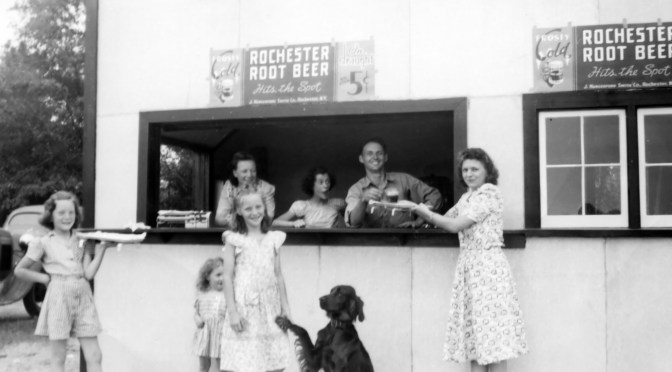
Marvin and Mabel Treutel operated a roadside root beer stand near their home on Wilhorn Road in Nekoosa, Wisconsin. Aside from 5-cent Rochester root beers, they served the “Best Roast Beef BBQ.” Pictured behind the counter in this late-1940s photo are Mabel Treutel (left), niece Lavonne Hanneman (center) and Marvin Treutel (right). Out front are daughters Bonnie Treutel (left), and Patricia Treutel (center, holding dog). The woman at right and the little girl at center are unidentified.

Wedding Wednesday: Carl and Ruby Hanneman

Nearly 90 years ago on a summer Tuesday morning, Ruby Viola Treutel and Carl Henry Frank Hanneman joined in marriage at St. James Catholic Church in Vesper, Wisconsin. The marriage, which would live on for more than 50 years and produce three children and 16 grandchildren, was described in detail in a story in the July 15, 1925 edition of the Wisconsin Rapids Daily Tribune:

TREUTEL-HANNEMAN
One of the prettiest weddings of the summer was solemnized yesterday morning at nine o’clock at St. James church, Vesper, when Miss Ruby Treutel, daughter of Walter Treutel of Vesper, became the bride of Carl F. Hanneman, son of Mr. and Mrs. Charles Hanneman of this city. Rev. Father Gille officiated at the nuptial Mass. 

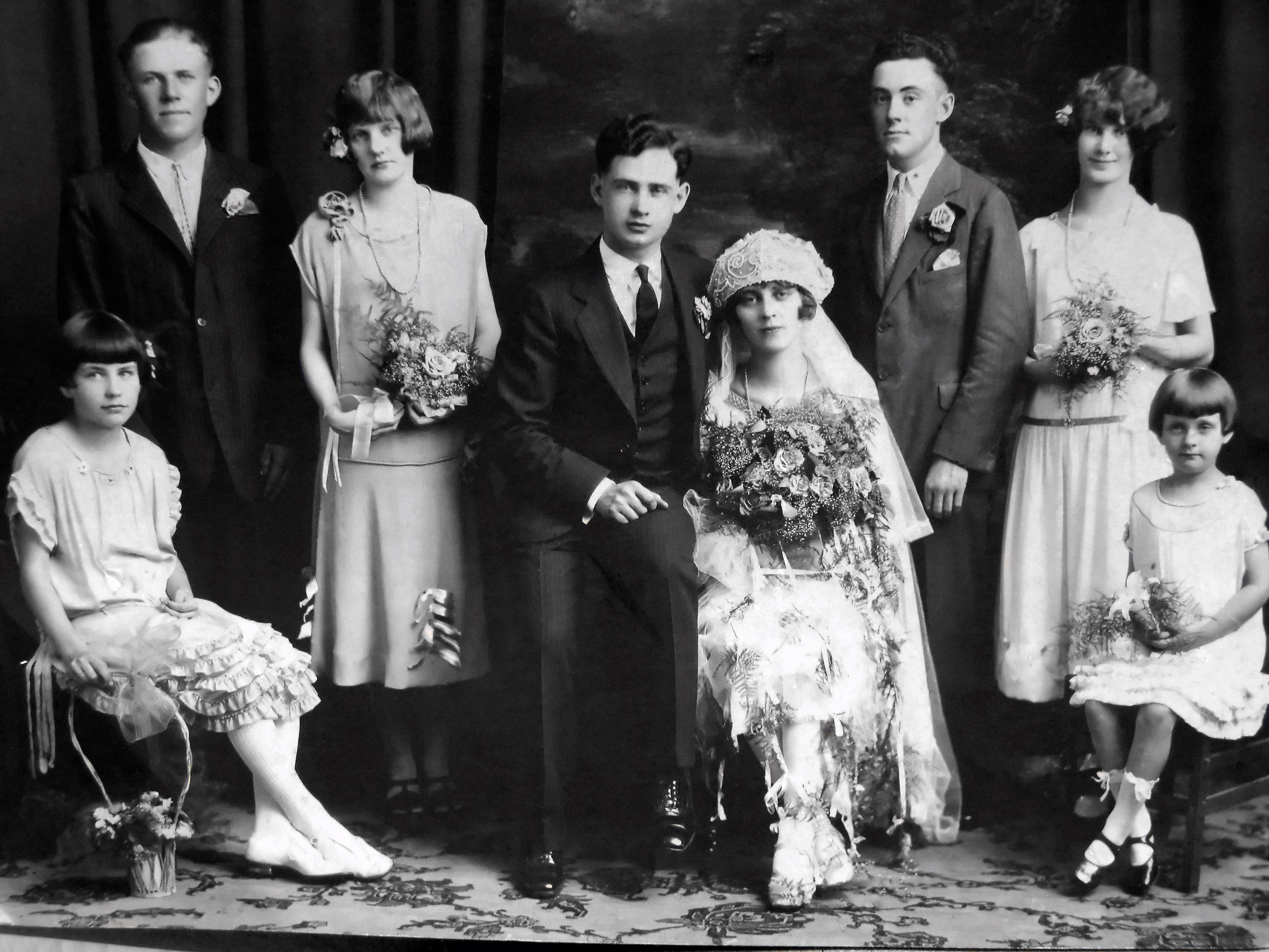
The wedding party of groom Carl Henry Frank Hanneman, 23, and Ruby Viola Treutel, 21. Wedding was July 14, 1925 at St. James Catholic Church, Vesper, Wis.  At front left is flower girl Nina Treutel, 11, sister of the bride. At front right is ring-bearer Elaine Treutel, 5, sister of the bride. Across the back, left to right, are Joe Ladick (bride's cousin), Gladys Cole (bride's cousin), groom Carl Hanneman, bride Ruby V. Hanneman, best man Wendell Miscoll, and maid of honor Esther Allbrecht.
The wedding party of groom Carl Henry Frank Hanneman, 23, and Ruby Viola Treutel, 21. Wedding was July 14, 1925 at St. James Catholic Church, Vesper, Wis. At front left is flower girl Nina Treutel, 11, sister of the bride. At front right is ring-bearer Elaine Treutel, 5, sister of the bride. Across the back, left to right, are Joe Ladick (bride’s cousin), Gladys Cole (bride’s cousin), groom Carl Hanneman, bride Ruby V. Hanneman, best man Wendell Miscoll, and maid of honor Esther Allbrecht.

The church was beautifully decorated with greens and the season’s flowers, making an appropriate setting for the wedding party. Miss Velma Doering of Stratford played the wedding march as the party entered the church and proceeded to the altar. Miss Gladys Cole of Nekoosa, and the groom’s attendant, Joseph Ladick, of Vesper, both cousins of the bride, were followed by two little sisters of the bride, Nina and Elaine, who acted as flower girl and ring bearer. The maid of honor, Miss Esther Albright, came next and was followed by the bride and her father, who gave her away. 

Mr. Hanneman and his best man, Wendell Miscoll, awaited the party at the altar. The bride was very beautiful in her gown of white georgette trimmed with gold lace. She wore a coronet of pearls, with her veil falling from a beaded butterfly. She carried a shower bouquet of pink rose buds. 

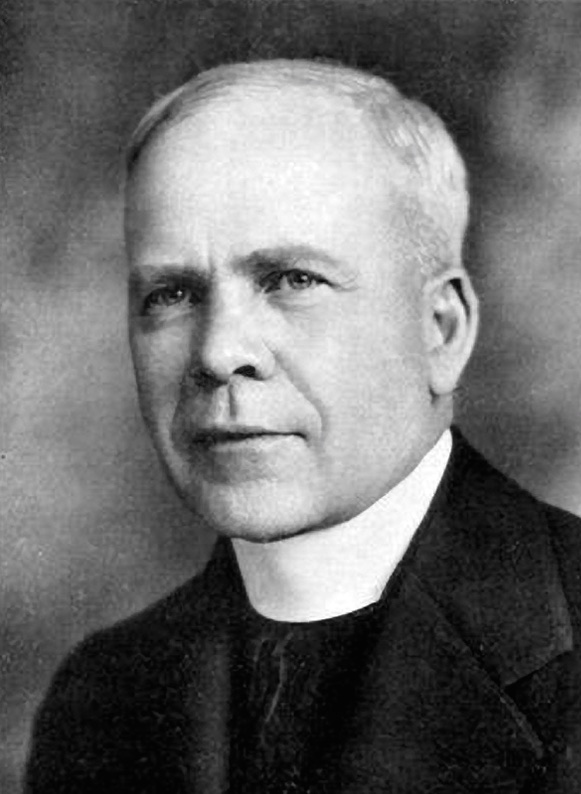
Rev. Charles W. Gille of St. James Catholic Church officiated at the wedding.

Miss Albright, the maid of honor, was gowned in orchid georgette and carried an arm bouquet of rose. Miss Cole, the bridesmaid, wore a gown of orange georgette, and also carried roses. Nina, the little flower girl, was in a little frock of yellow georgette, and Elaine completed the delightful color ensemble in a dress of pink georgette. She carried the ring in a white lily.

Following the service at the church, the bridal party and relatives came to this city, where the ten-thirty breakfast was served at the Witter Hotel. The bride is a graduate of Lincoln High School and the Stevens Point Normal. Since her graduation from the normal school she has been teaching at Vesper. The groom was graduated from Lincoln High and for some time following was employed at the Church Drug store. He later graduated from the pharmacy department of Marquette University at Milwaukee and is at present holding a position with Whitrock and Wolt.

Following a week’s outing in the northern part of the state, part of the time being spent as guests of Mr. and Mrs. Armand Bauer at their cottage at Hayward, they will return here and for the present make their home with Mr. Treutel at Vesper.

©2014 The Hanneman Archive