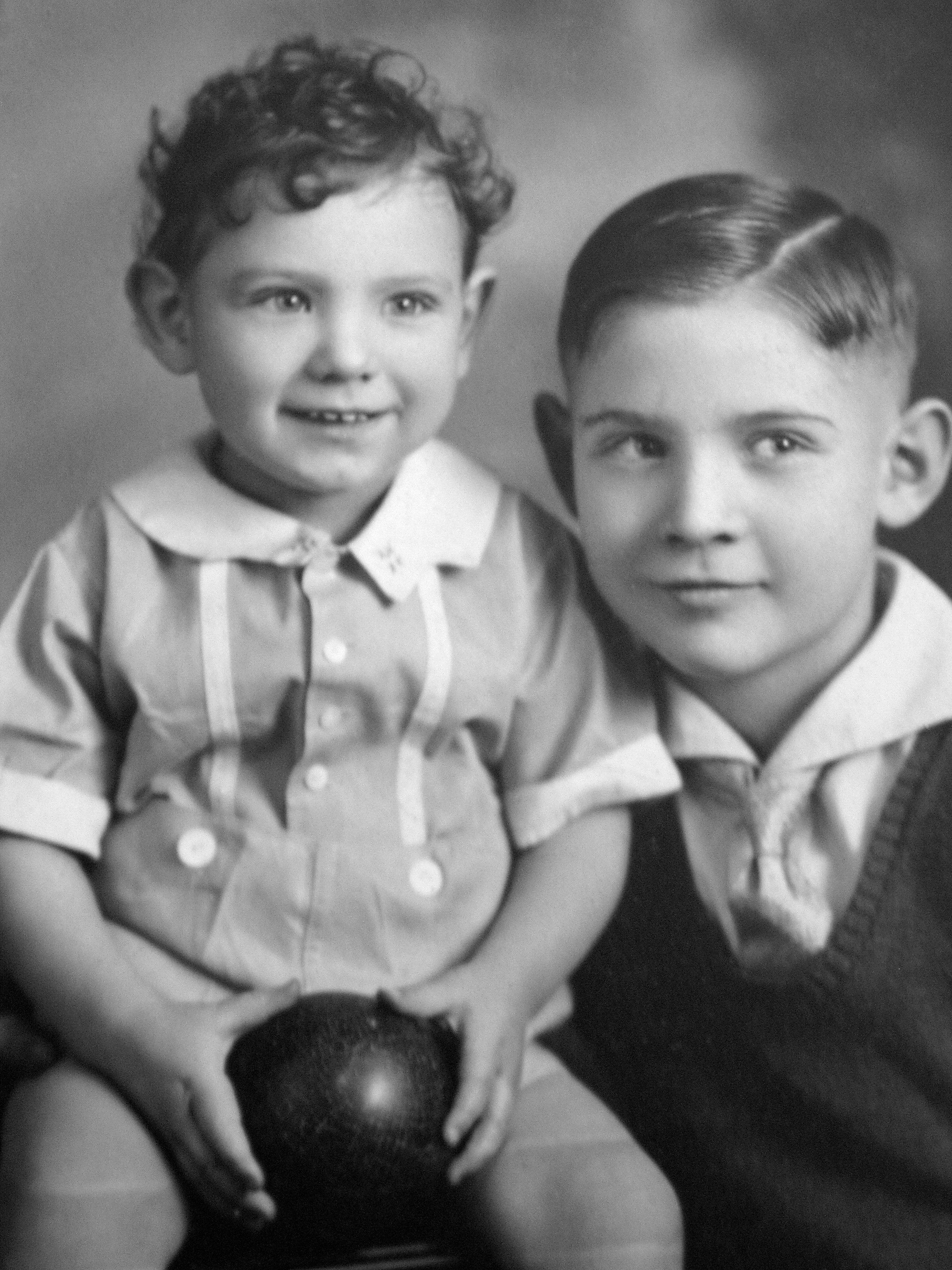
This is one of the earliest photos showing brothers David D. Hanneman (left) and Donn G. Hanneman, taken circa 1936. I believe this portrait was taken in Mauston, Wisconsin, where the family moved in early 1936. My Dad (David) was 3 years old that year. The family had a good relationship with Bauer Studios, so throughout the years there were always nice portraits of the Hanneman children.
David D. Hanneman (1933-2007) and brother Donn G. Hanneman (1926-2014).
I love the curly head of hair on Dad. He always had a great head of hair, right up to the day he lost it from chemotherapy in 2007. He asked me at the time if I thought it would grow back. I said yes, although Dad died before it had the chance. I imagine one day seeing him in Heaven, with either that distinguished-looking silver mane or the wavy jet-black hair from his youth.
“Stentorian Voice.” Of all the notations in the Mauston High School yearbooks of David D. Hanneman, those two words truly stand out. In the “Report of Condition of the Students of Mauston High School” in 1950, David Hanneman’s asset is listed as “stentorian voice.” Not a common adjective, “stentorian” means “of powerful voice.” It can also mean “booming” and “loud.” No doubt the years 1947-51 were stentorian years for Hanneman, for he and his singing buddies at MHS earned accolades and medals for their singing.
David D. Hanneman’s medals from the Wisconsin Centennial Music Festival in 1948.
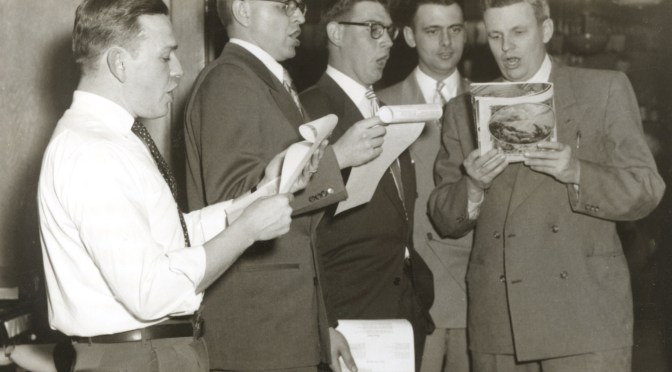
Mauston High School at the time was known for its quality vocal and instrumental music programs. The boys’ double quartet or octette was among the highest profile examples of that quality. The barbershop group regularly competed at the state level in competition sponsored by the Wisconsin School Music Association (WSMA).
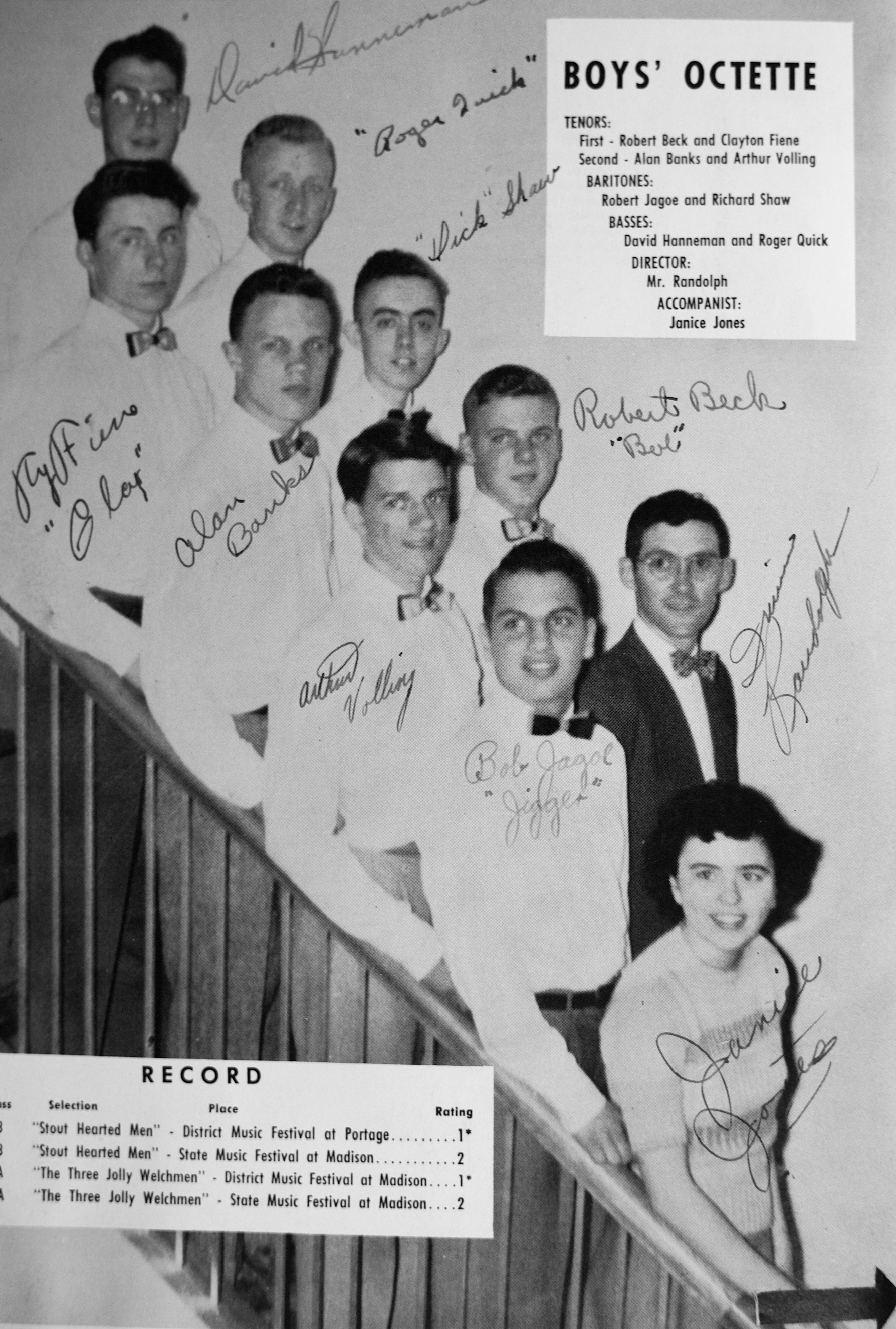
The group included Hanneman and Roger Quick at second bass, Bob Jagoe and Dick Shaw at first bass, Clayton “Ty” Fieneand Bob Beck at first tenor, and Alan Banks and Arthur Volling at second tenor. Self-dubbed the “State Men” for annual appearances in competition, the group had its own cartoon likeness drawn into the Mauston High School yearbook, The Hammer.
Members of the Mauston High School boys double quartet.
In the many WSMA competitions, David Hanneman also sang bass solos, duets and mixed quartets and double quartets. According to one of the judge’s score cards, a Mauston quartet was rated “excellent” for tone, “good” for intonation and “good” for technique. Another judge rated Hanneman “excellent” for his bass solo and noted “maturity of quality” as his greatest singing asset. Hanneman kept the dozens of medals he won at these competitions for many decades after high school.
The “State Men” had their own page in the Mauston High School yearbook in 1951.
Singing wasn’t Hanneman’s only musical interest, however. He played the trumpet for a time and was in the Mauston public school band. He appeared in numerous parades playing the bass drum for the band.
David got his love of song from his mother, Ruby V. Hanneman. As a youngster, Ruby often performed onstage at theaters in Wisconsin Rapids. The Hanneman home in Mauston had a beautiful pump organ and a Victrola record player with a large collection of music. Later in life he appeared in a number of community musicals and sang in the choir at Sacred Hearts of Jesus and Mary Catholic Church in Sun Prairie, Wisconsin. His deep voice could carry the entire parish in song, with enough volume to almost lift the church off its foundations.
United States Marine Cpl. Almeron A. Freeman was scheduled to finish his three-year military service in just a matter of months. After nearly 1½ years in Korea with the 1st Marine Division, Freeman was headed for California aboard a U.S. Navy transport in March 1955. He never made it home. The Douglas R6D airplane slammed into a mountain peak on the Hawaiian island of Oahu. All 66 aboard were killed.
The Bakersfield, California paper from March 22, 1955.
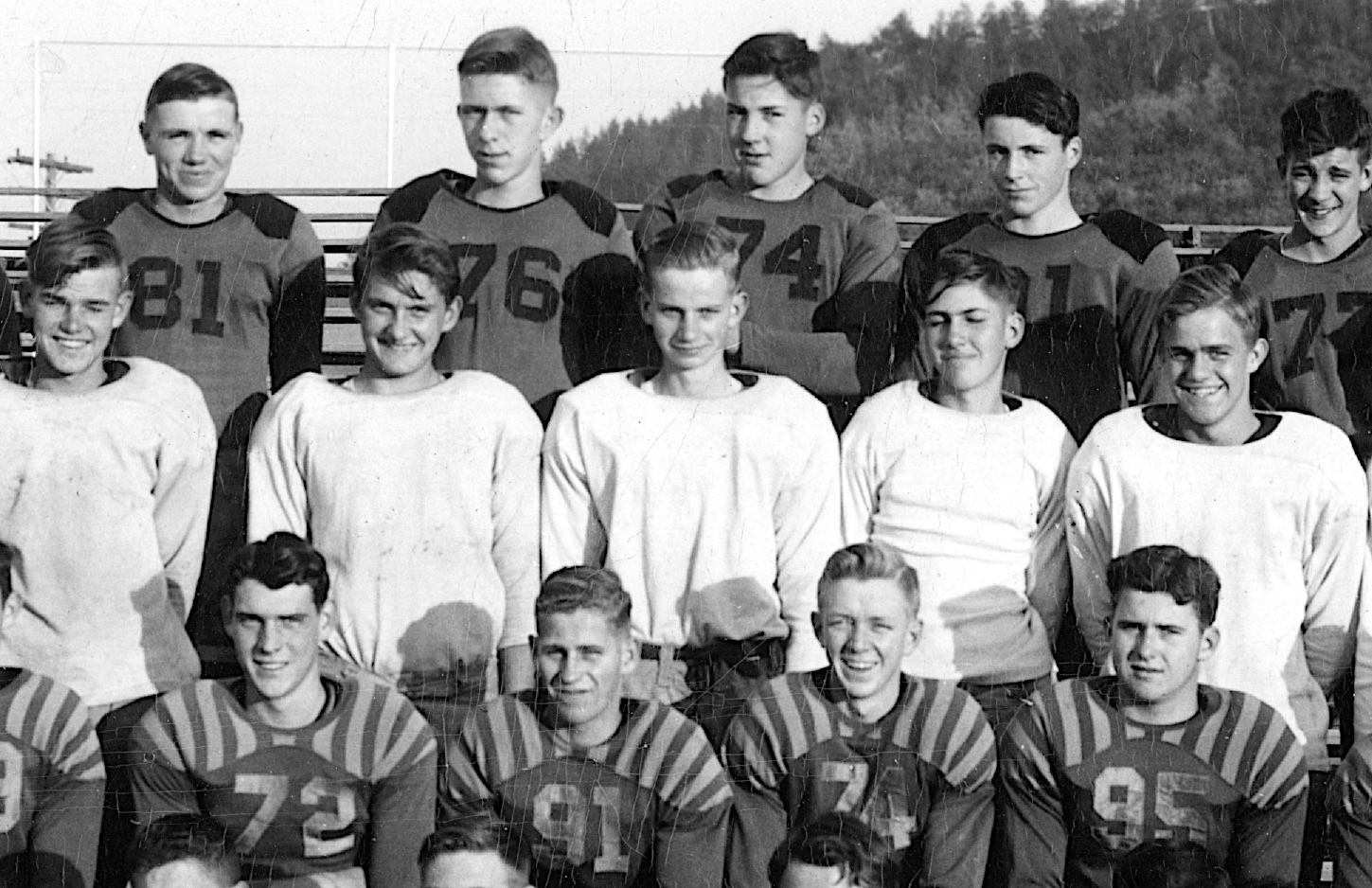
My father, David D. Hanneman, played football with Freeman at Mauston High School. Although Freeman was a year behind Dad in school, he was the same age. Freeman played left guard and wore No. 64 during the 1950 season. Dad played left tackle and wore No. 66. They were both muscular and athletic. Freeman’s death left a deep impression on Dad. In 2006, when planning the Mauston High School Class of 1951’s 55th reunion, Dad made sure Freeman’s photo was included in the program.
U.S. Marine Cpl. Almeron A. Freeman.
Freeman enlisted in the Marine Corps on August 27, 1952, directly after his graduation from Mauston High School. He was an infantry rifleman with the First Marine Division. He landed for duty in Korea just four months after an armistice ended Korean War combat and began a tense “peace” along the 38th Parallel.
At the end of his tour, he flew from South Korea to Tokyo, then to Hickam Field on the island of Oahu in the Hawaiian Islands. Just after 6 p.m. on March 21, 1955, Freeman was onboard a U.S. Navy R6D transport that left Hickam for Travis Air Force Base in California. Some 3½ hours into the flight, the plane developed radio problems and turned back for Oahu. Just after 2 a.m. on March 22, the plane was seen roaring low over the Navy’s Lualualei ammunition depot. Marine Pfc. Joseph T. Price, on guard duty at Lualualei, said the pilot turned on the landing lights and discovered the plane was headed straight into the Wai’ane Mountains. At the last second, the plane made a hard right, but slammed into the mountain about 200 feet below the tip of Pali Kea Peak. The explosion “lit up like daylight for about a minute,” Price said.
Almeron Freeman (farthest right in middle row), played for Mauston High School with David D. Hanneman (No. 72 in front row).
The resulting fire was so hot that it took rescuers nearly two hours to get close enough to confirm there were no survivors. The 66 killed included nine Navy crewmen and 57 passengers: 17 U.S. Air Force, four Navy, 12 Marines, 22 U.S. Army and two civilians (a mother and her baby daughter). It was the worst air disaster in Hawaii’s history. The U.S. Military Air Transportation System, which operated the flight, had flown 1.12 million passengers and crossed the Pacific nearly 42,000 times between January 1951 and March 1955 with no fatalities. The crash was caused by crew error. The plane was 8 miles off course when it struck the mountain.
Freeman’s junior class portrait.
Almeron Arthur Freeman was born February 3, 1933 in Dresbach Township, Minnesota, the son of Irvin M. Freeman and the former Lilah Jenks. Prior to 1940, the family moved from Houston County, Minnesota to Mauston. Irvin worked as a service station attendant. In addition to being a starting guard on the football team, Almeron was a member of the highly rated Mauston boxing team.
Freeman (at left in first row) pictured in 1951 with other letter winners in the M Club.
He came from a proud family military tradition. His great-grandfather and namesake, Almeron Augustus Freeman, served in the Civil War with the 1st Independent Battery, Wisconsin Light Artillery. The battery served under General William Tecumseh Sherman and General Ulysses S. Grant at the battle of Vicksburg, the battle of Port Gibson and later in defense of New Orleans. The elder Freeman later married and became a river pilot moving lumber on the waterways of Wisconsin.
Almeron Freeman (No. 30) played basketball for Mauston High School with David D. Hanneman (second from left in front row).
Marine Cpl. Freeman was buried May 17, 1955 at Jefferson Barracks National Cemetery in St. Louis. Due to the nature of the crash and fire, the remains of 40 service members were buried in a group grave site containing nine caskets. A memorial service for Freeman was held at Mauston High School on May 15, 1955.
The tragedy of the March 1955 air crash extended beyond the immediate victims and their families. Air Force Staff Sgt. Marion “Billy” Shackleford was scheduled to be on that flight, but because he forgot his travel papers, he was denied boarding. He was spared the fate of the 66 crash victims and returned home to Alabama to report for a new assignment. On April 19, 1955, the car he was driving was hit head-on by a Trailways Bus. He was killed instantly. His father, working on a nearby construction job, witnessed the accident. Like Freeman, Sgt. Shackleford was the great-grandson of a Civil War veteran.
Just three weeks after becoming a father for the third time, young pharmacist Carl. F. Hanneman took the extraordinary step of writing to the attorney general of Wisconsin to ask that he be granted full licensure as a registered pharmacist. It was a heartfelt letter, written by a young man feeling the weight of responsibility of a wife and three children. Written by a well-educated and accomplished man who felt he deserved what he as asking. The very future was at stake.
“I am writing this letter in all sincerity as what I am about to ask means everything to myself as well as my wife and three little kiddies,” Carl wrote to Attorney Gen. Orland S. Loomis on Sept. 3, 1937.“I am 35 years old and will be 36 this coming October and feel that obtaining my full registered papers will mean life itself to myself and my dear family.”
Carl explained that he was fully licensed as an assistant pharmacist, working at the Mauston Drug Store owned by Dr. J.S. Hess Jr. But he was unable to officially manage the drug store due to a quirk in state law.
Wisconsin Attorney Gen. Orland S. Loomis of Mauston
If Carl had worked in a smaller town with under 500 population, he could have legally managed the pharmacy. But Mauston population was about 2,100. Carl would need to be a registered pharmacist in order to manage the Mauston Drug Store.
“My capacity in the drug store is as an unofficial manager, as I do all of the buying etc., but legally cannot manage the store,” Carl wrote. “Dr. J.S. Hess Jr. has confidence in me and I a great deal in him, and as far as I am concerned am willing to stay here the rest of my life, dispensing for our own doctors.”
Carl reasoned that if he was qualified to own and manage a pharmacy in a small town (such as neighboring Lyndon Station, pop. 236), why could he not serve the same capacity in Mauston? “I have often wondered as has many others, are not the lives of 500 people in a small town just as valuable to their loved ones as those living in a town where there might be more than this amount?” Carl wrote.
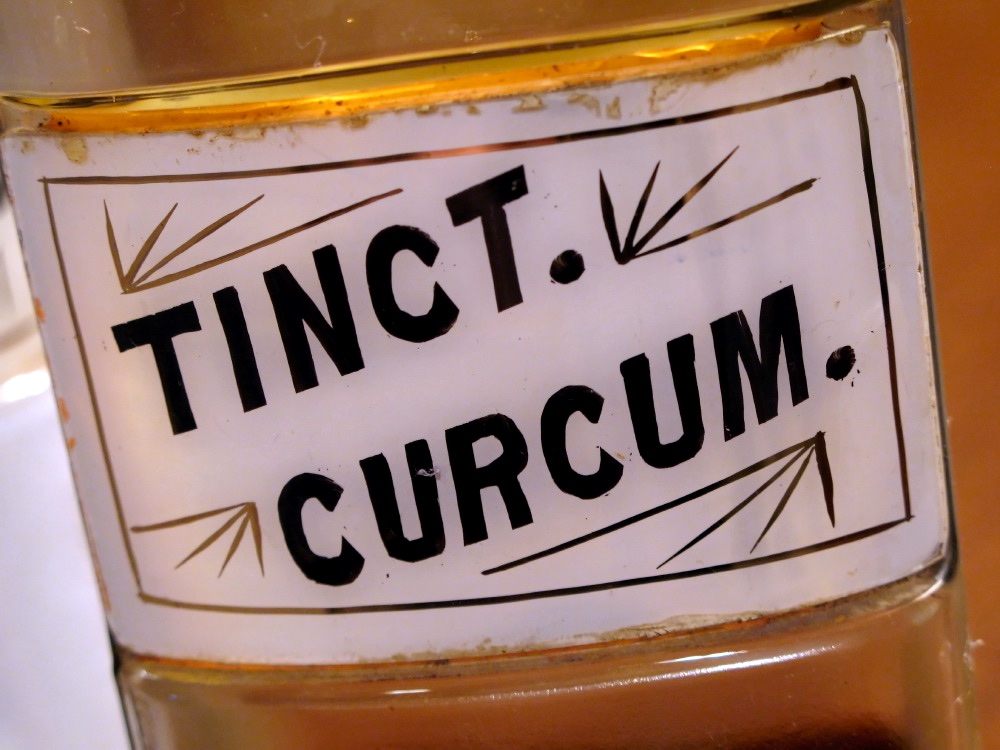
A label under glass from Carl F. Hanneman’s pharmacy collection.
By 1937, Carl had 16 years of experience in pharmacology, starting as an apprentice in 1921 at the Sam Church drug store in Wisconsin Rapids. Carl graduated from the pharmacy program at Marquette University in 1925 and became licensed as an assistant pharmacist. He wasn’t eligible to take the full pharmacist exam at the time because his apprenticeship fell just short of the required five years. Over the next decade he worked at drug stores in Janesville, Fond du Lac and Wisconsin Rapids, and even worked a three-year stint as a salesman for Consolidated Water Power & Paper Co.
“I knew my lifework was with the drug store as I truly love it and was very fortunate in securing a position with the Dr. Hess Hospital, Clinic and Drug Store organization on Feb. 1, 1936,” Carl wrote.
Carl said he would likely need three more years of study to pass the registered pharmacist board exams as they existed in 1937. With three children (including baby Lavonne born in August 1937), Carl figured that simply would not be possible. So he asked for help from Loomis, a Mauston native who served as city attorney from 1922 to 1931. Loomis was attorney general through 1938, and was elected governor of Wisconsin in 1942. He died before taking office. Eventually, Carl became good friends with Loomis and photographed him for the Wisconsin State Journal on the 1942 night of his election as governor of Wisconsin.
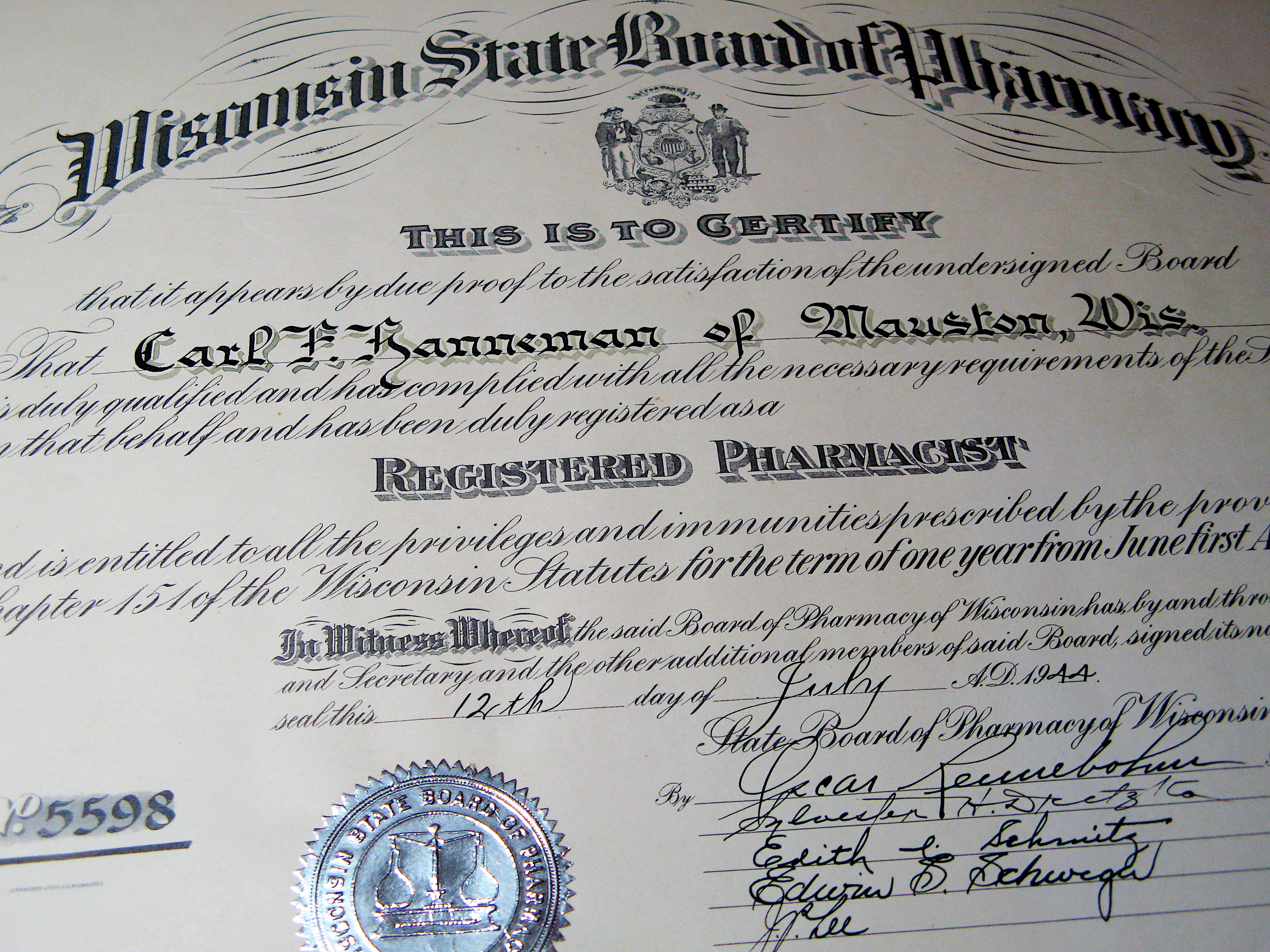
Carl F. Hanneman’s registered pharmacist license, issued in July 1944.
We don’t know if Loomis ever intervened on Carl’s behalf in his role as attorney general or governor-elect, or how he responded to the 1937 letter. A search of Loomis’ law-practice records at the Wisconsin Historical Society yielded no clues. Carl’s 1941 license from the Wisconsin State Board of Pharmacy still lists him as an assistant pharmacist. On July 12, 1944, the state of Wisconsin issued an ornate document certifying Carl as a full registered pharmacist. He worked under the new license number until his death in 1982. It would appear Carl secured his added credentials the hard way: he earned them.
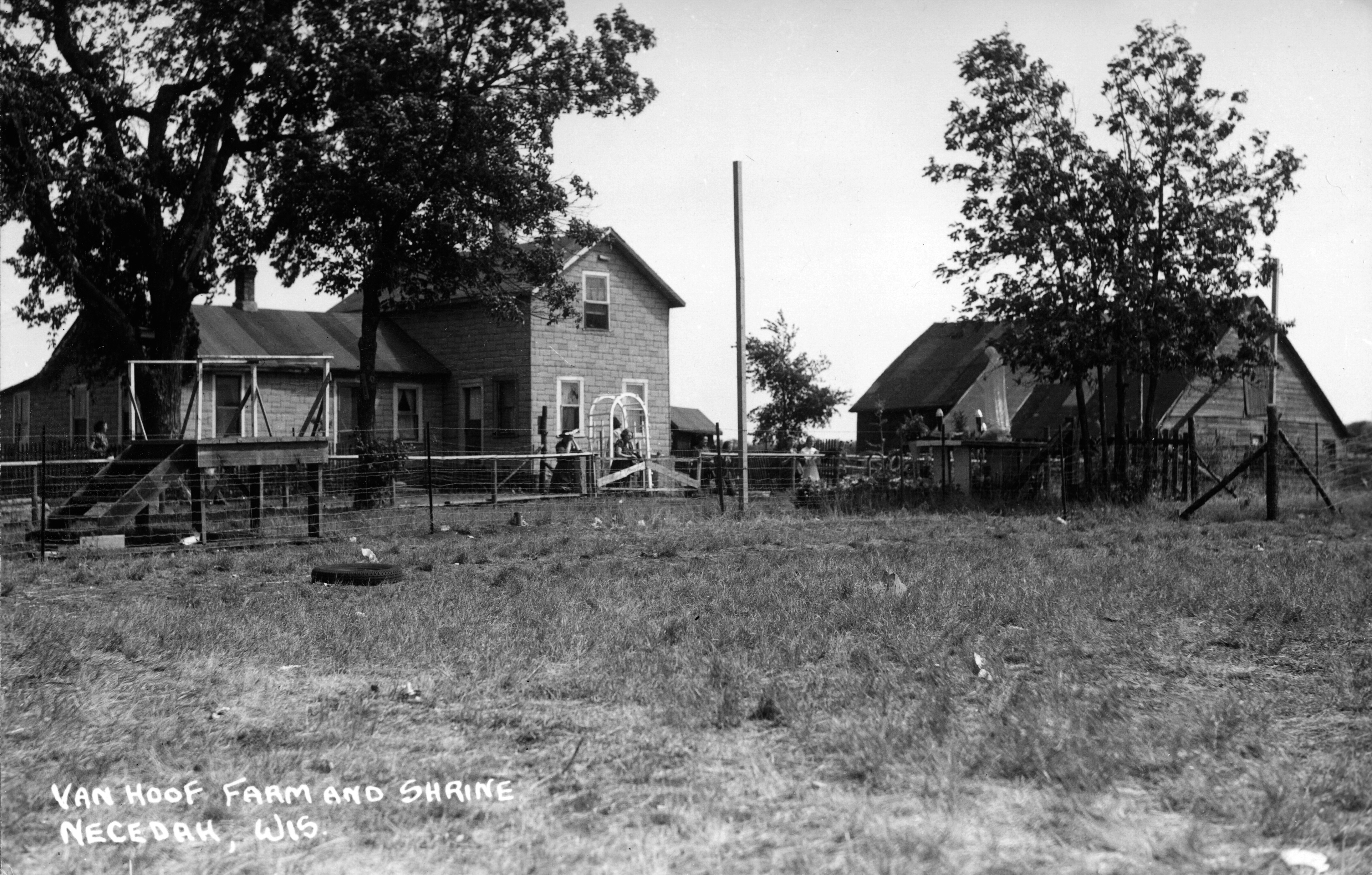
Nothing was bigger news in the fall of 1950 in central Wisconsin than Mary Ann Van Hoof and her claims of receiving visions from the Blessed Virgin Mary at the Van Hoof farm near Necedah. Members of the Hanneman family of Mauston, had great devotion to Mary, and they were among 50,000 people in Necedah on October 7, 1950, when Van Hoof received the eighth of her reported visions of Mary.
The front page of the Wisconsin State Journalthe next day recounted the alleged vision this way:
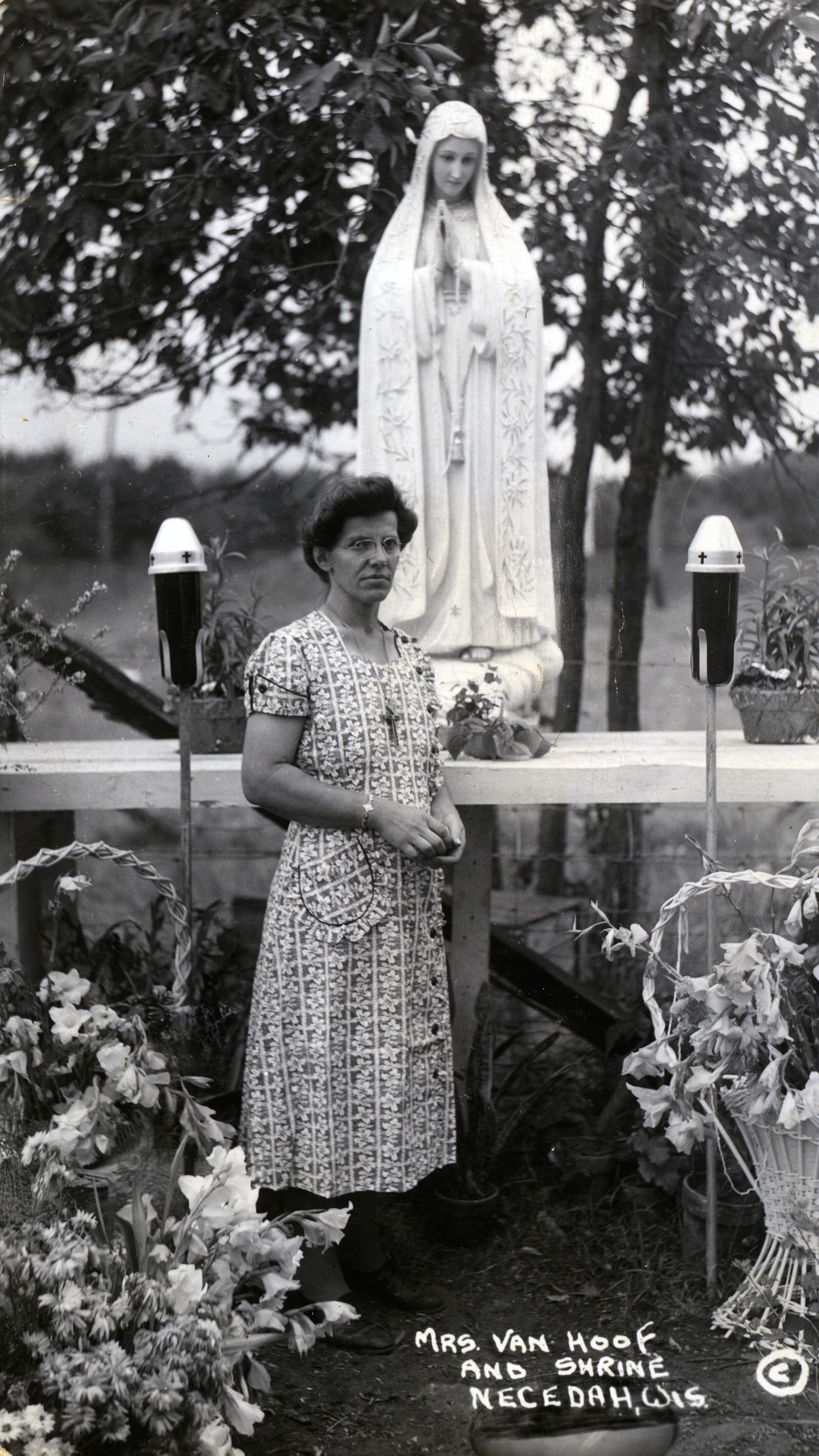
Mary Ann Van Hoof at her farm near Necedah, Wisconsin.
“Mrs. Fred Van Hoof said she saw the Virgin Mary in a vision for the eighth time Saturday and was told in a ‘last warning’ to pray for peace. The gaunt farm wife, who said last August that the Virgin would appear to her Saturday noon in a blinding light, walked from her shabby home at the appointed hour, knelt in prayer and raised a crucifix to a statue of the Virgin. At that moment, the sun burst through rain clouds which had hovered over the humble farm most of the morning, and a murmur swept through the crowd estimated by state police at 50,000 persons.After a few minutes, Mrs. Van Hoof arose and addressed the mingled throng of curious and claims to have done on previous visitations. ‘This is the battle for peace for all of you,’ she said. ‘Prayer, my dear children, will bring you peace.’ ”
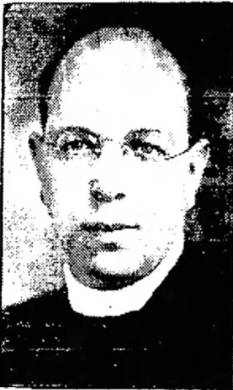
Rev. Father Victor A. Fortino
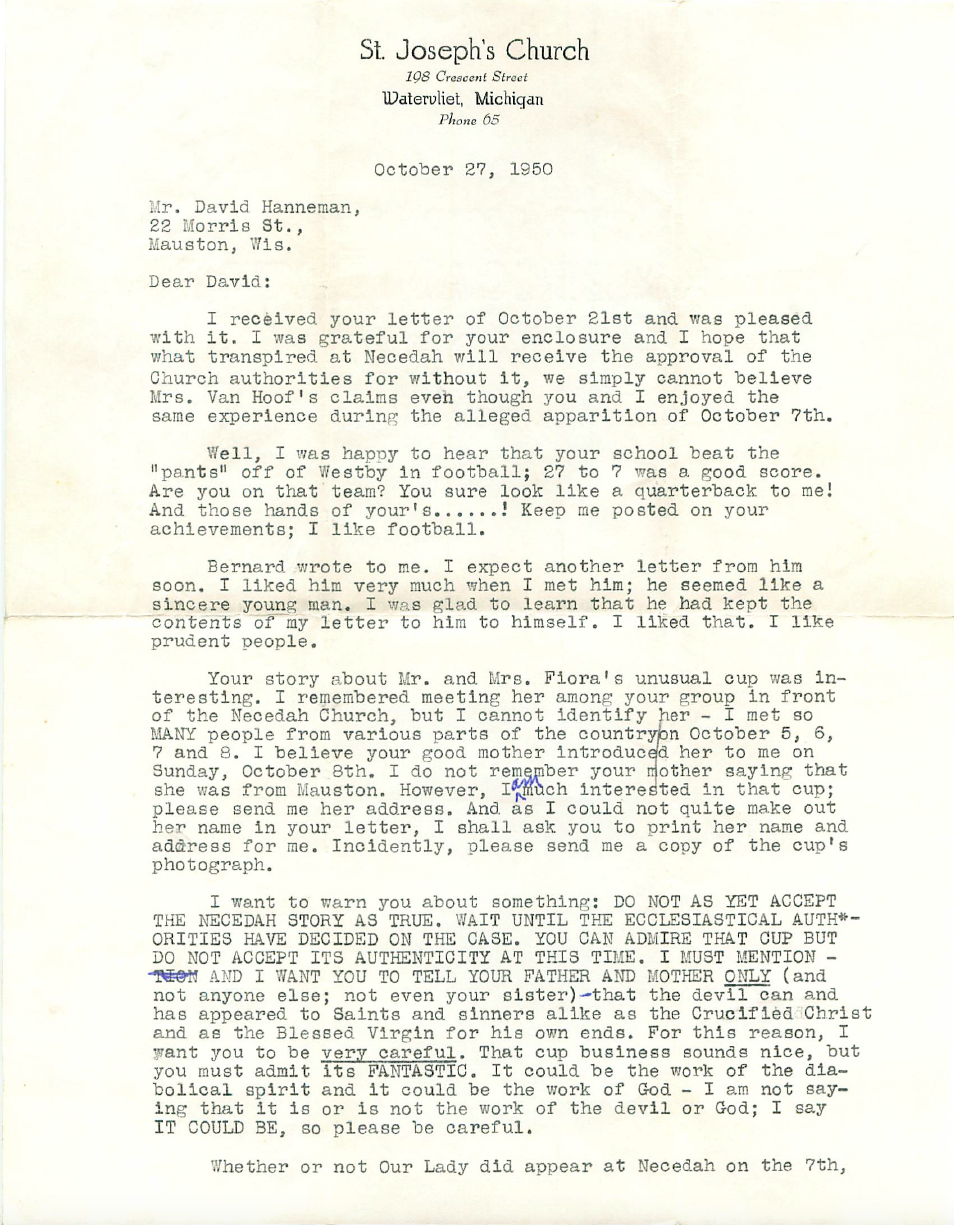
A priest from Watervliet, Michigan, who was also in attendance that day befriended the Hanneman family. Rev. Father Victor A. Fortino of St. Joseph’s Church in Watervliet, cautioned 17-year-old David D. Hanneman to wait for Catholic Church authorities to approve the alleged visions before he placed too much stock in them. “I hope that what transpired at Necedah will receive the approval of the Church authorities,for without it, we simply cannot believe Mrs. Van Hoof’s claims even though you and I enjoyed the same experience during the alleged apparition of Oct. 7,” Fortino wrote in a letter dated October 27, 1950.
The Van Hoof farm near Necedah, Wisconsin, was the site of reported visions of the Blessed Virgin Mary.
Father Fortino warned that Satan has appeared to Saints and sinners alike posing as the Blessed Mother and as the Crucified Christ, so it is crucial that the Church rule on the Van Hoof apparitions. “I want to warn you about something,” Fortino wrote. “DO NOT AS YET ACCEPT THE NECEDAH STORY AS TRUE. WAIT UNTIL THE ECCLESIASTICAL AUTHORITIES HAVE DECIDED ON THE CASE.”
As it turned out, Fortino’s words were almost prophetic. In June 1955, Bishop John Treacy of the Diocese of La Crosse officially rejected Van Hoof’s visions.“Because of the continued promotion of the claims made by Mrs. Mary A. Van Hoof of Necedah, Wis., we, by virtue of our authority as bishop of the diocese of La Crosse, hereby declare that all claims regarding supernatural revelations and visions made by the aforementioned Mrs. Van Hoof are false. Further more, all public and private religious worship connected with these false claims is prohibited at Necedah, Wis.” As early as August 1950, Bishop Treacy had said Van Hoof’s claims “are of extremely doubtful nature.”
Father Victor Fortino urged David Hanneman: “be very careful.”
Father Fortino may have suspected the Necedah claims would turn out to be false, but he wrote that some good could come from the gathering that week in 1950 no matter what. “It seemed to me that Our Lady brought us together for Her own good purposes,” Fortino wrote. “What She intends for us, I do not know. But I hope that much good will come out of our chance meeting and our mutual experience in Necedah.”
Despite the controversy over Van Hoof and her claims, the Hanneman family maintained strong devotion to the Blessed Virgin Mary. Carl and Ruby Hanneman kept a beautiful porcelain statue of the Blessed Mother in their Mauston home. After their deaths that statue found a place at David Hanneman’s residence in Sun Prairie. And it sat in front of the altar at his funeral Mass on April 19, 2007.
It was a tiny photograph, not much larger than an oversized postage stamp. It showed two boys, identified on the back as Bob Firlus and Sam Kaufman. Of course I was very familiar with Bob, my Dad’s lifelong friend from Mauston, Wisconsin. But Sam did not ring a bell. However, his presence in my Dad’s photo collection meant that he was a friend and likely a frequent guest at the home of my grandparents on Morris Street in Mauston. I wondered, what became of Sam?
Bob Firlus (at left) and Sam Kaufman on Morris Street in Mauston, circa 1940.
The photo detective in me kicked into high gear. My first check was with Mr. Firlus, who had some distinct and humorous early memories of Sam:
They had a nice house on Tremont Street. One day Sammy and I walked out to Coon Rock Bluff a few miles west of Mauston. We were near the bluff and Sammy said that he had to take a pee but he asked me not to tell his dad because his dad told him he should not pee outdoors.
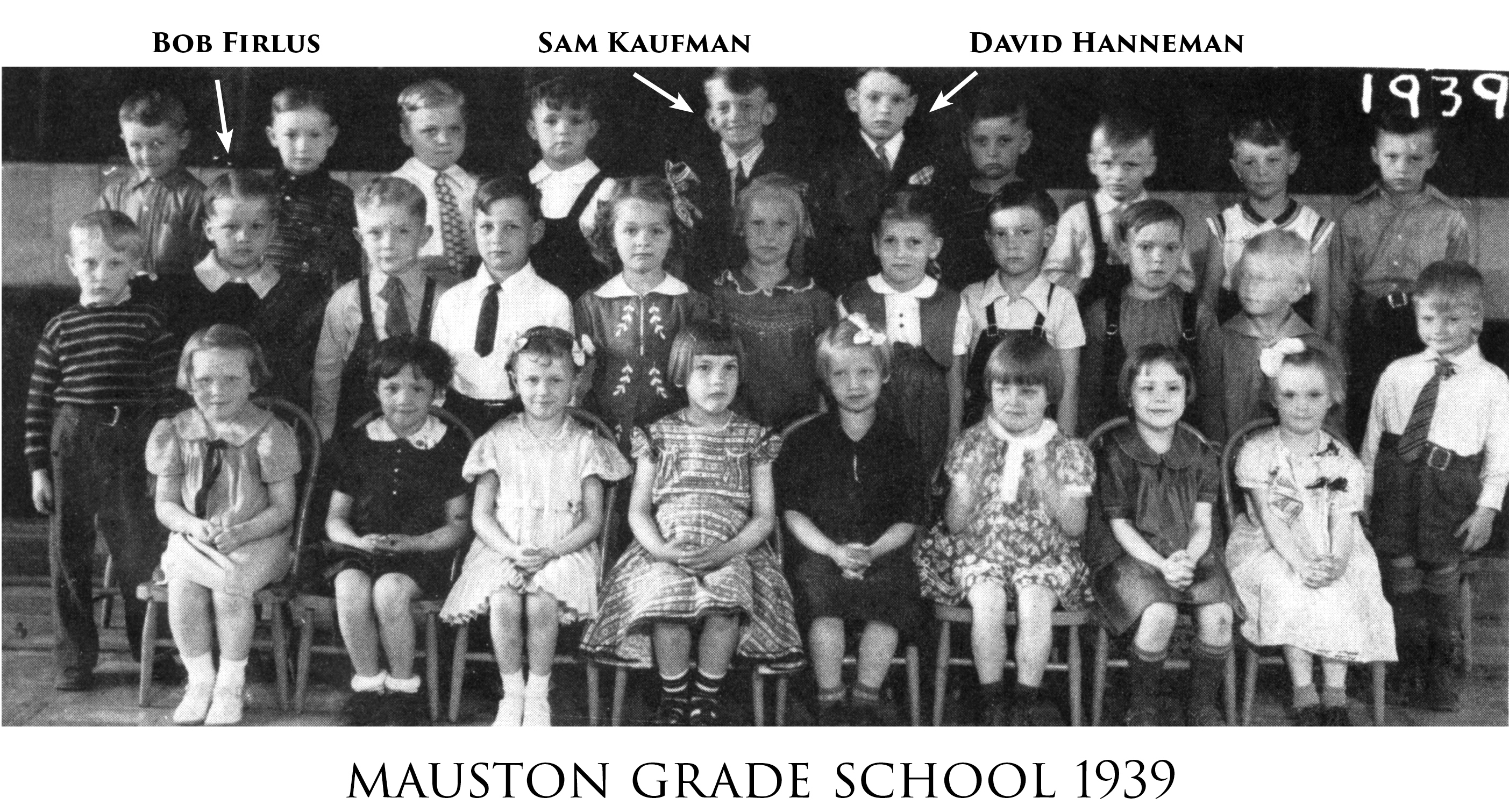
Ah, the troubles of youth! What a great story! Bob said he believed Sam had moved to Pennsylvania after leaving Mauston. I next dug out some of my Dad’s yearbooks and found Sam pictured with my Dad’s Mauston Grade School class in the late 1930s and early 1940s. He was one of the tallest boys in class, so was usually found in the back row. In the 1939 class photo, he was standing directly to my Dad’s right.
Bob Firlus, Sammy Kaufman and David Hanneman are shown in this early school photo.
I checked the U.S. Census and military records on Ancestry.com and found Sam’s father, Albert Ross Kaufman, a doctor at Mauston’s Hess Memorial Clinic. The elder Kaufman’s 1942 draft card showed he was 46 and living with his family at 214 Tremont Street in Mauston. That was fairly close to the Hess clinic, but not so close to the Hanneman house. So what was his connection to that photo taken on Morris Street? I looked up Sam’s mother, Ardis, and discovered her maiden name was Hess. OK, now we’re making progress. Hess was a very prominent name in Mauston, largely due to Dr. James Samuel Hess Sr., a pioneer doctor and founder of the hospital and clinic. Interestingly, Bob Firlus said he had recently thought about Sam and the name Ardis came to mind, although Bob hadn’t recalled that was Sam’s mother’s name.
Turns out that Dr. Ardis (Hess) Kaufman (also a physician) was the daughter of Dr. J.S. Hess Sr. and Maude (Robinson) Hess. She was the sister of Dr. J.S. Hess Jr., who lived directly across the street from the Hannemans. Dr. Sam, as the junior Hess was known, took over for his father at the hospital and clinic. That explained why Sammy was a frequent neighborhood visitor. My grandfather, Carl F. Hanneman, worked for Dr. Sam running the pharmacy attached to the Hess clinic. So it made sense that Bob Firlus and my Dad were buddies of Sam Kaufman. I dug into my photo archives and found another shot that appears to show Sam outside the Hess home around 1942.
A tall, thin young man believed to be Sam Kaufman outside the Hess home on Winsor Street.
Now that I had a good sense of Sam’s history in Mauston, I wanted to figure out where he went and what happened in his life. Again, Ancestry.com was a crucial source. I found listings for Dr. Albert R. Kaufman under city directories in New Kensington, Pennsylvania. Based on that, I ran search engine queries and located an obituary for Sam Kaufman. I reacted with sadness, since I always hope in doing this work to find a living person to track down. Sam died in October 2008 of lung cancer. Same cause as my Dad, and about 18 months later. From the obituary, it was clear Sam had lived an exemplary life.
The obituary described Sam’s college education, his longtime service in the U.S. Army, his 1957 marriage to Margaret “Meg” Floyd, and his career switch from salesman to high school teacher. He had a long teaching career at Baldwin High School in suburban Pittsburgh. The couple had two sons, James and Steve. From checking those names with search engines, it appears Steve has had a long career as an assistant U.S. attorney in Pittsburgh.
Even after I finished most of my research, Sam’s name stuck in my head. There was some other clue I was missing. Dad, could you give me some help here? Then it hit me. I vaguely recalled that Sammy accompanied my Dad’s family on one of their vacation trips to the Dakotas. But how to find the photo amidst the thousands in the archive? On this day, I had some help from above. The first archive box I opened had the photo for which I searched. The caption read: “Sammy Kaufman on right, David Hanneman on left.” It was in my Grandma Ruby’s handwriting.
David Hanneman (left) and Sam Kaufman outside the Ortman Chiropractic Clinic in Canistota, S.D., circa 1944.
It took a few days of work, but with a little effort I went from a tiny photo print with lots of questions to a decent understanding of Sam Kaufman and his life in and beyond Mauston. Well done, Sam, and thank you.
[The original version of this story posted in 2014 stated that President Truman visited Mauston, Wisconsin. A sharp-eyed former resident of Mauston noted in the comments section that Truman did not visit Mauston, but rather nearby Elroy. The Truman Presidential Library has now confirmed this, so the story has been corrected and expanded as of May 10, 2017.]
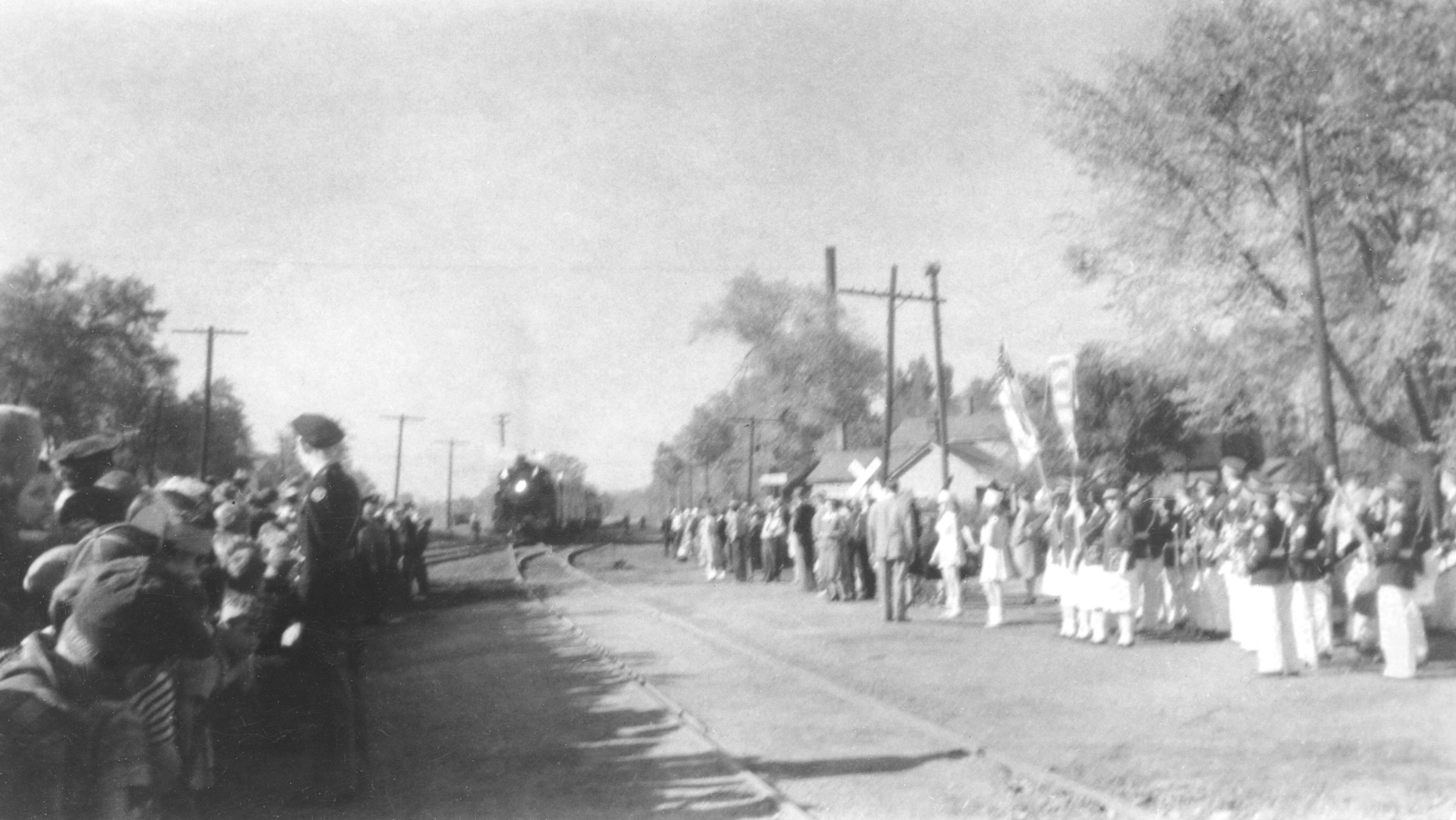
When President Harry S Truman pulled into tiny Elroy, Wisconsin on his rail tour of America in 1948, the Carl F. Hanneman family was at the station and captured several Polaroid images of the event. The grainy and out of focus photos are far from perfect, but they provide literal snapshots from one of the great political stories in American history.
The Harry S Truman express approaches Elroy, Wisconsin, on October 14, 1948.
Truman went on an 30,000-mile“whistle-stop” railroad tour of the nation,visiting large cities, small villages and everything in between. His 17-car train was called the Magellan. Much like his old boss President Franklin Delano Roosevelt had done, Truman made speeches from a presidential podium at the back of the train. The tour drew huge crowds wherever he went, and Mauston was no exception. According to the Truman Presidential Library, the president made up to eight speeches each day during the rail tour.
President Harry S Truman took his case directly to the people during his 1948 rail tour.
On this day, Truman started out with a speech in Mankato, Minnesota at 8:08 a.m. Other stops included Waseca, Rochester and Winona, Minnesota; and Sparta, Wisconsin. The train pulled into Elroy at 1:55 p.m. on October 14, 1948. Truman stepped to the podium and said:
I certainly do appreciate your coming out here. This was supposed to have been a water stop. I didn’t think that we would be here long enough for me to speak to you, but I am happy that we did stop long enough, and I appreciate your interest and I appreciate your coming out here to see the president.
I wish I had the chance to discuss with you all the issues in this campaign, but I haven’t the time now.
I hope you’ve been reading the speeches and statements I have been making over the country. They are in your interest, and if you vote for your own interests on the 2d of November you’ll elect a Democratic Governor and a Democratic Congressman from your district–and you’ll elect a Democratic administration in the whole United States Government. And then things will be safe and in the hands of the people.
Conventional political wisdom had Truman losing badly before a single ballot was cast. When he won the election, it was viewed as a stunning turn of events. Many will recall the famous photo of Truman holding the early edition of the Chicago Tribune with the erroneous headline, “Dewey Defeats Truman.” That photo was snapped at the back of the same train in St. Louis, as Truman departed for Washington.
It seems the term “whistle-stop” was considered a bit of a slight. When Republican Sen. Robert Taft of Ohio criticized the Democrat Truman for things he was saying on the “whistle-stop” tour, mayors of towns on the route of Truman’s tour reacted with indignation. “Our whistles never stop blowing,” one huffed. Crestline, Ohio, was quick to point out the 42 daily trains that served its population of 5,000. The Associated Press at the time said a whistle-stop was a “tank town, a hamlet, a mere wide place in the road.” Truman’s own comments at Elroy indicate the stop there was supposed to be only to take on water.
Of course millions of Americans live in such places, so the kerfuffle seemed a bit strange. As columnist Thomas L. Stokes noted, “Whistle-stop folks vote, too.” Stokes called the rail tour a public service, part of a president’s responsibility to communicate directly with the American people.
Esther Marie Albrecht was married to Emil Rudolph Gottschalk on November 12, 1930 in the Town of Hewitt in Wood County, Wisconsin. Esther was the maid of honor at the July 1925 wedding of Ruby V. Treutel and Carl F. Hanneman in Vesper, Wisconsin. Mr. and Mrs. Gottschalk moved to Waukesha, and had two daughters, Pearl and LaVon. They were longtime friends of the Hanneman family. She is the daughter of George and Pearl (Smith) Albrecht.
Esther M. Albrecht married Emil R. Gottschalk in November 1930 in the Town of Hewitt, Wood County, Wisconsin.
According to the 1930 and 1940 U.S. Census, Emil worked as a core maker in an iron foundry in Waukesha. Emil Gottschalk died on February 1, 1944 at just age 37. Mrs. Gottschalk operated Esther’s Food Store on Arcadian Avenue in Waukesha. In April 1946, she married Harold D. “Whitey” Buchs at St. Joseph’s Catholic Church in Waukesha. Esther died January 1, 1985 in Vesper. Harold died April 13, 2007 in Vesper.
For a child growing up in the 1930s and 1940s, big adventure often came in small packages. Like many boys his age, David D. Hanneman (1933-2007) was an avid collector of Big Little Books. These chunky mini-books allowed adventure-seeking children to follow the action of Buck Rogers, Dick Tracy, Flash Gordon, Tarzan and other characters. All for 10 cents a book.
The original Big Little Books concept was pioneered by the Whitman Publishing Company of Racine, Wisconsin. Whitman was a subsidiary of Western Publishing, the creator of the famous Little Golden Books (think Poky Little Puppy). Big Little Books were roughly 3¾ inches wide by 4½ inches high. Thickness varied by page count. For example, the 1934 Buffalo Bill and the Pony Express had 380 pages and was 1¼ inches thick. The layout was one of the classic features of Big Little Books. Each page spread had text on the left side and a black-and-white illustration on the right.
Big Little Books had text on the left-facing pages and illustrations on the right pages.
Whitman Publishing came out with its first Big Little Book in 1932, The Adventures of Dick Tracy. Soon after, Whitman had titles with comic strip characters like Wash Tubbs, as well as a range of Walt Disney titles. The 1934 series alone included titles such as Chester Gump Finds the Hidden Treasure, Buck Rogers in the City Below the Sea, Reg’lar Fellers, Betty Boop in Snow White, Kayo and Moon Mullins, Mickey Mouse in Blaggard Castle and Dick Tracy and the Stolen Bonds.
Most of the books had hard covers, although my Dad had one Buck Rogers title that was softcover and in a slightly smaller format (only 4¼ inches high). This book had no page numbers. The inside back cover spread was a two-page ad for Cocomalt drink mix. The 1935 Tom Mix and Tony Jr. in Terror Trailwas a larger format (4 5/8 by 5¼ inches) and featured real photographs inside.
Ruby V. Hanneman wrote an inscription on the inside cover for my Dad’s 8th birthday.
For my Dad’s 8th birthday, he received a copy of the 1941 Tarzan the Untamed by Edgar Rice Burroughs. Ever the historian, my Grandma Ruby V. Hanneman wrote the particulars down in blue pencil on the inside front cover: “David Dion Hanneman, March 27, 1941, for 8th birthday, from Dad, Mother, Lavonne and Donn.” This title was from the Better Little Books series, also published by Whitman. In addition to the story and illustrations, it had a flip-book feature that showed an animation as the reader flipped the pages through his thumb and forefinger.
Titles in the 1941 Better Little Books series included Big Chief Wahoo and the Magic Lamp, Mickey Mouse on Sky Island, Popeye and a Sock for Susan’s Sake, G-Man and the Gun Runners, Dick Tracy and his G-Men, Red Barry Undercover Man, Ellery Queen and the Adventure of the Last Man’s Club, Inspector Charlie Chan Solves a New Mystery and others. By the time he was in high school, my Dad stopped adding to his collection. But they clearly held a special place in his heart, since he kept and safeguarded them for more than 50 years before passing them on.
During his nearly six decades as a pharmacist, Carl F. Hanneman got to know a lot of people. He forged good relationships with the many sales reps who called on him at the Mauston Drug Store. Some came to dinner at the Hanneman home, and a few even stayed at the house while in town. One of the long-lasting perks he received from Parke, Davis and Company was a stunning set of lithographs depicting the history of pharmacy. More than 30 prints still exist from Carl’s 1950s collection.
Parke-Davis commissioned artist Robert Thom to produce 40 illustrations for the series, “A History of Pharmacy in Pictures.” Each print came with a history article that explained the depicted scene and its place in history. Launched in 1957, the series was developed in cooperation with the Institute for the History of Pharmacy at the University of Wisconsin. Druggists were encouraged to display the artwork in their stores.
The series depicted such early topics as scientist Galen in the second century to later developments such as chemotherapy, antibiotics and pharmaceutical research. Parke Davis also commissioned Thom to paint a series of illustrations on the history of medicine. Thom (1915-1979) was well known as an illustrator of historical subjects, including great moments in baseball and the history of Illinois and Michigan.
The paintings from Carl Hanneman’s collection are in the gallery below, including the explanatory text from each image.
— This post has been updated with additional Thom paintings.
Man learned early of the prestigious advantage of trademarks as a means of identification of source and of gaining customers’ confidence. One of the first therapeutic agents to bear such a mark was Terra Sigillata (Sealed Earth), a clay tablet originating on the Mediterranean island of Lemnos before 500 B.C. One day each year clay was dug from a pit on a Lemnian hillside in the presence of governmental and religious dignitaries. Washed, refined, rolled to a mass of proper thickness, the clay was formed into pastilles and impressed with an official seal by priestesses, then sun-dried. The tablets were then widely distributed commercially.
In the evolution of all successful and enduring systems of knowledge there comes a time when the observations of many men, or the intensive studies of one, transcend from the level of trade or vocation to that of a science. Pedanios Dioscorides (first century A.D.), contributed mightily to such a transition in Pharmacy. In order to study materia medica, Dioscorides accompanied the Roman armies throughout the known world. He recorded what he observed, promulgated excellent rules for collection of drugs, their storage and use. His texts were considered basic science as late as the sixteenth century.
Of the men of ancient times whose names are known and revered among both the professions of Pharmacy and Medicine, Galen, undoubtedly, is the foremost. Galen (130-200 A.D.) practiced and taught both Pharmacy and Medicine in Rome; his principles of preparing and compounding medicines ruled in the Western world for 1,500 years; and his name still is associated with that class of pharmaceuticals compounded by mechanical means – galenicals. He was the originator of the formula for a cold cream, essentially similar to that known today. Many procedures Galen originated have their counterparts in today’s modern compounding laboratories.
Twinship of the health professions, Pharmacy and Medicine, is nowhere more strikingly portrayed than by Damian, the apothecary, and Cosmas, the physician. Twin brothers of Arabian descent, and devout Christians, they offered the solace of religion as well as the benefit of their knowledge to the sick who visited them. Their twin careers were cut short in the year 303 by martyrdom. For centuries their tomb in the Syrian city of Cyprus was a shrine. Churches were built in their honor in Rome and other cities. After canonization, they became the patron saints of Pharmacy and Medicine, and many miracles were attributed to them.
During the Middle Ages remnants of the Western knowledge of Pharmacy and Medicine were preserved in the monasteries (fifth to twelfth centuries). These scientists are known to have been taught in the cloisters as early as the seventh century. Manuscripts from many islands were translated or copied for monastery libraries. The monks gathered herbs and simples in the field, or raised them in their own herb gardens. These they prepared according to the art of the apothecary for the benefit of the sick and injured. Gardens such as these still may be found in monasteries in many countries.
The Arabs separated the arts of apothecary and physician, establishing in Bagdad late in the eighth century the first privately owned drug stores. They preserved much of the Greco-Roman wisdom, added to it, developing with the aid of their natural resources syrups, confections, conserves, distilled waters and alcoholic liquids. The apothecary is examining logs of sandalwood offered by a traveling merchant, while children indulge their taste for sweets with stalks of sugar cane. When the Moslems swept across Africa, Spain and southern France, they carried with them a new pattern of Pharmacy which western Europe soon assimilated.
Among the brilliant contributors to the sciences of Pharmacy and Medicine during the Arabian era was one genius who seems to stand for his time – the Persian, Ibn Sina (about 980-1037 A.D.), called Avicenna by the Western world. Pharmacist, poet, physician, philosopher and diplomat, Avicenna was an intellectual giant, a favorite of Persian princes and rulers. He wrote in Arabic, often while secluded in the home of an apothecary friend. His pharmaceutical teachings were accepted as authority in the West until the 17th century; and still are dominant influences in the Orient.
In European countries exposed to Arabian influence, public pharmacies began to appear in the 17th century. However, it was not until about 1240 A.D. that, in Sicily and southern Italy, Pharmacy was separated from Medicine. Frederick II of Hohenstaufen, who was Emperor of Germany as well as King of Sicily, was a living link between Oriental and Occidental worlds. At his palace in Palermo, he presented subject Pharmacists with the first European edict completely separating their responsibilities from those of Medicine, and prescribing regulations for their professional practice.
The idea of a pharmacopoeia with official status, to be followed by all apothecaries, originated in Florence. The Nuovo Receptario, originally written in Italian, was published and became the legal standard for the city-state in 1498. It was the result of collaboration of the Guild of Apothecaries and the Medical Society – one of the earliest manifestations of constructive interprofessional relations. The professional groups received official advice and guidance from the powerful Dominican monk, Savonarola, (seated, foreground) who, at the time, was the political leader in Florence.
Trade in drugs and spices was lucrative in the Middle Ages. In the British Isles, it was monopolized by the Guild of Grocers, which had jurisdiction over the apothecaries. After years of effort, the apothecaries found allies among court physicians. King James I, flanked by two “Beefeaters” wore heavily padded attire because of fear of stabbing. Upon persuasion by the philosopher-politician, Francis Bacon, the King granted a charter in 1617 which formed a separate company known as the “Master, Wardens and Society of the Art and Mystery of the Apothecaries of the City of London” over vigorous protests of the grocers. This was the first organization of pharmacists in the Anglo-Saxon world.
Young Parisian Apothecary Louis Hébert answered the call of the New World in 1605, when he helped de Monts and Champlain build New France’s first settlement, the Habitation, at Port Royal (Nova Scotia, Canada). Hébert looked after the health of the pioneers, cultivated native drug plants, and supervised the gardens. At the waterfront, he examined specimens of drug plants offered by Micmac Indians. These included Arum, (Jack-in-the-Pulpit), Eupatorium (Boneset), Verbascum (Mullein), and Hydrastis (Golden Seal). When the Habitation was destroyed by the English in 1613, he returned to his Parisian apothecary shop. The lure of Canada was strong, however, and in 1617, he and the family returned with Champlain to Quebec, where Hébert’s “green thumb” gained him lasting fame as the first successful farmer in what is now Canada.
Many Europeans “of quality and wealth, particularly those who were non-conformists in religion” were attracted to the possibilities of the American Colonies. From Britain came John Winthrop, first Governor of Massachusetts Bay Colony and founder of Boston. Governor Winthrop, unable to induce professionals to the Colony, sought advice from English apothecaries and physicians, and added to his small store of imported drugs those derived from plants native to New England. In his home (about 1640), he made available as best he could the “art and mystery” of the apothecary for his citizens.
Christopher Marshall, an Irish immigrant, established his apothecary shop in Philadelphia in 1729. During 96 years, this pioneer pharmaceutical enterprise became a leading retail store, nucleus of large-scale chemical manufacturing; a “practical” training school for pharmacists; an important supply depot during the Revolution; and finally, it was managed by granddaughter Elizabeth, America’s first woman pharmacist. Christopher earned the title of “The fighting Quaker” during the Revolution; his sons, Charles and Christopher, Jr., (shown as youths with their father, about 1754) earned individual fame and carried on his fine traditions.
Colonial America’s first hospital (Pennsylvania) was established in Philadelphia in 1751; the first Hospital Pharmacy began operations there in 1752, temporarily set up in the Kinsey house, which served until the first hospital building was completed. The ingenuity of Benjamin Franklin was helpful in both. First Hospital Pharmacist was Jonathan Roberts; but it was his successor, John Morgan, whose practice as a hospital pharmacist (1755-56), and whose impact upon Pharmacy and Medicine influenced changes that were to become of importance to the development of professional pharmacy in North America. First as pharmacist, later as physician, he advocated prescription writing and championed independent practice of two professions.
During his few short years, Carl Wilhelm Scheele gave to the world discoveries that have brought its people incalculable advantages. Yet he never forgot that he was, first of all, a pharmacist. Encouraged by enlightened preceptors, all of his discoveries were made in the Swedish pharmacists in which he worked, as apprentice, as clerk, and finally as owner, in Köping. He began in a corner of the stock room of Unicorn Apothecary in Gothenburg. With rare genius, he made thousands of experiments, discovered oxygen, chlorine, prussic acid, tartaric acid, tungsten, molybdenum, glycerin, nitroglycerin, and countless other organic compounds that enter into today’s daily life, industry, health, and comfort.
The first man to hold the rank of a commissioned pharmaceutical officer in an American army was the Bostonian apothecary, Andrew Craigie. His duties included procurement, storage, manufacture and distribution of the Army’s drug requirements. He also developed an early wholesaling and manufacturing business.
Swedish pharmacist Scheele paved the way for isolating organic plant acids; but it remained for a young German apothecary, Friedrich Wilhelm Adam Sertürner, to give the world opium’s chief narcotic principle, morphine; and to recognize and prove the importance of a new class of organic substances: alkaloids. His first announcements challenged, Sertürner in 1816 conducted a new series of bold, startling experiments in his apothecary shop in Einbeck, including a series of physiologic tests on himself and three young friends. Recognition and fame followed. Relocating in an apothecary shop in Hameln, Sertürner continued organic chemical experimentation and discovery throughout his life.
Taking their cue from Sertürner’s alkaloidal experiments, two French pharmacists, Messrs. Pierre-Joseph Pelletier and Joseph-Bienaimé Caventou, isolated emetine from ipecacuanha in 1817; strychnine and brucine from nux vomica in 1818; then, in their laboratory in the back of a Parisian apothecary shop, they tackled the problem that had baffled scientists for decades – wresting the secrets of the Peruvian barks that were so useful against malaria. In 1820 Caventou and Pelletier announced the methods for separation of quinine and cinchonine from the cinchona barks; prepared pure salts, had them tested clinically, and set up manufacturing facilities. Many other discoveries came from their pharmacy-laboratory; high honors were accorded them.
Faced with two major threats; deterioration of the practice of pharmacy, and a discriminatory classification by the University of Pennsylvania medical faculty, the pharmacists of Philadelphia held a tempestuous protest meeting in Carpenters’ Hall, February 23, 1821. At a second meeting, March 13, the pharmacists voted formation of: an association, which became The Philadelphia College of Pharmacy; a school of pharmacy; and a self-policing board. Sixty- eight pharmacists signed the Constitution of the first pharmaceutical association in the United States; American Pharmacy’s first educational institution, bearing the same name, opened November 9.
First U.S. industry in medicinal herbs was carried on by the United Society of Believers in Christ’s Second Appearing, commonly known as the Shakers. Begun about 1820, and commercially important by 1830, the medicinal herb industry grew, hit its peak in the 1860’s, then waned at the close of the century. The Shakers gathered or cultivated some 200 varieties; dried, chopped, and pressed them into “bricks”; wrapped, labeled, and sold them to pharmacists and physicians world-wide. Tons of solid and fluid extracts also were produced. The Shaker label was recognized for reliability and quality for more than a century.
Need for better intercommunication among pharmacists; standards for education and apprenticeship; and quality control of imported drugs, led to calling of a convention of representative pharmacists in the Hall of the Philadelphia College of Pharmacy, October 6 to 8, 1852. Under leadership of its first President, Daniel B. Smith, and first Secretary, William Procter, Jr., the twenty delegates launched The American Pharmaceutical Association; mapped its objectives; and opened membership to “All pharmaceutists and druggists” of good character who subscribed to its Constitution and to its Code of Ethics. The Association continues to serve Pharmacy today.
Over the years, no real discord has existed between representatives of European and American Pharmacy so far as ethical and scientific aims are concerned. But when the groups met for the first time, at the Second International Congress of Pharmacy in Paris, France, August 21 to 24, 1867, there was a great divergence of opinion on the subject of compulsory limitation of pharmacies. William Procter, Jr., leading the delegates of The American Pharmaceutical Association, told the international body that “Public opinion is in America a forceful agent of reform,” and that, in his country, “there is not the slightest obstacle toward a multiplication of drug stores save that a lack of success.” His declaration vividly documented the American Way of Pharmacy.
Rarely has a titular distinction been so deserved. William Procter, Jr., graduated from The Philadelphia College of Pharmacy in 1837; operated a retail pharmacy; served the College as Professor of Pharmacy for 20 years; was a leader in founding The American Pharmaceutical Association; served that organization as its first secretary; later, as its president; served 30 years on the U.S.P. Revision Committee; was for 22 years Editor of the American Journal of Pharmacy. In 1869, though retired, Procter continued to edit the Journal in a small publication office located beside the College’s Tenth Street building. From retirement he returned to P.C.P.’s chair of Pharmacy in1872; literally died “in the harness,” in 1874.
When Dr. Albert B. Prescott launched the pharmacy course at the University of Michigan in 1868, critical attention was aroused because he abandoned the traditional requirement of pregraduation apprenticeship. At the 1871 convention of the American Pharmaceutical Association, he was denied credentials and ostracized. However, the Michigan course pioneered other major changes: laboratory pharmacy, a definite curriculum that included basic sciences, and a program that demanded students’ full-time attention. During the next thirty years, Dr. Prescott had the satisfaction of seeing his once revolutionary innovations generally adopted by pharmaceutical faculties.
The first “United States Pharmacopoeia” (1820) was the work of the medical profession. It was the first book of drug standards from a professional source to have achieved a nation’s acceptance. In 1877, the “U.S.P.” was in danger of dissolution due to the lack of interest of the medical profession. Dr. Edward R. Squibb, manufacturing pharmacist as well as physician, took the problem to The American Pharmaceutical Association convention. Pharmacists formed a “Committee on Revision” chairmanned by hospital pharmacist Charles Rice, assisted by pharmacist-educator Joseph P. Remington, and by Dr. Squibb, their indefatigable collaborator. The “U.S. Pharmacopoeia” surged to new importance.
Despite the professional skill and integrity of 19th-century pharmacists, seldom did two preparations of vegetable drugs have the same strength, even though prepared by identical processes. Plant drugs varied widely in active alkaloidal and glucosidal content. The first answer to this problem came when Parke, Davis & Company introduced standardized “Liquor Ergotae Purificatus” in 1879. Dr. Albert Brown Lyons, as the firm’s Chief Chemist, further developed methods of alkaloidal assay. Messrs. Parke and Davis recognized the value of his work, and in 1883, announced a list of twenty standardized “normal liquids.” Parke-Davis also pioneered in developing pharmacologic and physiologic standards for pharmaceuticals.
Scientific explorers opened vast new horizons for Pharmacy late in the 19th century. Sent in 1885 to Peru, Dr. Henry H. Rusby crossed South America amid incredible hardships. He returned with 45,000 botanical specimens, including Cocillana Bark.
The French retail pharmacist, Stanislas Limousin, introduced many devices to Pharmacy and Medicine. His greatest contributions were invention of glass ampoules, the medicine dropper, and apparatus for inhalation of oxygen.
Biological products (made from micro-organisms) got their discovery of diphtheria antitoxin by the German, Behring, in 1894. Pharmaceutical manufacturers since have constantly improved serums, antitoxins and vaccines, which have saved countless lives.
One of the successful researchers in the development of new chemical compounds specifically created to fight disease-causing organisms in the body was the French pharmacist, Ernest Francois Auguste Fourneau (1872-1949), who for 30 years headed chemical laboratories in the world-renowned Institut Pasteur, in Paris. His early work with bismuth and arsenic compounds advanced the treatment of syphilis. He broke the German secret of a specific for sleeping sickness; paved the way for the life-saving sulfonamide compounds; and from his laboratories came the first group of chemicals having recognized antihistaminic properties. His work led other investigators to broad fields of chemotherapeutic research.
Research in some form has gone hand in hand with the development of Pharmacy through the ages. However, it was the chemical synthesis of antipyrine in 1883 that gave impetus and inspiration for intensive search for therapeutically useful compounds. Begun by the Germans, who dominate the field until World War I, the lead in pharmaceutical research passed thereafter to the United States. Research in Pharmacy came into its own in the late 1930’s and early 1940’s; has grown steadily since, supported by pharmaceutical manufactures, universities, and government. Today it used techniques and trained personnel from every branch of science in the unending search for new life-saving and life-giving drug products.
Pharmaceutical manufacturing as an industry apart from retail Pharmacy had its beginnings about 1600; really got under way in the middle 1700’s. It developed first in Germany, then in England and in France. In America, it was the child of wars – born in the Revolution; grew rapidly during and following the Civil War; became independent of Europe during World War I; came of age during and following World War II. Utilizing latest technical advances from every branch of science, manufacturing Pharmacy economically develops and produces the latest and greatest in drugs in immense quantities, so that everywhere physicians may prescribe them and pharmacists dispense them for the benefit of all mankind.
Antibiotics are not new. Their actions probably were first observed by Pasteur in 1877. However, the second quarter of the 20th century marked the flowering of the antibiotic era – a new and dramatic departure in the production of disease-fighting drugs. Fleming’s discovery of penicillin in 1929 went undeveloped and Florey and Chain studied it in 1940. Under pressure of World War II, the pharmaceutical manufacturers rapidly adapted mass production methods to penicillin; have reduced costs to 1/1000th the original. Antibiotic discoveries came rapidly in the ’40’s. Intensive research continues to find antibiotics that will conquer more of men’s microbial enemies.
Pharmacy, with its heritage of 50 centuries of service to mankind, has come to be recognized as of the great professions. Like Medicine, it has come through many revolutions, has learned many things, has had to discard many of its older ways. Pharmacists are among the community’s finest educated people. When today’s retail pharmacist fills a prescription written by a physician, he provides a professional service incorporating the benefits of the work of pharmacists in all branches of the profession – education, research, development, standards, production, and distribution. Pharmacy’s professional stature will continue to grow in the future as this great heritage and tradition of service is passed on from preceptor to apprentice, from teacher to student, from father to son.

















 The Hanneman Archive