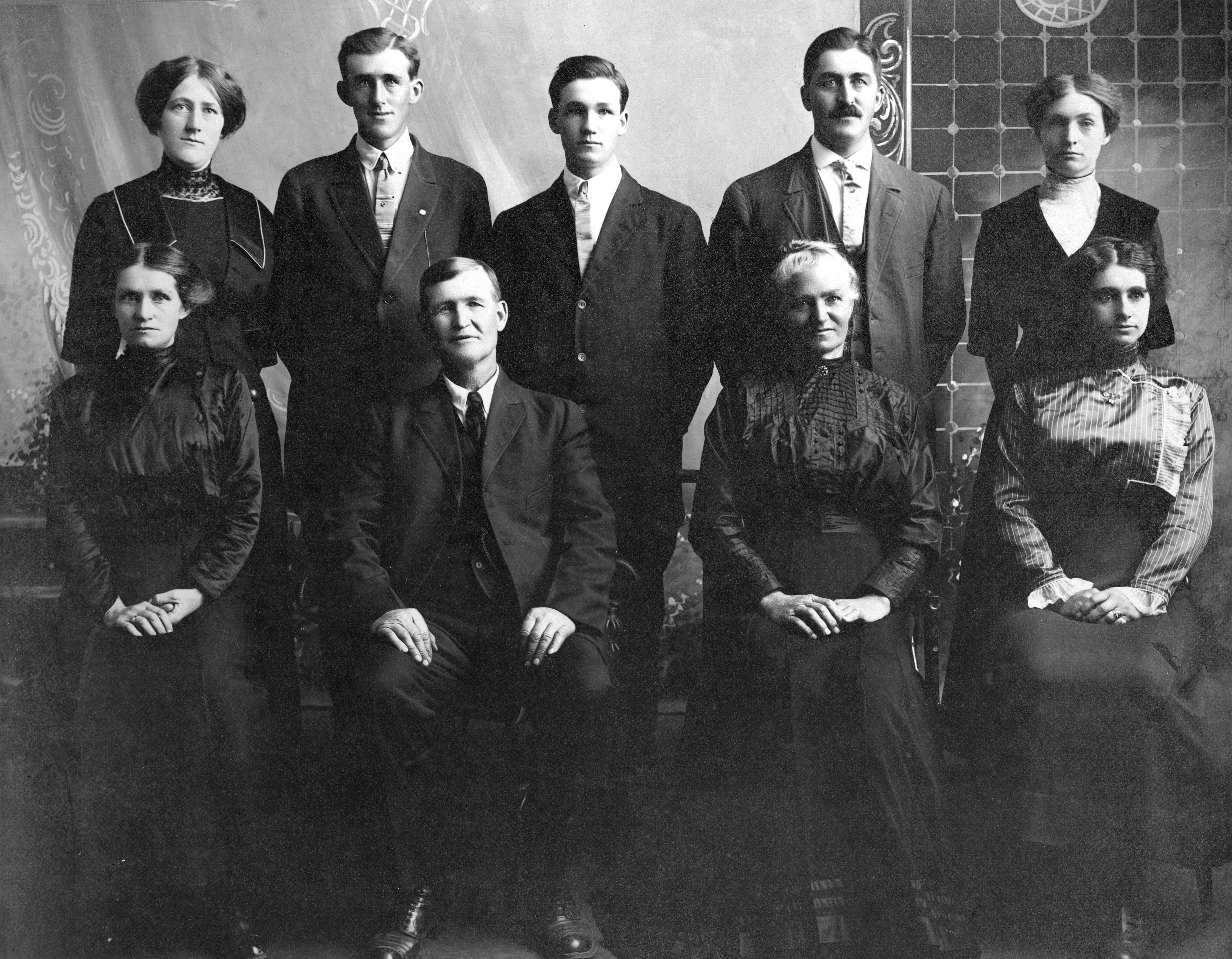
It is the only known photograph showing six of the seven children of Christian and Amanda Hanneman, pioneers of Portage and Wood counties in Wisconsin. The undated photo was probably taken around 1915 at a family event. Left to right are:
William Friedrich Johann Hanneman (1856-1939)
Bertha Auguste Ernestine (Hanneman) Bartelt (1860-1945)
Albert Friedrich O. Hanneman (1863-1932)
Herman Charles Hanneman (1864-1945)
Carl Friedrich Christian Hanneman (“Chas,” 1866-1932)
The sibling not pictured is August Friedrich Ferdinand Hanneman (1858-1902).
Along with their parents, this group came to America in late November 1882 aboard the SS Katie. They were the last of the Matthias Hannemann family to come to America from the Baltic Duchy of Pomerania (now part of Poland and Germany). The Hannemann clan (the name was eventually shortened to Hanneman) settled in and around the hamlet of Kellner in central Wisconsin.
Family Line: Matthias Hannemann >> Carl Frederick Christian Hannemann >> Carl Henry Frank Hanneman >> David D., Donn and Lavonne Hanneman.
He came to the United States at age 19 and lived the life of an American frontiersman: shuttling cargo between U.S. outposts in the West and ferrying people and goods across the Missouri River. For all of his adventurous living, William Johann Heinrich Gaulke retained one lasting memory that his family in Wisconsin still talks about: being a friend of a very young William Frederick ‘Buffalo Bill’ Cody.
William Gaulke (standing) with his arm around William F. Cody, who later went on to international fame as “Buffalo Bill.” (Photo courtesy of Sue Alft)
Gaulke met the famed U.S. Army scout and buffalo hunter while Gaulke was working and exploring the frontier lands in Nebraska and the Dakotas in the 1870s. A photograph in the Gaulke family album shows a twenty-something Gaulke standing with his arm around a seated William Cody.
Gaulke’s frontier experience grew out of tragedy he experienced in his native Germany. Born on October 1, 1848, Gaulke lost his father, John, before he turned six months old. When he was 11, Gaulke became an orphan at the death of his mother Fredericka. He emigrated to America in 1867 and landed in Milwaukee. After a short stint as a farmhand, Gaulke landed a job aboard a Great Lakes steamer, where he learned to speak English. After another stint working on farms in Illinois, Gaulke went west.
After emigrating to America in 1867, William Gaulke spent a number of years exploring the wild frontiers. (Photo courtesy of Sue Alft)
Gaulke experienced the wilds of the frontier lands as a teamster for the U.S. government. He guided a six-mule team hauling goods between U.S. Army posts. He was based at Fort Buford in the Dakota Territory. After tiring of that job, he built a skiff and drifted down the Missouri River to what is now Bismarck, North Dakota. Along with a group of companions, he established the town of Carlington. There, Gaulke operated a ferry moving people, goods and horses across the Missouri River near Fort McKeen (later called Fort Abraham Lincoln). Fort Lincoln was the base of Gen. George Armstrong Custer.
Right alongside the Mighty Missouri River, Gaulke built himself a shanty, where he lived and operated his ferry business. He built an outdoor fireplace that was used for cooking and warmth. It was also a hiding place for the $2,200 Gaulke had saved from his business ventures. Gaulke’s shanty was a frequent target of would-be thieves, but none of them ever thought to look under the fireplace for the buried money.
In 1872, Gaulke returned to Wisconsin, securing work at Grand Rapids in Wood County. In July 1876, he married Augusta Henriette Charlotte Kruger. Her mother, Friedericke Kruger, was the daughter of Matthias Hannemann (1794-1879). A short time later, the Gaulkes bought their first land in the Town of Grant in Portage County, very near where the Hannemann family established its first homes in the early 1860s. Gaulke cleared the land and established a successful farm. He also helped build many of the farm houses and barns in the area.
William Gaulke and Augusta (Kruger) Gaulke and family. Rear, left to right: Ella (Wagner), William Jr., John, Henry, Minnie (Panter). Front, left to right: Mary (Eberhardt), William Gaulke Sr., Augusta (Kruger) Gaulke, Laura (Turbin). (Photo courtesy of Sue Alft)
Gaulke also became deeply involved in civic work, serving as school district clerk, drainage district commisioner and chairman of the Town of Grant. He and Augusta had eight children, born between 1878 and 1897. Augusta died in 1914, four years before her mother. William died on October 25, 1928 after coming down with pneumonia.
William F. “Buffalo Bill” Cody in a late-life portrait (Library of Congress Photo)
Confirmation of the friendship between Gaulke and Buffalo Bill came in the early 1900s, when Cody brought his Wild West show to Grand Rapids, Wisconsin. Gaulke brought his youngest son, John, to the grounds near Lincoln High School. They watched the white-suited Cody ride about the arena on his white horse. Gaulke led his boy up to Cody, introduced himself and asked the showman if he remembered him from their time out west decades earlier. He did. “Why sure, Bill and they had quite a talk,” John Gaulke later wrote. “Finally Buffalo Bill reached into his pocket and gave my Dad a handful of tickets, who the whole family saw the show for nothing.”
A popular poster showing Buffalo Bill Cody superimposed on an image of a buffalo. (Library of Congress Photo)
William Cody was a first-rate Indian scout and buffalo hunter whose life was romanticized in dime novels written by author Ned Buntline. The pair collaborated to create a show called “The Scouts of the Plains.” In 1883, Cody developed a live show spectacular called Buffalo Bill’s Wild West. The Library of Congress says Cody “was a major contributor in the creation of the myth of the American West, as seen in Hollywood movies and television.”
Her look of delight really tells the whole story. Little Jane Patricia Hanneman, beholding a cake on her third birthday, shows a priceless expression. She celebrated her birthday in October 1958 with her paternal grandparents, Carl F. Hanneman (1901-1982) and Ruby V. Hanneman (1904-1977) at their home in Mauston, Wisconsin. In the background of the photo is her aunt and my Mom, Mary K. Hanneman. She could not have known it at the time, but Jane’s birthday falls on the same date as the 1819 wedding of her great-great-great grandparents, Matthias Hannemann and Caroline (Kuehl) Hannemann. The couple were married at Meesow, Regenwalde, Pomerania.
My Dad, David D. Hanneman, also shot some 8mm film at the celebration, which can be viewed below:
When David D. Hanneman was elected mayor of the city of Sun Prairie, Wisconsin in April 2003, it continued a Hanneman family tradition that stretches back more than 400 years to the county Regenwalde in the Baltic Duchy of Pomerania. Hanneman’s election as mayor on April 1, 2003 capped his nearly 40-year public service career — and put him in good family company.
The Hanneman family from Kellner, Wisconsin — from which David Hanneman descends — traces its roots to Pomerania, a picturesque land of Germanic peoples that dates to the 1300s. His earliest known ancestor, Matthias Hannemann, was from the village of Zeitlitz in the kreis, or county, of Regenwalde. Regenwalde means “woods of the Rega River,” referring to the picturesque waterway that ambles 100 miles through the county and empties into the Baltic Sea. This area has long been known for agriculture, fishing and forests, and it bears strong geomorphic similarities to the state of Wisconsin. The village of Zeitlitz covered about 2,200 acres and had approximately 100 households.
Mayor Dave Hanneman cuts the ribbon at opening of the Sun Prairie fire station. (Sun Prairie Star Photo)
Records trace the Hannemann (the original spelling had two ‘n’s at the end) family back at least to 1582 in Zeitlitz. The Hannemanns made up one of the predominant families in Zeitlitz, based on the number of entries found in the Lutheran church register. Many church records were destroyed in a fire in Stramehl in 1720, but the register from 1582 survived. At that time, there were a number of Hannemann families in Zeitlitz, and they owned some of the larger farms in the village. One of these men, likely the eldest brother, held the title of schulze, or mayor of Zeitlitz. Being the schulze was unlike the elected political position of mayor found in modern-day American communities. It was an inherited job, and the duties centered on making sure work was performed equitably in the village, and that the taxes of grain, goods or money were collected for the estate owner. The term schulze can have various related meanings, including “village headman,” mayor or even constable.
Mayor Hanneman speaks at a veterans’ event. (Sun Prairie Star Photo)
As farmers, the Hannemanns were also involved in providing financial support for the local minister and the church. Each tenant farmer paid his taxes in measurements of grain. The unnamed mayor Hannemann and Peter Hannemann were each responsible for taxes on two Hufen in Zeitlitz in the year 1582. A Hufe was the amount of land needed to sustain a family. There could have been more Hannemann families living on those four Hufen, but the church records only listed the major land tenants who paid taxes.
In the nearby village of Groß Raddow (about 6 miles from Zeitlitz), the Hannemann family had a similar history. A tax list from 1666 includes the names of Tews Hannemann (the schulze, or village mayor), Heinrich Hannemann, Chim Hannemann and Peter Hannemann. For at least several generations, it appears the Hannemann family inherited and passed on the office of mayor in Groß Raddow. In 1717, Hans Hannemann was the mayor, so we believe Hans is a descendant of Tews Hannemann.
Mayor Dave Hanneman cuts the cake at the 5th birthday of the new Sun Prairie Public Library.
The Matthias Hannemann family began emigrating to Wisconsin in 1861. Matthias left his home in 1866 and came to Wisconsin through Quebec. The family settled in and around Kellner, a tiny hamlet that straddles the Wood-Portage county line southeast of Wisconsin Rapids. At one time, the Hannemanns owned and farmed more than 1,000 acres in Wood and Portage counties. David’s great-grandfather, Christian Hanneman (Matthias’ son) was the last of this clan to come to America in November 1882.
Dave Hanneman (1933-2007) was first elected to public office on April 2, 1968 when he became Fourth Ward alderman in Sun Prairie. He served only one term as alderman, but stayed active in city politics, pushing the city to upgrade its sewer system to prevent backups into residential homes. He again ran successfully for alderman in 1988 and stayed on the Sun Prairie City Council until 1996, when he was elected to the Dane County Board of Supervisors. He held that post until being elected Sun Prairie mayor in 2003.
The Sun Prairie Star Countryman carried news of Hanneman’s election as Fourth Ward alderman in April 1968.
“Dave was involved in the growth of Sun Prairie and believed in progress for the community. He worked and helped champion the Highway 151/County Highway C project, which included working with the state Department of Transportation,” said Bill Clausius, who served on the city council and county board with Hanneman. “Dave was involved with the West Side Plan, which brought the Sun Prairie Community together to envision the future of the West Side. Dave supported and worked to begin the West Side Community Service Building. This facility includes a west side location for police, fire and EMS. His vision was to provide essential services to Sun Prairie residents and to shorten response times in case of an emergency.”
Clausius continued: “In 2003, Sun Prairie won the ‘Champions of Industry’ Award of Excellence as one of the best managed small cities in America. Dave personally raised $32,000 in donations from area businesses to fund production of a video featuring Sun Prairie, and highlighting Sun Prairie’s achievements.”
Her reign may have been brief, but for one day in 1922, Ruby V. Treutel was front-page news as the most popular single woman in Wood County, Wisconsin. To help celebrate dedication of a new bridge across the Wisconsin River, the community organized a popularity contest to find the Queen of the Bridge.
The Queen of the Bridge contest invited the nomination of single women of Wood County. The contest winner would preside at the dedication of what came to be called the Grand Avenue Bridge, linking the east and west sides of Wisconsin Rapids over the Wisconsin River.
Queen of the Bridge wasn’t really a beauty contest, but Ruby Treutel would have fared well on that count alone.
Miss Ruby Treutel of Vesper was among the early nominees for the Bridge Queen, and she jumped to a lead after the first weekend of balloting in September 1922. The front-page headline in the Wisconsin Rapids Daily Tribuneon Sept. 25, 1922, proclaimed: Ruby Treutel and Mary Herron in Spirited Contest. “A spirited race between Miss Ruby Treutel of Vesper and Miss Mary Herron of this city developed as a result of the week end balloting in the Bridge Queen popularity contest,” the article read, “with Miss Treutel leading by slightly over 200 votes of the 43,000 cast for these two candidates.”
Ruby Treutel was in the thick of it at the beginning, but eventually fell behind in voting.
Ruby’s 22,570 vote total was more than twice that of the third-place contestant and far ahead of the 10 votes for Miss Pearl Brewster. But, like fame and money, the lead would not last as the contest balloting steamed along for two weeks at such a rapid pace the contest was ended early. In the first week, more than 1.3 million ballots were cast. The Bridge Committee had trouble keeping up with the tallying, which would exceed 20 million votes by the end of the contest.
By September 28, 1922, Ruby’s vote total had more than doubled, to 45,240. But this now paled in comparison to contest leaders Eva Manka and Mary Herron, who had more than 500,000 votes between them. On Sept. 30, Herron’s vote total ballooned to 989,000, far exceeding Manka’s new total of 640,000. Ruby was in a respectable fifth place with 171,000 votes. By the time the committee decided to cut voting short on Sept. 30, balloting was at a fever pitch. The final vote totals were:
Mary Herron, 5,336,570 votes
Mildred Bossert, 3,645,840 votes
Eva Manka, 1,763,360 votes
Manon Matthews, 1,016,510 votes
Margaret Galles, 711,550 votes
Alice Damon, 618,550 votes
Ruby Treutel, 608,050 votes
Maurine Dutcher, 492,410 votes
Pearl Possley, 486,600 votes
Ruth McCarthy, 460,510 votes
Miss Herron was crowned Queen of the Bridge. On Oct. 18, 1922, she attended the huge dedication ceremony and officially christened the span the “Grand Avenue Bridge.” It was indeed a grand event, with thousands of people, a parade and even aerial acrobatics performed by the Federated Flyers stunt team, which did loops in the sky with its planes, and thrilled the crowd with wing walking.
This 1940 postcard shows the Grand Avenue Bridge in Wisconsin Rapids, Wis.
The Grand Avenue Bridge has long been an important part of Wood County’s infrastructure. The 1922 version replaced an old wood and steel span. Bridges across the Wisconsin River date to the 1870s. In earlier times, bridge was an important link between the former towns of Grand Rapids and Centralia,which later joined to form the city of Wisconsin Rapids.
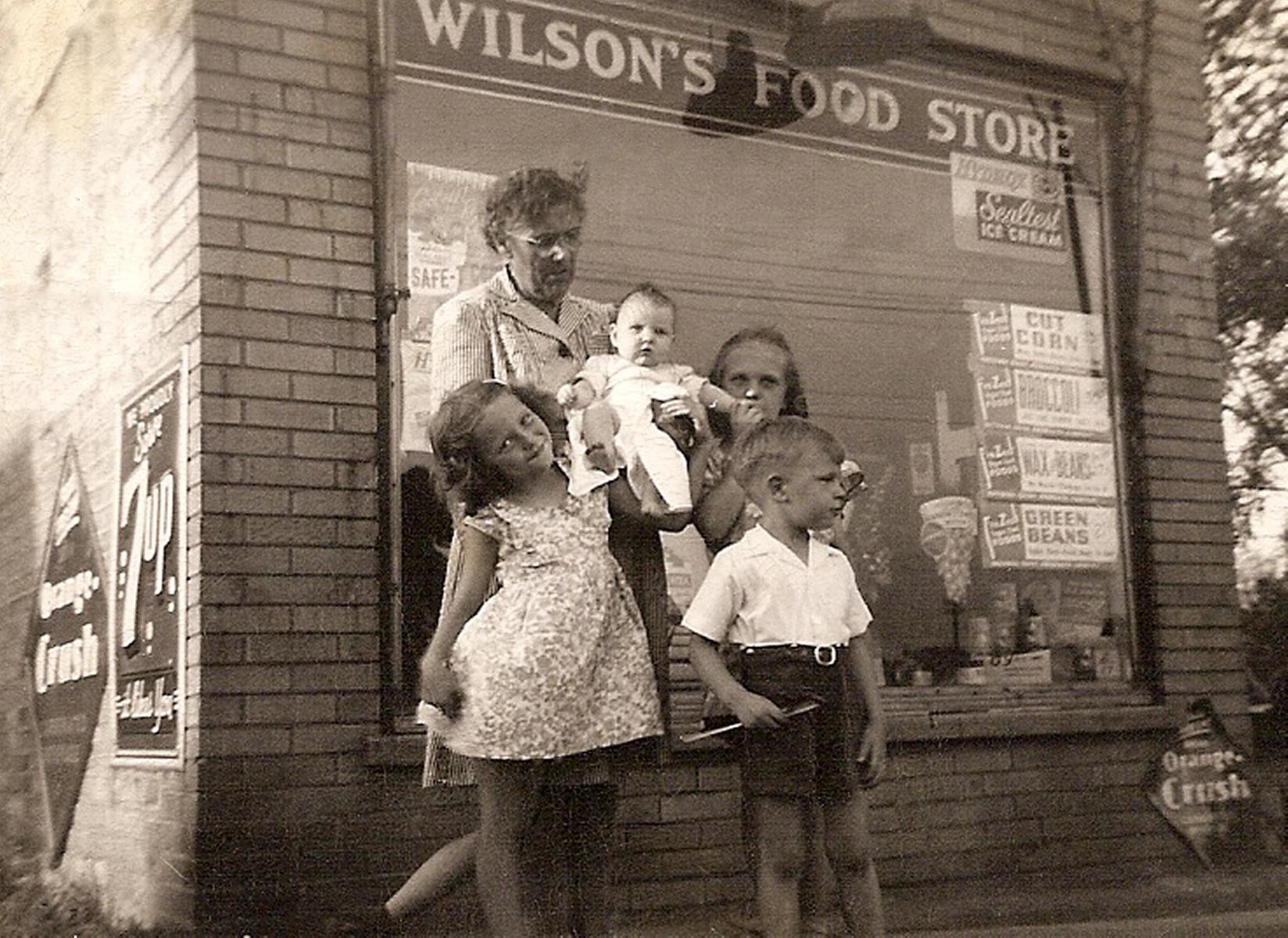
Our newest “Eye on the Past” feature photo shows a charming little grocery store located about 1.5 miles west of Lake Michigan in Waukegan, Illinois. Wilson’s Food Store was located at 1814 Grand Avenue, operated by my Dad’s aunt and uncle, Nina (Treutel) Wilson and Lawrence Wilson. Nina was a younger sister of my Grandmother Ruby (Treutel) Hanneman.
The Wilson family, including children Steve and Laurni Lee, operated the grocery in the late 1940s and early 1950s. The family living quarters were behind the store. Any time someone entered, a bell rang in the back and family members took turns waiting on customers. Shown on the right side of the photo are Laurni Lee (Wilson) Breedlove and Steve Wilson. Emma (Treutel) Carlin (1877-1962) is holding baby Bonnie (Treutel) Young. In front of them is Bonnie’s older sister, Patricia (Treutel) Anderson. Emma was Nina and Ruby’s aunt from Arpin, Wisconsin. Bonnie and Patricia are Laurni Lee and Steve’s cousins.
Lawrence Wilson was a longtime chemist and plant superintendent at Pfanstiehl Laboratories in Waukegan. I distinctly remember Uncle Laurie and Aunt Nina coming to my wedding in December 1990 in Racine, Wisconsin. Somewhere I have a video of them arriving at the reception at Racine’s Memorial Hall. After retirement, the couple moved to Arizona. Lawrence died in 2001, and Nina passed away in 2005.
The little brick building in the photo still stands, although over the years it was extended on both sides to include other businesses. The vintage metal signs in the photo advertised Orange Crush and 7up soda. Window stickers promoted Sealtest ice cream, Hydrox sandwich cookies, and produce (cut corn, green beens, wax beans and broccoli).
When was the last time your visit to the Cineplex included live entertainment? (The bratty 5-year-old in front of you throwing popcorn at his brother does not count.) The movie theater was once about much more than movies, and the price of admission included live performances, newsreels, comedy shorts and more. For years our own Ruby V. Hanneman was a featured performer at some of Wisconsin Rapids finest cinemas, and her name appeared in ads right alongside Silent Era stars of the day like Neal Hart, Ricardo Cortez,Doris Kenyon and Jack Holt.
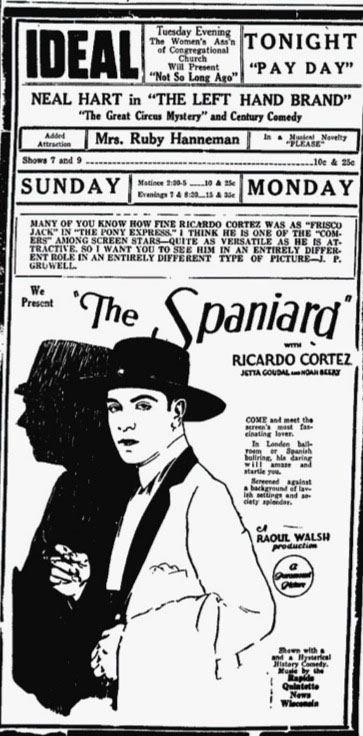
Ruby Treutel Hanneman was the musical attraction during the showing of The Spaniard in October 1925.
Ruby often appeared at theIdeal Theatre at 220 E. Grand Ave., Wisconsin Rapids. She sang a “musical novelty” at two shows on Halloween night 1925. The main attraction was The Thundering Herd, a movie based on the 1925 novel by Zane Grey. (Zane Grey happened to be a favorite author of Carl F. Hanneman and his son David, but we digress.) Seats that night were just 10 cents or 25 cents, half off the typical ticket prices.
On Thanksgiving 1925, Ruby sang for the audience at Paramount Pictures In the Name of Love, starring Ricardo Cortez and Greta Nissen. Ruby sang two numbers, “Lonesome, That’s All,” and “In the Garden of Tomorrow.” The 15 cent and 35 cent admission also included the Wisconsin Rapids Quintette, newsreels and a Will Rogers comedy.
Ruby Treutel sang as a prologue to The Dressmaker from Paris.
Ruby got perhaps her most prominent billing for the October 17, 1925 showing ofThe Spaniard. Her name was most prominent in the ad in the Wisconsin Rapids Daily Tribune.“Added Attraction, Mrs. Ruby Hanneman in a Musical Novelty,Please, the ad read. On Aug. 25, 1925 she appeared at the New Palace Theater singing, “I Wonder What’s Become of Sally.” The feature film that night was Born Rich starring Bert Lytell and Claire Windsor.
Ruby V. Treutel dressed for her lead role in the operetta ‘Sylvia’ in 1922.
By the time she starred at the New Palace and the Ideal, Ruby was a veteran singer. According to the April 4, 1921 edition of the Daily Tribune,Ruby Treutel “brought down the applause of the house time after time” for her performance in the play “The Fire Prince” at Daly’s Theater. Ruby was 17 at the time.
Now known as Mrs. Carl Hanneman, Ruby sang before the showing of Zane Grey’s “The Thundering Herd.”
When she graduated from Lincoln High School in Wisconsin Rapids in 1922, Ruby had years of experience in music and drama. She played the female lead in the operetta Sylvia during her senior year. She was also president of the Glee Club. Under her senior class portrait in the yearbook The Ahdawagam read the motto, “Music hath charms and so does she.”
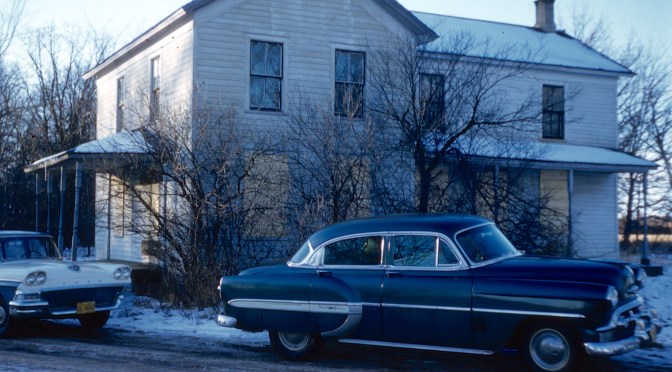
While scanning my grandfather’s old slide collection, I came across two stray images from 1957 marked “Gein’s House.” I couldn’t get the slides on the scanner bed fast enough. It turns out the photos were indeed of the ramshackle farm house of the notorious killer and grave robber, Ed Gein.
For Carl F. Hanneman, the trip to Plainfield would have been a minor detour on one of the family’s many trips from Mauston to Wisconsin Rapids, Wis. He, like thousands of other Wisconsinites in the late fall of 1957, just had to see for himself the home where the unimaginable occurred from 1945 to 1957. For in that decrepit structure at the corner of Acher and 2nd avenues a few miles southwest of Plainfield, the handyman bachelor Gein committed unspeakable acts.
The boarded-up house of Plainfield handyman Ed Gein, who robbed nearby graves and made macabre souvenirs from the stolen remains. The house was burned to the ground by an arsonist in March 1958. (Carl F. Hanneman photo)
The day of Gein’s undoing came on November 16, 1957, the opening day of the gun deer hunting season in Wisconsin. Gein made the trip into Plainfield to buy some anti-freeze at Worden’s hardware store. While there, he took a .22-caliber rifle from the store display and shot to death the owner, Bernice Worden, 58. After slitting her throat, he dragged her body out the back and put it into a truck. Later that day, sheriff’s deputies from several counties were searching for Worden, a well-known local who had run the Plainfield hardware store since her husband’s death in 1931.
Gein’s car had been spotted in the village that day, so police twice stopped at his 160-acre farmstead to talk to him. He wasn’t home. On the second trip, Waushara County Sheriff Arthur Schley peered into a shed that Gein used as a summer kitchen and was shocked. “My God, there she is!” he shouted. There was the body of Worden, hung upside down by the ankles, gutted and dressed out like a deer ready for the butcher. “There was a body hanging in the woodshed by the ankles,” said Captain Lloyd Schoephoester of the nearby Green Lake County sheriff’s department. “Tendons in the ankles had been cut and a rod and been placed through them. The body was drawn up in the air by a block and tackle. The body was dressed out and the head was missing.” Sheriff Schley went outside and vomited.
Police found the remains of nearly a dozen women in Ed Gein’s farmhouse near the village of Plainfield, Wis.Worden’s head was later found in a burlap sack nearby. Her internal organs were in a bucket. If that sight wasn’t enough to sicken responding police, a search of Gein’s home would put them over the edge. Inside the filthy and cluttered home they found five human heads wrapped in plastic bags, four skulls and 10 “death masks” made by removing the face and hair from a human head. “Some of them have lipstick on and look perfectly natural,” said Wood County sheriff’s deputy Dave Sharkey. “It you knew them, you’d be able to recognize them.”
There was more. Police found chairs and lampshades fashioned from human skin, four human noses, two sets of lips, a belt made of female nipples, and a collection of female genitals. Two of the vulvas in Gein’s collection belonged to teenage girls, and authorities concluded he likely murdered these girls. On the stove was a saucepan containing a human heart, later identified as belonging to Worden. There was a wastebasket made from skin, and skulls fastened to Gein’s bedposts. Bowls were made from the tops of human skulls.
At first, police thought they might be dealing with a prolific serial killer. After his arrest, Gein admitted killing Bernice Worden, but he said the grotesque artifacts in his home were from grave-robbing visits he made to the nearby Plainfield Cemetery, the Spiritland Cemetery in Portage County and the Hancock Cemetery in the Town of Hancock. Gein also admitted shooting and killing Portage County tavern keeper Mary Hogan on December 8, 1954. Her face was found among Gein’s collection of death masks.
Police were not initially inclined to believe Gein’s tales of grave robbing. On November 25, 1957, they exhumed the caskets of Eleanor Adams and Mabel Everson at Plainfield Cemetery. Both caskets were empty. In the soil above one casket they found dentures and a wedding ring. That was enough to convince police that Gein was indeed a grave robber. He told authorities he made the moonlight grave-robbing visits while in a daze. On some occasions, he awoke from the daze and stopped what he was doing. He said his grave robbing occurred between 1947 and 1952. He said he returned some bodies to their graves after experiencing remorse. Police did not dig up other graves, and ultimately don’t know just how many caskets Gein might have opened.
When interviewed by Wisconsin State Crime Lab officials, Gein said he would dress up with the women’s body parts. He would wear a death mask, a tanned skin shirt including women’s breasts, and a vagina placed over his own genitals, covered by a pair of panties. He would go out in the moonlight and prance about the farmyard in this sick getup. Although Gein was not a deer hunter, he was known to have given packages of “venison” to people in the community, who became sickened after Gein’s arrest at their unwitting cannibalism. Authorities became convinced that Gein practiced cannibalism, among his other grotesque crimes.
After a brief court hearing in January 1958, Gein was committed to the Wisconsin Central State Hospital for the criminally insane at Waupun, where he remained for 10 years. In early 1968, Circuit Court Judge Robert H. Gollmar ruled Gein was able to stand trial for the murder of Bernice Worden. In a November 1968 bench trial, Gein was convicted of first-degree murder for Worden’s death, but in a separate hearing found not guilty by reason of insanity. He was sent back to Waupun. He later was moved to the Mendota Mental Health Institute in Madison, where he died of cancer on July 26, 1984. He was buried next to his mother in the same Plainfield Cemetery that he plundered.
Gein suffered from schizophrenia. The death of his mother on December 29, 1945 apparently pushed him over the edge. Doctors said he had an unnatural Oedipus complex attachment to Augusta Gein. The women he killed and the graves he robbed represented substitutes for his mother. The women were plump and middle aged, doctors said. Gein had nursed his mother through two paralytic strokes. Gein’s father George died on April 1, 1940. His brother Henry was found dead after a marsh fire on the Gein property on May 16, 1944. It is widely believed that Gein killed his brother.
Based on the Worden convinction and Gein’s admission to killing Mary Hogan, Gein could not be considered a serial killer. But he was suspected of killing at least four other people. The teenage genitals found in his farmhouse might have belonged to Evelyn Hartley, 15, of La Crosse, and Georgia Jean Weckler, 8, of Fort Atkinson. Hartley disappeared in October 1953 and Weckler was abducted in May 1947. Neither crime was ever solved and the girls’ bodies were never found. In his 1982 book on the Gein case, Judge Gollmar wrote that if Gein did not kill these girls, then the abducted and killed two runaways, since his grave-robbing could not explain the presence of genitals belonging to young girls in Gein’s home. Gollmar also wrote that Gein might have killed two men who disappeared after visiting a Plainfield tavern. The disappearances of Victor Travis and a male companion were never solved. Travis’ jacket and his dog were found near the Gein farm, and neighbors noted a stench coming from Gein’s garden at the time.
Gein’s gruesome story created a cottage industry in macabre spinoffs. It was the inspiration for the book Psycho by Robert Bloch. The book was adapted into the 1960 Alfred Hitchcock film of the same name. Gein was said to be the inspiration for fictional characters in films including The Texas Chain Saw Massacre and Silence of the Lambs.
The Hanneman family has one link to Plainfield other than the photos of Gein’s house snapped by Carl Hanneman. Lisetta (Treutel) Moody (1861-1931), aunt of Ruby Hanneman, moved her family to Plainfield after living in Vesper in Wood County. She and her husband, Lewis Winfield Moody, are buried at Plainfield Cemetery. She testified at the trial of Frank Hinz after the 1902 shootout between the Moody and Hinz families.
This post has been updated with details from the 1982 book on Gein by Circuit Judge Robert H. Gollmar. The book, Edward Gein: America’s Most Bizarre Murderer, is a fascinating insider’s account of the Gein case.
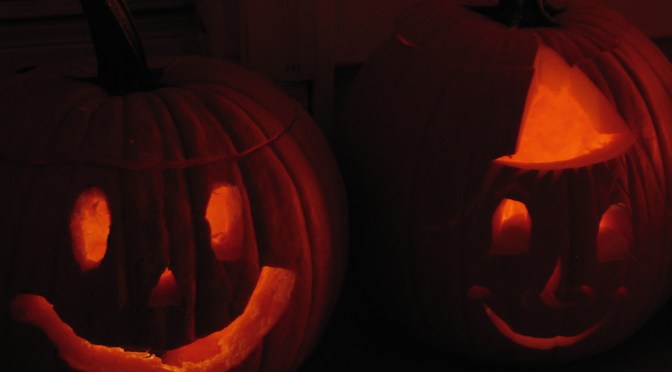
I have nothing but good memories of Halloween. Growing up in the late 1960s and early 1970s, October 31 was a date we looked forward to. Whether we got to buy a costume at the dime store or made our own, it was always an exciting night.
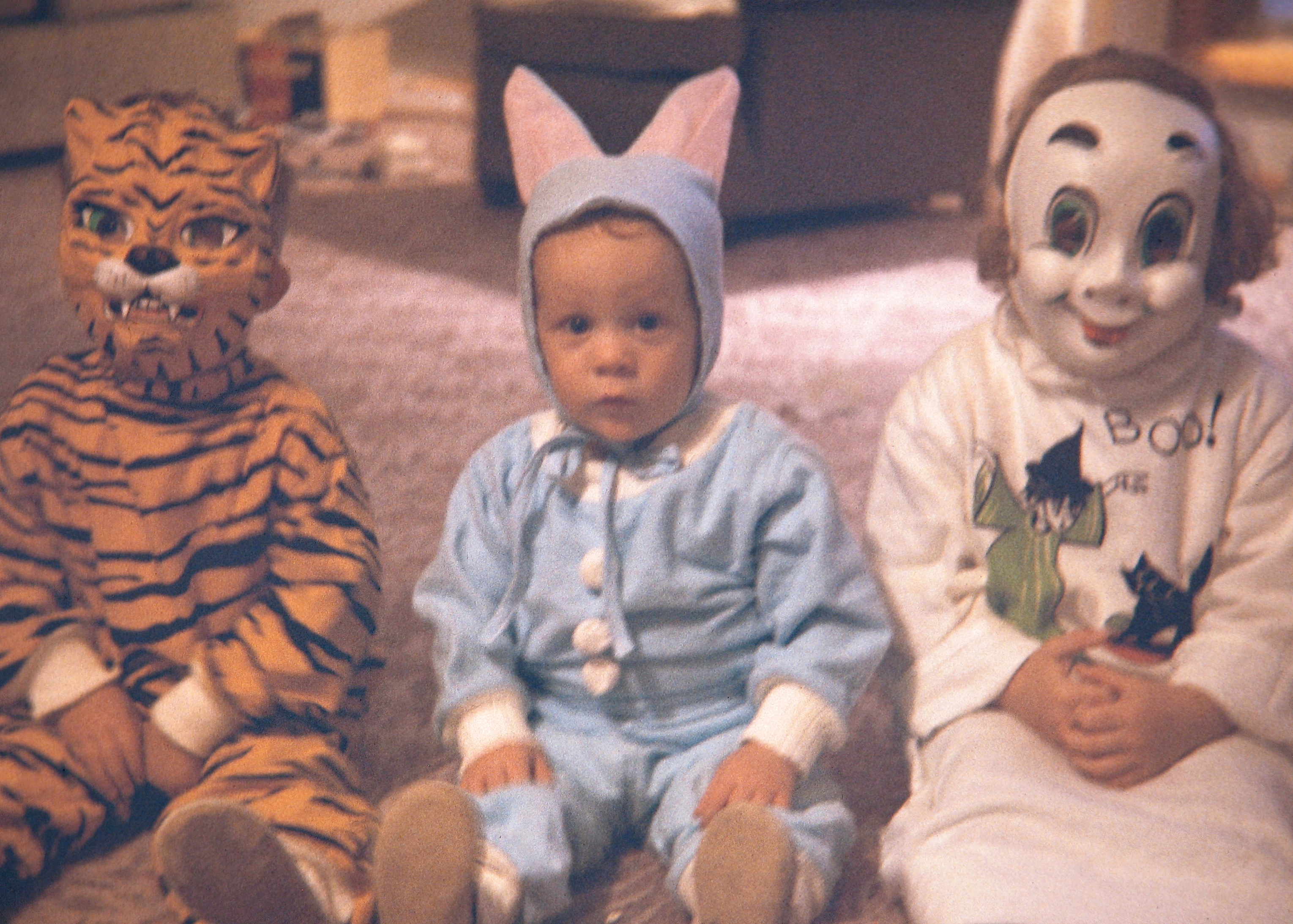
My brother David (left), yours truly at center at cousin Laura all set for Halloween at our home in Grand Rapids, Mich., circa 1964.
One of my most vivid Halloween memories was documented in my book, The Journey Home. I recall Dad tearing out the front door in his sock feet. I wondered what was happening. We figured it out a few minutes later when he dragged two teenagers into the front door and made them apologize for smashing our lit pumpkins. He then turned them over to Sun Prairie police.
We had one sad Halloween when my brother David fell into the neighbors tree well and spilled all of his candy. We all shared to make up for it. Another year, we went across town to “trick or treat” at a few houses of family friends. At one door, I was shocked that the lady who answered called me by name. “How does she know me with this costume on?” I wondered. My brother chimed in, “You forgot to put your mask down.” D’oh!
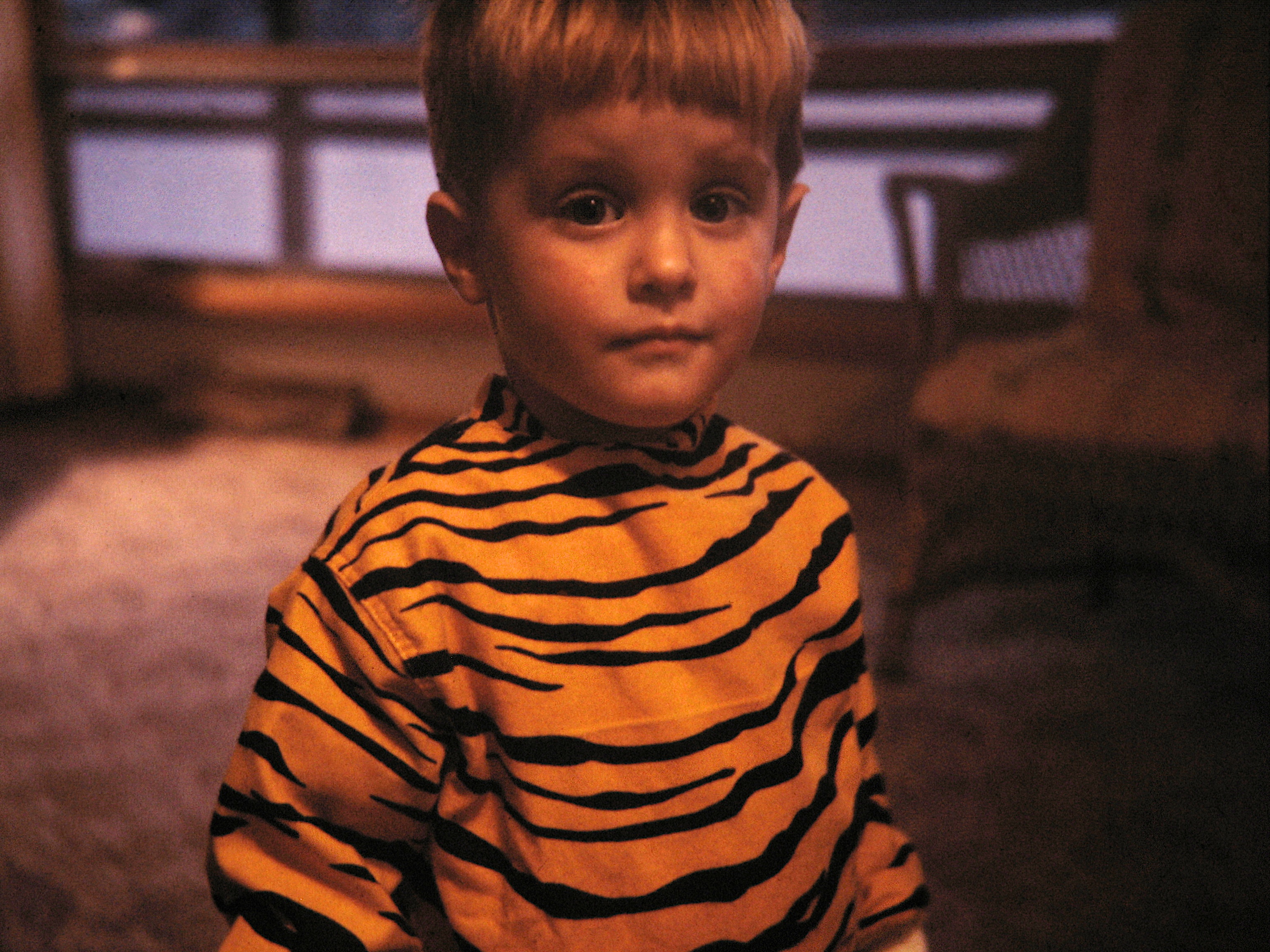
David C. Hanneman was a tiger for Halloween 1964.
Perhaps the most fun we had was creating our own costumes. Lighting the end of a cork on fire, then using the charred remains to paint black whiskers on our faces. Stuffing pillows up an oversized shirt helped complete the hobo look.
It wasn’t until toward the end of my trick-or-treating days that the scare over supposed razor blades in candy apples occurred. Hospitals offered to X-ray candy bags to check for pins or razor blades. That made me wonder if the candy would then glow? Ah, as it turned out the whole thing was a fraud that took on the sheen of urban legend.
Son Stevie watches Grandpa Dave Hanneman prepare to carve, circa 1993.
Once I had my own children, Halloween took on a new dimension. Our firstborn was too shy to go door to door, so we made our main stop at Grandma and Grandpa’s house. Eventually, Halloween became a major event. French onion soup or chili simmered in a crock pot while we took the kids around the neighborhood collecting goodies. Then we retreated into the warmth of the house for good food, warm apple cider and pie. The kids also ate candy.
With the more recent controversies claiming Halloween as un-Christian or even satanic, it was refreshing to read this article on About.com regarding the Catholic roots of Halloween.
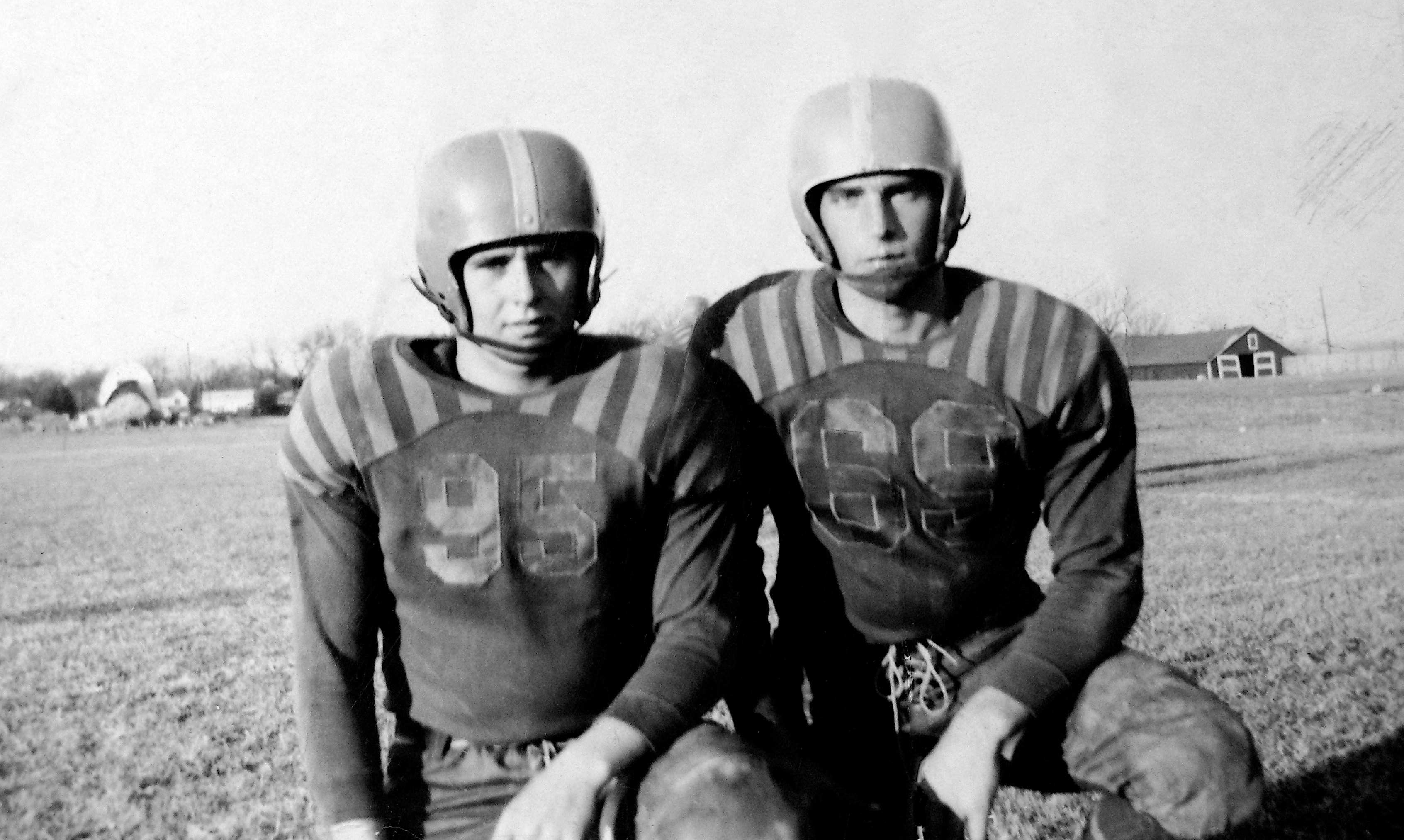
The 1947 football campaign was destined to be one for the ages at Mauston High School. The photo gallery below could be from that championship season, based on the youthful appearance of my Dad, David D. Hanneman (1933-2007). Dad was a starter for the Mauston Bluegold, even in his freshman year.
David D. Hanneman (center) played tackle, guard and on occasion, running back, for Mauston High School during the 1947-50 football seasons.
Dad played guard and tackle throughout his high school football career. But as is the case on small-town football teams, boys play both offense and defense. Many of the players would switch positions, depending on the opponent and game conditions.
Mauston ran up a 7-1 record in the 1947 football campaign, gaining them a share of the West Central Conference championship crown. Mauston was 3-1 in conference play. Midway through the season, Mauston ranked as one of the state’s highest-scoring teams. Here’s the 1947 season recap:
Sept. 12 Mauston 12, Reesdburg 0
Sept. 19 Mauston 25, Middleton 6
Sept. 26, Mauston 20, New Lisbon 12
Oct. 3, Mauston 13, Tomah 0
Oct. 10, Mauston 45, Westby 6
Oct. 17 Sparta 14, Mauston 7
Oct. 24 Mauston 37, New Lisbon 0
Nov. 1 Mauston 13, Viroqua 0
Dave Hanneman (at right) in one of his early years in Mauston football.
Bob “Jigger” Jagoe, who played quarterback for Mauston starting in the 1948 season, recalls how Dave’s mother, Ruby V. Hanneman, was zealous in her cheering.
You could hear her in the stands, shouting. She was so proud. Of course we used to kind of make a mockery of it, because she was so adamant, letting everybody know who her son was out there who made the tackle. They announced, ‘Tackle made by Dave Hanneman’ and she said, ‘That’s my Davey!’
In the 1950s, home football games were played at Veterans Memorial Park on the south end of Mauston. This locale looks much closer to downtown, so I’m betting these 1940s games were played in Riverside Park along the Lemonweir River. In several of the photos you can see the distant spire of St. Patrick’s Catholic Church.
— This post has been updated with quotes and other information.
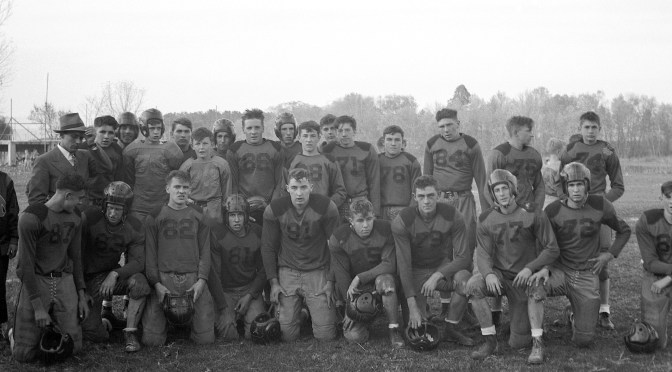
Dave Hanneman can be seen in the last row at left, second in from Coach McKenzie. Bob Jagoe is on his left. Front and center (91) is Dick Hale.
Mauston coach Doug McKenzie and players follow the on-field action.
A great view of the crowd at Riverside Park in Mauston.
It’s not clear if this galloping ghost is David D. Hanneman. He usually played at the line.
The Mauston Bluegold huddle before the play.
This appears to be a victory celebration.
Game action from this 1947 football contest at Mauston.
A good look at the spectators at Riverside Park. Recognize anyone?
Game action from this 1947 football contest at Mauston.
Dad’s conference crown medal from the 1947 championship season.
Another group shot of the team. On this one, Dave Hanneman (back row left, second from coach) has his tongue sticking out. Front and center (91) is Dick Hale.
A U.S. Navy recruit, probably a graduate of Mauston High School, watches the action.
A Mauston game program from September 1950. Note the team plays at Veterans Park instead of Riverside as in earlier years.















 The Hanneman Archive