“Memory of the Day of Confirmation.” Those German words are written in ornate lettering across a beautiful certificate commemorating the confirmation of Karl (we know him as Carl) Hanneman on June 11, 1916. The roughly11×17 inch document, found among the papers and photographs of David D. Hanneman, is remarkably well preserved and speaks to a time before Carl’s conversion to Catholicism. The certificate is written entirely in German and reads:
“Karl Hanneman received instruction in the Word of God on 11 June 1916 in the First Moravian Church, Grand Rapids, Wis.” At the bottom of the certificate it reads: Gottes Furcht is aller Weisheit Anfang, which roughly means “All Wisdom Begins with Fear of God.” The document was signed by the Rev C.A. Meilicke.
The confirmation certificate for Carl F. Hanneman from the First Moravian Church.
We know Carl’s father, Charles Hanneman, was raised as a Lutheran, as were most of the Hannemans. The marriage certificate for Charles and Rosine Hanneman (nee: Ostermann) only says their wedding was a “Divine Service” and does not indicate a church. In 1907, Charles and Rosine and their four sons joined the First Moravian Church of Wisconsin Rapids, a congregation of some 450 people in a brick church on First Avenue South.
The Moravian Church is one of the oldest Protestant denominations and traces its roots to the 1450s in Bohemia and Moravia. The area is now part of the modern day Czech Republic. It is possible the family’s connection to the Moravian Church came from Rosine (Ostermann) Hanneman, whose father emigrated from Saxony in what is now eastern Germany.
Carl and Ruby Hanneman were both converts to Catholicism, but we’ll save those stories for another entry.
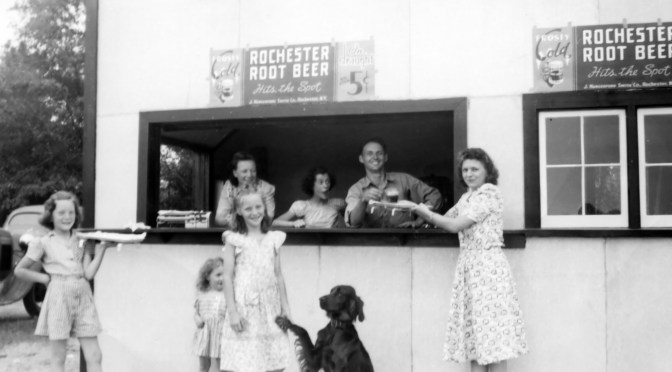
Marvin and Mabel Treutel operated a roadside root beer stand near their home on Wilhorn Road in Nekoosa, Wisconsin. Aside from 5-cent Rochester root beers, they served the “Best Roast Beef BBQ.” Pictured behind the counter in this late-1940s photo are Mabel Treutel (left), niece Lavonne Hanneman (center) and Marvin Treutel (right). Out front are daughters Bonnie Treutel (left), and Patricia Treutel (center, holding dog). The woman at right and the little girl at center are unidentified.
Nearly 90 years ago on a summer Tuesday morning, Ruby Viola Treutel and Carl Henry Frank Hanneman joined in marriage at St. James Catholic Church in Vesper, Wisconsin. The marriage, which would live on for more than 50 years and produce three children and 16 grandchildren, was described in detail in a story in the July 15, 1925 edition of the Wisconsin Rapids Daily Tribune:
TREUTEL-HANNEMAN One of the prettiest weddings of the summer was solemnized yesterday morning at nine o’clock at St. James church, Vesper, when Miss Ruby Treutel, daughter of Walter Treutel of Vesper, became the bride of Carl F. Hanneman, son of Mr. and Mrs. Charles Hanneman of this city. Rev. Father Gille officiated at the nuptial Mass.
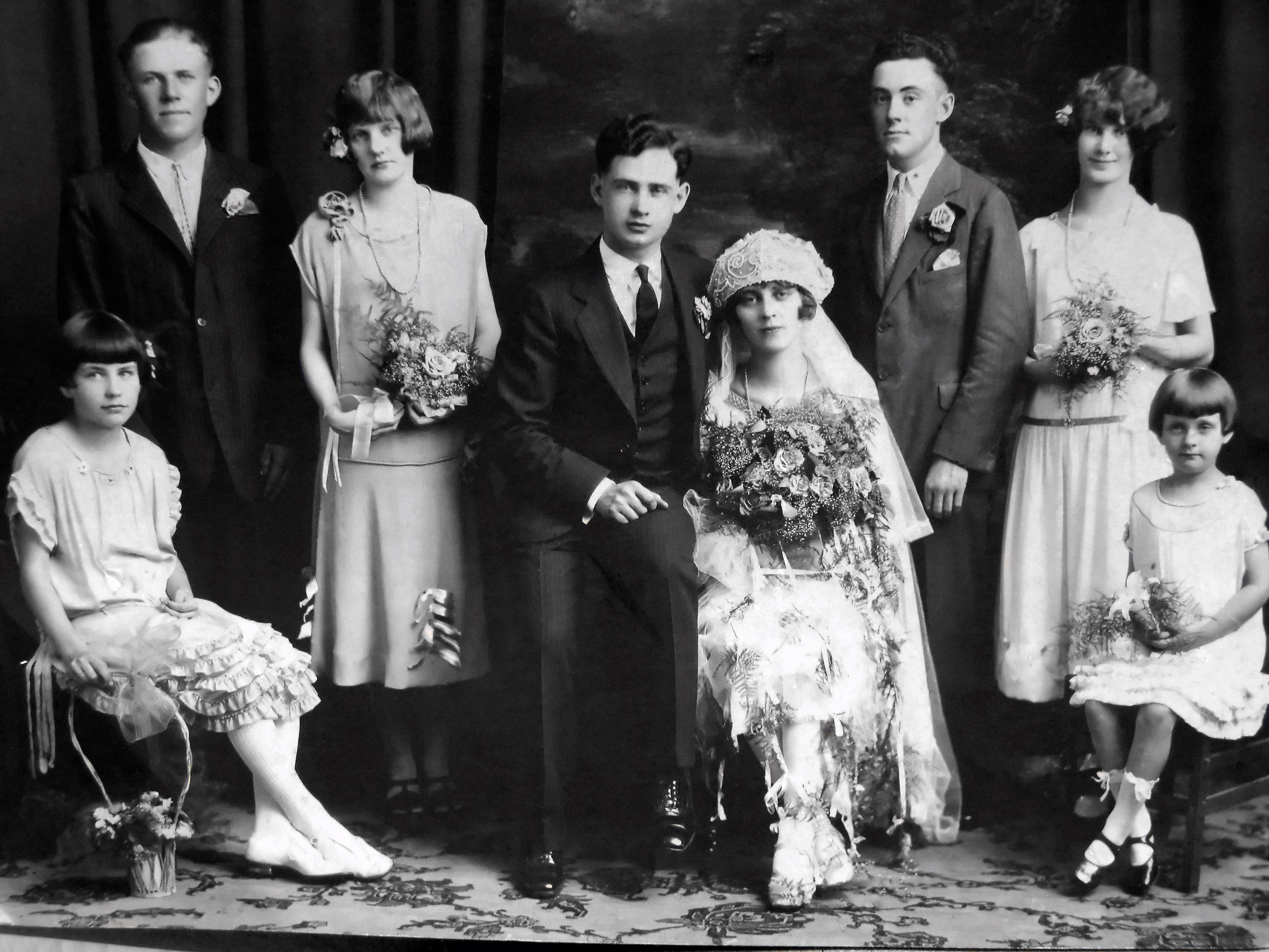
The wedding party of groom Carl Henry Frank Hanneman, 23, and Ruby Viola Treutel, 21. Wedding was July 14, 1925 at St. James Catholic Church, Vesper, Wis. At front left is flower girl Nina Treutel, 11, sister of the bride. At front right is ring-bearer Elaine Treutel, 5, sister of the bride. Across the back, left to right, are Joe Ladick (bride’s cousin), Gladys Cole (bride’s cousin), groom Carl Hanneman, bride Ruby V. Hanneman, best man Wendell Miscoll, and maid of honor Esther Allbrecht.
The church was beautifully decorated with greens and the season’s flowers, making an appropriate setting for the wedding party. Miss Velma Doering of Stratford played the wedding march as the party entered the church and proceeded to the altar. Miss Gladys Cole of Nekoosa, and the groom’s attendant, Joseph Ladick, of Vesper, both cousins of the bride, were followed by two little sisters of the bride, Nina and Elaine, who acted as flower girl and ring bearer. The maid of honor, Miss Esther Albright, came next and was followed by the bride and her father, who gave her away.
Mr. Hanneman and his best man, Wendell Miscoll,awaited the party at the altar. The bride was very beautiful in her gown of white georgette trimmed with gold lace. She wore a coronet of pearls, with her veil falling from a beaded butterfly. She carried a shower bouquet of pink rose buds.
Rev. Charles W. Gille of St. James Catholic Church officiated at the wedding.
Miss Albright, the maid of honor, was gowned in orchid georgette and carried an arm bouquet of rose. Miss Cole, the bridesmaid, wore a gown of orange georgette, and also carried roses. Nina, the little flower girl, was in a little frock of yellow georgette, and Elaine completed the delightful color ensemble in a dress of pink georgette. She carried the ring in a white lily.
Following the service at the church, the bridal party and relatives came to this city, where the ten-thirty breakfast was served at the Witter Hotel. The bride is a graduate of Lincoln High School and the Stevens Point Normal. Since her graduation from the normal school she has been teaching at Vesper. The groom was graduated from Lincoln High and for some time following was employed at the Church Drug store. He later graduated from the pharmacy department of Marquette University at Milwaukee and is at present holding a position with Whitrock and Wolt.
Following a week’s outing in the northern part of the state, part of the time being spent as guests of Mr. and Mrs. Armand Bauer at their cottage at Hayward, they will return here and for the present make their home with Mr. Treutel at Vesper.
The bridal photo, hand retouched to restore color to the roses.
The bridal portrait of Ruby V. Hanneman in its original frame.
For their honeymoon in July 1925, Carl F. Hanneman (1901-1982) and Ruby Viola (nee: Treutel) Hanneman (1904-1977) took a camping trip to Wisconsin’s north woods. The couple are pictured at a camp site near Hayward, Wis. They were married July 14, 1925 at Vesper, Wis.
He could be carrying milk from the barn, but Carl F. Hanneman (1901-1982) is actually on a honeymoon camping trip in this July 1925 photo. Carl and bride Ruby (nee: Treutel, 1904-1977) took a camping trip near Hayward, Wis., after their wedding on July 14, 1925.
An unidentified boy sits outside of a cottage near Hayward, Wis., with Ruby V. (Treutel) Hanneman (1904-1977) in July 1925. Ruby and new husband Carl F. Hanneman (1901-1982) were on their honeymoon.
Carl F. Hanneman (at right) leans on his Ford near the camp where he and bride Ruby spent their honeymoon.
Carl F. Hanneman and an unidentified boy at the Hanneman picnic table.
The Hanneman honeymoon had a rustic theme at a cottage near Hayward, Wis.
Carl F. and Ruby V. Hanneman took these selfies on their honeymoon in July 1925.
Carl F. and Ruby V. Hanneman on their 25th wedding anniversary in July 1950.
Back of the photo: Carl F. and Ruby V. Hanneman on their 25th wedding anniversary in July 1950.
Carl F. and Ruby V. Hanneman on their 50th wedding anniversary, celebrated at Sun Prairie in July 1975.
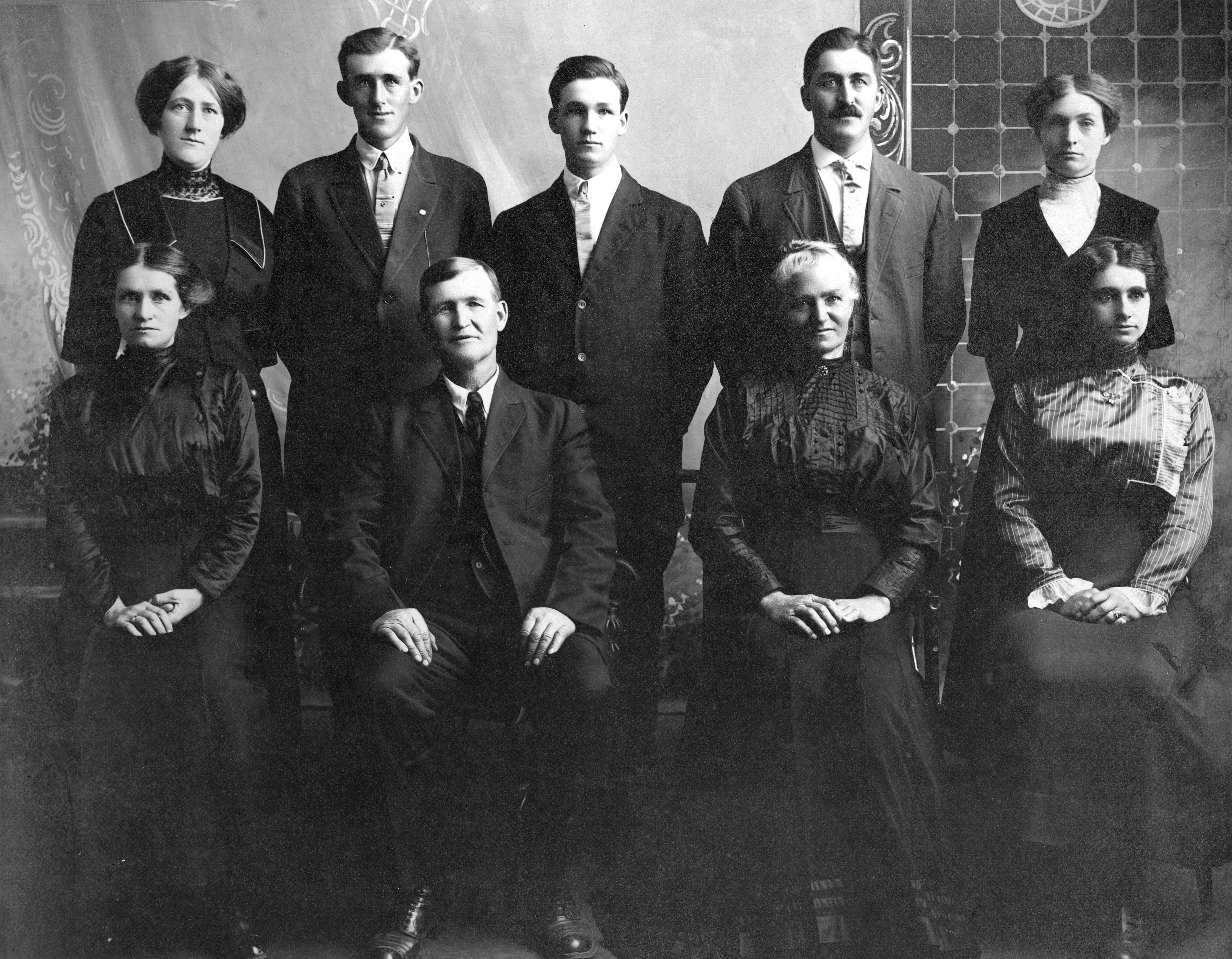
It is the only known photograph showing six of the seven children of Christian and Amanda Hanneman, pioneers of Portage and Wood counties in Wisconsin. The undated photo was probably taken around 1915 at a family event. Left to right are:
William Friedrich Johann Hanneman (1856-1939)
Bertha Auguste Ernestine (Hanneman) Bartelt (1860-1945)
Albert Friedrich O. Hanneman (1863-1932)
Herman Charles Hanneman (1864-1945)
Carl Friedrich Christian Hanneman (“Chas,” 1866-1932)
The sibling not pictured is August Friedrich Ferdinand Hanneman (1858-1902).
Along with their parents, this group came to America in late November 1882 aboard the SS Katie. They were the last of the Matthias Hannemann family to come to America from the Baltic Duchy of Pomerania (now part of Poland and Germany). The Hannemann clan (the name was eventually shortened to Hanneman) settled in and around the hamlet of Kellner in central Wisconsin.
Family Line: Matthias Hannemann >> Carl Frederick Christian Hannemann >> Carl Henry Frank Hanneman >> David D., Donn and Lavonne Hanneman.
He came to the United States at age 19 and lived the life of an American frontiersman: shuttling cargo between U.S. outposts in the West and ferrying people and goods across the Missouri River. For all of his adventurous living, William Johann Heinrich Gaulke retained one lasting memory that his family in Wisconsin still talks about: being a friend of a very young William Frederick ‘Buffalo Bill’ Cody.
William Gaulke (standing) with his arm around William F. Cody, who later went on to international fame as “Buffalo Bill.” (Photo courtesy of Sue Alft)
Gaulke met the famed U.S. Army scout and buffalo hunter while Gaulke was working and exploring the frontier lands in Nebraska and the Dakotas in the 1870s. A photograph in the Gaulke family album shows a twenty-something Gaulke standing with his arm around a seated William Cody.
Gaulke’s frontier experience grew out of tragedy he experienced in his native Germany. Born on October 1, 1848, Gaulke lost his father, John, before he turned six months old. When he was 11, Gaulke became an orphan at the death of his mother Fredericka. He emigrated to America in 1867 and landed in Milwaukee. After a short stint as a farmhand, Gaulke landed a job aboard a Great Lakes steamer, where he learned to speak English. After another stint working on farms in Illinois, Gaulke went west.
After emigrating to America in 1867, William Gaulke spent a number of years exploring the wild frontiers. (Photo courtesy of Sue Alft)
Gaulke experienced the wilds of the frontier lands as a teamster for the U.S. government. He guided a six-mule team hauling goods between U.S. Army posts. He was based at Fort Buford in the Dakota Territory. After tiring of that job, he built a skiff and drifted down the Missouri River to what is now Bismarck, North Dakota. Along with a group of companions, he established the town of Carlington. There, Gaulke operated a ferry moving people, goods and horses across the Missouri River near Fort McKeen (later called Fort Abraham Lincoln). Fort Lincoln was the base of Gen. George Armstrong Custer.
Right alongside the Mighty Missouri River, Gaulke built himself a shanty, where he lived and operated his ferry business. He built an outdoor fireplace that was used for cooking and warmth. It was also a hiding place for the $2,200 Gaulke had saved from his business ventures. Gaulke’s shanty was a frequent target of would-be thieves, but none of them ever thought to look under the fireplace for the buried money.
In 1872, Gaulke returned to Wisconsin, securing work at Grand Rapids in Wood County. In July 1876, he married Augusta Henriette Charlotte Kruger. Her mother, Friedericke Kruger, was the daughter of Matthias Hannemann (1794-1879). A short time later, the Gaulkes bought their first land in the Town of Grant in Portage County, very near where the Hannemann family established its first homes in the early 1860s. Gaulke cleared the land and established a successful farm. He also helped build many of the farm houses and barns in the area.
William Gaulke and Augusta (Kruger) Gaulke and family. Rear, left to right: Ella (Wagner), William Jr., John, Henry, Minnie (Panter). Front, left to right: Mary (Eberhardt), William Gaulke Sr., Augusta (Kruger) Gaulke, Laura (Turbin). (Photo courtesy of Sue Alft)
Gaulke also became deeply involved in civic work, serving as school district clerk, drainage district commisioner and chairman of the Town of Grant. He and Augusta had eight children, born between 1878 and 1897. Augusta died in 1914, four years before her mother. William died on October 25, 1928 after coming down with pneumonia.
William F. “Buffalo Bill” Cody in a late-life portrait (Library of Congress Photo)
Confirmation of the friendship between Gaulke and Buffalo Bill came in the early 1900s, when Cody brought his Wild West show to Grand Rapids, Wisconsin. Gaulke brought his youngest son, John, to the grounds near Lincoln High School. They watched the white-suited Cody ride about the arena on his white horse. Gaulke led his boy up to Cody, introduced himself and asked the showman if he remembered him from their time out west decades earlier. He did. “Why sure, Bill and they had quite a talk,” John Gaulke later wrote. “Finally Buffalo Bill reached into his pocket and gave my Dad a handful of tickets, who the whole family saw the show for nothing.”
A popular poster showing Buffalo Bill Cody superimposed on an image of a buffalo. (Library of Congress Photo)
William Cody was a first-rate Indian scout and buffalo hunter whose life was romanticized in dime novels written by author Ned Buntline. The pair collaborated to create a show called “The Scouts of the Plains.” In 1883, Cody developed a live show spectacular called Buffalo Bill’s Wild West. The Library of Congress says Cody “was a major contributor in the creation of the myth of the American West, as seen in Hollywood movies and television.”
The Knights of Columbus has long championed the “Keep Christ in Christmas” message to remind the public that the “holiday season” is really about the birth of the Savior. Each year, the more than 14,000 local K of C councils promote the message with car magnets, yard signs, television ads and radio spots.
The Nativity mosaic was used on a billboard along Interstate 94 in 2009.
Back in 2010, I wanted to create a 30-second broadcast commercial with this message, but we had no production budget. I found a beautiful mosaic image from the Knights of Columbus Incarnation Dome at the Basilica of the National Shrine of the Immaculate Conception in Washington, D.C. The year before, I used that image to create a billboard we placed alongside Interstate 94 in Racine County, Wisconsin.
Many Knights of Columbus councils distribute “Keep Christ in Christmas” lawn signs.
For the TV spot, we planned to use that still image with a pan-and-zoom “Ken Burns effect,” but I still needed voice talent and music. I looked no further than my then 11-year-old daughter, Ruby. She only needed a couple of takes to nail the script voiceover. My other daughter, Samantha, 14, took to her keyboard and recorded a section of “Greensleeves.” That is the tune used for the hymn What Child Is This? Once I put it all together, we had a very nice broadcast commercial, quite beautiful in its simplicity. The finished spot ran hundreds of times on a wide variety of cable television networks throughout the Archdiocese of Milwaukee. You can watch the video in the player below.
In the winter of 1966 or 1967, a young father designed and hand-crafted an outdoor nativity scene to decorate the family home in Sun Prairie, Wisconsin. David D. Hanneman (1933-2007) painted the set freehand and put it on display just under the garage window of his home on Wisconsin Avenue. The nativity scene was a fixture at the home in those early years, but eventually was put in storage and forgotten.
The original Nativity scene as built by David D. Hanneman, circa 1967.
Forty years later, after David Hanneman died, the badly weathered Nativity figures were rescued from a trash can in the garage. Over the next 18 months they were restored to almost original condition and put on display in the Village of Mount Pleasant.
The original backers and braces were removed from the cutout figures of St. Joseph, Mary and Baby Jesus. New 1-inch-thick plywood backers were crafted with a jigsaw, then glued to the figures and anchored with wood screws. Heavy L-shape stabilizing braces were screwed into the backers to give the figures sufficient weight to withstand winter winds.
Samantha J. Hanneman retouches details on the Baby Jesus figure built by her grandfather, David. D. Hanneman.
Samantha J. Hanneman, David Hanneman’s granddaughter, did most of the paint restoration work. With a special set of art brushes, she applied metallic gold and flat black paint to maintain the original look. Touch up paint was applied sparingly to the faces and hands of the figures to keep the hand-drawn details.
The newly restored Nativity scene was put on display at the Hanneman home in Racine County in December 2008, making the old tradition new again for another generation. The crèche was displayed for several years, but had to again be put in storage when we lost our home. Now the figures again wait patiently to have a new home where their warm glow will fill the Christmas night.
St. Francis of Assisi is credited with creating the first Nativity crib or crèche on Christmas Eve 1223 in Greccio, Italy. St. Francis was eager to make the birth of Christ something tangible for the faithful. He had a manger built, brought animals to be part of the set, and had Holy Mass said before this representation of the birth of Christ. After the preparations were finished, St. Francis and some of his followers went to the crèche for the Mass. After a short prayer by Francis, a vision of the Christ child appeared on the hay.The miracle stirred the animals and greatly moved the faithful who witnessed it.
Her look of delight really tells the whole story. Little Jane Patricia Hanneman, beholding a cake on her third birthday, shows a priceless expression. She celebrated her birthday in October 1958 with her paternal grandparents, Carl F. Hanneman (1901-1982) and Ruby V. Hanneman (1904-1977) at their home in Mauston, Wisconsin. In the background of the photo is her aunt and my Mom, Mary K. Hanneman. She could not have known it at the time, but Jane’s birthday falls on the same date as the 1819 wedding of her great-great-great grandparents, Matthias Hannemann and Caroline (Kuehl) Hannemann. The couple were married at Meesow, Regenwalde, Pomerania.
My Dad, David D. Hanneman, also shot some 8mm film at the celebration, which can be viewed below:
His death was given only passing notice in the Wisconsin State Journal, the state’s official newspaper. “May he rest in peace,” the brief item from April 9, 1864 read. So it was the unwritten that was truly remarkable in the all-too-brief life of James Moore, soldier of the Wisconsin 12th Infantry Regiment in the Civil War.
The son of Irish immigrants who settled to farming in the Town of Sun Prairie, Moore was just 14 when he enlisted in Company I of the 12th Infantry Regiment in late September 1862. Moore and Lemuel C. Neal of Sun Prairie enlisted together at Camp Randall on September 29, 1862. Moore was a boy who went to fight in a man’s war — a theme that would be repeated, most especially in the “war to end all wars,” World War I. His youth, just five months past his 14th birthday, seems quite remarkable for an infantry private. The sacrifice of his very young life in the fight to save the republic should always be remembered.
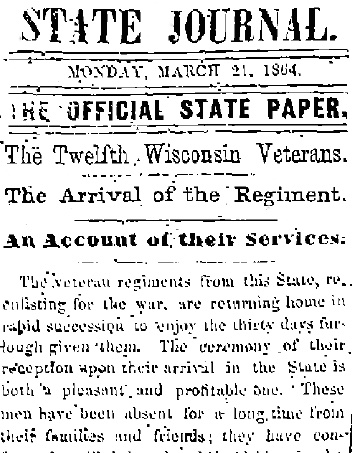
The Wisconsin State Journal covered the return of the 12th Infantry Regiment on March 21, 1864.
Moore saw combat and the horrors of America’s bloodiest war, although the 12th Infantry Regiment did not take part in the most famous battles of the Civil War. These men rebuilt and guarded key railroad lines, supported the battle of Vicksburg and took part in General Sherman’s Meridian Expedition in February 1864. That month they marched 416 miles, aiding in the capture and destruction of Jackson, Brandon and Decatur as they proceeded to Meridian. “A shell exploded in the ranks of Company I, killing Eugene Baldwin and W.H. Murray, wounding O. Lind, J.W. Dean, John Thorp and George Everett,” read the account in the 1866 Military History of Wisconsin.
The battle flag of the Wisconsin 12th Infantry Regiment is held by the Wisconsin Veterans Museum in Madison.
Shortly after the Meridian campaign, Moore was among some 700 men in the regiment sent home to Wisconsin on a 30-day furlough. After rolling into Madison via rail at 5 a.m. on March 21, the men ate a hearty supper at the Railroad Restaurant and then marched to their quarters at Camp Randall. The next day they were welcomed by Wisconsin’s newly minted governor, James Taylor Lewis. The Wisconsin State Journal published a chronicle of their service, noting the regiment had marched more than 2,000 miles to earn itself the nickname “the Marching 12th.”
The newspaper asked the community to be patient with these and other young soldiers, home from the stress of war with full bellies and money in their pockets. “Brave boys, they are going back, and the voice that now makes the night hideous with bawdy songs will utter its last accent in a victorious cheer upon some future battlefield,” the paper wrote. “Yes, they are going back, and he who is now a ‘drunken soldier’ will bear the dear old flag in triumph, amid the whistling bullets and screaming shell, to plant it on the battlements of the enemy.”
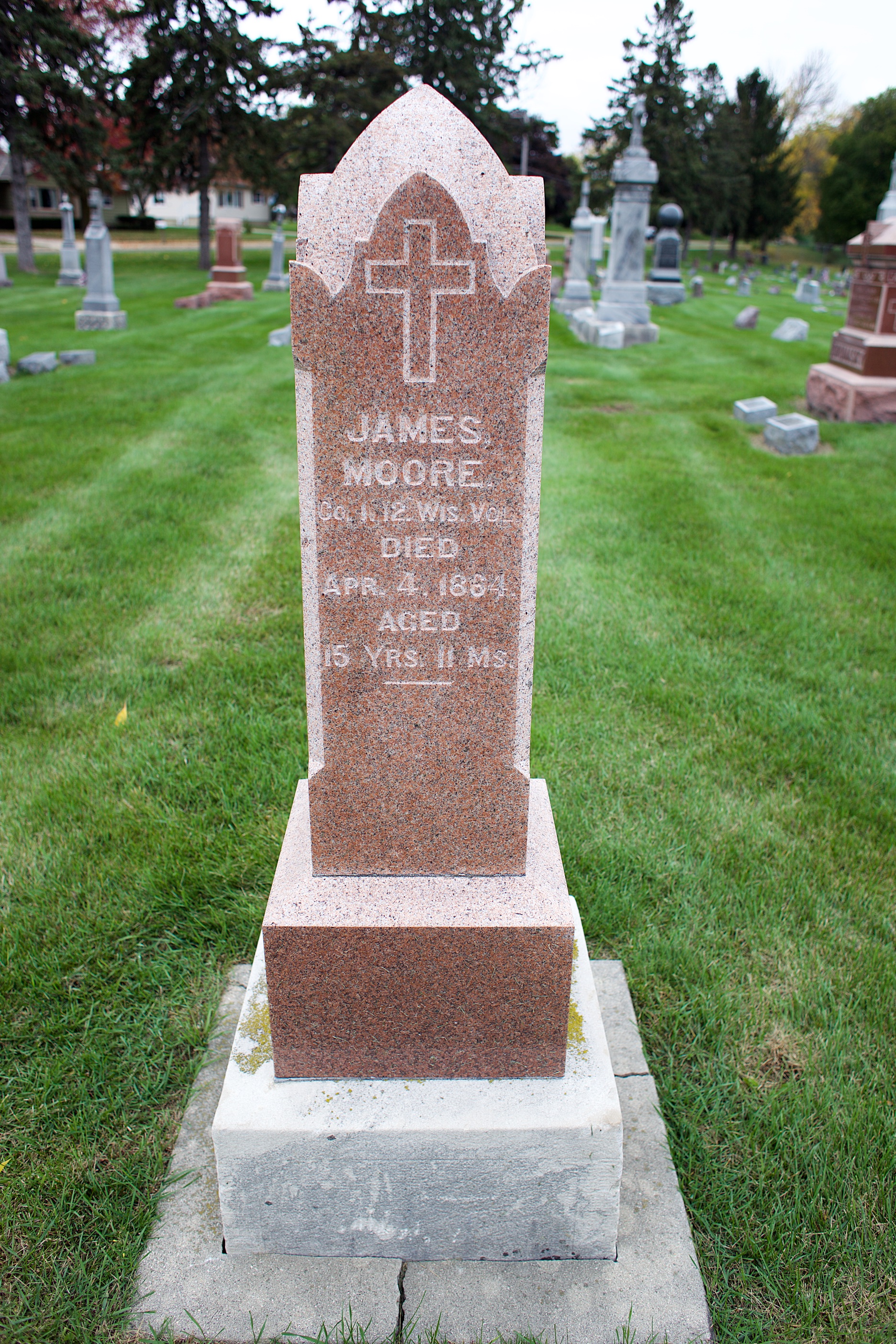
The grave marker of James Moore at Sacred Hearts of Jesus and Mary Catholic Cemetery in Sun Prairie, Wisconsin.
The soldiers of the 12th were discharged to their homes on Thursday, March 31. It is a safe assumption that Pvt. Moore was ill when he reached his family farm in the Town of Sun Prairie. He took to bed. His death on Monday, April 4 came before he had any chance to enjoy the well-deserved furlough. We don’t know what disease or illness claimed his life, or if he was exposed to it in battle, on the train ride home or at Camp Randall. His funeral Mass was held at Sacred Hearts of Jesus and Mary Catholic Church, which his father helped to build just a year before. His parents and two sisters had the sad duty of burying young James just as Wisconsin shook off the winter of 1864.
James Moore was born in Ohio on April 15, 1848, the only son of Mathew Moore and the former Catharine O’Neill. His parents emigrated from Ireland and spent some time in Ohio before settling on a 37-acre farm on the western edge of the Town of Sun Prairie in May 1850. Mathew and Catharine carried the loss of their son with them every day. Around 1875, the family left the farm and moved into the village of Sun Prairie, where Mathew died on April 28, 1891. Mrs. Moore died on Feb. 22, 1907 at age 93. Their daughters, Margaret Moore and Sara (Moore) Flavin, are buried near their parents — and their soldier brother — at Sacred Hearts of Jesus and Mary Cemetery in Sun Prairie.
Moore was among the more than 224,500 Union soldiers who died of disease, exposure or other non-battle causes in the Civil War. According to the Wisconsin Historical Society, the state sent more than 91,000 boys and men in 56 regiments to fight in the War of the Rebellion (1861-1865). More than 12,000 died, including nearly 8,500 from disease.
Lemuel C. Neal of Sun Prairie enlisted the same day as James Moore. Neal survived the war and lived until age 91. (Photo courtesy Wisconsin Veterans Museum)
His compatriot Lemuel C. Neal survived the war and went on to live a long, productive life. The son of Thomas Neal and the former Olive Dolley, Lemuel was one of nine children in the Neal farmhouse when he left home to enlist in the fall of 1862. He mustered out of service on May 31, 1865 and returned to Sun Prairie. His mother fell ill that fall and died on October 29 at age 45. The family left Wisconsin for Iowa, and eventually Lemuel settled in the Town of Turtle River, North Dakota. He married the former Ellen Forest and started a family. He kept moving west, later settling at Lewiston, Idaho. In 1896, he was awarded a patent for a clothespin by the U.S. patent office.
Neal again moved west, settling in Oceanside, California before eventually moving to Santa Ana. Neal and Ellen had two sons and two daughters. Ellen died in 1920. Neal remarried in February 1921, taking Clara Skelton Jones as his bride. Neal was hospitalized at the U.S. veterans hospital in Sawtelle, California in 1922, suffering from heart disease and high blood pressure. At the time, records listed his occupation as a merchant. He died at that same hospital on February 13, 1936. He was 91.
In the first half of the 20th century, druggists in America were often called on to literally fill prescriptions, placing medications into gelatin capsules and then counting out the order. Mauston pharmacist Carl F. Hanneman was very efficient at the task. Maybe too much so, opined The Mauston Star in a rather humorous article in December 1953.
“Joe Dziewior and this muser, watching ‘pestle and mortar’ Carl Hanneman throw a prescription together the other evening, now know why pill or capsule counting machines not not necessary to the registered pharmacist,” read the article on December 11, 1953. “With bottle in hand, Carl was pouring capsules into his hands and counting them faster than an adding machine.”
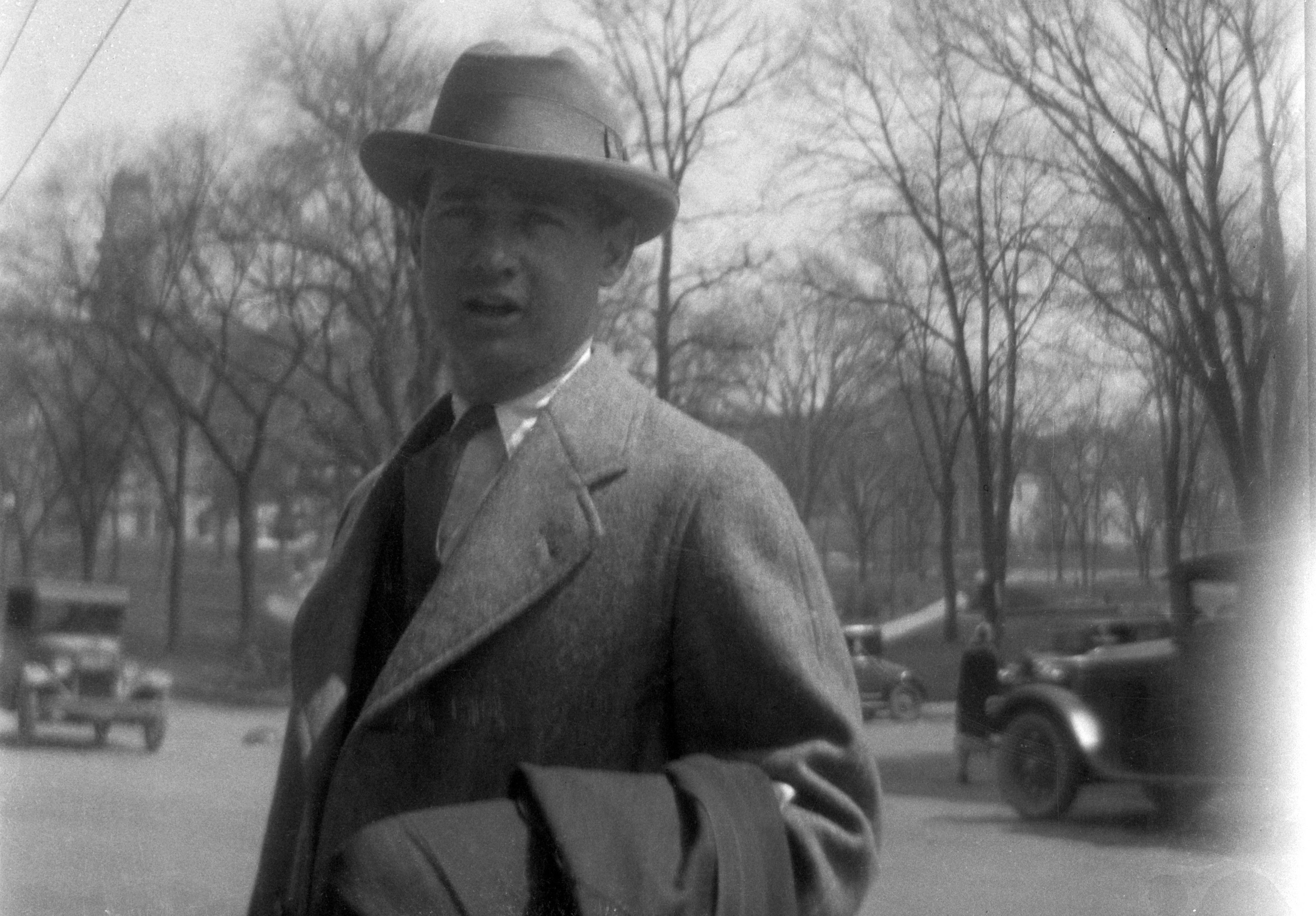
Carl F. Hanneman taking his suits to the cleaner at Janesville, Wis., on April 5, 1926. Carl and his wife, Ruby V. Hanneman, were on their way to dinner. Carl was a druggist at McCue & Buss Drug Co. at the time. He later moved to Mauston, Wis.
Carl was the registered pharmacist at the Mauston Drug Store on Division Street in Mauston. He had been the druggist there since moving his young family to Mauston in 1936 from Wisconsin Rapids. A graduate of Marquette University, Carl started as an assistant pharmacist, but obtained his full registered pharmacist license in the 1940s.
“After watching him for some time, we entertained a doubt as to the accuracy of the counts and Joe was inclined to agree with us,” the article continued. “But Carl said he could count pills time on end and whistle a tune at the same time, and still come out the a correct count. ‘Come, come, Carl!’ we exclaimed. ‘Isn’t that pulling our leg a bit?'”
Judging by Carl F. Hanneman’s vials from McCue & Buss Drug Co., registered pharmacists packaged both pre-made pills and medicine capsules.
Carl told the men a story of a “kindly old lady” who regularly came in for prescriptions and doubted the counts doled out by the druggist. “It never failed, but that after we wrapped up her prescription, she’d sit in the chair out there, undo the package and count the pills in the box,” Hanneman said. “To this day, she hasn’t demanded a recount!”
The article concluded: “Maybe registered pharmacists should be made ballot clerks. Recounts wouldn’t be necessary!”












 The Hanneman Archive