
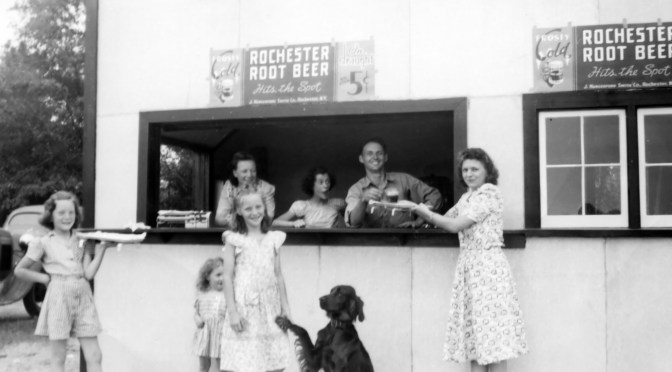
Marvin and Mabel Treutel operated a roadside root beer stand near their home on Wilhorn Road in Nekoosa, Wisconsin. Aside from 5-cent Rochester root beers, they served the “Best Roast Beef BBQ.” Pictured behind the counter in this late-1940s photo are Mabel Treutel (left), niece Lavonne Hanneman (center) and Marvin Treutel (right). Out front are daughters Bonnie Treutel (left), and Patricia Treutel (center, holding dog). The woman at right and the little girl at center are unidentified.
Tag Archives: Wood County

Wedding Wednesday: Carl and Ruby Hanneman
Nearly 90 years ago on a summer Tuesday morning, Ruby Viola Treutel and Carl Henry Frank Hanneman joined in marriage at St. James Catholic Church in Vesper, Wisconsin. The marriage, which would live on for more than 50 years and produce three children and 16 grandchildren, was described in detail in a story in the July 15, 1925 edition of the Wisconsin Rapids Daily Tribune:
TREUTEL-HANNEMAN
One of the prettiest weddings of the summer was solemnized yesterday morning at nine o’clock at St. James church, Vesper, when Miss Ruby Treutel, daughter of Walter Treutel of Vesper, became the bride of Carl F. Hanneman, son of Mr. and Mrs. Charles Hanneman of this city. Rev. Father Gille officiated at the nuptial Mass.
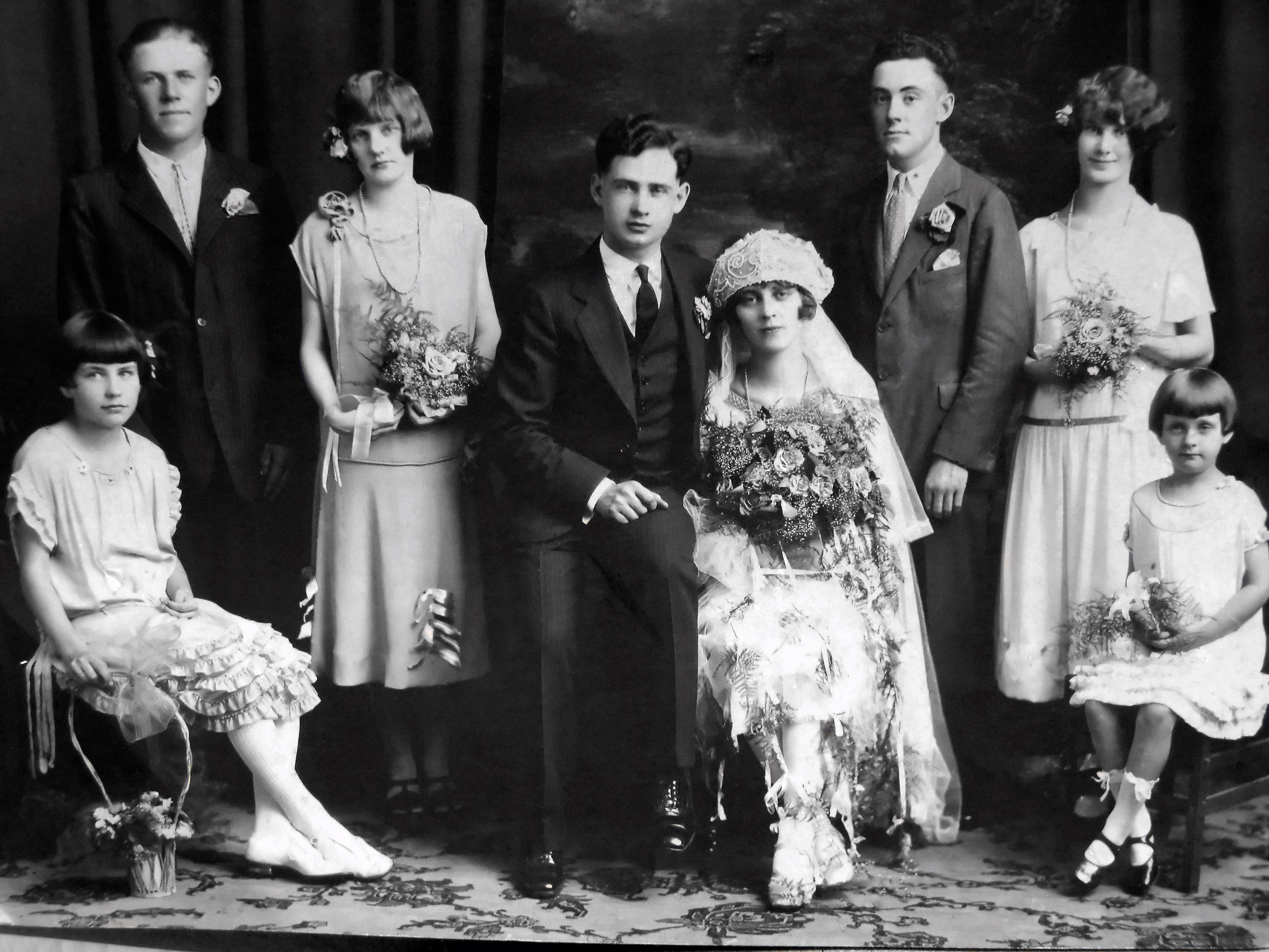
The church was beautifully decorated with greens and the season’s flowers, making an appropriate setting for the wedding party. Miss Velma Doering of Stratford played the wedding march as the party entered the church and proceeded to the altar. Miss Gladys Cole of Nekoosa, and the groom’s attendant, Joseph Ladick, of Vesper, both cousins of the bride, were followed by two little sisters of the bride, Nina and Elaine, who acted as flower girl and ring bearer. The maid of honor, Miss Esther Albright, came next and was followed by the bride and her father, who gave her away.
Mr. Hanneman and his best man, Wendell Miscoll, awaited the party at the altar. The bride was very beautiful in her gown of white georgette trimmed with gold lace. She wore a coronet of pearls, with her veil falling from a beaded butterfly. She carried a shower bouquet of pink rose buds.
Miss Albright, the maid of honor, was gowned in orchid georgette and carried an arm bouquet of rose. Miss Cole, the bridesmaid, wore a gown of orange georgette, and also carried roses. Nina, the little flower girl, was in a little frock of yellow georgette, and Elaine completed the delightful color ensemble in a dress of pink georgette. She carried the ring in a white lily.
Following the service at the church, the bridal party and relatives came to this city, where the ten-thirty breakfast was served at the Witter Hotel. The bride is a graduate of Lincoln High School and the Stevens Point Normal. Since her graduation from the normal school she has been teaching at Vesper. The groom was graduated from Lincoln High and for some time following was employed at the Church Drug store. He later graduated from the pharmacy department of Marquette University at Milwaukee and is at present holding a position with Whitrock and Wolt.
Following a week’s outing in the northern part of the state, part of the time being spent as guests of Mr. and Mrs. Armand Bauer at their cottage at Hayward, they will return here and for the present make their home with Mr. Treutel at Vesper.
©2014 The Hanneman Archive
The bridal photo, hand retouched to restore color to the roses.

The bridal portrait of Ruby V. Hanneman in its original frame.

For their honeymoon in July 1925, Carl F. Hanneman (1901-1982) and Ruby Viola (nee: Treutel) Hanneman (1904-1977) took a camping trip to Wisconsin’s north woods. The couple are pictured at a camp site near Hayward, Wis. They were married July 14, 1925 at Vesper, Wis.

He could be carrying milk from the barn, but Carl F. Hanneman (1901-1982) is actually on a honeymoon camping trip in this July 1925 photo. Carl and bride Ruby (nee: Treutel, 1904-1977) took a camping trip near Hayward, Wis., after their wedding on July 14, 1925.

An unidentified boy sits outside of a cottage near Hayward, Wis., with Ruby V. (Treutel) Hanneman (1904-1977) in July 1925. Ruby and new husband Carl F. Hanneman (1901-1982) were on their honeymoon.

Carl F. Hanneman (at right) leans on his Ford near the camp where he and bride Ruby spent their honeymoon.

Carl F. Hanneman and an unidentified boy at the Hanneman picnic table.

The Hanneman honeymoon had a rustic theme at a cottage near Hayward, Wis.

Carl F. and Ruby V. Hanneman took these selfies on their honeymoon in July 1925.

Carl F. and Ruby V. Hanneman on their 25th wedding anniversary in July 1950.

Back of the photo: Carl F. and Ruby V. Hanneman on their 25th wedding anniversary in July 1950.

Carl F. and Ruby V. Hanneman on their 50th wedding anniversary, celebrated at Sun Prairie in July 1975.

Eye on the Past: 6 Hanneman Siblings
It is the only known photograph showing six of the seven children of Christian and Amanda Hanneman, pioneers of Portage and Wood counties in Wisconsin. The undated photo was probably taken around 1915 at a family event. Left to right are:
- William Friedrich Johann Hanneman (1856-1939)
- Bertha Auguste Ernestine (Hanneman) Bartelt (1860-1945)
- Albert Friedrich O. Hanneman (1863-1932)
- Herman Charles Hanneman (1864-1945)
- Carl Friedrich Christian Hanneman (“Chas,” 1866-1932)
- Ernestine Wilhelmine Caroline (Hanneman) Timm (1870-1930)
The sibling not pictured is August Friedrich Ferdinand Hanneman (1858-1902).
Along with their parents, this group came to America in late November 1882 aboard the SS Katie. They were the last of the Matthias Hannemann family to come to America from the Baltic Duchy of Pomerania (now part of Poland and Germany). The Hannemann clan (the name was eventually shortened to Hanneman) settled in and around the hamlet of Kellner in central Wisconsin.
Family Line: Matthias Hannemann >> Carl Frederick Christian Hannemann >> Carl Henry Frank Hanneman >> David D., Donn and Lavonne Hanneman.
©2014 The Hanneman Archive
William Gaulke: Pioneer Frontiersman, Friend of Buffalo Bill Cody
He came to the United States at age 19 and lived the life of an American frontiersman: shuttling cargo between U.S. outposts in the West and ferrying people and goods across the Missouri River. For all of his adventurous living, William Johann Heinrich Gaulke retained one lasting memory that his family in Wisconsin still talks about: being a friend of a very young William Frederick ‘Buffalo Bill’ Cody.

Gaulke met the famed U.S. Army scout and buffalo hunter while Gaulke was working and exploring the frontier lands in Nebraska and the Dakotas in the 1870s. A photograph in the Gaulke family album shows a twenty-something Gaulke standing with his arm around a seated William Cody.
Gaulke’s frontier experience grew out of tragedy he experienced in his native Germany. Born on October 1, 1848, Gaulke lost his father, John, before he turned six months old. When he was 11, Gaulke became an orphan at the death of his mother Fredericka. He emigrated to America in 1867 and landed in Milwaukee. After a short stint as a farmhand, Gaulke landed a job aboard a Great Lakes steamer, where he learned to speak English. After another stint working on farms in Illinois, Gaulke went west.

Gaulke experienced the wilds of the frontier lands as a teamster for the U.S. government. He guided a six-mule team hauling goods between U.S. Army posts. He was based at Fort Buford in the Dakota Territory. After tiring of that job, he built a skiff and drifted down the Missouri River to what is now Bismarck, North Dakota. Along with a group of companions, he established the town of Carlington. There, Gaulke operated a ferry moving people, goods and horses across the Missouri River near Fort McKeen (later called Fort Abraham Lincoln). Fort Lincoln was the base of Gen. George Armstrong Custer.
Right alongside the Mighty Missouri River, Gaulke built himself a shanty, where he lived and operated his ferry business. He built an outdoor fireplace that was used for cooking and warmth. It was also a hiding place for the $2,200 Gaulke had saved from his business ventures. Gaulke’s shanty was a frequent target of would-be thieves, but none of them ever thought to look under the fireplace for the buried money.
In 1872, Gaulke returned to Wisconsin, securing work at Grand Rapids in Wood County. In July 1876, he married Augusta Henriette Charlotte Kruger. Her mother, Friedericke Kruger, was the daughter of Matthias Hannemann (1794-1879). A short time later, the Gaulkes bought their first land in the Town of Grant in Portage County, very near where the Hannemann family established its first homes in the early 1860s. Gaulke cleared the land and established a successful farm. He also helped build many of the farm houses and barns in the area.
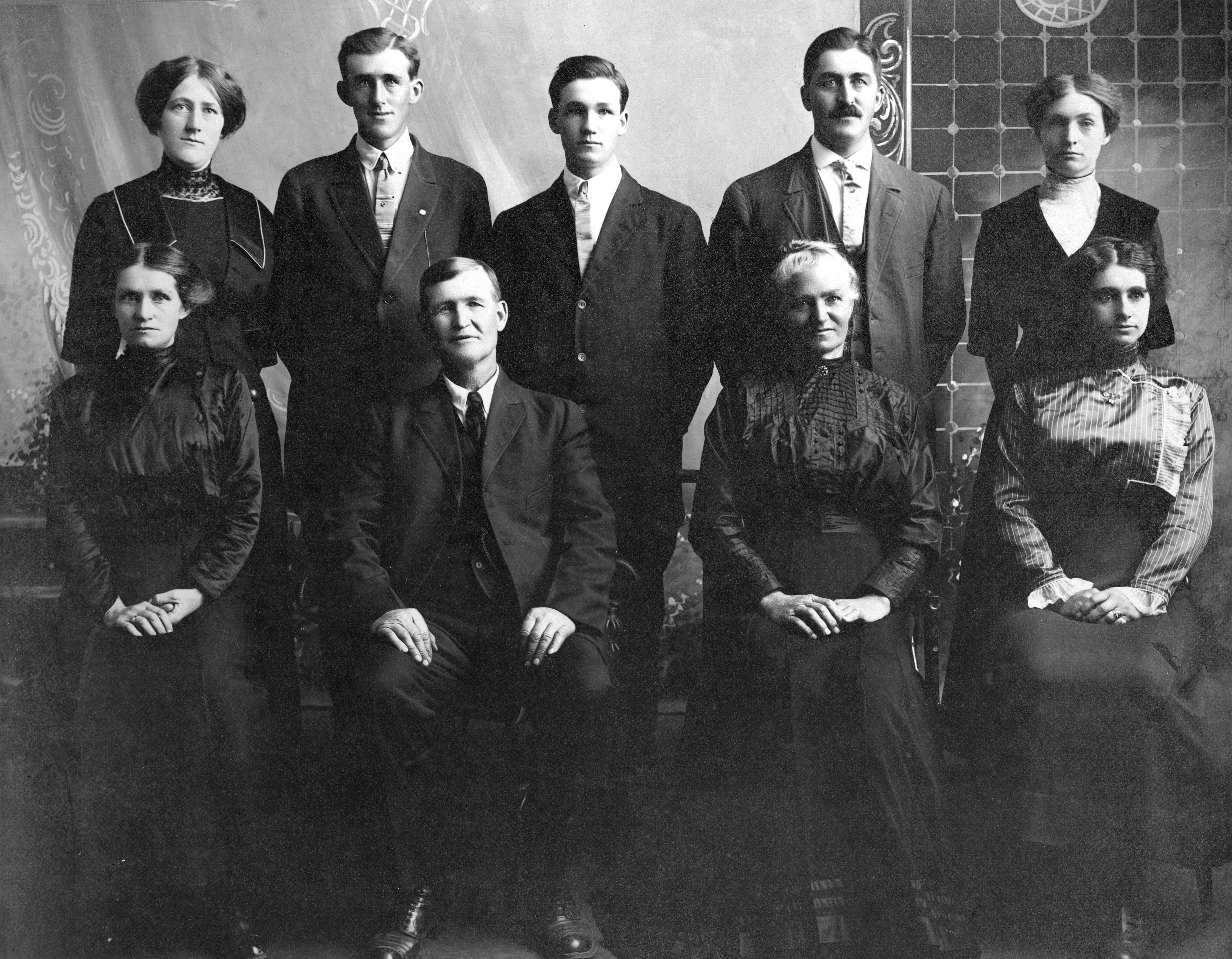
Gaulke also became deeply involved in civic work, serving as school district clerk, drainage district commisioner and chairman of the Town of Grant. He and Augusta had eight children, born between 1878 and 1897. Augusta died in 1914, four years before her mother. William died on October 25, 1928 after coming down with pneumonia.

Confirmation of the friendship between Gaulke and Buffalo Bill came in the early 1900s, when Cody brought his Wild West show to Grand Rapids, Wisconsin. Gaulke brought his youngest son, John, to the grounds near Lincoln High School. They watched the white-suited Cody ride about the arena on his white horse. Gaulke led his boy up to Cody, introduced himself and asked the showman if he remembered him from their time out west decades earlier. He did. “Why sure, Bill and they had quite a talk,” John Gaulke later wrote. “Finally Buffalo Bill reached into his pocket and gave my Dad a handful of tickets, who the whole family saw the show for nothing.”

William Cody was a first-rate Indian scout and buffalo hunter whose life was romanticized in dime novels written by author Ned Buntline. The pair collaborated to create a show called “The Scouts of the Plains.” In 1883, Cody developed a live show spectacular called Buffalo Bill’s Wild West. The Library of Congress says Cody “was a major contributor in the creation of the myth of the American West, as seen in Hollywood movies and television.”
©2014 The Hanneman Archive
Ruby Treutel’s Spirited 1922 Quest for ‘Queen of the Bridge’
Her reign may have been brief, but for one day in 1922, Ruby V. Treutel was front-page news as the most popular single woman in Wood County, Wisconsin. To help celebrate dedication of a new bridge across the Wisconsin River, the community organized a popularity contest to find the Queen of the Bridge.
The Queen of the Bridge contest invited the nomination of single women of Wood County. The contest winner would preside at the dedication of what came to be called the Grand Avenue Bridge, linking the east and west sides of Wisconsin Rapids over the Wisconsin River.

Miss Ruby Treutel of Vesper was among the early nominees for the Bridge Queen, and she jumped to a lead after the first weekend of balloting in September 1922. The front-page headline in the Wisconsin Rapids Daily Tribune on Sept. 25, 1922, proclaimed: Ruby Treutel and Mary Herron in Spirited Contest. “A spirited race between Miss Ruby Treutel of Vesper and Miss Mary Herron of this city developed as a result of the week end balloting in the Bridge Queen popularity contest,” the article read, “with Miss Treutel leading by slightly over 200 votes of the 43,000 cast for these two candidates.”

Ruby’s 22,570 vote total was more than twice that of the third-place contestant and far ahead of the 10 votes for Miss Pearl Brewster. But, like fame and money, the lead would not last as the contest balloting steamed along for two weeks at such a rapid pace the contest was ended early. In the first week, more than 1.3 million ballots were cast. The Bridge Committee had trouble keeping up with the tallying, which would exceed 20 million votes by the end of the contest.
By September 28, 1922, Ruby’s vote total had more than doubled, to 45,240. But this now paled in comparison to contest leaders Eva Manka and Mary Herron, who had more than 500,000 votes between them. On Sept. 30, Herron’s vote total ballooned to 989,000, far exceeding Manka’s new total of 640,000. Ruby was in a respectable fifth place with 171,000 votes. By the time the committee decided to cut voting short on Sept. 30, balloting was at a fever pitch. The final vote totals were:
- Mary Herron, 5,336,570 votes
- Mildred Bossert, 3,645,840 votes
- Eva Manka, 1,763,360 votes
- Manon Matthews, 1,016,510 votes
- Margaret Galles, 711,550 votes
- Alice Damon, 618,550 votes
- Ruby Treutel, 608,050 votes
- Maurine Dutcher, 492,410 votes
- Pearl Possley, 486,600 votes
- Ruth McCarthy, 460,510 votes
Miss Herron was crowned Queen of the Bridge. On Oct. 18, 1922, she attended the huge dedication ceremony and officially christened the span the “Grand Avenue Bridge.” It was indeed a grand event, with thousands of people, a parade and even aerial acrobatics performed by the Federated Flyers stunt team, which did loops in the sky with its planes, and thrilled the crowd with wing walking.

The Grand Avenue Bridge has long been an important part of Wood County’s infrastructure. The 1922 version replaced an old wood and steel span. Bridges across the Wisconsin River date to the 1870s. In earlier times, bridge was an important link between the former towns of Grand Rapids and Centralia, which later joined to form the city of Wisconsin Rapids.

When a Movie was More Than Just a Movie
When was the last time your visit to the Cineplex included live entertainment? (The bratty 5-year-old in front of you throwing popcorn at his brother does not count.) The movie theater was once about much more than movies, and the price of admission included live performances, newsreels, comedy shorts and more. For years our own Ruby V. Hanneman was a featured performer at some of Wisconsin Rapids finest cinemas, and her name appeared in ads right alongside Silent Era stars of the day like Neal Hart, Ricardo Cortez, Doris Kenyon and Jack Holt.
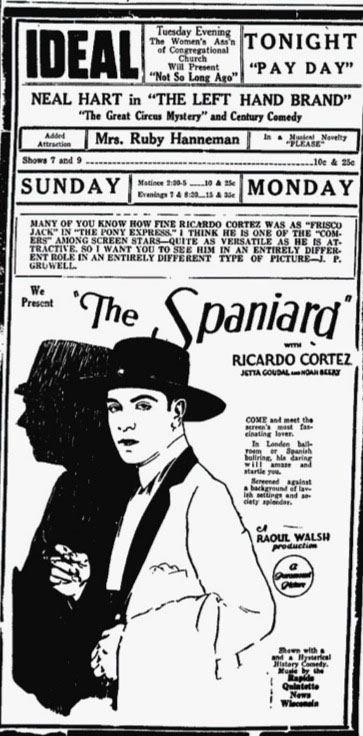
Ruby often appeared at the Ideal Theatre at 220 E. Grand Ave., Wisconsin Rapids. She sang a “musical novelty” at two shows on Halloween night 1925. The main attraction was The Thundering Herd, a movie based on the 1925 novel by Zane Grey. (Zane Grey happened to be a favorite author of Carl F. Hanneman and his son David, but we digress.) Seats that night were just 10 cents or 25 cents, half off the typical ticket prices.
On Thanksgiving 1925, Ruby sang for the audience at Paramount Pictures In the Name of Love, starring Ricardo Cortez and Greta Nissen. Ruby sang two numbers, “Lonesome, That’s All,” and “In the Garden of Tomorrow.” The 15 cent and 35 cent admission also included the Wisconsin Rapids Quintette, newsreels and a Will Rogers comedy.

Ruby got perhaps her most prominent billing for the October 17, 1925 showing of The Spaniard. Her name was most prominent in the ad in the Wisconsin Rapids Daily Tribune. “Added Attraction, Mrs. Ruby Hanneman in a Musical Novelty, Please, the ad read. On Aug. 25, 1925 she appeared at the New Palace Theater singing, “I Wonder What’s Become of Sally.” The feature film that night was Born Rich starring Bert Lytell and Claire Windsor.

By the time she starred at the New Palace and the Ideal, Ruby was a veteran singer. According to the April 4, 1921 edition of the Daily Tribune, Ruby Treutel “brought down the applause of the house time after time” for her performance in the play “The Fire Prince” at Daly’s Theater. Ruby was 17 at the time.

When she graduated from Lincoln High School in Wisconsin Rapids in 1922, Ruby had years of experience in music and drama. She played the female lead in the operetta Sylvia during her senior year. She was also president of the Glee Club. Under her senior class portrait in the yearbook The Ahdawagam read the motto, “Music hath charms and so does she.”
©2014 The Hanneman Archive
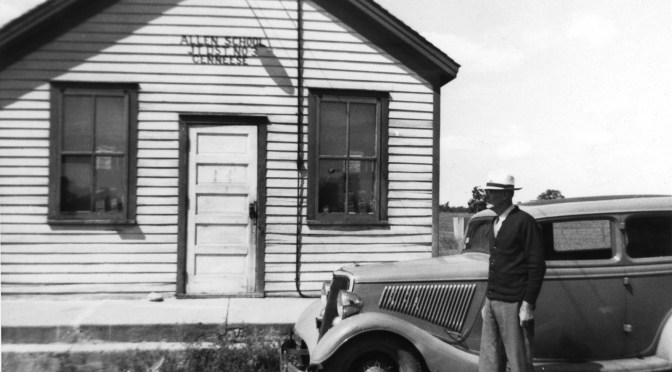
Oscar Treutel Goes Back to School in August 1942
School must have seemed just a bit smaller when Oscar Treutel went back for a visit on August 24, 1942. In the 1880s, Oscar was a student at “Allen School” in Joint District No. 3 in the Town of Genesee in Waukesha County, Wisconsin. Let’s hope Oscar wasn’t returning for a spelling lesson, since the building has Genesee misspelled as “Genneese.” Perhaps the building lettering was a class project.

The school was in the southwest corner of the town on the E. Allen property, near the Saylesville Mill Pond. We should distinguish this one-room school from the Ethan Allen School for Boys, a reformatory in nearby Delafield that operated from 1959-2011.
Oscar traveled to school from the Treutel home in nearby North Prairie. He was the fifth child of Philipp and Henrietta Treutel, born Oct. 9, 1874 in Waukesha County. He moved with his family to Vesper in Wood County just after the turn of the century. He spent his sunset years in nearby Arpin. He died in 1967 at age 92.
©2014 The Hanneman Archive

Photos with That Memorable Something
Sometimes a photograph will strike you in a certain way that makes it memorable. It has some intangible quality that makes it almost timeless. Of the thousands of images in our library, a handful qualify for this kind of distinction. Not for their physical clarity or skill of the photographer, but that certain look. You might describe it just a bit like looking at a Rockwell painting, or a black and white photograph by Ansel Adams.
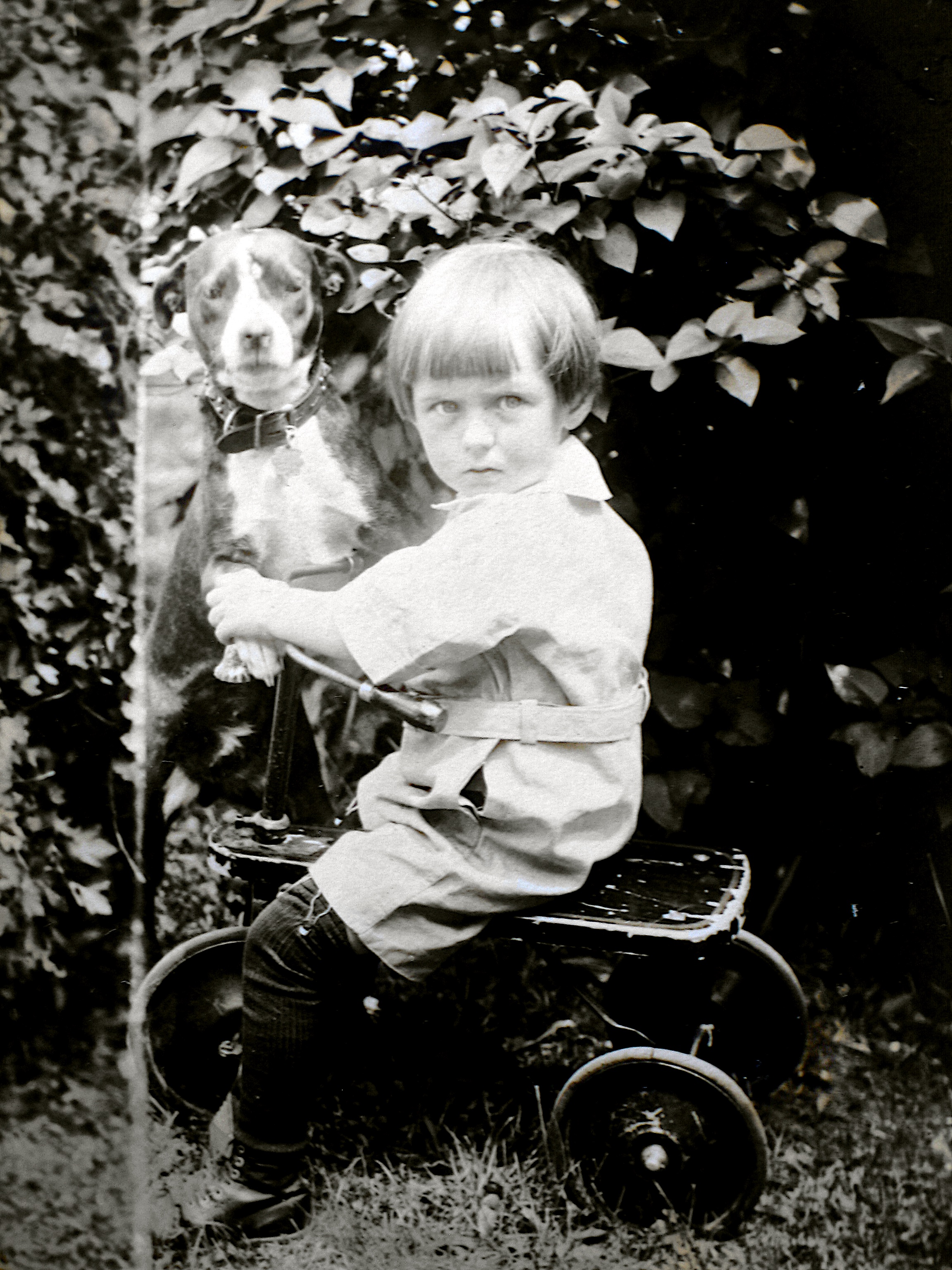
View the whole collection in the gallery below:

Elaine Treutel poses with the family dog in this ca. 1923 photo near Vesper, Wis. Directly behind her is older sister Ruby V. Treutel. Sitting on the bumper of the car is father Walter Treutel (1879-1948). The others are unidentified.

This image has a Little Rascals look and feel to it. Toddler Elaine Treutel and the family dog on her tricycle, circa 1922.

David D. Hanneman with his toe in the sand at Madeline Island, circa 1942.

Ruby V. Treutel (center) relaxes with the Sunday paper near Milwaukee’s Juneau Park in 1924. Ruby was visiting her fiance, Carl F. Hanneman (1901-1982), who was studying pharmacy at Marquette University. At front is Ruby’s sister, Nina H. Treutel (1914-2005). The woman near the car is unidentified.

A formal portrait of Elaine Treutel of Vesper, Wis., circa 1938. Born in January 1920 to Walter and Mary (Ladick) Treutel of Vesper, Elaine attented Lincoln High School in Wisconsin Rapids. She married Max Clark in October 1938. The couple lived for many years in Madison, then relocated to suburban Phoenix, Arizona.

Frank Herman Albert Hanneman (1895-1947) of Grand Rapids, Wis., posed for this studio photo with a shotgun, ammunition belt and even a hunting dog. The photo was taken ca. 1909. Frank was the son of Carl Frederick Christian Hanneman (1866-1932) and Rosine B. H. Ostermann (1874-1918).

Nina Treutel of Vesper, Wis., is about 18 months old in this circa 1916 photograph. Nina’s parents are Walter Treutel and Mary Helen (Ladick) Treutel.

A beautiful portrait of Lavonne Hanneman, circa 1955.

Ruby Treutel poses for an informal photo, circa 1922.

Ruby Treutel with her siblings Marvin, Elaine and Nina, circa 1921.

Carl F. Hanneman’s high school portrait, 1921.

Lavonne and David Hanneman examine a monument on a vacation trip to South Dakota in 1947.

Ruby Treutel holds her baby brother Gordon, circa 1910. Gordon died of pneumonia in February 1911.

Patricia Treutel is having a great time on the tree swing, circa 1943.

We don’t have an ID on this beautiful young lady. Photo appears to be from 1920s.

David D. Hanneman watches over his little sister, Lavonne, circa 1938.

David D. Hanneman and sister Lavonne Marie Hanneman, circa 1942.

1926 Fire Destroyed St. James Rectory at Vesper
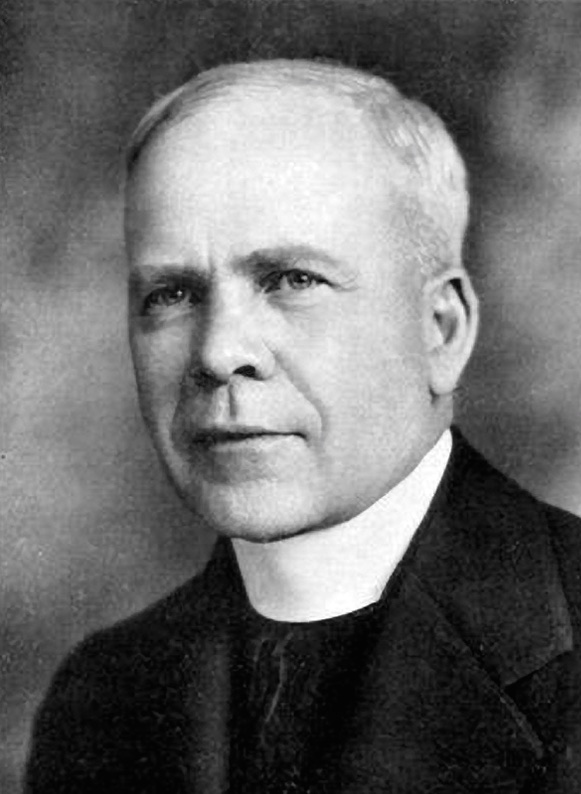
A fire in April 1926 at the parish priest’s residence in Vesper, Wisconsin, spread so fast that the building was reduced to its foundation before firefighters arrived.

Fire broke out in the rectory of St. James Catholic Church on Monday, April 19, 1926. Calls went to the Wisconsin Rapids fire department, but its firemen were all out battling grass fires. Villagers were on their own.
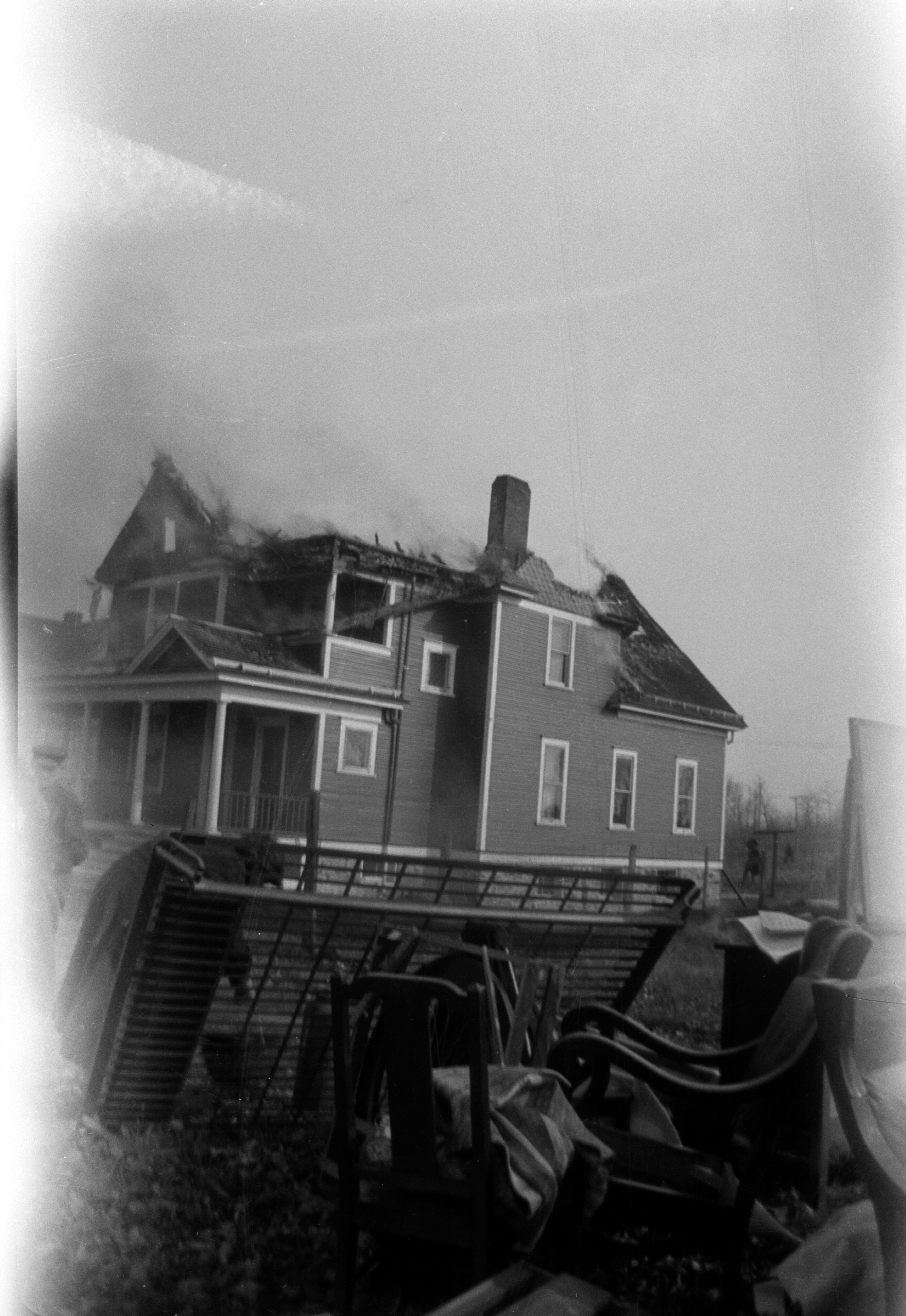
Neighbors rushed into the burning building to pull out as much as possible before the home was lost to the flames. It’s not known if the parish priest, Rev. Charles W. Gille, was at home when the fire broke out. Within a matter of minutes, the home was, as firefighters say, “totally involved.” The buckets of water thrown at it were of no use. By the time firemen from Marshfield arrived, it was too late.
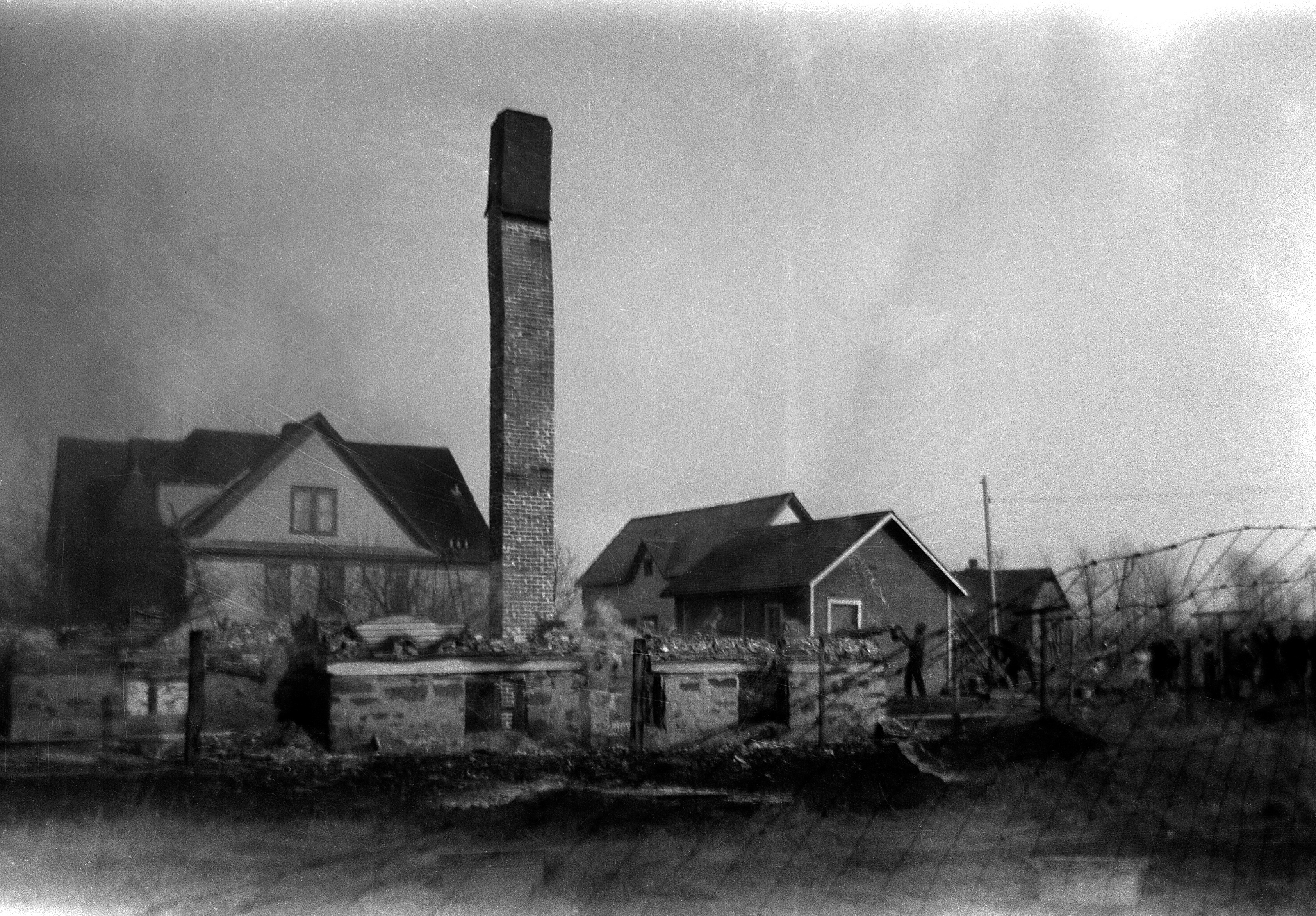
The former residence of the Henry Stahl family on Benson Avenue was purchased by the St. James parish in 1919 to serve as a home for the parish priest. The loss from the fire was estimated at more than $4,000. The photos were taken by Carl F. Hanneman, whose father-in-law, Walter Treutel, lived just down the block from the fire scene.

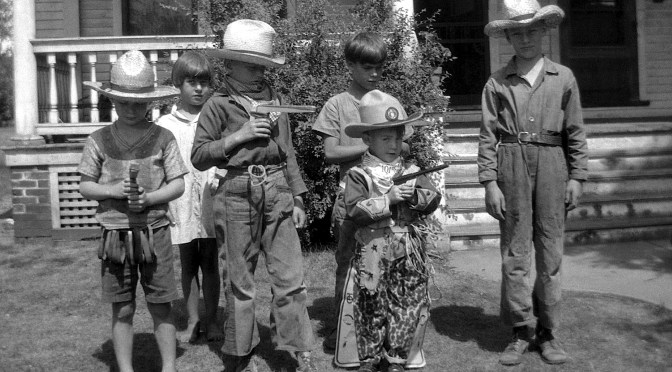
Neighborhood Cowboys of 1930 Wisconsin Rapids
Even in the late 1920s, it was a time-honored tradition for the neighborhood boys to dress up as their favorite cowboy hero. The priceless image above shows a group of youthful cowpokes hard at play on Wisconsin Avenue in Wisconsin Rapids. The smallest cowpoke in front is Donn G. Hanneman, and judging by his spiffy cowboy getup, it might have been sometime near his August birthday.
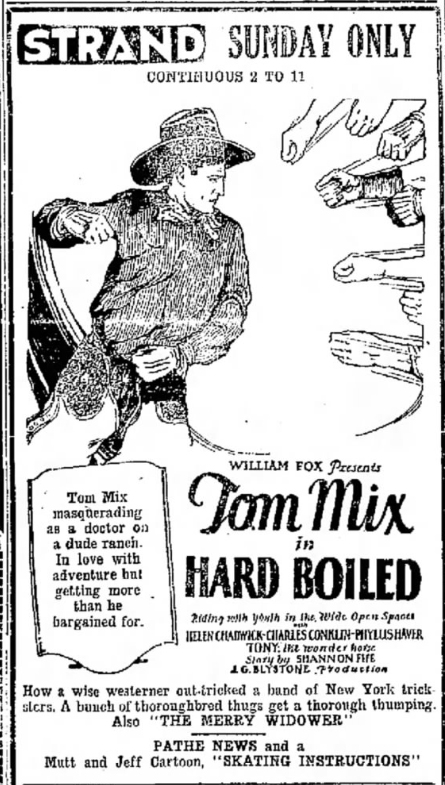
So just which movie stars would these boys (and one perplexed young lady) be imitating while hard at play? The photo dates to around 1930, so it was well before the days of Red Ryder played by Red Barry and Rocky Lane, and long before the Lone Ranger. But no worries, the cowboy genre was well established at the movie house by such stars as Hoot Gibson, Tom Mix and even a very young John Wayne. These tykes might have gone off to see Fred Thompson in The Two-Gun Man or John Wayne in The Big Trail. It was still a few years before Gene Autry would be the star of In Old Santa Fe.
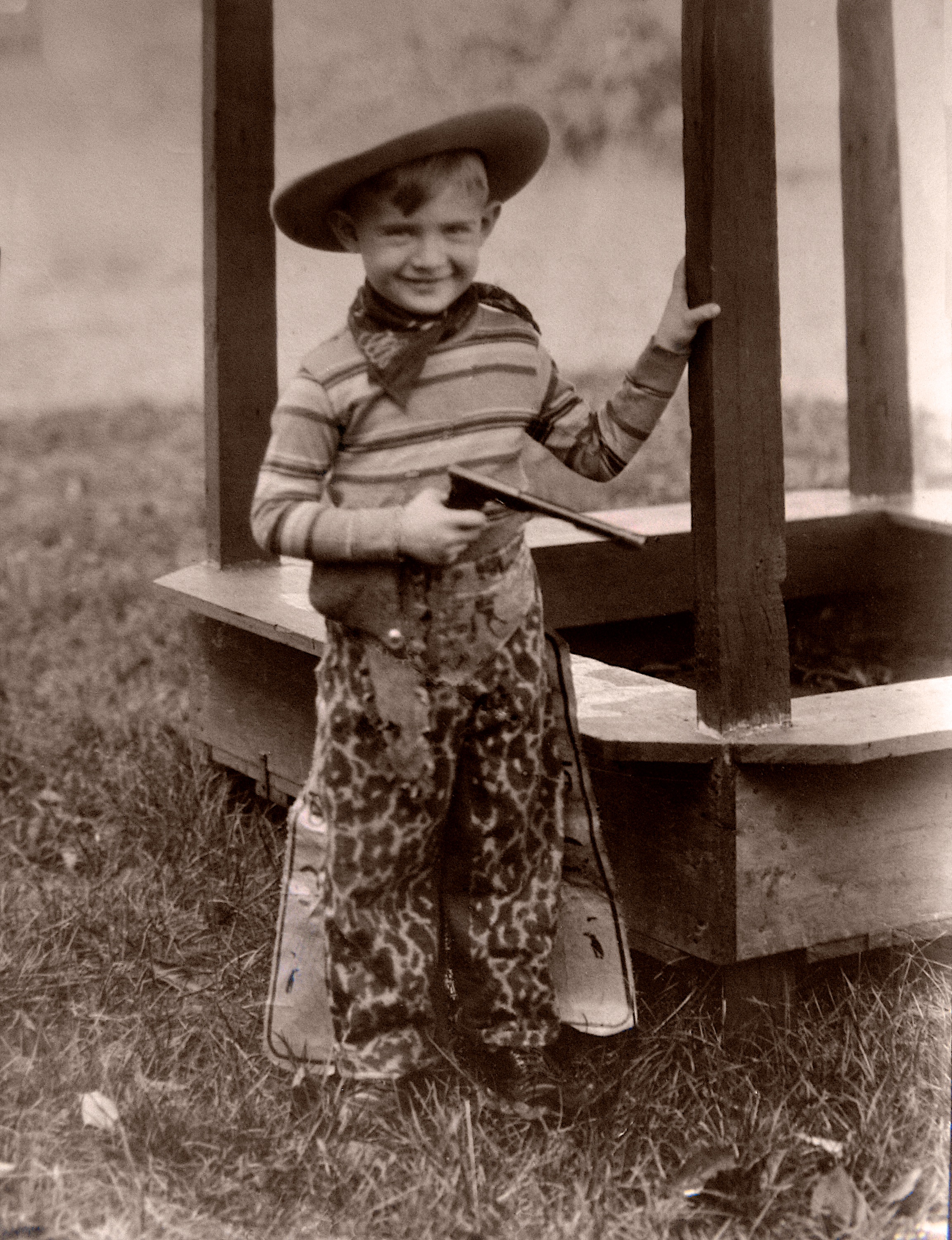
So here’s a tip of our 40-gallon hat to all of the aspiring cowboys of that era, with their chaps, shiny lawman’s badge, wooden gun and all the swagger a 5-year-old could muster. Let’s ride!
 The Hanneman Archive