There are several great things about this image of my Dad and his two siblings, taken in 1956 at Nekoosa, Wisconsin. The colors from the Kodachrome slide film are vivid, from the blue sky to the slicked-back black hair. The clothes are natty and the hairstyles are so 1950s. Right to left are Donn Gene Hanneman (1926-2014), Lavonne (Hanneman) Wellman (1937-1986), and my Dad, David D. Hanneman (1933-2014).
The photo was taken at the home of the trio’s uncle and aunt, Marvin and Mabel Treutel. The occasion was a Treutel family reunion. Their mother and my grandmother, Ruby V. Hanneman (1904-1977), was a Treutel before marrying Grandpa Carl F. Hanneman (1901-1922). It’s sad to think all three of them are gone, but I find comfort in the hope they are together in Heaven.
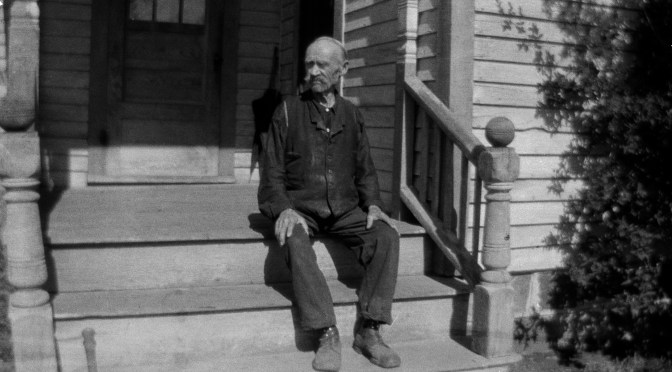
The photograph is very poignant. A frail man, sitting in the afternoon sun on the front porch steps. He looks haggard and tired, maybe ill. This image is the last known photograph taken of Karl Frederick Christian Hanneman, who was known around Wisconsin Rapids as Charles or “Chas” Hanneman. The photo likely dates to 1931 or 1932, when he suffered from prostate cancer that eventually took his life.
Charles Hanneman came to America in late November 1882 with his parents, Christian and Amanda Hanneman. He was just 15 when the family made its way from Stettin, Pomerania to Portage County, Wisconsin. Charles, his three brothers and two sisters settled on a 105-acre farm in the northwest corner of the Town of Grant, near the tiny hamlet of Kellner.
Nina and Elaine Treutel visit with Chas Hanneman, circa 1930.
Charles worked on the Hanneman farm for a time. His brothers would stay in farming (maps from that period show many Hanneman farms in Portage County), but eventually Charles left farming and found work in one of the area’s many sawmills.
At some point in his early 20s, Charles made the acquaintance of Rosine Ostermann, the eldest daughter of John and Mina Ostermann of the Town of Grand Rapids. They had many things in common. Both grew up on the family farm. Rosie’s parents were from Germany (Saxony and Prussia), and his were from Pomerania. Rosie’s grandfather George Ostermann was one of the pioneers of Portage County, listed on the earliest tax roll of the Town of Grant in 1864.
On April 2, 1891, Charles and Rosie were married atSt. John’s Evangelical Lutheran Church in Kellner in a divine service performed by A.G. Grimm. The witnesses were Charles’ father, Christian, and his brother, William. The bride’s attendants were her sister, Elsie Ostermann, and Emma Pribbernow. The groomsmen were cousins August Saeger and Herman Hanneman.
The young couple came to know heartache early in their marriage. Their firstborn, referred in the records only as “C.H. Hanneman,” died in infancy in 1892. They went on to have four sons: Arthur John (1893), Frank Herman Albert (1895), Wilbert George (1899), and our own Carl Henry Frank (1901).
Left to right: Christian Hanneman, Chas Hanneman, Carl Hanneman, David D. Hanneman.
Work in the sawmill must have been erratic, or Charles left that occupation for a time. In 1900, U.S. Census records show the family living and working on the farm of Charles’ brother, William Hanneman.
By 1905, Charles moved his family to the second ward in the city of Grand Rapids. He initially did manual labor for the city of Grand Rapids,possibly working on construction of the water and sewer works. The financial statements for the city in December 1907 show Charles worked 135 hours that month and earned 17.5 cents per hourfor a paycheck of $23.63.
By 1910 the family was living at 1774 Baker Street in Grand Rapids. The U.S. Census that year lists Charles as a laborer at a box factory. That may have referred to Consolidated Water, Power & Paper Co., where he later worked until his retirement, or the nearby Badger Box company.
On March 31, 1918, tragedy struck the Hanneman home when Rosine died suddenly at age 48. Her death notice, which ran on page 1 of the Daily Leader, said she was fine during the day but fell ill and died at 11 p.m. We know that she had diabetes, and that may have contributed to her death. Carl was 16 when his mother died.
Charles remarried in August 1919 and lived out his remaining years in his home at 1751 Baker Street. He became ill with prostate cancer in 1931 and was hospitalized numerous times in Wausau for surgery and treatments. He died at home on Oct. 11, 1932. He was 65. His death made front-page news in the Wisconsin Rapids Daily Tribune.
FAMILY LINE: Karl Frederick Christian Hanneman >> Carl F. Hanneman >> Donn, David & Lavonne Hanneman
Rosine Bertha Henrietta (Osterman) Hanneman (1870-1918), Frank Herman Albert Hanneman (1895-1947), Arthur James Hanneman (1893-1965), Carl Henry Frank Hanneman (1901-1982), Wilbert George Hanneman (1899-1987) and Carl Frederick Christian (Chas) Hanneman (1866-1932).
It is the only known photograph showing six of the seven children of Christian and Amanda Hanneman, pioneers of Portage and Wood counties in Wisconsin. The undated photo was probably taken around 1915 at a family event. Left to right are: William Friedrich Johann Hanneman (1856-1939) Bertha Auguste Ernestine (Hanneman) Bartelt (1860-1945) Albert Friedrich O. Hanneman (1863-1932) Herman Charles Hanneman (1864-1945) Carl Friedrich Christian Hanneman (“Chas,” 1866-1932) Ernestine Wilhelmine Caroline (Hanneman) Timm (1870-1930)
Hand tinted photograph of Chas Hanneman, location unknown.
Left to right: Christian Hanneman, Chas Hanneman, Carl Hanneman, David D. Hanneman.
Just three weeks after becoming a father for the third time, young pharmacist Carl. F. Hanneman took the extraordinary step of writing to the attorney general of Wisconsin to ask that he be granted full licensure as a registered pharmacist. It was a heartfelt letter, written by a young man feeling the weight of responsibility of a wife and three children. Written by a well-educated and accomplished man who felt he deserved what he as asking. The very future was at stake.
“I am writing this letter in all sincerity as what I am about to ask means everything to myself as well as my wife and three little kiddies,” Carl wrote to Attorney Gen. Orland S. Loomis on Sept. 3, 1937.“I am 35 years old and will be 36 this coming October and feel that obtaining my full registered papers will mean life itself to myself and my dear family.”
Carl explained that he was fully licensed as an assistant pharmacist, working at the Mauston Drug Store owned by Dr. J.S. Hess Jr. But he was unable to officially manage the drug store due to a quirk in state law.
Wisconsin Attorney Gen. Orland S. Loomis of Mauston
If Carl had worked in a smaller town with under 500 population, he could have legally managed the pharmacy. But Mauston population was about 2,100. Carl would need to be a registered pharmacist in order to manage the Mauston Drug Store.
“My capacity in the drug store is as an unofficial manager, as I do all of the buying etc., but legally cannot manage the store,” Carl wrote. “Dr. J.S. Hess Jr. has confidence in me and I a great deal in him, and as far as I am concerned am willing to stay here the rest of my life, dispensing for our own doctors.”
Carl reasoned that if he was qualified to own and manage a pharmacy in a small town (such as neighboring Lyndon Station, pop. 236), why could he not serve the same capacity in Mauston? “I have often wondered as has many others, are not the lives of 500 people in a small town just as valuable to their loved ones as those living in a town where there might be more than this amount?” Carl wrote.
A label under glass from Carl F. Hanneman’s pharmacy collection.
By 1937, Carl had 16 years of experience in pharmacology, starting as an apprentice in 1921 at the Sam Church drug store in Wisconsin Rapids. Carl graduated from the pharmacy program at Marquette University in 1925 and became licensed as an assistant pharmacist. He wasn’t eligible to take the full pharmacist exam at the time because his apprenticeship fell just short of the required five years. Over the next decade he worked at drug stores in Janesville, Fond du Lac and Wisconsin Rapids, and even worked a three-year stint as a salesman for Consolidated Water Power & Paper Co.
“I knew my lifework was with the drug store as I truly love it and was very fortunate in securing a position with the Dr. Hess Hospital, Clinic and Drug Store organization on Feb. 1, 1936,” Carl wrote.
Carl said he would likely need three more years of study to pass the registered pharmacist board exams as they existed in 1937. With three children (including baby Lavonne born in August 1937), Carl figured that simply would not be possible. So he asked for help from Loomis, a Mauston native who served as city attorney from 1922 to 1931. Loomis was attorney general through 1938, and was elected governor of Wisconsin in 1942. He died before taking office. Eventually, Carl became good friends with Loomis and photographed him for the Wisconsin State Journal on the 1942 night of his election as governor of Wisconsin.
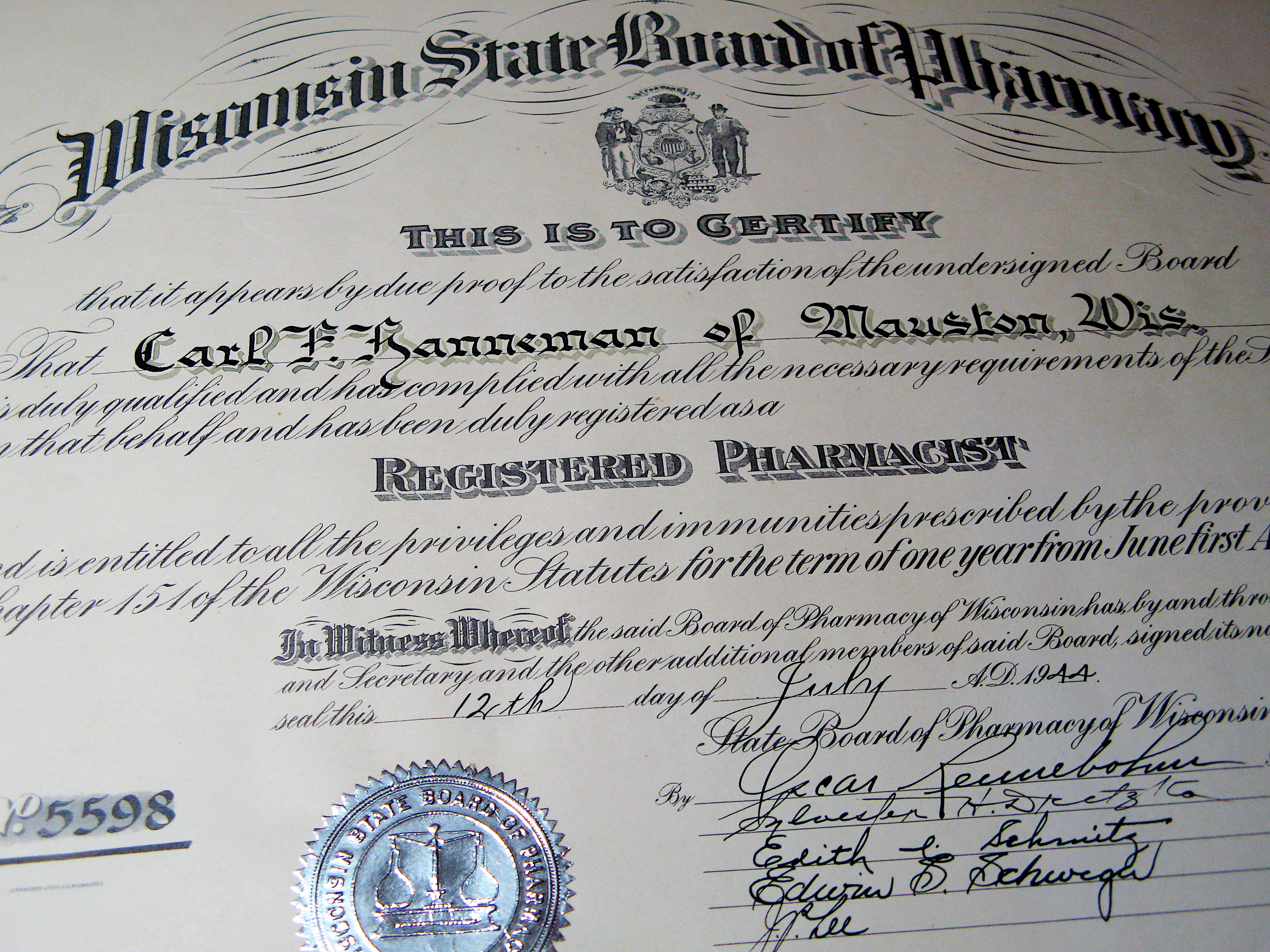
Carl F. Hanneman’s registered pharmacist license, issued in July 1944.
We don’t know if Loomis ever intervened on Carl’s behalf in his role as attorney general or governor-elect, or how he responded to the 1937 letter. A search of Loomis’ law-practice records at the Wisconsin Historical Society yielded no clues. Carl’s 1941 license from the Wisconsin State Board of Pharmacy still lists him as an assistant pharmacist. On July 12, 1944, the state of Wisconsin issued an ornate document certifying Carl as a full registered pharmacist. He worked under the new license number until his death in 1982. It would appear Carl secured his added credentials the hard way: he earned them.
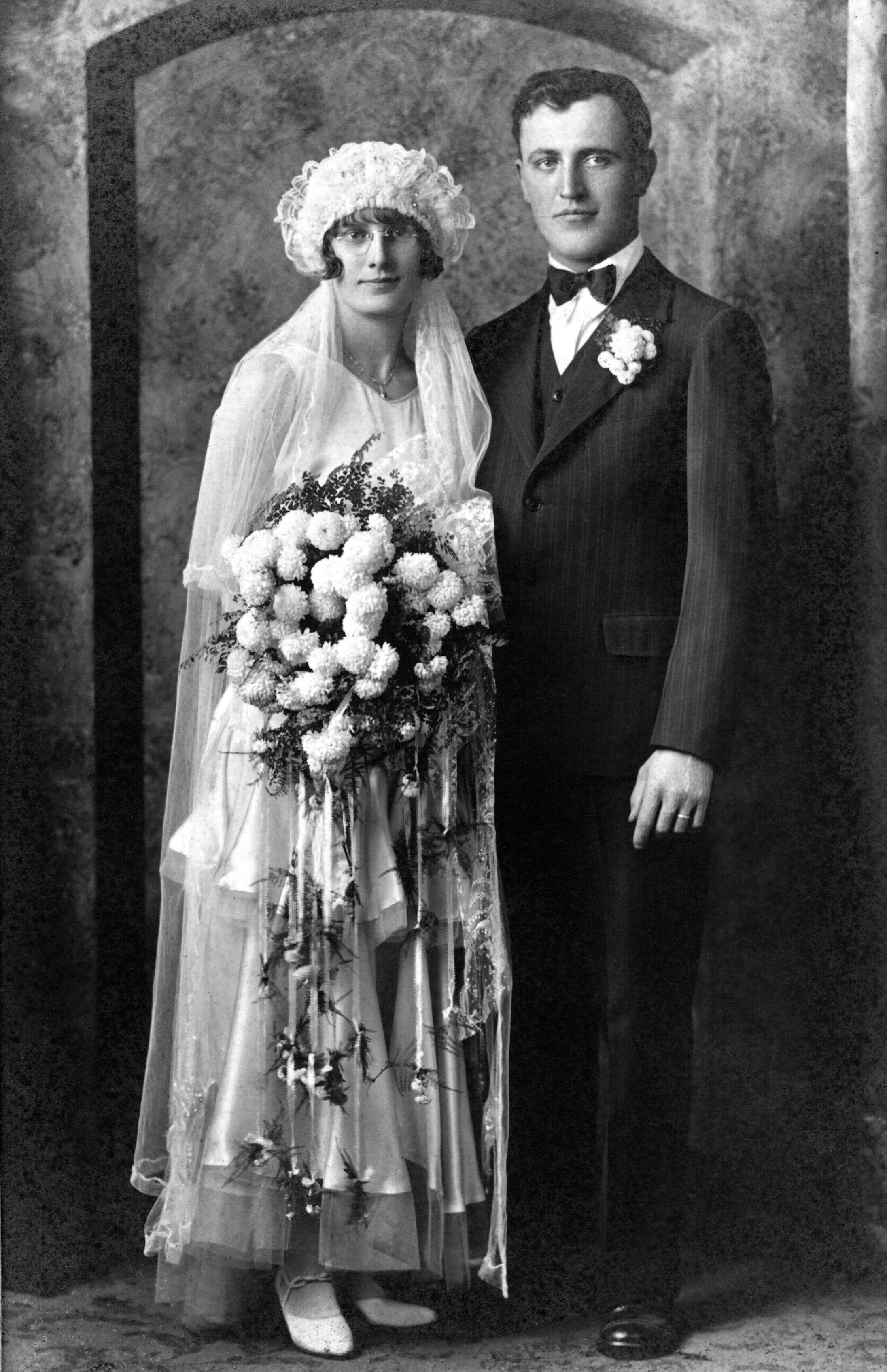
Esther Marie Albrecht was married to Emil Rudolph Gottschalk on November 12, 1930 in the Town of Hewitt in Wood County, Wisconsin. Esther was the maid of honor at the July 1925 wedding of Ruby V. Treutel and Carl F. Hanneman in Vesper, Wisconsin. Mr. and Mrs. Gottschalk moved to Waukesha, and had two daughters, Pearl and LaVon. They were longtime friends of the Hanneman family. She is the daughter of George and Pearl (Smith) Albrecht.
Esther M. Albrecht married Emil R. Gottschalk in November 1930 in the Town of Hewitt, Wood County, Wisconsin.
According to the 1930 and 1940 U.S. Census, Emil worked as a core maker in an iron foundry in Waukesha. Emil Gottschalk died on February 1, 1944 at just age 37. Mrs. Gottschalk operated Esther’s Food Store on Arcadian Avenue in Waukesha. In April 1946, she married Harold D. “Whitey” Buchs at St. Joseph’s Catholic Church in Waukesha. Esther died January 1, 1985 in Vesper. Harold died April 13, 2007 in Vesper.
These young ladies look like they are dressed for a Siberian winter, although the location of this photograph is central Wisconsin. Sisters Lillian M. Albrecht (left) and Esther M. Albrecht are bundled with fur coats, hats and hand warmers. The photo was taken about 1920, probably at Vesper, Wisconsin, their home town.
Lillian M. Albrecht and sister Esther M. Albrecht are well-prepared for winter.
Lillian married George J. Ladick in June 1922, and the couple had four children: Sylvia (1923-1961), Lucille (1925-2005), Lawrence (1930-2000) and Shirley. Esther married Emil R. Gottschalk in November 1930, and the couple had two daughters, Pearl (1936-2012) and LaVon.
Judging by the turnout, the marriage of Joseph John Mras and Mary V. Sternot of the Town of Sigel in Wood County, Wisconsin, was the celebration of the year in 1913. The pair were married by the Rev. John Willitzer on October 21. The group portrait was taken outside the Sigel home of the bride’s parents, Jacob and Josephine Sternot. The reception had a big turnout from Sigel and the nearby village of Vesper.
Groom Joseph Mras and bride Mary Sternot are flanked by flower girls Ruby V. Treutel (left) and Gladys Cole. Back row (left to right) includes Joseph Sternot, Josie Leu, John Pyrch, Anna Sternot, John Yeske and Mary Billiet.
As with other large-group photos in our collection, it is fun to look for details in the sea of faces. Standing just right of center is my grandmother, Ruby V. (Treutel) Hanneman, who was a flower girl at the wedding. The bride and groom are tucked away in the upper right corner, looking a bit weary. The entertainers are in center front, one with a fiddle, one with an accordion and a third holding a pitcher of beer. Three things seem to link the men in the photo: hats, beer and cigars. Some things never change.
A studio photo of the wedding party provides additional details on the big day. Ruby Treutel and (we believe) her cousin Gladys Cole were the flower girls, while one brother and one sister of the bride were also in the wedding party.
Joe and Mary Mras had three children,Clarence, Earl and William. Joe was a crane operator for 31 years for the Frank Garber Iron & Metal Co. in Wisconsin Rapids. He retired in 1959. Joe died on April 10, 1961. Mary died September 20, 1977. Their son Clarence was killed in an auto accident in September 1956. Earl died October 18, 2001. William died February 18, 1997.
— This post has been updated with corrected identifications on the wedding portrait.
Leaving the family homeland to make a trans-Atlantic trip and emigrate to America would be an intimidating prospect under the best circumstances. When Michael Friedrich Ferdinand Hannemann brought his pregnant wife Mina and infant son Albert aboard the ship John Bertram in Hamburg, Germany in April 1863, he likely had no idea the horror they would face during 46 days at sea.
Fred Hannemann, as he was known to family and friends, was not the first in the family to leave Pomerania for Wisconsin. At least two sisters were already in central Wisconsin, so Fred may have heard stories from them about their travels to the American Midwest. But that likely would not have prepared him for the life-threatening conditions the 336 passengers faced en route to New York. One of the middle children of Matthias and Maria Caroline Hannemann of Meesow, Kreis Regenwalde, Pomerania, Fred was among at least eight children in the clan who would come to America between 1861 and 1882.
The John Bertram was a 1,060-ton clipper ship built in just 90 days in Boston in 1850 and placed into service in January 1851. At 180 feet long, the ship was initially employed to shuttle cargo from Boston around Cape Horn to San Francisco. It was later sold and pressed into service moving emigrants and cargo from Europe to America. Between 1860 and 1869, nearly 2,100 people were carried from Europe and elsewhere to America aboard the John Bertram.
About 10 days into the journey, the John Bertram encountered a violent gale that ripped at the sails and caused the ship to pitch up and down in the massive ocean swells. The winds raged at the ship for 48 hours, tossing drinking water casks overboard and destroying the storm sails. Conditions below deck were likely horrific, with the violent rocking causing seasickness and injuries. On deck, conditions were worse. Four crewmen were lost overboard and eight others were disabled. Once the storm passed, the ship was leaking badly, making it difficult to keep under sail. Mina Hanneman no doubt had to struggle to care for young Albert Hannemann, 1, in the chaos. The former Johanna Wilhelmine Florentine Glebke was nearly seven months pregnant during the voyage.
On May 4, still three weeks from docking in New York, the John Bertram hit dense fog and became trapped in a massive ice floe. For four days, the ship was surrounded by ice that scraped the planks of the hull and ripped at the cutwater. Four other ships in the area became snared in the ice. Eventually the clipper broke free, but had to steer 3 degrees to the east in order to escape the ice fields.
The trip took its toll. Eight infants died during the trip, although two babies were born. Along with the crewmen who were washed overboard, 12 people lost their lives. Thankfully, Fred, Mina and Albert Hannemann made it safely to Castle Garden in New York. Once they reached the Town of Grand Rapids in Wood County, Wis., they settled into farming. Eventually, seven children were born into the home, as yet another branch of the Hannemann family tree took root in central Wisconsin.
We only have two photographs that show Carl F. Hanneman at school, and both appear to be from the same year. In the first, Carl is the second pupil in the second row at a school in Grand Rapids, Wisconsin. Wearing a tie and cardigan sweater, Carl is one of a half-dozen or so boys in the class. The clock reads 11:59, so the class photo was scheduled just before the lunch break. It is a well-kept and neatly appointed classroom. The girl sitting in front of Carl could easily be mistaken for his future bride, Ruby V. Treutel, although she went to school in nearby Vesper.
Carl F. Hanneman is third from the left in the first row. The photo was taken circa 1910.
The second photo was taken outdoors at an entrance to the school. Carl is third from the left in the first row. At the time, the Hannemans lived on Baker Street in Grand Rapids, so the Howe School would have been the closest public school. But the building in the photo does not match exterior details of the Howe School, so it’s unclear where Carl spent his elementary school years.
It seems the entire village of Vesper, Wisconsin came out for a banquet or other big event, and stayed for a photograph. The image appears to date to about 1913 or 1914. The large crowd spilled out of the village hall for a photograph. What was the occasion? A wedding? A dance? It is fun to imagine. The portrait was taken by Moore Photo of nearby Grand Rapids (now called Wisconsin Rapids).
What makes this image especially interesting is to zoom in and look at the details. See the little girl with the Dixie Queen plug cut tobacco lunch box? It’s strange to imagine a lunch tin with smoking tobacco advertised on the side, but this was before the age of comic books or movie stars. Lunch pails with tobacco ads were common.
In the front at left/center left is my grandmother, Ruby V. (Treutel) Hanneman, who appears to be about 10 years old. That would date the photo to 1914. In the sea of men back near the stairs appears to be Ruby’s father, Walter Treutel. He is sporting a mustache, which is something I’ve not seen in any family photos.
On the building next to the window is a large thermometer with the name “Hlasatel” on it. That was the name of a Bohemian/Czech newspaper. Vesper had a large population from Bohemia, including the family of my great-grandmother, Mary (Ladick) Treutel. Her parents emigrated from Bilina in what is now the Czech Republic.
Most of the men wore hats, so it is not easy to make identifications.
One little girl has a Dixie Queen tobacco lunch pail.
Judging by the dress, this must have been an important event.
Young Ruby V. Treutel is in the front row right, leaning on her right hand and tilting her head to her left.
Much of the village of Vesper came out for the photo.
“Memory of the Day of Confirmation.” Those German words are written in ornate lettering across a beautiful certificate commemorating the confirmation of Karl (we know him as Carl) Hanneman on June 11, 1916. The roughly11×17 inch document, found among the papers and photographs of David D. Hanneman, is remarkably well preserved and speaks to a time before Carl’s conversion to Catholicism. The certificate is written entirely in German and reads:
“Karl Hanneman received instruction in the Word of God on 11 June 1916 in the First Moravian Church, Grand Rapids, Wis.” At the bottom of the certificate it reads: Gottes Furcht is aller Weisheit Anfang, which roughly means “All Wisdom Begins with Fear of God.” The document was signed by the Rev C.A. Meilicke.
The confirmation certificate for Carl F. Hanneman from the First Moravian Church.
We know Carl’s father, Charles Hanneman, was raised as a Lutheran, as were most of the Hannemans. The marriage certificate for Charles and Rosine Hanneman (nee: Ostermann) only says their wedding was a “Divine Service” and does not indicate a church. In 1907, Charles and Rosine and their four sons joined the First Moravian Church of Wisconsin Rapids, a congregation of some 450 people in a brick church on First Avenue South.
The Moravian Church is one of the oldest Protestant denominations and traces its roots to the 1450s in Bohemia and Moravia. The area is now part of the modern day Czech Republic. It is possible the family’s connection to the Moravian Church came from Rosine (Ostermann) Hanneman, whose father emigrated from Saxony in what is now eastern Germany.
Carl and Ruby Hanneman were both converts to Catholicism, but we’ll save those stories for another entry.








 The Hanneman Archive