Tag Archives: Wisconsin

Three Generations of Knights of Columbus

For 80 years, there has been a member of the Hanneman family in the Knights of Columbus, the world’s largest Catholic fraternal and charitable organization. The line of service runs from Carl F. Hanneman (1901-1982), who joined in 1934, to his son David D. Hanneman (1933-2007), who joined in 1953, to his son Joe Hanneman, who joined the order in April 2007.

The three generations share other things in common with respect to the K of C, based in New Haven, Connecticut, with more than 14,000 local councils across America. All three have been members of the Fourth Degree, which focuses on patriotism and love of country. All three served in the Fourth Degree Color Corps and Honor Guard. The Honor Guard, wearing tuxedos, colored capes, ceremonial swords and plumed chapeaux, is a ceremonial presence at Masses, funeral wakes, Flag Day ceremonies and other events. Joe Hanneman served on the Honor Guard for the installation of Archbishop Jerome Listecki in Milwaukee. Carl joined the Fourth Degree in the late 1930s or early 1940s, judging by the group portrait of his exemplification class. David joined in 1973 and Joe joined in 2008.

Carl F. Hanneman (left section, second row, second from center aisle), joined the Fourth Degree of the Knights of Columbus in the late 1930s or early 1940s. Exact date of this photo is unknown.

All three also served as Grand Knight of their respective local K of C council. The Grand Knight is leader of the local council. Carl Hanneman was Grand Knight of Solomon Juneau Council 2770 in Mauston, Wisconsin in the late 1960s. David Hanneman was Grand Knight of Holy Family Council 4879 in Sun Prairie, Wisconsin, from 2001 to 2003. Joe Hanneman was Grand Knight of Msgr. Stanley B. Witkowiak Council 697 in Racine in 2010 and 2011.

Altar server Joe Hanneman with his father David D. Hanneman (at right) and Bill Dziadosz.

The Knights of Columbus is a fraternal and charitable organization founded in 1882 by Venerable Father Michael J. McGivney, whose cause for sainthood is being considered at the Vatican. The Knights operate under the principles of charity, unity, fraternity and patriotism. Knights raise money and volunteer for a wide range of causes, from pro-life programs such as crisis pregnancy centers, to programs providing free wheelchairs to the disabled, to grants to local programs that support the mentally retarded. The K of C and local councils have provided more than 500 ultrasound machines to crisis pregnancy centers.

David D. Hanneman was part of a large class that became Fourth Degree Sir Knights on April 14, 1973 in Madison.

Knights provide free coats to needy children each winter. They run a variety of athletic events, including Punt, Pass and Kick, and a basketball free-throw competition. Knights also support and promote vocations to the priesthood, sponsoring seminarians and providing other material support for those studying for the priesthood. In 2013, Knights provided a record amount of charity, with over $170 million raised and 70.5 million hours of voluntary service provided. In 2014, the K of C provided more than $2 million to help persecuted Christians from Iraq and other Mideast countries being targeted by ISIS and other terrorist organizations.

Boy Scouts participate in a flag retirement ceremony run by the Knights in Racine. Speaking at the podium is Deputy Grand Knight Joe Hanneman.
Boy Scouts participate in a flag retirement ceremony run by Assembly 1207, the Fourth Degree Knights in Racine. Speaking at the podium is Deputy Grand Knight Joe Hanneman.

The Fourth Degree of the Knights is especially dedicated to patriotism and the idea that love of God and love of country go hand in hand. The Fourth Degree was founded in 1900 to combat the prejudiced notion that Catholics were not loyal Americans and could not be trusted in public office or with civic responsibility. The Fourth Degree provides free flags for schools and nonprofit organizations, supports veterans’ organizations,  provides material needs to local veterans’ hospitals, and sends faith materials and other assistance to members of the military serving overseas.

Sir Knight Joe Hanneman (left) in an honor guard at St. Rita Catholic Church in Racine.

Famous Knights include Venerable Archbishop Fulton J. Sheen, one of the Catholic Church’s all-time great authors and communicators; former Green Bay Packers coaching legend Vince Lombardi; baseball’s Sultan of Swat, Babe Ruth; Supreme Court Justice Samuel Alito; Ray Flynn, former U.S. ambassador to the Vatican; Cardinal Francis George, former archbishop of Chicago; Saint Rafael Guizar Valencia; and six martyrs of the Cristero War in Mexico: Father Luis Bátis Sáinz, Father José María Robles Hurtado, Father Mateo Correa Magallanes, Father Miguel de la Mora, Father Rodrigo Aguilar Alemán and Father Pedro de Jesús Maldonado Lucero. The K of C operates in the United States, Canada, Mexico, the Philippines, Poland, the Dominican Republic, Puerto Rico, Panama, the Bahamas, the Virgin Islands, Cuba, Guatemala, Guam and Saipan.

A number of other members of the extended Hanneman family have been members of the Knights of Columbus: Earl J. Mulqueen Sr. (my grandfather), Earl J. Mulqueen Jr., Donn G. Hanneman, longtime Wisconsin Rapids building inspector Arthur J. Hanneman, and former state representative Arthur Treutel.

— This post has been updated with a date correction and two new photographs.

©2014 The Hanneman Archive

Erinnerung An Den Tag Der Confirmation

“Memory of the Day of Confirmation.” Those German words are written in ornate lettering across a beautiful certificate commemorating the confirmation of Karl (we know him as Carl) Hanneman on June 11, 1916. The roughly 11×17 inch document, found among the papers and photographs of David D. Hanneman, is remarkably well preserved and speaks to a time before Carl’s conversion to Catholicism. The certificate is written entirely in German and reads:

“Karl Hanneman received instruction in the Word of God on 11 June 1916 in the First Moravian Church, Grand Rapids, Wis.” At the bottom of the certificate it reads: Gottes Furcht is aller Weisheit Anfang, which roughly means “All Wisdom Begins with Fear of God.” The document was signed by the Rev C.A. Meilicke.

The confirmation certificate for Carl F. Hanneman from the First Moravian Church.

We know Carl’s father, Charles Hanneman, was raised as a Lutheran, as were most of the Hannemans. The marriage certificate for Charles and Rosine Hanneman (nee: Ostermann) only says their wedding was a “Divine Service” and does not indicate a church. In 1907, Charles and Rosine and their four sons joined the First Moravian Church of Wisconsin Rapids, a congregation of some 450 people in a brick church on First Avenue South.

The Moravian Church is one of the oldest Protestant denominations and traces its roots to the 1450s in Bohemia and Moravia. The area is now part of the modern day Czech Republic. It is possible the family’s connection to the Moravian Church came from Rosine (Ostermann) Hanneman, whose father emigrated from Saxony in what is now eastern Germany.

Carl and Ruby Hanneman were both converts to Catholicism, but we’ll save those stories for another entry.

©2014 The Hanneman Archive

Eye on the Past: Rochester Root Beer

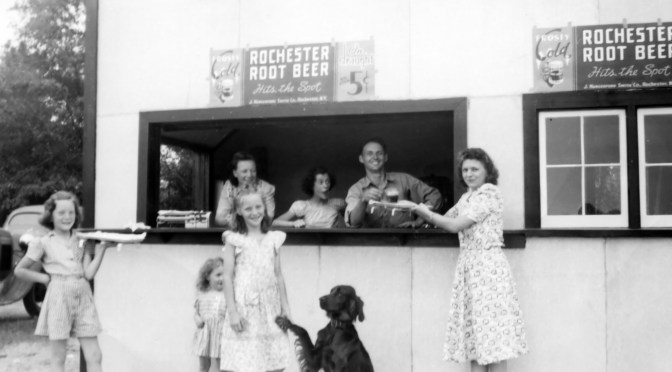
Marvin and Mabel Treutel operated a roadside root beer stand near their home on Wilhorn Road in Nekoosa, Wisconsin. Aside from 5-cent Rochester root beers, they served the “Best Roast Beef BBQ.” Pictured behind the counter in this late-1940s photo are Mabel Treutel (left), niece Lavonne Hanneman (center) and Marvin Treutel (right). Out front are daughters Bonnie Treutel (left), and Patricia Treutel (center, holding dog). The woman at right and the little girl at center are unidentified.

Wedding Wednesday: Carl and Ruby Hanneman

Nearly 90 years ago on a summer Tuesday morning, Ruby Viola Treutel and Carl Henry Frank Hanneman joined in marriage at St. James Catholic Church in Vesper, Wisconsin. The marriage, which would live on for more than 50 years and produce three children and 16 grandchildren, was described in detail in a story in the July 15, 1925 edition of the Wisconsin Rapids Daily Tribune:

TREUTEL-HANNEMAN
One of the prettiest weddings of the summer was solemnized yesterday morning at nine o’clock at St. James church, Vesper, when Miss Ruby Treutel, daughter of Walter Treutel of Vesper, became the bride of Carl F. Hanneman, son of Mr. and Mrs. Charles Hanneman of this city. Rev. Father Gille officiated at the nuptial Mass. 

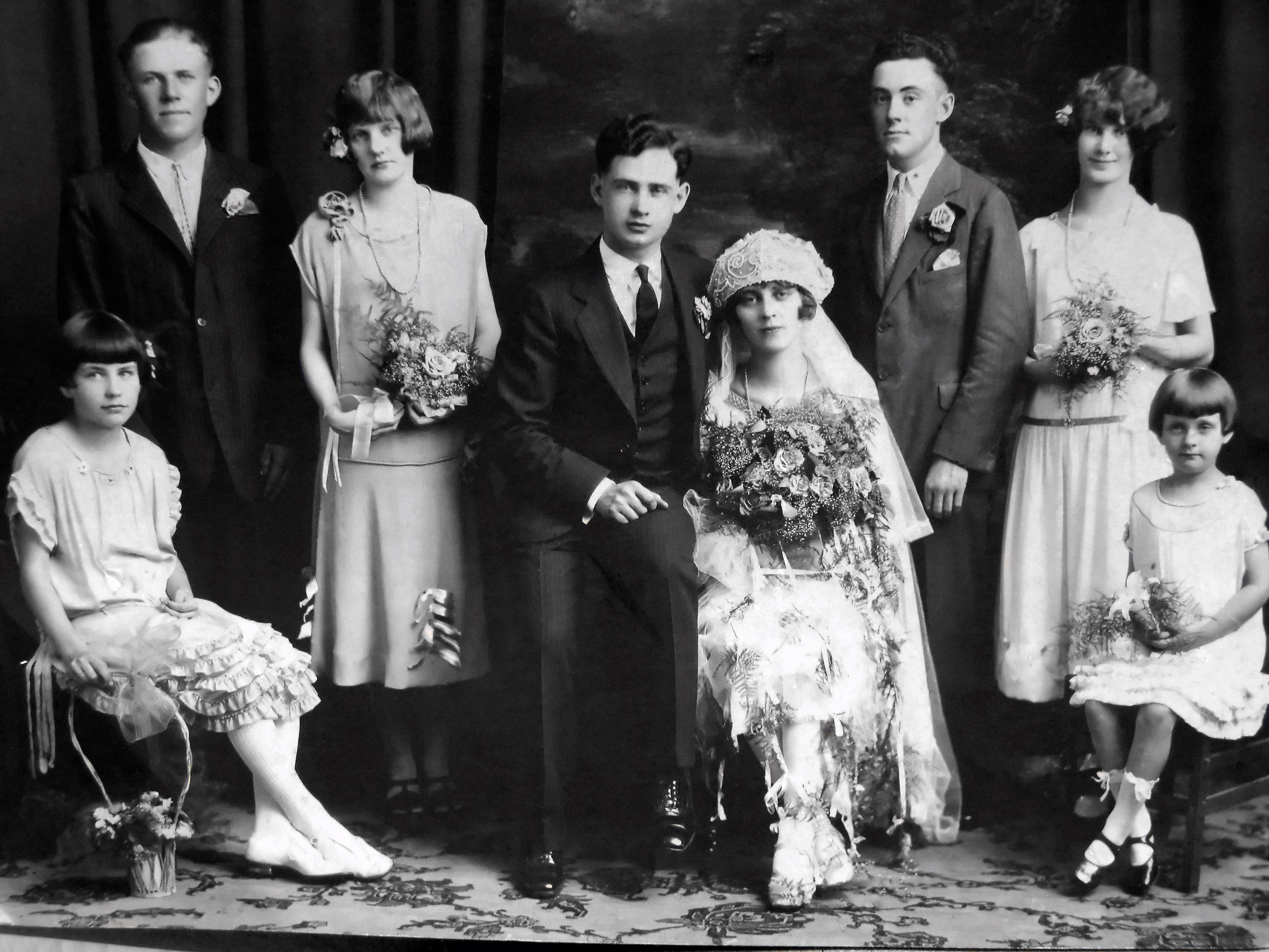
The wedding party of groom Carl Henry Frank Hanneman, 23, and Ruby Viola Treutel, 21. Wedding was July 14, 1925 at St. James Catholic Church, Vesper, Wis.  At front left is flower girl Nina Treutel, 11, sister of the bride. At front right is ring-bearer Elaine Treutel, 5, sister of the bride. Across the back, left to right, are Joe Ladick (bride's cousin), Gladys Cole (bride's cousin), groom Carl Hanneman, bride Ruby V. Hanneman, best man Wendell Miscoll, and maid of honor Esther Allbrecht.
The wedding party of groom Carl Henry Frank Hanneman, 23, and Ruby Viola Treutel, 21. Wedding was July 14, 1925 at St. James Catholic Church, Vesper, Wis. At front left is flower girl Nina Treutel, 11, sister of the bride. At front right is ring-bearer Elaine Treutel, 5, sister of the bride. Across the back, left to right, are Joe Ladick (bride’s cousin), Gladys Cole (bride’s cousin), groom Carl Hanneman, bride Ruby V. Hanneman, best man Wendell Miscoll, and maid of honor Esther Allbrecht.

The church was beautifully decorated with greens and the season’s flowers, making an appropriate setting for the wedding party. Miss Velma Doering of Stratford played the wedding march as the party entered the church and proceeded to the altar. Miss Gladys Cole of Nekoosa, and the groom’s attendant, Joseph Ladick, of Vesper, both cousins of the bride, were followed by two little sisters of the bride, Nina and Elaine, who acted as flower girl and ring bearer. The maid of honor, Miss Esther Albright, came next and was followed by the bride and her father, who gave her away. 

Mr. Hanneman and his best man, Wendell Miscoll, awaited the party at the altar. The bride was very beautiful in her gown of white georgette trimmed with gold lace. She wore a coronet of pearls, with her veil falling from a beaded butterfly. She carried a shower bouquet of pink rose buds. 

Rev. Charles W. Gille of St. James Catholic Church officiated at the wedding.

Miss Albright, the maid of honor, was gowned in orchid georgette and carried an arm bouquet of rose. Miss Cole, the bridesmaid, wore a gown of orange georgette, and also carried roses. Nina, the little flower girl, was in a little frock of yellow georgette, and Elaine completed the delightful color ensemble in a dress of pink georgette. She carried the ring in a white lily.

Following the service at the church, the bridal party and relatives came to this city, where the ten-thirty breakfast was served at the Witter Hotel. The bride is a graduate of Lincoln High School and the Stevens Point Normal. Since her graduation from the normal school she has been teaching at Vesper. The groom was graduated from Lincoln High and for some time following was employed at the Church Drug store. He later graduated from the pharmacy department of Marquette University at Milwaukee and is at present holding a position with Whitrock and Wolt.

Following a week’s outing in the northern part of the state, part of the time being spent as guests of Mr. and Mrs. Armand Bauer at their cottage at Hayward, they will return here and for the present make their home with Mr. Treutel at Vesper.

©2014 The Hanneman Archive

William Gaulke: Pioneer Frontiersman, Friend of Buffalo Bill Cody

He came to the United States at age 19 and lived the life of an American frontiersman: shuttling cargo between U.S. outposts in the West and ferrying people and goods across the Missouri River. For all of his adventurous living, William Johann Heinrich Gaulke retained one lasting memory that his family in Wisconsin still talks about: being a friend of a very young William Frederick ‘Buffalo Bill’ Cody. 

William Gaulke (standing) with his arm around William F. Cody, who later went on to fame as "Buffalo Bill."
William Gaulke (standing) with his arm around William F. Cody, who later went on to international fame as “Buffalo Bill.” (Photo courtesy of Sue Alft)

Gaulke met the famed U.S. Army scout and buffalo hunter while Gaulke was working and exploring the frontier lands in Nebraska and the Dakotas in the 1870s. A photograph in the Gaulke family album shows a twenty-something Gaulke standing with his arm around a seated William Cody.

Gaulke’s frontier experience grew out of tragedy he experienced in his native Germany. Born on October 1, 1848, Gaulke lost his father, John, before he turned six months old. When he was 11, Gaulke became an orphan at the death of his mother Fredericka. He emigrated to America in 1867 and landed in Milwaukee. After a short stint as a farmhand, Gaulke landed a job aboard a Great Lakes steamer, where he learned to speak English. After another stint working on farms in Illinois, Gaulke went west.

After emigrating to America in 1867, William Gaulke spent a number of years exploring the wild frontiers.
After emigrating to America in 1867, William Gaulke spent a number of years exploring the wild frontiers. (Photo courtesy of Sue Alft)

Gaulke experienced the wilds of the frontier lands as a teamster for the U.S. government. He guided a six-mule team hauling goods between U.S. Army posts. He was based at Fort Buford in the Dakota Territory. After tiring of that job, he built a skiff and drifted down the Missouri River to what is now Bismarck, North Dakota. Along with a group of companions, he established the town of Carlington. There, Gaulke operated a ferry moving people, goods and horses across the Missouri River near Fort McKeen (later called Fort Abraham Lincoln). Fort Lincoln was the base of Gen. George Armstrong Custer.

Right alongside the Mighty Missouri River, Gaulke built himself a shanty, where he lived and operated his ferry business. He built an outdoor fireplace that was used for cooking and warmth. It was also a hiding place for the $2,200 Gaulke had saved from his business ventures. Gaulke’s shanty was a frequent target of would-be thieves, but none of them ever thought to look under the fireplace for the buried money.

In 1872, Gaulke returned to Wisconsin, securing work at Grand Rapids in Wood County. In July 1876, he married Augusta Henriette Charlotte Kruger. Her mother, Friedericke Kruger, was the daughter of Matthias Hannemann (1794-1879). A short time later, the Gaulkes bought their first land in the Town of Grant in Portage County, very near where the Hannemann family established its first homes in the early 1860s. Gaulke cleared the land and established a successful farm. He also helped build many of the farm houses and barns in the area.

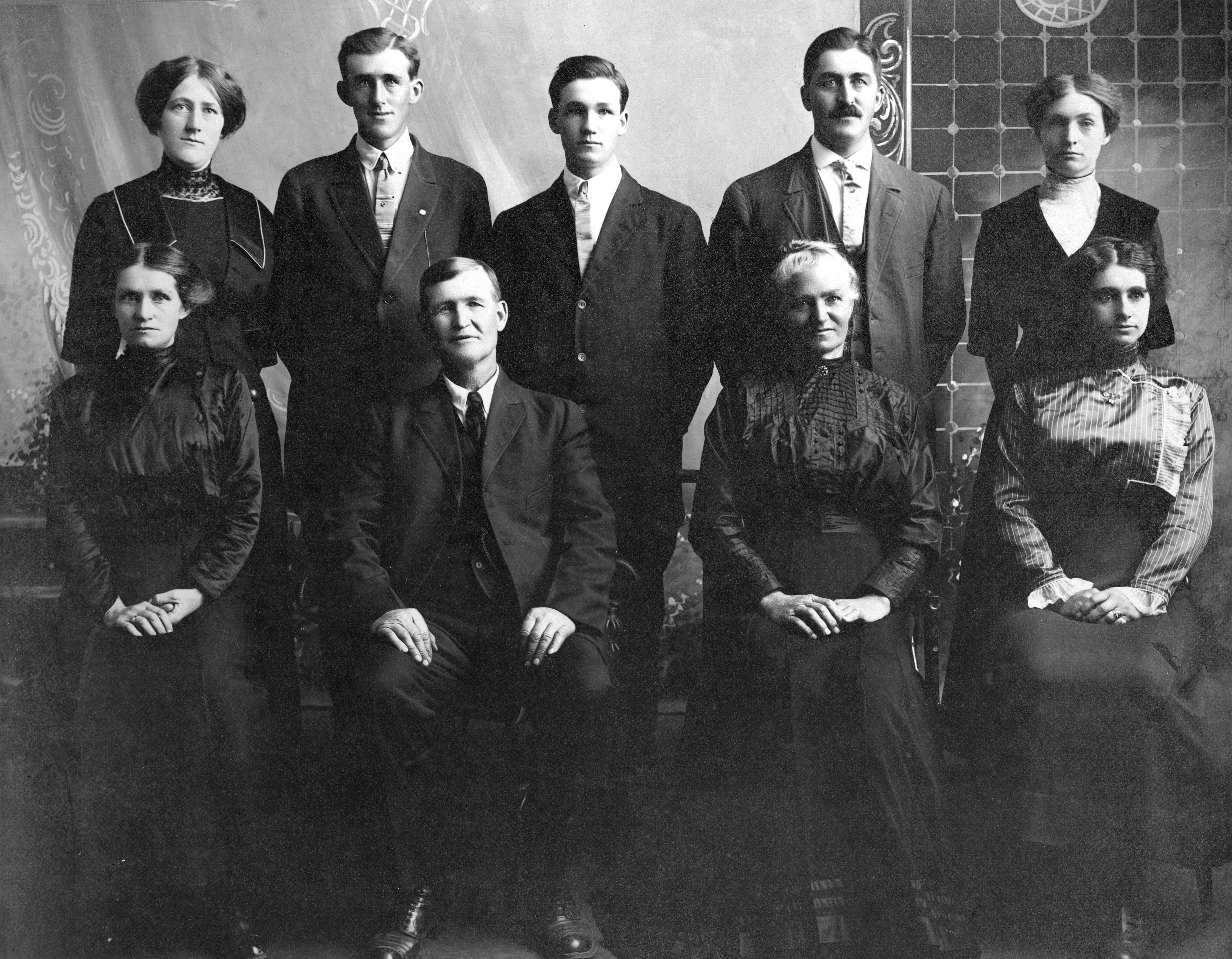
William Gaulke and Augusta (Kruger) Gaulke and family. Rear, left to right: Ella (Wagner), William Jr., John, Henry, Minnie (Panter). Front, left to right: Mary (Eberhardt), William Gaulke Sr., Augusta (Kruger) Gaulke, Laura (Turbin). Photo courtesy of Sue Alft
William Gaulke and Augusta (Kruger) Gaulke and family. Rear, left to right: Ella (Wagner), William Jr., John, Henry, Minnie (Panter). Front, left to right: Mary (Eberhardt), William Gaulke Sr., Augusta (Kruger) Gaulke, Laura (Turbin). (Photo courtesy of Sue Alft)

Gaulke also became deeply involved in civic work, serving as school district clerk, drainage district commisioner and chairman of the Town of Grant. He and Augusta had eight children, born between 1878 and 1897. Augusta died in 1914, four years before her mother. William died on October 25, 1928 after coming down with pneumonia.

William F. "Buffalo Bill" Cody in a late-life portrait (Library of Congress Photo)
William F. “Buffalo Bill” Cody in a late-life portrait (Library of Congress Photo)

Confirmation of the friendship between Gaulke and Buffalo Bill came in the early 1900s, when Cody brought his Wild West show to Grand Rapids, Wisconsin. Gaulke brought his youngest son, John, to the grounds near Lincoln High School. They watched the white-suited Cody ride about the arena on his white horse. Gaulke led his boy up to Cody, introduced himself and asked the showman if he remembered him from their time out west decades earlier. He did. “Why sure, Bill and they had quite a talk,” John Gaulke later wrote. “Finally Buffalo Bill reached into his pocket and gave my Dad a handful of tickets, who the whole family saw the show for nothing.”

A popular poster showing Buffalo Bill Cody superimposed on an image of a buffalo. (Library of Congress Photo)

William Cody was a first-rate Indian scout and buffalo hunter whose life was romanticized in dime novels written by author Ned Buntline. The pair collaborated to create a show called “The Scouts of the Plains.” In 1883, Cody developed a live show spectacular called Buffalo Bill’s Wild West. The Library of Congress says Cody “was a major contributor in the creation of the myth of the American West, as seen in Hollywood movies and television.”

©2014 The Hanneman Archive 

Daughters Helped Bring ‘Keep Christ in Christmas’ Message to Television

The Knights of Columbus has long championed the “Keep Christ in Christmas” message to remind the public that the “holiday season” is really about the birth of the Savior. Each year, the more than 14,000 local K of C councils promote the message with car magnets, yard signs, television ads and radio spots.

The Nativity mosaic was used on a billboard along Interstate 94 in 2009.

Back in 2010, I wanted to create a 30-second broadcast commercial with this message, but we had no production budget. I found a beautiful mosaic image from the Knights of Columbus Incarnation Dome at the Basilica of the National Shrine of the Immaculate Conception in Washington, D.C. The year before, I used that image to create a billboard we placed alongside Interstate 94 in Racine County, Wisconsin.

Many Knights of Columbus councils distribute "Keep Christ in Christmas" lawn signs.
Many Knights of Columbus councils distribute “Keep Christ in Christmas” lawn signs.

For the TV spot, we planned to use that still image with a pan-and-zoom “Ken Burns effect,” but I still needed voice talent and music. I looked no further than my then 11-year-old daughter, Ruby. She only needed a couple of takes to nail the script voiceover. My other daughter, Samantha, 14, took to her keyboard and recorded a section of “Greensleeves.” That is the tune used for the hymn What Child Is This? Once I put it all together, we had a very nice broadcast commercial, quite beautiful in its simplicity. The finished spot ran hundreds of times on a wide variety of cable television networks throughout the Archdiocese of Milwaukee. You can watch the video in the player below.

Restoring Grandpa’s Handmade Nativity Scene

In the winter of 1966 or 1967, a young father designed and hand-crafted an outdoor nativity scene to decorate the family home in Sun Prairie, Wisconsin. David D. Hanneman (1933-2007) painted the set freehand and put it on display just under the garage window of his home on Wisconsin Avenue. The nativity scene was a fixture at the home in those early years, but eventually was put in storage and forgotten.

The original Nativity scene as built by David D. Hanneman, circa 1967.

Forty years later, after David Hanneman died, the badly weathered Nativity figures were rescued from a trash can in the garage. Over the next 18 months they were restored to almost original condition and put on display in the Village of Mount Pleasant.

The original backers and braces were removed from the cutout figures of St. Joseph, Mary and Baby Jesus. New 1-inch-thick plywood backers were crafted with a jigsaw, then glued to the figures and anchored with wood screws. Heavy L-shape stabilizing braces were screwed into the backers to give the figures sufficient weight to withstand winter winds.

Samantha J. Hanneman retouches details on the Baby Jesus figure built by her grandfather, David. D. Hanneman.

Samantha J. Hanneman, David Hanneman’s granddaughter, did most of the paint restoration work. With a special set of art brushes, she applied metallic gold and flat black paint to maintain the original look. Touch up paint was applied sparingly to the faces and hands of the figures to keep the hand-drawn details.

The newly restored Nativity scene was put on display at the Hanneman home in Racine County in December 2008, making the old tradition new again for another generation. The crèche was displayed for several years, but had to again be put in storage when we lost our home.  Now the figures again wait patiently to have a new home where their warm glow will fill the Christmas night.

St. Francis of Assisi is credited with creating the first Nativity crib or crèche on Christmas Eve 1223 in Greccio, Italy. St. Francis was eager to make the birth of Christ something tangible for the faithful. He had a manger built, brought animals to be part of the set, and had Holy Mass said before this representation of the birth of Christ. After the preparations were finished, St. Francis and some of his followers went to the crèche for the Mass. After a short prayer by Francis, a vision of the Christ child appeared on the hay. The miracle stirred the animals and greatly moved the faithful who witnessed it.

©2014 The Hanneman Archive

‘Pestle and Mortar’ Carl Hanneman Passes the Pill-Counting Test

In the first half of the 20th century, druggists in America were often called on to literally fill prescriptions, placing medications into gelatin capsules and then counting out the order. Mauston pharmacist Carl F. Hanneman was very efficient at the task. Maybe too much so, opined The Mauston Star in a rather humorous article in December 1953.

“Joe Dziewior and this muser, watching ‘pestle and mortar’ Carl Hanneman throw a prescription together the other evening, now know why pill or capsule counting machines not not necessary to the registered pharmacist,” read the article on December 11, 1953. “With bottle in hand, Carl was pouring capsules into his hands and counting them faster than an adding machine.” 

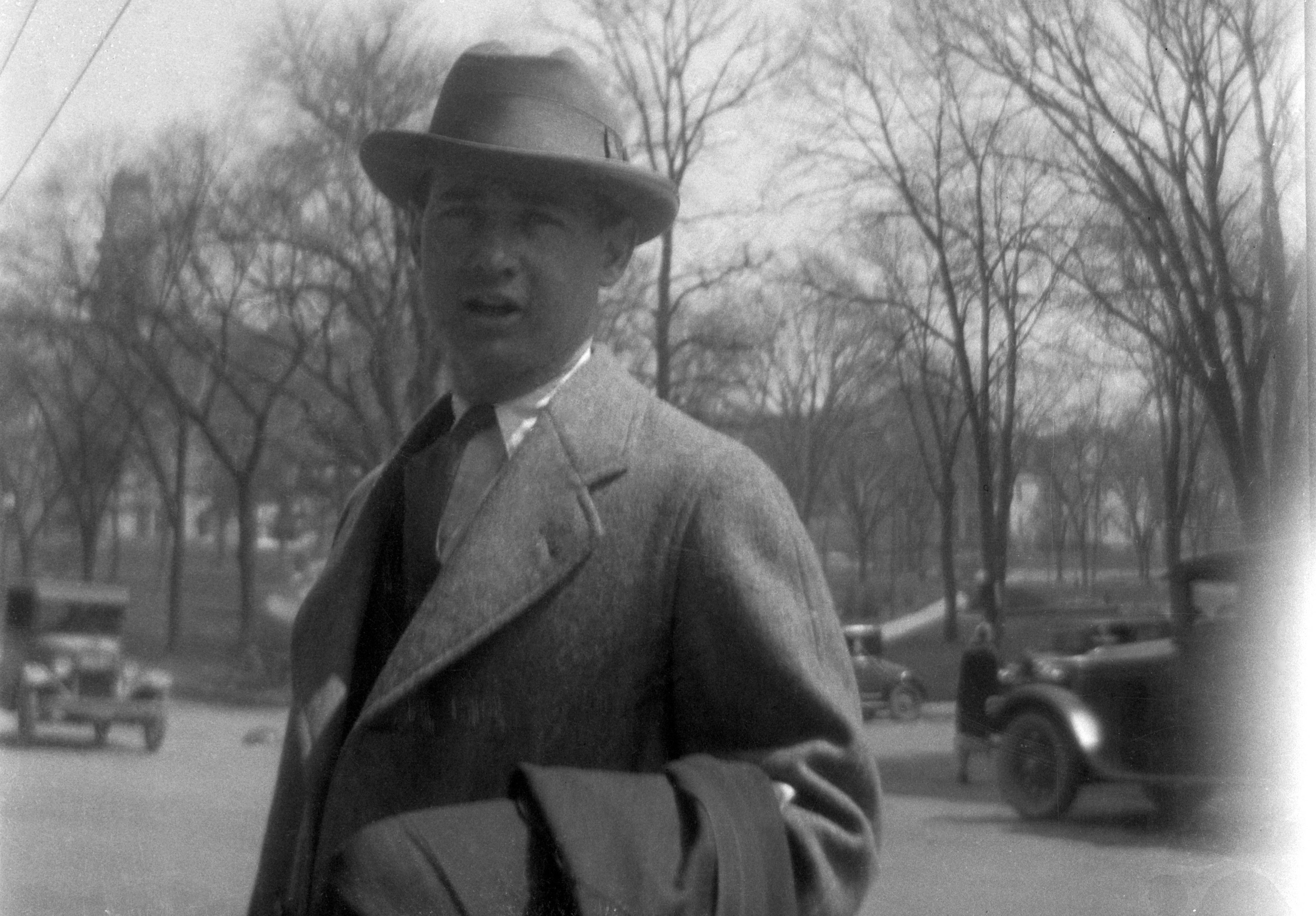
Carl F. Hanneman taking his suits to the cleaner at Janesville, Wis., on April 5, 1926. Carl and his wife, Ruby V. Hanneman, were on their way to dinner. Carl was a druggist at McCue & Buss Drug Co. at the time.
Carl F. Hanneman taking his suits to the cleaner at Janesville, Wis., on April 5, 1926. Carl and his wife, Ruby V. Hanneman, were on their way to dinner. Carl was a druggist at McCue & Buss Drug Co. at the time. He later moved to Mauston, Wis.

Carl was the registered pharmacist at the Mauston Drug Store on Division Street in Mauston. He had been the druggist there since moving his young family to Mauston in 1936 from Wisconsin Rapids. A graduate of Marquette University, Carl started as an assistant pharmacist, but obtained his full registered pharmacist license in the 1940s.

“After watching him for some time, we entertained a doubt as to the accuracy of the counts and Joe was inclined to agree with us,” the article continued. “But Carl said he could count pills time on end and whistle a tune at the same time, and still come out the a correct count. ‘Come, come, Carl!’ we exclaimed. ‘Isn’t that pulling our leg a bit?'”

Judging by these vials from McCue & Buss Drug Co., registered pharmacists packaged both pre-made pills and medicine capsules.
Judging by Carl F. Hanneman’s vials from McCue & Buss Drug Co., registered pharmacists packaged both pre-made pills and medicine capsules.

Carl told the men a story of a “kindly old lady” who regularly came in for prescriptions and doubted the counts doled out by the druggist. “It never failed, but that after we wrapped up her prescription, she’d sit in the chair out there, undo the package and count the pills in the box,” Hanneman said. “To this day, she hasn’t demanded a recount!”

The article concluded: “Maybe registered pharmacists should be made ballot clerks. Recounts wouldn’t be necessary!”

©2014 The Hanneman Archive
Family Line: Carl F. Hanneman >> David D. Hanneman, Donn G. Hanneman and Lavonne M. (Hanneman) Wellman

Dying Wish Brought Chapel Windows Home to St. Mary’s Hospital

As kids growing up in Sun Prairie, any time we ventured into the back room of our basement we were likely to hear a voice from upstairs shout, “Don’t you go near those windows!” Of course we knew what that meant: the antique stained-glass behemoths covered in blankets in the farthest reaches of the basement, next to the furnace. I never gave a great deal of thought to them, until one day in 2006 when my father was dying of cancer.

I fully tell the story of the stained-glass chapel windows in my book, The Journey Home: My Father’s Story of Cancer, Faith and Life-Changing Miracles. It’s worth covering here, too.  It shows how sometimes, things all come together to create something beautiful, even out of sadness.

The St. Mary's Hospital chapel as it looked in the 1950s.
The St. Mary’s Hospital chapel as it looked in the 1950s.

Founded in 1912, St. Mary’s Hospital in Madison always had a chapel as part of its facilities. In 1926, a new, ornate chapel was built as part of an expansion of St. Mary’s. The chapel had 10 window frames, each with two beautiful arched stained-glass windows that rose 20 feet from eye level to midway up the wall. In between each were two Stations of the Cross. The windows remained part of the chapel until 1973, when that section of the building was razed to make way for a new hospital wing on Mills Street. My Dad obtained two of the windows, a total of four panels, carrying them home in blankets to rest for more than three decades.

The windows are prominently visible in this newswire photo from 1946, from a Mass to celebrate presentation of a papal medal to Leo T. Crowley of Madison.

When Dad was being treated for lung cancer at St. Mary’s in the fall of 2006, he got an inspiration to give those windows back to St. Mary’s. He asked for my help in doing some research, but he was so impatient he wheeled himself down to the administrative offices to talk to someone about it. That someone, vice president Barbara K. Miller, was enthralled with the idea, but it was her last day on the job before retiring. She promised to get the ball rolling on the donation. “I want these windows to come home to St. Mary’s,” he told her.

The chapel window sections as they looked in 2007 in the Hanneman basement.

Dad was a little worried that his donation wouldn’t get done. The idea occupied his mind more than anything else in November 2006. He knew his time with us was short. He told the story and his idea to his physician, Dr. Gregory Motl. Dad made Dr. Motl promise that if he didn’t survive the cancer, the donation would be completed. Motl grasped Dad’s hand and said reassuringly, “I will Dave. I will.”

To say the hospital embraced Dad’s idea would be an understatement. His timing was perfect, since St. Mary’s was planning a $182 million expansion that would add a new east wing with operating rooms, a cardiac center, outpatient offices, patient rooms and more. St. Mary’s  was looking for ways to tie the new facility to the hospital’s heritage. The architects designed special spaces for each of the four window sections. St. Mary’s had a new internal champion for the windows, Steve Sparks, public relations director.

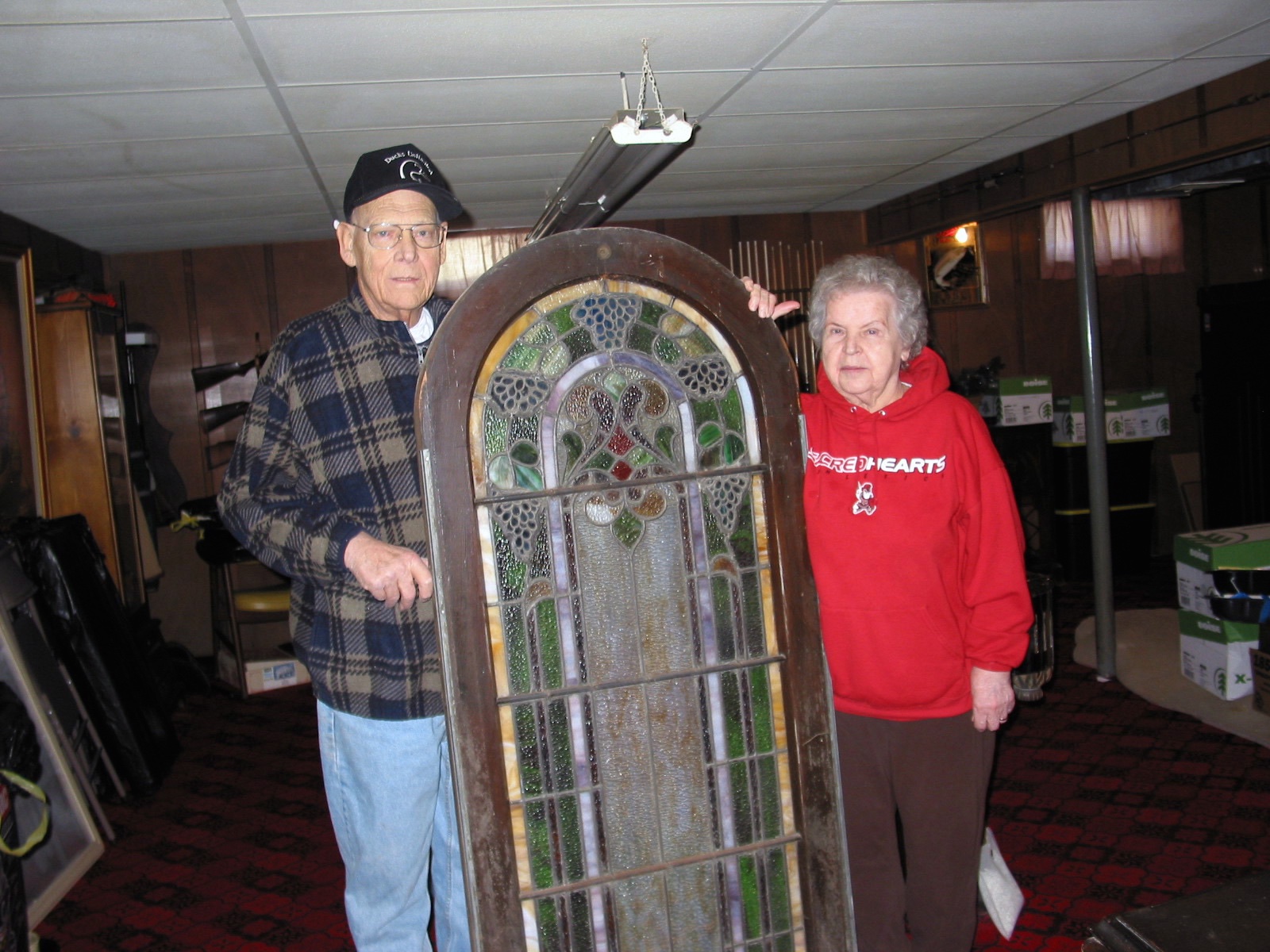
After months of planning, St. Mary’s was finally ready to take possession of the windows. On March 22, 2007, Sparks and workmen came to Sun Prairie to transport the windows. He snapped some photos of Mom and Dad with a window section. Dad looked pale and drawn, but I know he appreciated the milestone that day represented. “It was humbling for me,” Sparks recounted later. “This gift demonstrated exceptional courage and generosity. It is an experience I won’t forget.”

David and Mary Hanneman pose with one window section on March 22, 2007.

Tears were shed that afternoon as the windows were lovingly carried outside. It was the first daylight to penetrate the stained glass in more than three decades. For Dad, it was the accomplishment of a mission of giving. His part was finished; now St. Mary’s would take over. Not two weeks later, Dad was admitted to St. Mary’s and then discharged to HospiceCare Inc., where he died on April 14, 2007. 

In early December 2007, Mom  and I were invited to the dedication day at the new St. Mary’s east wing. We attended a luncheon and heard very kind words about Dad from Dr. Frank Byrne, president of St. Mary’s Hospital. They were similar to what Dr. Byrne wrote right after Dad’s death. “It is clear from Dave’s accomplishments that dedication to community was always a part of his priorities,” Byrne wrote, “and we will all benefit from that dedication for years to come. At this sad time, we hope it will be a reminder that though life may seem short, the contributions made by one individual have a significant impact in building a future for us all.”

The window section placed in the atrium of the new east wing at St. Mary's Hospital in Madison.
The window section placed in the atrium of the new east wing at St. Mary’s Hospital.

When we walked into the atrium and first saw one of the window sections, it was enough to bring tears. There it was, set into the wall and brilliantly backlit in a way that brought out the green, red and amber hues of the glass. It was, as designed by the architects, a welcoming beacon for everyone visiting St. Mary’s. Mom posed next to the window, and even did an impromptu interview with Madison’s Catholic newspaper, The Catholic Herald. The three other window sections were placed on different floors of the east wing. One is in a waiting room. The others are in prominent spots.

The story of these chapel windows gives testimony that beauty can emerge from the depths of the darkest tragedies. Dad kept the windows safe for 35 years, and he got them safely home to St. Mary’s just weeks before he, too, made it home.

This post has been updated with additional window photos.
©2014-2025 The Hanneman Archive

Hanneman’s Mayoral Election Continued 400-Year Tradition

When David D. Hanneman was elected mayor of the city of Sun Prairie, Wisconsin in April 2003, it continued a Hanneman family tradition that stretches back more than 400 years to the county Regenwalde in the Baltic Duchy of Pomerania. Hanneman’s election as mayor on April 1, 2003 capped his nearly 40-year public service career — and put him in good family company.

The Hanneman family from Kellner, Wisconsin — from which David Hanneman descends — traces its roots to Pomerania, a picturesque land of Germanic peoples that dates to the 1300s. His earliest known ancestor, Matthias Hannemann, was from the village of Zeitlitz in the kreis, or county, of Regenwalde. Regenwalde means “woods of the Rega River,” referring to the picturesque waterway that ambles 100 miles through the county and empties into the Baltic Sea. This area has long been known for agriculture, fishing and forests, and it bears strong geomorphic similarities to the state of Wisconsin. The village of Zeitlitz covered about 2,200 acres and had approximately 100 households.

Mayor Dave Hanneman cuts the ribbon at opening of the Sun Prairie fire station. (Sun Prairie Star Photo)

Records trace the Hannemann (the original spelling had two ‘n’s at the end) family back at least to 1582 in Zeitlitz. The Hannemanns made up one of the predominant families in Zeitlitz, based on the number of entries found in the Lutheran church register. Many church records were destroyed in a fire in Stramehl in 1720, but the register from 1582 survived. At that time, there were a number of Hannemann families in Zeitlitz, and they owned some of the larger farms in the village. One of these men, likely the eldest brother, held the title of schulze, or mayor of Zeitlitz. Being the schulze was unlike the elected political position of mayor found in modern-day American communities. It was an inherited job, and the duties centered on making sure work was performed equitably in the village, and that the taxes of grain, goods or money were collected for the estate owner. The term schulze can have various related meanings, including “village headman,” mayor or even constable.

Mayor Hanneman Speaks at a veterans' event.
Mayor Hanneman speaks at a veterans’ event. (Sun Prairie Star Photo)

As farmers, the Hannemanns were also involved in providing financial support for the local minister and the church. Each tenant farmer paid his taxes in measurements of grain. The unnamed mayor Hannemann and Peter Hannemann were each responsible for taxes on two Hufen in Zeitlitz in the year 1582. A Hufe was the amount of land needed to sustain a family. There could have been more Hannemann families living on those four Hufen, but the church records only listed the major land tenants who paid taxes.

In the nearby village of Groß Raddow (about 6 miles from Zeitlitz), the Hannemann family had a similar history. A tax list from 1666 includes the names of Tews Hannemann (the schulze, or village mayor), Heinrich Hannemann, Chim Hannemann and Peter Hannemann. For at least several generations, it appears the Hannemann family inherited and passed on the office of mayor in Groß Raddow. In 1717, Hans Hannemann was the mayor, so we believe Hans is a descendant of Tews Hannemann.

Mayor Dave Hanneman cuts the cake at the 5th birthday of the new Sun Prairie Public Library.

The Matthias Hannemann family began emigrating to Wisconsin in 1861. Matthias left his home in 1866 and came to Wisconsin through Quebec. The family settled in and around Kellner, a tiny hamlet that straddles the Wood-Portage county line southeast of Wisconsin Rapids. At one time, the Hannemanns owned and farmed more than 1,000 acres in Wood and Portage counties. David’s great-grandfather, Christian Hanneman (Matthias’ son) was the last of this clan to come to America in November 1882.

Dave Hanneman (1933-2007) was first elected to public office on April 2, 1968 when he became Fourth Ward alderman in Sun Prairie. He served only one term as alderman, but stayed active in city politics, pushing the city to upgrade its sewer system to prevent backups into residential homes. He again ran successfully for alderman in 1988 and stayed on the Sun Prairie City Council until 1996, when he was elected to the Dane County Board of Supervisors. He held that post until being elected Sun Prairie mayor in 2003.

The Sun Prairie Star Countryman carried news of Hanneman's election as alderman in 1968.
The Sun Prairie Star Countryman carried news of Hanneman’s election as Fourth Ward alderman in April 1968.

“Dave was involved in the growth of Sun Prairie and believed in progress for the community. He worked and helped champion the Highway 151/County Highway C project, which included working with the state Department of Transportation,” said Bill Clausius, who served on the city council and county board with Hanneman. “Dave was involved with the West Side Plan, which brought the Sun Prairie Community together to envision the future of the West Side. Dave supported and worked to begin the West Side Community Service Building. This facility includes a west side location for police, fire and EMS. His vision was to provide essential services to Sun Prairie residents and to shorten response times in case of an emergency.”

Clausius continued: “In 2003, Sun Prairie won the ‘Champions of Industry’ Award of Excellence as one of the best managed small cities in America.  Dave personally raised $32,000 in donations from area businesses to fund production of a video featuring Sun Prairie, and highlighting Sun Prairie’s achievements.”

— Adapted from the forthcoming book ‘Treasured Lives.’
©2014 The Hanneman Archive