One beautiful young lady truly stands out among the 160 pages of the 1922 Ahdawagam. What is an Ahdawagam, you ask? It is the name of the school annual, or yearbook, at Lincoln High School in Wisconsin Rapids. Ahdawagam is an Indian word that refers to the “two-sided rapids” along the Wisconsin River.
The specially featured young lady was touted for her musical talents and participation in a wide range of student activities. She is Ruby V. Treutel (1904-1977) of Vesper, Wis., before she became Ruby V. Hanneman as the bride of Carl Henry Frank Hanneman (1901-1982).
It is indeed a treat to stroll through the pages of this early 1920s book, 98 years after it was published. It was a very different era, and these young people seem so mature and serious. Although maybe that is because we came to know them much later in life.
Ruby’s first appearance in the book is near the front, in the senior portrait section. Right between Irene Timm (“Timmy”) and Florence Van Dyke (“Flo”). No nickname is mentioned for Ruby. The listing has five lines describing her school activities: Glee Club, Ahdawagam staffmember, Dramatic Club, Mask and Wig Club (founding member), Gamma Sigma musical society, and a performer in the school operetta for three years. Ruby’s slogan certainly fits the woman we came to know: “Music hath charms and so has she.”
She is next listed in the “Class Mirror” section. Her answers included: Heart = Carl; Mind = Church’s (pharmacy where Carl worked); favorite occupation = singing; wants to be = opera singer; and “ought to be” = second Galli Curci. The last item is a reference to Amelita Galli-Curci, the Italy-born coloratura soprano who was an acclaimed opera singer in the early 20th century.
A few chapters later, in the Music and Drama section, we find Ruby’s stronghold. She was president of the 87-member Glee Club, which encourages development of musical talent. The club also performs an operetta each year.
Glee Club: Ruby is in the center of the middle row.
Just pages later we find Ruby in the group photo for Gamma Sigma, which draws the most musically talented students in the school. She was among the founding members during the 1921-22 school year. The group offered regular public singing and instrumental performances.
Gamma Sigma: Ruby is seated in the first row, second from the right.
Ruby played the lead role in the Glee Club operetta production of Sylvia. The club and the performance were directed by Elizabeth Bradford, Lincoln High School’s musical supervisor.
The Cast of the 1922 production of “Sylvia.” Ruby is seated third from the right.
The operetta was no small-time school production. It received a preview article on the society page of the Wisconsin Rapids Daily Tribune on Jan. 17, 1922. Sylvia was originally slated to be performed at Daly’s Opera House in Wisconsin Rapids. Two weeks before opening night, the opera house burned to the ground. Firefighters were hampered because the hydrants near the opera house were frozen and water had to be pumped from the Wisconsin River. The fire forced the operetta production to relocate to Lincoln High School for the Jan. 27 performance.
Ruby V. Treutel dressed for her lead role in the musical ‘Sylvia’ in 1922.
The Daily Tribune published an extensive review in the Jan. 28 issue. The reviewer sang the praises of Ruby and her co-performers. “Miss Ruby Treutel scored in the title role, as the haughty sweetheart of the court poet. As an actress, she showed unusual ability in every situation,
“but it was as a singer that she won the hearts of the crowd completely.”
A review published in the Jan. 28 issue of the Wisconsin Rapids Daily Tribune.
Ruby shined with her rendition of “Unto Thy Heart” with a violin obligato by Esther Levin. The number “seemed to appeal to her listeners especially, for they accorded her enthusiastic and well-deserved applause,” the Daily Tribune review said.
We’ve documented elsewhere on this site the musical talents of Ruby Treutel Hanneman. She performed in various theaters, starting when she was just 17. In April 1921, Ruby “brought down the applause of the house time after time” with her performance in the play “The Fire Prince,” according to the Daily Tribune.
Ruby’s next yearbook appearance is on a photo-collage page. She and future husband Carl are doing some kind of goofing around. The photo isn’t real clear, but it appears Carl is either playing some kind of stringed instrument or wielding a fishing pole or a sword. See what you think. Many of the photos in the collage seem to be related to the operetta.
It is impressive to see how dressed up these students are on every page of the yearbook. Ladies in dresses and the young men in suits and ties. Fashion was the rule of the day.
Finally, Ruby is pictured among 17 members of the Ahdawagam yearbook staff. She served as editor of music and drama.
Ahdawagam yearbook staff: Ruby is seated, third from the left. She was music and drama editor.
Ruby’s final mention in the book is on a list under the heading “The Great White Way.” All of the people on the list were described as lights (“head light,” “flashlight,” “candle,” etc.). Ruby is listed as “Star Light.”
Carl gets the last word. He appears in the alumni section, where he is listed for his job as a druggist at Church’s Drug Store. Carl graduated from Lincoln High School in 1921.
The staff box for the yearbook says it was Vol. 10 for the Ahdawagam. The editor-in-chief was Viola J. Nash. The book was produced by the Hein-Sutor Printing Company of Wisconsin Rapids.
Carl (back row second from left) and Ruby (front row second from left) in a previous year appeared together in “The Fire Prince.”
The September 1960 Chicago plane crash that killed all six members of the Richard Rickman family was caused by a faulty engine valve and an intense oil fire, according to a federal investigation report obtained through the National Archives.
Richard E. Rickman, 34, was flying his wife and four children from Wisconsin Rapids to Detroit on Labor Day 1960 when his Beechcraft C35 Bonanza (tail number N-5816C) plunged into Lake Michigan with flames trailing from the engine. Rickman, his wife Helen and children Richard, Robert, Catherine and Patricia were killed in the crash. The plane and its passengers sunk into the dark waters of Lake Michigan off Chicago’s Oak Street Beach. [See related:Entire Rickman Family Killed in 1960 Plane Crash]
It was a horrific, haunting tragedy. The Rickmans, native to central Wisconsin, were returning home to the Detroit area after a Labor Day vacation. Following the advice of the airport manager in Wisconsin Rapids, Rickman flew across Wisconsin and then along the Lake Michigan shoreline to Chicago. That’s where the trouble started. Rickman radioed the tower at Meigs Field in Chicago that he had an emergency and needed to land. [See an aerial view of Meigs Field] He never got the chance. The plane nose-dived into the water about 1 mile offshore from a crowded Oak Street Beach. All six Rickmans were killed.
The Civil Aeronautics Board began investigating the crash just as the sections of damaged plane were recovered from the depths of Lake Michigan. The wings were sheared off on impact. Witnesses on the beach reported seeing flames coming from the engine as the single-engine plane dove into the water. The probe was led by Clifford G. Sheker, the CAB’s air safety investigator. The 205-horsepower Continental engine was recovered and sent off for analysis. Sheker testified before a Cook County coroner’s inquest jury twice — in September and October 1960. His preliminary finding in October was that engine trouble caused the crash.
That’s where the public attention stopped. The probe continued and led to a report of findings in April 1961, but there was no media coverage on the final cause of the crash. The Hanneman Archive began a search for Sheker’s report back in 2015. It was not on the Federal Aviation Administration’s online database of old CAB crash investigations. The CAB was a predecessor to the National Transportation Safety Board.
We enlisted the help of the National Archives and Records Administration in College Park, Maryland. After several months, an archivist named Amy R. found the answer in April 1961 meeting minutes from the Civil Aeronautics Board. She was kind enough to snap digital photos of the report narrative and send them via email. As far as we can tell, these details were not published by news outlets at the time.
The report said Rickman was about a mile offshore headed south at 7:26 p.m. when he broadcast a Mayday call: “I have an engine failure or something – I am coming in!” The flight was immediately cleared for emergency landing at Meigs Field, a single-runway airport on Northerly Island, a peninsula along Chicago’s lakefront. Sheker’s report described what happened:
“About this time ground witnesses and the occupants of another plane saw the aircraft afire in flight. They observed the plane make a left turn and go out of control twice before it crashed into Lake Michigan and exploded.”
The Continental Motors E-185 engine became disabled by an “intense oil fire” that originated in the area of the exhaust heater muff. The No. 3 exhaust valve showed “fatigue failure” that led to the fire. The engine crankcase was broken open and the Nos. 3 and 4 pistons and connecting rods were broken. The “intense, in-flight fire” entered the cabin in the area of the rudder pedals and “subjected the entire cabin to fire.”
Rickman was an experienced pilot with 379 total flight hours, including 228 hours with the Beechcraft C35. His Beechcraft was manufactured in 1951 and licensed to Rickman in 1957. It’s unknown if the CAB or later the FAA took any action as a result of the Rickman crash, such as issuing an airworthiness letter. There was no indication in the CAB report of the maintenance history of the plane, or if the No. 3 exhaust valve had caused other engine fires.
Just 18 months before, superstar singers Buddy Holly, Ritchie Valens and J.P. “The Big Bopper” Richardson were killed when the Beechcraft C35 Bonanza in which they were traveling crashed near Clear Lake, Iowa. February 3, 1959 became known as “The Day the Music Died,” memorialized in Don McLean’s 1971 song, “American Pie.” The Civil Aeronautics Board faulted the pilot for taking off in poor weather when he was restricted to visual flight rules.
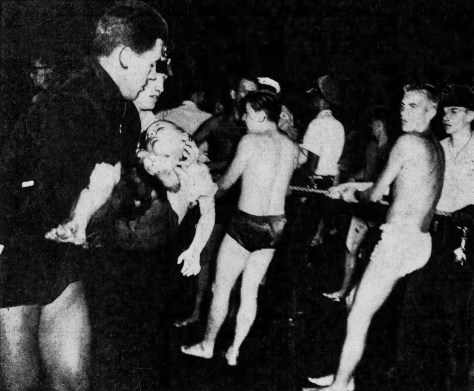
Lifeguard Fred Rizzo carries the lifeless body of little Catherine Rickman from a police marine boat to a Chicago Fire Department ambulance on Sept. 5, 1960. Efforts to revive the girl were unsuccessful. (Screen grab: Chicago Tribune Photo by James O’Leary)
One of the most heartbreaking scenes from Sept. 5, 1960 was the sight of little Catherine Rickman, 4, being carried from a rescue boat to an ambulance by lifeguard Fred Rizzo. Boaters found her floating in the water shortly after the crash. She had burns on her face, legs and feet. The girl was revived briefly in the ambulance on the way to the hospital, but she died a short time later. Her grandparents, Edwin and Renata Rickman of Saginaw, Mich., identified her body. The search for her parents and siblings went on for days.
A lifeguard gives oxygen to Catherine Rickman in a Chicago Fire Department ambulance on Sept. 5, 1960. (Screen grab: Chicago Tribune photo by James O’Leary.)
The diver who first found the bodies was Jeffrey Daxe, 34, a Chicago pilot and lifeguard. Daxe lived just across Lakeshore Drive near the beach. He was able to quickly gather his diving gear and have a lifeguard row him out to the crash site. The experience haunted Daxe for decades, according to his son, Jeff Daxe of Dayton, Ohio:
“As he told the story of the recovery of the victims, his face would transform to one with a look of concern. He would look away from his outstretched hand almost as if he could see, or didn’t want to see, the faces of the victims as he brought them to the surface.”
The senior Daxe went on to a career in aviation, and moved to Valparaiso, Ind. He told the story of the Rickman crash often. Even in recent years, when visiting Lake Michigan, his son said, he spent a long time gazing out on the water, expressing concern for the safety of boaters and windsurfers. “I believe the experience had a tremendous impact on his life.”
Pilot Jeffrey Daxe in the 1950s with his Stearman biplane. Daxe, who was also a lifeguard and diver, was the first to find the bodies of Richard E. Rickman, his wife and three of their four children. (Photo courtesy of Jeff Daxe)
Tom Metcalf remembers the Rickmans well, growing up for a time in the same neighborhood in Redford Township, a western suburb of Detroit. “I remember playing with Richard and Robert,” said Metcalf, who was 6 at the time of the crash. “I also remember flying with them in their aircraft. My father was a military pilot and he and Mr. Rickman were friends with a common interest in flying. I also remember my mother chasing some news reporter out of our back yard after catching him trying to ask me questions after the accident.”
Like Daxe, Metcalf was deeply affected by the Rickman tragedy. He said he hopes to visit the family’s graves at Forest Hill Cemetery in Wisconsin Rapids, Wis. “I have thought of them often and sent prayers their way throughout my life,” Metcalf said.
Richard E. Rickman, the son of longtime shoe-store proprietor Edwin J. Rickman, grew up in Wisconsin Rapids. He was a descendant of pioneer resident Matthias Hanneman, who came to Wisconsin in 1866 from Pomerania. He served in the U.S. Naval Reserve in World War II. His father had served in WWI. A factory representative for the Ogden Manufacturing Co., Rickman married the former Helen Anderson in December 1949 and they later moved to Michigan. Their first child, Richard Edward, was born in Lansing in May 1953. Robert John was born in Lansing in March 1955. Catherine Helen was born in Detroit in June 1956; and Patricia Ann joined the family in Detroit in September 1957.
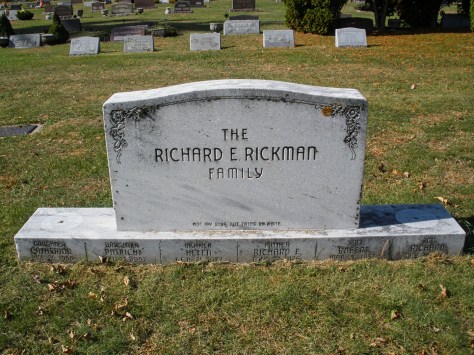
The epitaph on the Rickman Family monument at Forest Hill says simply: “Not my will, but Thine be done.”
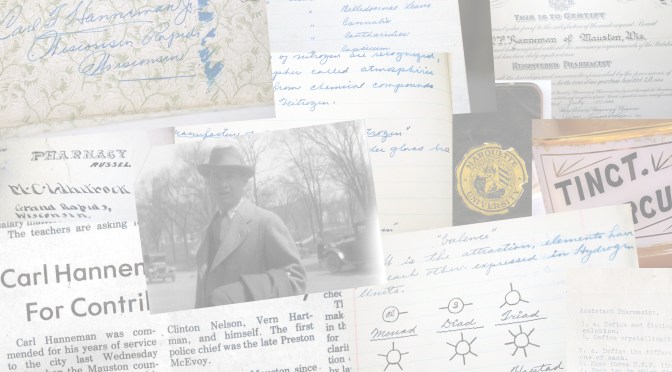
Carl F. Hanneman’s college pharmacy notebooks and study guides from 1924 and 1925 have been donated to the Department of Special Collections and University Archives at Marquette University in Milwaukee. The material was turned over to the university and accession papers signed May 26, 2017.
Carl F. Hanneman
It was a long road for the college pharmacy materials, kept by the senior Hanneman at homes in Wisconsin Rapids, Janesville, Fond du Lac and Mauston. When Carl died in May 1982, the papers went to his youngest son, David D. Hanneman (1933-2007). Now, more than 90 years after they helped Carl become a registered pharmacist, the papers will be preserved by Marquette.
Carl earned his licensure in January 1925 after completing Marquette’s short course in pharmacy. He went on to a pharmacy career that spanned nearly 60 years, much of it behind the counter at the Mauston Drug Store.
Carl’s notebooks contained meticulous notes on chemistry and other subjects.
The handwritten notes are unique because Marquette previously had little documentation of its popular short course in pharmacy. The university’s degree program in pharmacy was discontinued during World War I because so many faculty and students left campus to fight overseas. The pharmacy degree program was never restarted, but demand continued for higher education to help students pass that state pharmacy board exams.
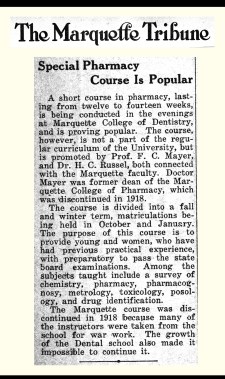
In 1923, Marquette began offering a “short course” in pharmacy under the auspices of the College of Dentistry. The courses in chemistry, organic chemistry, pharmacy, pharmacognosy, toxicology and drg identification were rigorous. They were taught by Dr. Hugh C. Russell and Professor Frederick C. Mayer, both former deans of the Marquette College of Pharmacy. The two-semester program was designed for young men and women with pharmacy experience, in preparation to pass the state exams.
Carl Hanneman studies in the mid-1920s.
The books Carl left behind contain hundreds of pages of meticulous notes on chemistry, pharmacy and related subjects. Two of the books have Marquette pennant stickers on the front. Carl’s pocket-size copy of the Guide to the Organic Drugs of the United States Pharmacopœia has a Marquette University seal on the cover. His exam book shows he scored an 82 percent on one test in 1924.
Carl (1901-1982) would no doubt be tickled to know his college work will be preserved in the archives of his alma mater. We think his son David would be rather proud, too.
The essence of wintergreen that wafted out the windows onto Division Street in Mauston, Wisconsin. Bottling and selling hand-crafted mosquito repellent at taverns and resorts across northern Wisconsin. Filling pills behind the pharmacy counter as a child. In this installment of audio memories, Dave Hanneman (1933-2007) remembers the work of his pharmacist father, Carl F. Hanneman (1901-1982). This interview was recorded in mid-November 2006 at St. Mary’s Hospital in Madison, Wisconsin.
Carl F. Hanneman printed his own labels and wrote the ad copy for Stay Off.
Vials from a portable druggist kit owned by Carl F. Hanneman.
Carl F. Hanneman taking his suits to the cleaner at Janesville, Wis., on April 5, 1926. Carl and his wife, Ruby V. Hanneman, were on their way to dinner. Carl was a druggist at McCue & Buss Drug Co. at the time.
Christopher Marshall, an Irish immigrant, established his apothecary shop in Philadelphia in 1729. During 96 years, this pioneer pharmaceutical enterprise became a leading retail store, nucleus of large-scale chemical manufacturing; a “practical” training school for pharmacists; an important supply depot during the Revolution; and finally, it was managed by granddaughter Elizabeth, America’s first woman pharmacist. Christopher earned the title of “The fighting Quaker” during the Revolution; his sons, Charles and Christopher, Jr., (shown as youths with their father, about 1754) earned individual fame and carried on his fine traditions.
Carl F. Hanneman’s 1925 state of Wisconsin license as an assistant pharmacist.
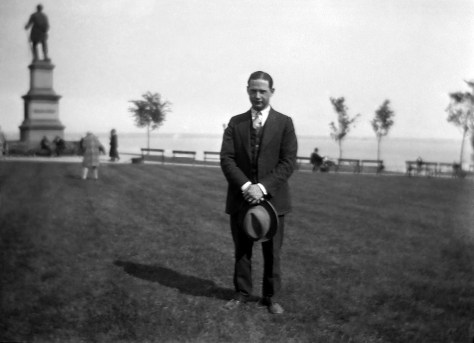
Carl F. Hanneman at Solomon Juneau Park in Milwaukee in 1924.
Carl Hanneman emerges from the Mauston Drug Store, circa 1958.
A sample from one of Carl Hanneman’s pharmacy notebooks.
Dad with parents Carl and Ruby Hanneman, and dog Cookie.
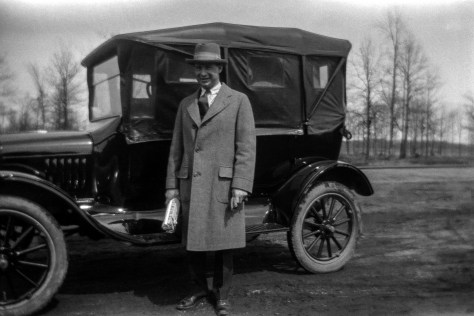
Carl F. Hanneman has that thrilled schoolboy look on his face in this vintage photograph from about 1925. And why not? It appears he is posing next to his new purchase: a Ford Model T, which came in any color a customer wanted “as long as it’s black.” Although there is no snow on the ground, the Ford is outfitted for inclement weather with a pretty nice canopy.
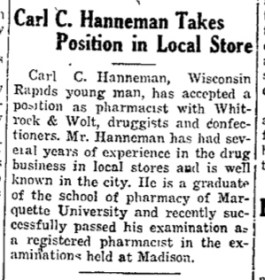
Carl’s first job as a licensed pharmacist made front-page news in the Feb. 14, 1925 issue of the Wisconsin Rapids Daily Tribune. The paper incorrectly stated his middle initial.
We don’t have any notes that went with this image, so we will have to surmise some things to gain the proper context. Based on Carl’s apparent age and his natty threads, it would be safe to assume if he indeed purchased this auto, it was after he landed his first post-graduation job at the Whitrock & Wolt pharmacy in Wisconsin Rapids. That event made front-page news in February 1925.
After Carl married his longtime sweetheart, Ruby V. Treutel, in July 1925, a Model T was visible in photos from their honeymoon near Hayward, Wisconsin. That does not appear to be the same automobile as the one pictured above and below. So some mystery remains surrounding Carl’s early vehicular habits. If only we could still ask him about it.
For most of his adult life, Carl F. Hanneman said he studied pharmacy at Marquette University in Milwaukee, securing the academic knowledge required to pass the state of Wisconsin pharmacy board exam. Even his obituary in the May 30, 1982 issue of the Wisconsin State Journal stated, “He was a graduate pharmacist of Marquette University.”
Now, more than 90 years after Hanneman’s days of youth in Milwaukee, a question has been raised about where he studied to prepare for his nearly 60-year career as a pharmacist. As The Hanneman Archive was preparing to donate Carl’s student notebooks, study guides and formulary books from his days at Marquette, staff at the university’s archives said they could not find him in an initial search of the graduate database.
Carl F. Hanneman at Solomon Juneau Park in Milwaukee in 1924.
The College of Pharmacy at Marquette was disbanded in 1918, as World War I decimated the ranks of students and faculty alike. The plan was to re-establish the pharmacy program after the war, but those plans were never realized and Marquette never again had a pharmacy degree program. So what to make of Carl’s story and his history? We can assume he did not fabricate it, since he was licensed in Wisconsin for 57 years. So, what to do when presented with a mystery? We dug into it.
Some facts in our favorite pharmacist’s story are well-established. Carl Henry Frank Hanneman was born on October 28, 1901 in Grand Rapids, Wood County, Wisconsin (the city’s name was changed to Wisconsin Rapids in 1920). He was the youngest of five children of Charles and Rosine (Osterman) Hanneman. (We related elsewhere on this sitesome of the confusion surrounding his birth when he sought a copy of his original birth certificate in 1946).
Charles Hanneman emigrated from Pomerania to Wisconsin in November 1882.
His father Charles, whose full name is Carl Frederick Christian Hanneman, emigrated to Wisconsin in November 1882 from county Regenwalde in the Baltic Duchy of Pomerania (now in Poland and Germany). His mother was native to Wood County, Wisconsin. The senior Hanneman toiled at manual labor. He started as a saw mill worker and later became a farm hand for his brother William at the dawn of the 20th century. Charles worked on the 1908 construction of the sewer system in Grand Rapids, earning 17.5 cents per hour. He later worked in a paper mill. Young Carl had a good role model for hard work.
Carl attended public schools, graduating from Lincoln High School in 1921. He was a smart young man, with equal talents at science and art. Shortly after high school, he began work as an apprentice at the well-known Sam Church drug store. A spark was lit. Carl felt a calling. Carl’s apprenticeship at the Church drug store lasted nearly five years. We believe the person who told Carl about Marquette University was Mark C. Whitrock, a 1913 Marquette pharmacy graduate and pharmacist at Sam Church. Nearly 10 years Carl’s senior, Whitrock was also a member of the Wisconsin Rapids city council.
Carl Hanneman studies in the mid-1920s.
Among Carl’s Marquette papers is a pharmacy course notebook originally belonging to Whitrock. It is from a theoretical pharmacy course taught by Dr. Hugh C. Russell, a physician and professor in Marquette’s College of Pharmacy. Whitrock gave the book to Carl to help him prepare to study for work as a druggist. What to do, since the pharmacy degree program at Marquette was no more? With some help from the Marquette University Archives and Carl’s own writings, we found the answer.
Marquette’s short course in pharmacy proved popular in the mid-1920s.
In 1923, Marquette began offering a “short course” in pharmacy under the auspices of the College of Dentistry. The school newspaper, the Marquette Tribune,said the course was “not part of the regular curriculum of the university.” What? The courses in chemistry, organic chemistry, pharmacy, pharmacognosy, toxicology and drug identification were rigorous. They were taught by the aforementioned Dr. Russell and Professor Frederick C. Mayer, both former deans of the Marquette College of Pharmacy. The two-semester program was designed for young men and women with pharmacy experience, in preparation to pass the state exams.
Carl studied under two former deans of the Marquette College of Pharmacy.
Carl enrolled in the pharmacy short course in the winter of 1924. We know he paid tuition (he referenced in later writings having to save before enrolling at Marquette). He lived in the 700 block of 37th Street in Milwaukee, just west of the Marquette campus. We have a number of photos of his fiancee, Ruby Treutel, visiting him at Solomon Juneau Park in Milwaukee in 1924.
The books Carl left behind contain hundreds of pages of meticulous notes on chemistry, pharmacy and related subjects. Two of the books have Marquette pennant stickers on the front. Carl’s pocket-size copy of the Guide to the Organic Drugs of the United States Pharmacopœia has a Marquette University seal on the cover. His exam book shows he scored an 82 percent on one test in 1924. The test was corrected by someone identified only as “A. Mankowski.” So far, we have not identified that person further.
Carl’s organic drugs guide from his days at Marquette University.
It seems odd that Marquette would offer such a program but not count it as official curriculum. The university offered certification programs in other subjects. We have no paper certificate or other document showing Carl matriculated from the pharmacy short course, but we will ask Marquette to check its records thoroughly. Otherwise, Carl and many others like him from the 1920s would be Marquette orphans, educated by the university but not claimed as students or course graduates.
Carl traveled to Madison on January 24, 1925 for the state Board of Pharmacy examination. He was one of 105 applicants seeking licensure as either a registered pharmacist or assistant registered pharmacist. Carl was among 76 people who passed the exam that day. On January 30, the Wisconsin State Board of Pharmacy issued him certificate No. 3252 as a registered assistant pharmacist. With his credentials in hand, he returned home to Wisconsin Rapids. Mark Whitrock hired him as a druggist for the brand new Whitrock & Wolt pharmacy on Grand Avenue.
Carl Hanneman’s graduation and first job made front-page news in Wisconsin Rapids. The newspaper got his middle initial wrong.
Six months later in nearby Vesper, Carl married his longtime sweetheart, Ruby Viola Treutel. After working at the Whitrock pharmacy much of 1925, Carl and Ruby moved to Janesville. Carl took a druggist job with the McCue & Buss Drug Co. in downtown Janesville. After about six months, Carl and his now-pregnant wife moved to Fond du Lac, where Carl started work for Fred Staeben at the Staeben Drug Co. Just weeks later, they welcomed their first child, Donn Gene Hanneman.
By Christmas 1927, the Hannemans moved back to Wisconsin Rapids. Carl became a druggist for his old employer, Sam Church. He stayed in that job for five years. In March 1933, the family welcomed another son, David Dion. Carl then left the pharmacy world for a sales job with the Consolidated Water Power & Paper Co. That assignment lasted for several years.
Longtime pharmacist Sam Church hired Carl Hanneman as an apprentice in the early 1920s, then as a druggist in 1927.
Pharmacy was his calling, so Carl looked for a chance to retake his place behind the druggist’s counter. In February 1936, Carl was hired by Dr. J. Samuel Hess Jr. to be an assistant pharmacist at the Mauston Drug Store, which was attached to the Hess Memorial Hospital in Mauston.
We wrote elsewhere on this site of Carl’s heartfelt September 1937 plea for assistance obtaining a full registered pharmacist license. He wrote to Orland S. Loomis, a well-known Mauston attorney and former state senator who was then Wisconsin’s attorney general. Carl regretted not taking the full registered pharmacist exam in 1925. At the time, he was six months short of the five years of apprentice experience required to become a registered pharmacist. Now 12 years later, lacking that higher license, he could not officially manage the Mauston Drug Store because of a quirk in state law regarding small-town pharmacies. The better license would mean better salary, something that became crucial in August 1937 with the birth of the Hannemans’ third child, daughter Lavonne Marie.
We don’t know if Loomis wrote back or helped Carl with his license issues. (Loomis became governor-elect of Wisconsin in 1942, but died before taking office. As a correspondent for the Wisconsin State Journal, Carl photographed Loomis at the Loomis home in Mauston on election eve in November 1942). Carl became a full registered pharmacist on July 12, 1944. He was among nine people issued new licenses that Wednesday in Madison. He was issued certificate No. 5598 by the Wisconsin State Board of Pharmacy. The certificate was signed by Oscar Rennebohm, a well-known Madison pharmacist who later became Wisconsin’s 32nd governor.
Carl earned his full registered pharmacist license in 1944.
So the mystery is solved. Carl Hanneman did enroll in and complete a short course in pharmacy at Marquette University in 1924. It remains to be seen if Marquette will claim him and his many colleagues who studied in the pharmacy short course in the 1920s. His class notes, study guides and other materials from that time will be donated to the Marquette University Archives later this summer.
A sample from one of Carl Hanneman’s pharmacy notebooks.
Carl’s notebooks contained meticulous notes on chemistry and other subjects.
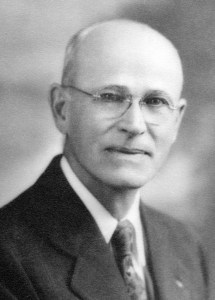
Professor Frederick C. Mayer was one of at least two faculty who taught the pharmacy short course.
Carl earned his registered assistant pharmacist license in January 1925.
Carl F. Hanneman taking his suits to the cleaner at Janesville, Wis., on April 5, 1926. Carl and his wife, Ruby V. Hanneman, were on their way to dinner. Carl was a druggist at McCue & Buss Drug Co. at the time.
Carl F. Hanneman served as an apprentice at the Sam Church drug store (shown at right) in Wisconsin Rapids. He was later hired as an assistant pharmacist after completing his education and working at three other pharmacies.
In 1926 and 1927, Carl F. Hanneman worked for the Staeben Drug Co. in Fond du Lac, Wisconsin.
The Mauston Drug Store, circa 1930. Image courtesy of the Juneau County Historical Society.
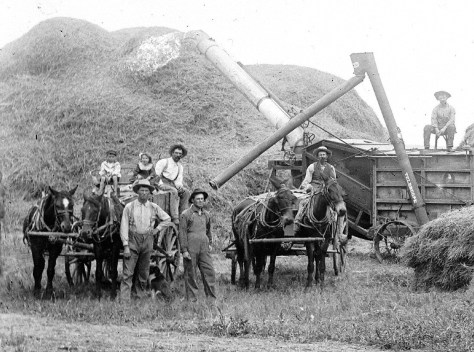
Nestled within the two dozen photo collections in the Library of Congress American Memory project is an image of grain threshing on a Hanneman farm in central Nebraska in the opening years of the 20th century.
Work on the grain threshing stopped just long enough for the farm laborers to pose for a photograph taken by Solomon D. Butcher. The caption reads: “Threshing crew on farm of E.F. Hanneman, Watertown, Buffalo County, Nebraska.” The year was 1903. The image was submitted to the Library of Congress by the Nebraska State Historical Society.
A cropped section of the Library of Congress photo. It might be Ernest Hanneman at center.
The glass-plate negative photo is interesting for several reasons. One is the hand-drawn accents, such as the smoke coming from the steam engine and the straw pouring from the chute of the thresher. In the age of Adobe Photoshop and digital photo manipulation, these details might cause a chuckle. The “smoke” hardly looks real. But these details are charming nonetheless, a look at how photographers created detail and motion in photographs of that era.
Another detail section of the Library of Congress image. Note the hand-drawn grain coming from the thresher chute.
The photo is not only of a Hanneman family farm, but it also has ties to Wisconsin. The “E.F. Hanneman” mentioned in the caption refers to Edward F. Hanneman, who lived much of his life in Buffalo County, Nebraska. Edward was born in Wisconsin in October 1880, presumably in Columbia County north of Madison. His family lived there for a time before moving west to Nebraska.
Ernest and Maria Hanneman photo from FindAGrave.com (submitted by Charmaine Becker).
Edward’s father, Ernest Ludwig Friedrich Hanneman, was born in Pomerania in 1843. He came to America in 1861. Ernest’s parents, Dietrich and Maria Hanneman, settled in Columbia County, but had both died by 1880. Dietrich and Maria are buried in Hillside Cemetery in Columbus, Wis. By the time of the 1900 U.S. Census, the Ernest Hanneman family had settled in Amanda Township in Buffalo County, Nebraska.
We’ve noted on these pages before that Columbia County, Wisconsin, was one of the Wisconsin Hanneman enclaves in the late 1800s. There were others in Dane, Fond du Lac, Dodge, Marathon, Wood, Portage, Racine, Winnebago and Outagamie counties. My Hanneman line settled in Portage and Wood counties, starting in 1861. There could be a connection between the Dietrich Hanneman line and my line (Matthias Hanneman, 1794-1879). More research is needed.
Many, if not most, of the Hannemans who settled the U.S. Midwest in the 1800s came from the Duchy of Pomerania, a long-ago Baltic state which is now part of Poland and Germany. My family line goes back to at least 1550 in Kreis (county) Regenwalde, Pomerania. Some of the Marathon County Hannemans moved west and settled in Lake County, South Dakota. Some Hannemans who emigrated to Wisconsin later settled in Minnesota, Iowa, South Dakota, North Dakota and Nebraska.
The American Memory project was one of the Library of Congress’ early efforts to digitize some 5 million images from its trove of priceless photographs. It invited submissions from libraries and historical societies around the nation. The Edward F. Hanneman farm photo was part of the collection “Prairie Settlement: Nebraska Photographs and Family Letters.”
We’ve noted elsewhere on this blog the photography skills of Carl F. Hanneman, but lately we’ve discovered that he and his brother Wilbert G. Hanneman had talents with freehand illustration. Working on the yearbook at Lincoln High School in Grand Rapids, Wis., the brothers served almost as dueling artists.
Judging by the line drawings each made in high school and in years after, both men had artistic abilities. Wilbert (1899-1987) first served as an artist and editor for the Ahdawagam yearbook. Ahdawagam is an Indian word that refers to the “two-sided rapids” along the Wisconsin River. The yearbook was first published in 1916. Wilbert graduated from Lincoln in 1918, and Carl followed in 1921. Both Carl (1901-1982) and Wilbert drew the illustrations for the yearbook’s section pages, such as Alumni and Sports, and the various class sections.
Wilbert drew a stunning likeness based on Carl’s high school graduation picture. The latest example of hand illustrations we could find is from 1945, showing a U.S. service member next to the saying, “Keep off the Lifeline.” The Navy serviceman in the illustration bears a striking resemblance to Carl. His son Donn G. Hanneman (1926-2014) served aboard the USS Hoggatt Bay during World War II.
As he prepared his six-seat Beechcraft C35 Bonanza airplane for takeoff, Richard E. Rickman asked airport manager John Stedman if he should take the most direct route, across expansive Lake Michigan to Detroit. Stedman cautioned against it, telling the pilot to fly east across Wisconsin to the lake, then hug the shore and make his way over to Michigan. This approach would presumably be safer, and provide great views for Rickman, his wife and four children.
It was just after the dinner hour on Labor Day 1960. The Rickman family packed themselves into the aircraft at Alexander Field in Wisconsin Rapids, ready to make the flight home to Detroit. The family had been to Drummond, Wis., to visit Helen Rickman’s parents, then flew to the Rapids to visit other relatives.
Richard, the son of a longtime shoe-store proprietor, grew up in Wisconsin Rapids. He was a descendant of pioneer resident Matthias Hanneman, who came to Wisconsin in 1866 from Pomerania. A factory representative for the Ogden Manufacturing Co., Rickman married the former Helen Anderson in December 1949 and they later moved to Michigan. Their first child, Richard Edward, was born in Lansing in May 1953. Robert John was born in Lansing in March 1955. Catherine Helen was born in Detroit in June 1956; and Patricia Ann joined the family in Detroit in September 1957.
The Richard E. Rickman family, shown in a 1960 newspaper photograph. Left to right are Richard, 7; Patricia, 3; Richard Sr., 35; Robert, 5; Helen, 34; and Catherine, 4.
The final day of the Rickmans’ visit was spent at the airfield. Rickman gave plane rides to his sister, Elvira Pluke, her husband Nolan and their five children. Rickman primarily used the single-engine aircraft for business trips. The family had recently flown to California in the plane, and then used it for the Labor Day weekend visit.
The wheels of the Beechcraft left the ground of Alexander Field at 6:30 p.m. The Rickman family flew along the western shore of Lake Michigan. They were treated to an incredible view of the Chicago skyline as the aircraft flew less an a mile offshore. The first sign of trouble came near 7:30 p.m., when Rickman issued distress calls that were heard by ships and aircraft as far north as Milwaukee. Rickman radioed Meigs Field in downtown Chicago and asked permission to make an emergency landing because the plane’s engine was cutting out.
Officials at Meigs Field gave Rickman permission for an emergency landing. He veered the aircraft out over the lake and circled to attempt a landing. Witnesses at nearby Oak Street Beach saw sparks trailing from the airplane. The 185-horsepower Continental engine caught fire and became enveloped in smoke. Suddenly, the 25-foot-long airplane turned straight down and plunged headlong into the lake. Hundreds of horrified beach-goers saw a blinding explosion as the plane hit the water.
The Wisconsin Rapids Daily Tribune carried the horrifying news on September 6, 1960.
William J. Cempleman saw the fiery crash from aboard the yacht Playtime. “The whole lake looked afire. Flames soared twenty-five to thirty feet,” Cempleman said. “When we got to the scene, a big circle of water was flaming. All we could see was an airplane wheel floating.” As the Playtime circled the crash site, Cempleman saw the charred body of little Catherine Rickman, 4, floating about 15 feet from the flames. Newspapers across America later published a dramatic Associated Press photograph of a police marine officer carrying the lifeless body of Catherine to shore. Resuscitation efforts failed.
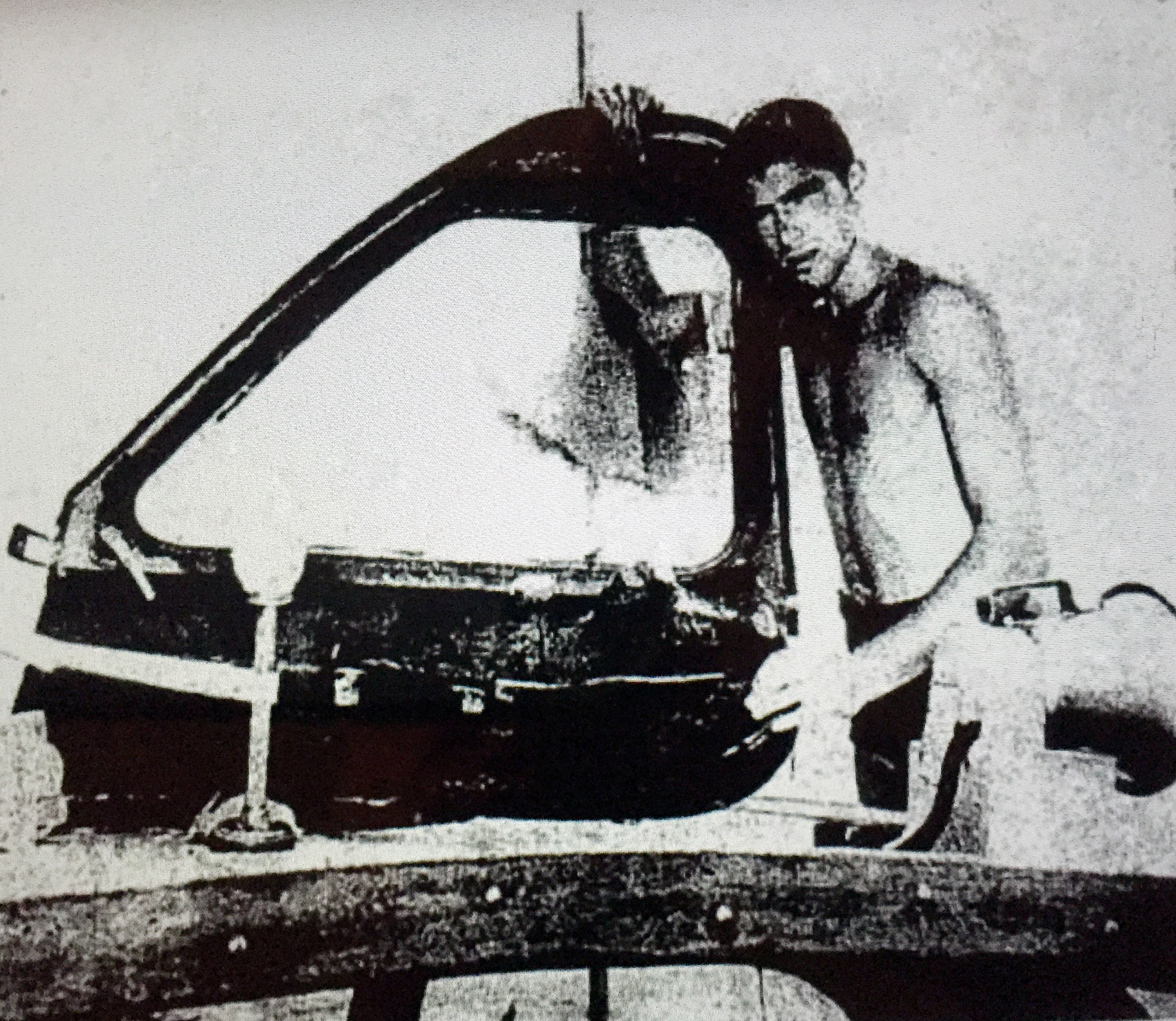
Lifeguard Bill Zimmerman with a door from the doomed Beechcraft C35 Bonanza piloted by Richard E. Rickman. (Chicago Tribune)
Police and Coast Guard vessels searched the waters off Oak Street Beach into the night. Divers used underwater lights to aid in the search, but found no trace of the aircraft or the other members of the Rickman family. Divers resume the search on September 6, but did not locate the wreckage or the other victims until September 7. Diver Jeff Daxe, a commercial pilot, was the first to reach the bodies. The Chicago Daily Tribune reported that one body was found 50 feet from the fuselage, while the other four were inside the wreckage. After the victims were recovered and taken to Burnham Harbor, it was discovered that Richard Rickman’s watch stopped at 7:38 p.m.
The impact sheared off both wings, but only one was found. The engine and propeller were found some distance from the rest of the wreckage in about 30 feet of water. Two weeks after the crash, the Civil Aeronautics Board issued a preliminary opinion that engine failure had caused the crash. In late October the CAB confirmed that opinion, but said the engine would be sent back to the manufacturer for testing. It’s unknown if that ever happened.
The six members of the Rickman family were memorialized at a funeral service on Saturday, September 10, 1960 at Immanuel Lutheran Church in Wisconsin Rapids. They were buried at Forest Hill Cemetery.
The six members of the Richard E. Rickman family are buried at Forest Hill Cemetery in Wisconsin Rapids. (Photo courtesy of Ben Chitek)
Richard Edwin Rickman was born on April 27, 1926, the youngest child of Edwin and Renata (Rathke) Rickman. Edwin John Rickman was the son of Christian Wilhelm Ludwig Theodor and Amelia Bertha Emilie Auguste (Hannemann) Rickman. Amelia’s father was August Friedrich Hanneman, the son of family patriarch Matthias Hannemann. Richard Rickman graduated from Lincoln High School in 1943 and enlisted in the U.S. Navy in July 1943. He served more than three years in the Navy during World War II and was discharged as an ensign in September 1960. He graduated from Northwestern University with a degree in business administration.
The change from summer to fall always reminds me of leaves. Lots and lots of leaves. With more than a dozen huge oak trees in our back yard in Sun Prairie, we always had mountains of leaves to romp through during fall. On windy days, the air in our back yard was filled with falling leaves. Before the days we had to help rake and bag the leaves, we dove into the pile with reckless abandon.
My own children had a similar experience in our first home on the north side of Racine. We had maple and apple trees that left plenty of seasonal detritus across the landscape. I have some precious video (see below) of our oldest, Stevie, running through the leaves at my childhood home in about the year 1995.
Fall always meant trips to the pumpkin farm, huddling around the fire pit on the back deck, picking fresh apples at local orchards, and of course getting the snowblower tuned up and ready for winter. It is a season of change, of color, of transitions. As the years pass, it also becomes a season of reflection and wistfulness.


 member, Dramatic Club, Mask and Wig Club (founding member), Gamma Sigma musical society, and a performer in the school operetta for three years. Ruby’s slogan certainly fits the woman we came to know: “Music hath charms and so has she.”
 Amelita Galli-Curci, the Italy-born coloratura soprano who was an acclaimed opera singer in the early 20th century.


 and future husband Carl are doing some kind of goofing around. The photo isn’t real clear, but it appears Carl is either playing some kind of stringed instrument or wielding a fishing pole or a sword. See what you think. Many of the photos in the collage seem to be related to the operetta.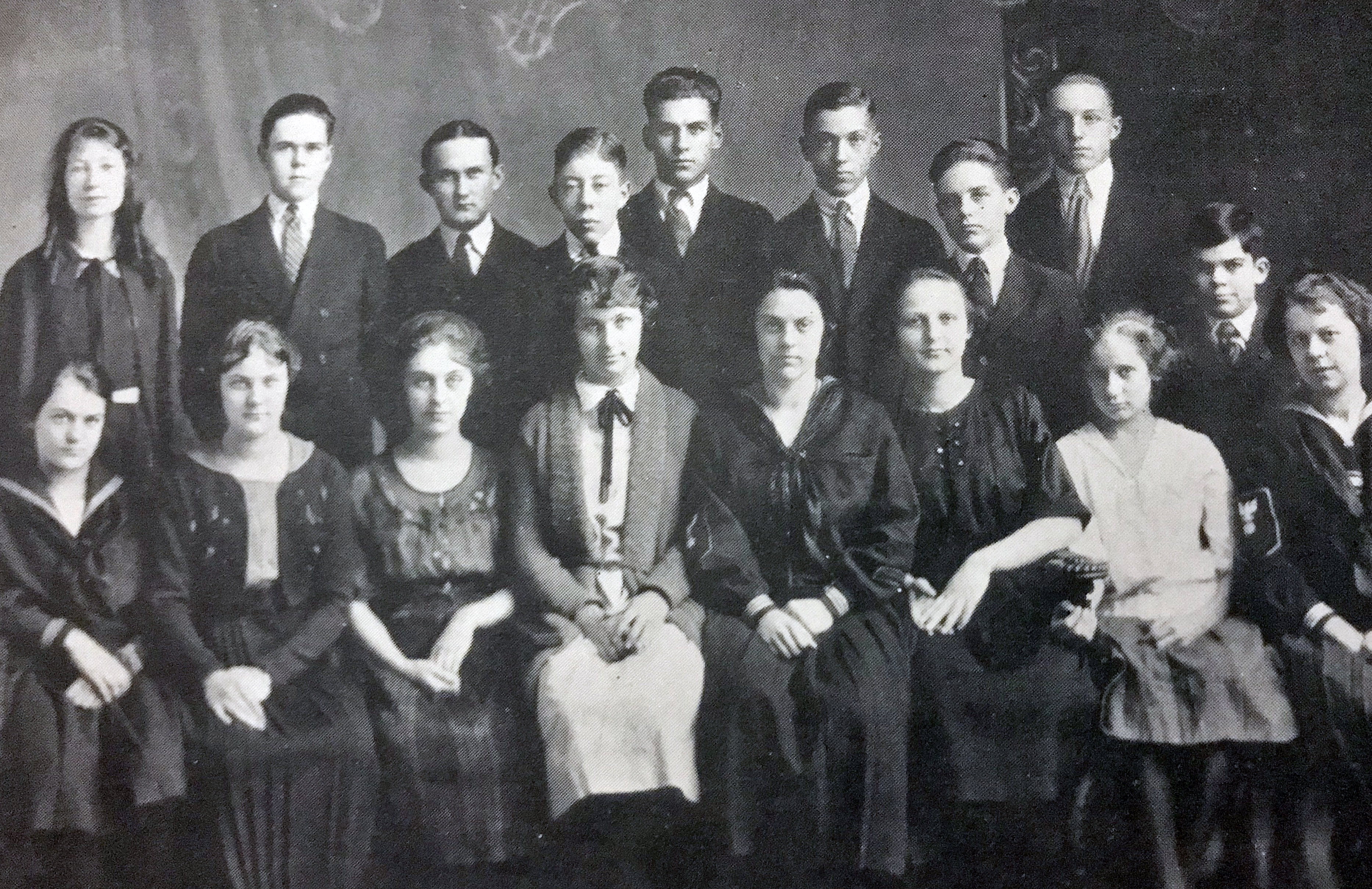


















 The Hanneman Archive