Leaving the family homeland to make a trans-Atlantic trip and emigrate to America would be an intimidating prospect under the best circumstances. When Michael Friedrich Ferdinand Hannemann brought his pregnant wife Mina and infant son Albert aboard the ship John Bertram in Hamburg, Germany in April 1863, he likely had no idea the horror they would face during 46 days at sea.
Fred Hannemann, as he was known to family and friends, was not the first in the family to leave Pomerania for Wisconsin. At least two sisters were already in central Wisconsin, so Fred may have heard stories from them about their travels to the American Midwest. But that likely would not have prepared him for the life-threatening conditions the 336 passengers faced en route to New York. One of the middle children of Matthias and Maria Caroline Hannemann of Meesow, Kreis Regenwalde, Pomerania, Fred was among at least eight children in the clan who would come to America between 1861 and 1882.
The John Bertram was a 1,060-ton clipper ship built in just 90 days in Boston in 1850 and placed into service in January 1851. At 180 feet long, the ship was initially employed to shuttle cargo from Boston around Cape Horn to San Francisco. It was later sold and pressed into service moving emigrants and cargo from Europe to America. Between 1860 and 1869, nearly 2,100 people were carried from Europe and elsewhere to America aboard the John Bertram.
About 10 days into the journey, the John Bertram encountered a violent gale that ripped at the sails and caused the ship to pitch up and down in the massive ocean swells. The winds raged at the ship for 48 hours, tossing drinking water casks overboard and destroying the storm sails. Conditions below deck were likely horrific, with the violent rocking causing seasickness and injuries. On deck, conditions were worse. Four crewmen were lost overboard and eight others were disabled. Once the storm passed, the ship was leaking badly, making it difficult to keep under sail. Mina Hanneman no doubt had to struggle to care for young Albert Hannemann, 1, in the chaos. The former Johanna Wilhelmine Florentine Glebke was nearly seven months pregnant during the voyage.
On May 4, still three weeks from docking in New York, the John Bertram hit dense fog and became trapped in a massive ice floe. For four days, the ship was surrounded by ice that scraped the planks of the hull and ripped at the cutwater. Four other ships in the area became snared in the ice. Eventually the clipper broke free, but had to steer 3 degrees to the east in order to escape the ice fields.
The trip took its toll. Eight infants died during the trip, although two babies were born. Along with the crewmen who were washed overboard, 12 people lost their lives. Thankfully, Fred, Mina and Albert Hannemann made it safely to Castle Garden in New York. Once they reached the Town of Grand Rapids in Wood County, Wis., they settled into farming. Eventually, seven children were born into the home, as yet another branch of the Hannemann family tree took root in central Wisconsin.
We only have two photographs that show Carl F. Hanneman at school, and both appear to be from the same year. In the first, Carl is the second pupil in the second row at a school in Grand Rapids, Wisconsin. Wearing a tie and cardigan sweater, Carl is one of a half-dozen or so boys in the class. The clock reads 11:59, so the class photo was scheduled just before the lunch break. It is a well-kept and neatly appointed classroom. The girl sitting in front of Carl could easily be mistaken for his future bride, Ruby V. Treutel, although she went to school in nearby Vesper.
Carl F. Hanneman is third from the left in the first row. The photo was taken circa 1910.
The second photo was taken outdoors at an entrance to the school. Carl is third from the left in the first row. At the time, the Hannemans lived on Baker Street in Grand Rapids, so the Howe School would have been the closest public school. But the building in the photo does not match exterior details of the Howe School, so it’s unclear where Carl spent his elementary school years.
For 80 years, there has been a member of the Hanneman family in the Knights of Columbus, the world’s largest Catholic fraternal and charitable organization. The line of service runs from Carl F. Hanneman (1901-1982), who joined in 1934, to his son David D. Hanneman (1933-2007), who joined in 1953, to his son Joe Hanneman, who joined the order in April 2007.
The three generations share other things in common with respect to the K of C, based in New Haven, Connecticut, with more than 14,000 local councils across America. All three have been members of the Fourth Degree, which focuses on patriotism and love of country. All three served in the Fourth Degree Color Corps and Honor Guard. The Honor Guard, wearing tuxedos, colored capes, ceremonial swords and plumed chapeaux, is a ceremonial presence at Masses, funeral wakes, Flag Day ceremonies and other events. Joe Hanneman served on the Honor Guard for the installation of Archbishop Jerome Listecki in Milwaukee. Carl joined the Fourth Degree in the late 1930s or early 1940s, judging by the group portrait of his exemplification class. David joined in 1973 and Joe joined in 2008.
Carl F. Hanneman (left section, second row, second from center aisle), joined the Fourth Degree of the Knights of Columbus in the late 1930s or early 1940s. Exact date of this photo is unknown.
All three also served as Grand Knight of their respective local K of C council. The Grand Knight is leader of the local council. Carl Hanneman was Grand Knight of Solomon Juneau Council 2770 in Mauston, Wisconsin in the late 1960s. David Hanneman was Grand Knight of Holy Family Council 4879 in Sun Prairie, Wisconsin, from 2001 to 2003. Joe Hanneman was Grand Knight of Msgr. Stanley B. Witkowiak Council 697 in Racine in 2010 and 2011.
Altar server Joe Hanneman with his father David D. Hanneman (at right) and Bill Dziadosz.
The Knights of Columbus is a fraternal and charitable organization founded in 1882 by Venerable Father Michael J. McGivney, whose cause for sainthood is being considered at the Vatican. The Knights operate under the principles of charity, unity, fraternity and patriotism. Knights raise money and volunteer for a wide range of causes, from pro-life programs such as crisis pregnancy centers, to programs providing free wheelchairs to the disabled, to grants to local programs that support the mentally retarded. The K of C and local councils have provided more than 500 ultrasound machines to crisis pregnancy centers.
David D. Hanneman was part of a large class that became Fourth Degree Sir Knights on April 14, 1973 in Madison.
Knights provide free coats to needy children each winter. They run a variety of athletic events, including Punt, Pass and Kick, and a basketball free-throw competition. Knights also support and promote vocations to the priesthood, sponsoring seminarians and providing other material support for those studying for the priesthood. In 2013, Knights provided a record amount of charity, with over $170 million raised and 70.5 million hours of voluntary service provided. In 2014, the K of C provided more than $2 million to help persecuted Christians from Iraq and other Mideast countries being targeted by ISIS and other terrorist organizations.
Boy Scouts participate in a flag retirement ceremony run by Assembly 1207, the Fourth Degree Knights in Racine. Speaking at the podium is Deputy Grand Knight Joe Hanneman.
The Fourth Degree of the Knights is especially dedicated to patriotism and the idea that love of God and love of country go hand in hand. The Fourth Degree was founded in 1900 to combat the prejudiced notion that Catholics were not loyal Americans and could not be trusted in public office or with civic responsibility. The Fourth Degree provides free flags for schools and nonprofit organizations, supports veterans’ organizations, provides material needs to local veterans’ hospitals, and sends faith materials and other assistance to members of the military serving overseas.
Sir Knight Joe Hanneman (left) in an honor guard at St. Rita Catholic Church in Racine.
Famous Knights include Venerable Archbishop Fulton J. Sheen, one of the Catholic Church’s all-time great authors and communicators; former Green Bay Packers coaching legend Vince Lombardi; baseball’s Sultan of Swat, Babe Ruth; Supreme Court Justice Samuel Alito; Ray Flynn, former U.S. ambassador to the Vatican; Cardinal Francis George, former archbishop of Chicago; Saint Rafael Guizar Valencia; and six martyrs of the Cristero War in Mexico: Father Luis Bátis Sáinz, Father José María Robles Hurtado, Father Mateo Correa Magallanes, Father Miguel de la Mora, Father Rodrigo Aguilar Alemán and Father Pedro de Jesús Maldonado Lucero. The K of C operates in the United States, Canada, Mexico, the Philippines, Poland, the Dominican Republic, Puerto Rico, Panama, the Bahamas, the Virgin Islands, Cuba, Guatemala, Guam and Saipan.
A number of other members of the extended Hanneman family have been members of the Knights of Columbus: Earl J. Mulqueen Sr. (my grandfather), Earl J. Mulqueen Jr.,Donn G. Hanneman, longtime Wisconsin Rapids building inspector Arthur J. Hanneman, and former state representative Arthur Treutel.
— This post has been updated with a date correction and two new photographs.
Carl F. and Ruby V. Hanneman (at left) on the day Carl was made a Sir Knight in the Fourth Degree of the Knights of Columbus.
David D. Hanneman (third from left) on the day in April 1973 he became a Fourth Degree Sir Knight.
David D. Hanneman (left of center, dark hair), stands just behind his father, Carl, at the reception following the Knights of Columbus Fourth Degree exemplification.
Carl F. Hanneman with his son David (two at left) at the Hanneman home in Sun Prairie before David became a Sir Knight on April 14, 1973.
Carl F. Hanneman handmade the K of C logo for Solomon Juneau Council 2770 in Mauston, Wis.
Carl F. Hanneman was a delegate to the 1937 Wisconsin convention of the Knights of Columbus.
Carl F. Hanneman was a delegate to the 1937 Wisconsin convention of the Knights of Columbus.
Altar server Joe Hanneman with his father David D. Hanneman (at right) and Bill Dziadosz.
The Knights of Columbus Honor Guard at the 2007 funeral of David. D. Hanneman.
The Knights of Columbus sent scores of volunteers to Europe in World War I to operate recreation centers for soldiers and provide comfort at the front.
The Knights of Columbus Glee Club in Racine, Wis., provided entertainment around the city in the 1920s.
The K of C sponsored a “Keep Christ in Christmas” billboard on Interstate 94 near Racine.
K of C councils often hold Landing Day parties to celebrate Catholic explorer Christopher Columbus’ discover of the New World in 1492.
Father Mark Jones blesses the new home of the K of C in Racine, Wis., while Grand Knight Joe Hanneman (at right) looks on.
Wearing regalia and plumed chapeaux, the Knights of Columbus Fourth Degree honor guards often serve at funerals and other Masses.
K of C councils hold “Life Savers for Life” events to raise money for pro-life efforts such as crisis pregnancy centers.
Boy Scouts participate in a flag retirement ceremony run by the Knights in Racine. Speaking at the podium is Deputy Grand Knight Joe Hanneman.
Knights in Racine, Wisconsin honor members of the Catholic church who provide exemplary service with the Pro Deo Et Ecclesia award. The medal was designed by Joe Hanneman.
A young girl tries on a new coat provided by the Knights of Columbus at the HALO homeless shelter in Racine, Wis.
A young boy tries on a new coat provided by the Knights of Columbus at the HALO homeless shelter in Racine, Wis.
Knights and other Christian volunteers pray together after setting up a Nativity scene on Monument Square in Racine, Wis.
Every year the K of C helps set up a Nativity scene on Monument Square in Racine, Wis.
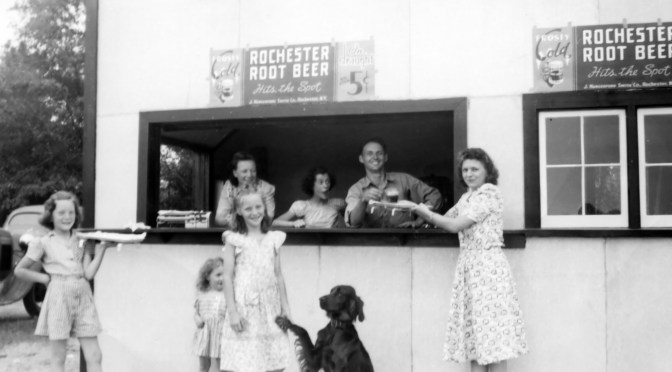
Marvin and Mabel Treutel operated a roadside root beer stand near their home on Wilhorn Road in Nekoosa, Wisconsin. Aside from 5-cent Rochester root beers, they served the “Best Roast Beef BBQ.” Pictured behind the counter in this late-1940s photo are Mabel Treutel (left), niece Lavonne Hanneman (center) and Marvin Treutel (right). Out front are daughters Bonnie Treutel (left), and Patricia Treutel (center, holding dog). The woman at right and the little girl at center are unidentified.
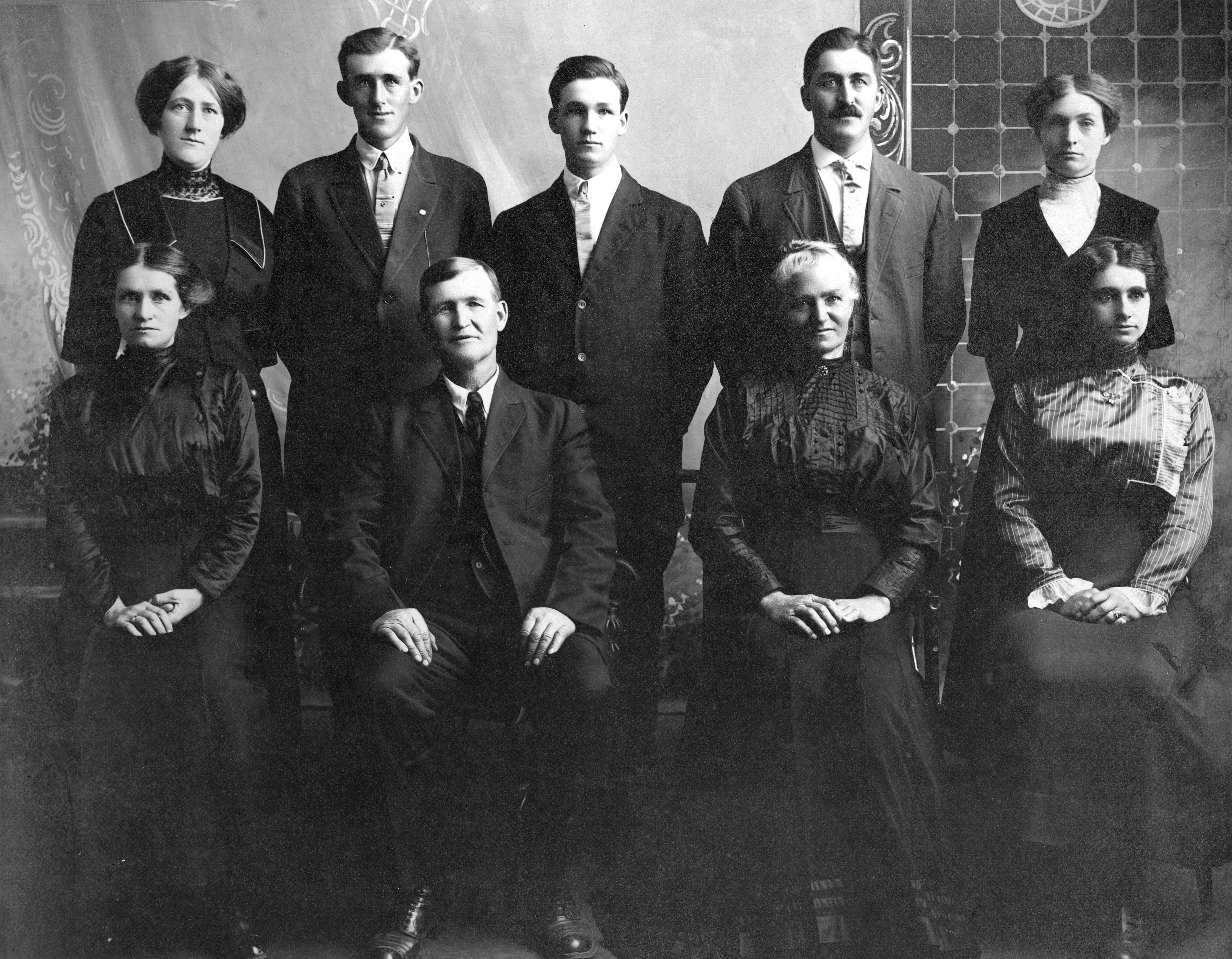
It is the only known photograph showing six of the seven children of Christian and Amanda Hanneman, pioneers of Portage and Wood counties in Wisconsin. The undated photo was probably taken around 1915 at a family event. Left to right are:
William Friedrich Johann Hanneman (1856-1939)
Bertha Auguste Ernestine (Hanneman) Bartelt (1860-1945)
Albert Friedrich O. Hanneman (1863-1932)
Herman Charles Hanneman (1864-1945)
Carl Friedrich Christian Hanneman (“Chas,” 1866-1932)
The sibling not pictured is August Friedrich Ferdinand Hanneman (1858-1902).
Along with their parents, this group came to America in late November 1882 aboard the SS Katie. They were the last of the Matthias Hannemann family to come to America from the Baltic Duchy of Pomerania (now part of Poland and Germany). The Hannemann clan (the name was eventually shortened to Hanneman) settled in and around the hamlet of Kellner in central Wisconsin.
Family Line: Matthias Hannemann >> Carl Frederick Christian Hannemann >> Carl Henry Frank Hanneman >> David D., Donn and Lavonne Hanneman.
He came to the United States at age 19 and lived the life of an American frontiersman: shuttling cargo between U.S. outposts in the West and ferrying people and goods across the Missouri River. For all of his adventurous living, William Johann Heinrich Gaulke retained one lasting memory that his family in Wisconsin still talks about: being a friend of a very young William Frederick ‘Buffalo Bill’ Cody.
William Gaulke (standing) with his arm around William F. Cody, who later went on to international fame as “Buffalo Bill.” (Photo courtesy of Sue Alft)
Gaulke met the famed U.S. Army scout and buffalo hunter while Gaulke was working and exploring the frontier lands in Nebraska and the Dakotas in the 1870s. A photograph in the Gaulke family album shows a twenty-something Gaulke standing with his arm around a seated William Cody.
Gaulke’s frontier experience grew out of tragedy he experienced in his native Germany. Born on October 1, 1848, Gaulke lost his father, John, before he turned six months old. When he was 11, Gaulke became an orphan at the death of his mother Fredericka. He emigrated to America in 1867 and landed in Milwaukee. After a short stint as a farmhand, Gaulke landed a job aboard a Great Lakes steamer, where he learned to speak English. After another stint working on farms in Illinois, Gaulke went west.
After emigrating to America in 1867, William Gaulke spent a number of years exploring the wild frontiers. (Photo courtesy of Sue Alft)
Gaulke experienced the wilds of the frontier lands as a teamster for the U.S. government. He guided a six-mule team hauling goods between U.S. Army posts. He was based at Fort Buford in the Dakota Territory. After tiring of that job, he built a skiff and drifted down the Missouri River to what is now Bismarck, North Dakota. Along with a group of companions, he established the town of Carlington. There, Gaulke operated a ferry moving people, goods and horses across the Missouri River near Fort McKeen (later called Fort Abraham Lincoln). Fort Lincoln was the base of Gen. George Armstrong Custer.
Right alongside the Mighty Missouri River, Gaulke built himself a shanty, where he lived and operated his ferry business. He built an outdoor fireplace that was used for cooking and warmth. It was also a hiding place for the $2,200 Gaulke had saved from his business ventures. Gaulke’s shanty was a frequent target of would-be thieves, but none of them ever thought to look under the fireplace for the buried money.
In 1872, Gaulke returned to Wisconsin, securing work at Grand Rapids in Wood County. In July 1876, he married Augusta Henriette Charlotte Kruger. Her mother, Friedericke Kruger, was the daughter of Matthias Hannemann (1794-1879). A short time later, the Gaulkes bought their first land in the Town of Grant in Portage County, very near where the Hannemann family established its first homes in the early 1860s. Gaulke cleared the land and established a successful farm. He also helped build many of the farm houses and barns in the area.
William Gaulke and Augusta (Kruger) Gaulke and family. Rear, left to right: Ella (Wagner), William Jr., John, Henry, Minnie (Panter). Front, left to right: Mary (Eberhardt), William Gaulke Sr., Augusta (Kruger) Gaulke, Laura (Turbin). (Photo courtesy of Sue Alft)
Gaulke also became deeply involved in civic work, serving as school district clerk, drainage district commisioner and chairman of the Town of Grant. He and Augusta had eight children, born between 1878 and 1897. Augusta died in 1914, four years before her mother. William died on October 25, 1928 after coming down with pneumonia.
William F. “Buffalo Bill” Cody in a late-life portrait (Library of Congress Photo)
Confirmation of the friendship between Gaulke and Buffalo Bill came in the early 1900s, when Cody brought his Wild West show to Grand Rapids, Wisconsin. Gaulke brought his youngest son, John, to the grounds near Lincoln High School. They watched the white-suited Cody ride about the arena on his white horse. Gaulke led his boy up to Cody, introduced himself and asked the showman if he remembered him from their time out west decades earlier. He did. “Why sure, Bill and they had quite a talk,” John Gaulke later wrote. “Finally Buffalo Bill reached into his pocket and gave my Dad a handful of tickets, who the whole family saw the show for nothing.”
A popular poster showing Buffalo Bill Cody superimposed on an image of a buffalo. (Library of Congress Photo)
William Cody was a first-rate Indian scout and buffalo hunter whose life was romanticized in dime novels written by author Ned Buntline. The pair collaborated to create a show called “The Scouts of the Plains.” In 1883, Cody developed a live show spectacular called Buffalo Bill’s Wild West. The Library of Congress says Cody “was a major contributor in the creation of the myth of the American West, as seen in Hollywood movies and television.”
Her look of delight really tells the whole story. Little Jane Patricia Hanneman, beholding a cake on her third birthday, shows a priceless expression. She celebrated her birthday in October 1958 with her paternal grandparents, Carl F. Hanneman (1901-1982) and Ruby V. Hanneman (1904-1977) at their home in Mauston, Wisconsin. In the background of the photo is her aunt and my Mom, Mary K. Hanneman. She could not have known it at the time, but Jane’s birthday falls on the same date as the 1819 wedding of her great-great-great grandparents, Matthias Hannemann and Caroline (Kuehl) Hannemann. The couple were married at Meesow, Regenwalde, Pomerania.
My Dad, David D. Hanneman, also shot some 8mm film at the celebration, which can be viewed below:
As kids growing up in Sun Prairie, any time we ventured into the back room of our basement we were likely to hear a voice from upstairs shout, “Don’t you go near those windows!” Of course we knew what that meant: the antique stained-glass behemoths covered in blankets in the farthest reaches of the basement, next to the furnace. I never gave a great deal of thought to them, until one day in 2006 when my father was dying of cancer.
The St. Mary’s Hospital chapel as it looked in the 1950s.
Founded in 1912, St. Mary’s Hospital in Madison always had a chapel as part of its facilities. In 1926, a new, ornate chapel was built as part of an expansion of St. Mary’s. The chapel had 10 window frames, each with two beautiful arched stained-glass windows that rose 20 feet from eye level to midway up the wall. In between each were two Stations of the Cross. The windows remained part of the chapel until 1973, when that section of the building was razed to make way for a new hospital wing on Mills Street. My Dad obtained two of the windows, a total of four panels, carrying them home in blankets to rest for more than three decades.
The windows are prominently visible in this newswire photo from 1946, from a Mass to celebrate presentation of a papal medal to Leo T. Crowley of Madison.
When Dad was being treated for lung cancer at St. Mary’s in the fall of 2006, he got an inspiration to give those windows back to St. Mary’s. He asked for my help in doing some research, but he was so impatient he wheeled himself down to the administrative offices to talk to someone about it. That someone, vice president Barbara K. Miller, was enthralled with the idea, but it was her last day on the job before retiring. She promised to get the ball rolling on the donation. “I want these windows to come home to St. Mary’s,” he told her.
The chapel window sections as they looked in 2007 in the Hanneman basement.
Dad was a little worried that his donation wouldn’t get done. The idea occupied his mind more than anything else in November 2006. He knew his time with us was short. He told the story and his idea to his physician, Dr. Gregory Motl. Dad made Dr. Motl promise that if he didn’t survive the cancer, the donation would be completed. Motl grasped Dad’s hand and said reassuringly, “I will Dave. I will.”
To say the hospital embraced Dad’s idea would be an understatement. His timing was perfect, since St. Mary’s was planning a $182 million expansion that would add a new east wing with operating rooms, a cardiac center, outpatient offices, patient rooms and more. St. Mary’s was looking for ways to tie the new facility to the hospital’s heritage. The architects designed special spaces for each of the four window sections. St. Mary’s had a new internal champion for the windows, Steve Sparks, public relations director.
After months of planning, St. Mary’s was finally ready to take possession of the windows. On March 22, 2007, Sparks and workmen came to Sun Prairie to transport the windows. He snapped some photos of Mom and Dad with a window section. Dad looked pale and drawn, but I know he appreciated the milestone that day represented. “It was humbling for me,” Sparks recounted later. “This gift demonstrated exceptional courage and generosity. It is an experience I won’t forget.”
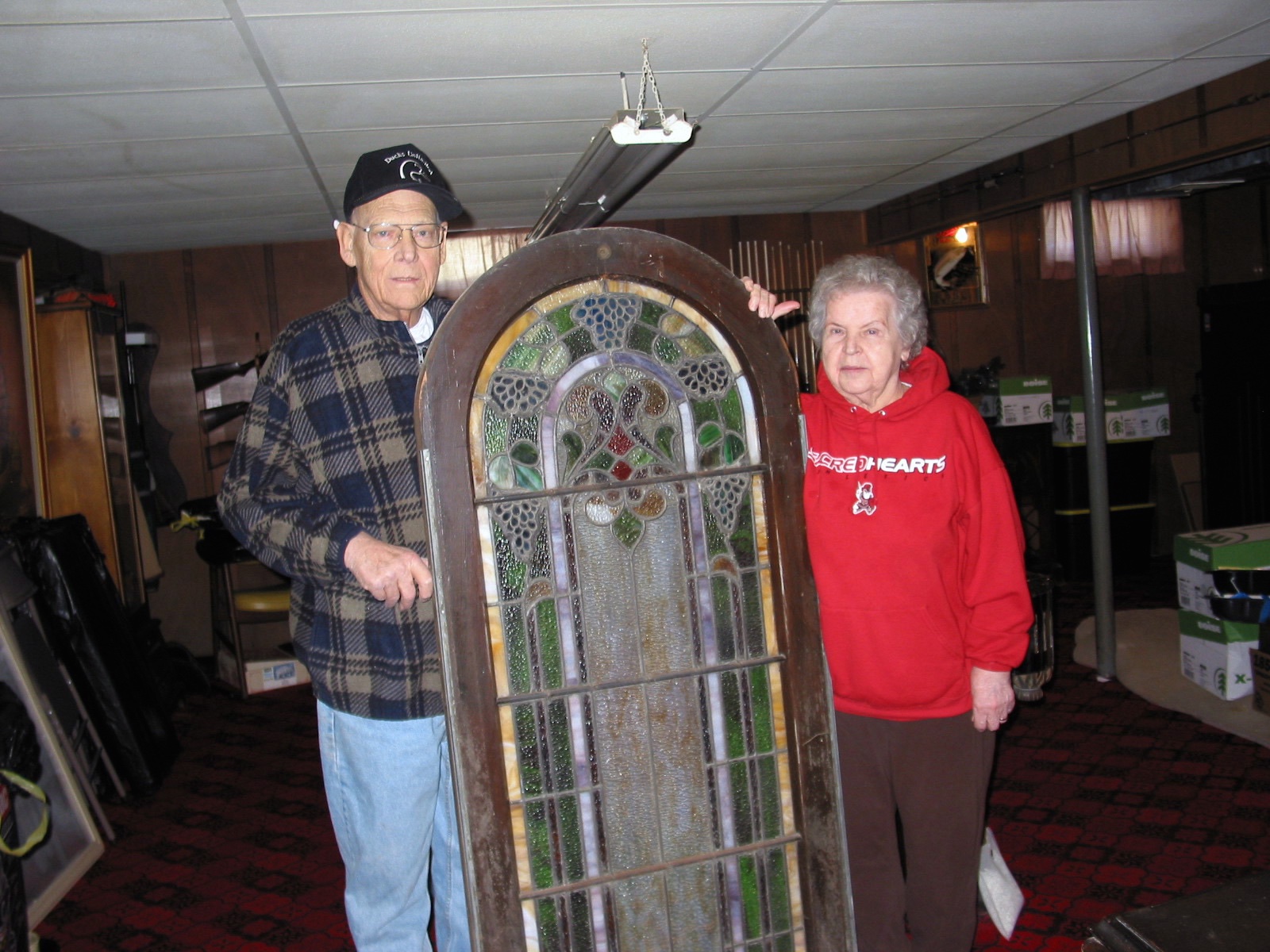
David and Mary Hanneman pose with one window section on March 22, 2007.
Tears were shed that afternoon as the windows were lovingly carried outside. It was the first daylight to penetrate the stained glass in more than three decades. For Dad, it was the accomplishment of a mission of giving. His part was finished; now St. Mary’s would take over. Not two weeks later, Dad was admitted to St. Mary’s and then discharged to HospiceCare Inc., where he died on April 14, 2007.
In early December 2007, Mom and I were invited to the dedication day at the new St. Mary’s east wing. We attended a luncheon and heard very kind words about Dad from Dr. Frank Byrne, president of St. Mary’s Hospital. They were similar to what Dr. Byrne wrote right after Dad’s death. “It is clear from Dave’s accomplishments that dedication to community was always a part of his priorities,” Byrne wrote, “and we will all benefit from that dedication for years to come. At this sad time, we hope it will be a reminder that though life may seem short, the contributions made by one individual have a significant impact in building a future for us all.”
The window section placed in the atrium of the new east wing at St. Mary’s Hospital.
When we walked into the atrium and first saw one of the window sections, it was enough to bring tears. There it was, set into the wall and brilliantly backlit in a way that brought out the green, red and amber hues of the glass. It was, as designed by the architects, a welcoming beacon for everyone visiting St. Mary’s. Mom posed next to the window, and even did an impromptu interview with Madison’s Catholic newspaper, The Catholic Herald. The three other window sections were placed on different floors of the east wing. One is in a waiting room. The others are in prominent spots.
The story of these chapel windows gives testimony that beauty can emerge from the depths of the darkest tragedies. Dad kept the windows safe for 35 years, and he got them safely home to St. Mary’s just weeks before he, too, made it home.
This post has been updated with additional window photos.
The windows are prominently visible in this newswire photo from 1946, from a Mass to celebrate presentation of a papal medal to Leo T. Crowley of Madison.
The St. Mary’s Hospital chapel as it looked in the 1950s.
This 1973 news clipping shows the exterior of the chapel building just prior to demolition.
The chapel window sections as they looked in 2007 in the Hanneman basement.
David and Mary Hanneman with a section of stained glass window on the day the windows were picked up for use at St. Mary’s Hospital.
The Wisconsin State Journal ran a front-page story on St. Mary’s in late 2007 and featured the stained glass windows.
The main window section in the St. Mary’s Hospital atrium as it looked at the dedication in December 2007.
A sign next to the window section in the St. Mary’s atrium told the story of the chapel windows.
Mary K. Hanneman next to one of the window sections she and the late David D. Hanneman donated to St. Mary’s Hospital.
St. Mary’s integrated many items from its history in the new east wing, including the original 1911 hospital cornerstone.
Mary K. Hanneman next to one of the window sections she and the late David D. Hanneman donated to St. Mary’s Hospital.
The beautiful windows were for decades a part of the chapel at St. Mary’s Hospital in Madison.
The window section placed in the atrium of the new east wing at St. Mary’s Hospital in Madison.
Mary Hanneman is interviewed by Kat Wagner of The Catholic Herald in December 2007.
A portion of the stained glass detail is used in a history display in the old lobby of St. Mary’s Hospital in Madison, Wis.
The second window crown section is on display in a third floor waiting room in the southwest wing of St. Mary’s Hospital in Madison, Wis.
When David D. Hanneman was elected mayor of the city of Sun Prairie, Wisconsin in April 2003, it continued a Hanneman family tradition that stretches back more than 400 years to the county Regenwalde in the Baltic Duchy of Pomerania. Hanneman’s election as mayor on April 1, 2003 capped his nearly 40-year public service career — and put him in good family company.
The Hanneman family from Kellner, Wisconsin — from which David Hanneman descends — traces its roots to Pomerania, a picturesque land of Germanic peoples that dates to the 1300s. His earliest known ancestor, Matthias Hannemann, was from the village of Zeitlitz in the kreis, or county, of Regenwalde. Regenwalde means “woods of the Rega River,” referring to the picturesque waterway that ambles 100 miles through the county and empties into the Baltic Sea. This area has long been known for agriculture, fishing and forests, and it bears strong geomorphic similarities to the state of Wisconsin. The village of Zeitlitz covered about 2,200 acres and had approximately 100 households.
Mayor Dave Hanneman cuts the ribbon at opening of the Sun Prairie fire station. (Sun Prairie Star Photo)
Records trace the Hannemann (the original spelling had two ‘n’s at the end) family back at least to 1582 in Zeitlitz. The Hannemanns made up one of the predominant families in Zeitlitz, based on the number of entries found in the Lutheran church register. Many church records were destroyed in a fire in Stramehl in 1720, but the register from 1582 survived. At that time, there were a number of Hannemann families in Zeitlitz, and they owned some of the larger farms in the village. One of these men, likely the eldest brother, held the title of schulze, or mayor of Zeitlitz. Being the schulze was unlike the elected political position of mayor found in modern-day American communities. It was an inherited job, and the duties centered on making sure work was performed equitably in the village, and that the taxes of grain, goods or money were collected for the estate owner. The term schulze can have various related meanings, including “village headman,” mayor or even constable.
Mayor Hanneman speaks at a veterans’ event. (Sun Prairie Star Photo)
As farmers, the Hannemanns were also involved in providing financial support for the local minister and the church. Each tenant farmer paid his taxes in measurements of grain. The unnamed mayor Hannemann and Peter Hannemann were each responsible for taxes on two Hufen in Zeitlitz in the year 1582. A Hufe was the amount of land needed to sustain a family. There could have been more Hannemann families living on those four Hufen, but the church records only listed the major land tenants who paid taxes.
In the nearby village of Groß Raddow (about 6 miles from Zeitlitz), the Hannemann family had a similar history. A tax list from 1666 includes the names of Tews Hannemann (the schulze, or village mayor), Heinrich Hannemann, Chim Hannemann and Peter Hannemann. For at least several generations, it appears the Hannemann family inherited and passed on the office of mayor in Groß Raddow. In 1717, Hans Hannemann was the mayor, so we believe Hans is a descendant of Tews Hannemann.
Mayor Dave Hanneman cuts the cake at the 5th birthday of the new Sun Prairie Public Library.
The Matthias Hannemann family began emigrating to Wisconsin in 1861. Matthias left his home in 1866 and came to Wisconsin through Quebec. The family settled in and around Kellner, a tiny hamlet that straddles the Wood-Portage county line southeast of Wisconsin Rapids. At one time, the Hannemanns owned and farmed more than 1,000 acres in Wood and Portage counties. David’s great-grandfather, Christian Hanneman (Matthias’ son) was the last of this clan to come to America in November 1882.
Dave Hanneman (1933-2007) was first elected to public office on April 2, 1968 when he became Fourth Ward alderman in Sun Prairie. He served only one term as alderman, but stayed active in city politics, pushing the city to upgrade its sewer system to prevent backups into residential homes. He again ran successfully for alderman in 1988 and stayed on the Sun Prairie City Council until 1996, when he was elected to the Dane County Board of Supervisors. He held that post until being elected Sun Prairie mayor in 2003.
The Sun Prairie Star Countryman carried news of Hanneman’s election as Fourth Ward alderman in April 1968.
“Dave was involved in the growth of Sun Prairie and believed in progress for the community. He worked and helped champion the Highway 151/County Highway C project, which included working with the state Department of Transportation,” said Bill Clausius, who served on the city council and county board with Hanneman. “Dave was involved with the West Side Plan, which brought the Sun Prairie Community together to envision the future of the West Side. Dave supported and worked to begin the West Side Community Service Building. This facility includes a west side location for police, fire and EMS. His vision was to provide essential services to Sun Prairie residents and to shorten response times in case of an emergency.”
Clausius continued: “In 2003, Sun Prairie won the ‘Champions of Industry’ Award of Excellence as one of the best managed small cities in America. Dave personally raised $32,000 in donations from area businesses to fund production of a video featuring Sun Prairie, and highlighting Sun Prairie’s achievements.”
Her reign may have been brief, but for one day in 1922, Ruby V. Treutel was front-page news as the most popular single woman in Wood County, Wisconsin. To help celebrate dedication of a new bridge across the Wisconsin River, the community organized a popularity contest to find the Queen of the Bridge.
The Queen of the Bridge contest invited the nomination of single women of Wood County. The contest winner would preside at the dedication of what came to be called the Grand Avenue Bridge, linking the east and west sides of Wisconsin Rapids over the Wisconsin River.
Queen of the Bridge wasn’t really a beauty contest, but Ruby Treutel would have fared well on that count alone.
Miss Ruby Treutel of Vesper was among the early nominees for the Bridge Queen, and she jumped to a lead after the first weekend of balloting in September 1922. The front-page headline in the Wisconsin Rapids Daily Tribuneon Sept. 25, 1922, proclaimed: Ruby Treutel and Mary Herron in Spirited Contest. “A spirited race between Miss Ruby Treutel of Vesper and Miss Mary Herron of this city developed as a result of the week end balloting in the Bridge Queen popularity contest,” the article read, “with Miss Treutel leading by slightly over 200 votes of the 43,000 cast for these two candidates.”
Ruby Treutel was in the thick of it at the beginning, but eventually fell behind in voting.
Ruby’s 22,570 vote total was more than twice that of the third-place contestant and far ahead of the 10 votes for Miss Pearl Brewster. But, like fame and money, the lead would not last as the contest balloting steamed along for two weeks at such a rapid pace the contest was ended early. In the first week, more than 1.3 million ballots were cast. The Bridge Committee had trouble keeping up with the tallying, which would exceed 20 million votes by the end of the contest.
By September 28, 1922, Ruby’s vote total had more than doubled, to 45,240. But this now paled in comparison to contest leaders Eva Manka and Mary Herron, who had more than 500,000 votes between them. On Sept. 30, Herron’s vote total ballooned to 989,000, far exceeding Manka’s new total of 640,000. Ruby was in a respectable fifth place with 171,000 votes. By the time the committee decided to cut voting short on Sept. 30, balloting was at a fever pitch. The final vote totals were:
Mary Herron, 5,336,570 votes
Mildred Bossert, 3,645,840 votes
Eva Manka, 1,763,360 votes
Manon Matthews, 1,016,510 votes
Margaret Galles, 711,550 votes
Alice Damon, 618,550 votes
Ruby Treutel, 608,050 votes
Maurine Dutcher, 492,410 votes
Pearl Possley, 486,600 votes
Ruth McCarthy, 460,510 votes
Miss Herron was crowned Queen of the Bridge. On Oct. 18, 1922, she attended the huge dedication ceremony and officially christened the span the “Grand Avenue Bridge.” It was indeed a grand event, with thousands of people, a parade and even aerial acrobatics performed by the Federated Flyers stunt team, which did loops in the sky with its planes, and thrilled the crowd with wing walking.
This 1940 postcard shows the Grand Avenue Bridge in Wisconsin Rapids, Wis.
The Grand Avenue Bridge has long been an important part of Wood County’s infrastructure. The 1922 version replaced an old wood and steel span. Bridges across the Wisconsin River date to the 1870s. In earlier times, bridge was an important link between the former towns of Grand Rapids and Centralia,which later joined to form the city of Wisconsin Rapids.











 The Hanneman Archive