This photograph from my Grandmother Ruby V. Hanneman shows the interior of the State Bank of Vesper in the village of Vesper, Wisconsin, circa 1912. Scrawled on the back of the photo in pencil is the following notation: “First Vesper Bank. Jones Cashier, Martin President, Oliver V-P.”
George E. Martin was president of the State Bank of Vesper, chartered in December 1911 with capitalization of $10,000. Owen Oliver was vice president and Burton Jones was cashier. It is not clear if these are the three gentlemen shown in the photo. The bank made slow progress at first. A new management team was put in place in 1913, with Vesper hardware merchant George H. Horn serving as president, farmer Arthur P. Bean vice president and Fred Ellsworth cashier. According to the 1923 History of Wood County, Ellsworth sold his share in 1919 to three investors from Wisconsin Rapids. The bank subsequently grew from $55,000 in deposits to $140,000 and was considered one of the strongest country banks in the area.
Grandma Ruby (maiden name Treutel) grew up in Vesper. Her father Walter Treutel was a longtime postal carrier. Several uncles operated a butcher shop, general store and blacksmith/carpentry shop in the village. Her aunt Emma was postmistress for nearly a decade.
There are several great things about this image of my Dad and his two siblings, taken in 1956 at Nekoosa, Wisconsin. The colors from the Kodachrome slide film are vivid, from the blue sky to the slicked-back black hair. The clothes are natty and the hairstyles are so 1950s. Right to left are Donn Gene Hanneman (1926-2014), Lavonne (Hanneman) Wellman (1937-1986), and my Dad, David D. Hanneman (1933-2014).
The photo was taken at the home of the trio’s uncle and aunt, Marvin and Mabel Treutel. The occasion was a Treutel family reunion. Their mother and my grandmother, Ruby V. Hanneman (1904-1977), was a Treutel before marrying Grandpa Carl F. Hanneman (1901-1922). It’s sad to think all three of them are gone, but I find comfort in the hope they are together in Heaven.
United States Marine Cpl. Almeron A. Freeman was scheduled to finish his three-year military service in just a matter of months. After nearly 1½ years in Korea with the 1st Marine Division, Freeman was headed for California aboard a U.S. Navy transport in March 1955. He never made it home. The Douglas R6D airplane slammed into a mountain peak on the Hawaiian island of Oahu. All 66 aboard were killed.
The Bakersfield, California paper from March 22, 1955.
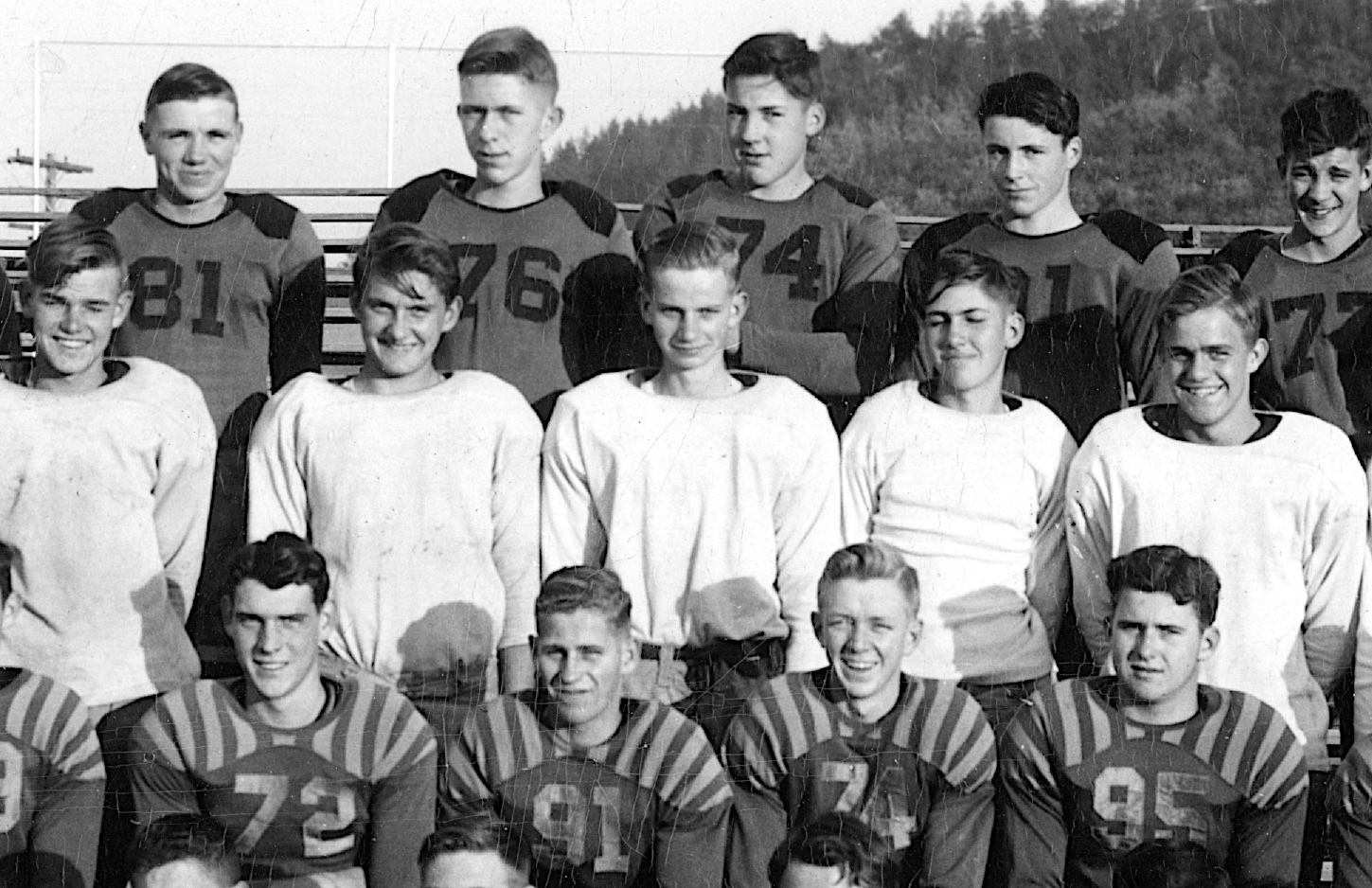
My father, David D. Hanneman, played football with Freeman at Mauston High School. Although Freeman was a year behind Dad in school, he was the same age. Freeman played left guard and wore No. 64 during the 1950 season. Dad played left tackle and wore No. 66. They were both muscular and athletic. Freeman’s death left a deep impression on Dad. In 2006, when planning the Mauston High School Class of 1951’s 55th reunion, Dad made sure Freeman’s photo was included in the program.
U.S. Marine Cpl. Almeron A. Freeman.
Freeman enlisted in the Marine Corps on August 27, 1952, directly after his graduation from Mauston High School. He was an infantry rifleman with the First Marine Division. He landed for duty in Korea just four months after an armistice ended Korean War combat and began a tense “peace” along the 38th Parallel.
At the end of his tour, he flew from South Korea to Tokyo, then to Hickam Field on the island of Oahu in the Hawaiian Islands. Just after 6 p.m. on March 21, 1955, Freeman was onboard a U.S. Navy R6D transport that left Hickam for Travis Air Force Base in California. Some 3½ hours into the flight, the plane developed radio problems and turned back for Oahu. Just after 2 a.m. on March 22, the plane was seen roaring low over the Navy’s Lualualei ammunition depot. Marine Pfc. Joseph T. Price, on guard duty at Lualualei, said the pilot turned on the landing lights and discovered the plane was headed straight into the Wai’ane Mountains. At the last second, the plane made a hard right, but slammed into the mountain about 200 feet below the tip of Pali Kea Peak. The explosion “lit up like daylight for about a minute,” Price said.
Almeron Freeman (farthest right in middle row), played for Mauston High School with David D. Hanneman (No. 72 in front row).
The resulting fire was so hot that it took rescuers nearly two hours to get close enough to confirm there were no survivors. The 66 killed included nine Navy crewmen and 57 passengers: 17 U.S. Air Force, four Navy, 12 Marines, 22 U.S. Army and two civilians (a mother and her baby daughter). It was the worst air disaster in Hawaii’s history. The U.S. Military Air Transportation System, which operated the flight, had flown 1.12 million passengers and crossed the Pacific nearly 42,000 times between January 1951 and March 1955 with no fatalities. The crash was caused by crew error. The plane was 8 miles off course when it struck the mountain.
Freeman’s junior class portrait.
Almeron Arthur Freeman was born February 3, 1933 in Dresbach Township, Minnesota, the son of Irvin M. Freeman and the former Lilah Jenks. Prior to 1940, the family moved from Houston County, Minnesota to Mauston. Irvin worked as a service station attendant. In addition to being a starting guard on the football team, Almeron was a member of the highly rated Mauston boxing team.
Freeman (at left in first row) pictured in 1951 with other letter winners in the M Club.
He came from a proud family military tradition. His great-grandfather and namesake, Almeron Augustus Freeman, served in the Civil War with the 1st Independent Battery, Wisconsin Light Artillery. The battery served under General William Tecumseh Sherman and General Ulysses S. Grant at the battle of Vicksburg, the battle of Port Gibson and later in defense of New Orleans. The elder Freeman later married and became a river pilot moving lumber on the waterways of Wisconsin.
Almeron Freeman (No. 30) played basketball for Mauston High School with David D. Hanneman (second from left in front row).
Marine Cpl. Freeman was buried May 17, 1955 at Jefferson Barracks National Cemetery in St. Louis. Due to the nature of the crash and fire, the remains of 40 service members were buried in a group grave site containing nine caskets. A memorial service for Freeman was held at Mauston High School on May 15, 1955.
The tragedy of the March 1955 air crash extended beyond the immediate victims and their families. Air Force Staff Sgt. Marion “Billy” Shackleford was scheduled to be on that flight, but because he forgot his travel papers, he was denied boarding. He was spared the fate of the 66 crash victims and returned home to Alabama to report for a new assignment. On April 19, 1955, the car he was driving was hit head-on by a Trailways Bus. He was killed instantly. His father, working on a nearby construction job, witnessed the accident. Like Freeman, Sgt. Shackleford was the great-grandson of a Civil War veteran.
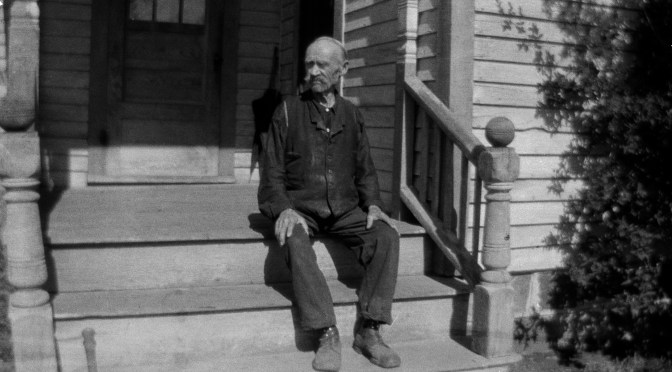
The photograph is very poignant. A frail man, sitting in the afternoon sun on the front porch steps. He looks haggard and tired, maybe ill. This image is the last known photograph taken of Karl Frederick Christian Hanneman, who was known around Wisconsin Rapids as Charles or “Chas” Hanneman. The photo likely dates to 1931 or 1932, when he suffered from prostate cancer that eventually took his life.
Charles Hanneman came to America in late November 1882 with his parents, Christian and Amanda Hanneman. He was just 15 when the family made its way from Stettin, Pomerania to Portage County, Wisconsin. Charles, his three brothers and two sisters settled on a 105-acre farm in the northwest corner of the Town of Grant, near the tiny hamlet of Kellner.
Nina and Elaine Treutel visit with Chas Hanneman, circa 1930.
Charles worked on the Hanneman farm for a time. His brothers would stay in farming (maps from that period show many Hanneman farms in Portage County), but eventually Charles left farming and found work in one of the area’s many sawmills.
At some point in his early 20s, Charles made the acquaintance of Rosine Ostermann, the eldest daughter of John and Mina Ostermann of the Town of Grand Rapids. They had many things in common. Both grew up on the family farm. Rosie’s parents were from Germany (Saxony and Prussia), and his were from Pomerania. Rosie’s grandfather George Ostermann was one of the pioneers of Portage County, listed on the earliest tax roll of the Town of Grant in 1864.
On April 2, 1891, Charles and Rosie were married atSt. John’s Evangelical Lutheran Church in Kellner in a divine service performed by A.G. Grimm. The witnesses were Charles’ father, Christian, and his brother, William. The bride’s attendants were her sister, Elsie Ostermann, and Emma Pribbernow. The groomsmen were cousins August Saeger and Herman Hanneman.
The young couple came to know heartache early in their marriage. Their firstborn, referred in the records only as “C.H. Hanneman,” died in infancy in 1892. They went on to have four sons: Arthur John (1893), Frank Herman Albert (1895), Wilbert George (1899), and our own Carl Henry Frank (1901).
Left to right: Christian Hanneman, Chas Hanneman, Carl Hanneman, David D. Hanneman.
Work in the sawmill must have been erratic, or Charles left that occupation for a time. In 1900, U.S. Census records show the family living and working on the farm of Charles’ brother, William Hanneman.
By 1905, Charles moved his family to the second ward in the city of Grand Rapids. He initially did manual labor for the city of Grand Rapids,possibly working on construction of the water and sewer works. The financial statements for the city in December 1907 show Charles worked 135 hours that month and earned 17.5 cents per hourfor a paycheck of $23.63.
By 1910 the family was living at 1774 Baker Street in Grand Rapids. The U.S. Census that year lists Charles as a laborer at a box factory. That may have referred to Consolidated Water, Power & Paper Co., where he later worked until his retirement, or the nearby Badger Box company.
On March 31, 1918, tragedy struck the Hanneman home when Rosine died suddenly at age 48. Her death notice, which ran on page 1 of the Daily Leader, said she was fine during the day but fell ill and died at 11 p.m. We know that she had diabetes, and that may have contributed to her death. Carl was 16 when his mother died.
Charles remarried in August 1919 and lived out his remaining years in his home at 1751 Baker Street. He became ill with prostate cancer in 1931 and was hospitalized numerous times in Wausau for surgery and treatments. He died at home on Oct. 11, 1932. He was 65. His death made front-page news in the Wisconsin Rapids Daily Tribune.
FAMILY LINE: Karl Frederick Christian Hanneman >> Carl F. Hanneman >> Donn, David & Lavonne Hanneman
Rosine Bertha Henrietta (Osterman) Hanneman (1870-1918), Frank Herman Albert Hanneman (1895-1947), Arthur James Hanneman (1893-1965), Carl Henry Frank Hanneman (1901-1982), Wilbert George Hanneman (1899-1987) and Carl Frederick Christian (Chas) Hanneman (1866-1932).
It is the only known photograph showing six of the seven children of Christian and Amanda Hanneman, pioneers of Portage and Wood counties in Wisconsin. The undated photo was probably taken around 1915 at a family event. Left to right are: William Friedrich Johann Hanneman (1856-1939) Bertha Auguste Ernestine (Hanneman) Bartelt (1860-1945) Albert Friedrich O. Hanneman (1863-1932) Herman Charles Hanneman (1864-1945) Carl Friedrich Christian Hanneman (“Chas,” 1866-1932) Ernestine Wilhelmine Caroline (Hanneman) Timm (1870-1930)
Hand tinted photograph of Chas Hanneman, location unknown.
Left to right: Christian Hanneman, Chas Hanneman, Carl Hanneman, David D. Hanneman.
My Dad’s family made several trips out West, to Arizona and the Dakotas. Sorting out and matching photos with cities has been a constant challenge. A couple of intriguing photos show Dad with a cowboy identified as Hiram Greene. I wondered, was Hiram Greene a famous rodeo rider, a film star or some other celebrity?
My first source of information was the caption on the back of one photo, written by my grandmother, Ruby V. Hanneman. It listed the name “Hiram Greene” and said he was from Billings, Montana. The photo, according to the caption, was taken at Canistota, Minnesota. As it turned out, that caption was problematic in several respects.
Hiram Greene with David D. Hanneman on July 14, 1945.
I took a chance by doing a generic search engine query and came up empty. I quickly ruled out the idea that Mr. Greene was a major celebrity. Using databases at Ancestry.com, I was unable to find anyone by that name near Billings, Montana. But I did find what appeared to be a good match right in South Dakota, where the Hanneman family vacationed several times in the 1940s.
Hiram Hoyt Greene was a farmer who lived much of his life around Mitchell, S.D. I ran a quick search and discovered the major tourist attraction in Mitchell is the Mitchell Corn Palace, home to world-famous murals made from corn. That quickly rang a bell with me. I had numerous photos of the Hannemans outside the Corn Palace. This led me to conclude that it was possible that Dad met Hiram Greene on the streets of Mitchell. Especially since there is no Canistota, Minnesota. There is a Canistota, S.D., another city the Hanneman family visited on vacation. Canistota is home to the famous Ortman Chiropractic Clinic. I could find no link between Hiram and Canistota, although it is only 40 miles from Mitchell. I took yet another look through the photo library and found an image of the Ortman Clinic. The building next to it appears to match the brick building that Dad and Mr. Greene are standing near. So it was Canistota after all.
According to the 1940 U.S. Census, Hiram Hoyt Greene was a livestock and grain producer. This made sense. A cattle rancher would certainly dress like a cowboy. Perhaps Dad saw Mr. Greene on the street and wanted to have his photo taken with a real cowboy. I wonder if that had happened to Mr. Greene before? I started out looking for a celebrity, but found a regular, hard-working cattle rancher. It was an even better story, in my opinion.
Hiram Hoyt Greene was born in May 1898. At the time of the World War I draft, he was a farmer in Mitchell, S.D. In May 1920, he married May Luella Moe. The couple had nine children. At various times in his working life, Greene farmed and lived in Mitchell, the Town of Beulah and Mount Vernon, South Dakota. He was hospitalized in November 1958, just a day after celebrating the wedding of one of his sons. He died on November 28, 1958 at age 60.
I learned several key lessons from this photo detective assignment. First, it is always a good idea to write down information on the back of photographs. Or in the case of modern digital images, to embed a caption and keywords in the photo files. But you can’t always trust the information on old photo prints. Sometimes captions are written long after the events shown in the photo. Memories can be jumbled, so it is good to check the information and correct it if necessary.
— This post has been updated with more information.
It was a tiny photograph, not much larger than an oversized postage stamp. It showed two boys, identified on the back as Bob Firlus and Sam Kaufman. Of course I was very familiar with Bob, my Dad’s lifelong friend from Mauston, Wisconsin. But Sam did not ring a bell. However, his presence in my Dad’s photo collection meant that he was a friend and likely a frequent guest at the home of my grandparents on Morris Street in Mauston. I wondered, what became of Sam?
Bob Firlus (at left) and Sam Kaufman on Morris Street in Mauston, circa 1940.
The photo detective in me kicked into high gear. My first check was with Mr. Firlus, who had some distinct and humorous early memories of Sam:
They had a nice house on Tremont Street. One day Sammy and I walked out to Coon Rock Bluff a few miles west of Mauston. We were near the bluff and Sammy said that he had to take a pee but he asked me not to tell his dad because his dad told him he should not pee outdoors.
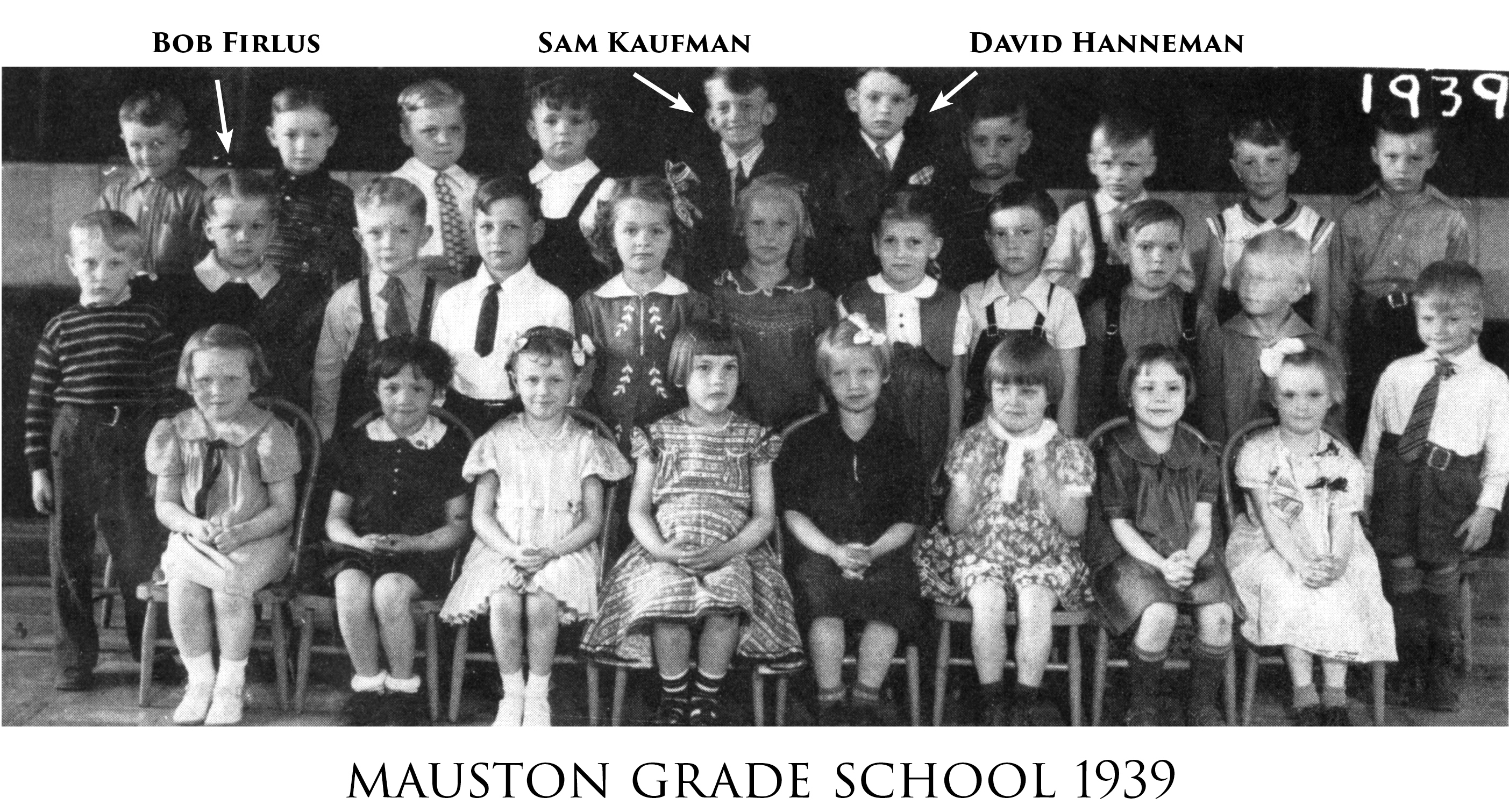
Ah, the troubles of youth! What a great story! Bob said he believed Sam had moved to Pennsylvania after leaving Mauston. I next dug out some of my Dad’s yearbooks and found Sam pictured with my Dad’s Mauston Grade School class in the late 1930s and early 1940s. He was one of the tallest boys in class, so was usually found in the back row. In the 1939 class photo, he was standing directly to my Dad’s right.
Bob Firlus, Sammy Kaufman and David Hanneman are shown in this early school photo.
I checked the U.S. Census and military records on Ancestry.com and found Sam’s father, Albert Ross Kaufman, a doctor at Mauston’s Hess Memorial Clinic. The elder Kaufman’s 1942 draft card showed he was 46 and living with his family at 214 Tremont Street in Mauston. That was fairly close to the Hess clinic, but not so close to the Hanneman house. So what was his connection to that photo taken on Morris Street? I looked up Sam’s mother, Ardis, and discovered her maiden name was Hess. OK, now we’re making progress. Hess was a very prominent name in Mauston, largely due to Dr. James Samuel Hess Sr., a pioneer doctor and founder of the hospital and clinic. Interestingly, Bob Firlus said he had recently thought about Sam and the name Ardis came to mind, although Bob hadn’t recalled that was Sam’s mother’s name.
Turns out that Dr. Ardis (Hess) Kaufman (also a physician) was the daughter of Dr. J.S. Hess Sr. and Maude (Robinson) Hess. She was the sister of Dr. J.S. Hess Jr., who lived directly across the street from the Hannemans. Dr. Sam, as the junior Hess was known, took over for his father at the hospital and clinic. That explained why Sammy was a frequent neighborhood visitor. My grandfather, Carl F. Hanneman, worked for Dr. Sam running the pharmacy attached to the Hess clinic. So it made sense that Bob Firlus and my Dad were buddies of Sam Kaufman. I dug into my photo archives and found another shot that appears to show Sam outside the Hess home around 1942.
A tall, thin young man believed to be Sam Kaufman outside the Hess home on Winsor Street.
Now that I had a good sense of Sam’s history in Mauston, I wanted to figure out where he went and what happened in his life. Again, Ancestry.com was a crucial source. I found listings for Dr. Albert R. Kaufman under city directories in New Kensington, Pennsylvania. Based on that, I ran search engine queries and located an obituary for Sam Kaufman. I reacted with sadness, since I always hope in doing this work to find a living person to track down. Sam died in October 2008 of lung cancer. Same cause as my Dad, and about 18 months later. From the obituary, it was clear Sam had lived an exemplary life.
The obituary described Sam’s college education, his longtime service in the U.S. Army, his 1957 marriage to Margaret “Meg” Floyd, and his career switch from salesman to high school teacher. He had a long teaching career at Baldwin High School in suburban Pittsburgh. The couple had two sons, James and Steve. From checking those names with search engines, it appears Steve has had a long career as an assistant U.S. attorney in Pittsburgh.
Even after I finished most of my research, Sam’s name stuck in my head. There was some other clue I was missing. Dad, could you give me some help here? Then it hit me. I vaguely recalled that Sammy accompanied my Dad’s family on one of their vacation trips to the Dakotas. But how to find the photo amidst the thousands in the archive? On this day, I had some help from above. The first archive box I opened had the photo for which I searched. The caption read: “Sammy Kaufman on right, David Hanneman on left.” It was in my Grandma Ruby’s handwriting.
David Hanneman (left) and Sam Kaufman outside the Ortman Chiropractic Clinic in Canistota, S.D., circa 1944.
It took a few days of work, but with a little effort I went from a tiny photo print with lots of questions to a decent understanding of Sam Kaufman and his life in and beyond Mauston. Well done, Sam, and thank you.
[The original version of this story posted in 2014 stated that President Truman visited Mauston, Wisconsin. A sharp-eyed former resident of Mauston noted in the comments section that Truman did not visit Mauston, but rather nearby Elroy. The Truman Presidential Library has now confirmed this, so the story has been corrected and expanded as of May 10, 2017.]
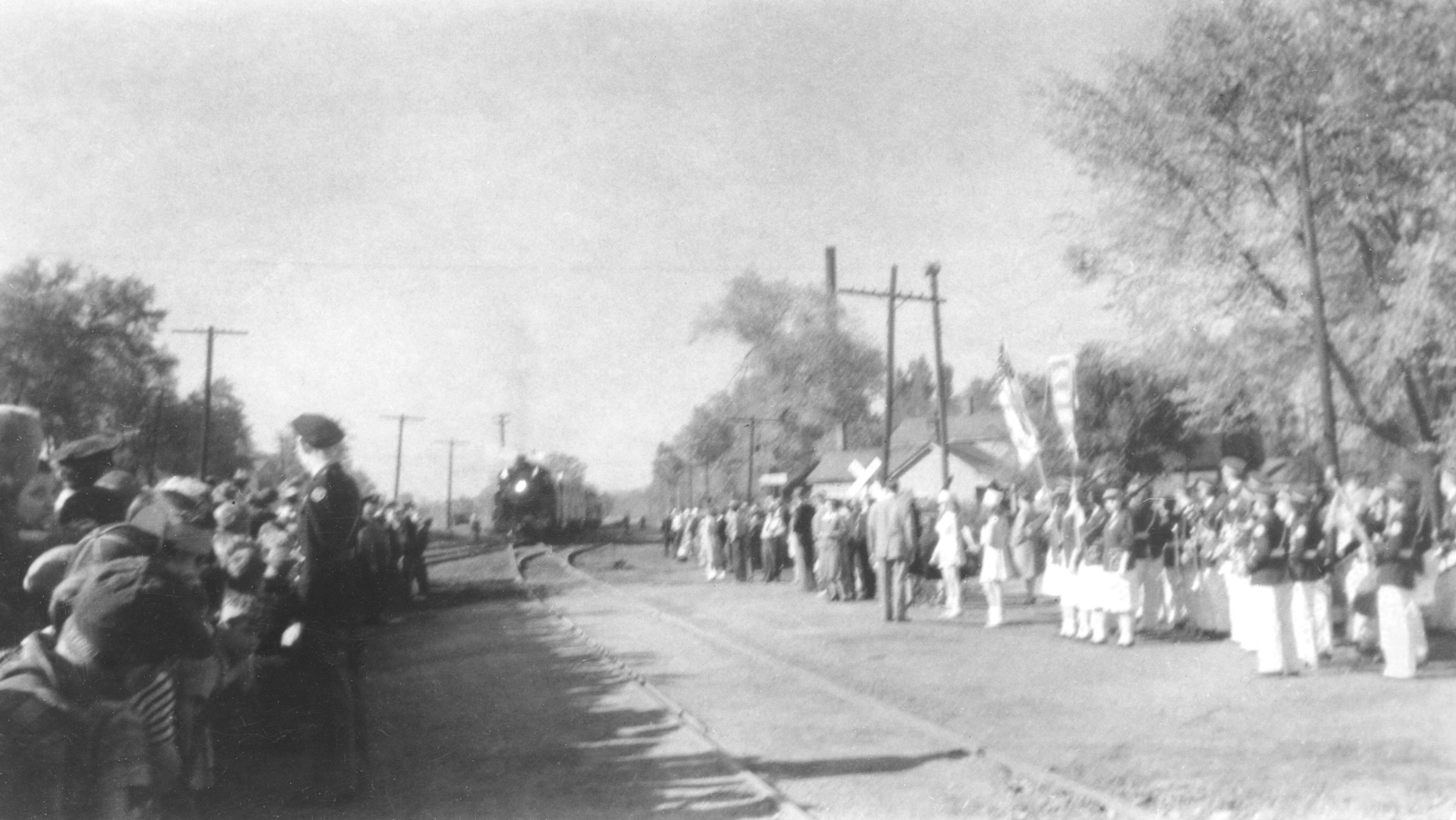
When President Harry S Truman pulled into tiny Elroy, Wisconsin on his rail tour of America in 1948, the Carl F. Hanneman family was at the station and captured several Polaroid images of the event. The grainy and out of focus photos are far from perfect, but they provide literal snapshots from one of the great political stories in American history.
The Harry S Truman express approaches Elroy, Wisconsin, on October 14, 1948.
Truman went on an 30,000-mile“whistle-stop” railroad tour of the nation,visiting large cities, small villages and everything in between. His 17-car train was called the Magellan. Much like his old boss President Franklin Delano Roosevelt had done, Truman made speeches from a presidential podium at the back of the train. The tour drew huge crowds wherever he went, and Mauston was no exception. According to the Truman Presidential Library, the president made up to eight speeches each day during the rail tour.
President Harry S Truman took his case directly to the people during his 1948 rail tour.
On this day, Truman started out with a speech in Mankato, Minnesota at 8:08 a.m. Other stops included Waseca, Rochester and Winona, Minnesota; and Sparta, Wisconsin. The train pulled into Elroy at 1:55 p.m. on October 14, 1948. Truman stepped to the podium and said:
I certainly do appreciate your coming out here. This was supposed to have been a water stop. I didn’t think that we would be here long enough for me to speak to you, but I am happy that we did stop long enough, and I appreciate your interest and I appreciate your coming out here to see the president.
I wish I had the chance to discuss with you all the issues in this campaign, but I haven’t the time now.
I hope you’ve been reading the speeches and statements I have been making over the country. They are in your interest, and if you vote for your own interests on the 2d of November you’ll elect a Democratic Governor and a Democratic Congressman from your district–and you’ll elect a Democratic administration in the whole United States Government. And then things will be safe and in the hands of the people.
Conventional political wisdom had Truman losing badly before a single ballot was cast. When he won the election, it was viewed as a stunning turn of events. Many will recall the famous photo of Truman holding the early edition of the Chicago Tribune with the erroneous headline, “Dewey Defeats Truman.” That photo was snapped at the back of the same train in St. Louis, as Truman departed for Washington.
It seems the term “whistle-stop” was considered a bit of a slight. When Republican Sen. Robert Taft of Ohio criticized the Democrat Truman for things he was saying on the “whistle-stop” tour, mayors of towns on the route of Truman’s tour reacted with indignation. “Our whistles never stop blowing,” one huffed. Crestline, Ohio, was quick to point out the 42 daily trains that served its population of 5,000. The Associated Press at the time said a whistle-stop was a “tank town, a hamlet, a mere wide place in the road.” Truman’s own comments at Elroy indicate the stop there was supposed to be only to take on water.
Of course millions of Americans live in such places, so the kerfuffle seemed a bit strange. As columnist Thomas L. Stokes noted, “Whistle-stop folks vote, too.” Stokes called the rail tour a public service, part of a president’s responsibility to communicate directly with the American people.
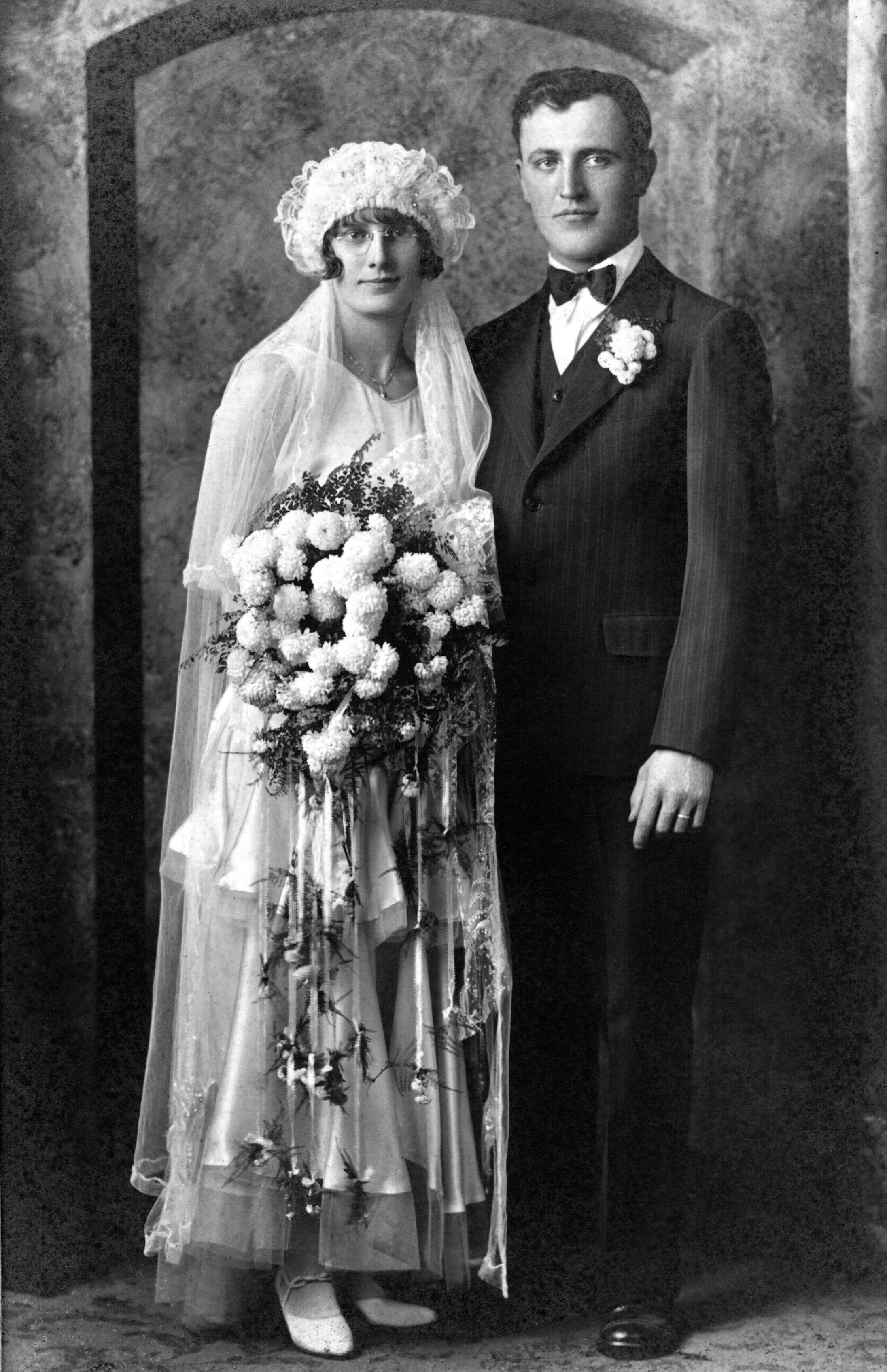
Esther Marie Albrecht was married to Emil Rudolph Gottschalk on November 12, 1930 in the Town of Hewitt in Wood County, Wisconsin. Esther was the maid of honor at the July 1925 wedding of Ruby V. Treutel and Carl F. Hanneman in Vesper, Wisconsin. Mr. and Mrs. Gottschalk moved to Waukesha, and had two daughters, Pearl and LaVon. They were longtime friends of the Hanneman family. She is the daughter of George and Pearl (Smith) Albrecht.
Esther M. Albrecht married Emil R. Gottschalk in November 1930 in the Town of Hewitt, Wood County, Wisconsin.
According to the 1930 and 1940 U.S. Census, Emil worked as a core maker in an iron foundry in Waukesha. Emil Gottschalk died on February 1, 1944 at just age 37. Mrs. Gottschalk operated Esther’s Food Store on Arcadian Avenue in Waukesha. In April 1946, she married Harold D. “Whitey” Buchs at St. Joseph’s Catholic Church in Waukesha. Esther died January 1, 1985 in Vesper. Harold died April 13, 2007 in Vesper.
These young ladies look like they are dressed for a Siberian winter, although the location of this photograph is central Wisconsin. Sisters Lillian M. Albrecht (left) and Esther M. Albrecht are bundled with fur coats, hats and hand warmers. The photo was taken about 1920, probably at Vesper, Wisconsin, their home town.
Lillian M. Albrecht and sister Esther M. Albrecht are well-prepared for winter.
Lillian married George J. Ladick in June 1922, and the couple had four children: Sylvia (1923-1961), Lucille (1925-2005), Lawrence (1930-2000) and Shirley. Esther married Emil R. Gottschalk in November 1930, and the couple had two daughters, Pearl (1936-2012) and LaVon.
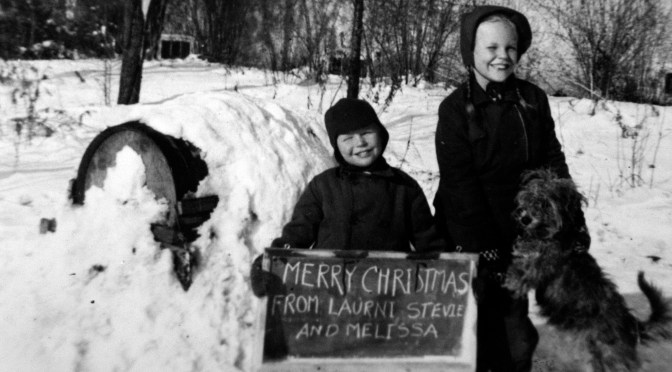
Stevie Wilson and Laurni Lee Wilson made their own Christmas greeting in December 1942 with this photograph sent to their Uncle and Aunt, Carl and Ruby Hanneman of Mauston, Wisconsin. They even included greetings from their dog, Melissa. The Wilsons lived in Waukegan, Illinois, where the Hanneman family often visited. Stevie and Laurni Lee are the children of Lawrence and Nina (Treutel) Wilson. Nina is Ruby (Treutel) Hanneman’s sister. Merry Christmas!














 The Hanneman Archive