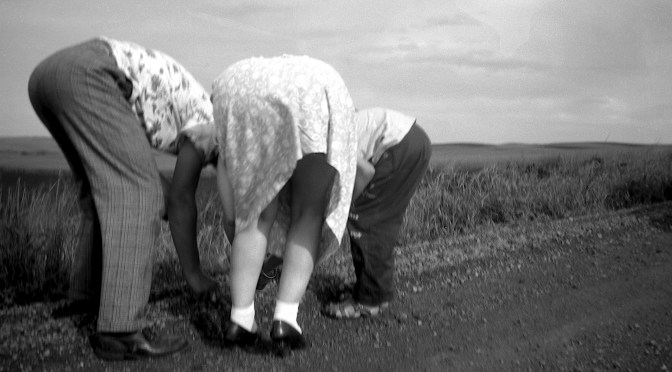
It wasn’t such a curious hobby, collecting rocks, but more in how it was done. Ruby Viola (Treutel) Hanneman (1904-1977), simply could not resist picking rocks up off the ground wherever she went. And judging by the facial expressions of those around her, it became somewhat of a family joke.
Lavonne Hanneman can’t resist laughing as her mother Ruby bends down to pick up rocks on a trip to South Dakota in 1947.
Rock collecting was certainly a Hanneman tradition. Uncle Wilbert G. Hanneman (1899-1987) had a rock shop up in Wausau, from which many a Hanneman child procured varieties of colorful, polished rocks. I have a bag of them to this day. Ruby liked to get her collectibles the old fashioned way, by finding them. She’d bend down to grab the most interesting or unusual ones, and husband Carl F. Hanneman (1901-1982) was often nearby to capture the moment on film.
David D. Hanneman’s priceless facial expression says it all, as his father Carl snaps yet another photo of mother Ruby picking up rocks.
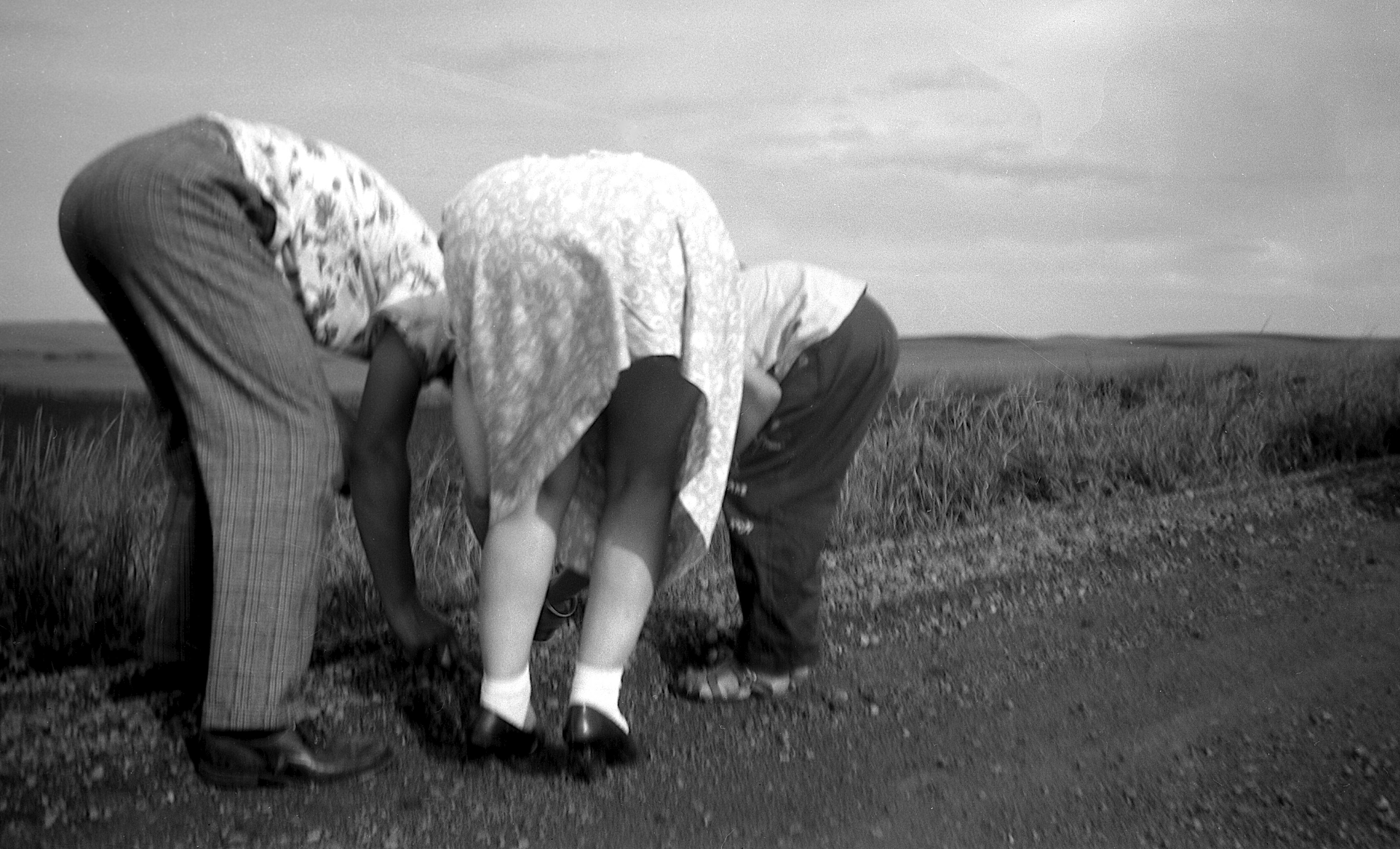
The best examples of this hobby (or habit) came on a family trip from Mauston, Wisconsin, to Williston, South Dakota in 1947. After getting caught all bent over on several photographic occasions, Ruby and the kids shot back. They put their heads together and gave old Carl Hanneman a two-cheek salute.
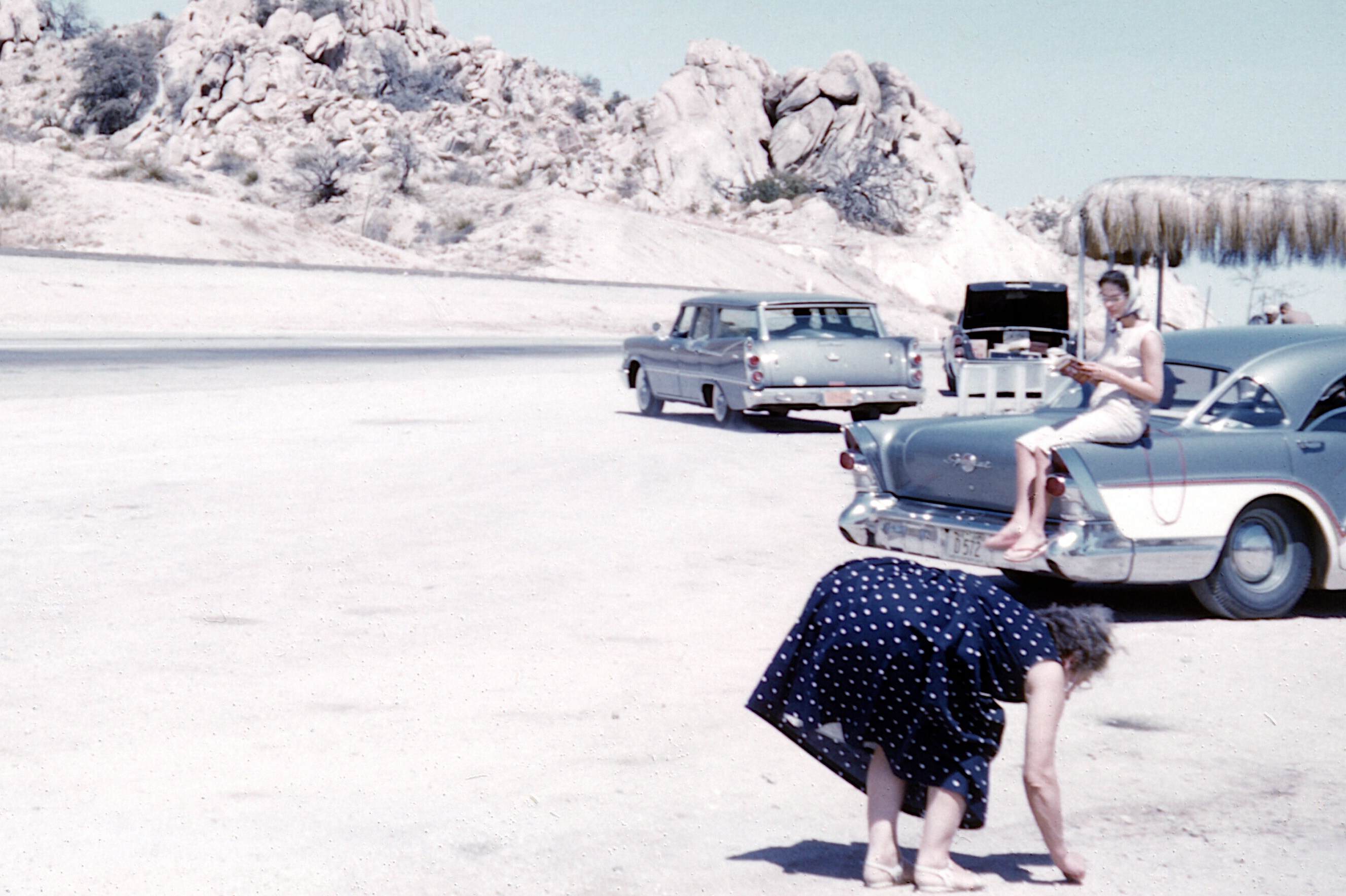
David and Lavonne Hanneman joined their mother Ruby in offering a rear-end salute to cameraman Carl F. Hanneman.This photo proves Ruby’s habit was not a passing fad. Here she gathers samples on a trip to Phoenix in 1959.
Army Pvt. Rudolph Mika Jr. (at left) of Mauston, Wisconsin, talks to livestock buyer John Randall at the Juneau County Fair at Mauston in the summer of 1942. Mika went into the Army glider corps and took part in the invasion of North Africa during World War II. He was taken prisoner by German troops in Holland in September 1944 and repatriated in June 1945.
Army Pvt. Rudolph Mika (at left) of Mauston, Wis., talks to livestock buyer John Randall at the Juneau County Fair at Mauston in the summer of 1942.
The 1940 U.S. Census showed Mika working at the Mauston pickle factory and living at home with his parents, Rudolph Mika Sr. and Anna Mika. The elder Mika was a carrier for the local ice dealer. The Mikas lived on Winsor Street, just a few houses away from the Carl F. Hanneman family and the home of Dr. J. Samuel Hess Jr. Hanneman was on the Juneau County Fair Board for many years. He snapped the photo of Mika and Randall.
Rudy Mika enlisted in the U.S. Army in March 1942 at Madison. His occupation was listed as a carpenter. After the war, he returned to Mauston. He died on January 6, 2001 at Mauston, age 89. Randall died in January 1971 at age 74.
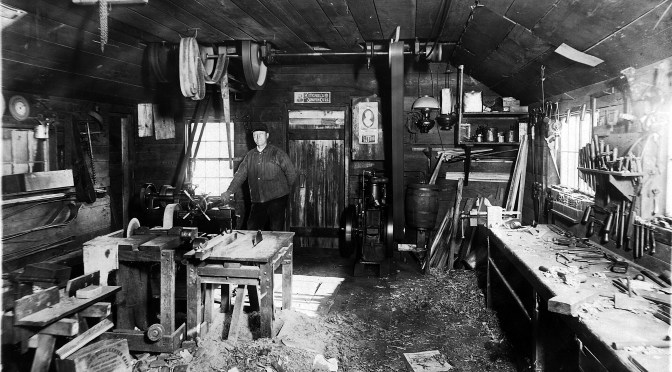
Charles Treutel (1869-1958) poses in the Treutel Bros. Shop at Vesper, Wisconsin, in 1911. Charles and his brother Henry A. Treutel (1864-1962) opened a blacksmith operation in Vesper after moving to Wood County from Mukwonago, Wis., in 1901. As can be seen in the photo, the Treutels also did carpentry work. The brothers later expanded their shop and made the transition from shoeing horses to tuning up engines and selling agricultural implements.
A 1911 book, Vesper, Wisconsin: A Sketch of A Model City, described the business this way:
Charles and Henry Treutel, skilled mechanics, have operated the blacksmith and wagon shop at Vesper since Nov. 1901 and have built up a large and prosperous business by courtesy and excellent workmanship. They are masters of every line of their business and are especially skilled in horseshoeing and repair work. In addition to their shop work the Messrs Treutel carry a large line of farm implements and their mechanical knowledge has enabled them to select the best makes in all the lines of machines they carry. They have a model shop fully equipped for their work.
The Treutel Bros. learned their trade from their father, Philipp Treutel (1833-1891), who came to America from Germany in 1854. As detailed in a previous post, the Treutels were blacksmiths, carpenters, tallow chandlers and tailors from near Darmstadt, Germany. Philipp Treutel is buried at North Prairie, Wisconsin.
— This post has been updated with additional information.
The tiny village of Vesper in Wood County, Wisconsin engendered such good feelings among its early residents that someone penned a tribute song to the village along the Hemlock Creek. The Hemlock Creek runs from just north of Arpin and flows south to the Wood County line. It includes more than 80 miles of streams.
The Treutel family enjoys a picnic lunch on their property along the Hemlock Creek at Vesper, Wisconsin, circa 1924. Pictured, L to R, are Elaine Treutel, Walter Treutel and Ruby Treutel. Marvin Treutel is partially hidden.
From the ashes of a massive sawmill fire in 1894, Vesper became a prosperous farming and manufacturing village 10 miles northeast of Wisconsin Rapids. Many of our relatives found work here and raised families. The village had a number of factories, general stores, a meat market, a locally owned bank, blacksmith shops, a community theater, a roller rink and more.
On warm summer days in the early 1900s, folks came from miles around to gather at the bandstand in Cameron Park. They enjoyed a variety of live music by the Vesper Cornet Band and other area musicians. It is not surprising such a place would win the hearts of its 300 residents.
The old Goldsworthy’s Store in Vesper, which later became the Treutel Bros. store.
We don’t know the author of the Vesper song, or even the musical score. But its lyrics tell a story of how the pioneer residents believed in their little community on the winding creek. And if you need confirmation that it is a genuine Wisconsin song, just look at the pronunciation of the word “creek.” Or is that “crick?”
Vesper, Wisconsin on the Hemlock Creek
1) You can rave about your cities with their glitter and their show,
And the interesting places where people like to go
But to come to solid comfort we can show you all a trick,
Where? Vesper, Wisconsin on the Hemlock Creek
Chorus
Vesper for mine, yes it’s Vesper for mine,
She isn’t very big, but she’s the best on the line,
They can travel where they want to
But we’ll try our best to stick,
Where? Vesper, Wisconsin, on the Hemlock Creek.
2) It’s the home of dandy people and their children not a few,
It’s the home of cheese and butter and a big condensery, too,
They make drainage tile and silos, have a band and park that’re slick
Where? Vesper, Wisconsin, on the Hemlock Creek.
3) Now the people are so busy that it keeps them on the go,
So they haven’t got a bit of time to stop and watch her grow,
It’s the town where things are doing and we aim to do them quick,
Where? Vesper, Wisconsin, on the Hemlock Creek.
4) To each stranger who is seeking for a place to build his roost,
We extend an invitation to the town for which we boost,
We’ll be glad to have you with us and we know you’ll want to stick,
Where? Vesper, Wisconsin, on the Hemlock Creek.
The Vesper Cornet Band performed at the Cameron Park band shelter and other locales around Vesper, Wisconsin. Oscar, Charles and Henry Treutel were band members.
It is common knowledge to family members that Carl F. Hanneman was born on Oct. 28, 1901. But when he needed proof of that fact back in 1946, there was none to be found. On Feb. 22, 1946, Carl sent a letter and the 50-cent fee to the Wood County register of deeds, asking for a copy of his birth certificate.
Register of Deeds Henry Ebbe sent the letter back with an answer that must have shocked Carl: “There doesn’t seem to be any birth certificate for you on the above date. There is a Ruben born Oct. 21, 1901. Father Chas. and Mother Rose. Could this be yours? I am returning your 50 cents.”
The earliest known photo of Carl Henry Frank Hanneman, born 28 Oct 1901.
That set Carl off scrambling to find proof of his birth. He asked the pastor of the Moravian Church of Wisconsin Rapids for help. Carl’s parents, Charles and Rosine Hanneman, joined the Moravian Church on March 29, 1907. Church records did list Carl F’s birthdate as Oct. 28, 1901, so Moravian Minister George Westphal wrote a letter testifying to the church records. But since Carl was not baptized in the Moravian church, this record was only indirect evidence of his birth.
If Carl had turned to U.S. Census records (which were not available at the time), it might have confused the matter more. The 1910 Census lists the youngest son of Charles and Rosa Hanneman as Harold Hanneman, age 8. Carl’s first middle name is Henry, so no doubt the Census worker simply wrote it down wrong.
So what happened? It’s not clear, but we do know the record was officially corrected. Carl’s birth certificate still shows the name Ruben and the wrong birthday, but the errors are crossed out and replaced with the correct information. Wood County Health Officer Frank Pomainville corrected the record in red ink in 1960.
In a state where the one-room schoolhouse was quite the norm in the early 1900s, tiny Vesper, Wis., boasted an impressive two-story brick school building that was the center of learning for area children for decades.
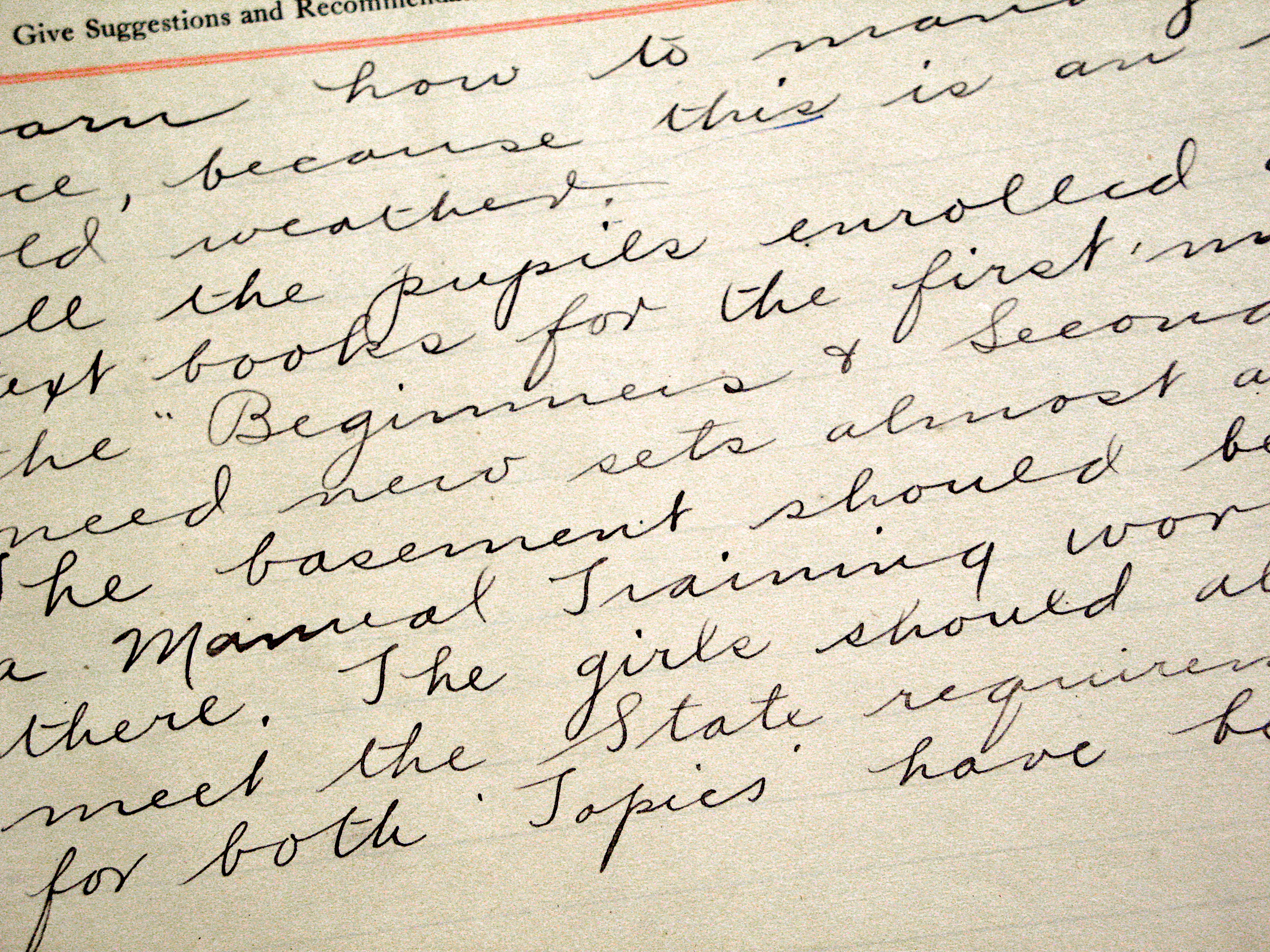
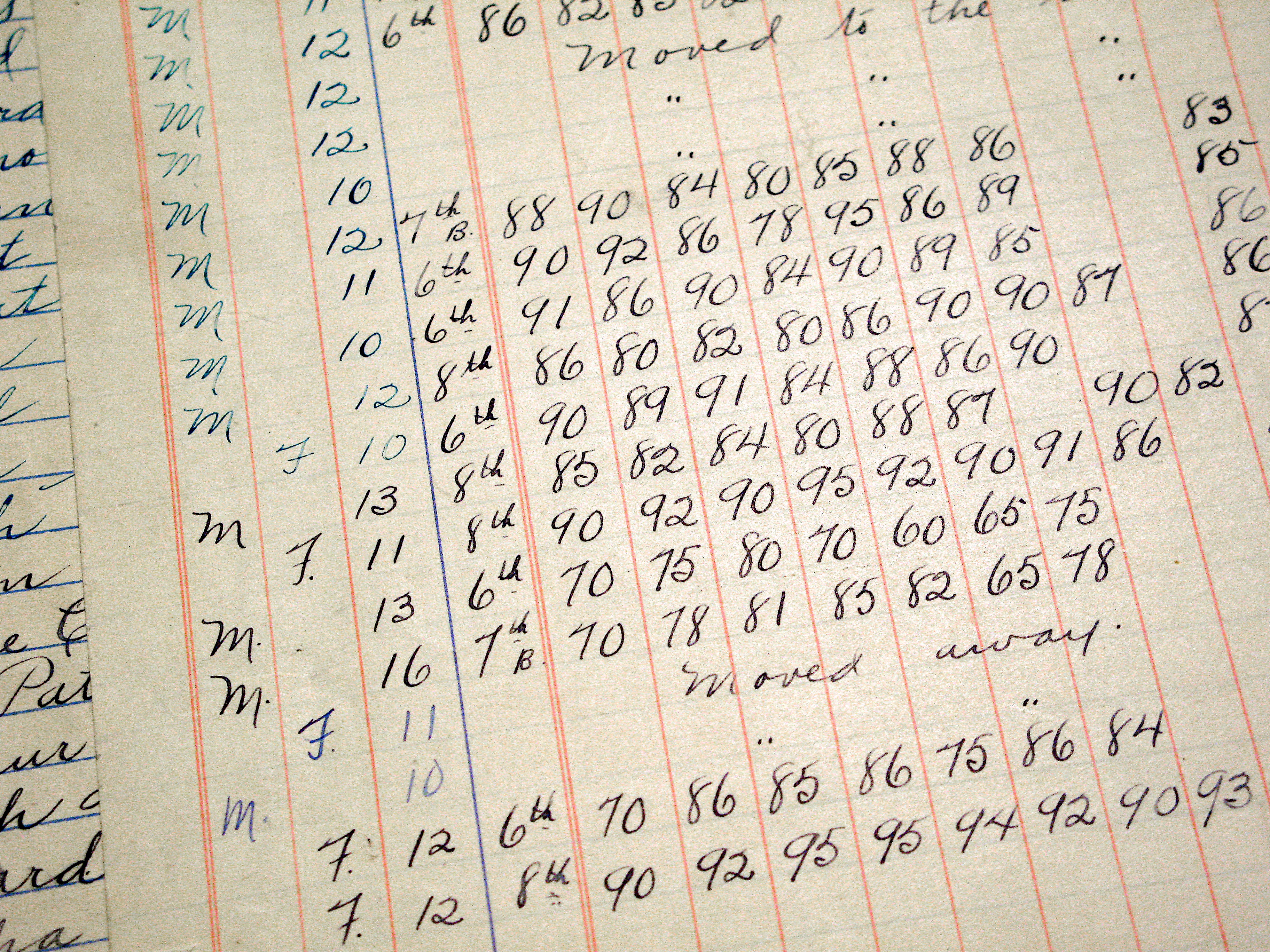
Built in 1906 just off of Main Street in Vesper, the Vesper Graded School was home to students of District No. 1, Town of Hansen. We get an interesting look at life inside the school from a teacher’s record book covering the years 1911-1917. The “Welch’s System Attendance, Classification, Gradation and Close Supervision” book belonged to Ruby (Treutel) Hanneman, who attended Vesper school starting in 1913 and later taught at the school.
The teacher kept detailed notes on conditions at the school, in addition to records of student performance and attendance.
The detailed notes in the book make one thing very clear: the teacher had her hands full each school year. Not only did one woman handle teaching duties for lower and upper grades, but she had to manage the building and contend with a cranky, bulky coal furnace each winter.
During the years covered in the record book, Vesper had three teachers: Mabelle Rowland in 1911-1912, Ella H. Hessler from 1912-13 to 1914-15, and Sara Icke in 1915-16 and 1916-17. Teachers were paid between $50 and $60 per month. Ruby’s uncle, Henry Treutel, served on the school board in early years (his son Harold attended classes during that time). In the late 1920s, another uncle, Charles Treutel, was also on the board.
It seems the biggest challenge for the teachers was not in the classroom but the furnace room. The coal-fired furnace often belched smoke and gases into the clean-air intake and into the classrooms. “Before you begin school learn how to manage the drafts of furnace and cold air shafts,” wrote Mabelle Rowland in her 1912 “Teacher’s Report to Successor.” “The inspector is very critical on this work.” Teacher Ella Hessler wrote one year later: “The furnace needs repair. The smoke enters the fresh air. The furnace work in cold weather is too heavy for a woman.” Similar notations were made in subsequent years.
Each student’s attendance and academic performance were tracked in detail.
The school typically served from 25 to 40 students per term. Primary grades were on one level and upper grades on the other. The teacher staggered the subjects so she could get lessons started for one group and then move to the other.Classes started at 9 a.m. and students were dismissed for the day at 4 p.m. Course work included arithmetic, history, language, reading, grammar, physiology, domestic science for girls, manual training for boys, civics and geography.
Some of the children walked to school from homes nearby in the village, while others came in from the countryside. Tardiness was common, due to distance walked, duties at home or a pokey walking pace. In 1911-1912, Alfred and Agnes Peterson were the brother-sister tardiness champs with 20 and 17 instances, respectively. Clara Zieher had 18 tardy notations, followed by Erma Dassow with 15 (her brother Elmer had just 4). Absence from school was also common due to illness or duties helping at home. On occasion a student or two left school for a month or two to perform farm work. Arnold Conklin had best attendance in 1911-1912, only missing one day out of 180.
Absences were common from illness or need to stay home and work on farm chores.
The book tracked each student’s attendance and progress on a range of subjects. Teachers made notations for some students that ranged from “fair worker,’“weak eyes” and “slow” to “hard worker,” “irregular and very nervous,” and “dull.”
In the 1911-1912 school year, the school library had a mere 50 volumes. The school invested in books each year, and by June 1917 the library’s holdings included 144 books. For obvious reasons, the boys’ and girls’ out buildings regularly needed repairs and painting. The number of trees on school grounds that were in “thrifty condition” ranged from four to seven.
Ruby Treutel enrolled at Vesper Graded School in November 1913, when she was 10. There was some indication she had attended a parochial school prior to that. During her first year, Ruby missed 21.5 days and was tardy six times. Her cousin Harold Treutel had a mere three sick days. Ruby received good grades for the term: orthography, 91; reading, 95; writing, 90; arithmetic, 70; grammar, 89; geography, 83; and constitutions, 90. During the 1914-1915 school year, Ruby was out sick 20 days, but she still maintained As and Bs in all of her subjects.
The teacher’s annual summary provides interesting detail on all conditions at the school.
During the 1915-1916 term, Ruby excelled in all of her courses, scoring solid ‘A’s in orthography, reading, grammar, U.S. history and physiology. Her lowest grade was a ‘B’ in geography and arithmetic.
Harold Treutel graduated from Vesper Graded School in 1917 and enrolled at Lincoln High School in Grand Rapids.Ruby graduated from Vesper in 1918, also enrolling at Lincoln High School. That may be where she first met Carl F. Hanneman, whom she would marry in July 1925.
The old Vesper Graded School is now a private home, shown here in 2006.
They were craftsmen — blacksmiths, tailors, chandlers, carpenters — the clan of Treutels who came to Wisconsin from the Darmstadt area of Germany starting in 1849. The Johann Adam Treutel family left the village of Königstädten between 1849 and 1854 and headed for America. They were part of a huge wave of German emigrants that changed the face of Wisconsin and the United States.
The Wisconsin branch of the Treutel family tree is from Königstädten, a village just northwest of the city of Darmstadt. From this “king’s village” came Johann Adam Treutel and his wife, Elizabetha Katharina (Geier) Treutel. According to the Hessisches Staatsarchivin Darmstadt, Adam, Katharina and at least some of their children left for America in July 1854. The emigration index simply lists that the eldest Treutel traveled “with his family.”
Their sonJohn Treutelhad already been in Wisconsin for some two years when they departed Germany. We believe the 1854 traveling party included at least three other Treutel children: Philipp Treutel, 21; Sebastian Treutel, 19; and Henry J. Treutel, 13. Their destination was Milwaukee. In May 1849, the eldest Treutel child, Adam, left for America, living in New York for a time before moving to Milwaukee.
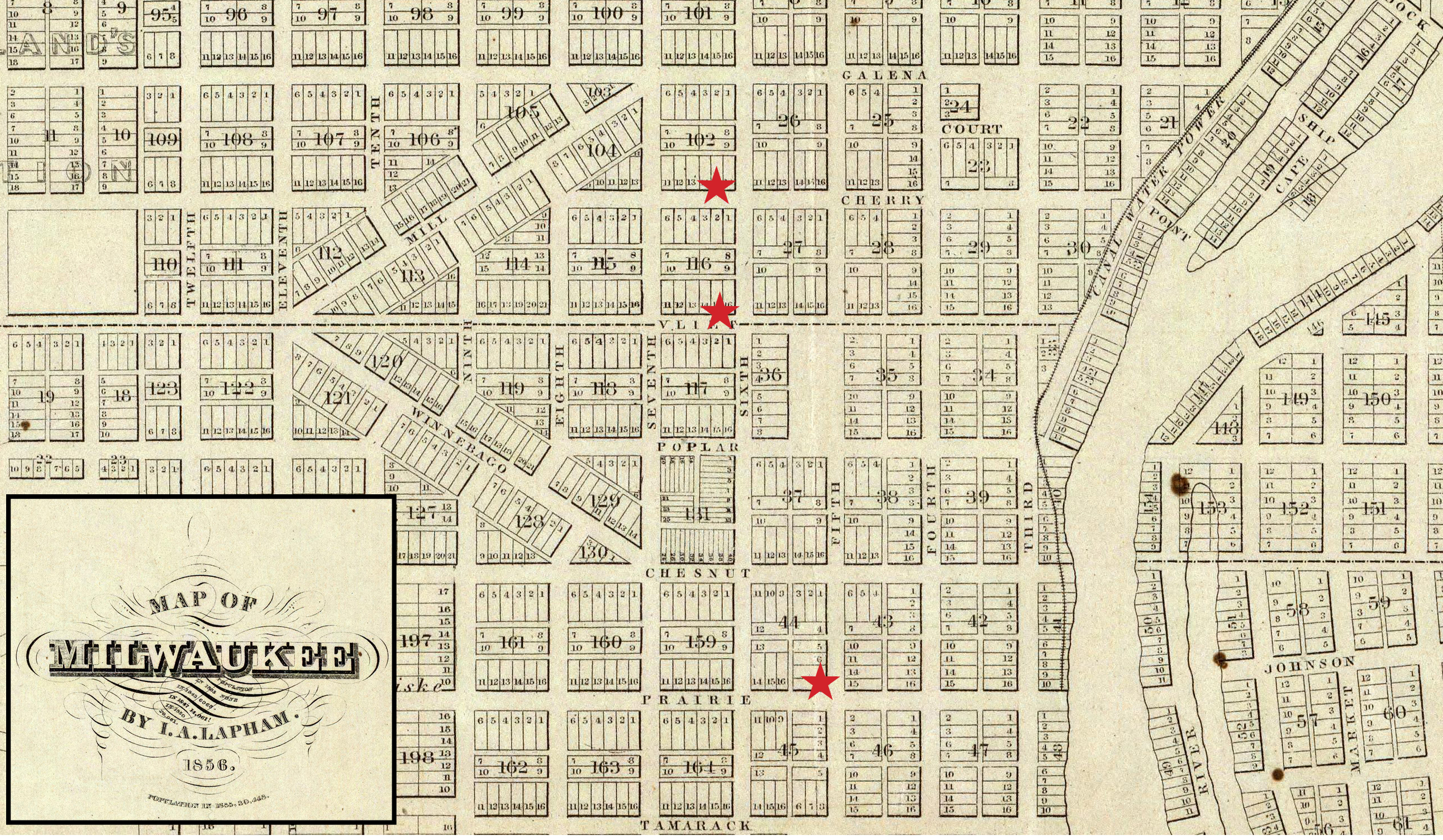
The red stars show locations where members of the Treutel family operated blacksmith and chandler shops in Milwaukee. At right is the Milwaukee River.
The Treutel family ran a tallow chandler shop near downtown Milwaukee. The shop sold soap and candles made from animal fat and other ingredients. At various times in the 1860s and 1870s, Adam Jr. worked as a railroad man, a tallow chandler and a tailor. The Treutels, some of whom lived in Milwaukee’s Second Ward, had good Darmstadt neighbors, including master brewers Joseph Schlitz and Phillip Best. When their father Johann Adam died in Milwaukee in 1859, some of the Treutel sons took up residence with other German families in Milwaukee.
Although his primary residence was in Mukwonago in Waukesha County, Philipp Treutel is listed in the 1863 Milwaukee city directory as having a blacksmith shop at the southwest corner of Fifth and Prairie in downtown Milwaukee. He is listed in the 1867 directory as living at 517 Cherry St., next door to his younger brother, Henry. So it appears Philipp moved between Milwaukee and Waukesha counties, probably based on availability of work.
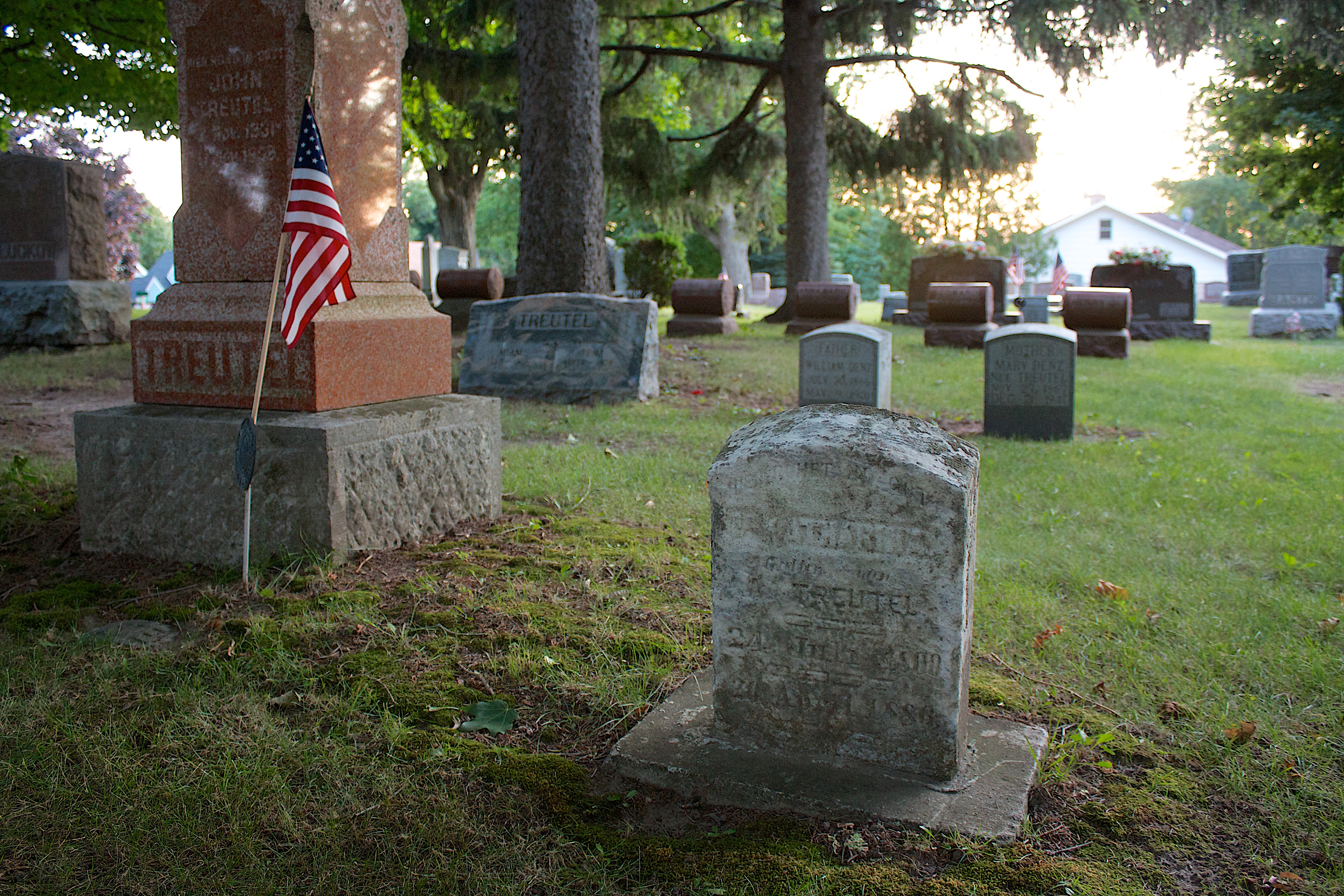
The tombstone of Katharina (Geier) Treutel sits in the shadow of the monument to her son, John, at Union Cemetery in West Bend, Wis.
Katharina Geier Treutel was born on July 24, 1800 in Hesse-Darmstadt, the daughter of Nicolaus and Elizabetha Geier. She married Johann Adam Treutel sometime around or just after 1820. She died on April 26, 1886 in the Town of Addison, Washington County, Wis., and is buried at Union Cemetery in West Bend. The cause of death was listed as marasmus senilis, which basically means old age. She had eight children, five of whom (along with 42 grandchildren) survived her. Her tombstone reads:
Hier Ruht in Gott (Here Rests in God)
Katharina
Gattin von (Wife of)
A. Treutel
Philipp Treutel settled in Mukwonago in Waukesha County, where he married Henrietta Krosch and fathered seven children, including Walter Treutel (father of Ruby Treutel Hanneman). He was a blacksmith, and probably learned the trade from his father. After Philipp’s death in 1891, Henrietta moved the Treutel family to Vesper in Wood County, Wisconsin.
Henry J. Treutel enlisted in the 26th Wisconsin Infantry Regimentduring the Civil War, and fought at the Battle of Gettysburg. Sebastian also joined the 26th Wisconsin, but was given a disability discharge in August 1863, possibly from wounds during the war. We don’t believe Philipp or John Treutel were called into service.
Henry, Sebastian and John Treutel eventually settled in the Town of Addison, Washington County. John was a carpenter. The 1870 U.S. Census for the Town of Addison shows a Jacob Treutel, 31,living at the John Treutel homestead. It is possible that Jacob, who would have been born about 1839, was a younger brother. Sebastian was also a carpenter, but he later worked hauling the U.S. Mailin Washington County. Henry operated a blacksmith shop, a store, a saloon and a cheese factory near the village of Aurora. He later moved to Wausau.
Based on all of the evidence we’ve gathered, it appears the Johann Adam Treutel family included Adam (1822), John (1831), Philipp and deceased twin brother (1833), Sebastian (1835) and Henry (1841). Other possible children are Peter and Jacob, but more research is needed to establish their lineage.
Family Line: Johann Adam Treutel >> Philipp Treutel >> Walter Treutel >> Ruby Treutel Hanneman >> Donn, David and Lavonne Hanneman.
Monument of Philipp Treutel, grandfather of Ruby (Treutel) Hanneman, at North Prairie Cemetery in Waukesha County, Wis. Philipp died in 1891.
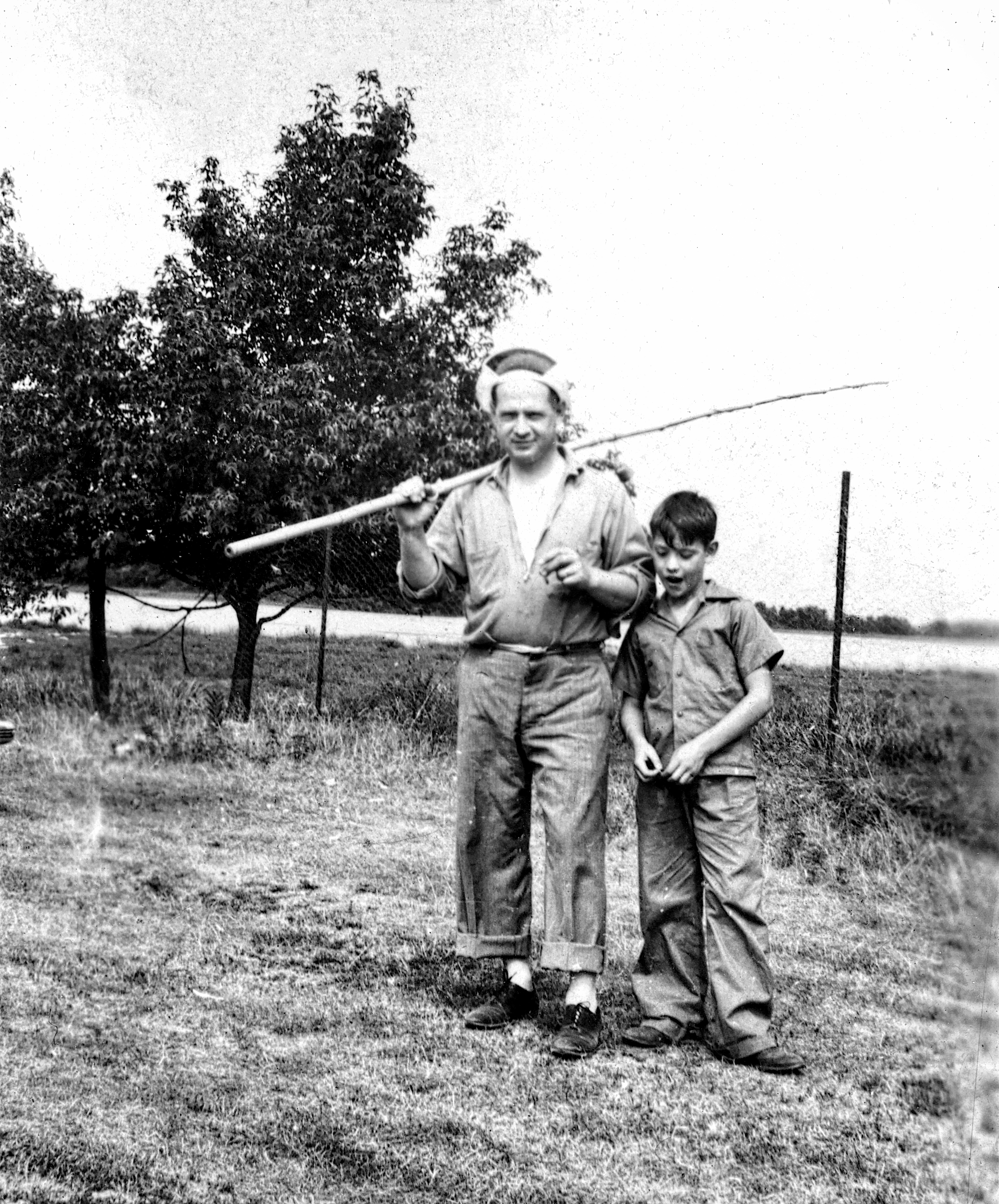
Photographs can document history in many ways, so it’s fun to look deeper into historical images to learn what they can tell us. The image atop this post shows a man and a boy. The man has a cane pole, so we can assume the pair has gone or is going fishing. Look a little deeper. The photo has a Rockwell-esque quality to it. Set in the summer of 1942, the photo shows Carl Henry Frank Hanneman (1901-1982) and his youngest son, David D. Hanneman (1933-2007). You can see Carl’s love for fishing — something he shared with his children and grandchildren who learned to fish on Mauston’s Lemonweir River.
The son is following along, asking questions of the fishing expert. What is he asking? Perhaps, “Hey, Dad, why don’t I have a cane pole?” It’s a time-honored tradition,passing on a love for fishing from one generation to the next. We’ll cover more of that in a future installment.
More than 60 years after it was first used to ward off mosquitoes and other pests in central Wisconsin, the lavender and citronella scent of Carl F. Hanneman’s Stay-Off bug repellent still lingers across time. The Mauston pharmacist invented his own blend of essential oils that provided a natural defense against biting pests, and he sold the product across the area for years.
Carl F. Hanneman sold his insect repellent at bars and bait shops all over central Wisconsin.
Carl Hanneman’s inspiration for his product came from his need for extra income, and his knowledge of chemistry and pharmacology. Even in the depths of World War II, when rationing made it difficult to obtain raw materials, Carl found a way to make Stay-Off and sell it at taverns, bait shops and resorts all over the area. Due to an abundance of lakes and rivers, Central Wisconsin is known for proliferation of mosquitoes and other flying pests during tourist season.
“His being a pharmacist allowed him access to some of the compounds needed to make this stuff,” recalled Carl’s son, David D. Hanneman. The topical elixir, which used an olive oil base and a secret recipe of lavender, citronella and other essential oils, was often mixed on the back porch of the Hanneman home in Mauston, Wis. “It was kind of comical,” David Hanneman said.
Aside from providing access to the needed ingredients, Carl’s role as pharmacist at the Mauston Drug Store had other benefits that helped him sell Stay-Off on his own time. “Because he was his own dispensary, he was able to upgrade his gas card,” David Hanneman said. “So we weren’t restricted and limited in traveling. We could go back on up north and go fishing or do whatever over weekends. And we’d drop off a dozen bottles here, and a dozen bottles at that bar, a dozen bottles over at that other fishery house.”
Carl F. Hanneman printed his own labels and wrote the ad copy for Stay-Off.
Carl wrote his own marketing copy to help sell the 4-ounce bottles of Stay-Off. “Stay-Off is not only an excellent insect repellent, but has that cool, soothing and refreshing feeling on hot summer days,” he wrote. “It is highly recommended for women and children’s skin, producing a soft tenderness due to the semi-olive oil base.” The lotion soothes existing bug bites and provides protection against strong sun rays, he wrote.
David Hanneman said selling Stay-Off was a nice side business for the family. “It gave us nice added income,” he said, although “we never got rich off the stuff.”
The recipe for Stay-Off called for making the mixture in 1 gallon batches. A half-gallon of Stay-Off and several 4-ounce bottles survive to this day. All of the ingredients are still commercially available. So even 60 years after it was first mixed, it would be possible to make more Stay-Off using Carl’s old recipe.
The Volstead Act that ushered in the era of Prohibition was designed to prevent the manufacture, transportation and sale of alcohol in the United States. Don’t tell that to the cows.
It seems some of the dairy cows belonging to Robert Hanneman of Portage County, Wisconsin, found themselves in a state of intoxication in July 1922. How? Some mischievous bootleggers thought it would be fun to leave a barrel of mash in the pasture for Hanneman’s cows to eat. When Hanneman arrived at the pasture one mid-July evening, he was shocked to discover a half-dozen hammered Holsteins.
Talk about your mooo-nshine.
Wood County Undersheriff Cliff Bluett responded to the call. “The whole herd was staggering around and they were in a worse intoxicated condition than any human can get,” Bluett reported.
According to the account in the Wood County Tribune: “One cow was missing entirely, another was dead drunk and could not be moved off the ground, five cows were finally driven into the barn but were so ‘pickled’ that it was found unsafe to leave them inside and had to be turned out and another cow was ‘so bad off’ that she collapsed in her over-intoxicated condition and could not be moved again, the undersheriff said.”
Farmer Hanneman reported one cow was so dead drunk she could not be budged from the pasture. Five bombed bovines stumbled about the barn and had to be let loose. Eventually, most of the crapulous cattle submitted to the evening milking. That left the farmer with a serious quandary: would this unusual “whole milk” put him afoul of Prohibition laws?
“A joke is a joke,” he said, “and we will deal with the culprits.”
No word if those pioneer cow-tippers were ever caught. Undersheriff Bluett was from Wood County, but the Hanneman farm was in Portage County. He sent his findings to his counterparts across the county line.















 The Hanneman Archive