Our photo library is a bit thin on photos from my mother’s Mulqueen side of the family, but we do have some nice images worth sharing. My Mom grew up in Cudahy (we always pronounced it coo-da-hi, although it’s actually cuh-dah-hay) and comes from a family of 10. The matriarch and patriarch were Margaret Madonna (Dailey) Mulqueen (1895-1982) and Earl J. Mulqueen Sr. (1895-1965).
Left to right are Uncle Joe Mulqueen, Aunt Lavonne (Hanneman) Wellman, Uncle Patrick Mulqueen, Grandma Ruby Hanneman and (I believe) Uncle Pat’s wife Ruth.
In the foreground is Grandma Margaret Madonna (Dailey) Mulqueen (1895-1982), and in the back is Grandpa Earl J. Mulqueen Sr. (1895-1965)
Grandma Margaret M. Mulqueen and Grandpa Earl J. Mulqueen Sr., on a visit to my folks’ house in Grand Rapids, Mich.
Sunday dinner at the Mulqueen house in Cudahy.
David C. Hanneman and Laura Mulqueen Curzon, circa 1965.
David C. Hanneman and Laura Mulqueen Curzon, circa 1965.
Looks like Laura Mulqueen Curzon got what she wanted for Christmas. In the background is Grandma Ruby Hanneman.
Looks like a dinner party at my parents house in Greenfield in the late 1950s.
I’m ashamed to say I’m not sure which of cousin Laura Mulqueen Curzon’s brothers this is. Taken in Colorado.
Grandma Margaret M. Mulqueen along with Aunt Evelyn Mulqueen.
Sister Madonna Marie Mulqueen holds baby David C. Hanneman, while Laura Mulqueen Curzon looks bored.
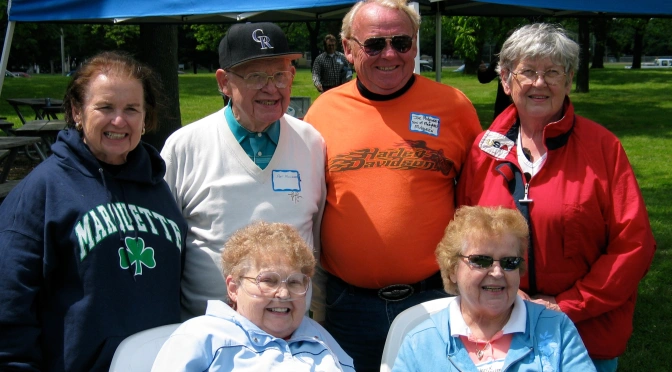
One of the last Mulqueen family reunions. Back row left to right are Aunt Ruth (Mulqueen) McShane, Uncle Patrick Mulqueen, Uncle Joe Mulqueen and Aunt Joanie (Mulqueen) Haske. Front row includes Sister Madonna Marie Mulqueen and Mom, Mary K. Hanneman.
A nice artsy shot of Mom, Mary K. (Mulqueen) Hanneman at the Hanneman house in Mauston, Wis.
Coming in the door are Grandma Margaret Mulqueen and Grandpa Earl J. Mulqueen Sr., along with Mom and Dad, David D. and Mary K. Hanneman.
Easter Sunday in the 1970s with Grandma Margaret Mulqueen, Laura Mulqueen Curzon, Mary Hanneman, yours truly, David C. Hanneman, and in front Margret Hanneman and Amy Hanneman Bozza.
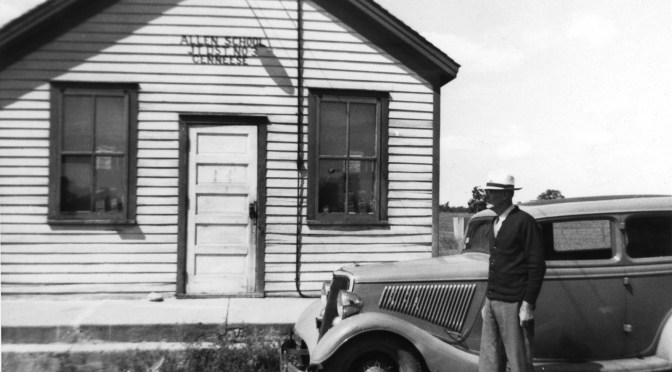
School must have seemed just a bit smaller when Oscar Treutel went back for a visit on August 24, 1942. In the 1880s, Oscar was a student at “Allen School” in Joint District No. 3 in the Town of Genesee in Waukesha County, Wisconsin. Let’s hope Oscar wasn’t returning for a spelling lesson, since the building has Genesee misspelled as “Genneese.” Perhaps the building lettering was a class project.
A young Oscar Treutel, circa 1899, when he was a college student in Waukesha, Wisconsin.
The school was in the southwest corner of the town on the E. Allen property, near the Saylesville Mill Pond. We should distinguish this one-room school from the Ethan Allen School for Boys, a reformatory in nearby Delafield that operated from 1959-2011.
Oscar traveled to school from the Treutel home in nearby North Prairie. He was the fifth child of Philipp and Henrietta Treutel, born Oct. 9, 1874 in Waukesha County. He moved with his family to Vesper in Wood County just after the turn of the century. He spent his sunset years in nearby Arpin. He died in 1967 at age 92.
I just learned with sadness of the death of my Dad’s older brother, Donn Gene Hanneman, who died in Minneapolis at age 88. Uncle Donn was the last of the Mauston Hanneman family to pass away. My Dad, David D. Hanneman, died in 2007 at age 74.
I have many memories of my uncle. He was foremost the father of nine wonderful human beings, my cousins Diane, Caroline, Tom, Jane, Mary Ellen, John, Jim, Nancy and Thomas Patrick (March 1-4, 1949). The cousins were raised by a saintly mother, my aunt Elaine Hanneman.
Donn G. Hanneman
Donn was a veteran of World War II and served as a seaman-second class on the USS Hoggatt Bay. The USS Hoggatt Bay (CVE-75) was a Casablanca-class escort carrier (crew of 860) commissioned in December 1943.
Donn G. Hanneman lounges outside his Grandpa Treutel’s home in Vesper, Wisconsin.
Donn was born on August 20, 1926, in Wisconsin Rapids to Carl Henry Frank Hanneman (1901-1982) and the former Ruby Viola Treutel (1904-1977). In 1936, the Hanneman family moved to Mauston in Juneau County, where Carl took a job as a pharmacist attached to the Mauston hospital and clinic. By that time, my father had come along (March 1933). In August 1937, the family expanded to include Lavonne Marie Hanneman Wellman (1937-1986).
As a boy, Donn had his share of illnesses and injuries. He spent more than a week in the Marshfield hospital in September 1929, then returned there in April 1930. Just before my Dad was born in March 1933, Donn was hospitalized in Wisconsin Rapids for more than a week, after an operation for appendicitis.
Donn Gene Hanneman sits in an indoor baby swing at the Hanneman home in Fond du Lac, Wisconsin, ca. 1927. Carl Hanneman was a pharmacist for the Staeben Drug Co. in Fond du Lac at the time.
Just after his 11th birthday in August 1937, Donn was standing on the running board of a moving vehicle while leaving the Juneau County Fairgrounds when he fell and suffered a head injury. He was seen at the Mauston clinic and taken home, but soon after “lost his power of speech and all consciousness,” according to an account in The Daily Tribune in Wisconsin Rapids. “He was then rushed to the hospital.” Donn was diagnosed with a concussion and put on two weeks of bed rest, although that was extended. The September 8 edition of The Daily Tribune said Donn “is making a satisfactory recovery, although he will be confined to his bed for two more weeks.”
Back in those days, a family’s every move ended up in the newspaper. In the case of the Hannemans, it was thanks to the faithful correspondence of Ruby Hanneman. “Mr. and Mrs. Carl Hanneman and little son Don Gene were completely taken by surprise last evening when forty friends arrived to give them a house warming on the occasion of moving into their new home on Hale Street,” the Wisconsin Rapids Daily Tribune reported on April 8, 1932.
Some of the most charming photographs in our library are of a 5-year-old Donn dressed up as a cowboy playing with friends on the sidewalks on the 1200 block of Washington Avenue in Wisconsin Rapids. We detailed those photos in a previous post.
Donn in his cowboy threads at Wisconsin Rapids.
As a youth Donn enjoyed books, and collected enough that his father built him a bookcase that held up to 175 volumes. Carl wrote to my then 6-year-old father about it in August 1939. Dad was staying with an aunt and uncle in Waukegan, Illinois. “Say David, I made a book case for Donn for his birthday, and you know that you still have something coming,” Carl wrote, “so what would you like to have Dad make something for you too, if so tell mother and I will try to start it as soon as I can.”
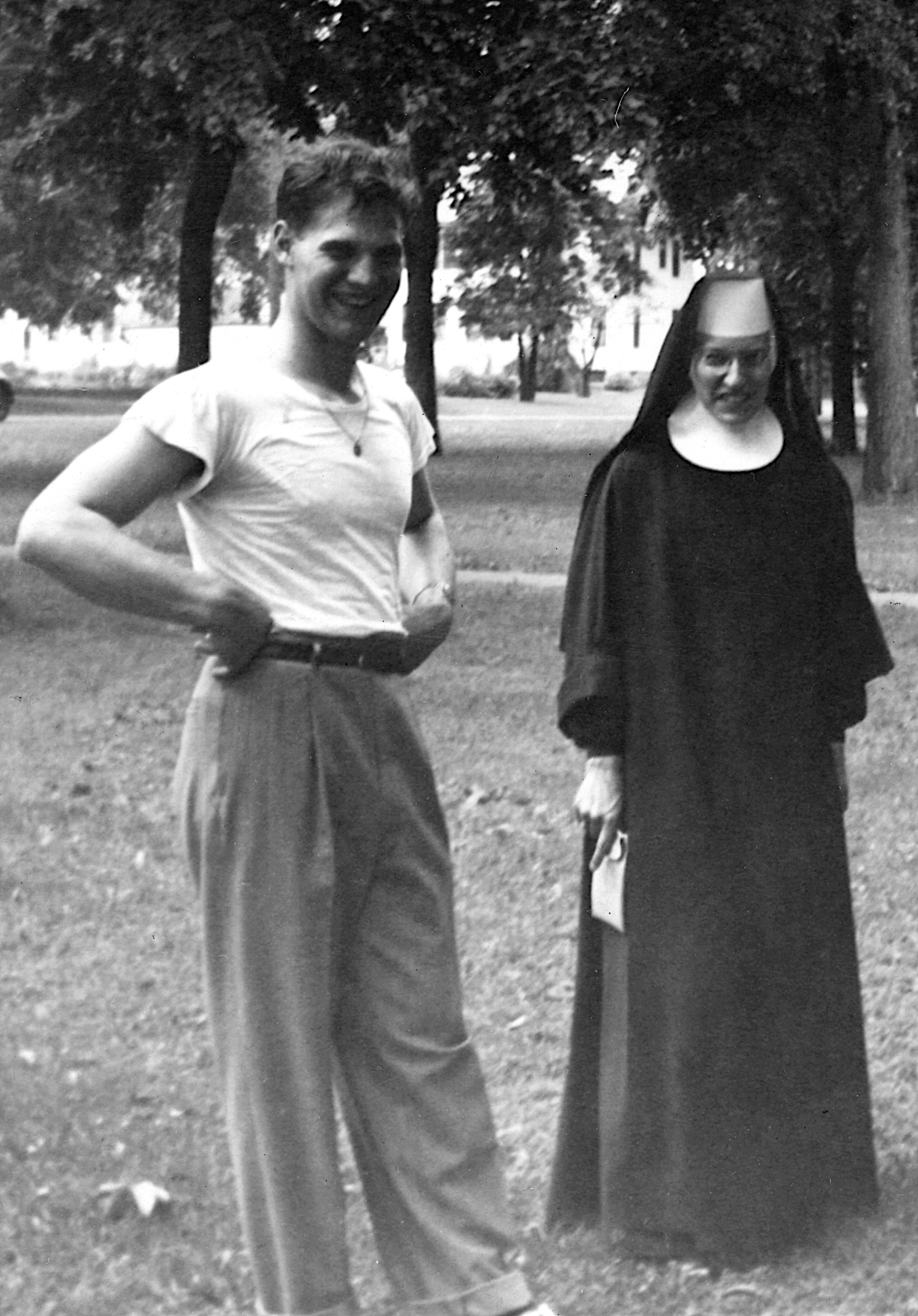
Donn G. Hanneman with Sister Emeric Weber of St. Patrick’s Catholic Grade School, 1948.
For a time Donn attended St. Patrick’s Catholic Grade School in Mauston, then run by the Benedictine Sisters. He was among the graduates attending the school’s 100th anniversary in 1995. At the event, he ran into one of his teachers, Sister Emeric Weber, who was just 19 when she started teaching at St. Patrick’s.
“Sister Emeric, I’m sorry I’m late,” he quipped, to which the aged nun replied, “What’s your excuse now? What’s your excuse?”
Like his brother David and father Carl, Donn was a longtime Fourth-Degree member of the Knights of Columbus, the world’s largest Catholic fraternal and service organization. He most recently belonged to Council 1013 in Rochester, Minnesota.
There are many others better qualified to provide more recent stories about Donn. And even though he tossed my father through the bay window of their Mauston home when they were boys, my Dad didn’t hold it against him. When he was ill with cancer in the fall of 2006, Dad put it simply and succinctly: “He’s my brother and I love him.”
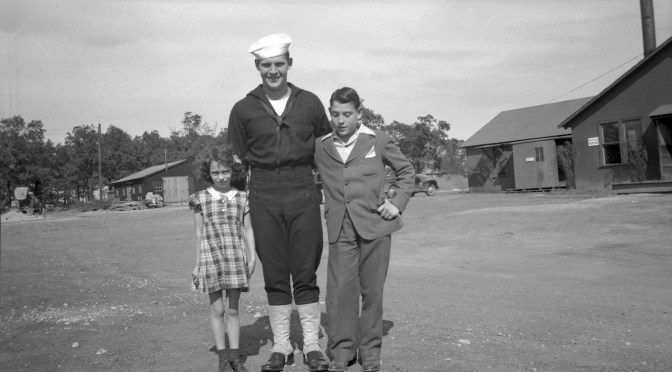
Donn G. Hanneman (center) in his U.S. Navy uniform, with sister Lavonne and brother David in 1944.
David D. Hanneman and older brother Donn G. Hanneman, circa 1935. Read more about the photo: http://wp.me/p4FxQb-v7
Donn G. Hanneman lounges outside his Grandpa Treutel’s home in Vesper, Wisconsin, circa 1930.
Donn G. Hanneman in the world’s smallest swimming pool.
Donn at the family home in Fond du Lac.
Donn Gene Hanneman, son of Carl F. Hanneman (1901-1982) and Ruby V. (Treutel) Hanneman (1904-1977), sits in an indoor baby swing at the Hanneman home in Fond du Lac, Wis, ca. 1927. Carl Hanneman was a pharmacist for the Staeben Drug Co. in Fond du Lac at the time.
Donn in his cowboy threads at Wisconsin Rapids.
Donn G. Hanneman wears a convincing looking police uniform, perhaps a Halloween costume.
Donn G. Hanneman looks like a lonely cowpoke with his wagon, circa 1930.
David D. Hanneman on the shoulders of brother Donn.
Donn G. Hanneman towers over his little sister, Lavonne Marie, circa 1941.
Donn G. Hanneman at the Mauston rail station, circa 1944.
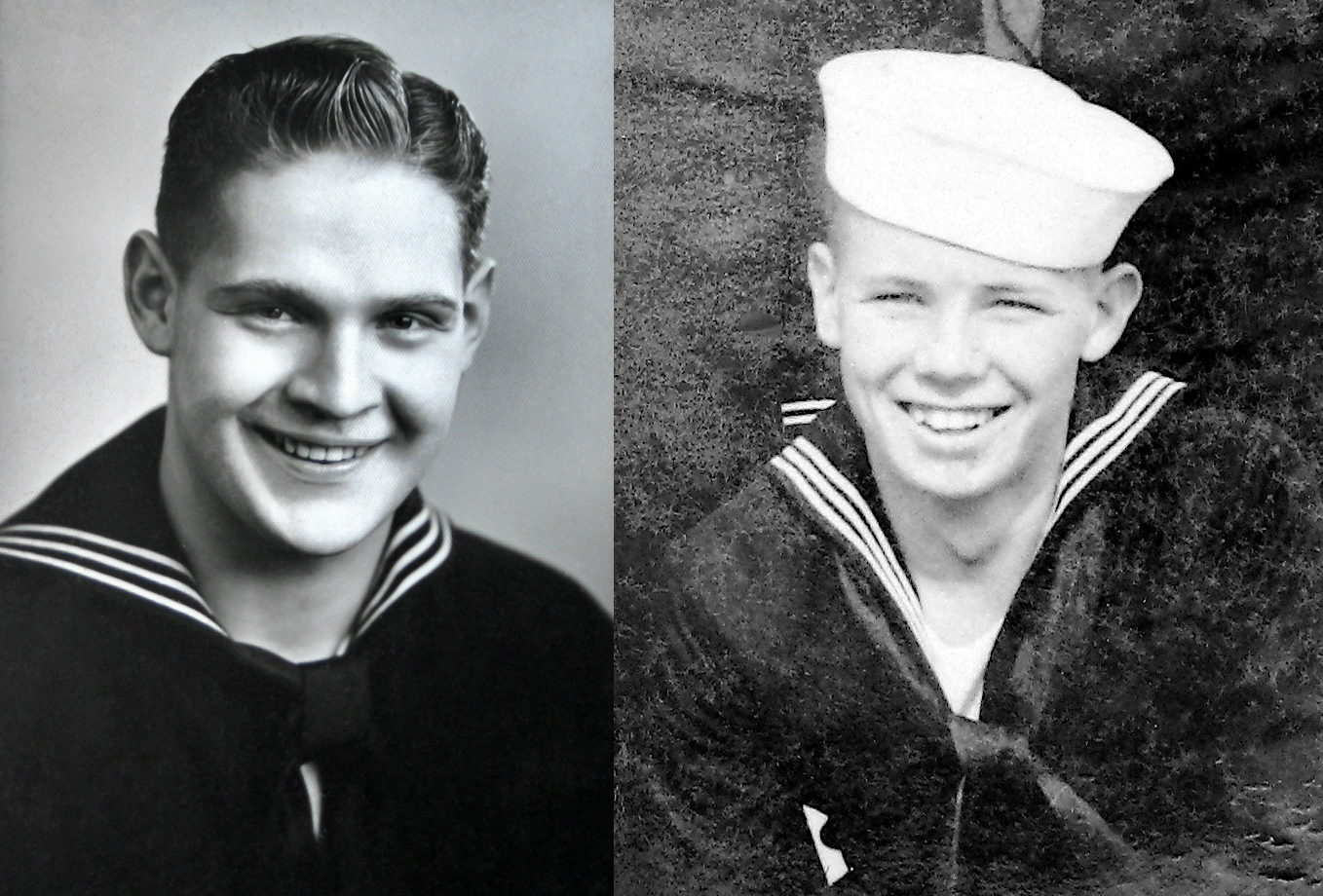
Donn G. Hanneman in his U.S. Navy uniform in 1944.
I remember well the first and last times I saw my father-in-law, Ron LaCanne.
In the nearly 25 years between these two events, I came to respect and love this man, whose story late in life became one of remarkable faith. I was incredibly moved by his quiet and steady faith in Christ and his hope of attaining glory in Heaven after his earthly journey, which ended earlier today at age 74.
It was such a long road away from the day I first met him. That was in early 1990, when I stopped at the LaCanne home on North Wisconsin Street in Racine to pick up his daughter Sue for a date. I was more than a bit nervous, because I had been told he was not fond of newspaper reporters. At the time, I was a reporter at The Journal Times, Racine’s daily newspaper. I sat on the couch and we chatted about the story I’d worked on that day, dealing with a Caledonia teenager who killed a dog, reportedly due to listening to heavy metal music. Somehow I survived the discussion and made a decent first impression on the man I would come to spend countless hours with over the next nearly 25 years.
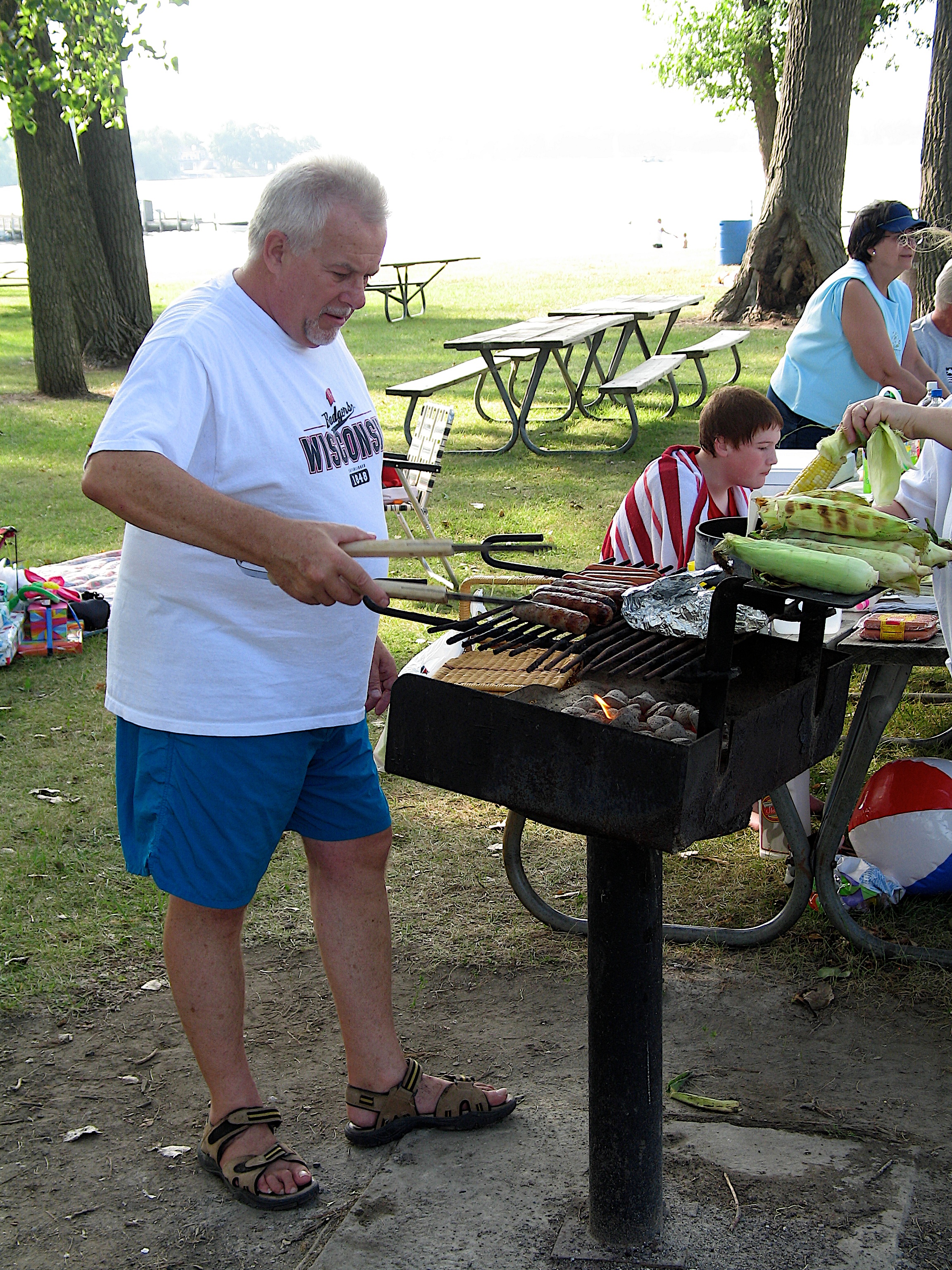
Ron in his favorite spot, working the grill.
My final and lasting impressions of him came in a series of visits this summer at the LaCanne apartment in Racine. Ron was thin, frail and dying from cancer. And although we’d been estranged in recent years, this time I was not nervous to visit. I presented him with a very special Rosary given to me by Catholic filmmaker Steve Ray. The Rosary had been placed on nearly a dozen sites in the Holy Land. This included Golgotha, the place of the crucifixion of Christ. He picked up the Rosary and felt the intricate carvings, then carefully laid it back in its olive wood box. I didn’t fully understand how much this touched him until a while later when the fire alarm went off in the apartment complex. He struggled to stand up from his recliner and grabbed two things: a hand-carved “comfort cross” given to him by a priest friend, and that Rosary. I struggled to hold back tears as my mother-in-law Eileen helped him out the door.
Two weeks later I visited again. This time he was confined to bed and drifted in and out of consciousness. We still had a nice talk, recalling stories and memories from across the years. I told him that many people were praying for him on his journey and that God would remain very close to him. “I sure hope so,” he said, squeezing my hand. A few minutes later, this solemn moment was replaced by laughter and joy. I told him that our oldest daughter Samantha was going to a concert that night. “A concert?” he said. He swung his hands out into the air and started singing the Alleluia Chorus from George Frideric Handel’s Messiah.We laughed at the joy and spontaneity of it. It seemed so appropriate, and so very beautiful. Wow.
Samantha, Stevie and Ruby with Gramps.
Several times we sat alone and talked about his final days on earth. He spoke freely and with stark honesty about his impending death. I encouraged him not to be afraid, since all of those who love him have complete faith that Jesus will not forsake him. “I’m not afraid to die,” he said. Then he asked me to do him a favor. “Can you help me identify the gentleman sitting on the couch over there?” There was no one on the couch. And since Ron had lost his sight over the past year, he would not have seen anyone there in the first place. But I could tell he was seeing something profound, even if it was beyond my vision. “Describe him to me,” I said. The visitor had dark hair and wore a cap. His expression was calm, peaceful and friendly. “He has been sitting there for the past two days,” Ron said. We talked a little more, and I suggested his visitor was a guardian angel sent by God to protect and comfort him. The idea was not foreign to me, as I’ve read a number of accounts by hospice workers of dying patients seeing angels.
We were on guard for weeks expecting Ron’s death, but he wasn’t about to follow any script. Just when we feared the worst, he would rally and have a great day or two. I recall one day pulling up to the apartment center and seeing him sitting outside in the sunshine, facing Lake Michigan. I asked him how he felt. “Doing great,” he said. “I feel really good.” On another visit, after listening to a preseason Packers game, we talked again about death and dying. “The time is near,” he said. I thanked him for the incredible witness he was providing to his grandchildren (and all of us). The Cross is heavy, and he knew it. But in his final months, weeks and days, he found peace. And now he is at peace.
I’ve always believed life is well-reflected in pictures, both on paper and ink and in the mind’s imagination. Many images of Ron come to me as I recall the last 25 years. Let me share just a few.
I remember the early afternoon of October 5, 2002. It was a very difficult day. I was driving Ron back to Racine from Children’s Hospital of Wisconsin in Wauwatosa. A short time before, his oldest son, Patrick, had died at the too-young age of 37. Ron exhaled loudly and struggled to find some words. “I’ll tell you, Joe, this is so hard. So hard. No one should have to experience the death of their child.” So very true. We drove and recalled favorite memories of Patrick. By the end of that drive, we both better understood the impact Pat had made on the family. It continues to this day. I can only imagine the embrace the two shared at their reunion earlier today!
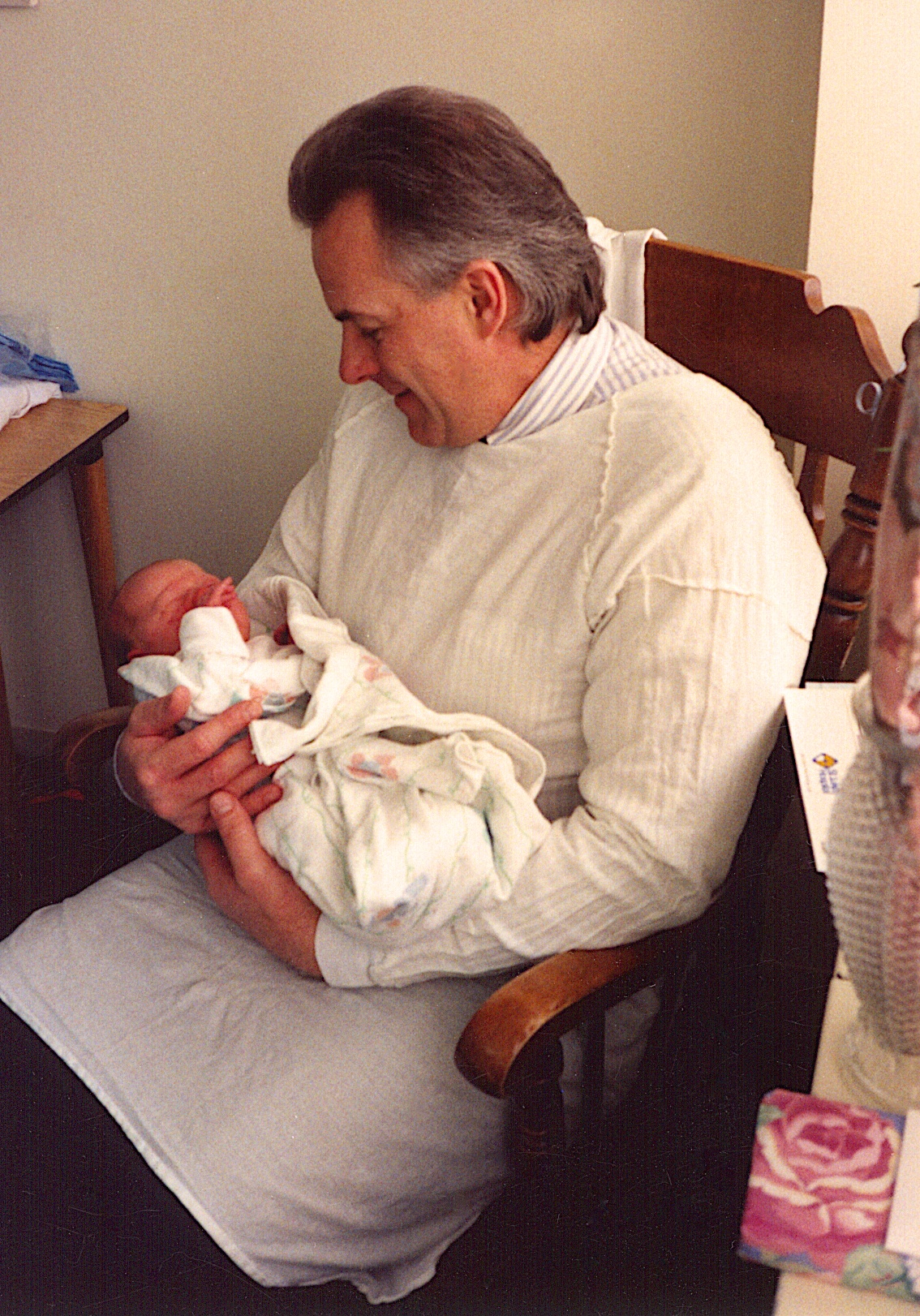
Ron LaCanne holds his first grandchild, Stevie, on January 21, 1992.
My mind rolls back to January 1992, when a well-dressed Ron stopped at St. Luke’s Hospital in Racine. He was on his way to his job at S.C. Johnson Wax, but had to stop first for some quality time with his first grandson, Stephen Patrick Hanneman. The photo my wife Sue snapped that morning tells of the joy and pride of a new grandpa. That day Ron earned the moniker he later awarded himself: “Gramps.”Gramps. He wore that title as well as anyone could, loving his five grandchildren like no one else.
Everyone always enjoyed July 4 at the LaCanne residence. While the grandkids were little, Ron went all out with a fireworks show as good as you’d see at the lakefront in Milwaukee or Racine. There were toy soldiers launched 100 feet in the air, returned to earth via parachute. And the Titanic, a huge brick of sound and color that should have come with its own fire department. On one occasion, one of the fireworks tipped over, firing projectiles across the gathered relatives. We all dove for cover under tables. “Incoming!” Over the years, Ron gave up the fireworks duty, but none of us could ever match those incredible displays.
Ron with grandchildren Samantha, Ruby, Josh and Geoffrey.
Speaking of displays, Ron was also the master of Christmas decorating. He always got two trees, one for the living room and one for the basement. His main tree was usually the tallest, fattest one on the lot, which he covered every square inch with ornaments, lights and beads. The rest of the house was festooned with lighted villages, Santa statues and a Nativity set that could reside at the Vatican. One year after a few seasons of collecting ceramic lighted Norman Rockwell houses, we put up an entire village on an expansive shelf space over our front door. After plugging it in, I danced down the upstairs hallway, singing, “Ron LaCanne, eat my dust!” Silly to be sure, but in a way, it was my own tribute to the master.
Every year, Ron played Santa at the LaCanne Christmas eve party. This was an event attended by dozens of family members. The food was diverse and plentiful, half the punch was spiked and the kids were all antsy in anticipation of Santa’s arrival. About 9 p.m., Ron would slip out of the living room, duck into a phone booth and emerge as Santa, always coming in through the front door. It was tradition that “Santa” would pick up the youngest grandchild for a photo. This often lead to either wide-eyed amazement or quivering tears. This was all followed by an orgy of gift opening for the kids. One year, an eagle-eyed granddaughter Samantha noticed that Grandpa was gone for a while, and when he returned, his hair was wet and he wore different shoes. Hmmmm. Another year, after Ron had retired from being Santa, youngest grandchild Josh LaCanne was determined to let Santa know the best gifts should be for him and not his brother, Geoffrey. When the red-clad bearded one (played by Ron’s son Chris) appeared at the party, young Josh got wide eyed and shouted, “Brother wants rocks!”
Ron and Eileen during an outing with Samantha and Stevie.
Ron and Eileen were always faithful attendees at the grandkids’ activities. Countless soccer games on chilly, windswept fields in Franksville, Christmas concerts, track meets, graduations. Ron was there with either a video camera or a still camera. Over the years he took thousands of photos and hours of video, often making commemorative books that he would present at birthdays or Christmas. I recall a time seeing a video that showed the family watching videos of the grandkids. Life imitates art.
As time went on and events in the world became more troubling, Ron decided he wanted his grandchildren to know about a simpler time, when right and wrong were easy to spot and traditional values where championed. So he started writing, tales of his childhood growing up as a Catholic boy in Racine. Stories, anecdotes and just things he wanted the kids to know, they were all included in this growing 100-page tome of Ronaldian wisdom. Occasionally he would share bits and pieces. What a gift these writings will be to his grandchildren and their children. I hope one day to be able to digitize them and format them into a book.
Ron was always willing to help out with a project. In 2007, after my father died of lung cancer, he helped me install a new floor in the upstairs hallway at my parents’ home in Sun Prairie. During my Dad’s illness, his little dog Chewy didn’t get as much attention and didn’t get put out as often. The result was he used the baseboards and the carpet for a bathroom. It was awful work pulling out the carpet, only to realize the baseboard, plaster and parts of the subfloor were contaminated. We worked for two days, first removing the mess, then treating the walls and subfloor with pure bleach to neutralize the smell. My eyes are still burning. When we were done, my Mom had a new wood floor and no more doggie smell.
We all gathered for a portrait at Nicholson’s in 2000.
When I was running my own marketing business, I tapped Ron’s business expertise and we worked together on some major projects for my client, Volvo Construction Equipment. I hired Ron to help me evaluate company financials, stock reports, annual reports and other business intelligence on prospective customers for Volvo. His analysis and detailed input allowed me to present market studies that were so well-received I still hear compliments about them, nearly a decade later.
I could go on for pages, but time is fleeting. Ron lived a very full 74 years. He gave much of his time, from his days in the U.S. Army, to volunteering in the community to groups such as the Opportunity Center and United Way. He rose high in the ranks at one of America’s great brand companies, SC Johnson Wax. But it was and is his family that was the love of his life. On Sunday evenings when everyone gathered in the living room after another of Eileen’s great dinners, Ron would pat his stomach and look around the room. “Mi familia!” he would say. Nothing can top having your family surrounding you. How he loved his wife Eileen, daughter Sue, sons Patrick and Chris (and wife Elise); and his grandkids, Stevie, Samantha, Ruby, Geoffrey and Josh.
My thoughts return to the man with the Rosary, clutching it and the Cross like an anchor during a time of fear and uncertainty. This will be Ron’s everlasting lesson and legacy. To carry the Cross through good and bad times in life, maintaining the hope of things unseen. As his life came to a close, Ron returned to his roots and his embraced his Catholic faith. It was his comfort and salvation. To use a phrase from his ancestors’ native tongue, La fede mi da vita:Faith gives me life.
The spring of 1854 must have seemed full of promise for the Johann Friedrich Krosch family. After 55 years growing up and raising a family in the Kingdom of Saxony, Frederick Krosch prepared to leave his home at Jessnitz and set out for America. Two of his sons, William, 29, and Karl, 30, came to Wisconsin in 1850, and now it was time to join them.
So in May 1854 the Krosch family left their hometown along the Mulde River and began the long journey to America. When the sailing ship Bertha left the Port of Bremen around June 12, there were six Kroschs among the 218 passengers onboard: Frederick, wife Christiana, 53, sons Augustus Frederick, 20; Reinhold, 16; and Gustav, 11; and daughter Henrietta, 16.
August F. Krosch
Officially known as the Barque Bertha, the ship was a multi-mast sailing vessel. It was very likely a rough journey, with the ship both dependent on, and at the mercy of, the North Atlantic winds. The Krosch family started the voyage in steerage, the least comfortable part of the ship.
During the journey passengers noticed a shark following the ship for days, according to family stories passed down through generations. This was most upsetting, since a shark following a vessel was believed to signal impending death on board. Old sailors’ lore held that sharks had the ability to sense if someone on board was near death.
At one point a severe storm blew up and damaged the ship’s rigging. The carpenter aboard the Bertha refused to scale the mast to make repairs. So Augustus Krosch hoisted himself up and fixed the mast, allowing the Bertha to be back underway. Shortly after, the Krosch family was moved from steerage to a cabin for the rest of the journey. Augustus and Reinhold then got jobs working as carpenters aboard the Bertha.
The family sold everything to make the journey to America. The Krosch men kept their money in money belts worn under their clothing. Although the belts painfully chafed the skin, no one dared remove them for fear of being robbed.
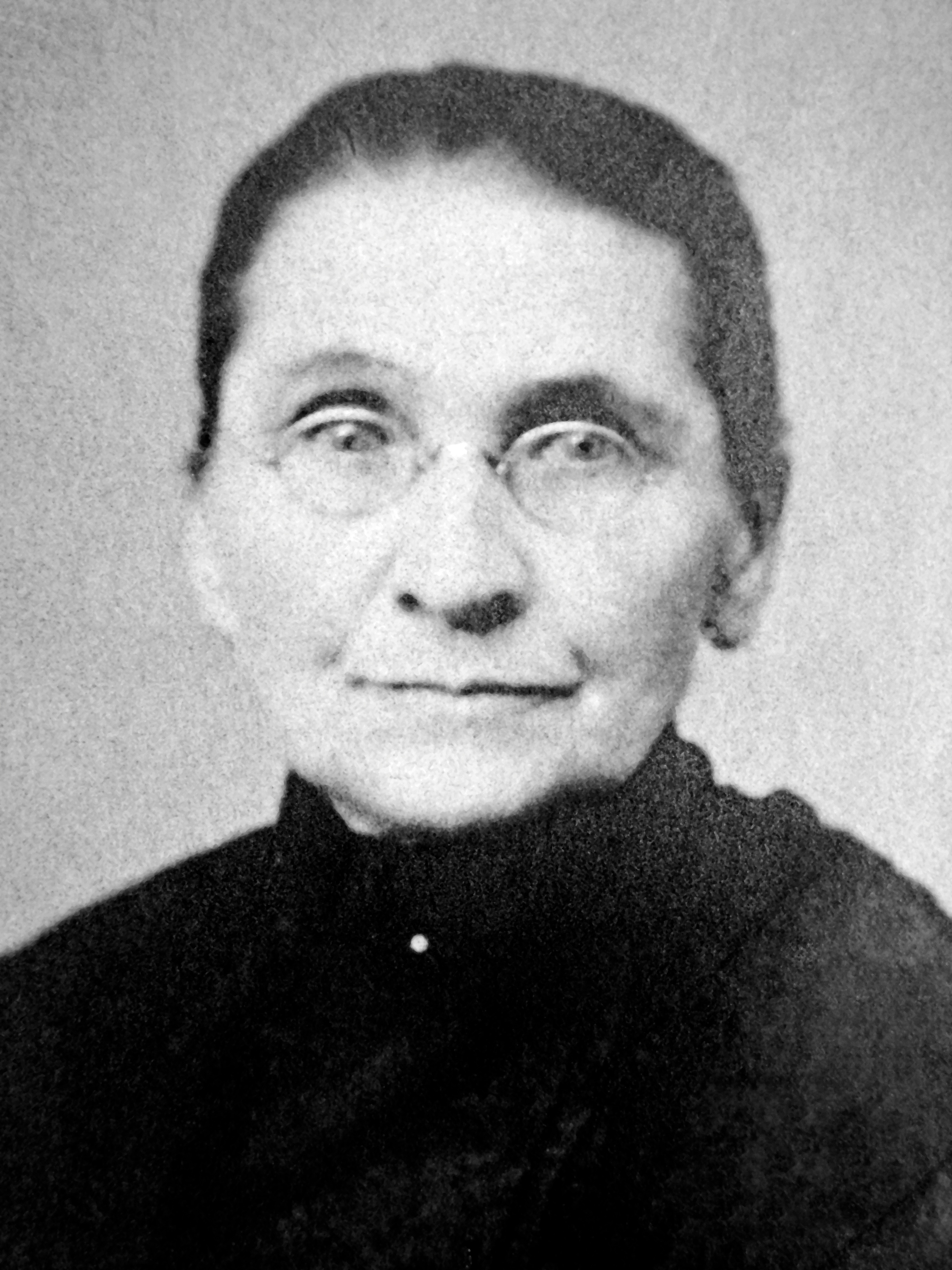
Portrait of Henrietta (Krosch) Treutel (1838-1908). Henrietta Krosch came to America in July 1854 at age 16 from the town of Jessnitz, Saxony, Germany.
Brisk trade winds pushed the ship backward, delaying arrival in New York by a week. About two-thirds of the way across, the Bertha encountered “large quantities” of ice, according to voyage record filed in New York by the ship’s master, named Klamp.
On Thursday, July 20, 1854, the Bertha arrived at the Port of New York after 40 days at sea. The Kroschs then traveled to Chicago, likely by steamboat and railroad. Hotel accommodations in Chicago were scarce, so the family took the only room they could find. But an infestation of bedbugs forced them to flee the hotel for a livery stable, where they spent the night.
From there they likely rode the train to Milwaukee, and then continued on until reaching East Troy in Walworth County, where Karl and William were living. Frederick purchased land in nearby Mukwonago and started a farm. His daughter, Henrietta, met and married a blacksmith named Philipp Treutel. They first established their home in Mukwonago and later moved to North Prairie.
Frederick Krosch is buried in Oak Knoll Cemetery at Mukwonago, Wisconsin.
William Krosch settled near the village of Eagle, and married Christiana Naumann in 1857. “My father’s farm was only 80 acres. It was mostly woodland, so he worked very hard to clear some for farming,” wrote Amelia Krosch Richardson in a 1940 memoir. “There was but my brother Will and myself at that time. We had a sister, Ida, who died when she was four years old of diphtheria and one baby sister that did not live. Both are buried near our home in Wisconsin.” The story of Ida Krosch was chronicled in an earlier article.
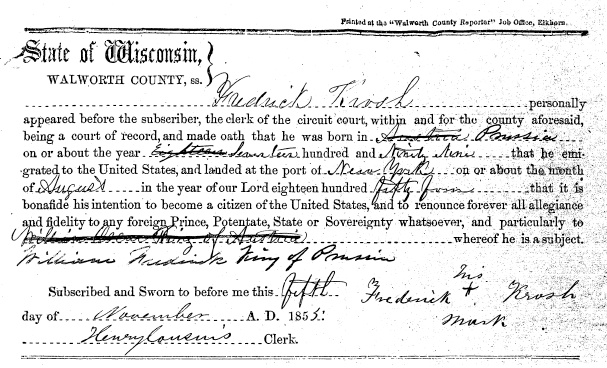
On November 5, 1855, Frederick Krosch (1799-1876) filed his declaration of intent to become a U.S. Citizen.
Eventually, William, Augustus and Gustave Krosch moved west and settled around Blue Earth, Minnesota. After Frederick Krosch died in 1877, his wife Christiana moved to Minnesota, where she died in 1881. Reinhold and Karl stayed on their farms near Lake Beulah in Walworth County, Wisconsin.
FAMILY LINE:John Frederick Krosch >> Henrietta (Krosch) Treutel >> Walter Treutel >> Ruby V. (Treutel) Hanneman >> Donn, David and Lavonne Hanneman.
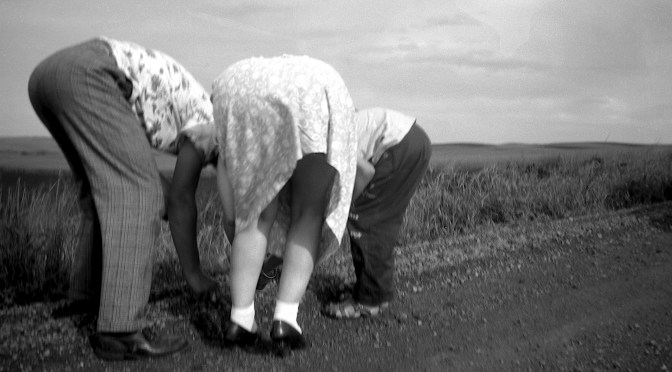
It wasn’t such a curious hobby, collecting rocks, but more in how it was done. Ruby Viola (Treutel) Hanneman (1904-1977), simply could not resist picking rocks up off the ground wherever she went. And judging by the facial expressions of those around her, it became somewhat of a family joke.
Lavonne Hanneman can’t resist laughing as her mother Ruby bends down to pick up rocks on a trip to South Dakota in 1947.
Rock collecting was certainly a Hanneman tradition. Uncle Wilbert G. Hanneman (1899-1987) had a rock shop up in Wausau, from which many a Hanneman child procured varieties of colorful, polished rocks. I have a bag of them to this day. Ruby liked to get her collectibles the old fashioned way, by finding them. She’d bend down to grab the most interesting or unusual ones, and husband Carl F. Hanneman (1901-1982) was often nearby to capture the moment on film.
David D. Hanneman’s priceless facial expression says it all, as his father Carl snaps yet another photo of mother Ruby picking up rocks.
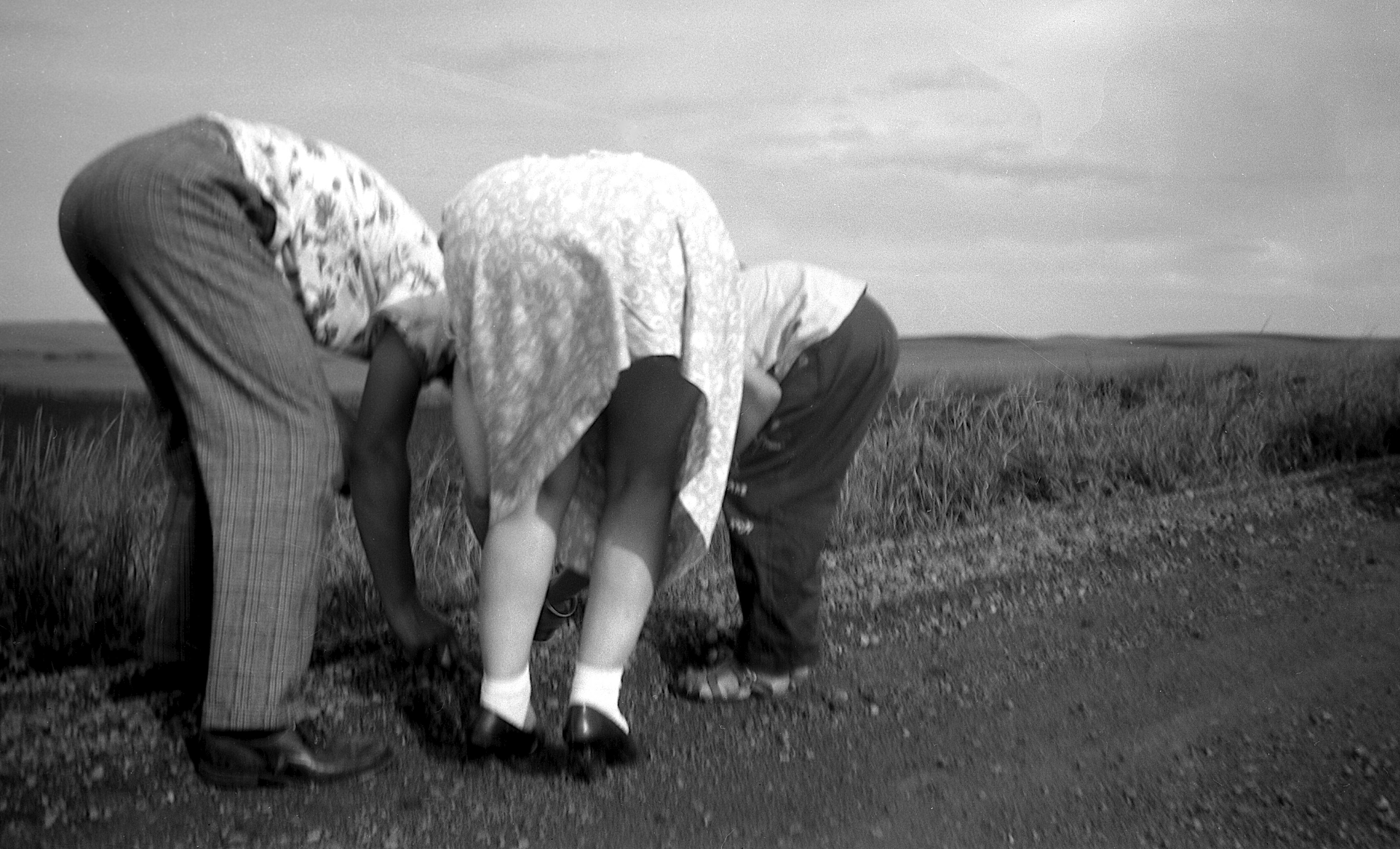
The best examples of this hobby (or habit) came on a family trip from Mauston, Wisconsin, to Williston, South Dakota in 1947. After getting caught all bent over on several photographic occasions, Ruby and the kids shot back. They put their heads together and gave old Carl Hanneman a two-cheek salute.
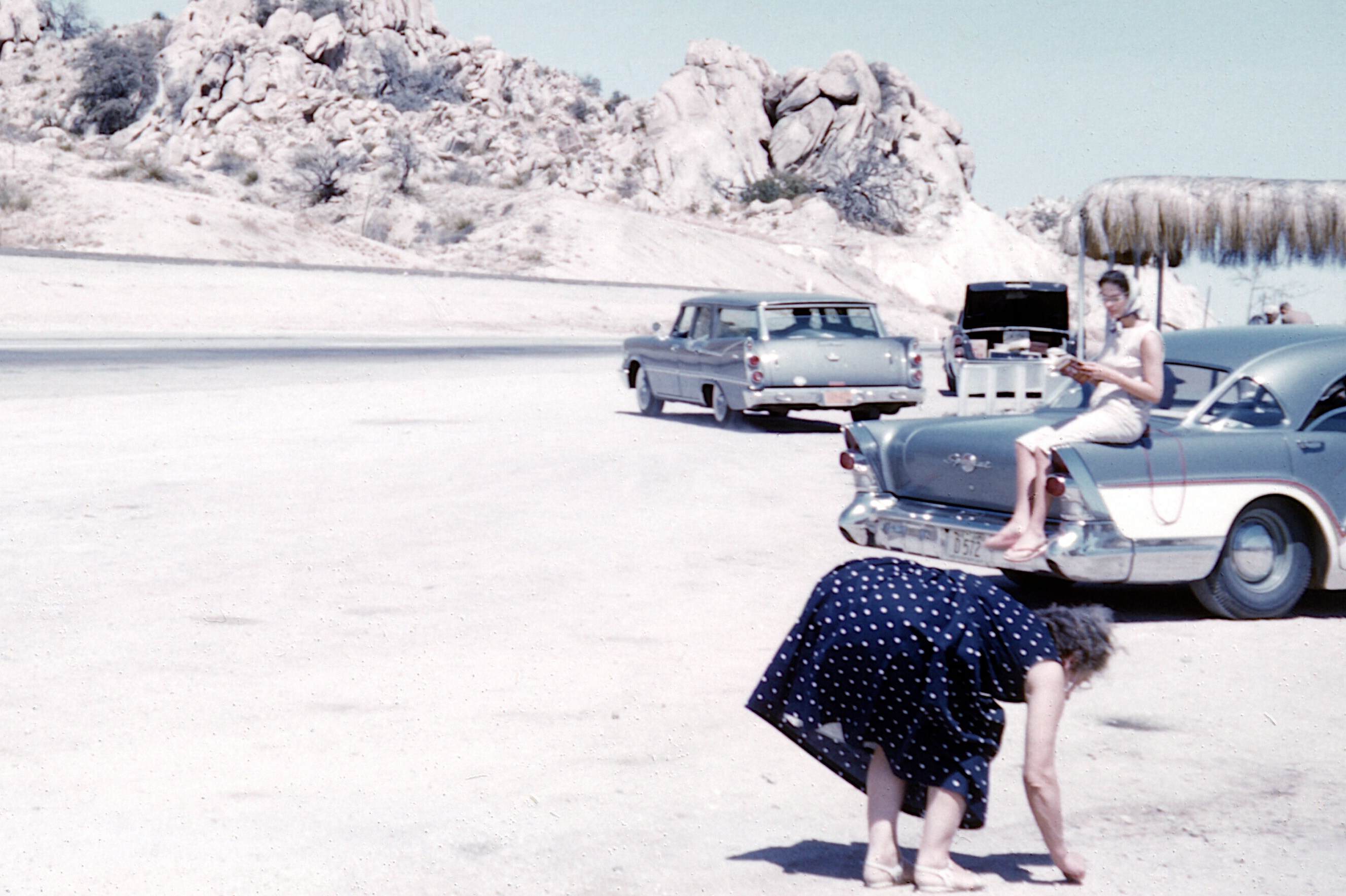
David and Lavonne Hanneman joined their mother Ruby in offering a rear-end salute to cameraman Carl F. Hanneman.This photo proves Ruby’s habit was not a passing fad. Here she gathers samples on a trip to Phoenix in 1959.
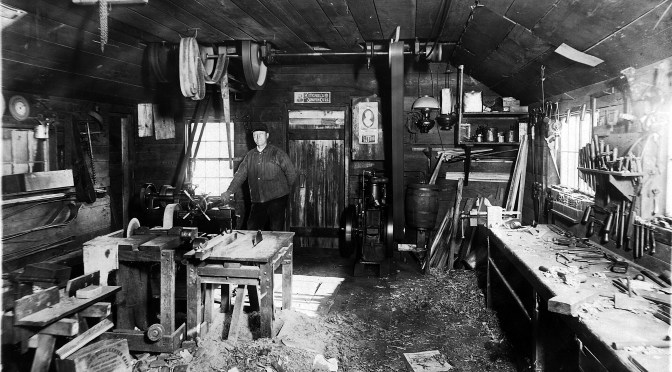
Charles Treutel (1869-1958) poses in the Treutel Bros. Shop at Vesper, Wisconsin, in 1911. Charles and his brother Henry A. Treutel (1864-1962) opened a blacksmith operation in Vesper after moving to Wood County from Mukwonago, Wis., in 1901. As can be seen in the photo, the Treutels also did carpentry work. The brothers later expanded their shop and made the transition from shoeing horses to tuning up engines and selling agricultural implements.
A 1911 book, Vesper, Wisconsin: A Sketch of A Model City, described the business this way:
Charles and Henry Treutel, skilled mechanics, have operated the blacksmith and wagon shop at Vesper since Nov. 1901 and have built up a large and prosperous business by courtesy and excellent workmanship. They are masters of every line of their business and are especially skilled in horseshoeing and repair work. In addition to their shop work the Messrs Treutel carry a large line of farm implements and their mechanical knowledge has enabled them to select the best makes in all the lines of machines they carry. They have a model shop fully equipped for their work.
The Treutel Bros. learned their trade from their father, Philipp Treutel (1833-1891), who came to America from Germany in 1854. As detailed in a previous post, the Treutels were blacksmiths, carpenters, tallow chandlers and tailors from near Darmstadt, Germany. Philipp Treutel is buried at North Prairie, Wisconsin.
— This post has been updated with additional information.
It is common knowledge to family members that Carl F. Hanneman was born on Oct. 28, 1901. But when he needed proof of that fact back in 1946, there was none to be found. On Feb. 22, 1946, Carl sent a letter and the 50-cent fee to the Wood County register of deeds, asking for a copy of his birth certificate.
Register of Deeds Henry Ebbe sent the letter back with an answer that must have shocked Carl: “There doesn’t seem to be any birth certificate for you on the above date. There is a Ruben born Oct. 21, 1901. Father Chas. and Mother Rose. Could this be yours? I am returning your 50 cents.”
The earliest known photo of Carl Henry Frank Hanneman, born 28 Oct 1901.
That set Carl off scrambling to find proof of his birth. He asked the pastor of the Moravian Church of Wisconsin Rapids for help. Carl’s parents, Charles and Rosine Hanneman, joined the Moravian Church on March 29, 1907. Church records did list Carl F’s birthdate as Oct. 28, 1901, so Moravian Minister George Westphal wrote a letter testifying to the church records. But since Carl was not baptized in the Moravian church, this record was only indirect evidence of his birth.
If Carl had turned to U.S. Census records (which were not available at the time), it might have confused the matter more. The 1910 Census lists the youngest son of Charles and Rosa Hanneman as Harold Hanneman, age 8. Carl’s first middle name is Henry, so no doubt the Census worker simply wrote it down wrong.
So what happened? It’s not clear, but we do know the record was officially corrected. Carl’s birth certificate still shows the name Ruben and the wrong birthday, but the errors are crossed out and replaced with the correct information. Wood County Health Officer Frank Pomainville corrected the record in red ink in 1960.
In a state where the one-room schoolhouse was quite the norm in the early 1900s, tiny Vesper, Wis., boasted an impressive two-story brick school building that was the center of learning for area children for decades.
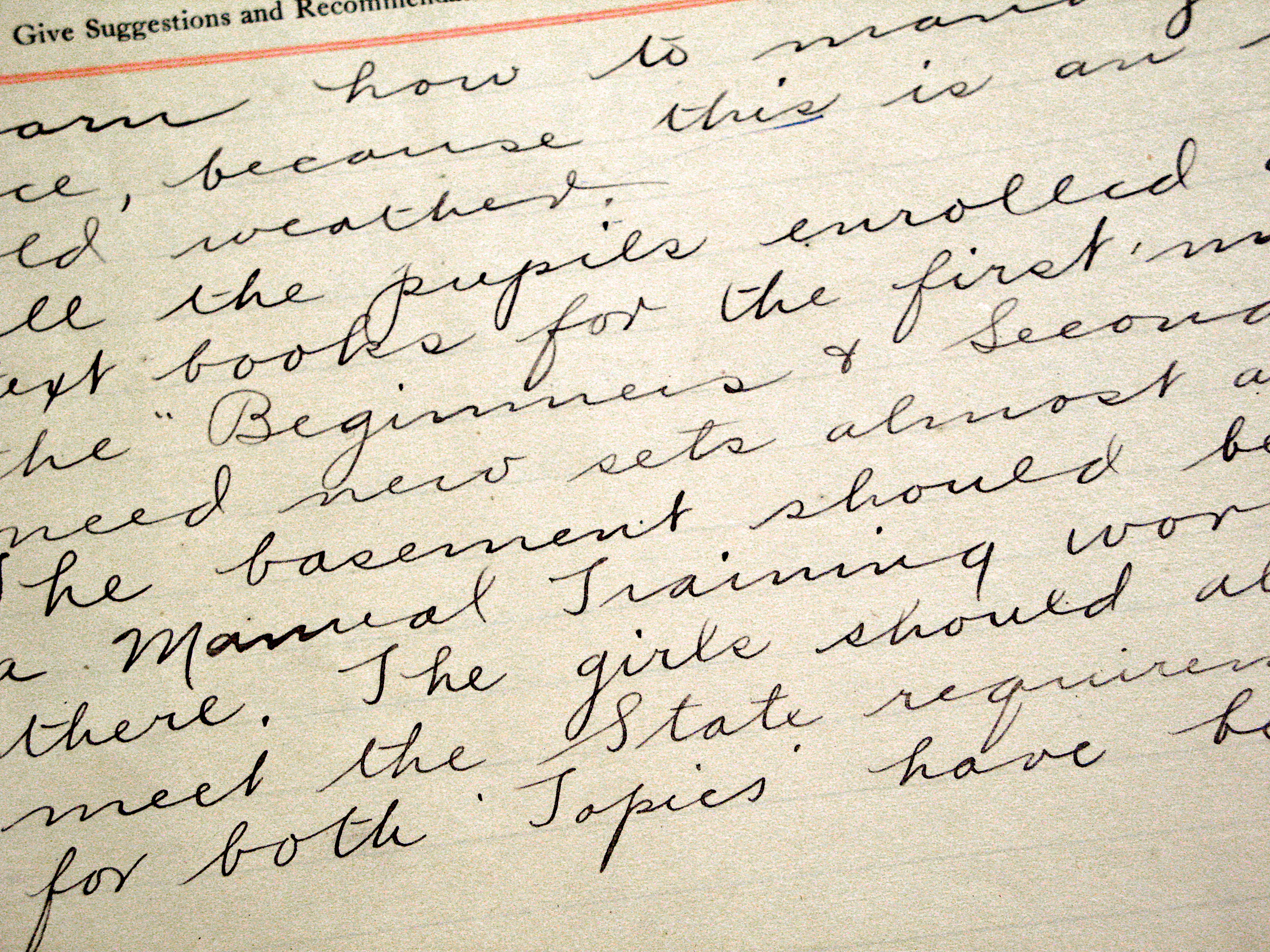
Built in 1906 just off of Main Street in Vesper, the Vesper Graded School was home to students of District No. 1, Town of Hansen. We get an interesting look at life inside the school from a teacher’s record book covering the years 1911-1917. The “Welch’s System Attendance, Classification, Gradation and Close Supervision” book belonged to Ruby (Treutel) Hanneman, who attended Vesper school starting in 1913 and later taught at the school.
The teacher kept detailed notes on conditions at the school, in addition to records of student performance and attendance.
The detailed notes in the book make one thing very clear: the teacher had her hands full each school year. Not only did one woman handle teaching duties for lower and upper grades, but she had to manage the building and contend with a cranky, bulky coal furnace each winter.
During the years covered in the record book, Vesper had three teachers: Mabelle Rowland in 1911-1912, Ella H. Hessler from 1912-13 to 1914-15, and Sara Icke in 1915-16 and 1916-17. Teachers were paid between $50 and $60 per month. Ruby’s uncle, Henry Treutel, served on the school board in early years (his son Harold attended classes during that time). In the late 1920s, another uncle, Charles Treutel, was also on the board.
It seems the biggest challenge for the teachers was not in the classroom but the furnace room. The coal-fired furnace often belched smoke and gases into the clean-air intake and into the classrooms. “Before you begin school learn how to manage the drafts of furnace and cold air shafts,” wrote Mabelle Rowland in her 1912 “Teacher’s Report to Successor.” “The inspector is very critical on this work.” Teacher Ella Hessler wrote one year later: “The furnace needs repair. The smoke enters the fresh air. The furnace work in cold weather is too heavy for a woman.” Similar notations were made in subsequent years.
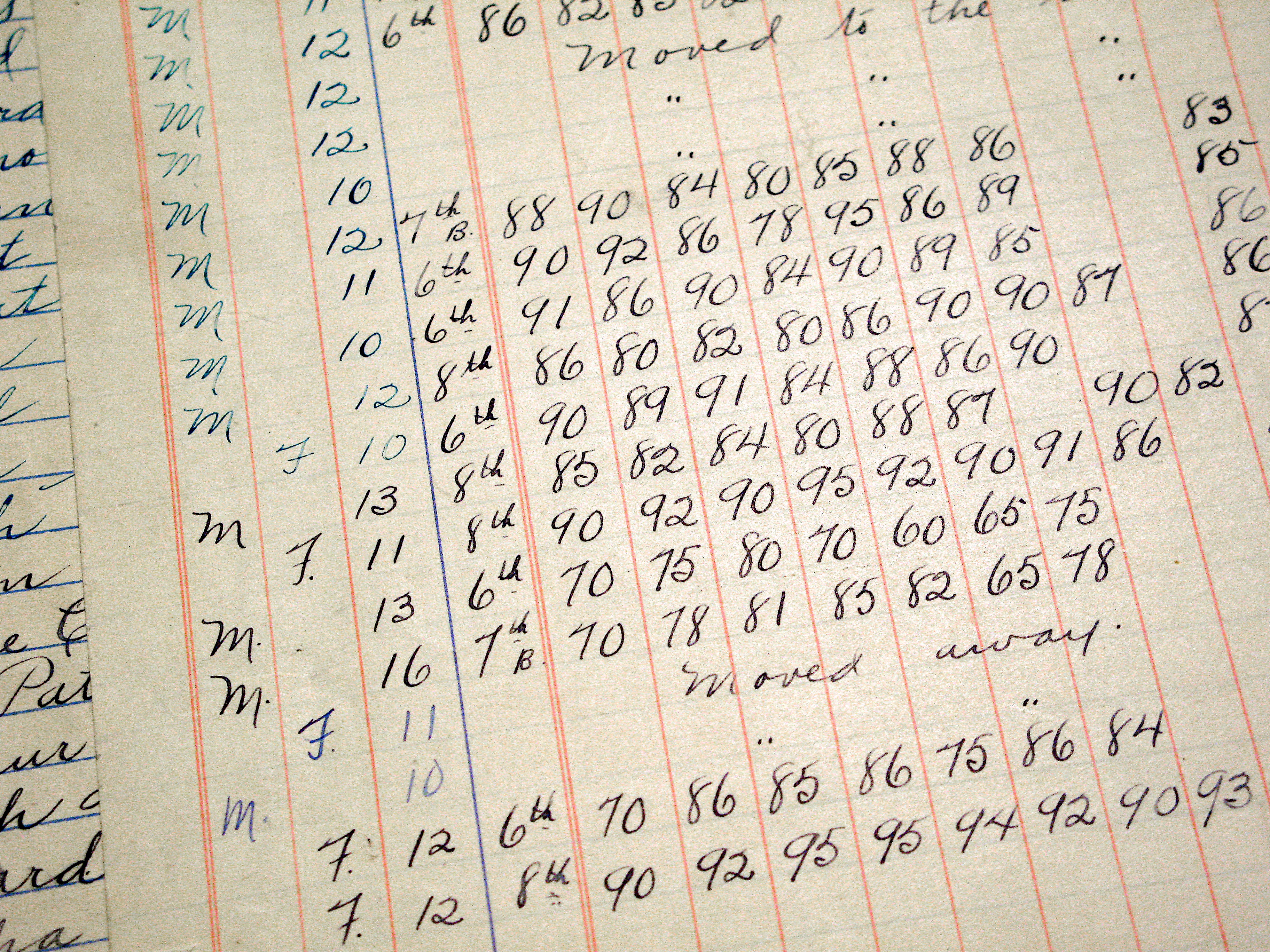
Each student’s attendance and academic performance were tracked in detail.
The school typically served from 25 to 40 students per term. Primary grades were on one level and upper grades on the other. The teacher staggered the subjects so she could get lessons started for one group and then move to the other.Classes started at 9 a.m. and students were dismissed for the day at 4 p.m. Course work included arithmetic, history, language, reading, grammar, physiology, domestic science for girls, manual training for boys, civics and geography.
Some of the children walked to school from homes nearby in the village, while others came in from the countryside. Tardiness was common, due to distance walked, duties at home or a pokey walking pace. In 1911-1912, Alfred and Agnes Peterson were the brother-sister tardiness champs with 20 and 17 instances, respectively. Clara Zieher had 18 tardy notations, followed by Erma Dassow with 15 (her brother Elmer had just 4). Absence from school was also common due to illness or duties helping at home. On occasion a student or two left school for a month or two to perform farm work. Arnold Conklin had best attendance in 1911-1912, only missing one day out of 180.
Absences were common from illness or need to stay home and work on farm chores.
The book tracked each student’s attendance and progress on a range of subjects. Teachers made notations for some students that ranged from “fair worker,’“weak eyes” and “slow” to “hard worker,” “irregular and very nervous,” and “dull.”
In the 1911-1912 school year, the school library had a mere 50 volumes. The school invested in books each year, and by June 1917 the library’s holdings included 144 books. For obvious reasons, the boys’ and girls’ out buildings regularly needed repairs and painting. The number of trees on school grounds that were in “thrifty condition” ranged from four to seven.
Ruby Treutel enrolled at Vesper Graded School in November 1913, when she was 10. There was some indication she had attended a parochial school prior to that. During her first year, Ruby missed 21.5 days and was tardy six times. Her cousin Harold Treutel had a mere three sick days. Ruby received good grades for the term: orthography, 91; reading, 95; writing, 90; arithmetic, 70; grammar, 89; geography, 83; and constitutions, 90. During the 1914-1915 school year, Ruby was out sick 20 days, but she still maintained As and Bs in all of her subjects.
The teacher’s annual summary provides interesting detail on all conditions at the school.
During the 1915-1916 term, Ruby excelled in all of her courses, scoring solid ‘A’s in orthography, reading, grammar, U.S. history and physiology. Her lowest grade was a ‘B’ in geography and arithmetic.
Harold Treutel graduated from Vesper Graded School in 1917 and enrolled at Lincoln High School in Grand Rapids.Ruby graduated from Vesper in 1918, also enrolling at Lincoln High School. That may be where she first met Carl F. Hanneman, whom she would marry in July 1925.
The old Vesper Graded School is now a private home, shown here in 2006.
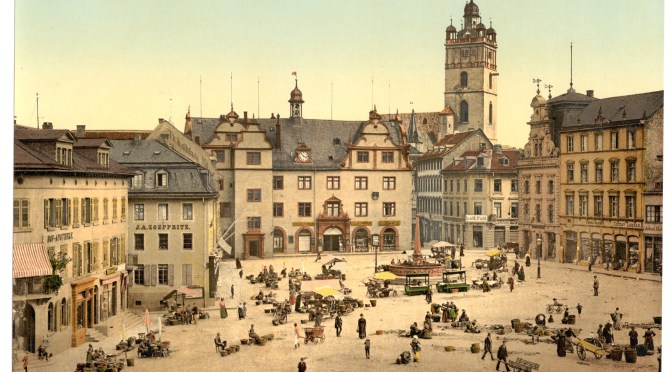
They were craftsmen — blacksmiths, tailors, chandlers, carpenters — the clan of Treutels who came to Wisconsin from the Darmstadt area of Germany starting in 1849. The Johann Adam Treutel family left the village of Königstädten between 1849 and 1854 and headed for America. They were part of a huge wave of German emigrants that changed the face of Wisconsin and the United States.
The Wisconsin branch of the Treutel family tree is from Königstädten, a village just northwest of the city of Darmstadt. From this “king’s village” came Johann Adam Treutel and his wife, Elizabetha Katharina (Geier) Treutel. According to the Hessisches Staatsarchivin Darmstadt, Adam, Katharina and at least some of their children left for America in July 1854. The emigration index simply lists that the eldest Treutel traveled “with his family.”
Their sonJohn Treutelhad already been in Wisconsin for some two years when they departed Germany. We believe the 1854 traveling party included at least three other Treutel children: Philipp Treutel, 21; Sebastian Treutel, 19; and Henry J. Treutel, 13. Their destination was Milwaukee. In May 1849, the eldest Treutel child, Adam, left for America, living in New York for a time before moving to Milwaukee.
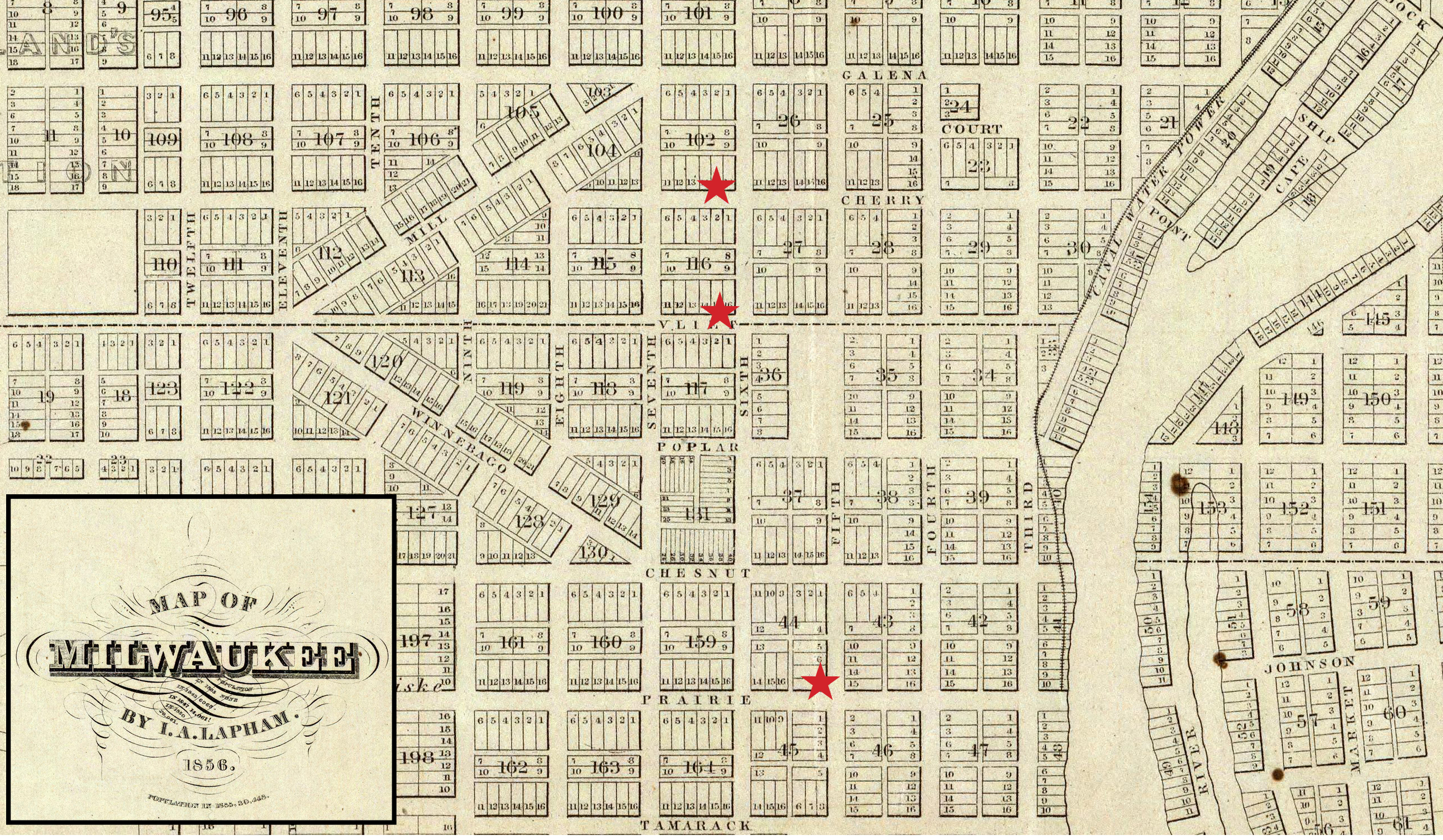
The red stars show locations where members of the Treutel family operated blacksmith and chandler shops in Milwaukee. At right is the Milwaukee River.
The Treutel family ran a tallow chandler shop near downtown Milwaukee. The shop sold soap and candles made from animal fat and other ingredients. At various times in the 1860s and 1870s, Adam Jr. worked as a railroad man, a tallow chandler and a tailor. The Treutels, some of whom lived in Milwaukee’s Second Ward, had good Darmstadt neighbors, including master brewers Joseph Schlitz and Phillip Best. When their father Johann Adam died in Milwaukee in 1859, some of the Treutel sons took up residence with other German families in Milwaukee.
Although his primary residence was in Mukwonago in Waukesha County, Philipp Treutel is listed in the 1863 Milwaukee city directory as having a blacksmith shop at the southwest corner of Fifth and Prairie in downtown Milwaukee. He is listed in the 1867 directory as living at 517 Cherry St., next door to his younger brother, Henry. So it appears Philipp moved between Milwaukee and Waukesha counties, probably based on availability of work.
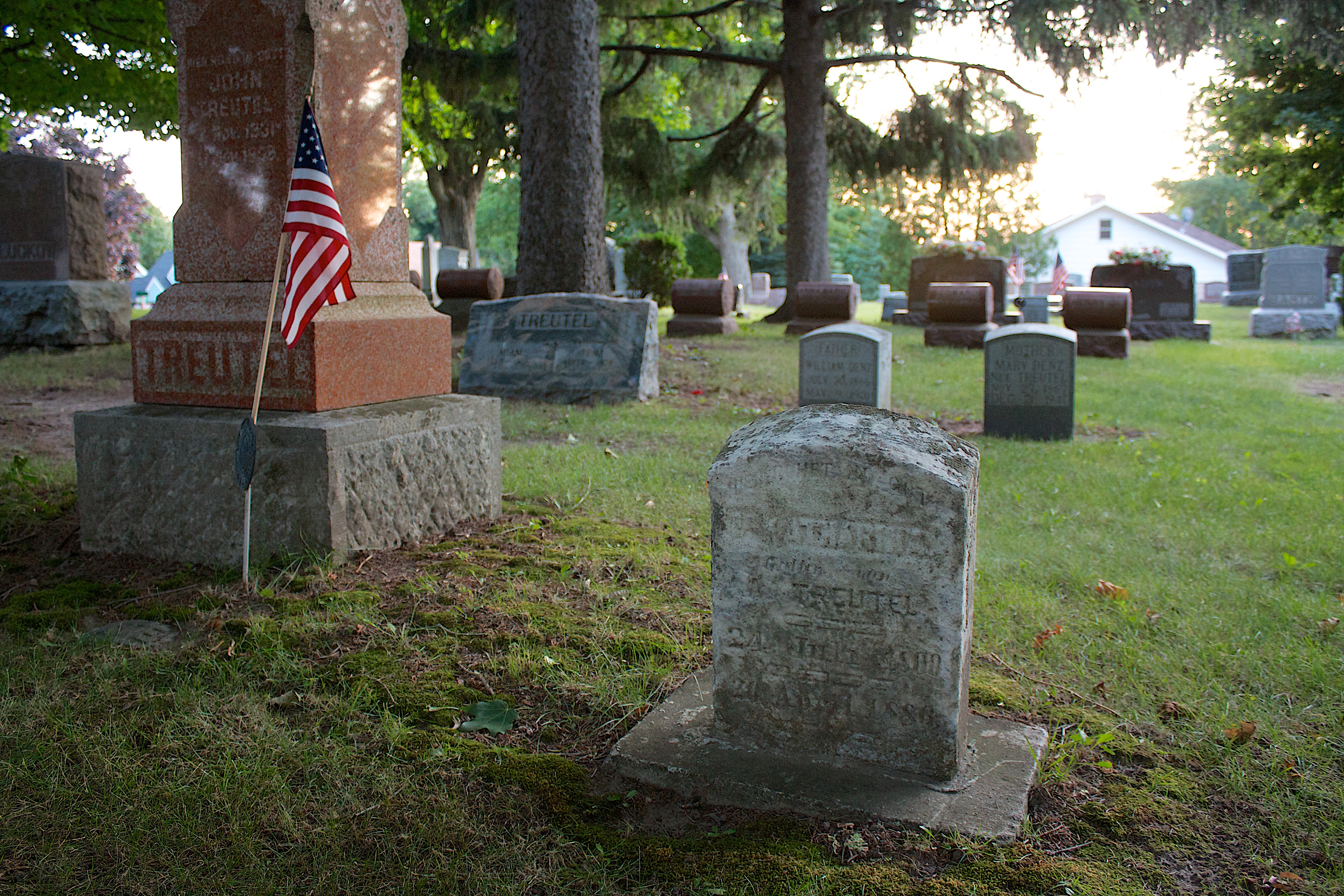
The tombstone of Katharina (Geier) Treutel sits in the shadow of the monument to her son, John, at Union Cemetery in West Bend, Wis.
Katharina Geier Treutel was born on July 24, 1800 in Hesse-Darmstadt, the daughter of Nicolaus and Elizabetha Geier. She married Johann Adam Treutel sometime around or just after 1820. She died on April 26, 1886 in the Town of Addison, Washington County, Wis., and is buried at Union Cemetery in West Bend. The cause of death was listed as marasmus senilis, which basically means old age. She had eight children, five of whom (along with 42 grandchildren) survived her. Her tombstone reads:
Hier Ruht in Gott (Here Rests in God)
Katharina
Gattin von (Wife of)
A. Treutel
Philipp Treutel settled in Mukwonago in Waukesha County, where he married Henrietta Krosch and fathered seven children, including Walter Treutel (father of Ruby Treutel Hanneman). He was a blacksmith, and probably learned the trade from his father. After Philipp’s death in 1891, Henrietta moved the Treutel family to Vesper in Wood County, Wisconsin.
Henry J. Treutel enlisted in the 26th Wisconsin Infantry Regimentduring the Civil War, and fought at the Battle of Gettysburg. Sebastian also joined the 26th Wisconsin, but was given a disability discharge in August 1863, possibly from wounds during the war. We don’t believe Philipp or John Treutel were called into service.
Henry, Sebastian and John Treutel eventually settled in the Town of Addison, Washington County. John was a carpenter. The 1870 U.S. Census for the Town of Addison shows a Jacob Treutel, 31,living at the John Treutel homestead. It is possible that Jacob, who would have been born about 1839, was a younger brother. Sebastian was also a carpenter, but he later worked hauling the U.S. Mailin Washington County. Henry operated a blacksmith shop, a store, a saloon and a cheese factory near the village of Aurora. He later moved to Wausau.
Based on all of the evidence we’ve gathered, it appears the Johann Adam Treutel family included Adam (1822), John (1831), Philipp and deceased twin brother (1833), Sebastian (1835) and Henry (1841). Other possible children are Peter and Jacob, but more research is needed to establish their lineage.
Family Line: Johann Adam Treutel >> Philipp Treutel >> Walter Treutel >> Ruby Treutel Hanneman >> Donn, David and Lavonne Hanneman.
Monument of Philipp Treutel, grandfather of Ruby (Treutel) Hanneman, at North Prairie Cemetery in Waukesha County, Wis. Philipp died in 1891.



















 The Hanneman Archive