For a child growing up in the 1930s and 1940s, big adventure often came in small packages. Like many boys his age, David D. Hanneman (1933-2007) was an avid collector of Big Little Books. These chunky mini-books allowed adventure-seeking children to follow the action of Buck Rogers, Dick Tracy, Flash Gordon, Tarzan and other characters. All for 10 cents a book.
The original Big Little Books concept was pioneered by the Whitman Publishing Company of Racine, Wisconsin. Whitman was a subsidiary of Western Publishing, the creator of the famous Little Golden Books (think Poky Little Puppy). Big Little Books were roughly 3¾ inches wide by 4½ inches high. Thickness varied by page count. For example, the 1934 Buffalo Bill and the Pony Express had 380 pages and was 1¼ inches thick. The layout was one of the classic features of Big Little Books. Each page spread had text on the left side and a black-and-white illustration on the right.
Big Little Books had text on the left-facing pages and illustrations on the right pages.
Whitman Publishing came out with its first Big Little Book in 1932, The Adventures of Dick Tracy. Soon after, Whitman had titles with comic strip characters like Wash Tubbs, as well as a range of Walt Disney titles. The 1934 series alone included titles such as Chester Gump Finds the Hidden Treasure, Buck Rogers in the City Below the Sea, Reg’lar Fellers, Betty Boop in Snow White, Kayo and Moon Mullins, Mickey Mouse in Blaggard Castle and Dick Tracy and the Stolen Bonds.
Most of the books had hard covers, although my Dad had one Buck Rogers title that was softcover and in a slightly smaller format (only 4¼ inches high). This book had no page numbers. The inside back cover spread was a two-page ad for Cocomalt drink mix. The 1935 Tom Mix and Tony Jr. in Terror Trailwas a larger format (4 5/8 by 5¼ inches) and featured real photographs inside.
Ruby V. Hanneman wrote an inscription on the inside cover for my Dad’s 8th birthday.
For my Dad’s 8th birthday, he received a copy of the 1941 Tarzan the Untamed by Edgar Rice Burroughs. Ever the historian, my Grandma Ruby V. Hanneman wrote the particulars down in blue pencil on the inside front cover: “David Dion Hanneman, March 27, 1941, for 8th birthday, from Dad, Mother, Lavonne and Donn.” This title was from the Better Little Books series, also published by Whitman. In addition to the story and illustrations, it had a flip-book feature that showed an animation as the reader flipped the pages through his thumb and forefinger.
Titles in the 1941 Better Little Books series included Big Chief Wahoo and the Magic Lamp, Mickey Mouse on Sky Island, Popeye and a Sock for Susan’s Sake, G-Man and the Gun Runners, Dick Tracy and his G-Men, Red Barry Undercover Man, Ellery Queen and the Adventure of the Last Man’s Club, Inspector Charlie Chan Solves a New Mystery and others. By the time he was in high school, my Dad stopped adding to his collection. But they clearly held a special place in his heart, since he kept and safeguarded them for more than 50 years before passing them on.
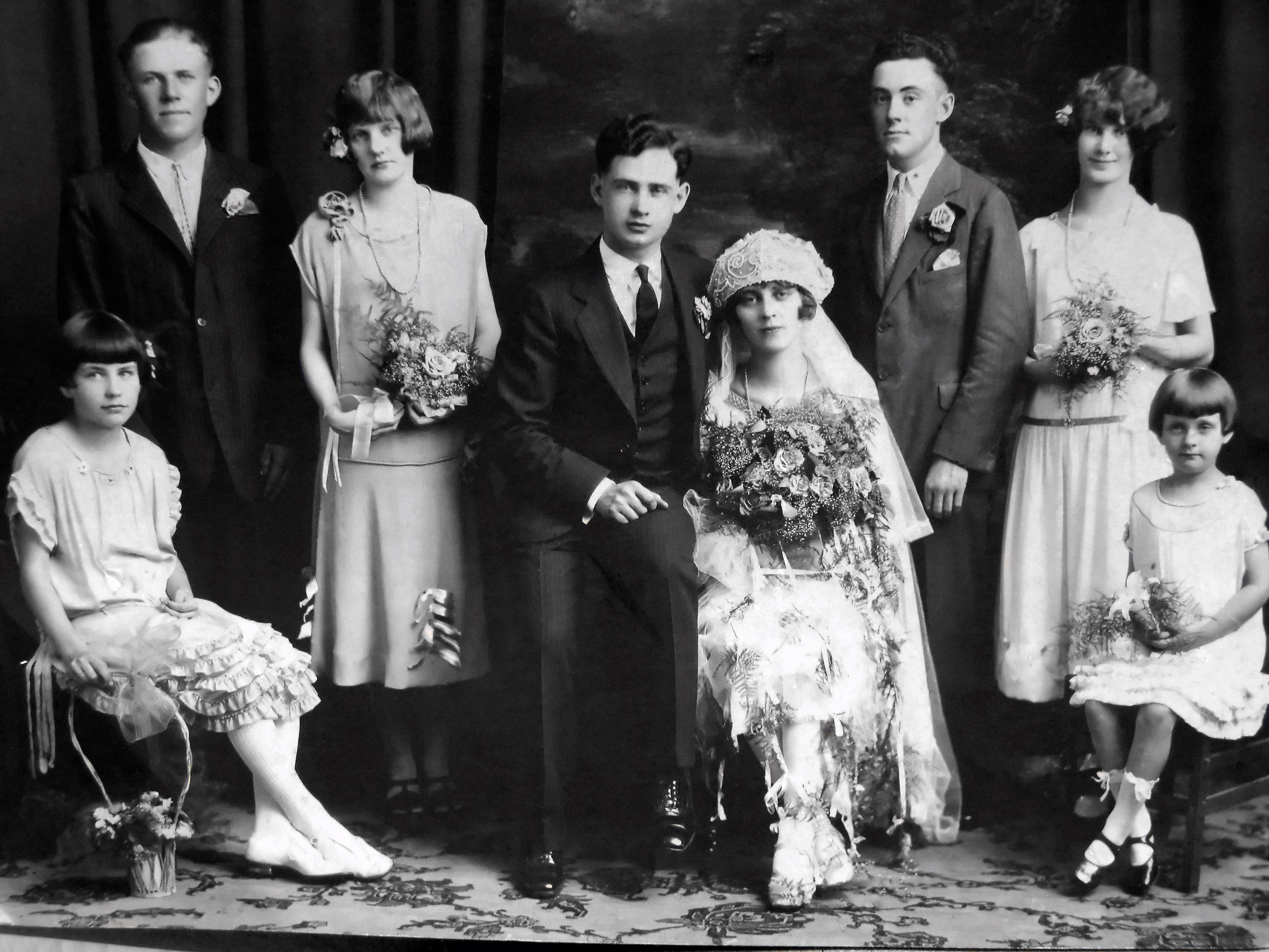
Judging by the turnout, the marriage of Joseph John Mras and Mary V. Sternot of the Town of Sigel in Wood County, Wisconsin, was the celebration of the year in 1913. The pair were married by the Rev. John Willitzer on October 21. The group portrait was taken outside the Sigel home of the bride’s parents, Jacob and Josephine Sternot. The reception had a big turnout from Sigel and the nearby village of Vesper.
Groom Joseph Mras and bride Mary Sternot are flanked by flower girls Ruby V. Treutel (left) and Gladys Cole. Back row (left to right) includes Joseph Sternot, Josie Leu, John Pyrch, Anna Sternot, John Yeske and Mary Billiet.
As with other large-group photos in our collection, it is fun to look for details in the sea of faces. Standing just right of center is my grandmother, Ruby V. (Treutel) Hanneman, who was a flower girl at the wedding. The bride and groom are tucked away in the upper right corner, looking a bit weary. The entertainers are in center front, one with a fiddle, one with an accordion and a third holding a pitcher of beer. Three things seem to link the men in the photo: hats, beer and cigars. Some things never change.
A studio photo of the wedding party provides additional details on the big day. Ruby Treutel and (we believe) her cousin Gladys Cole were the flower girls, while one brother and one sister of the bride were also in the wedding party.
Joe and Mary Mras had three children,Clarence, Earl and William. Joe was a crane operator for 31 years for the Frank Garber Iron & Metal Co. in Wisconsin Rapids. He retired in 1959. Joe died on April 10, 1961. Mary died September 20, 1977. Their son Clarence was killed in an auto accident in September 1956. Earl died October 18, 2001. William died February 18, 1997.
— This post has been updated with corrected identifications on the wedding portrait.
Leaving the family homeland to make a trans-Atlantic trip and emigrate to America would be an intimidating prospect under the best circumstances. When Michael Friedrich Ferdinand Hannemann brought his pregnant wife Mina and infant son Albert aboard the ship John Bertram in Hamburg, Germany in April 1863, he likely had no idea the horror they would face during 46 days at sea.
Fred Hannemann, as he was known to family and friends, was not the first in the family to leave Pomerania for Wisconsin. At least two sisters were already in central Wisconsin, so Fred may have heard stories from them about their travels to the American Midwest. But that likely would not have prepared him for the life-threatening conditions the 336 passengers faced en route to New York. One of the middle children of Matthias and Maria Caroline Hannemann of Meesow, Kreis Regenwalde, Pomerania, Fred was among at least eight children in the clan who would come to America between 1861 and 1882.
The John Bertram was a 1,060-ton clipper ship built in just 90 days in Boston in 1850 and placed into service in January 1851. At 180 feet long, the ship was initially employed to shuttle cargo from Boston around Cape Horn to San Francisco. It was later sold and pressed into service moving emigrants and cargo from Europe to America. Between 1860 and 1869, nearly 2,100 people were carried from Europe and elsewhere to America aboard the John Bertram.
About 10 days into the journey, the John Bertram encountered a violent gale that ripped at the sails and caused the ship to pitch up and down in the massive ocean swells. The winds raged at the ship for 48 hours, tossing drinking water casks overboard and destroying the storm sails. Conditions below deck were likely horrific, with the violent rocking causing seasickness and injuries. On deck, conditions were worse. Four crewmen were lost overboard and eight others were disabled. Once the storm passed, the ship was leaking badly, making it difficult to keep under sail. Mina Hanneman no doubt had to struggle to care for young Albert Hannemann, 1, in the chaos. The former Johanna Wilhelmine Florentine Glebke was nearly seven months pregnant during the voyage.
On May 4, still three weeks from docking in New York, the John Bertram hit dense fog and became trapped in a massive ice floe. For four days, the ship was surrounded by ice that scraped the planks of the hull and ripped at the cutwater. Four other ships in the area became snared in the ice. Eventually the clipper broke free, but had to steer 3 degrees to the east in order to escape the ice fields.
The trip took its toll. Eight infants died during the trip, although two babies were born. Along with the crewmen who were washed overboard, 12 people lost their lives. Thankfully, Fred, Mina and Albert Hannemann made it safely to Castle Garden in New York. Once they reached the Town of Grand Rapids in Wood County, Wis., they settled into farming. Eventually, seven children were born into the home, as yet another branch of the Hannemann family tree took root in central Wisconsin.
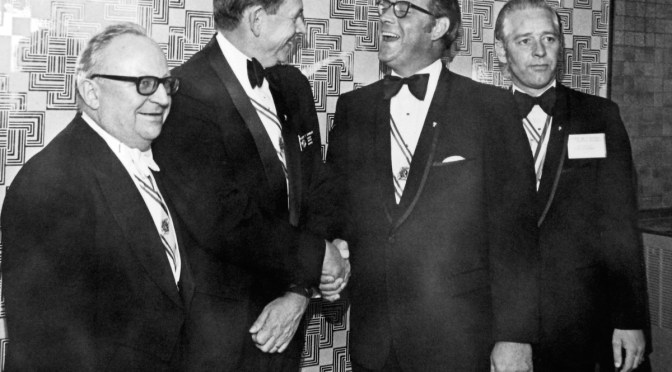
For 80 years, there has been a member of the Hanneman family in the Knights of Columbus, the world’s largest Catholic fraternal and charitable organization. The line of service runs from Carl F. Hanneman (1901-1982), who joined in 1934, to his son David D. Hanneman (1933-2007), who joined in 1953, to his son Joe Hanneman, who joined the order in April 2007.
The three generations share other things in common with respect to the K of C, based in New Haven, Connecticut, with more than 14,000 local councils across America. All three have been members of the Fourth Degree, which focuses on patriotism and love of country. All three served in the Fourth Degree Color Corps and Honor Guard. The Honor Guard, wearing tuxedos, colored capes, ceremonial swords and plumed chapeaux, is a ceremonial presence at Masses, funeral wakes, Flag Day ceremonies and other events. Joe Hanneman served on the Honor Guard for the installation of Archbishop Jerome Listecki in Milwaukee. Carl joined the Fourth Degree in the late 1930s or early 1940s, judging by the group portrait of his exemplification class. David joined in 1973 and Joe joined in 2008.
Carl F. Hanneman (left section, second row, second from center aisle), joined the Fourth Degree of the Knights of Columbus in the late 1930s or early 1940s. Exact date of this photo is unknown.
All three also served as Grand Knight of their respective local K of C council. The Grand Knight is leader of the local council. Carl Hanneman was Grand Knight of Solomon Juneau Council 2770 in Mauston, Wisconsin in the late 1960s. David Hanneman was Grand Knight of Holy Family Council 4879 in Sun Prairie, Wisconsin, from 2001 to 2003. Joe Hanneman was Grand Knight of Msgr. Stanley B. Witkowiak Council 697 in Racine in 2010 and 2011.
Altar server Joe Hanneman with his father David D. Hanneman (at right) and Bill Dziadosz.
The Knights of Columbus is a fraternal and charitable organization founded in 1882 by Venerable Father Michael J. McGivney, whose cause for sainthood is being considered at the Vatican. The Knights operate under the principles of charity, unity, fraternity and patriotism. Knights raise money and volunteer for a wide range of causes, from pro-life programs such as crisis pregnancy centers, to programs providing free wheelchairs to the disabled, to grants to local programs that support the mentally retarded. The K of C and local councils have provided more than 500 ultrasound machines to crisis pregnancy centers.
David D. Hanneman was part of a large class that became Fourth Degree Sir Knights on April 14, 1973 in Madison.
Knights provide free coats to needy children each winter. They run a variety of athletic events, including Punt, Pass and Kick, and a basketball free-throw competition. Knights also support and promote vocations to the priesthood, sponsoring seminarians and providing other material support for those studying for the priesthood. In 2013, Knights provided a record amount of charity, with over $170 million raised and 70.5 million hours of voluntary service provided. In 2014, the K of C provided more than $2 million to help persecuted Christians from Iraq and other Mideast countries being targeted by ISIS and other terrorist organizations.
Boy Scouts participate in a flag retirement ceremony run by Assembly 1207, the Fourth Degree Knights in Racine. Speaking at the podium is Deputy Grand Knight Joe Hanneman.
The Fourth Degree of the Knights is especially dedicated to patriotism and the idea that love of God and love of country go hand in hand. The Fourth Degree was founded in 1900 to combat the prejudiced notion that Catholics were not loyal Americans and could not be trusted in public office or with civic responsibility. The Fourth Degree provides free flags for schools and nonprofit organizations, supports veterans’ organizations, provides material needs to local veterans’ hospitals, and sends faith materials and other assistance to members of the military serving overseas.
Sir Knight Joe Hanneman (left) in an honor guard at St. Rita Catholic Church in Racine.
Famous Knights include Venerable Archbishop Fulton J. Sheen, one of the Catholic Church’s all-time great authors and communicators; former Green Bay Packers coaching legend Vince Lombardi; baseball’s Sultan of Swat, Babe Ruth; Supreme Court Justice Samuel Alito; Ray Flynn, former U.S. ambassador to the Vatican; Cardinal Francis George, former archbishop of Chicago; Saint Rafael Guizar Valencia; and six martyrs of the Cristero War in Mexico: Father Luis Bátis Sáinz, Father José María Robles Hurtado, Father Mateo Correa Magallanes, Father Miguel de la Mora, Father Rodrigo Aguilar Alemán and Father Pedro de Jesús Maldonado Lucero. The K of C operates in the United States, Canada, Mexico, the Philippines, Poland, the Dominican Republic, Puerto Rico, Panama, the Bahamas, the Virgin Islands, Cuba, Guatemala, Guam and Saipan.
A number of other members of the extended Hanneman family have been members of the Knights of Columbus: Earl J. Mulqueen Sr. (my grandfather), Earl J. Mulqueen Jr.,Donn G. Hanneman, longtime Wisconsin Rapids building inspector Arthur J. Hanneman, and former state representative Arthur Treutel.
— This post has been updated with a date correction and two new photographs.
Carl F. and Ruby V. Hanneman (at left) on the day Carl was made a Sir Knight in the Fourth Degree of the Knights of Columbus.
David D. Hanneman (third from left) on the day in April 1973 he became a Fourth Degree Sir Knight.
David D. Hanneman (left of center, dark hair), stands just behind his father, Carl, at the reception following the Knights of Columbus Fourth Degree exemplification.
Carl F. Hanneman with his son David (two at left) at the Hanneman home in Sun Prairie before David became a Sir Knight on April 14, 1973.
Carl F. Hanneman handmade the K of C logo for Solomon Juneau Council 2770 in Mauston, Wis.
Carl F. Hanneman was a delegate to the 1937 Wisconsin convention of the Knights of Columbus.
Carl F. Hanneman was a delegate to the 1937 Wisconsin convention of the Knights of Columbus.
Altar server Joe Hanneman with his father David D. Hanneman (at right) and Bill Dziadosz.
The Knights of Columbus Honor Guard at the 2007 funeral of David. D. Hanneman.
The Knights of Columbus sent scores of volunteers to Europe in World War I to operate recreation centers for soldiers and provide comfort at the front.
The Knights of Columbus Glee Club in Racine, Wis., provided entertainment around the city in the 1920s.
The K of C sponsored a “Keep Christ in Christmas” billboard on Interstate 94 near Racine.
K of C councils often hold Landing Day parties to celebrate Catholic explorer Christopher Columbus’ discover of the New World in 1492.
Father Mark Jones blesses the new home of the K of C in Racine, Wis., while Grand Knight Joe Hanneman (at right) looks on.
Wearing regalia and plumed chapeaux, the Knights of Columbus Fourth Degree honor guards often serve at funerals and other Masses.
K of C councils hold “Life Savers for Life” events to raise money for pro-life efforts such as crisis pregnancy centers.
Boy Scouts participate in a flag retirement ceremony run by the Knights in Racine. Speaking at the podium is Deputy Grand Knight Joe Hanneman.
Knights in Racine, Wisconsin honor members of the Catholic church who provide exemplary service with the Pro Deo Et Ecclesia award. The medal was designed by Joe Hanneman.
A young girl tries on a new coat provided by the Knights of Columbus at the HALO homeless shelter in Racine, Wis.
A young boy tries on a new coat provided by the Knights of Columbus at the HALO homeless shelter in Racine, Wis.
Knights and other Christian volunteers pray together after setting up a Nativity scene on Monument Square in Racine, Wis.
Every year the K of C helps set up a Nativity scene on Monument Square in Racine, Wis.
“Memory of the Day of Confirmation.” Those German words are written in ornate lettering across a beautiful certificate commemorating the confirmation of Karl (we know him as Carl) Hanneman on June 11, 1916. The roughly11×17 inch document, found among the papers and photographs of David D. Hanneman, is remarkably well preserved and speaks to a time before Carl’s conversion to Catholicism. The certificate is written entirely in German and reads:
“Karl Hanneman received instruction in the Word of God on 11 June 1916 in the First Moravian Church, Grand Rapids, Wis.” At the bottom of the certificate it reads: Gottes Furcht is aller Weisheit Anfang, which roughly means “All Wisdom Begins with Fear of God.” The document was signed by the Rev C.A. Meilicke.
The confirmation certificate for Carl F. Hanneman from the First Moravian Church.
We know Carl’s father, Charles Hanneman, was raised as a Lutheran, as were most of the Hannemans. The marriage certificate for Charles and Rosine Hanneman (nee: Ostermann) only says their wedding was a “Divine Service” and does not indicate a church. In 1907, Charles and Rosine and their four sons joined the First Moravian Church of Wisconsin Rapids, a congregation of some 450 people in a brick church on First Avenue South.
The Moravian Church is one of the oldest Protestant denominations and traces its roots to the 1450s in Bohemia and Moravia. The area is now part of the modern day Czech Republic. It is possible the family’s connection to the Moravian Church came from Rosine (Ostermann) Hanneman, whose father emigrated from Saxony in what is now eastern Germany.
Carl and Ruby Hanneman were both converts to Catholicism, but we’ll save those stories for another entry.
Nearly 90 years ago on a summer Tuesday morning, Ruby Viola Treutel and Carl Henry Frank Hanneman joined in marriage at St. James Catholic Church in Vesper, Wisconsin. The marriage, which would live on for more than 50 years and produce three children and 16 grandchildren, was described in detail in a story in the July 15, 1925 edition of the Wisconsin Rapids Daily Tribune:
TREUTEL-HANNEMAN One of the prettiest weddings of the summer was solemnized yesterday morning at nine o’clock at St. James church, Vesper, when Miss Ruby Treutel, daughter of Walter Treutel of Vesper, became the bride of Carl F. Hanneman, son of Mr. and Mrs. Charles Hanneman of this city. Rev. Father Gille officiated at the nuptial Mass.
The wedding party of groom Carl Henry Frank Hanneman, 23, and Ruby Viola Treutel, 21. Wedding was July 14, 1925 at St. James Catholic Church, Vesper, Wis. At front left is flower girl Nina Treutel, 11, sister of the bride. At front right is ring-bearer Elaine Treutel, 5, sister of the bride. Across the back, left to right, are Joe Ladick (bride’s cousin), Gladys Cole (bride’s cousin), groom Carl Hanneman, bride Ruby V. Hanneman, best man Wendell Miscoll, and maid of honor Esther Allbrecht.
The church was beautifully decorated with greens and the season’s flowers, making an appropriate setting for the wedding party. Miss Velma Doering of Stratford played the wedding march as the party entered the church and proceeded to the altar. Miss Gladys Cole of Nekoosa, and the groom’s attendant, Joseph Ladick, of Vesper, both cousins of the bride, were followed by two little sisters of the bride, Nina and Elaine, who acted as flower girl and ring bearer. The maid of honor, Miss Esther Albright, came next and was followed by the bride and her father, who gave her away.
Mr. Hanneman and his best man, Wendell Miscoll,awaited the party at the altar. The bride was very beautiful in her gown of white georgette trimmed with gold lace. She wore a coronet of pearls, with her veil falling from a beaded butterfly. She carried a shower bouquet of pink rose buds.
Rev. Charles W. Gille of St. James Catholic Church officiated at the wedding.
Miss Albright, the maid of honor, was gowned in orchid georgette and carried an arm bouquet of rose. Miss Cole, the bridesmaid, wore a gown of orange georgette, and also carried roses. Nina, the little flower girl, was in a little frock of yellow georgette, and Elaine completed the delightful color ensemble in a dress of pink georgette. She carried the ring in a white lily.
Following the service at the church, the bridal party and relatives came to this city, where the ten-thirty breakfast was served at the Witter Hotel. The bride is a graduate of Lincoln High School and the Stevens Point Normal. Since her graduation from the normal school she has been teaching at Vesper. The groom was graduated from Lincoln High and for some time following was employed at the Church Drug store. He later graduated from the pharmacy department of Marquette University at Milwaukee and is at present holding a position with Whitrock and Wolt.
Following a week’s outing in the northern part of the state, part of the time being spent as guests of Mr. and Mrs. Armand Bauer at their cottage at Hayward, they will return here and for the present make their home with Mr. Treutel at Vesper.
The bridal photo, hand retouched to restore color to the roses.
The bridal portrait of Ruby V. Hanneman in its original frame.
For their honeymoon in July 1925, Carl F. Hanneman (1901-1982) and Ruby Viola (nee: Treutel) Hanneman (1904-1977) took a camping trip to Wisconsin’s north woods. The couple are pictured at a camp site near Hayward, Wis. They were married July 14, 1925 at Vesper, Wis.
He could be carrying milk from the barn, but Carl F. Hanneman (1901-1982) is actually on a honeymoon camping trip in this July 1925 photo. Carl and bride Ruby (nee: Treutel, 1904-1977) took a camping trip near Hayward, Wis., after their wedding on July 14, 1925.
An unidentified boy sits outside of a cottage near Hayward, Wis., with Ruby V. (Treutel) Hanneman (1904-1977) in July 1925. Ruby and new husband Carl F. Hanneman (1901-1982) were on their honeymoon.
Carl F. Hanneman (at right) leans on his Ford near the camp where he and bride Ruby spent their honeymoon.
Carl F. Hanneman and an unidentified boy at the Hanneman picnic table.
The Hanneman honeymoon had a rustic theme at a cottage near Hayward, Wis.
Carl F. and Ruby V. Hanneman took these selfies on their honeymoon in July 1925.
Carl F. and Ruby V. Hanneman on their 25th wedding anniversary in July 1950.
Back of the photo: Carl F. and Ruby V. Hanneman on their 25th wedding anniversary in July 1950.
Carl F. and Ruby V. Hanneman on their 50th wedding anniversary, celebrated at Sun Prairie in July 1975.
He came to the United States at age 19 and lived the life of an American frontiersman: shuttling cargo between U.S. outposts in the West and ferrying people and goods across the Missouri River. For all of his adventurous living, William Johann Heinrich Gaulke retained one lasting memory that his family in Wisconsin still talks about: being a friend of a very young William Frederick ‘Buffalo Bill’ Cody.
William Gaulke (standing) with his arm around William F. Cody, who later went on to international fame as “Buffalo Bill.” (Photo courtesy of Sue Alft)
Gaulke met the famed U.S. Army scout and buffalo hunter while Gaulke was working and exploring the frontier lands in Nebraska and the Dakotas in the 1870s. A photograph in the Gaulke family album shows a twenty-something Gaulke standing with his arm around a seated William Cody.
Gaulke’s frontier experience grew out of tragedy he experienced in his native Germany. Born on October 1, 1848, Gaulke lost his father, John, before he turned six months old. When he was 11, Gaulke became an orphan at the death of his mother Fredericka. He emigrated to America in 1867 and landed in Milwaukee. After a short stint as a farmhand, Gaulke landed a job aboard a Great Lakes steamer, where he learned to speak English. After another stint working on farms in Illinois, Gaulke went west.
After emigrating to America in 1867, William Gaulke spent a number of years exploring the wild frontiers. (Photo courtesy of Sue Alft)
Gaulke experienced the wilds of the frontier lands as a teamster for the U.S. government. He guided a six-mule team hauling goods between U.S. Army posts. He was based at Fort Buford in the Dakota Territory. After tiring of that job, he built a skiff and drifted down the Missouri River to what is now Bismarck, North Dakota. Along with a group of companions, he established the town of Carlington. There, Gaulke operated a ferry moving people, goods and horses across the Missouri River near Fort McKeen (later called Fort Abraham Lincoln). Fort Lincoln was the base of Gen. George Armstrong Custer.
Right alongside the Mighty Missouri River, Gaulke built himself a shanty, where he lived and operated his ferry business. He built an outdoor fireplace that was used for cooking and warmth. It was also a hiding place for the $2,200 Gaulke had saved from his business ventures. Gaulke’s shanty was a frequent target of would-be thieves, but none of them ever thought to look under the fireplace for the buried money.
In 1872, Gaulke returned to Wisconsin, securing work at Grand Rapids in Wood County. In July 1876, he married Augusta Henriette Charlotte Kruger. Her mother, Friedericke Kruger, was the daughter of Matthias Hannemann (1794-1879). A short time later, the Gaulkes bought their first land in the Town of Grant in Portage County, very near where the Hannemann family established its first homes in the early 1860s. Gaulke cleared the land and established a successful farm. He also helped build many of the farm houses and barns in the area.
William Gaulke and Augusta (Kruger) Gaulke and family. Rear, left to right: Ella (Wagner), William Jr., John, Henry, Minnie (Panter). Front, left to right: Mary (Eberhardt), William Gaulke Sr., Augusta (Kruger) Gaulke, Laura (Turbin). (Photo courtesy of Sue Alft)
Gaulke also became deeply involved in civic work, serving as school district clerk, drainage district commisioner and chairman of the Town of Grant. He and Augusta had eight children, born between 1878 and 1897. Augusta died in 1914, four years before her mother. William died on October 25, 1928 after coming down with pneumonia.
William F. “Buffalo Bill” Cody in a late-life portrait (Library of Congress Photo)
Confirmation of the friendship between Gaulke and Buffalo Bill came in the early 1900s, when Cody brought his Wild West show to Grand Rapids, Wisconsin. Gaulke brought his youngest son, John, to the grounds near Lincoln High School. They watched the white-suited Cody ride about the arena on his white horse. Gaulke led his boy up to Cody, introduced himself and asked the showman if he remembered him from their time out west decades earlier. He did. “Why sure, Bill and they had quite a talk,” John Gaulke later wrote. “Finally Buffalo Bill reached into his pocket and gave my Dad a handful of tickets, who the whole family saw the show for nothing.”
A popular poster showing Buffalo Bill Cody superimposed on an image of a buffalo. (Library of Congress Photo)
William Cody was a first-rate Indian scout and buffalo hunter whose life was romanticized in dime novels written by author Ned Buntline. The pair collaborated to create a show called “The Scouts of the Plains.” In 1883, Cody developed a live show spectacular called Buffalo Bill’s Wild West. The Library of Congress says Cody “was a major contributor in the creation of the myth of the American West, as seen in Hollywood movies and television.”
The Knights of Columbus has long championed the “Keep Christ in Christmas” message to remind the public that the “holiday season” is really about the birth of the Savior. Each year, the more than 14,000 local K of C councils promote the message with car magnets, yard signs, television ads and radio spots.
The Nativity mosaic was used on a billboard along Interstate 94 in 2009.
Back in 2010, I wanted to create a 30-second broadcast commercial with this message, but we had no production budget. I found a beautiful mosaic image from the Knights of Columbus Incarnation Dome at the Basilica of the National Shrine of the Immaculate Conception in Washington, D.C. The year before, I used that image to create a billboard we placed alongside Interstate 94 in Racine County, Wisconsin.
Many Knights of Columbus councils distribute “Keep Christ in Christmas” lawn signs.
For the TV spot, we planned to use that still image with a pan-and-zoom “Ken Burns effect,” but I still needed voice talent and music. I looked no further than my then 11-year-old daughter, Ruby. She only needed a couple of takes to nail the script voiceover. My other daughter, Samantha, 14, took to her keyboard and recorded a section of “Greensleeves.” That is the tune used for the hymn What Child Is This? Once I put it all together, we had a very nice broadcast commercial, quite beautiful in its simplicity. The finished spot ran hundreds of times on a wide variety of cable television networks throughout the Archdiocese of Milwaukee. You can watch the video in the player below.
In the winter of 1966 or 1967, a young father designed and hand-crafted an outdoor nativity scene to decorate the family home in Sun Prairie, Wisconsin. David D. Hanneman (1933-2007) painted the set freehand and put it on display just under the garage window of his home on Wisconsin Avenue. The nativity scene was a fixture at the home in those early years, but eventually was put in storage and forgotten.
The original Nativity scene as built by David D. Hanneman, circa 1967.
Forty years later, after David Hanneman died, the badly weathered Nativity figures were rescued from a trash can in the garage. Over the next 18 months they were restored to almost original condition and put on display in the Village of Mount Pleasant.
The original backers and braces were removed from the cutout figures of St. Joseph, Mary and Baby Jesus. New 1-inch-thick plywood backers were crafted with a jigsaw, then glued to the figures and anchored with wood screws. Heavy L-shape stabilizing braces were screwed into the backers to give the figures sufficient weight to withstand winter winds.
Samantha J. Hanneman retouches details on the Baby Jesus figure built by her grandfather, David. D. Hanneman.
Samantha J. Hanneman, David Hanneman’s granddaughter, did most of the paint restoration work. With a special set of art brushes, she applied metallic gold and flat black paint to maintain the original look. Touch up paint was applied sparingly to the faces and hands of the figures to keep the hand-drawn details.
The newly restored Nativity scene was put on display at the Hanneman home in Racine County in December 2008, making the old tradition new again for another generation. The crèche was displayed for several years, but had to again be put in storage when we lost our home. Now the figures again wait patiently to have a new home where their warm glow will fill the Christmas night.
St. Francis of Assisi is credited with creating the first Nativity crib or crèche on Christmas Eve 1223 in Greccio, Italy. St. Francis was eager to make the birth of Christ something tangible for the faithful. He had a manger built, brought animals to be part of the set, and had Holy Mass said before this representation of the birth of Christ. After the preparations were finished, St. Francis and some of his followers went to the crèche for the Mass. After a short prayer by Francis, a vision of the Christ child appeared on the hay.The miracle stirred the animals and greatly moved the faithful who witnessed it.
In the first half of the 20th century, druggists in America were often called on to literally fill prescriptions, placing medications into gelatin capsules and then counting out the order. Mauston pharmacist Carl F. Hanneman was very efficient at the task. Maybe too much so, opined The Mauston Star in a rather humorous article in December 1953.
“Joe Dziewior and this muser, watching ‘pestle and mortar’ Carl Hanneman throw a prescription together the other evening, now know why pill or capsule counting machines not not necessary to the registered pharmacist,” read the article on December 11, 1953. “With bottle in hand, Carl was pouring capsules into his hands and counting them faster than an adding machine.”
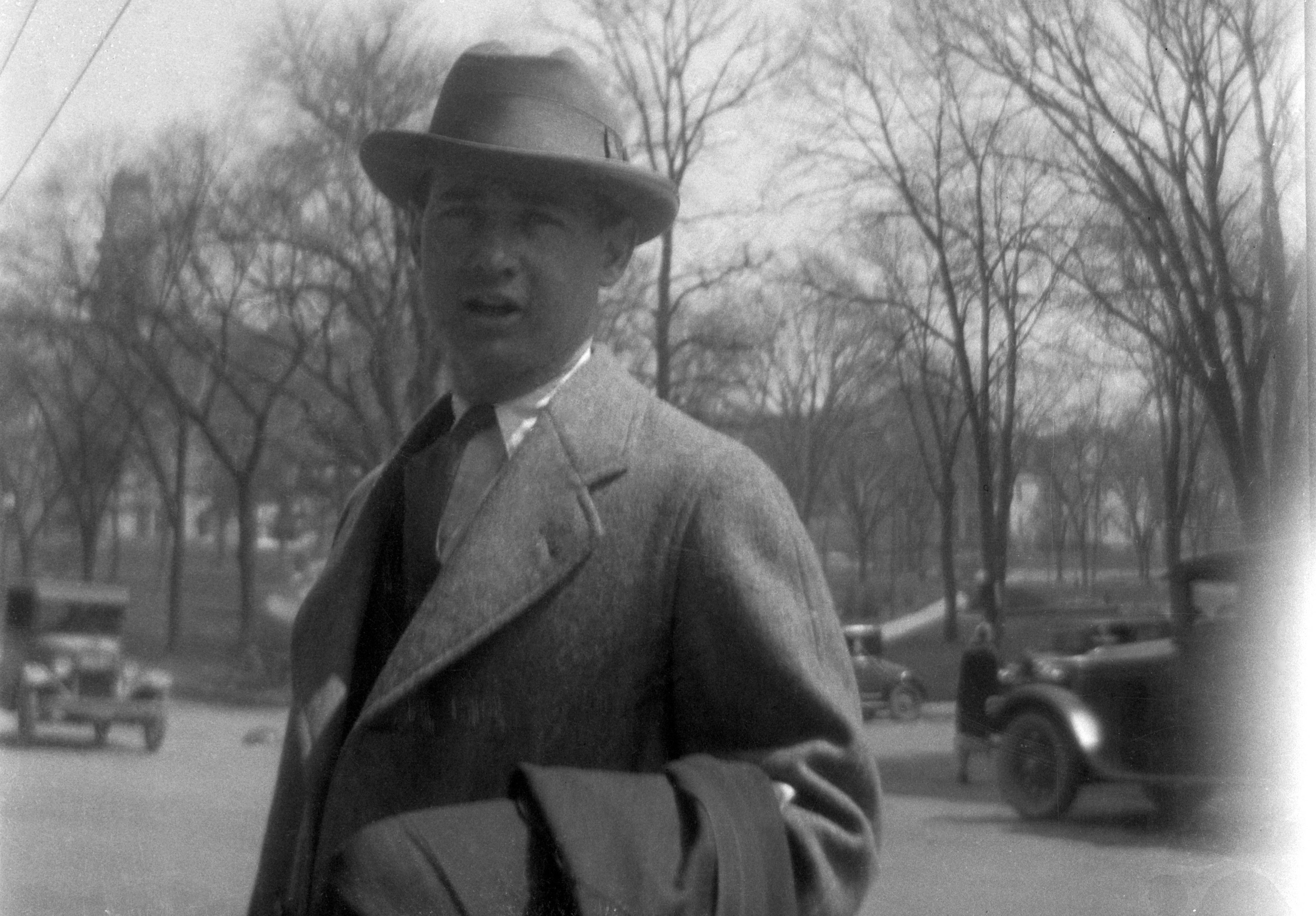
Carl F. Hanneman taking his suits to the cleaner at Janesville, Wis., on April 5, 1926. Carl and his wife, Ruby V. Hanneman, were on their way to dinner. Carl was a druggist at McCue & Buss Drug Co. at the time. He later moved to Mauston, Wis.
Carl was the registered pharmacist at the Mauston Drug Store on Division Street in Mauston. He had been the druggist there since moving his young family to Mauston in 1936 from Wisconsin Rapids. A graduate of Marquette University, Carl started as an assistant pharmacist, but obtained his full registered pharmacist license in the 1940s.
“After watching him for some time, we entertained a doubt as to the accuracy of the counts and Joe was inclined to agree with us,” the article continued. “But Carl said he could count pills time on end and whistle a tune at the same time, and still come out the a correct count. ‘Come, come, Carl!’ we exclaimed. ‘Isn’t that pulling our leg a bit?'”
Judging by Carl F. Hanneman’s vials from McCue & Buss Drug Co., registered pharmacists packaged both pre-made pills and medicine capsules.
Carl told the men a story of a “kindly old lady” who regularly came in for prescriptions and doubted the counts doled out by the druggist. “It never failed, but that after we wrapped up her prescription, she’d sit in the chair out there, undo the package and count the pills in the box,” Hanneman said. “To this day, she hasn’t demanded a recount!”
The article concluded: “Maybe registered pharmacists should be made ballot clerks. Recounts wouldn’t be necessary!”










 The Hanneman Archive