Tag Archives: Wisconsin

Walter Treutel’s 240,000-mile Journey Through Wood County, Wisconsin

It would be hard not to respect a man who worked diligently at his job six days a week for 30 years. For Walter Treutel, the job record was even more impressive. His career as a rural letter carrier took him on a nearly 240,000-mile journey making sure the people of Vesper, Wisconsin received their mail and packages from 1904 to 1934.

Walter Treutel of Vesper, Wisconsin.

“The new rural mail carriers who will begin carrying mail on the 10 new routes on December 1st received their appointment from Washington last week,” the local Grand Rapids, Wis., newspaper announced in November 1904. “These carriers all took the competitive examination in this city four weeks ago and those fortunate to receive an appointment will now only have to file their bond for the faithful performance of their duty.” Walter’s first day as a letter carrier was Dec. 1, 1904. He was just two years married to the former Mary Ladick, and their firstborn child, Ruby, was just six months old.

His first trip over Rural Route 1 was made in an open buggy pulled by two ponies. He and his sister, Emma Carlin, rode that first 26.5-mile run together to deliver just 35 pieces of mail. At the time, the Vesper postal station was located inside the Treutel Bros. store, run by Walter’s brothers, Charles and Henry Treutel. Walter’s official postal substitute was his wife, Mary.

Walter Treutel picnics with children Nina, Elaine and Marvin, circa 1925. Behind the camera is Ruby (Treutel) Hanneman.

The dirt roads were rough and filled with chuckholes. The buggy rode over corduroy — soft or swampy sections that were shored up by placing logs  across the path. Roads were so punishing in those early days that horses typically lasted only two years in service.

The first open postal buggy was eventually replaced by a covered postal wagon. Walter used a dozen horses on his  route over the years. One of the toughest, “Old Baldy,” served for seven years in all sorts of weather. His first automobile, a two-cylinder Buick roadster, was nicknamed “The Little Red Devil.” Three other postal vehicles served on the route during his tenure.

He served under five postmasters during his 30 years, including his sister Emma Carlin, who was Vesper postmistress for nine years starting in 1906. In November 1934, Walter took his overdue two-week vacation, then returned for one final route on Dec. 1 — thirty years to the day after his first day on the job.

Walter Treutel with second wife Vera (at left), sister Emma Carlin, daughter Ruby Hanneman and grandchildren Lavonne and David D. Hanneman.

Walter was born July 23, 1879 in Mukwonago, Wisconsin, the son of Philipp and Henrietta (Krosch) Treutel. Walter’s wife, the former Mary Helen Ladick, died in 1925 after suffering a post-operative infection. She was just 41. They had five children, four of whom (Ruby, Nina, Marvin and Elaine) survived into adulthood. Walter died Feb. 15, 1948 of lingering heart disease. He was 68.
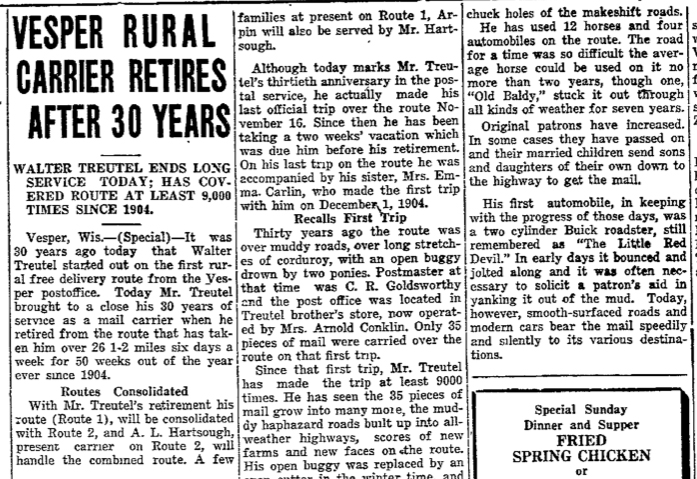
The Wisconsin Rapids Daily Tribune wrote about Walter Treutel's last day on the job in 1934.
The Wisconsin Rapids Daily Tribune wrote about Walter Treutel’s last day on the job in 1934.

FAMILY LINE: Johann Adam Treutel >> Philipp Treutel >> Walter Treutel >> Ruby (Treutel) Hanneman >> Donn, David and Lavonne Hanneman.
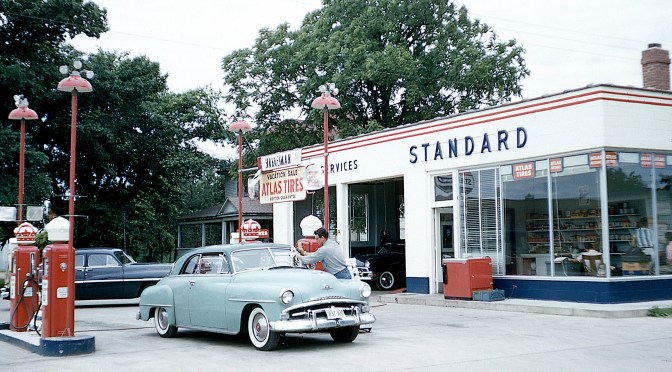
1951 Photos Show Hanneman’s Standard Station at Mauston

Before embarking on his long sales career, David D. Hanneman (1933-2007) briefly owned and operated a Standard Oil gasoline station at the corner of Union and State streets in Mauston, Wisconsin. Newly discovered color slides show Hanneman working at the Standard station, most likely in the summer of 1951 after his graduation from Mauston High School.

David D. Hanneman stands outside his Standard Oil station in  Mauston in 1951.
David D. Hanneman poses outside of his Standard Oil station in Mauston in 1951.

The photos show a dapper young attendant (think Clark Kent) posed outside the station, leaning on the soda cooler. Another image shows him cleaning the windshield of a customer’s auto, part of the “full service” treatment that disappeared long ago. The station featured the classic pumps that delivered Red Crown regular and White Crown premium gasoline.

During the 1950s, Standard Oil was the dominant domestic oil company in the United States. Its torch-and-oval logo was instantly recognizable to millions of Americans (even after Standard became Amoco). The Mauston Standard station stood at the busiest intersection in the city. A Kwik Trip station occupies the land today.

Detail shows "Hanneman" on the north side of the Standard Station.
Detail shows “Hanneman” on the north side of the Standard Station.

After owning and managing the station, Hanneman realized the job was not for him. He went on to take classes at La Crosse State (now called University of Wisconsin-La Crosse) and worked as a salesman at Dahl Motors in La Crosse, before his career in pharmaceutical and veterinary medical sales.


Couple Sets a Trend with Their 1925 ‘Selfies’

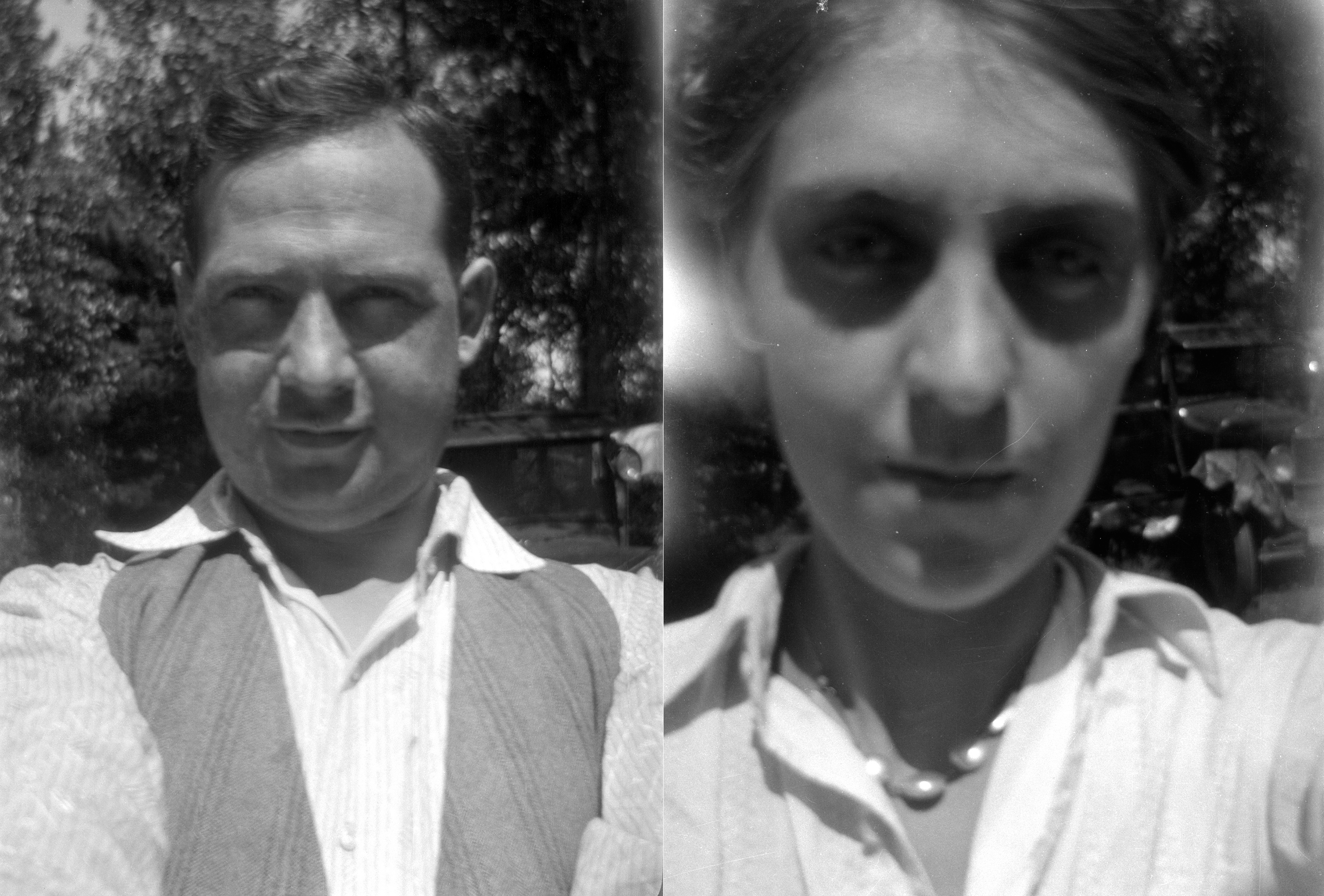
Many decades before the social phenomenon of taking self-portraits or “selfies” became all the rage, a young honeymooning couple in July 1925 predicted the trend by snapping their own photos at a camp site in Hayward, Wisconsin.

Carl F. Hanneman and the former Ruby Viola Treutel were married on July 14, 1925 at St. James Catholic Church in tiny Vesper, Wisconsin. For their honeymoon, they chose to motor to Wisconsin’s North Woods. Part of their time was spent at a cottage owned by friends, Mr. and Mrs. Armand Bauer, in Hayward.

Carl F. and Ruby V. Hanneman took these selfies on their honeymoon in July 1925.

Being a budding photographer, Carl took lots of photos from their trip, some candid and even playful. Two that stand out are ‘selfies’ taken by Carl and Ruby. Carl’s is at a good distance and quite sharp, while Ruby’s was an ultra-closeup, a bit out of focus. Given the camera technology of the day, these photos were more of a feat than it might seem. Nothing like snapping a quick shot today with an iPhone 6.

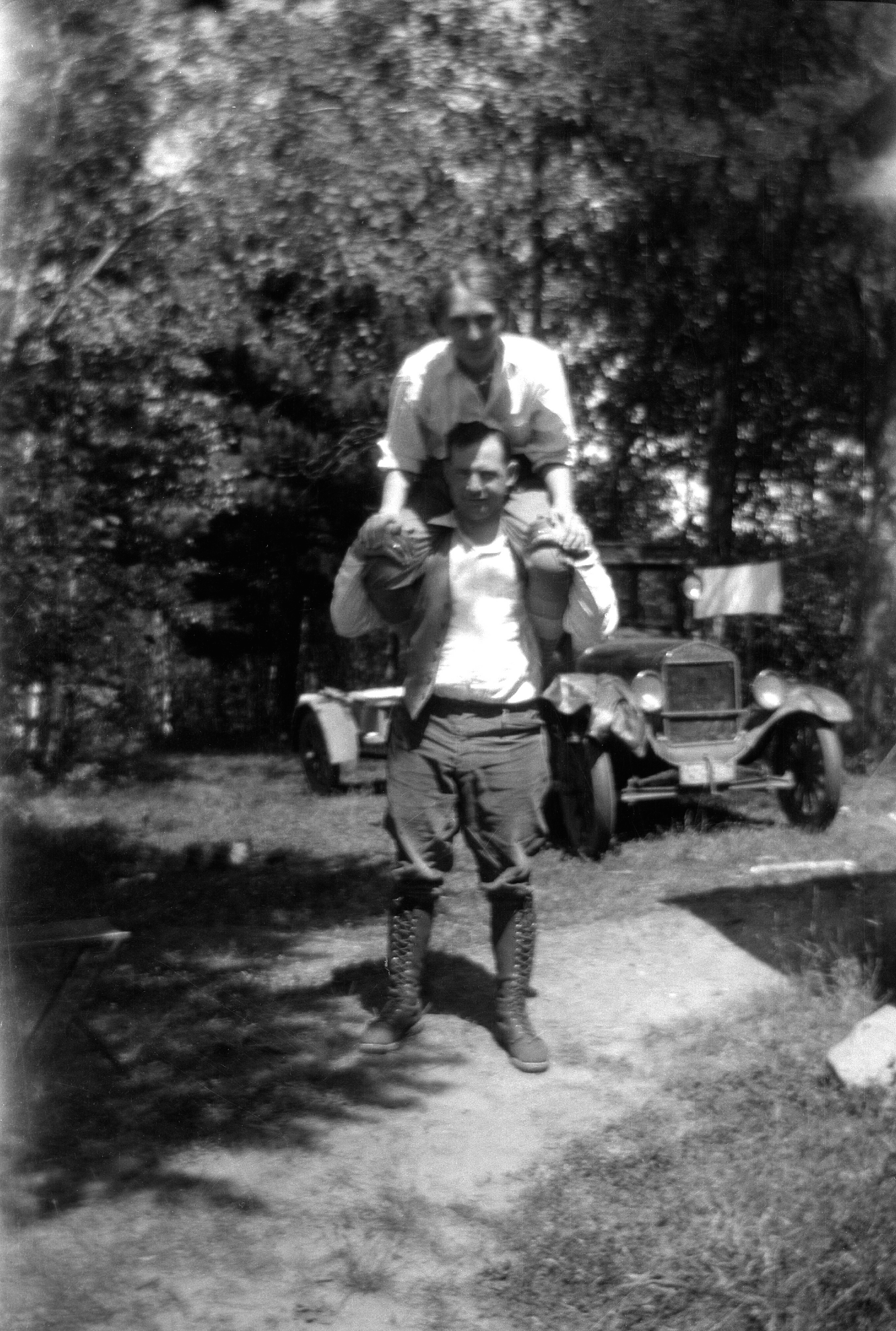
Ruby V. Hanneman rides on the shoulders of new husband Carl at their honeymoon camp at Hayward, Wisconsin.

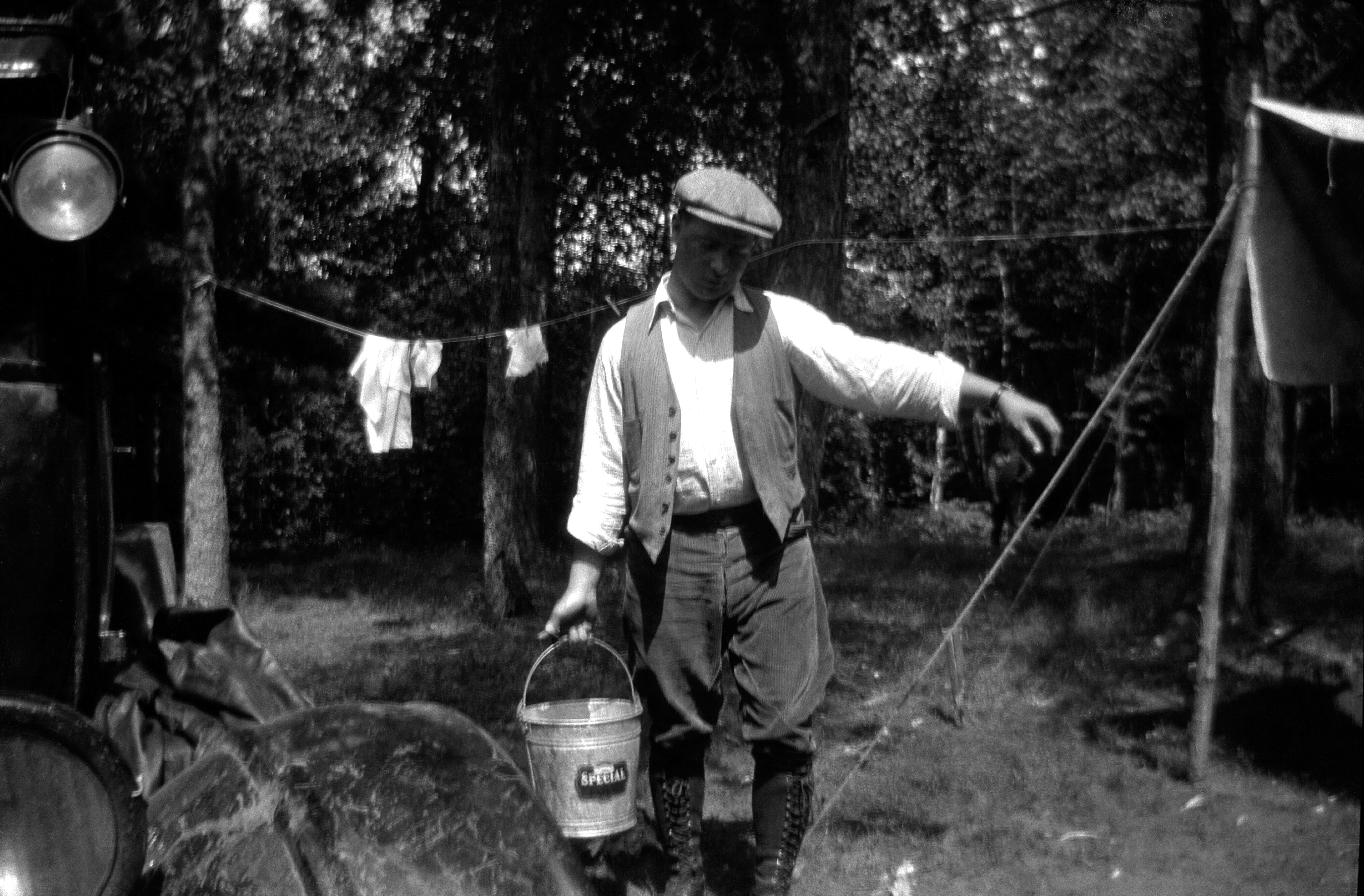
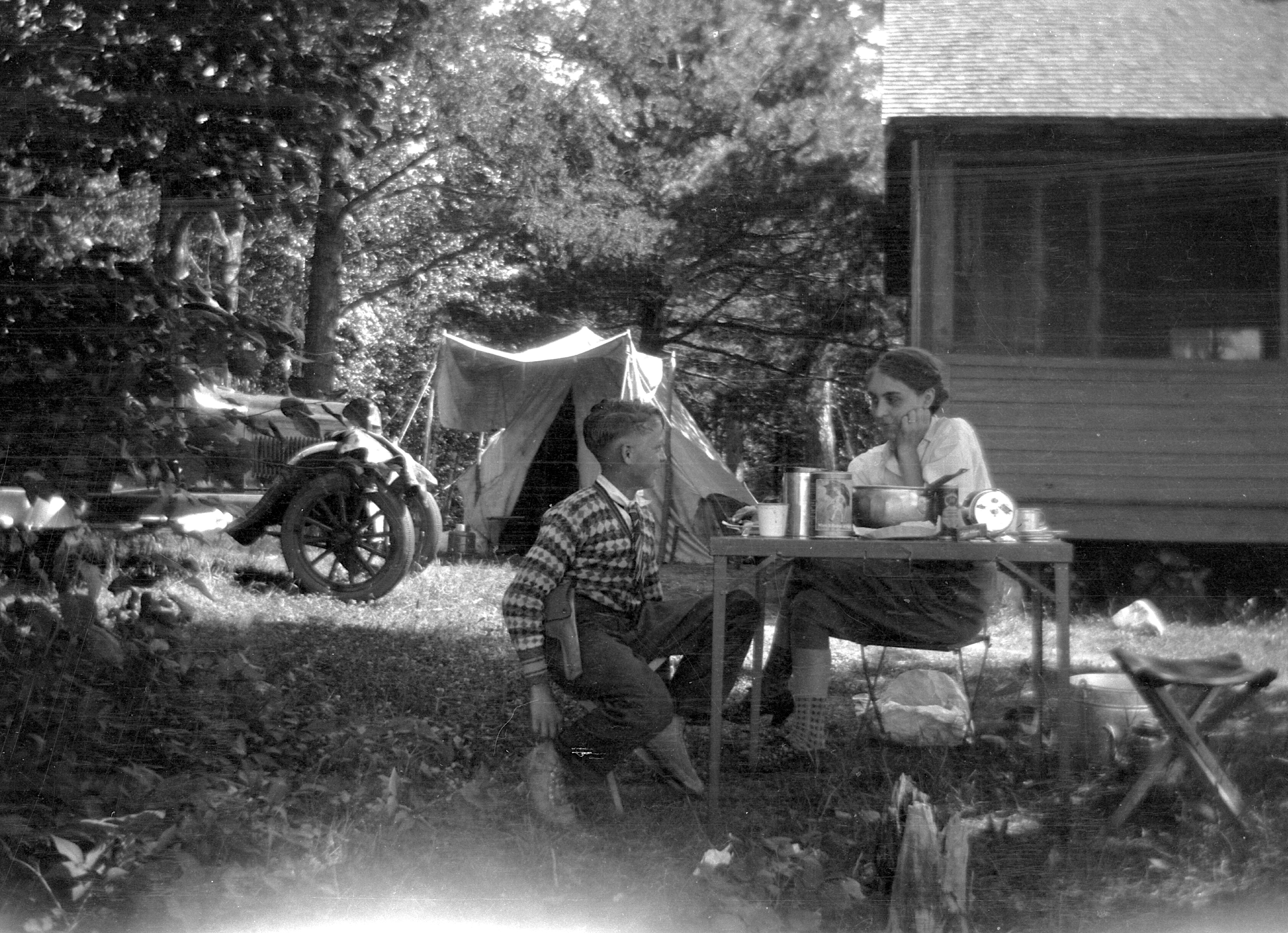
Other photos from the trip showed Carl walking with Ruby on his shoulders, Carl slinging a pail and Ruby sitting at a picnic table with a youngster who resembles her younger brother, Marvin Treutel (but might have been their hosts’ boy).

He could be carrying milk from the barn, but Carl F. Hanneman (1901-1982) is actually on a honeymoon camping trip in this July 1925 photo.
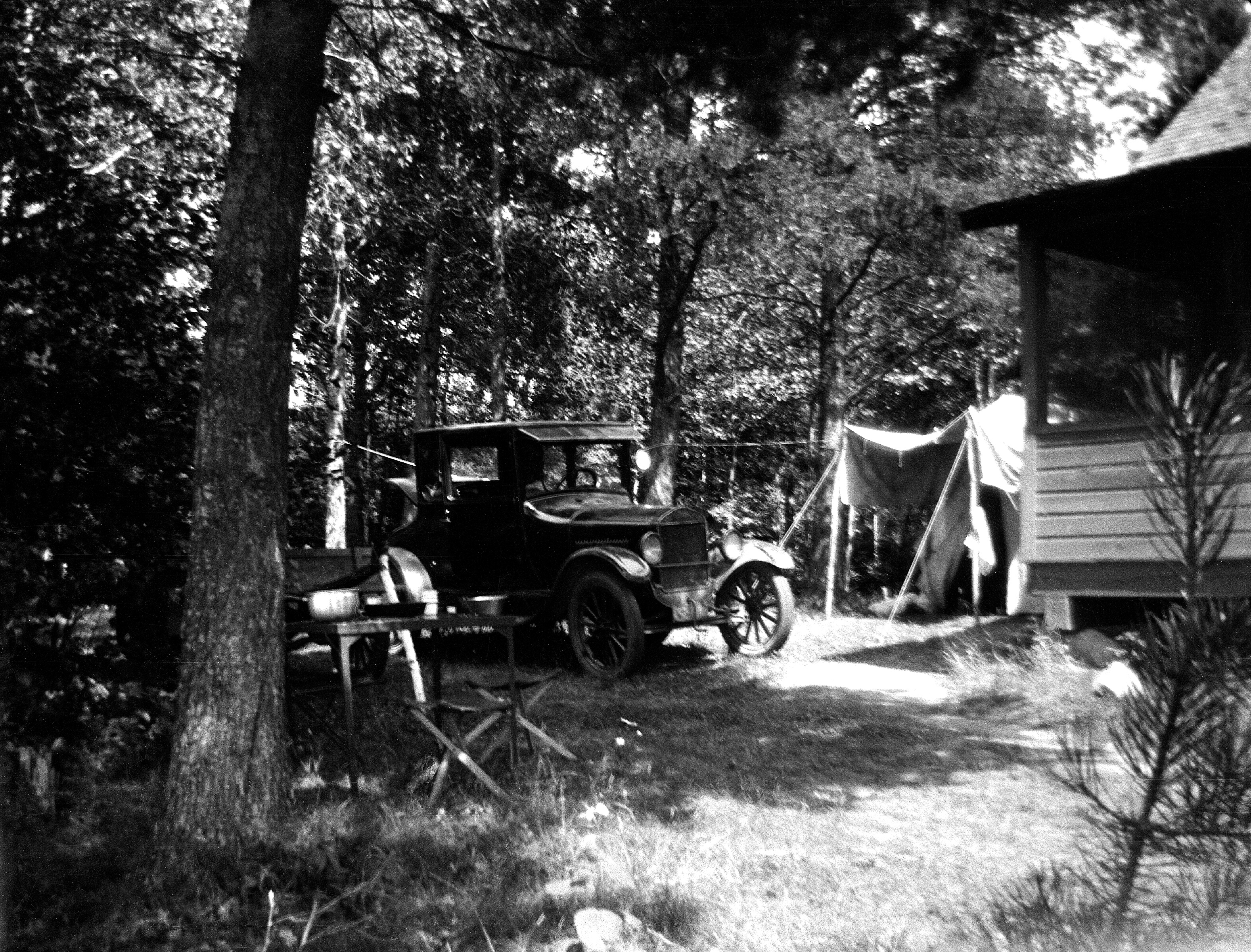
Camp scene from near Hayward, Wis. in July 1925. Pictured is the Ford Model T belonging to Carl F. Hanneman (1901-1982) of Wisconsin Rapids, Wis. Hanneman was on his honeymoon with Ruby V. (Treutel) Hanneman (1904-1977) of Vesper, Wis.

Carl and Ruby had no way to know that the ‘selfie’ would become a dominant means of communication among young people around the world, or that the practice would spawn social media platforms, a television series, songs and videos on YouTube.

It’s good to be a trend-setter.

2007_12_18_21 (1)

Carl Hanneman Documents Fire of the Century at Mauston

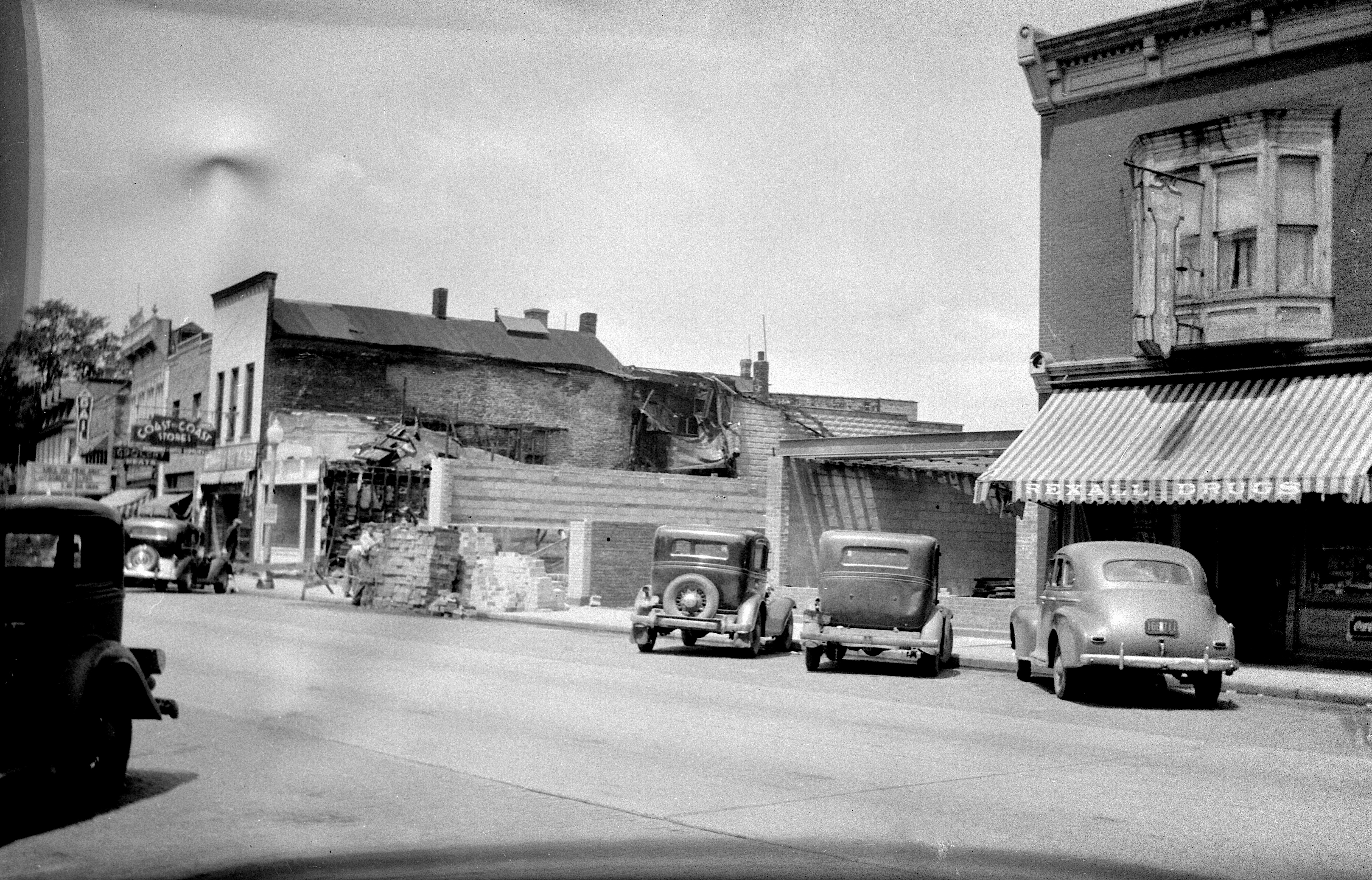
It was the fire of the century in the tiny city of Mauston, Wisconsin. Life may have started normally on Friday, Jan. 5, 1945, but before 9 a.m. a massive fire broke out that threatened to wipe out the city’s downtown. The man called on to document the blaze for local law enforcement was Carl F. Hanneman, the druggist at the Mauston Drug Store. It may have been the most prominent collection of photos he shot, but was just one among many accidents, fires and crime scenes he photographed over the years.

Carl would have been readying himself for the trip to the pharmacy downtown when the fire broke out that January morning. About  8:30 a.m. the fire started in the rear of the Gamble Stores building along the north side of State Street. Within 30 minutes it had spread to four downtown buildings and threatened the entire business district.Mauston Fire 1

As firefighters from Mauston tried in vain to control the blaze in subzero temperatures, reinforcements from fire departments in Lyndon, New Lisbon and Wisconsin Dells raced to help. Carl stood just behind the line of rescue  workers and took photos.

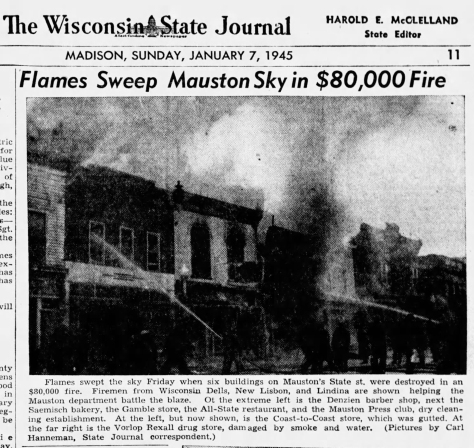
It took five hours to control the huge blaze, which destroyed Gamble’s, Mauston Press Club dry cleaners, Samisch Bakery, the Fred Denzien barber shop and the All-Star restaurant. At one point during the blaze, the brick facade of the All-Star fell onto the street. Nearby businesses, including Vorlo Drug and Coast to Coast, were badly burned. Damage exceeded $80,000 – equivalent to more than $1 million in 2014 dollars. Mauston Fire Chief John Smith said calm winds kept the fire from sweeping through the entire downtown.

The extreme heat from the fire is evident along the roof line.

Carl’s efforts that day earned him a page 1 photo in the Wisconsin State Journal, and two additional photos on page 11. He served as a Mauston correspondent for The State Journal for many years, garnering numerous front-page stories and photographs.

Carl dated and signed the prints from the Mauston fire in January 1945.

Carl documented many local emergencies in Mauston and surrounding areas. He captured the moment when a semi-trailer plowed into the front of the Tourist Hotel, knocking down the sign and collapsing the awning. Many of these photographs have a custom “CF Hanneman” imprint on the back, so it’s obvious Carl shot a fair number of news  photos. Some photos from the 1945 fire have even shown up on Ebay.

WSJ_MaustonFire_1945_01_07_P11a
One of three of Carl’s photos that appeared in The Wisconsin State Journal on January 7, 1945.
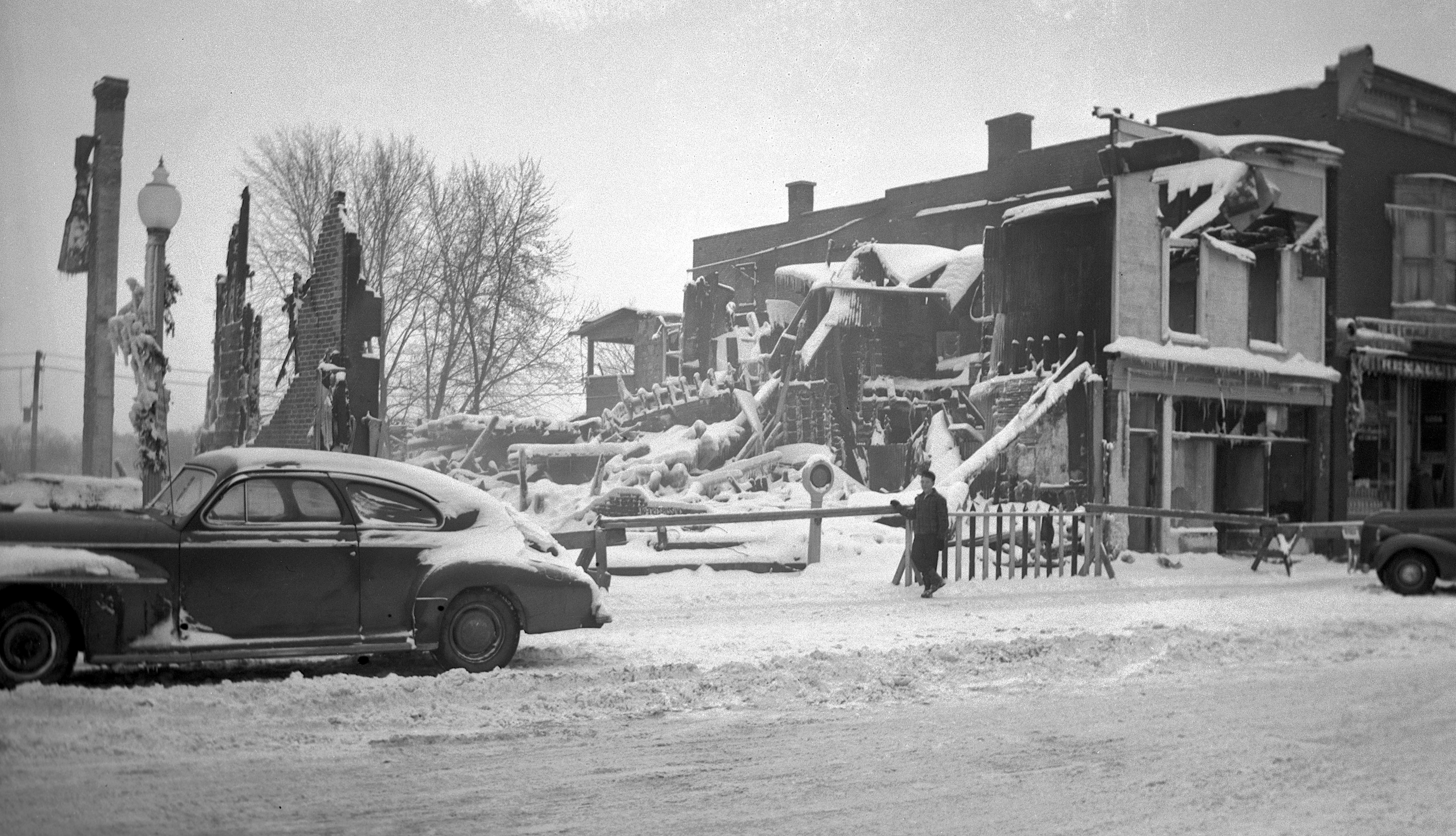
David D. Hanneman stands on State Street in front of the charred ruins from the 1945 Mauston fire.
David D. Hanneman stands on State Street in front of the charred ruins.
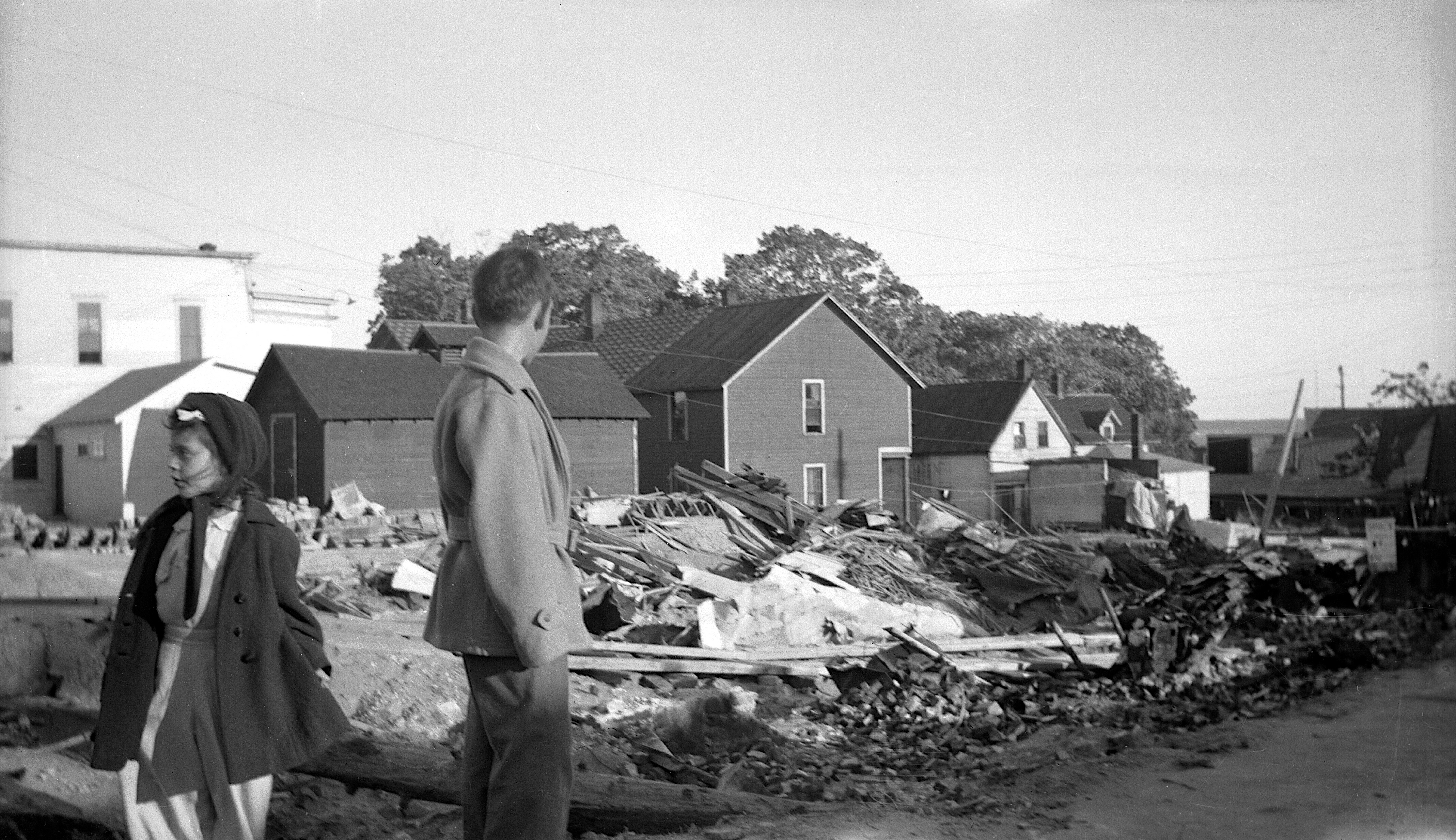
David D. Hanneman and his younger sister, Lavonne, survey damage from the 1945 Mauston fire.
David D. Hanneman and his younger sister, Lavonne, survey damage.
By summer 1945, the fire debris was gone and rebuilding was in process.

Earliest Known Photo Shows Chas. Hanneman Family in 1905

Another newly discovered photograph from 1905 shows the Chas. Hanneman family of Grand Rapids, Wisconsin. It is the earliest known photo of this family, and the only clear photograph we have of mother Rosine Bertha Henrietta (Osterman) Hanneman.

This photo is a real treasure for its clarity and detail. Often prints this old have many flaws and defects, but this is one of the best in the Hanneman Archive collection. We received it courtesy of Tom Hanneman of Minneapolis. It was originally from the photo collection of one of the boys in the photo, Carl Henry Frank Hanneman (1901-1982).

It is also one of perhaps three photos we have that show Rosine  “Rosie” Hanneman. This mother of five (her firstborn died in 1891) died on Easter Sunday 1918 of diabetes. She was just 47 years old. She lived in the days before availability of insulin.

The father of the family, Carl Frederick Christian (“Chas”) Hanneman (1866-1932) worked many jobs in central Wisconsin. He was initially a farmer after emigrating to Wisconsin from Meesow, Kreis Regenwalde, Pomerania, in November 1882. He worked in the timber industry before moving his family to the city of Grand Rapids (now called Wisconsin Rapids). There he worked as a laborer (17 cents per hour) digging and installing the city’s new sewer system in the early part of the 20th Century. Eventually, Chas took on work in a paper mill. He died of prostate cancer shortly after retiring from the mill.

One of Chas’ grandchildren, Donn G. Hanneman, recalled sitting on the hospital bed when Chas was being treated for his cancer. “I’m going to heaven soon,” Chas told the 6-year-old. “I’d like it if you would put flowers on my grave.”

Rosine Bertha Henrietta (Osterman) Hanneman (1870-1918), Frank Herman Albert Hanneman (1895-1947), Arthur James Hanneman (1893-1965), Carl Henry Frank Hanneman (1901-1982), Wilbert George Hanneman (1899-1987) and Carl Frederick Christian (Chas) Hanneman (1866-1932).

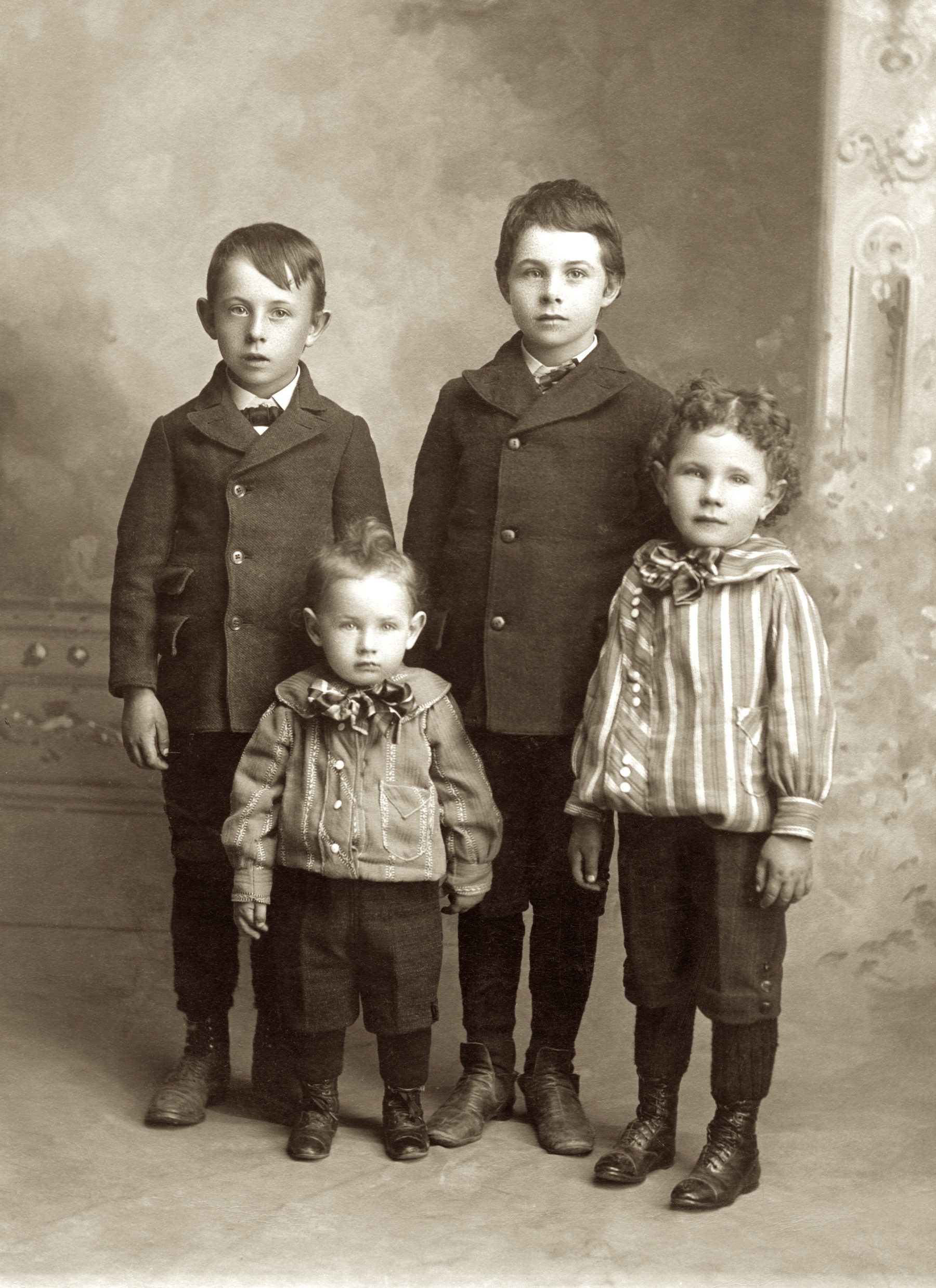
Photo Shows Hanneman Brothers in 1903

A newly discovered 1903 photo shows four Hanneman brothers of the Carl Frederick Christian Hanneman family. It is the earliest known photograph of our own Carl Henry Frank Hanneman (1901-1982). The photo was taken at Grand Rapids, Wisconsin.

In the front row are Carl (at left) and Wilbert George (1899-1987). In the back are Frank Herman Albert (1895-1947) and Arthur John (1893-1965). The firstborn of this family, Charles M. Hanneman, died just after his birth on November 24, 1891.

The boys were the sons of Carl Frederick Christian Hanneman (1866-1932) and Rosine Bertha Henrietta (Osterman) Hanneman (1870-1918). The couple were married in 1891.

The photo was scanned from a collection loaned to us by Thomas Donn Hanneman of Minneapolis, one of the 16 grandchildren of Carl F. and Ruby (Treutel) Hanneman of Mauston, Wisconsin.Hanneman Boys 1903

1890s Carriage Stone Serves as a Family Gathering Place

Back in the days when horses were the main mode of transportation, many homes across America had carriage stones near the street to assist those stepping down from horse-drawn carriages.

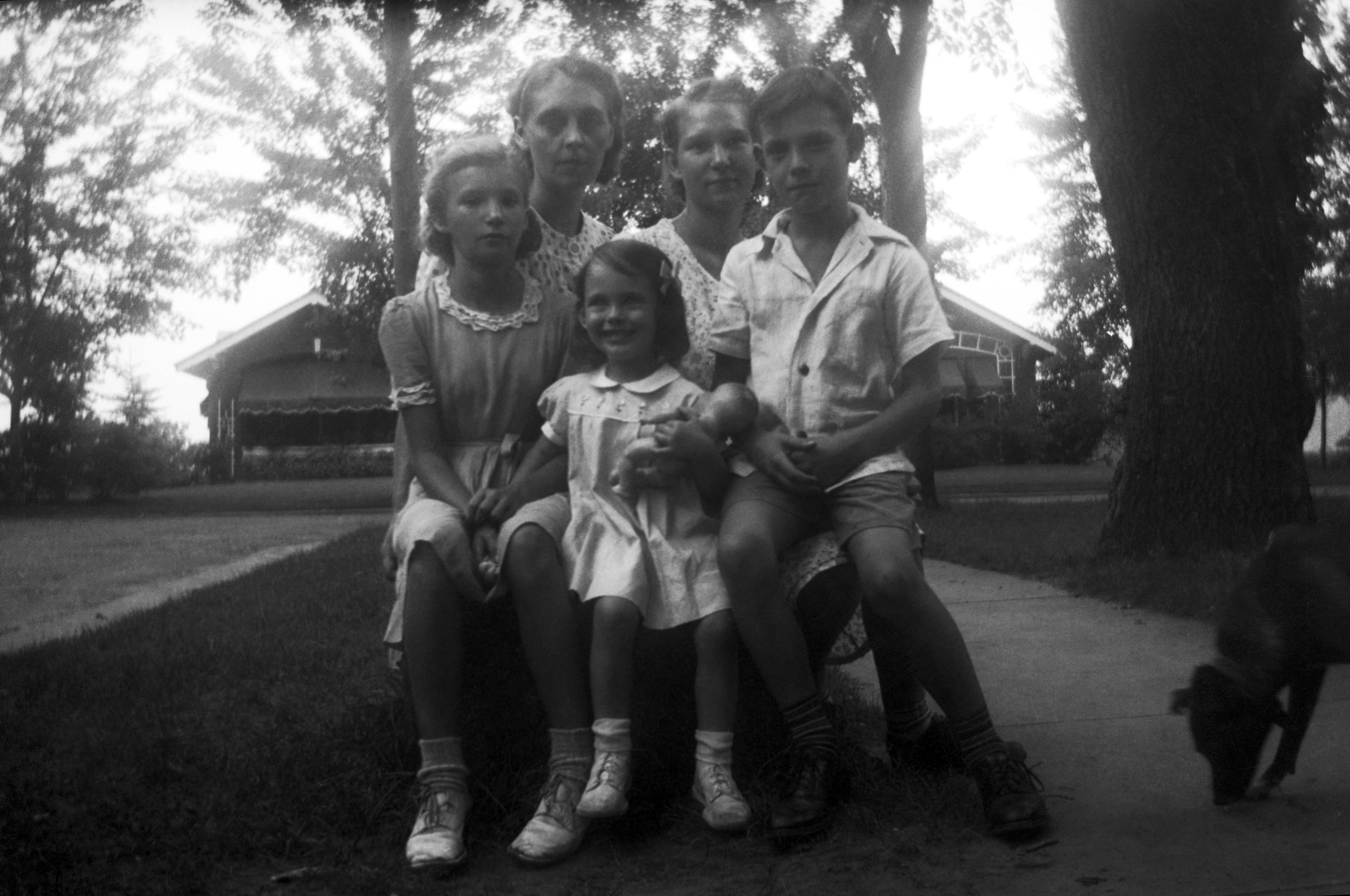
A fine example of the carriage stone stands in front of the old Hanneman home on Morris Street in Mauston, Wis. The carriage stone no doubt served its time as a platform to access horse-drawn transportation. But for many more decades the large granite stone was a family gathering place for photos and a launch pad for dozens of children at play.

More than 70 years of photographs held by The Hanneman Archive provide ample testimony to the importance of the old carriage stone. The earliest photographic records we have is from 1937, although the stone was likely original equipment when the home was built in the early 1890s. Brewmaster Charles Miller built the home at 22 Morris Street with the finest materials, so it’s no surprise he would have a carriage stone out front.

One photograph from about 1942 shows five people sitting on the stone for a photograph, including Ruby V. Hanneman and children Lavonne M. Hanneman, and David D. Hanneman.  Another image from about 1957 shows Donn G. Hanneman, wife Elaine and children Diane, Caroline, Tom, Jane and Mary Ellen. The photo above shows Carl F. Hanneman and grandson David Carl Hanneman, taken circa 1965.

Lavonne Hanneman (front) and brother David (at right) sit on the carriage stone, circa 1942.

For the 15 grandchildren of Carl and Ruby Hanneman, the carriage stone was much more than a cool novelty. Just standing on the stone seemed to give a great vantage to the yard, even though  the stone was just 18 inches high. It was always a race to see who would get first dibs on the stone.

Mary K. Hanneman sits on the carriage stone in 1958. With her is dog Cookie.


Ruby V. Hanneman with her son Donn and his family in the late 1950s or early 1960s.

For many of those old photos, family members sat or stood at the carriage stone in the shade of towering elm trees. The old trees are long gone now, but the stone remains, looking just the same as it did in the 1930s.

In several visits in years prior to his death in 2007, David D. Hanneman stopped at the house and asked the current owners if he could take the carriage stone. Initially they agreed, but later changed their minds. Seems the lady of the house had become attached to the old stone, as evidenced by the flowers lovingly planted around its edge. That’s understandable. Just another generation of folks who’ve come to care for that old carriage stone.

— This post has been updated with a photo gallery

©2014-2020 The Hanneman Archive

Emigration Records Found for Matthias Hannemann

For years, family genealogists have searched in vain for the emigration records of Matthias Hannemann, the earliest known ancestor of the Hanneman family of central Wisconsin. Over the years, the registers of hundreds of immigrant ships were searched, covering tens of thousands of names belonging to people who came through ports in New York, Baltimore and New Orleans. But no Matthias.

All of that changed several nights ago. During a routine search of newly transcribed records from the Port of Hamburg, Germany, I found Matthias’ name. He and his second wife, Caroline, traveled with their son, William, daughter Justina Louisa Henrietta Saeger and her family. They were among 474 passengers aboard the SS Hyram when it sailed from Hamburg on April 19, 1866. Matthias is listed on the register as a schwiegervater, or father-in-law, referring to his son-in-law, John Saeger.Hyram Ship Register

It was a long journey aboard the segelschiff, or sailing ship. The ship docked at Grosse Isle near Québec on the St. Lawrence Seaway on June 4, 1866. Grosse Isle served as a quarantine station for ships destined for the Port of Québec in Canada, to prevent the spread of disease. Grosse Isle was the site of tragedy in 1847, when more than 5,000 Irish immigrants escaping the famine in their homeland died from typhus and other diseases upon reaching Canada. A large Irish cemetery and two monuments bear witness to those sad days.

Eight passengers on the Hyram died during the journey in 1866. Two children were born onboard ship. Once the 10 members of the Hannemann and Saeger families disembarked, they likely continued traveling by boat along the St. Lawrence River, across Lake Ontario and Lake Erie. From Detroit, they might have traveled by rail to Chicago and then Milwaukee on their way to tiny Kellner, Wis.

The Hyram’s ship registry is among the earliest documentary evidence of the Hannemann family’s exodus from Pomerania to Wisconsin. We know at least two of Matthias’ other children arrived in America in 1861, but their travel records have not been found. The earliest emigration record from this family is that of Michael Friedrich Ferdinand Hannemann, who arrived aboard the ship John Bertram in May 1863 with his wife, Wilhelmina and infant son, August.

Matthias’ emigration record is the most significant find since we discovered his long-lost grave site in Portage County in 2009.

©2013 The Hanneman Archive

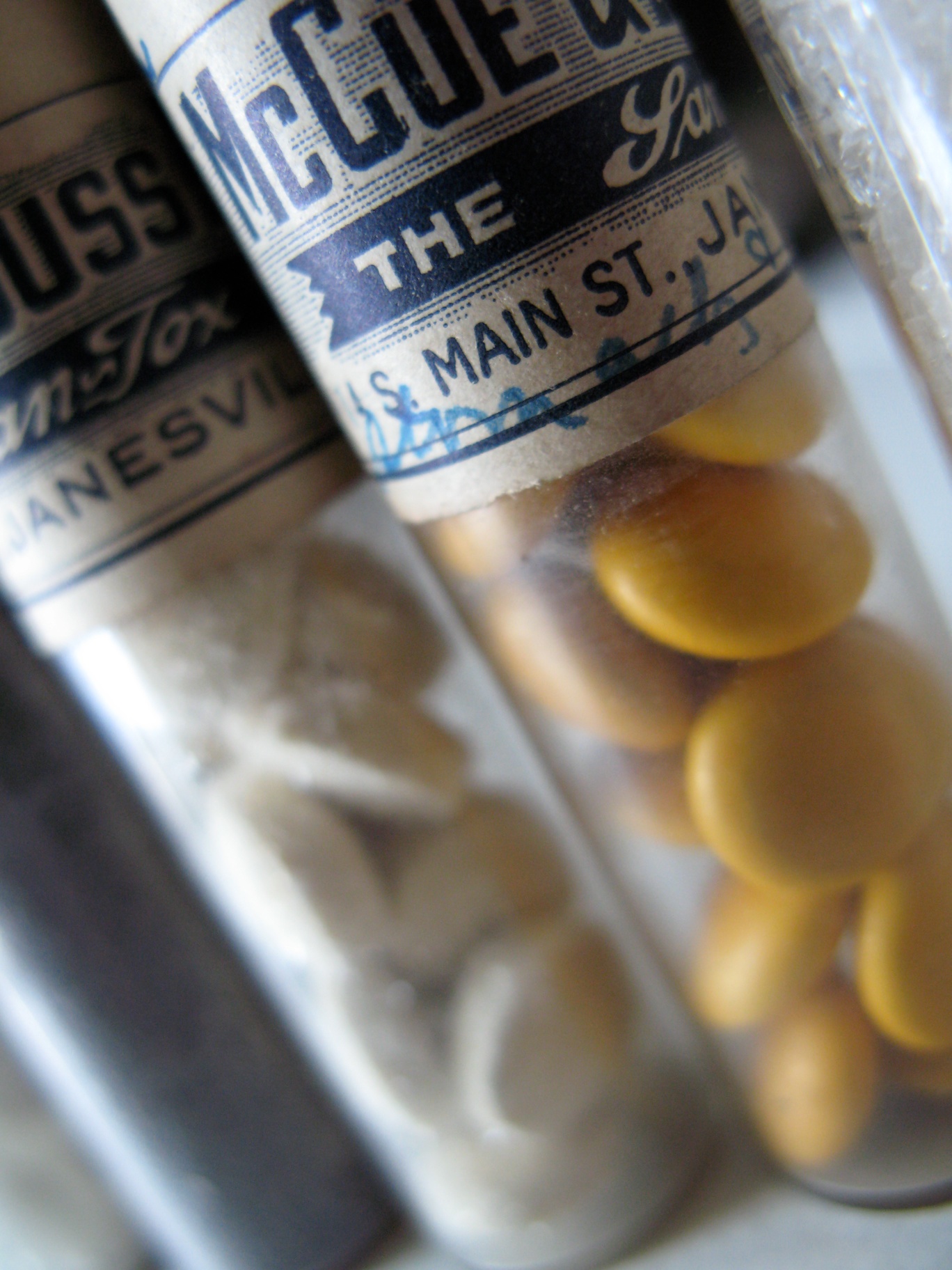
Hanneman Portable Pharmacy Kit Dates to 1920s

My grandfather, Carl F. Hanneman, was a pharmacist for nearly 60 years. One of the treasures he left behind was a portable pharmacist’s kit in a leather satchel. The many glass vials are still filled with various pills and powders he dispensed to patients at pharmacies in Fond du Lac, Janesville, Wisconsin Rapids, Mauston and Sun Prairie. The oldest of the prescription vials dates to 1926.

Hanneman Pharmacy Kit IMG_5741

Mystery Photo Might Show Rosine Hanneman

For years we’ve wondered about the identity of a pretty young woman with dark hair and a beaded necklace. The photo was an old mounted print that came from the Hanneman collection at Mauston. There were no notations on the back of the print. Nor were there any similar photos among the hundreds of prints and negatives in the collection.

A recently discovered photo of a much older woman offers a hint of the identity of the younger woman. Both appear to be Rosine Bertha Henrietta (Osterman) Hanneman, the mother of Carl F. Hanneman.

The woman at left in the image above was identified as Rosie Hanneman by one of her sons, Wilbert G. Hanneman(1899-1987). A digital copy of the photo was supplied to us by one of Wilbert’s grandsons, Tim Swanson. The shape of the face and hair pulled back show similarities to the other photograph.

The photo at left is a bit shocking, because Rosine Hanneman was just 47 when she died of diabetes in 1918. It provides visual evidence of how the disease aged and otherwise wreaked havoc on its victims before the advent of commercially produced insulin in the mid-1920s.

Rosine Osterman was born on July 8, 1870 in Four Mile Creek, Wood County, Wisconsin. Her father, John Christian Osterman, came to America from Thuringia, Germany. Her mother, Wilhelmine Dorothea Schroeder, came from Prussia. On April 2, 1891, she married Carl Frederick Christian Hanneman, a sawmill laborer. They had five children: Arthur John (1893-1965), Frank Herman Albert (1895-1947), Wilbert George (1899-1987), Carl Henry Frank (1901-1982) and C.H., who died as an infant in 1892.