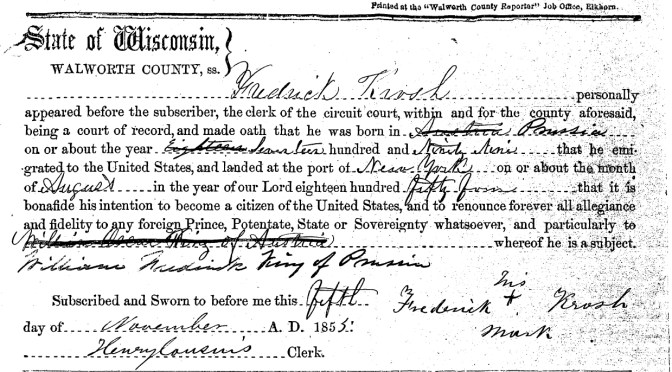
Some of the earliest documentation of a Hanneman-Treutel relative in America — dated 1855 — has been discovered in the archives of the Walworth County, Wisconsin Circuit Court. John Frederick Krosch, just a year from stepping off the boat from Saxony, filed his declaration of intent to become a United States citizen on November 5, 1855 before the county court in Elkhorn, Wisconsin.
Krosch made the declaration on behalf of himself and his wife, Christiana. The declaration document says Krosch intended to become a U.S. citizen and that he “renounced forever all allegiance and fidelity to any foreign prince, potentate, state or sovereignty whatsoever, and particularly to William Frederick, King of Prussia.” The document was found in the court archives, held at the Area Research Center at the University of Wisconsin-Whitewater.
Johann Friedrich Krosch was born in 1799 in the Kingdom of Saxony, which today is part of Germany. In 1854, he brought his wife Christiana and children Charles, Augustus, Reinhold, Henrietta (grandmother of Ruby V. Treutel Hanneman) and Gustave to America.
Frederick Krosch’s farm was in Section 23 on this 1870 Mukwonago-area map.
The Krosch family landed at New York on July 21, 1854 and headed for Milwaukee. The eldest boys established farms at Lake Beulah near East Troy in Walworth County. John Frederick Krosch may have initially lived in Walworth County to help his boys get their farms started, considering that he filed his citizenship declaration in Walworth County.
By 1860, the elder Krosch had his own farm near Mukwonago in nearby Waukesha County. The 1860 U.S. Census lists the youngest Krosch boys, Reinhold and Gustave, as laborers on their father’s 80-acre farm. Plat records from 1873 show the Krosch farm in Section 23 of the Town of Mukwonago, just a few miles from where his daughter Henrietta Treutel lived with her husband, Philipp Treutel.
Krosch farmed at Mukwonago for more than a decade. We don’t know much about his later years. He died on August 7, 1876 at age 77. He is buried among the settlers of Mukwonago at Oak Knoll Cemetery, a short distance from where his farm once stood.
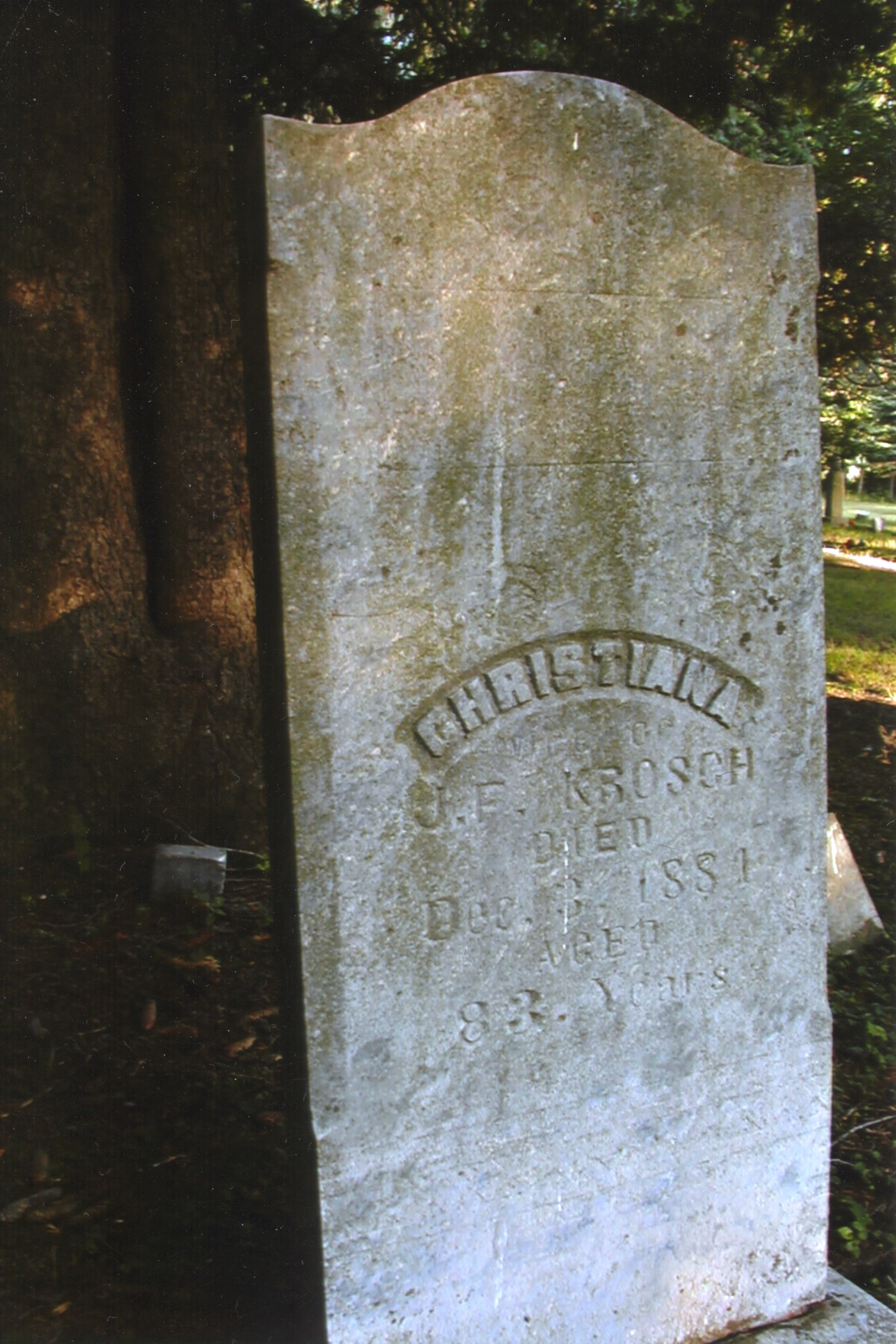
The grave of Christiana (Schlagel) Krosch at Elmore, Minnesota.
His wife Christiana (Schlagel) Krosch moved to Elmore, Minnesota after being widowed. The 1880 U.S. Census lists her living on the farm of her son, William F. Krosch. She died on December 3, 1884. She is buried near three grandchildren at Dobson Schoolhouse Cemetery in Elmore.
FAMILY LINE: John Frederick Krosch >> Henrietta (Krosch) Treutel >> Walter Treutel >> Ruby (Treutel) Hanneman >> Donn, David and Lavonne Hanneman.
The grave of Christiana (Schlagel) Krosch at Elmore, Minnesota.
Frederick Krosch’s farm was in Section 23 on this 1870 Mukwonago-area map.
John Frederick Krosch’s grave at Oak Knoll Cemetery in Mukwonago, Wisconsin.
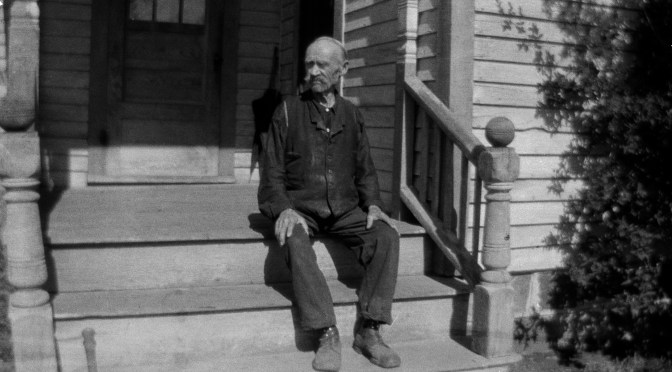
The photograph is very poignant. A frail man, sitting in the afternoon sun on the front porch steps. He looks haggard and tired, maybe ill. This image is the last known photograph taken of Karl Frederick Christian Hanneman, who was known around Wisconsin Rapids as Charles or “Chas” Hanneman. The photo likely dates to 1931 or 1932, when he suffered from prostate cancer that eventually took his life.
Charles Hanneman came to America in late November 1882 with his parents, Christian and Amanda Hanneman. He was just 15 when the family made its way from Stettin, Pomerania to Portage County, Wisconsin. Charles, his three brothers and two sisters settled on a 105-acre farm in the northwest corner of the Town of Grant, near the tiny hamlet of Kellner.
Nina and Elaine Treutel visit with Chas Hanneman, circa 1930.
Charles worked on the Hanneman farm for a time. His brothers would stay in farming (maps from that period show many Hanneman farms in Portage County), but eventually Charles left farming and found work in one of the area’s many sawmills.
At some point in his early 20s, Charles made the acquaintance of Rosine Ostermann, the eldest daughter of John and Mina Ostermann of the Town of Grand Rapids. They had many things in common. Both grew up on the family farm. Rosie’s parents were from Germany (Saxony and Prussia), and his were from Pomerania. Rosie’s grandfather George Ostermann was one of the pioneers of Portage County, listed on the earliest tax roll of the Town of Grant in 1864.
On April 2, 1891, Charles and Rosie were married atSt. John’s Evangelical Lutheran Church in Kellner in a divine service performed by A.G. Grimm. The witnesses were Charles’ father, Christian, and his brother, William. The bride’s attendants were her sister, Elsie Ostermann, and Emma Pribbernow. The groomsmen were cousins August Saeger and Herman Hanneman.
The young couple came to know heartache early in their marriage. Their firstborn, referred in the records only as “C.H. Hanneman,” died in infancy in 1892. They went on to have four sons: Arthur John (1893), Frank Herman Albert (1895), Wilbert George (1899), and our own Carl Henry Frank (1901).
Left to right: Christian Hanneman, Chas Hanneman, Carl Hanneman, David D. Hanneman.
Work in the sawmill must have been erratic, or Charles left that occupation for a time. In 1900, U.S. Census records show the family living and working on the farm of Charles’ brother, William Hanneman.
By 1905, Charles moved his family to the second ward in the city of Grand Rapids. He initially did manual labor for the city of Grand Rapids,possibly working on construction of the water and sewer works. The financial statements for the city in December 1907 show Charles worked 135 hours that month and earned 17.5 cents per hourfor a paycheck of $23.63.
By 1910 the family was living at 1774 Baker Street in Grand Rapids. The U.S. Census that year lists Charles as a laborer at a box factory. That may have referred to Consolidated Water, Power & Paper Co., where he later worked until his retirement, or the nearby Badger Box company.
On March 31, 1918, tragedy struck the Hanneman home when Rosine died suddenly at age 48. Her death notice, which ran on page 1 of the Daily Leader, said she was fine during the day but fell ill and died at 11 p.m. We know that she had diabetes, and that may have contributed to her death. Carl was 16 when his mother died.
Charles remarried in August 1919 and lived out his remaining years in his home at 1751 Baker Street. He became ill with prostate cancer in 1931 and was hospitalized numerous times in Wausau for surgery and treatments. He died at home on Oct. 11, 1932. He was 65. His death made front-page news in the Wisconsin Rapids Daily Tribune.
FAMILY LINE: Karl Frederick Christian Hanneman >> Carl F. Hanneman >> Donn, David & Lavonne Hanneman
Rosine Bertha Henrietta (Osterman) Hanneman (1870-1918), Frank Herman Albert Hanneman (1895-1947), Arthur James Hanneman (1893-1965), Carl Henry Frank Hanneman (1901-1982), Wilbert George Hanneman (1899-1987) and Carl Frederick Christian (Chas) Hanneman (1866-1932).
It is the only known photograph showing six of the seven children of Christian and Amanda Hanneman, pioneers of Portage and Wood counties in Wisconsin. The undated photo was probably taken around 1915 at a family event. Left to right are: William Friedrich Johann Hanneman (1856-1939) Bertha Auguste Ernestine (Hanneman) Bartelt (1860-1945) Albert Friedrich O. Hanneman (1863-1932) Herman Charles Hanneman (1864-1945) Carl Friedrich Christian Hanneman (“Chas,” 1866-1932) Ernestine Wilhelmine Caroline (Hanneman) Timm (1870-1930)
Hand tinted photograph of Chas Hanneman, location unknown.
Left to right: Christian Hanneman, Chas Hanneman, Carl Hanneman, David D. Hanneman.
Just three weeks after becoming a father for the third time, young pharmacist Carl. F. Hanneman took the extraordinary step of writing to the attorney general of Wisconsin to ask that he be granted full licensure as a registered pharmacist. It was a heartfelt letter, written by a young man feeling the weight of responsibility of a wife and three children. Written by a well-educated and accomplished man who felt he deserved what he as asking. The very future was at stake.
“I am writing this letter in all sincerity as what I am about to ask means everything to myself as well as my wife and three little kiddies,” Carl wrote to Attorney Gen. Orland S. Loomis on Sept. 3, 1937.“I am 35 years old and will be 36 this coming October and feel that obtaining my full registered papers will mean life itself to myself and my dear family.”
Carl explained that he was fully licensed as an assistant pharmacist, working at the Mauston Drug Store owned by Dr. J.S. Hess Jr. But he was unable to officially manage the drug store due to a quirk in state law.
Wisconsin Attorney Gen. Orland S. Loomis of Mauston
If Carl had worked in a smaller town with under 500 population, he could have legally managed the pharmacy. But Mauston population was about 2,100. Carl would need to be a registered pharmacist in order to manage the Mauston Drug Store.
“My capacity in the drug store is as an unofficial manager, as I do all of the buying etc., but legally cannot manage the store,” Carl wrote. “Dr. J.S. Hess Jr. has confidence in me and I a great deal in him, and as far as I am concerned am willing to stay here the rest of my life, dispensing for our own doctors.”
Carl reasoned that if he was qualified to own and manage a pharmacy in a small town (such as neighboring Lyndon Station, pop. 236), why could he not serve the same capacity in Mauston? “I have often wondered as has many others, are not the lives of 500 people in a small town just as valuable to their loved ones as those living in a town where there might be more than this amount?” Carl wrote.
A label under glass from Carl F. Hanneman’s pharmacy collection.
By 1937, Carl had 16 years of experience in pharmacology, starting as an apprentice in 1921 at the Sam Church drug store in Wisconsin Rapids. Carl graduated from the pharmacy program at Marquette University in 1925 and became licensed as an assistant pharmacist. He wasn’t eligible to take the full pharmacist exam at the time because his apprenticeship fell just short of the required five years. Over the next decade he worked at drug stores in Janesville, Fond du Lac and Wisconsin Rapids, and even worked a three-year stint as a salesman for Consolidated Water Power & Paper Co.
“I knew my lifework was with the drug store as I truly love it and was very fortunate in securing a position with the Dr. Hess Hospital, Clinic and Drug Store organization on Feb. 1, 1936,” Carl wrote.
Carl said he would likely need three more years of study to pass the registered pharmacist board exams as they existed in 1937. With three children (including baby Lavonne born in August 1937), Carl figured that simply would not be possible. So he asked for help from Loomis, a Mauston native who served as city attorney from 1922 to 1931. Loomis was attorney general through 1938, and was elected governor of Wisconsin in 1942. He died before taking office. Eventually, Carl became good friends with Loomis and photographed him for the Wisconsin State Journal on the 1942 night of his election as governor of Wisconsin.
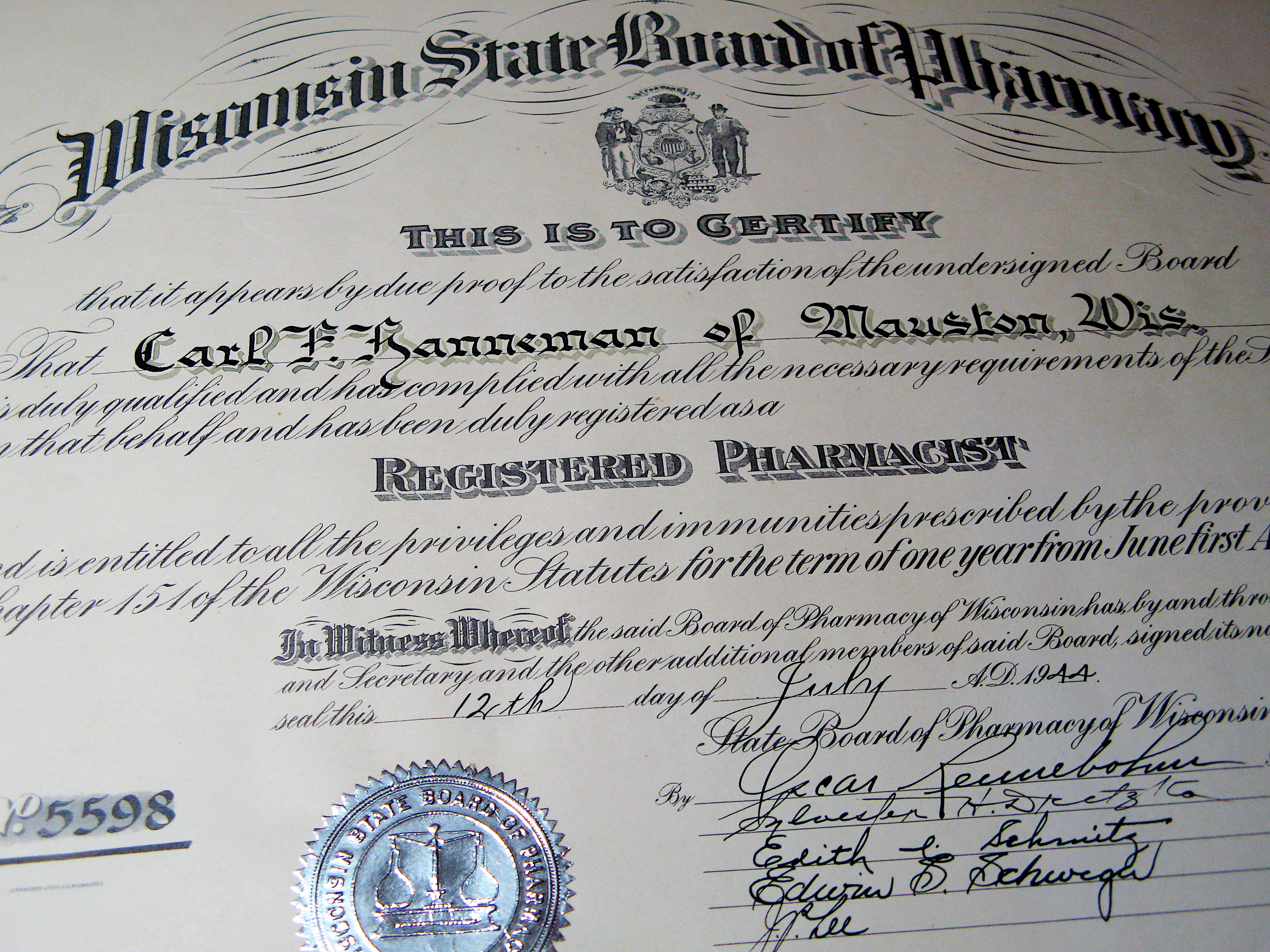
Carl F. Hanneman’s registered pharmacist license, issued in July 1944.
We don’t know if Loomis ever intervened on Carl’s behalf in his role as attorney general or governor-elect, or how he responded to the 1937 letter. A search of Loomis’ law-practice records at the Wisconsin Historical Society yielded no clues. Carl’s 1941 license from the Wisconsin State Board of Pharmacy still lists him as an assistant pharmacist. On July 12, 1944, the state of Wisconsin issued an ornate document certifying Carl as a full registered pharmacist. He worked under the new license number until his death in 1982. It would appear Carl secured his added credentials the hard way: he earned them.
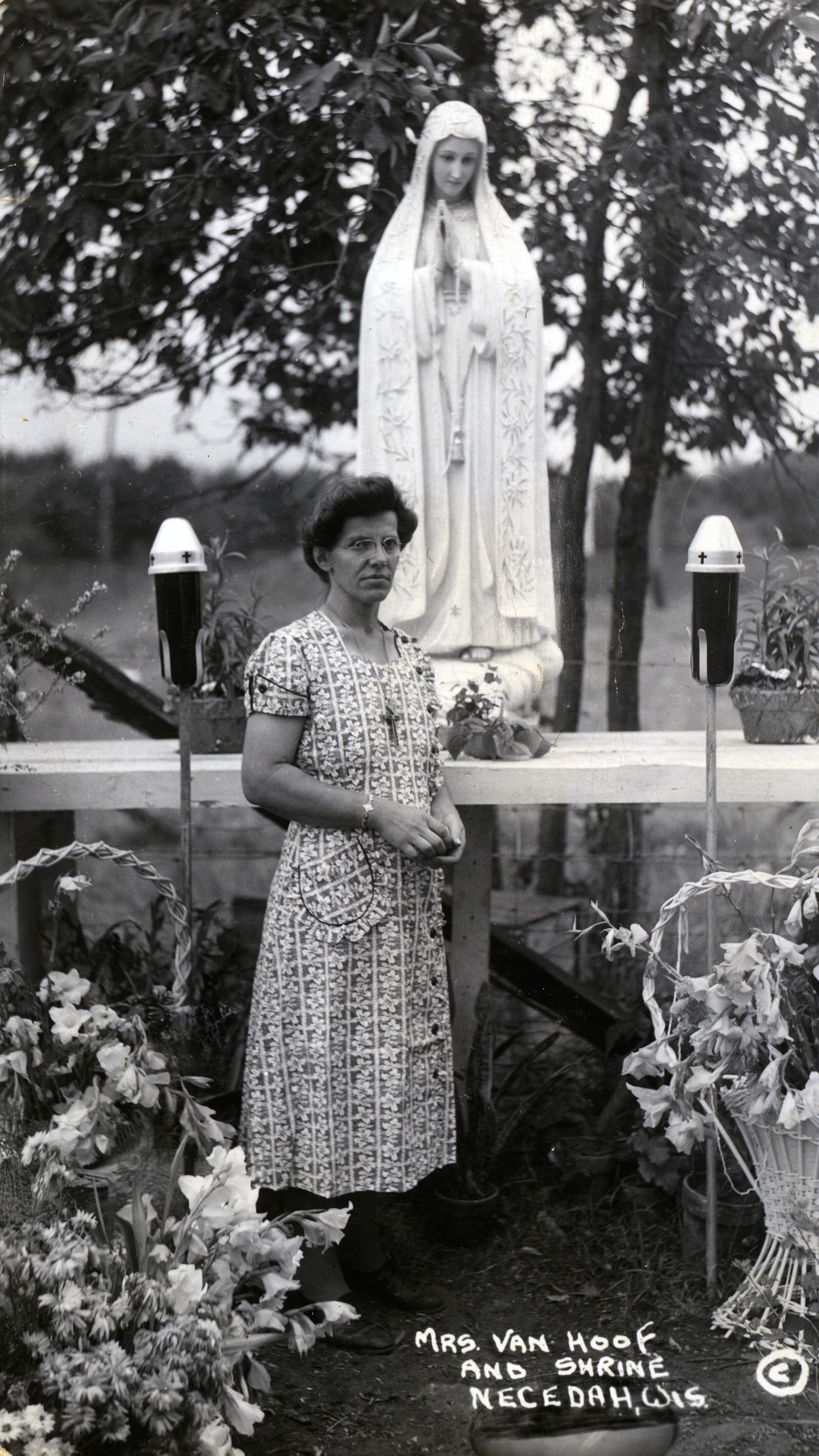
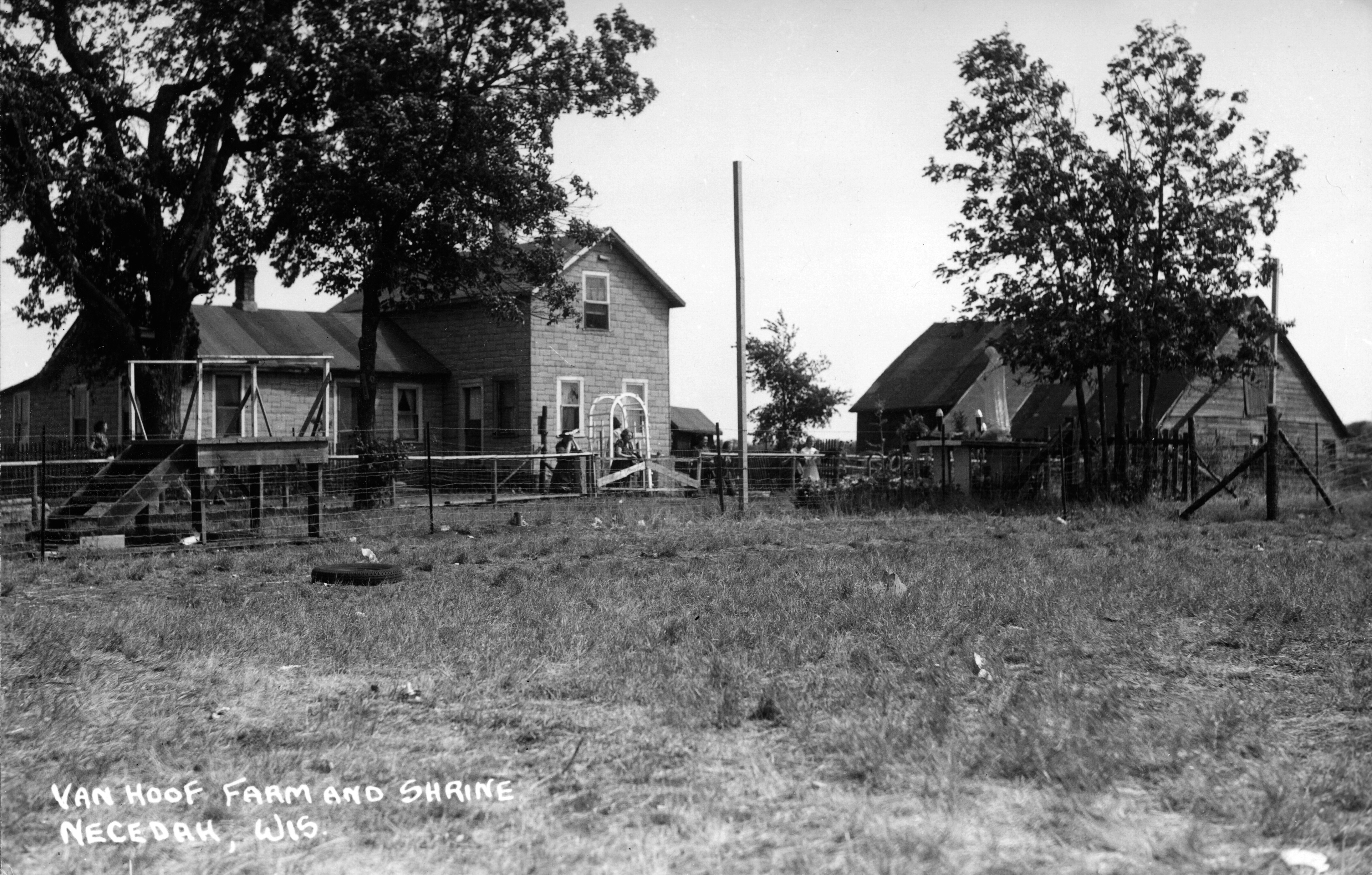
Nothing was bigger news in the fall of 1950 in central Wisconsin than Mary Ann Van Hoof and her claims of receiving visions from the Blessed Virgin Mary at the Van Hoof farm near Necedah. Members of the Hanneman family of Mauston, had great devotion to Mary, and they were among 50,000 people in Necedah on October 7, 1950, when Van Hoof received the eighth of her reported visions of Mary.
The front page of the Wisconsin State Journalthe next day recounted the alleged vision this way:
Mary Ann Van Hoof at her farm near Necedah, Wisconsin.
“Mrs. Fred Van Hoof said she saw the Virgin Mary in a vision for the eighth time Saturday and was told in a ‘last warning’ to pray for peace. The gaunt farm wife, who said last August that the Virgin would appear to her Saturday noon in a blinding light, walked from her shabby home at the appointed hour, knelt in prayer and raised a crucifix to a statue of the Virgin. At that moment, the sun burst through rain clouds which had hovered over the humble farm most of the morning, and a murmur swept through the crowd estimated by state police at 50,000 persons.After a few minutes, Mrs. Van Hoof arose and addressed the mingled throng of curious and claims to have done on previous visitations. ‘This is the battle for peace for all of you,’ she said. ‘Prayer, my dear children, will bring you peace.’ ”
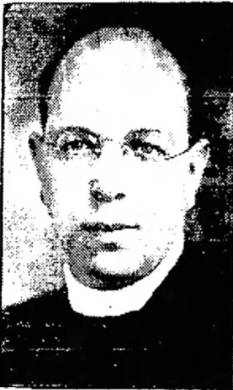
Rev. Father Victor A. Fortino
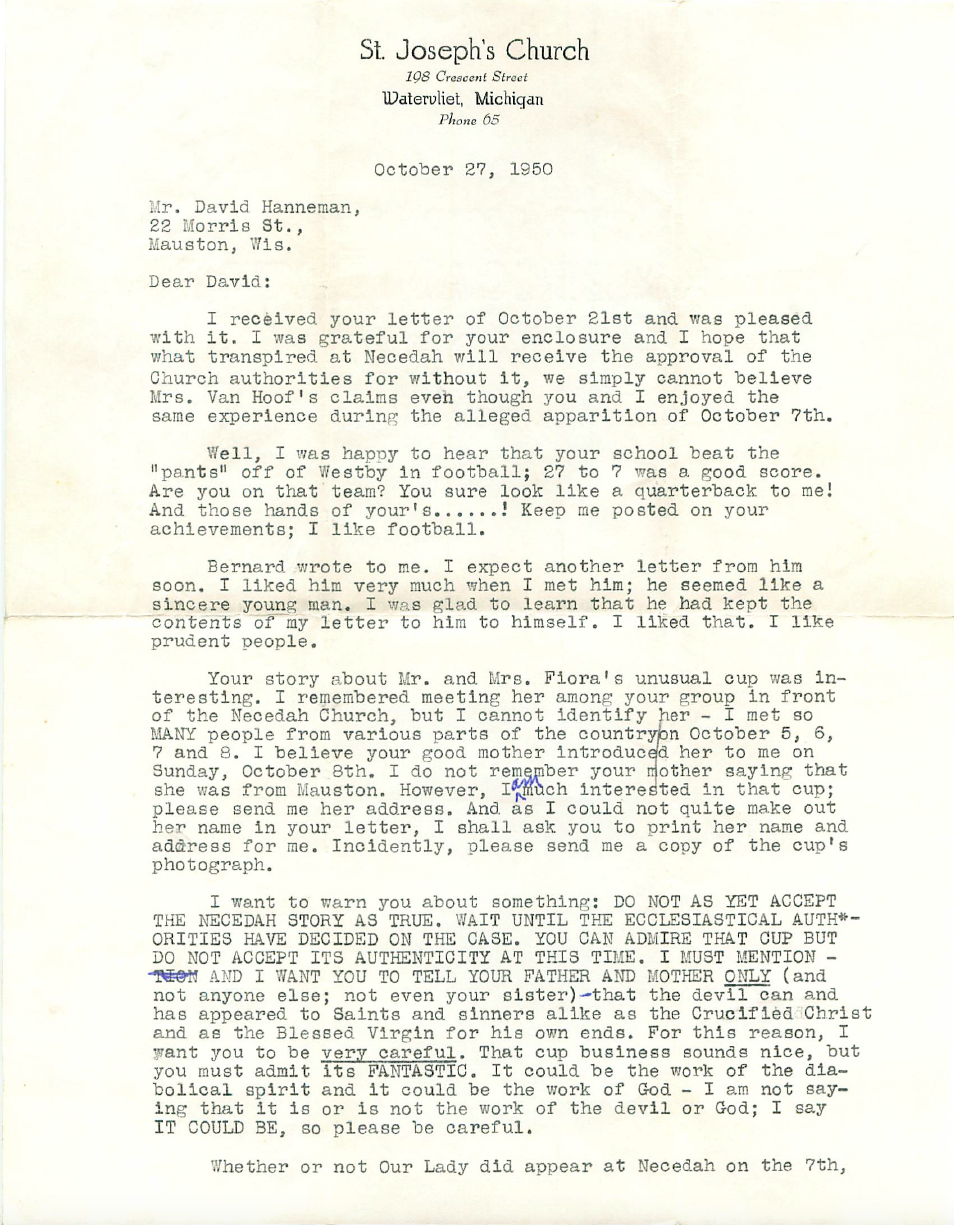
A priest from Watervliet, Michigan, who was also in attendance that day befriended the Hanneman family. Rev. Father Victor A. Fortino of St. Joseph’s Church in Watervliet, cautioned 17-year-old David D. Hanneman to wait for Catholic Church authorities to approve the alleged visions before he placed too much stock in them. “I hope that what transpired at Necedah will receive the approval of the Church authorities,for without it, we simply cannot believe Mrs. Van Hoof’s claims even though you and I enjoyed the same experience during the alleged apparition of Oct. 7,” Fortino wrote in a letter dated October 27, 1950.
The Van Hoof farm near Necedah, Wisconsin, was the site of reported visions of the Blessed Virgin Mary.
Father Fortino warned that Satan has appeared to Saints and sinners alike posing as the Blessed Mother and as the Crucified Christ, so it is crucial that the Church rule on the Van Hoof apparitions. “I want to warn you about something,” Fortino wrote. “DO NOT AS YET ACCEPT THE NECEDAH STORY AS TRUE. WAIT UNTIL THE ECCLESIASTICAL AUTHORITIES HAVE DECIDED ON THE CASE.”
As it turned out, Fortino’s words were almost prophetic. In June 1955, Bishop John Treacy of the Diocese of La Crosse officially rejected Van Hoof’s visions.“Because of the continued promotion of the claims made by Mrs. Mary A. Van Hoof of Necedah, Wis., we, by virtue of our authority as bishop of the diocese of La Crosse, hereby declare that all claims regarding supernatural revelations and visions made by the aforementioned Mrs. Van Hoof are false. Further more, all public and private religious worship connected with these false claims is prohibited at Necedah, Wis.” As early as August 1950, Bishop Treacy had said Van Hoof’s claims “are of extremely doubtful nature.”
Father Victor Fortino urged David Hanneman: “be very careful.”
Father Fortino may have suspected the Necedah claims would turn out to be false, but he wrote that some good could come from the gathering that week in 1950 no matter what. “It seemed to me that Our Lady brought us together for Her own good purposes,” Fortino wrote. “What She intends for us, I do not know. But I hope that much good will come out of our chance meeting and our mutual experience in Necedah.”
Despite the controversy over Van Hoof and her claims, the Hanneman family maintained strong devotion to the Blessed Virgin Mary. Carl and Ruby Hanneman kept a beautiful porcelain statue of the Blessed Mother in their Mauston home. After their deaths that statue found a place at David Hanneman’s residence in Sun Prairie. And it sat in front of the altar at his funeral Mass on April 19, 2007.
[The original version of this story posted in 2014 stated that President Truman visited Mauston, Wisconsin. A sharp-eyed former resident of Mauston noted in the comments section that Truman did not visit Mauston, but rather nearby Elroy. The Truman Presidential Library has now confirmed this, so the story has been corrected and expanded as of May 10, 2017.]
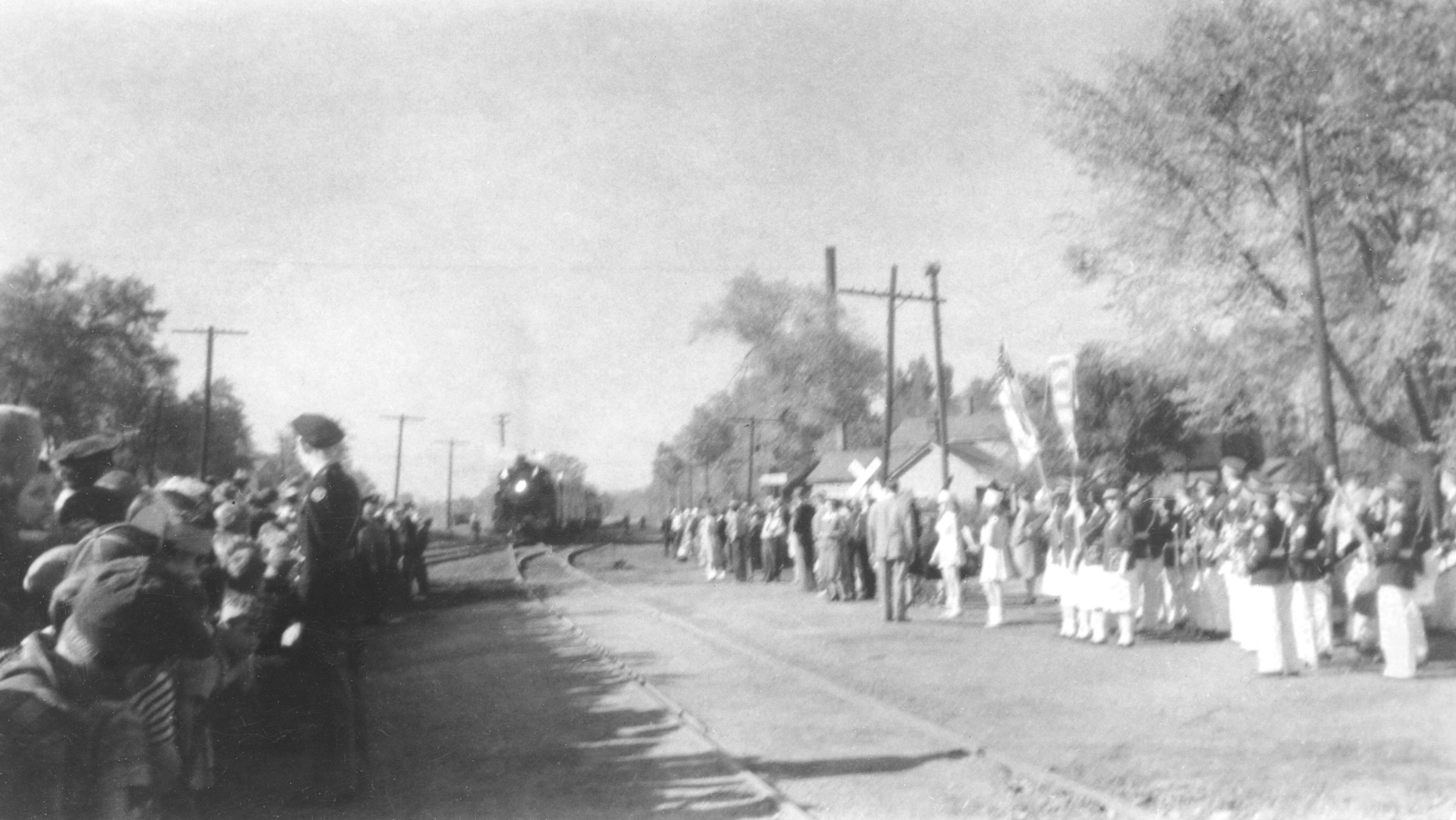
When President Harry S Truman pulled into tiny Elroy, Wisconsin on his rail tour of America in 1948, the Carl F. Hanneman family was at the station and captured several Polaroid images of the event. The grainy and out of focus photos are far from perfect, but they provide literal snapshots from one of the great political stories in American history.
The Harry S Truman express approaches Elroy, Wisconsin, on October 14, 1948.
Truman went on an 30,000-mile“whistle-stop” railroad tour of the nation,visiting large cities, small villages and everything in between. His 17-car train was called the Magellan. Much like his old boss President Franklin Delano Roosevelt had done, Truman made speeches from a presidential podium at the back of the train. The tour drew huge crowds wherever he went, and Mauston was no exception. According to the Truman Presidential Library, the president made up to eight speeches each day during the rail tour.
President Harry S Truman took his case directly to the people during his 1948 rail tour.
On this day, Truman started out with a speech in Mankato, Minnesota at 8:08 a.m. Other stops included Waseca, Rochester and Winona, Minnesota; and Sparta, Wisconsin. The train pulled into Elroy at 1:55 p.m. on October 14, 1948. Truman stepped to the podium and said:
I certainly do appreciate your coming out here. This was supposed to have been a water stop. I didn’t think that we would be here long enough for me to speak to you, but I am happy that we did stop long enough, and I appreciate your interest and I appreciate your coming out here to see the president.
I wish I had the chance to discuss with you all the issues in this campaign, but I haven’t the time now.
I hope you’ve been reading the speeches and statements I have been making over the country. They are in your interest, and if you vote for your own interests on the 2d of November you’ll elect a Democratic Governor and a Democratic Congressman from your district–and you’ll elect a Democratic administration in the whole United States Government. And then things will be safe and in the hands of the people.
Conventional political wisdom had Truman losing badly before a single ballot was cast. When he won the election, it was viewed as a stunning turn of events. Many will recall the famous photo of Truman holding the early edition of the Chicago Tribune with the erroneous headline, “Dewey Defeats Truman.” That photo was snapped at the back of the same train in St. Louis, as Truman departed for Washington.
It seems the term “whistle-stop” was considered a bit of a slight. When Republican Sen. Robert Taft of Ohio criticized the Democrat Truman for things he was saying on the “whistle-stop” tour, mayors of towns on the route of Truman’s tour reacted with indignation. “Our whistles never stop blowing,” one huffed. Crestline, Ohio, was quick to point out the 42 daily trains that served its population of 5,000. The Associated Press at the time said a whistle-stop was a “tank town, a hamlet, a mere wide place in the road.” Truman’s own comments at Elroy indicate the stop there was supposed to be only to take on water.
Of course millions of Americans live in such places, so the kerfuffle seemed a bit strange. As columnist Thomas L. Stokes noted, “Whistle-stop folks vote, too.” Stokes called the rail tour a public service, part of a president’s responsibility to communicate directly with the American people.
Leaving the family homeland to make a trans-Atlantic trip and emigrate to America would be an intimidating prospect under the best circumstances. When Michael Friedrich Ferdinand Hannemann brought his pregnant wife Mina and infant son Albert aboard the ship John Bertram in Hamburg, Germany in April 1863, he likely had no idea the horror they would face during 46 days at sea.
Fred Hannemann, as he was known to family and friends, was not the first in the family to leave Pomerania for Wisconsin. At least two sisters were already in central Wisconsin, so Fred may have heard stories from them about their travels to the American Midwest. But that likely would not have prepared him for the life-threatening conditions the 336 passengers faced en route to New York. One of the middle children of Matthias and Maria Caroline Hannemann of Meesow, Kreis Regenwalde, Pomerania, Fred was among at least eight children in the clan who would come to America between 1861 and 1882.
The John Bertram was a 1,060-ton clipper ship built in just 90 days in Boston in 1850 and placed into service in January 1851. At 180 feet long, the ship was initially employed to shuttle cargo from Boston around Cape Horn to San Francisco. It was later sold and pressed into service moving emigrants and cargo from Europe to America. Between 1860 and 1869, nearly 2,100 people were carried from Europe and elsewhere to America aboard the John Bertram.
About 10 days into the journey, the John Bertram encountered a violent gale that ripped at the sails and caused the ship to pitch up and down in the massive ocean swells. The winds raged at the ship for 48 hours, tossing drinking water casks overboard and destroying the storm sails. Conditions below deck were likely horrific, with the violent rocking causing seasickness and injuries. On deck, conditions were worse. Four crewmen were lost overboard and eight others were disabled. Once the storm passed, the ship was leaking badly, making it difficult to keep under sail. Mina Hanneman no doubt had to struggle to care for young Albert Hannemann, 1, in the chaos. The former Johanna Wilhelmine Florentine Glebke was nearly seven months pregnant during the voyage.
On May 4, still three weeks from docking in New York, the John Bertram hit dense fog and became trapped in a massive ice floe. For four days, the ship was surrounded by ice that scraped the planks of the hull and ripped at the cutwater. Four other ships in the area became snared in the ice. Eventually the clipper broke free, but had to steer 3 degrees to the east in order to escape the ice fields.
The trip took its toll. Eight infants died during the trip, although two babies were born. Along with the crewmen who were washed overboard, 12 people lost their lives. Thankfully, Fred, Mina and Albert Hannemann made it safely to Castle Garden in New York. Once they reached the Town of Grand Rapids in Wood County, Wis., they settled into farming. Eventually, seven children were born into the home, as yet another branch of the Hannemann family tree took root in central Wisconsin.
For 80 years, there has been a member of the Hanneman family in the Knights of Columbus, the world’s largest Catholic fraternal and charitable organization. The line of service runs from Carl F. Hanneman (1901-1982), who joined in 1934, to his son David D. Hanneman (1933-2007), who joined in 1953, to his son Joe Hanneman, who joined the order in April 2007.
The three generations share other things in common with respect to the K of C, based in New Haven, Connecticut, with more than 14,000 local councils across America. All three have been members of the Fourth Degree, which focuses on patriotism and love of country. All three served in the Fourth Degree Color Corps and Honor Guard. The Honor Guard, wearing tuxedos, colored capes, ceremonial swords and plumed chapeaux, is a ceremonial presence at Masses, funeral wakes, Flag Day ceremonies and other events. Joe Hanneman served on the Honor Guard for the installation of Archbishop Jerome Listecki in Milwaukee. Carl joined the Fourth Degree in the late 1930s or early 1940s, judging by the group portrait of his exemplification class. David joined in 1973 and Joe joined in 2008.
Carl F. Hanneman (left section, second row, second from center aisle), joined the Fourth Degree of the Knights of Columbus in the late 1930s or early 1940s. Exact date of this photo is unknown.
All three also served as Grand Knight of their respective local K of C council. The Grand Knight is leader of the local council. Carl Hanneman was Grand Knight of Solomon Juneau Council 2770 in Mauston, Wisconsin in the late 1960s. David Hanneman was Grand Knight of Holy Family Council 4879 in Sun Prairie, Wisconsin, from 2001 to 2003. Joe Hanneman was Grand Knight of Msgr. Stanley B. Witkowiak Council 697 in Racine in 2010 and 2011.
Altar server Joe Hanneman with his father David D. Hanneman (at right) and Bill Dziadosz.
The Knights of Columbus is a fraternal and charitable organization founded in 1882 by Venerable Father Michael J. McGivney, whose cause for sainthood is being considered at the Vatican. The Knights operate under the principles of charity, unity, fraternity and patriotism. Knights raise money and volunteer for a wide range of causes, from pro-life programs such as crisis pregnancy centers, to programs providing free wheelchairs to the disabled, to grants to local programs that support the mentally retarded. The K of C and local councils have provided more than 500 ultrasound machines to crisis pregnancy centers.
David D. Hanneman was part of a large class that became Fourth Degree Sir Knights on April 14, 1973 in Madison.
Knights provide free coats to needy children each winter. They run a variety of athletic events, including Punt, Pass and Kick, and a basketball free-throw competition. Knights also support and promote vocations to the priesthood, sponsoring seminarians and providing other material support for those studying for the priesthood. In 2013, Knights provided a record amount of charity, with over $170 million raised and 70.5 million hours of voluntary service provided. In 2014, the K of C provided more than $2 million to help persecuted Christians from Iraq and other Mideast countries being targeted by ISIS and other terrorist organizations.
Boy Scouts participate in a flag retirement ceremony run by Assembly 1207, the Fourth Degree Knights in Racine. Speaking at the podium is Deputy Grand Knight Joe Hanneman.
The Fourth Degree of the Knights is especially dedicated to patriotism and the idea that love of God and love of country go hand in hand. The Fourth Degree was founded in 1900 to combat the prejudiced notion that Catholics were not loyal Americans and could not be trusted in public office or with civic responsibility. The Fourth Degree provides free flags for schools and nonprofit organizations, supports veterans’ organizations, provides material needs to local veterans’ hospitals, and sends faith materials and other assistance to members of the military serving overseas.
Sir Knight Joe Hanneman (left) in an honor guard at St. Rita Catholic Church in Racine.
Famous Knights include Venerable Archbishop Fulton J. Sheen, one of the Catholic Church’s all-time great authors and communicators; former Green Bay Packers coaching legend Vince Lombardi; baseball’s Sultan of Swat, Babe Ruth; Supreme Court Justice Samuel Alito; Ray Flynn, former U.S. ambassador to the Vatican; Cardinal Francis George, former archbishop of Chicago; Saint Rafael Guizar Valencia; and six martyrs of the Cristero War in Mexico: Father Luis Bátis Sáinz, Father José María Robles Hurtado, Father Mateo Correa Magallanes, Father Miguel de la Mora, Father Rodrigo Aguilar Alemán and Father Pedro de Jesús Maldonado Lucero. The K of C operates in the United States, Canada, Mexico, the Philippines, Poland, the Dominican Republic, Puerto Rico, Panama, the Bahamas, the Virgin Islands, Cuba, Guatemala, Guam and Saipan.
A number of other members of the extended Hanneman family have been members of the Knights of Columbus: Earl J. Mulqueen Sr. (my grandfather), Earl J. Mulqueen Jr.,Donn G. Hanneman, longtime Wisconsin Rapids building inspector Arthur J. Hanneman, and former state representative Arthur Treutel.
— This post has been updated with a date correction and two new photographs.
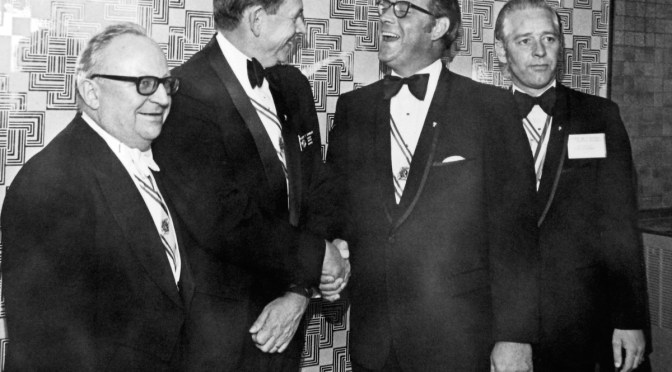
Carl F. and Ruby V. Hanneman (at left) on the day Carl was made a Sir Knight in the Fourth Degree of the Knights of Columbus.
David D. Hanneman (third from left) on the day in April 1973 he became a Fourth Degree Sir Knight.
David D. Hanneman (left of center, dark hair), stands just behind his father, Carl, at the reception following the Knights of Columbus Fourth Degree exemplification.
Carl F. Hanneman with his son David (two at left) at the Hanneman home in Sun Prairie before David became a Sir Knight on April 14, 1973.
Carl F. Hanneman handmade the K of C logo for Solomon Juneau Council 2770 in Mauston, Wis.
Carl F. Hanneman was a delegate to the 1937 Wisconsin convention of the Knights of Columbus.
Carl F. Hanneman was a delegate to the 1937 Wisconsin convention of the Knights of Columbus.
Altar server Joe Hanneman with his father David D. Hanneman (at right) and Bill Dziadosz.
The Knights of Columbus Honor Guard at the 2007 funeral of David. D. Hanneman.
The Knights of Columbus sent scores of volunteers to Europe in World War I to operate recreation centers for soldiers and provide comfort at the front.
The Knights of Columbus Glee Club in Racine, Wis., provided entertainment around the city in the 1920s.
The K of C sponsored a “Keep Christ in Christmas” billboard on Interstate 94 near Racine.
K of C councils often hold Landing Day parties to celebrate Catholic explorer Christopher Columbus’ discover of the New World in 1492.
Father Mark Jones blesses the new home of the K of C in Racine, Wis., while Grand Knight Joe Hanneman (at right) looks on.
Wearing regalia and plumed chapeaux, the Knights of Columbus Fourth Degree honor guards often serve at funerals and other Masses.
K of C councils hold “Life Savers for Life” events to raise money for pro-life efforts such as crisis pregnancy centers.
Boy Scouts participate in a flag retirement ceremony run by the Knights in Racine. Speaking at the podium is Deputy Grand Knight Joe Hanneman.
Knights in Racine, Wisconsin honor members of the Catholic church who provide exemplary service with the Pro Deo Et Ecclesia award. The medal was designed by Joe Hanneman.
A young girl tries on a new coat provided by the Knights of Columbus at the HALO homeless shelter in Racine, Wis.
A young boy tries on a new coat provided by the Knights of Columbus at the HALO homeless shelter in Racine, Wis.
Knights and other Christian volunteers pray together after setting up a Nativity scene on Monument Square in Racine, Wis.
Every year the K of C helps set up a Nativity scene on Monument Square in Racine, Wis.
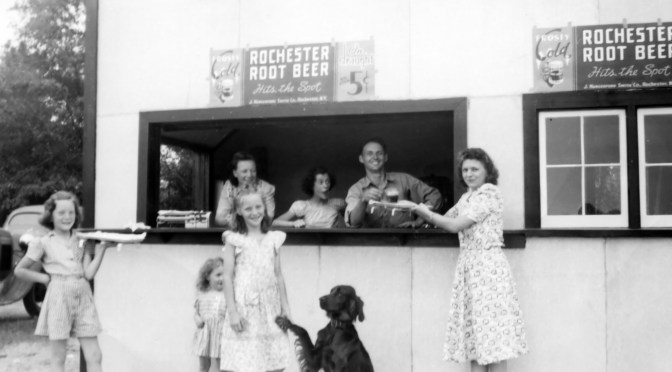
Marvin and Mabel Treutel operated a roadside root beer stand near their home on Wilhorn Road in Nekoosa, Wisconsin. Aside from 5-cent Rochester root beers, they served the “Best Roast Beef BBQ.” Pictured behind the counter in this late-1940s photo are Mabel Treutel (left), niece Lavonne Hanneman (center) and Marvin Treutel (right). Out front are daughters Bonnie Treutel (left), and Patricia Treutel (center, holding dog). The woman at right and the little girl at center are unidentified.
It is the only known photograph showing six of the seven children of Christian and Amanda Hanneman, pioneers of Portage and Wood counties in Wisconsin. The undated photo was probably taken around 1915 at a family event. Left to right are:
William Friedrich Johann Hanneman (1856-1939)
Bertha Auguste Ernestine (Hanneman) Bartelt (1860-1945)
Albert Friedrich O. Hanneman (1863-1932)
Herman Charles Hanneman (1864-1945)
Carl Friedrich Christian Hanneman (“Chas,” 1866-1932)
The sibling not pictured is August Friedrich Ferdinand Hanneman (1858-1902).
Along with their parents, this group came to America in late November 1882 aboard the SS Katie. They were the last of the Matthias Hannemann family to come to America from the Baltic Duchy of Pomerania (now part of Poland and Germany). The Hannemann clan (the name was eventually shortened to Hanneman) settled in and around the hamlet of Kellner in central Wisconsin.
Family Line: Matthias Hannemann >> Carl Frederick Christian Hannemann >> Carl Henry Frank Hanneman >> David D., Donn and Lavonne Hanneman.
His death was given only passing notice in the Wisconsin State Journal, the state’s official newspaper. “May he rest in peace,” the brief item from April 9, 1864 read. So it was the unwritten that was truly remarkable in the all-too-brief life of James Moore, soldier of the Wisconsin 12th Infantry Regiment in the Civil War.
The son of Irish immigrants who settled to farming in the Town of Sun Prairie, Moore was just 14 when he enlisted in Company I of the 12th Infantry Regiment in late September 1862. Moore and Lemuel C. Neal of Sun Prairie enlisted together at Camp Randall on September 29, 1862. Moore was a boy who went to fight in a man’s war — a theme that would be repeated, most especially in the “war to end all wars,” World War I. His youth, just five months past his 14th birthday, seems quite remarkable for an infantry private. The sacrifice of his very young life in the fight to save the republic should always be remembered.
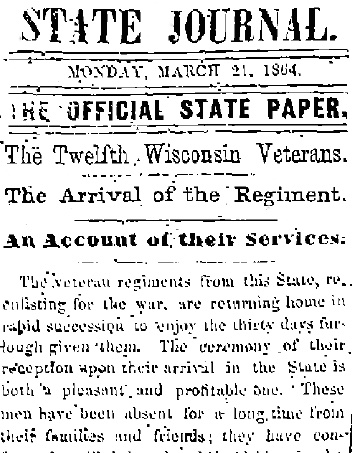
The Wisconsin State Journal covered the return of the 12th Infantry Regiment on March 21, 1864.
Moore saw combat and the horrors of America’s bloodiest war, although the 12th Infantry Regiment did not take part in the most famous battles of the Civil War. These men rebuilt and guarded key railroad lines, supported the battle of Vicksburg and took part in General Sherman’s Meridian Expedition in February 1864. That month they marched 416 miles, aiding in the capture and destruction of Jackson, Brandon and Decatur as they proceeded to Meridian. “A shell exploded in the ranks of Company I, killing Eugene Baldwin and W.H. Murray, wounding O. Lind, J.W. Dean, John Thorp and George Everett,” read the account in the 1866 Military History of Wisconsin.
The battle flag of the Wisconsin 12th Infantry Regiment is held by the Wisconsin Veterans Museum in Madison.
Shortly after the Meridian campaign, Moore was among some 700 men in the regiment sent home to Wisconsin on a 30-day furlough. After rolling into Madison via rail at 5 a.m. on March 21, the men ate a hearty supper at the Railroad Restaurant and then marched to their quarters at Camp Randall. The next day they were welcomed by Wisconsin’s newly minted governor, James Taylor Lewis. The Wisconsin State Journal published a chronicle of their service, noting the regiment had marched more than 2,000 miles to earn itself the nickname “the Marching 12th.”
The newspaper asked the community to be patient with these and other young soldiers, home from the stress of war with full bellies and money in their pockets. “Brave boys, they are going back, and the voice that now makes the night hideous with bawdy songs will utter its last accent in a victorious cheer upon some future battlefield,” the paper wrote. “Yes, they are going back, and he who is now a ‘drunken soldier’ will bear the dear old flag in triumph, amid the whistling bullets and screaming shell, to plant it on the battlements of the enemy.”
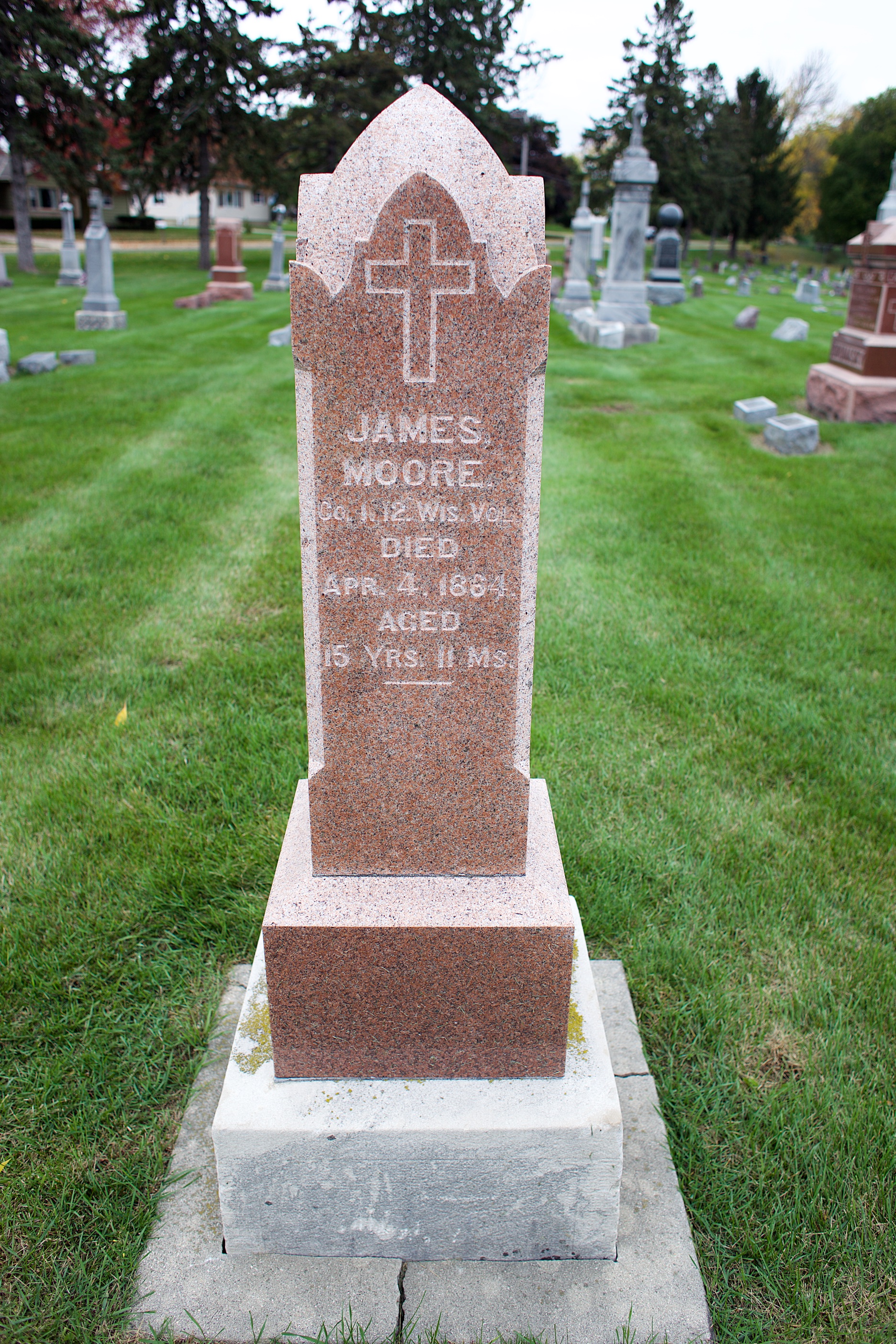
The grave marker of James Moore at Sacred Hearts of Jesus and Mary Catholic Cemetery in Sun Prairie, Wisconsin.
The soldiers of the 12th were discharged to their homes on Thursday, March 31. It is a safe assumption that Pvt. Moore was ill when he reached his family farm in the Town of Sun Prairie. He took to bed. His death on Monday, April 4 came before he had any chance to enjoy the well-deserved furlough. We don’t know what disease or illness claimed his life, or if he was exposed to it in battle, on the train ride home or at Camp Randall. His funeral Mass was held at Sacred Hearts of Jesus and Mary Catholic Church, which his father helped to build just a year before. His parents and two sisters had the sad duty of burying young James just as Wisconsin shook off the winter of 1864.
James Moore was born in Ohio on April 15, 1848, the only son of Mathew Moore and the former Catharine O’Neill. His parents emigrated from Ireland and spent some time in Ohio before settling on a 37-acre farm on the western edge of the Town of Sun Prairie in May 1850. Mathew and Catharine carried the loss of their son with them every day. Around 1875, the family left the farm and moved into the village of Sun Prairie, where Mathew died on April 28, 1891. Mrs. Moore died on Feb. 22, 1907 at age 93. Their daughters, Margaret Moore and Sara (Moore) Flavin, are buried near their parents — and their soldier brother — at Sacred Hearts of Jesus and Mary Cemetery in Sun Prairie.
Moore was among the more than 224,500 Union soldiers who died of disease, exposure or other non-battle causes in the Civil War. According to the Wisconsin Historical Society, the state sent more than 91,000 boys and men in 56 regiments to fight in the War of the Rebellion (1861-1865). More than 12,000 died, including nearly 8,500 from disease.
Lemuel C. Neal of Sun Prairie enlisted the same day as James Moore. Neal survived the war and lived until age 91. (Photo courtesy Wisconsin Veterans Museum)
His compatriot Lemuel C. Neal survived the war and went on to live a long, productive life. The son of Thomas Neal and the former Olive Dolley, Lemuel was one of nine children in the Neal farmhouse when he left home to enlist in the fall of 1862. He mustered out of service on May 31, 1865 and returned to Sun Prairie. His mother fell ill that fall and died on October 29 at age 45. The family left Wisconsin for Iowa, and eventually Lemuel settled in the Town of Turtle River, North Dakota. He married the former Ellen Forest and started a family. He kept moving west, later settling at Lewiston, Idaho. In 1896, he was awarded a patent for a clothespin by the U.S. patent office.
Neal again moved west, settling in Oceanside, California before eventually moving to Santa Ana. Neal and Ellen had two sons and two daughters. Ellen died in 1920. Neal remarried in February 1921, taking Clara Skelton Jones as his bride. Neal was hospitalized at the U.S. veterans hospital in Sawtelle, California in 1922, suffering from heart disease and high blood pressure. At the time, records listed his occupation as a merchant. He died at that same hospital on February 13, 1936. He was 91.

















 The Hanneman Archive