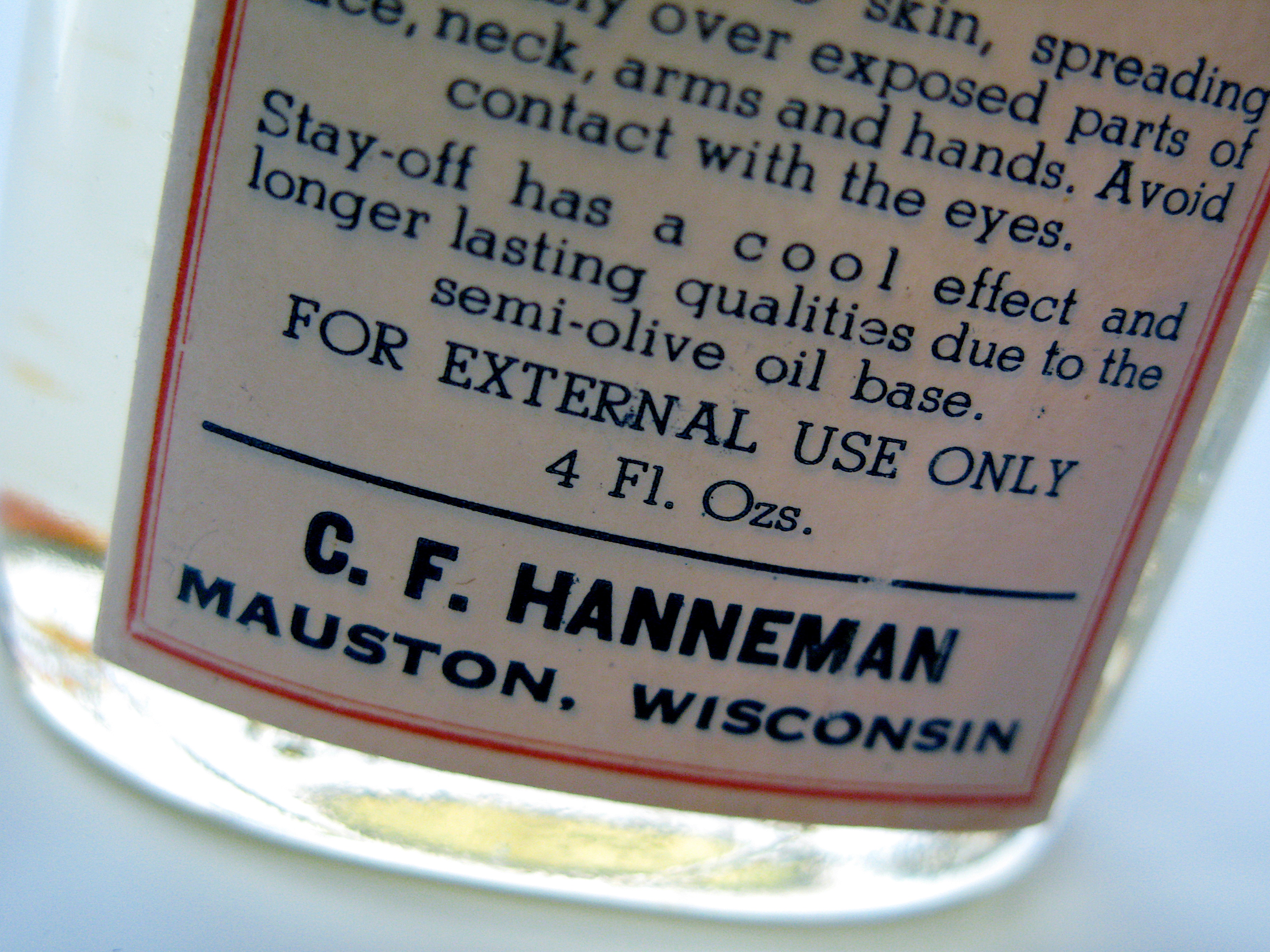
More than 60 years after it was first used to ward off mosquitoes and other pests in central Wisconsin, the lavender and citronella scent of Carl F. Hanneman’s Stay-Off bug repellent still lingers across time. The Mauston pharmacist invented his own blend of essential oils that provided a natural defense against biting pests, and he sold the product across the area for years.
Carl F. Hanneman sold his insect repellent at bars and bait shops all over central Wisconsin.
Carl Hanneman’s inspiration for his product came from his need for extra income, and his knowledge of chemistry and pharmacology. Even in the depths of World War II, when rationing made it difficult to obtain raw materials, Carl found a way to make Stay-Off and sell it at taverns, bait shops and resorts all over the area. Due to an abundance of lakes and rivers, Central Wisconsin is known for proliferation of mosquitoes and other flying pests during tourist season.
“His being a pharmacist allowed him access to some of the compounds needed to make this stuff,” recalled Carl’s son, David D. Hanneman. The topical elixir, which used an olive oil base and a secret recipe of lavender, citronella and other essential oils, was often mixed on the back porch of the Hanneman home in Mauston, Wis. “It was kind of comical,” David Hanneman said.
Aside from providing access to the needed ingredients, Carl’s role as pharmacist at the Mauston Drug Store had other benefits that helped him sell Stay-Off on his own time. “Because he was his own dispensary, he was able to upgrade his gas card,” David Hanneman said. “So we weren’t restricted and limited in traveling. We could go back on up north and go fishing or do whatever over weekends. And we’d drop off a dozen bottles here, and a dozen bottles at that bar, a dozen bottles over at that other fishery house.”
Carl F. Hanneman printed his own labels and wrote the ad copy for Stay-Off.
Carl wrote his own marketing copy to help sell the 4-ounce bottles of Stay-Off. “Stay-Off is not only an excellent insect repellent, but has that cool, soothing and refreshing feeling on hot summer days,” he wrote. “It is highly recommended for women and children’s skin, producing a soft tenderness due to the semi-olive oil base.” The lotion soothes existing bug bites and provides protection against strong sun rays, he wrote.
David Hanneman said selling Stay-Off was a nice side business for the family. “It gave us nice added income,” he said, although “we never got rich off the stuff.”
The recipe for Stay-Off called for making the mixture in 1 gallon batches. A half-gallon of Stay-Off and several 4-ounce bottles survive to this day. All of the ingredients are still commercially available. So even 60 years after it was first mixed, it would be possible to make more Stay-Off using Carl’s old recipe.
The Volstead Act that ushered in the era of Prohibition was designed to prevent the manufacture, transportation and sale of alcohol in the United States. Don’t tell that to the cows.
It seems some of the dairy cows belonging to Robert Hanneman of Portage County, Wisconsin, found themselves in a state of intoxication in July 1922. How? Some mischievous bootleggers thought it would be fun to leave a barrel of mash in the pasture for Hanneman’s cows to eat. When Hanneman arrived at the pasture one mid-July evening, he was shocked to discover a half-dozen hammered Holsteins.
Talk about your mooo-nshine.
Wood County Undersheriff Cliff Bluett responded to the call. “The whole herd was staggering around and they were in a worse intoxicated condition than any human can get,” Bluett reported.
According to the account in the Wood County Tribune: “One cow was missing entirely, another was dead drunk and could not be moved off the ground, five cows were finally driven into the barn but were so ‘pickled’ that it was found unsafe to leave them inside and had to be turned out and another cow was ‘so bad off’ that she collapsed in her over-intoxicated condition and could not be moved again, the undersheriff said.”
Farmer Hanneman reported one cow was so dead drunk she could not be budged from the pasture. Five bombed bovines stumbled about the barn and had to be let loose. Eventually, most of the crapulous cattle submitted to the evening milking. That left the farmer with a serious quandary: would this unusual “whole milk” put him afoul of Prohibition laws?
“A joke is a joke,” he said, “and we will deal with the culprits.”
No word if those pioneer cow-tippers were ever caught. Undersheriff Bluett was from Wood County, but the Hanneman farm was in Portage County. He sent his findings to his counterparts across the county line.
This was a day I’d long dreaded. I knew it was coming, and prepared for it the best I could. But I feared it still, because I did not have an answer for the question it posed. How do I — how could I — say goodbye to our family home?
I walked through the now nearly empty house and I still had no answer. So much had happened during the nearly 14 years we lived here. Our third child joined us here. They all grew up here. Our oldest went off to college from here. I started a home-based business here; a business that failed during the long recession. That’s what eventually brought me to this day, just a short time before foreclosure would take it all away.
Stevie, Ruby and Samantha on the first day of school.
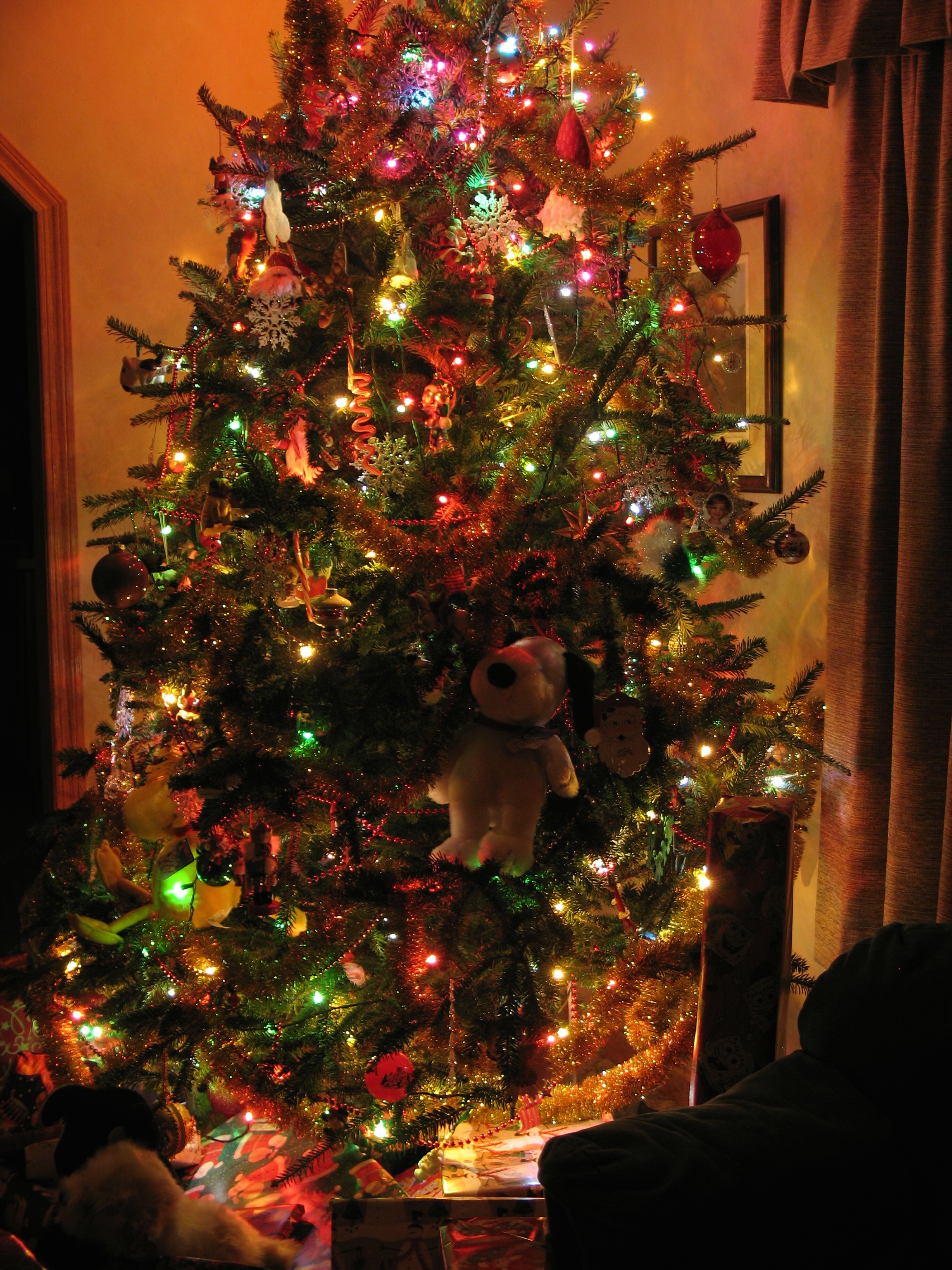
I stood in the front entryway and listened. Nothing. The quiet was almost deafening. A few boxes and odds and ends were scattered about, but very little remained of the home I loved. This is not how a home is supposed to look. I’m struck by how cold and empty it is. No pictures on the walls. No dogs running to the window to bark at the mailman. No children watching a favorite movie. No charcoal grill cooking steaks out on the deck. No carefully decorated Christmas tree in the corner of the family room, sending out a warm glow into the night. No family saying grace at the dinner table. This is not how I want to remember our home.
I start to walk the house. Almost like a projected movie, the memories flowed, right before my eyes.
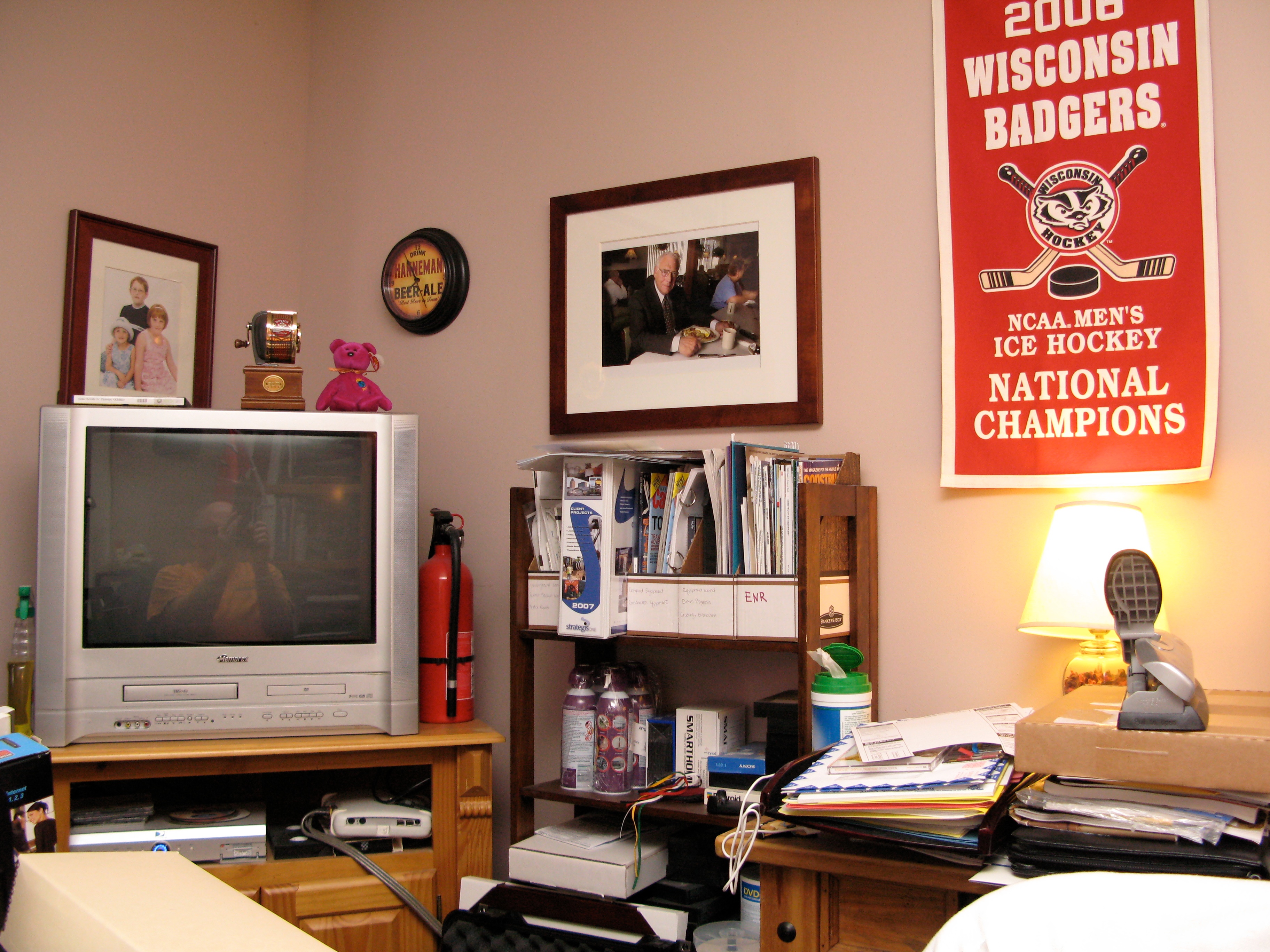
The cluttered brilliance of my home office.
I peered outside the small window to the left of the front door. I can almost see my late father coming up the sidewalk with a broad smile and saying, “Hello, Jofus” (that was his little word play on my given name after St. Joseph). September 15, 2006. That was the last time he was here. The sun glints off his silver hair, he waves, and is gone.
I turn and start to head up the stairs to the second floor. The paint color is darker on a large section of the wall. For most of the time we lived here, a giant quilt hung on the wall, embroidered with the saying, “In a House with Love, All things are Possible.” The carpeting on a section of the landing looked new where a small cherry bookcase sat. The case had belonged to my Grandpa Carl. On top of the case I had a shrine with candles, a large crucifix and a statue of the Blessed Virgin Mary. On many nights those candles burned in prayer for a dying relative, a sick friend or some special intention. I used to get angry at our son for dipping his fingers into the hot wax and either making fingerprints on the wood, or rolling little marble-size balls of warm wax that he left along the edge of the bookcase. What a silly thing to get upset about. How I wish I could put the case back and have those wax fingerprints again.
Welcoming Beacon: In a house with love, all things are possible.My home office on one of its cleaner days.
At the top of the stairs, I paused. This was the site of one of the most frightening events in family history. Samantha, then 4, was playing with a magic kit. It had a small polystyrene ball and a black tube. Her little eyes turned to a look of terror when she realized the ball had become lodged in her throat. My wife tried the Heimlich maneuver and smacking Samantha between the shoulders. It didn’t work. In desperation, she picked little Samantha up by the ankles and held her upside down. Pop! Out it came. The tears of relief flowed.
I turned left and entered the master bedroom. The heart of the house was now nearly empty. In the corner still stood a chest of drawers. I opened the top drawer and saw an envelope and more than a dozen plastic baggies. Each bag contained a tiny tooth, snatched from under a child’s pillow and replaced with a gift. It was good of the Tooth Fairy to leave them. I kept them all. I picked up the letter, which was addressed to Santa Claus, North Pole. It even had a stamp on it. I gathered the bags and the letter into my pockets. Precious memories need to be kept.
Near the end of packing, I found a tooth that sat in a dish, unredeemed.
I walked down the hallway toward the children’s bedrooms. On the wall I could see the outlines where our wedding photos used to hang. How young we all looked on that Saturday, December 1, 1990, at St. Rose of Lima Catholic Church. I still had hair and was 40 pounds lighter. What a blessed day that was. Such a contrast to the sadness of today.
As I approach the first bedroom, I see a large hole near the bottom of the wooden door. I remember the day in 2002 I rushed home from work because our then 10-year-old son Stevie had kicked a hole in the door in a fit of anger. As I walked inside the room, I could almost see my son’s battery-operated pteradactyl, flying in circles, anchored to the ceiling by fishing line. The wooden dressers that once sat along the western wall for years had glass aquariums on top — home to hermit crabs, green anole lizards and frogs. The anoles had a diet of live crickets, which were as likely to escape into the carpet as end up in a lizard’s stomach.
Samantha, Ruby and Stevie, waiting for Christmas with new puppy, Mr. Puggles.
Across the hall, I was impressed by the cheery green paint of another child’s bedroom. There were glow-in-the-dark stars pressed all over the ceiling. Pet nets hung in the corners, once home to dozens of stuffed animals. They are empty now. This room had changed hands several times over the years. It started out with white walls as a nursery. The white steel crib sat against the far wall, waiting for its new resident. She came home on a July 4 during our first summer here. It was 104 degrees outside. Little Ruby spent a week in intensive care with a hole in her lung. She was our third baby. We worried so much about her. Every peep on the baby monitor sent us scurrying down the hall. But all was well. How many times I sat in the oak rocking chair in this room, feeding Ruby a bottle. There’s no feeling in the world like rocking a newborn in the still of the night. I thank God for the experience, and the memories.
Samantha holds baby sister Ruby in July 1999.
There was one last bedroom on my tour. Over the years it was painted blue, white, pink and yellow. Today I saw a toddler bed tucked in the corner. I was reading a book to a curly hair redhead. It was a classic Dr. Seuss tome, Mr. Brown Can Moo! Can You?It was a favorite of all three children for its memorable, rhythmic lines. “Dibble dibble dop dop, cock-a-doodle-doo! Mr. Brown can do it. How about you?” Once the book was done, we started a nightly ritual to see how long I’d sit by her bed as she fell asleep. I started the bidding. “I’ll stay THESE minutes,” I said, holding up two fingers. “No, THESE minutes,” Samantha shot back, holding up five fingers on each hand. After a few rounds of this, she usually won. Now I wish I had these minutes back again. As I turned to leave the room, I saw both daughters asleep in their beds. A small lamp threw off just enough to illumine the room. In my head I could hear a favorite Nat King Cole song:
Lights out, sweetheart / One more perfect day is through
Lights out, sweetheart / One more perfect dream come true
We’ve reached the hour of parting / So kiss me tenderly
Lights out, sweetheart / Close your eyes and dream of me
Close your eyes and dream … of me
Goodnight, sweetheart
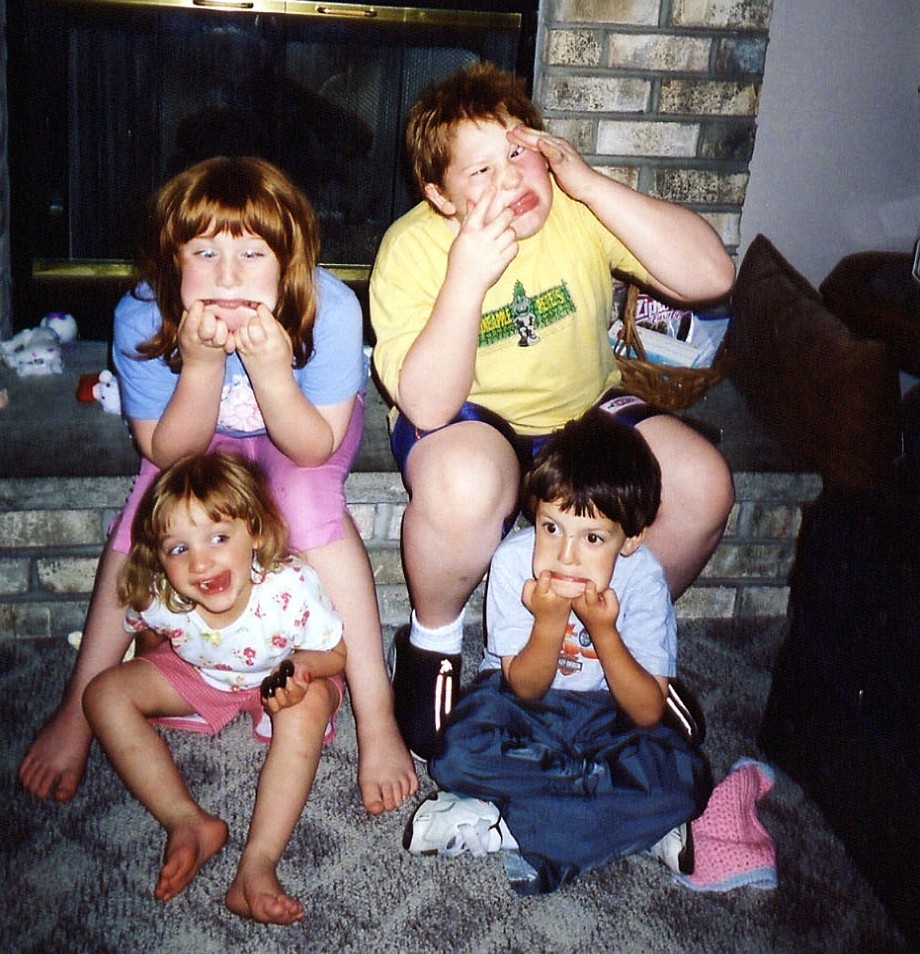
The kids and cousin Geoffrey have a creepy-face contest.
Back down the stairs, I stood in the foyer again. My grandmother’s 1899 Singer sewing machine had been the centerpiece for years as the staging place for all sorts of family displays. I saw the children gathered around the Advent wreath, taking turns lighting the purple and rose candles. Or placing Baby Jesus into the Nativity creche on Christmas Eve. Most of the year it was covered with framed family photos, from the kids’ sports and school pictures to the large wooden-framed antique photo of my Grandma Ruby Hanneman (1904-1977).
I walked into the kitchen and was overwhelmed with memories of family meals, birthday parties, family meetings and prayer time. I recall our weekly ritual of doing a “blessing cup” ceremony, where each of us would take the blessing cup and talk about something we are thankful for. Ruby, who was very young when we started the tradition, always said the same thing: “I’m sankable (thankful) for my skoowa (school).” It never got old. Today, the table is gone and the blessing cup is packed away. I am still most thankful for it all.
One of many birthdays celebrated at our kitchen table.
I looked out the sliding glass door to the deck. Suddenly the gas grill was fired up and I was cooking steaks, vegetable kabobs and hot dogs. On the corner of the deck, a fire pit crackled with warmth in the fall night, with our children and the neighbors gathered around, toasting marshmallows. A group of children and adults sat in chairs on the deck, watching me light fireworks for July 4th. “Ooh, pretty! Light the big one now, Daddy.” I looked up at the second-story windows and saw the low flickering light from a television playing a favorite Disney movie, Aladdin.
My Dad’s handmade Nativity scene, restored by his granddaughter, Samantha.
I walked around the front of the house and the snow was suddenly 3 feet deep. On the porch was my Dad’s handmade wooden Nativity scene, which daughter Samantha had repainted and restored. It glowed a welcoming gold, red and green in the cold darkness. I walked toward the garage and all three kids came running down the driveway with their fishing poles and a tackle box in tow. “Wait for me!” one yelled, as they ran towards the neighborhood pond. How I miss those fishing days now.
I walked back inside and stood at the foot of the stairway. I listened, but heard nothing. Heavy silence. Nobody home anymore. My heart was so heavy, it felt like stone. I never wanted this day, but now it was here, and at an end. “Thank you so much,” I said out loud, almost expecting the house to answer me. “I’m sorry I failed you. Thank you for sheltering us for so long. I will never forget.” There was one more word I thought I should speak, but the lump in my throat kept it from coming out. I just couldn’t say it.
There was nothing like a lazy Sunday, fishing at the pond.
I pulled out of the driveway for the last time and started to drive away. I stopped and looked out the window. More than a decade of memories were visible to me all at once. They swirled around the house like fairy dust. In the upper window, my oldest daughter laid on her bed, reading a book. On the front lawn, our preschool children splashed in a pool. Relatives filed in the front door with armloads of Christmas presents. Our son sat in a lawn chair on the porch, studying for exams. All three children romped during a nighttime snowstorm. “Dadda, it’s snowing!”A petting zoo was set up in the front yard for a birthday party, with children taking turns riding a pony around the block. A tent was set up for a summertime sleepover. The smell of steaks wafted from the backyard grill. My Dad got out of his blue sedan and walked up the driveway with a wave. Voices rang out from the children’s rooms:“I had a bad dream.” “Santa came!” “I got all As!” “I love you, too.” “I’m really proud of you.”
I rolled down the window and took it all in. I waved and bid all of the memories to come with me. And so they followed. Some things are just too precious to leave behind. ♦
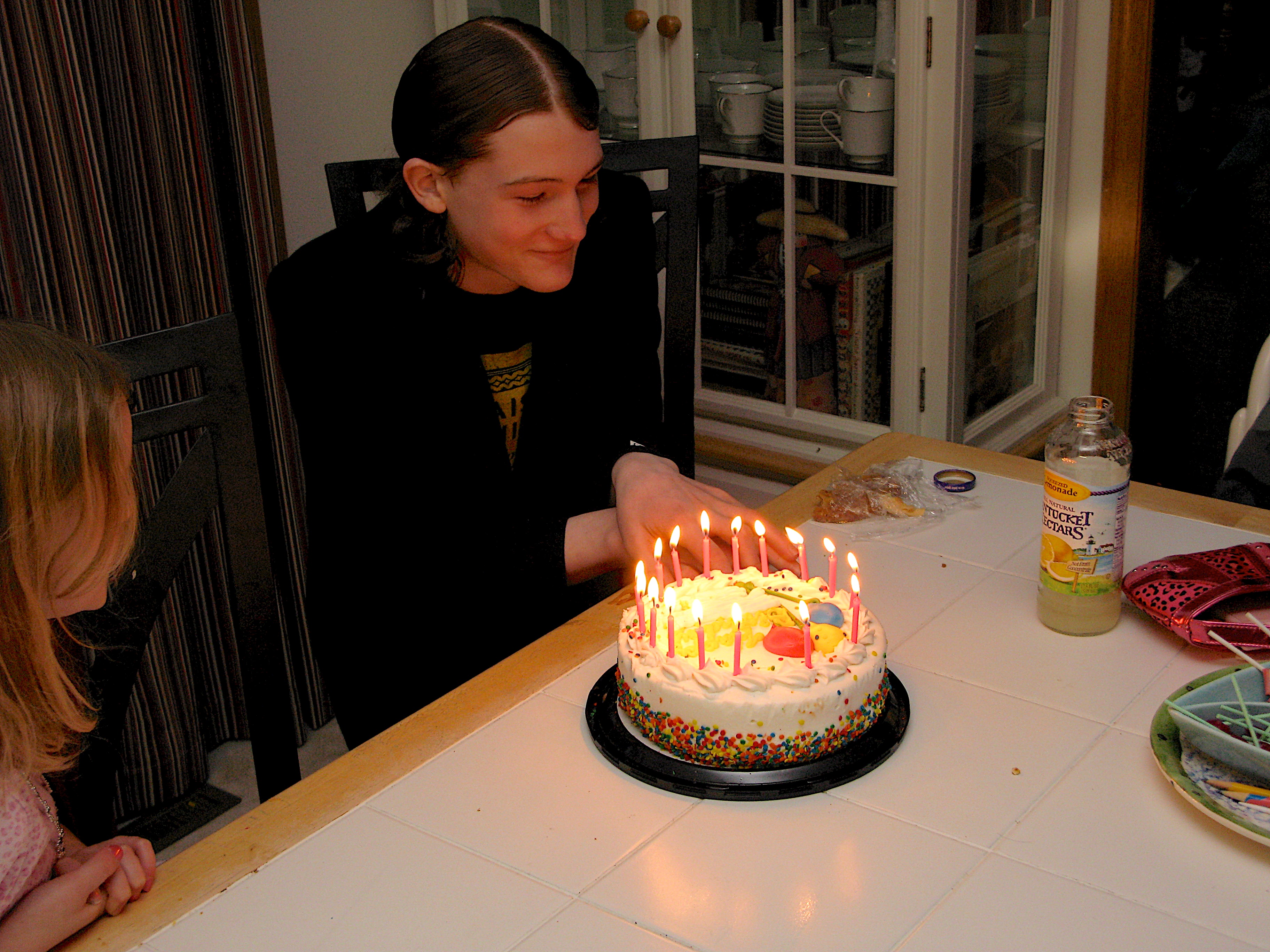
An art project stuck to the sliding glass door.The Christmas tree was always a labor of love.Stevie waits to blow out the candles on his 16th birthday.
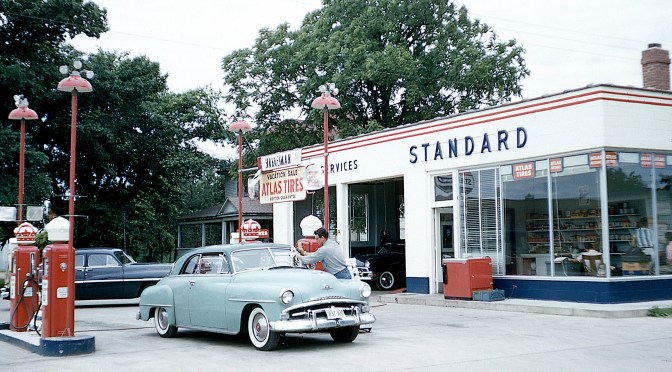
Before embarking on his long sales career, David D. Hanneman (1933-2007) briefly owned and operated a Standard Oil gasoline station at the corner of Union and State streets in Mauston, Wisconsin. Newly discovered color slides show Hanneman working at the Standard station, most likely in the summer of 1951 after his graduation from Mauston High School.
David D. Hanneman poses outside of his Standard Oil station in Mauston in 1951.
The photos show a dapper young attendant (think Clark Kent) posed outside the station, leaning on the soda cooler. Another image shows him cleaning the windshield of a customer’s auto, part of the “full service” treatment that disappeared long ago. The station featured the classic pumps that delivered Red Crown regular and White Crown premium gasoline.
During the 1950s, Standard Oil was the dominant domestic oil company in the United States. Its torch-and-oval logo was instantly recognizable to millions of Americans (even after Standard became Amoco). The Mauston Standard station stood at the busiest intersection in the city. A Kwik Trip station occupies the land today.
Detail shows “Hanneman” on the north side of the Standard Station.
After owning and managing the station, Hanneman realized the job was not for him. He went on to take classes at La Crosse State (now called University of Wisconsin-La Crosse) and worked as a salesman at Dahl Motors in La Crosse, before his career in pharmaceutical and veterinary medical sales.
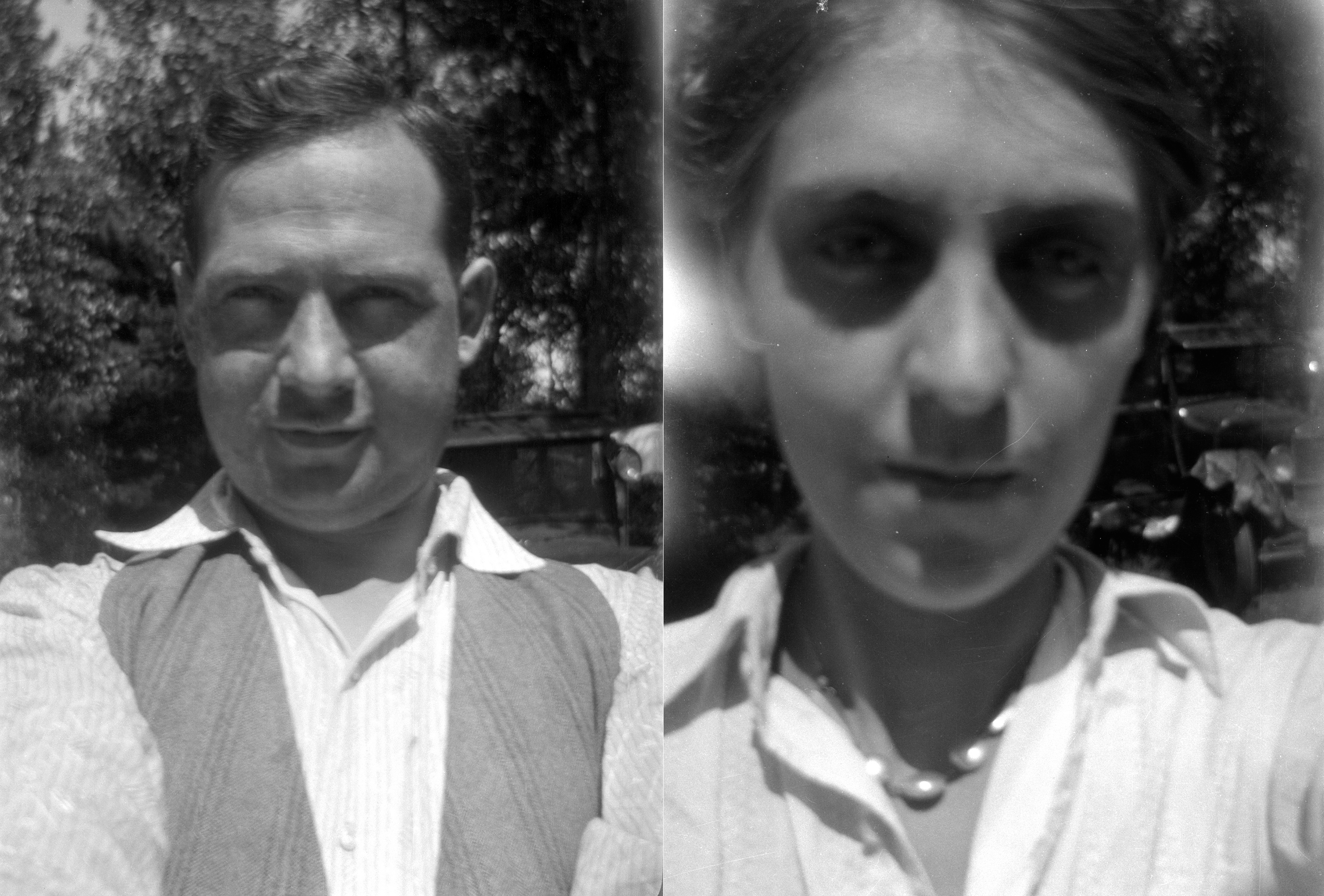
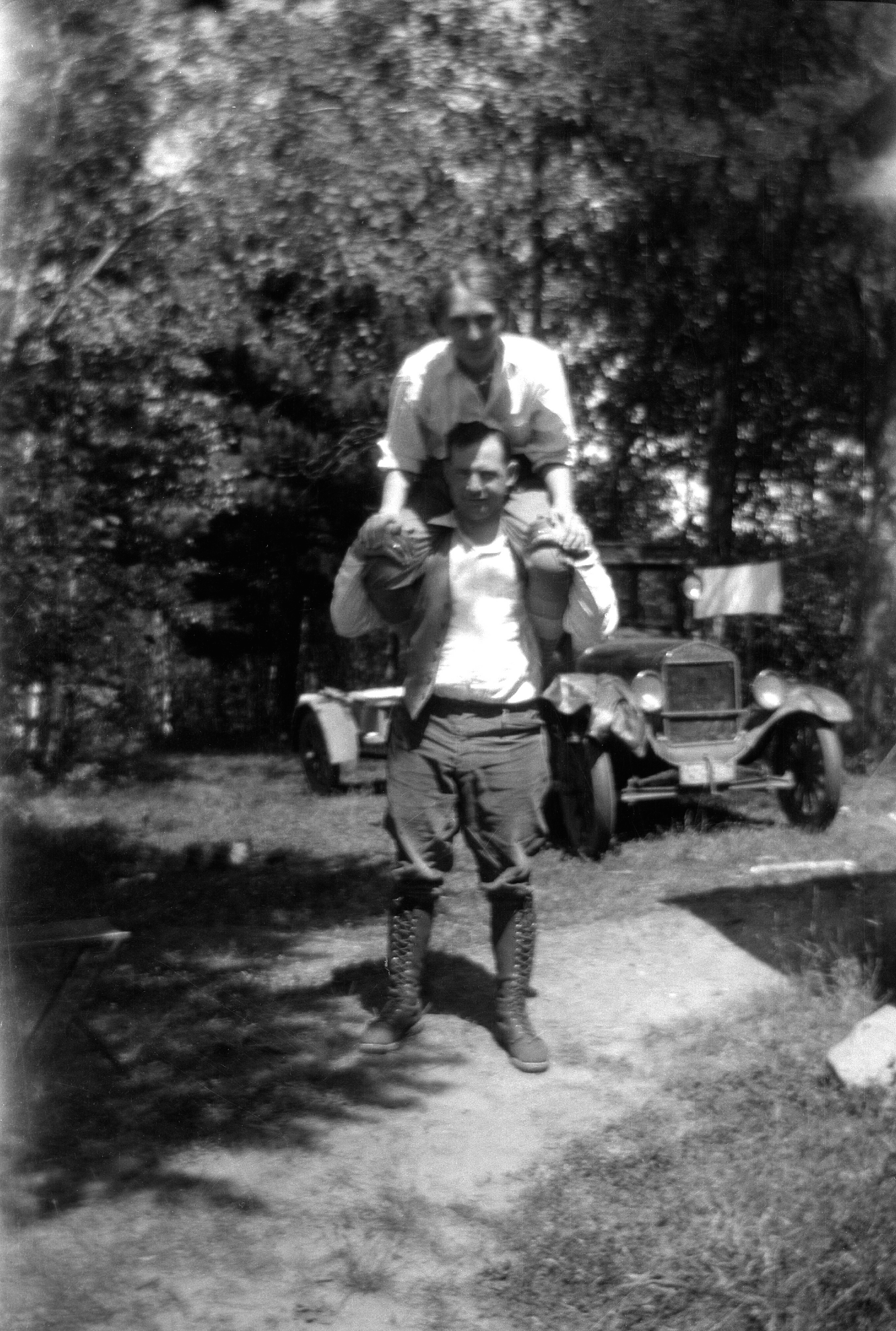
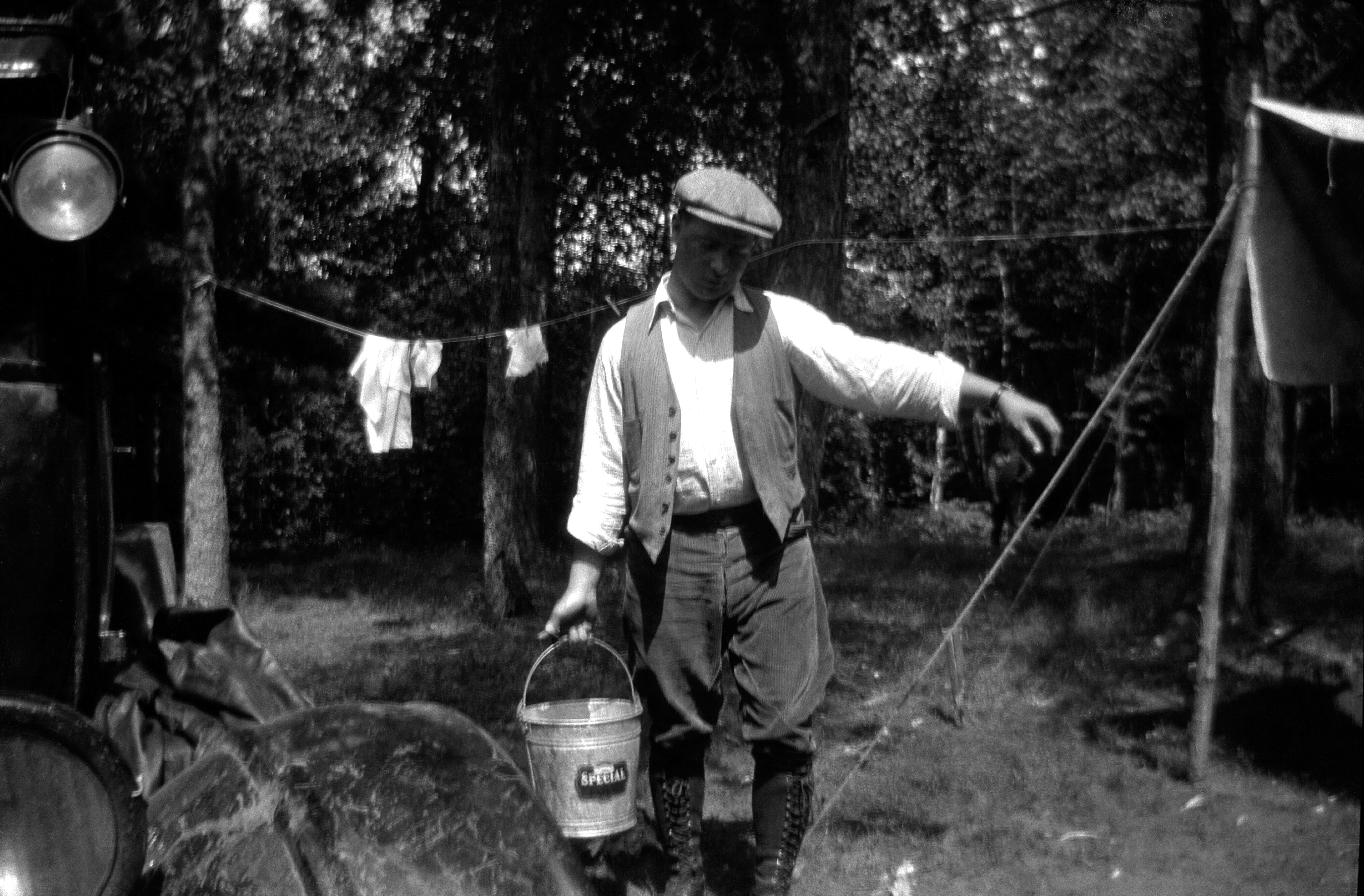
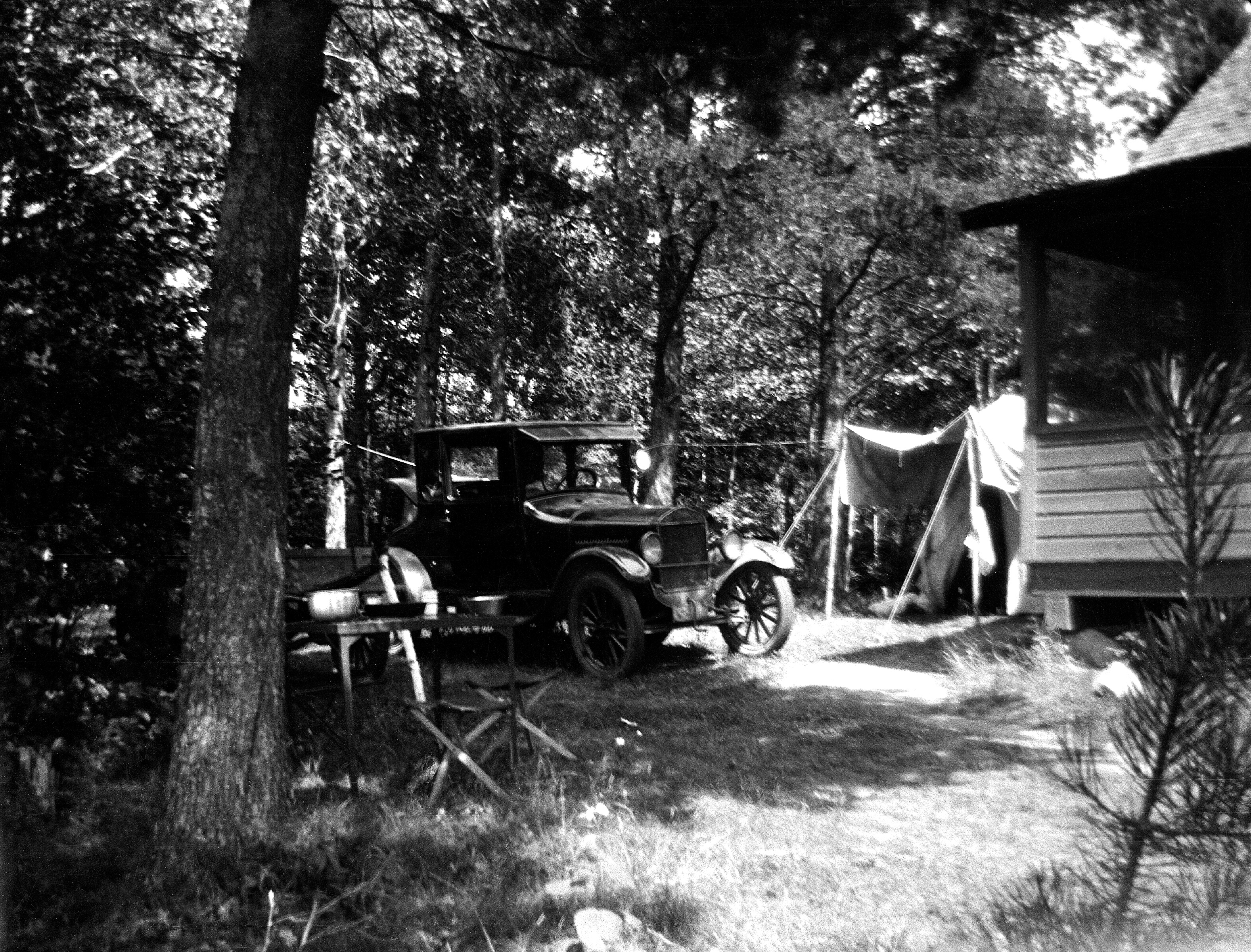
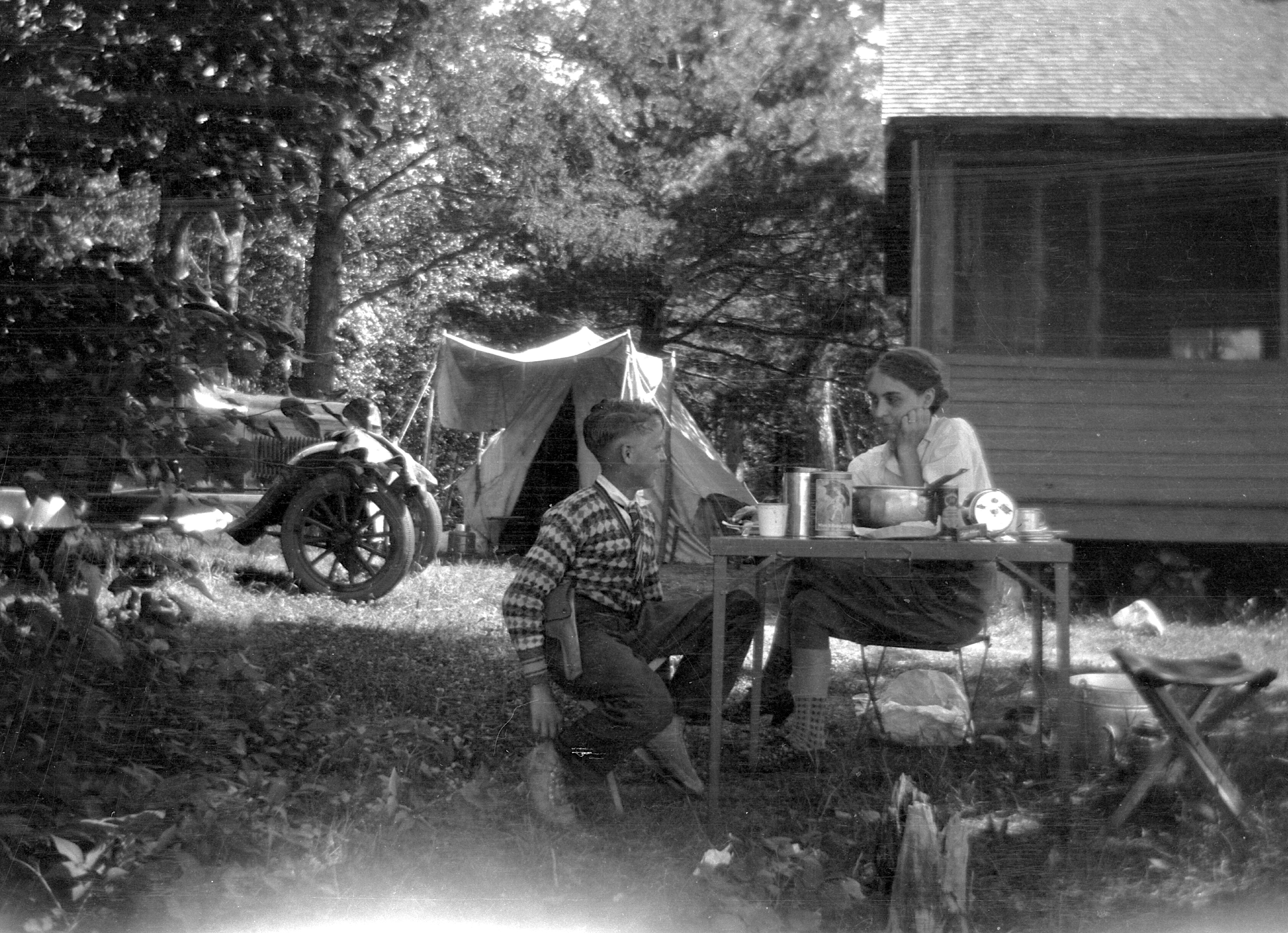
Many decades before the social phenomenon of taking self-portraits or “selfies” became all the rage, a young honeymooning couple in July 1925 predicted the trend by snapping their own photos at a camp site in Hayward, Wisconsin.
Carl F. Hanneman and the former Ruby Viola Treutel were married on July 14, 1925 at St. James Catholic Church in tiny Vesper, Wisconsin. For their honeymoon, they chose to motor to Wisconsin’s North Woods. Part of their time was spent at a cottage owned by friends, Mr. and Mrs. Armand Bauer, in Hayward.
Carl F. and Ruby V. Hanneman took these selfies on their honeymoon in July 1925.
Being a budding photographer, Carl took lots of photos from their trip, some candid and even playful. Two that stand out are ‘selfies’ taken by Carl and Ruby. Carl’s is at a good distance and quite sharp, while Ruby’s was an ultra-closeup, a bit out of focus. Given the camera technology of the day, these photos were more of a feat than it might seem. Nothing like snapping a quick shot today with an iPhone 6.
Ruby V. Hanneman rides on the shoulders of new husband Carl at their honeymoon camp at Hayward, Wisconsin.
Other photos from the trip showed Carl walking with Ruby on his shoulders, Carl slinging a pail and Ruby sitting at a picnic table with a youngster who resembles her younger brother, Marvin Treutel (but might have been their hosts’ boy).
He could be carrying milk from the barn, but Carl F. Hanneman (1901-1982) is actually on a honeymoon camping trip in this July 1925 photo.Camp scene from near Hayward, Wis. in July 1925. Pictured is the Ford Model T belonging to Carl F. Hanneman (1901-1982) of Wisconsin Rapids, Wis. Hanneman was on his honeymoon with Ruby V. (Treutel) Hanneman (1904-1977) of Vesper, Wis.
Carl and Ruby had no way to know that the ‘selfie’ would become a dominant means of communication among young people around the world, or that the practice would spawn social media platforms, a television series, songs and videos on YouTube.
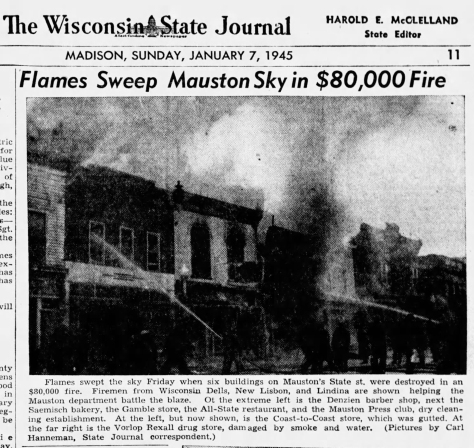
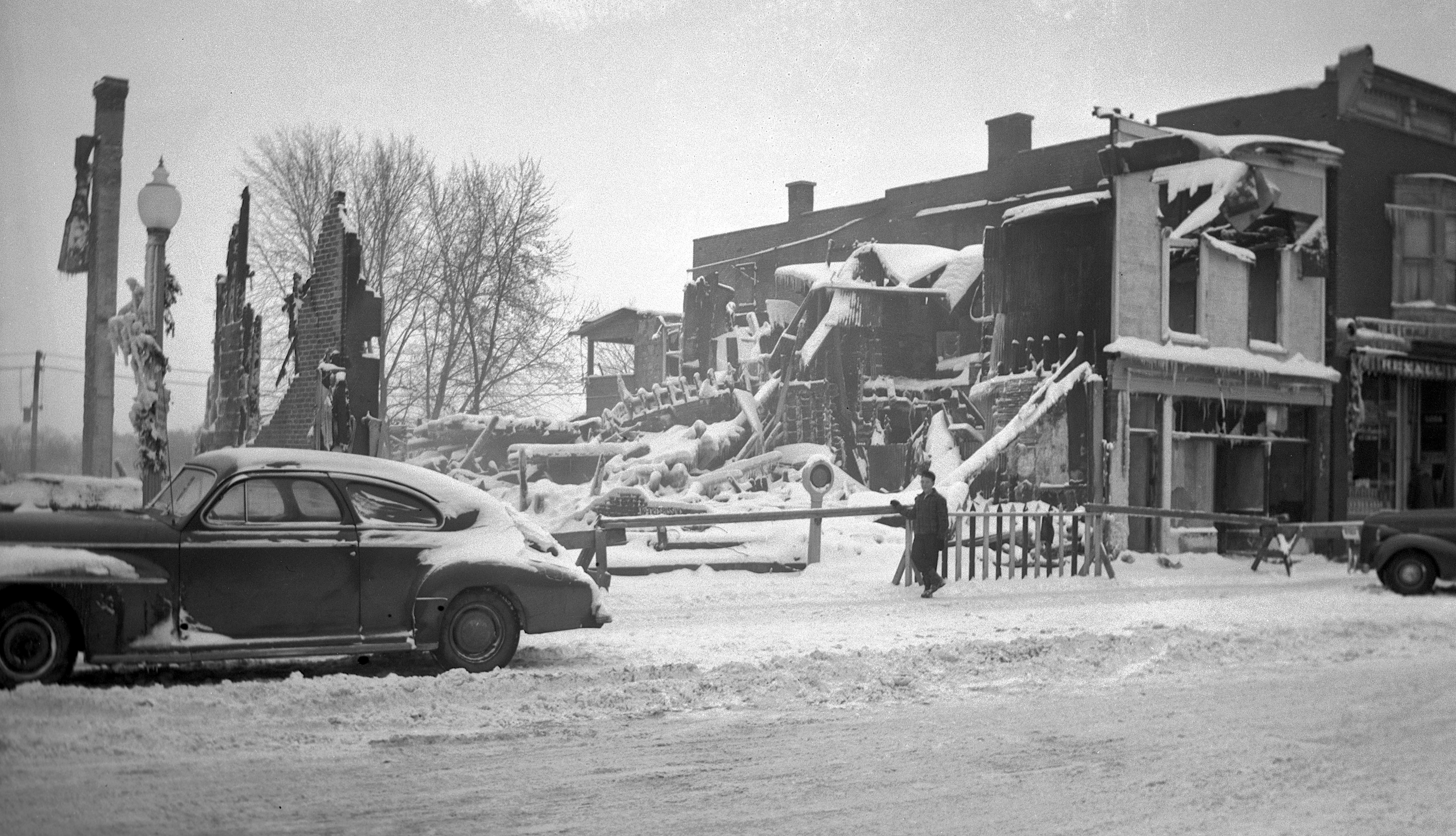
It was the fire of the century in the tiny city of Mauston, Wisconsin. Life may have started normally on Friday, Jan. 5, 1945, but before 9 a.m. a massive fire broke out that threatened to wipe out the city’s downtown. The man called on to document the blaze for local law enforcement was Carl F. Hanneman, the druggist at the Mauston Drug Store. It may have been the most prominent collection of photos he shot, but was just one among many accidents, fires and crime scenes he photographed over the years.
Carl would have been readying himself for the trip to the pharmacy downtown when the fire broke out that January morning. About 8:30 a.m. the fire started in the rear of the Gamble Stores building along the north side of State Street. Within 30 minutes it had spread to four downtown buildings and threatened the entire business district.
As firefighters from Mauston tried in vain to control the blaze in subzero temperatures, reinforcements from fire departments in Lyndon, New Lisbon and Wisconsin Dells raced to help. Carl stood just behind the line of rescue workers and took photos.
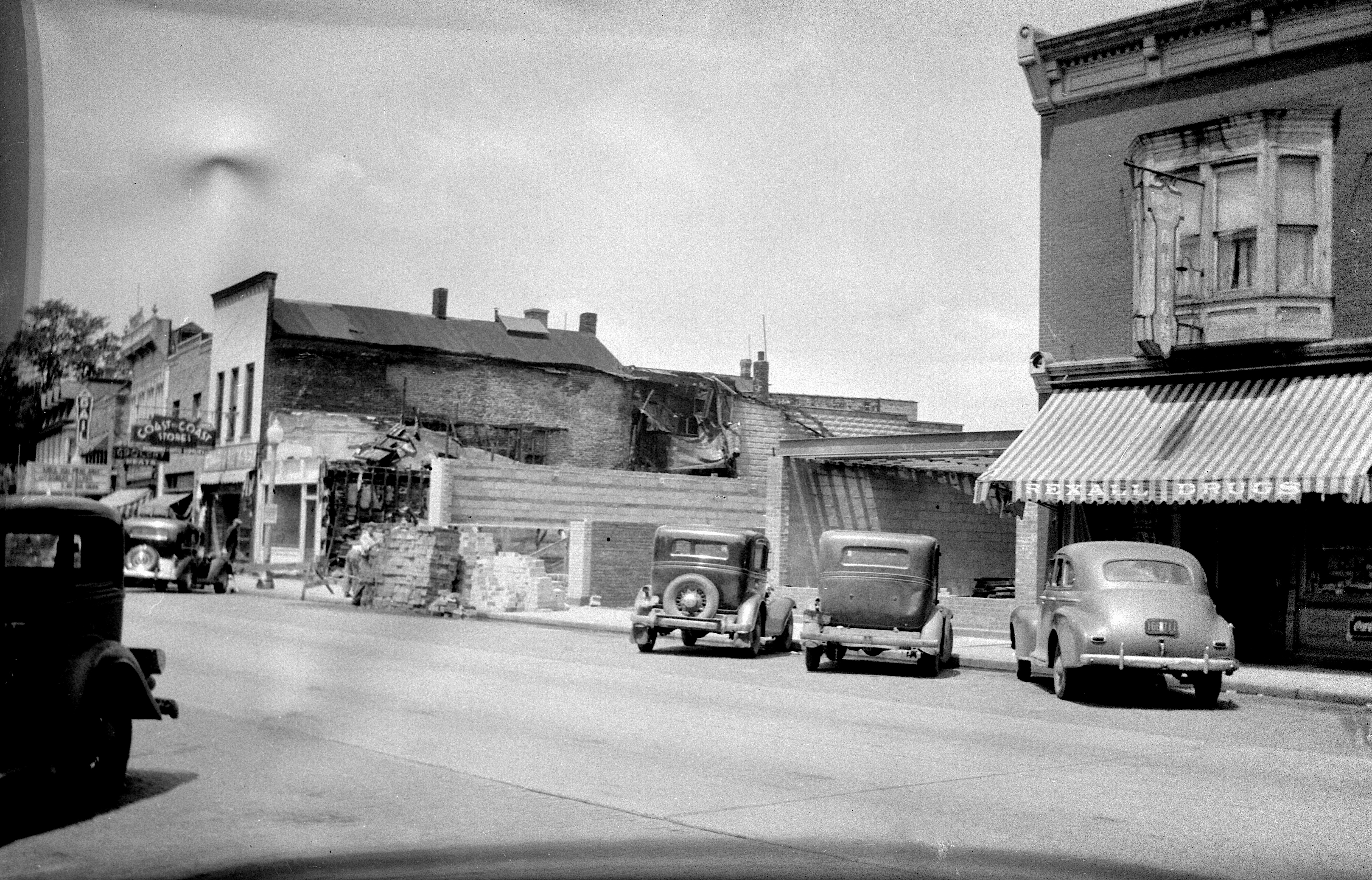
It took five hours to control the huge blaze, which destroyed Gamble’s, Mauston Press Club dry cleaners, Samisch Bakery, the Fred Denzien barber shop and the All-Star restaurant. At one point during the blaze, the brick facade of the All-Star fell onto the street. Nearby businesses, including Vorlo Drug and Coast to Coast, were badly burned. Damage exceeded $80,000 – equivalent to more than $1 million in 2014 dollars. Mauston Fire Chief John Smith said calm winds kept the fire from sweeping through the entire downtown.
The extreme heat from the fire is evident along the roof line.
Carl’s efforts that day earned him a page 1 photo in the Wisconsin State Journal, and two additional photos on page 11. He served as a Mauston correspondent for The State Journal for many years, garnering numerous front-page stories and photographs.
Carl dated and signed the prints from the Mauston fire in January 1945.
Carl documented many local emergencies in Mauston and surrounding areas. He captured the moment when a semi-trailer plowed into the front of the Tourist Hotel, knocking down the sign and collapsing the awning. Many of these photographs have a custom “CF Hanneman” imprint on the back, so it’s obvious Carl shot a fair number of news photos. Some photos from the 1945 fire have even shown up on Ebay.
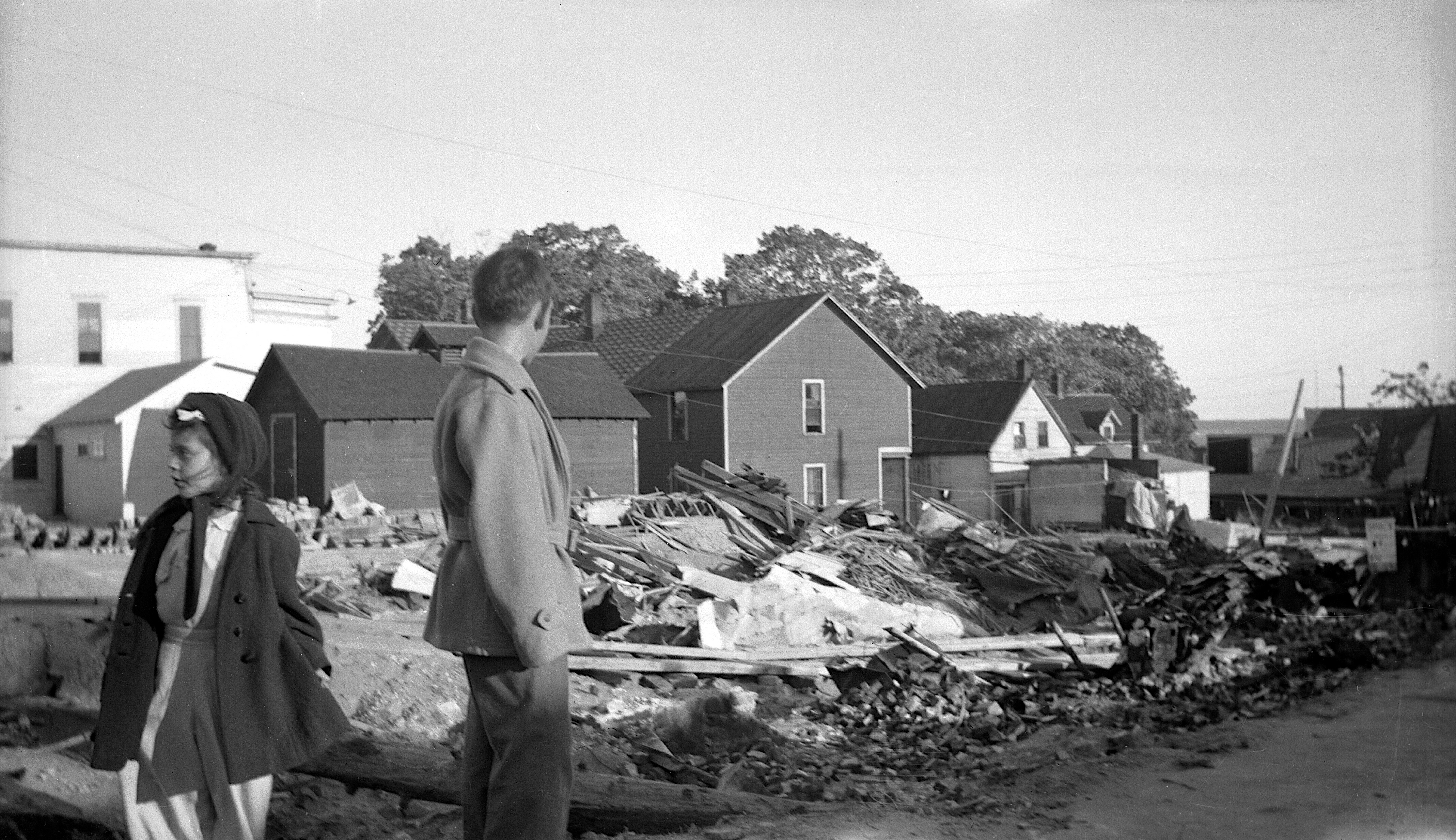
One of three of Carl’s photos that appeared in The Wisconsin State Journal on January 7, 1945.David D. Hanneman stands on State Street in front of the charred ruins.David D. Hanneman and his younger sister, Lavonne, survey damage.By summer 1945, the fire debris was gone and rebuilding was in process.
Another newly discovered photograph from 1905 shows the Chas. Hanneman family of Grand Rapids, Wisconsin. It is the earliest known photo of this family, and the only clear photograph we have of mother Rosine Bertha Henrietta (Osterman) Hanneman.
This photo is a real treasure for its clarity and detail. Often prints this old have many flaws and defects, but this is one of the best in the Hanneman Archive collection. We received it courtesy of Tom Hanneman of Minneapolis. It was originally from the photo collection of one of the boys in the photo, Carl Henry Frank Hanneman (1901-1982).
It is also one of perhaps three photos we have that show Rosine “Rosie” Hanneman. This mother of five (her firstborn died in 1891) died on Easter Sunday 1918 of diabetes. She was just 47 years old. She lived in the days before availability of insulin.
The father of the family, Carl Frederick Christian (“Chas”) Hanneman (1866-1932) worked many jobs in central Wisconsin. He was initially a farmer after emigrating to Wisconsin from Meesow, Kreis Regenwalde, Pomerania, in November 1882. He worked in the timber industry before moving his family to the city of Grand Rapids (now called Wisconsin Rapids). There he worked as a laborer (17 cents per hour) digging and installing the city’s new sewer system in the early part of the 20th Century. Eventually, Chas took on work in a paper mill. He died of prostate cancer shortly after retiring from the mill.
One of Chas’ grandchildren, Donn G. Hanneman, recalled sitting on the hospital bed when Chas was being treated for his cancer. “I’m going to heaven soon,” Chas told the 6-year-old. “I’d like it if you would put flowers on my grave.”
Rosine Bertha Henrietta (Osterman) Hanneman (1870-1918), Frank Herman Albert Hanneman (1895-1947), Arthur James Hanneman (1893-1965), Carl Henry Frank Hanneman (1901-1982), Wilbert George Hanneman (1899-1987) and Carl Frederick Christian (Chas) Hanneman (1866-1932).
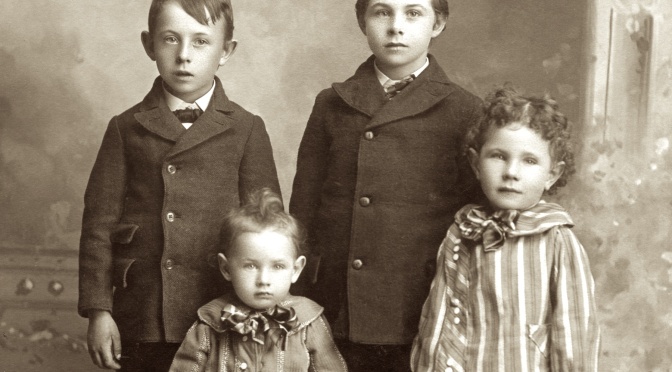
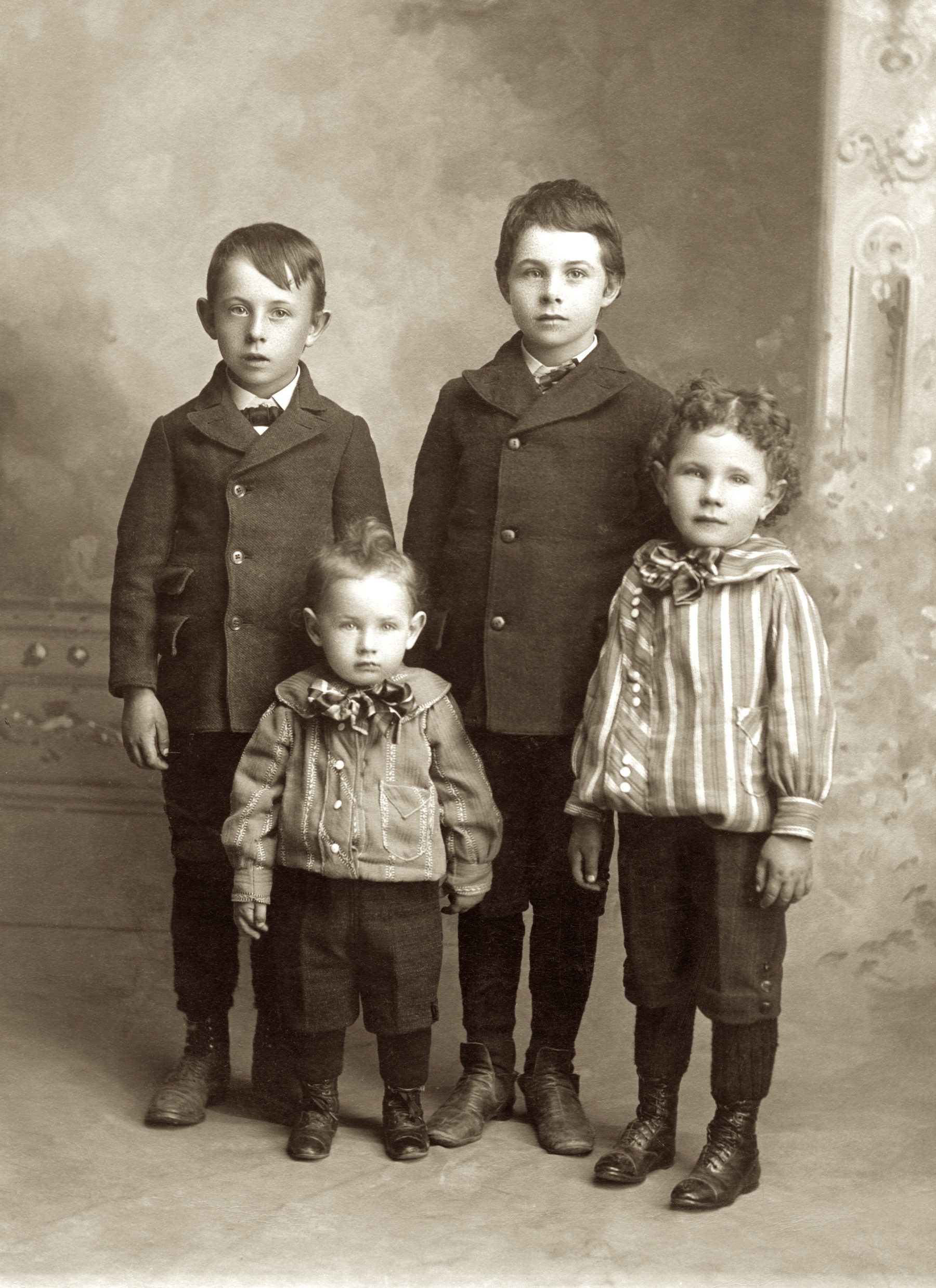
A newly discovered 1903 photo shows four Hanneman brothers of the Carl Frederick Christian Hanneman family. It is the earliest known photograph of our own Carl Henry Frank Hanneman (1901-1982). The photo was taken at Grand Rapids, Wisconsin.
In the front row are Carl (at left) and Wilbert George (1899-1987). In the back are Frank Herman Albert (1895-1947) and Arthur John (1893-1965). The firstborn of this family, Charles M. Hanneman, died just after his birth on November 24, 1891.
The boys were the sons of Carl Frederick Christian Hanneman (1866-1932) and Rosine Bertha Henrietta (Osterman) Hanneman (1870-1918). The couple were married in 1891.
The photo was scanned from a collection loaned to us by Thomas Donn Hanneman of Minneapolis, one of the 16 grandchildren of Carl F. and Ruby (Treutel) Hanneman of Mauston, Wisconsin.
Back in the days when horses were the main mode of transportation, many homes across America had carriage stones near the street to assist those stepping down from horse-drawn carriages.
A fine example of the carriage stone stands in front of the old Hanneman home on Morris Street in Mauston, Wis. The carriage stone no doubt served its time as a platform to access horse-drawn transportation. But for many more decades the large granite stone was a family gathering place for photos and a launch pad for dozens of children at play.
More than 70 years of photographs held by The Hanneman Archive provide ample testimony to the importance of the old carriage stone. The earliest photographic records we have is from 1937, although the stone was likely original equipment when the home was built in the early 1890s. Brewmaster Charles Miller built the home at 22 Morris Street with the finest materials, so it’s no surprise he would have a carriage stone out front.
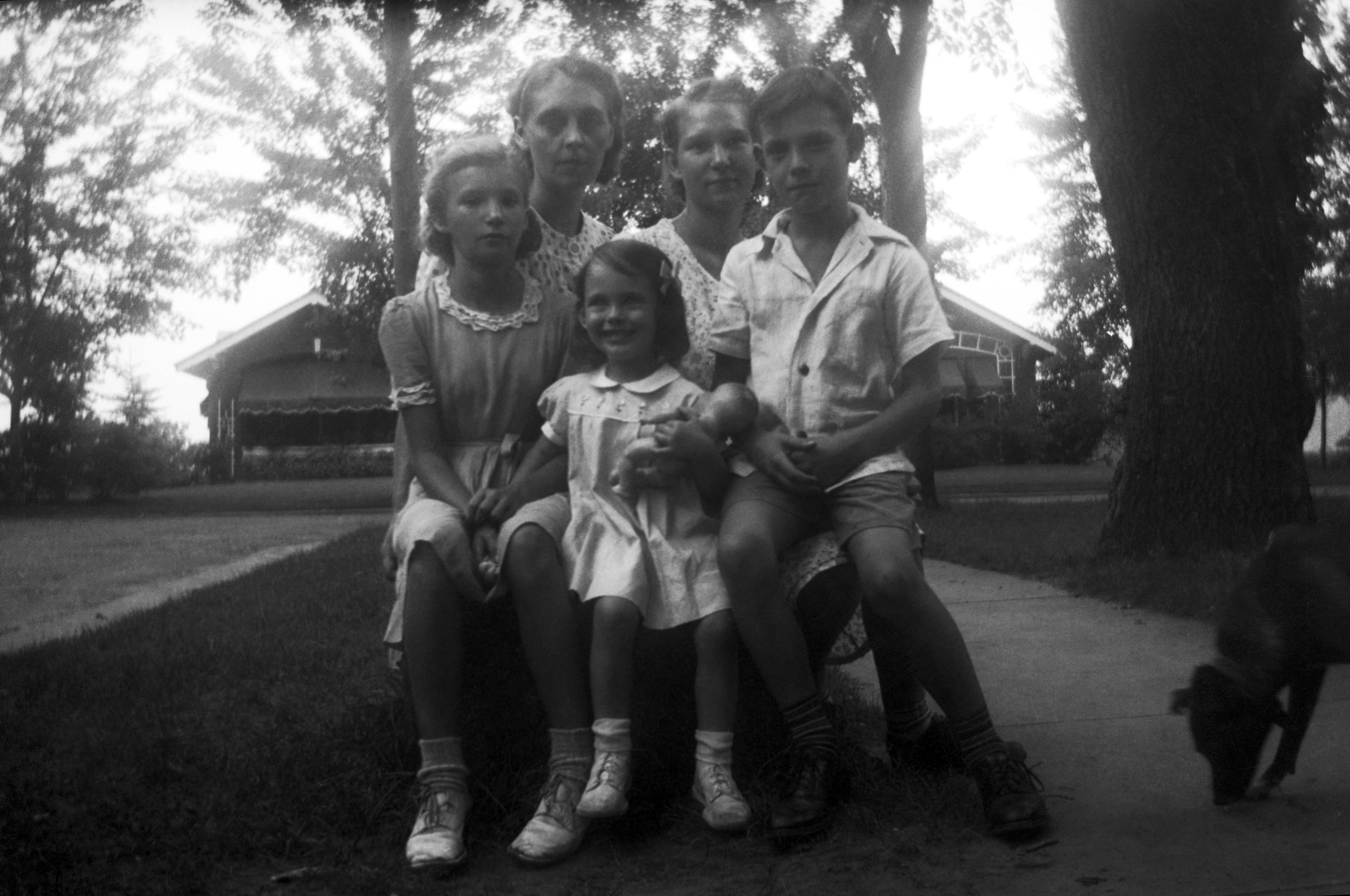
One photograph from about 1942 shows five people sitting on the stone for a photograph, including Ruby V. Hanneman and children Lavonne M. Hanneman, and David D. Hanneman. Another image from about 1957 shows Donn G. Hanneman, wife Elaine and children Diane, Caroline, Tom, Jane and Mary Ellen. The photo above shows Carl F. Hanneman and grandson David Carl Hanneman, taken circa 1965.
Lavonne Hanneman (front) and brother David (at right) sit on the carriage stone, circa 1942.
For the 15 grandchildren of Carl and Ruby Hanneman, the carriage stone was much more than a cool novelty. Just standing on the stone seemed to give a great vantage to the yard, even though the stone was just 18 inches high. It was always a race to see who would get first dibs on the stone.
Mary K. Hanneman sits on the carriage stone in 1958. With her is dog Cookie.
Ruby V. Hanneman with her son Donn and his family in the late 1950s or early 1960s.
For many of those old photos, family members sat or stood at the carriage stone in the shade of towering elm trees. The old trees are long gone now, but the stone remains, looking just the same as it did in the 1930s.
In several visits in years prior to his death in 2007, David D. Hanneman stopped at the house and asked the current owners if he could take the carriage stone. Initially they agreed, but later changed their minds. Seems the lady of the house had become attached to the old stone, as evidenced by the flowers lovingly planted around its edge. That’s understandable. Just another generation of folks who’ve come to care for that old carriage stone.
For years, family genealogists have searched in vain for the emigration records of Matthias Hannemann, the earliest known ancestor of the Hanneman family of central Wisconsin. Over the years, the registers of hundreds of immigrant ships were searched, covering tens of thousands of names belonging to people who came through ports in New York, Baltimore and New Orleans. But no Matthias.
All of that changed several nights ago. During a routine search of newly transcribed records from the Port of Hamburg, Germany, I found Matthias’ name. He and his second wife, Caroline, traveled with their son, William, daughter Justina Louisa Henrietta Saeger and her family. They were among 474 passengers aboard the SS Hyram when it sailed from Hamburg on April 19, 1866. Matthias is listed on the register as a schwiegervater, or father-in-law, referring to his son-in-law, John Saeger.
It was a long journey aboard the segelschiff, or sailing ship. The ship docked at Grosse Isle near Québec on the St. Lawrence Seaway on June 4, 1866. Grosse Isle served as a quarantine station for ships destined for the Port of Québec in Canada, to prevent the spread of disease. Grosse Isle was the site of tragedy in 1847, when more than 5,000 Irish immigrants escaping the famine in their homeland died from typhus and other diseases upon reaching Canada. A large Irish cemetery and two monuments bear witness to those sad days.
Eight passengers on the Hyram died during the journey in 1866. Two children were born onboard ship. Once the 10 members of the Hannemann and Saeger families disembarked, they likely continued traveling by boat along the St. Lawrence River, across Lake Ontario and Lake Erie. From Detroit, they might have traveled by rail to Chicago and then Milwaukee on their way to tiny Kellner, Wis.
The Hyram’s ship registry is among the earliest documentary evidence of the Hannemann family’s exodus from Pomerania to Wisconsin. We know at least two of Matthias’ other children arrived in America in 1861, but their travel records have not been found. The earliest emigration record from this family is that of Michael Friedrich Ferdinand Hannemann, who arrived aboard the ship John Bertram in May 1863 with his wife, Wilhelmina and infant son, August.



















 The Hanneman Archive