SUN PRAIRIE, Wisconsin — With a temperature of minus 2 degrees and a fresh coating of 8 inches of snow on the ground, you might think Jimmy the Groundhog would have predicted six more weeks of winter. But alas, the world-famous weather prognosticator did not see his shadow, meaning an early spring. He did, however, take a vicious bite at Sun Prairie mayor Jon Freund, who served as the official translator for the esteemed Jimmy.
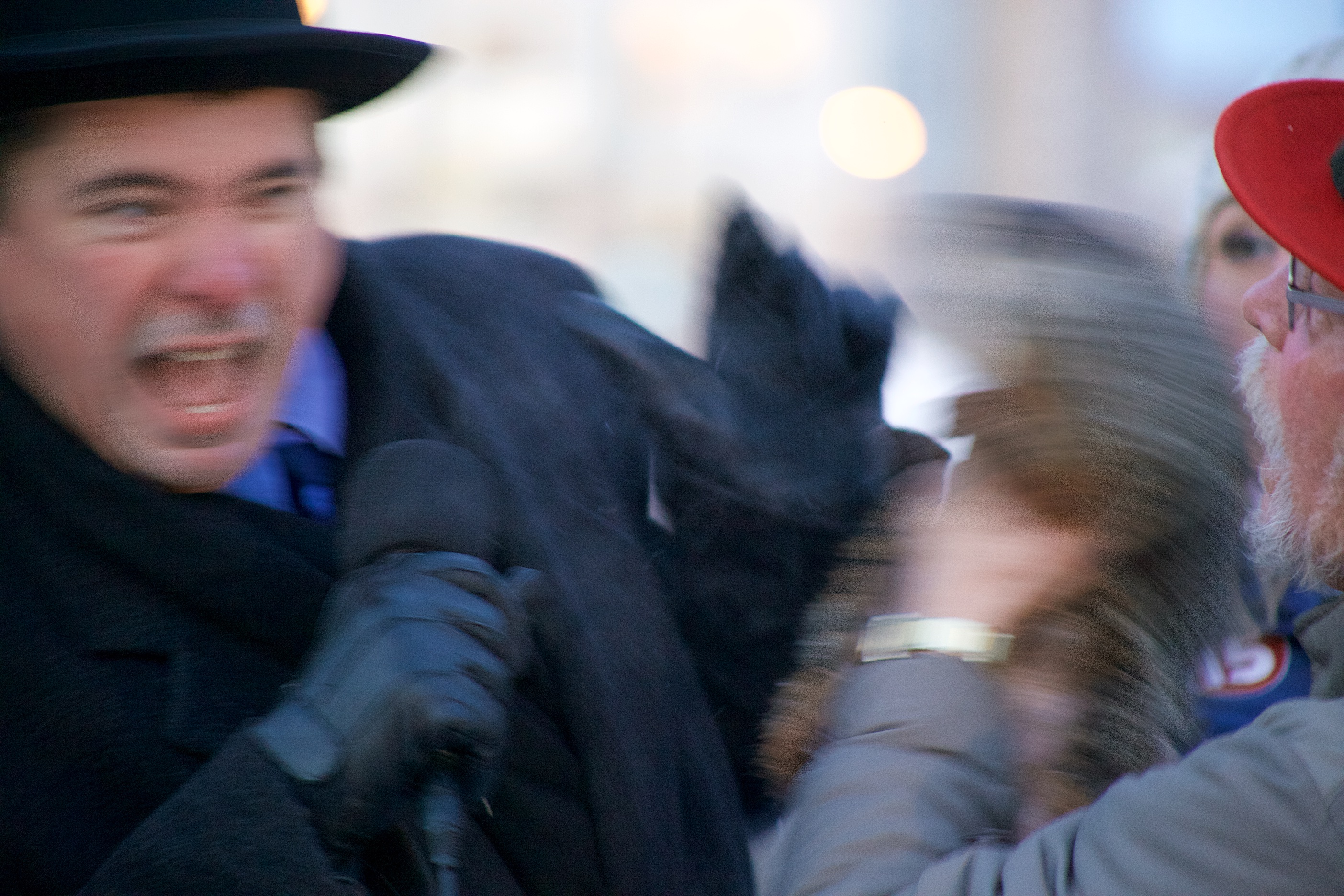
Sun Prairie Mayor Jon Freund recoils after being bitten on the ear by Jimmy the Groundhog.Freund wasn’t too pleased with the bite from Jimmy, but the ceremony continued.
A modest crowd of hearty Groundhog Day fans gathered on Cannery Square to witness the 67th annual weather prognostication from Jimmy. Just after 7 a.m. Central time, Jimmy whispered to Freund that spring was coming. But before he did that, Jimmy bit the ear of the mayor, who recoiled in pain but quickly recovered his composure. After a quick apology from Jimmy, the ceremony continued.
Despite the clear skies, Freund said Jimmy did not see his shadow. A few minutes after the ceremony, the sun rose and cast February shadows on both man and beast. A Madison television station quoted Hahn as saying Jimmy did see his shadow. The city of Sun Prairie later issued a statement saying the mayor made the right call. The controversy led to speculation from some corners that video replay officials would be in attendance at next year’s Groundhog Day ceremony.
Folklore says that if a groundhog (also called a woodchuck or marmot) emerges from its burrow and sees its shadow, it will return to slumber in expectation of six more weeks of winter. If the day is cloudy and no shadow appears, spring will come early. According to a roundup on Wikipedia, predictions are pretty well split across North America for Groundhog Day 2015. Sun Prairie’s result is listed as “disputed.”
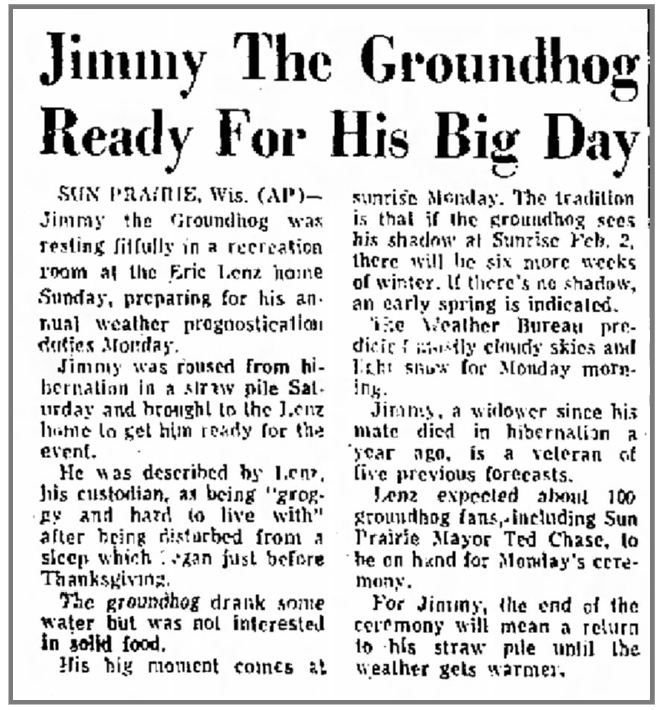
Jimmy made front-page news in The Troy Record in New York in February 1970.
Jimmy arrived in a stretch limousine with a Sun Prairie Volunteer Fire Department escort. Like a Hollywood star, Jimmy emerged from his limo to camera flashes and blaring lights from two television stations. He was accompanied by his handler, Jerry Hahn, who is retiring from the groundhog business after today. Hahn shed tears as Freund and others paid him tribute for serving as Jimmy’s caretaker since 2003. Jimmy will now be cared for by Jeff Gauger, owner of the Beans ’n Cream coffee house on Cannery Square. Gauger has a hobby farm.
Jerry Hahn pets Jimmy the Groundhog, who has been in his care since 2003.
Jimmy has been predicting weather in the Groundhog Capital of the World since 1948. The current Jimmy is the 11th burrowing rodent to serve as Sun Prairie’s weather forecaster. And while a certain East Coast groundhog gets most of the national media attention, Jimmy has a better than 80 percent accuracy rating. According to legend, he’s always accurate. It’s just the mayor does not always translate correctly from “groundhogese” to English.
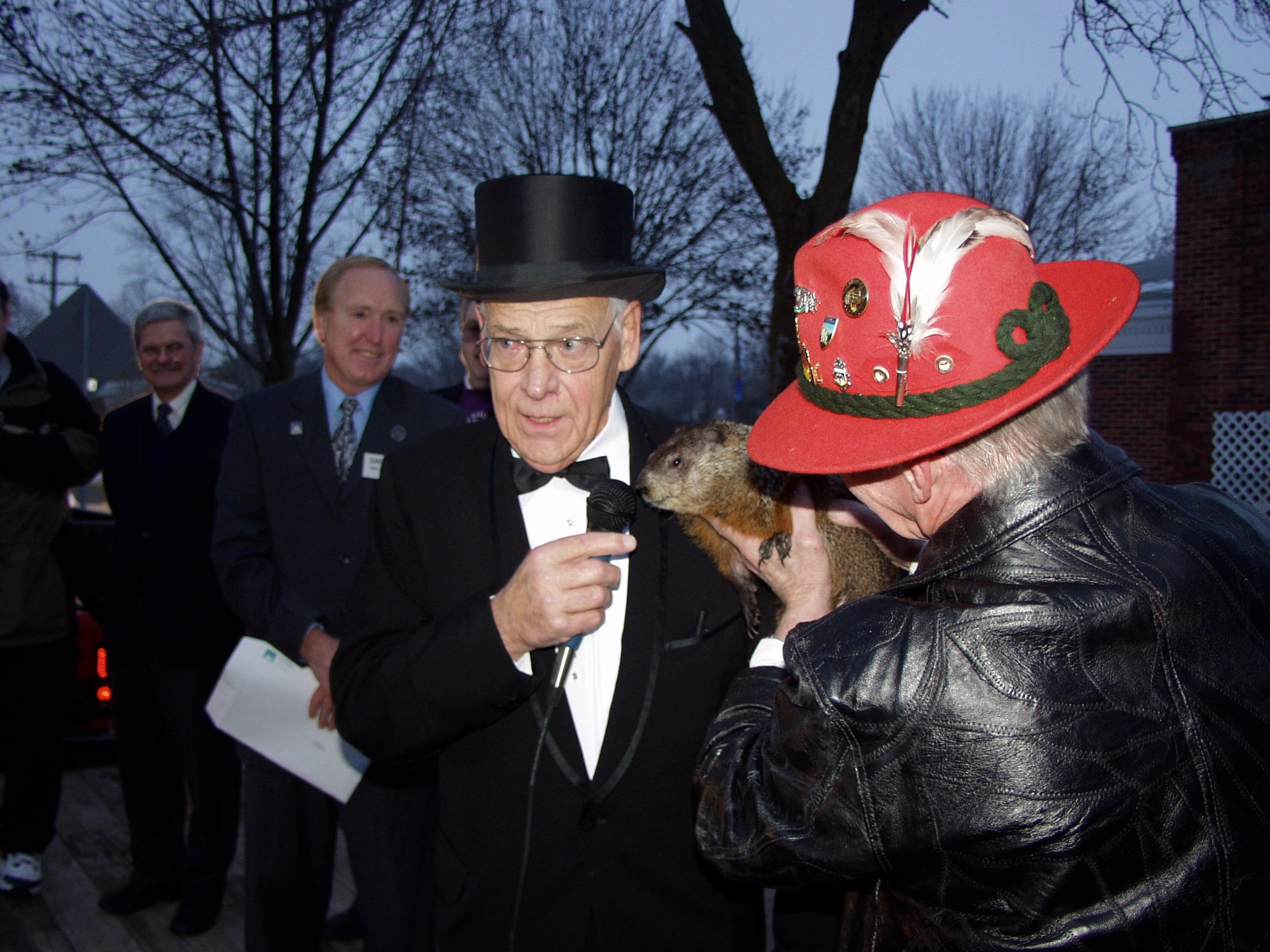
Even with the bitter cold, I had to see for myself what all the fuss was about. When my late father, David D. Hanneman, was mayor from 2003-2005, he presided over two such ceremonies (see video above). In February 2005, Dad wore a tuxedo to go along with the mayor’s official groundhog top hat. The year before, Dad interviewed Jimmy before a large crowd. “What? You don’t like to be kissed? Well OK, I won’t kiss you then,” Dad said to laughter from the crowd.
Mayor David D. Hanneman with Jimmy the Groundhog in 2005. (Sun Prairie Star Photo)
View a complete photo gallery from today’s event below:
By Joe Hanneman PROFESSOR RICHARD T. ELY WAS AN ANARCHIST. Ely was a socialist, an author of “utopian, impracticable and pernicious doctrines.” He was a pro-union rabblerouser who preferred “dirty, dissipated, unmarried, unreliable and unskilled” workers. He was a threat to the American way of life. So you might believe if you read the scathing charges leveled against the University of Wisconsin economics professor in a national magazine by the outspoken Wisconsin superintendent of public instruction.
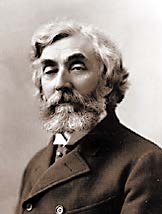
Professor Ely stood accused in 1894.
The clash between Ely and school teacher Oliver E. Wells in 1894 led to a highly publicized trial. The professor was eventually cleared, but what was remembered for generations was the statement issued by the Board of Regents after the trial — words so powerful and timeless they were cast into bronze.
A ‘Magna Carta’
The words used to clear Ely — which the professor later called the “pronunciamento of academic freedom” and “part of the Wisconsin Magna Carta” — were ensconced on a large bronze tablet and eventually bolted to Bascom Hall at the University of Wisconsin-Madison. The plaque reads:
“Whatever may be the limitations which trammel inquiry elsewhere, we believe that the great State University of Wisconsin should ever encourage that continual and fearless sifting and winnowing by which alone the truth
can be found.”
Those words became more important for the University of Wisconsin-Parkside in 1998, when two duplicates of the famed plaques were freed from a 25-year dormancy in the basement archives, restored and prepared for installation on campus (see related story). The plaques are symbols not only linking the university to a proud tradition, but also a modern beacon defending the creation of knowledge that is at the heart of University of Wisconsin education.
The Oliver Wells letter set off a firestorm of controversy.
“The principles of academic freedom have never found expression in language so beautiful, words so impressive, phrases so inspiring,” said UW President Charles Van Hise at the plaque’s dedication in June 1915. Theodore Herfurth, a member of the class of 1894 who later wrote a definitive history of the Sifting and Winnowing story, said the memorial plaque “stands as a sentinel” to guard the spirit of the university.“When time and the elements shall have effaced every resistive letter on the historic bronze tablet, its imperishable spirit shall still ring clear and true,” Herfurth wrote in 1948, just two years before his death. The Sifting and Winnowing story still rings across time. In December 1964, it was the subject of the short-lived Profiles in Courage television series, starring Daniel O’Herlihy as Ely and Edward Asner as Wells.
Ely probably couldn’t have imagined such an outcome when Wells, a teacher and former superintendent of schools in Waupaca County, attacked him in a 535-word letter to the editor of The Nation titled “The College Anarchist,” published in the July 12, 1894 issue. In his role as Wisconsin superintendent of public instruction (1891-95), Wells was an ex-officio member of the Board of Regents.
Oliver Wells leveled scandalous accusations at Professor Ely.
Ely, a distinguished political economist, had among his concerns the welfare of the working class and organized labor. He interacted with the labor movement, and wrote about socialism in his textbooks. A founder of the American Economic Association and the Christian Social Union, Ely helped develop the reform ideology that was central to the Progressive movement in America.
A Covert Socialist?
Wells’ frontal attack accused Ely of fomenting strikes at the Democratic Printing Company and the Tracy-Gibbs Printing Company in Madison, and of boycotting a non-union printing company. When Wells got no traction on those issues by complaining to UW President Adams and fellow Regents, he went public. Wells said Ely’s writings masked a covert socialism that constituted an “attack on life and property such as this country has already become too familiar with.” Herfurth described Wells’ letter as “scathing, excoriating and denunciatory,” making Wells Ely’s “antagonist and violent public accuser.”
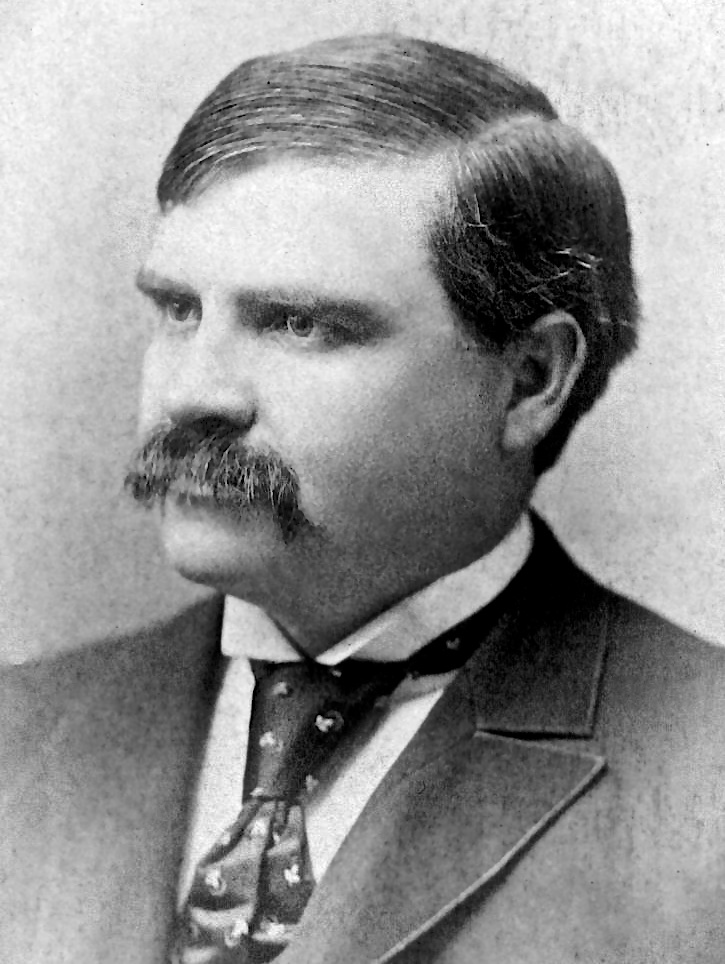
The embarrassing national publicity that followed forced the Board of Regents to appoint a three-member trial panel to investigate Ely. The inquiry was chaired by Herbert W. Chynoweth, former Wisconsin assistant attorney general and a prominent Madison attorney. Other panel members included Dr. Harvey B. Dale, former four-term mayor of Oshkosh, and Milwaukee banker John Johnston. During a three-day hearing that began Aug. 20, 1894, Wells’ accusations began to unravel as exaggerations, half-truths and misrepresentation. Chynoweth made a key ruling on the second day of the hearing that the panel would not examine all of Ely’s writings, but would focus on specific allegations in Wells’ letter to The Nation.
Regent Herbert W. Chynoweth of Madison chaired the Ely inquiry panel.
Testimony showed that Ely did not coerce or direct strikers, boycott non-union shops or promote anarchy. In fact, Ely was hailed as one of America’s foremost minds on political economy. He voiced support for unionization of printing company employees, but was not involved in the ongoing labor disputes.
E. Benjamin Andrews, president of Brown University, wrote that to dismiss Ely would “be a great blow at freedom of university teaching.” UW President Charles Kendall Adams, after reviewing Ely’s writings, said not even “a paragraph or sentence…can be interpreted as an encouragement of lawlessness or disorder.” Albion Woodbury Small, founder of the sociology department at the University of Chicago, said “no man in the United States has done so much as he to bring economic thought down out of the clouds and into contact with actual human concerns. Nothing could be more grotesque than to accuse him of encouraging a spirit of lawlessness and violence.”
UW President Charles Kendall Adams found no basis for the charges.
As the hearing entered its third day, Wells admitted that he could not prove his accusations. At this point, the panel dropped from trial mode into that of a fact-finder. Ely’s exoneration was secured. The panel’s report, issued to the Board of Regents on Sept. 18, 1894, went beyond exoneration. Regents unanimously adopted the document and its poetic language, sending a signal through the ages of its commitment to freedom of inquiry.
“We feel that we would unworthy of the position we hold if we did not believe in progress in all departments of knowledge,” read the report, believed to be written by UW President Adams. “In all lines of academic investigation, it is of the utmost importance that the investigator should be absolutely free to follow the indications of truth wherever they may lead.” There was later ongoing debate as to who coined the “Sifting and Winnowing” phrase. In June 1942, an aged Professor Ely insisted the credit belonged to Alfred T. Rogers, the son-in-law of Regent Chynoweth.
Yet Another Threat
While the poetic words made a memorable statement, they were not resurrected for nearly 20 years when yet another UW professor stood accused of impropriety. Sociology professor Edward Alsworth Ross was implicated for allegedly consorting with anarchist Emma Goldman and giving a speaking platform to sexual liberation proponent Parker Sercombe, a man said to promote immorality.
Accusations against Professor E.A. Ross led to the casting of the plaque in 1910.
Regents were so incensed with the 1910 allegations against Ross that they approved a statement of censure. Suggestions were made that Ross be fired. UW President Van Hise led a vigorous defense of Ross against what again proved to be somewhat dubious allegations. Regents did not take action against Ross. The professor never attended Goldman’s talk in Madison, but when she paid a visit to his office, he gave her a tour of campus. “Promptly the newspapers shrieked that I was an anarchist,” Ross said. Van Hise privately told Ross that his real indiscretion was publishing Sin and Society: An Analysis of Latter-Day Iniquity. Some on the Board of Regents sought a pretext to oust Ross because of the book, Van Hise said.
Journalist Lincoln Steffens suggested casting the “Sifting and Winnowing” statement into a plaque.
Fearing that academic freedom was again in jeopardy, the Class of 1910 decided to have the famed Sifting and Winnowing statement cast into bronze and presented to the university as a gift. The idea for the memorial came from Lincoln Steffens, the “muckraking” journalist from American Magazine. Steffens discovered the 1894 Regents report while researching the University of Wisconsin and was deeply impressed by the Sifting and Winnowing statement. Steffens became a great admirer of Sen. Robert Marion La Follette, leader of the Progressive movement, while writing his 1909 article, “Sending a State to College.” Students at the time were largely unaware of Steffens’ involvement. Class leaders kept this fact close to the vest. However, conservative members of the Board of Regents were aware of it. Many of them were not fond of Steffens, whom they referred to with great derision as “Stinkin’ Leffins.”
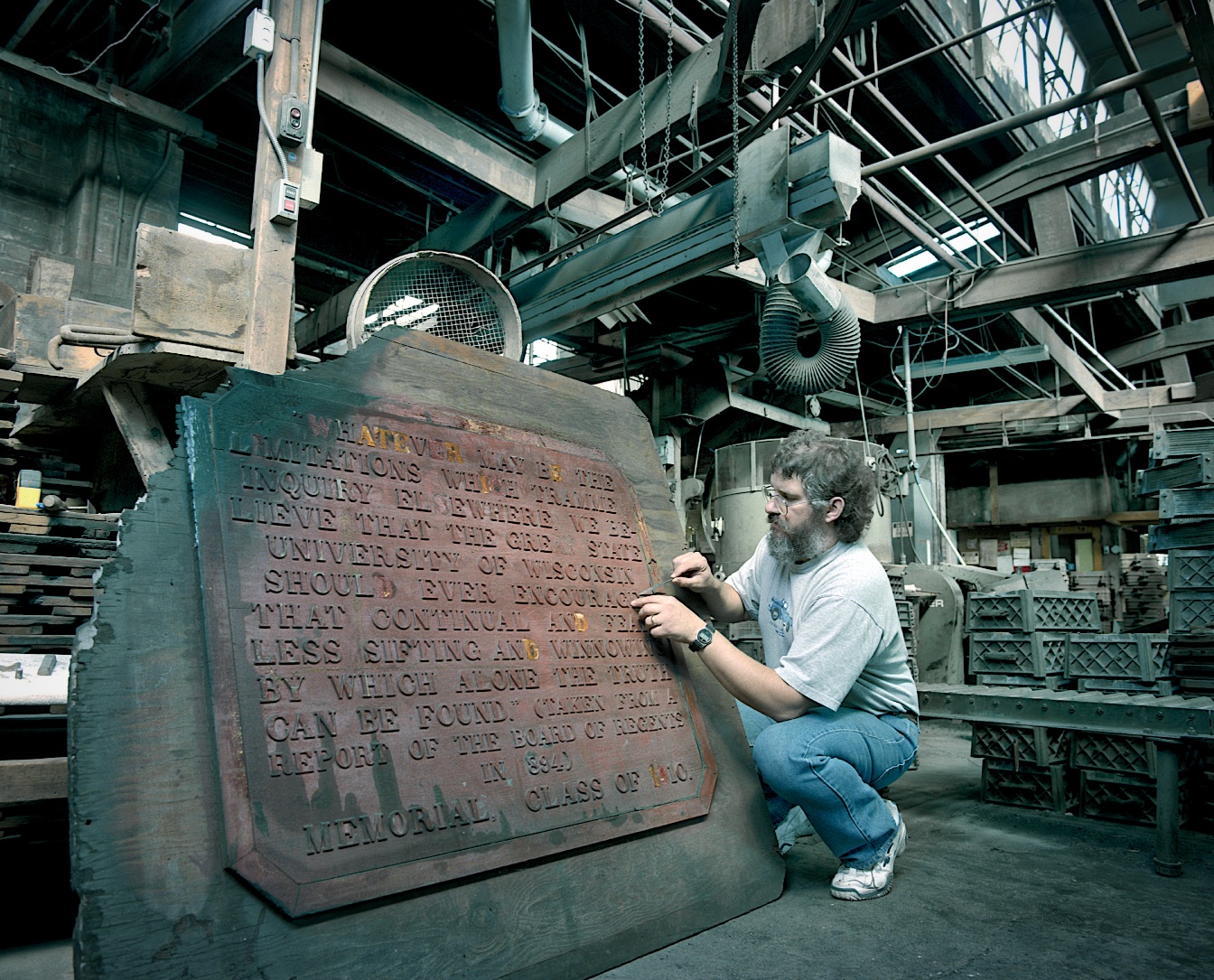
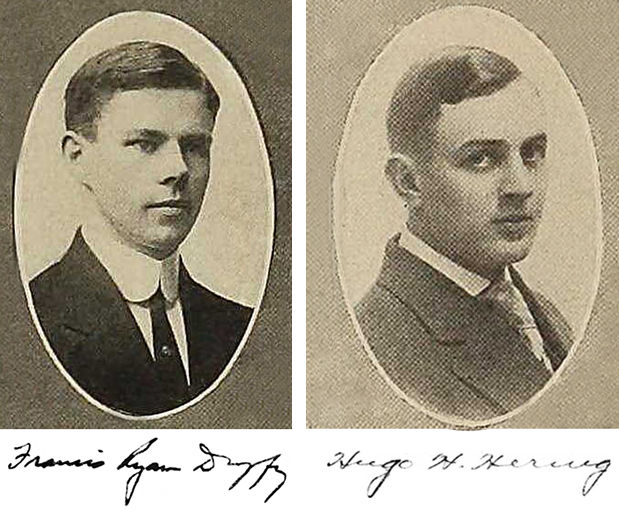
Using scrap plywood and pattern maker’s letters, student Hugo H. Hering created the somewhat crude plaque pattern and had it cast at Madison Brass Works Inc. foundry for $25. “It was purely a hand-made job,” Hering said, “in which I used a three-ply wood veneer panel as a background. I bought white metal letters, such as used by Pattern Makers, and fastened these letters to the veneer back.” Hering carted the form to Madison Brass and Henry Vogts cast the tablet for the students.
Tom Pankratz examines what is believed to be the original wooden “Sifting and Winnowing” form at the old Madison Brass Works foundry in 1998. (Duzynski Photo)
Feeling the plaque was a political statement and a slap in the face, Regents rejected it in June 1910. The board at the time was dominated by Stalwart Republicans, at least some of whom believed the students were being used by Progressives to cast aspersions on conservative members of the Board of Regents. “It was the entire situation and spirit of it all that was resented,” Regent Charles P. Cary later said. “The spirit as Regents interpreted it was something like this: ‘There, dern ye, take that dose and swallow it. You don’t dare refuse it even if it gags you, and it probably will.’ ”
There was a public perception that the students were trying to dictate to the Regents. Indeed, student leaders had plans to erect the bronze tablet themselves near campus if Regents rejected it. Class President Francis Ryan Duffy petitioned the Board of Regents to place the plaque at any “suitable” campus location. Publicly, Regents said rejection of the tablet came from not wanting to set a precedent that could “mutilate” the facades of university buildings. According to the account by Herfurth, however, the real reason was they despised Lincoln Steffens.
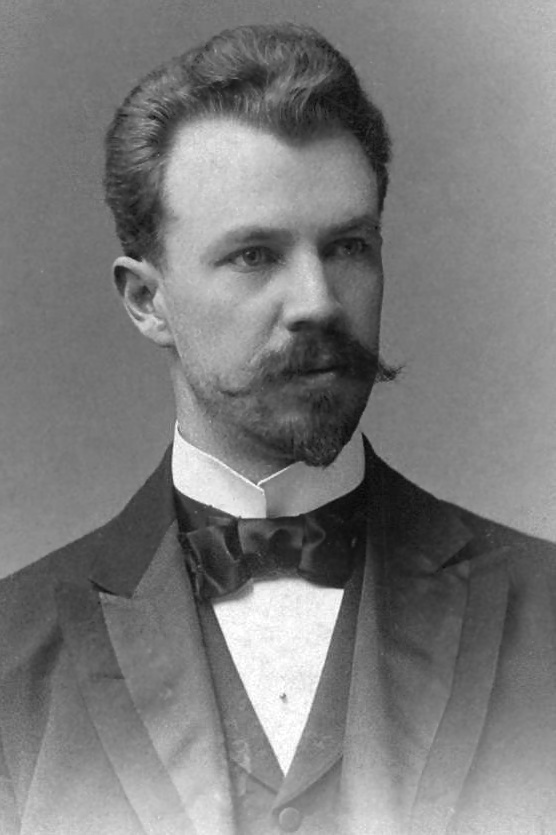
Student Francis Ryan Duffy petitioned the Regents to accept the plaque in 1910. Hugo H. Hering was chairman of the memorial committee and designed the plaque.
After the kerfuffle, the plaque, as one newspaper put it, came to repose “in a dry goods box in the basement of the administration building.” Regents formally accepted the tablet in April 1912, but had no plans to affix it to a building. It wasn’t until 1915 when tempers had cooled (and the makeup of the Board of Regents had changed) that the plaque was rescued from storage, bolted to the door post of Bascom Hall and formally dedicated. President Van Hise had to broker a solution between zealous Class of 1910 alumni and Regents who were still stung at the suggestion they had harmed academic freedom in 1910.
The location of the plaque was more than mere symbolism. Bascom Hall “is the citadel of power of the University of Wisconsin,” Herfurth wrote in 1948. It was long the meeting place of the Board of Regents, a body Herfurth said has “the prerogative and the responsibility to establish, to defend and to preserve the spiritual, the ethical and the cultural values which comprise the essence of a great university.”
INSPIRING WORDS: UW President Charles Van Hise speaks at the original plaque dedication in June 1915.
“It was one of the cases that defined academic freedom in this country,” said W. Lee Hansen, professor emeritus of economics at UW-Madison and editor of Academic Freedom on Trial: 100 Years of Sifting and Winnowing at the University of Wisconsin, a 1998 book about the plaque and the issues behind it. “I don’t know of any other schools that have statements that are that concise and expressive.”
Plaque Stolen in 1956
The plaque stood as a symbol of freedom for 41 years before pranksters removed it from its hallowed spot on Bascom Hall in 1956. Just as a fund was being established to recast it, police found the 255-pound plaque near a trail on campus. It was rededicated with great pomp and ceremony on February 15, 1957. More than 325 members of the Class of 1910 were honored at the event, attended by Wisconsin Gov. Vernon Thompson and former Gov. Oscar Rennebohm. Duffy, now chief judge of the U.S. Court of Appeals in Chicago, was among the honored guests. Hering, who went on from his university days to become assistant Wisconsin state treasurer, died in 1946.
Regent Kenneth L. Greenquist of Racine proposed creating duplicates of the Sifting and Winnowing plaque.
In 1964, Racine attorney Kenneth Greenquist, a member of the Board of Regents, sponsored a resolution to create duplicates of the plaque for the UW Center campuses around the state. Plaques were installed at the Racine and Kenosha campuses in 1965 and 1966 on what is now Gateway Technical College’s Lake Building and Bradford High School in Kenosha. UW-Parkside took possession of the plaques at its founding in 1968, and thus began their long residence in storage.
At the 1967 dedication of the Sifting and Winnowing plaque at the UW Center in Green Bay, Wisconsin Gov. Warren Knowles said the plaque contains a bold idea — and a challenge. “The idea embodied in the words of the plaque we will dedicate today is as old as the concept of freedom itself: the right of free inquiry, the right to dissent, the right of free speech, the right of minorities to be heard in the forums of public opinion,” Knowles said. “All of this and more is contained in the famous ‘Sifting and Winnowing’ statement of the 1894 Board of Regents of the University of Wisconsin. These are freedoms that must be fought for and won anew by each generation.” ♦
— A shorter version of this article appeared in the winter 1998-99 issue of Perspective magazine at the University of Wisconsin-Parkside. Special thanks to the UW-Madison Archives for research assistance, materials and photos used in preparation of this article. On Wisconsin!
—
Postscript
Richard T. Ely taught at the University of Wisconsin until 1925, when he left for Northwestern University. More than 70 years after his death, his writings continue to draw spirited debate. He died on October 4, 1943 in Connecticut. He was 89. He is buried at Forest Hill Cemetery in Madison.
Oliver E. Wells served as Wisconsin superintendent of public instruction from 1891 to 1895. He was previously a teacher in Appleton and the superintendent of Waupaca County schools. In September 1899, he became principal of Wisconsin’s first teacher training school, located at Wausau. He served in that role until 1915. Wells died on December 26, 1922 at age 69.
Charles Kendall Adams served as University of Wisconsin president from 1892 until 1901, when he resigned due to failing health. He was previously president of Cornell University from 1885 to 1892 and a professor at the University of Michigan. During the Civil War, he commanded Michigan’s Tappan Guards. He died on July 28, 1902 in Redlands, California. He was 67.
Herbert W. Chynoweth was a chief lieutenant and legal adviser to Robert M. La Follette. He served as assistant Wisconsin attorney general and later conducted a longstanding legal practice in Madison. He died on October 14, 1906 from arterial sclerosis. He was 58.
Charles R. Van Hise was the first University of Wisconsin alumnus to serve as is president. He was named successor to Charles Kendall Adams in 1903 and served until 1918. Under his leadership, the university sought to move beyond instruction to help improve the lives of everyone in the state. This led to the “Wisconsin Idea,” that the borders of the university are the borders of the state. Built in 1967, Van Hise Hall on the UW campus is named in his honor. Van Hise died on November 19, 1918 in Milwaukee.
Francis Ryan Duffy was U.S. senator from Wisconsin from 1933-1939 and later a federal judge. After graduating from the University of Wisconsin in 1910, Duffy earned his law degree at UW in 1912. He established a law practice, served in World War I, then returned to practicing law. After serving in the Senate, Duffy was appointed federal judge for the Eastern District of Wisconsin in June 1939. He was named an appeals court judge in the U.S. Court of Appeals (Seventh Circuit) in 1949. Duffy died on August 16, 1979.
It was the moving definition of a close call. A semi-trailer truck being driven by John N. Post flipped over in late June 1946 and slid right into the front of the Tourist Hotel on State Street in Mauston, Wisconsin. The semi ripped off the hotel’s screened porch and pushed it down the block.
The truck pushed parts of the porch 20 feet to the west.
Breaking glass exploded into the only unoccupied room at the inn. The room’s regular resident, a truck driver himself, was away on vacation. Post, 25, told police that he pulled out in order to pass a car driven by Charles A. Petrowitz, 15. Petrowitz started to make a left turn, forcing Post to veer and lose control of the truck. Post was treated at the Mauston hospital and released. No citations were issued in the accident. In addition to building damage, the truck also knocked over a light post, a mailbox and a fire hydrant.
Truck driver John N. Post suffered only minor injuries in the crash.
The photos were taken by Carl F. Hanneman for The Wisconsin State Journal, which ran two images and a short story on its State Page on June 25, 1946.
It would be easy to say that Julius Rudolph Hannemann lived his life with a boom. There were likely many in Washington, D.C. in the 1870s and 1880s who wished he hadn’t created so many of them. As president of the district artillery corps, Maj. Hannemann provided the ceremonial explosive huzzahs at civic events from decoration day to the inauguration of presidents.
Although Hannemann had a distinguished record of service with Union Army units during the Civil War, one senses just a bit of resentment at the noise created by his artillery men. Hannemann commanded the artillery for Decoration Day at Arlington National Cemetery one year. A local newspaper quipped, “All persons residing in the vicinity are advised to have their lives insured.” The article ran under the headline: “The Poisoned Major to the Front.” Another article said he “has broken millions of panes of glass, the peace of the capital, more often than can be computed, by firing cannon.”
On New Year’s Eve 1875, his corps fired a 37-volley salute to the new year in Judiciary Square. According to one news account, “the ammunition for this purpose having been furnished by the War Department.” On September 18, 1880, a platoon fired a 200-gun salute to commemorate the Republican victory in Maine, according to a front-page article in the The Evening Star. In 1879, President Rutherford B. Hayes approved Hannemann’s promotion from second lieutenant to captain. Hannemann was later promoted to major.
The Evening Critic carried the news of the major’s death on Page 1.
Hannemann was struck with apoplexy (possibly a stroke) at the inauguration of President James A. Garfield in early March 1881. It was this condition that eventually took his life on the morning of January 28, 1885. He was just 43 years old. “His death had been expected for some time,” wrote the The Evening Critic. “A well-known and efficient militia officer and a prominent member of the G.A.R. passes to that bourne where military parades are unknown and the weary are at rest.”
Hannemann was born in Prussia in 1842 to a military family. Upon emigrating to the United States, he volunteered for duty in the Civil War on May 17, 1861. He served with the 39th New York Volunteer Infantry Regiment, known as the “Garibaldi Guard.” He started as a private, but by March 1865, he was a 2nd lieutenant with the 7th New York Infantry Regiment. In June of that year, he was named adjutant of the 7th.
We don’t know of any link between Julius Rudolph Hannemann and the Hanneman family that came from Pomerania to Wisconsin in the 1860s. The major seems to have come from an area in the Kingdom of Saxony, south and west of Pomerania.
By Joe Hanneman MAJ. JOSEPH SMALL III GREW CONCERNED as he peered out the windshield of his U.S. Marine Corps OV-10 Bronco reconnaissance plane, cruising low over enemy territory just inside Kuwait. It was early afternoon, Feb. 25, 1991, the second day of the Allied ground war. It was an all-out assault against Saddam Hussein’s Iraqi forces, who held the tiny oil-rich nation with an iron grip. But unlike the clear skies on the first day of the ground offensive, the weather had turned ominous.
Small lowered his twin-engine turboprop plane to about 4,500 feet. He was just beneath the low, stormy cloud ceiling and in the midst of thick, sooty smoke from the oil-well fires that scorched the earth below. He didn’t like being this low in a plane that flew only about one-fourth the speed of a U. S. fighter jet. He’d been the target of two Iraqi surface-to-air missiles on a previous mission, but was never low enough to really worry about being hit.
Today was different.
Small and his aerial observer, Marine Corps Capt. David Spellacy, were searching for an Iraqi tank column that had slowed the advance of the 1st Marine Division’s 1st Tank Battalion into southwest Kuwait. They set up a search pattern, and planned to call in air and artillery strikes on the tanks once they found them. While Spellacy surveyed the desert floor below, Small kept “jinking” the plane in erratic movements, hoping to make the aircraft a difficult target for Iraqi gunners.
Small snapped this photo from the cockpit of his Marine Corps OV-10 Bronco.
After a few minutes of searching, they came upon a large, trench complex dug into the sand below. They were close enough to see soldiers moving about on the ground.
SMALL QUICKLY REALIZED HE’D STUMBLED ONTO a hornet’s nest of Iraqi troops, and was flying low enough to get stung. While Spellacy took down target coordinates, Small thought about getting the plane out of there. It was too late.
Screaming from the ground at 5 o’clock, a shoulder-launched surface-to-air missile ripped into the right wing, killing Spellacy and crippling the aircraft. “I remember a loud explosion,” Small said. “It felt like a giant hand came out and smacked the airplane, like swatting a fly. I remember a brilliant, white light, coming from somewhere. The airplane was instantly, completely out of control.”
Not knowing Spellacy’s condition, or that the plane’s right wing had been blown off, Small tried to regain control of the craft. It didn’t work. Racing against time, Small pulled the eject handle. Within a second, both men rocketed free of the crippled airplane, 3-5 miles inside enemy territory. “I don’t remember any noise,” Small said. “My next conscious thought was when I was under the parachute.”
Small’s duty in Operation Desert Storm was the first combat assignment for the Racine native and 1975 UW-Parkside graduate. He’d arrived in Saudi Arabia on the first day of the air war, Jan. 17, with Marine Observation Squadron 1 from New River, N.C. Typically, he flew one mission per day. He’d leave the airstrip near the port city of Jubayl each day for a 4-hour flight, mostly patrolling the Kuwait-Saudi border and mapping enemy tank and troop locations.
IT WAS A LONG WAY FROM TINY SYLVANIA AIRPORT in Racine County, where Small fulfilled his dream of earning a pilot’s license on the day he graduated from UW-Parkside in December 1975. During his 17 years in the Corps, he’d flown other dangerous missions. He flew a helicopter on search-and-rescue missions to aid survivors of Hurricane David in the Dominican Republic in 1979. On one mission, his helicopter ended up belly-deep in mud as survivors rushed the craft to get at relief supplies.
He also flew drug interdiction missions in cooperation with the U.S. Customs Service and the Coast Guard in 1987. On one mission, he stumbled onto an air-to-boat drop of drugs, and guided law enforcement to the scene. The dealers were caught and convicted. Another time; another enemy. Now, floating into the hands of the Iraqis, Small pulled his survival radio from his vest and got off a quick mayday, noting his location. Now all he could do was wait to hit the ground.
When he landed, Small tore ligaments in his knee, and suffered a deep cut on his forearm. He laid on the ground, facing up. Within seconds, a dozen Iraqi soldiers were all over him. There was no running. “Evidently, the sound of my aircraft crashing got them out of their holes. Why they didn’t shoot – to this day I don’t know.”
After disarming him and removing his survival vest at gunpoint, the soldiers put Small in a land rover and drove north. A soldier in the front seat had his rifle pointed at Small’s face. A rival group of soldiers in another vehicle tried to run them off the road. Small looked to one of his captors for a clue to what was happening.
“He looked at me and said, ‘They’re crazy. They want to kill you.’ ”
SMALL WAS TAKEN TO AN UNDERGROUND BUNKER complex several miles away. He waited about 45 minutes as the Iraqis figured out what to do with him. One of the soldiers held a cigarette to his mouth for a few puffs. After taking his flight suit and gear, they dragged him up the stairs and stuffed him into another vehicle. This time, the destination was Kuwait City. At a building in the center of the Kuwaiti capital, the soldiers sat Small in the center of a room for another round of interrogation. The cloth strips used to bind his hands dug into his wrists, causing deep lacerations. The beating started off with cuffs to the ears and back of the head. They administered what Small called “a pretty good whooping,” but they never struck him in the face. After being led into another room, he was whipped with what he believed was a fire hose. One soldier hit him in the back of the head so hard it knocked him out cold.
“I figured they were going to beat me, then shoot me,” he said.
Small remembered what he had read about POWs in Vietnam, and how American soldiers answered questions by being vague or telling lies. It was a technique he would use often during his interrogation; a technique he later credited with saving his life. When the Iraqis found his flight map among his belongings and began questioning him about what it meant, Small said he told the “biggest, grandest lie I think I’ve ever told in my entire life.” It worked.
After that session ended, Small was again loaded into a vehicle and driven from Kuwait City to Basra in southern Iraq, headquarters of Saddam’s elite Republican Guard. They traveled up a darkened Highway 6, which would within two days become known as the “Highway of Death,” as Allied pilots destroyed scores of retreating Iraqi vehicles.
During the next interrogation, Small was not beaten, but was threatened with death if he didn’t cooperate. The next morning, Small was put into a car and driven to Baghdad. He was afraid during the daylong drive – afraid that U.S. planes might spot them on the highway and bomb the vehicle. Luckily for him, the weather was bad and no planes were visible. “Again,” Small said, “God was on my side. He kept the weather bad. Had the weather been nicer, I’m sure we wouldn’t have made it.”
SMALL ENDURED ONE LAST ROUND OF QUESTIONING before being sent to a POW prison. Guards who led him to the questioning hit him in the head, and purposely made him walk into walls or trip on the stairs. He was unsure what the Iraqis had in store for him. He had seen the pictures of captured Allied soldiers on CNN, soldiers who’d been beaten bloody and forced to read statements condemning the war. He knew what could happen. Then the questions ended. Small was taken to a dark, cold prison and left in a cell by himself. It had been 30 hours since he was shot down, and the impact of his ordeal caught up with him. He sat in his cell and wept.
He found only restless sleep that night, on a small square of foam padding that served as a bed. The night was interrupted by U.S. air raids that drew loud anti-aircraft fire from inside the prison compound. Having hit rock bottom emotionally, Small sat in his 12-by-12 cell and prayed. It was about the only comfort he’d found since being captured. He was making peace with God. “I figured that was it; I was done.”
Although his cell door had a blanket draped over it to keep him from seeing out, Small on occasion heard muffled whispers from other cells. At one point, he heard his name whispered. Someone must have heard him announce his name to the guards when he came in the night before. In between visits by his captors, Small discovered there were five other Allied pilots in his wing of the prison. Slowly, they exchanged information in whispers. He filled them in on the progress of the war. A couple days later, two more prisoners were brought in. The men worked to keep each others’ spirits up. On occasion, Small’s guard would give him a cigarette. He even brought him some hot tea on evening. “That was a good day,” Small said.
THE FIRST HINT THE WAR WAS OVER was when the bombing stopped. The prisoners heard the report of small arms fire in Baghdad, a traditional Muslim sign of celebration. On the night of March 4, all the prisoners were gathered, put on a bus and driven to another prison in Baghdad. A representative of the Red Crescent (similar to the Red Cross) was taking down everyone’s name. Prisoners were allowed to shave, then were blindfolded.
They were loaded onto a bus, and told they were now in the custody of the International Red Cross. It was finally ending. “That was the first time I really believed it,” Small said. They were put up at a luxury hotel for the night, and treated to hot showers and good food. The next day, they were loaded onto a Swissair plane and took off for Riyadh, Saudi Arabia.
Near Saudi airspace, the commercial jet was joined up by two American F-15 fighters, which flew in tight formation as an escort. The pilots raised their helmet shields and gave a thumbs up. They broke away and were replaced by two British Tornado fighters. Their first official welcome home was a stirring sight for all on board. “It was the happiest day of my life, boy. We let out a whoop.”
When Small descended the steps at the Riyadh airfield, U.S. Army Gen. H. Norman Schwarzkopf, the Allied commander, was waiting to greet the POWs. The big, burly four-star general had tears streaming down his face.
AFTER A CHECKUP ABOARD A U.S. HOSPITAL SHIP near Bahrain, Small and his comrades flew a VIP plane to Andrews Air Force Base, Md. Waiting there were thousands of people, including his wife, Leanne, their children Lauren, 10, and Michael, 8, his son, David, 17, and his parents, Joe and Dolores Small of Racine.
Maj. Joseph Small III (second from left) receives a medal from Marine Corps Commandant Gen. Alfred Gray at Bethesda Naval Medical Center in 1991.
Despite his valor and bravery, Small refuses to call himself a hero. And it’s not just modesty. He says many other soldiers have withstood much worse than he, including Vietnam POWs who didn’t come home to the adulation of the American public. That’s a message he’s carried to dozens of speaking engagements since the war ended. He’s also had difficulty dealing with the death of Spellacy – known as “Hank” in his unit – who left behind a wife and three young children. Small described his partner that day as the “greatest guy you’d ever want to know.”
Small has experienced “survivor guilt” and wondered if there’s anything he might have done to change the outcome. He knows there are no answers. “He was sitting three feet behind me. He got hit and I didn’t. God had something for me to do and God had something for Hank to do.”
Small, 41, was stationed in Florida after the war, training future Navy and Marine pilots at Pensacola Naval Air Station. (He retired from the Corps in early 1994 and started life as a civilian.) Small hopes his POW experience and willingness to talk about it will one day help some future soldier survive imprisonment in an enemy camp.
“If I can have some influence at some time on someone who may go through this 10, 15, 20 years from now … that’s what’s going to make it all worthwhile.” ♦
This story originally appeared in the Spring 1993 issue of Perspective magazine at the University of Wisconsin-Parkside
“Stentorian Voice.” Of all the notations in the Mauston High School yearbooks of David D. Hanneman, those two words truly stand out. In the “Report of Condition of the Students of Mauston High School” in 1950, David Hanneman’s asset is listed as “stentorian voice.” Not a common adjective, “stentorian” means “of powerful voice.” It can also mean “booming” and “loud.” No doubt the years 1947-51 were stentorian years for Hanneman, for he and his singing buddies at MHS earned accolades and medals for their singing.
David D. Hanneman’s medals from the Wisconsin Centennial Music Festival in 1948.
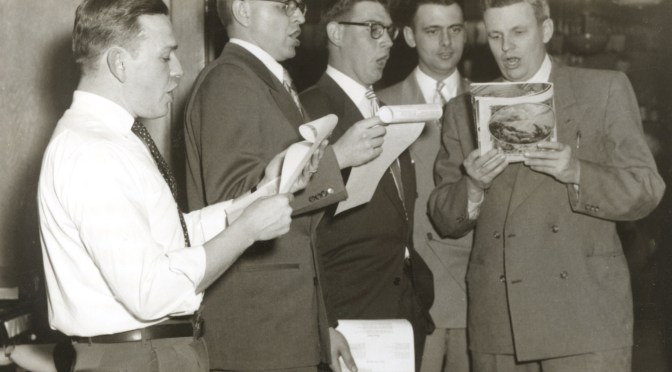
Mauston High School at the time was known for its quality vocal and instrumental music programs. The boys’ double quartet or octette was among the highest profile examples of that quality. The barbershop group regularly competed at the state level in competition sponsored by the Wisconsin School Music Association (WSMA).
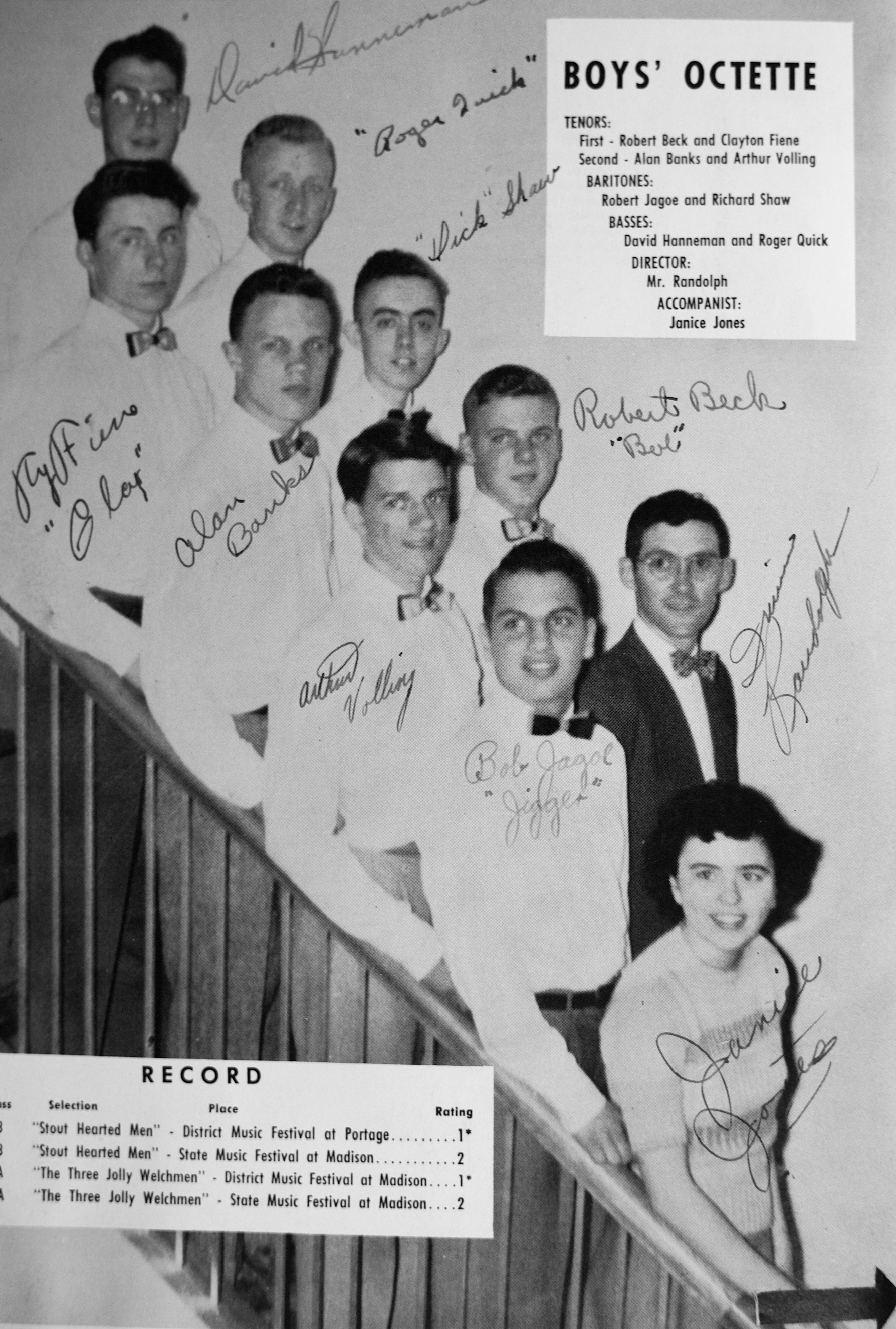
The group included Hanneman and Roger Quick at second bass, Bob Jagoe and Dick Shaw at first bass, Clayton “Ty” Fieneand Bob Beck at first tenor, and Alan Banks and Arthur Volling at second tenor. Self-dubbed the “State Men” for annual appearances in competition, the group had its own cartoon likeness drawn into the Mauston High School yearbook, The Hammer.
Members of the Mauston High School boys double quartet.
In the many WSMA competitions, David Hanneman also sang bass solos, duets and mixed quartets and double quartets. According to one of the judge’s score cards, a Mauston quartet was rated “excellent” for tone, “good” for intonation and “good” for technique. Another judge rated Hanneman “excellent” for his bass solo and noted “maturity of quality” as his greatest singing asset. Hanneman kept the dozens of medals he won at these competitions for many decades after high school.
The “State Men” had their own page in the Mauston High School yearbook in 1951.
Singing wasn’t Hanneman’s only musical interest, however. He played the trumpet for a time and was in the Mauston public school band. He appeared in numerous parades playing the bass drum for the band.
David got his love of song from his mother, Ruby V. Hanneman. As a youngster, Ruby often performed onstage at theaters in Wisconsin Rapids. The Hanneman home in Mauston had a beautiful pump organ and a Victrola record player with a large collection of music. Later in life he appeared in a number of community musicals and sang in the choir at Sacred Hearts of Jesus and Mary Catholic Church in Sun Prairie, Wisconsin. His deep voice could carry the entire parish in song, with enough volume to almost lift the church off its foundations.
United States Marine Cpl. Almeron A. Freeman was scheduled to finish his three-year military service in just a matter of months. After nearly 1½ years in Korea with the 1st Marine Division, Freeman was headed for California aboard a U.S. Navy transport in March 1955. He never made it home. The Douglas R6D airplane slammed into a mountain peak on the Hawaiian island of Oahu. All 66 aboard were killed.
The Bakersfield, California paper from March 22, 1955.
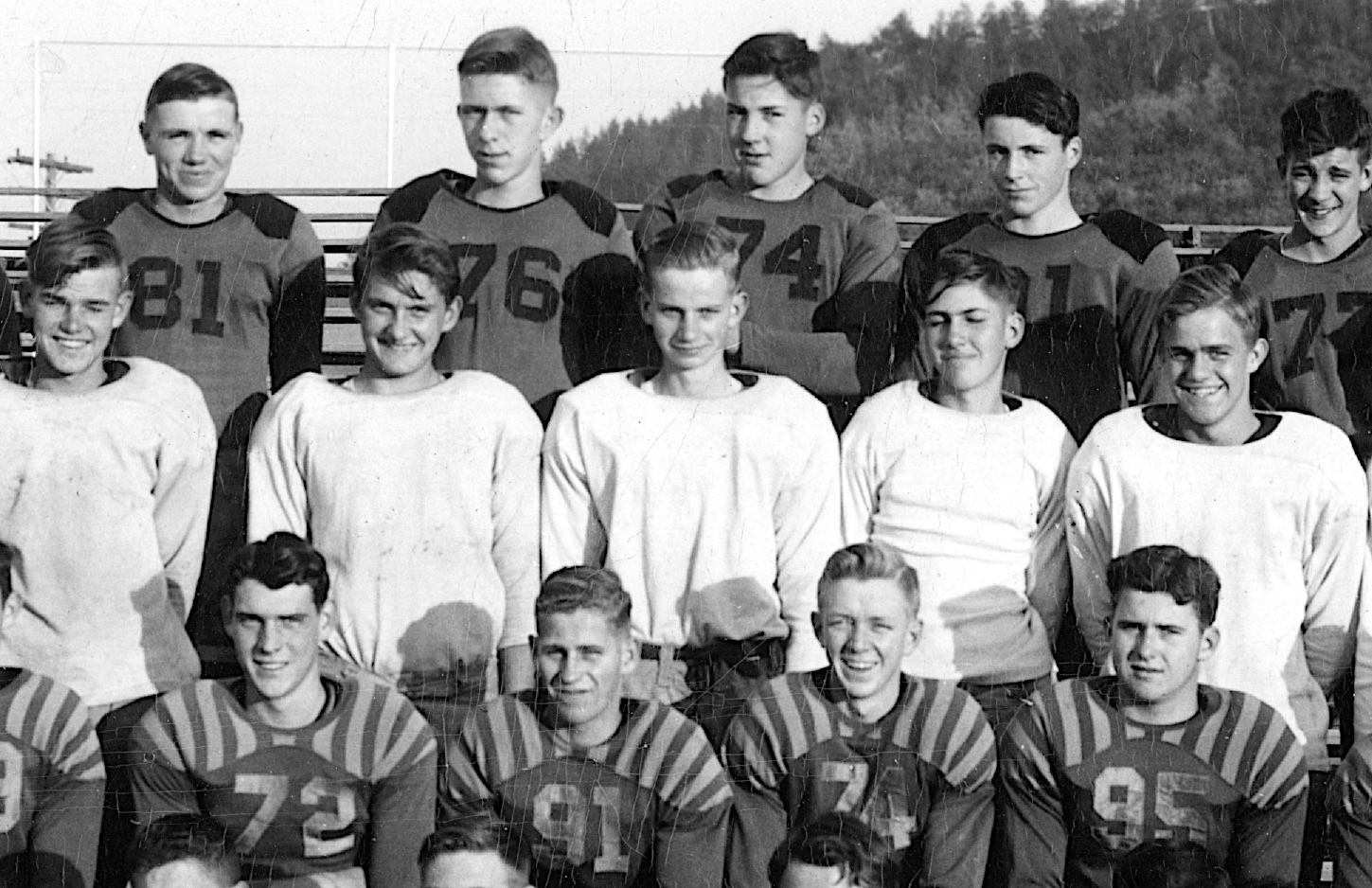
My father, David D. Hanneman, played football with Freeman at Mauston High School. Although Freeman was a year behind Dad in school, he was the same age. Freeman played left guard and wore No. 64 during the 1950 season. Dad played left tackle and wore No. 66. They were both muscular and athletic. Freeman’s death left a deep impression on Dad. In 2006, when planning the Mauston High School Class of 1951’s 55th reunion, Dad made sure Freeman’s photo was included in the program.
U.S. Marine Cpl. Almeron A. Freeman.
Freeman enlisted in the Marine Corps on August 27, 1952, directly after his graduation from Mauston High School. He was an infantry rifleman with the First Marine Division. He landed for duty in Korea just four months after an armistice ended Korean War combat and began a tense “peace” along the 38th Parallel.
At the end of his tour, he flew from South Korea to Tokyo, then to Hickam Field on the island of Oahu in the Hawaiian Islands. Just after 6 p.m. on March 21, 1955, Freeman was onboard a U.S. Navy R6D transport that left Hickam for Travis Air Force Base in California. Some 3½ hours into the flight, the plane developed radio problems and turned back for Oahu. Just after 2 a.m. on March 22, the plane was seen roaring low over the Navy’s Lualualei ammunition depot. Marine Pfc. Joseph T. Price, on guard duty at Lualualei, said the pilot turned on the landing lights and discovered the plane was headed straight into the Wai’ane Mountains. At the last second, the plane made a hard right, but slammed into the mountain about 200 feet below the tip of Pali Kea Peak. The explosion “lit up like daylight for about a minute,” Price said.
Almeron Freeman (farthest right in middle row), played for Mauston High School with David D. Hanneman (No. 72 in front row).
The resulting fire was so hot that it took rescuers nearly two hours to get close enough to confirm there were no survivors. The 66 killed included nine Navy crewmen and 57 passengers: 17 U.S. Air Force, four Navy, 12 Marines, 22 U.S. Army and two civilians (a mother and her baby daughter). It was the worst air disaster in Hawaii’s history. The U.S. Military Air Transportation System, which operated the flight, had flown 1.12 million passengers and crossed the Pacific nearly 42,000 times between January 1951 and March 1955 with no fatalities. The crash was caused by crew error. The plane was 8 miles off course when it struck the mountain.
Freeman’s junior class portrait.
Almeron Arthur Freeman was born February 3, 1933 in Dresbach Township, Minnesota, the son of Irvin M. Freeman and the former Lilah Jenks. Prior to 1940, the family moved from Houston County, Minnesota to Mauston. Irvin worked as a service station attendant. In addition to being a starting guard on the football team, Almeron was a member of the highly rated Mauston boxing team.
Freeman (at left in first row) pictured in 1951 with other letter winners in the M Club.
He came from a proud family military tradition. His great-grandfather and namesake, Almeron Augustus Freeman, served in the Civil War with the 1st Independent Battery, Wisconsin Light Artillery. The battery served under General William Tecumseh Sherman and General Ulysses S. Grant at the battle of Vicksburg, the battle of Port Gibson and later in defense of New Orleans. The elder Freeman later married and became a river pilot moving lumber on the waterways of Wisconsin.
Almeron Freeman (No. 30) played basketball for Mauston High School with David D. Hanneman (second from left in front row).
Marine Cpl. Freeman was buried May 17, 1955 at Jefferson Barracks National Cemetery in St. Louis. Due to the nature of the crash and fire, the remains of 40 service members were buried in a group grave site containing nine caskets. A memorial service for Freeman was held at Mauston High School on May 15, 1955.
The tragedy of the March 1955 air crash extended beyond the immediate victims and their families. Air Force Staff Sgt. Marion “Billy” Shackleford was scheduled to be on that flight, but because he forgot his travel papers, he was denied boarding. He was spared the fate of the 66 crash victims and returned home to Alabama to report for a new assignment. On April 19, 1955, the car he was driving was hit head-on by a Trailways Bus. He was killed instantly. His father, working on a nearby construction job, witnessed the accident. Like Freeman, Sgt. Shackleford was the great-grandson of a Civil War veteran.
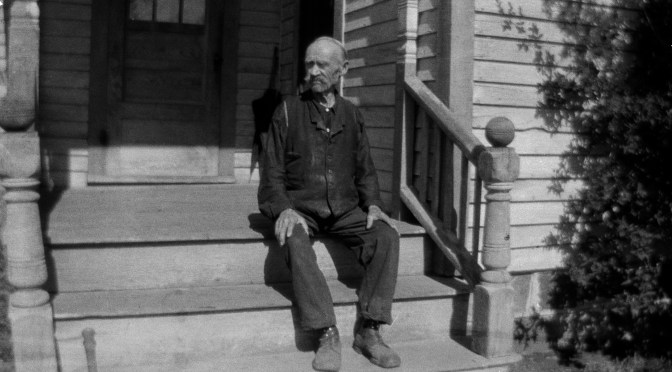
The photograph is very poignant. A frail man, sitting in the afternoon sun on the front porch steps. He looks haggard and tired, maybe ill. This image is the last known photograph taken of Karl Frederick Christian Hanneman, who was known around Wisconsin Rapids as Charles or “Chas” Hanneman. The photo likely dates to 1931 or 1932, when he suffered from prostate cancer that eventually took his life.
Charles Hanneman came to America in late November 1882 with his parents, Christian and Amanda Hanneman. He was just 15 when the family made its way from Stettin, Pomerania to Portage County, Wisconsin. Charles, his three brothers and two sisters settled on a 105-acre farm in the northwest corner of the Town of Grant, near the tiny hamlet of Kellner.
Nina and Elaine Treutel visit with Chas Hanneman, circa 1930.
Charles worked on the Hanneman farm for a time. His brothers would stay in farming (maps from that period show many Hanneman farms in Portage County), but eventually Charles left farming and found work in one of the area’s many sawmills.
At some point in his early 20s, Charles made the acquaintance of Rosine Ostermann, the eldest daughter of John and Mina Ostermann of the Town of Grand Rapids. They had many things in common. Both grew up on the family farm. Rosie’s parents were from Germany (Saxony and Prussia), and his were from Pomerania. Rosie’s grandfather George Ostermann was one of the pioneers of Portage County, listed on the earliest tax roll of the Town of Grant in 1864.
On April 2, 1891, Charles and Rosie were married atSt. John’s Evangelical Lutheran Church in Kellner in a divine service performed by A.G. Grimm. The witnesses were Charles’ father, Christian, and his brother, William. The bride’s attendants were her sister, Elsie Ostermann, and Emma Pribbernow. The groomsmen were cousins August Saeger and Herman Hanneman.
The young couple came to know heartache early in their marriage. Their firstborn, referred in the records only as “C.H. Hanneman,” died in infancy in 1892. They went on to have four sons: Arthur John (1893), Frank Herman Albert (1895), Wilbert George (1899), and our own Carl Henry Frank (1901).
Left to right: Christian Hanneman, Chas Hanneman, Carl Hanneman, David D. Hanneman.
Work in the sawmill must have been erratic, or Charles left that occupation for a time. In 1900, U.S. Census records show the family living and working on the farm of Charles’ brother, William Hanneman.
By 1905, Charles moved his family to the second ward in the city of Grand Rapids. He initially did manual labor for the city of Grand Rapids,possibly working on construction of the water and sewer works. The financial statements for the city in December 1907 show Charles worked 135 hours that month and earned 17.5 cents per hourfor a paycheck of $23.63.
By 1910 the family was living at 1774 Baker Street in Grand Rapids. The U.S. Census that year lists Charles as a laborer at a box factory. That may have referred to Consolidated Water, Power & Paper Co., where he later worked until his retirement, or the nearby Badger Box company.
On March 31, 1918, tragedy struck the Hanneman home when Rosine died suddenly at age 48. Her death notice, which ran on page 1 of the Daily Leader, said she was fine during the day but fell ill and died at 11 p.m. We know that she had diabetes, and that may have contributed to her death. Carl was 16 when his mother died.
Charles remarried in August 1919 and lived out his remaining years in his home at 1751 Baker Street. He became ill with prostate cancer in 1931 and was hospitalized numerous times in Wausau for surgery and treatments. He died at home on Oct. 11, 1932. He was 65. His death made front-page news in the Wisconsin Rapids Daily Tribune.
FAMILY LINE: Karl Frederick Christian Hanneman >> Carl F. Hanneman >> Donn, David & Lavonne Hanneman
Rosine Bertha Henrietta (Osterman) Hanneman (1870-1918), Frank Herman Albert Hanneman (1895-1947), Arthur James Hanneman (1893-1965), Carl Henry Frank Hanneman (1901-1982), Wilbert George Hanneman (1899-1987) and Carl Frederick Christian (Chas) Hanneman (1866-1932).
It is the only known photograph showing six of the seven children of Christian and Amanda Hanneman, pioneers of Portage and Wood counties in Wisconsin. The undated photo was probably taken around 1915 at a family event. Left to right are: William Friedrich Johann Hanneman (1856-1939) Bertha Auguste Ernestine (Hanneman) Bartelt (1860-1945) Albert Friedrich O. Hanneman (1863-1932) Herman Charles Hanneman (1864-1945) Carl Friedrich Christian Hanneman (“Chas,” 1866-1932) Ernestine Wilhelmine Caroline (Hanneman) Timm (1870-1930)
Hand tinted photograph of Chas Hanneman, location unknown.
Left to right: Christian Hanneman, Chas Hanneman, Carl Hanneman, David D. Hanneman.
For a child growing up in the 1930s and 1940s, big adventure often came in small packages. Like many boys his age, David D. Hanneman (1933-2007) was an avid collector of Big Little Books. These chunky mini-books allowed adventure-seeking children to follow the action of Buck Rogers, Dick Tracy, Flash Gordon, Tarzan and other characters. All for 10 cents a book.
The original Big Little Books concept was pioneered by the Whitman Publishing Company of Racine, Wisconsin. Whitman was a subsidiary of Western Publishing, the creator of the famous Little Golden Books (think Poky Little Puppy). Big Little Books were roughly 3¾ inches wide by 4½ inches high. Thickness varied by page count. For example, the 1934 Buffalo Bill and the Pony Express had 380 pages and was 1¼ inches thick. The layout was one of the classic features of Big Little Books. Each page spread had text on the left side and a black-and-white illustration on the right.
Big Little Books had text on the left-facing pages and illustrations on the right pages.
Whitman Publishing came out with its first Big Little Book in 1932, The Adventures of Dick Tracy. Soon after, Whitman had titles with comic strip characters like Wash Tubbs, as well as a range of Walt Disney titles. The 1934 series alone included titles such as Chester Gump Finds the Hidden Treasure, Buck Rogers in the City Below the Sea, Reg’lar Fellers, Betty Boop in Snow White, Kayo and Moon Mullins, Mickey Mouse in Blaggard Castle and Dick Tracy and the Stolen Bonds.
Most of the books had hard covers, although my Dad had one Buck Rogers title that was softcover and in a slightly smaller format (only 4¼ inches high). This book had no page numbers. The inside back cover spread was a two-page ad for Cocomalt drink mix. The 1935 Tom Mix and Tony Jr. in Terror Trailwas a larger format (4 5/8 by 5¼ inches) and featured real photographs inside.
Ruby V. Hanneman wrote an inscription on the inside cover for my Dad’s 8th birthday.
For my Dad’s 8th birthday, he received a copy of the 1941 Tarzan the Untamed by Edgar Rice Burroughs. Ever the historian, my Grandma Ruby V. Hanneman wrote the particulars down in blue pencil on the inside front cover: “David Dion Hanneman, March 27, 1941, for 8th birthday, from Dad, Mother, Lavonne and Donn.” This title was from the Better Little Books series, also published by Whitman. In addition to the story and illustrations, it had a flip-book feature that showed an animation as the reader flipped the pages through his thumb and forefinger.
Titles in the 1941 Better Little Books series included Big Chief Wahoo and the Magic Lamp, Mickey Mouse on Sky Island, Popeye and a Sock for Susan’s Sake, G-Man and the Gun Runners, Dick Tracy and his G-Men, Red Barry Undercover Man, Ellery Queen and the Adventure of the Last Man’s Club, Inspector Charlie Chan Solves a New Mystery and others. By the time he was in high school, my Dad stopped adding to his collection. But they clearly held a special place in his heart, since he kept and safeguarded them for more than 50 years before passing them on.
Judging by the turnout, the marriage of Joseph John Mras and Mary V. Sternot of the Town of Sigel in Wood County, Wisconsin, was the celebration of the year in 1913. The pair were married by the Rev. John Willitzer on October 21. The group portrait was taken outside the Sigel home of the bride’s parents, Jacob and Josephine Sternot. The reception had a big turnout from Sigel and the nearby village of Vesper.
Groom Joseph Mras and bride Mary Sternot are flanked by flower girls Ruby V. Treutel (left) and Gladys Cole. Back row (left to right) includes Joseph Sternot, Josie Leu, John Pyrch, Anna Sternot, John Yeske and Mary Billiet.
As with other large-group photos in our collection, it is fun to look for details in the sea of faces. Standing just right of center is my grandmother, Ruby V. (Treutel) Hanneman, who was a flower girl at the wedding. The bride and groom are tucked away in the upper right corner, looking a bit weary. The entertainers are in center front, one with a fiddle, one with an accordion and a third holding a pitcher of beer. Three things seem to link the men in the photo: hats, beer and cigars. Some things never change.
A studio photo of the wedding party provides additional details on the big day. Ruby Treutel and (we believe) her cousin Gladys Cole were the flower girls, while one brother and one sister of the bride were also in the wedding party.
Joe and Mary Mras had three children,Clarence, Earl and William. Joe was a crane operator for 31 years for the Frank Garber Iron & Metal Co. in Wisconsin Rapids. He retired in 1959. Joe died on April 10, 1961. Mary died September 20, 1977. Their son Clarence was killed in an auto accident in September 1956. Earl died October 18, 2001. William died February 18, 1997.
— This post has been updated with corrected identifications on the wedding portrait.


















 The Hanneman Archive