Our photo library is a bit thin on photos from my mother’s Mulqueen side of the family, but we do have some nice images worth sharing. My Mom grew up in Cudahy (we always pronounced it coo-da-hi, although it’s actually cuh-dah-hay) and comes from a family of 10. The matriarch and patriarch were Margaret Madonna (Dailey) Mulqueen (1895-1982) and Earl J. Mulqueen Sr. (1895-1965).
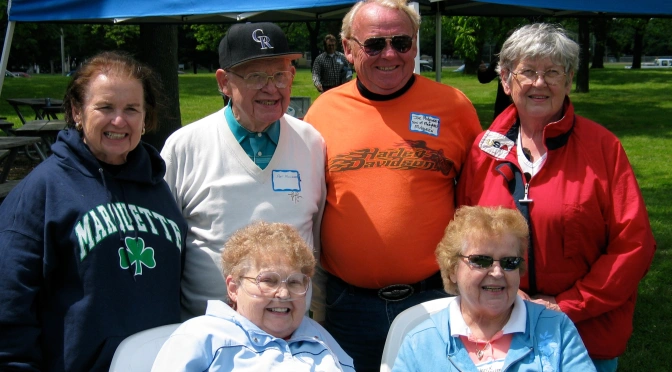
Left to right are Uncle Joe Mulqueen, Aunt Lavonne (Hanneman) Wellman, Uncle Patrick Mulqueen, Grandma Ruby Hanneman and (I believe) Uncle Pat’s wife Ruth.
In the foreground is Grandma Margaret Madonna (Dailey) Mulqueen (1895-1982), and in the back is Grandpa Earl J. Mulqueen Sr. (1895-1965)
Grandma Margaret M. Mulqueen and Grandpa Earl J. Mulqueen Sr., on a visit to my folks’ house in Grand Rapids, Mich.
Sunday dinner at the Mulqueen house in Cudahy.
David C. Hanneman and Laura Mulqueen Curzon, circa 1965.
David C. Hanneman and Laura Mulqueen Curzon, circa 1965.
Looks like Laura Mulqueen Curzon got what she wanted for Christmas. In the background is Grandma Ruby Hanneman.
Looks like a dinner party at my parents house in Greenfield in the late 1950s.
I’m ashamed to say I’m not sure which of cousin Laura Mulqueen Curzon’s brothers this is. Taken in Colorado.
Grandma Margaret M. Mulqueen along with Aunt Evelyn Mulqueen.
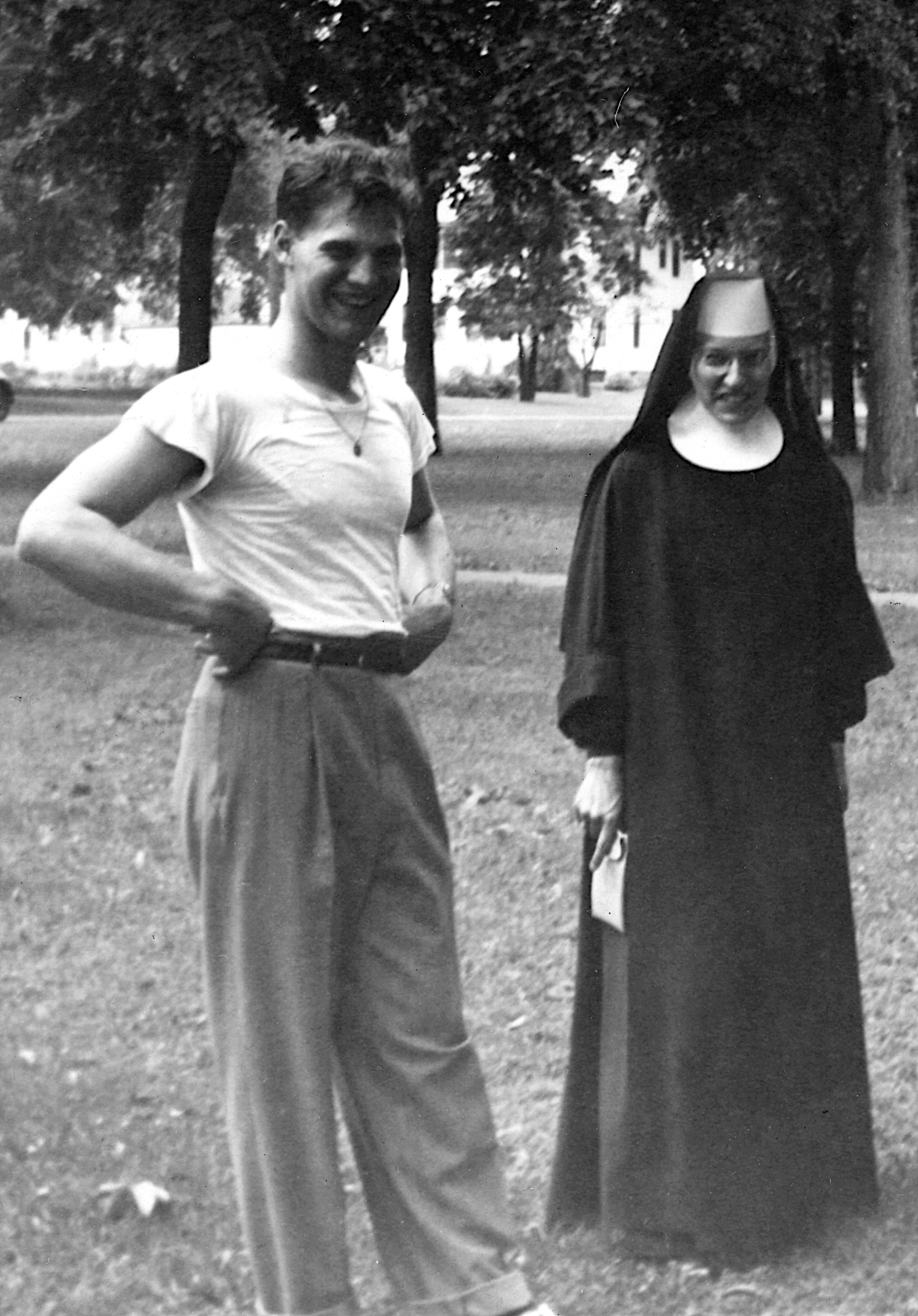
Sister Madonna Marie Mulqueen holds baby David C. Hanneman, while Laura Mulqueen Curzon looks bored.
One of the last Mulqueen family reunions. Back row left to right are Aunt Ruth (Mulqueen) McShane, Uncle Patrick Mulqueen, Uncle Joe Mulqueen and Aunt Joanie (Mulqueen) Haske. Front row includes Sister Madonna Marie Mulqueen and Mom, Mary K. Hanneman.
A nice artsy shot of Mom, Mary K. (Mulqueen) Hanneman at the Hanneman house in Mauston, Wis.
Coming in the door are Grandma Margaret Mulqueen and Grandpa Earl J. Mulqueen Sr., along with Mom and Dad, David D. and Mary K. Hanneman.
Easter Sunday in the 1970s with Grandma Margaret Mulqueen, Laura Mulqueen Curzon, Mary Hanneman, yours truly, David C. Hanneman, and in front Margret Hanneman and Amy Hanneman Bozza.
I just learned with sadness of the death of my Dad’s older brother, Donn Gene Hanneman, who died in Minneapolis at age 88. Uncle Donn was the last of the Mauston Hanneman family to pass away. My Dad, David D. Hanneman, died in 2007 at age 74.
I have many memories of my uncle. He was foremost the father of nine wonderful human beings, my cousins Diane, Caroline, Tom, Jane, Mary Ellen, John, Jim, Nancy and Thomas Patrick (March 1-4, 1949). The cousins were raised by a saintly mother, my aunt Elaine Hanneman.
Donn G. Hanneman
Donn was a veteran of World War II and served as a seaman-second class on the USS Hoggatt Bay. The USS Hoggatt Bay (CVE-75) was a Casablanca-class escort carrier (crew of 860) commissioned in December 1943.
Donn G. Hanneman lounges outside his Grandpa Treutel’s home in Vesper, Wisconsin.
Donn was born on August 20, 1926, in Wisconsin Rapids to Carl Henry Frank Hanneman (1901-1982) and the former Ruby Viola Treutel (1904-1977). In 1936, the Hanneman family moved to Mauston in Juneau County, where Carl took a job as a pharmacist attached to the Mauston hospital and clinic. By that time, my father had come along (March 1933). In August 1937, the family expanded to include Lavonne Marie Hanneman Wellman (1937-1986).
As a boy, Donn had his share of illnesses and injuries. He spent more than a week in the Marshfield hospital in September 1929, then returned there in April 1930. Just before my Dad was born in March 1933, Donn was hospitalized in Wisconsin Rapids for more than a week, after an operation for appendicitis.
Donn Gene Hanneman sits in an indoor baby swing at the Hanneman home in Fond du Lac, Wisconsin, ca. 1927. Carl Hanneman was a pharmacist for the Staeben Drug Co. in Fond du Lac at the time.
Just after his 11th birthday in August 1937, Donn was standing on the running board of a moving vehicle while leaving the Juneau County Fairgrounds when he fell and suffered a head injury. He was seen at the Mauston clinic and taken home, but soon after “lost his power of speech and all consciousness,” according to an account in The Daily Tribune in Wisconsin Rapids. “He was then rushed to the hospital.” Donn was diagnosed with a concussion and put on two weeks of bed rest, although that was extended. The September 8 edition of The Daily Tribune said Donn “is making a satisfactory recovery, although he will be confined to his bed for two more weeks.”
Back in those days, a family’s every move ended up in the newspaper. In the case of the Hannemans, it was thanks to the faithful correspondence of Ruby Hanneman. “Mr. and Mrs. Carl Hanneman and little son Don Gene were completely taken by surprise last evening when forty friends arrived to give them a house warming on the occasion of moving into their new home on Hale Street,” the Wisconsin Rapids Daily Tribune reported on April 8, 1932.
Some of the most charming photographs in our library are of a 5-year-old Donn dressed up as a cowboy playing with friends on the sidewalks on the 1200 block of Washington Avenue in Wisconsin Rapids. We detailed those photos in a previous post.
Donn in his cowboy threads at Wisconsin Rapids.
As a youth Donn enjoyed books, and collected enough that his father built him a bookcase that held up to 175 volumes. Carl wrote to my then 6-year-old father about it in August 1939. Dad was staying with an aunt and uncle in Waukegan, Illinois. “Say David, I made a book case for Donn for his birthday, and you know that you still have something coming,” Carl wrote, “so what would you like to have Dad make something for you too, if so tell mother and I will try to start it as soon as I can.”
Donn G. Hanneman with Sister Emeric Weber of St. Patrick’s Catholic Grade School, 1948.
For a time Donn attended St. Patrick’s Catholic Grade School in Mauston, then run by the Benedictine Sisters. He was among the graduates attending the school’s 100th anniversary in 1995. At the event, he ran into one of his teachers, Sister Emeric Weber, who was just 19 when she started teaching at St. Patrick’s.
“Sister Emeric, I’m sorry I’m late,” he quipped, to which the aged nun replied, “What’s your excuse now? What’s your excuse?”
Like his brother David and father Carl, Donn was a longtime Fourth-Degree member of the Knights of Columbus, the world’s largest Catholic fraternal and service organization. He most recently belonged to Council 1013 in Rochester, Minnesota.
There are many others better qualified to provide more recent stories about Donn. And even though he tossed my father through the bay window of their Mauston home when they were boys, my Dad didn’t hold it against him. When he was ill with cancer in the fall of 2006, Dad put it simply and succinctly: “He’s my brother and I love him.”
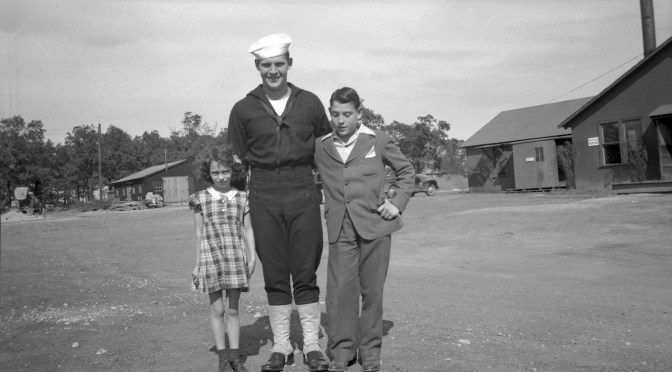
Donn G. Hanneman (center) in his U.S. Navy uniform, with sister Lavonne and brother David in 1944.
David D. Hanneman and older brother Donn G. Hanneman, circa 1935. Read more about the photo: http://wp.me/p4FxQb-v7
Donn G. Hanneman lounges outside his Grandpa Treutel’s home in Vesper, Wisconsin, circa 1930.
Donn G. Hanneman in the world’s smallest swimming pool.
Donn at the family home in Fond du Lac.
Donn Gene Hanneman, son of Carl F. Hanneman (1901-1982) and Ruby V. (Treutel) Hanneman (1904-1977), sits in an indoor baby swing at the Hanneman home in Fond du Lac, Wis, ca. 1927. Carl Hanneman was a pharmacist for the Staeben Drug Co. in Fond du Lac at the time.
Donn in his cowboy threads at Wisconsin Rapids.
Donn G. Hanneman wears a convincing looking police uniform, perhaps a Halloween costume.
Donn G. Hanneman looks like a lonely cowpoke with his wagon, circa 1930.
David D. Hanneman on the shoulders of brother Donn.
Donn G. Hanneman towers over his little sister, Lavonne Marie, circa 1941.
Donn G. Hanneman at the Mauston rail station, circa 1944.
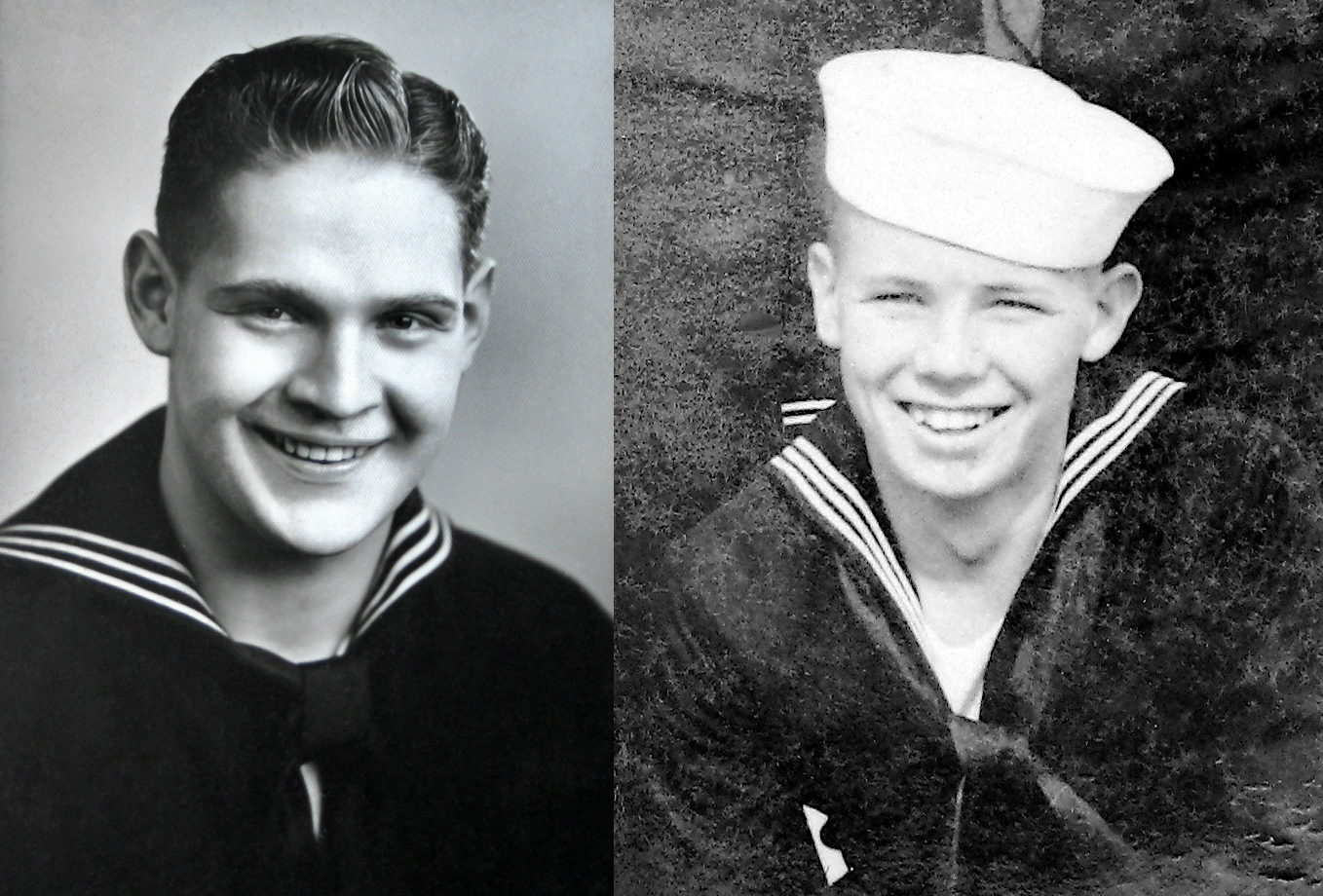
Donn G. Hanneman in his U.S. Navy uniform in 1944.
Few things in the American experience are held so dear by so many as the parade. From the smallest rural towns to the heart of New York City, Americans have long held celebrations by parade.
Members of the American Legion prepare to march in a parade in Mauston, circa 1942.
Reasons for parades are as varied as the communities in which they take place. Perhaps the most widely celebrated type of parade is the Independence Day or July 4 parade. New York has its St. Patrick’s Day Parade and the famous Macy’s Thanksgiving Day Parade. The Left Coast has its parades of bacchanalia and pride. America’s heartland gathers for high school homecomings, Memorial Day, Christmas, Thanksgiving and special-themed parades such as the old Circus World parade in Milwaukee.
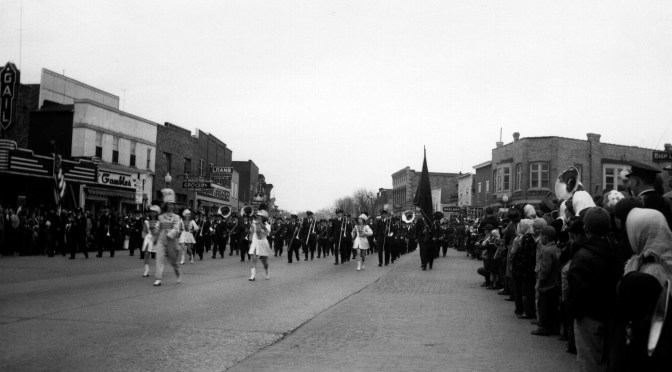
The Wisconsin Dells marching band parades down State Street in Mauston, circa 1942.
High school and college marching bands are a frequent source of parade entertainment. Other favorite parade participants include brigades of toddlers on tricycles, doll buggies pushed by little girls and the myriad parade floats and displays honoring the nation’s military.
Parades have long been used as a way to project military might, such as the goose-stepping Nazis of Germany or the show of ballistic missiles in Communist Russia. In America, ticker-tape parades became a favorite way to welcome home troops and war heroes such as Gen. Dwight D. Eisenhower and Admiral Chester Nimitz. The original ticker-tape parade was held in New York to celebrate dedication of the Statue of Liberty. A memorable parade in summer 1969 honored the Apollo 11 astronauts.
David D. Hanneman prepares to ride a horse in a Mauston parade, circa 1942.
David D. Hanneman (at right) and other boy scouts before a parade in Mauston in the early 1940s.
Mauston Boy Scouts enter the parade line, circa 1943. The town’s military honor roll can be seen on the side of the building.
A marching band in downtown Mauston in the late 1960s.
A fire truck heads down the parade route in Mauston in the late 1960s.
Residents of Mauston, Wis., mill about the downtown area during a parade or community festival in the mid-1940s. Smith’s IGA market is visible across the street.
David D. Hanneman (1933-2007), a member of the Mauston High School Marching Band, poses outside his Mauston home in 1948. Hanneman, who later in life became mayor of Sun Prairie, Wis., played bass drum and trumpet.
The Mauston High School Marching Band performs in a parade in downtown Portage, Wis., ca. 1948. In the foreground is bass drummer David D. Hanneman (1933-2007) of Mauston.
Sun Prairie Mayor David D. Hanneman waits to enter the parade route in Sun Prairie, circa 2003.
Sun Prairie Mayor David D. Hanneman rides in a local parade, circa 2004.
David D. Hanneman in what appears to be a drum and bugle corps uniform, circa 1948.
The Mauston High School Band after leaving the football field during a homecoming game in the 1940s.
Sometimes a photograph will strike you in a certain way that makes it memorable. It has some intangible quality that makes it almost timeless. Of the thousands of images in our library, a handful qualify for this kind of distinction. Not for their physical clarity or skill of the photographer, but that certain look. You might describe it just a bit like looking at a Rockwell painting, or a black and white photograph by Ansel Adams.
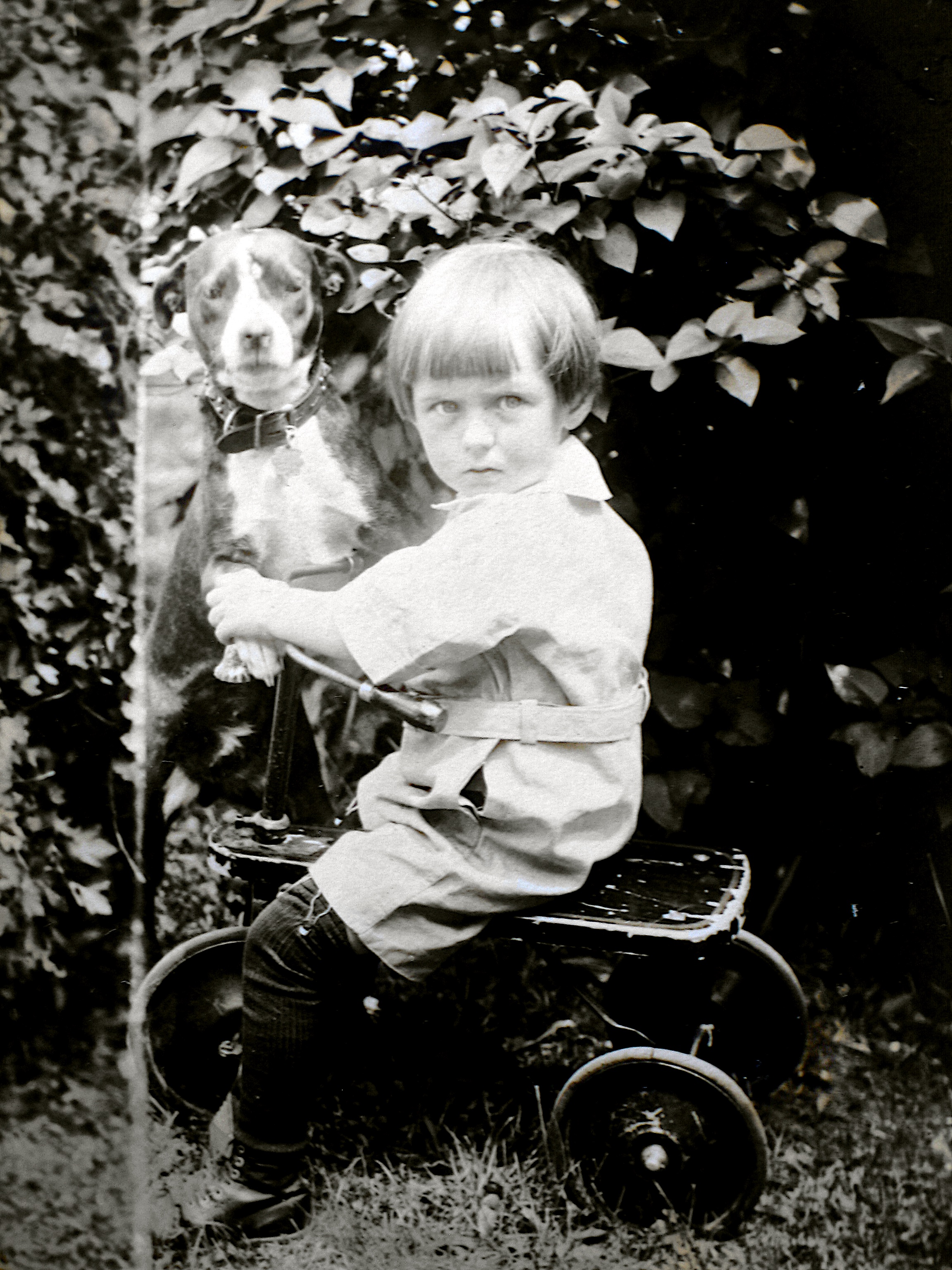
This image has a Little Rascals look and feel to it. Originally thought to be toddler Elaine Treutel and the family dog on her tricycle, circa 1922. Turns out this was actually one of the sons of Harry Cole.
View the whole collection in the gallery below:
Elaine Treutel poses with the family dog in this ca. 1923 photo near Vesper, Wis. Directly behind her is older sister Ruby V. Treutel. Sitting on the bumper of the car is father Walter Treutel (1879-1948). The others are unidentified.
This image has a Little Rascals look and feel to it. Toddler Elaine Treutel and the family dog on her tricycle, circa 1922.
David D. Hanneman with his toe in the sand at Madeline Island, circa 1942.
Ruby V. Treutel (center) relaxes with the Sunday paper near Milwaukee’s Juneau Park in 1924. Ruby was visiting her fiance, Carl F. Hanneman (1901-1982), who was studying pharmacy at Marquette University. At front is Ruby’s sister, Nina H. Treutel (1914-2005). The woman near the car is unidentified.
A formal portrait of Elaine Treutel of Vesper, Wis., circa 1938. Born in January 1920 to Walter and Mary (Ladick) Treutel of Vesper, Elaine attented Lincoln High School in Wisconsin Rapids. She married Max Clark in October 1938. The couple lived for many years in Madison, then relocated to suburban Phoenix, Arizona.
Frank Herman Albert Hanneman (1895-1947) of Grand Rapids, Wis., posed for this studio photo with a shotgun, ammunition belt and even a hunting dog. The photo was taken ca. 1909. Frank was the son of Carl Frederick Christian Hanneman (1866-1932) and Rosine B. H. Ostermann (1874-1918).
Nina Treutel of Vesper, Wis., is about 18 months old in this circa 1916 photograph. Nina’s parents are Walter Treutel and Mary Helen (Ladick) Treutel.
A beautiful portrait of Lavonne Hanneman, circa 1955.
Ruby Treutel poses for an informal photo, circa 1922.
Ruby Treutel with her siblings Marvin, Elaine and Nina, circa 1921.
Carl F. Hanneman’s high school portrait, 1921.
Lavonne and David Hanneman examine a monument on a vacation trip to South Dakota in 1947.
Ruby Treutel holds her baby brother Gordon, circa 1910. Gordon died of pneumonia in February 1911.
Patricia Treutel is having a great time on the tree swing, circa 1943.
We don’t have an ID on this beautiful young lady. Photo appears to be from 1920s.
David D. Hanneman watches over his little sister, Lavonne, circa 1938.
David D. Hanneman and sister Lavonne Marie Hanneman, circa 1942.
People often talk about getting 15 minutes of fame. For the late Carl F. Hanneman, it was closer to 15 seconds in a new Wisconsin Public Television documentary on Juneau County, Wisconsin.
Carl F. Hanneman filed this story with the Wisconsin State Journal on December 8, 1942.
The hourlong documentary, produced as part of Wisconsin Public Television’s Wisconsin Hometown Stories series, includes a section on the death of Governor-elect Orland S. Loomis of Mauston. Loomis died on December 7, 1942 after suffering a series of heart attacks. He was to be sworn into office in January 1943. As a local correspondent for the Wisconsin State Journal, Hanneman filed a story on December 8 detailing Mauston’s grief at the loss of their hometown hero. His news clipping was used as a graphic during the Loomis portion of the documentary.
Carl’s ties to Loomis went beyond the 1942 political obituary. On election night, November 3, 1942, he was one of the only photographers at Loomis’ home as the election results came in and Loomis was declared the winner over Gov. Julius P. Heil. Carl’s news photo ran above the fold on Page 1 of the State Journal on November 4, 1942.
Hanneman’s election-night photo taken at Loomis’ home in Mauston ran on Page 1 of the Wisconsin State Journal.
Hanneman (1901-1982) had known Loomis since about 1936, when Carl came to Mauston from Wisconsin Rapids to be a pharmacist for Dr. J. Samuel Hess Jr. He sought Loomis’ help in 1937 in obtaining his full licensure as a registered pharmacist (an upgrade from his existing license as an assistant pharmacist). At the time, Loomis was Wisconsin’s attorney general. Hanneman also worked to help elect Loomis as attorney general and governor. In recognition of his efforts, Loomis gave Hanneman a large pastel painting that once hung in his office at the state Capitol in Madison. The large-format pastel, weighing some 100 pounds in its hand-carved ornate frame, hung in the Hanneman home in Mauston and later in the home of Sun Prairie Mayor David D. Hanneman, Carl’s son.
Orland S. Loomis gave this painting to Carl F. Hanneman for his help on the gubernatorial election in 1942. It still hangs in the home of the late David D. Hanneman.
The fascinating Wisconsin Hometown Stories documentary, which first aired in April 2014 and is now available on DVD, covers much more than Loomis and his political career. It traces Juneau County’s history from its early days, when towns like Mauston sprung up around grist mills on the Lemonweir River. It details the county’s cranberry farms, the massive Necedah Wildlife Refuge, the heritage of the Winnebago (Ho-Chunk) Indians, creation of the huge manmade Petenwell Lake, and development of National Guard bases including Camp Williams and Volk Field.
Carl F. Hanneman befriended a young Tommy Thompson in 1966 when Thompson first ran for state office.
A prominent section of the documentary focuses on former Wisconsin Governor Tommy G. Thompson of Elroy. Thompson takes viewers on a tour of southern Juneau County where he grew up, including an old gas and grocery run by his father. Thompson served as Wisconsin’s 42nd governor from 1987 to 2001.
When he first ran for Wisconsin State Assembly in 1966, Thompson stopped in Mauston and met a pharmacist named Carl Hanneman. Carl was so impressed with the young lawyer from Elroy that he closed up shop for the afternoon and took Thompson all over Mauston, introducing him to other businessmen. From that day on, Hanneman always referred to him as “my friend Tommy Thompson.” It was a kindness Thompson never forgot.
Somehow the story of Carl’s early politicking for Thompson got left out of the Wisconsin Public Television documentary. Well, there’s only so much you can fit into an hour of television.
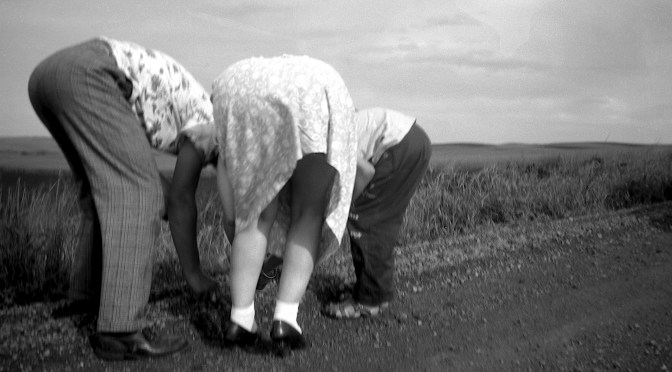
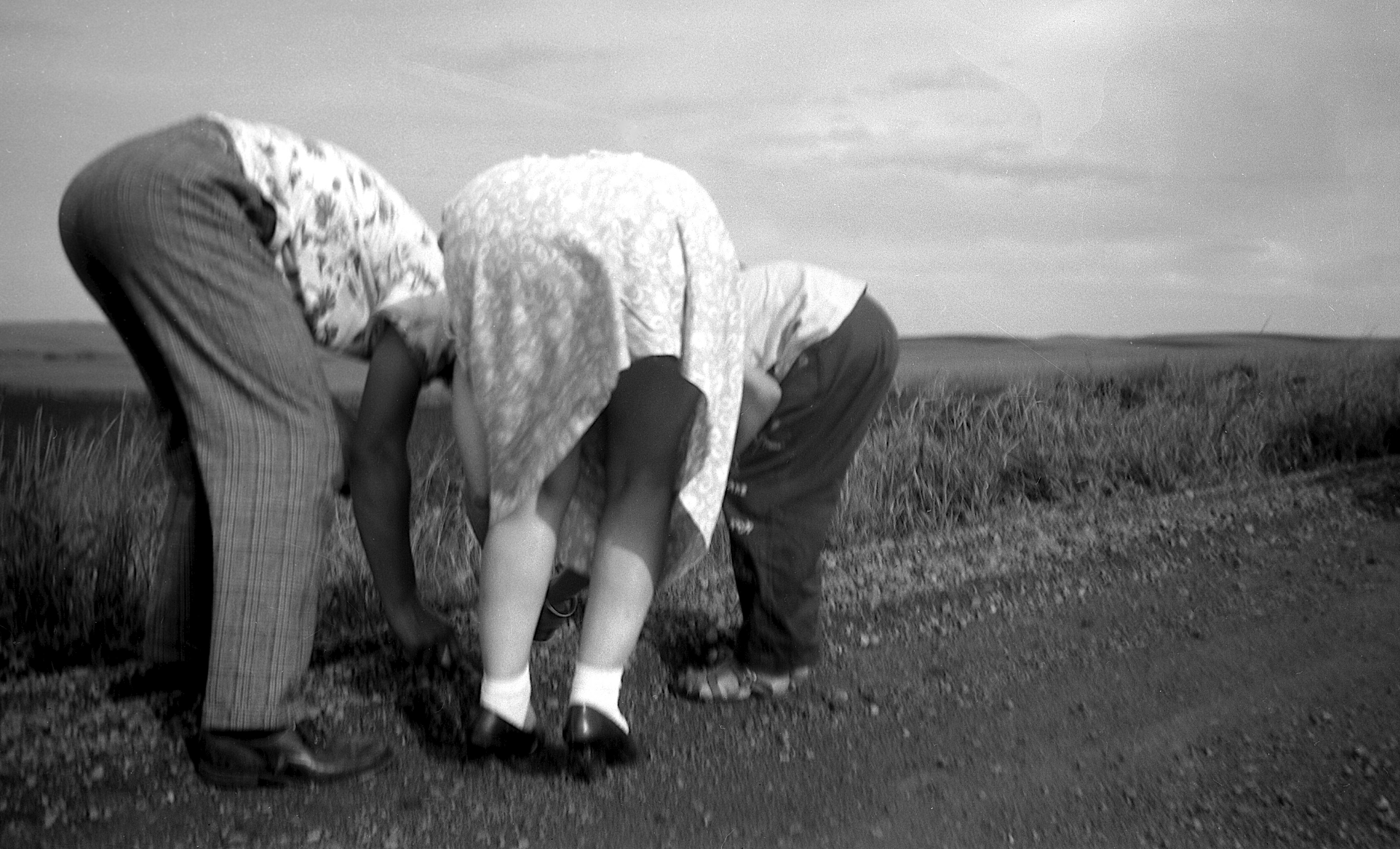
It wasn’t such a curious hobby, collecting rocks, but more in how it was done. Ruby Viola (Treutel) Hanneman (1904-1977), simply could not resist picking rocks up off the ground wherever she went. And judging by the facial expressions of those around her, it became somewhat of a family joke.
Lavonne Hanneman can’t resist laughing as her mother Ruby bends down to pick up rocks on a trip to South Dakota in 1947.
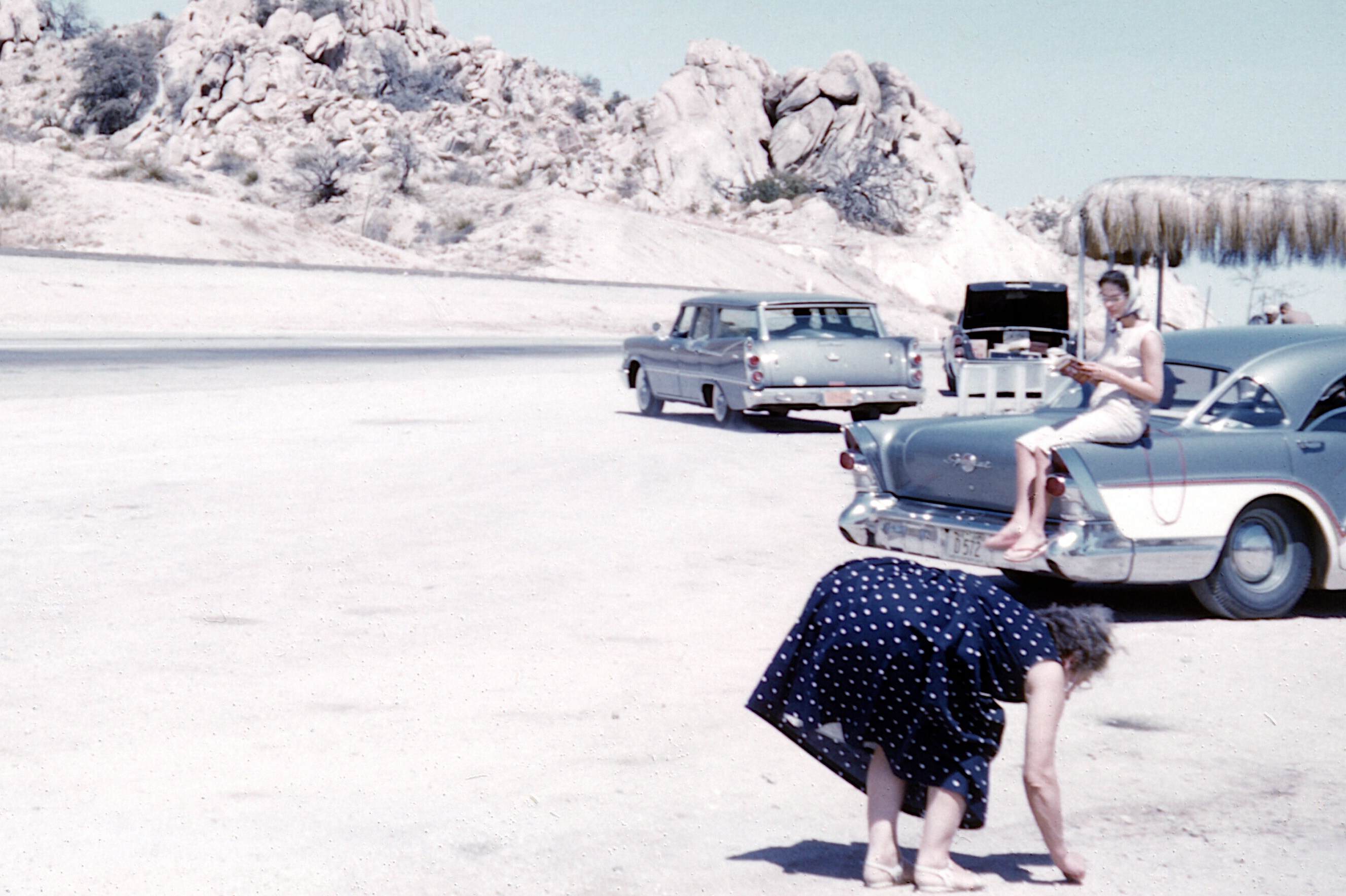
Rock collecting was certainly a Hanneman tradition. Uncle Wilbert G. Hanneman (1899-1987) had a rock shop up in Wausau, from which many a Hanneman child procured varieties of colorful, polished rocks. I have a bag of them to this day. Ruby liked to get her collectibles the old fashioned way, by finding them. She’d bend down to grab the most interesting or unusual ones, and husband Carl F. Hanneman (1901-1982) was often nearby to capture the moment on film.
David D. Hanneman’s priceless facial expression says it all, as his father Carl snaps yet another photo of mother Ruby picking up rocks.
The best examples of this hobby (or habit) came on a family trip from Mauston, Wisconsin, to Williston, South Dakota in 1947. After getting caught all bent over on several photographic occasions, Ruby and the kids shot back. They put their heads together and gave old Carl Hanneman a two-cheek salute.
David and Lavonne Hanneman joined their mother Ruby in offering a rear-end salute to cameraman Carl F. Hanneman.This photo proves Ruby’s habit was not a passing fad. Here she gathers samples on a trip to Phoenix in 1959.
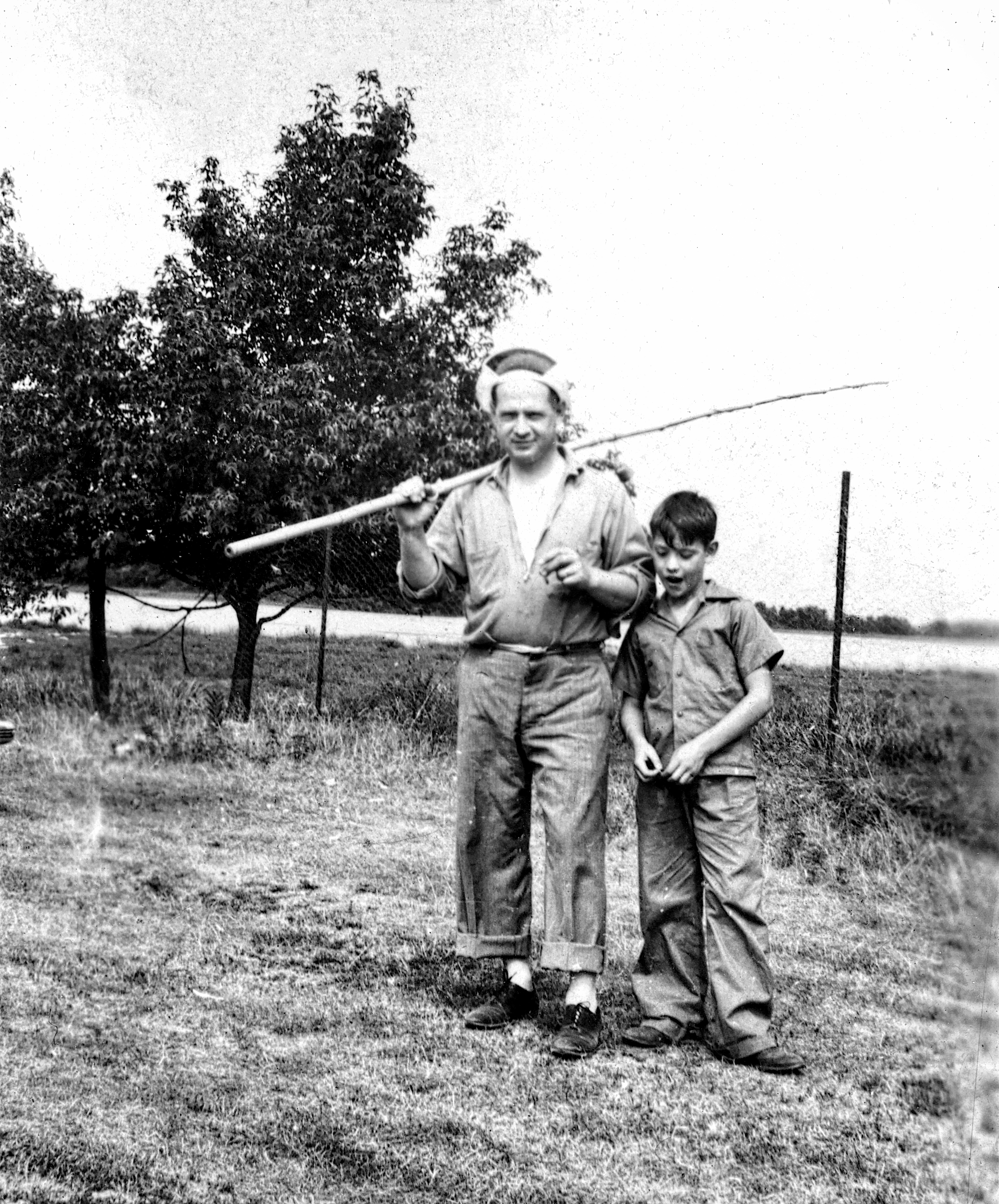
Photographs can document history in many ways, so it’s fun to look deeper into historical images to learn what they can tell us. The image atop this post shows a man and a boy. The man has a cane pole, so we can assume the pair has gone or is going fishing. Look a little deeper. The photo has a Rockwell-esque quality to it. Set in the summer of 1942, the photo shows Carl Henry Frank Hanneman (1901-1982) and his youngest son, David D. Hanneman (1933-2007). You can see Carl’s love for fishing — something he shared with his children and grandchildren who learned to fish on Mauston’s Lemonweir River.
The son is following along, asking questions of the fishing expert. What is he asking? Perhaps, “Hey, Dad, why don’t I have a cane pole?” It’s a time-honored tradition,passing on a love for fishing from one generation to the next. We’ll cover more of that in a future installment.
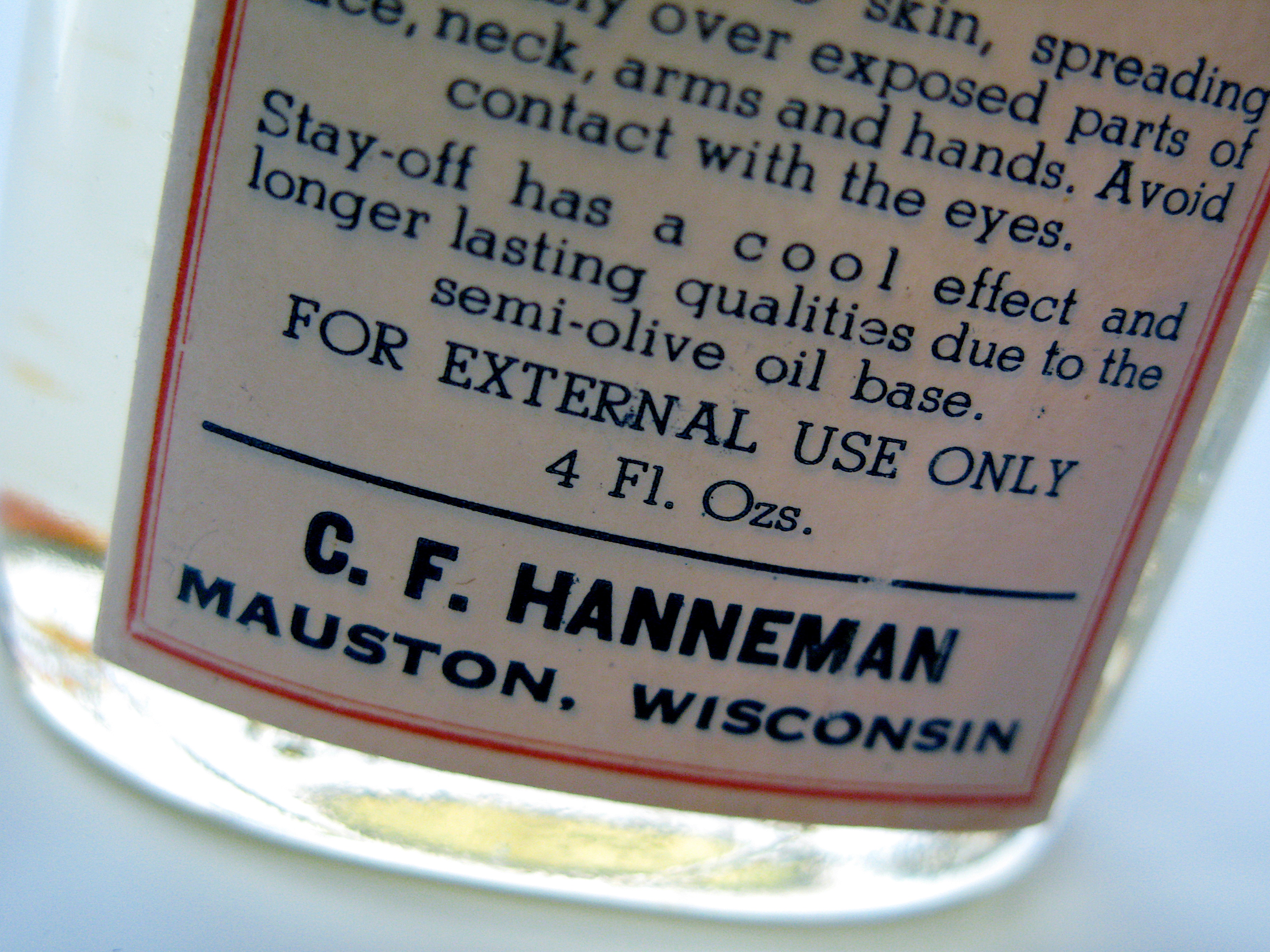
More than 60 years after it was first used to ward off mosquitoes and other pests in central Wisconsin, the lavender and citronella scent of Carl F. Hanneman’s Stay-Off bug repellent still lingers across time. The Mauston pharmacist invented his own blend of essential oils that provided a natural defense against biting pests, and he sold the product across the area for years.
Carl F. Hanneman sold his insect repellent at bars and bait shops all over central Wisconsin.
Carl Hanneman’s inspiration for his product came from his need for extra income, and his knowledge of chemistry and pharmacology. Even in the depths of World War II, when rationing made it difficult to obtain raw materials, Carl found a way to make Stay-Off and sell it at taverns, bait shops and resorts all over the area. Due to an abundance of lakes and rivers, Central Wisconsin is known for proliferation of mosquitoes and other flying pests during tourist season.
“His being a pharmacist allowed him access to some of the compounds needed to make this stuff,” recalled Carl’s son, David D. Hanneman. The topical elixir, which used an olive oil base and a secret recipe of lavender, citronella and other essential oils, was often mixed on the back porch of the Hanneman home in Mauston, Wis. “It was kind of comical,” David Hanneman said.
Aside from providing access to the needed ingredients, Carl’s role as pharmacist at the Mauston Drug Store had other benefits that helped him sell Stay-Off on his own time. “Because he was his own dispensary, he was able to upgrade his gas card,” David Hanneman said. “So we weren’t restricted and limited in traveling. We could go back on up north and go fishing or do whatever over weekends. And we’d drop off a dozen bottles here, and a dozen bottles at that bar, a dozen bottles over at that other fishery house.”
Carl F. Hanneman printed his own labels and wrote the ad copy for Stay-Off.
Carl wrote his own marketing copy to help sell the 4-ounce bottles of Stay-Off. “Stay-Off is not only an excellent insect repellent, but has that cool, soothing and refreshing feeling on hot summer days,” he wrote. “It is highly recommended for women and children’s skin, producing a soft tenderness due to the semi-olive oil base.” The lotion soothes existing bug bites and provides protection against strong sun rays, he wrote.
David Hanneman said selling Stay-Off was a nice side business for the family. “It gave us nice added income,” he said, although “we never got rich off the stuff.”
The recipe for Stay-Off called for making the mixture in 1 gallon batches. A half-gallon of Stay-Off and several 4-ounce bottles survive to this day. All of the ingredients are still commercially available. So even 60 years after it was first mixed, it would be possible to make more Stay-Off using Carl’s old recipe.
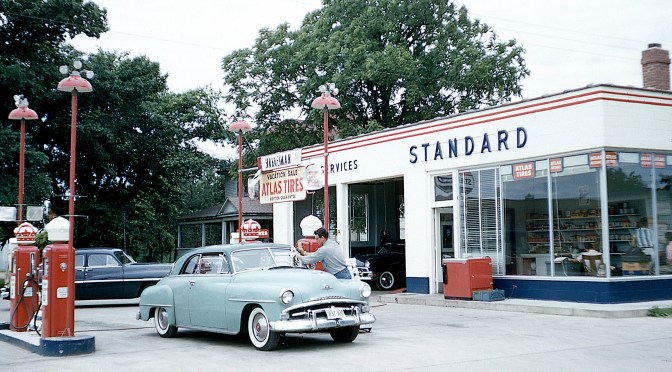
Before embarking on his long sales career, David D. Hanneman (1933-2007) briefly owned and operated a Standard Oil gasoline station at the corner of Union and State streets in Mauston, Wisconsin. Newly discovered color slides show Hanneman working at the Standard station, most likely in the summer of 1951 after his graduation from Mauston High School.
David D. Hanneman poses outside of his Standard Oil station in Mauston in 1951.
The photos show a dapper young attendant (think Clark Kent) posed outside the station, leaning on the soda cooler. Another image shows him cleaning the windshield of a customer’s auto, part of the “full service” treatment that disappeared long ago. The station featured the classic pumps that delivered Red Crown regular and White Crown premium gasoline.
During the 1950s, Standard Oil was the dominant domestic oil company in the United States. Its torch-and-oval logo was instantly recognizable to millions of Americans (even after Standard became Amoco). The Mauston Standard station stood at the busiest intersection in the city. A Kwik Trip station occupies the land today.
Detail shows “Hanneman” on the north side of the Standard Station.
After owning and managing the station, Hanneman realized the job was not for him. He went on to take classes at La Crosse State (now called University of Wisconsin-La Crosse) and worked as a salesman at Dahl Motors in La Crosse, before his career in pharmaceutical and veterinary medical sales.
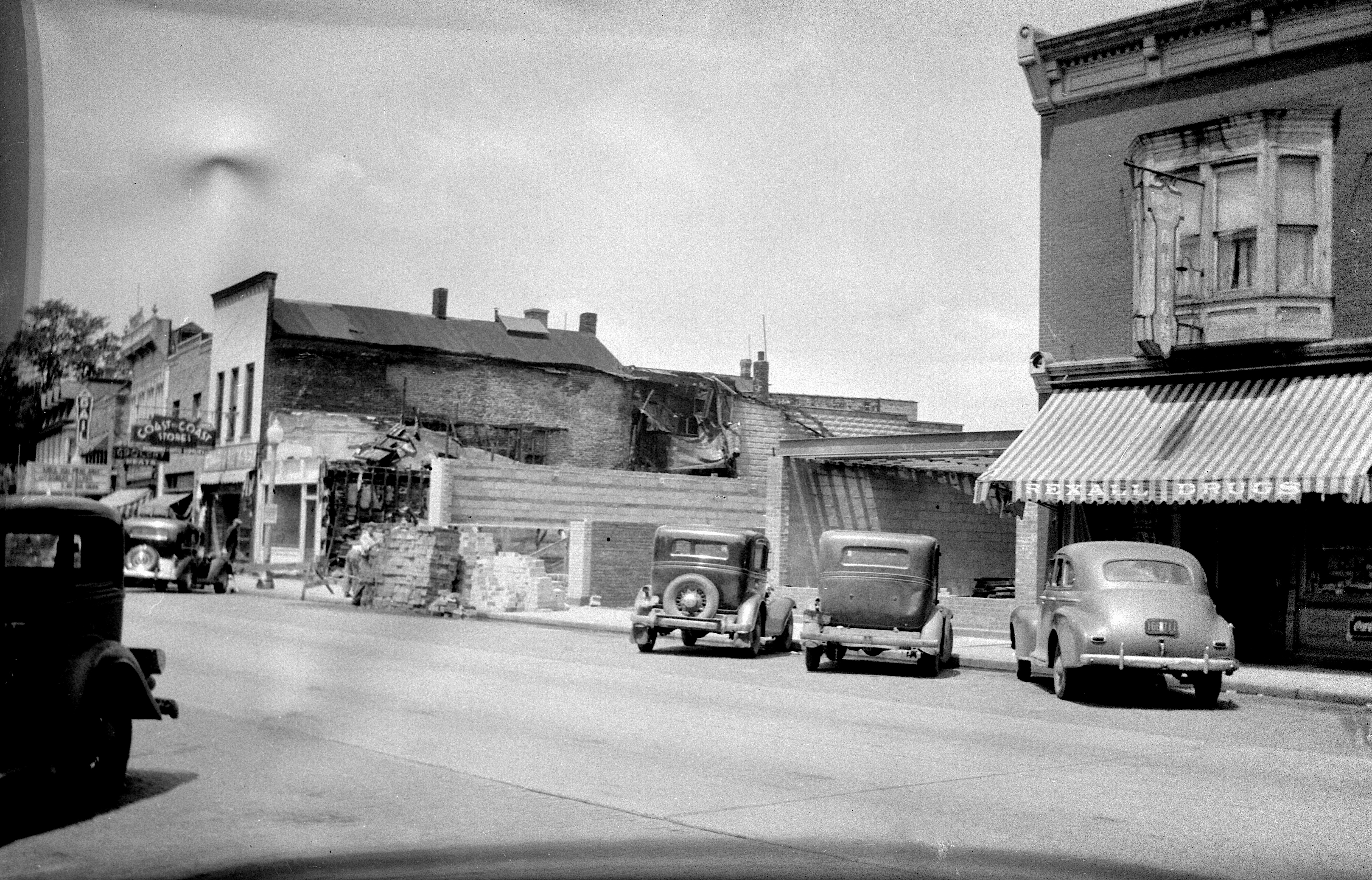
It was the fire of the century in the tiny city of Mauston, Wisconsin. Life may have started normally on Friday, Jan. 5, 1945, but before 9 a.m. a massive fire broke out that threatened to wipe out the city’s downtown. The man called on to document the blaze for local law enforcement was Carl F. Hanneman, the druggist at the Mauston Drug Store. It may have been the most prominent collection of photos he shot, but was just one among many accidents, fires and crime scenes he photographed over the years.
Carl would have been readying himself for the trip to the pharmacy downtown when the fire broke out that January morning. About 8:30 a.m. the fire started in the rear of the Gamble Stores building along the north side of State Street. Within 30 minutes it had spread to four downtown buildings and threatened the entire business district.
As firefighters from Mauston tried in vain to control the blaze in subzero temperatures, reinforcements from fire departments in Lyndon, New Lisbon and Wisconsin Dells raced to help. Carl stood just behind the line of rescue workers and took photos.
It took five hours to control the huge blaze, which destroyed Gamble’s, Mauston Press Club dry cleaners, Samisch Bakery, the Fred Denzien barber shop and the All-Star restaurant. At one point during the blaze, the brick facade of the All-Star fell onto the street. Nearby businesses, including Vorlo Drug and Coast to Coast, were badly burned. Damage exceeded $80,000 – equivalent to more than $1 million in 2014 dollars. Mauston Fire Chief John Smith said calm winds kept the fire from sweeping through the entire downtown.
The extreme heat from the fire is evident along the roof line.
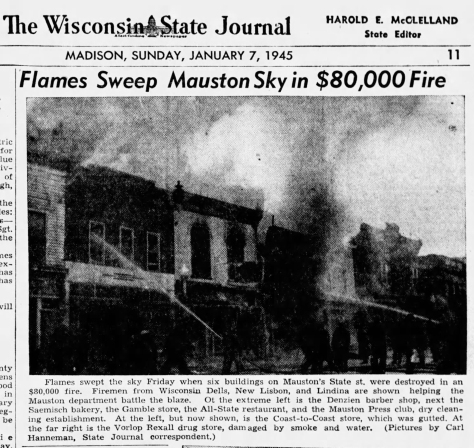
Carl’s efforts that day earned him a page 1 photo in the Wisconsin State Journal, and two additional photos on page 11. He served as a Mauston correspondent for The State Journal for many years, garnering numerous front-page stories and photographs.
Carl dated and signed the prints from the Mauston fire in January 1945.
Carl documented many local emergencies in Mauston and surrounding areas. He captured the moment when a semi-trailer plowed into the front of the Tourist Hotel, knocking down the sign and collapsing the awning. Many of these photographs have a custom “CF Hanneman” imprint on the back, so it’s obvious Carl shot a fair number of news photos. Some photos from the 1945 fire have even shown up on Ebay.
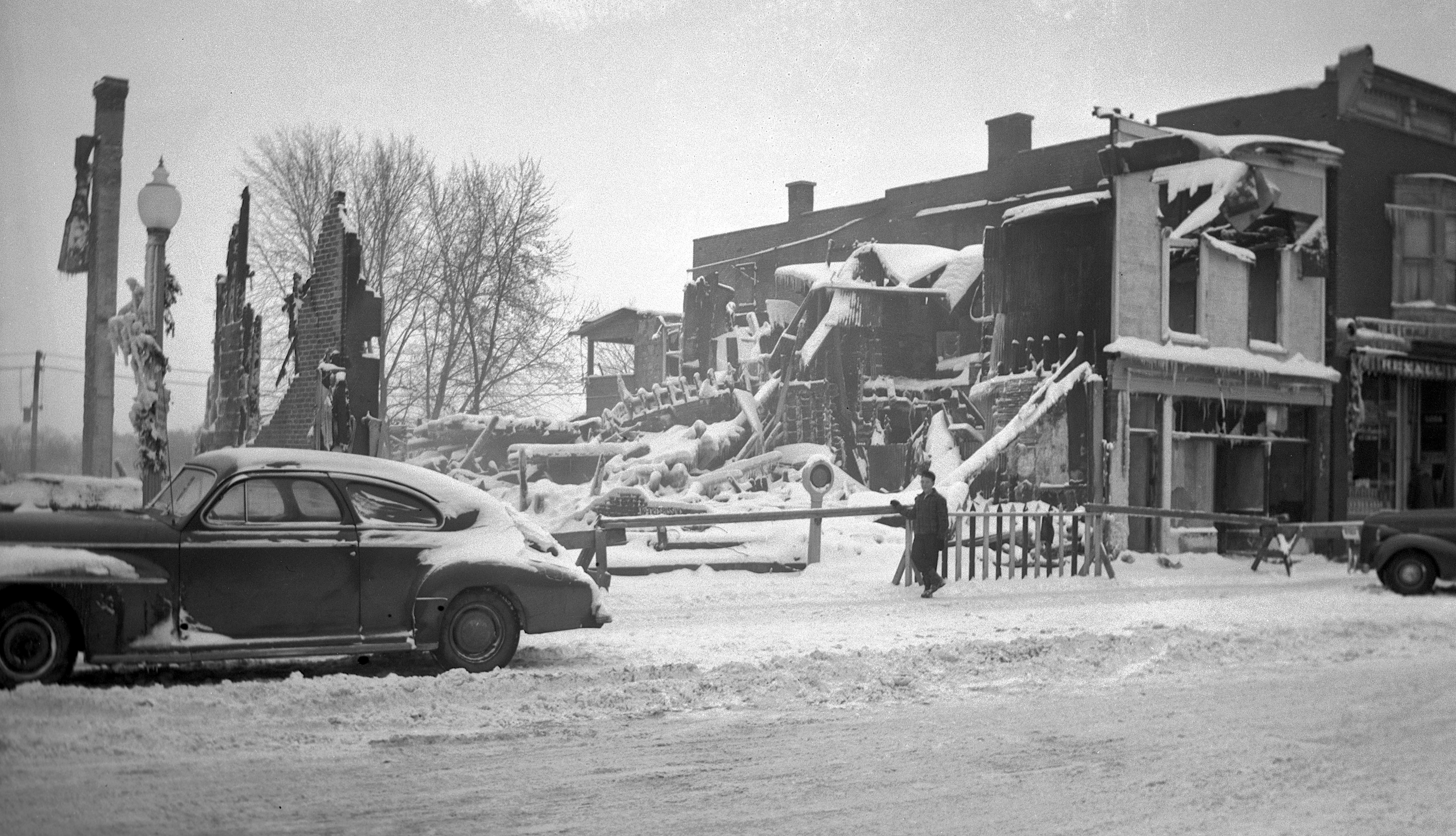
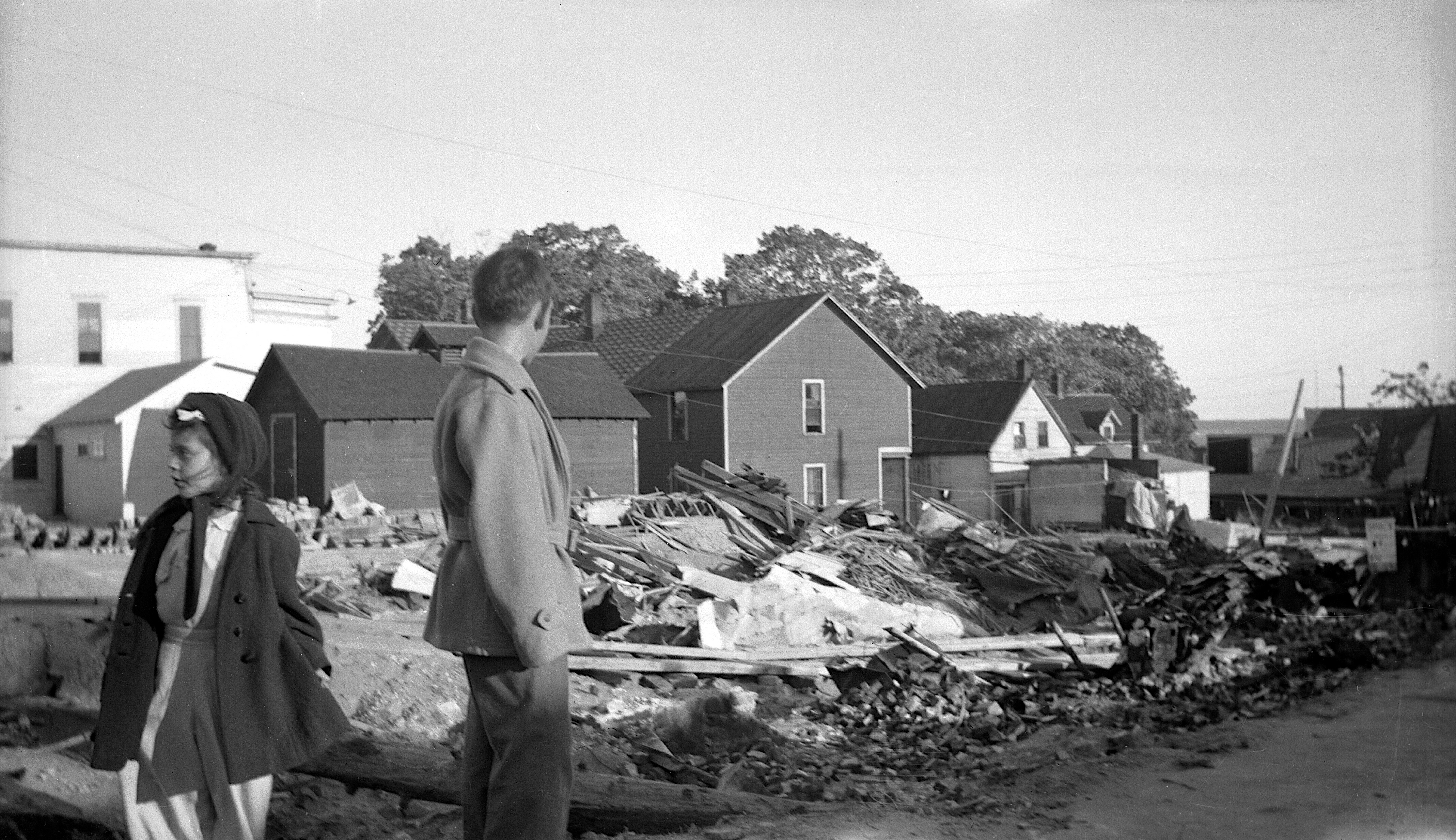
One of three of Carl’s photos that appeared in The Wisconsin State Journal on January 7, 1945.David D. Hanneman stands on State Street in front of the charred ruins.David D. Hanneman and his younger sister, Lavonne, survey damage.By summer 1945, the fire debris was gone and rebuilding was in process.


















 The Hanneman Archive