Army Pvt. Rudolph Mika Jr. (at left) of Mauston, Wisconsin, talks to livestock buyer John Randall at the Juneau County Fair at Mauston in the summer of 1942. Mika went into the Army glider corps and took part in the invasion of North Africa during World War II. He was taken prisoner by German troops in Holland in September 1944 and repatriated in June 1945.
Army Pvt. Rudolph Mika (at left) of Mauston, Wis., talks to livestock buyer John Randall at the Juneau County Fair at Mauston in the summer of 1942.
The 1940 U.S. Census showed Mika working at the Mauston pickle factory and living at home with his parents, Rudolph Mika Sr. and Anna Mika. The elder Mika was a carrier for the local ice dealer. The Mikas lived on Winsor Street, just a few houses away from the Carl F. Hanneman family and the home of Dr. J. Samuel Hess Jr. Hanneman was on the Juneau County Fair Board for many years. He snapped the photo of Mika and Randall.
Rudy Mika enlisted in the U.S. Army in March 1942 at Madison. His occupation was listed as a carpenter. After the war, he returned to Mauston. He died on January 6, 2001 at Mauston, age 89. Randall died in January 1971 at age 74.
It is common knowledge to family members that Carl F. Hanneman was born on Oct. 28, 1901. But when he needed proof of that fact back in 1946, there was none to be found. On Feb. 22, 1946, Carl sent a letter and the 50-cent fee to the Wood County register of deeds, asking for a copy of his birth certificate.
Register of Deeds Henry Ebbe sent the letter back with an answer that must have shocked Carl: “There doesn’t seem to be any birth certificate for you on the above date. There is a Ruben born Oct. 21, 1901. Father Chas. and Mother Rose. Could this be yours? I am returning your 50 cents.”
The earliest known photo of Carl Henry Frank Hanneman, born 28 Oct 1901.
That set Carl off scrambling to find proof of his birth. He asked the pastor of the Moravian Church of Wisconsin Rapids for help. Carl’s parents, Charles and Rosine Hanneman, joined the Moravian Church on March 29, 1907. Church records did list Carl F’s birthdate as Oct. 28, 1901, so Moravian Minister George Westphal wrote a letter testifying to the church records. But since Carl was not baptized in the Moravian church, this record was only indirect evidence of his birth.
If Carl had turned to U.S. Census records (which were not available at the time), it might have confused the matter more. The 1910 Census lists the youngest son of Charles and Rosa Hanneman as Harold Hanneman, age 8. Carl’s first middle name is Henry, so no doubt the Census worker simply wrote it down wrong.
So what happened? It’s not clear, but we do know the record was officially corrected. Carl’s birth certificate still shows the name Ruben and the wrong birthday, but the errors are crossed out and replaced with the correct information. Wood County Health Officer Frank Pomainville corrected the record in red ink in 1960.
In a state where the one-room schoolhouse was quite the norm in the early 1900s, tiny Vesper, Wis., boasted an impressive two-story brick school building that was the center of learning for area children for decades.
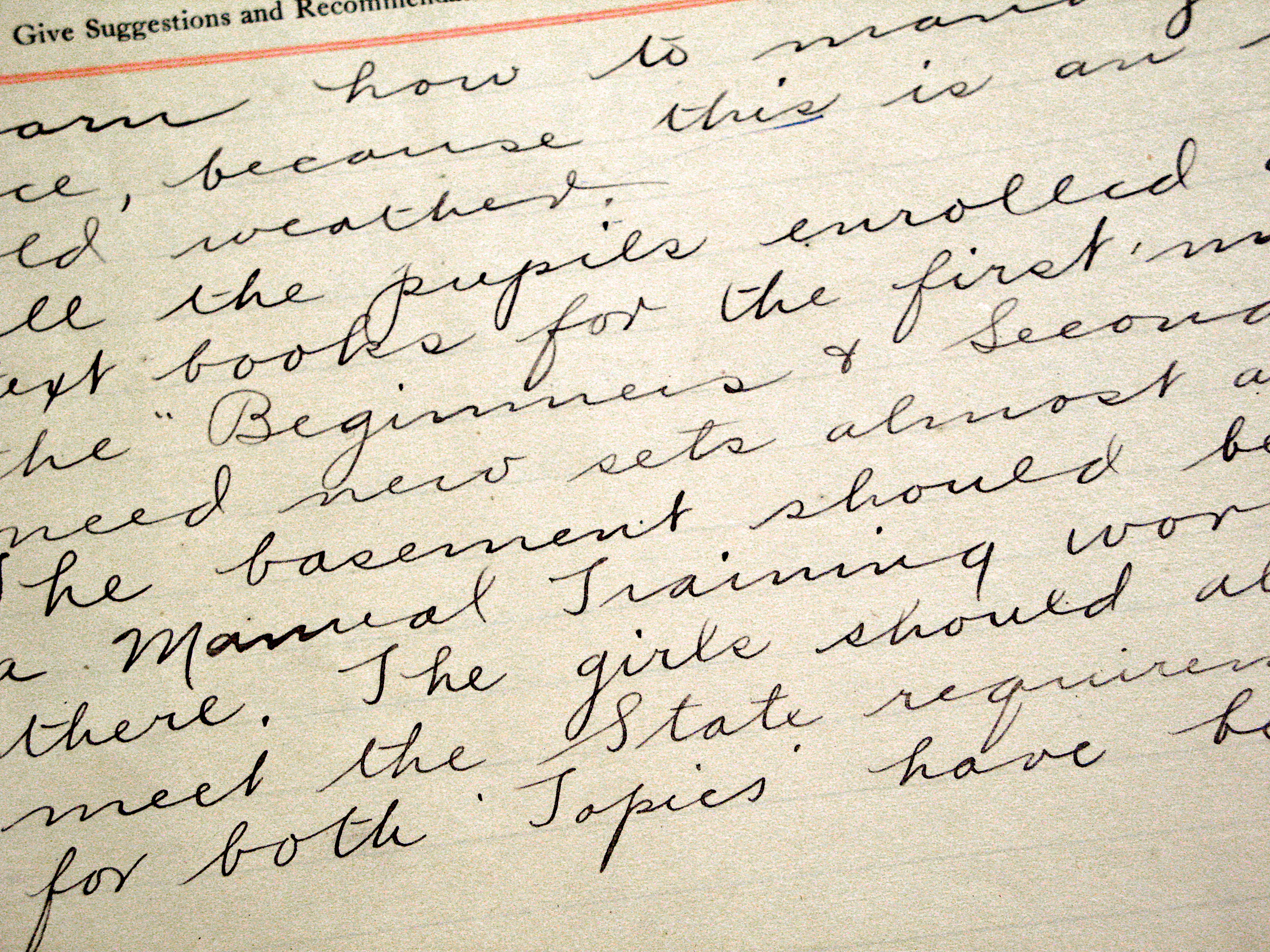
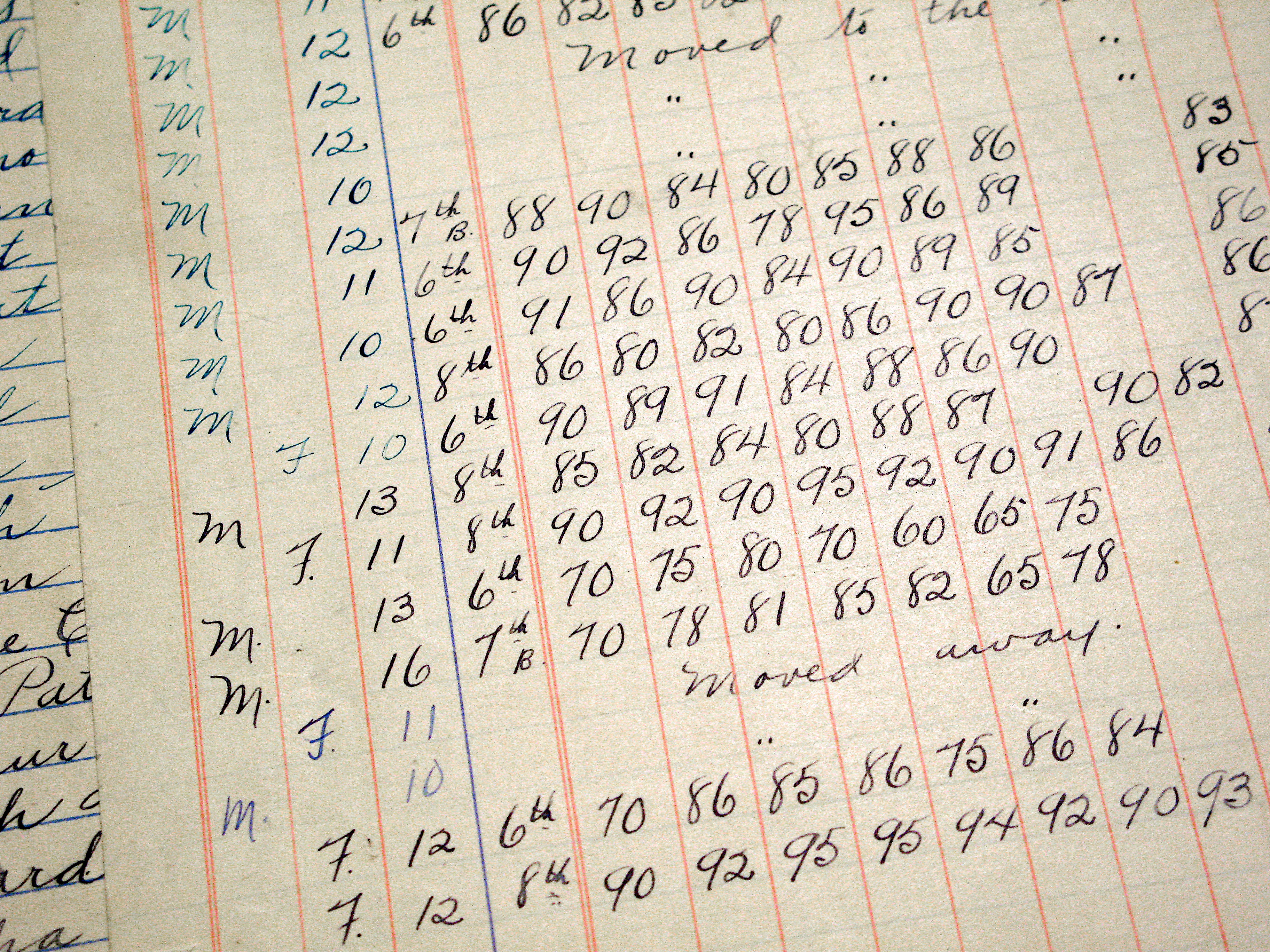
Built in 1906 just off of Main Street in Vesper, the Vesper Graded School was home to students of District No. 1, Town of Hansen. We get an interesting look at life inside the school from a teacher’s record book covering the years 1911-1917. The “Welch’s System Attendance, Classification, Gradation and Close Supervision” book belonged to Ruby (Treutel) Hanneman, who attended Vesper school starting in 1913 and later taught at the school.
The teacher kept detailed notes on conditions at the school, in addition to records of student performance and attendance.
The detailed notes in the book make one thing very clear: the teacher had her hands full each school year. Not only did one woman handle teaching duties for lower and upper grades, but she had to manage the building and contend with a cranky, bulky coal furnace each winter.
During the years covered in the record book, Vesper had three teachers: Mabelle Rowland in 1911-1912, Ella H. Hessler from 1912-13 to 1914-15, and Sara Icke in 1915-16 and 1916-17. Teachers were paid between $50 and $60 per month. Ruby’s uncle, Henry Treutel, served on the school board in early years (his son Harold attended classes during that time). In the late 1920s, another uncle, Charles Treutel, was also on the board.
It seems the biggest challenge for the teachers was not in the classroom but the furnace room. The coal-fired furnace often belched smoke and gases into the clean-air intake and into the classrooms. “Before you begin school learn how to manage the drafts of furnace and cold air shafts,” wrote Mabelle Rowland in her 1912 “Teacher’s Report to Successor.” “The inspector is very critical on this work.” Teacher Ella Hessler wrote one year later: “The furnace needs repair. The smoke enters the fresh air. The furnace work in cold weather is too heavy for a woman.” Similar notations were made in subsequent years.
Each student’s attendance and academic performance were tracked in detail.
The school typically served from 25 to 40 students per term. Primary grades were on one level and upper grades on the other. The teacher staggered the subjects so she could get lessons started for one group and then move to the other.Classes started at 9 a.m. and students were dismissed for the day at 4 p.m. Course work included arithmetic, history, language, reading, grammar, physiology, domestic science for girls, manual training for boys, civics and geography.
Some of the children walked to school from homes nearby in the village, while others came in from the countryside. Tardiness was common, due to distance walked, duties at home or a pokey walking pace. In 1911-1912, Alfred and Agnes Peterson were the brother-sister tardiness champs with 20 and 17 instances, respectively. Clara Zieher had 18 tardy notations, followed by Erma Dassow with 15 (her brother Elmer had just 4). Absence from school was also common due to illness or duties helping at home. On occasion a student or two left school for a month or two to perform farm work. Arnold Conklin had best attendance in 1911-1912, only missing one day out of 180.
Absences were common from illness or need to stay home and work on farm chores.
The book tracked each student’s attendance and progress on a range of subjects. Teachers made notations for some students that ranged from “fair worker,’“weak eyes” and “slow” to “hard worker,” “irregular and very nervous,” and “dull.”
In the 1911-1912 school year, the school library had a mere 50 volumes. The school invested in books each year, and by June 1917 the library’s holdings included 144 books. For obvious reasons, the boys’ and girls’ out buildings regularly needed repairs and painting. The number of trees on school grounds that were in “thrifty condition” ranged from four to seven.
Ruby Treutel enrolled at Vesper Graded School in November 1913, when she was 10. There was some indication she had attended a parochial school prior to that. During her first year, Ruby missed 21.5 days and was tardy six times. Her cousin Harold Treutel had a mere three sick days. Ruby received good grades for the term: orthography, 91; reading, 95; writing, 90; arithmetic, 70; grammar, 89; geography, 83; and constitutions, 90. During the 1914-1915 school year, Ruby was out sick 20 days, but she still maintained As and Bs in all of her subjects.
The teacher’s annual summary provides interesting detail on all conditions at the school.
During the 1915-1916 term, Ruby excelled in all of her courses, scoring solid ‘A’s in orthography, reading, grammar, U.S. history and physiology. Her lowest grade was a ‘B’ in geography and arithmetic.
Harold Treutel graduated from Vesper Graded School in 1917 and enrolled at Lincoln High School in Grand Rapids.Ruby graduated from Vesper in 1918, also enrolling at Lincoln High School. That may be where she first met Carl F. Hanneman, whom she would marry in July 1925.
The old Vesper Graded School is now a private home, shown here in 2006.
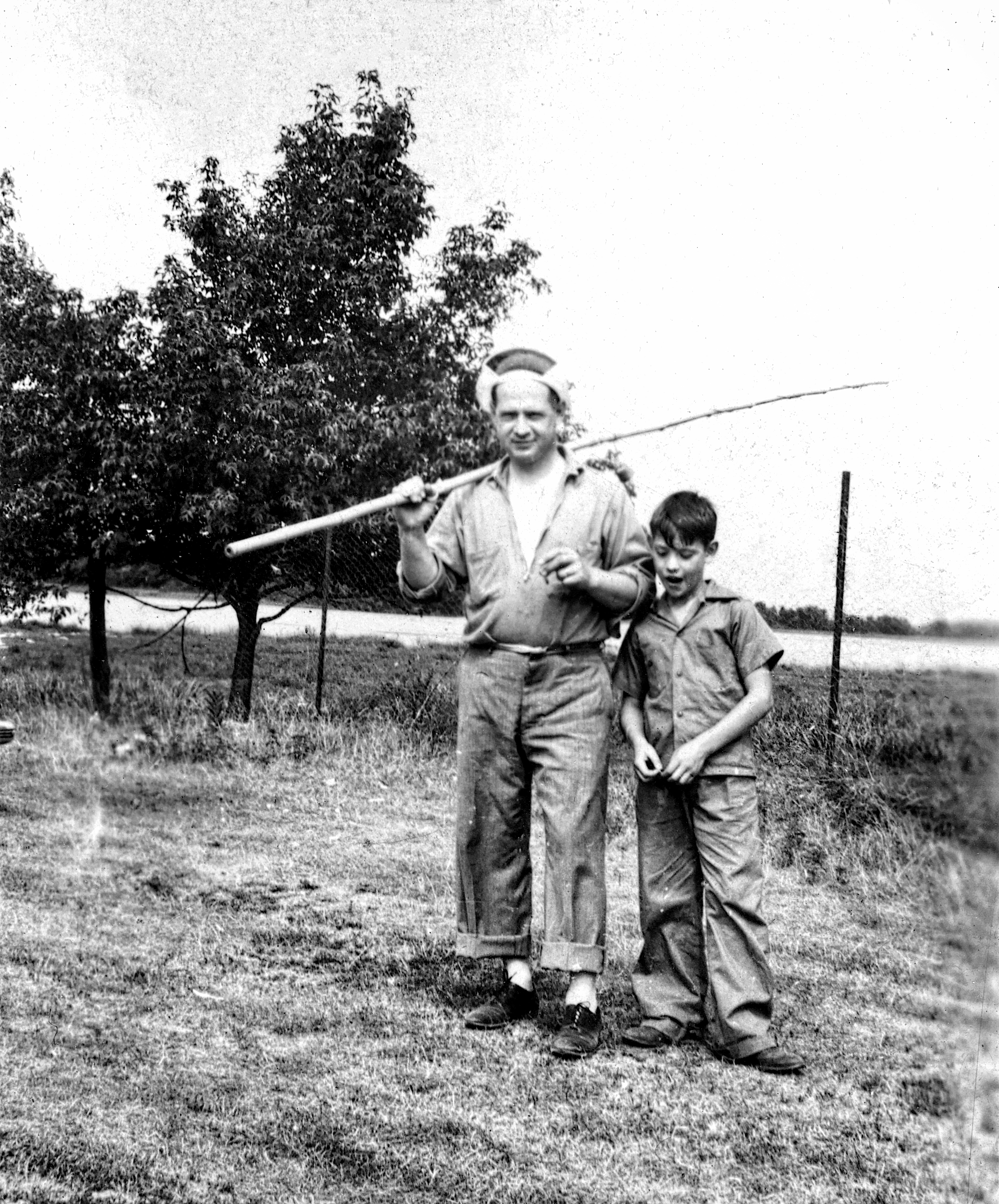
Photographs can document history in many ways, so it’s fun to look deeper into historical images to learn what they can tell us. The image atop this post shows a man and a boy. The man has a cane pole, so we can assume the pair has gone or is going fishing. Look a little deeper. The photo has a Rockwell-esque quality to it. Set in the summer of 1942, the photo shows Carl Henry Frank Hanneman (1901-1982) and his youngest son, David D. Hanneman (1933-2007). You can see Carl’s love for fishing — something he shared with his children and grandchildren who learned to fish on Mauston’s Lemonweir River.
The son is following along, asking questions of the fishing expert. What is he asking? Perhaps, “Hey, Dad, why don’t I have a cane pole?” It’s a time-honored tradition,passing on a love for fishing from one generation to the next. We’ll cover more of that in a future installment.
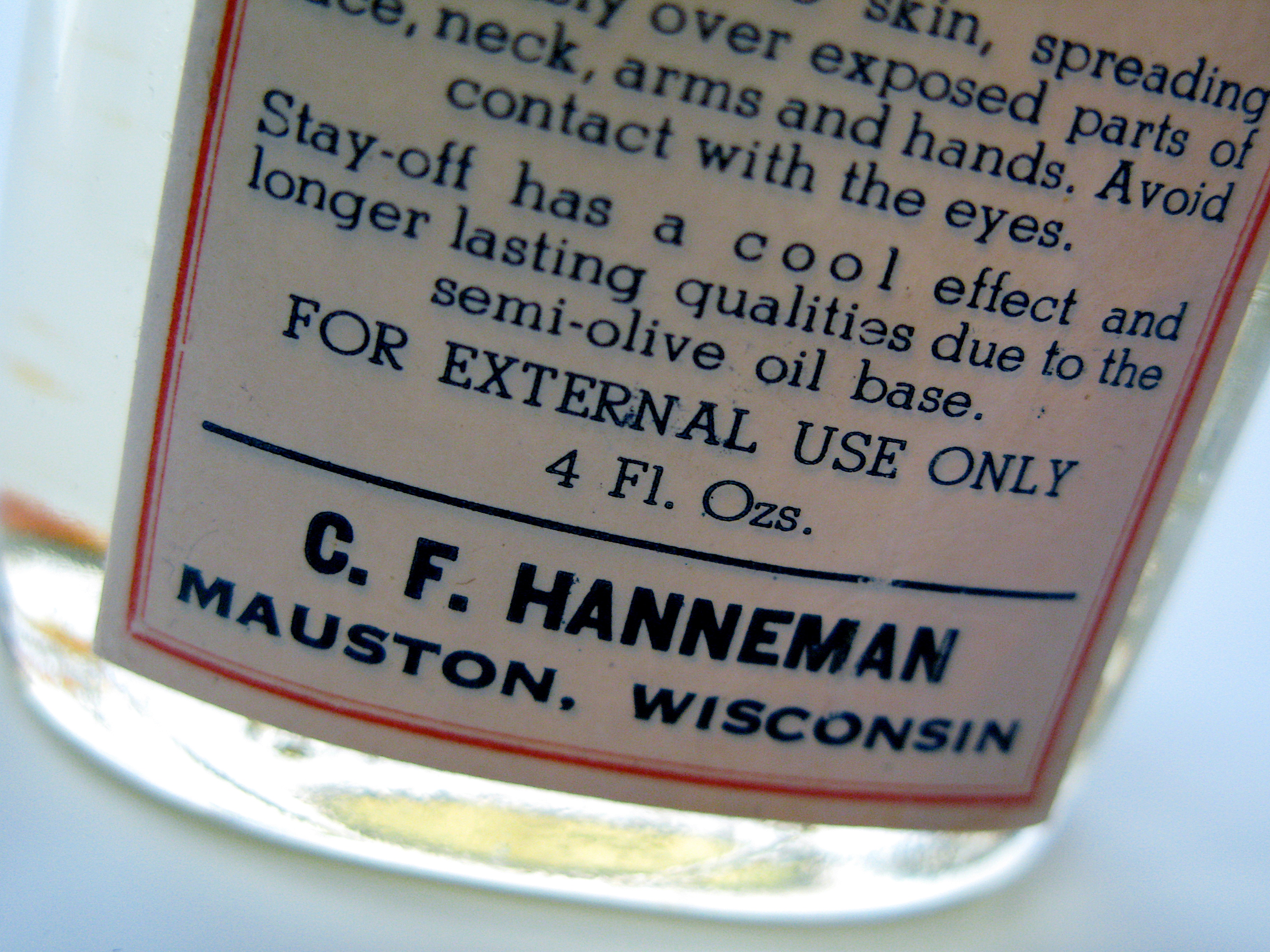
More than 60 years after it was first used to ward off mosquitoes and other pests in central Wisconsin, the lavender and citronella scent of Carl F. Hanneman’s Stay-Off bug repellent still lingers across time. The Mauston pharmacist invented his own blend of essential oils that provided a natural defense against biting pests, and he sold the product across the area for years.
Carl F. Hanneman sold his insect repellent at bars and bait shops all over central Wisconsin.
Carl Hanneman’s inspiration for his product came from his need for extra income, and his knowledge of chemistry and pharmacology. Even in the depths of World War II, when rationing made it difficult to obtain raw materials, Carl found a way to make Stay-Off and sell it at taverns, bait shops and resorts all over the area. Due to an abundance of lakes and rivers, Central Wisconsin is known for proliferation of mosquitoes and other flying pests during tourist season.
“His being a pharmacist allowed him access to some of the compounds needed to make this stuff,” recalled Carl’s son, David D. Hanneman. The topical elixir, which used an olive oil base and a secret recipe of lavender, citronella and other essential oils, was often mixed on the back porch of the Hanneman home in Mauston, Wis. “It was kind of comical,” David Hanneman said.
Aside from providing access to the needed ingredients, Carl’s role as pharmacist at the Mauston Drug Store had other benefits that helped him sell Stay-Off on his own time. “Because he was his own dispensary, he was able to upgrade his gas card,” David Hanneman said. “So we weren’t restricted and limited in traveling. We could go back on up north and go fishing or do whatever over weekends. And we’d drop off a dozen bottles here, and a dozen bottles at that bar, a dozen bottles over at that other fishery house.”
Carl F. Hanneman printed his own labels and wrote the ad copy for Stay-Off.
Carl wrote his own marketing copy to help sell the 4-ounce bottles of Stay-Off. “Stay-Off is not only an excellent insect repellent, but has that cool, soothing and refreshing feeling on hot summer days,” he wrote. “It is highly recommended for women and children’s skin, producing a soft tenderness due to the semi-olive oil base.” The lotion soothes existing bug bites and provides protection against strong sun rays, he wrote.
David Hanneman said selling Stay-Off was a nice side business for the family. “It gave us nice added income,” he said, although “we never got rich off the stuff.”
The recipe for Stay-Off called for making the mixture in 1 gallon batches. A half-gallon of Stay-Off and several 4-ounce bottles survive to this day. All of the ingredients are still commercially available. So even 60 years after it was first mixed, it would be possible to make more Stay-Off using Carl’s old recipe.
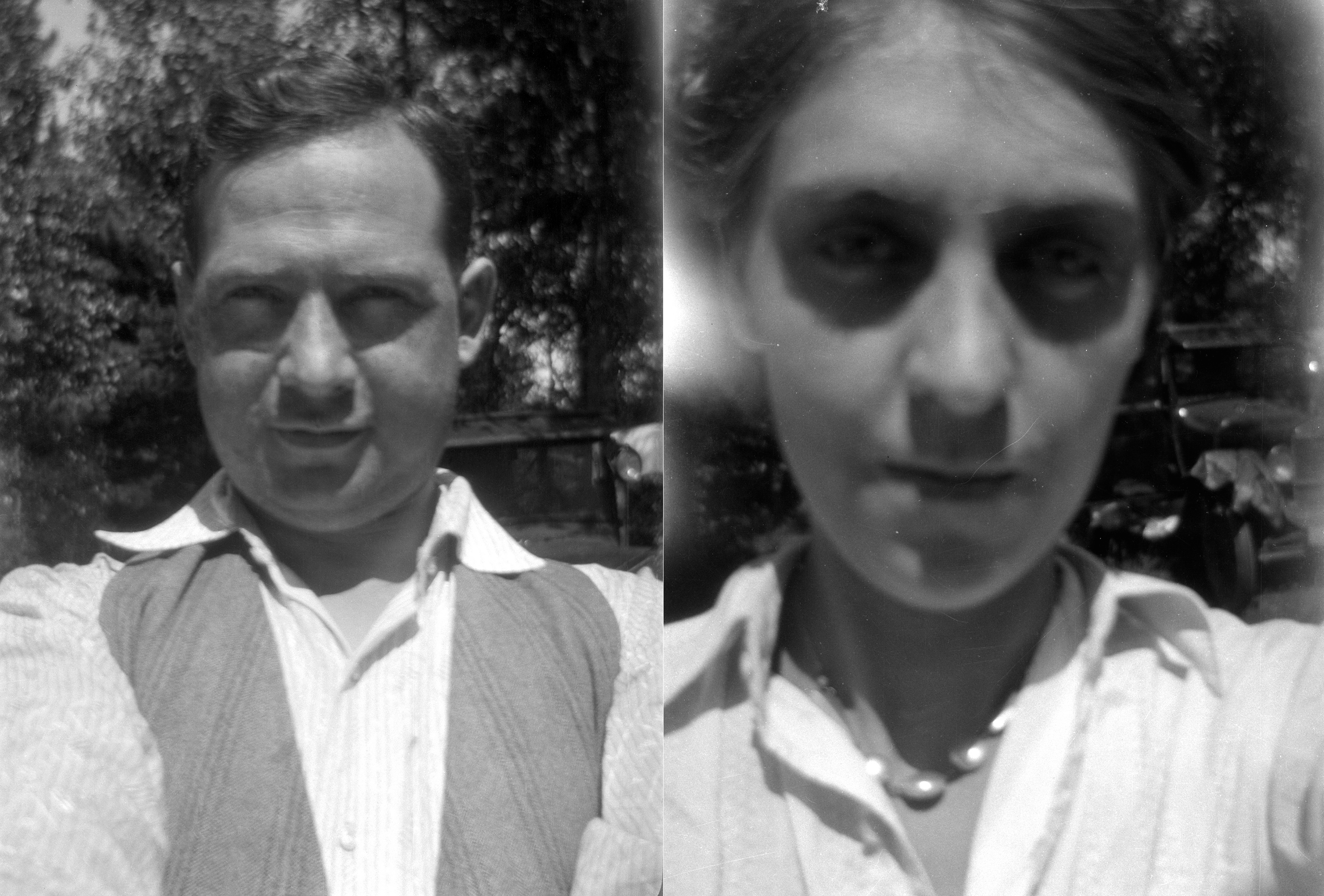
Many decades before the social phenomenon of taking self-portraits or “selfies” became all the rage, a young honeymooning couple in July 1925 predicted the trend by snapping their own photos at a camp site in Hayward, Wisconsin.
Carl F. Hanneman and the former Ruby Viola Treutel were married on July 14, 1925 at St. James Catholic Church in tiny Vesper, Wisconsin. For their honeymoon, they chose to motor to Wisconsin’s North Woods. Part of their time was spent at a cottage owned by friends, Mr. and Mrs. Armand Bauer, in Hayward.
Carl F. and Ruby V. Hanneman took these selfies on their honeymoon in July 1925.
Being a budding photographer, Carl took lots of photos from their trip, some candid and even playful. Two that stand out are ‘selfies’ taken by Carl and Ruby. Carl’s is at a good distance and quite sharp, while Ruby’s was an ultra-closeup, a bit out of focus. Given the camera technology of the day, these photos were more of a feat than it might seem. Nothing like snapping a quick shot today with an iPhone 6.
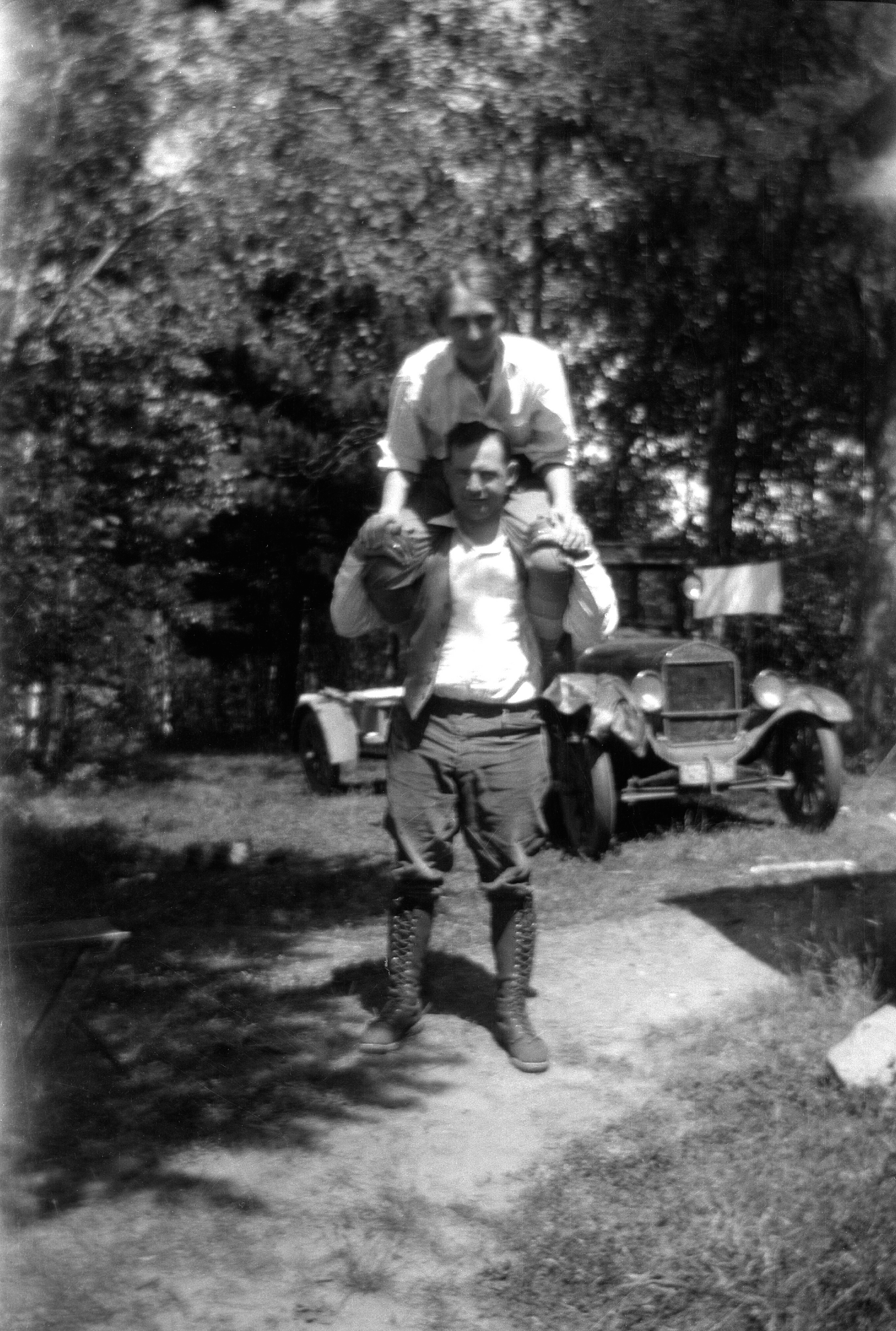
Ruby V. Hanneman rides on the shoulders of new husband Carl at their honeymoon camp at Hayward, Wisconsin.
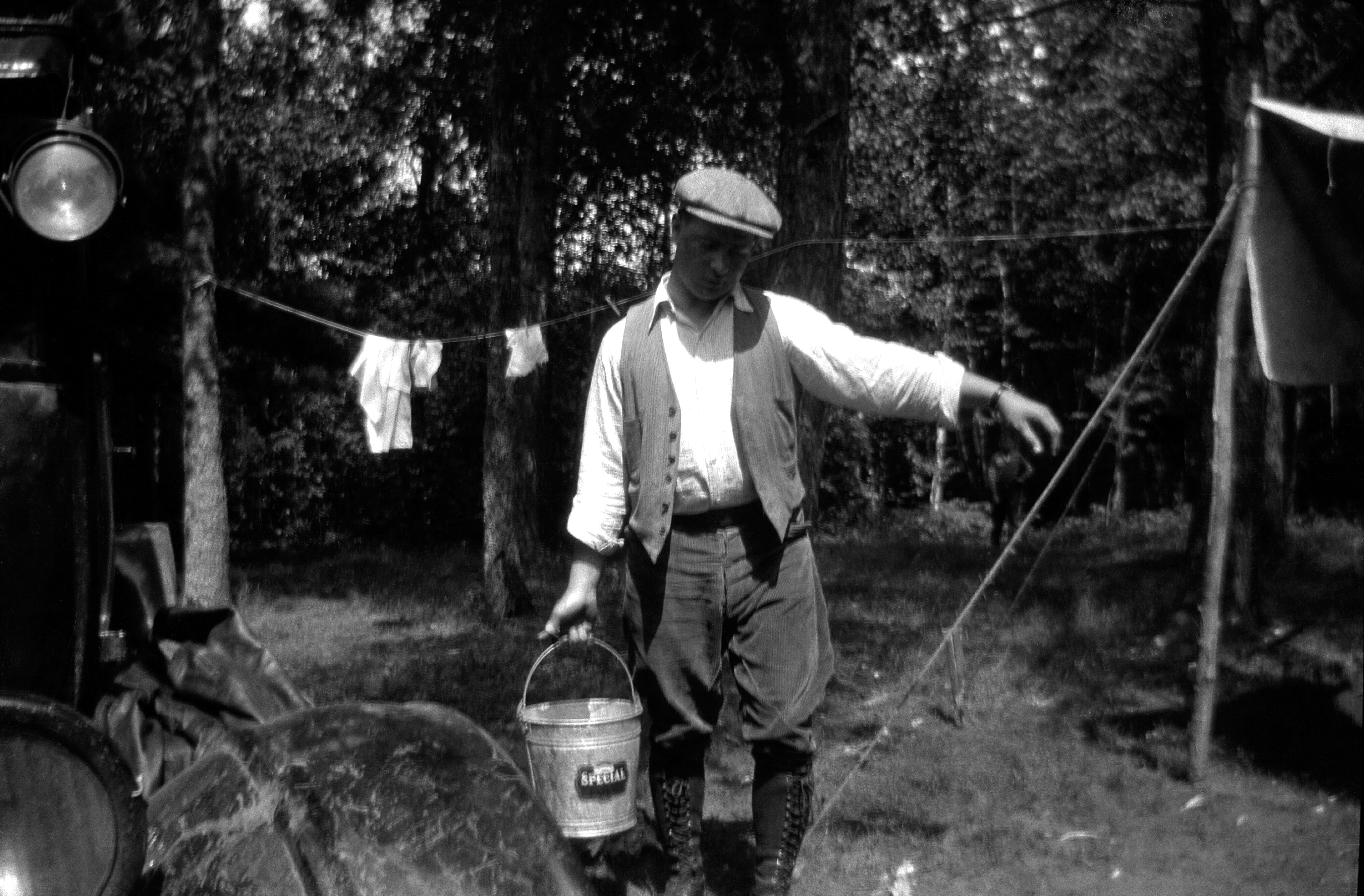
Other photos from the trip showed Carl walking with Ruby on his shoulders, Carl slinging a pail and Ruby sitting at a picnic table with a youngster who resembles her younger brother, Marvin Treutel (but might have been their hosts’ boy).
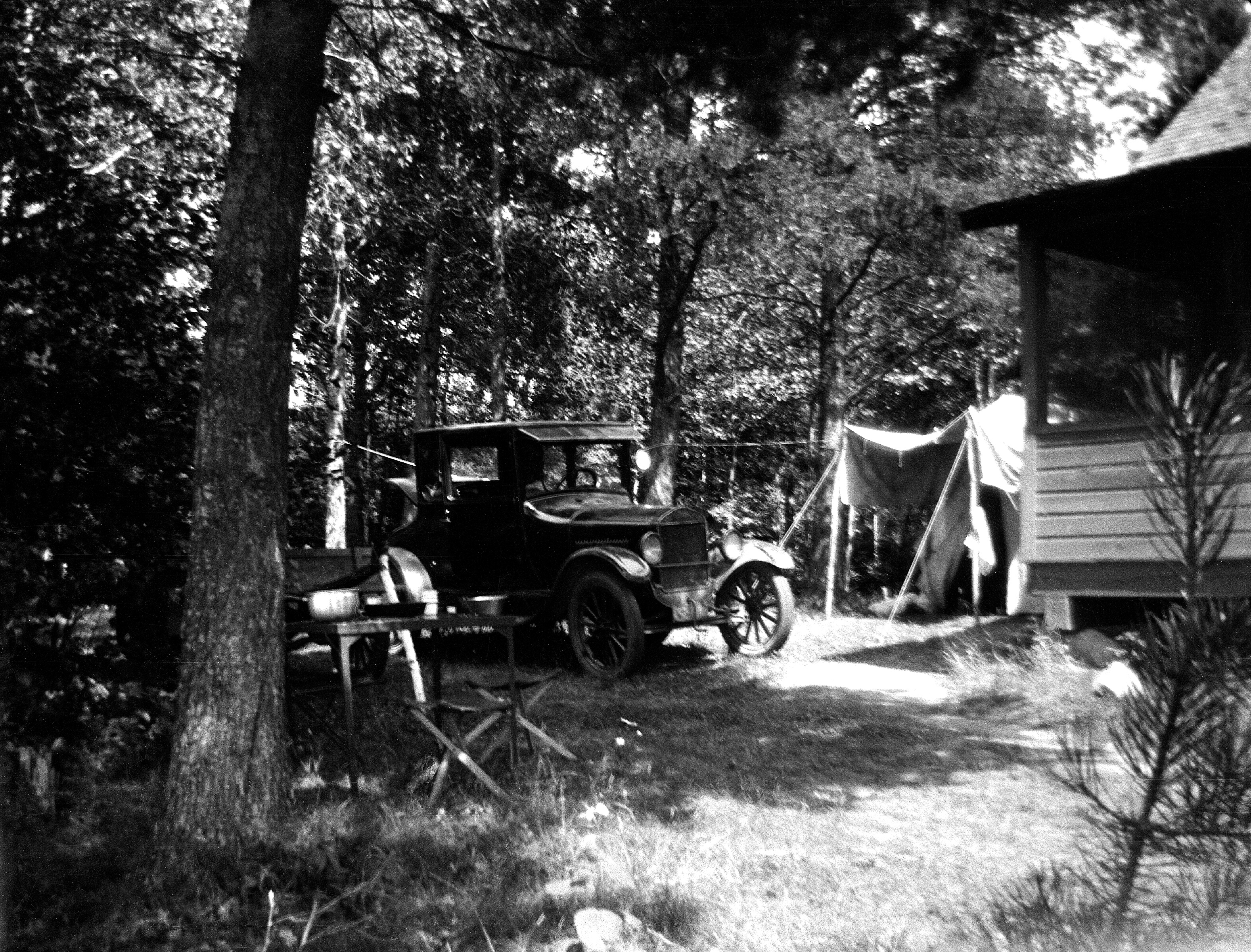
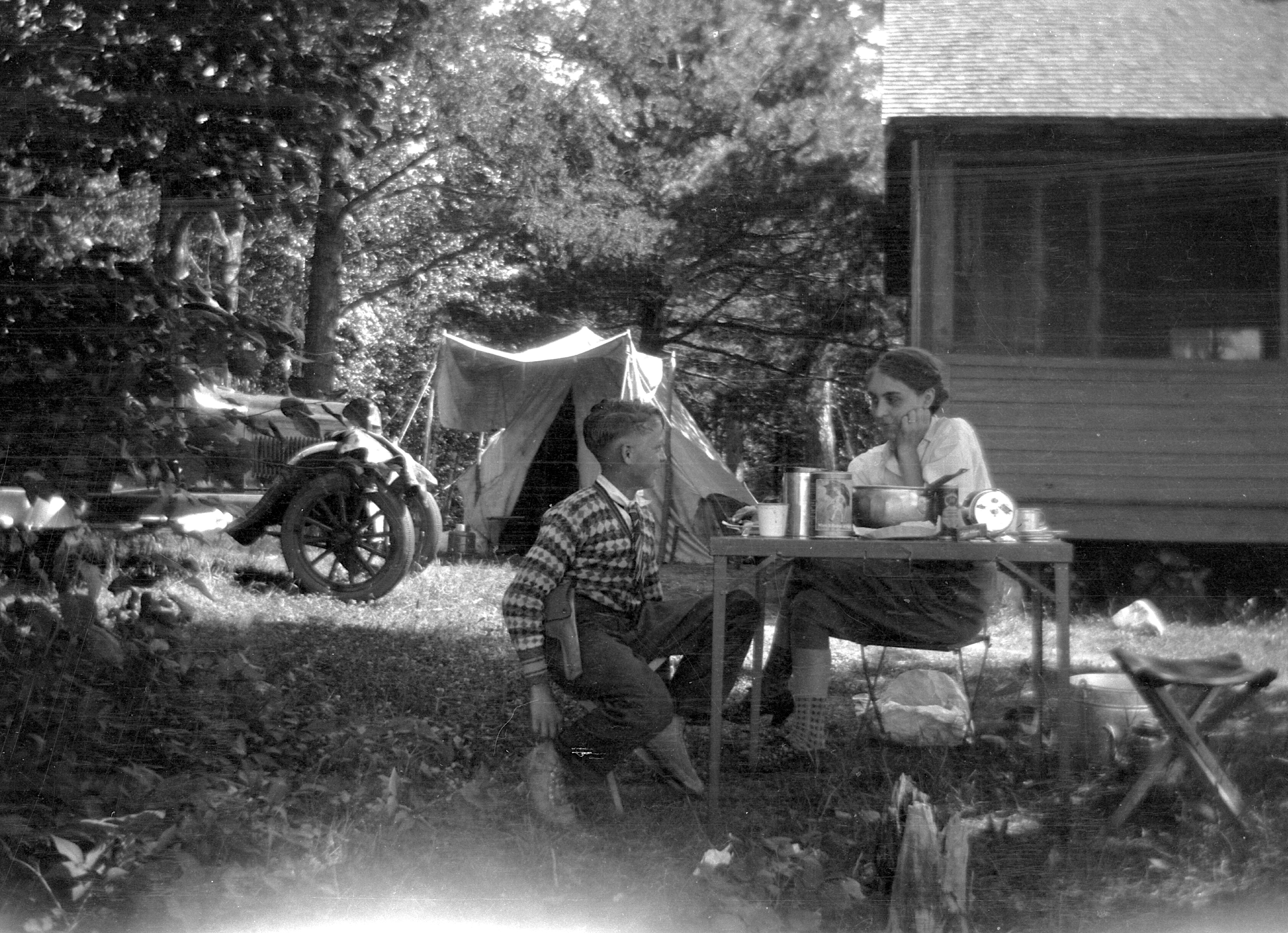
He could be carrying milk from the barn, but Carl F. Hanneman (1901-1982) is actually on a honeymoon camping trip in this July 1925 photo.Camp scene from near Hayward, Wis. in July 1925. Pictured is the Ford Model T belonging to Carl F. Hanneman (1901-1982) of Wisconsin Rapids, Wis. Hanneman was on his honeymoon with Ruby V. (Treutel) Hanneman (1904-1977) of Vesper, Wis.
Carl and Ruby had no way to know that the ‘selfie’ would become a dominant means of communication among young people around the world, or that the practice would spawn social media platforms, a television series, songs and videos on YouTube.
It was the fire of the century in the tiny city of Mauston, Wisconsin. Life may have started normally on Friday, Jan. 5, 1945, but before 9 a.m. a massive fire broke out that threatened to wipe out the city’s downtown. The man called on to document the blaze for local law enforcement was Carl F. Hanneman, the druggist at the Mauston Drug Store. It may have been the most prominent collection of photos he shot, but was just one among many accidents, fires and crime scenes he photographed over the years.
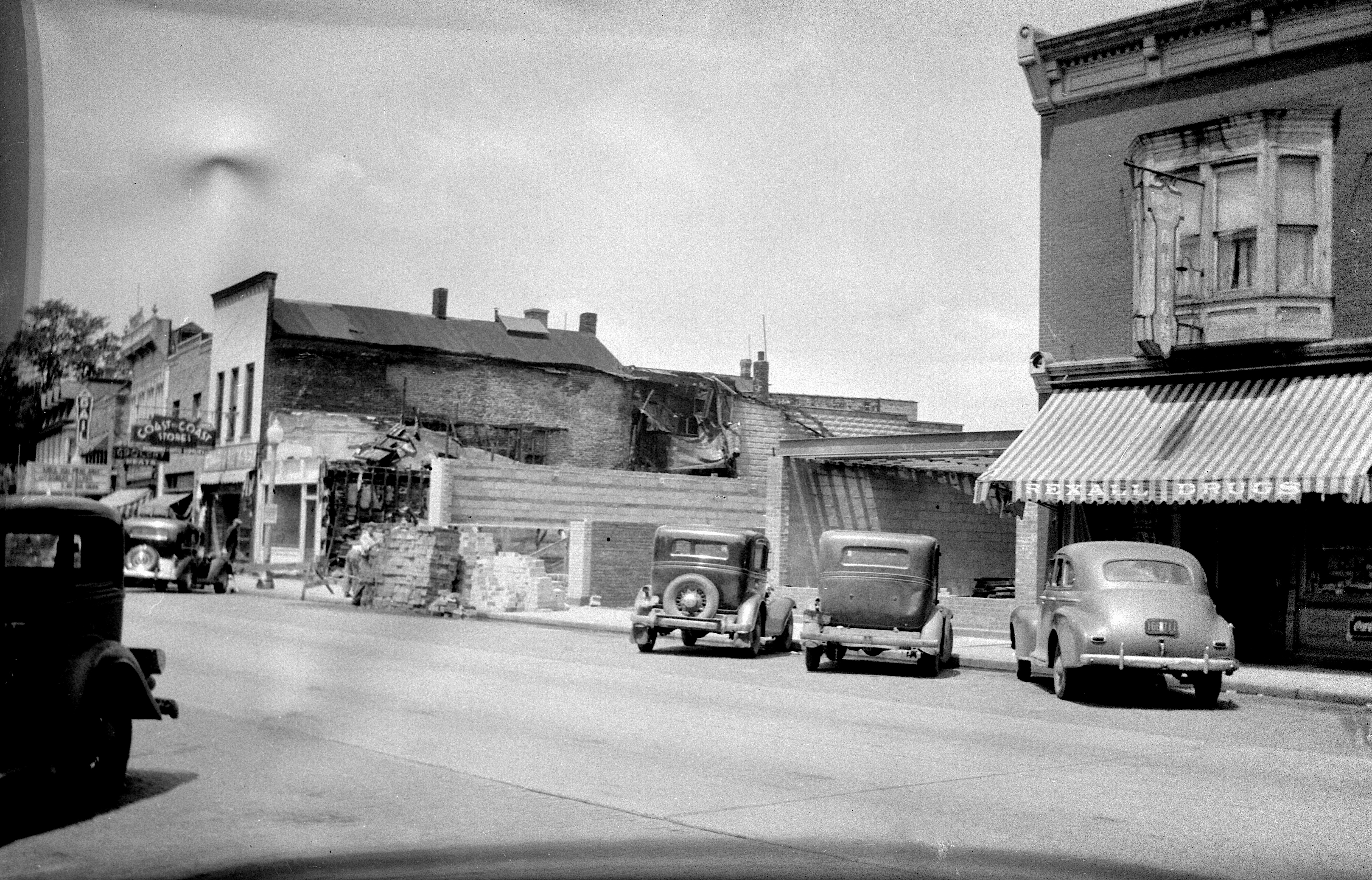
Carl would have been readying himself for the trip to the pharmacy downtown when the fire broke out that January morning. About 8:30 a.m. the fire started in the rear of the Gamble Stores building along the north side of State Street. Within 30 minutes it had spread to four downtown buildings and threatened the entire business district.
As firefighters from Mauston tried in vain to control the blaze in subzero temperatures, reinforcements from fire departments in Lyndon, New Lisbon and Wisconsin Dells raced to help. Carl stood just behind the line of rescue workers and took photos.
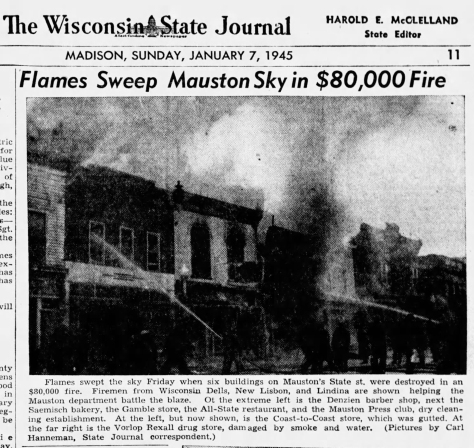
It took five hours to control the huge blaze, which destroyed Gamble’s, Mauston Press Club dry cleaners, Samisch Bakery, the Fred Denzien barber shop and the All-Star restaurant. At one point during the blaze, the brick facade of the All-Star fell onto the street. Nearby businesses, including Vorlo Drug and Coast to Coast, were badly burned. Damage exceeded $80,000 – equivalent to more than $1 million in 2014 dollars. Mauston Fire Chief John Smith said calm winds kept the fire from sweeping through the entire downtown.
The extreme heat from the fire is evident along the roof line.
Carl’s efforts that day earned him a page 1 photo in the Wisconsin State Journal, and two additional photos on page 11. He served as a Mauston correspondent for The State Journal for many years, garnering numerous front-page stories and photographs.
Carl dated and signed the prints from the Mauston fire in January 1945.
Carl documented many local emergencies in Mauston and surrounding areas. He captured the moment when a semi-trailer plowed into the front of the Tourist Hotel, knocking down the sign and collapsing the awning. Many of these photographs have a custom “CF Hanneman” imprint on the back, so it’s obvious Carl shot a fair number of news photos. Some photos from the 1945 fire have even shown up on Ebay.
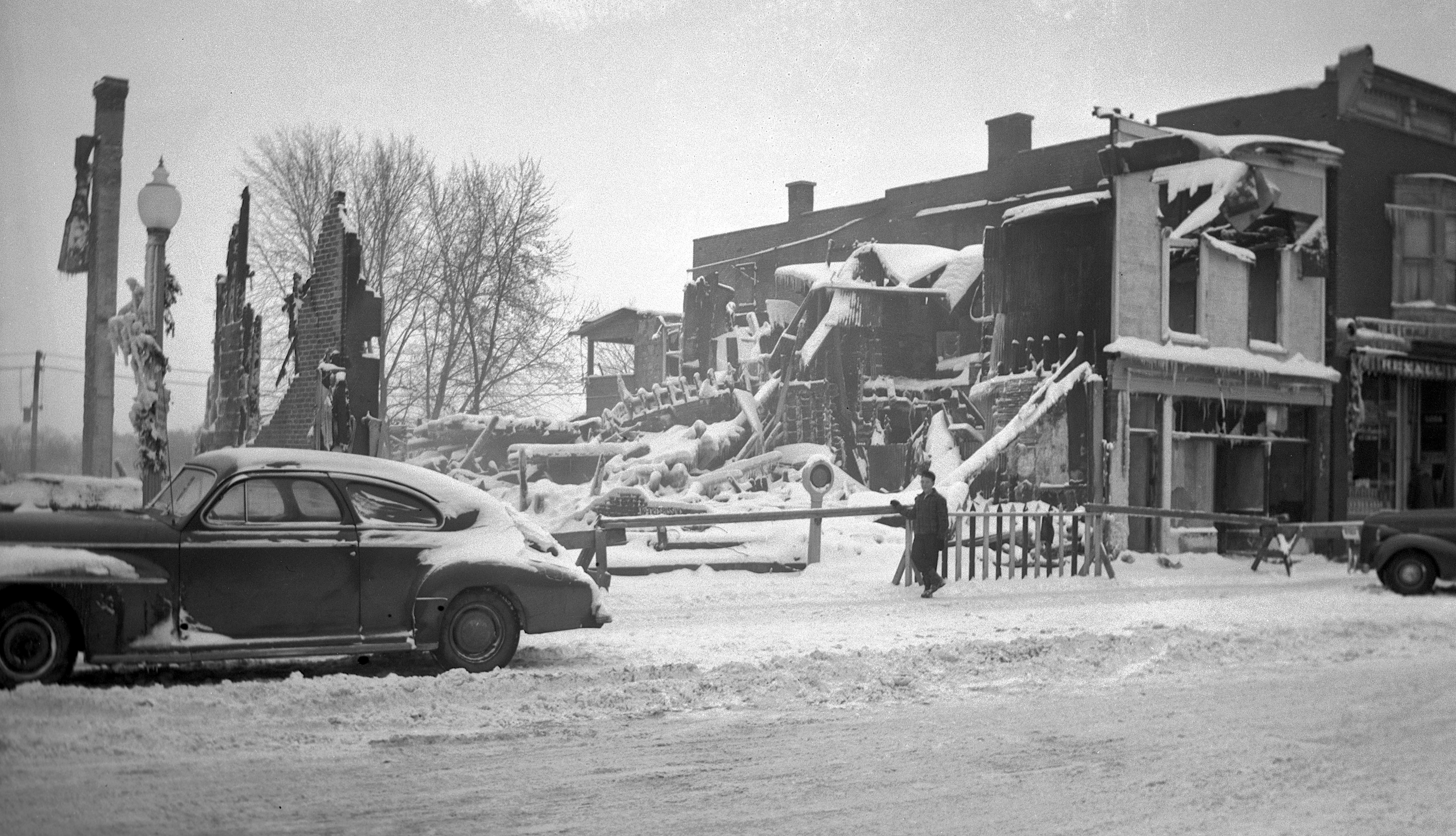
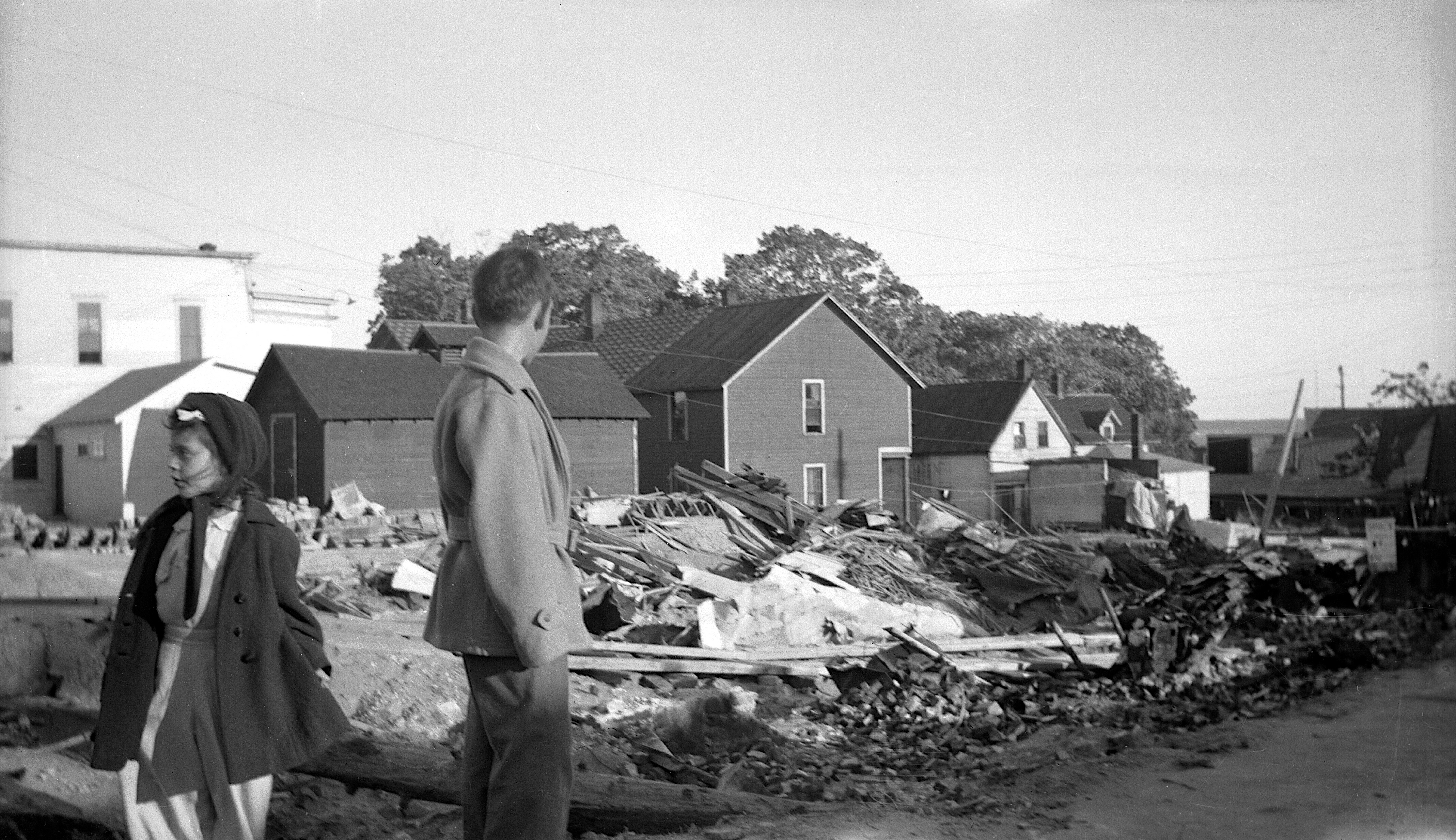
One of three of Carl’s photos that appeared in The Wisconsin State Journal on January 7, 1945.David D. Hanneman stands on State Street in front of the charred ruins.David D. Hanneman and his younger sister, Lavonne, survey damage.By summer 1945, the fire debris was gone and rebuilding was in process.
Back in the days when horses were the main mode of transportation, many homes across America had carriage stones near the street to assist those stepping down from horse-drawn carriages.
A fine example of the carriage stone stands in front of the old Hanneman home on Morris Street in Mauston, Wis. The carriage stone no doubt served its time as a platform to access horse-drawn transportation. But for many more decades the large granite stone was a family gathering place for photos and a launch pad for dozens of children at play.
More than 70 years of photographs held by The Hanneman Archive provide ample testimony to the importance of the old carriage stone. The earliest photographic records we have is from 1937, although the stone was likely original equipment when the home was built in the early 1890s. Brewmaster Charles Miller built the home at 22 Morris Street with the finest materials, so it’s no surprise he would have a carriage stone out front.
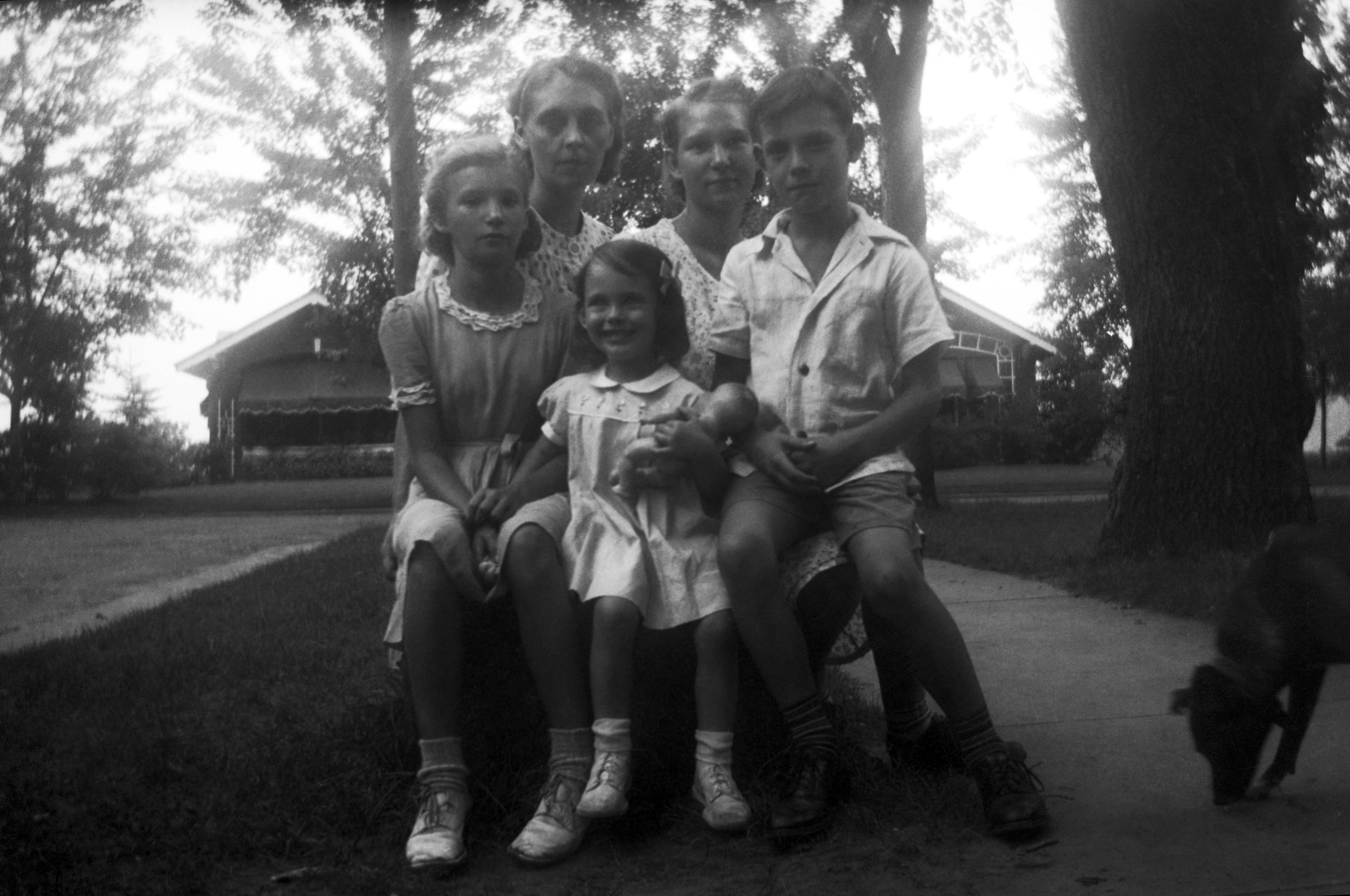
One photograph from about 1942 shows five people sitting on the stone for a photograph, including Ruby V. Hanneman and children Lavonne M. Hanneman, and David D. Hanneman. Another image from about 1957 shows Donn G. Hanneman, wife Elaine and children Diane, Caroline, Tom, Jane and Mary Ellen. The photo above shows Carl F. Hanneman and grandson David Carl Hanneman, taken circa 1965.
Lavonne Hanneman (front) and brother David (at right) sit on the carriage stone, circa 1942.
For the 15 grandchildren of Carl and Ruby Hanneman, the carriage stone was much more than a cool novelty. Just standing on the stone seemed to give a great vantage to the yard, even though the stone was just 18 inches high. It was always a race to see who would get first dibs on the stone.
Mary K. Hanneman sits on the carriage stone in 1958. With her is dog Cookie.
Ruby V. Hanneman with her son Donn and his family in the late 1950s or early 1960s.
For many of those old photos, family members sat or stood at the carriage stone in the shade of towering elm trees. The old trees are long gone now, but the stone remains, looking just the same as it did in the 1930s.
In several visits in years prior to his death in 2007, David D. Hanneman stopped at the house and asked the current owners if he could take the carriage stone. Initially they agreed, but later changed their minds. Seems the lady of the house had become attached to the old stone, as evidenced by the flowers lovingly planted around its edge. That’s understandable. Just another generation of folks who’ve come to care for that old carriage stone.
An oft-repeated story told of a tunnel that ran from the basement of the Carl F. Hanneman home in Mauston under Winsor Street to the property of Dr. J. Samuel Hess Jr. A new book refutes the old tunnel story, but shows how the Hanneman home was originally part of the Mauston Brewery complex.
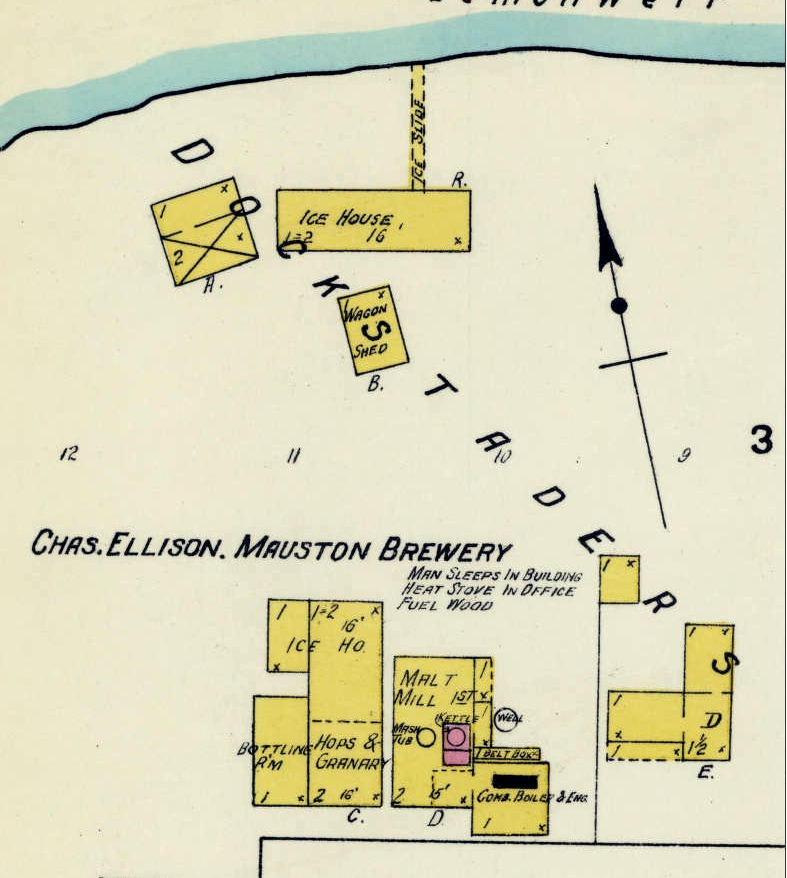
A book by Mauston resident Richard D. Rossin Jr. tells a fascinating story of the Mauston Brewery, which produced fine German suds at 451 Winsor Street from 1868 to 1916. The brewery operated where the former Hess home now stands, up the hill from the Lemonweir River. The home at 22 Morris Street was built by then brewery owner Charles F. Miler around 1893.
There have been many variants of the tunnel story. One tale said that the tunnel was used during Prohibition to secretly move moonshine from the old brewery across the street for distribution. Another was that the tunnel was used by Charles Miller to get to work in bad weather.
A plat map shows the location of the Mauston Brewery in relation to homes on Morris and Winsor Streets.
The late Juneau County historian Merton Eberlein, who lived at 27 Morris Street, once wrote that the tunnel story was a myth. “My home has been on the corner of Winsor and Morris since 1904 and I believe I am capable of saying, ‘It ain’t so,’ ” the book quotes Eberlein as saying. “If a tunnel existed, I certainly would have been aware of it, as I knew every nook and cranny of both the Hanneman home and the old brewery.” Eberlein and his father both worked in the brewery.
Rossin recounts visiting the Hanneman home in the 1970s and asking Ruby Hanneman to show him where the tunnel was. She led him into the pantry on the south side of the kitchen and showed him a trap door that led down to a large cistern.
Many of Carl and Ruby Hanneman’s grandchildren might remember a different location for the entrance to the tunnel. On the west side of the kitchen was a doorway and staircase that led to the basement of the home. On the north wall of the basement was a large archway, similar to those found in the basement under the Hess home. The arch had been bricked over at some point. The bricks that filled in the archway did not match those of the arch, or the large limestone blocks that made up the foundation.
This Sunburn fire map shows the various structures that made up the Mauston Brewery.
Eberlein said the tunnel would have been impossible, since a ridge of hard blue sandstone ran down the center under Winsor Street. When city water was installed around 1915, three contractors tried to blast through the rock along the street with no luck, Eberlein wrote.
There is an explanation for the archway, even if it wasn’t the tunnel of family lore. Charles Miller might have had his own brew cellar, similar to those built underneath the brewery. The book has photographs of the brew cellars that still exist under the old Hess home, which was built on the brewery foundation in 1928. A brew cellar would not have extended anywhere near Winsor Street, yet would have been big enough to hold Miller’s own personal stock of beer or other beverages.
Such a feature would not have been unheard of for the owner of a brewery. We know there is a large cistern built under the south side of the property. There was also a well drilled just to the left of the back porch, according to a hand-drawn property map left behind by Charles Miller’s widow, Frederica Miller Sheridan. She said the well was 22 feet deep. A stone was placed over the well casing when it was decommissioned. “When Miller had it built, he had all the best materials put in the house, even the cellar,” Mrs. Miller wrote.
According to Eberlein, the Millers drew water from the cistern via a pump to use in their laundry, which was located in what was later the pantry. A butlery was located just off the kitchen, used for serving the table in the dining room. The huge stone blocks used to build the basement were hewn at the quarry at Lemonweir Mills.
The Mauston Brewery remains an interesting part of early city history.
According to plat maps detailed in the book, there was once a bottling house located northeast of the Miller home. The bottling house had to be located across the street from the brewery, as brewery regulations prohibited bottling operations on brewery property. So beer was put in barrels, taxed, and then moved to the bottling works near the Miller house.
Myrtle Price bought the Miller house in 1932 and made extensive changes to the inside. Carl Hanneman rented the home from Mrs. Price for 11 years until her death in 1947. He continued making rent payments to her estate before purchasing the home in the 1950s. Mrs. Price was the widow of Clinton G. Price, the Juneau County district attorney who was assassinated in their home in April 1930.
The old Hanneman home is again for sale, with a listing price of $117,000. The Carl F. Hanneman estate sold the home for $18,000 in the early 1980s. The house has been completely renovated with maplewood floors, a new kitchen and a permanent addition where the back porch had been.
Rossin’s book is a fascinating piece of Mauston history, with significant references to the Hanneman family. The book costs $15 including shipping. You can send payment to: Richard D. Rossin Jr., P.O. Box 34, Mauston, WI 53948. Rossin can also be reached by e-mail.
— This post has been updated with additional images.
For decades, the records of St. John Lutheran Cemetery in Kellner, Wis., did not include a location for the grave of one of the church’s old settlers, Matthias Hannemann. His funeral and burial in May 1879 were recorded in the church register, but with no indication of burial location.
This more than century old mystery has been solved, however, and we now know where this early Hanneman forebear is laid to rest. As part of a research project for a forthcoming Hanneman history book, we found the grave location at the cemetery just southeast of Wisconsin Rapids.
The grave site of Matthias Hanneman is at left center, indicated by the upturned earth of the partially excavated stone.
Matthias Hannemann (1794-1879) is the earliest known ancestor of the Hanneman families of Wood and Portage counties of Wisconsin. He was the great-grandfather of Carl F. Hanneman of Mauston, Wis. Matthias came to America before June 1870 from Meesow, county Regenwalde, Pomerania, to settle with his children in north central Wisconsin.
During a site visit to St. John cemetery in July 2009, we determined that the earliest burials at the cemetery were physically arranged by date of death. Based on that, we determined Matthias would have been buried between August and Augusta Knoll (April 1878) and Carl Schmidt (October 1878). There was an unmarked grave in this spot, with a small portion of headstone poking above the grass.
Once we found a portion of stone poking above grass level, we pulled the grass back to reveal the headstone.
We pulled back the overgrown grass and weeds and a light layer of sand to reveal a 1 foot square remnant of headstone. Some hints of lettering were visible on the badly weathered and corroded stone face. We photographed the stone and applied a variety of filters and effects to the photo file, but could not make out a name.
We asked Sue Alft, head of the St. John Cemetery committee, to visit the site. She agreed that the plot was the burial place of Matthias and his second wife, Caroline (Steffen) Hannemann. Coincidentally, Alft is descended from Matthias Hannemann through his daughter, Friedericke (Hannemann) Kruger (1825-1918).















 The Hanneman Archive