Sometimes a photograph will strike you in a certain way that makes it memorable. It has some intangible quality that makes it almost timeless. Of the thousands of images in our library, a handful qualify for this kind of distinction. Not for their physical clarity or skill of the photographer, but that certain look. You might describe it just a bit like looking at a Rockwell painting, or a black and white photograph by Ansel Adams.
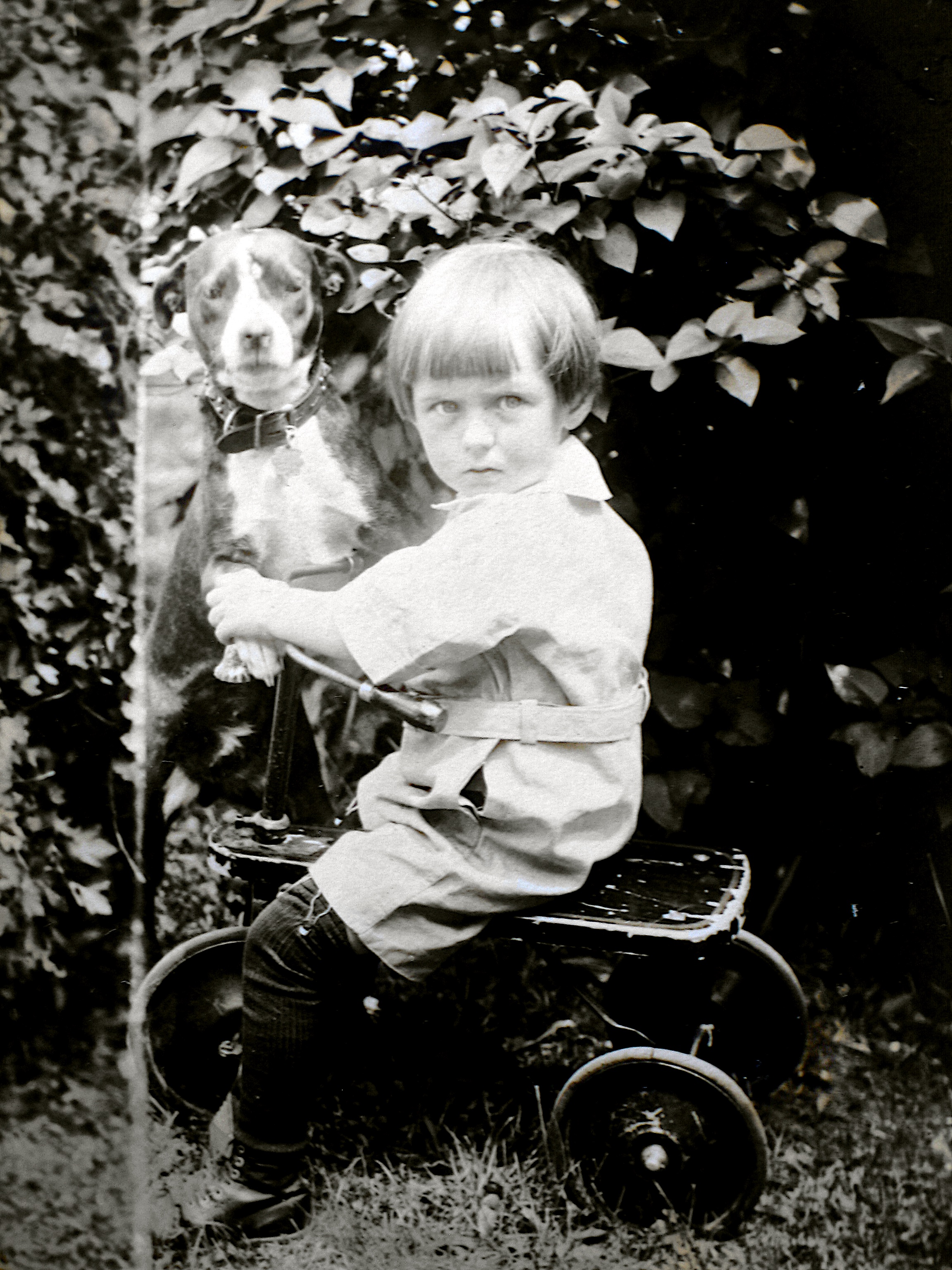
This image has a Little Rascals look and feel to it. Originally thought to be toddler Elaine Treutel and the family dog on her tricycle, circa 1922. Turns out this was actually one of the sons of Harry Cole.
View the whole collection in the gallery below:
Elaine Treutel poses with the family dog in this ca. 1923 photo near Vesper, Wis. Directly behind her is older sister Ruby V. Treutel. Sitting on the bumper of the car is father Walter Treutel (1879-1948). The others are unidentified.
This image has a Little Rascals look and feel to it. Toddler Elaine Treutel and the family dog on her tricycle, circa 1922.
David D. Hanneman with his toe in the sand at Madeline Island, circa 1942.
Ruby V. Treutel (center) relaxes with the Sunday paper near Milwaukee’s Juneau Park in 1924. Ruby was visiting her fiance, Carl F. Hanneman (1901-1982), who was studying pharmacy at Marquette University. At front is Ruby’s sister, Nina H. Treutel (1914-2005). The woman near the car is unidentified.
A formal portrait of Elaine Treutel of Vesper, Wis., circa 1938. Born in January 1920 to Walter and Mary (Ladick) Treutel of Vesper, Elaine attented Lincoln High School in Wisconsin Rapids. She married Max Clark in October 1938. The couple lived for many years in Madison, then relocated to suburban Phoenix, Arizona.
Frank Herman Albert Hanneman (1895-1947) of Grand Rapids, Wis., posed for this studio photo with a shotgun, ammunition belt and even a hunting dog. The photo was taken ca. 1909. Frank was the son of Carl Frederick Christian Hanneman (1866-1932) and Rosine B. H. Ostermann (1874-1918).
Nina Treutel of Vesper, Wis., is about 18 months old in this circa 1916 photograph. Nina’s parents are Walter Treutel and Mary Helen (Ladick) Treutel.
A beautiful portrait of Lavonne Hanneman, circa 1955.
Ruby Treutel poses for an informal photo, circa 1922.
Ruby Treutel with her siblings Marvin, Elaine and Nina, circa 1921.
Carl F. Hanneman’s high school portrait, 1921.
Lavonne and David Hanneman examine a monument on a vacation trip to South Dakota in 1947.
Ruby Treutel holds her baby brother Gordon, circa 1910. Gordon died of pneumonia in February 1911.
Patricia Treutel is having a great time on the tree swing, circa 1943.
We don’t have an ID on this beautiful young lady. Photo appears to be from 1920s.
David D. Hanneman watches over his little sister, Lavonne, circa 1938.
David D. Hanneman and sister Lavonne Marie Hanneman, circa 1942.
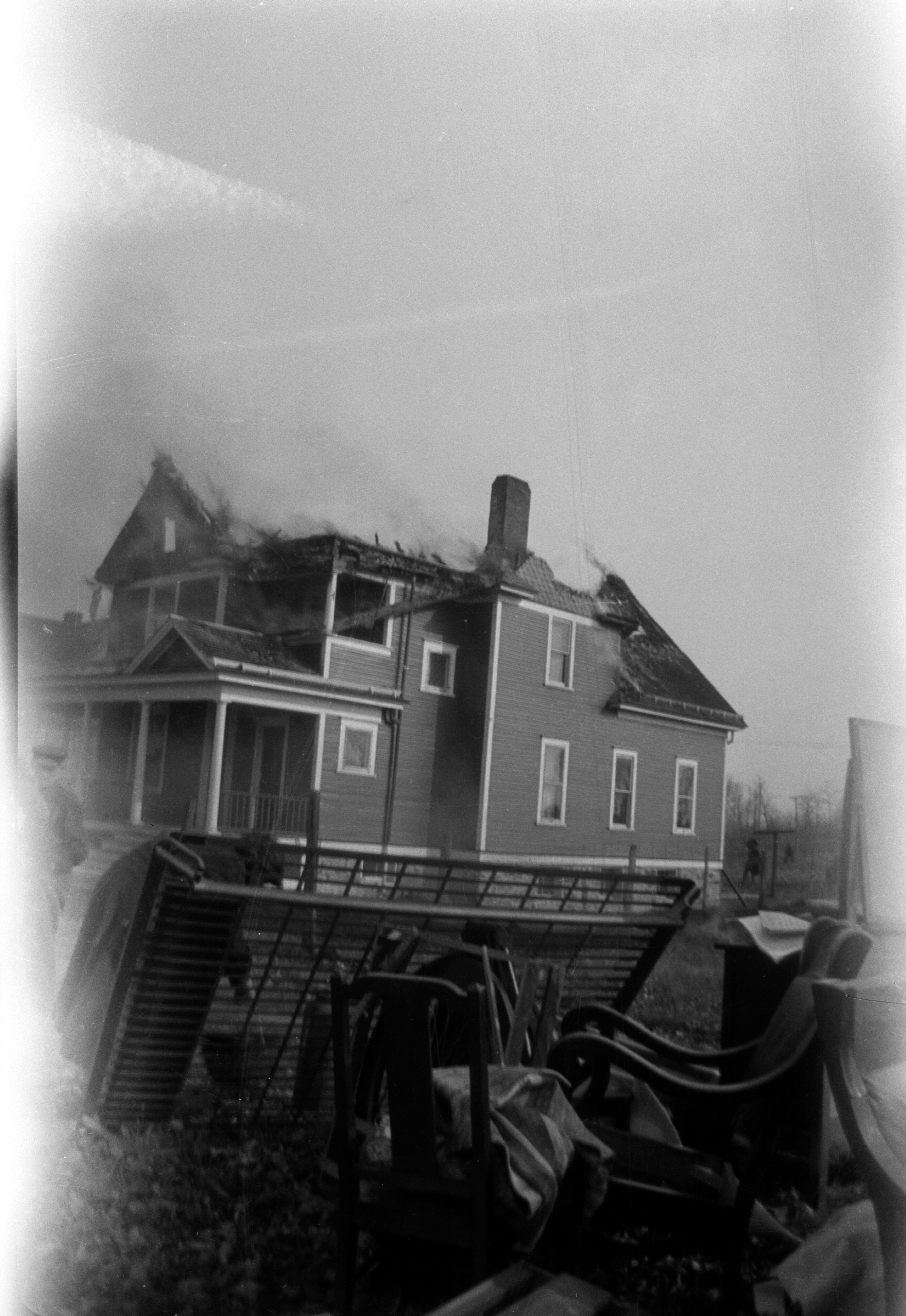
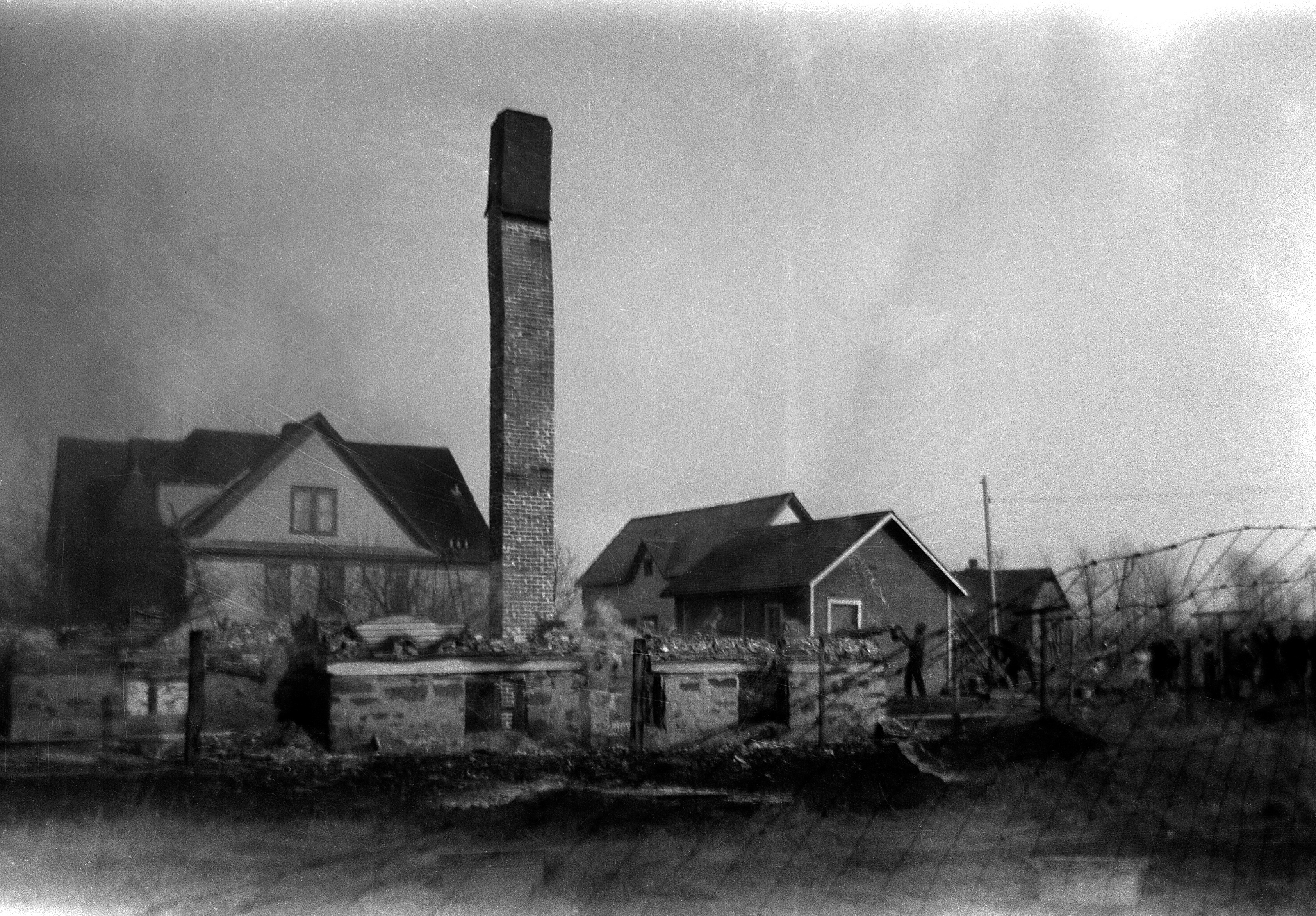
A fire in April 1926 at the parish priest’s residence in Vesper, Wisconsin, spread so fast that the building was reduced to its foundation before firefighters arrived.
Rev. Charles W. Gille
Fire broke out in the rectory of St. James Catholic Church on Monday, April 19, 1926. Calls went to the Wisconsin Rapids fire department, but its firemen were all out battling grass fires. Villagers were on their own.
Belongings from the burning home can be seen in the foreground.
Neighbors rushed into the burning building to pull out as much as possible before the home was lost to the flames. It’s not known if the parish priest, Rev. Charles W. Gille, was at home when the fire broke out. Within a matter of minutes, the home was, as firefighters say, “totally involved.” The buckets of water thrown at it were of no use. By the time firemen from Marshfield arrived, it was too late.
As the fire reduces the home to its foundation, a man is seen tossing water on the roof of a nearby building.
The former residence of the Henry Stahl family on Benson Avenue was purchased by the St. James parish in 1919 to serve as a home for the parish priest. The loss from the fire was estimated at more than $4,000. The photos were taken by Carl F. Hanneman, whose father-in-law, Walter Treutel, lived just down the block from the fire scene.
This double exposure appears to show a man walking through the remains of the fire.
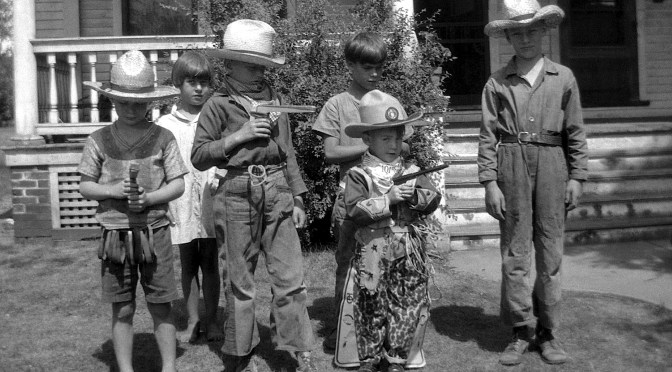
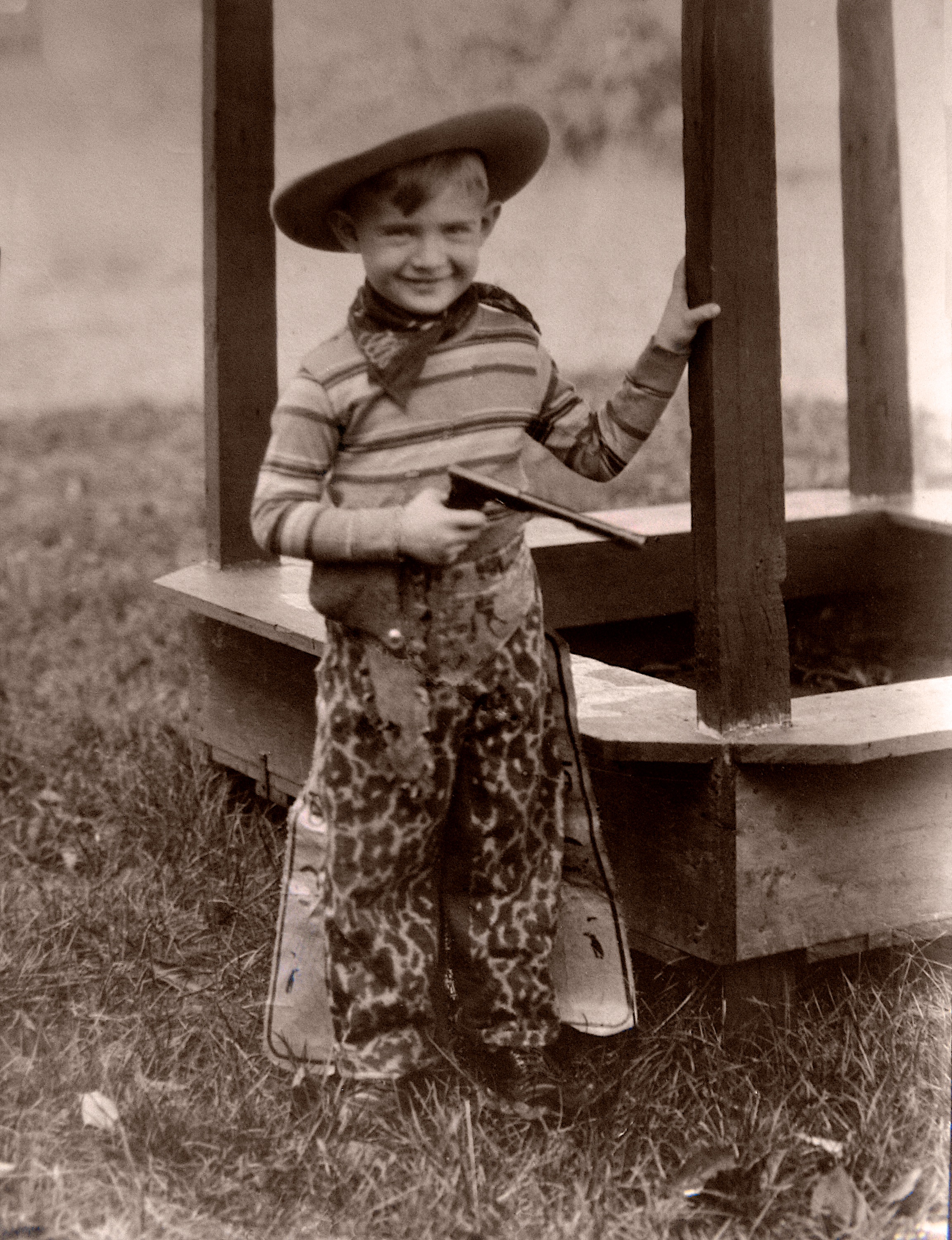
Even in the late 1920s, it was a time-honored tradition for the neighborhood boys to dress up as their favorite cowboy hero. The priceless image above shows a group of youthful cowpokes hard at play on Wisconsin Avenue in Wisconsin Rapids. The smallest cowpoke in front is Donn G. Hanneman, and judging by his spiffy cowboy getup, it might have been sometime near his August birthday.
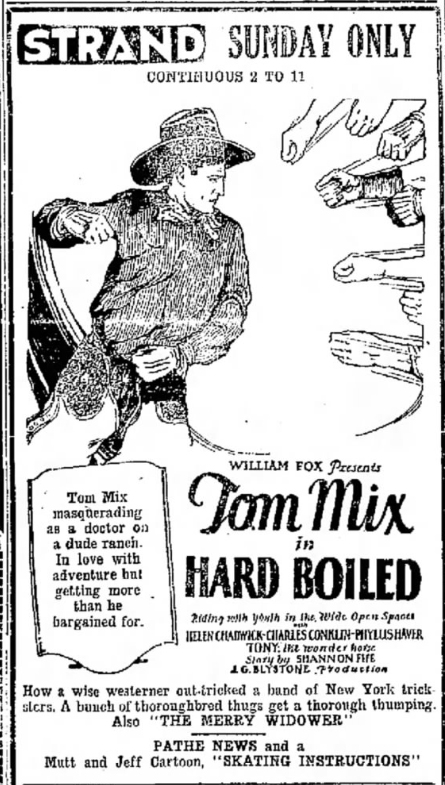
Youth flocked to see their hero Tom Mix and his steed, Tony the Wonder Horse.
So just which movie stars would these boys (and one perplexed young lady) be imitating while hard at play? The photo dates to around 1930, so it was well before the days of Red Ryder played by Red Barry and Rocky Lane, and long before the Lone Ranger. But no worries, the cowboy genre was well established at the movie house by such stars as Hoot Gibson, Tom Mix and even a very young John Wayne. These tykes might have gone off to see Fred Thompson in The Two-Gun Manor John Wayne in The Big Trail. It was still a few years before Gene Autry would be the star of In Old Santa Fe.
A bit older Donn Hanneman in his latest cowboy getup, circa 1933.
So here’s a tip of our 40-gallon hat to all of the aspiring cowboys of that era, with their chaps, shiny lawman’s badge, wooden gun and all the swagger a 5-year-old could muster. Let’s ride!
People often talk about getting 15 minutes of fame. For the late Carl F. Hanneman, it was closer to 15 seconds in a new Wisconsin Public Television documentary on Juneau County, Wisconsin.
Carl F. Hanneman filed this story with the Wisconsin State Journal on December 8, 1942.
The hourlong documentary, produced as part of Wisconsin Public Television’s Wisconsin Hometown Stories series, includes a section on the death of Governor-elect Orland S. Loomis of Mauston. Loomis died on December 7, 1942 after suffering a series of heart attacks. He was to be sworn into office in January 1943. As a local correspondent for the Wisconsin State Journal, Hanneman filed a story on December 8 detailing Mauston’s grief at the loss of their hometown hero. His news clipping was used as a graphic during the Loomis portion of the documentary.
Carl’s ties to Loomis went beyond the 1942 political obituary. On election night, November 3, 1942, he was one of the only photographers at Loomis’ home as the election results came in and Loomis was declared the winner over Gov. Julius P. Heil. Carl’s news photo ran above the fold on Page 1 of the State Journal on November 4, 1942.
Hanneman’s election-night photo taken at Loomis’ home in Mauston ran on Page 1 of the Wisconsin State Journal.
Hanneman (1901-1982) had known Loomis since about 1936, when Carl came to Mauston from Wisconsin Rapids to be a pharmacist for Dr. J. Samuel Hess Jr. He sought Loomis’ help in 1937 in obtaining his full licensure as a registered pharmacist (an upgrade from his existing license as an assistant pharmacist). At the time, Loomis was Wisconsin’s attorney general. Hanneman also worked to help elect Loomis as attorney general and governor. In recognition of his efforts, Loomis gave Hanneman a large pastel painting that once hung in his office at the state Capitol in Madison. The large-format pastel, weighing some 100 pounds in its hand-carved ornate frame, hung in the Hanneman home in Mauston and later in the home of Sun Prairie Mayor David D. Hanneman, Carl’s son.
Orland S. Loomis gave this painting to Carl F. Hanneman for his help on the gubernatorial election in 1942. It still hangs in the home of the late David D. Hanneman.
The fascinating Wisconsin Hometown Stories documentary, which first aired in April 2014 and is now available on DVD, covers much more than Loomis and his political career. It traces Juneau County’s history from its early days, when towns like Mauston sprung up around grist mills on the Lemonweir River. It details the county’s cranberry farms, the massive Necedah Wildlife Refuge, the heritage of the Winnebago (Ho-Chunk) Indians, creation of the huge manmade Petenwell Lake, and development of National Guard bases including Camp Williams and Volk Field.
Carl F. Hanneman befriended a young Tommy Thompson in 1966 when Thompson first ran for state office.
A prominent section of the documentary focuses on former Wisconsin Governor Tommy G. Thompson of Elroy. Thompson takes viewers on a tour of southern Juneau County where he grew up, including an old gas and grocery run by his father. Thompson served as Wisconsin’s 42nd governor from 1987 to 2001.
When he first ran for Wisconsin State Assembly in 1966, Thompson stopped in Mauston and met a pharmacist named Carl Hanneman. Carl was so impressed with the young lawyer from Elroy that he closed up shop for the afternoon and took Thompson all over Mauston, introducing him to other businessmen. From that day on, Hanneman always referred to him as “my friend Tommy Thompson.” It was a kindness Thompson never forgot.
Somehow the story of Carl’s early politicking for Thompson got left out of the Wisconsin Public Television documentary. Well, there’s only so much you can fit into an hour of television.
Society’s obsession with weight is not a new phenomenon, but it seems a most curious detail to include in an obituary. William Carlin of the Town of Ottawa in Waukesha County, Wisconsin, suffered such a fate when newspapers made his girth the top fact in his obituary.
“Weighed 385 Pounds,” read the Page 1 headline in the The Waukesha Freeman on May 25, 1899. “Mr. Carlin weighed 385 pounds and was doubtless the heaviest man in the county,” the article said. “His death was caused by fatty degeneration of the heart.” Doubtless. It’s unclear how the newspaper reached such a conclusion. Carlin, who was just 50 when he died, was not part of a circus. He didn’t seek fame as the state’s fattest man. Yet the newspaper deemed his life should boil down to the fact he was heavy. The Weekly Wisconsin newspaper in Milwaukee also found Carlin’s weight newsworthy, but relegated it to Page 5.
The Waukesha Freeman carried the death of William Carlin on Page 1 in May 1899.
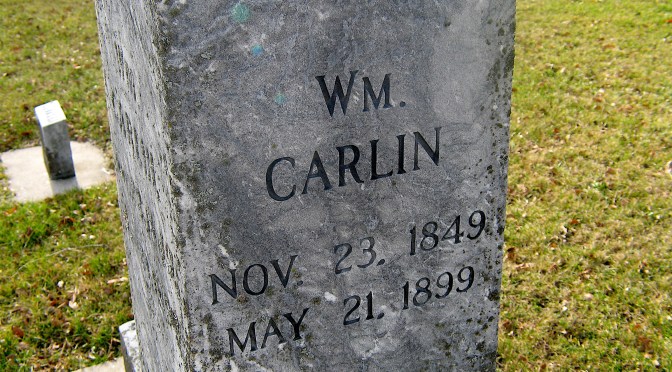
So history won’t remember him only for his body size, we’ll shed some more light on the life of William Carlin. Born November 23, 1849 in the Town of Ottawa, he was the son of Christopher Carlin and the former Elizabeth Cobb. Christopher Carlin died at age 37 in June 1858, when William was 8 years old. The Carlins were farmers on land northwest of tiny North Prairie. Christopher Carlin emigrated from England. At one time in the 1890s, William Carlin owned 300 acres of farmland in Waukesha County.
William Carlin married the former Annie Jones, and they had two children. Orville Walter Carlin, husband of Emma (Treutel) Carlin, was born February 5, 1874. Elizabeth J. “Lizzie” Carlin was born in January 1881. Their mother died in May 1889 at the young age of 37. Orville and Lizzie suffered a second tragedy in May 1899 when their father died, as newspapers said, from “fatty degeneration of the heart.” Orville married Emma Treutel and moved to Vesper, Wisconsin, where he operated a butcher shop. He died in 1934 at age 60. Lizzie married Jacob F. Supita. She died in 1944. William’s brother, Thomas Carlin, died in 1903 at age 52, so it seems genetics worked against the Carlin men.
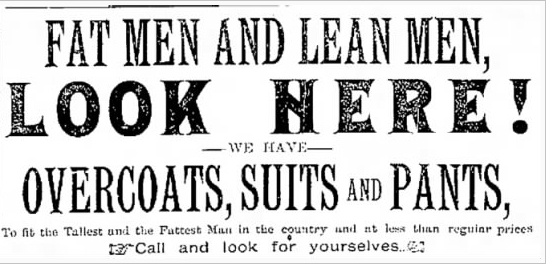
The Waukesha Journal carried this ad in November 1889.
Newspapers have long carried stories about record-setters, be it for height or weight. Often the subject of the stories sought the publicity. But what of those who didn’t? Did La Crosse businessman Samuel P. Welsh approve of his moniker as Wisconsin’s fattest man? When he married Grace Dutzel in June 1911, newspapers across the Midwest carried stories on how he weighed 400 pounds, while his bride “tipped the beam” at just 100 pounds. The Indianapolis News ran a Page 1 wire story on the Welshes arriving in Milwaukee for their honeymoon.
The Green Bay Republican carried this tidbit in December 1843: “The fattest man in the world lives in Connecticut. He is so thick through that he must lie down when he wishes to look tall.”
Dave McGuire of Silver Lake, Wisconsin, posed for a newspaper photograph in May 1921. It ran under the caption, “World’s Fattest? Who Knows?” “Dave McGuire of Silver Lake, Wis., doesn’t belong to a circus, nor does he ever expect to enter one,” one newspaper caption read. “He’s six feet seven inches tall and weighs 744 pounds, but he doesn’t care to go to the trouble of finding out whether he’s the fattest man in the world or not. He’s satisfied with the simple farm life.“
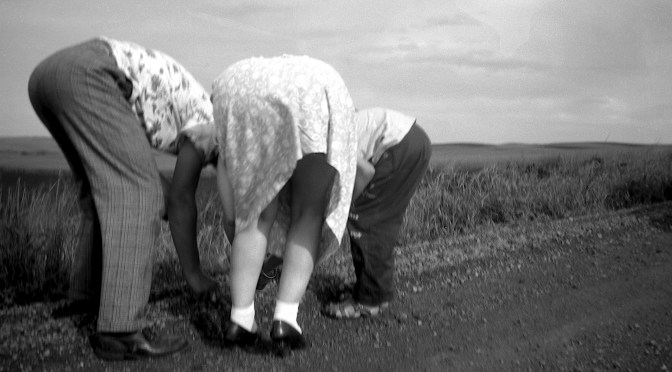
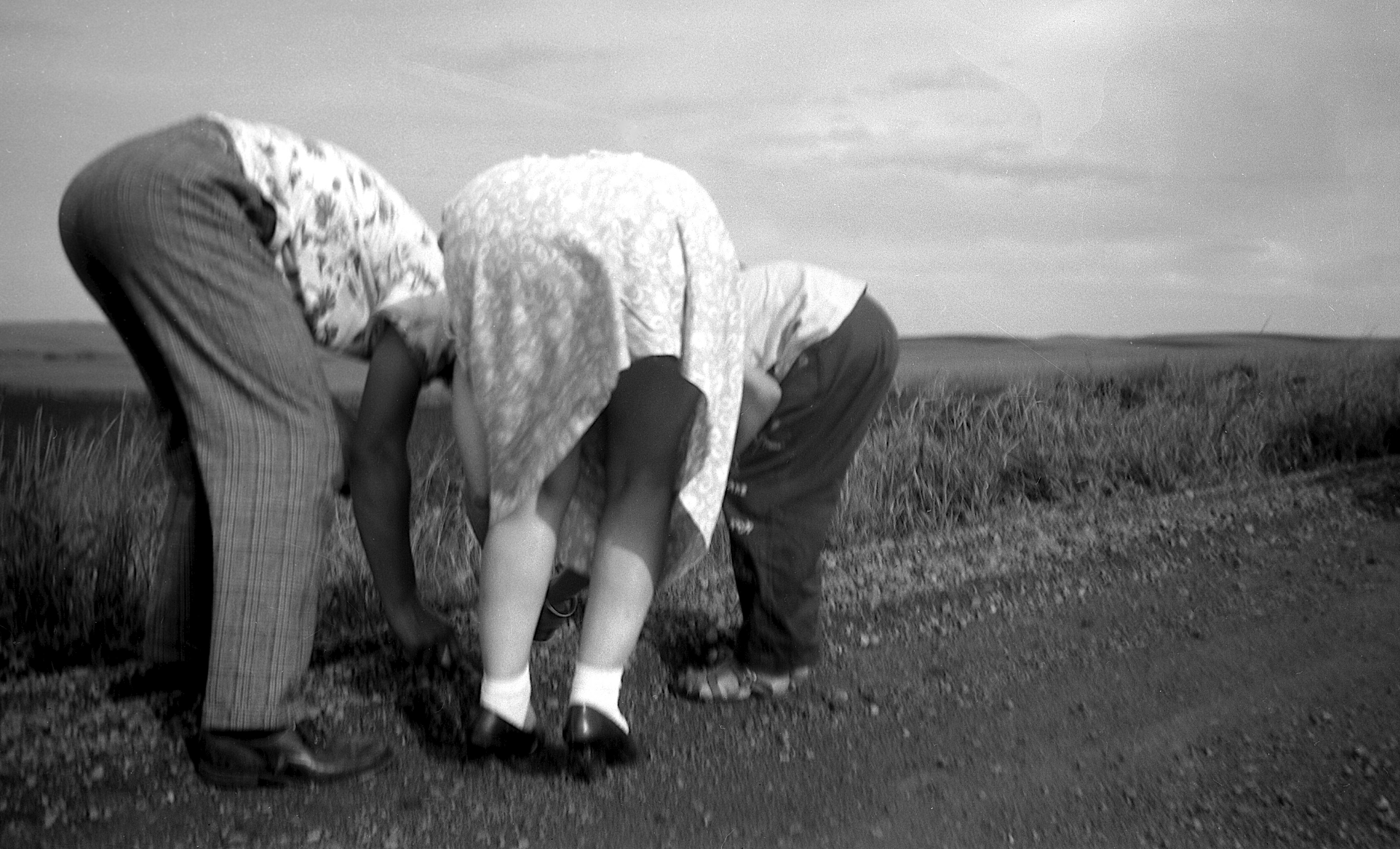
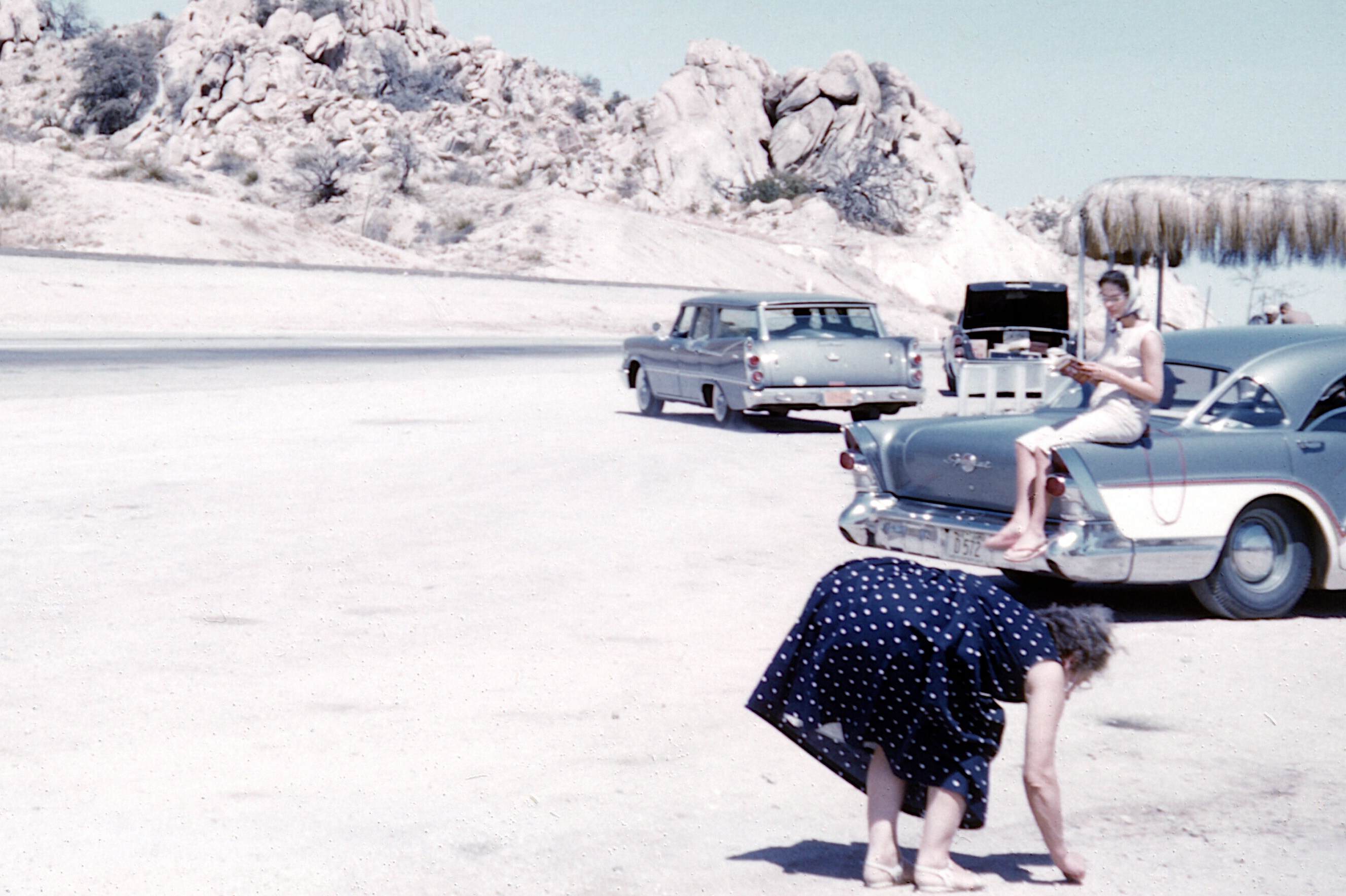
It wasn’t such a curious hobby, collecting rocks, but more in how it was done. Ruby Viola (Treutel) Hanneman (1904-1977), simply could not resist picking rocks up off the ground wherever she went. And judging by the facial expressions of those around her, it became somewhat of a family joke.
Lavonne Hanneman can’t resist laughing as her mother Ruby bends down to pick up rocks on a trip to South Dakota in 1947.
Rock collecting was certainly a Hanneman tradition. Uncle Wilbert G. Hanneman (1899-1987) had a rock shop up in Wausau, from which many a Hanneman child procured varieties of colorful, polished rocks. I have a bag of them to this day. Ruby liked to get her collectibles the old fashioned way, by finding them. She’d bend down to grab the most interesting or unusual ones, and husband Carl F. Hanneman (1901-1982) was often nearby to capture the moment on film.
David D. Hanneman’s priceless facial expression says it all, as his father Carl snaps yet another photo of mother Ruby picking up rocks.
The best examples of this hobby (or habit) came on a family trip from Mauston, Wisconsin, to Williston, South Dakota in 1947. After getting caught all bent over on several photographic occasions, Ruby and the kids shot back. They put their heads together and gave old Carl Hanneman a two-cheek salute.
David and Lavonne Hanneman joined their mother Ruby in offering a rear-end salute to cameraman Carl F. Hanneman.This photo proves Ruby’s habit was not a passing fad. Here she gathers samples on a trip to Phoenix in 1959.
Army Pvt. Rudolph Mika Jr. (at left) of Mauston, Wisconsin, talks to livestock buyer John Randall at the Juneau County Fair at Mauston in the summer of 1942. Mika went into the Army glider corps and took part in the invasion of North Africa during World War II. He was taken prisoner by German troops in Holland in September 1944 and repatriated in June 1945.
Army Pvt. Rudolph Mika (at left) of Mauston, Wis., talks to livestock buyer John Randall at the Juneau County Fair at Mauston in the summer of 1942.
The 1940 U.S. Census showed Mika working at the Mauston pickle factory and living at home with his parents, Rudolph Mika Sr. and Anna Mika. The elder Mika was a carrier for the local ice dealer. The Mikas lived on Winsor Street, just a few houses away from the Carl F. Hanneman family and the home of Dr. J. Samuel Hess Jr. Hanneman was on the Juneau County Fair Board for many years. He snapped the photo of Mika and Randall.
Rudy Mika enlisted in the U.S. Army in March 1942 at Madison. His occupation was listed as a carpenter. After the war, he returned to Mauston. He died on January 6, 2001 at Mauston, age 89. Randall died in January 1971 at age 74.
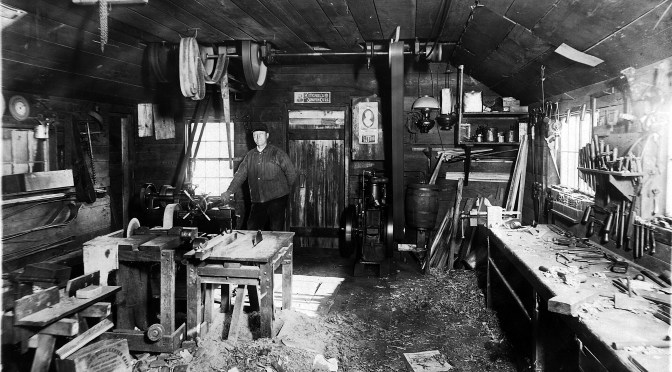
Charles Treutel (1869-1958) poses in the Treutel Bros. Shop at Vesper, Wisconsin, in 1911. Charles and his brother Henry A. Treutel (1864-1962) opened a blacksmith operation in Vesper after moving to Wood County from Mukwonago, Wis., in 1901. As can be seen in the photo, the Treutels also did carpentry work. The brothers later expanded their shop and made the transition from shoeing horses to tuning up engines and selling agricultural implements.
A 1911 book, Vesper, Wisconsin: A Sketch of A Model City, described the business this way:
Charles and Henry Treutel, skilled mechanics, have operated the blacksmith and wagon shop at Vesper since Nov. 1901 and have built up a large and prosperous business by courtesy and excellent workmanship. They are masters of every line of their business and are especially skilled in horseshoeing and repair work. In addition to their shop work the Messrs Treutel carry a large line of farm implements and their mechanical knowledge has enabled them to select the best makes in all the lines of machines they carry. They have a model shop fully equipped for their work.
The Treutel Bros. learned their trade from their father, Philipp Treutel (1833-1891), who came to America from Germany in 1854. As detailed in a previous post, the Treutels were blacksmiths, carpenters, tallow chandlers and tailors from near Darmstadt, Germany. Philipp Treutel is buried at North Prairie, Wisconsin.
— This post has been updated with additional information.
The tiny village of Vesper in Wood County, Wisconsin engendered such good feelings among its early residents that someone penned a tribute song to the village along the Hemlock Creek. The Hemlock Creek runs from just north of Arpin and flows south to the Wood County line. It includes more than 80 miles of streams.
The Treutel family enjoys a picnic lunch on their property along the Hemlock Creek at Vesper, Wisconsin, circa 1924. Pictured, L to R, are Elaine Treutel, Walter Treutel and Ruby Treutel. Marvin Treutel is partially hidden.
From the ashes of a massive sawmill fire in 1894, Vesper became a prosperous farming and manufacturing village 10 miles northeast of Wisconsin Rapids. Many of our relatives found work here and raised families. The village had a number of factories, general stores, a meat market, a locally owned bank, blacksmith shops, a community theater, a roller rink and more.
On warm summer days in the early 1900s, folks came from miles around to gather at the bandstand in Cameron Park. They enjoyed a variety of live music by the Vesper Cornet Band and other area musicians. It is not surprising such a place would win the hearts of its 300 residents.
The old Goldsworthy’s Store in Vesper, which later became the Treutel Bros. store.
We don’t know the author of the Vesper song, or even the musical score. But its lyrics tell a story of how the pioneer residents believed in their little community on the winding creek. And if you need confirmation that it is a genuine Wisconsin song, just look at the pronunciation of the word “creek.” Or is that “crick?”
Vesper, Wisconsin on the Hemlock Creek
1) You can rave about your cities with their glitter and their show,
And the interesting places where people like to go
But to come to solid comfort we can show you all a trick,
Where? Vesper, Wisconsin on the Hemlock Creek
Chorus
Vesper for mine, yes it’s Vesper for mine,
She isn’t very big, but she’s the best on the line,
They can travel where they want to
But we’ll try our best to stick,
Where? Vesper, Wisconsin, on the Hemlock Creek.
2) It’s the home of dandy people and their children not a few,
It’s the home of cheese and butter and a big condensery, too,
They make drainage tile and silos, have a band and park that’re slick
Where? Vesper, Wisconsin, on the Hemlock Creek.
3) Now the people are so busy that it keeps them on the go,
So they haven’t got a bit of time to stop and watch her grow,
It’s the town where things are doing and we aim to do them quick,
Where? Vesper, Wisconsin, on the Hemlock Creek.
4) To each stranger who is seeking for a place to build his roost,
We extend an invitation to the town for which we boost,
We’ll be glad to have you with us and we know you’ll want to stick,
Where? Vesper, Wisconsin, on the Hemlock Creek.
The Vesper Cornet Band performed at the Cameron Park band shelter and other locales around Vesper, Wisconsin. Oscar, Charles and Henry Treutel were band members.
It is common knowledge to family members that Carl F. Hanneman was born on Oct. 28, 1901. But when he needed proof of that fact back in 1946, there was none to be found. On Feb. 22, 1946, Carl sent a letter and the 50-cent fee to the Wood County register of deeds, asking for a copy of his birth certificate.
Register of Deeds Henry Ebbe sent the letter back with an answer that must have shocked Carl: “There doesn’t seem to be any birth certificate for you on the above date. There is a Ruben born Oct. 21, 1901. Father Chas. and Mother Rose. Could this be yours? I am returning your 50 cents.”
The earliest known photo of Carl Henry Frank Hanneman, born 28 Oct 1901.
That set Carl off scrambling to find proof of his birth. He asked the pastor of the Moravian Church of Wisconsin Rapids for help. Carl’s parents, Charles and Rosine Hanneman, joined the Moravian Church on March 29, 1907. Church records did list Carl F’s birthdate as Oct. 28, 1901, so Moravian Minister George Westphal wrote a letter testifying to the church records. But since Carl was not baptized in the Moravian church, this record was only indirect evidence of his birth.
If Carl had turned to U.S. Census records (which were not available at the time), it might have confused the matter more. The 1910 Census lists the youngest son of Charles and Rosa Hanneman as Harold Hanneman, age 8. Carl’s first middle name is Henry, so no doubt the Census worker simply wrote it down wrong.
So what happened? It’s not clear, but we do know the record was officially corrected. Carl’s birth certificate still shows the name Ruben and the wrong birthday, but the errors are crossed out and replaced with the correct information. Wood County Health Officer Frank Pomainville corrected the record in red ink in 1960.