
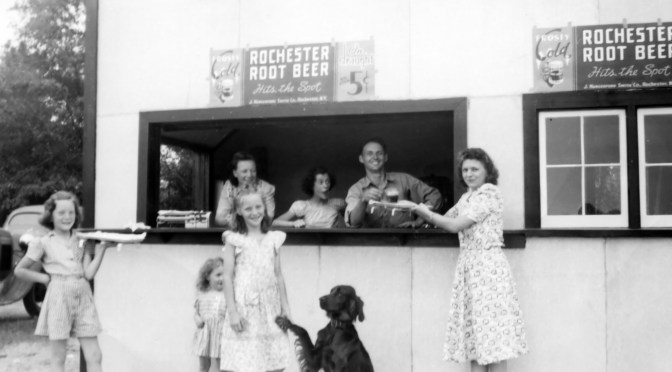
Marvin and Mabel Treutel operated a roadside root beer stand near their home on Wilhorn Road in Nekoosa, Wisconsin. Aside from 5-cent Rochester root beers, they served the “Best Roast Beef BBQ.” Pictured behind the counter in this late-1940s photo are Mabel Treutel (left), niece Lavonne Hanneman (center) and Marvin Treutel (right). Out front are daughters Bonnie Treutel (left), and Patricia Treutel (center, holding dog). The woman at right and the little girl at center are unidentified.
Category Archives: On the Job

‘Pestle and Mortar’ Carl Hanneman Passes the Pill-Counting Test
In the first half of the 20th century, druggists in America were often called on to literally fill prescriptions, placing medications into gelatin capsules and then counting out the order. Mauston pharmacist Carl F. Hanneman was very efficient at the task. Maybe too much so, opined The Mauston Star in a rather humorous article in December 1953.
“Joe Dziewior and this muser, watching ‘pestle and mortar’ Carl Hanneman throw a prescription together the other evening, now know why pill or capsule counting machines not not necessary to the registered pharmacist,” read the article on December 11, 1953. “With bottle in hand, Carl was pouring capsules into his hands and counting them faster than an adding machine.”
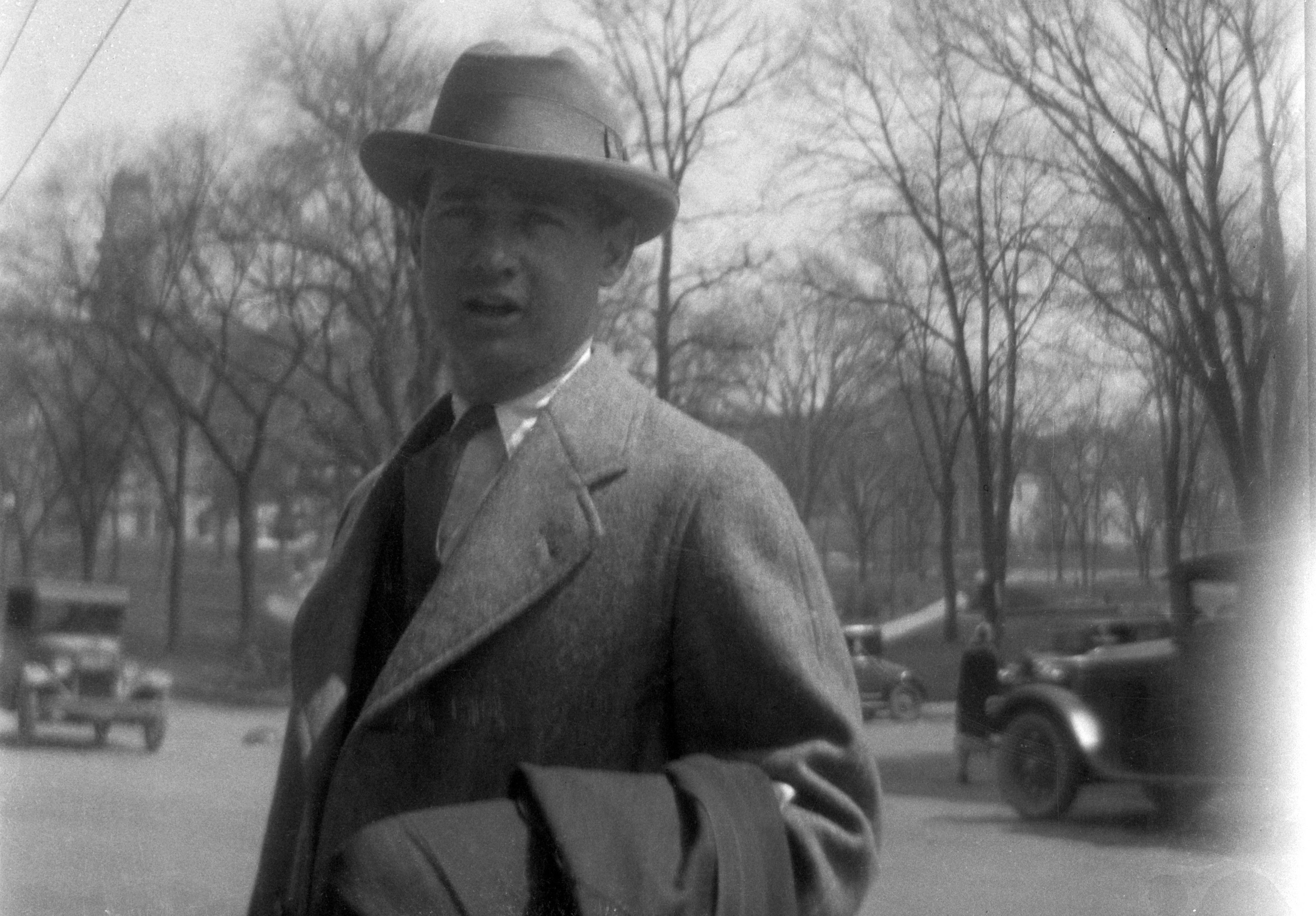
Carl was the registered pharmacist at the Mauston Drug Store on Division Street in Mauston. He had been the druggist there since moving his young family to Mauston in 1936 from Wisconsin Rapids. A graduate of Marquette University, Carl started as an assistant pharmacist, but obtained his full registered pharmacist license in the 1940s.
“After watching him for some time, we entertained a doubt as to the accuracy of the counts and Joe was inclined to agree with us,” the article continued. “But Carl said he could count pills time on end and whistle a tune at the same time, and still come out the a correct count. ‘Come, come, Carl!’ we exclaimed. ‘Isn’t that pulling our leg a bit?'”

Carl told the men a story of a “kindly old lady” who regularly came in for prescriptions and doubted the counts doled out by the druggist. “It never failed, but that after we wrapped up her prescription, she’d sit in the chair out there, undo the package and count the pills in the box,” Hanneman said. “To this day, she hasn’t demanded a recount!”
The article concluded: “Maybe registered pharmacists should be made ballot clerks. Recounts wouldn’t be necessary!”
©2014 The Hanneman Archive Family Line: Carl F. Hanneman >> David D. Hanneman, Donn G. Hanneman and Lavonne M. (Hanneman) Wellman
Hanneman’s Mayoral Election Continued 400-Year Tradition
When David D. Hanneman was elected mayor of the city of Sun Prairie, Wisconsin in April 2003, it continued a Hanneman family tradition that stretches back more than 400 years to the county Regenwalde in the Baltic Duchy of Pomerania. Hanneman’s election as mayor on April 1, 2003 capped his nearly 40-year public service career — and put him in good family company.
The Hanneman family from Kellner, Wisconsin — from which David Hanneman descends — traces its roots to Pomerania, a picturesque land of Germanic peoples that dates to the 1300s. His earliest known ancestor, Matthias Hannemann, was from the village of Zeitlitz in the kreis, or county, of Regenwalde. Regenwalde means “woods of the Rega River,” referring to the picturesque waterway that ambles 100 miles through the county and empties into the Baltic Sea. This area has long been known for agriculture, fishing and forests, and it bears strong geomorphic similarities to the state of Wisconsin. The village of Zeitlitz covered about 2,200 acres and had approximately 100 households.

Records trace the Hannemann (the original spelling had two ‘n’s at the end) family back at least to 1582 in Zeitlitz. The Hannemanns made up one of the predominant families in Zeitlitz, based on the number of entries found in the Lutheran church register. Many church records were destroyed in a fire in Stramehl in 1720, but the register from 1582 survived. At that time, there were a number of Hannemann families in Zeitlitz, and they owned some of the larger farms in the village. One of these men, likely the eldest brother, held the title of schulze, or mayor of Zeitlitz. Being the schulze was unlike the elected political position of mayor found in modern-day American communities. It was an inherited job, and the duties centered on making sure work was performed equitably in the village, and that the taxes of grain, goods or money were collected for the estate owner. The term schulze can have various related meanings, including “village headman,” mayor or even constable.

As farmers, the Hannemanns were also involved in providing financial support for the local minister and the church. Each tenant farmer paid his taxes in measurements of grain. The unnamed mayor Hannemann and Peter Hannemann were each responsible for taxes on two Hufen in Zeitlitz in the year 1582. A Hufe was the amount of land needed to sustain a family. There could have been more Hannemann families living on those four Hufen, but the church records only listed the major land tenants who paid taxes.
In the nearby village of Groß Raddow (about 6 miles from Zeitlitz), the Hannemann family had a similar history. A tax list from 1666 includes the names of Tews Hannemann (the schulze, or village mayor), Heinrich Hannemann, Chim Hannemann and Peter Hannemann. For at least several generations, it appears the Hannemann family inherited and passed on the office of mayor in Groß Raddow. In 1717, Hans Hannemann was the mayor, so we believe Hans is a descendant of Tews Hannemann.

The Matthias Hannemann family began emigrating to Wisconsin in 1861. Matthias left his home in 1866 and came to Wisconsin through Quebec. The family settled in and around Kellner, a tiny hamlet that straddles the Wood-Portage county line southeast of Wisconsin Rapids. At one time, the Hannemanns owned and farmed more than 1,000 acres in Wood and Portage counties. David’s great-grandfather, Christian Hanneman (Matthias’ son) was the last of this clan to come to America in November 1882.
Dave Hanneman (1933-2007) was first elected to public office on April 2, 1968 when he became Fourth Ward alderman in Sun Prairie. He served only one term as alderman, but stayed active in city politics, pushing the city to upgrade its sewer system to prevent backups into residential homes. He again ran successfully for alderman in 1988 and stayed on the Sun Prairie City Council until 1996, when he was elected to the Dane County Board of Supervisors. He held that post until being elected Sun Prairie mayor in 2003.

“Dave was involved in the growth of Sun Prairie and believed in progress for the community. He worked and helped champion the Highway 151/County Highway C project, which included working with the state Department of Transportation,” said Bill Clausius, who served on the city council and county board with Hanneman. “Dave was involved with the West Side Plan, which brought the Sun Prairie Community together to envision the future of the West Side. Dave supported and worked to begin the West Side Community Service Building. This facility includes a west side location for police, fire and EMS. His vision was to provide essential services to Sun Prairie residents and to shorten response times in case of an emergency.”
Clausius continued: “In 2003, Sun Prairie won the ‘Champions of Industry’ Award of Excellence as one of the best managed small cities in America. Dave personally raised $32,000 in donations from area businesses to fund production of a video featuring Sun Prairie, and highlighting Sun Prairie’s achievements.”
— Adapted from the forthcoming book ‘Treasured Lives.’©2014 The Hanneman Archive

The Wisconsin State Journal’s story on Hanneman’s election in 2003.

David D. Hanneman takes the oath of office as mayor in April 2003.

News coverage from Sun Prairie’s newspaper, The Star.

The Capital Times carried a feature story on the new mayor.

Mayor Hanneman presents the Charles D. Ashley awards. (Sun Prairie Star Photo)

Mayor Hanneman with Gov. Jim Doyle (left) and Rep. Tom Hebl at a Sun Prairie schools event. (Sun Prairie Star Photo)

Mayor Hanneman dressed for the city’s annual Christmas tree lighting ceremony.

Mayor Dave Hanneman leans down to listen to the “groundhogese” spoken by Sun Prairie’s famous weather prognosticator, Jimmy the Groundhog.

Dave Hanneman presides at a Sun Prairie City Council meeting.

John Bogle (right) receives an award presented by Mayor Dave Hanneman. (Sun Prairie Star Photo)

Hanneman rides down Main Street in a Sun Prairie parade.

Hanneman participates in a news conference at the Wisconsin state Capitol.

Mayor Dave Hanneman interviews Jimmy the Groundhog on Groundhog Day. (Sun Prairie Star Photo)

Mayor Hanneman (second to right of podium) at a Sun Prairie schools event. (Sun Prairie Star Photo)

Mayor Hanneman (holding check at right) along with other Dane County mayors. (Sun Prairie Star Photo)

Hanneman acting as emcee at the American Cancer Society Relay for Life. (Sun Prairie Star Photo)

Mayor Hanneman and Dane County Executive Kathleen Falk at a Veridian Homes groundbreaking ceremony. (Sun Prairie Star Photo)
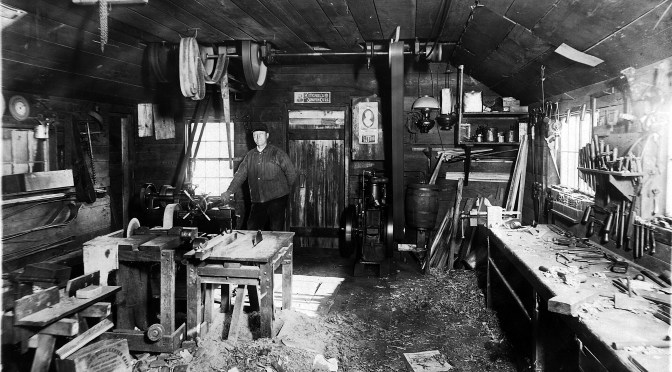
Treutel Bros. Blacksmith Shop at Vesper, Wisconsin
Charles Treutel (1869-1958) poses in the Treutel Bros. Shop at Vesper, Wisconsin, in 1911. Charles and his brother Henry A. Treutel (1864-1962) opened a blacksmith operation in Vesper after moving to Wood County from Mukwonago, Wis., in 1901. As can be seen in the photo, the Treutels also did carpentry work. The brothers later expanded their shop and made the transition from shoeing horses to tuning up engines and selling agricultural implements.
A 1911 book, Vesper, Wisconsin: A Sketch of A Model City, described the business this way:
Charles and Henry Treutel, skilled mechanics, have operated the blacksmith and wagon shop at Vesper since Nov. 1901 and have built up a large and prosperous business by courtesy and excellent workmanship. They are masters of every line of their business and are especially skilled in horseshoeing and repair work. In addition to their shop work the Messrs Treutel carry a large line of farm implements and their mechanical knowledge has enabled them to select the best makes in all the lines of machines they carry. They have a model shop fully equipped for their work.
The Treutel Bros. learned their trade from their father, Philipp Treutel (1833-1891), who came to America from Germany in 1854. As detailed in a previous post, the Treutels were blacksmiths, carpenters, tallow chandlers and tailors from near Darmstadt, Germany. Philipp Treutel is buried at North Prairie, Wisconsin.
— This post has been updated with additional information.
©2014 The Hanneman Archive

Rare 1911 Manual Shows Teacher’s Look at Life at Vesper Graded School
In a state where the one-room schoolhouse was quite the norm in the early 1900s, tiny Vesper, Wis., boasted an impressive two-story brick school building that was the center of learning for area children for decades.
Built in 1906 just off of Main Street in Vesper, the Vesper Graded School was home to students of District No. 1, Town of Hansen. We get an interesting look at life inside the school from a teacher’s record book covering the years 1911-1917. The “Welch’s System Attendance, Classification, Gradation and Close Supervision” book belonged to Ruby (Treutel) Hanneman, who attended Vesper school starting in 1913 and later taught at the school.
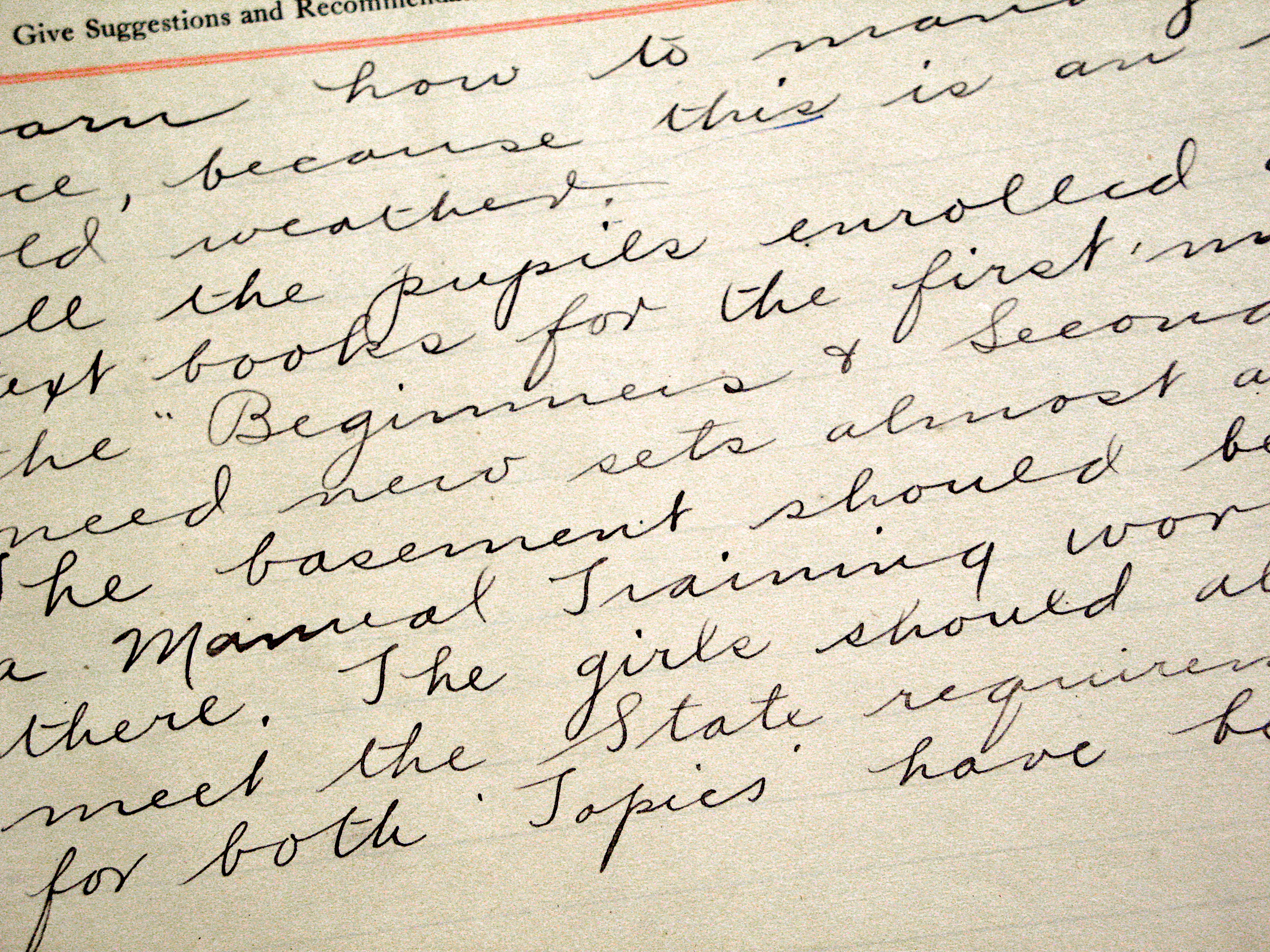
The detailed notes in the book make one thing very clear: the teacher had her hands full each school year. Not only did one woman handle teaching duties for lower and upper grades, but she had to manage the building and contend with a cranky, bulky coal furnace each winter.
During the years covered in the record book, Vesper had three teachers: Mabelle Rowland in 1911-1912, Ella H. Hessler from 1912-13 to 1914-15, and Sara Icke in 1915-16 and 1916-17. Teachers were paid between $50 and $60 per month. Ruby’s uncle, Henry Treutel, served on the school board in early years (his son Harold attended classes during that time). In the late 1920s, another uncle, Charles Treutel, was also on the board.
It seems the biggest challenge for the teachers was not in the classroom but the furnace room. The coal-fired furnace often belched smoke and gases into the clean-air intake and into the classrooms. “Before you begin school learn how to manage the drafts of furnace and cold air shafts,” wrote Mabelle Rowland in her 1912 “Teacher’s Report to Successor.” “The inspector is very critical on this work.” Teacher Ella Hessler wrote one year later: “The furnace needs repair. The smoke enters the fresh air. The furnace work in cold weather is too heavy for a woman.” Similar notations were made in subsequent years.
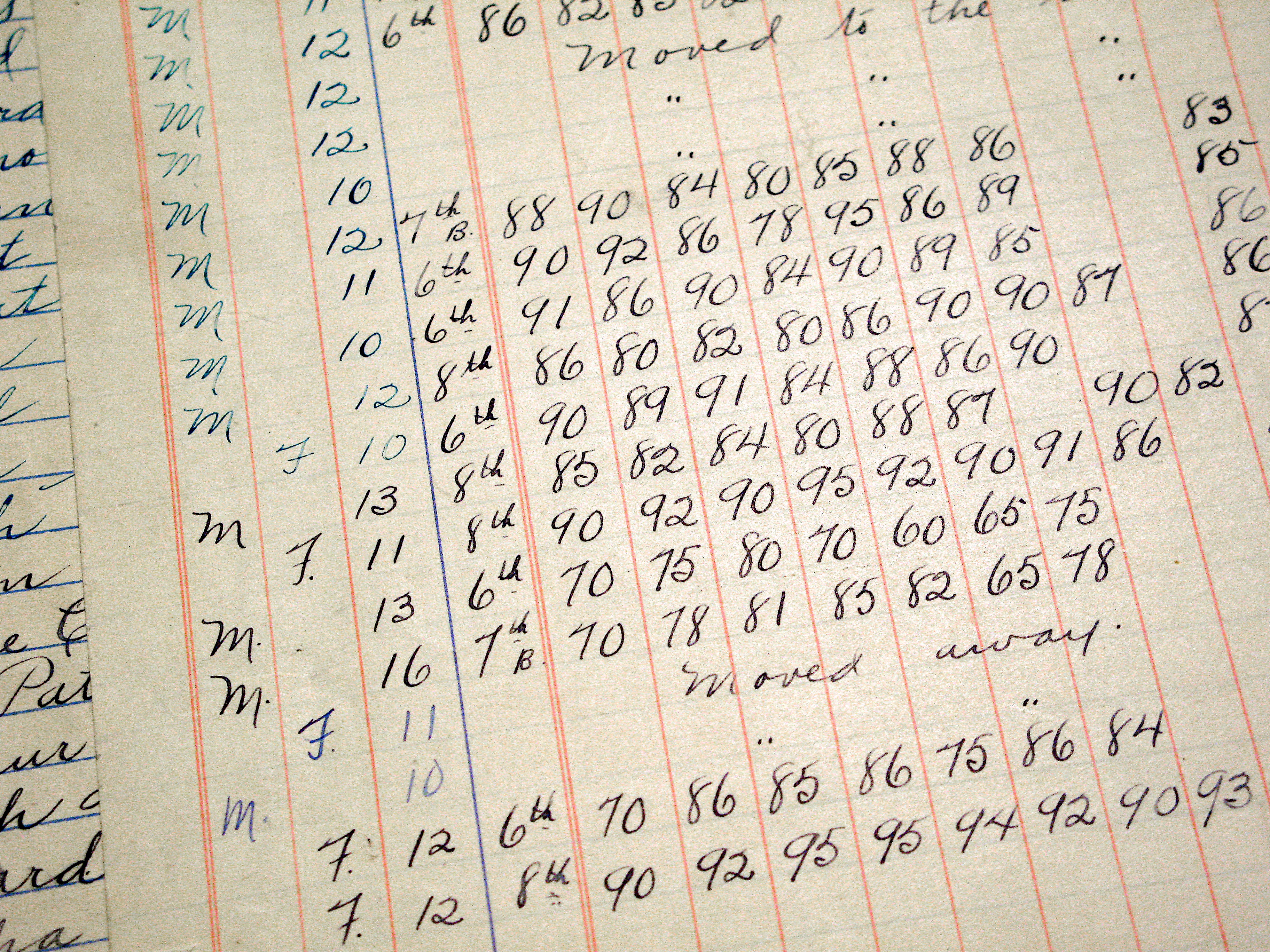
The school typically served from 25 to 40 students per term. Primary grades were on one level and upper grades on the other. The teacher staggered the subjects so she could get lessons started for one group and then move to the other. Classes started at 9 a.m. and students were dismissed for the day at 4 p.m. Course work included arithmetic, history, language, reading, grammar, physiology, domestic science for girls, manual training for boys, civics and geography.
Some of the children walked to school from homes nearby in the village, while others came in from the countryside. Tardiness was common, due to distance walked, duties at home or a pokey walking pace. In 1911-1912, Alfred and Agnes Peterson were the brother-sister tardiness champs with 20 and 17 instances, respectively. Clara Zieher had 18 tardy notations, followed by Erma Dassow with 15 (her brother Elmer had just 4). Absence from school was also common due to illness or duties helping at home. On occasion a student or two left school for a month or two to perform farm work. Arnold Conklin had best attendance in 1911-1912, only missing one day out of 180.

The book tracked each student’s attendance and progress on a range of subjects. Teachers made notations for some students that ranged from “fair worker,’ “weak eyes” and “slow” to “hard worker,” “irregular and very nervous,” and “dull.”
In the 1911-1912 school year, the school library had a mere 50 volumes. The school invested in books each year, and by June 1917 the library’s holdings included 144 books. For obvious reasons, the boys’ and girls’ out buildings regularly needed repairs and painting. The number of trees on school grounds that were in “thrifty condition” ranged from four to seven.
Ruby Treutel enrolled at Vesper Graded School in November 1913, when she was 10. There was some indication she had attended a parochial school prior to that. During her first year, Ruby missed 21.5 days and was tardy six times. Her cousin Harold Treutel had a mere three sick days. Ruby received good grades for the term: orthography, 91; reading, 95; writing, 90; arithmetic, 70; grammar, 89; geography, 83; and constitutions, 90. During the 1914-1915 school year, Ruby was out sick 20 days, but she still maintained As and Bs in all of her subjects.

During the 1915-1916 term, Ruby excelled in all of her courses, scoring solid ‘A’s in orthography, reading, grammar, U.S. history and physiology. Her lowest grade was a ‘B’ in geography and arithmetic.
Harold Treutel graduated from Vesper Graded School in 1917 and enrolled at Lincoln High School in Grand Rapids. Ruby graduated from Vesper in 1918, also enrolling at Lincoln High School. That may be where she first met Carl F. Hanneman, whom she would marry in July 1925.


The Story of Hannemans’ Stay-Off Mosquito and Insect Repellent
More than 60 years after it was first used to ward off mosquitoes and other pests in central Wisconsin, the lavender and citronella scent of Carl F. Hanneman’s Stay-Off bug repellent still lingers across time. The Mauston pharmacist invented his own blend of essential oils that provided a natural defense against biting pests, and he sold the product across the area for years.

Carl Hanneman’s inspiration for his product came from his need for extra income, and his knowledge of chemistry and pharmacology. Even in the depths of World War II, when rationing made it difficult to obtain raw materials, Carl found a way to make Stay-Off and sell it at taverns, bait shops and resorts all over the area. Due to an abundance of lakes and rivers, Central Wisconsin is known for proliferation of mosquitoes and other flying pests during tourist season.
“His being a pharmacist allowed him access to some of the compounds needed to make this stuff,” recalled Carl’s son, David D. Hanneman. The topical elixir, which used an olive oil base and a secret recipe of lavender, citronella and other essential oils, was often mixed on the back porch of the Hanneman home in Mauston, Wis. “It was kind of comical,” David Hanneman said.
Aside from providing access to the needed ingredients, Carl’s role as pharmacist at the Mauston Drug Store had other benefits that helped him sell Stay-Off on his own time. “Because he was his own dispensary, he was able to upgrade his gas card,” David Hanneman said. “So we weren’t restricted and limited in traveling. We could go back on up north and go fishing or do whatever over weekends. And we’d drop off a dozen bottles here, and a dozen bottles at that bar, a dozen bottles over at that other fishery house.”

Carl wrote his own marketing copy to help sell the 4-ounce bottles of Stay-Off. “Stay-Off is not only an excellent insect repellent, but has that cool, soothing and refreshing feeling on hot summer days,” he wrote. “It is highly recommended for women and children’s skin, producing a soft tenderness due to the semi-olive oil base.” The lotion soothes existing bug bites and provides protection against strong sun rays, he wrote.
David Hanneman said selling Stay-Off was a nice side business for the family. “It gave us nice added income,” he said, although “we never got rich off the stuff.”
The recipe for Stay-Off called for making the mixture in 1 gallon batches. A half-gallon of Stay-Off and several 4-ounce bottles survive to this day. All of the ingredients are still commercially available. So even 60 years after it was first mixed, it would be possible to make more Stay-Off using Carl’s old recipe.
1951 Photos Show Hanneman’s Standard Station at Mauston
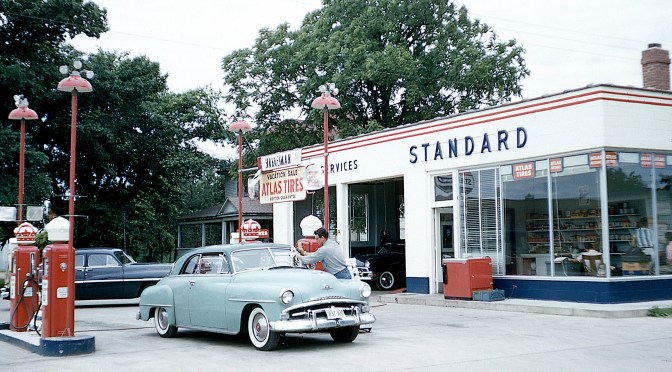
Before embarking on his long sales career, David D. Hanneman (1933-2007) briefly owned and operated a Standard Oil gasoline station at the corner of Union and State streets in Mauston, Wisconsin. Newly discovered color slides show Hanneman working at the Standard station, most likely in the summer of 1951 after his graduation from Mauston High School.

The photos show a dapper young attendant (think Clark Kent) posed outside the station, leaning on the soda cooler. Another image shows him cleaning the windshield of a customer’s auto, part of the “full service” treatment that disappeared long ago. The station featured the classic pumps that delivered Red Crown regular and White Crown premium gasoline.
During the 1950s, Standard Oil was the dominant domestic oil company in the United States. Its torch-and-oval logo was instantly recognizable to millions of Americans (even after Standard became Amoco). The Mauston Standard station stood at the busiest intersection in the city. A Kwik Trip station occupies the land today.

After owning and managing the station, Hanneman realized the job was not for him. He went on to take classes at La Crosse State (now called University of Wisconsin-La Crosse) and worked as a salesman at Dahl Motors in La Crosse, before his career in pharmaceutical and veterinary medical sales.

Hanneman Portable Pharmacy Kit Dates to 1920s
My grandfather, Carl F. Hanneman, was a pharmacist for nearly 60 years. One of the treasures he left behind was a portable pharmacist’s kit in a leather satchel. The many glass vials are still filled with various pills and powders he dispensed to patients at pharmacies in Fond du Lac, Janesville, Wisconsin Rapids, Mauston and Sun Prairie. The oldest of the prescription vials dates to 1926.


 The Hanneman Archive