The Knights of Columbus has long championed the “Keep Christ in Christmas” message to remind the public that the “holiday season” is really about the birth of the Savior. Each year, the more than 17,000 local K of C councils promote the message with car magnets, yard signs, television ads and radio spots. This Christmas messaging has been going on for decades.
The Nativity mosaic was used on a billboard along Interstate 94 in 2009.
Back in 2010, I wanted to create a 30-second broadcast commercial with this message, but we had no production budget. I found a beautiful mosaic image from the Knights of Columbus Incarnation Dome at the Basilica of the National Shrine of the Immaculate Conception in Washington, D.C. The year before, I used that image to create a billboard we placed alongside Interstate 94 in Racine County, Wisconsin.
Many Knights of Columbus councils distribute “Keep Christ in Christmas” lawn signs.
For the TV spot, we planned to use that still image with a pan-and-zoom effect, but I still needed voice talent and music. I looked no further than my then 11-year-old daughter, Ruby. She only needed a couple of takes to nail the script voiceover. My other daughter, Samantha, then 14, took to her keyboard and recorded a section of “Greensleeves.” That is the tune used for the hymn What Child Is This?
Once I put it all together, we had a very nice broadcast commercial, quite beautiful in its simplicity. The finished spot ran hundreds of times on a wide variety of cable television networks throughout the Archdiocese of Milwaukee.
This beautiful message is needed ever the more in 2025 than it was 15 years go. A secular and increasingly anti-Christian society makes it all the more important to boldly speak the faith and proclaim the coming of the redeemer of mankind, the King of all creation: Jesus Christ.
My daughters’ simple, elegant presentation was and is a perfect complement to the reality that God so loved the world that he sent His only Son through Mary, the Ark of the New Covenant, into the world to save men from their sins.
This Divine rescue mission, envisioned from all eternity, continues today. Welcome Him into your hearts. Ask Him for the faith to truly understand the mission of the Redeemer. For more than two millennia ago, a Child was born and placed in a manger, in Bethlehem the “House of Bread.”
My business donated the cost to place this billboard along Interstate 94 in Racine County, Wis.
Jesus the Bread of Life beckons all to follow him, worship Him and be one with Him through Holy Communion: the Body, Blood, Soul and Divinity of Christ. He is really and truly present in all of the tabernacles around the world, and wherever/whenever Holy Mass is offered.
I am a third-generation Knight of Columbus. In my time as grand knight of Racine Council 697, Captain of Fourth Degree Assembly 1207, and a founder of Racine Council 15659, Christmas projects were always close to my heart. Whether delivering gifts to children whose families could not afford them to helping erect a Nativity creche on Monument Square (see photos above), they all remain precious memories.
(The staple in the corner of the document was rusted. That gave me an idea of how long the story below sat in my paper files, unused. When finding this recently, I chuckled at the list of big publications I wanted to send it to. That never happened. It has been some 30 years since I wrote this. Mom and Dad are gone now. My three children are grown. But the memories of those days are still so vivid, of a cherished canine friend.)
I stood in my bedroom that Sunday night in July, tears rolling off my face and sobs shaking my body. An uncontrollable tide of grief welled up inside me, and although my wife Sue was with me in the room, I suddenly felt very alone.
I wasn’t prepared for how I would feel when you died, probably because I never thought I would have to face the situation. But now the shock of realization hit me with incredible force.
A million thoughts raced through my mind as I tried to come to terms with the news. I was at a loss as to why I was taking it so hard. I wondered if I was abnormal. The same feelings of loss and desperation haunted me as if Mom or Dad had died. But my tears were not for them. I was crying for you, Korby, my big-hearted, beautiful golden retriever.
As I sat down and sobbed into my hands, I remembered you laying on the hallway floor the last time I saw you. You couldn’t get up to play, or to take a walk around the block like you loved to do. I knew you were sick, but I convinced myself you would get better. I was sure that nothing— not old age, not sickness — would get the best of you. But when Mom and Dad called to say they had to put you to sleep, it cut me to the core. I could not accept that your time had come, and I didn’t want to believe that someone who added so much to my life was gone.
His legal name was Korbel: My BrandyMan, but we called him Korby. With me in 1986, college graduation day.
A rush of memories passed in front of me, and I realized just what I would be missing the next time I stepped foot in Mom and Dad’s house.
I remember the day Dad brought you home. You were an adorable, long-eared puppy with huge paws and the enthusiasm to match. You charged across the front lawn and jumped into my lap, chewing on my hand with your baby teeth. I was afraid of dogs, but you seemed different to me. You had boundless energy and limitless affection. It would have been hard not to fall in love with you.
I remembered how strong-willed you were while growing up. You were good at heart, but you always did what you wanted and went where you pleased. I’ll never forget the day you flunked out of dog obedience school because you couldn’t sit still. While other dogs were heeding commands to stay, you opted to run around looking for someone to kiss.
Your playfulness and spunky character quickly became the talk of the neighborhood. I always wondered what the neighbors thought when they rang the bell and you came to the door with an old shoe or pair of underwear from the laundry pile in your mouth. I’d laugh when they reached down to accept the gift you brought them and you ran away. Your face seemed to say “chase me,” and I always did. I never got sick of galloping around the living room until I was able to tackle you and retrieve what you had in your mouth.
The nights I came home late from work or school, no matter what the hour, you always came downstairs from your bed to greet me. Half the time you remembered to bring a gift, like one of Dad’s slippers. Your groggy eyes told me how much of an effort this was for you, but you came just the same. Even if you were sleepy, you always waited for me to go to bed before you went back upstairs. Thanks for watching out for me.
Joe and Korby: Christmas in the mid-1980s
The year after college when I was looking for full-time work, we became constant companions. After Mom and Dad went to work each morning, I waited for you to push my bedroom door open with your nose, then jump on the bed and fall asleep until I was ready to get up. Later in the day, if we had nothing else going (which we usually didn’t), we’d take a walk. I loved your reaction when I looked at you and uttered that golden phrase: “You want to go for a walk?” You cocked your head sideways as if to say, “Really?” Then all I needed to say was walkie to set you barking and dancing by the garage door. You got so excited on our walks, sometimes I thought you’d pull me off my feet.
Then there were the car rides. Sometimes I’d ask you if you wanted to ride in the car, just to see how happy it made you, even if I had nowhere particular to go. You were always first in the car door, pushing your way past me into the front seat. You were quite a sight, with your big head out the window and lazy tongue hanging out. When you sneezed on the window from the cold air blowing up your nose, I’d cringe and make a mental note to buy some Windex. And there was all that dog hair you left on the upholstery.
What I wouldn’t give to hear your “achoo” on one of those rides now.
During the winter, I remember us going into the back yard to play our version of canine football. I took off my hat and threw it like a Frisbee across the frozen yard. Then the race was on. It was too hard to catch you, but I always managed to get in a few good tackles. Thanks for letting me win a few. You were a good sport.
Korby loved to romp in the snow, chasing a football or any other object (hat, mitten, etc.)
One of my favorite games inside the house was when you came over to me with one of those worn out yellow tennis balls in your mouth. Being as coy and you could, you dropped the ball in front of me, but as soon as I made a move for it, you snatched it back. It was really funny how you loosened your grip on the ball just enough to let me think I could get it away, then clamped down on it when I tried. I don’t think I ever laughed so hard as when I rolled the ball down the hall and you chased it so hard you slid on your rear into the kitchen table. Whenever you got frustrated with the game, you took the ball between your paws and pulled the fur off it with your teeth. You gave us an impressive collection of bald tennis balls.
“You were not just my dog, or my pet. You were a part of me.”
You were always a great ally, Korb. I remember that year between college graduation and my first full-time job, when things got so frustrating I sometimes ended up in tears. But you were always there to lick my face and let me know things would be all right. And last Christmas Day, when Sue got called off to war with the Army Reserve, you knew I was upset and stayed by my side all weekend. Thanks for being so supportive.
You gave us plenty to smile about on Christmas mornings. We were all busy with our exchange of gifts, but you wouldn’t stand to play second fiddle to a bunch of wrapped packages. It became a Christmas ritual to watch you dive into the discarded wrapping paper, throw it in the air, then catch it in your mouth before tearing it to bits. Thanks to you, the living room looked like the wake of a paper tornado. I tried to save two or three stick-on bows, because I knew how much you loved pulling them apart. By the end of the morning, you usually found your gift, just by the smell of the rawhide emanating from under the wrapper. I still have a picture of you struggling to carry the 3-foot-long bone we gave you one year.
Korby helping cousin Laura with one of her gifts in the early 1980s.
One of my most vivid memories of you was from dinner time. It seemed that when it came to food, you had no idea you were a dog. Every day was the same story. Your bowl of food was put down at 4:30, but you preferred to wait until 5, when we sat around the dinner table. Like a professional panhandler, you made the rounds. You knew I was a soft touch. I figured that was why you always slid your nose into the crook of my arm and pushed your way in until your face was practically on my plate. I always gave in and slipped you a scrap of meat or a few vegetables. I could never figure out why you loved peas and carrots so much, but that came in handy for both of us. When you didn’t get what you wanted, did you have to knock your bowl of food over onto the floor? Oh well, just part of your strategy, huh?
What I wouldn’t give now to see you make that mess again.
I hope you don’t think we didn’t notice the one night you put your big paws on the kitchen table while we were in the other room and stole half the pizza. And Mom figured out real fast the time you plundered an entire ham from the counter. You probably figured you were doing Mom and Dad a favor the nights they had bridge club, by moving from one snack dish to the next, cleaning out the contents.
After I moved to another city with my job, coming home to visit you was a special treat. You made me feel so important when I came through the door. You grabbed a shoe and headed for the hills, and the chase was on until I tackled you. I always thought I was winning when I caught you, but now I realize that’s what you wanted in the first place. But I got my revenge when I’d take a dog biscuit, put it in my mouth and get down on all fours. You had a hard time getting the bone away from me. Well, at least until you threw your 100-pound frame on my back and knocked me over.
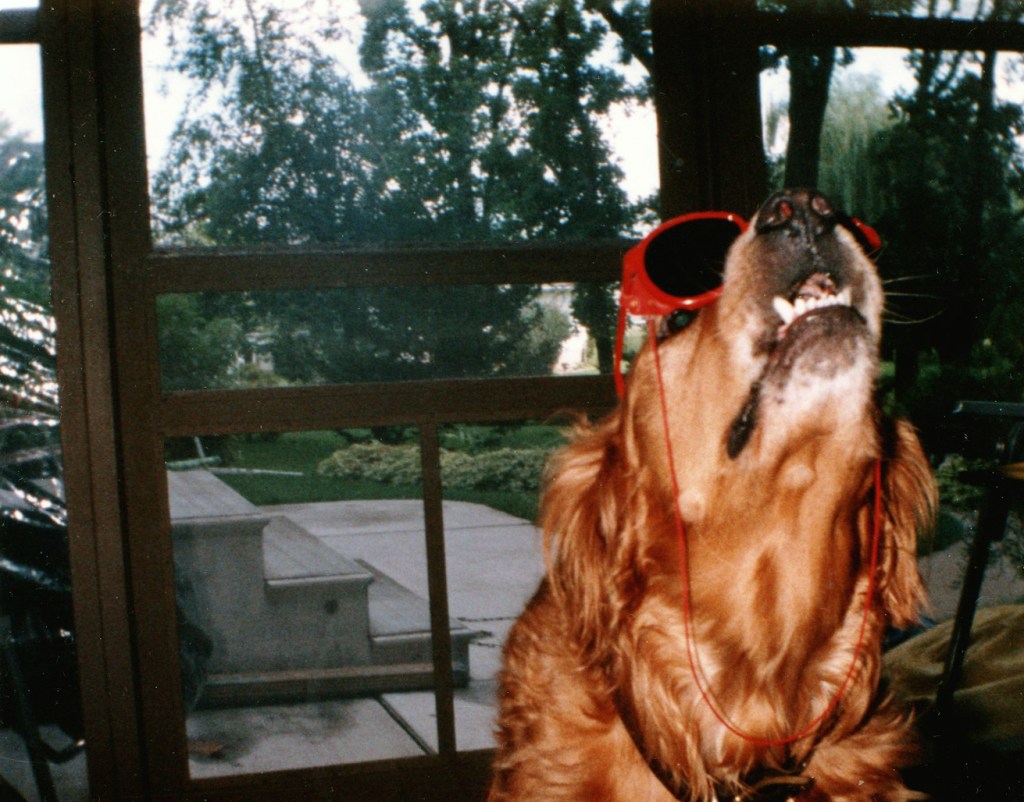
Korby wasn’t so fond of wearing someone else’s ski goggles.
After roughhousing for a while, I liked to lay down next to you and give you a big bear hug. You looked so peaceful as I scratched your ears and petted you. I’ll never forget the feeling of your smooth golden fur or the softness of your floppy ears. Your eyes would drift shut and your breathing grow deep. Then, just as you fell asleep, your paws would wiggle as if you were running. I used to wonder if you dreamed about running in a big, open field. I’ll bet that’s where you are now.
You always broke my heart when Sunday afternoon came and I had to pack up to go home. As I would gather my belongings, you looked up from the couch with big puppy eyes that seemed to say, “Aw, c’mon, don’t leave!” You got me to stay that one time when you grabbed my wrist in your mouth and pulled me back in the door.
Now that you’re gone, I wish I had stayed more back then.
Every time I called home, I got a sense of security and homesickness alike when I heard your bark in the background. Barking was one of your passions. It didn’t matter if it was a squirrel or bird in the back yard, or a common housefly on the sliding glass door that was your window to the world. You let out a resonating “woof!” that jolted anyone within 20 feet and shook the rafters. Just when we thought your eyes might be getting bad, you proved us wrong by barking at someone walking two blocks away.
When your fur started graying, I got a twinge of concern, and for a moment I was afraid you were getting old. But those thoughts always vanished in the face of your still-playful nature.
But last spring, I caught myself again worrying when you gained a lot of weight and had to be put on special medication to flush a buildup of water from your body. You got better for a while, as I was sure you’d be with us for years to come. And even though you were losing weight, I told myself you’d be fine.
Korby in his younger days, with David, who would be there for Korb in the end.
Then came one Friday I was home for a visit. You looked tired as you staggered over to greet me for a moment, then laid back down to nap. When I sat down to eat my lunch, you struggled and almost fell over trying to get up to come get your share. But after that second piece of pepperoni from my pizza you perked up. And again in the face of evidence that you were slowly leaving us, I believed you were fine. I hugged and kissed you extra long before heading home that day.
But the next day, when our brother David was up to see you, you didn’t get up at all. Even your favorite word walkie wasn’t of interest. You didn’t know it then, but Mom and Dad were worried. They had talked about having Dr. Sartori come over during the week and put you to sleep while they were away. They didn’t want to see you go. But David said no, if it was your time, he wanted to be with you.
So David, God bless him, took you outside for a short walk, then put you in his car. I picture the two of you as you drove down all the side streets on the way to the vet’s office. You even had your head out the window, just like old times.
The vet was not surprised to see you. We later found out you had cancer growing in you that caused you to lose weight and age so fast. When the vet came into the waiting room, you slumped to the floor, just like you always did when you didn’t want to go somewhere. You were vintage Korby, right to the end. It was so hard for David as he held you in his arms while the doctor gave you a shot. He could feel you relax as your worldly troubles slipped away.
One of Korby’s favorite spots: his side of the couch. Mom’s feet are in the shot.
But just as your pain was ending, Korb, ours was just starting. Tears flow from me every time I think of you. It’s going to be so hard to go into that house and not hear the click of your nails on the floor, or see that shoe or pair of underwear dangling from your mouth.
But writing this, I finally understand my powerful reaction to your death. You were not just my dog, or my pet, but a part of me. You knew me so well. Your selfless nature and affection did more for me that you probably ever could understand. Until I met my wife, you were my very best friend, whom I grew desperately close to. Even when I got married, you didn’t hold it against me. Thanks for that.
I know that I’ll always shed a few tears when I look at your picture or think about you. But I’ll also smile, because I know you’re somewhere much better now.
I can’t say goodbye to you, Korb. It would hurt too much. So keep that shoe handy. I’ll chase you again someday.
We met only briefly, 55-plus years ago. It was in Grand Rapids, a city on the eastern shore of Lake Michigan, directly across from Milwaukee. It was a Saturday; 9:04 a.m. to be exact. She named me Patrick.
I won’t know on this side of eternity whether she had a chance to hold me or say goodbye before the nurses whisked me away to my new life. After spontaneous labor of 2 hours 14 minutes, there I was, all of 7 pounds 11 ounces, a “normal newborn boy,” according to the obstetrician’s notes.
Just like that, I was gone. So was she, the woman who gave birth to me in June 1964.
I thought of her often while growing up, and especially when I married and had my own children. After on-and-off searching for decades, I finally learned her identity in 2018. I so hoped to have a chance to meet her face to face, or at least to speak via telephone. I sent her letters and photographs of my children. It was not to be.
In August 2020, a Google search brought a real shock: she died in late March at age 78. I sat and stared at her photo in the the online obituary. I felt stunned, like being punched in the solar plexus. This can’t be. A few days earlier, I had decided I would make a cold call to her house and determine once and for all if she would speak with me. Now I can’t.
She was there, and then she was gone.
***
Hello, I must be going. That phrase is the title of a 1930 Marx Brothers song, the 1978 biography of comedian Groucho Marx and the second studio album of British pop icon and singer Phil Collins. The words came into my head and stuck there after I discovered that my birth mother had died.
I would never get a chance to meet her in this life.
My adoption story began in September 1963, when a 21-year-old Michigan State University student unexpectedly became pregnant. After a few months, she moved from her home in East Lansing, Mich., to the Salvation Army Evangeline Home and Hospital in Grand Rapids. It was there she gave birth to me on June 27, 1964. I was turned over to the Catholic Service Bureau of the Diocese of Grand Rapids for adoption.
My first official portrait as a member of the Hanneman family.
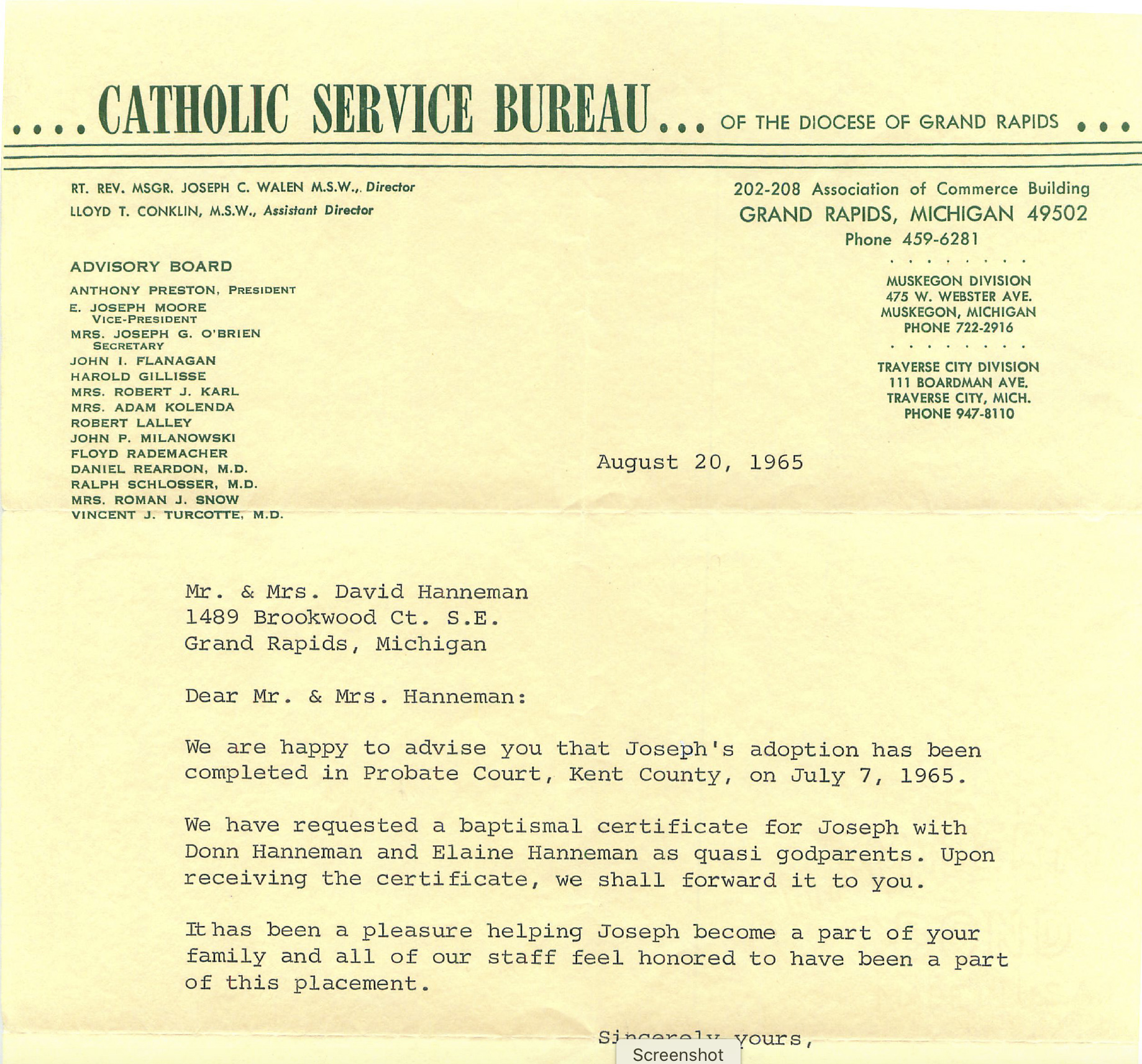
After three months in foster care, I was placed with a couple from suburban Milwaukee who had recently moved to the Kentwood section of Grand Rapids. Thus I began my life as Joseph Michael Hanneman, the son of David D. Hanneman of Mauston and the former Mary Katherine Mulqueen of Cudahy. My adoption was finalized on July 7, 1965, just in time for our family to move to Sun Prairie, Wis.
I had a very good upbringing by two faithful Catholic parents, but I was always curious about my birth parents. Who were they? How did I end up in the adoption system? Mom and Dad shared what they knew: my heritage was Irish, Polish and Swedish. One of my biological grandfathers was very tall, maybe even 6 foot 6 inches. That was about it. Not much to go on.
My parents received this August 1965 letter informing them that my adoption was now final.
In 1986, after graduating from the University of Wisconsin-Madison, I moved back home for a time while searching for a full-time job in newspaper journalism. I decided to put my reporting skills to work to learn more about my ancestry. Mom and Dad kept their important papers in a metal 4-gallon cherry can under the sink in the downstairs bathroom. Michigan cherries, of course. I found a packet of information there on my adoption. There was a finalized court order signed by Probate Judge A. Dale Stoppels of Kent County, Mich., and a letter from caseworker Schuyler B. Henehan at the Catholic Service Bureau of the Diocese of Grand Rapids. It wasn’t much, but it was a start.
The final adoption order signed in July 1965 by Probate Court Judge A. Dale Stoppels.
I wrote to the adoption agency and made a request for any and all information they had about my adoption. I also sent a letter to the Adoption Central Registry in Lansing to inquire if either of my biological parents had signed a waiver of privacy stating I could be told about their families. Not wanting my parents to feel hurt that I was doing this research, I rented Post Office Box 1106 at the U.S. Post Office in Downtown Madison. I received my first reply on March 31, 1987, from adoption search specialist Bonnie Kooistra at Catholic Social Services of Kent County. It didn’t provide any real clues to my birth mother or father’s identity, but did fill in some key details.
The letter said my birth mother was 22 at the time of my birth. She had light brown hair, dark brown eyes and a fair complexion. She stood 5 feet 4 inches tall. She was a Roman Catholic in her second term at Michigan State. The case workers at the time described her as “a shy, withdrawn person who was in poor health.” She had some serious medical issues. Her father was 55 and had a white-collar job, and her mother was a housewife, age 54.
A letter arrived from Michigan in March 1987.
My birth father was 25 when I was born, although there was no indication in the correspondence that he had any role in the adoption. That was typical in those days. I couldn’t even know if he was aware of my birth. He had red hair, green-gray eyes and freckles. Sounds familiar. He stood 5 feet 10 inches tall. He was a senior at Michigan State and adhered to no religion. “He was considered easygoing, kind, not temperamental,” the letter stated. His heritage was listed as Irish.
The letter further explained that I was not entitled to any identifying information under Michigan law. So they would not tell me the name of the hospital in which I was born. “I have never heard of a judge ordering a release of information,” Ms. Kooistra wrote. That made me frustrated and angry, but it appeared there was little I could do to obtain more information.
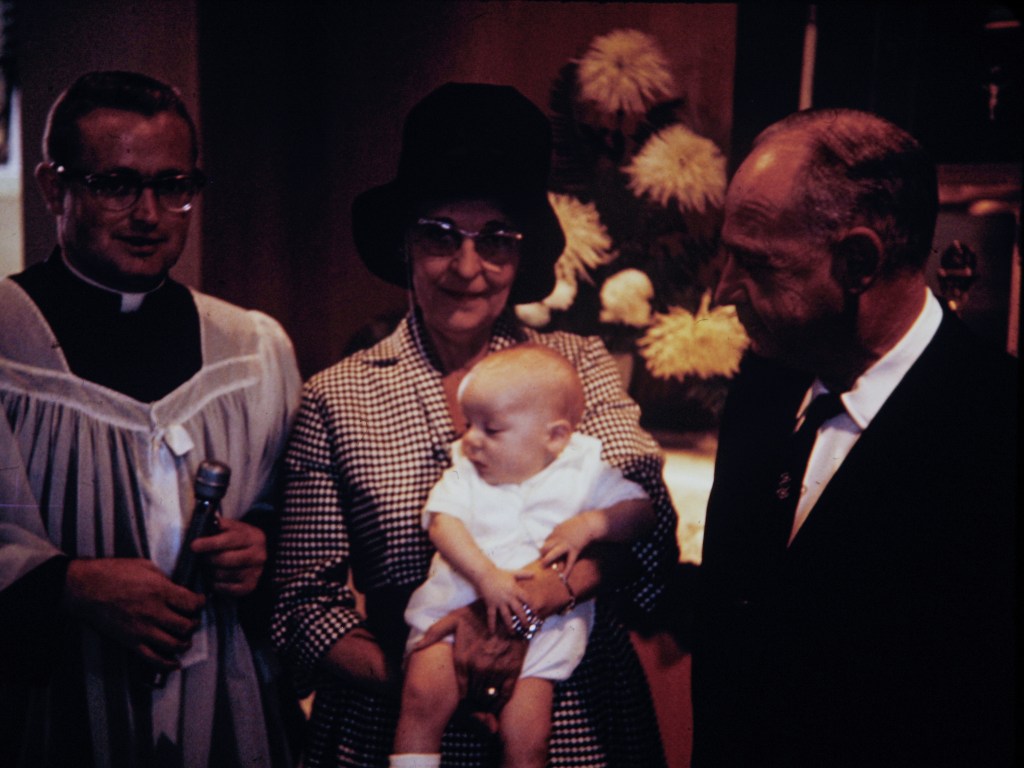
This appears to be my baptism, which is a mystery. I was baptized at the Cathedral of St. Andrew in Grand Rapids in July 1964 under my birth name. Holding me here is my adoptive grandmother, Ruby V. Hanneman, with grandpa Carl F. Hanneman. The priest who baptized me in 1964 was named Rev. Vincent Kamarauskas from the cathedral. The priest pictured is unidentified.
I didn’t make another attempt to learn more about my adoption until December 1994. I was now married with a nearly 3-year-old boy. I looked at his crop of red hair and started to wonder again about my ethnic heritage. I wrote to Catholic Social Services in Grand Rapids. This time, they were able to tell me more, due to changes in the law. The letter from adoption specialist Sandra Recker had a wealth of detail, including the county my birth parents came from (Ingham) and the name of the birth hospital (Salvation Army Evangeline Home and Hospital).
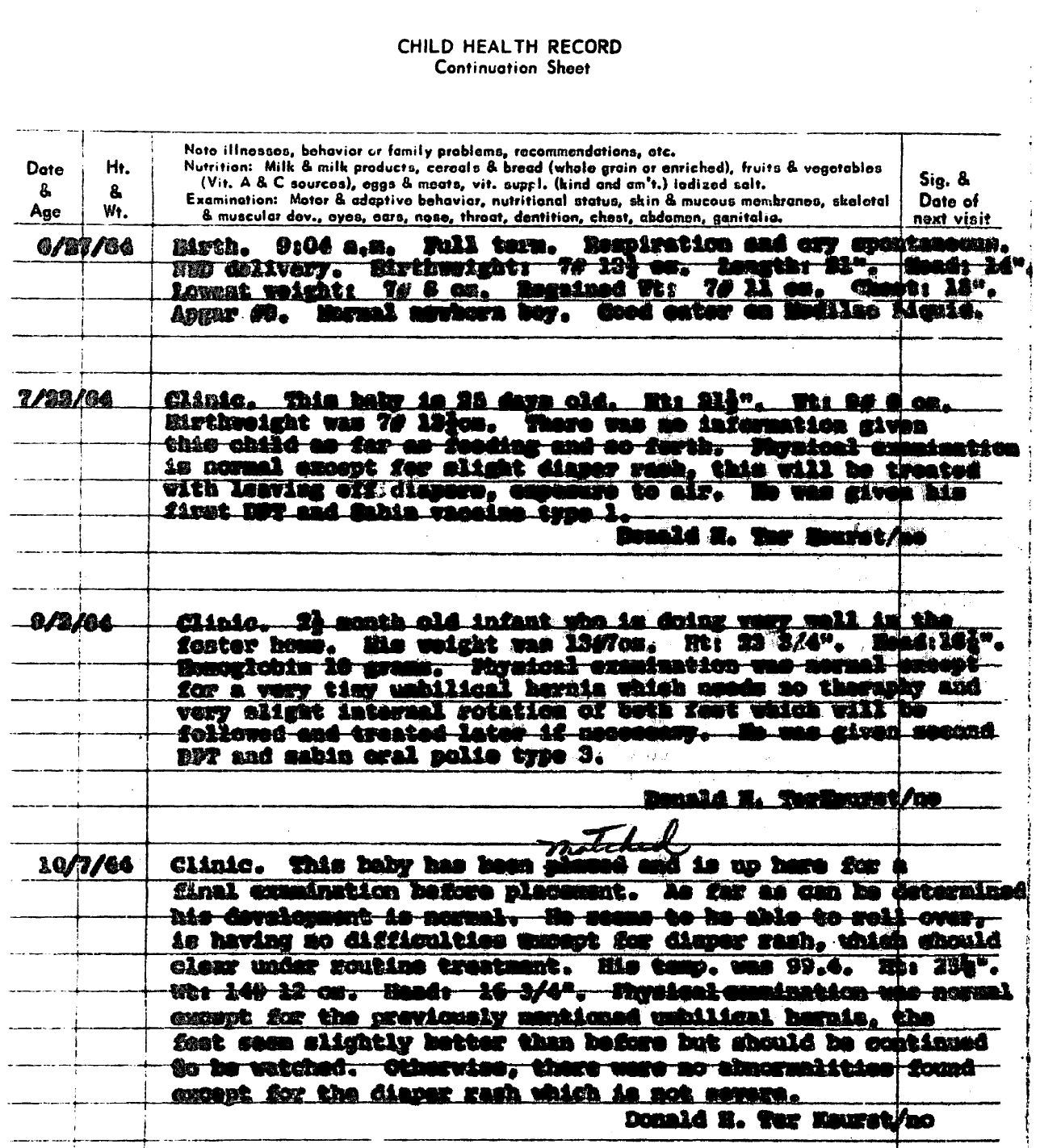
The letter said my birth mother was in her second term of college, and my birth father was a college senior who worked at the campus newspaper. She was in poor health with a chronic medical condition that could be life-threatening. Sandra included a photocopy of my medical record from my time at the hospital and in foster care. It contained four listings, including the day of my birth and three visits to the pediatric clinic. It was difficult to decipher, but eventually I determined the pediatrician was Dr. Donald H. Ter Keurst (1932-2004), a 1957 graduate of the University of Michigan Medical School.
There were four entries in my health records; three of which were signed by a pediatrician, Dr. Donald H. Ter Keurst of Grand Rapids.
I’d made good progress since my search began in the mid-1980s and, for now, this satisfied my curiosity about my personal history. But it continued to nag at me. I became very involved in genealogy research after the 2007 death of my Dad. I was able to trace his family history back to at least 1550 in the Baltic Duchy of Pomerania. But I could only guess at my own roots. That didn’t sit well with me.
During the 2014-2016 time frame, my two daughters began asking questions about their ethnic heritage and history. Now ages 15 and 18, they’d not expressed much interest before. So this gave some motivation for me to set out and hunt for clues to my origins. For the third time in 30 years, I wrote to Catholic Social Services in Grand Rapids, hoping to learn more than in the first two attempts. Based on that correspondence, it appeared my best bet to learn more would be to petition the court for a “confidential intermediary” who would locate the birth parents and see if they would be willing to establish contact.
At this time I was doing freelance writing for a European agency that develops articles and other content for web sites. (You can read their feature article on my search here.) One project was to analyze the variety of home DNA tests being marketed for genealogy. By the time this project was complete, I took a half-dozen DNA tests from vendors such as 23andMe, AncestryDNA, National Geographic, Family Tree DNA and MyHeritage. As it turned out, the writing project brought the breaks I needed to solve my history puzzle.
***
Nov. 27, 2016 was a monumental day. I received an email from 23andMe.com informing me that my DNA test results were available. I would finally get some estimate of my ethnic heritage. Was I really Irish, Polish and Swedish? As it turned out, that information was small potatoes. I clicked on the link for “DNA Relatives” and was confronted with a bunch of matches. Actually there were 1,500 matches, but the one atop the list stuck out: 26.22% DNA shared in 48 segments. Possible relationship: half-brother. What?
I stared at the results for a few minutes, still in shock. I didn’t expect to log in and find a brother atop my list of matches. The web site had a messaging feature. I quickly typed this note and sent it off to someone listed only by his initials:
Hello, my recently acquired DNA results indicate you might be my half brother, possibly on the maternal side. I was adopted in Michigan and have been seeking information on my birth parents.
23andMe Text Message
I logged onto the site every day, but didn’t see a reply until Dec. 5. Based on my new relative’s first note, I don’t think it sunk in that we were so closely related. “John, interesting results,” he wrote. John? A few minutes later, he came back and wrote, “Joe, I was adopted as well in Michigan, 1962. ….I would love to chat with you. It’s Monday Dec. 5, around 4 p.m. …hope to hear from you soon, Brother….!” We were able to talk via cell phone later that night. It was an incredible day. For Sean, I was his only known blood relative (aside from our birth mother and his own children).
It sure was nice to have someone with whom to confab about genealogy. We shared all of our research and looked for commonalities. Sean told me that he enlisted help from a Catholic social worker in 1993. She made contact with our birth mother. Our mother didn’t want to have contact with him at the time, but she filled out a long medical questionnaire. (Sadly, the social worker who spoke with our birth mother did not record her name or contact information, even in the confidential files.)
From that questionnaire I learned that my maternal grandfather was over 6 feet tall and 220 pounds; a “take-charge guy,” according to her notes. His wife was small and rather quiet, but very involved in their Catholic parish. She died tragically in 1965. Her father was a chemist. These clues would all come in handy before too long.
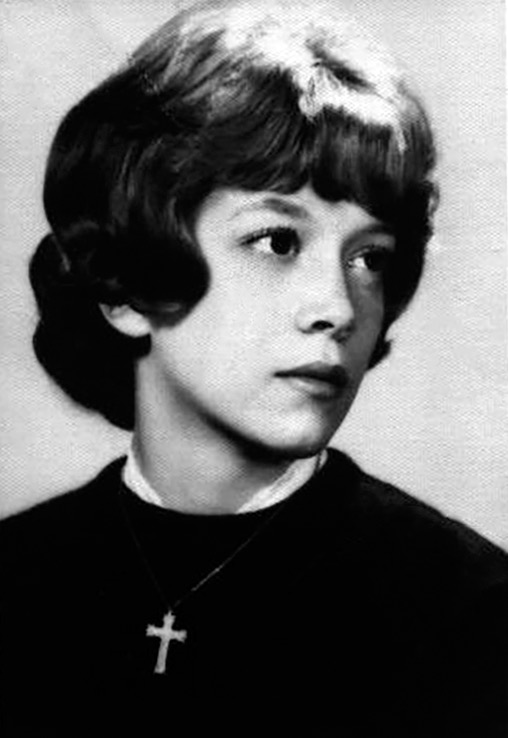
The high school portrait of Mary Patricia Walsh (1942-2020).
During the summer of 2018 we received two key clues from Sean’s relatives. One told us that our birth mother went by her middle name. Another weighed in with a huge clue: she thought our birth mother’s name was Pat Walsh. Whoa! With this bit of information and the other data points, I set off into my genealogy databases. It didn’t take long to find the likely candidate family. Her name was Mary Patricia Walsh, the only daughter of Howard C. Walsh and the former Mary Olive Switalski. She fit every data point from the questionnaire she sent Sean. We had solved the biggest mystery in either of our lives.
At about the same time, my DNA test results from AncestryDNA came in. I was an experienced Ancestry.com user and knew their database of users was huge compared to any other genealogy company. I got another shocker when viewing my DNA matches, another brother. This time, it turns out, it was from my birth father’s side. I sent a message to the account holder and waited.
In the mean time, I had several other matches who were likely second cousins, so I reached out to them while poking around their online family trees. Before the reply came from my new half-brother, I determined the identity of my birth father. Sadly, he died in December 2013 at age 74. Before I had the first phone conversation with my brother Dave, I obtained a letter from the adoption agency confirming my birth father’s identity. I will write more about Bill in a separate post. He was a good man, married for more than 50 years with two great children, Dave and Kelly.
***
It would be difficult to overstate the importance of learning the identity of my birth parents. While it did not lead to any in-person introductions, it opened up my entire genealogy. With hard work and research, I would soon be able to trace my maternal history to a village in County Kilkenny, Ireland; a rural area in Yorkshire, England; a city in Poland and somewhere in Sweden. Both maternal and paternal families had an emigration path that ran through Cincinnati and greater Ohio. Plenty of work to do.
My birth mother got married a little more than a year after my birth. She and her parents were communicants at St. Thomas Aquinas Catholic Church in East Lansing, Mich. A year after she married, her mother died very suddenly at age 55. My birth mother did go by her middle name: Tricia when she was younger, Pat in adulthood and later changed to Trish. She had one sibling, John Howard Walsh Sr., who died in 2015. Her three sons now live in the Carolinas, which is where she died on March 27 after battling cancer.
While my genealogy search did not lead to meeting either birth parent, I am much richer for the effort. I have six “new” half-siblings, three of whom I’ve gotten to know from a distance. I hope to visit Michigan next summer. The hospital where I was born is still there, although it’s no longer a health-care facility. There are many people to meet face to face.
We can start with “hello.” •
Epilogue: On Christmas Day 2020, I received an incredible gift: the remaining contents of my adoption case file. The nearly 20 pages of documents confirmed all I already knew. It added some wonderful detail, too. My full birth name was Patrick Kevin Walsh. It appears my birth mother did spend some time with me before I went into foster care in early July 1964. My foster care was either in a facility named McMillan or with a family with the McMillan surname. There are many other bits of information that are new to me. These documents scanned from microfilm turned out to be a wonderful Christmas present.
Howard C. Walsh ran for City Council in East Lansing.Mary PatriciaTricia exhibited a painting in 1954.July 1965 wedding portrait from the Lansing State Journal.
Song has the power to totally capture a memory or preserve a time in life that is worth remembering. Everyone most likely has a song that transports them back in time and helps them relive a painful, sweet or wistful memory. Music is truly the thread that stitches together the sometimes-ragged patches of our lives.
This was quite powerfully the case during the last weeks of my mother’s life in December 2018. The title song from Kenny Loggins’ debut solo album, Celebrate Me Home, became the anthem for the walk I made to see my mother off to Heaven. Just the first few twinkling notes on the piano are enough to bring me back, and draw bittersweet tears from my eyes. Every time.
“Play me one more song that I’ll always remember.”
I often listened to CDs on my drive each evening to the Brookdale Senior Living care center where Mom spent her final months. One of my favorites was Yesterday, Today, Tomorrow, a compendium of greatest hits by Kenny Loggins. The first time I heard Track 14, Celebrate Me Home, I sensed it was previewing the events that would soon unfold, leading up to Mom’s death at age 86.
Mom holding Ruby Hanneman, flanked by cousins Samantha and Abby Hanneman.
Each night after Mom fell asleep watching television, I would quietly slip out and make the 10-minute drive home. Many times I played that CD. Celebrate Me Home always put a lump in my throat. I could sense a little more every day that Mom was moving closer to her eternal home.
Please, celebrate me home Give me a number Please, celebrate me home Play me one more song That I’ll always remember
In the early morning hours of Dec. 27, 2018, this song overwhelmed me on my drive home. Searing tears made it hard to see the road. Mom had passed away two hours prior, just before midnight on Dec. 26. (I wrote about that elsewhere on this site.)
As I pulled up to the stoplight at Broadway Drive and Highway 19, the lyrics hit me in a way they hadn’t before. Celebrate. Home.Beyond the grief was the reality that Mom’s going home was a cause for celebration. No doubt all of Heaven celebrated that night, for she entered eternity free from pain, sickness and the worries of this world. Just one day beyond Christmas, her favorite holiday.
Home for the holidays I believe I’ve missed each and every face Come on and play one easy Let’s turn on every love light in the place It’s time I found myself Totally surrounded in your circles Oh my friends Please, celebrate me home…
For many months after Mom’s funeral, I could not listen to the Kenny Loggins CD. That song. It was seared into my brain like the work of a branding iron. Too painful. But eventually I found myself listening again. Now I could see through the pain, and felt the hope and joy in the melody and lyrics. Celebrate, celebrate. Celebrate me home.
Play me one more song That I’ll always remember I can recall whenever I Find myself too all alone
I can make believe I’ve never gone
Then I’ll never know where I belong Sing me home
I am forever grateful for the incredible talent that went into making Celebrate Me Home. It will always be atop my all-time play list. Until that one day when others might sing this beautiful song to celebrate me home. •
A group of sparrows perched on the edge of the bird feeder outside Lloyd Miller’s window, pecking at the seeds like there was no tomorrow.
Oblivious to the man watching them from just feet away, the birds went about their business, then flew away. They are a living reminder of just how much Miller’s life has changed in the past four years.
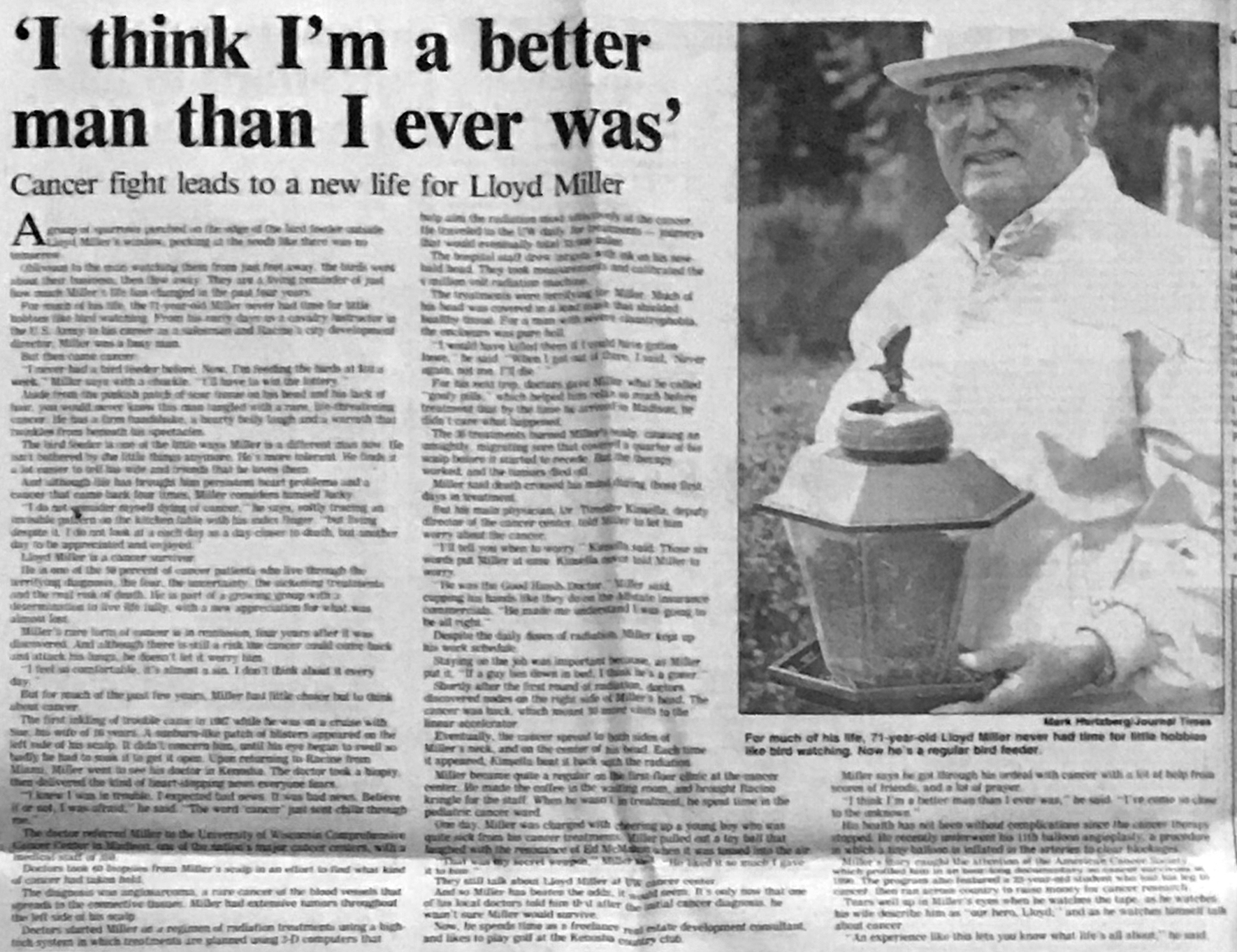
This story was part of an award-winning 12-page special section published in The Journal Times on Dec. 1, 1991. The project won awards from the Wisconsin Newspaper Association, the American Cancer Society and the American College of Radiology.
For much of his life, the 71-year-old Miller never had time for little hobbies like bird watching. From his early days as a cavalry instructor in the U.S. Army to his career as a salesman and Racine’s city development director, Miller was a busy man.
Then came cancer.
“I never had a bird feeder before. Now, I’m feeding the birds at $10 a week,” Miller says with a chuckle. “I’ll have to win the lottery.”
Aside from the pinkish patch of scar tissue on his head and his lack of hair, you would never know this man tangled with a rare, life-threatening cancer.
He has a firm handshake, a hearty belly laugh and a warmth that twinkles from beneath his spectacles.
Life has changed
The bird feeder is one of the little ways Miller is a different man now. He isn’t bothered by the little things anymore. He’s more tolerant. He finds it a lot easier to tell his wife and friends that he loves them.
And although life has brought him persistent heart problems and a cancer that came back four times, Miller considers himself lucky.
Lloyd Miller never used to have time for hobbies. Now he’s a regular bird-feeder. — Journal Times photo by Mark Hertzberg
“I do not consider myself dying of cancer,” he says, softly tracing an invisible pattern on the kitchen table with his index finger, “but living despite it. I do not look at each day as a day closer to death, but another day to be appreciated and enjoyed.”
Lloyd Miller is a cancer survivor.
He is one of the 50 percent of cancer patients who live through the terrifying diagnosis, the fear, the uncertainty, the sickening treatments and the real risk of death. He is part of a growing group with a determination to live life fully, with a new appreciation for what was almost lost.
Miller’s rare form of cancer is in remission, four years after it was discovered. And although there still is a risk the cancer could come back and attack his lungs, he doesn’t let it worry him.
“I feel so comfortable, it’s almost a sin. I don’t think about it every day.”
But for much of the past few years, Miller had little choice but to think about cancer.
The first inkling of trouble came in 1987 while he was on a cruise with Sue, his wife of 16 years. A sunburn-like patch of blisters appeared on the left side of his scalp. It didn’t concern him, until his eye began to swell so badly he had to soak it to get it to open. Upon returning to Racine from Miami, Miller went to see his doctor in Kenosha. The doctor took a biopsy, then delivered the kind of heart-stopping news everyone fears.
Lloyd Miller’s story as it appeared in the Journal Times on Dec. 1, 1991.
“I knew I was in trouble. I expected bad news. It was bad news. Believe it or not, I was afraid,” he said. “The word ‘cancer’ just sent chills through me.”
The doctor referred Miller to the University of Wisconsin Comprehensive Cancer Center in Madison, one of the nation’s major cancer centers, with a medical staff of 350.
Doctors took 60 biopsies from Miller’s scalp in an effort to find what kind of cancer had taken hold.
Rare cancer diagnosed
The diagnosis was angiosarcoma, a rare cancer of the blood vessels that spreads to the connective tissues. Miller had extensive tumors throughout the left side of his scalp.
Doctors started Miller on a regimen of radiation treatments using a high-tech system in which treatments are planned using 3-D computers that help aim the radiation most effectively at the cancer. He traveled to the UW daily for treatments — journeys that would eventually total 33,000 miles.
The hospital staff drew targets with ink on his now-bald head. They took measurements and calibrated the 6-million-volt radiation machine.
The treatments were terrifying for Miller. Much of his head was covered in a lead mask that shielded healthy tissue. For a man with severe claustrophobia, the enclosure was pure hell.
“I would have killed them if I could have gotten loose,” he said. “When I got out of there, I said, ‘Never again, not me. I’ll die.’ ”
For his next trip, doctors gave Miller what he called “goofy pills” that helped him relax so much before treatment that by the time he arrived in Madison, he didn’t care what happened.
Treatments burn the scalp
The 30 treatments burned Miller’s scalp, causing an unsightly, migrating sore that covered a quarter of his scalp before it started to recede. But the therapy worked and the tumors died off.
Miller said death crossed his mind during those first days in treatment.
But his main physician, Dr. Timothy Kinsella, deputy director of the cancer center, told Miller to let him worry about the cancer.
“I’ll tell you when to worry,” Kinsella said. Those six words put Miller at ease. Kinsella never told Miller to worry.
“He was the Good Hands doctor,” Miller said, cupping his hands like they do on the Allstate insurance commercials. “He made me understand I was going to be all right.”
Despite the daily doses of radiation, Miller kept up his work schedule.
Staying on the job was important because, as Miller put it, “If a guy lies down in bed, I think he’s a goner.”
Shortly after the first round of radiation, doctors discovered nodes on the right side of Miller’s head. The cancer was back, which meant 30 more visits to the linear accelerator.
Eventually, the cancer spread to both sides of Millers’ neck and on the center of his head. Each time it appeared, Kinsella beat it back with radiation.
Miller became quite a regular on the first-floor clinic at the cancer center. He made the coffee in the waiting room, and brought Racine kringle for the staff. When he wasn’t in treatment, he spent time in the pediatric cancer ward.
One day, Miller was charged with cheering up a young boy who was quite sick from his cancer treatments. Miller pulled out a toy ball that laughed with the resonance of Ed McMahon when it was tossed into the air. “That was my secret weapon,” Miller said. “He liked it so much I gave it to him.”
They still remember Lloyd Miller at UW Cancer Center.
Help and prayers
And so Miller has beaten the odds, it would seem. It’s only now that one of his local doctors told him that after the initial cancer diagnosis, he wasn’t sure Miller would survive.
Now he spends time as a freelance real estate development consultant and likes to play golf at the Kenosha country club. Miller says he got through his ordeal with cancer with a lot of help from scores of friends and a lot of prayer.
“I think I’m a better man now than I ever was,” he said. “I’ve come so close to the unknown.”
His health has not been without complications since the cancer therapy stopped. He recently underwent his 11th balloon angioplasty, a procedure in which a tiny balloon is inflated in the arteries to clear blockages.
Miller’s story caught the attention of the American Cancer Society, which profiled him in an hourlong documentary on cancer survivors in 1990. The program also featured a 23-year-old student who lost his leg to cancer, then ran across country to raise money for cancer research.
Tears well up in Miller’s eyes when he watches the tape, as he watches his wife describe him as “our hero, Lloyd,” and as he watches himself talk about cancer.
“An experience like this lets you know what life’s all about,” he said. •
EPILOGUE:Lloyd G. Miller died on March 6, 2004 at his retirement home in Orlando, Fla. He was 83.
Jeff Peterson will never forget Valentine’s Day 1985.
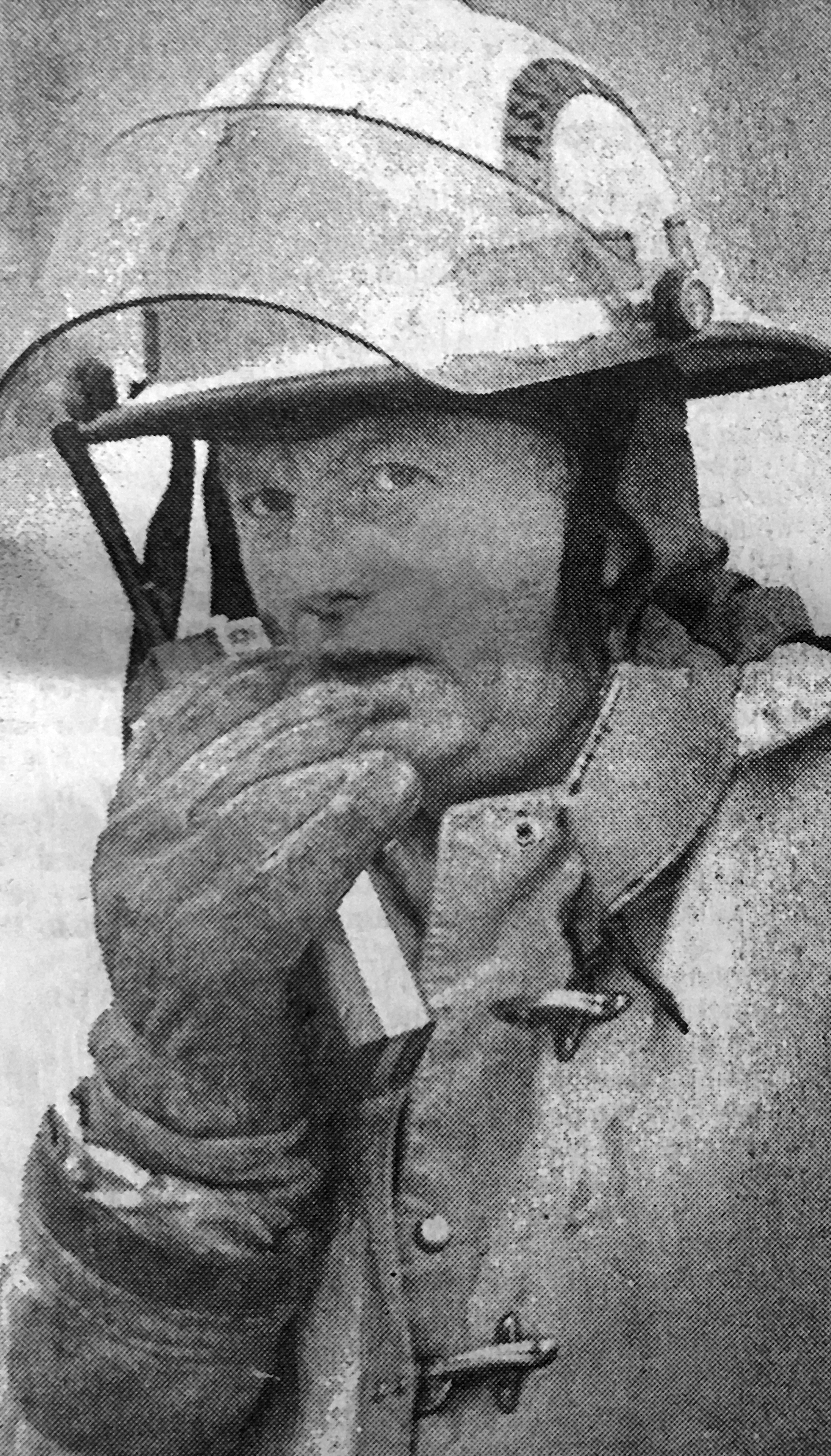
A battalion chief with the Racine Fire Department, Peterson was on his way to St. Mary’s Medical Center on a routine call that night. En route, he noticed a sharp pain in his groin, a pain that steadily worsened. By the time he arrived, he needed medical attention.
“By the time I got to St. Mary’s, I could hardly walk,” Peterson, 49, recalled.
Doctors who examined him originally thought he was suffering from torsion, a painful twisting of the vas deferens leading from the testicles. But efforts to relieve the pain were useless.
This story was part of an award-winning 12-page special section published in The Journal Times on Dec. 1, 1991. The project won awards from the Wisconsin Newspaper Association, the American Cancer Society and the American College of Radiology.
Peterson underwent exploratory surgery that night at St. Mary’s. He was under local anesthetic and was able to ask the surgeon what he saw. There were lumps on one of the testicles, he was told, and it could be cancer.
“I thought I was going to die,” he said. “I thought I had a death sentence.”
Surgeons removed the diseased testicle, which they believed was the original site of the cancer. He went home the next day, still reeling from the diagnosis.
Smoke inhalation a factor? Peterson did not smoke and he wondered how he could develop such a rare cancer, which strikes about 130 Wisconsin men a year. But he recalled his early days in the fire department, days when “you were a candy ass” if you wore an oxygen mask to a fire scene.
More than once, he recalled coughing up black phlegm after coming out of a fire. Now, he wonders what those early days did to him.
Peterson was admitted to the Mayo Clinic in Rochester, Minn., where doctors put him through a battery of tests. The news was not encouraging. The cancer had spread to Peterson’s lungs and the tumors were growing fast.
“They had grown from the size of the head of your pen to the size of a small orange in three weeks or so,” he said.
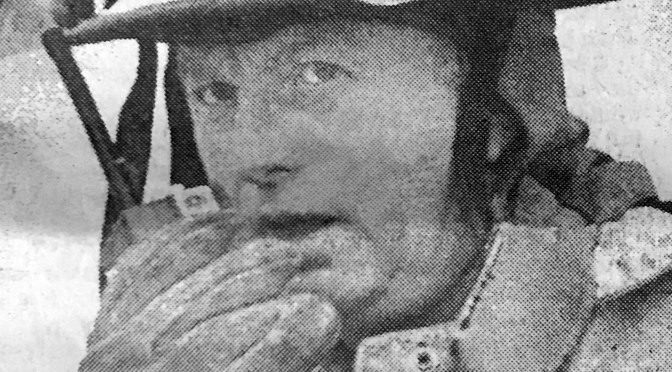
Jeff Peterson on duty with the Racine Fire Department. — Journal Times photo by Mark Hertzberg
Doctors decided to attack the lung tumors with chemotherapy. Peterson returned to Racine and went on a regimen of chemotherapy. One week of treatments was followed by three off weeks to let his body recover.
Peterson lost his hair from the nauseating treatments, but he decided to go back to work at the fire department, where he was in charge of training programs. Being at work was therapeutic.
“I found if I sat at home, the only thing I could think about is, ‘Am I going to die?’ ” he said. “I needed a diversion. That diversion was going to work.”
Diversion is not all he found at the fire department. He also found inspiration and the will to keep fighting.
Heroic inspiration The source of the inspiration was Dan Christensen. Christensen was always the first to greet Peterson and ask him how he was doing. Christensen told him things would work out, he’d be OK.
Encouraging words are always good to hear, but Christensen’s words carried extra meaning for Peterson, because his fellow firefighter was dying from amyotrophic lateral sclerosis — Lou Gehrig’s disease.
“It was just remarkable, a person could take life, so little of which he had left, and still give so much to the people he had around him,” Peterson said.
Even as Christensen lost his motion control as his muscles deteriorated from the disease, he kept up the pep talks for Peterson. He visited him in the hospital and always had an encouraging word. He may not have known it at the time, but Christensen, who died in August, helped save his friend’s life.
“He made me keep on fighting,” Peterson said. “That’s a major part of beating cancer. You have to take one day at a time.”
There was plenty of fight ahead for Jeff Peterson.
The nausea and vomiting from chemotherapy put him back in the hospital. He developed blood clots in his lungs. Then, he developed a fungus-like disease in his lungs that put his life in jeopardy.
Jeff Peterson’s story as it appeared in the newspaper on Dec. 1, 1991.
He remembers that meeting with doctors well. The combination of complications could be fatal. The doctor had tears in his eyes.
“ ‘You’re not rid of me yet,’ ” Peterson said he told the doctor. “I made up my mind I was not going to be that statistic. I was going to be a statistic on the positive side.”
Doctors started treating the lung fungus with steroids, but the going was still rough. Peterson got angry when some of his visitors treated him like he was a sure bet to die.
No giving up There were a few times in the hospital, when he was weary from the chemotherapy, that Peterson felt like giving up. Dying. But then sleep would come for a few hours, putting a little more fight in his soul.
By late 1985, Peterson turned the corner on his disease. The tumors responded to therapy and the fungus was subsiding. Peterson was winning.
That was six years ago. Peterson has been cancer-free ever since. The disease challenged him and nearly killed him, but it also gave him a sense of how precious life is.
“Cancer gives you a new outlook on life. Every day to me is a bonus,” he said. “I used to take a lot more things more seriously than I do now. You know the time here is so short, you should make the best of it every day.”
These days, Peterson spends part of his time delivering talks to high school boys about testicular self-exams, something even he was ignorant about before he got cancer.
“It’s a subject not many kids want to talk about, but it’s got to be done,” he said. “That’s one of the points I was extremely angry about. My own physician never told me to do a testicular exam.”
He also spends time whenever called upon to help cancer patients adjust to the disease. He won’t let them give up, just like Danny Christensen wouldn’t let him give up. One man he saw recently was ready to throw in the towel, but Peterson convinced him it was worth the fight. The man is doing fine now.
“That’s one of the boosts that makes me smile every day,” he said. •
EPILOGUE:Peterson retired from the Racine Fire Department in early 1999 after more than 30 years as a firefighter, including a stint as chief.
It was one of those days that heightens the senses, tests emotions and really brings home the meaning, beauty and challenges of life. The first day of school in Racine was arguably like countless other August days in Wisconsin. Except this time it was my 6-year-old son Stevie heading off to a new life.
Much to my surprise, it was I who felt the impact. And ironically, I was the one who learned the most that warm August day.
While I had worked all summer to prepare Stevie for what it would be like to start first grade, I wasn’t ready for how it would affect me. I’d never thought much about it, frankly. Why should it be any different than kindergarten, or day care? But by the end of this hallmark day, I came to realize many things, not the least of which was just how much I love and admire my children and my wife.
As I watched Stevie get dressed for his first day of first grade at Racine Montessori School, he seemed to grow up right there before my eyes. His nervous look as he slung his backpack over his shoulders and walked to the car stirred old feelings in me, memories of stiff new outfits, hairspray and early morning front-porch pictures. As we drove the 5 miles to school and chatted about what first grade would be like, I saw myself in the back seat. Only braver. Still shy, but more sure.
Things were changing this day. Big things.
I walked Stevie to his new classroom and watched him put his lunchbox on the hall shelf. I felt proud of him. But I was nervous because I knew he was about to pass into a new phase of his life. I stood in the comer of the polished hardwood floor as his new teacher showed him his school supplies and sat at the table explaining the new routine. He looked apprehensive — just how I felt. But he was OK. I gave him a quick hug and kissed the top of his head, just like I’ve always done. I wanted to cry. I wanted to take him back home, roll back time and replay our years together. Iwanted to once again play blocks, to have him crawl on my back, or run to me when I got home from work, shouting, “Daddy!”
Instead I stood in the doorway of this magnificent old brick schoolhouse and watched as the teacher’s aide snapped Stevie’s picture. More kids entered the room. A new school year. Time to go, Dad. It’s OK. We’ve got many more milestones ahead.
Until my dying day I will not forget that scene, a picture of my little boy sitting at that little table in a big place. It’s burned into my memory like a favorite page in a scrapbook, only this page is marked with a teardrop.
As I drove back home, I listened to Elton John sing, “Don’t Go Breakin’ My Heart” on the radio and laughed. Too late. I realized our baby was on his way in life, a journey that would take him through science camps and football games, sleepovers, Boy Scouts and someday, dating. It had never hit me like this before. He’d be home by 4, still my boy. But older. Taller. More handsome.
He’s growing up. Didn’t I see it before? Never like today.
Stevie on a Racine Montessori School field trip.
This was quickly becoming a day of epiphany for me. I got home and our 2-year-old, Samantha, ran to give me a hug with her enthusiastic shout, “Dada!” I realized more than ever how much I loved being father, a Dad. I treasured the morning, as Sam and I read books and played Dolly House. “Don’t read your paper, Dada,” she said. Okay, honey. Okay. Let’s read your books. Let’s play horsey. Let’s just sit. One day when I walk you to first grade I’ll stand in the doorway and remember today. And I’ll smile because I was here. I experienced it — and I appreciate it.
I’ll remember.
After Samantha and my wife Sue left to run some errands, I had more time to think. Clear and vivid thoughts. Almost revelations. Surely I knew all of these things before, but God chose today for me to really see them.
As I looked out our front bay window at the perfect blue sky and sunshine, I felt in my heart how blessed I am. I thought how much I admired Sue. The night before she and Stevie set up orange cones in the back yard and practiced soccer kicks for his upcoming foray into youth soccer. She’djust spent three hours in a clinic for new volunteer coaches for Stevie’s new team, the Bears. No hesitation for her. She and the other would-be coaches waddled around the practice field with soccer balls stuck between their legs, learning creative coaching techniques. I need to take on more things like that with such enthusiasm and energy. I draw strength from her.
I folded laundry, did some work on the computer and listened to CDs. Now James Taylor was singing to me, but this time I didn’t laugh. I listened to the soothing vocals:
Only for a minute, to find yourself in it, to wait by the stream, to drop out of your dream. Look on up, look up from your life. Look up from your life.
I keep hearing the song. I think it’s telling me something, especially on this day.
When Stevie got home from school, he looked different— and I felt different. He excitedly told me about volcanoes and melting ice and magic potion and Frisbee golf. Wow. Keep telling me, buddy. I’m here. I’m listening. All the while, Samantha sat on my lap, chiming in, “I go to school too, Dada. I do that, too.”
Stevie and Samantha at school, a couple of years later.
We ate ice cream sundaes and celebrated our momentous day. I was certain that I was the one who learned the most that day. For not since Samantha’s birth two years prior or Stevie’s in 1992 have I felt like this. The world stood still for just a moment. Just long enough for me to step off, step back and look.
While I saw many things I see every day, I thank God because on this day, I saw many, many things that I don’t. •
(This article was written in August 1998 with my intention of submitting it to my former employer, the Racine Journal Times. That didn’t happen, and I forgot about it until 22 years later, as I was digitizing some old journals found in the garage. Quite a find, indeed.)
As I pulled my car into the darkened Sacred Hearts cemetery earlier this week, I noticed something remarkable. The cemetery was dotted by lights, even in the depths of winter darkness. So I felt right at home, as I had come to place a candle at the grave of my mother, Mary K. Hanneman.
Mom left us at 11:49 p.m. on Dec. 26, 2018. That moment remains forever suspended in time for me. Her final moment reminded me in many ways of the birth of my three children. As soon as they entered the world, there was a moment before the first breath; a moment of anticipation. Time stopped and eternity intervened. This was so similar for the end of Mom’s life. With her last breath drawn and exhaled, there was also tremendous anticipation. Time stopped. Only I didn’t get to see her first moment in eternity. Although I knew it by faith.
Mom was a woman of great Catholic faith. She always arrived early at Saturday 5 p.m. Mass at Sacred Hearts of Jesus and Mary Catholic Church in order to pray the Rosary. She was always in touch with her prayer life. On any occasions that one of us needed extra prayers, Mom was on the phone to the good sisters at the Sacred Hearts convent. Much grace flowed from those prayers — great examples of persevering faith. In her final weeks and days, Mom knew where she was going. The night she died she sat up in bed and looked off into the distance with a look of wonderment. She knew. She saw.
We waited more than an hour at the beginning of a new day for her death to be officially declared. That could not be done until a hospice nurse arrived to check for a pulse. After she recorded the legal time of death (as inaccurate as it was), the nurse related some of her experiences at the bedsides of dying patients. She talked of the bodies of the recently deceased giving off smells. At first I thought of something unpleasant, but she quickly clarified these were good scents, like roses.
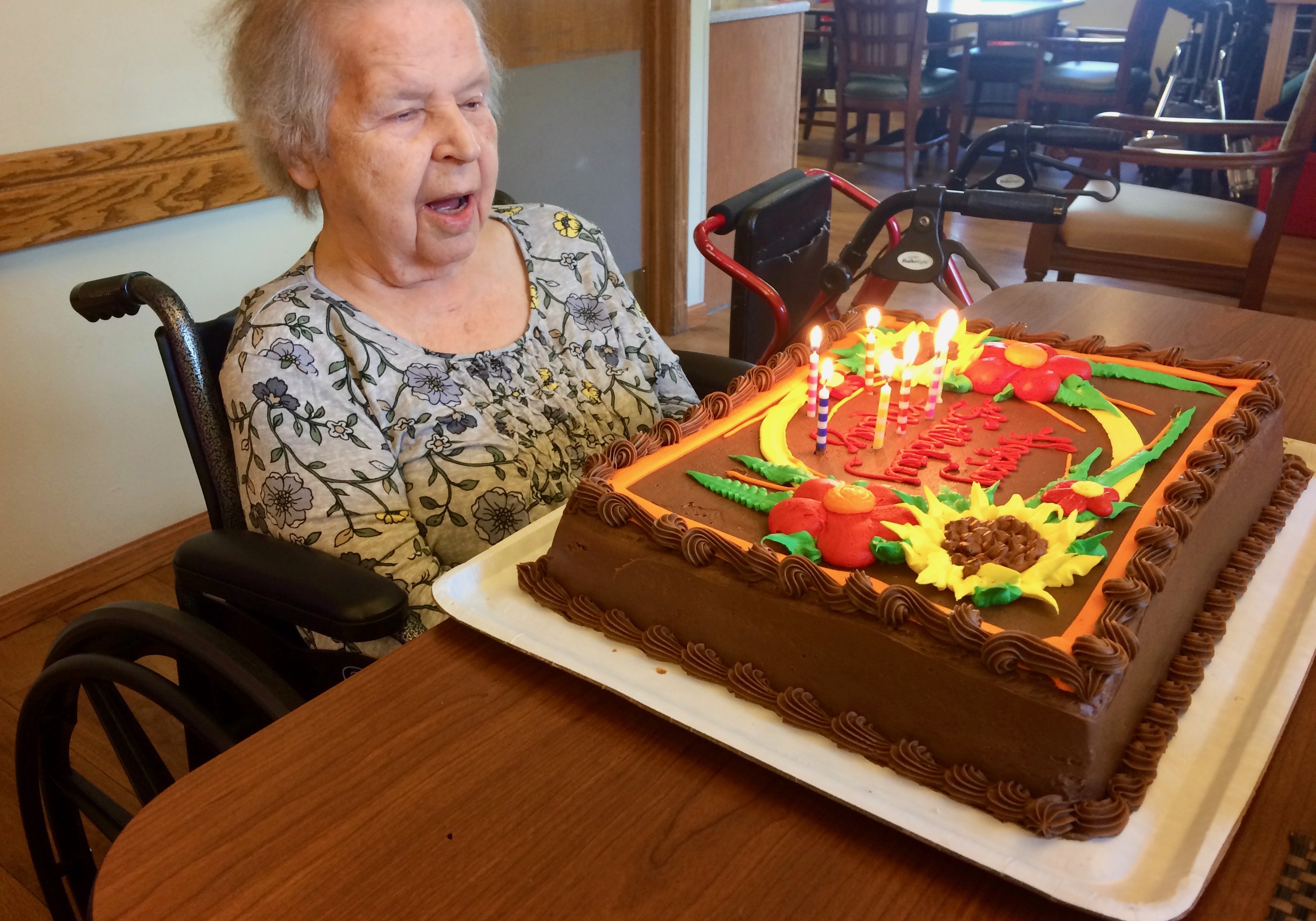
Mom a number of years ago with another type of candle, celebrating the September birthday of her granddaughter Samantha.
As I pondered that notion, I looked around Mom’s small room at the Brookdale care center. I felt for a moment like someone unseen walked past me. I smelled a scent that I cannot accurately describe. It was not roses, or flowers at all. It was the most pure, clean scent I ever experienced. The closest descriptor would be a citrus smell. I looked around the room and in the hall to see if someone was using a cleaning chemical. Nothing. Then it was gone. I remarked to the nurse about it. “Did you smell that?” I said. I tried to describe it. “You see!” she replied. Then just as quickly as it left, the scent returned. It was powerful and amazingly present. I felt there was something well beyond a mere olfactory manifestation at work. What is that?
After perhaps five minutes of this scent permeating the room, it disappeared. Gone with no lingering trace. I was quite struck by it all; unsure if I had imagined it. Over the coming days and weeks, I pondered the experience. Could the presence of angels leave a heavenly scent behind? I’d often read about the bodies of saints giving off what is called the odor of sanctity, but this was typically a floral smell. I searched the internet, but could not find anything that described what happened in Mom’s room that night.
I turned to my friend Steve Ray, a Catholic filmmaker, author and great teacher of the faith. He did not hesitate. “God gives graces to those who love him,” he wrote. “It seems like a great grace was bestowed on you in the death of both of your parents.”
Steve recalled my description of my Dad’s death in my 2010 book, The Journey Home.How even after Dad died and was silent, he returned long enough to mouth the word “love” three times. I never thought I would have another experience so profound. Until Mom left us. It was so very different, but just as impactful. Mom’s final gift.
It took me a full year to be able to write about it. I knew it would be impossible to accurately describe what happened. What words could convey the depth of what I experienced? Surely writing about it would be almost a disservice, since words on a computer screen simply would not suffice. But it seems a gift like that should be shared, so I do my best in writing this post.
“And the light shineth in darkness, and the darkness did not comprehend it.” —John 1:5
I thought about all of this as I placed the battery-powered candle at the graveside. I asked Mom and Dad to pray for me and my family. I looked around the darkened cemetery again and was impressed with the flickering of candles and the glow of lighted wreaths at the graves of dozens of souls. “Look at all of these lights in the world, still with us,” I thought. As I walked back to my car, I said a prayer of thanks for the lives of everyone buried there, amid my hope they are all with Christ in Heaven.
Just before I pulled away, I turned back to look at Mom and Dad’s headstone.
It was just a little light, but how it overcame the darkness. •
SUN PRAIRIE, Wisconsin — After a journey of 114 years along a path that remains shrouded in mystery, the ornate gold chalice used by a young priest at his first Holy Mass has come back to his home parish just in time for Christmas.
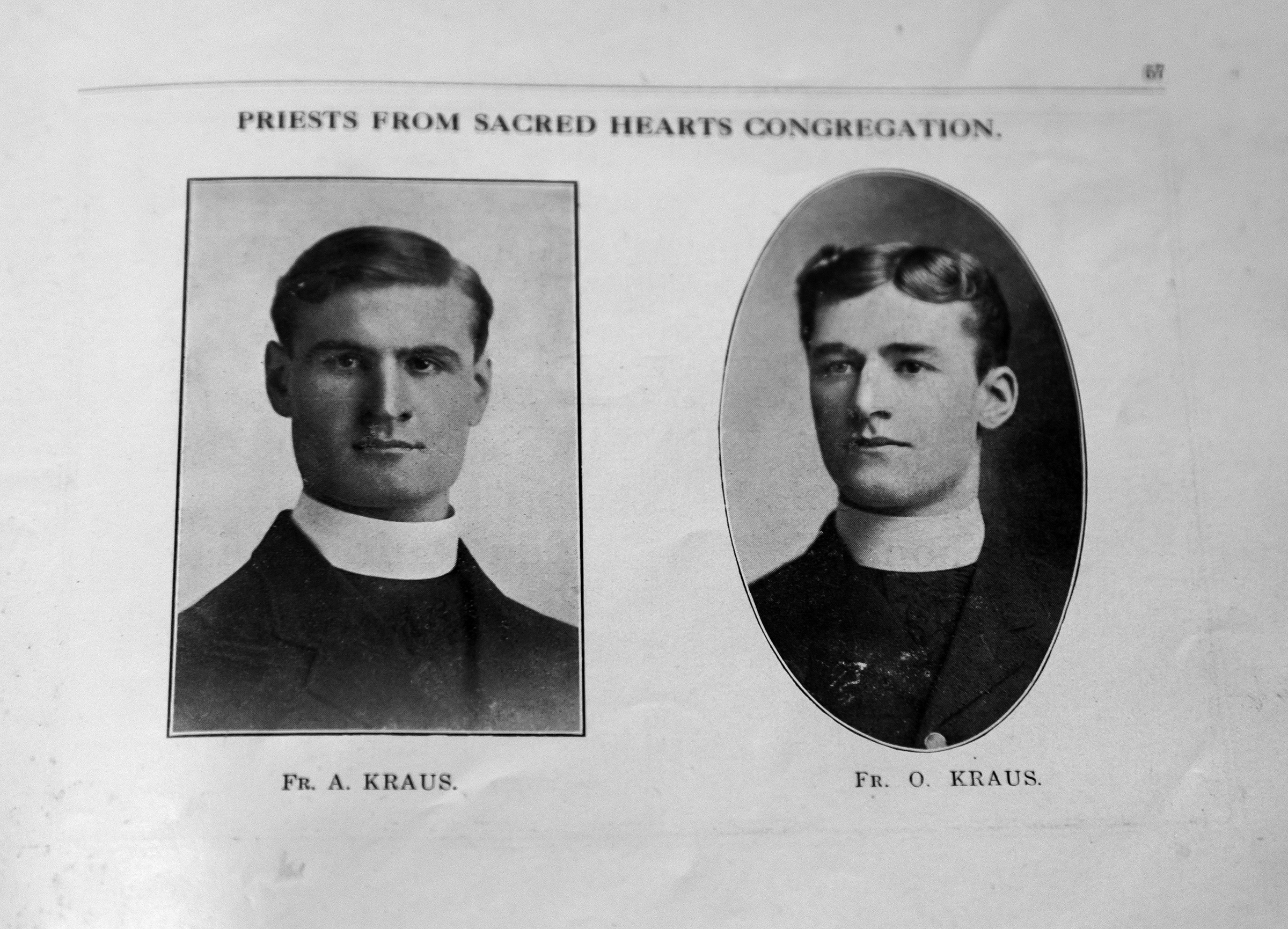
Henry Joseph Kraus, who was known as Otto, was 22 years old when he said his first Mass at Sacred Hearts of Jesus and Mary Catholic Church on Sept. 7, 1905. He was ordained to the priesthood four days earlier by Archbishop Sebastian G. Messmer at St. Augustine Catholic Church in Milwaukee.
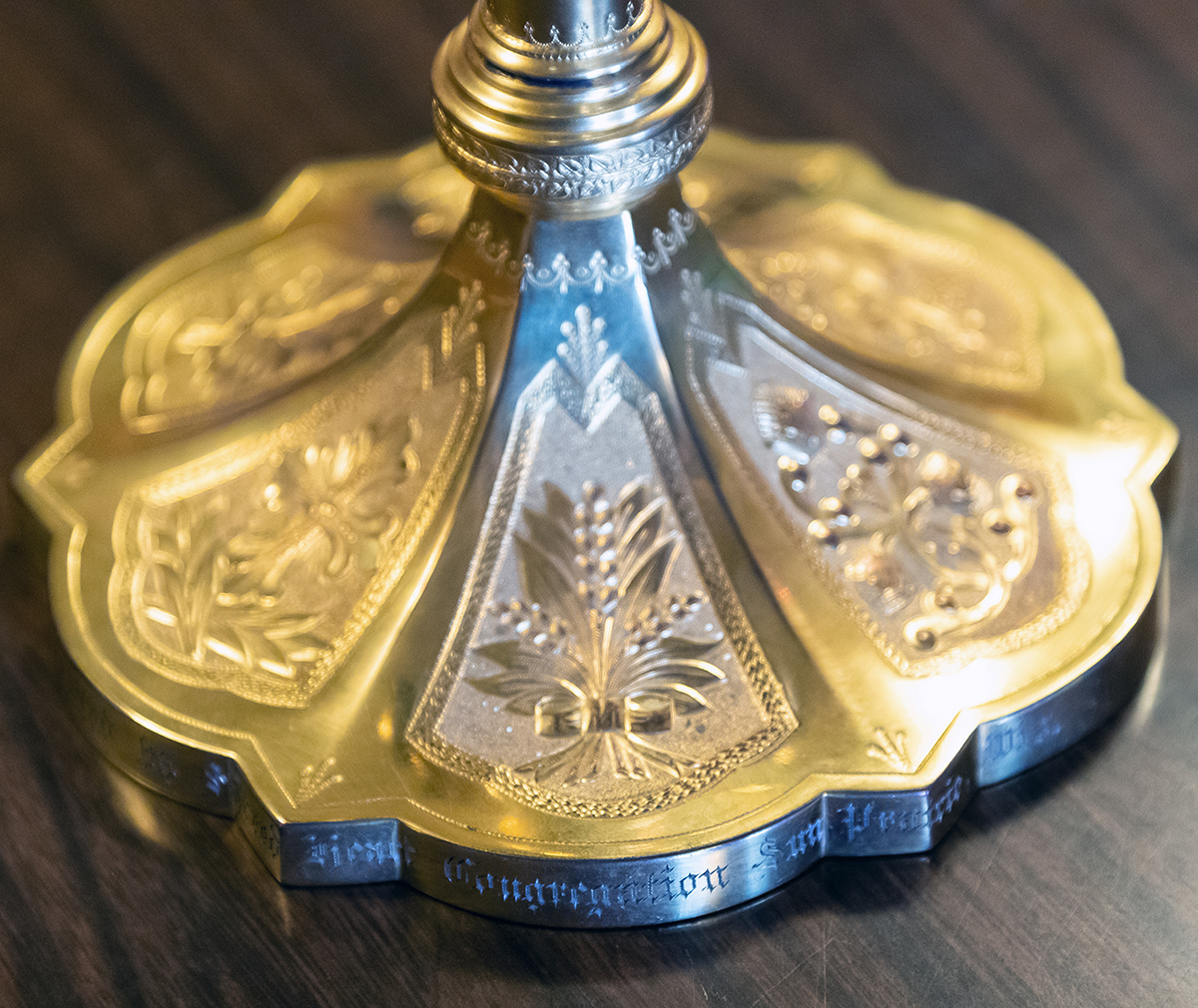
Parishioners at Sacred Hearts gifted Kraus with a gold chalice, which held the Precious Blood at the Solemn High Mass said by the newly ordained Father Kraus. Along the outside of the foot of the chalice, the inscription reads: “In Memory of My First Mass September 7, 1905 — Presented by Sacred Hearts Congregation, Sun Prairie, Wis.”
Some 114 years andthree months later, the chalice was held up next to the rectory Christmas tree by Msgr. Duane Moellenberndt,pastor of Sacred Hearts of Jesus and Mary. “It’s a wonderful gift to the parish,” he said, reflecting on how such a precious, blessed artifact made its way back to Sun Prairie. “It’s a marvelous gift.”
The 1905 card for the first Mass of Rev. Otto Kraus at Sacred Hearts of Jesus and Mary Catholic Church. (Photos courtesy of Sacred Hearts/Mary Gehrmann)
Otto Kraus studied for the priesthood at St. Francis de Sales Seminary near Milwaukee, under its longtime rector, Msgr. Joseph Rainer. He went to the seminary just before the turn of the 20th century from his family’s 115-acre farm a few miles east of Sacred Hearts church. His parents, Engelbert and Emma Kraus, eventually sent two sons into the priesthood.
Otto was the only priest ordained in the Archdiocese of Milwaukee on Sunday, Sept. 3, 1905. The following Thursday, the new Fr. Kraus celebrated Solemn High Mass at Sacred Hearts, using the inscribed gold chalice to hold the Precious Blood of Christ.
The chalice has engraved and extruded details on the foot, stem and node. The bowl has an engraved band halfway down from the lip. The foot of the chalice is hexagonal with slightly in-curved sides. The top of the foot features debossed images of vegetation. The foot is inscribed, but not with Fr. Kraus’ name; something that later presented a challenge in determining its original owner.
Sacred Hearts of Jesus and Mary Catholic Church as it appeared in the early 1900s. The current church was built in 1921. (Photo courtesy of Sacred Hearts)
Atop the first-Mass remembrance cards given out that day were two scriptural references: “By the grace of God I am what I am” (1 Cor. 15:10), and “A priest forever” (Psalm 110:4). The bottom of the card read, “I will sacrifice to thee O Lord the sacrifice of praise” (Psalm 115:17).
The Mass was just the joyous occasion the parish badly needed, coming just weeks after the sudden death of its longtime pastor, Rev. Alouis J. Kuehne. Father Kuehne, 48, had led the Sun Prairie parish since 1880. Otto Kraus served as sub-deacon for Kuehne’s Solemn Requiem Mass on Aug. 16, 1905. Also assisting at the Mass was Aloysius M. Gmeinder, a parishioner who lived on the farm immediately south of the Kraus property. Gmeinder was a year behind Kraus at St. Francis Seminary.
Moellenberndt said the current practice is for a seminarian to receive the chalice for his first Mass from family. “I don’t know if it was true in those years, but when I was ordained, typically your parents gave you the chalice,” he said. “So it’s important not only because of what it’s used for, but also because normally it’s your parents or your family that gives you the chalice that you use for your first Mass.”
The chalice has a hexagonal foot with curved sides, accented with debossed artwork. (CWR photo by Joseph M. Hanneman)
Father Kraus’ first assignment was at Holy Trinity Catholic Church, one of the oldest parishes in Milwaukee. After 18 months, he was named pastor of St. George Catholic Church near Sheboygan Falls, Wis. It’s not clear exactly how long his pastorate lasted, but ill health forced Fr. Kraus into a very early retirement. By mid-1910, he was back home on the family farm near Sun Prairie.
For nearly two decades, Fr. Kraus lived with his mother. After his father died in 1912, the family moved to Sun Prairie, settling in a home just a few blocks from Sacred Hearts. Monsignor Moellenberndt said it’s possible Fr. Kraus celebrated Masses at his home parish during those years, a practice followed by other retired priests over the decades.
Henry J. “Otto” Kraus and his younger brother, Aloysius, both became priests in the Archdiocese of Milwaukee. Both men are buried at Sacred Hearts of Jesus and Mary Catholic Cemetery.
After Fr. Kraus’ mother died in October 1926, he moved to Oshkosh, Wis., and became a resident at Alexian Brothers Hospital. That is where he died on Jan. 17, 1929. He was just 46. His younger brother, Rev. Aloysius P. Kraus, sang the Solemn Requiem Mass at Sacred Hearts on Jan. 21, 1929. Aloysius was ordained to the priesthood in 1912 and was pastor at St. Joseph Catholic Church in Waupun, Wis., at the time of his brother’s death. Father Otto suffered from goiter, an enlargement of the thyroid gland at the base of the neck, according to Mary Gehrmann, a longtime Sacred Hearts parishioner and grand-niece of the Krauses.
The stem, node and bowl have detailed engraving. (CWR photo by Joseph M. Hanneman)
Monsignor Moellenberndt said it’s anyone’s guess what became of the chalice after Father Kraus’ death. In 2019, it was discovered in one of 40 boxes of materials donated to the Green Bay Diocesan Museum, located some 125 miles northeast of Sun Prairie. A museum staff member noticed the inscription on the chalice and contacted Sacred Hearts. Since there was no name with the inscription, they had to do some sleuthing. With help from the archives at the Archdiocese of Milwaukee, Moellenberndt determined that Fr. Otto Kraus was the owner of the chalice. Sacred Hearts parishioners Gary and Julia Hanson drove to Green Bay and brought the chalice back to Sun Prairie.
“The archivist in Green Bay said she’s happy that we found the priest that it belonged to and doubly happy that it has found its way back home,” Moellenberndt said. “So it’s wonderful to have it back, because this is where it came from. There’s that historical connection to the parish.”
Moellenberndt said once the chalice is polished, it will again be used in the Holy Sacrifice of the Mass. That could be the first time the chalice has been a part of Mass at Sacred Hearts since that 1905 Thursday when a brand new priest spoke these words and elevated it before the crucifix: Hæc quotiescúmque fecéritis in mei memóriam faciétis — “As often as ye shall do these things ye shall do them in memory of Me.”
(This story appeared on the Catholic World Report magazine web site on Dec. 24, 2019. The author’s family has been a part of Sacred Hearts parish since the early 1970s. His mother, Mary K. Hanneman, taught at Sacred Hearts school for nearly three decades.)
My mother walked into the family room, looking almost sheepish, and said, “I want to show you something.” She was almost beaming as she got out a yellowed sheet of paper, folded into four panels, with a hand-written title on the cover: To Mary. It was evident that this paper, whatever it contained, was precious to her.
She held the document up to her heart and explained that my father had written it for her many years ago. She wanted me to know that they did have their moments of closeness that superseded any of the difficulties during nearly 50 years of marriage. And now, a couple of years removed from Dad’s 2007 death from lung cancer, Mom truly treasured a poem he penned back in the 1960s.
The paper was weathered, but the words were as impactful as the day they were written.
“Go ahead, read it!” she said, turning her head with tears in her eyes. And so I did.
To Mary
It has oft been said, “Please do not grieve.”
‘Tis far better to give than to receive.
And at this time of love and of cheer,
I think of all about me here.
The loving family with which I’m blest,
And know within, I’m not a guest.
That all about me is real and true,
That what I have is because of you.
Daily you give these gifts of love,
Of which I am recipient of.
And I wonder in my small way,
‘Dear Lord, how can I ever repay?’
This woman who is always ready,
to wipe a nose or wind a teddy?
Who at this time bears the gift of gifts,
A child of God sleeps within her midst.
A child who needs loving care,
To grow strong, to know what’s right and fair.
These few reasons and so many more,
Make it easy to see why I adore.
This woman, who is my wife,
Who will share with me throughout my life,
All the joys and troubles that we will face,
And put them in their proper place.
So I offer my gift at this time to you,
My deepest love, which indeed is not new.
Needless to say, I was very touched. My father, despite his tremendous gifts in public speaking and dealing with people, found it difficult to express thoughts in writing. So this definitely came from the heart. Whenever he had a speech to give or a presentation before the Sun Prairie City Council or the Dane County Board of Supervisors, Dad wrote out a draft and Mom helped him polish it with structure and grammar. She was always the reading teacher!
I was tickled that she not only saved the poem, but seemed to get the same thrill as I’m sure she did upon first receiving it four decades earlier. This was a softer side of Mom we didn’t always see growing up, but which became a central part of her as the autumn years turned to winter. I photographed the card and gave it back to Mom, who put it away again for safekeeping.
I thought of the poem again shortly after Mom died in late December 2018. I was given the black-and-white photo atop this story to scan for Mom’s memorial video. I was struck by how young my parents looked, probably shortly after being married in August 1958. It was easy to see the sentiments of the poem in this photograph.
Dad, thank you for writing something that Mom treasured her entire adult life. And Mom, thanks for sharing it, and showing a side of you that you tried to keep hidden. As we observe the first Mother’s Day without you, we are heartened by the thought of you two, together in the company of the angels and saints. Happy Mother’s Day.


















 The Hanneman Archive