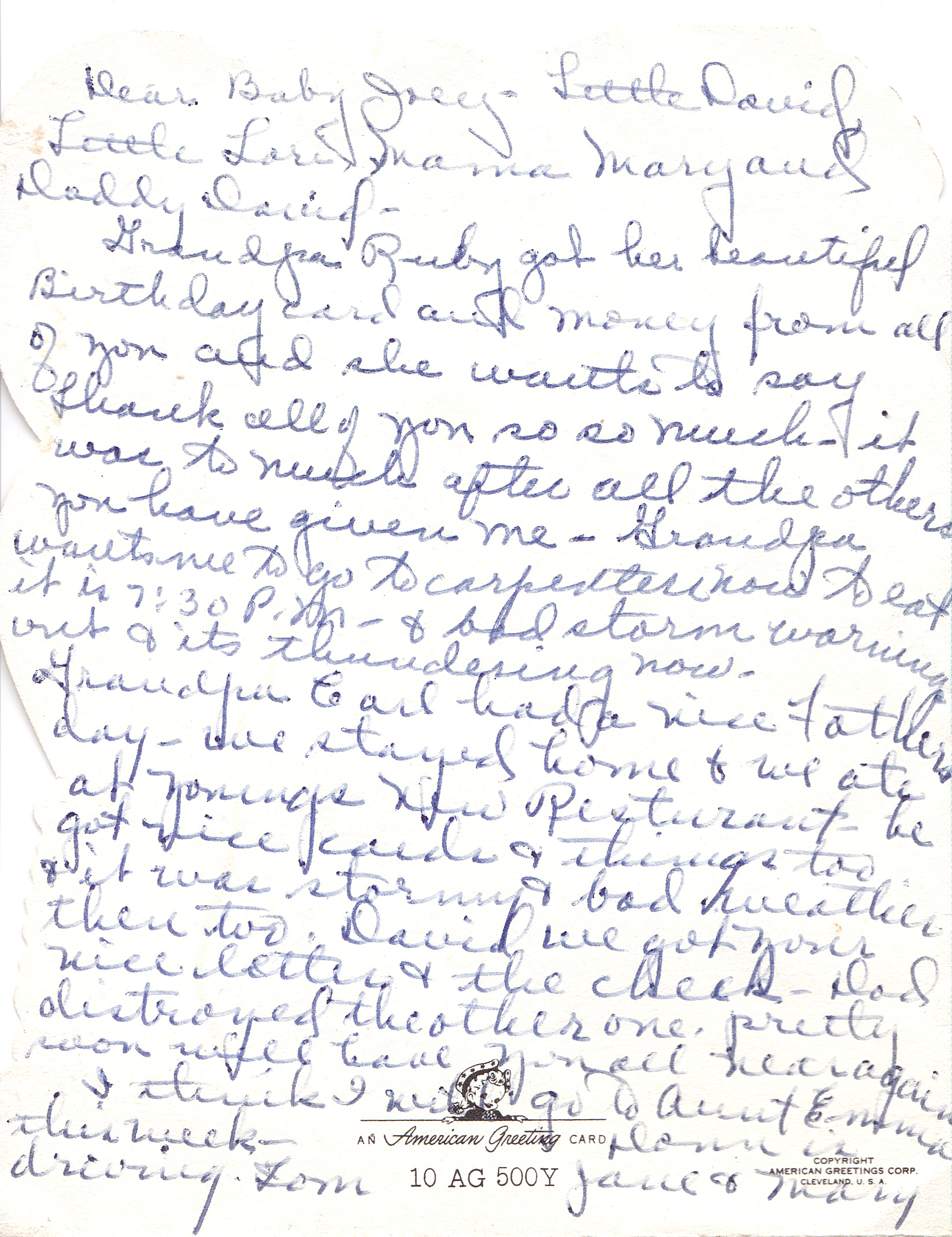
Handwritten letters are a lost art, so it was particularly thrilling to find one inside a card from my paternal grandparents, Carl and Ruby Hanneman, sent for my first birthday in June 1965.
My grandmother was a prolific letter writer, note scribbler and update scrivener. She wrote in a stream of consciousness. Sentences didn’t always have punctuation and could stretch on for half a page. But she captured details that might slip past a less-careful correspondent. Like exactly what time on Tuesday she and Grandpa Carl got their car back from Floyd “Snuffy” Clark at the auto body shop.
Unlike a photograph, a personal letter brings out the writer’s personality. Reading the note in the birthday card, I could almost hear my grandparents voices. They switched off writing in the card. Grandpa went first, telling how Grandma loved the birthday card and money sent by my parents. Then Grandma Ruby took over and provided a full update on the happenings on Morris Street in Mauston, Wis.
Enjoy.
—
June 27th, 1964
Dear Little Baby Joey,
The little sweetheart — one year old! Grandpa Carl and I send our love with big hugs and kisses to you — God blesses always Baby Joey —love, love, love from Grandpa Carl and Grandma Ruby xxxxx
—
Dear Baby Joey & Little David, Little Lori & Mama Mary and Daddy David:
Grandpa: Ruby got her beautiful birthday card and money from all of you and she wants to say thank all of you so much — it was too much after all the others you have given me —
Grandpa wants me to go to Carpenter’s now to eat it is 7:30 p.m. & bad storm warning out & it’s thundering now.
Ruby Hanneman crammed information into every spare inch of the birthday card.
Grandpa Carl had a nice Father’s Day — we stayed home and we ate at Noneng’s new restaurant — he got nice cards and things, too, and it was stormy bad weather then, too. David we got your nice letter & the check — Dad destroyed the other one. Pretty soon will have you all hear (sic) again. I think I will go to Aunt Emma this week. Donn is driving Tom, Jane & Mary Ellen on July 3rd. I go back on Sunday. The youngsters will stay here & at Lavonne’s for several weeks.
I called Marvin’s, talked to Mabel — I am not going to Aunt Emma’s this week. Marv is taking a week of his vacation & they leave Fri. a.m. for Tomahawk — so that upsets my plans. Now I won’t be able to go until later in July.
Mary is to have planter warts treated on bottom of feet 1st and 2nd of July. They had planned to come this Sat. & with my planning to go to Arpin we changed it. Now I wish they would come sooner.
Ruby and Carl with Baby Joe Hanneman at his 1964 baptism.
There was a big extra addition on Parade of Homes in Mad. Sun. paper for open house. 15th annual Mad. Parade of Homes from June 20th thru June 27th on Madison’s far west side. I hope David knows about it by now. I have the booklet saved for him whenever he comes this week.[Nota bene: I believe we were still living in Grand Rapids, Mich., in June 1965, but would soon move to a house on Lake Wisconsin. This was shortly before construction began on my parents home in Sun Prairie, Wis.]
Dad has been feeling much better. Mr. Clark (Snuffy) had the car Mon. & fixed all the rust spots & put new chrome on front — we got it back Tues 22nd at 4:00 p.m.
Thurs. a.m. 24th:
Dad drove to Camp Douglas & Hustler this a.m. to solicit more ads — he wants to go to Necedah tomorrow a.m.[Nota bene: Carl helped put together the printed guide for the Juneau County Fair. One of his duties was ad sales.]
Mary I keep thinking about your Mom. I hope and pray she is getting along nicely & eyesight will be helped.
First birthday, June 1965, with one big candle. At left is Laura (Mulqueen) Curzon and the frosting thief is none other than David C. Hanneman.
How are our three little cherubs? I really did miss them and Grandpa did too. He felt badly because he had to be in bed so much while they were here. They are little loves and we enjoyed all of them so. David wrote that Little David asked about us. How does Baby Joey manage in the little walker? If the back wheels rotated like the front ones do, I bet he would really walk soon.
Have some birthday cake for us & we will be singing Happy Birthday to Joey here — all love & XXXes to all.
Dad & Mom xx
Top Image: The front of the birthday card at left, with a photo of Carl and Ruby Hanneman from around 1960.
High school yearbooks are an excellent source for family historians to find sometimes-hidden facts and images from a loved one’s past. And as I discovered with my late father’s copy of the Mauston High School 1949 yearbook, it’s wise to stroll through the pages multiple times so as not to miss things.
Dave Hanneman’s sophomore photo.
Mauston High School’s yearbook is called Hammer. It was first published in 1916. Dad (David D. Hanneman) enrolled at Mauston High in the fall of 1947 and graduated in spring 1951. As we’ve noted elsewhere on these pages, he was part of the 1947 football squad that won the West Central Conference title with a 7-1 record. The 1949 Hammer covered his sophomore year.
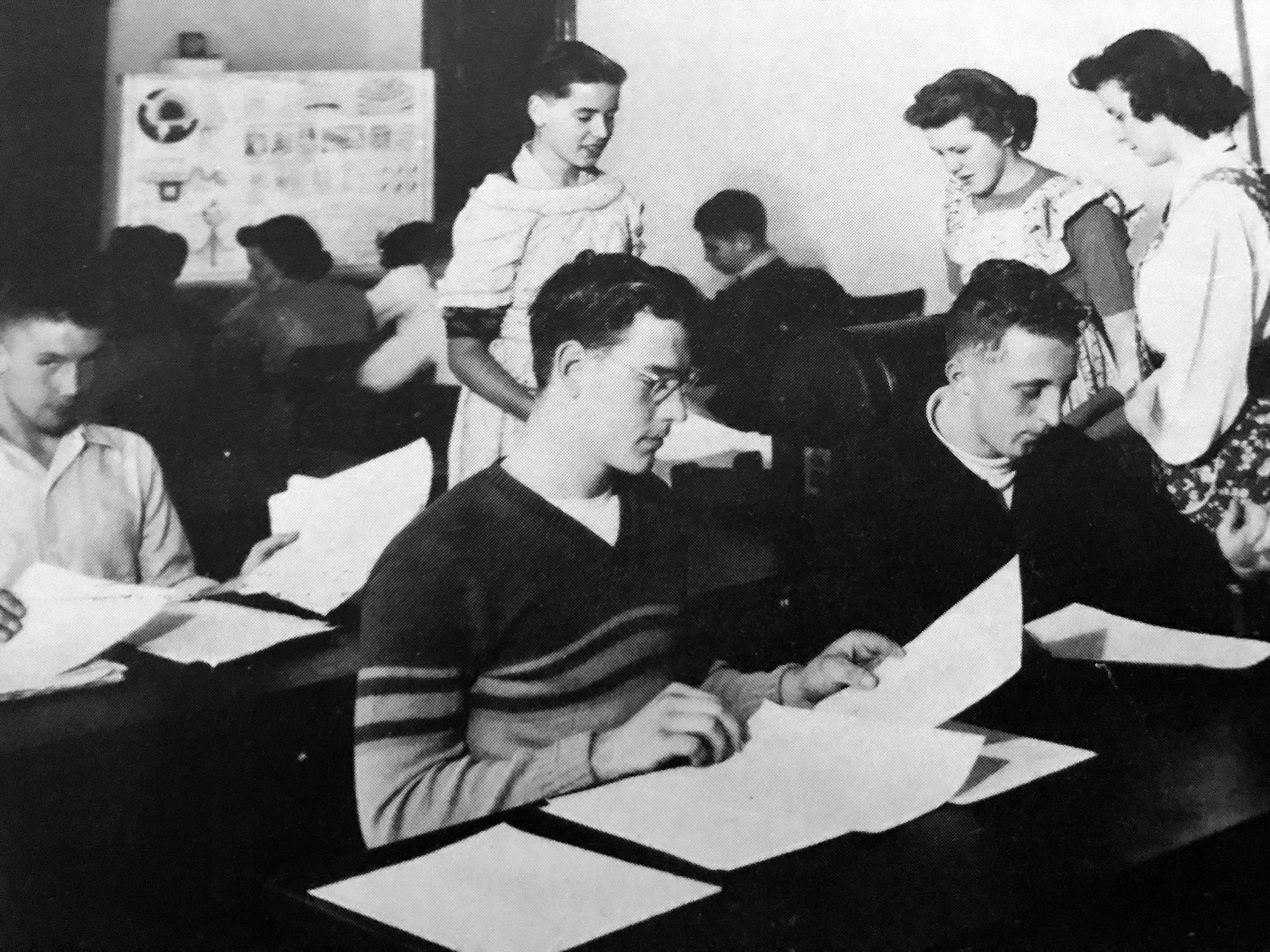
The biggest surprise came on the page featuring the student newspaper, The Blue Quill. Dad is listed as one of two staff artists. I had viewed this yearbook before, but never noticed this. We have no issues of the The Blue Quill, so we don’t know what he and co-artist Donald Krueger sketched for the news, feature and sports pages. I’ve seen a few simple sketches and doodles he drew on the yearbook autograph pages, but nothing else. Art talent ran in the family, we covered elsewhere regarding Grandpa Carl F. Hanneman and his drawings for the Wisconsin Rapids Lincoln High School Ahdawagam.
Dave Hanneman (front left) during a meeting of The Blue Quill staff.
There were no surprises in the yearbook on the athletics front, where Dad always excelled. The 1948 MHS Bluegold finished in a tie for second in the West Central Conference with a 5-1-1 record in football. The team was on pace to win its second consecutive title, but a late-season 7-0 loss to eventual champion Sparta knocked them into second. The Bluegold finished the season with a 12-12 tie with Viroqua after the visitors stormed back in the final 54 seconds to secure the draw to ruin Mauston’s homecoming.
The1949 Hammer featured a football team photo. I recalled that Dad had saved a large-format print of the photo, with many of the player names written on the back. Years ago I scanned the image (below) and even used it to promote my genealogy business.
Dave Hanneman (second row, sixth from left) wore No. 72 during his sophomore season.
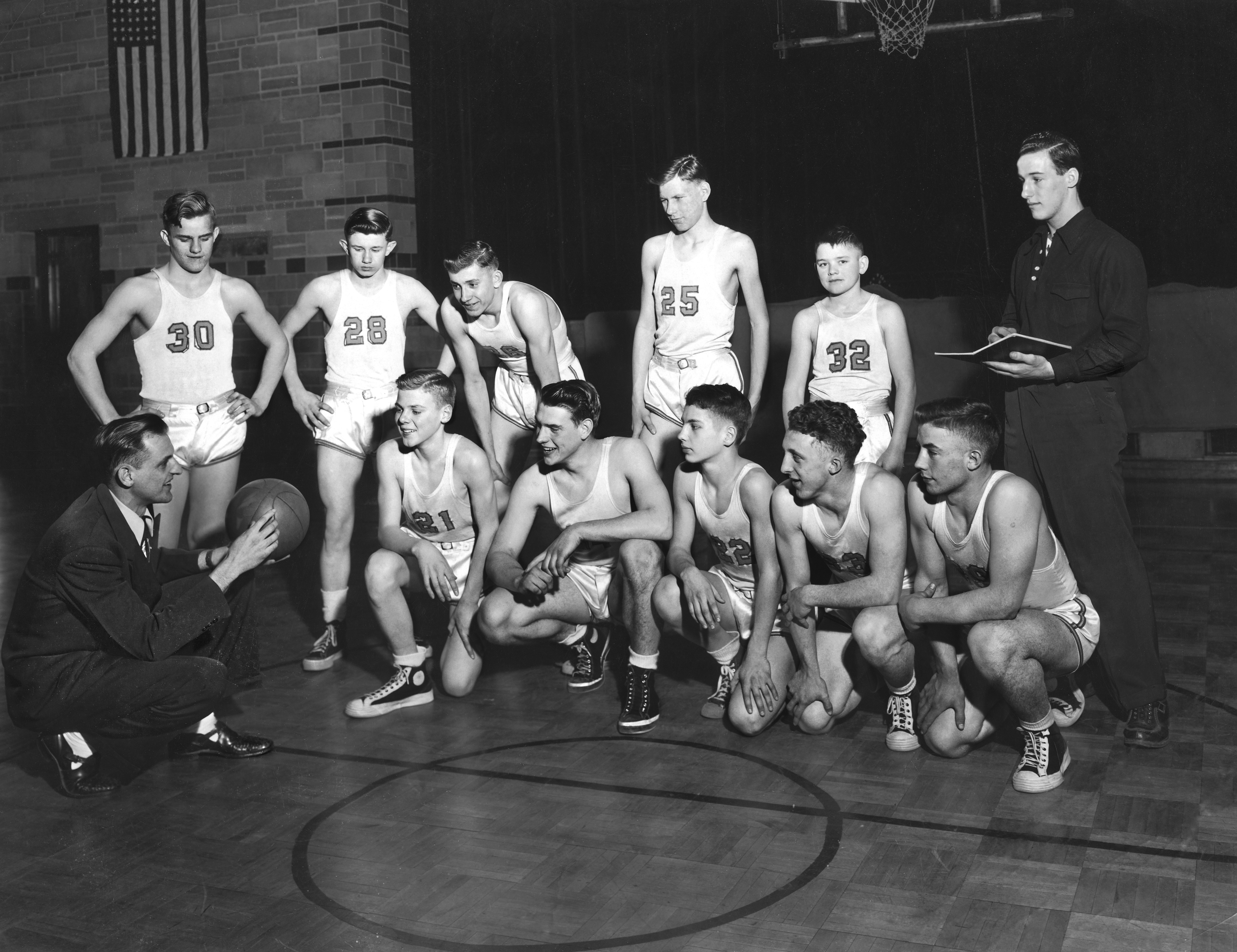
For his sophomore year, Dad was on the B Squad for basketball. His final two years he played center on the varsity squad.
The Mauston High School Bluegold basketball team, B Squad.
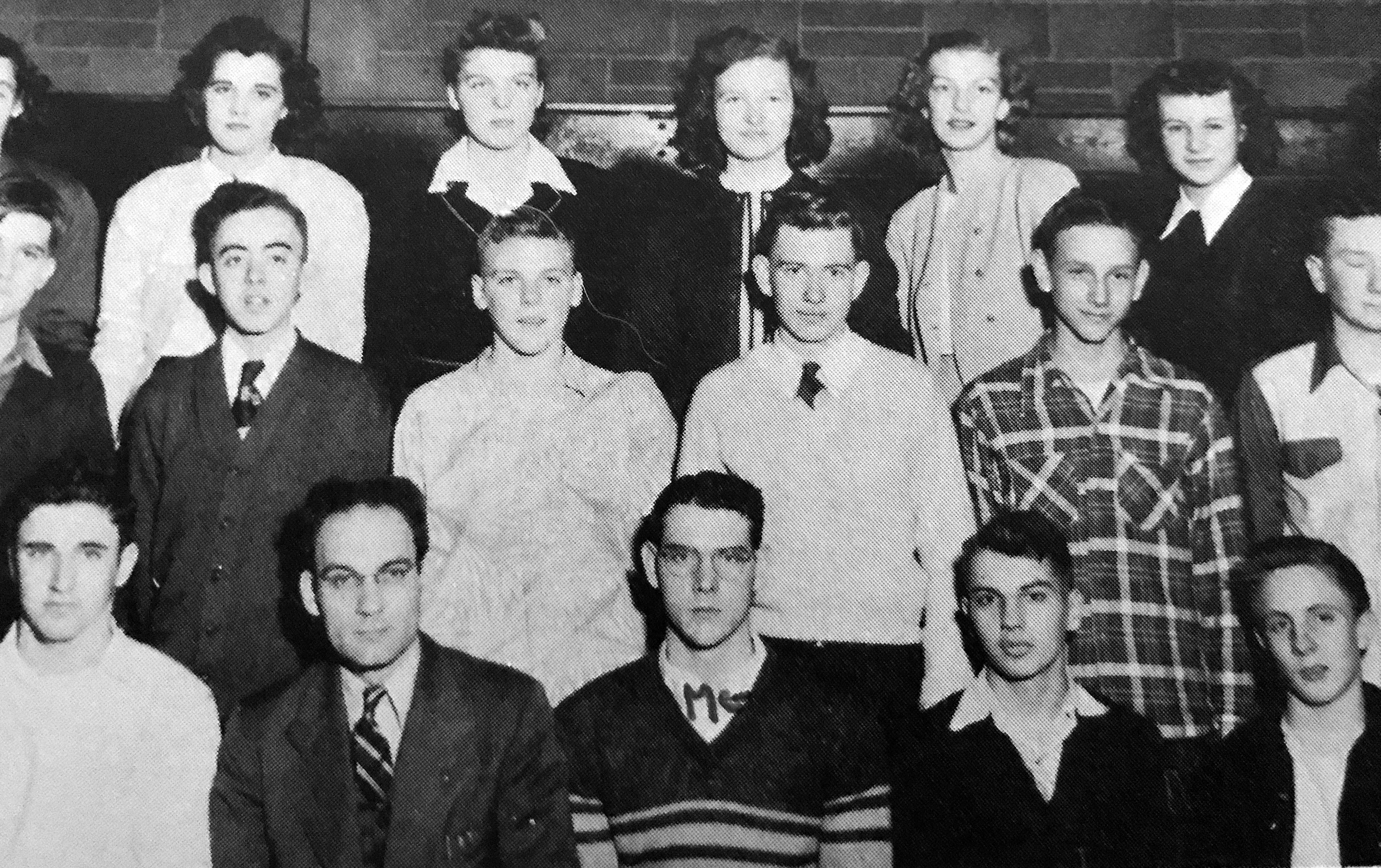
Dad was also pictured with the science club, Sigma Gamma Pi Beta. He served as vice-president during his sophomore year. It was the only year he is listed as a member of the science club.
Dave, labeled “Me” in pen, was vice-president of the science club.
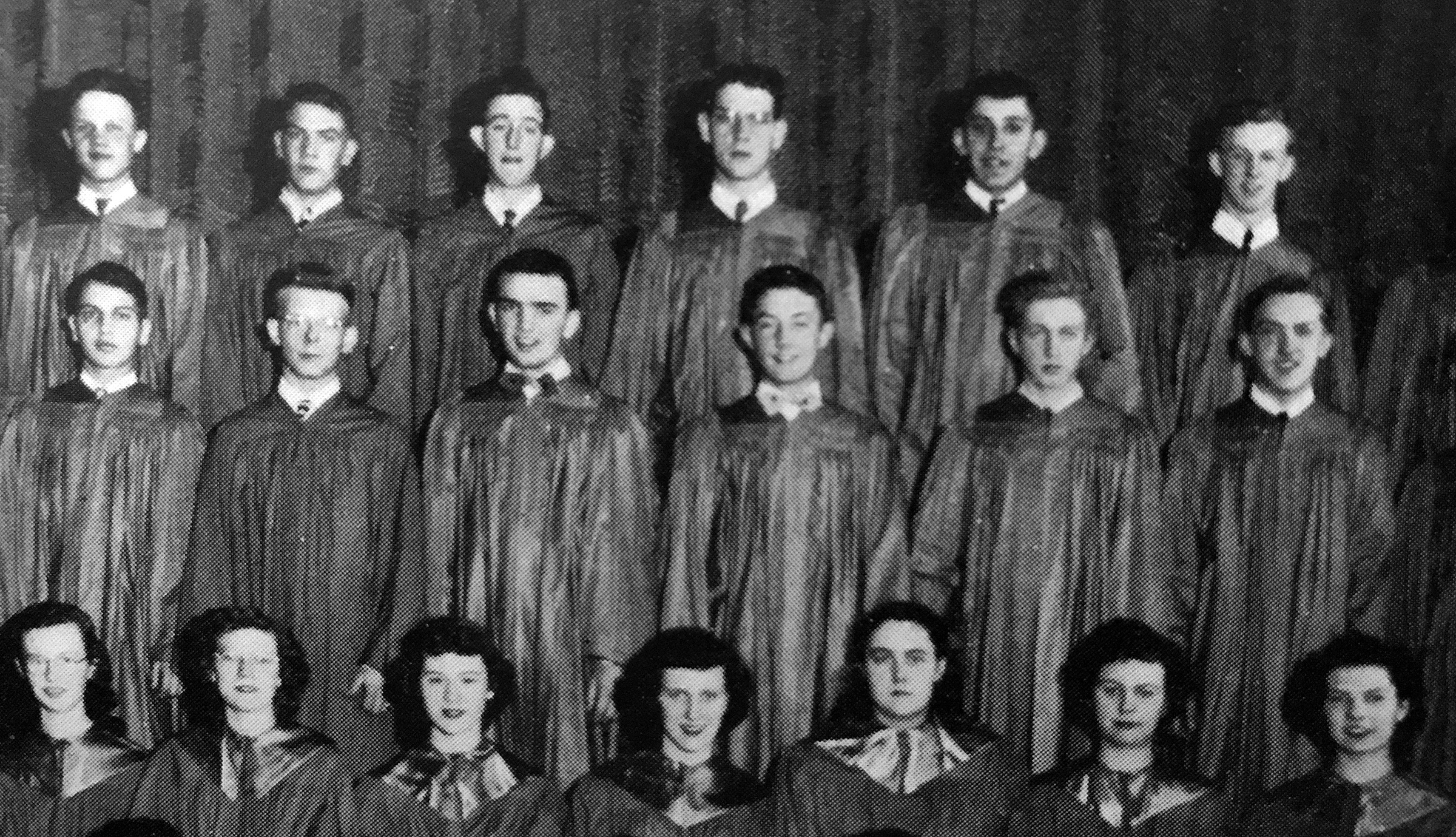
Not surprisingly, Dad was a member of the Boys Glee Club. He enjoyed performing arts even more than athletics, and won more medals and awards for his singing than his prowess on the field and the basketball court.
The Boys Glee Club. Dave Hanneman is third from the right in the back row.
Dad was among the members of the M Club, made up of winners of athletic letters. He won letters for football, basketball and track.
Dave is shown third from the left in the second row of the ‘M’ Club.
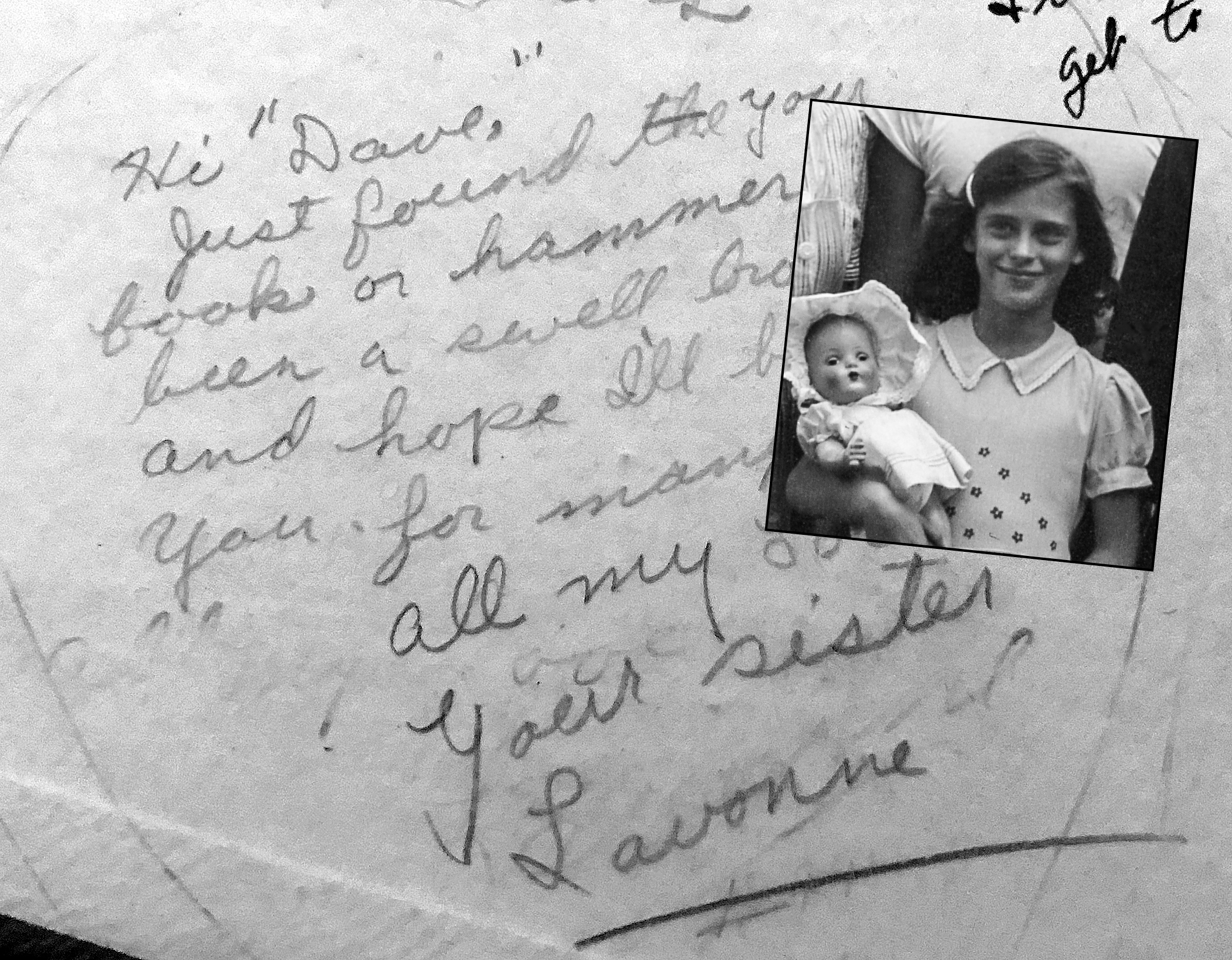
One of the most touching things in all of Dad’s yearbooks was the autograph left each year by his younger sister, Lavonne. Dad was four years older and took seriously his job of protecting Vonnie. They had a special bond. Here she wrote a tribute note, erased it and penciled in another one, circled by a heart. After her 1986 death at age 48, Dad told me these notes held very special meaning for him.
Lavonne wrote “I hope I’ll be with you for many years.”
Below is one of the frequent doodles found in Dad’s yearbooks. He was part of a double quartet that competed every year in Wisconsin School Music Association events.
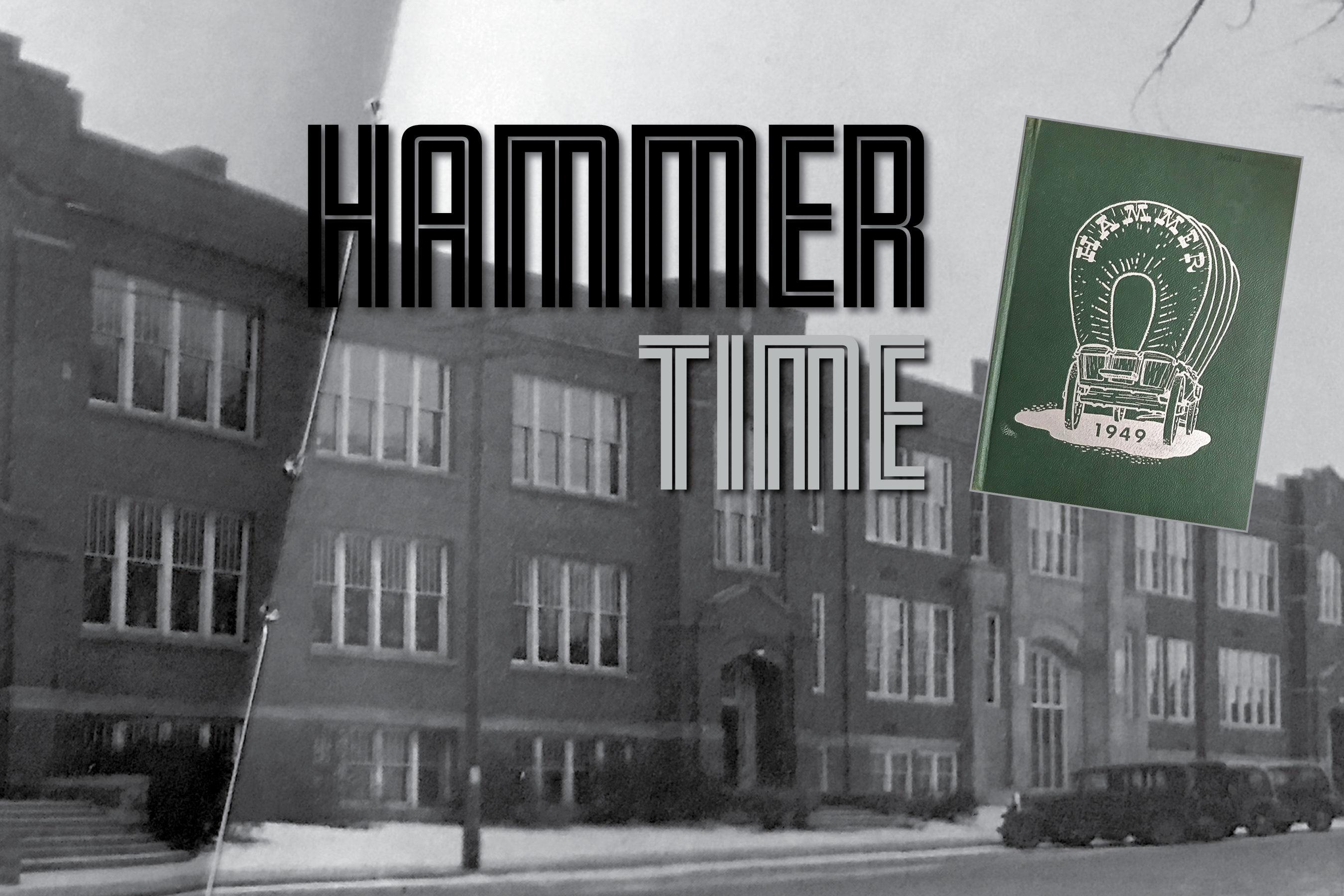
Top Photo: Mauston High School as it appeared in the center spread of the 1949 yearbook. The yearbook cover design is shown upper right.
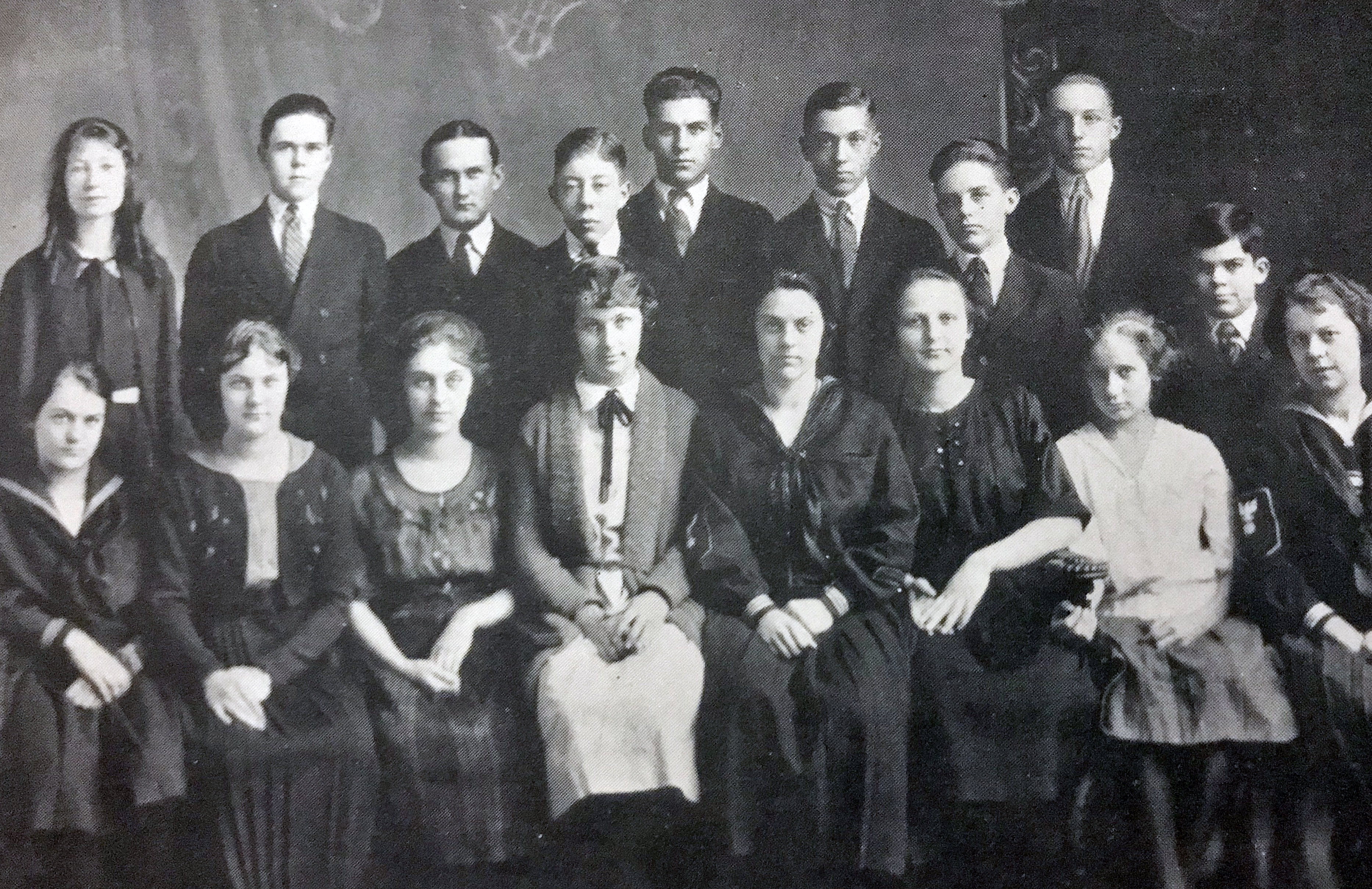
One beautiful young lady truly stands out among the 160 pages of the 1922 Ahdawagam. What is an Ahdawagam, you ask? It is the name of the school annual, or yearbook, at Lincoln High School in Wisconsin Rapids. Ahdawagam is an Indian word that refers to the “two-sided rapids” along the Wisconsin River.
The specially featured young lady was touted for her musical talents and participation in a wide range of student activities. She is Ruby V. Treutel (1904-1977) of Vesper, Wis., before she became Ruby V. Hanneman as the bride of Carl Henry Frank Hanneman (1901-1982).
It is indeed a treat to stroll through the pages of this early 1920s book, 98 years after it was published. It was a very different era, and these young people seem so mature and serious. Although maybe that is because we came to know them much later in life.
Ruby’s first appearance in the book is near the front, in the senior portrait section. Right between Irene Timm (“Timmy”) and Florence Van Dyke (“Flo”). No nickname is mentioned for Ruby. The listing has five lines describing her school activities: Glee Club, Ahdawagam staffmember, Dramatic Club, Mask and Wig Club (founding member), Gamma Sigma musical society, and a performer in the school operetta for three years. Ruby’s slogan certainly fits the woman we came to know: “Music hath charms and so has she.”
She is next listed in the “Class Mirror” section. Her answers included: Heart = Carl; Mind = Church’s (pharmacy where Carl worked); favorite occupation = singing; wants to be = opera singer; and “ought to be” = second Galli Curci. The last item is a reference to Amelita Galli-Curci, the Italy-born coloratura soprano who was an acclaimed opera singer in the early 20th century.
A few chapters later, in the Music and Drama section, we find Ruby’s stronghold. She was president of the 87-member Glee Club, which encourages development of musical talent. The club also performs an operetta each year.
Glee Club: Ruby is in the center of the middle row.
Just pages later we find Ruby in the group photo for Gamma Sigma, which draws the most musically talented students in the school. She was among the founding members during the 1921-22 school year. The group offered regular public singing and instrumental performances.
Gamma Sigma: Ruby is seated in the first row, second from the right.
Ruby played the lead role in the Glee Club operetta production of Sylvia. The club and the performance were directed by Elizabeth Bradford, Lincoln High School’s musical supervisor.
The Cast of the 1922 production of “Sylvia.” Ruby is seated third from the right.
The operetta was no small-time school production. It received a preview article on the society page of the Wisconsin Rapids Daily Tribune on Jan. 17, 1922. Sylvia was originally slated to be performed at Daly’s Opera House in Wisconsin Rapids. Two weeks before opening night, the opera house burned to the ground. Firefighters were hampered because the hydrants near the opera house were frozen and water had to be pumped from the Wisconsin River. The fire forced the operetta production to relocate to Lincoln High School for the Jan. 27 performance.
Ruby V. Treutel dressed for her lead role in the musical ‘Sylvia’ in 1922.
The Daily Tribune published an extensive review in the Jan. 28 issue. The reviewer sang the praises of Ruby and her co-performers. “Miss Ruby Treutel scored in the title role, as the haughty sweetheart of the court poet. As an actress, she showed unusual ability in every situation,
“but it was as a singer that she won the hearts of the crowd completely.”
A review published in the Jan. 28 issue of the Wisconsin Rapids Daily Tribune.
Ruby shined with her rendition of “Unto Thy Heart” with a violin obligato by Esther Levin. The number “seemed to appeal to her listeners especially, for they accorded her enthusiastic and well-deserved applause,” the Daily Tribune review said.
We’ve documented elsewhere on this site the musical talents of Ruby Treutel Hanneman. She performed in various theaters, starting when she was just 17. In April 1921, Ruby “brought down the applause of the house time after time” with her performance in the play “The Fire Prince,” according to the Daily Tribune.
Ruby’s next yearbook appearance is on a photo-collage page. She and future husband Carl are doing some kind of goofing around. The photo isn’t real clear, but it appears Carl is either playing some kind of stringed instrument or wielding a fishing pole or a sword. See what you think. Many of the photos in the collage seem to be related to the operetta.
It is impressive to see how dressed up these students are on every page of the yearbook. Ladies in dresses and the young men in suits and ties. Fashion was the rule of the day.
Finally, Ruby is pictured among 17 members of the Ahdawagam yearbook staff. She served as editor of music and drama.
Ahdawagam yearbook staff: Ruby is seated, third from the left. She was music and drama editor.
Ruby’s final mention in the book is on a list under the heading “The Great White Way.” All of the people on the list were described as lights (“head light,” “flashlight,” “candle,” etc.). Ruby is listed as “Star Light.”
Carl gets the last word. He appears in the alumni section, where he is listed for his job as a druggist at Church’s Drug Store. Carl graduated from Lincoln High School in 1921.
The staff box for the yearbook says it was Vol. 10 for the Ahdawagam. The editor-in-chief was Viola J. Nash. The book was produced by the Hein-Sutor Printing Company of Wisconsin Rapids.
Carl (back row second from left) and Ruby (front row second from left) in a previous year appeared together in “The Fire Prince.”
I just love this image. Back in 2007 I was photographing a variety of things from Mom and Dad’s house, at my mother’s request. I came across this birthday card from October 1979. It was from my grandfather, Carl F. Hanneman, to my Mom, on her 47th birthday.
Carl F. Hanneman (1901-1982)
What I found touching was that Grandpa Carl still sent a little cash gift to a daughter-in-law who was nearly 50. He signed the card “Grandpa” even though he was her father-in-law. I loved that my mother never cashed the check — not wanting Carl to spend the money from his very fixed income. She kept the card and the check. Precious.
It’s funny how these memories pop up so unexpectedly. I saw this photo two days ago while searching for something totally unrelated. Mom has been gone to Heaven for 18 months. Grandpa Carl for 38 years. Yet finding this photo brings them right back to me, just as if this card were received earlier today.
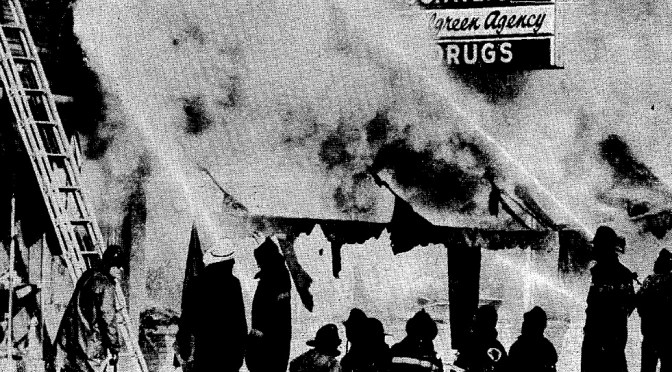
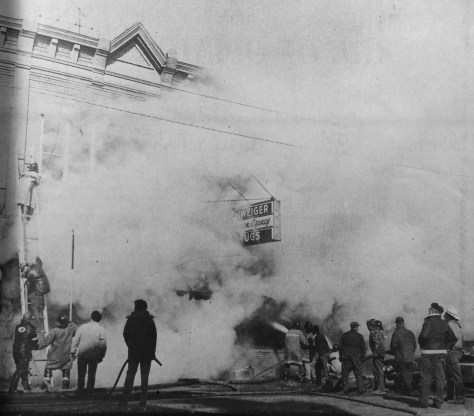
The huge explosion and fire that leveled numerous buildings in Sun Prairie on July 10 and 11 reminded me of another massive fire in the same area more than 40 years ago. On March 3, 1975, a fast-moving fire destroyed the Schweiger Walgreen Drug Store and Hillenbrand’s shoe store in the 200 block of East Main Street.
The fire alarm was sounded at 1:51 p.m. that day, bringing 33 firemen from the Sun Prairie Volunteer Fire Department to the scene. They were shortly joined by another 25 firefighters and trucks from Stoughton, DeForest and Marshall. The fire was discovered in the basement of the Schweiger Walgreen’s store, 214 E. Main St., and quickly spread to the adjacent Hillenbrand’s and apartments above both buildings. It took more than five hours to fully contain the blaze. The last crews left the scene at around 11 p.m.
Firefighters battle a blaze at the Schweiger Walgreen Drug Store in Downtown Sun Prairie on March 3, 1975. (Sun Prairie Star-Countryman photo)
Margaret McGonigle, 75, became trapped on the roof of the drug store building when the stairs down from her apartment were blocked by fire. She was rescued by the snorkel truck from the Sun Prairie Fire Department, according to the March 6, 1975 issue of the Sun Prairie Star-Countryman. Mrs. McGonigle was the widow of pharmacist John M. McGonigle, whose family owned and operated McGonigle’s Drug Store for more than 50 years before Robert Schweiger purchased it in 1970. She was also postmaster of Sun Prairie for 38 years before retiring in 1966. John McGonigle died in September 1965.
I distinctly recall going downtown with my father to view the aftermath of the fire. I recall the outriggers on the snorkel truck, and large amounts of road salt around the tires of the fire engines. The pharmacy held special memories for us, since my grandfather, Carl F. Hanneman, was a reserve pharmacist who occasionally worked for McGonigle’s. The Hillenbrand clothing and shoe stores were run by John Hein, a good friend of my parents, and the shoe store was managed by Roger Reichert, also a family friend. Reichert lived above the store and lost all of his belongings in the fire.
Volunteers move boxes of shoes from the Hillenbrand clothing and shoe store, 206 E. Main St., Sun Prairie. (Sun Prairie Star-Countryman photo)
The state fire marshal investigated the blaze, but was unable to determine a cause. Damage to the structures and contents was estimated by Fire Chief Milton Tester at $200,000. Within a week, Schweiger’s opened in temporary quarters on Bristol Street. The buildings were a total loss and had to be demolished.
“Many fine things have been said about our volunteer firemen before. But last week’s fire had to be one of their finest efforts,” read the “Shavings from the Editor’s Pencil” column in the Star-Countryman. “I spent nearly three hours in that biting cold watching those magnificent, heroic firemen work. Not once did I see anyone so much as flinch at going into a burning building or otherwise approaching a dangerous situation.”
Both the 2018 fire that claimed the life of Capt. Cory Barr and the 1975 fire had one thing in common: a pharmacy. The Barr House tavern at the corner of Bristol and Main streets, owned by Capt. Barr and his wife, once housed the Crosse and Crosse Drug Store, according to the Sun Prairie Public Museum. The building dates to the 1890s.
The Schweiger fire was one of three major blazes in Sun Prairie in 1975. On Aug. 10 that year, fire swept through the Moldrem Furniture store at 13 N. Bird St. in the Bird Street Centre. The fire did about $185,000 damage to the 34-year-old business. The store was a total loss. A backdraft blew two firefighters out the front doors of the store. Retiring assistant fire chief Arnie Kleven described the fire as his most frightening in an August 2017 interview with The Star. Kleven said the doors probably saved his life that day. Wiring in the air conditioning system was cited as the cause of the fire.
In July 1975, shorted wiring sparked a major fire in the garage and offices of Bill Gawne Ford Inc., 425 W. Main St. That fire caused an estimated $85,000 damage.
(This post has been updated with details on the Moldrem and Gawne fires.)
Firefighters battled fire, smoke and bitter cold weather. (The Capital Times/Dave Sandell)
It took more than five hours to contain the blaze. (Wisconsin State Journal/Edwin Stein)
A snorkel truck was used in the dramatic rescue of Margaret McGonigle, owner of the drug store building, who was trapped on the roof. (Sun Prairie Star-Countryman photo)
Fire crews from Sun Prairie, DeForest, Stoughton and Marshall battled the blaze. (Sun Prairie Star-Countryman photo)
Shelby Beers behind the counter of the Crosse and Cross Drugstore, circa 1920s. (Sun Prairie Public Museum photo)
When one of my sisters first showed me this photograph, I knew it was a major discovery. We know the occasion (Mom and Dad’s engagement party) and the time frame (June 1958). The task ahead is to identify every one of the 26 people in the photo. After discovering the medium-format negative, I scanned the photo larger to aid with identifications.
David D. Hanneman and Mary K. Mulqueen were married on August 9, 1958 at St. Veronica Catholic Church in Milwaukee. About two months prior, an engagement party was held in their honor. I’m not fully sure of the location, but it could be at the Cudahy home of my grandparents, Earl J. Mulqueen Sr. and Margaret (Dailey) Mulqueen.
We’ve made pretty good headway on photo identifications with the help of the then-bride-to-be and her sisters. The result so far? Of 26 people, only two remain unidentified, with one additional identification being tentative. View the full-size version of the photo here.
Party by the numbers: See below for a key to faces, known and unknown.
Since this post was first published, readers have identified several more people in the photograph. Elaine Hanneman reports that No. 2 is Bob Ripp, No. 24 is his wife, Marjean, and No. 4 is Ruby Curtis. At this party, Donn G. Hanneman and Tinker Mulqueen recognized each other from serving in the U.S. Navy during World War II, Elaine said.
Lois (Detlaff) Mulqueen (Identified by Jean Mulqueen Maule)
Bob Ripp (identified by Elaine Hanneman), 1927-2016
Vina M. (Tucker) Seely (1919-2008)
Ruby Curtis (identified by Elaine Hanneman)
Donn G. Hanneman (1926-2014)
Elaine M. (Kline) Hanneman
Ruby V. (Treutel) Hanneman (1904-1977)
Margaret M. (Dailey) Mulqueen (1895-1982)
Unknown
Ruth (Cieszynski) Mulqueen (1926-2008)
Mary K. Mulqueen (1932-2018)
David D. Hanneman (1933-2007)
Eleanor (Deutsch) Mulqueen (1929-1963)
Donald J. Dailey (1935-2009)
Thomas H. Dailey (1904-1983)
Joan (Mulqueen) Haske
Friend of Joan (Mulqueen) Haske
Earl J. Mulqueen Jr. (1923-1980)
Tinker Mulqueen (1926-2007)
Joseph A. Mulqueen (1944-2015)
Edward J. Mulqueen (1931-1991)
Marie A. Mulqueen (1925-2010)
Lavonne (Hanneman) Wellman (1937-1986)
Marjean Ripp (identified by Elaine Hanneman), 1933-2004
Florence (White) Dailey (1869-1966)
James Grattan Seely (1916-1990)
If you recognize any of the unknowns, leave a comment below so we can update this post.
As we make our way through the recently acquired vintage family photo album, we turn our attention to more unnamed faces. In this case, a boy and young man who could be the earlier faces of Henry Adam Treutel (1864-1962).
Henry A. Treutel
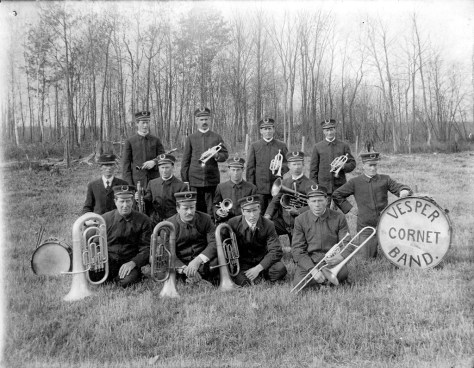
Henry Treutel was the third of seven children born to Philipp and Henrietta (Krosch) Treutel. The earliest confirmed photo of him in our collection shows him as a member of the Vesper Cornet Band, a local music group that performed around Wood County in the early 1900s. Other family-related members of the band included Charles Treutel and Orville Carlin.
Henry has a distinctive face and a somewhat different look than his siblings. Based on the shape of his face and his expression, we found two unidentified images that seem to fit him.
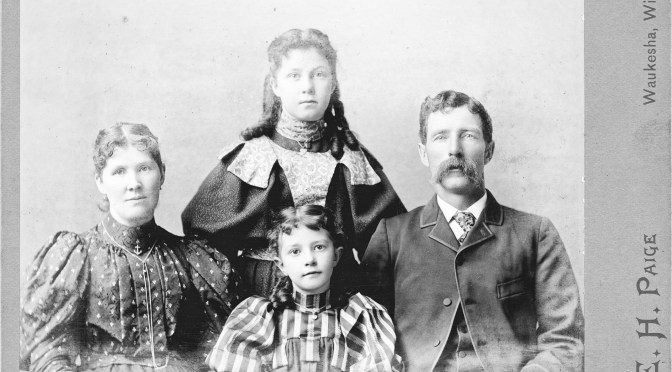
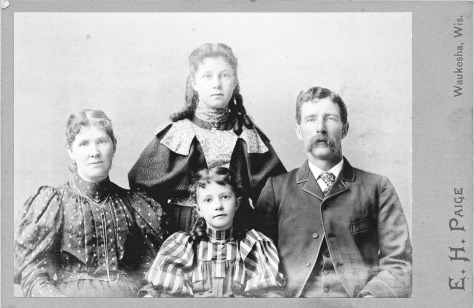
The two images at left are unidentified, although they seem good candidates to be Henry Adam Treutel (1864-1962), shown in the right two photos. Both of the unidentified portraits were taken in Waukesha, Wisconsin. Henry grew up in nearby Mukwonago.
Henry Adam Treutel was born in Mukwonago, Wisconsin on October 5, 1864. He learned his blacksmithing and carpentry skills from his father Philipp in Mukwonago and Milwaukee. On October 11, 1900 in the village of Eagle, he married Josephine Adelia Garlach at the home of her parents, Constantine and Josephine Garlach. Shortly after, the couple moved with the rest of the Treutel family to Vesper in Wood County.
Almost immediately, Henry and Charles Treutel established Treutel Bros. blacksmith shop. They also sold Deering farm implements, and made and repaired wagons. Business was good, as evidenced by the large barn the brothers built on their property. Henry also secured construction of what the Grand Rapids Tribune described as “one of the most modern residences in Vesper.” Sadness filled the Treutel home on January 31, 1902, when Henry and Josephine’s firstborn child, Warren Mark Treutel, died at just 1 day old. Their second and only other child, Harold James Treutel, was born on September 2, 1903.
The Vesper Cornet Band performed at the Cameron Park band shelter and other locales around Vesper, Wisconsin. Oscar, Charles and Henry Treutel were band members.
The Treutel Bros. excelled in music as well as business. “The Vesper people did not know there was a band in town until Wednesday evening, when the four Treutel Brothers came out and surprised the people by playing a few pieces,” the The Daily Tribune reported. “Come out again, boys.” It appears that Oscar and Walter Treutel joined their brothers in the performance, although I don’t believe Walter was part of the Cornet Band.
In 1917, Treutel Bros. expanded their facilities to add a large garage for the repair of automobiles. It later became a gasoline filling station, selling Red Crown fuel. Henry retired from the business in 1940.
Josephine Treutel died on June 14, 1955 in Wisconsin Rapids, where the couple moved in 1952 after retirement. Henry died on July 19, 1962 at age 97. The couple were survived by their son, Harold, daughter-in-law Genevieve (Senn) Treutel, and grandchildren Robert, Frederick, Barbara and Kathleen. A grandchild, Rose Marie, preceded them in death in January 1928.
The house was silent and the wooden bookshelves were empty, yet a small something caught my eye. In the corner of one shelf stood a tiny metal figurine: an Indian in headdress, from a cowboys and Indians play set from long ago. The man was kneeling with a rifle pointed off in the distance. The figurine was hand-painted; possibly made from lead. It was just the kind of little toy I recall seeing in the house in which my father grew up in Mauston, some 70 miles from where I now stood. There was a box in my Grandpa’s den office that contained cowboys and Indians, toy soldiers, wooden blocks and other assorted goodies that we grandkids played with.
The toy Indian figurine sat alone on the edge of the bookcase shelf.
I looked around the room, amazed that this one little item remained hidden after all of the furnishings were gone. The house I grew up in was nearly ready for market, mostly empty of content but not of memories. After days helping clean and polish the house, I found myself saying goodbye. Yet here, some 52 years after first setting foot in this place, the house was saying something to me as well.
The Indian figurine was the second surprise of the day as I made my way around my parents’ home. A few minutes before, I noticed some crumpled salmon-colored construction paper jammed into the corner of a cupboard beneath the basement bar. I figured it was a random scrap that should be out in the trash. But as soon as I picked it up, I realized it was anything but. It was a play program from Mauston High School’s January 1950 production of The Atomic Blonde, a play my father starred in. As I carefully opened the brittle paper, I recognized my Grandmother Ruby’s handwriting across the top of the first inside page: “Jan. 6 – 1950.”
Inside pages of the program from The Atomic Blonde, put on by the Mauston High School junior class of 1950.
This sure was a treat. The Atomic Blonde, the program read, “takes place in the lobby of Bob Nickerson’s and Skid Weiling’s hotel and and healthitorium in Silver Springs, a summer resort town in the mid-west.” On the other inside page was the cast listing for the play, “presented by the junior class of 1950.” Dad played Skid Weiling, one of the main characters. I recognized many of the cast names from when I helped Dad design a program for his 55th high school reunion in 2006. Mary Crandall, Carol Quamme, Roger Quick, Robert “Jigger” Jagoe, Clayton “Ty” Fiene, Bob Beck and others.
The Mauston Star: Jan. 12, 1950.
I dug around in my news clippings and found an article, “Atomic Blonde Scores Hit Here,” from the January 12, 1950 issue of The Mauston Star. That article made the play sound more interesting: “Take a couple of love-sick guys, one of their pals masquerading as a blonde glamour gal, a headless ghost, a gigolo or two, an ambitious mother and several lovely gals and stir them into a broken-down resort hotel warmed by a steam bath.” Pretty spicy stuff for 1950. The paper was effusive in its praise of the student actors. “Heading the cast were Dave Hanneman and Pat Dougherty, who were well chosen and able in their resort-operator roles.”
It appeared that my late father, who died in April 2007, was here in this empty house, reminding me there are still memories to be preserved and celebrated. So, as I did years ago when I said goodbye to my own home,I walked the three levels and tried to unearth as much as I could from 52 years of memories.
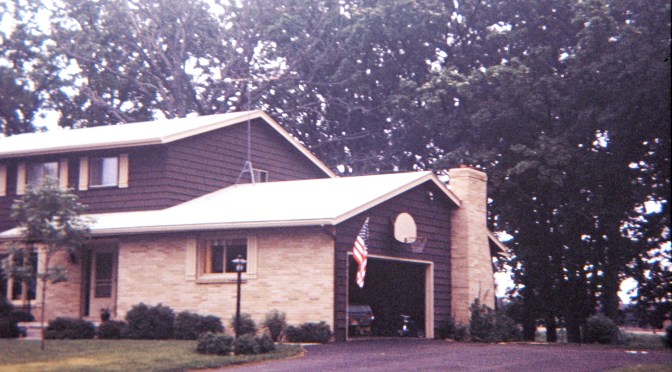
The Hanneman house was built and then occupied in 1965. It was one of the first homes in the Royal Oaks subdivision of Sun Prairie. And royal the oaks were, with 17 of them towering over the rear of the half-acre property. The house’s blueprints came from Better Homes & Gardens magazine and its signature home design for 1965. While the house was under construction, we lived in a rented home on Lake Wisconsin in Columbia County. Dad made frequent stops at the house and often found things on site not to his liking. One day he was so disgusted by the builder’s sloppiness, he redid an entire window frame. Dad complained for many years that the builder messed up the plans. One room was too big and another too small. We couldn’t tell the difference, but Dad was very exacting.
Over the years, many hundreds of people came and went through the front door, including grandparents, neighbors, school friends, card buddies, bridge club members, foster children, cousins, a couple of reigning Misses Wisconsin, doctors and, in later years, paramedics. I won’t describe here about the events surrounding Dad’s lung cancer and death, since I wrote about that extensively in my book The Journey Home.
The house in 1967, 2006 and 2017.
I was now standing in the family room, which was the heart of group activity. On one side I could see my Grandpa Carl, rocking in the mahogany recliner. On this day, he looked rather sad. It was probably 1978, not long removed from the July 1977 death of Grandma Ruby. Many a Friday we drove from Sun Prairie to Mauston to bring Grandpa back for a visit. He was so sad and lonely after losing his wife of 52 years. It always started the same way. One of us would pick up the phone on a Friday afternoon and hear a long pause before Grandpa burst into tears. He couldn’t even get the words out. “It’s OK Grandpa, we’ll come get you! Don’t be sad!” I still get a lump in my throat thinking about it. A few of those calls took on serious urgency, like the time Grandpa said he was laying on the floor and could not get up or walk. Dad quickly drove to Mauston to retrieve him, discovering Grandpa had a case of gout that needed attention. Our home became a haven for Grandpa Carl up until he fell to liver cancer in 1982.
A few feet away stands the white-brick fireplace with double mantle. What a treat it was when Dad would bring some firewood from the woodpile out back and build a roaring fire. We would lay in front of it, propping our bare feet on the lower mantle and toasting our toes. Each kid jockeyed for position to get the best “seat” for the fire. I noticed the upper mantle was decorated with greens for Christmas, interspersed with fake fruit covered in glitter. I can still see the Christmas stockings. Most of them were not hung but set on the lower mantle due to the weight of the oranges and apples always at the bottom of each. The fireplace became a critical asset one spring week in the 1970s when a massive ice storm hit Dane County. We had no heat or power for three days. Dad was gone on business and could not get back due to the icy weather. Mom kept things going. The experience was surreal, especially the creepy groans and creaks the tree branches made under weight of the ice. Then came cracks like thunder just before branches fell to the ground. We used the fireplace for heat. We took turns bailing out the basement sump pump to prevent the house from flooding.
The television set always stood under the bookcase to the left of the fireplace. I vividly recall watching one of the Apollo moon landings with the Greens, our next-door neighbors. Way back then, the television was a black-and-white console with vacuum tubes that glowed in the back of the cabinet. The TV had to “warm up” before it showed a picture. Every so often, repairman Phil Wedige came over to replace a tube or some other part. We watched countless hours of programs as a family. Among the most memorable were “Jesus of Nazareth,” the “Roots” miniseries and the four-part “Holocaust” miniseries recounting the Shoah. Dad loved his Jimmy Stewart and John Wayne westerns, and we all enjoyed Clint Eastwood in High Plains Drifter and Pale Rider.
Grandpa Carl Hanneman rests in the seat of honor in the Hanneman family room.
Televised Green Bay Packers games were always memorable, even when the Packers were forgettable. The kids sat on the floor and the adults had the real seats for the Sunday spectacle. Our usual guests for the games were Dr. and Mrs. Joseph Behrend. Dr. Joe was our family physician. I remember more groans of pain from him and Dad during those games than I ever heard at the medical clinic he founded in Sun Prairie. I was too young to really remember the Lombardi glory years, but I sure remember the painful seasons under Dan Devine, Bart Starr, Forrest Gregg and Lindy Infante. It wasn’t until 1992 that the Pack really was back, and those sad little bumper stickers we put on the car finally meant something.
A Love of Reading
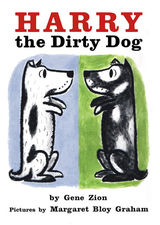
A couch once stood in various places in the family room. We went through several couches over the years, from one with solid green upholstery to a truly gaudy scotch plaid number that made up for its appearance with comfort and extra length. I recall Mom reading to me from toddler age on. Even busy with five kids, she found time to read to each of us. My favorites included “Harry the Dirty Dog,” by Gene Zion. “Harry was a
white dog with black spots who liked everything … except getting a bath,” the story went. Then there was “Crictor” by Tomi Ungerer, a story about an old lady and her boa constrictor. Perhaps my favorite, though, was “Are You My Mother?” by P.D. Eastman. The charming illustrations in this book (edited by Dr. Seuss) captured my imagination. They detailed in colored pencil the adventure of a baby bird who fell out of the nest and went on a grand search for his mother. Mom read these books countless times. I never tired of the stories.
When the house was first built, it had a back patio under roof with posts that supported the overhang. Eventually, Dad framed it in and installed screen panels. That was a luxury, having a screened-in porch. It was quite a treat to dine al fresco, without Wisconsin’s state bird (the mosquito) interfering. My most vivid memory of the screened porch came in July 1975, when we hosted a reception for Grandpa Carl and Grandma Ruby for their 50th wedding anniversary. Grandpa wore a dark blue blazer, crisp white dress shirt and silver-blue patterned tie. Grandma wore a pearlescent seafoam green dress. Her corsage was a lily; his was a yellow rose. I stood at the entrance to the back porch and noticed how the late afternoon sun cast itself warmly across the happy faces of people no longer with us, such as Uncle Wilbert, the “rock hound,” and my dear Aunt Lavonne, who was taken from us just 11 years later at age 48.
Grandma Margaret Mulqueen with Mom, circa 1976.
The kitchen of course held a special place in our hearts. As I walked in on this day, I saw Grandma Mulqueen, Mom’s mother. For some reason, we never called her by her beautiful given name, Margaret Madonna. She was just Grandma Mulqueen. She rode the Greyhound bus from Cudahy to Sun Prairie to spend a few days. Her visits meant fresh bread and cinnamon rolls; her own secret recipe. She and Mom mixed up huge batches of dough in a green plastic tub, then tucked it away under the sink, where heat from the dishwasher and water pipes helped the dough to rise. Of course we couldn’t resist pulling back the dish towel that covered the green tub and taking a pinch of dough. “Don’t touch that bread or it will never rise!” came the admonition from another room. Too late.
I sat in Grandma Mulqueen’s lap and she told stories. About what I don’t recall, but I do remember her voice was kind and soothing. We begged her to make us a big pot of oatmeal, acting like Mom never fed us. At night, after Grandma retired to her guest room, we peeked into the bathroom to see if her dentures were sitting in a glass of water. They always were. We always looked. It was always gross. Such memories!
Dad plays cards with grandchildren Samantha and Stevie.
The kitchen was also the main spot for playing board games and cards. It was the site of many bitter losses in Monopoly. Bitter for us children, who were almost always bankrupted by landowner Dad. Usually you could tell the game was nearing an end when Dad said to one of us, “I’ll tell you what I’m going to do.” This was usually followed by confiscation of property, and for some players like my sisters Marghi and Amy, occasional tears. Dad laughed, but not in a mean way. It was more of an “evil but loving” thing. He was competitive like that.
Other games that graced the kitchen table included cribbage (which I regret never learning), poker and dirty clubs. It was the latter card game that was responsible for some epic battles. One night, Grandpa Carl got especially upset, slammed his cards on the table and stormed away. He then uttered words that will forever live in Hanneman lore: “Baby bullcrap! I’m walking home!” If Grandpa Carl lost that game, it was a rare letdown for the veteran card shark. He was every bit as competitive as Dad. One night in high school, I sat at that table until midnight and took an unparalleled pounding at dirty clubs. When the smoke cleared, it was Carl with 80 wins, Joe with 1. One. Win. Every time he won, Grandpa patted my hand, giggled and said, “I’m so sorry.” Ha. He enjoyed every one of those 80 wins.
Back to Nature
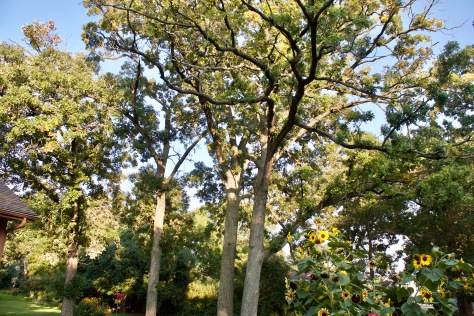
One of the great features of our home was the huge backyard. At one time, there were 17 huge oak trees creating a dense canopy. It’s down to about six now. When I was a preschooler, I hauled my bedroom pillow down into the yard, lay in the grass and just looked up. The giant limbs swayed in the breeze, only occasionally letting a ray of sunlight pierce the cover to reach the ground. The high canopy provided a test to us budding athletes, too. If one of us could punt a football high enough to hit one of those high limbs, an offer from the Green Bay Packers was sure to await us. I’m still waiting.
Fewer than half of the oaks from 1965 are still there, but the back yard still has a nice canopy.
In the early days before neighboring houses were built, my brother David and I liked to make our own “snow” in the back woods. We rubbed Styrofoam on the bark of the oak trees. One time we got bawled out by some nosy lady who happened upon us. She yelled that we were going to kill the trees. Pah! Never happened. On one side of the lawn near the house, Dad built an incredible rock patio out of sandstone. It included a horseshoe-shape wall and a patio surface that was probably 10-by-20 feet. The borders between the rocks were filled with tiny pebbles, which we were forbidden to mess with. Of course we did, although quickly discovering the unpleasant duty of sweeping them back into place.
During at least a few winters, Dad poured an ice surface in the back yard. It wasn’t as smooth as the local ice rink, but heck, who else could say they had a skatable ice sheet in the back yard? In the fall, we all worked to rake up what seemed like millions of oak leaves. We never had a fancy lawn vacuum like some of the neighbors. So it was a bamboo rake, blisters and arm aches for all. Our efforts created a leaf mountain that we all jumped in, which at least partially made up for the pain of raking. The video below shows my firstborn child, Stevie, romping in the leaves on a 1990s fall afternoon at Grandma and Grandpa’s house, along with Bailey the golden retriever. Aunt Marghi was behind the camera.
Back inside the house, I continued my tour with the dining and living rooms. We usually were not allowed in either unless it was a special occasion like Thanksgiving or Christmas. Thanksgiving was a big deal in our house. I recounted in my book The Journey Homehow exacting Dad was in preparing for and then carving the turkey. Those celebrations changed over the years as grandparents left us and grandchildren appeared on the scene. Eventually, the dining spread spilled onto several tables, with the grandkids assigned to the card tables. I never felt so adult as when I carved the turkey one of the first years after Dad’s death. It just wasn’t the same. The large group in a smallish space created lots of chaos, noise and stress. One of the last years we had a large Thanksgiving gathering around that table, Mom’s nerves were a bit frayed. During a particularly loud time during the meal, she snapped at my youngest daughter, Ruby, “Would you shut up and eat your dinner?” Whoa. Poor Ruby looked around the table in stunned silence, since she hadn’t said a peep.
Merry Christmases
Christmas was another chaos-inducing holiday at the Hanneman home. Everybody talked at the same time, which is evident on the video below from December 1994. When we were little, my parents made sure we had lots of things to open. I don’t know how they did it, especially when money was tight. One of my favorite Christmas gifts was a die-cast metal Batmobile with a missile launcher. It actually shot tiny plastic missiles off the back. Perhaps the most lasting, beautiful gift was an art print by Wisconsin wildlife artist Owen Gromme, which Dad exquisitely framed and signed on the back. When my son Stevie was 11 months old, my brother David taught him a disgusting skill on Christmas Day. Grandpa Dave walked in to the bathroom to discover Stevie flushing toilet paper and splashing in the water. “Don’t teach him that,” grandpa boomed. Watch below and chuckle.
Basement Refuge
Back in the 1970s, Mom and Dad decided to turn the basement into a rec room. About two-thirds of the basement was covered with a commercial-grade red carpet. Dad put wallpaper on the east wall. The pattern showed chess pieces on a board. That was OK, but the way it hung on the wall made the whole wall appear to be tilted. Even though the paper was hung with total precision. I know this bothered Dad to no end.
The pool table served as great entertainment for more than 50 years.
The centerpiece of the basement was always the pool table. I don’t know where he got it, but Dad in the 1960s put in a gorgeous full-size billiards table from the Sydney Laner & Co. of Chicago. Sydney Laner established his billiards firm in 1918. It operated in Chicago until 2010. Dad carefully laid the huge slate on the supporting beams of the table, then leveled the entire table using playing cards as shims to ensure every area of the playing surface was level. Even after 50 years, the green felt has no wear marks, and the cushions have just as much pop as the day they were installed.
Playing cards were used as shims to balance the pool table.
As was the case with cards, action on the pool table was dominated by Dad and Grandpa Carl. Both wielded the cue stick with power and precision. There was nothing like the sharp cracking sound when the cue ball hit the racked pool balls to open each game. I learned all I know about pool from them: how to line up a shot, figure angles on the bumpers, properly chalk the cue tip, etc. My skill never rose to the level of our resident pool sharks, but it was so fun to play against them. I’ve not played pool in many years. I have fond memories of my own children playing “rollin’ bowling” with the pool balls. I will miss that table.
During the early years, the basement frequently got rainwater and an occasional sewer backup. Dad got into an epic battle with Sun Prairie city hall over the drainage for the entire subdivision. One backup was awful. It burped brown sludge 3-4 inches deep across the entire basement. This was just after the new carpet was installed. Outfitted in rubber boots, gloves and masks, we used shop vacs to slurp up the mess. We each got a 2-by-4 to squeegee the filth from the carpet. Dad used Nolvasan, a surgical scrub, to help disinfect the entire basement. What a horrid mess. I vaguely recall there was litigation over the sewer backup.
Coverage by the late Bob Richards of NBC-15 television in Madison was instrumental in solving the problem of sewer backups in Sun Prairie.
Eventually, Dad contacted NBC 15 television about the drainage controversy. They sent Bob Richards, the ‘Contact 15’ consumer affairs reporter, to city hall to cover hearings on the issue. Dad, a former Sun Prairie alderman, was interviewed on TV. The publicity helped pressure the city to put in new drainage pipes and tiles at Main Street and Thompson Road. Ultimately that solved the issue for the entire subdivision. I was so impressed with the TV reporter, I went to watch him in the studio during a 6 p.m. newscast. It was a major influence in my decision to become a journalist.
The final memory I have of the basement was of the beautiful stained-glass windows that stood hidden across from the furnace for decades. Dad obtained them from St. Mary’s Hospital as the hospital demolished its old chapel in 1973. The two tall windows included four sections. When Dad was being treated for lung cancer at St. Mary’s in November 2006, he got the idea to donate the windows back to the hospital. It was providential timing, since St. Mary’s was in the midst of a $182 million expansion. The hospital not only accepted the donation, it asked the architects to incorporate the windows into the new hospital wing. Today, there are four waiting areas at St. Mary’s graced by the windows, backlit with beautiful dramatic effect. “I want these windows to come home to St. Mary’s,” Dad said at the time. And so they did. You can read more about the windows in The Journey Home and on the Hanneman Archive website.
I walked the house a final time, impressed by how many memories flooded back to me. They could fill a book. This home has ably done its duty for more than five decades. The man of the house has gone back to God, and Mom needs the sale proceeds to ensure good ongoing healthcare. How do you say goodbye to such a special place? I thought I accomplished that by quietly pulling shut the door into the garage. On second thought, no goodbyes. Only memories, written here and displayed in the photo gallery below. My hope for this place is it takes such good care of another family for many decades to come.
What are the odds? I wondered that question as I flipped through a very old, leather-bound photo album purchased from a collector in Ohio. What are the odds that I would come into possession of a Treutel/Krosch family photo album stretching back 150 years, from a person in another state whom I’ve never met? The chance would seem very small indeed.
We’ve already outlined some of the wonderful finds from this photo album, including the cartes de visite showing Philipp Treutel,his wife Henrietta and his mother-in-law, Christiana Krosch. Those photos were fun and easy, because they were labeled with names by a relative long ago. Now comes the hard part: determining the identities of many faces with no names. It is certainly possible that all of the suppositions below are inaccurate. Without the aid of original photo captions or relatives who might recognize the people, we can only make educated guesses.
Philipp Treutel (1833-1891) had a long face and prominent mustache, which matched well with a number of unlabeled photos in the album. Could he be the stranger in those images? One was even a wedding photo, but I was a bit skeptical that the album could include a studio photo from the 1850s.
Do these photos show the same man? The man at right is Philipp Treutel. The others had no photo identifications, but they bear some resemblance to Philipp.
a wedding photo, but I was a bit skeptical that the album could include a studio photo from the 1850s.
The other image shows a man with three young women, presumably his daughters. We know Philipp and Henrietta Treutel had three daughters: Adeline, born in November 1859; Lisetta, born in April 1861; and Emma, born in February 1877. The youngest girl in this photo appears to be 6 or 7, which would put the year at about 1883. That was some eight years before Philipp’s untimely death from influenza.
Is this Philipp Treutel with his three daughters? The woman at left looks old enough to be a wife, but we are sure she is not Philipp’s wife, Henrietta.
We have no photos in our collection that show Adeline (Treutel) Moody (1859-1928), who married William Jones Moody in 1883 and eventually settled near Vesper, Wisconsin; or Lisetta (Treutel) Moody (1861-1931), who married Lewis Winfield Moody in 1887 and settled at Plainfield, Wisconsin. Since the little girl in the photo could be Emma Treutel, we created a photo series to evaluate resemblance.
The photos at center and right show Emma (Treutel) Carlin, 1877-1962. Is the little girl at left Emma? Without more photos from Emma’s youth, it is very difficult to draw conclusions.
We next examined the wedding portrait that could show Philipp Treutel and Henrietta (Krosch) Treutel. We don’t know their wedding year, but it was likely around 1857 or 1858. Below is a photo series comparing the bride to later photos of Henrietta Treutel. Again, there is a resemblance, but no other clues to help in the determination.
Henrietta (Krosch) Treutel is show at center and right. The bride at left from the wedding portrait below.
We can see family resemblance in many of our album images, so we’re on the right track. But to make judgments with confidence, we need more photos from the Treutel and Krosch families. There are other faces in this old album that we will review in another post, including possible youth photos of Walter Treutel and his brother Henry A. Treutel.
To borrow a phrase from the 1994 movie Forrest Gump, an old photo album is a lot like a box of chocolates: you never know what you’re going to get. That was certainly the case with a very old leather-bound album we recently acquired from a collector in Ohio. In it we found the first known photograph of great-great-great grandmother, Christiana (Schlagel) Krosch.
The album was purchased from the same source who provided us the carte de visite image of Philipp Treutel. Based on his inclusion in the album, we surmised that the other photos would be related to the family tree of my grandmother, Ruby (Treutel) Hanneman. One of the first carte de visite photos we pulled from the album was labeled, “Grand Mother Krosch, Our Mother’s Mother.” It was right next to a photo of Henrietta (Krosch) Treutel. Since Henrietta was the only girl in the Krosch family of six children, it was an easy jump to conclude the photo showed her mother, the former Johanna Christiana Schlagel (1801-1884).
Christiana (Schlagel) Krosch in an undated photograph. The portrait could have been taken the same day as that of her daughter, Henrietta, shown at the bottom of this article. The carpeting and staging of the studio are identical.
The photograph is the first image in our collection that goes back five generations. It was taken at the studio of F.D. Faulkner in Waukesha, Wisconsin. There are a number of other unlabeled photos in the album that could also be Christiana Krosch. We laid the photos side-by-side in Adobe Photoshop, and even overlaid a low-opacity version of Christiana’s head and face on the other images. The facial contours, distance between the eyes, etc., are remarkably similar. Could the other photos show Christiana later in life? The beady pupils in the right two photos were likely drawn in by the photographer.
Could these photographs show the same woman?
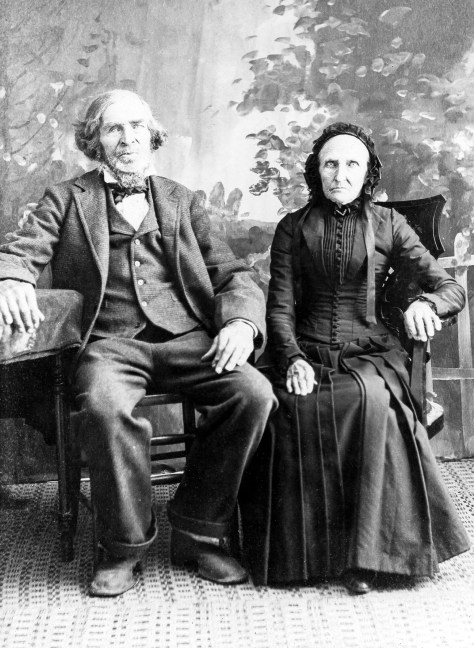
If she is the woman in the far right image in the series, then we have an ever bigger discovery. That image was taken from a portrait of an elderly man and woman. The portrait was from the studios of F.L. and A.M. Bishop, who had locations in Mukwonago and Waterford, Wisconsin. Christiana and her husband John Frederick Krosch settled on a farm just north of Mukwonago after emigrating from Saxony in 1854. Based on visual comparisons, that portrait could show Frederick and Christiana Krosch. We have no images of Frederick Krosch for comparison. He died in August 1876.
Frederick and Christiana were married on May 10, 1824 at a Lutheran church in Salzwedel, Saxony, Prussia (now Germany). They had six children between 1824 and 1842. Their second youngest was Caroline Wilhelmine Henriette Krosch (born in January 1839), who was called Henrietta. According to Lutheran church records, she was baptized on January 13, 1839 in the parish at Gössnitz. We have unsourced information that she was born at Merseburg, Germany, which is not far from Gössnitz. This information conflicts our earlier belief that the family came from Jessnitz, Prussia. Many Prussian villages had very similar names, which can lead to confusion in genealogy research. More work is needed on where the family lived in Prussia.
As documented in an earlier article, the Krosch family left Germany in June 1854 for America. Theirs was a perilous journey aboard the Barque Bertha, which encountered terrible storms and stiff trade winds that delayed arrival in New York by one week. After 40 days at sea, they reached New York, set out for Chicago and Milwaukee, and eventually reached East Troy in Walworth County. Frederick took to farming on an 80-acre plat north of Mukwonago. After Frederick Krosch’s death, Christiana moved to Minnesota to live with her son, William Frederick Krosch. She died in December 1884 and is buried at the Dobson Schoolhouse Cemeteryin Elmore.
Henrietta Krosch married Philipp Treutel sometime in the late 1850s. Philipp established a blacksmith shop at Mukwonago, but he also worked as a blacksmith in Milwaukee during the 1860s. The couple had seven children between 1859 and 1879. Their youngest, Walter Treutel, became father to our grandmother, Ruby Viola (Treutel) Hanneman. The newly acquired photo album also had a carte de visite of Henrietta at a much younger age than the other two photos of her in our collection.
Family Line: Frederick and Christiana Krosch >> Henrietta (Krosch) Treutel >> Walter Treutel >> Ruby V. (Treutel) Hanneman >> Donn, David and Lavonne Hanneman.















 reading to me from toddler age on. Even busy with five kids, she found time to read to each of us. My favorites included “Harry the Dirty Dog,” by Gene Zion. “Harry was a









 The Hanneman Archive