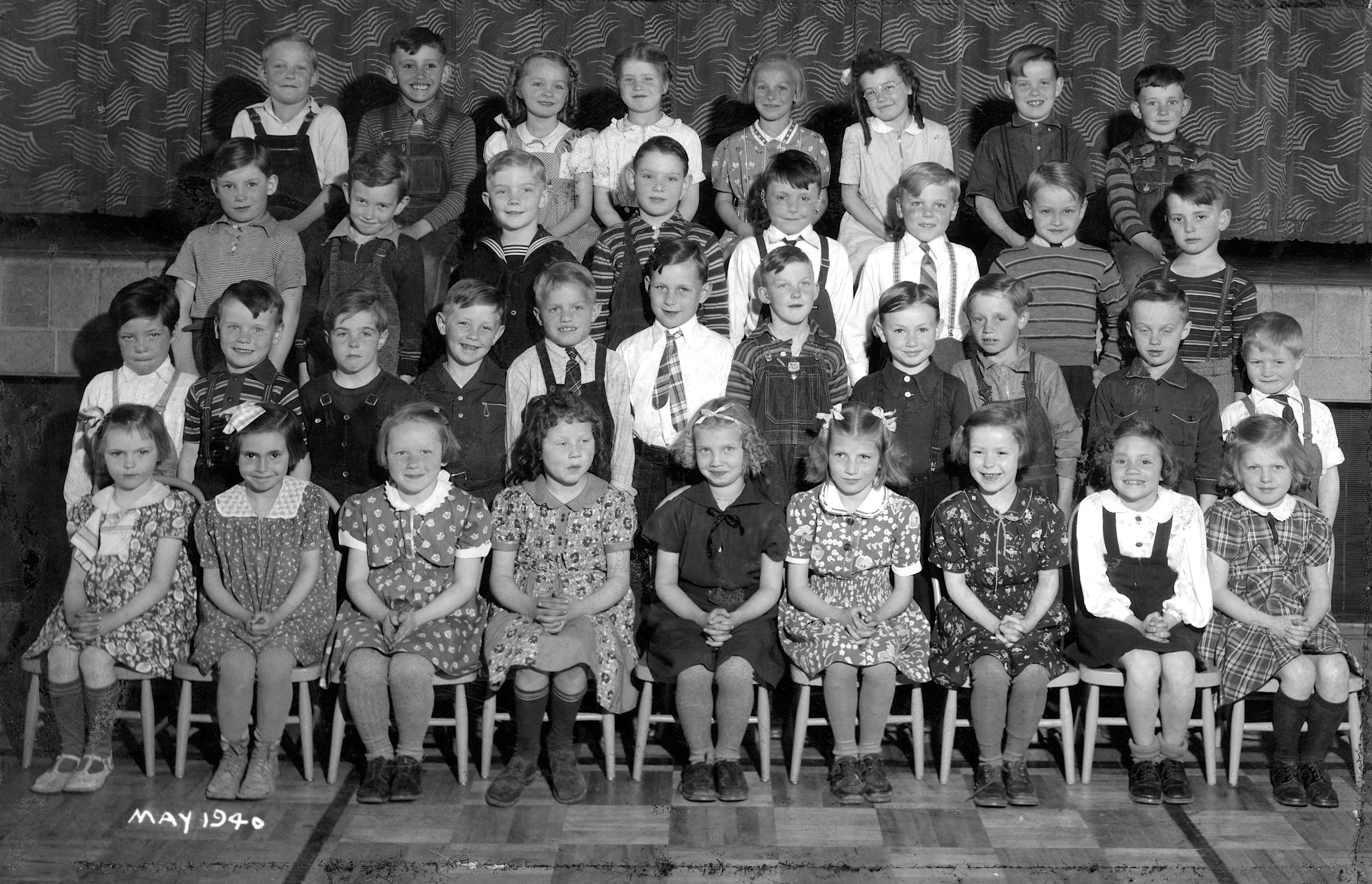
Many in this group photo from May 1940 would spend their entire pre-secondary education together in Mauston, Wisconsin. A few of the children in this MaustonGrade School photo had moved from Mauston by the time the 1940 U.S. Census was taken a month later. But many graduated together in the Class of 1951 at Mauston High School.
Bottom Row: Leah Reynolds, Clara Minor, Carol Quamme, Arlene Naglus, Alice Chilson, A. Longsdorf, Gladys Baldwin, Patricia Lane, Mary Crandall.
Second Row: Gerald Stout, S. Jones, Norman Pelton, Arnold Beghin, Almeron Freeman, Tommy Rowe, E. Roberts, Donald Millard, Harold Webster, George Lyons, Robert Randall.
Third Row: Donald Jax, Bernard Solberg, Wendell Smith, David Hanneman, Clayton ‘Ty’ Fiene, Robert Beck, Robert Firlus, Donald Clickner.
Fourth Row: H. Faulkner, Erhard Merk, Joy Smith, Lillian Ackerman, Jessie Hauer, Edith Shaw, Edwin Booth, O. Boldon.
I wish I could get you a big birthday gift this year, like prepaid college tuition or a new car. But I can’t. I think I have something much more valuable to share, though. I wrote the letter below almost 23 years ago, when you were barely two weeks old.
Much has changed in our lives and in the world since then. You grew up and overcame big challenges on your way to high school, and then college. You’ve gone out into the work work and supported yourself as you pay for your own education. I know that has been hard, but it is a great credit to you, and I’m very proud of you.
When I wrote the letter, we had no idea who you would become. You were at times a cranky baby, with lots of colic. But you were mostly happy. It was a sheer delight watching you grow up. As I see you ready to celebrate your 23rd birthday, I can say that I could not be a more proud Dad of my only son. Just like the letter says, you’ve grown up to be a good man. I love you.
Dad
Feb. 2, 1992
Dear Stevie —
You probably don’t like us calling you Stevie anymore, but right now, it fits you perfectly. It’s 10:30 p.m. on a Sunday. I’m watching a rerun of M*A*S*H on television as your Mom naps on the couch. You are asleep in your crib down the hall. I can hear you breathing over the nursery monitor.
There are a lot of things I want to say to you. The first is that your Mom and I love you very much. You’re only 2 weeks old, but you’ve added so much to our lives. And now we sit and imagine what kind of a person you will grow up to be. We know you’ll be a good boy, and eventually, a good man.
The letter sat in the bottom of my dusty Sentry safe for 23 years.
First, some history. You were born at 8:41 p.m. on Jan. 20. You weighed 7 pounds 13 ounces. I’ll never forget your little hand clutched around my finger as you lay on the incubator table. You were so alert as you waited to be put in a blanket.
The day you were born, George Bush was President of the United States. Tommy Thompson (a good friend of your great Grandpa Carl) was governor of Wisconsin. Your Dad works as a reporter for the Racine Journal Times, covering state government and politics. Your Mom works for Communications Concepts in Racine, doing graphic arts on a computer. The top TV shows are Cheers, Murphy Brown and L.A. Law.
You are a beautiful baby. You have dark eyes, red hair and soft, rounded cheeks. You’re only 2 weeks old, but already you can lift your head in the crib. I wonder what you are thinking when you gaze up at us while you’re feeding or playing. We nicknamed you “Popeye” because when you want your bottle, you look up with only 1 eye open and open your mouth.
You were conceived at the end of the 1991 Persian Gulf War. Your Mom was in the Army Reserves and was called off to war in Dec. 1990. She was stationed in Augsburg, Germany, as a food inspector. When she came home from war in April 1991, we had you. You were part of what was called “Operation Desert Stork,” named after the war, “Operation Desert Storm.”
As I write this your Mom and I are looking forward to seeing you crawl, take your first steps, and all the things that come after. But for now, there’s one thing we’re sure of — how happy we are you’re here.
Love,
Dad
At Christmas 2014 with Mr. Puggles.
A 2008 image of Stevie.
Stevie with one of his patented expressions.
We used to stuff pillows in our sweatpants and hip check each other around.
One of my favorite photos, taken at Wisconsin Dells.
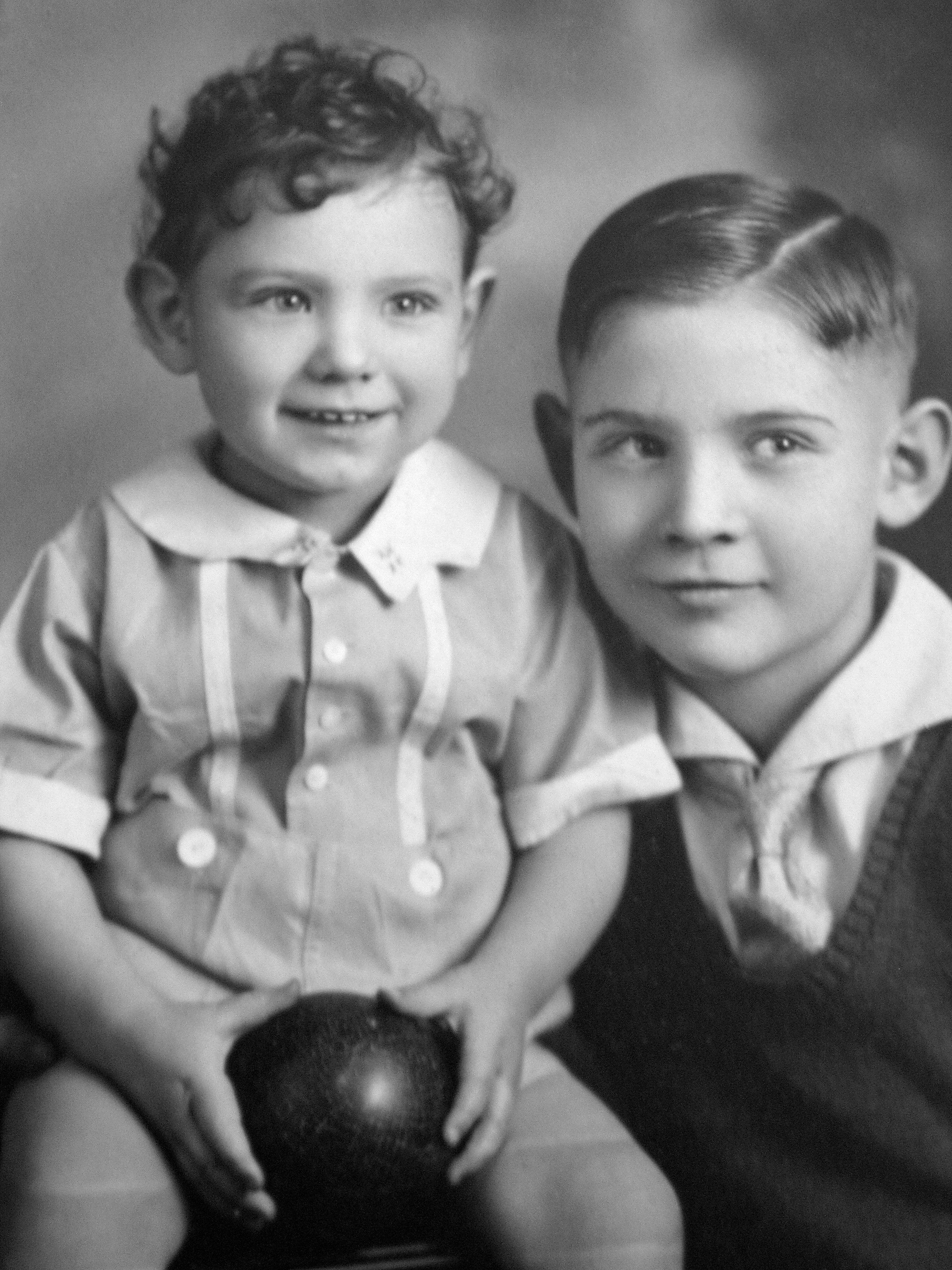
This is one of the earliest photos showing brothers David D. Hanneman (left) and Donn G. Hanneman, taken circa 1936. I believe this portrait was taken in Mauston, Wisconsin, where the family moved in early 1936. My Dad (David) was 3 years old that year. The family had a good relationship with Bauer Studios, so throughout the years there were always nice portraits of the Hanneman children.
David D. Hanneman (1933-2007) and brother Donn G. Hanneman (1926-2014).
I love the curly head of hair on Dad. He always had a great head of hair, right up to the day he lost it from chemotherapy in 2007. He asked me at the time if I thought it would grow back. I said yes, although Dad died before it had the chance. I imagine one day seeing him in Heaven, with either that distinguished-looking silver mane or the wavy jet-black hair from his youth.
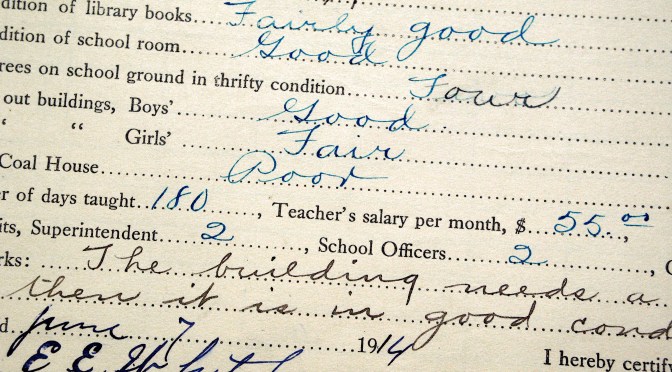
Historical documents and photographs are the heart of any good family archive. The Hanneman Archive is already well-populated with more than 700 photographic images. Now we have added a documents section featuring a variety of declarations from our collection. Examples include ship registries, church death records written in German, draft cards, professional certifications and more. The page is among the links at the top of our home page.
The gallery will be expanded frequently. For until it is shared, a document is but a mere sheet of paper.
There are several great things about this image of my Dad and his two siblings, taken in 1956 at Nekoosa, Wisconsin. The colors from the Kodachrome slide film are vivid, from the blue sky to the slicked-back black hair. The clothes are natty and the hairstyles are so 1950s. Right to left are Donn Gene Hanneman (1926-2014), Lavonne (Hanneman) Wellman (1937-1986), and my Dad, David D. Hanneman (1933-2014).
The photo was taken at the home of the trio’s uncle and aunt, Marvin and Mabel Treutel. The occasion was a Treutel family reunion. Their mother and my grandmother, Ruby V. Hanneman (1904-1977), was a Treutel before marrying Grandpa Carl F. Hanneman (1901-1922). It’s sad to think all three of them are gone, but I find comfort in the hope they are together in Heaven.
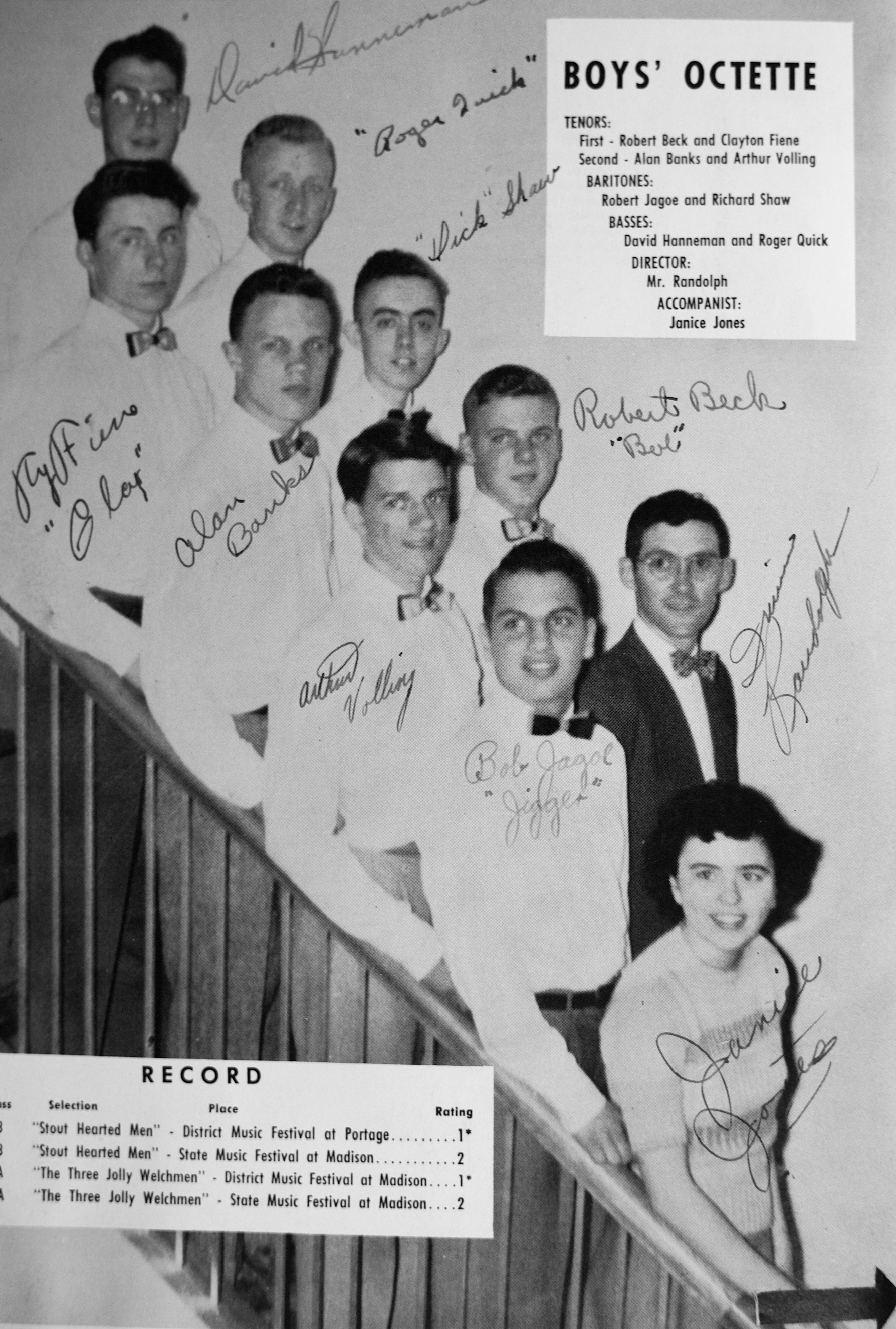
“Stentorian Voice.” Of all the notations in the Mauston High School yearbooks of David D. Hanneman, those two words truly stand out. In the “Report of Condition of the Students of Mauston High School” in 1950, David Hanneman’s asset is listed as “stentorian voice.” Not a common adjective, “stentorian” means “of powerful voice.” It can also mean “booming” and “loud.” No doubt the years 1947-51 were stentorian years for Hanneman, for he and his singing buddies at MHS earned accolades and medals for their singing.
David D. Hanneman’s medals from the Wisconsin Centennial Music Festival in 1948.
Mauston High School at the time was known for its quality vocal and instrumental music programs. The boys’ double quartet or octette was among the highest profile examples of that quality. The barbershop group regularly competed at the state level in competition sponsored by the Wisconsin School Music Association (WSMA).
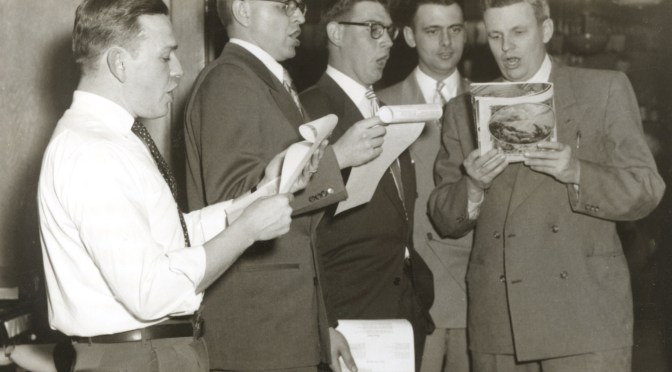
The group included Hanneman and Roger Quick at second bass, Bob Jagoe and Dick Shaw at first bass, Clayton “Ty” Fieneand Bob Beck at first tenor, and Alan Banks and Arthur Volling at second tenor. Self-dubbed the “State Men” for annual appearances in competition, the group had its own cartoon likeness drawn into the Mauston High School yearbook, The Hammer.
Members of the Mauston High School boys double quartet.
In the many WSMA competitions, David Hanneman also sang bass solos, duets and mixed quartets and double quartets. According to one of the judge’s score cards, a Mauston quartet was rated “excellent” for tone, “good” for intonation and “good” for technique. Another judge rated Hanneman “excellent” for his bass solo and noted “maturity of quality” as his greatest singing asset. Hanneman kept the dozens of medals he won at these competitions for many decades after high school.
The “State Men” had their own page in the Mauston High School yearbook in 1951.
Singing wasn’t Hanneman’s only musical interest, however. He played the trumpet for a time and was in the Mauston public school band. He appeared in numerous parades playing the bass drum for the band.
David got his love of song from his mother, Ruby V. Hanneman. As a youngster, Ruby often performed onstage at theaters in Wisconsin Rapids. The Hanneman home in Mauston had a beautiful pump organ and a Victrola record player with a large collection of music. Later in life he appeared in a number of community musicals and sang in the choir at Sacred Hearts of Jesus and Mary Catholic Church in Sun Prairie, Wisconsin. His deep voice could carry the entire parish in song, with enough volume to almost lift the church off its foundations.
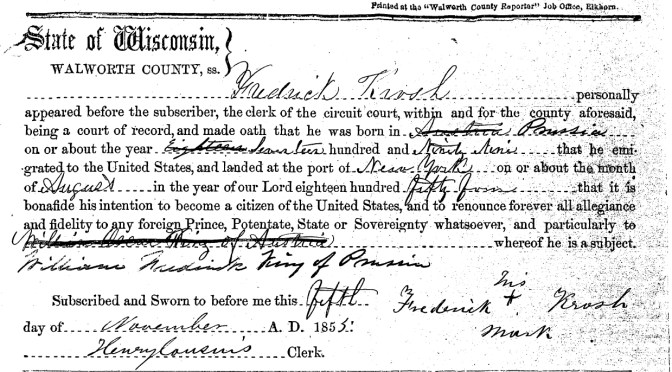
Some of the earliest documentation of a Hanneman-Treutel relative in America — dated 1855 — has been discovered in the archives of the Walworth County, Wisconsin Circuit Court. John Frederick Krosch, just a year from stepping off the boat from Saxony, filed his declaration of intent to become a United States citizen on November 5, 1855 before the county court in Elkhorn, Wisconsin.
Krosch made the declaration on behalf of himself and his wife, Christiana. The declaration document says Krosch intended to become a U.S. citizen and that he “renounced forever all allegiance and fidelity to any foreign prince, potentate, state or sovereignty whatsoever, and particularly to William Frederick, King of Prussia.” The document was found in the court archives, held at the Area Research Center at the University of Wisconsin-Whitewater.
Johann Friedrich Krosch was born in 1799 in the Kingdom of Saxony, which today is part of Germany. In 1854, he brought his wife Christiana and children Charles, Augustus, Reinhold, Henrietta (grandmother of Ruby V. Treutel Hanneman) and Gustave to America.
Frederick Krosch’s farm was in Section 23 on this 1870 Mukwonago-area map.
The Krosch family landed at New York on July 21, 1854 and headed for Milwaukee. The eldest boys established farms at Lake Beulah near East Troy in Walworth County. John Frederick Krosch may have initially lived in Walworth County to help his boys get their farms started, considering that he filed his citizenship declaration in Walworth County.
By 1860, the elder Krosch had his own farm near Mukwonago in nearby Waukesha County. The 1860 U.S. Census lists the youngest Krosch boys, Reinhold and Gustave, as laborers on their father’s 80-acre farm. Plat records from 1873 show the Krosch farm in Section 23 of the Town of Mukwonago, just a few miles from where his daughter Henrietta Treutel lived with her husband, Philipp Treutel.
Krosch farmed at Mukwonago for more than a decade. We don’t know much about his later years. He died on August 7, 1876 at age 77. He is buried among the settlers of Mukwonago at Oak Knoll Cemetery, a short distance from where his farm once stood.
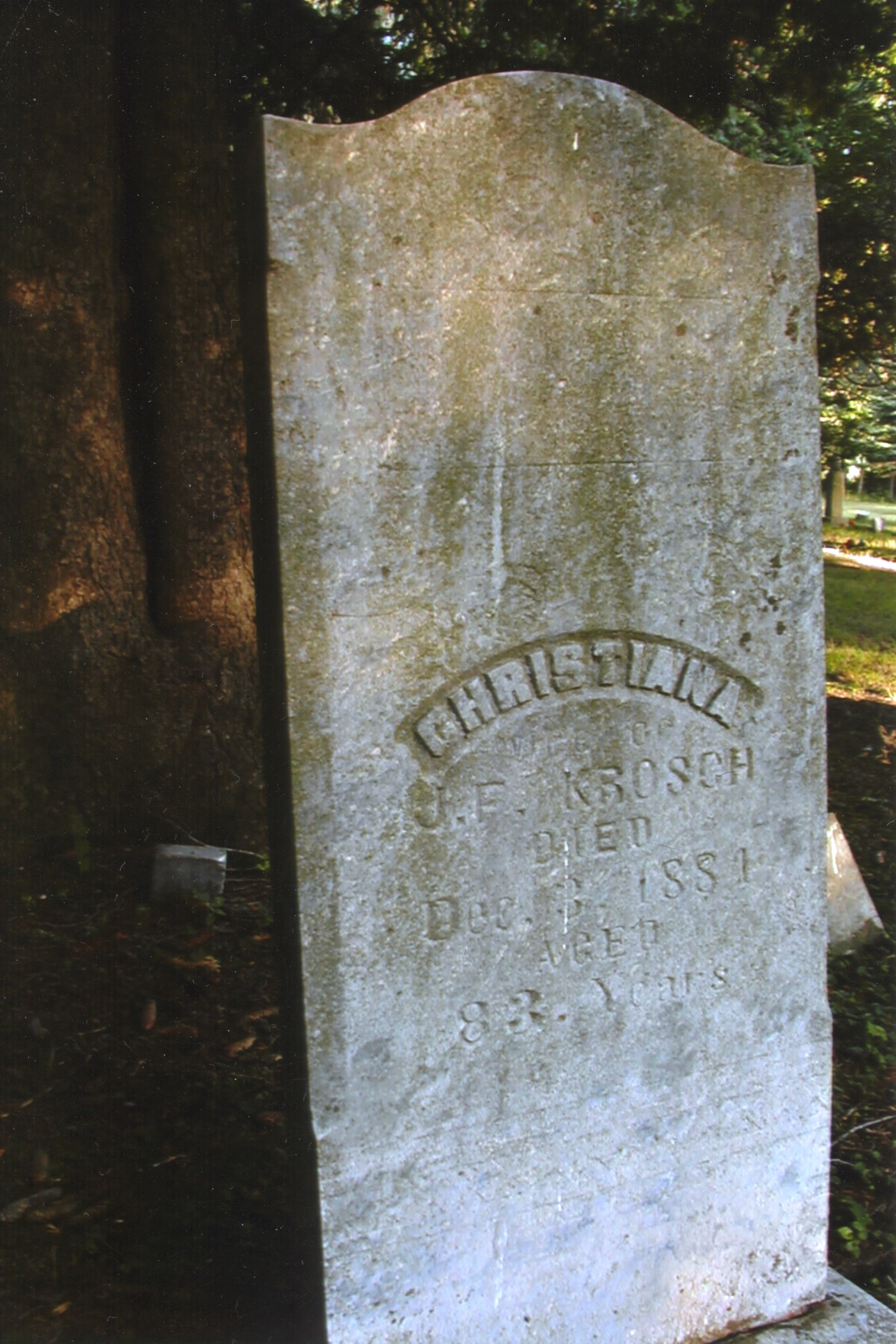
The grave of Christiana (Schlagel) Krosch at Elmore, Minnesota.
His wife Christiana (Schlagel) Krosch moved to Elmore, Minnesota after being widowed. The 1880 U.S. Census lists her living on the farm of her son, William F. Krosch. She died on December 3, 1884. She is buried near three grandchildren at Dobson Schoolhouse Cemetery in Elmore.
FAMILY LINE: John Frederick Krosch >> Henrietta (Krosch) Treutel >> Walter Treutel >> Ruby (Treutel) Hanneman >> Donn, David and Lavonne Hanneman.
The grave of Christiana (Schlagel) Krosch at Elmore, Minnesota.
Frederick Krosch’s farm was in Section 23 on this 1870 Mukwonago-area map.
John Frederick Krosch’s grave at Oak Knoll Cemetery in Mukwonago, Wisconsin.
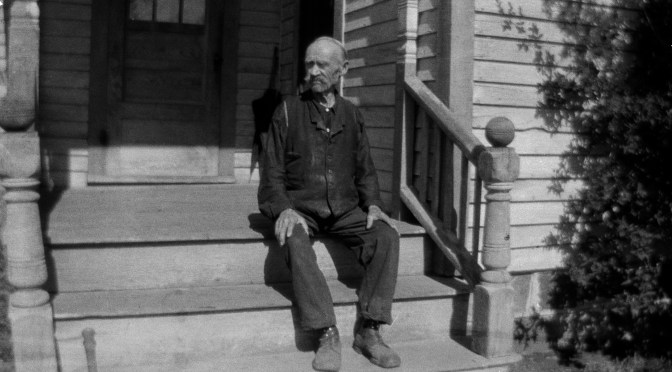
The photograph is very poignant. A frail man, sitting in the afternoon sun on the front porch steps. He looks haggard and tired, maybe ill. This image is the last known photograph taken of Karl Frederick Christian Hanneman, who was known around Wisconsin Rapids as Charles or “Chas” Hanneman. The photo likely dates to 1931 or 1932, when he suffered from prostate cancer that eventually took his life.
Charles Hanneman came to America in late November 1882 with his parents, Christian and Amanda Hanneman. He was just 15 when the family made its way from Stettin, Pomerania to Portage County, Wisconsin. Charles, his three brothers and two sisters settled on a 105-acre farm in the northwest corner of the Town of Grant, near the tiny hamlet of Kellner.
Nina and Elaine Treutel visit with Chas Hanneman, circa 1930.
Charles worked on the Hanneman farm for a time. His brothers would stay in farming (maps from that period show many Hanneman farms in Portage County), but eventually Charles left farming and found work in one of the area’s many sawmills.
At some point in his early 20s, Charles made the acquaintance of Rosine Ostermann, the eldest daughter of John and Mina Ostermann of the Town of Grand Rapids. They had many things in common. Both grew up on the family farm. Rosie’s parents were from Germany (Saxony and Prussia), and his were from Pomerania. Rosie’s grandfather George Ostermann was one of the pioneers of Portage County, listed on the earliest tax roll of the Town of Grant in 1864.
On April 2, 1891, Charles and Rosie were married atSt. John’s Evangelical Lutheran Church in Kellner in a divine service performed by A.G. Grimm. The witnesses were Charles’ father, Christian, and his brother, William. The bride’s attendants were her sister, Elsie Ostermann, and Emma Pribbernow. The groomsmen were cousins August Saeger and Herman Hanneman.
The young couple came to know heartache early in their marriage. Their firstborn, referred in the records only as “C.H. Hanneman,” died in infancy in 1892. They went on to have four sons: Arthur John (1893), Frank Herman Albert (1895), Wilbert George (1899), and our own Carl Henry Frank (1901).
Left to right: Christian Hanneman, Chas Hanneman, Carl Hanneman, David D. Hanneman.
Work in the sawmill must have been erratic, or Charles left that occupation for a time. In 1900, U.S. Census records show the family living and working on the farm of Charles’ brother, William Hanneman.
By 1905, Charles moved his family to the second ward in the city of Grand Rapids. He initially did manual labor for the city of Grand Rapids,possibly working on construction of the water and sewer works. The financial statements for the city in December 1907 show Charles worked 135 hours that month and earned 17.5 cents per hourfor a paycheck of $23.63.
By 1910 the family was living at 1774 Baker Street in Grand Rapids. The U.S. Census that year lists Charles as a laborer at a box factory. That may have referred to Consolidated Water, Power & Paper Co., where he later worked until his retirement, or the nearby Badger Box company.
On March 31, 1918, tragedy struck the Hanneman home when Rosine died suddenly at age 48. Her death notice, which ran on page 1 of the Daily Leader, said she was fine during the day but fell ill and died at 11 p.m. We know that she had diabetes, and that may have contributed to her death. Carl was 16 when his mother died.
Charles remarried in August 1919 and lived out his remaining years in his home at 1751 Baker Street. He became ill with prostate cancer in 1931 and was hospitalized numerous times in Wausau for surgery and treatments. He died at home on Oct. 11, 1932. He was 65. His death made front-page news in the Wisconsin Rapids Daily Tribune.
FAMILY LINE: Karl Frederick Christian Hanneman >> Carl F. Hanneman >> Donn, David & Lavonne Hanneman
Rosine Bertha Henrietta (Osterman) Hanneman (1870-1918), Frank Herman Albert Hanneman (1895-1947), Arthur James Hanneman (1893-1965), Carl Henry Frank Hanneman (1901-1982), Wilbert George Hanneman (1899-1987) and Carl Frederick Christian (Chas) Hanneman (1866-1932).
It is the only known photograph showing six of the seven children of Christian and Amanda Hanneman, pioneers of Portage and Wood counties in Wisconsin. The undated photo was probably taken around 1915 at a family event. Left to right are: William Friedrich Johann Hanneman (1856-1939) Bertha Auguste Ernestine (Hanneman) Bartelt (1860-1945) Albert Friedrich O. Hanneman (1863-1932) Herman Charles Hanneman (1864-1945) Carl Friedrich Christian Hanneman (“Chas,” 1866-1932) Ernestine Wilhelmine Caroline (Hanneman) Timm (1870-1930)
Hand tinted photograph of Chas Hanneman, location unknown.
Left to right: Christian Hanneman, Chas Hanneman, Carl Hanneman, David D. Hanneman.
Just three weeks after becoming a father for the third time, young pharmacist Carl. F. Hanneman took the extraordinary step of writing to the attorney general of Wisconsin to ask that he be granted full licensure as a registered pharmacist. It was a heartfelt letter, written by a young man feeling the weight of responsibility of a wife and three children. Written by a well-educated and accomplished man who felt he deserved what he as asking. The very future was at stake.
“I am writing this letter in all sincerity as what I am about to ask means everything to myself as well as my wife and three little kiddies,” Carl wrote to Attorney Gen. Orland S. Loomis on Sept. 3, 1937.“I am 35 years old and will be 36 this coming October and feel that obtaining my full registered papers will mean life itself to myself and my dear family.”
Carl explained that he was fully licensed as an assistant pharmacist, working at the Mauston Drug Store owned by Dr. J.S. Hess Jr. But he was unable to officially manage the drug store due to a quirk in state law.
Wisconsin Attorney Gen. Orland S. Loomis of Mauston
If Carl had worked in a smaller town with under 500 population, he could have legally managed the pharmacy. But Mauston population was about 2,100. Carl would need to be a registered pharmacist in order to manage the Mauston Drug Store.
“My capacity in the drug store is as an unofficial manager, as I do all of the buying etc., but legally cannot manage the store,” Carl wrote. “Dr. J.S. Hess Jr. has confidence in me and I a great deal in him, and as far as I am concerned am willing to stay here the rest of my life, dispensing for our own doctors.”
Carl reasoned that if he was qualified to own and manage a pharmacy in a small town (such as neighboring Lyndon Station, pop. 236), why could he not serve the same capacity in Mauston? “I have often wondered as has many others, are not the lives of 500 people in a small town just as valuable to their loved ones as those living in a town where there might be more than this amount?” Carl wrote.
A label under glass from Carl F. Hanneman’s pharmacy collection.
By 1937, Carl had 16 years of experience in pharmacology, starting as an apprentice in 1921 at the Sam Church drug store in Wisconsin Rapids. Carl graduated from the pharmacy program at Marquette University in 1925 and became licensed as an assistant pharmacist. He wasn’t eligible to take the full pharmacist exam at the time because his apprenticeship fell just short of the required five years. Over the next decade he worked at drug stores in Janesville, Fond du Lac and Wisconsin Rapids, and even worked a three-year stint as a salesman for Consolidated Water Power & Paper Co.
“I knew my lifework was with the drug store as I truly love it and was very fortunate in securing a position with the Dr. Hess Hospital, Clinic and Drug Store organization on Feb. 1, 1936,” Carl wrote.
Carl said he would likely need three more years of study to pass the registered pharmacist board exams as they existed in 1937. With three children (including baby Lavonne born in August 1937), Carl figured that simply would not be possible. So he asked for help from Loomis, a Mauston native who served as city attorney from 1922 to 1931. Loomis was attorney general through 1938, and was elected governor of Wisconsin in 1942. He died before taking office. Eventually, Carl became good friends with Loomis and photographed him for the Wisconsin State Journal on the 1942 night of his election as governor of Wisconsin.
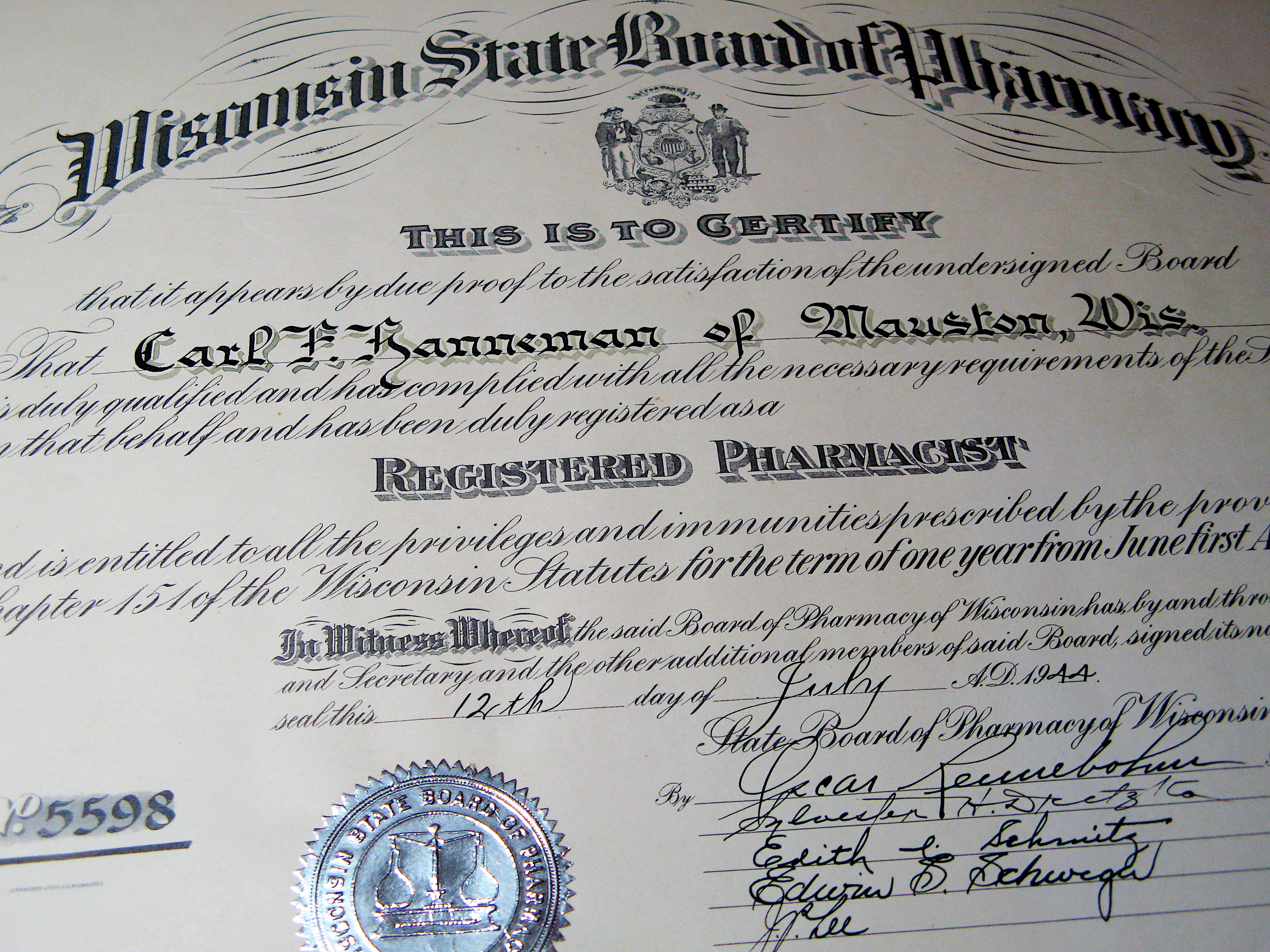
Carl F. Hanneman’s registered pharmacist license, issued in July 1944.
We don’t know if Loomis ever intervened on Carl’s behalf in his role as attorney general or governor-elect, or how he responded to the 1937 letter. A search of Loomis’ law-practice records at the Wisconsin Historical Society yielded no clues. Carl’s 1941 license from the Wisconsin State Board of Pharmacy still lists him as an assistant pharmacist. On July 12, 1944, the state of Wisconsin issued an ornate document certifying Carl as a full registered pharmacist. He worked under the new license number until his death in 1982. It would appear Carl secured his added credentials the hard way: he earned them.
Milwaukee was a key industrial production hub during World War II, and there was concern that spies or saboteurs would attack defense contractors or the public utilities that supplied them with power. As a master mechanic at Wisconsin Electric’s huge Lakeside Power Plant in St. Francis, Earl J. Mulqueen Sr. worked under tight security to ensure the war effort continued uninterrupted.
Nicknamed “The Governor,” Mulqueen was well known around his home in Cudahy as a Mr. Fixit. Whenever the boiler would go out at St. Frederick’s Catholic Church or school, they would call the Governor to come over and get things working again. When World War II broke out in late 1941, Mulqueen was just starting his third decade working for Wisconsin Electric. He put his mechanical skills to work keeping the turbines and other equipment at Lakeside in good working order.
Earl Mulqueen Sr. worked at the Lakeside Power Plant in St. Francis for more than 35 years.
Signs on and around the Lakeside plant carried a warning: “National Defense Premises. No Entry.” Armed agents guarded the plant 24 hours a day — part of a force of more than 1,000 men providing security at Wisconsin power utilities during the war. Because of his key role in keeping Lakeside in operation, Mulqueen received his own security protection. He often stayed at the plant for long stretches. When he came home to fetch clean clothes and pay a quick visit, he was accompanied by FBI agents. On occasion, an agent came alone to pick up clothes or other supplies for Mulqueen.
Earl J. Mulqueen Sr. in 1944.
The security precautions were warranted. Milwaukee factories were converted to war production of artillery, fuel storage, engines, turbines and all sorts of mechanical parts. The build-up created huge demand for power. The nation could ill afford an attack that shut down a key plant like Lakeside. Even before the attack on Pearl Harbor, Wisconsin Electric officials expressed security concerns, and fears the Lakeside power plant could be attacked with explosives by boat from Lake Michigan.
Nazi Germany launched just such a plan when it landed eight special agents on the shores of New York and Florida in June 1942. The German agents carried explosives and were tasked with blowing up U.S. defense industries and terrorizing population centers. “They came to maim and kill,” said FBI Director J. Edgar Hoover. Codenamed Operation Pastorius, the plot was foiled when one of the saboteurs turned himself in to the FBI. Federal agents arrested the men and recovered high explosives disguised as pieces of coal.
Steam turbines at the Lakeside Power Plant in St. Francis, Wisconsin.
Such an attack could have been devastating. Manufacturers like Allis-Chalmers, Falk Corp., Ladish, Bucyrus Erie, Case, Heil Co. and many others produced components and finished goods for the U.S. military. Everything from engines, to fuel trailers, to cargo and transport ships were built in eastern Wisconsin during the war. Wisconsin utilities scrambled to add generating capacity to keep up. Opened in 1920, Lakeside carried the burden of power supply as the other generation plants were being built.
Ladish Drop Forge in Cudahy was one of many companies producing war materiel.
Mulqueen left his job as a machinist at the Case plow works in Racine in February 1920 to work for the Milwaukee Electric Railway and Light Co. (later called Wisconsin Electric) as a machinist helper in the utility’s Racine operations. In November of that year, he married Margaret Madonna Dailey at St. Joseph Catholic Church in Racine. A former teacher, Miss Dailey had graduated in June 1920 from Northwestern University. Earl worked in Racine until 1925, when he was transferred to the Lakeside Power Plant. The Mulqueen family then moved to Cudahy. The couple had 11 children; six of whom served in the U.S. military.
The Reminder-Enterprise in Cudahy carried a photo from Earl J. Mulqueen Sr.’s 40th anniversary with Wisconsin Electric in March 1960.
















 The Hanneman Archive