MAUSTON, Wisconsin — Mauston residents don’t believe in the “unlucky 13” superstition anymore. They can’t after seeing 13 familiar faces that have been absent so long once again through their city streets.
These 13 familiar faces belong to Mauston servicemen, all of whom have seen service overseas and all of whom arrived home at about the same time to vi‘sit their families.
The 13, whose service abroad totals 240 months, were feted at an informal dinner and dance at the Mauston American Legion hall, under the joint sponsorship of the American Legion post and the Mauston Rod and Gun Club, and for a time they once again became “that kid next door” or that “Joe’s boy” as they let the cares of the war drop from their uniformed shoulders.
Their Record
The group includes a man who went through the entire New Guinea campaign with the famed 32nd Division; a man who stood guard over the Japanese at a prison camp overseas; a man who was taken a prisoner of war only to be released at the capitulation of Romania; a man who went through the invasions of Italy and Sicily with the Navy, and others whose heroic deeds were written in most any theater imaginable.
It also includes four airmen who have completed a total of 118 missions. The Lucky 13 are:
Capt. Riley D. Robinson, 31, whose wife and child live in Mauston, who served as supply officer and battery commander with the 32nd Division in Australia and throughout the New Guinea campaign for 30 months.
Corp. Edward Dwyer, 30, son of Mr. and Mrs. Burt Dwyer, a veteran of three and one-half years of service, two and a half years of which were spent in the southwest Pacific area.
Pfc. Harold Hagemann, 48, whose wife and child live in Mauston, who served 25 months in the south Pacific as a military policeman at a Japanese prisoner of war camp.
Pvt. Arnold L. Jobs, 20, son of Mrs. Emil Jobs, veteran of 21 months of service, of which from June 1943 to October 1944 was spent in Iceland.
First Lieut. Warren L. Hasse, 21, son of Mr. and Mrs. Louis Hasse, who completed 35 missions as a Flying Fortress bombardier navigator while serving seven months with the Eighth Air Force in England.
Corp. Clifford J. Flentye, 27, son of Mr. and Mrs. Henry Flentye, a veteran of 32 months in the southwest Pacific.
First Lieut. William R. Holgate, 21, son of Mrs. Roy Holgate, a Flying Fortress pilot who was taken prisoner in Romania after being shot down on his 13th mission and then released at the capitulation of that country.
Apprentice Seaman Robert Loomis, son of the late Gov. Orland and Mrs. Loomis, who has been in the Navy for two years, serving nine months of that time in the southwest Pacific.
First Lieut. Kenneth G. Buglass, 25, son of Mr. and Mrs. G.D. Buglass, a veteran of three years of service, who completed 50 missions as a bomber pilot in the North African and Italian theaters during 12 months of overseas duty.
Ripley Was Around Ensign Burdette Ripley, 26, son of Mr. and Mrs. Eugene Kranz, who entered service in 1939, and went overseas in March 1943, hitting ports in England, Persia, Africa, Sicily, Italy, Australia, Arabia and Ceylon.—
Staff Sgt. Earl Standish, 30, son of Mr. and Mrs. Myron St. Claire, who entered service in October 1940 and spent two and a half years in the southwest Pacific.
Tech Sgt. Joseph A. LaBelle, 30, son of Mr. and Mrs. A.J. LaBelle, who completed 20 missions as engineer-gunner while service for a year with the Air Force is England.
Jack Downing, 20, yeoman third class, son of Mrs. Louis Hale, who entered the Navy in July 1942 and has been in active duty for the past year sailing in the Atlantic, Pacific and Mediterranean. He was engaged in the invasions of Sicily and Italy and had one destroyer sunk under him.
— Originally published in the November 6, 1944 editions of The Wisconsin State Journal in Madison.
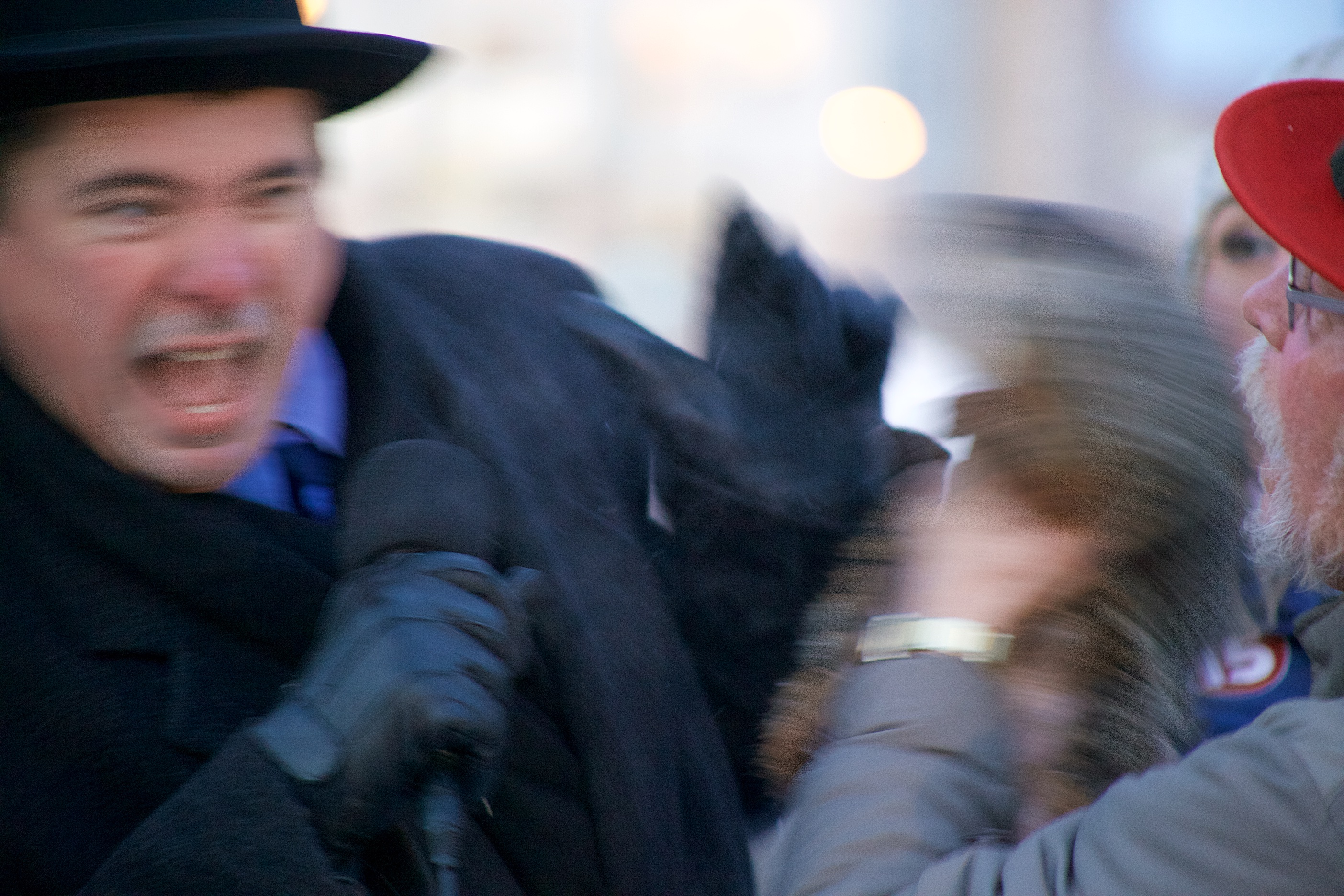
SUN PRAIRIE, Wisconsin — With a temperature of minus 2 degrees and a fresh coating of 8 inches of snow on the ground, you might think Jimmy the Groundhog would have predicted six more weeks of winter. But alas, the world-famous weather prognosticator did not see his shadow, meaning an early spring. He did, however, take a vicious bite at Sun Prairie mayor Jon Freund, who served as the official translator for the esteemed Jimmy.
Sun Prairie Mayor Jon Freund recoils after being bitten on the ear by Jimmy the Groundhog.Freund wasn’t too pleased with the bite from Jimmy, but the ceremony continued.
A modest crowd of hearty Groundhog Day fans gathered on Cannery Square to witness the 67th annual weather prognostication from Jimmy. Just after 7 a.m. Central time, Jimmy whispered to Freund that spring was coming. But before he did that, Jimmy bit the ear of the mayor, who recoiled in pain but quickly recovered his composure. After a quick apology from Jimmy, the ceremony continued.
Despite the clear skies, Freund said Jimmy did not see his shadow. A few minutes after the ceremony, the sun rose and cast February shadows on both man and beast. A Madison television station quoted Hahn as saying Jimmy did see his shadow. The city of Sun Prairie later issued a statement saying the mayor made the right call. The controversy led to speculation from some corners that video replay officials would be in attendance at next year’s Groundhog Day ceremony.
Folklore says that if a groundhog (also called a woodchuck or marmot) emerges from its burrow and sees its shadow, it will return to slumber in expectation of six more weeks of winter. If the day is cloudy and no shadow appears, spring will come early. According to a roundup on Wikipedia, predictions are pretty well split across North America for Groundhog Day 2015. Sun Prairie’s result is listed as “disputed.”
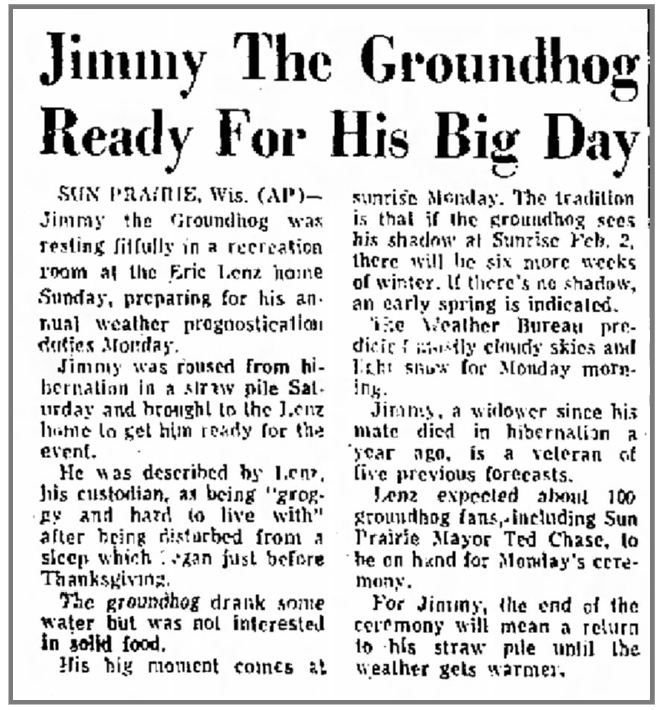
Jimmy made front-page news in The Troy Record in New York in February 1970.
Jimmy arrived in a stretch limousine with a Sun Prairie Volunteer Fire Department escort. Like a Hollywood star, Jimmy emerged from his limo to camera flashes and blaring lights from two television stations. He was accompanied by his handler, Jerry Hahn, who is retiring from the groundhog business after today. Hahn shed tears as Freund and others paid him tribute for serving as Jimmy’s caretaker since 2003. Jimmy will now be cared for by Jeff Gauger, owner of the Beans ’n Cream coffee house on Cannery Square. Gauger has a hobby farm.
Jerry Hahn pets Jimmy the Groundhog, who has been in his care since 2003.
Jimmy has been predicting weather in the Groundhog Capital of the World since 1948. The current Jimmy is the 11th burrowing rodent to serve as Sun Prairie’s weather forecaster. And while a certain East Coast groundhog gets most of the national media attention, Jimmy has a better than 80 percent accuracy rating. According to legend, he’s always accurate. It’s just the mayor does not always translate correctly from “groundhogese” to English.
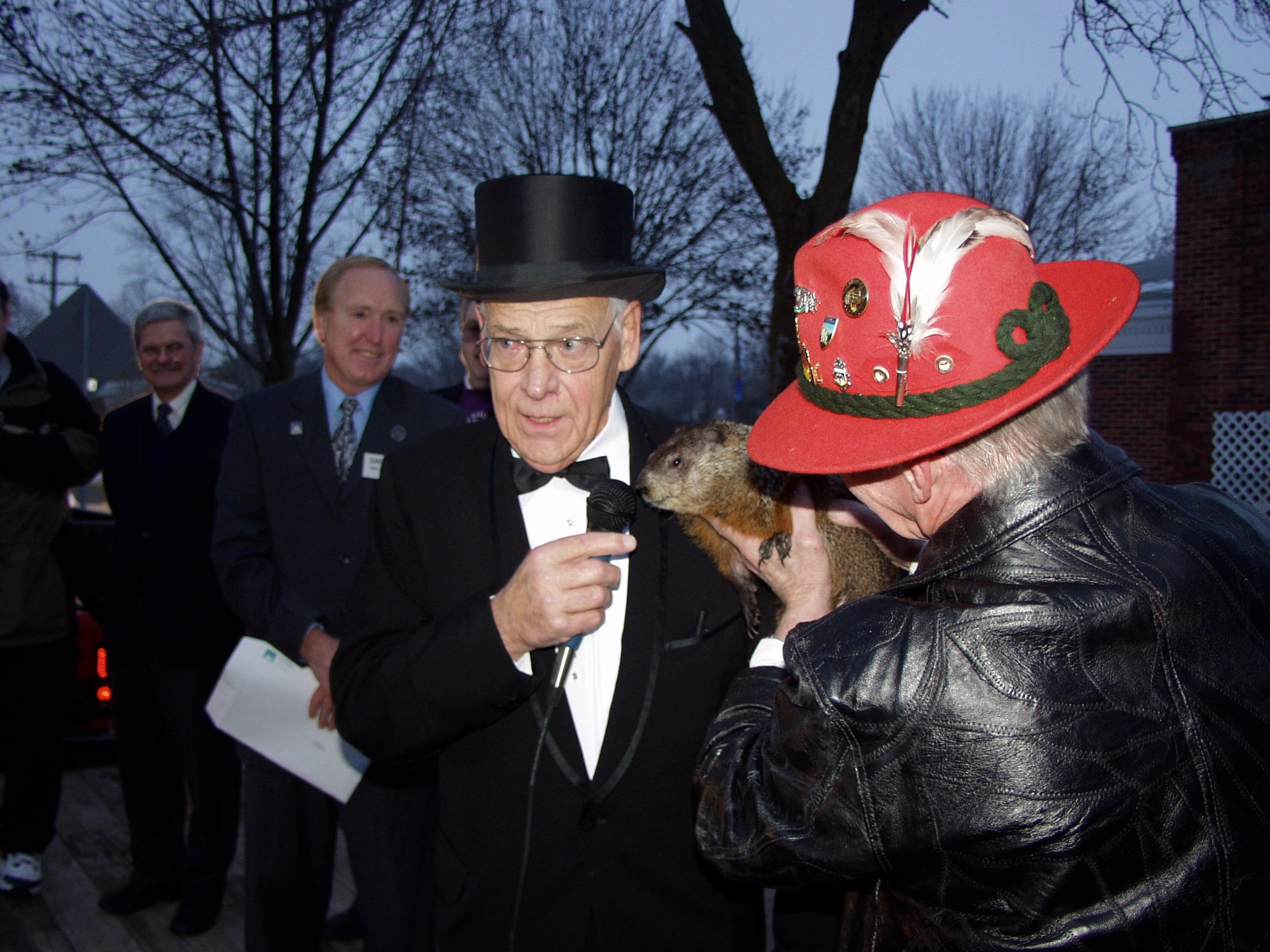
Even with the bitter cold, I had to see for myself what all the fuss was about. When my late father, David D. Hanneman, was mayor from 2003-2005, he presided over two such ceremonies (see video above). In February 2005, Dad wore a tuxedo to go along with the mayor’s official groundhog top hat. The year before, Dad interviewed Jimmy before a large crowd. “What? You don’t like to be kissed? Well OK, I won’t kiss you then,” Dad said to laughter from the crowd.
Mayor David D. Hanneman with Jimmy the Groundhog in 2005. (Sun Prairie Star Photo)
View a complete photo gallery from today’s event below:
The book about my father’s battle with lung cancer and his final months on this earth has been in print for nearly five years. It seems a good time to update the book’s official video trailer. The new version, posted below, is in high definition. Back when the original trailer was created, HD video was still fairly novel. But now HD is the norm on home televisions and computers, so it was time to upgrade this important promotional video. You can also view the video in a larger format here.
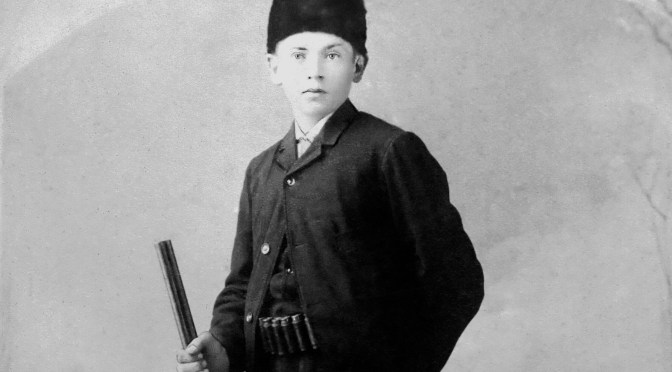
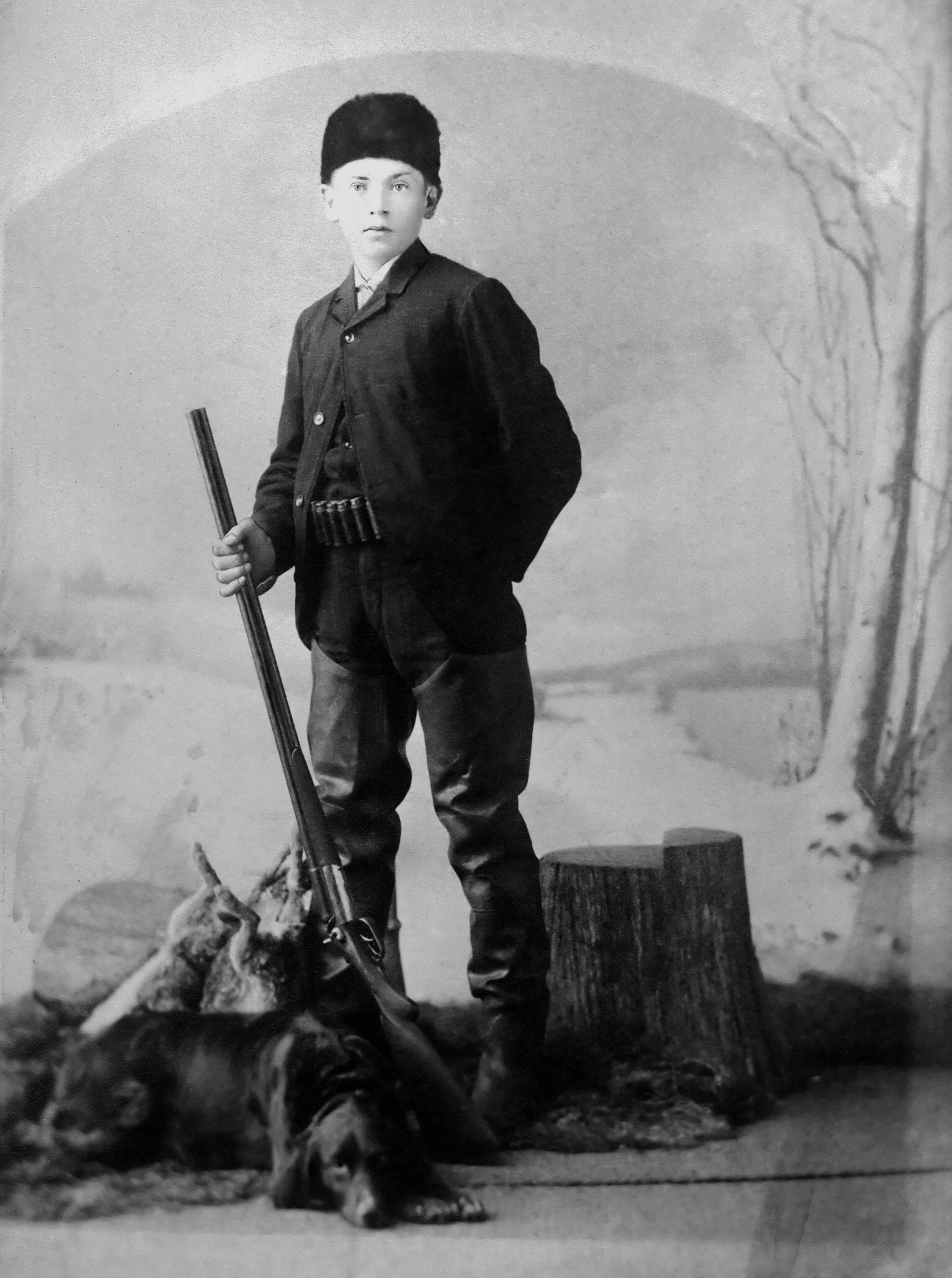
The more than century-old photo shows a stoic, proud young man wearing an ammunition belt and holding a shotgun in his right hand. At his feet lays a loyal hunting dog, seemingly tired from a day in the field. The young man is identified in the corner of the photo as Frank Hanneman, age 14. That dates the photo to 1909 or 1910.
The paper-mounted and framed portait, in nearly perfect condition, survived all of these years in the possession of Carl F. Hanneman, Frank’s brother, and later in the collection of David D. Hanneman, Carl’s son. It is one of the oldest existing photos of a Hanneman from Wood County, Wisconsin.
Frank Hanneman, 14, posed for this photo around 1910.
What do we know about this young hunter? Frank Herman Albert Hanneman was born July 7, 1895 near Grand Rapids, Wisconsin, the son of Charles and Rosine Hanneman. In his early years the family lived and worked on the farm of his uncle, William Hanneman, in the Town of Grand Rapids in Wood County. The 1900 U.S. Census lists Charles Hanneman, 33, as a farm laborer on the farm of William Hanneman. By 1905 the Charles Hanneman family moved to Baker Street in Wisconsin Rapids when Charles got work at the Consolidated Water Power & Paper Co.
The Hanneman boys enjoyed the great outdoors of central Wisconsin. We might assume by the photo, Frank enjoyed hunting birds. We have plenty of photos of a young Carl Hanneman fishing. On June 11, 1916, Frank married Irma Wilhelmine Louise Staffeld, and the couple took up residence on Baker Street in Wisconsin Rapids – a block away from his parents. The couple had five children between 1916 and 1929: Dorothy, Marjorie, Robert, Elizabeth and Joyce. Like his father, Frank had a long career working at Consolidated Water Power & Paper Co.
On July 14, 1947, Frank suffered a heart attack at home, and died shortly after arriving at Riverview Hospital. He was 52. His brother, Carl, was vacationing with his family in North Dakota, but returned for the funeral before rejoining the family vacation.
I wish I could get you a big birthday gift this year, like prepaid college tuition or a new car. But I can’t. I think I have something much more valuable to share, though. I wrote the letter below almost 23 years ago, when you were barely two weeks old.
Much has changed in our lives and in the world since then. You grew up and overcame big challenges on your way to high school, and then college. You’ve gone out into the work work and supported yourself as you pay for your own education. I know that has been hard, but it is a great credit to you, and I’m very proud of you.
When I wrote the letter, we had no idea who you would become. You were at times a cranky baby, with lots of colic. But you were mostly happy. It was a sheer delight watching you grow up. As I see you ready to celebrate your 23rd birthday, I can say that I could not be a more proud Dad of my only son. Just like the letter says, you’ve grown up to be a good man. I love you.
Dad
Feb. 2, 1992
Dear Stevie —
You probably don’t like us calling you Stevie anymore, but right now, it fits you perfectly. It’s 10:30 p.m. on a Sunday. I’m watching a rerun of M*A*S*H on television as your Mom naps on the couch. You are asleep in your crib down the hall. I can hear you breathing over the nursery monitor.
There are a lot of things I want to say to you. The first is that your Mom and I love you very much. You’re only 2 weeks old, but you’ve added so much to our lives. And now we sit and imagine what kind of a person you will grow up to be. We know you’ll be a good boy, and eventually, a good man.
The letter sat in the bottom of my dusty Sentry safe for 23 years.
First, some history. You were born at 8:41 p.m. on Jan. 20. You weighed 7 pounds 13 ounces. I’ll never forget your little hand clutched around my finger as you lay on the incubator table. You were so alert as you waited to be put in a blanket.
The day you were born, George Bush was President of the United States. Tommy Thompson (a good friend of your great Grandpa Carl) was governor of Wisconsin. Your Dad works as a reporter for the Racine Journal Times, covering state government and politics. Your Mom works for Communications Concepts in Racine, doing graphic arts on a computer. The top TV shows are Cheers, Murphy Brown and L.A. Law.
You are a beautiful baby. You have dark eyes, red hair and soft, rounded cheeks. You’re only 2 weeks old, but already you can lift your head in the crib. I wonder what you are thinking when you gaze up at us while you’re feeding or playing. We nicknamed you “Popeye” because when you want your bottle, you look up with only 1 eye open and open your mouth.
You were conceived at the end of the 1991 Persian Gulf War. Your Mom was in the Army Reserves and was called off to war in Dec. 1990. She was stationed in Augsburg, Germany, as a food inspector. When she came home from war in April 1991, we had you. You were part of what was called “Operation Desert Stork,” named after the war, “Operation Desert Storm.”
As I write this your Mom and I are looking forward to seeing you crawl, take your first steps, and all the things that come after. But for now, there’s one thing we’re sure of — how happy we are you’re here.
Love,
Dad
At Christmas 2014 with Mr. Puggles.
A 2008 image of Stevie.
Stevie with one of his patented expressions.
We used to stuff pillows in our sweatpants and hip check each other around.
One of my favorite photos, taken at Wisconsin Dells.
SHAWNEETOWN, Illinois — Children skipped happily along the streets of this southern Illinois town on the afternoon of Sunday, April 3, 1898. Sunday school had let out and the rest of the sunny day was theirs to claim. A large crowd of adults ambled along the walk, crossing Market Street and continuing on their way home. At the north end of Market Street, the levee that protects the town from the Ohio River was badly strained by rising water. But if the townsfolk were worried, it did not show on this spring day.
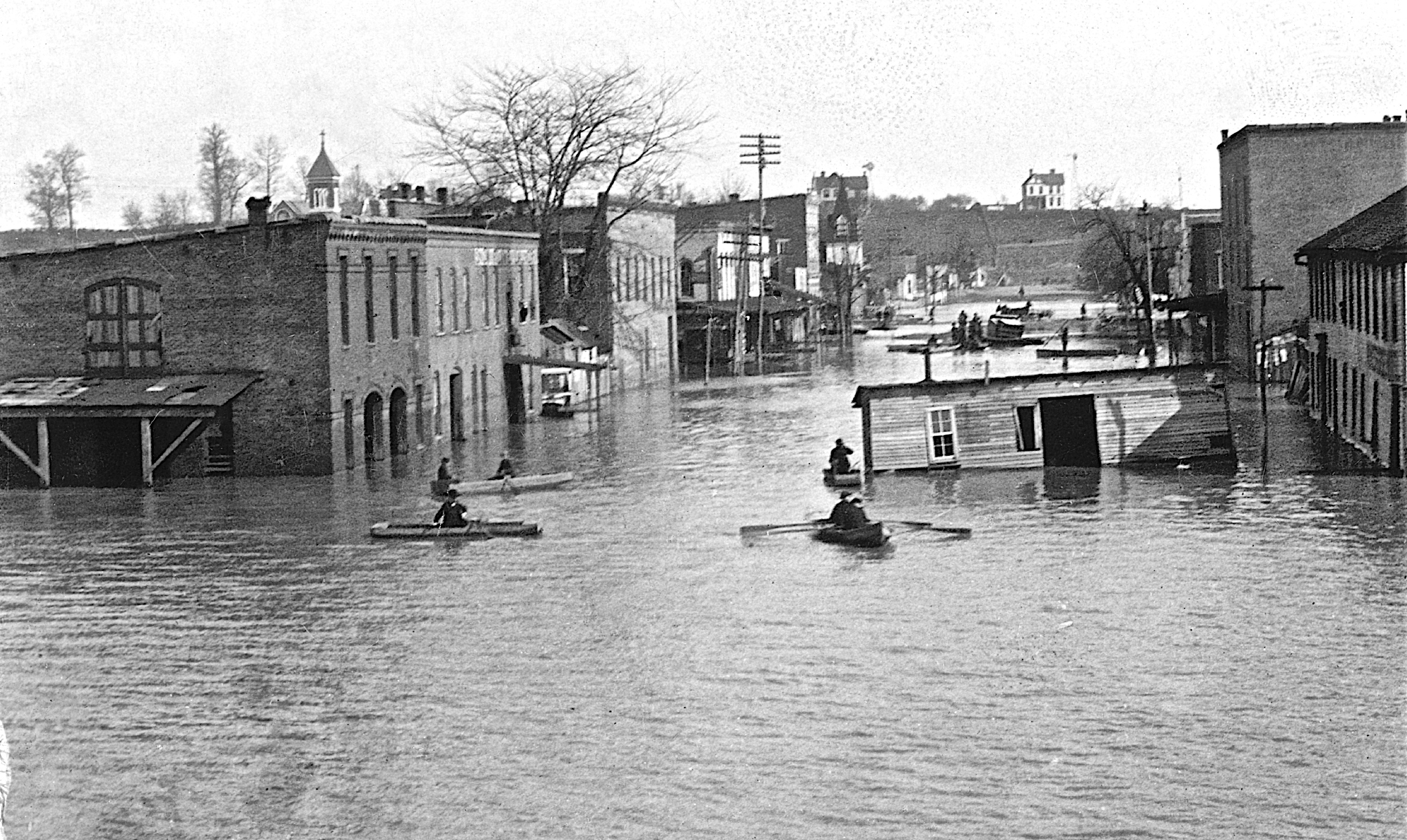
About 4:45 p.m., a 10-foot section of the levee collapsed and river water began pouring through the breach onto Market Street. The hole in the levee quickly grew to a half-mile wide, exploding into a wall of onrushing flood water that raced into the center of town. The flood rush hit the town like a blast from a double-barrel shotgun. Dozens of homes in the immediate path, many nothing more than shanties, were suddenly swept away. The small buildings were thrust along, some of them smashing against sturdier structures like the courthouse. Within mere moments, a quarter of Shawneetown’s homes were gone, the remains of which tumbled along in the rolling boils of a massive flood.
Floodwaters reached more than 12 feet deep in much of Shawneetown and surrounding areas in the April 1898 flood. This photo of the floodwaters at Uniontown, Ky., was taken by B.L. Singley, president of the Keystone View Company, for a stereoscopic card.
The people of Shawneetown were no strangers to floods. They had waged war with the Ohio River for generations. The Ohio always won the battle, but the people rebuilt time and again. As heavy spring rains swelled the Ohio again in March 1898, the older folks in town knew it could mean big trouble. But the relatively new levees were supposed to prevent it. Levees were built in 1884 after back-to-back years of devastating floods that twice wiped out much of the town. Today, the Ohio River again claimed its superiority with the ferocity of a jungle cat.
The Decatur newspaper feared the worst, proclaiming 400 dead. The actual number was 25.
“About 50 small frame houses along the line of the levee to the south were crushed like toys,” witness T.J. Hogan of Omaha, Illinois said. Stunned residents scrambled for higher ground. Women on the streets struggled through the muddy waters, holding their babies aloft as the flood waters reached neck level. “The strongest houses, built especially to resist floods, went down like corn stalks,” wrote photographer Benneville L. Singley. “There was a wild rush for the hills. None had time to secure either treasure or clothing.”
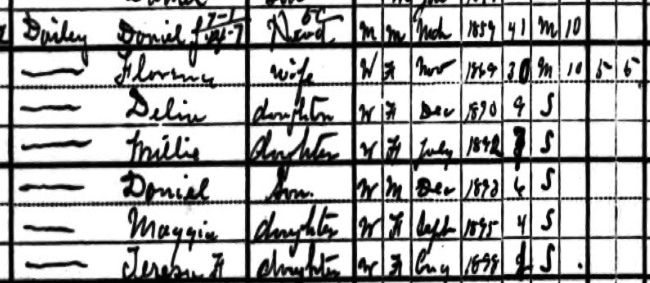
A few miles northwest of Shawneetown, the Daniel J. Dailey Jr. family was preparing for Sunday supper on their farm in North Fork Township. Florence (White) Dailey, 30, prepared the meal while the children helped ready the table. The Dailey home was a busy place, with Delia, Millie, Daniel and Maggie scuttling about. Maggie, just 2 ½, grew up to become our own Margaret Madonna (Dailey) Mulqueen of Cudahy, Wisconsin.
The 1900 U.S. Census shows the Dailey family in Gallatin County, Illinois.
The Dailey and White families had farmed this area of Gallatin County since the early 1860s. Daniel J. Dailey Sr. brought his young family from Ohio about 1860. The 1860 U.S. Census shows the Dailey family consisted of Daniel, 30, Hannah, 26, Mary, 4, and Daniel J., 2. The White family, from which Florence (White) Dailey came, settled in Gallatin County nearly a decade before her birth. The 1860 census showed the White family included father Don, 24, mother Sarah, 24 and children Mary, 5, Wiley, 3, and James, 6 months. Florence was born in November 1869.
We don’t know how long it took word to reach North Fork about the massive breach in the levee. It was most likely the next morning. The news no doubt sent Daniel Dailey towards Shawneetown with other area farmers, while Florence (White) Dailey gathered supplies for what would soon become a massive relief effort. By nightfall on April 3, the river had flooded dozens of square miles in and around Shawneetown with water up to 15 feet deep.
By morning, the town was devastated. Those who could scrambled to the roofs of their homes to escape the rising terror. Dozens raced into the Gallatin County Courthouse, the Riverside Hotel and the Ridgway Bank, seeking shelter on the upper floors of these sturdy structures. A few early rescue boats and canoes drifted into town and began rescuing the stranded. “Hundreds of those who escaped the rush of water were perched on roofs, trees and along the top of the levee,” a newspaper dispatch read. “They were taken from their dangerous positions as rapidly as possible.” Survivors were taken to nearby Junction City, where an emergency camp was established.
Upstream, carpenters, farmers and any able-bodied men began building flat boats that would be used to ferry supplies and people. When word reached dry land in nearby towns, frantic wires were sent to Springfield for help. The situation was pure panic. Newspapers across America carried dramatic headlines; FLOOD AT SHAWNEETOWN. Some predicted hundreds of deaths. One paper even pegged the toll at 1,000.
Meanwhile, rescuers shortly had weather to battle. The cold rains had started again, whipped by 30-mile-per-hour winds that made the sheets of rain cut like glass. Relief efforts were being coordinated at Ridgway, some 12 miles from Shawneetown. The governor sent more than 100 tents and rations for more than 1,000 people, but initially the displaced could rely only on the charity of neighbors and strangers. It would be weeks before the deep flood waters began to recede. Doctors hurried to the area to help prevent sanitary conditions from sickening the townsfolk.
On April 5, the Shawneetown relief committee released a statement and called for donations: “The whole town is submerged. One tract of twelve acres is about 15 feet under water; this was formerly covered with small dwellings and is now absolutely bare. On this tract the greatest loss of life occurred. It is evident that bodies cannot be recovered, nor any absolute knowledge of the number of deaths obtained until the waters abate.”
When the waters finally receded, the full toll of the disaster could be chronicled. There were 25 killed by drowning. Some 143 houses were demolished or rendered untenable. About half of those floated away on the rising river. The relief committee distributed more than $22,000 and helped rebuild many homes. Losses were estimated at in excess of $300,000.
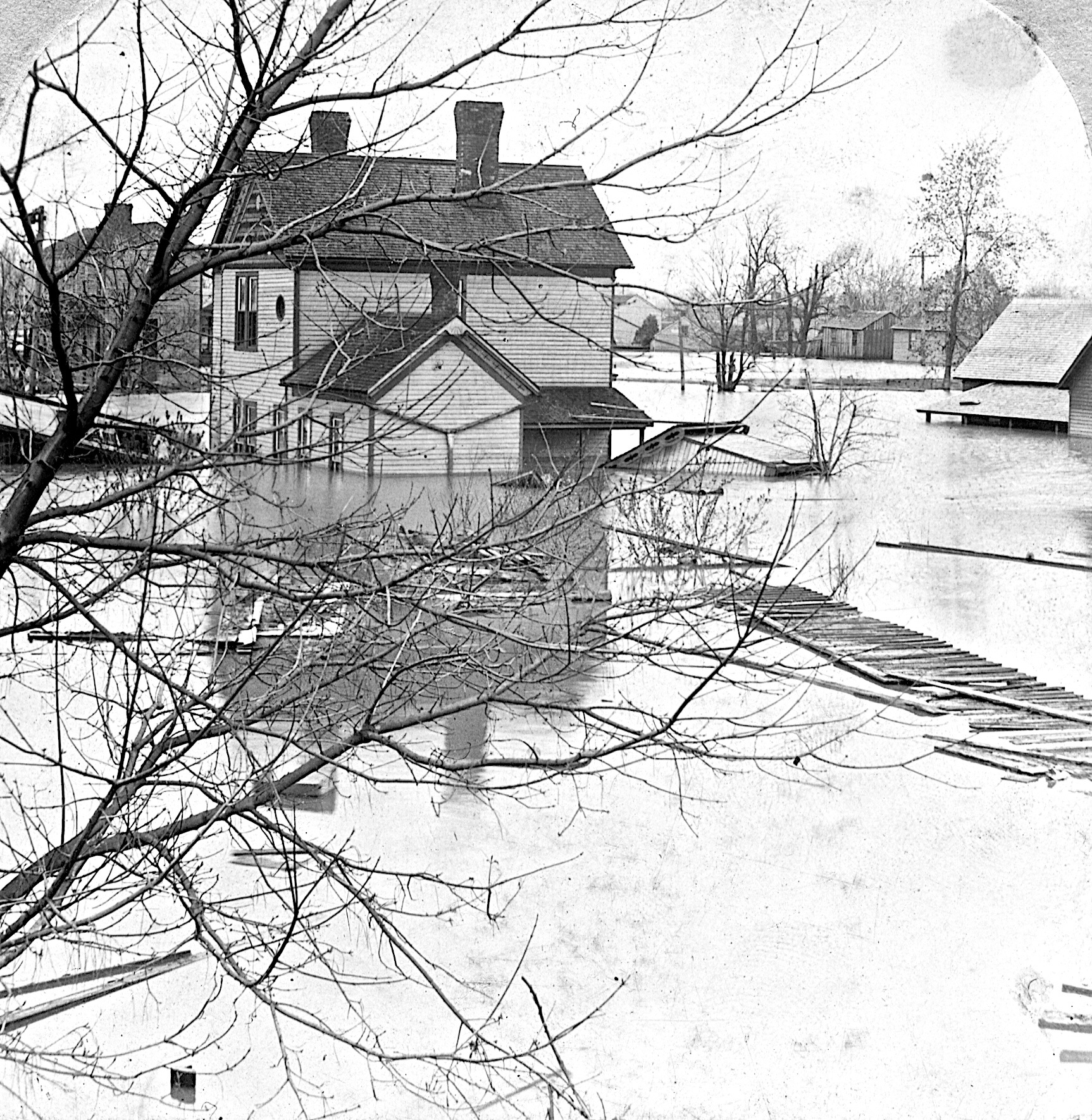
Another image shot by B.L. Singley shows the devastation from the flood at Shawneetown.
Gallatin County Sheriff Charles R. Galloway suffered particularly stunning personal loss. After learning his daughters Dora, 19, and Mary, 12 were killed in the flood, he then learned of the drowning of his wife, Sylvester. Photographer Singley wrote that the sheriff’s hair “turned suddenly white from grief at the loss of his wife and two daughters.” In some cases, entire families were wiped out, such as Charles Clayton, his wife and their four children.
Until 1883, Shawneetown was completely at the mercy of the river. That year, after floods had again wiped out much of the village, construction was begun on a levee system. The levee was still incomplete in February 1884 when the river overpowered it, pouring floodwaters into the town. “Within 24 hours from that time, all the poorer people of Shawneetown were homeless, their houses drifting about and away in the turbulent flood,” read a report prepared for the Illinois legislature.
There was something in the community’s DNA that willed the folks to rebuild. This was a longstanding feature of life in Shawneetown. Morris Birbeck, writing his 1817 Notes on a Journey in America, remarked: “As the lava of Mount Etna can not dislodge this strange being from the cities which have been repeatedly ravished by its eruptions, the Ohio, with its annual overflowings, is unable to wash away the inhabitants of Shawneetown.”
As true as Birbeck’s observation was, the Ohio struck at Shawneetown with disastrous results again in 1913. That year, more than 1,000 people took up residence in tent cities built on the nearby hills. An emergency hospital was built to care for the injured and sick. In 1932, the levee was raised to 5 feet above the high-water mark from 1913. But nothing would hold back the flood waters in 1937, when what was called a 1,000-year flood swamped the town. After more than a century of floods and destruction, Shawneetown would not rebuild on the lowlands. The state and federal governments helped move the village onto hills 4 miles back from the river.
Margaret Dailey, who was referred to in Census documents as Maggie and Madge, moved away from North Fork and went to school at Northwestern University. She finished her studies in June 1920, and shortly after married a young man named Earl James Mulqueen in Racine, Wisconsin. The Mulqueen family home, which eventually relocated to Cudahy, welcomed 11 children between 1921 and 1944.
— This post has been updated with an additional photo of the flood, and a correction on the location of the first photo to Uniontown, Ky., rather than Shawneetown.
To see other photos of flood devastation at Shawneetown over the years, visit the Ghosts of Old Shawneetown.
It was the moving definition of a close call. A semi-trailer truck being driven by John N. Post flipped over in late June 1946 and slid right into the front of the Tourist Hotel on State Street in Mauston, Wisconsin. The semi ripped off the hotel’s screened porch and pushed it down the block.
The truck pushed parts of the porch 20 feet to the west.
Breaking glass exploded into the only unoccupied room at the inn. The room’s regular resident, a truck driver himself, was away on vacation. Post, 25, told police that he pulled out in order to pass a car driven by Charles A. Petrowitz, 15. Petrowitz started to make a left turn, forcing Post to veer and lose control of the truck. Post was treated at the Mauston hospital and released. No citations were issued in the accident. In addition to building damage, the truck also knocked over a light post, a mailbox and a fire hydrant.
Truck driver John N. Post suffered only minor injuries in the crash.
The photos were taken by Carl F. Hanneman for The Wisconsin State Journal, which ran two images and a short story on its State Page on June 25, 1946.
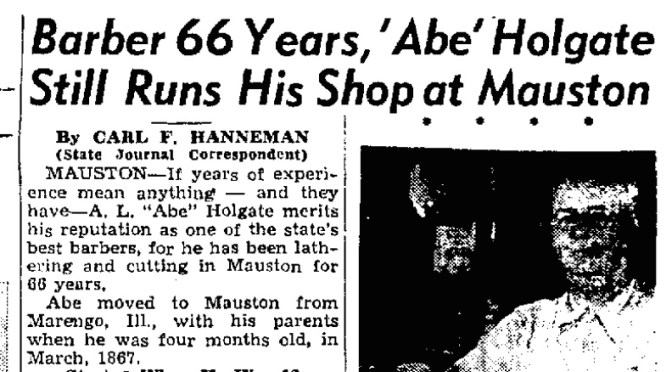
If years of experience mean anything — and they have — A.L. “Abe” Holgate merits his reputation as one of the state’s best barbers, for he has been lathering and cutting Mauston for 66 years.
Abe moved to Mauston from Marengo, Ill., with his parents when he was four months old, in March 1867. His father William was a barber, but barbering didn’t enter the little shaver’s mind until he was 12, when his father became seriously ill and the lad promised to learn the trade and look after his mother. When his father recovered, the lad kept his promise, and at the age of 12, back in 1878, he started the long hours of standing beside a barber chair.
Now Abe is 78, but you’ll find him on the job in his shop across from the Juneau County Courthouse, even during the long Saturday hours.
The steps have decreased since the days of the old-time rack, which used to hold the treasured array of individual shaving mu.gs, bright with inscriptions and names.
Holgate is in excellent health, never missing a day at the shop and still enjoying a good schottische with the proper music. Musically inclined himself, he plays a wicked guitar. His favorite hobbies are hunting and fishing, and although many fine catches of large and small game fish are still caught in the Lemonweir River at Mauston, he claims that previous to construction of the dam it was nothing for an individual to catch a wagonload of bluegills before the game limit was established.
Mr. and Mrs. Holgate observed their golden wedding anniversary in 1936. Among his five grandchildren is First Lt. William Holgate, who as a pilot on a B-24 was shot down over Romania, later released from prison camp and now is home on leave.
(Published in the October 29, 1944 editions of The Wisconsin State Journal)
Postscript: Abe L. Holgate died on October 9, 1951 in Mauston. He was 84. In addition to his barber duties, Abe served for a time as chief of the volunteer Mauston Fire Department. His son, Roy E. Holgate, also worked as a barber in Mauston. Roy, who was at one time Mauston city clerk, died of pneumonia on February 7, 1937. He was 47 years old. Abe’s father, William Holgate, is buried next to his son and grandson at the Mauston cemetery. The family accounts for more than 80 years of barbering across three generations.
It was mixed in with photographs and other documents — a colorful, torn ticket stub. I picked it up and examined it and was left wondering, what is the story behind it? The game was between the University of Wisconsin and Northwestern on November 10, 1945. I presumed that my Dad was the lucky holder of the $1.75 ticket. He was 12 at the time, so a trip from Mauston to Madison for a college football game would have been a big treat. I had to find out more about this game. So I dug right into it.
The ticket stub was like an invitation to re-live the 1945 homecoming game.
The weather forecast for the homecoming game called for a high of 39 degrees after an overnight low of 18. The Friday night calm on the UW campus was broken by roving mobs of teenagers who broke store windows and vandalized cars along State Street. Madison police made 49 arrests for curfew violations, according to The Wisconsin State Journal. Still, police considered the homecoming crowd on campus well-behaved overall, so they did not use the tear gas and water wagons that were held in reserve.
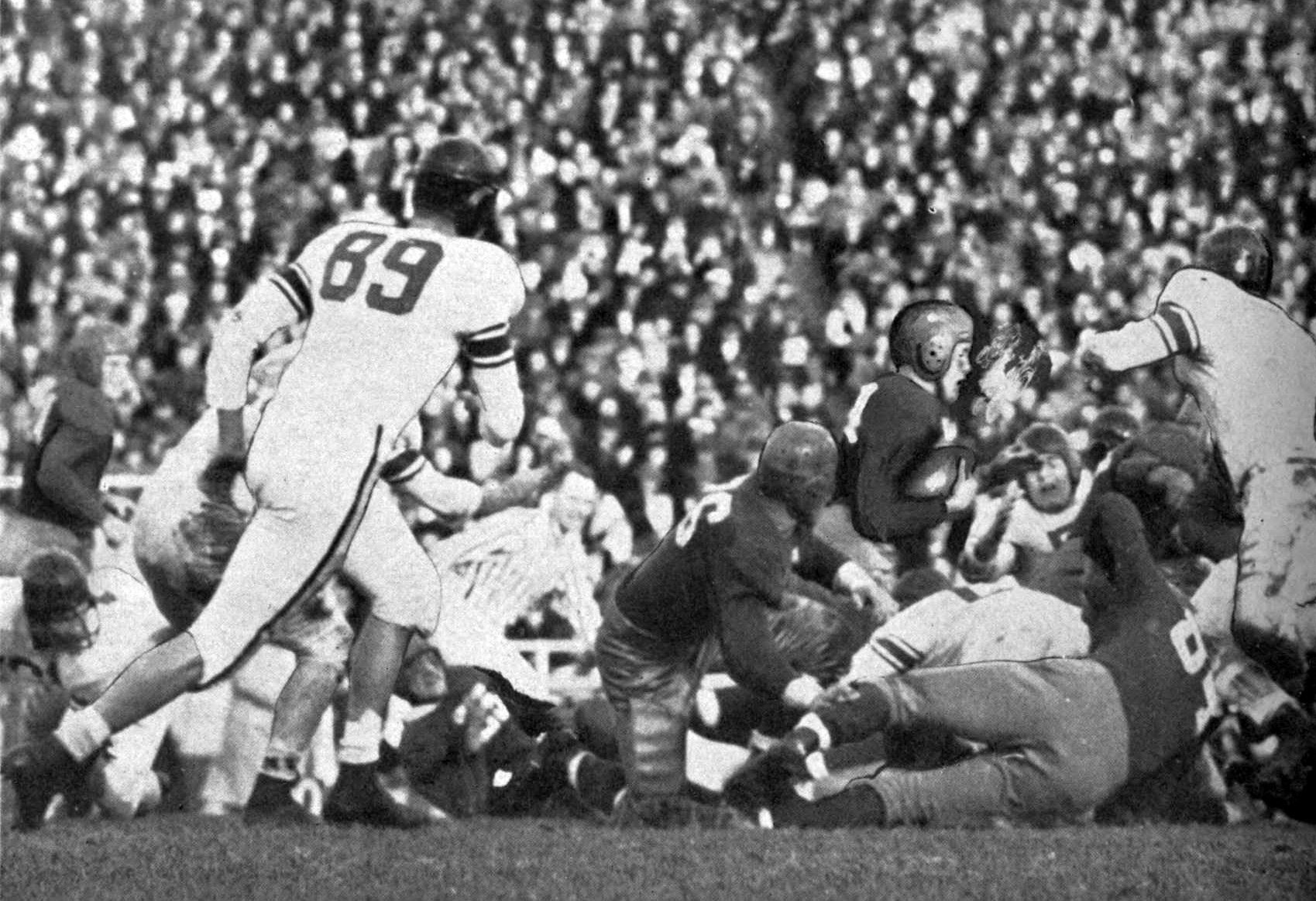
Scatback Jerry Thompson runs for 5 yards against Northwestern on November 10, 1945.
Camp Randall was packed with 45,000 fans when game time arrived on Saturday. Dad (or whomever held that ticket) sat in the south end zone, Section Z, Row 6, Seat 5. This is the end of the stadium backed against the UW Field House. I’ve sat in that section myself a few times over the years. Fans were treated to a great game. “This was a game with few dull moments, one in which each turned loose a devastating running attack,” wrote Henry J. McCormick, sports editor of The Wisconsin State Journal. The first quarter ended scoreless. Wisconsin’s initial drive ended on Northwestern’s 48 when Jerry Thompson’s pass was intercepted. Northwestern fared no better, as its drive ended on Wisconsin’s 25 when Badger Don Kindt intercepted a Jim Farrar pass.
‘Big Ben’ Bendrick slashed Northwestern for 133 rushing yards, but fumbled twice.
In the second quarter, Wisconsin scored a touchdown on a 16-play, 80-yard drive that ended with a reverse and a pass to the end zone. Northwestern answered with an impressive 73-yard touchdown drive. Wisconsin roared right back on the next drive. Halfback Ben Bendrick ripped off 17 of his 133 yards on one play. Kindt finished the drive by plunging into the end zone with only 8 seconds left in the half. Halftime score was 14-7 in favor of the Badgers. The second half opened with the same high tempo. Northwestern took the kickoff and moved right down the field with 70 yards on 11 plays. Farrar’s 25-yard pass to tight end Stan Gorski brought the game to a 14-14 tie. On the very next drive Wisconsin’s Bendrick tore off a 41-yard run, followed by an 11-yard scamper from Kindt. A fourth-down pass from Thompson was intercepted by Bill Hunt of Northwestern. When the Wildcats pounded down to the Wisconsin 1 yard line on the drive, the Badgers’ defense stiffened, stopping the Cats on a fourth-down pass play. As the third quarter ended, the score was still knotted at 14.
On the opening drive of the fourth quarter, Bendrick continued his punishing ground game. But lightning struck as Bendrick went around left end. The ball popped out, right into the hands of Northwestern’s Hunt, who returned the ball to the Wisconsin 9 yard line. After two running plays, Northwestern took it to the end zone for a 21-14 lead. The teams then traded unsuccessful drives. Wisconsin’s Thompson threw another pick at mid-field, but Northwestern’s ensuing drive stalled. When the Badgers got the ball back, Bendrick fumbled again. Northwestern pounced on the ball at the Wisconsin 24. Seven plays later, Northwestern scored to go up 28-14. That’s how the game ended.
When your team rolls up 244 yards rushing, it typically won’t lose. But on this day, the Badgers made too many mistakes, spotting the Wildcats 14 points with two fumbles. The headlines should have been about Bendrick’s stellar 133-yard rushing day. The Badger faithful left Camp Randall entertained, but unsatisfied. If my Dad, David D. Hanneman, was the ticket holder, I’m guessing he was there with his father, Carl F. Hanneman. The first Wisconsin game I can recall attending with my grandfather was a 1977 game vs. Michigan State. The Badgers lost that day, 9-7.
Don Kindt ran for 63 yards against Northwestern.
Hidden behind the headlines of the 1945 game was a compelling military story. It was just the third game back for Don Kindt, who shared halfback duties with “Big Ben” Bendrick. As just a 17-year-old, Kindt interrupted his Wisconsin football career in 1943 to enlist in the U.S. Army’s 10th Mountain Division during World War II. He saw extensive action in Italy and was awarded two bronze stars. He returned to the Badgers in October 1945. After his Wisconsin playing career, Kindt spent nine seasons with the Chicago Bears. He recounts his war experiences in an extensive interview conducted in 1994 by the Wisconsin Veterans Museum.
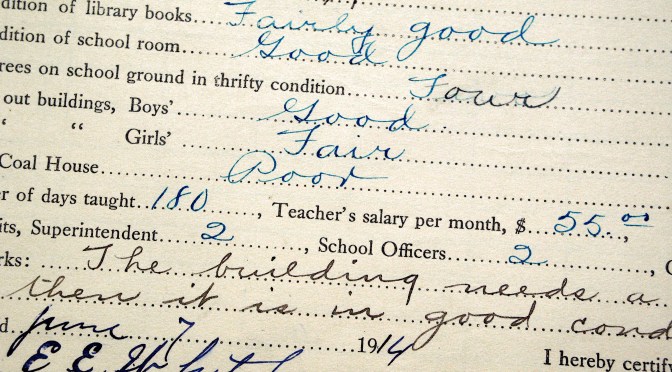
Historical documents and photographs are the heart of any good family archive. The Hanneman Archive is already well-populated with more than 700 photographic images. Now we have added a documents section featuring a variety of declarations from our collection. Examples include ship registries, church death records written in German, draft cards, professional certifications and more. The page is among the links at the top of our home page.
The gallery will be expanded frequently. For until it is shared, a document is but a mere sheet of paper.
















 The Hanneman Archive