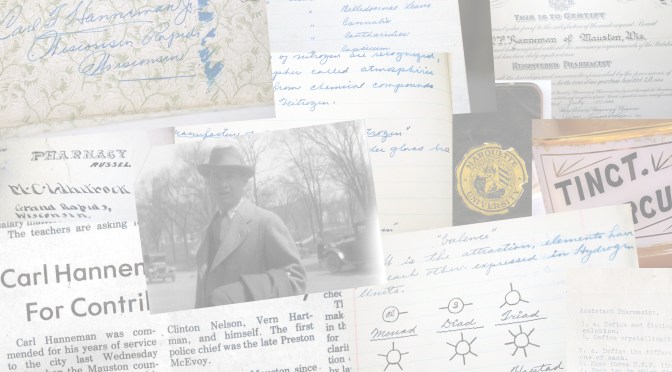
The essence of wintergreen that wafted out the windows onto Division Street in Mauston, Wisconsin. Bottling and selling hand-crafted mosquito repellent at taverns and resorts across northern Wisconsin. Filling pills behind the pharmacy counter as a child. In this installment of audio memories, Dave Hanneman (1933-2007) remembers the work of his pharmacist father, Carl F. Hanneman (1901-1982). This interview was recorded in mid-November 2006 at St. Mary’s Hospital in Madison, Wisconsin.
Carl F. Hanneman printed his own labels and wrote the ad copy for Stay Off.
Vials from a portable druggist kit owned by Carl F. Hanneman.
Carl F. Hanneman taking his suits to the cleaner at Janesville, Wis., on April 5, 1926. Carl and his wife, Ruby V. Hanneman, were on their way to dinner. Carl was a druggist at McCue & Buss Drug Co. at the time.
Christopher Marshall, an Irish immigrant, established his apothecary shop in Philadelphia in 1729. During 96 years, this pioneer pharmaceutical enterprise became a leading retail store, nucleus of large-scale chemical manufacturing; a “practical” training school for pharmacists; an important supply depot during the Revolution; and finally, it was managed by granddaughter Elizabeth, America’s first woman pharmacist. Christopher earned the title of “The fighting Quaker” during the Revolution; his sons, Charles and Christopher, Jr., (shown as youths with their father, about 1754) earned individual fame and carried on his fine traditions.
Carl F. Hanneman’s 1925 state of Wisconsin license as an assistant pharmacist.
Carl F. Hanneman at Solomon Juneau Park in Milwaukee in 1924.
Carl Hanneman emerges from the Mauston Drug Store, circa 1958.
A sample from one of Carl Hanneman’s pharmacy notebooks.
Dad with parents Carl and Ruby Hanneman, and dog Cookie.
Growing up in an Irish family of 11 children during the Great Depression and World War II left Mary K. (Mulqueen) Hanneman with vivid memories. The seventh child born to Earl James Mulqueen Sr. (1895-1965) and Margaret Madonna (Dailey) Mulqueen (1895-1982), she has tender memories of her parents and life in Cudahy, a southern suburb of Milwaukee.
In April 2009, she sat down for an oral history interview with granddaughter Ruby Hanneman, 9, and son Joe Hanneman. The discussion covered subjects like how the big family made ends meet during the Great Depression, how having four siblings serving in World War II changed family life at home, and the lasting impressions left by her late parents. The presentation lasts 23 minutes 6 seconds.
The photo above shows Margaret Mulqueen and husband Earl across the table for Sunday dinner in the late 1950s. The photo embedded in the SoundCloud player shows Mary with sisters Ruth (Mulqueen) McShane and Joan (Mulqueen) Haske outside the Mulqueen home on East Cudahy Avenue.
I often heard the yarn that the Treutel family that came to Wisconsin in the 1850s was descended from royalty back in the old country.Dad would regale us with the story of the “Von Treutelers,” and he pronounced Von like the sound of “fawn.” It sounded royal. I spent more than a few research hours trying to track down the origin of this story. Yes, there were Treutelaars and Treutelers back in Germany. I found nothing to trace them or any relatives to a royal family. Until now.
While searching for something else, I was paging through a scrapbook kept by Emma (Treutel) Carlin (1877-1962), Dad’s beloved Aunt Emma from Arpin, Wisconsin. Emma was a faithful letter writer and keeper of family history. One of the pages of her scrapbook, provided to me courtesy of Bonnie (Treutel) Young, sketches out a bit of a family tree. Down in the lower right corner is a short treatise on Treutel royalty.
Handwriting from the scrapbook of Emma (Treutel) Carlin, 1877-1962.
“The name Treutel originally was Von Treuteler,” Emma wrote. “Royalty in Germany. The name in this country goes by the name Treutel. Some Von Treuteler married out of his class in Germany and I believe lost his title or ‘Von.’ ” On another section of the page, Emma wrote: “Any persons having the name Treutel or Von Treuteler are positive relatives some way or another.”
Not exactly a certificate of royal pedigree, I realize, but an indication that the royalty story was passed through the family for some time. Back in July 1854, Johann Adam Treutel (1800-1859) brought his family to America from Darmstadt, Germany (part of the Grand Duchy of Hesse). He and his wife, Katharina (Geier) Treutel, lived at least part of their marriage in Königstädten, just north of Darmstadt near the city of Russelsheim. A rough translation of Königstädten is “king’s village.” So who was the king? Was he a Von Treuteler? That will have to be the subject of more research.
A few pages later in Emma’s scrapbook, I found another item that led me to discover another of Adam and Katherine Treutel’s children who came to America. It was an obituary clipped from the Milwaukee Journal or Milwaukee Sentinel in August 1940. The deceased was named Edward Bredel, age 67. I wondered what the connection was, and why Emma clipped this obituary.
The 1904 wedding portrait of Emma Treutel and Orville Carlin.
I ran a search for the surnames of Treutel and Bredel at the FamilySearch.org web site and got a very quick answer. By looking at marriage records of a number of people, I discovered parents Christoph Bredel and Margaretha Treutel. A little more reading and I found a death record for Anna M. Treutel Bredel, with parents listed as “A. Treutel” and “Catherina T.” Looked like a match.
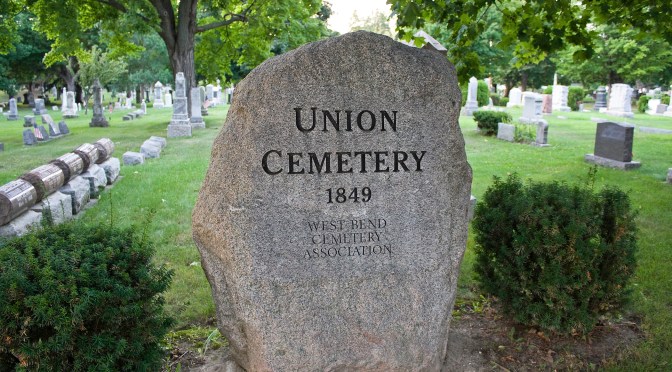
I had a Margaret Treutel listed as one of Johann Adam Treutel and Elizabeth Katharina (Geier) Treutel’s children. But I never found any details related to her. Until now. Margaret and Christoph Bredel had at least seven children between 1861 and 1881. It appears Margaret met Mr. Bredel when her parents came to Milwaukee sometime after July 1854. The Treutels established a number of businesses near downtown Milwaukee, including tailor, tallow chandler and blacksmith shops. Christoph Bredel was a shoemaker with a shop located at 313 State Street (now called Wisconsin Avenue). In the Civil War, he served with both the 14th and 17th Wisconsin Infantry regiments. Margaret died at age 59 on 24 April 1898 in Milwaukee. She was buried the next day at Union Cemetery in West Bend, Wis. Many of the original Treutel emigrants are buried in West Bend. Christoph died in January 1916. He was 83.
The discovery of Margaret’s family details puts us one step closer to filling out the history of the Treutel family that came to America from Darmstadt between 1849 and 1854. Katharina (Geier) Treutel’s obituary said she had eight children. I have eight in my database: Adam, John, Philipp, a twin of Philipp who died as an infant, Sebastian, Margaret,Henry and Peter. The only one I have no information on is Peter. Emma’s scrapbook has a notation next to his name: “Southern.” I know some Treutels settled near New Orleans, so perhaps I will find the answer there.
Every family historian has come up against the dreaded brick wall. Something that stops or stalls a genealogy search and prevents you from making progress in writing your family history. So it’s a joyous occasion to smash down one of those brick walls, which is just was I did this week related to my maternal grandfather, Earl J. Mulqueen (1895-1965).
I had been stymied for years trying to learn about Earl’s parents and other ancestors. The story I’d been told was that his parents both died before he was 4 years old and he was raised by two bachelor uncles on a farm near Green Bay, Wisconsin. I was able to find him and his younger sister on the 1900 and 1910 U.S. Census in the Town of Holland, Brown County. But despite years of searching, I could not find any record of his parents, who I was told were named Charles Mulqueen and Mary Chase.
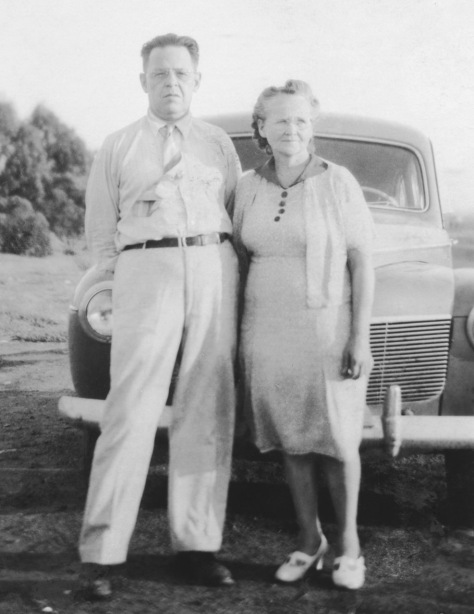
Earl James Mulqueen (1895-1965) and his wife, Margaret M. (Dailey) Mulqueen (1895-1982), in a photo from summer or fall of 1944.
Fast forward to this week. I met with two of my mom’s younger sisters, to see what information they might have about their father. Only three of 11 siblings in the Mulqueen clan of Cudahy, Wisconsin are still alive, so I was eager to finish this research now. One of the things we reviewed was a family bible originally belonging to my grandmother, Margaret Madonna (Dailey) Mulqueen (1895-1982). A small notation in the family tree section of the bible listed Earl’s parents as Charles Chase and Elizabeth McQueen. McQueen is a common spelling variant of the surname Mulqueen, and the Wisconsin branch of this family used the names almost interchangeably.
At this point, the information started to make sense. If Earl took his mother’s maiden name, it would explain my difficulty finding his parents in the records. On his 1965 death certificate, Earl’s parents were listed as Charles Mulqueen and Mary Chase. Was that information incorrect? I was about to find out. I turned to my trusty subscription to Newspapers.com, a subsidiary of Ancestry.com. I ran the obvious name searches, but turned up nothing. Then I tried a search just for the words “Chase” and “Askeaton,” the latter being the hamlet in Brown County settled by Irish families in the 1850s. Up popped a headline from the March 15, 1897 issue of the Green Bay Gazette: “Death of Mrs. Charles Chase of This City.” Bingo. One brick in the wall fell.
From the March 15, 1897 issue of the Green Bay Gazette.
According to the article, Mrs. Chase died of fever after giving birth. I knew my grandfather’s younger sister was born in 1897, so this made sense. Next I turned to the Wisconsin Historical Society and its index of pre-1907 death records. Again, the typical name searches did not find anything useful. I then did a broad search for all Brown County deaths from 1890 to 1900 and manually looked through them. There I found a death record for Bridget E. Chase on March 12, 1897. Bridget? I recalled the U.S. Census records for a McQueen family in the Town of Holland, Brown County, had a Bridget listed. Her age was a close match for Bridget Chase. The Elizabeth McQueen listed in grandma’s Bible was actually Bridget Elizabeth McQueen.Boom. Down came more bricks.
I used the same search strategy with the Wisconsin Historical Society’s marriage records. I found a Charles Henry Chase who got married on September 4, 1894. This sounded promising. But when I clicked on the “search for possible spouse matches” feature on the web site, it came up blank. That usually does not happen. So I again took the long road, calling up all Brown County marriages from 1890 to 1900 and zeroing in on the letter M. There I found two matches, both with the same September 1894 wedding date as Charles H. Chase. The first was for “Bridget Micgreen” and the second was for “Bridget E. Mcinween.” Whoa. What merciless butchering of the McQueen/Mulqueen name! As I quickly ordered paper copies of these documents from the WHS, I could hear that brick wall rumbling and crumbling.
Based on the information in these documents, Bridget Elizabeth was pregnant with my grandfather at the time of her September 1894 marriage to Charles H. Chase. Grandpa was born on 7 January 1895. Now I had confirmation of my grandfather’s parents, whom he never really knew. I’m still waiting for the marriage and death certificates from Madison, and I hope they shed further light on this couple. There are still big questions needing answers. Why did Earl take his mother’s maiden name, Mulqueen, rather than his father’s name, Chase? Again, this is not typical, so there must be a significant story behind it. What happened to Charles H. Chase? I had often been told he died while my grandfather was young. But I had also been told his surname was Mulqueen. I am in the process of tracking down his story.
Earl J. Mulqueen, circa 1964.
While I was on a research roll, I turned to Elizabeth Mulqueen’s parents. I easily located them on the 1860 U.S. Census for the Town of Holland in Brown County. Daniel and Mary Mulqueen, parents to James, 9; Thomas, 5; Margaret, 3; and Michael, 1 month old. On the 1870 U.S. Census, new children appeared, including Margaret, 7; Daniel, 5;Bridget, 4; and Mary, 1. That makes two Margarets with different ages, so either the 1870 Census is in error, or the first Margaret died and a new daughter bore the same name. The Census put Earl’s mother’s birth year at around 1866.
I next used my Family Tree Maker software (powered by Ancestry.com databases) to look for more information on this family. I found little Mary Mulqueen’s Wisconsin birth record, which listed the mother’s maiden name as Corcoran. So now I knew Daniel Mulqueen married Mary Corcoran, likely prior to 1851, when the family lived in Ohio. But I could find no birth or death records on file for any of the couple’s other children.
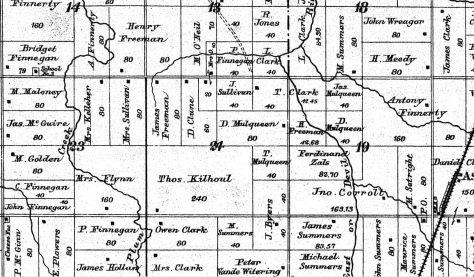
This 1889 plat map shows the farms of Dan Mulqueen, James, Mulqueen and Thomas Mulqueen in the Town of Holland, Brown County, Wisconsin. The family owned 200 acres just to the northwest of the village of Askeaton.
By digging more through news microfilm, I discovered that Daniel Mulqueen spent his final years at the Brown County Asylum, having been judged “insane.” Unfortunately, I have no information on his case, which could have simply been dementia. People with infirmities that could not be handled at home often ended up in county asylums, sometimes called “poor farms” or “insane asylums.”
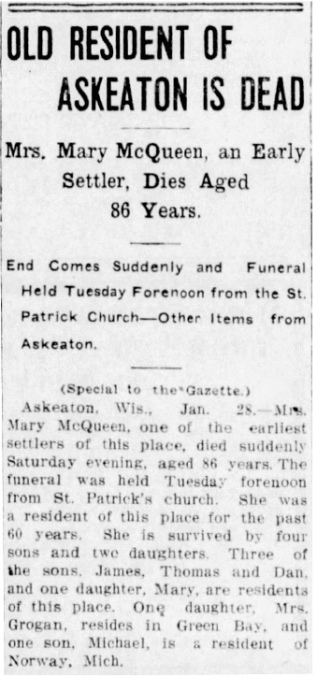
Mary (Corcoran) Mulqueen died on the family farm near Askeaton, Wisconsin. This 1913 news article is from the Green Bay Gazette.
Dan first entered the asylum on June 7, 1888. He was in and out of the institution over the next few years. He died at the Brown County Asylum on March 30, 1893. The only obituary, in the Daily State Gazette of Green Bay, read thusly: “Daniel McQueen, an insane man, died at the county asylum yesterday afternoon. He was 74 years of age. The funeral will be held tomorrow in the town of West Holland.” How sensitive. This man emigrated to America from Ireland, raised a large family on a successful farm in Wisconsin, yet the local paper only remembers him for an illness in his final years.
My Grandpa Earl and his sister moved to the Mulqueen farm near Askeaton after their mother died in March 1897. Their grandmother, Mary, lived on the farm until her death in 1913. The men of the farm included Daniel Mulqueen Jr. and his older brother James. I believe Dan and James are the bachelor uncles about which I’d been told.
Determined to start a life of his own, Earl left the Mulqueen farm and moved south to Racine County around 1916. He spent time as a farm hand in Kansasville, where his good friend Howard Gilson lived. Earl later moved to Racine and worked for J.I. Case before starting a long career for Wisconsin Electric. He met and married my grandmother, the former Margaret Madonna Dailey, at Racine on Nov. 23, 1920. They moved to Cudahy, Wisconsin, in the mid- to late 1920s.
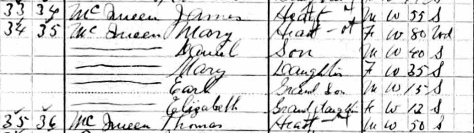
The 1910 U.S. Census for the Town of Holland shows Earl and Elizabeth Mulqueen.
The little hamlet of Askeaton, Wisconsin, is named for a village in County Limerick, Ireland. Farmers from County Limerick emigrated to America starting in 1844 and eventually made their way to Brown County, Wisconsin. Askeaton, Ireland, has a fascinating history, with ruins of a medieval castle that dates to about the year 1200 and a Franciscan abbey founded in 1389. It was once a large walled town, but in 1846 was described in an Irish gazetteer as “a poor lumpish village.” The population at the time the group of farmers left for Wisconsin was about 4,400.
In the span of just a few days, I’ve unearthed more information on Earl Mulqueen’s ancestry than I found in more than 10 years of searching. Now that the brick wall has come down, I look forward to fruitful research in the coming days and months.
It was one of the big mysteries in our family tree: what ever happened to Sebastian Treutel, brother to Philipp Treutel, who came to Wisconsin from Darmstadt, Germany in 1854? The only indication we had in our records was that Sebastian died around the year 1877 at age 41. We did not know a place or cause of death.
Thanks to some research done by a local historian in West Bend, Wisconsin, we have more answers about Sebastian. His name appears on a Civil War monument recently placed at Union Cemetery in West Bend, where his brothers John Treutel and Henry J. Treutel are buried. The managers of Union Cemetery confirmed that Sebastian Treutel is buried in Block 2, Lot 19 of the cemetery. There is no headstone visible. It could have been swallowed by the earth, damaged or removed sometime during the past 140 years.
A Grand Army of the Republic medallion, posted in the Treutel family block at Union Cemetery, West Bend, Wisconsin.
Information provided by the local historian says that Sebastian died on January 19, 1876. We are working to confirm this with evidence, such as a news clipping. The cemetery has no recorded death date. A 1937 obituary for Sebastian’s widow, Anna Sophia (Schultz) Treutel, listed the year of his death as 1877. It appears that Sebastian’s service in the Civil War weakened his constitution and might have played some role in his death.
Sebastian Treutel enlisted in Company A of the 26th Wisconsin Volunteer Infantry Regiment on August 15, 1862. He was assigned the rank of private. Company A, commanded by Capt. William Georg, was nicknamed the “Flying Rangers.” Sebastian’s last name is misspelled as “Treudel” in regimental records. At the time, Sebastian was living in Milwaukee, probably working with one of his brothers in the blacksmith trade. His younger brother, Henry, enlisted as a corporal in Company G of the 26th Wisconsin, known as the Washington County Rifles.
The 26th Wisconsin fought a critical battle in April and May 1863 at Chancellorsville, Virginia. According to the History of the 26th Wisconsin Infantry,Union forces at Chancellorsville were not prepared for the Confederate assault on their right flank. The 26th Wisconsin and the 58th New York tried to make a stand at Hawkins Farm. They could not hold, but fought bravely enough to give the Union time to evacuate supplies and forces. Sadly, newspapers in New York and Milwaukee unfairly tagged the men of the 26th as cowards, inaccurately claiming they dropped their weapons and ran. the Union suffered 14,000 casualties in the battle, but the Confederates lost their commanding lieutenant general, Thomas Stonewall Jackson.
Battle of Chancellorsville, etching by W.H. Shelton. (Library of Congress collection)
According to West Bend historian Bev Hetzel, Sebastian Treutel became ill during the Chancellorsville battle. The illness led to heart problems and Treutel was discharged from the war on August 18, 1863. The reason listed was disability.
On November 18, 1867, Sebastian married the former Anna Schultz in a justice of the peace ceremony in the town of Addison, Washington County, Wisconsin. The marriage record says Sebastian was a carpenter. Witnesses to the wedding were Henry Schultz and John Russo. Parents of the groom were listed as Adam Treutel and Catharina Treutel. Parents of the bride were listed as Henry and Anna Schultz. The presider was Justice of the Peace Francis Forster, a farmer from the town of Addison.
Sebastian was listed on the 1870 U.S. Census as a carpenter in Addison, Washington County. Later in the 1870s, he worked as a U.S. mail carrier, working the route from West Bend in Washington County to Theresa in Dodge County. Postal service records show his contract was annulled as of July 31, 1875. Given the suggested death date, perhaps he was ailing at the time.
Sebastian and Anna Treutel had four children:
Margaretha Maria, born January 3, 1870. She married Louis Emil Dettmann in 1890. We do not know Maggie’s death date.
Ida Magdalena, born February 22, 1872. She married Edward H. Grundmann. Ida died in 1944.
Herman Sebastian Ludwig, born May 6, 1874. He married Dorothea Treutel (maiden name unknown). Herman died in 1912.
Christina Henrietta, born April 24, 1876. She married Emil Joseph Weiner. Tena died in 1960.
Anna Treutel remarried in 1880. New husband Carl Frederick Bohlmann was 48, while Anna was 29. They had one child, Clara (Bohlmann) Laisy (1881-1964). Mr. Bohlmann died in 1917. Anna died on August 5, 1937 in Milwaukee.
Note: The Treutel family headed by Johann Adam Treutel and Elizabetha Katharina (Geier) Treutel emigrated from Koenigstadten in the Hesse-Darmstadt region of Germany in 1854. Read more about that here. Our connection to the family goes this way: Johann Adam Treutel (1800-1859) >> Philipp Treutel (1833-1891) >> Walter Treutel (1879-1948) >> Ruby (Treutel) Hanneman (1904-1977) >> David D. Hanneman (1933-2007).
When the wooden covered bridge was built over Cedar Creek in 1876, memories of the Civil War were still fresh and the main modes of transportation were horses and oxen pulling buggies or wagons. The clip-clop of hooves and the rolling thunder of wooden wheels have long since faded, but Wisconsin’s last covered bridge still stands proud at age 140.
Nina Wilson (center) and daughter Laurni Lee (at left) on the famous covered bridge on June 30, 1941. The woman at right is unidentified.
Located on a scenic route some 20 miles north of Milwaukee, the beautiful span no longer carries vehicle traffic but is still a boon to pedestrian traffic and those armed with cameras. It has served as the backdrop for countless photos over the years. It is such an important landmark to nearby Cedarburg, Covered Bridge Park was built around it and a historic marker from the Wisconsin Historical Society was placed nearby.
The bridge uses wooden lattice trusses and interlaced 3-by-10-inch planks.
Our look at this magnificent bridge goes back to late June 1941. Pictured are Nina (Treutel) Wilson (center) and her daughter, Laurni Lee. Nina is the sister of my grandmother, Ruby V. (Treutel) Hanneman. I believe the photograph was taken by Emma (Treutel) Carlin, who at the time was working at the Washington County Asylum in West Bend. In her scrapbook, Emma kept a July 1941 news clipping on the bridge from The Milwaukee Journal. Across the top of the page, she wrote, “I rode over this bridge June 30, 1941.”
The Milwaukee Journal article bid poetic tribute to the old bridge:
“Grayed with the snows and suns of many years, it might tell a hundred tales to the traveler who would stop and bend a sympathetic ear. …Leaning under the weight of its years, this friendly bridge (it has no name) still creaks and rumbles heartily and bears its passing burdens of farmers and curious visitors as trustily as the day its last dowels and wedges were driven tight.”
This sketch of the Cedarburg covered bridge, by artist Frank S. Moulton, appeared in the Wisconsin State Journal on November 26, 1950.
At that time, the bridge still carried live traffic, although only vehicles weighing 3 tons or less. It was built with just enough height to accommodate a wagonload of hay. The structure was welcome shelter in summer and winter for horses and drivers alike. The bridge is 12 feet wide and 120 feet long. Its construction has been described as a masterpiece, using lattice trusses with interlaced 3-by-10-inch planks. It is held together with 2 inch hardwood dowels. Its road surface is covered with 3-inch planks. A concrete support was added beneath the midway point in 1927 to help the bridge support motorized vehicles.
Wisconsin once had dozens of covered bridges. The last one to be demolished (in 1935) spanned the Wisconsin River at Boscobel. But the folks of Ozaukee County worked hard to ensure their covered bridge would be maintained for future generations. It was taken out of active service in 1962, as another bridge was built over Cedar Creek to handle vehicle traffic. In May 1965, the state historical marker was installed next to the bridge.
Covered Bridge Park is located on Covered Bridge Road, which runs north and south between Highway 60 and Pleasant Valley Road just north of Cedarburg.
For most of his adult life, Carl F. Hanneman said he studied pharmacy at Marquette University in Milwaukee, securing the academic knowledge required to pass the state of Wisconsin pharmacy board exam. Even his obituary in the May 30, 1982 issue of the Wisconsin State Journal stated, “He was a graduate pharmacist of Marquette University.”
Now, more than 90 years after Hanneman’s days of youth in Milwaukee, a question has been raised about where he studied to prepare for his nearly 60-year career as a pharmacist. As The Hanneman Archive was preparing to donate Carl’s student notebooks, study guides and formulary books from his days at Marquette, staff at the university’s archives said they could not find him in an initial search of the graduate database.
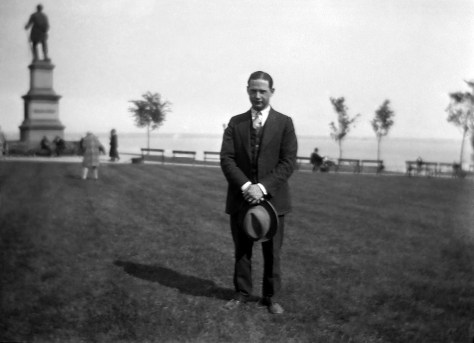
Carl F. Hanneman at Solomon Juneau Park in Milwaukee in 1924.
The College of Pharmacy at Marquette was disbanded in 1918, as World War I decimated the ranks of students and faculty alike. The plan was to re-establish the pharmacy program after the war, but those plans were never realized and Marquette never again had a pharmacy degree program. So what to make of Carl’s story and his history? We can assume he did not fabricate it, since he was licensed in Wisconsin for 57 years. So, what to do when presented with a mystery? We dug into it.
Some facts in our favorite pharmacist’s story are well-established. Carl Henry Frank Hanneman was born on October 28, 1901 in Grand Rapids, Wood County, Wisconsin (the city’s name was changed to Wisconsin Rapids in 1920). He was the youngest of five children of Charles and Rosine (Osterman) Hanneman. (We related elsewhere on this sitesome of the confusion surrounding his birth when he sought a copy of his original birth certificate in 1946).
Charles Hanneman emigrated from Pomerania to Wisconsin in November 1882.
His father Charles, whose full name is Carl Frederick Christian Hanneman, emigrated to Wisconsin in November 1882 from county Regenwalde in the Baltic Duchy of Pomerania (now in Poland and Germany). His mother was native to Wood County, Wisconsin. The senior Hanneman toiled at manual labor. He started as a saw mill worker and later became a farm hand for his brother William at the dawn of the 20th century. Charles worked on the 1908 construction of the sewer system in Grand Rapids, earning 17.5 cents per hour. He later worked in a paper mill. Young Carl had a good role model for hard work.
Carl attended public schools, graduating from Lincoln High School in 1921. He was a smart young man, with equal talents at science and art. Shortly after high school, he began work as an apprentice at the well-known Sam Church drug store. A spark was lit. Carl felt a calling. Carl’s apprenticeship at the Church drug store lasted nearly five years. We believe the person who told Carl about Marquette University was Mark C. Whitrock, a 1913 Marquette pharmacy graduate and pharmacist at Sam Church. Nearly 10 years Carl’s senior, Whitrock was also a member of the Wisconsin Rapids city council.
Carl Hanneman studies in the mid-1920s.
Among Carl’s Marquette papers is a pharmacy course notebook originally belonging to Whitrock. It is from a theoretical pharmacy course taught by Dr. Hugh C. Russell, a physician and professor in Marquette’s College of Pharmacy. Whitrock gave the book to Carl to help him prepare to study for work as a druggist. What to do, since the pharmacy degree program at Marquette was no more? With some help from the Marquette University Archives and Carl’s own writings, we found the answer.
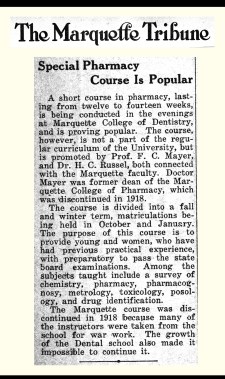
Marquette’s short course in pharmacy proved popular in the mid-1920s.
In 1923, Marquette began offering a “short course” in pharmacy under the auspices of the College of Dentistry. The school newspaper, the Marquette Tribune,said the course was “not part of the regular curriculum of the university.” What? The courses in chemistry, organic chemistry, pharmacy, pharmacognosy, toxicology and drug identification were rigorous. They were taught by the aforementioned Dr. Russell and Professor Frederick C. Mayer, both former deans of the Marquette College of Pharmacy. The two-semester program was designed for young men and women with pharmacy experience, in preparation to pass the state exams.
Carl studied under two former deans of the Marquette College of Pharmacy.
Carl enrolled in the pharmacy short course in the winter of 1924. We know he paid tuition (he referenced in later writings having to save before enrolling at Marquette). He lived in the 700 block of 37th Street in Milwaukee, just west of the Marquette campus. We have a number of photos of his fiancee, Ruby Treutel, visiting him at Solomon Juneau Park in Milwaukee in 1924.
The books Carl left behind contain hundreds of pages of meticulous notes on chemistry, pharmacy and related subjects. Two of the books have Marquette pennant stickers on the front. Carl’s pocket-size copy of the Guide to the Organic Drugs of the United States Pharmacopœia has a Marquette University seal on the cover. His exam book shows he scored an 82 percent on one test in 1924. The test was corrected by someone identified only as “A. Mankowski.” So far, we have not identified that person further.
Carl’s organic drugs guide from his days at Marquette University.
It seems odd that Marquette would offer such a program but not count it as official curriculum. The university offered certification programs in other subjects. We have no paper certificate or other document showing Carl matriculated from the pharmacy short course, but we will ask Marquette to check its records thoroughly. Otherwise, Carl and many others like him from the 1920s would be Marquette orphans, educated by the university but not claimed as students or course graduates.
Carl traveled to Madison on January 24, 1925 for the state Board of Pharmacy examination. He was one of 105 applicants seeking licensure as either a registered pharmacist or assistant registered pharmacist. Carl was among 76 people who passed the exam that day. On January 30, the Wisconsin State Board of Pharmacy issued him certificate No. 3252 as a registered assistant pharmacist. With his credentials in hand, he returned home to Wisconsin Rapids. Mark Whitrock hired him as a druggist for the brand new Whitrock & Wolt pharmacy on Grand Avenue.
Carl Hanneman’s graduation and first job made front-page news in Wisconsin Rapids. The newspaper got his middle initial wrong.
Six months later in nearby Vesper, Carl married his longtime sweetheart, Ruby Viola Treutel. After working at the Whitrock pharmacy much of 1925, Carl and Ruby moved to Janesville. Carl took a druggist job with the McCue & Buss Drug Co. in downtown Janesville. After about six months, Carl and his now-pregnant wife moved to Fond du Lac, where Carl started work for Fred Staeben at the Staeben Drug Co. Just weeks later, they welcomed their first child, Donn Gene Hanneman.
By Christmas 1927, the Hannemans moved back to Wisconsin Rapids. Carl became a druggist for his old employer, Sam Church. He stayed in that job for five years. In March 1933, the family welcomed another son, David Dion. Carl then left the pharmacy world for a sales job with the Consolidated Water Power & Paper Co. That assignment lasted for several years.
Longtime pharmacist Sam Church hired Carl Hanneman as an apprentice in the early 1920s, then as a druggist in 1927.
Pharmacy was his calling, so Carl looked for a chance to retake his place behind the druggist’s counter. In February 1936, Carl was hired by Dr. J. Samuel Hess Jr. to be an assistant pharmacist at the Mauston Drug Store, which was attached to the Hess Memorial Hospital in Mauston.
We wrote elsewhere on this site of Carl’s heartfelt September 1937 plea for assistance obtaining a full registered pharmacist license. He wrote to Orland S. Loomis, a well-known Mauston attorney and former state senator who was then Wisconsin’s attorney general. Carl regretted not taking the full registered pharmacist exam in 1925. At the time, he was six months short of the five years of apprentice experience required to become a registered pharmacist. Now 12 years later, lacking that higher license, he could not officially manage the Mauston Drug Store because of a quirk in state law regarding small-town pharmacies. The better license would mean better salary, something that became crucial in August 1937 with the birth of the Hannemans’ third child, daughter Lavonne Marie.
We don’t know if Loomis wrote back or helped Carl with his license issues. (Loomis became governor-elect of Wisconsin in 1942, but died before taking office. As a correspondent for the Wisconsin State Journal, Carl photographed Loomis at the Loomis home in Mauston on election eve in November 1942). Carl became a full registered pharmacist on July 12, 1944. He was among nine people issued new licenses that Wednesday in Madison. He was issued certificate No. 5598 by the Wisconsin State Board of Pharmacy. The certificate was signed by Oscar Rennebohm, a well-known Madison pharmacist who later became Wisconsin’s 32nd governor.
Carl earned his full registered pharmacist license in 1944.
So the mystery is solved. Carl Hanneman did enroll in and complete a short course in pharmacy at Marquette University in 1924. It remains to be seen if Marquette will claim him and his many colleagues who studied in the pharmacy short course in the 1920s. His class notes, study guides and other materials from that time will be donated to the Marquette University Archives later this summer.
A sample from one of Carl Hanneman’s pharmacy notebooks.
Carl’s notebooks contained meticulous notes on chemistry and other subjects.
Professor Frederick C. Mayer was one of at least two faculty who taught the pharmacy short course.
Carl earned his registered assistant pharmacist license in January 1925.
Carl F. Hanneman taking his suits to the cleaner at Janesville, Wis., on April 5, 1926. Carl and his wife, Ruby V. Hanneman, were on their way to dinner. Carl was a druggist at McCue & Buss Drug Co. at the time.
Carl F. Hanneman served as an apprentice at the Sam Church drug store (shown at right) in Wisconsin Rapids. He was later hired as an assistant pharmacist after completing his education and working at three other pharmacies.
In 1926 and 1927, Carl F. Hanneman worked for the Staeben Drug Co. in Fond du Lac, Wisconsin.
The Mauston Drug Store, circa 1930. Image courtesy of the Juneau County Historical Society.
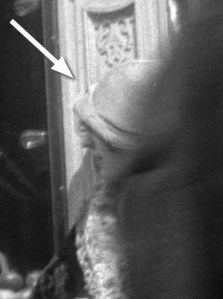
This photo from 1926 or 1927 has always intrigued me. At first glance, it looks like the man passing before the camera was the famed architect Frank Lloyd Wright. For years, I could not figure out who was in the photo or where it was taken.
One day I opened the digital file in Adobe Photoshop and zoomed in on the details. There, hidden to the left of the man’s suit lapel, was my grandmother, Ruby (Treutel) Hanneman. Now the photo made some sense. No doubt my grandfather, Carl F. Hanneman, was taking a picture of his lovely bride when someone pulled the 1920s equivalent of a photobomb. Wearing a hat and fur coat, Ruby is facing the camera, but looking to her right. The photo intruder’s identity remains a mystery.
Ruby Hanneman looks to her right just before being obscured by the belly and suit coat of this strolling gentleman in 1926.
I concluded the photo was most likely taken on the streets of Janesville, Wisconsin in 1926. At the time, Carl was a pharmacist for the McCue & Buss Drug Co., 14 S. Main Street, Janesville. Ruby was wearing her Sunday best, so perhaps the couple were going to lunch after Mass. The other possible location for the photo is Fond du Lac, where Carl once worked as a druggist for the Staeben Drug Co.
It seems natural that Carl and Ruby were pioneers of the photobomb (or at least early victims of it). As we wrote on these pages in 2014, they took “selfies” on their honeymoon in July 1925, generations before invention of the iPhone or the selfie stick. “Photobombing” is a somewhat recent term referring to the practice of inserting oneself into a photo scene, usually to play a joke on the photographer.
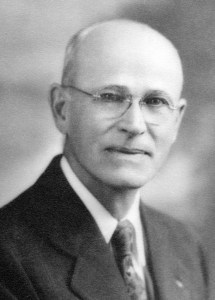
Carl was an avid photographer. His photo collection includes a number of Janesville street scenes from the mid-1920s (see samples below). Early in his career, he had short stints working in Janesville and Fond du Lac before returning to his hometown, Wisconsin Rapids. In 1936, he moved his young family to Mauston, where the couple spent the rest of their lives. He was a pharmacist for more than 50 years.
As I found out today, the college graduation of our firstborn son brought out great parental pride but also just a tinge of sadness at the quick passage of time. As I watched my son, Stephen Patrick, stride across the stage at the University of Wisconsin-Parkside to receive his diploma, my mind wandered to times long ago.
As Stevie shook the hands of the chancellor, the dean and the provost, I could see him climbing over my back as a toddler, wearing a rugby shirt and little blue jeans. I saw him in his flannel shirt and baseball cap at the pumpkin farm, riding in a wheelbarrow full of carefully selected pumpkins. I saw him, the proud big brother, holding his newborn sister,Samantha. I could hear echoes of Christmas 1996, with a new baby in the house. “You know what my favorite Christmas present is, Dad?” he asked eagerly. “Samantha,” he replied, beaming at his new sister. I saw him a few years later, pick up his baby sister, Ruby, and help us give her a bath.
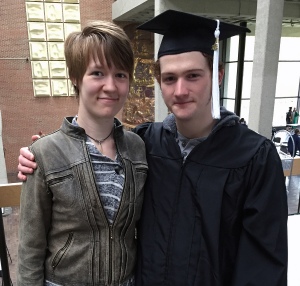
Stevie with his girlfriend, Maggie, after graduating with a degree in computer science.
My mind wandered, but was brought back to the present for a moment. “Stephen Hanneman, bachelor of science,” professor Gregory Mayer called out over the public address system. Stevie, the young man, took his diploma cover from Chancellor Deborah Ford and strode back to his seat, the white tassel on his mortarboard dancing the whole way. How did this day arrive, watching my 24-year-old achieve one of the biggest of life’s milestones? How did he get here, one of 509 graduates in the Class of 2016? I realized that the golden-voiced soap-opera actor, Macdonald Carey, was right when he said: “Like sands through the hourglass, so are the days of our lives.”
Reminiscing might be one sure sign of aging, but graduations are good times to indulge in memories. Stevie overcame huge obstacles in his life to reach this day. We watched him pull his high school career from the clutches and turn things around. He killed it on the American College Test (ACT) and suddenly, a great future opened up. He put himself through school with student loans, working various jobs, and the unwavering help of his dear girlfriend, Maggie. How I wished I’d been able to provide more help and be there more during those years. But at the same time, how proud I am that he made it happen for himself.
Standing at the graduation reception in Wyllie Hall, I gave Stevie a big hug of congratulations. I knew, like the pumpkin farm and the bicycle rides and soccer games, memories of this day would be etched forever in my mind. I realized anew that as a parent, you do your very best, pray a lot, and then let them go.
Happy graduation, son. Your Dad is so very proud of you.
In 1946, my grandfather wrote a charming article for the Wisconsin State Journalabout the English wife of a U.S. soldier who came to Mauston, Wis., to find a fully furnished home waiting for her.
It seems the story of Charles Grinolds and his new bride, Margaret, got noticed across the pond in Great Britain. The former Margaret Eley was native to England. We’ll let Carl F. Hanneman of the Wisconsin State Journal tell the story from the June 30, 1946 issue:
Journal Story on Mauston Welcome to GI Bride Moves British Paper to Congratulatory Ending
MAUSTON, Wis. — Mrs. Charles Grinolds, British war bride, and The Wisconsin State Journal’s account of her welcome at Mauston last winter, received considerable attention in the British press. The comment of the Hertfordshire and Bedfordshire Express, published May 16, follows:
ANGLO-AMERICAN
“In pondering Mr. Churchill’s suggestions that America and Britain should think about setting up house together in the political sphere, it is not entirely impertinent to think of the tens of thousands of British girls and American boys who have had the same idea in the domestic realm.
They and their relatives must be more than a little tired of the jokes on this topic and while it is true that an international marriage has special problems, it must be remembered that two out of every 10 all-British marriages are now providing work for the matrimonial courts, divorce courts or solicitors’ offices, and there is no evidence that the proportion of unsuccessful British-American marriages is as high as that.
The great majority which turn out most happily do not usually make news, so we are pleased to mention the happy welcome which was given to Mrs. Charles Grinolds (nee Margaret Eley), only daughter of Mr. and Mrs. V. Eley of Ashwell, when she arrived at her new home at Mauston, Wisconsin, U.S.A.
With her husband, former Staff Sgt. C. Grinolds, and Charles Victor Jr., who was born after his father left England last July, Mrs. Grinolds arrived at her new hometown at 4 a.m. but found crowds and (Wisconsin State Journal) photographers awaiting to welcome her, a repeat performance of what had already happened at Chicago.
It was at Chicago that Margaret had a big surprise. While she was following the military policeman assigned to her at the railroad station, a civilian came up and took the baby from her arms. She was frightened at first, but then realized that the young man was no stranger. It was her husband, whom she had not expected would meet her at Chicago and whom she had never before seen in civilian clothes.
Bigger surprises were to come.
This is what happened to Margaret at Mauston, according to the Wisconsin State Journal:
‘Thrilled with a surprise house new and completely furnished, Mrs. Grinolds found it furnished even to pictures and books, and in the basement were 187 quarts of fruit, 30 quarts of canned chicken and other canned goods. On the table in a modernistic kitchen was a large angel food cake with the inscription ‘Welcome,’ while the percolator was sputtering its tune upon a recently installed new electric range.
‘Nice work, Margaret.’ ”
After publishing the original blog post on this subject in 2015, I received correspondence from Nigel Reed, a nephew of the couple from the Eley side of the family. Nigel supplied a digital copy of the Hertfordshire and Bedfordshire Express with the May 1946 Grinolds story. That, in turn, led me to discover two additional articles written by my grandfather Carl in 1946. The first is detailed above. The other appeared in The Wisconsin State Journal February 18, 1946, the day before Mrs. Grinolds reached Mauston and saw her new home:
Furnished Bungalow Awaits English Bride of Area Man
By Carl F. Hanneman
State Journal Correspondent
MAUSTON — A completely furnished five-room modern bungalow is waiting in Mauston for Mrs. Helen Margaret Grinolds as a surprise for the English war bride, wife of Staff Sgt. Charles Grinolds, Mauston.
Mrs. Grinolds was among the hundreds of war brides scheduled to arrive in New York last weekend on the Santa Paula, and was to come directly to Mauston with their son, Charles Victor, who was born July 29, 1945, after his father left England for home.
She was to arrive in Mauston late today.
Sgt. Grinolds entered service in February 1942 and left for England in September 1942. He was stationed in England for 33 months and returned home in July 1945. He was discharged that September.
The couple was married in St. Mary’s church at Ashwell, England, and theirs was the first Anglo-American wedding performed in Ashwell during the war. Mrs. Grinolds is the daughter of Mr. and Mrs. H.V. (Harold Victor) Eley, Ashwell, and she has one brother, Antone, 16. •
Charles D. Grinolds’ 1950 obituary from The Wisconsin State Journal
My original post had details on Charles, his military history and his untimely death in 1950. But with the help of Mr. Reed and some additional digging, we can put more details to this heartwarming love story.
Charles Dockstader Grinolds died on Sunday, July 30, 1950 at his Mauston home of a heart ailment. He was just 36. By that time, he and Margaret had three sons: Charles Victor, who had celebrated his 5th birthday the day before his father’s death; Anthony Basil, 3; and Stephen McClellan, 1. After suffering such a devastating loss, Mrs. Grinolds took her sons and returned to England and the support of her family. They came back to the United States in August 1951 aboard the ship Queen Mary.
Mrs. Grinolds married William Osborne in Mauston on March 30, 1952. The couple moved to Colorado Springs, Colorado in 1965. She died September 5, 1972 in Colorado Springs.
The three sons of Charles and Margaret Grinolds all had military careers like their father. Charles V. Grinolds served in the U.S. Air Force in Vietnam, the Persian Gulf War and in Iraq. He died on June 10, 2006. Stephen M. Grinolds served in the U.S. Marine Corps in Vietnam from 1967-1972. He died on December 23, 2005. Anthony B. Grinolds served in the U.S. Air Force in England. He lives in San Antonio, Texas.
















 Mauston.
 The Hanneman Archive