Category Archives: Family Tales

Dying Wish Brought Chapel Windows Home to St. Mary’s Hospital

As kids growing up in Sun Prairie, any time we ventured into the back room of our basement we were likely to hear a voice from upstairs shout, “Don’t you go near those windows!” Of course we knew what that meant: the antique stained-glass behemoths covered in blankets in the farthest reaches of the basement, next to the furnace. I never gave a great deal of thought to them, until one day in 2006 when my father was dying of cancer.

I fully tell the story of the stained-glass chapel windows in my book, The Journey Home: My Father’s Story of Cancer, Faith and Life-Changing Miracles. It’s worth covering here, too.  It shows how sometimes, things all come together to create something beautiful, even out of sadness.

The St. Mary's Hospital chapel as it looked in the 1950s.
The St. Mary’s Hospital chapel as it looked in the 1950s.

Founded in 1912, St. Mary’s Hospital in Madison always had a chapel as part of its facilities. In 1926, a new, ornate chapel was built as part of an expansion of St. Mary’s. The chapel had 10 window frames, each with two beautiful arched stained-glass windows that rose 20 feet from eye level to midway up the wall. In between each were two Stations of the Cross. The windows remained part of the chapel until 1973, when that section of the building was razed to make way for a new hospital wing on Mills Street. My Dad obtained two of the windows, a total of four panels, carrying them home in blankets to rest for more than three decades.

The windows are prominently visible in this newswire photo from 1946, from a Mass to celebrate presentation of a papal medal to Leo T. Crowley of Madison.

When Dad was being treated for lung cancer at St. Mary’s in the fall of 2006, he got an inspiration to give those windows back to St. Mary’s. He asked for my help in doing some research, but he was so impatient he wheeled himself down to the administrative offices to talk to someone about it. That someone, vice president Barbara K. Miller, was enthralled with the idea, but it was her last day on the job before retiring. She promised to get the ball rolling on the donation. “I want these windows to come home to St. Mary’s,” he told her.

The chapel window sections as they looked in 2007 in the Hanneman basement.

Dad was a little worried that his donation wouldn’t get done. The idea occupied his mind more than anything else in November 2006. He knew his time with us was short. He told the story and his idea to his physician, Dr. Gregory Motl. Dad made Dr. Motl promise that if he didn’t survive the cancer, the donation would be completed. Motl grasped Dad’s hand and said reassuringly, “I will Dave. I will.”

To say the hospital embraced Dad’s idea would be an understatement. His timing was perfect, since St. Mary’s was planning a $182 million expansion that would add a new east wing with operating rooms, a cardiac center, outpatient offices, patient rooms and more. St. Mary’s  was looking for ways to tie the new facility to the hospital’s heritage. The architects designed special spaces for each of the four window sections. St. Mary’s had a new internal champion for the windows, Steve Sparks, public relations director.

After months of planning, St. Mary’s was finally ready to take possession of the windows. On March 22, 2007, Sparks and workmen came to Sun Prairie to transport the windows. He snapped some photos of Mom and Dad with a window section. Dad looked pale and drawn, but I know he appreciated the milestone that day represented. “It was humbling for me,” Sparks recounted later. “This gift demonstrated exceptional courage and generosity. It is an experience I won’t forget.”
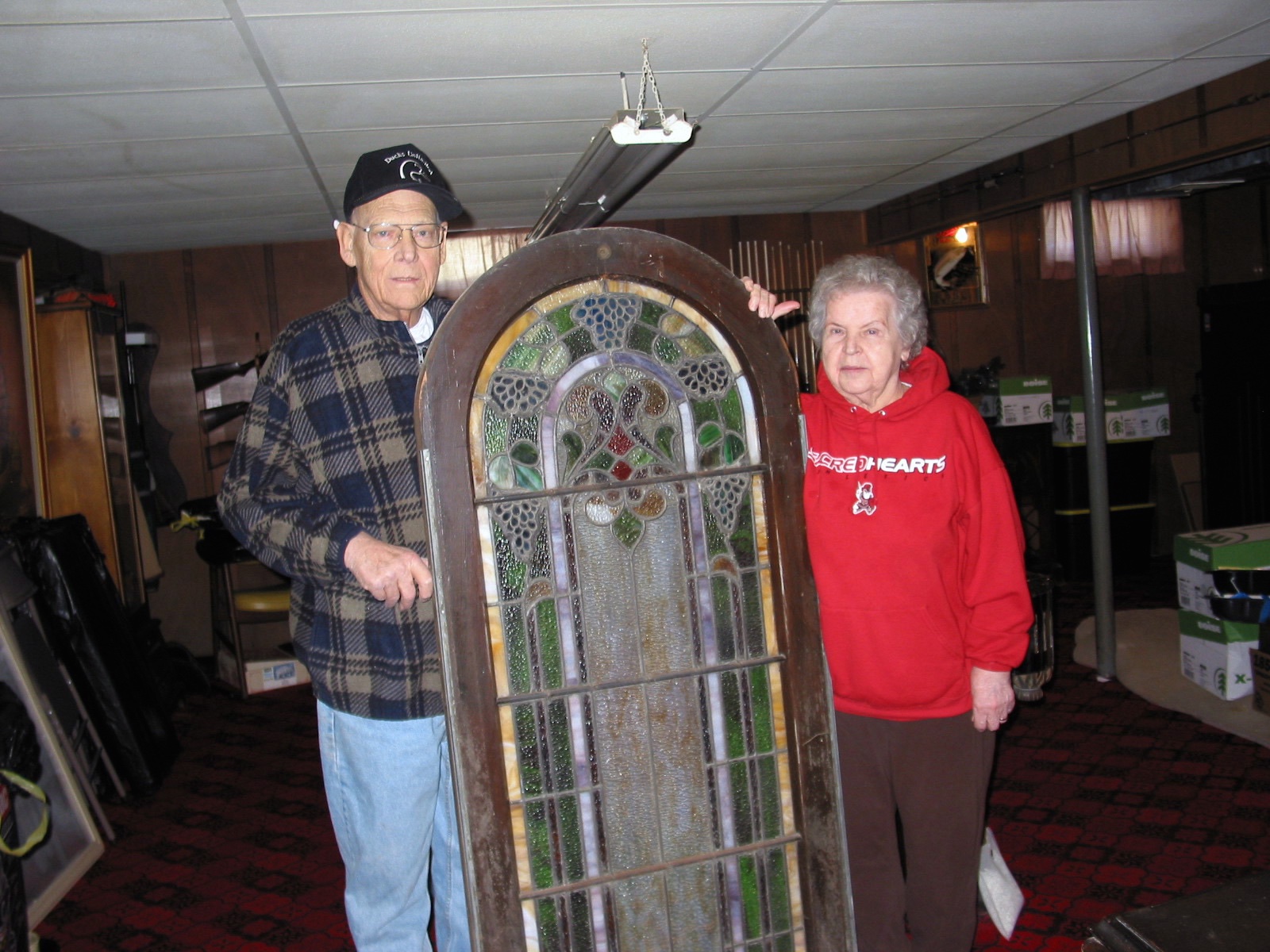
David and Mary Hanneman pose with one window section on March 22, 2007.

Tears were shed that afternoon as the windows were lovingly carried outside. It was the first daylight to penetrate the stained glass in more than three decades. For Dad, it was the accomplishment of a mission of giving. His part was finished; now St. Mary’s would take over. Not two weeks later, Dad was admitted to St. Mary’s and then discharged to HospiceCare Inc., where he died on April 14, 2007. 

In early December 2007, Mom  and I were invited to the dedication day at the new St. Mary’s east wing. We attended a luncheon and heard very kind words about Dad from Dr. Frank Byrne, president of St. Mary’s Hospital. They were similar to what Dr. Byrne wrote right after Dad’s death. “It is clear from Dave’s accomplishments that dedication to community was always a part of his priorities,” Byrne wrote, “and we will all benefit from that dedication for years to come. At this sad time, we hope it will be a reminder that though life may seem short, the contributions made by one individual have a significant impact in building a future for us all.”

The window section placed in the atrium of the new east wing at St. Mary's Hospital in Madison.
The window section placed in the atrium of the new east wing at St. Mary’s Hospital.

When we walked into the atrium and first saw one of the window sections, it was enough to bring tears. There it was, set into the wall and brilliantly backlit in a way that brought out the green, red and amber hues of the glass. It was, as designed by the architects, a welcoming beacon for everyone visiting St. Mary’s. Mom posed next to the window, and even did an impromptu interview with Madison’s Catholic newspaper, The Catholic Herald. The three other window sections were placed on different floors of the east wing. One is in a waiting room. The others are in prominent spots.

The story of these chapel windows gives testimony that beauty can emerge from the depths of the darkest tragedies. Dad kept the windows safe for 35 years, and he got them safely home to St. Mary’s just weeks before he, too, made it home.

This post has been updated with additional window photos.
©2014-2025 The Hanneman Archive

Hanneman’s Mayoral Election Continued 400-Year Tradition

When David D. Hanneman was elected mayor of the city of Sun Prairie, Wisconsin in April 2003, it continued a Hanneman family tradition that stretches back more than 400 years to the county Regenwalde in the Baltic Duchy of Pomerania. Hanneman’s election as mayor on April 1, 2003 capped his nearly 40-year public service career — and put him in good family company.

The Hanneman family from Kellner, Wisconsin — from which David Hanneman descends — traces its roots to Pomerania, a picturesque land of Germanic peoples that dates to the 1300s. His earliest known ancestor, Matthias Hannemann, was from the village of Zeitlitz in the kreis, or county, of Regenwalde. Regenwalde means “woods of the Rega River,” referring to the picturesque waterway that ambles 100 miles through the county and empties into the Baltic Sea. This area has long been known for agriculture, fishing and forests, and it bears strong geomorphic similarities to the state of Wisconsin. The village of Zeitlitz covered about 2,200 acres and had approximately 100 households.

Mayor Dave Hanneman cuts the ribbon at opening of the Sun Prairie fire station. (Sun Prairie Star Photo)

Records trace the Hannemann (the original spelling had two ‘n’s at the end) family back at least to 1582 in Zeitlitz. The Hannemanns made up one of the predominant families in Zeitlitz, based on the number of entries found in the Lutheran church register. Many church records were destroyed in a fire in Stramehl in 1720, but the register from 1582 survived. At that time, there were a number of Hannemann families in Zeitlitz, and they owned some of the larger farms in the village. One of these men, likely the eldest brother, held the title of schulze, or mayor of Zeitlitz. Being the schulze was unlike the elected political position of mayor found in modern-day American communities. It was an inherited job, and the duties centered on making sure work was performed equitably in the village, and that the taxes of grain, goods or money were collected for the estate owner. The term schulze can have various related meanings, including “village headman,” mayor or even constable.

Mayor Hanneman Speaks at a veterans' event.
Mayor Hanneman speaks at a veterans’ event. (Sun Prairie Star Photo)

As farmers, the Hannemanns were also involved in providing financial support for the local minister and the church. Each tenant farmer paid his taxes in measurements of grain. The unnamed mayor Hannemann and Peter Hannemann were each responsible for taxes on two Hufen in Zeitlitz in the year 1582. A Hufe was the amount of land needed to sustain a family. There could have been more Hannemann families living on those four Hufen, but the church records only listed the major land tenants who paid taxes.

In the nearby village of Groß Raddow (about 6 miles from Zeitlitz), the Hannemann family had a similar history. A tax list from 1666 includes the names of Tews Hannemann (the schulze, or village mayor), Heinrich Hannemann, Chim Hannemann and Peter Hannemann. For at least several generations, it appears the Hannemann family inherited and passed on the office of mayor in Groß Raddow. In 1717, Hans Hannemann was the mayor, so we believe Hans is a descendant of Tews Hannemann.

Mayor Dave Hanneman cuts the cake at the 5th birthday of the new Sun Prairie Public Library.

The Matthias Hannemann family began emigrating to Wisconsin in 1861. Matthias left his home in 1866 and came to Wisconsin through Quebec. The family settled in and around Kellner, a tiny hamlet that straddles the Wood-Portage county line southeast of Wisconsin Rapids. At one time, the Hannemanns owned and farmed more than 1,000 acres in Wood and Portage counties. David’s great-grandfather, Christian Hanneman (Matthias’ son) was the last of this clan to come to America in November 1882.

Dave Hanneman (1933-2007) was first elected to public office on April 2, 1968 when he became Fourth Ward alderman in Sun Prairie. He served only one term as alderman, but stayed active in city politics, pushing the city to upgrade its sewer system to prevent backups into residential homes. He again ran successfully for alderman in 1988 and stayed on the Sun Prairie City Council until 1996, when he was elected to the Dane County Board of Supervisors. He held that post until being elected Sun Prairie mayor in 2003.

The Sun Prairie Star Countryman carried news of Hanneman's election as alderman in 1968.
The Sun Prairie Star Countryman carried news of Hanneman’s election as Fourth Ward alderman in April 1968.

“Dave was involved in the growth of Sun Prairie and believed in progress for the community. He worked and helped champion the Highway 151/County Highway C project, which included working with the state Department of Transportation,” said Bill Clausius, who served on the city council and county board with Hanneman. “Dave was involved with the West Side Plan, which brought the Sun Prairie Community together to envision the future of the West Side. Dave supported and worked to begin the West Side Community Service Building. This facility includes a west side location for police, fire and EMS. His vision was to provide essential services to Sun Prairie residents and to shorten response times in case of an emergency.”

Clausius continued: “In 2003, Sun Prairie won the ‘Champions of Industry’ Award of Excellence as one of the best managed small cities in America.  Dave personally raised $32,000 in donations from area businesses to fund production of a video featuring Sun Prairie, and highlighting Sun Prairie’s achievements.”

— Adapted from the forthcoming book ‘Treasured Lives.’
©2014 The Hanneman Archive


Ruby Treutel’s Spirited 1922 Quest for ‘Queen of the Bridge’

Her reign may have been brief, but for one day in 1922, Ruby V. Treutel was front-page news as the most popular single woman in Wood County, Wisconsin. To help celebrate dedication of a new bridge across the Wisconsin River, the community organized a popularity contest to find the Queen of the Bridge.

The Queen of the Bridge contest invited the nomination of single women of Wood County. The contest winner would preside at the dedication of what came to be called the Grand Avenue Bridge, linking the east and west sides of Wisconsin Rapids over the Wisconsin River. 

Queen of the Bridge wasn't really a beauty contest, but Ruby Treutel would have fared well on that count.
Queen of the Bridge wasn’t really a beauty contest, but Ruby Treutel would have fared well on that count alone.

Miss Ruby Treutel of Vesper was among the early nominees for the Bridge Queen, and she jumped to a lead after the first weekend of balloting in September 1922. The front-page headline in the Wisconsin Rapids Daily Tribune on Sept. 25, 1922, proclaimed: Ruby Treutel and Mary Herron in Spirited Contest. “A spirited race between Miss Ruby Treutel of Vesper and Miss Mary Herron of this city developed as a result of the week end balloting in the Bridge Queen popularity contest,” the article read, “with Miss Treutel leading by slightly over 200 votes of the 43,000 cast for these two candidates.”

Ruby Treutel was in the thick of it at the beginning, but eventually fell behind in voting.

Ruby’s 22,570 vote total was more than twice that of the third-place contestant and far ahead of the 10 votes for Miss Pearl Brewster. But, like fame and money, the lead would not last as the contest balloting steamed along for two weeks at such a rapid pace the contest was ended early. In the first week, more than 1.3 million ballots were cast. The Bridge Committee had trouble keeping up with the tallying, which would exceed 20 million votes by the end of the contest.

By September 28, 1922, Ruby’s vote total had more than doubled, to 45,240. But this now paled in comparison to contest leaders Eva Manka and Mary Herron, who had more than 500,000 votes between them. On Sept. 30, Herron’s vote total ballooned to 989,000, far exceeding Manka’s new total of 640,000. Ruby was in a respectable fifth place with 171,000 votes. By the time the committee decided to cut voting short on Sept. 30, balloting was at a fever pitch. The final vote totals were:

  • Mary Herron, 5,336,570 votes
  • Mildred Bossert, 3,645,840 votes
  • Eva Manka, 1,763,360 votes
  • Manon Matthews, 1,016,510 votes
  • Margaret Galles, 711,550 votes
  • Alice Damon, 618,550 votes
  • Ruby Treutel, 608,050 votes
  • Maurine Dutcher, 492,410 votes
  • Pearl Possley, 486,600 votes
  • Ruth McCarthy, 460,510 votes

Miss Herron was crowned Queen of the Bridge. On Oct. 18, 1922, she attended the huge dedication ceremony and officially christened the span the “Grand Avenue Bridge.” It was indeed a grand event, with thousands of people, a parade and even aerial acrobatics performed by the Federated Flyers stunt team, which did loops in the sky with its planes, and thrilled the crowd with wing walking.

This 1940 postcard shows the Grand Avenue Bridge in Wisconsin Rapids, Wis.

The Grand Avenue Bridge has long been an important part of Wood County’s infrastructure. The 1922 version replaced an old wood and steel span. Bridges across the Wisconsin River date to the 1870s. In earlier times, bridge was an important link between the former towns of Grand Rapids and Centralia, which later joined to form the city of Wisconsin Rapids.

Mulqueen’s Donated WWII Knife Makes it to War in the Pacific

When the United States was drawn into World War II by the Japanese attack on Pearl Harbor, the war effort was put forth by everyone from soldiers at the front to school children at home. Young Edward J. Mulqueen of Cudahy, Wisconsin, wanted to do his part, so he donated his prized hunting knife to the U.S. military.

An 11-year-old student at St. Frederick’s Catholic School, Mulqueen read about the shortages of materials for the war effort. Newspapers carried pleas for donation of quality knives, since the hardened steel used in the blades was scarce. Eddie didn’t hesitate. In late 1942, he carefully packaged up his knife and mailed it to the address published in the newspaper. He was proud to do his part. After all, with two brothers headed for the Pacific theater (and later a third) he had a personal stake in the fight.

He might have forgotten about the donation, but two letters from the U.S. military, one from a general and one from a corporal,  set his heart to soaring. The first letter, dated January 21, 1943, thanked Eddie for his thoughtfulness. “Words themselves cannot fully express our gratitude,” wrote Maj. Gen. Barney M. Giles, commander of the Fourth Air Force. “However, when the battles are over and our boys  are home again, we all will thrill at the tales of how they were used.”

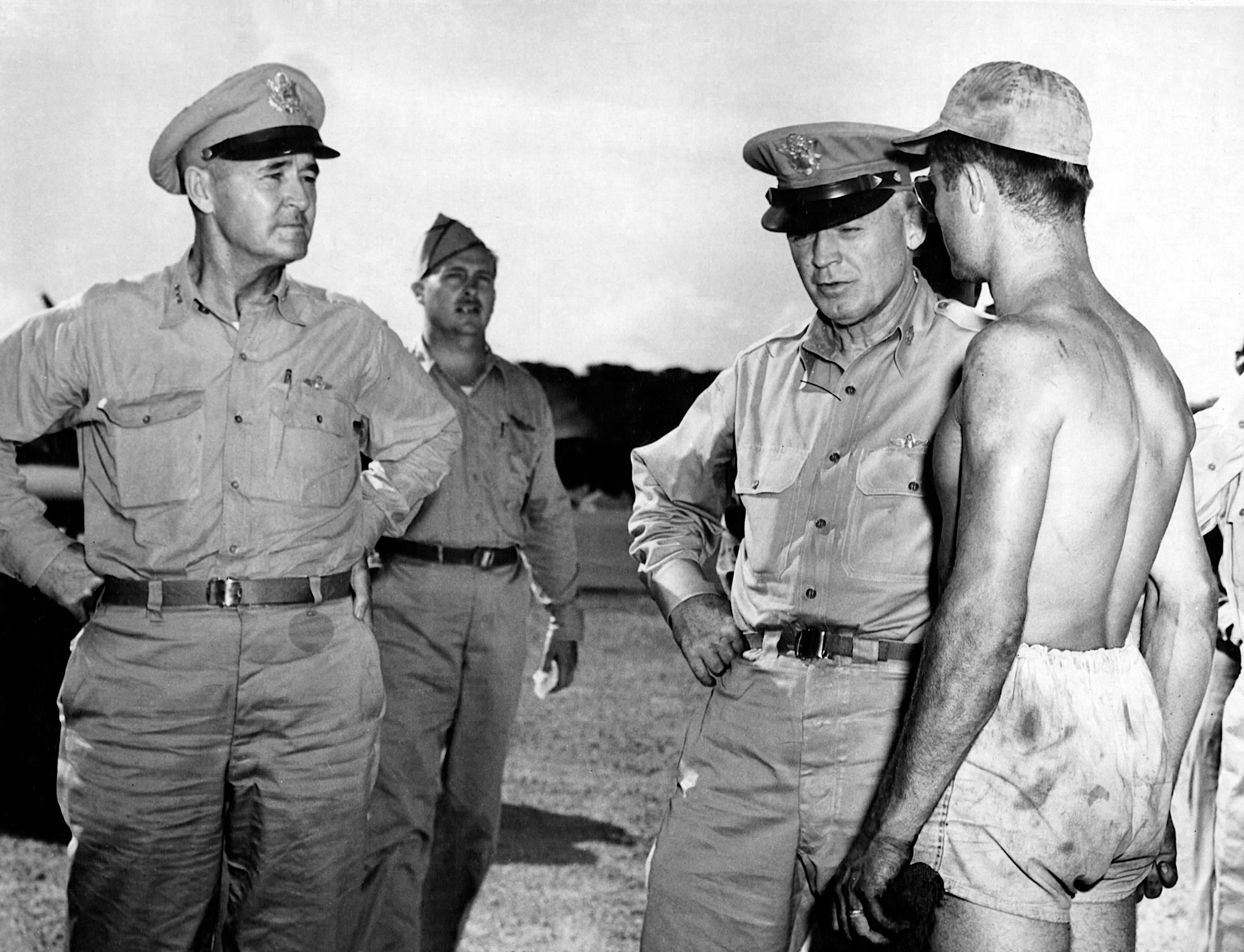
Lt. Gen. Barney M. Giles (left) sent a letter to Edward Mulqueen thanking him for donating a knife to the war effort. Here, he and Gen. Henry H. "Hap" Arnold speak with S/Sgt. Leo Fliess of Sturtevant, Wis., on Guam in 1945. (Army Air Force Photo)
Gen. Barney M. Giles (left) sent a letter to Edward Mulqueen thanking him for donating a knife to the war effort. Here, he and Gen. Henry H. “Hap” Arnold speak with S/Sgt. Leo Fliess of Sturtevant, Wis., on Guam in 1945. (Army Air Force Photo)

Giles was not just some Army bureaucrat. He was commanding general of the U.S. Army Air Force in the Pacific, who later became deputy commander of the entire U.S. Army Air Force. Giles worked alongside legendary war heroes, including Adm. Chester Nimitz, Lt. Gen. James Doolittle  and Gen. Henry H. “Hap” Arnold. He closed his letter to Mulqueen this way: “This much I know. With your gift goes another weapon that will certainly do much to help our boys slap the Japs into a complete and lasting tailspin.”

The next letter, from a U.S. Army Air Force officer in February 1943, was especially meaningful to Eddie. “He wished he had a hundred, yes even a thousand knives to donate,” read an article in the Cudahy Reminder/Enterprise. “His knife was seeing action and was being useful to one of our service men fighting in the Pacific.”

U.S. Army Air Force Cpl. Lucas R. Boyson wrote to thank Eddie Mulqueen for the donated knife in February 1943.

Stationed in the Fiji Islands, Cpl. Lucas R. Boyson was glad to receive the knife sent all the way from Wisconsin. Boyson, 29, was even more impressed that an elementary school student was behind the donation. “I was fortunate to receive your knife and to say it was a treat would be to put it mildly,” Boyson wrote in a letter to Mulqueen on February 14, 1943. “It is grand to cut stalks of sugar cane or bamboo sticks and for that matter general miscellaneous uses. I shall carry it with me always and each time I use it, I’ll whisper a ‘thanks to Eddie.’ ”

A married enlistee from Elyria, Ohio, Boyson was serving with the 375th Air Base Squadron, part of the U.S. Army air corps. He was among the first wave of men from Lorain County, Ohio to volunteer for service in January 1941. He wrote to Eddie that the natives on the islands were impressed with the knife, compared with the “hand-pounded, crude machetes they carry with them in the jungles.”

We don’t know if Boyson ever used the knife in combat, but we do know he survived the war and returned to Ohio, where he lived an exemplary life of faith and public service. On February 28, 1946, Lucas and Wilhelmina Boyson welcomed a baby daughter, Mina. Lucas was an attorney who became actively involved with his American Legion post, St. Jude Catholic Church and a variety of civic groups and causes. At one time he headed the Lorain County Bar Association. He was also a Fourth Degree member of the Knights of Columbus, a group with a special focus on patriotism. Boyson died on December 5, 1992 at age 78.

Inspired by the wartime service of three brothers and one sister, Eddie joined the U.S. Navy and served during the Korean War. After the war, he got married and started a job at Wisconsin Electric Power Co. He was an electrician for many years. Eddie and his wife Marie had three children. The couple later moved to Michigan, where Eddie died in August 1991 at age 60.

©2014 The Hanneman Archive

‘You Buy the Bonds and the Mulqueens Will Win the War’

It was just the kind of wartime story that made an emotional impact on Milwaukee and the state of Wisconsin. Three Irish brothers serving in World War II appeared together to promote the sale of war bonds at a series of rallies in November 1944. Two were home on leave from the front and one was about to embark on his first overseas tour of duty.

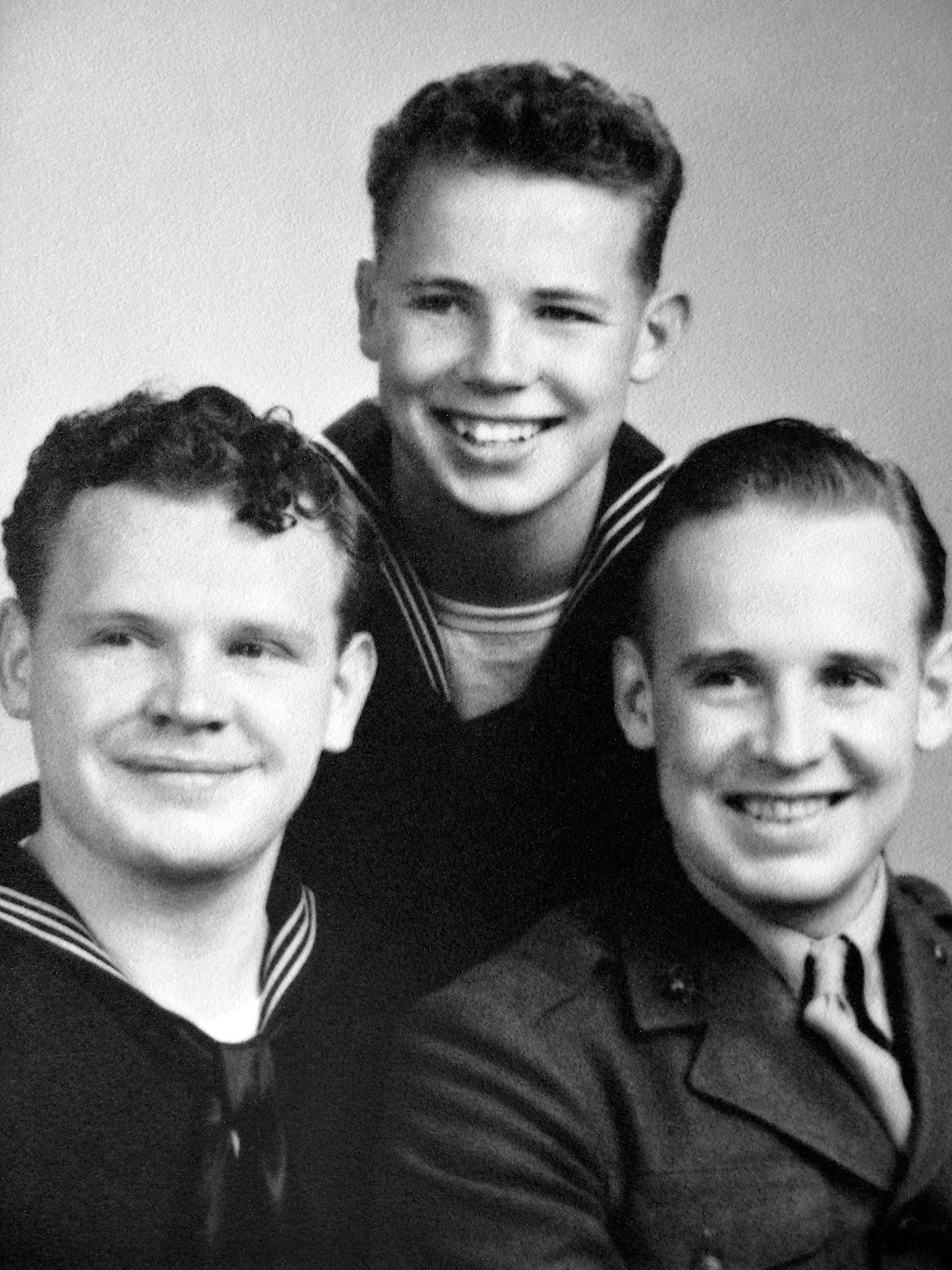
There they stood on stage, the baby-faced Thomas “Tinker” Mulqueen still in naval training, the serious Marine Cpl. Earl J. Mulqueen Jr., on crutches due to the loss of his left leg above the knee, and the curly-haired redhead, Patrick J. Mulqueen, home from more than 18 months at sea with the U.S. Navy.

The Milwaukee Journal carried a front-page story on the Mulqueen brothers and the war bond drive in November 1944.

“Maybe it is because they are Irish, or maybe it is because they look so much like little boys—or maybe it is because everyone at one time or another, lost his heart to an Irish grin,” wrote The Milwaukee Journal in a front-page story on November 10, 1944. “But no matter what the reason, more and more persons every day are agreeing that the Mulqueen brothers, Tommy, Earl and Patrick, are among the greatest things which ever happened to Milwaukee.”

The impact the boys had was most evident at a bond rally at Schuster’s Department Store on Milwaukee’s North 3rd Street. The event got off to a slow start. Ben Barkin, head of the local war finance committee (later a legendary Milwaukee PR man and founder of the Great Circus Parade) was worried. That all changed when the Mulqueen boys took to the stage. “They are so cute,” one woman said. “They look like little boys playing soldier.”

Three Mulqueen brothers appear at a Milwaukee war bond drive in November 1944. Left to right are Michael Thomas Mulqueen, Earl James Mulqueen Jr. and Patrick Joseph Mulqueen. Behind the group is war bond chairman Ben Barkin.
Three Mulqueen brothers appear at a Milwaukee war bond rally in November 1944. Left to right are Michael Thomas Mulqueen, Earl James Mulqueen Jr. and Patrick Joseph Mulqueen. Behind the group is war bond chairman Ben Barkin.

Now the crowd was interested. Barkin introduced the lads. The 17-year-old Tommy was first to step forward and said simply, “You buy the bonds and the Mulqueens will win the war.” Considering he had yet to set foot in a combat zone, such as statement could have been viewed as a “wisecrack by a fresh kid,” The Journal wrote. But it wasn’t. “When Tommy said it, you knew he was telling the solemn truth,” the paper wrote. (Tinker went on to serve as a sailor on the fleet oiler USS Mattaponi.)

Earl talked about the war. At 21, he had seen more fierce combat than most would ever see. He fought at Guadalcanal and Tarawa with the 2nd Marine Division. Those were two of the bloodiest, deadliest battles of the entire Pacific war. Earl was a mortar crewman, so he was right at the front.

This hazy snapshot from the Pacific shows U.S. Marine Cpl. Earl J. Mulqueen Jr. next to the mortar he took into combat during World War II.

Earl was helping prepare an invasion fleet for the 1944 assault on the Mariana Islands when his landing ship-tank (LST) blew up at Pearl Harbor. The massive chain explosion caused the loss of many ships and resulted in hundreds of casualties. Because of the preparations underway for the invasion of Saipan, the Pearl Harbor disaster was a classified secret until the 1960s. So Earl was only able to say that he “almost made it to Saipan.” (Details of Earl’s war service and loss of his leg in the West Loch disaster will be the focus of a future Archive story.) 

U.S. Marines storm Tarawa, Gilbert Islands, November 1943. (National Archives Photo)

Patrick spoke of his experience as a fireman aboard the light cruiser USS Concord (CL-10). He enlisted on August 7, 1942 and by March 1943 was among the compliment of 700 aboard the Concord. The ship escorted reinforcement convoys in the southern Pacific, and prowled the dangerous, icy waters of the north Pacific. The Concord was involved in numerous bombardments of the Kurile Islands. During 1943, the Concord was on a surveying mission of the South Pacific with retired Rear Admiral Richard E. Byrd, the famous explorer. The ship visited Tahiti, Bora Bora and the Easter Islands. A huge explosion onboard on October 7, 1943 took the lives of 22 crewmen. Caused by ignition of gasoline fumes at the rear of the ship, the explosion threw some men overboard, while others were killed from concussion, burns, fractured skulls and broken necks. On October 8, those men were buried at sea. After participating in bond rallies in Milwaukee, Patrick was assigned duty on the USS Crockett (APA148), a Haskell class amphibious attack transport. The USS Crockett had just been commissioned on November 28, 1944.

The crowd at Schuster’s quickly figured out that these “boys” had seen and experienced the horror of war. “It was simple and short,” The Journal wrote. “No frills. No hero stuff, no dramatics—nothing but a couple of kids, one on crutches, asking people to buy and sell bonds.” The stories of the Mulqueen boys had the desired effect. Barkin exclaimed, “You know, the bond drive is going to come out all right.” He was right, for the Schuster’s bond drive raised more than $500,000.

The Mulqueen brothers even appeared at war bond rallies with their mother, Margaret Mulqueen, who was active in the Marine Corps League.

Schuster’s was just one of many venues at which the Mulqueen boys spoke. At some rallies, they were joined by their mother, Margaret “Madge” Mulqueen, who was deeply involved with the war effort through the Wisconsin chapter of the Marine Corps League. She had four blue stars displayed in the window of the Mulqueen home at 3854 E. Cudahy Avenue in Cudahy — one for each of the three boys and one for her daughter Margaret, a Navy nurse based in San Diego.

The bond drives were a crucial part of the home-front effort in World War II. Across the nation, eight war-bond drives between 1942 and 1945 raised more than $190 billion. Investors purchased $25 bonds for $18.25. Bonds were redeemable after 10 years. Companies sponsored in-house bond rallies, and employees pledged purchases through payroll deduction. Children were encouraged to buy 25-cent war stamps to save up for their own war bond. Special sections of local newspapers were dedicated to promoting bond sales. On the radio, popular programs such as Fibber McGee and Molly dedicated entire episodes to war bonds and other home-front efforts.

Sgt. Louis C. Koth (left) and Marine Cpl. Earl J. Mulqueen Jr. are introduced at the Oshkosh B'Gosh Inc. bond rally on November 30, 1944.
Sgt. Louis C. Koth (left) and Marine Cpl. Earl J. Mulqueen Jr. are introduced by company president Earl W. Wyman at the Oshkosh B’Gosh Inc. bond rally on November 30, 1944.

Earl Mulqueen and Army T/Sgt. Louis C. Koth appeared at such a corporate event at Oshkosh B’Gosh Inc. on November 30, 1944. They were introduced by company president Earl W. Wyman. Koth was a radio operator aboard a U.S. Army Air Force B-17 bomber that was shot down during a mission over Schweinfurt, Germany. Koth was on his third mission in a B-17 Stratofortress when he was forced to parachute into enemy territory. Taken prisoner and repatriated 11 months later, Koth lost his right arm. Koth began participating in the bond tours shortly after being released from a hospital in Madison in the fall of 1944.

Koth and Earl Mulqueen toured Oshkosh Motor Truck Inc. and Universal Motor Co. Later they were interviewed live on radio station WOSH by local bond chairman Richard J. White. “Both of these boys are giving freely of their time to help the sixth war loan campaign,” White said. “They have made sacrifices beyond any that we are being asked to make, and although they will not see action again, they are both anxious to do whatever they possibly can to see that ammunition does not have to be rationed at the front.”

The bond rallies helped explain the costs of supplying the troops. Toothbrushes cost 8 cents each. A hand grenade was $1.56. An anti-tank shell cost nearly $3. A Garand rifle was $55. A 1,000-pound bomb cost $250, while a 75-mm Howitzer cost $11,350. A PT boat cost the military $145,000, while a 1,630-ton destroyer had a price tag of $10 million. A fully outfitted battleship cost $97 million. Bond drives supplied the U.S. government with needed cash, while giving ordinary citizens a concrete way to participate in the war effort.

Ads like this one from First Wisconsin promoted sale of war bonds during World War II.

Largely due to Barkin’s tireless efforts, Milwaukee’s World War II war-bond drives became a model for the nation. Described by The Milwaukee Journal as an “ace ward bond salesman,” Barkin was honored as Milwaukee’s man of the year in 1945 by the Milwaukee Junior Chamber of Commerce. For his $1 annual salary, Barkin popped up just about everywhere in Milwaukee: schools, churches, civic clubs and businesses. The 28-year-old was unable to enlist due to a disability, so he threw his energy into raising money for the war effort. Doctors told him to slow down, but the pitchman didn’t listen. He gave more than 1,000 speeches each year as head of the community division of the war finance committee.

“Let’s show Milwaukee what their money is buying,” Barkin said in 1943. He organized a “Wings for Victory” parade of tanks, jeeps, artillery and other hardware to do just that. Funds from the rally after the parade were used to buy military transport planes for Mitchell Field. Barkin convinced Milwaukee to rename Wisconsin Avenue “War Bonds Drive” for the duration of World War II, a practice later adopted in dozens of other cities. He understood the importance of having soldiers, sailors, airmen and Marines tell their stories. The results were often heart-rending. He told the story of a Milwaukee woman who stood in line for two hours to buy a war bond for her boy, serving in North Africa. Her husband had just died two days prior. “Doggone it,” Barkin told Walter Monfried of The Milwaukee Journal, “that kinds of gets you, doesn’t it?”

Three Mulqueen brothers served in World War II: Patrick (left), Thomas (center) and Earl.

So Barkin knew when the Mulqueen boys stepped on stage, the people would dig deeply into their pockets to support the war. “No matter what the mood of the meeting before the kids talk,” The Journal wrote, “when they finish, that meeting is sure of going over the top.

“Everyone who has heard the Mulqueen brothers agrees,” the paper wrote, “that the kids are among the best in the world.”

[This post has been updated with more details on the Oshkosh bond drive on November 30, 1944]
©2014 The Hanneman Archive

When a Movie was More Than Just a Movie

When was the last time your visit to the Cineplex included live entertainment? (The bratty 5-year-old in front of you throwing popcorn at his brother does not count.) The movie theater was once about much more than movies, and the price of admission included live performances, newsreels, comedy shorts and more. For years our own Ruby V. Hanneman was a featured performer at some of Wisconsin Rapids finest cinemas, and her name appeared in ads right alongside Silent Era stars of the day like Neal Hart, Ricardo Cortez, Doris Kenyon and Jack Holt.

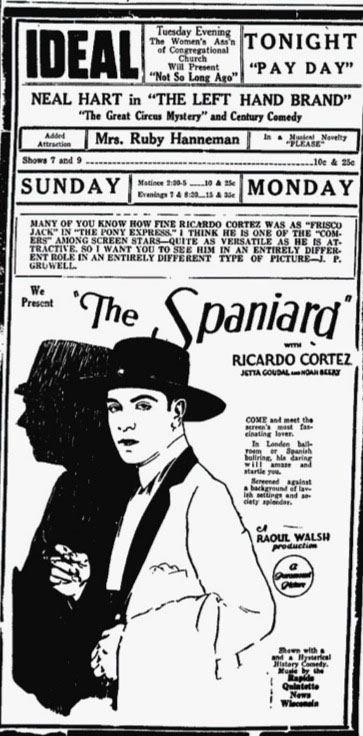
Ruby Treutel Hanneman was the musical attraction during the showing of The Spaniard.
Ruby Treutel Hanneman was the musical attraction during the showing of The Spaniard in October 1925.

Ruby often appeared at the Ideal Theatre at 220 E. Grand Ave., Wisconsin Rapids. She sang a “musical novelty” at two shows on Halloween night 1925. The main attraction was The Thundering Herd, a movie based on the 1925 novel by Zane Grey. (Zane Grey happened to be a favorite author of Carl F. Hanneman and his son David, but we digress.) Seats that night were just 10 cents or 25 cents, half off the typical ticket prices.

On Thanksgiving 1925, Ruby sang for the audience at Paramount Pictures In the Name of Love, starring Ricardo Cortez and Greta Nissen. Ruby sang two numbers, “Lonesome, That’s All,” and “In the Garden of Tomorrow.” The 15 cent and 35 cent admission also included the Wisconsin Rapids Quintette, newsreels and a Will Rogers comedy.

Ruby Treutel sang as a prologue to The Dressmaker from Paris.

Ruby got perhaps her most prominent billing for the October 17, 1925 showing of The Spaniard. Her name was most prominent in the ad in the Wisconsin Rapids Daily Tribune. “Added Attraction, Mrs. Ruby Hanneman in a Musical Novelty, Pleasethe ad read. On Aug. 25, 1925 she appeared at the New Palace Theater singing, “I Wonder What’s Become of Sally.” The feature film that night was Born Rich starring Bert Lytell and Claire Windsor.

Ruby V. Treutel dressed for her lead role in the musical 'Sylvia' in 1922.
Ruby V. Treutel dressed for her lead role in the operetta ‘Sylvia’ in 1922.

By the time she starred at the New Palace and the Ideal, Ruby was a veteran singer. According to the April 4, 1921 edition of the Daily Tribune, Ruby Treutel “brought down the applause of the house time after time” for her performance in the play “The Fire Prince” at Daly’s Theater. Ruby was 17 at the time.

Now known as Mrs. Carl Hanneman, Ruby sang before the showing of Zane Grey's "The Thundering Herd."
Now known as Mrs. Carl Hanneman, Ruby sang before the showing of Zane Grey’s “The Thundering Herd.”

When she graduated from Lincoln High School in Wisconsin Rapids in 1922, Ruby had years of experience in music and drama. She played the female lead in the operetta Sylvia during her senior year. She was also president of the Glee Club. Under her senior class portrait in the yearbook The Ahdawagam read the motto, “Music hath charms and so does she.”

©2014 The Hanneman Archive

Cemeteries Offer Great Lessons in History

As any serious genealogist will tell you, a visit to a cemetery can provide a wealth of family history information. But it can be much more than that. Each year as we approach All Souls Day (November 2), the season presents an opportunity to renew and maintain family connections, just by walking through a cemetery.

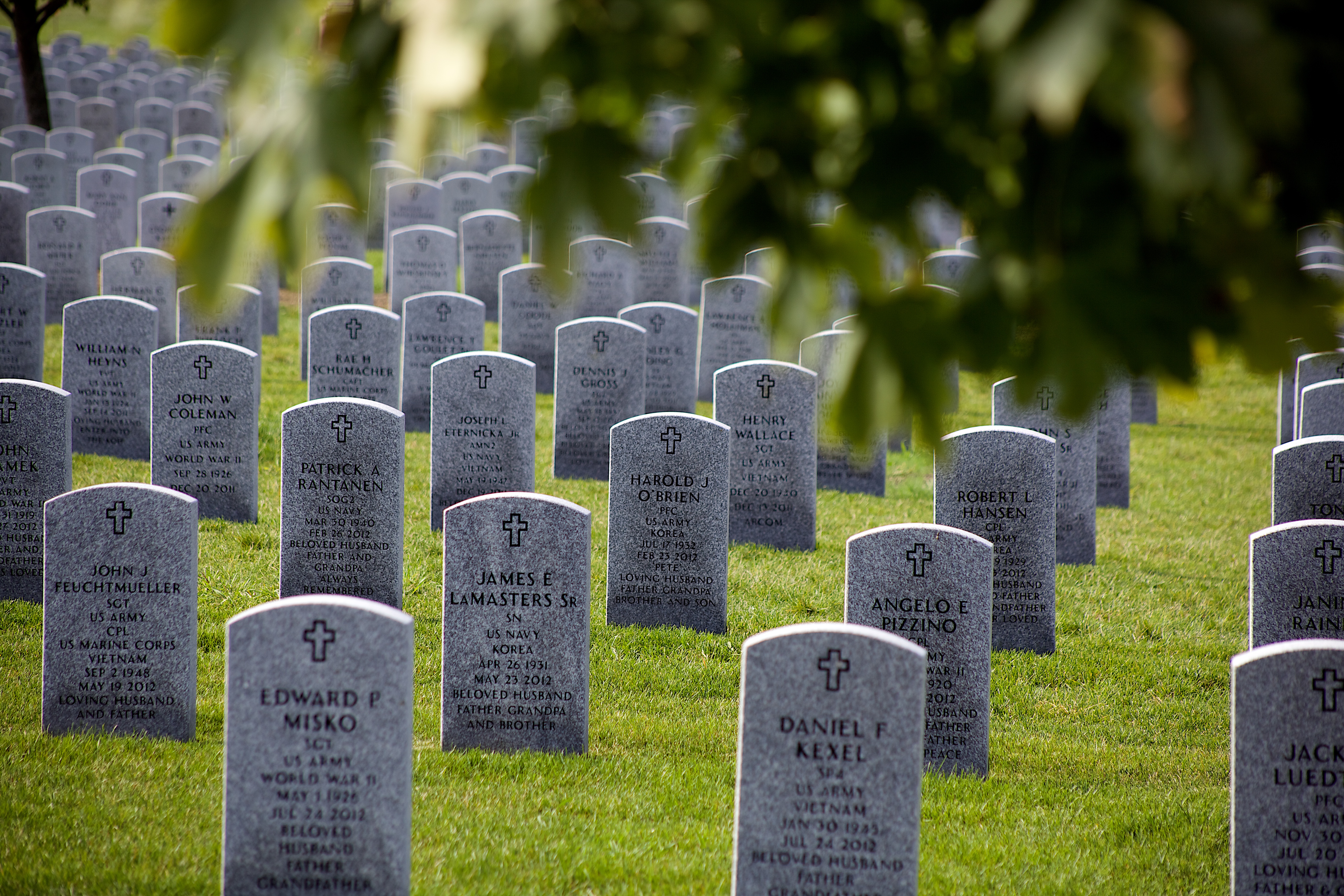
Southeastern Wisconsin Veterans Memorial Cemetery in Union Grove, Wisconsin.
Southern Wisconsin Veterans Memorial Cemetery in Union Grove, Wisconsin.

One of the most touching scenes I’ve encountered was at a small cemetery in Augsburg, Germany. Walking past after dark, I looked through the small gate to see dozens of flickering vigil candles. These were not solar lights but real candles. Someone cared enough to visit there each night and light the votives.

A 20-minute walk through any cemetery will provide you access to family stories. Parents who lived long, full lives. Others who died much too young. Babies, some just one day old. Some who were never born. John and Jane Does, victims of murder. And in many older cemeteries, some of the departed rest with no visible monuments. Their markers were damaged or swallowed up in soft ground or by encroaching woods.

This anchor-themed monument is at St. Mary's Catholic Cemetery in Portage, Wisconsin.
This anchor-themed monument is at St. Mary’s Catholic Cemetery in Portage, Wisconsin.

Observe the different monuments. Some are massive obelisks, others plain, square markers. A few are made from unusual materials. Some display incredible artistry. In many German cemeteries you will see monuments with engraved hands pointing to Heaven. Angels, crosses and even anchors are common subject of monument carvings.

Oak Grove Cemetery in Eagle, Wisconsin, is itself a monument to neglect.

Some cemeteries are known more for their infamy, such as Oak Grove Cemetery in Eagle, Wisconsin. We chronicled that story earlier in “A Sad Resting Place for Little Ida.” It is sad to see a cemetery fall into neglect and disrepair. It’s especially angering when a cemetery is targeted by vandals. A few years back, thugs toppled more than 100 monuments at Calvary Cemetery and Old Holy Cross Cemetery in Racine, Wisconsin. My Knights of Columbus council spent several weekends righting the monuments and making extensive repairs. Most of the damage was fixed, but some especially old stones were beyond repair.

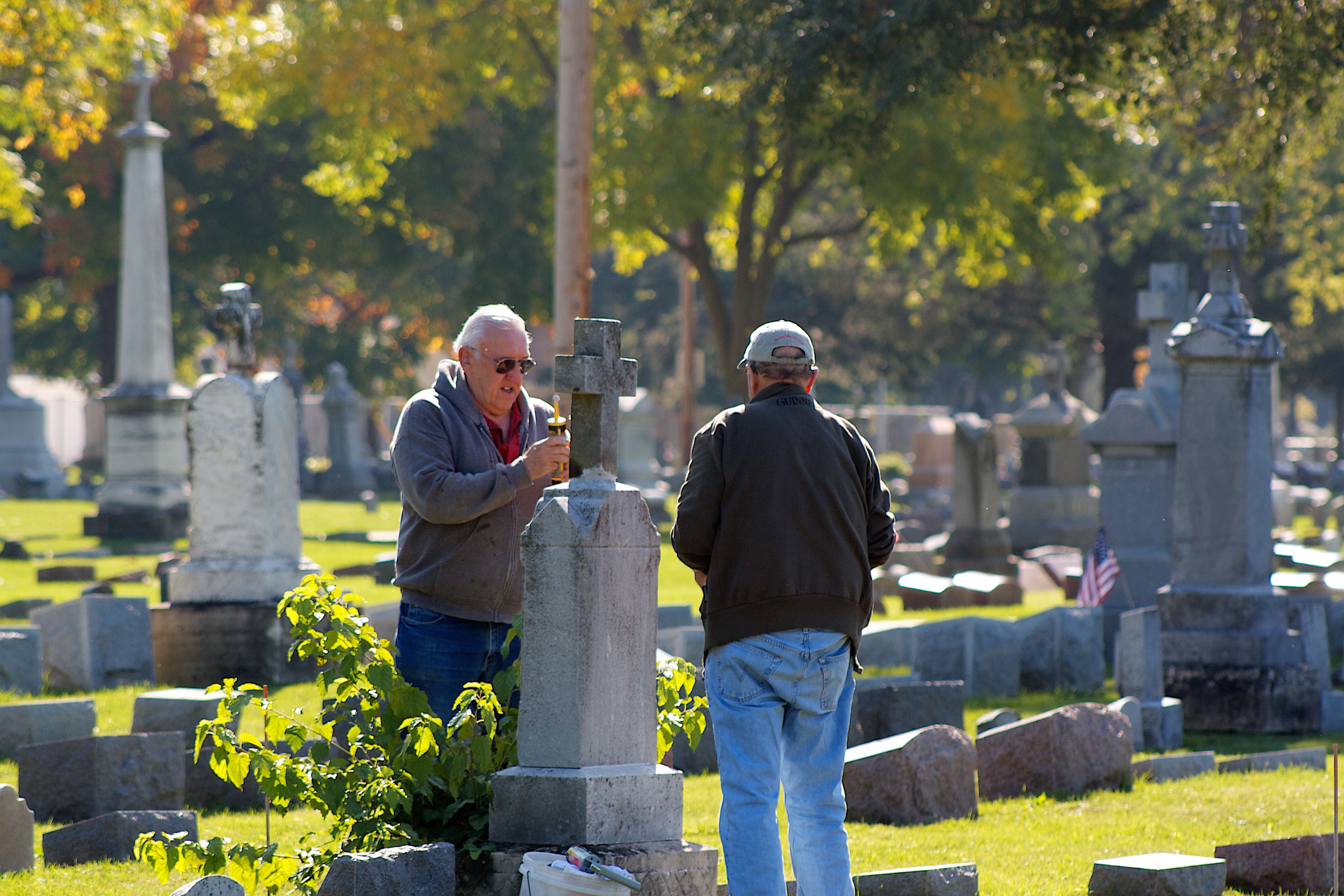
John Clark and John Murphy of the Knights of Columbus repair vandalized monuments in Racine, Wisconsin.

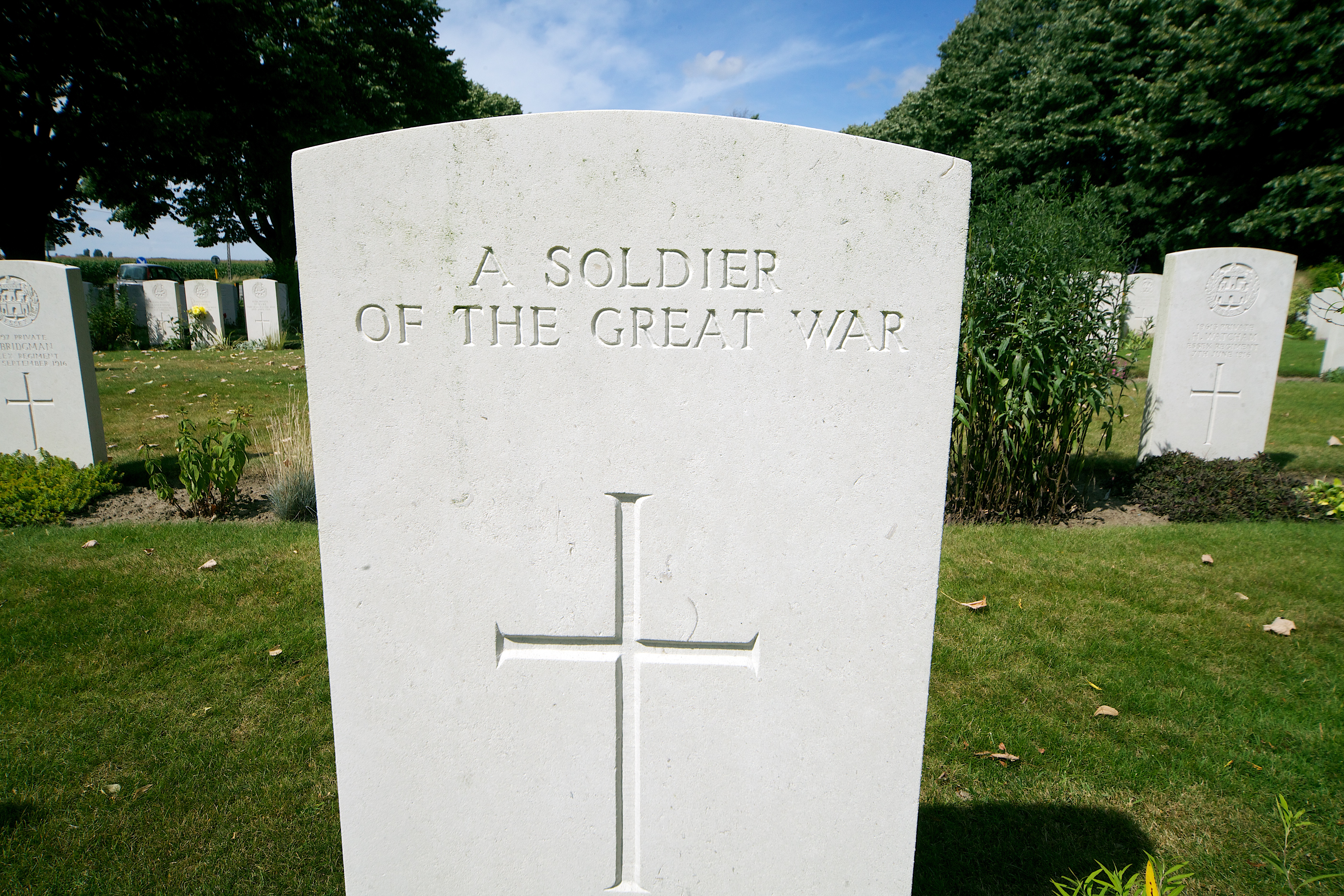
Military cemeteries and the graves of soldiers are especially touching. I recall walking row after row of World War I grave markers in Ypres, Belgium, where the famous poem In Flanders Fields was composed in 1915. All of those young lives cut short by “the war to end all wars.” Such sacrifice. World War I cemeteries dot the landscape in Belgium; some in the middle of farm fields.

Grave of an unknown soldier near Ypres, Belgium.

While our loved ones are gone, they can teach us still. There are great resources available to help you find where your relatives are buried. My favorite online database is the Find A Grave web site. Take a camera along on your next trip to the cemetery and help your fellow genealogists document history.

©2014 The Hanneman Archive

A Look Back at Two Generations of Halloween

I have nothing but good memories of Halloween. Growing up in the late 1960s and early 1970s, October 31 was a date we looked forward to. Whether we got to buy a costume at the dime store or made our own, it was always an exciting night.

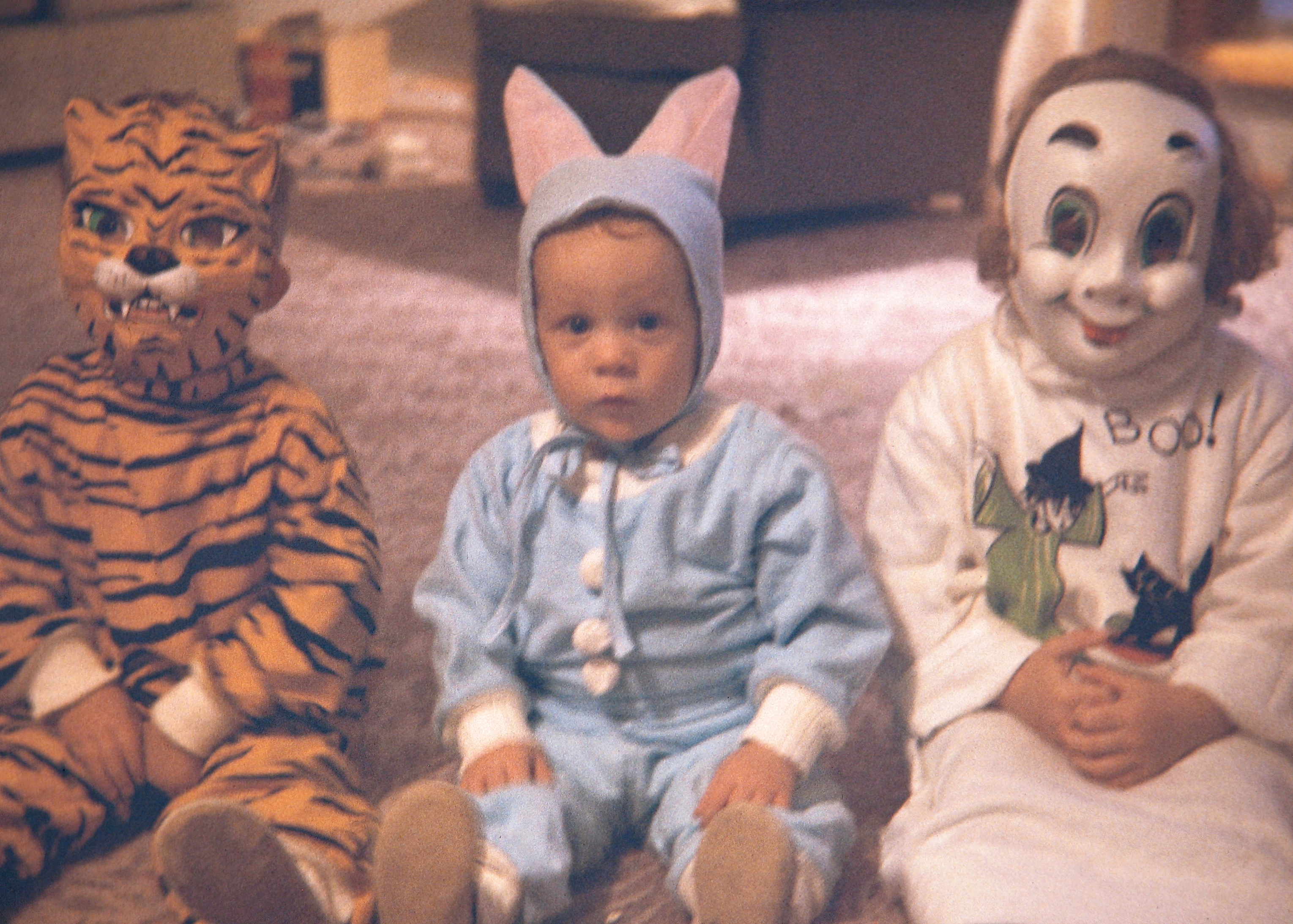
My brother David (left), yours truly at center at cousin Laura all set for Halloween at our home in Grand Rapids, Mich., circa 1964.

One of my most vivid Halloween memories was documented in my book, The Journey Home. I recall Dad tearing out the front door in his sock feet. I wondered what was happening. We figured it out a few minutes later when he dragged two teenagers into the front door and made them apologize for smashing our lit pumpkins. He then turned them over to Sun Prairie police.

We had one sad Halloween when my brother David fell into the neighbors tree well and spilled all of his candy. We all shared to make up for it. Another year, we went across town to “trick or treat” at a few houses of family friends. At one door, I was shocked that the lady who answered called me by name. “How does she know me with this costume on?” I wondered. My brother chimed in, “You forgot to put your mask down.” D’oh!

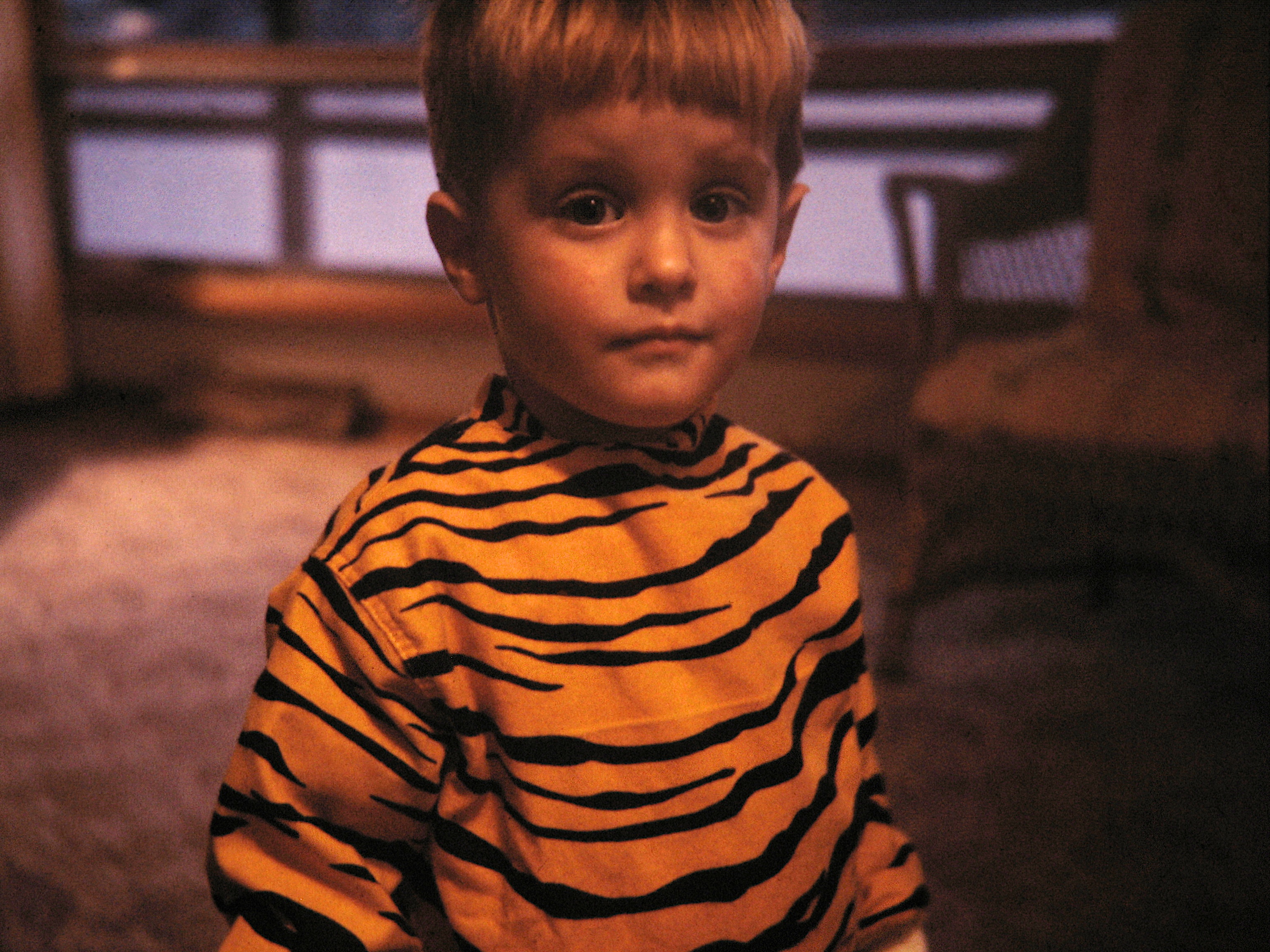
David C. Hanneman was a tiger for Halloween 1964.

Perhaps the most fun we had was creating our own costumes. Lighting the end of a cork on fire, then using the charred remains to paint black whiskers on our faces. Stuffing pillows up an oversized shirt helped complete the hobo look.

It wasn’t until toward the end of my trick-or-treating days that the scare over supposed razor blades in candy apples occurred. Hospitals offered to X-ray candy bags to check for pins or razor blades. That made me wonder if the candy would then glow? Ah, as it turned out the whole thing was a fraud that took on the sheen of urban legend.

Son Stevie watches Grandpa Dave Hanneman prepare to carve, circa 1993.

Once I had my own children, Halloween took on a new dimension. Our firstborn was too shy to go door to door, so we made our main stop at Grandma and Grandpa’s house. Eventually, Halloween became a major event. French onion soup or chili simmered in a crock pot while we took the kids around the neighborhood collecting goodies. Then we retreated into the warmth of the house for good food, warm apple cider and pie. The kids also ate candy.

With the more recent controversies claiming Halloween as un-Christian or even satanic, it was refreshing to read this article on About.com regarding the Catholic roots of Halloween.

©2014 The Hanneman Archive


Mauston Football Wins Conference Crown in 1947

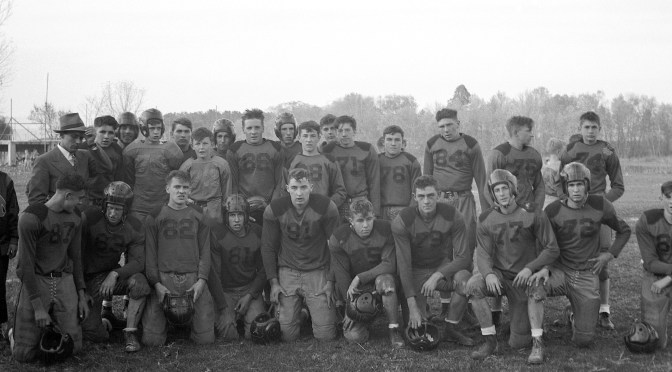
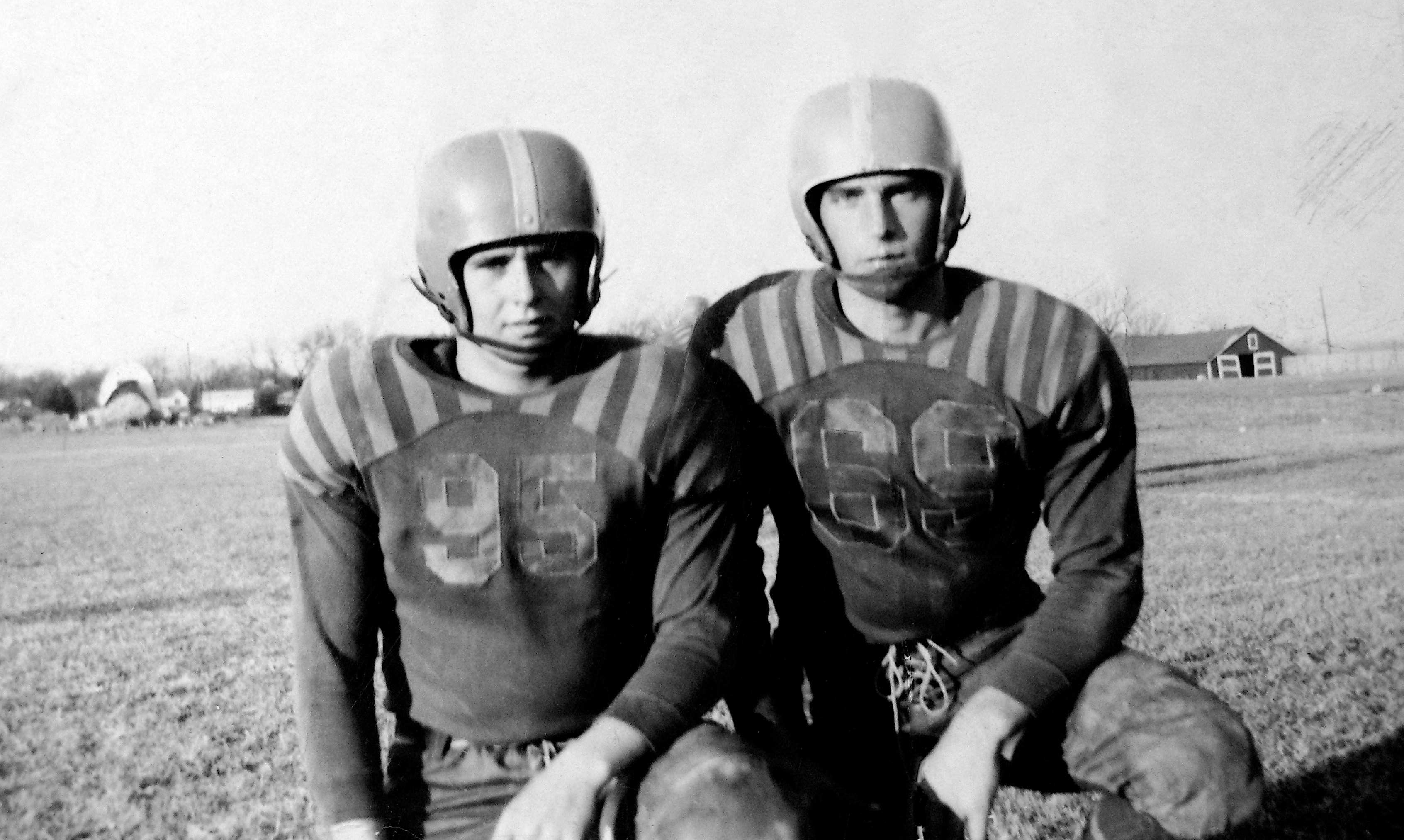
The 1947 football campaign was destined to be one for the ages at Mauston High School. The photo gallery below could be from that championship season, based on the youthful appearance of my Dad, David D. Hanneman (1933-2007). Dad was a starter for the Mauston Bluegold, even in his freshman year.

David D. Hanneman (center) played tackle, guard and on occasion, running back, for Mauston High School during the 1947-50 football seasons.

Dad played guard and tackle throughout his high school football career. But as is the case on small-town football teams, boys play both offense and defense. Many of the players would switch positions, depending on the opponent and game conditions.

Mauston ran up a 7-1 record in the 1947 football campaign, gaining them a share of the West Central Conference championship crown. Mauston was 3-1 in conference play. Midway through the season, Mauston ranked as one of the state’s highest-scoring teams. Here’s the 1947 season recap:

  • Sept. 12  Mauston 12, Reesdburg 0
  • Sept. 19  Mauston 25, Middleton 6
  • Sept. 26, Mauston 20, New Lisbon 12
  • Oct. 3,  Mauston 13, Tomah 0
  • Oct. 10,  Mauston 45, Westby 6
  • Oct. 17  Sparta 14, Mauston 7
  • Oct. 24  Mauston 37, New Lisbon 0
  • Nov. 1  Mauston 13, Viroqua 0
Dave Hanneman (at right) in one of his early years in Mauston football.

Bob “Jigger” Jagoe, who played quarterback for Mauston starting in the 1948 season, recalls how Dave’s mother, Ruby V. Hanneman, was zealous in her cheering.

You could hear her in the stands, shouting. She was so proud. Of course we used to kind of make a mockery of it, because she was so adamant, letting everybody know who her son was out there who made the tackle. They announced, ‘Tackle made by Dave Hanneman’  and she said, ‘That’s my Davey!’

In the 1950s, home football games were played at Veterans Memorial Park on the south end of Mauston. This locale looks much closer to downtown, so I’m betting these 1940s games were played in Riverside Park along the Lemonweir River. In several of the photos you can see the distant spire of St. Patrick’s Catholic Church.

— This post has been updated with quotes and other information.

©2014 The Hanneman Archive

Oscar Treutel Goes Back to School in August 1942

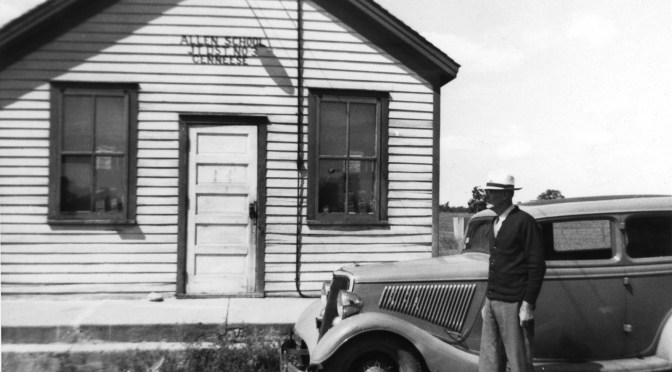
School must have seemed just a bit smaller when Oscar Treutel went back for a visit on August 24, 1942. In the 1880s, Oscar was a student at “Allen School” in Joint District No. 3 in the Town of Genesee in Waukesha County, Wisconsin. Let’s hope Oscar wasn’t returning for a spelling lesson, since the building has Genesee misspelled as “Genneese.” Perhaps the building lettering was a class project.

A young Oscar Treutel, circa 1899, when he was a college student in Waukesha, Wisconsin.

The school was in the southwest corner of the town on the E. Allen property, near the Saylesville Mill Pond. We should distinguish this one-room school from the Ethan Allen School for Boys, a reformatory in nearby Delafield that operated from 1959-2011.

Oscar traveled to school from the Treutel home in nearby North Prairie. He was the fifth child of Philipp and Henrietta Treutel, born Oct. 9, 1874 in Waukesha County. He moved with his family to Vesper in Wood County just after the turn of the century. He spent his sunset years in nearby Arpin. He died in 1967 at age 92.

©2014 The Hanneman Archive