All posts by Joe Hanneman

Investigative reporter, Blaze Media LLC. Father of 3. Tradition-minded Catholic. “Unless there is a Good Friday in your life, there can never be an Easter Sunday.” —Archbishop Fulton J. Sheen

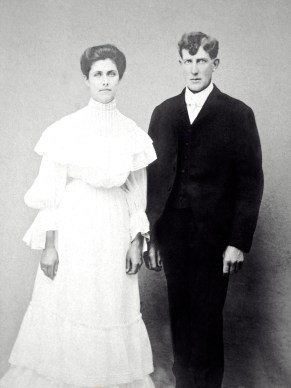
Details from Charles Chase – Elizabeth Mulqueen Marriage License

We’re able to add some details to our Mulqueen family story from the 1894 marriage license of Charles Henry Chase and Bridget Elizabeth Mulqueen. A copy of the document was obtained from the Wisconsin Historical Society.

The couple were married September 4, 1894 at St. Patrick’s Catholic Church in Askeaton, a hamlet in southern Brown County, Wisconsin. The wedding Mass was said by the newly ordained Rev. Gervase J. O’Connell, pastor of St. Patrick’s. Witnesses to the marriage were  James Clancy and Mary Mulqueen, sister of the bride.

Gervase_OConnell
Father Gervase J. O’Connell, rector of St. Patrick’s Catholic Church in Askeaton, Wisconsin (1894).

Charles Henry Chase is described as the son of Horace Chase and Catherine Whalen. He was a resident of Marinette, Wisconsin, at the time of the wedding. His occupation is listed as “farmer, then butcher.” He was born in Bangor, Maine. His residence in Marinette lines up with the long-held belief that his son, Earl J. Mulqueen Sr., was born in the seat of Marinette County. However, the Marinette County Register of Deeds can find no record of Earl’s birth (January 7, 1895) under any surname. The Wisconsin Historical Society’s pre-1907 vital records database does not have any birth record for Earl in any Wisconsin county.

Charles’ birthplace on the marriage record contradicts what is listed on U.S. Census and other documents. Those records said Earl’s father was born in Vermont. A search of U.S. Census and other genealogy databases turned up no documents of a family headed by Horace Chase with wife Catherine and son Charles. Milwaukee once had a mayor named Horace Chase, and there was a man by that name living in Bangor in La Crosse County, Wisconsin. But neither fit the bill of the Horace we’re seeking. So it would seem that each answer we find generates several more in return.

The Mulqueen surname is listed as Micqueen or M’cqueen on the 1894 marriage record. Daniel and Mary (Corcoran) Mulqueen are listed as Elizabeth’s parents. The McQueen and Mulqueen surnames were used interchangeably in newspaper articles, U.S. Census records and church documents. We believe Mulqueen to be the correct Irish usage of the surname. If you go back far enough in Irish history, you will find the Gaelic Ó Maolchaoin, which according to the 1923 book Irish Names and Surnames by Rev. Patrick Woulfe, means “descendant of Maolcaoin (gentle chief).” This version of the name appears to date to before the year 1096. Another very similar Gaelic variant, Ó Maolchaoine, means “servant of St. Caoine.” I’ve not found any Catholic saints by that name, but perhaps there is an English translation that will provide a clue. The Mulqueen clan appears to have originated from an area that includes counties Clare and Limerick in Ireland. I have no memories of my grandpa Earl, but from what my mother has told me, “gentle chief” is a moniker that would fit him well.

Our quest to track down Charles Henry Chase continues. We were always told that both of Earl’s parents died when he was very young. Elizabeth died in March 1897, when Earl was 2. Earl and his sister, Elizabeth, chose to take their mother’s maiden name. Charles had at least one other child, Mary Chase, outside of his marriage to Elizabeth Mulqueen. Our most recent documentary evidence of Mary was in Earl’s September 1965 obituary, which lists his half-sister as living in Pleasant Hill, California.

– To see the complete 1894 marriage license, click here.

Carl Hanneman Pharmacy Papers Donated to Marquette University

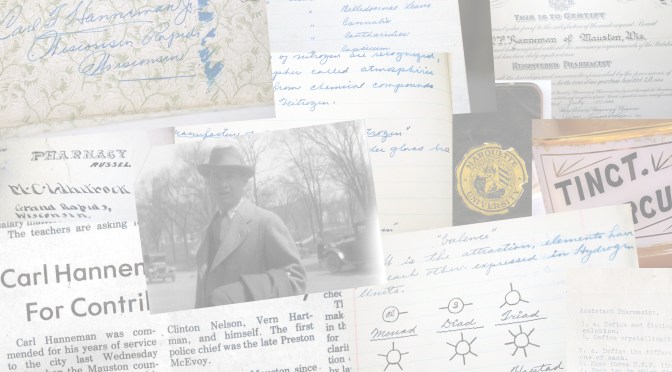
Carl F. Hanneman’s college pharmacy notebooks and study guides from 1924 and 1925 have been donated to the Department of Special Collections and University Archives at Marquette University in Milwaukee. The material was turned over to the university and accession papers signed May 26, 2017.

CarlFHanneman
Carl F. Hanneman

It was a long road for the college pharmacy materials, kept by the senior Hanneman at homes in Wisconsin Rapids, Janesville, Fond du Lac and Mauston. When Carl died in May 1982, the papers went to his youngest son, David D. Hanneman (1933-2007). Now, more than 90 years after they helped Carl become a registered pharmacist, the papers will be preserved by Marquette.

Carl earned his licensure in January 1925 after completing Marquette’s short course in pharmacy. He went on to a pharmacy career that spanned nearly 60 years, much of it behind the counter at the Mauston Drug Store.

ClassNotes2
Carl’s notebooks contained meticulous notes on chemistry and other subjects.

The handwritten notes are unique because Marquette previously had little documentation of its popular short course in pharmacy. The university’s degree program in pharmacy was discontinued during World War I because so many faculty and students left campus to fight overseas. The pharmacy degree program was never restarted, but demand continued for higher education to help students pass that state pharmacy board exams.

In 1923, Marquette began offering a “short course” in pharmacy under the auspices of the College of Dentistry. The courses in chemistry, organic chemistry, pharmacy, pharmacognosy, toxicology and drg identification were rigorous. They were taught by Dr. Hugh C. Russell and Professor Frederick C. Mayer, both former deans of the Marquette College of Pharmacy. The two-semester program was designed for young men and women with pharmacy experience, in preparation to pass the state exams.

Carl_study
Carl Hanneman studies in the mid-1920s.

The books Carl left behind contain hundreds of pages of meticulous notes on chemistry, pharmacy and related subjects. Two of the books have Marquette pennant stickers on the front. Carl’s pocket-size copy of the Guide to the Organic Drugs of the United States Pharmacopœia has a Marquette University seal on the cover. His exam book shows he scored an 82 percent on one test in 1924.

Carl (1901-1982) would no doubt be tickled to know his college work will be preserved in the archives of his alma mater. We think his son David would be rather proud, too.

Read more about Carl F. Hanneman’s Marquette days.

– Listen to David Hanneman’s Remembrances of His Father’s Pharmacy

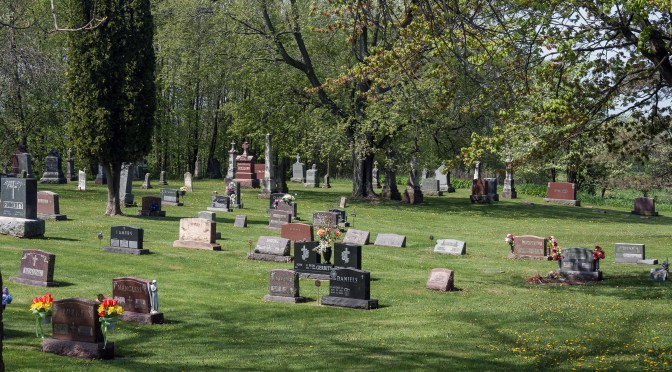
Mystery in Askeaton: Where are the Mulqueens Buried?

It is indeed a sad situation to be buried in an unmarked grave, seemingly forgotten by the world. Worse yet, to have no one document the burial, or have the records lost or destroyed. That is the apparent reality for five members of the Daniel Mulqueen family of Askeaton, Wisconsin. This includes Bridget Elizabeth (Mulqueen) Chase, the mother of Earl J. Mulqueen Sr. (1895-1965).

We know the family patriarch, Daniel, is buried at St. Patrick’s Catholic Cemetery in Askeaton. We also have every reason to believe these five Mulqueens are buried in the same cemetery:

  • Mary (Corcoran) Mulqueen (1827-1913), wife of Daniel
  • Daughter Bridget Elizabeth (Mulqueen) Chase (1866-1897)
  • Son Thomas Mulqueen (1855-1913)
  • Son James Mulqueen (1853-1917)
  • Son Daniel Mulqueen Jr. (1865-1926)

Newspaper obituaries either directly state or strongly suggest these Mulqueens are indeed buried in the parish cemetery. Yet the only monument is for the father, Daniel, who died in March 1893. Worse yet, there are no cemetery records for the four siblings and their mother. A recent site inspection confirmed the situation, and deepened the mystery.

IMG_6138
The St. Patrick’s cemetery map does not include burial information for most of the Daniel Mulqueen family.

Every cemetery has unmarked graves. Sometimes, families did not have funds to create a headstone. Some burials were marked by wooden crosses or other temporary markers that were destroyed by the passage of time. Small footstones could be swallowed by the earth, lying unnoticed just beneath the surface. Records were often nothing more than index cards. Over more than a century, these records could be lost, misfiled or destroyed by fire.

IMG_6072
The monument for Daniel Mulqueen (spelled McQueen on the marker) includes no  information on his wife or children.

The lot maps for St. Patrick’s cemetery clearly show the plot for Daniel Mulqueen, along the western property line in the oldest section of the cemetery. Underneath his name are the names Mary and Mike. Mary is Daniel’s wife. He had a son named Michael, but he is buried in Dickinson County, Michigan. It is clear upon visual inspection that there are burials to the north of Daniel’s monument. Depressions in the ground often indicate very old burials, since pressure from the earth eventually crushes and implodes wooden caskets. Today, burials in Wisconsin require use of a concrete burial vault to prevent this situation.

There is a good chance all of the “missing” graves are immediately to the north of the Daniel Mulqueen marker. The map is blank for that area, so it appears no one else holds a deed for that space. Other, similar size lots on the cemetery map contain as many as eight burials, so there would be room for a family. About 75 feet north of the Mulqueen lot, there is a small metal cross marking burial of an unknown parishioner. This makes it clear there are at least some undocumented burials at St. Patrick’s cemetery.

There are ways to find unmarked burials. Sunken grave markers can by found using a steel earth probe. The same earth probe can indicate unmarked burials, since the earth in the burial location is less compact than surrounding, undisturbed ground. Those methods can be tried on a future cemetery visit. Other methods, including use of ground-penetrating radar, are too expensive to be practical.

We plan to examine the record books for St. Patrick’s Catholic Church, which should include death, funeral and burial information. Those records are most likely held by the Diocese of Green Bay, where we have already filed a request for access.

Mulqueens Major Donors to Build St. Patrick’s in Askeaton

The Mulqueen family that came from Ireland to settle near Askeaton, Wisconsin, donated today’s equivalent of $15,000 to help build St. Patrick’s Catholic Church in 1908. The donation amounts from four Mulqueen family members are etched into a marble monument in the narthex of the church in southern Brown County, Wisconsin.

A recent visit to the tiny hamlet of Askeaton unearthed more details of the Mulqueen family that settled there in the 1850s. These pioneers are the ancestors of Earl J. Mulqueen Sr. (1895-1965), who grew up on his grandparents farm just a couple miles from St. Patrick’s Catholic Church.

Mulqueen_Donors
The names of Mary, James, Daniel and Thomas Mulqueen are etched into the donor monument at the back of St. Patrick’s Catholic Church in Askeaton.

On the southern wall of the narthex of the church is a beautiful marble monument with the roll of donors who put up the funds to build the new St. Patrick’s that was dedicated in 1908. It replaced the previous church structure that had been across the road on land that is now part of the parish cemetery. The family matriarch, Mary (Corcoran) Mulqueen, donated $100, while her sons Daniel Jr., Thomas and James donated a total of $500. The $600 Mulqueen family donation represents at least $15,000 in 2017 dollars. For this hard-working farm family, this was no doubt a major sacrifice. Overall, parishioners raised the 2017 equivalent of $475,000 to build the church.

One thing is clear looking at the monument and examining some of the early church books: the family name was Mulqueen, not the McQueen that appears on headstones in St. Patrick’s Catholic Cemetery across the street. The two surnames seemed to be used almost interchangeably, but the Mulqueen spelling is what appears in church records.

StPatricks_School_Askeaton
The old St. Patrick’s Catholic School on the edge of cemetery property in Askeaton, Wis.

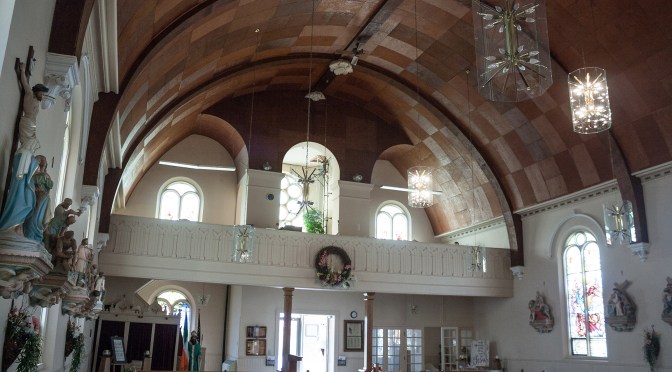
St. Patrick’s is a stunning church with an arched ceiling and a collection of some of the most beautiful stained glass windows you will ever see. The windows depict saints and scenes from the New Testament, including Jesus’ baptism in the Jordan River, the Resurrection, the Blessed Virgin Mary at Lourdes, St. Michael the Archangel, the Sacred Heart of Jesus, a Guardian Angel, St. Patrick and more. Mass is still said here twice a week.

It is very clear looking at the church, the two former school buildings and the well-kept cemetery that the Catholic Church has always been at the heart of life in Askeaton. Even before the Irish immigrants could build the first church in Askeaton, they attended Mass in each other’s homes. Before long, though, they built the original St. Patrick’s Catholic Church and had a full-time resident priest. Earl Mulqueen and his  younger sister Elizabeth no doubt received First Holy Communion and Confirmation in this church.

Audio Memories: Carl Hanneman’s Pharmacy Work in 1930s and 1940s

The essence of wintergreen that wafted out the windows onto Division Street in Mauston, Wisconsin. Bottling and selling hand-crafted mosquito repellent at taverns and resorts across northern Wisconsin. Filling pills behind the pharmacy counter as a child. In this installment of audio memories, Dave Hanneman (1933-2007) remembers the work of his pharmacist father, Carl F. Hanneman (1901-1982). This interview was recorded in mid-November 2006 at St. Mary’s Hospital in Madison, Wisconsin.

Elizabeth McQueen Chase was a Victim of Typhus in March 1897

Bridget Elizabeth (McQueen) Chase, the mother of Earl J. Mulqueen Sr. (1895-1965), died of typhus on March 12, 1897, just two weeks after giving birth to her daughter Elizabeth. That fact is revealed in a death certificate just received from the Wisconsin Historical Society in Madison.

The death certificate says Elizabeth was just 20, much younger than the age listed in her newspaper obituary. That is most likely an error, as the 1870 U.S. Census puts her birthdate at about 1866. That means she died at about age 31. Two weeks prior to her death, on February 26, 1897, she gave birth to daughter Elizabeth in Green Bay. Earl was just over 2 years old when his mother died.

Typhus is a bacterial disease characterized by a rash, fever, cough, headaches, rapid breathing and confusion. Before the widespread availability of antibiotics such as doxycycline, typhus was often fatal. The disease has several forms, although the most common form was spread by body lice. It is different than typhoid fever.

The Brown County death certificate helps shed a little more light on Elizabeth’s story. Until recently, we had no idea who Earl’s mother was. Earl was raised on his grandparents’ farm near Askeaton, Wisconsin after the death of both parents. He took his mother’s maiden name. His father, Charles Henry Chase, is still largely a mystery — one we hope to solve with help of Charles and Elizabeth’s marriage certificate. The couple were married on September 4, 1894, about four months before Earl’s birth. Earl was said to be born in Marinette, while his sister Elizabeth was born in Green Bay. The young Chase family was living in Green Bay at the time of Bridget Elizabeth’s death.

Dan Mulqueen Dies Combo
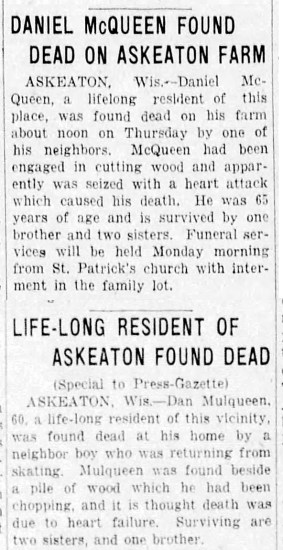
Newspaper obituaries state the burial location for Daniel Mulqueen Jr. as St. Patrick’s in Askeaton.

While progress has been made, the mysteries keep piling up. St. Patrick’s Catholic Cemetery in Askeaton has no record of Bridget Elizabeth McQueen Chase’s 1897 burial. Her newspaper obituary clearly states her funeral was at St. Patrick’s church. No burial records seem to exist for four other members of the Askeaton McQueen family, including Mary (Corcoran) McQueen (1827-1913), Thomas McQueen (1855-1913), James McQueen (1853-unknown) and Daniel McQueen Jr. (1865-1926). Newspaper obituaries for most of those individuals state that the funerals and/or burials were at St. Patrick’s in Askeaton. A planned visit to the cemetery could clear things up, but right now there does not appear to be a paper trail for those burials.

We do know the burial locations of the other two children of Daniel and Mary McQueen / Mulqueen. Michael McQueen (1860-1947) is buried in Norway, Dickinson County, Michigan. He lived much of his adult life in Vulcan, Michigan. Mary (McQueen) McCaughey (1868-1945) is buried with her husband in Huron County, Ontario, Canada.

Key questions that still need answers regarding Earl and his ancestors:

  • What became of Earl’s father, Charles H. Chase? The 1898 Green Bay city directory lists a Charles Chase as a chef at Hotel Christie, but it’s not clear if this is the same man. The only death records for a Charles Chase for this time period are for a much older, already married man who farmed in Greenleaf, not far from Askeaton. That man died in 1905 at age 65.
  • Who were Charles Chase’s ancestors and what was their heritage?
  • Where is Earl’s birth certificate? No record seems to exist under the Chase or Mulqueen/McQueen names in Marinette or Brown counties. In fact, there is no birth certificate for him in state records at all.
  • Did Earl’s maternal grandparents, Daniel and Mary Mulqueen, come from County Limerick, Ireland, as did most of the settlers of Askeaton, Wisconsin?
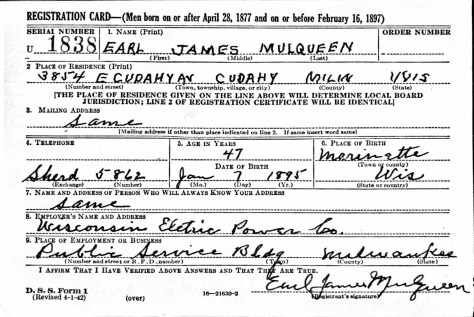
US, World War II Draft Registration Cards, 1942 - Earl James Mulqueen
The World War II draft card, along with other documents, for Earl J. Mulqueen Sr. list his place of birth as Marinette, Wisconsin. So far, no birth certificate has been found for him under the Chase, McQueen or Mulqueen surnames.

Audio Memories: Great Depression and World War II in Cudahy

Growing up in an Irish family of 11 children during the Great Depression and World War II left Mary K. (Mulqueen) Hanneman with vivid memories. The seventh child born to Earl James Mulqueen Sr. (1895-1965) and Margaret Madonna (Dailey) Mulqueen (1895-1982), she has tender memories of her parents and life in Cudahy, a southern suburb of Milwaukee.

In April 2009, she sat down for an oral history interview with granddaughter Ruby Hanneman, 9, and son Joe Hanneman. The discussion covered subjects like how the big family made ends meet during the Great Depression, how having four siblings serving in World War II changed family life at home, and the lasting impressions left by her late parents. The presentation lasts 23 minutes 6 seconds.

The photo above shows Margaret Mulqueen and husband Earl across the table for Sunday dinner in the late 1950s. The photo embedded in the SoundCloud player shows Mary with sisters Ruth (Mulqueen) McShane and Joan (Mulqueen) Haske outside the Mulqueen home on East Cudahy Avenue.

New Mayor Weighs in on the Issues

During his two years as mayor of Sun Prairie, Wisconsin, David D. Hanneman made several appearances on the local television public-affairs program called “City Talk.” You might think that local cable access programming would be uninteresting, but in this case, you would be wrong. Hosted by former Sun Prairie alderman Don Hooser, the show on KSUN always featured thought-provoking, in-depth discussions of issues facing the city. Topics included the city’s master plan to develop its west side, something that has beautifully come to fruition in the years since.

When Dad passed away in 2007, Hooser arranged to re-run theses programs in Dad’s memory. Hooser still hosts a local public-affairs program, now called “Talk of the Town.” The program below was taped on September 24, 2003.

Audio Memories: Vesper and Arpin, Wisconsin in the 1930s and 1940s

In an effort to put my family history audio recordings to better use, we’re adding a new post category: audio history. In this inaugural audio clip, my Dad shares recollections of childhood visits to Vesper and Arpin, Wisconsin. The Hanneman family from Mauston often visited Dad’s maternal grandfather, Walter Treutel (1879-1948), in Vesper. A short distance away was the home of Aunt Emma (Treutel) Carlin (1877-1948). Listen carefully for the description of dinner preparation in Arpin, where Uncle Oscar Treutel lopped a few heads off to get things started. This was recorded in November 2006, just as Dad started treatment for the cancer that would end his life five months later.

Were the Treutels Royalty in Germany?

I often heard the yarn that the Treutel family that came to Wisconsin in the 1850s was descended from royalty back in the old country. Dad would regale us with the story of the “Von Treutelers,” and he pronounced Von like the sound of “fawn.” It sounded royal. I spent more than a few research hours trying to track down the origin of this story. Yes, there were Treutelaars and Treutelers back in Germany. I found nothing to trace them or any relatives to a royal family. Until now.

While searching for something else, I was paging through a scrapbook kept by Emma (Treutel) Carlin (1877-1962), Dad’s beloved Aunt Emma from Arpin, Wisconsin. Emma was a faithful letter writer and keeper of family history. One of the pages of her scrapbook, provided to me courtesy of Bonnie (Treutel) Young, sketches out a bit of a family tree. Down in the lower right corner is a short treatise on Treutel royalty.

Royalty_Clip
Handwriting from the scrapbook of Emma (Treutel) Carlin, 1877-1962.

“The name Treutel originally was Von Treuteler,” Emma wrote. “Royalty in Germany. The  name in this country goes by the name Treutel. Some Von Treuteler married out of his class in Germany and I believe lost his title or ‘Von.’ ” On another section of the page, Emma wrote: “Any persons having the name Treutel or Von Treuteler are positive relatives some way or another.”

Not exactly a certificate of royal pedigree, I realize, but an indication that the royalty story was passed through the family for some time. Back in July 1854, Johann Adam Treutel (1800-1859) brought his family to America from Darmstadt, Germany (part of the Grand Duchy of Hesse). He and his wife, Katharina (Geier) Treutel, lived at least part of their marriage in Königstädten, just north of Darmstadt near the city of Russelsheim. A rough translation of Königstädten is “king’s village.” So who was the king? Was he a Von Treuteler? That will have to be the subject of more research.

A few pages later in Emma’s scrapbook, I found another item that led me to discover another of Adam and Katherine Treutel’s children who came to America. It was an obituary clipped from the Milwaukee Journal or Milwaukee Sentinel in August 1940. The deceased was named Edward Bredel, age 67. I wondered what the connection was, and why Emma clipped this obituary.

IMG_0945
The 1904 wedding portrait of Emma Treutel and Orville Carlin.

I ran a search for the surnames of Treutel and Bredel at the FamilySearch.org web site and got a very quick answer. By looking at marriage records of a number of people, I discovered parents Christoph Bredel and Margaretha Treutel. A little more reading and I found a death record for Anna M. Treutel Bredel, with parents listed as “A. Treutel” and “Catherina T.” Looked like a match.

I had a Margaret Treutel listed as one of Johann Adam Treutel and Elizabeth Katharina (Geier) Treutel’s children. But I never found any details related to her. Until now. Margaret and Christoph Bredel had at least seven children between 1861 and 1881. It appears Margaret met Mr. Bredel when her parents came to Milwaukee sometime after July 1854. The Treutels established a number of businesses near downtown Milwaukee, including tailor, tallow chandler and blacksmith shops. Christoph Bredel was a shoemaker with a shop located at 313 State Street (now called Wisconsin Avenue). In the Civil War, he served with both the 14th and 17th Wisconsin Infantry regiments. Margaret died at age 59 on 24 April 1898 in Milwaukee. She was buried the next day at Union Cemetery in West Bend, Wis. Many of the original Treutel emigrants are buried in West Bend. Christoph died in January 1916. He was 83.

The discovery of Margaret’s family details puts us one step closer to filling out the history of the Treutel family that came to America from Darmstadt between 1849 and 1854. Katharina (Geier) Treutel’s obituary said she had eight children. I have eight in my database: Adam, John, Philipp, a twin of Philipp who died as an infant, Sebastian, Margaret, Henry and Peter. The only one I have no information on is Peter. Emma’s scrapbook has a notation next to his name: “Southern.” I know some Treutels settled near New Orleans, so perhaps I will find the answer there.