Investigative reporter, Blaze Media LLC. Father of 3. Tradition-minded Catholic.
“Unless there is a Good Friday in your life, there can never be an Easter Sunday.”
—Archbishop Fulton J. Sheen
The change from summer to fall always reminds me of leaves. Lots and lots of leaves. With more than a dozen huge oak trees in our back yard in Sun Prairie, we always had mountains of leaves to romp through during fall. On windy days, the air in our back yard was filled with falling leaves. Before the days we had to help rake and bag the leaves, we dove into the pile with reckless abandon.
My own children had a similar experience in our first home on the north side of Racine. We had maple and apple trees that left plenty of seasonal detritus across the landscape. I have some precious video (see below) of our oldest, Stevie, running through the leaves at my childhood home in about the year 1995.
Fall always meant trips to the pumpkin farm, huddling around the fire pit on the back deck, picking fresh apples at local orchards, and of course getting the snowblower tuned up and ready for winter. It is a season of change, of color, of transitions. As the years pass, it also becomes a season of reflection and wistfulness.
I had the honor and privilege on July 21 to be a witness as we welcomed a special young lady home. She is called Jane, but one day we hope to know her real name. Sixteen years to the day after her beaten body was found in rural Racine County, Jane Doe again found rest at Holy Family Catholic Cemetery in Caledonia, Wisconsin.
In my day job as director of Racine Catholic Cemeteries, I had the task of making sure this little country cemetery was looking its best for the noon committal of Jane’s body. From October 1999 until October 2013, Jane lay at rest on the western edge of Holy Family Catholic Cemetery.
This 2012 composite image from the National Center for Missing and Exploited Children shows what Jane Doe might have looked like.
But for the past 22 months, she was at the Milwaukee County Medical Examiner’s Office as police gathered new forensic evidence and conducted new tests. The murder investigation is still very active. The Racine County Sheriff’s Department is determined to not only identify Jane, but to arrest her killer or killers. Investigators say Jane was serially abused and tortured in the weeks leading up to her death. She was found on July 21, 1999 at the edge of a cornfield in the Town of Raymond.
The most poignant scene on this beautiful sunny day was that of Tracy Hintz standing alongside the casket throughout the committal service. Hintz is the Racine County Sheriff’s Department lead investigator on the Jane Doe case. She is much more to Jane, who was between 18 and 25 when she was murdered. Tracy is her advocate, protector, guardian and champion. She rode in the hearse from Draeger-Langendorf Funeral Home in Racine to Milwaukee, then back again to Holy Family Catholic Cemetery. It seemed she did not want to let Jane go; not without a proper goodbye. That goodbye can’t come until the day the world know’s Jane’s real name.
Tracy wiped a silent tear and momentarily stepped away from Jane’s casket. This case is deeply personal for her. Thank God for that. Look at Tracy’s face and you can see it. She will identify Jane. She will arrest her killer. Then she can return to this beautiful place, point Heavenward and whisper a goodbye and a thank you.
It was a special day to welcome this young lady back. You are loved, Jane. Be assured of that. And you are home.
The feature story below was written by my grandfather, Carl F. Hanneman, and published in The Wisconsin State Journal on February 21, 1946. It relates the tale of a U.S. army medic, his British bride and baby, who were separated from him for more than six months at the end of World War II. Below the story I provide some more detail on Charles D. Grinolds and his World War II service.
Mauston Vet Escorts British Bride and Son Into New Home Replete Even to Food on Table
By Carl F. Hanneman State Journal Correspondent
MAUSTON — Thrilled with a surprise house, new and completely furnished, Mrs. Charles Grinolds, Ashwell, England, has joined her husband here and introduced him to his son, Charles Victor, who was born after his staff sergeant father left England last July.
The Wisconsin State Journal story featured the happily reunited Grinolds family.
When Mrs. Grinolds entered her new home at 4 a.m. Tuesday she found it furnished even to pictures and books, but in the basement were 187 quarts of fruit, 30 quarts of canned chicken, and other canned goods.
On the table in the modernistic kitchen was a large angel food cake with the inscription, “Welcome,” while the percolator was sputtering its tune upon a recently installed new electric range.
It all climaxed a separation which began early last July, when Grinolds left England just before his son was born. The long wait ended happily , too, for Charles Victor, Jr., was no worse off from the long, tedious journey, and laughed and cooed in his father’s arms as father and son inspected the comforts of their five-room bungalow.
The mother, the former Margaret Eley, although totally exhausted, prepared the baby’s formula before tucking him into his new little bed.
Charles, Margaret and baby Charles Victor Grinolds enter their new home at Mauston in 1946.
The couple was married in St. Mary’s church in Ashwell, the first Anglo-American wedding in the community during the war. The father served overseas for 33 months, then had to leave before his son was born.
Mrs. Grinolds left England on the American “Santa Paula,” formerly a hospital ship, and was on the water 11 days, arriving in New York last weekend four days overdue because of storms. She was confined to her quarters by seasickness for three days, but the baby appeared to enjoy the trip.
The sight of land, any land, was a great thrill after the rough voyage during which seas rolled over the decks. Upon leaving the ship in New York, the war brides and babies were taken on a sightseeing tour to acquaint the new Americans with their adopted land.
Grinolds, recently discharged, was waiting anxiously in a Chicago railroad station when his family arrived. His wife, who was not expecting her husband in Chicago and had never seen him in civilian clothes, was following a military police assigned to her and became frightened when her husband came up from behind and took the baby from her arms.
But then she was home. ♦
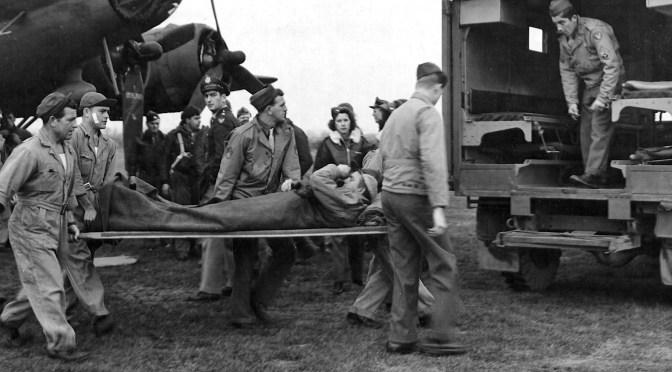
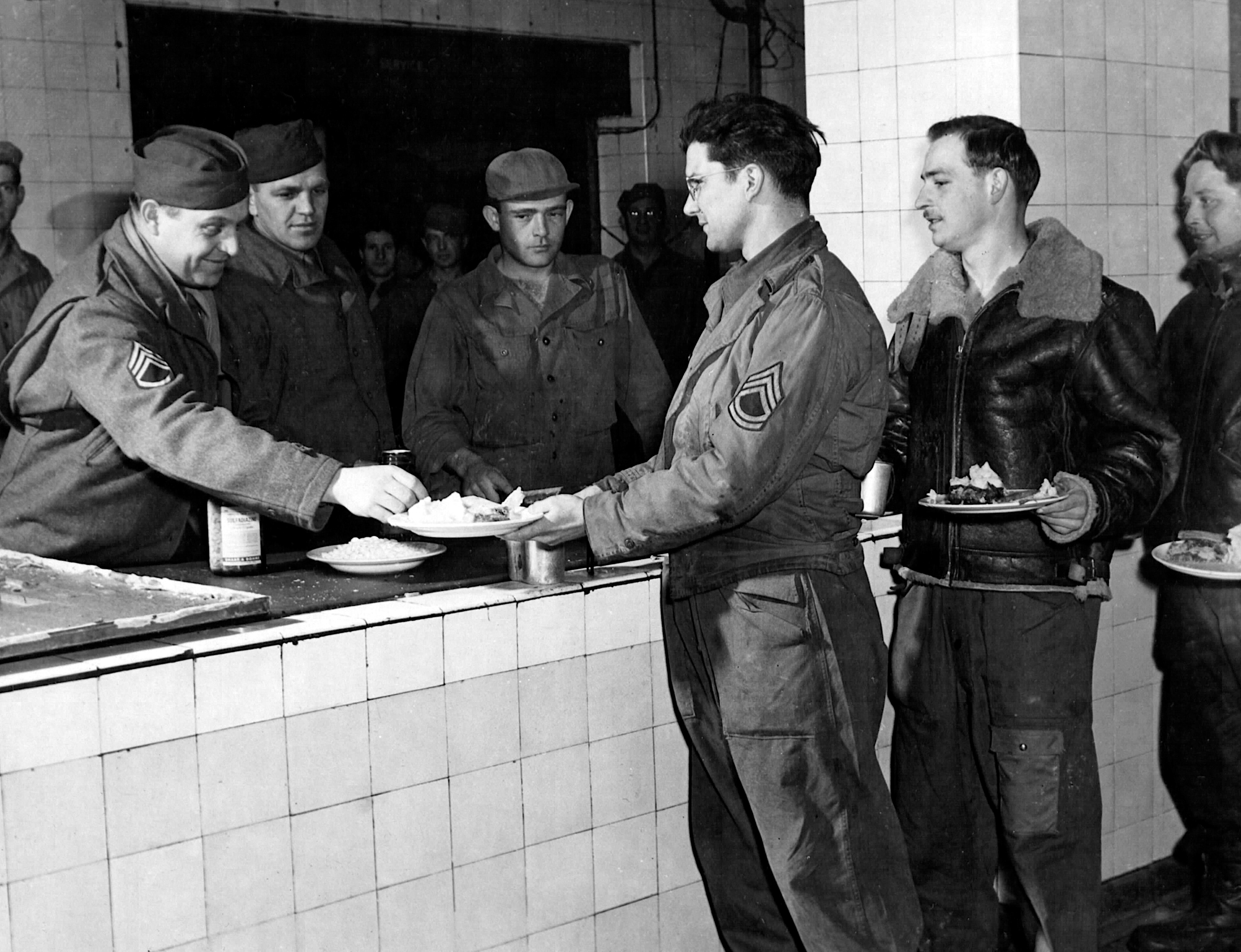
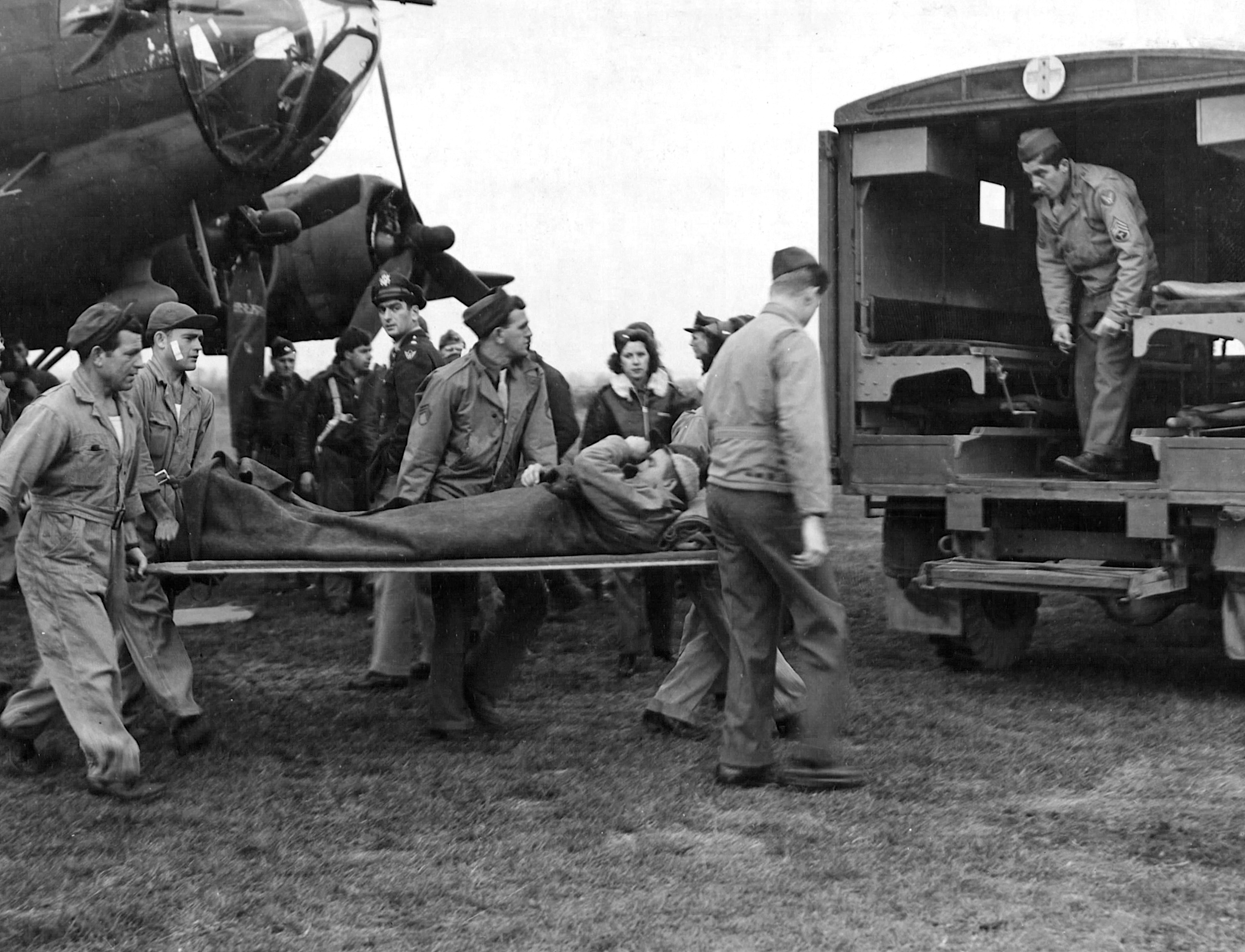
Richard Dockstader Grinolds was drafted into the U.S. Army in February 1942 at Fort Sheridan, Illinois. He became a staff sergeant in the Army Air Force and was stationed in England with the 324th Bomb Squadron, 91st Bomb Group. His specialty was medical technician. He was featured several times in U.S. Army news photos; twice carrying wounded and once for a feature on a rash of illnesses among troops in England. The 91st Bomb Group was home to the famous “Memphis Belle” B17 Flying Fortress.
Staff Sgt. Charles D. Grinolds of Mauston (second in line) waits to be administered a sulfa pill, part of a U.S. Army Air Force effort to reduce illness at the 91st Bomb Group in England during World War II. (U.S. Army photo)
Grinolds lost his father, McClellan Grinolds, in 1918, when the boy was just 4. He and his brother were raised by their mother, the former Ruby Elizabeth Dockstader. The Grinolds and Dockstaders were both pioneer Juneau County families. The Hanneman family lived just around the corner from Dockstader Street, named for pioneer Benjamin Dockstader.
Staff Sgt. Charles D. Grinolds (far right) helps carry Staff Sgt. Marion M. Walshe to an ambulance after the bombardier was injured on a mission over Europe.
The baby featured in the story above, Charles Victor Grinolds, was born in England on July 29, 1945, as his father was headed back to the United States. He was one of four children born to the couple. Sadly, Charles D. Grinolds died on July 30, 1950. He was just 36. He is buried at Oakwood Cemetery in Mauston. The firstborn son grew up to have a distinguished military career, serving in the U.S. Air Force in Vietnam, the Persian Gulf War and the Iraq War. He died on June 10, 2006 in Modesto, California. He was the father of six children.
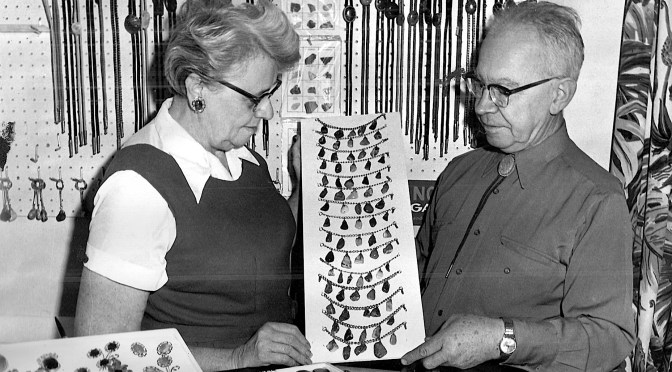
As a boy, I often got to travel with my Dad on his sales routes across Wisconsin to sell veterinary pharmaceuticals and supplies. One of his routes took him to Wausau, so we got to pay a visit to Hanneman’s Rock and Gift Shop, run by my great uncle and aunt, Wilbert G. and Irma Hanneman. Visits to the shop always resulted in getting to pick out something made from the most exquisite polished rocks and colorful crystals.
Over the years, I developed a nice collection of treasures from the rock shop. I came to believe that Uncle Wilbert (nicknamed “Wib”) had made a career out of selling rocks and crystals. Actually, he and Aunt Irma took it up as a post-retirement labor of love after Wib’s long career in banking. They sold gifts from the shop in their home at 130 Ninth Avenue in Wausau in the 1960s and early 1970s, but also attended craft shows and other events to peddle their intricately patterned wares.
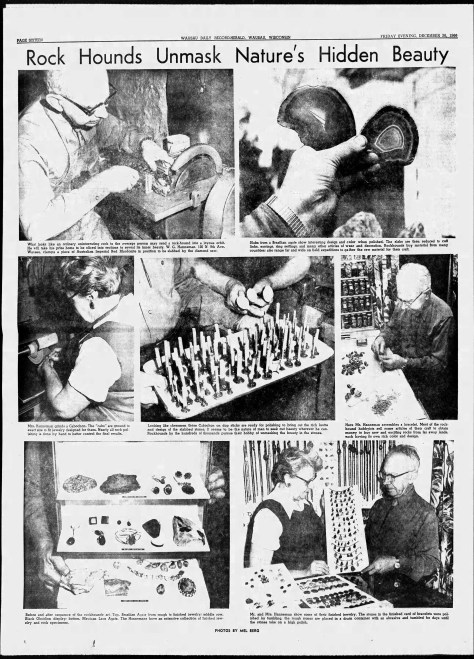
Wilbert G. Hanneman uses a diamond saw to cut slabs of Australian imperial red rhodonite.
In December 1966, the Wausau Daily Herald-Record ran a photo page featuring the Hannemans and their rock shop. “What looks like an uninteresting rock to the average person may send a rock-hound into a joyous orbit,” read one of the captions. The photo showed Wib using a diamond saw to slice Australian red rhodonite into slabs. Another photo showed polished slabs of Brazilian agate, which were later used to make cuff links, ring settings and other items.
Although Wib and Irma used tumblers to polish many of the smaller rocks, much of the rock polishing was done by hand “to better control the final results,” the newspaper wrote. The craft has its aim to “unmask the beauty in the stones.”
Wilbert G. Hanneman was born May 1, 1899 in Merrill, Wisconsin, the third of five boys born to Charles and Rosina Hanneman. He was the older brother of my grandfather, Carl F. Hanneman. In June 1923, Wib married Irma Pagels and the couple moved to Wausau. Wib had a long career working for the Citizens State Bank and Trust Co., from which he retired in 1964. Wib was a graduate of the School of Banking at the University of Wisconsin-Madison.
Wib overcame a bout of polio that left him with a pronounced limp. Late in life he suffered a heart attack that forced him to give up his beloved cigars. Wib and Irma celebrated their 50th wedding anniversary in 1973. Carl, who was the best man, attended the anniversary doings. The couple had two children, Richard D. Hanneman and Lynn (Hanneman) Swanson Zarnke. Wib died in 1987 and Irma died in 1996.
(This post has been updated with the full newspaper page image)
From very little on, my grandmother, Ruby Viola Hanneman, had a beauty that radiated in the many photographs taken of her. Her grandchildren no doubt recall the housecoat-type of outfits she often wore around the house. But make no mistake, Ruby was a fashion icon in her day. Our photo gallery bears ample testimony.
My grandparents were anything but wealthy. They worked hard to provide a middle-class home to their three children, Donn, David (my Dad) and Lavonne. Grandpa Carl F. Hanneman was a pharmacist at the Hess clinic and hospital. As we detailed in another post, he wrote to the attorney general of Wisconsin for help in upgrading his pharmacist license so he could better care for his family.
Regardless of the family’s financial circumstances, the Hanneman children were always dressed in nice clothing. Carl had nice suits for work and Sunday Mass. If you met Ruby at a family event, you might think she descended from royalty. Actually, there was a longstanding family yarn that said the Treutel family from which Ruby came was from a royal line in Europe. I’m still researching that one. Nevertheless, Ruby was always sharply dressed. The main photo above shows her in a Life Magazine pose during a 1950s trip out West. Classic stuff.
Far be it for me to offer detailed commentary on women’s fashion, but I am struck by Ruby’s fashion sense as shown in the photo gallery below. Dresses, hats, gloves, shoes and coats, nicely coordinated. This was evident at different events, from weddings to the common Sunday visit to family and extended family in the Wisconsin Rapids area. So many decades later, these photos are a real treat, although also reminders of the hole in our lives left by the absence of loved ones like Dad (1933-2007) and Grandma Ruby (1904-1977).
Ruby E. Hanneman has her great-grandmother’s keen sense of fashion.
I am quite tickled that my youngest daughter, not coincidentally named Ruby, is also very interested in fashion and interior decorating, just like her great grandma. I marvel at her discussions of colors, styles and fabrics — things I know little about. One thing is for sure: Ruby V. Hanneman is no doubt pleased to look down and see Ruby E. Hanneman, a young lady after her own heart.
As many times as I’ve traveled to central Wisconsin, I was not aware of a beautiful, sprawling religious shrine built by a Catholic priest in thanksgiving for having his health restored after a visit to Lourdes, France in the early 1900s. The Rudolph Grotto Gardens near Wisconsin Rapids were the dream fulfilled of Father Philip Wagner, who developed and dedicated the site to the Blessed Virgin Mary in 1927.
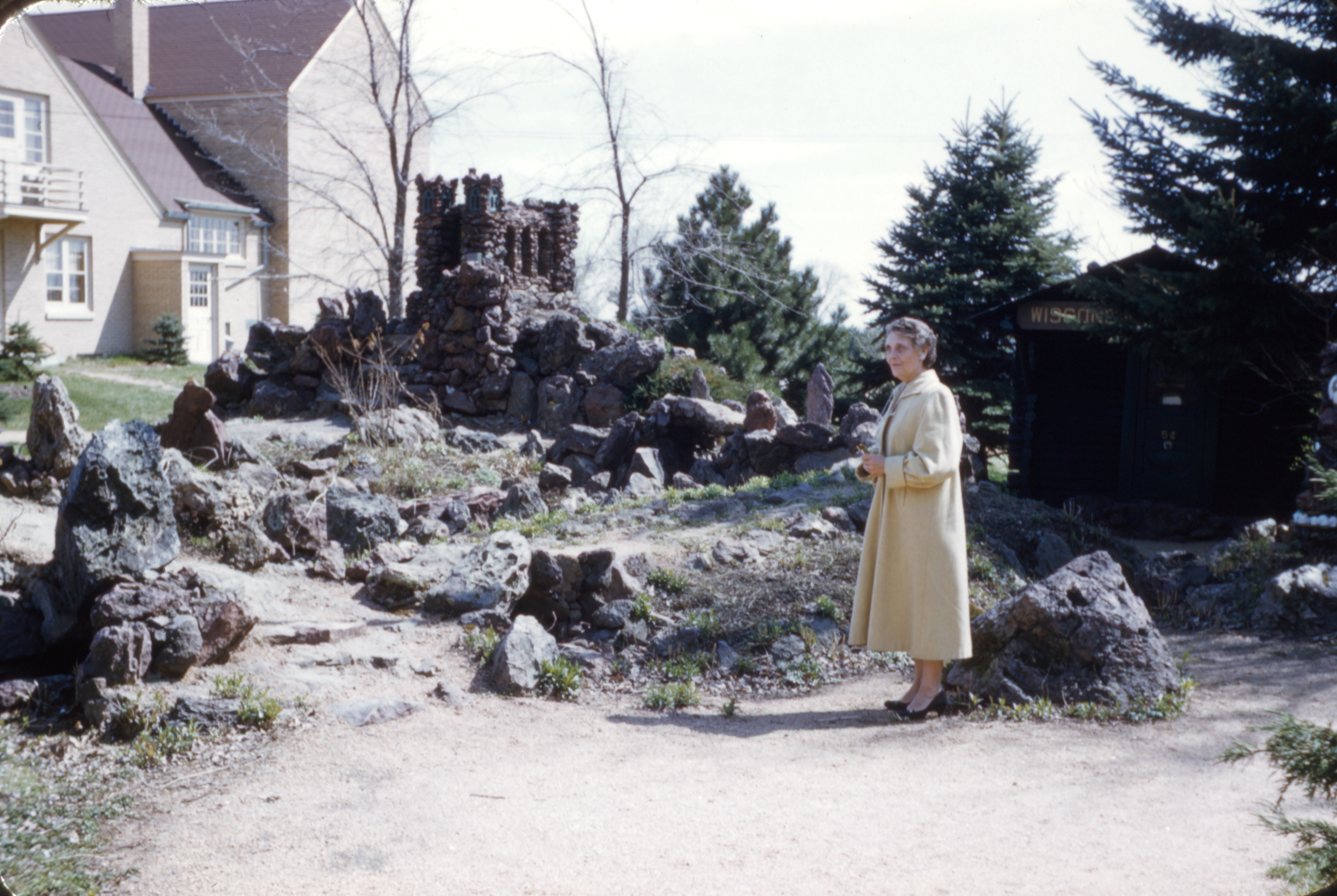
I learned of Rudolph Grotto Gardens while researching a photo of my grandmother, Ruby V. Hanneman, standing near a statue of St. Philomena in 1958 or 1959. St. Philomena, who was martyred at age 13, is known as the Patroness of the Living Rosary. Her shrine at Rudolph Grotto Gardens was built in 1957 by Edmund Rybicki, Father Wagner’s right-hand man.
The first grotto shrine at the Rudolph site, dedicated to the Our Lady of Lourdes, was completed in 1928. When a young and sick Philip Wagner visited the famous shrine at Lourdes, he promised the Blessed Virgin Mary that if he were healed of his illnesses so he could become a priest, he would build a shrine to her in America. And so he was healed, and was ordained a priest in 1915. He was assigned to St. Philomena Catholic Church in Rudolph in 1917.
Ruby V. Hanneman stands at the St. Philomena shrine in Rudolph in the late 1950s.
Over the years, the site expanded to include the Stations of the Cross, the Ten Commandments, a Last Supper Shrine, A “Wonder Cave” modeled after the catacombs, a Shrine of the Resurrection, a soldier’s monument and more.
Father Wagner and Rybicki labored on the site for decades. After Father Wagner died in 1959, Rybicki became the site caretaker. In 1961, St. Philomena Church was rededicated and renamed St. Philip the Apostle in honor of Father Philip Wagner. The last project at the grotto gardens was finished in 1983. Read more about the site here.
Lavonne Hanneman stands near an arch at the Rudolph Grotto Gardens in 1958 or 1959.Ruby V. Hanneman at Rudolph Grotto Gardens in 1958 or 1959.
This photograph has perplexed me for years. A baby in a diaper, lying on a pillow inside a steel wash tub. I strongly suspect this is my father, David D. Hanneman (1933-2007). The image raises many questions but provides no answers.
A strange place for a nap. This might be David D. Hanneman in the summer of 1933.
Why stick a baby in a wash tub? Was this the poor family’s playpen? The Depression-era bassinette? A brutal pre-Dr. Spock time-out? Freshly picked from the vine? In this day and age, such a photo might get you a visit from Child Services. I’m guessing my Grandma Ruby (Treutel) Hanneman (1904-1977) just thought it made a cute photo. She was known to dote on her “little Davey.”
If this was Dad in the tub, the photo was likely taken in Wisconsin Rapids, Wisconsin, where he was born in March 1933. The family did not move to Mauston until early 1936. Usually I can confirm my Dad’s ID in photos by the ears, but they are not visible in this image.
My memories of such a steel container at the house in Mauston had nothing to do with babies. I recall bluegill, sunfish and bass in such a tub, waiting for Grandpa Carl’s skilled fillet knife. Or the tub filled with ice and bottles of orange and grape soda (known as “pop” by some of you). But no babies.
This one is destined to remain a mystery. I’m sure it would tickle my grandma to know it was a conversation piece some 80 years later, and that no one called Child Services.
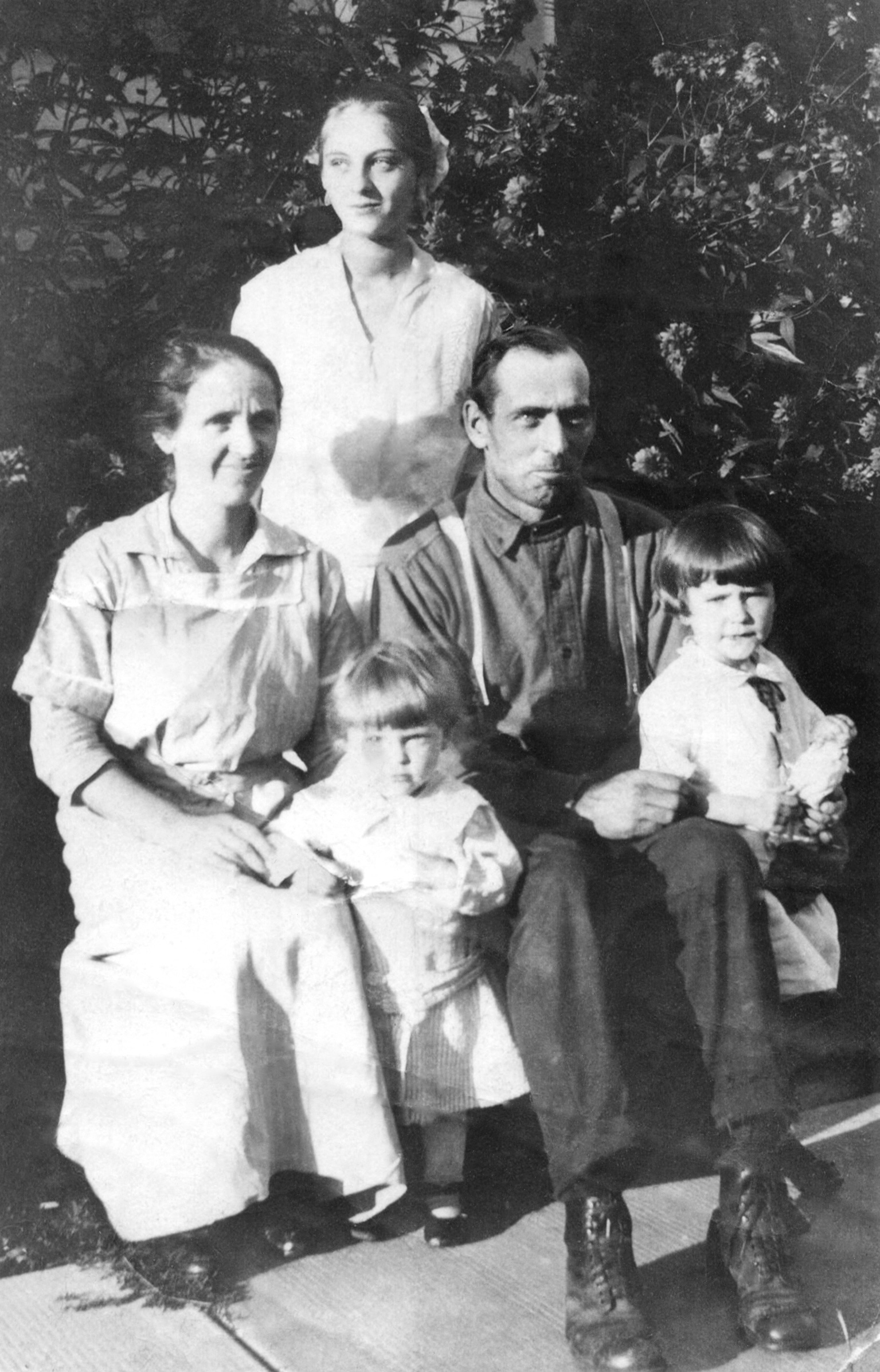
A simple family snapshot taken around 1918 is the only photograph we have showing Walter Treutel and his wife Mary (Ladick) Treutel together. Taken at the Treutel home in the village of Vesper, Wisconsin, the photo shows a teenaged Ruby along with younger siblings Marvin, 2, and Nina, 4. Elaine Treutel would come along in 1920. Baby Gordon Treutel died in 1910.
Walter was a rural route postal carrier for the U.S. Postal Service, while Mary tended to the family home on Anderton Avenue. The couple were married on December 29, 1902 in Vesper. Walter had recently relocated to Vesper from North Prairie in Waukesha County. Our Grandma Ruby Viola (Treutel) Hanneman was their first child, born June 22, 1904. Ruby was born at 1 p.m., delivered by Dr. F.A. Goedecke.
We learned recently that Mary’s nickname was Molly. That factoid came from none other than cousin Mary “Mollisu” Clark, the daughter of Elaine (Treutel) Clark and Max Clark.
Mrs. Treutel died at just 42 years old in January 1925. She had an operation in nearby Marshfield, but a post-operative infection claimed her life on January 31. She did not live to see her daughter Ruby get married that summer, and she did not get to see her other three children grow into adulthood.
The uncropped version of the photo shows Ruby V. Treutel standing at rear. Mary and Walter Treutel are seated. In front are Marvin and Nina Treutel.
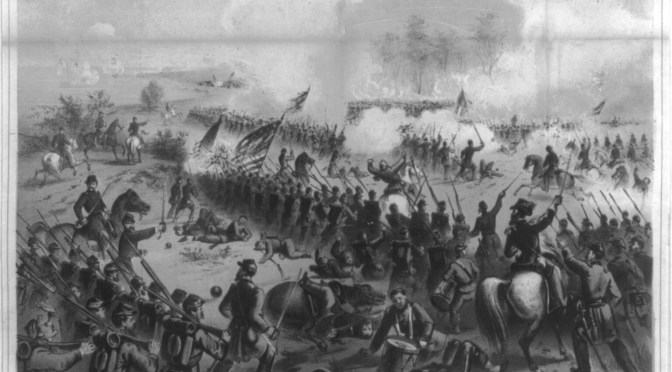
Whether by voluntary enlistment or draft, the Civil War that began in April 1861 took fathers and sons away for years — and sometimes forever.
Michael Kennedy of Sun Prairie, Wisconsin, was in the first wave of men to enlist after President Abraham Lincoln called for volunteers to defend the Union. The son of Sylvester and Mary Kennedy joined the 16th Wisconsin Infantry Regiment at Camp Randall in Madison on November 21, 1861. The regiment mustered into service on January 31, 1862 and left the state on March 13 en route to Pittsburg Landing, Tennessee. After several days encampment along the Tennessee River, the 16th Wisconsin was attached to the Sixth Division, Army of the Tennessee, commanded by Brigadier Gen. Benjamin M. Prentiss.
Early on April 6, Capt. Edward Saxe of the 16th Wisconsin’s Company A was ordered to make an advance toward the Confederate line. Within a short distance, an enemy volley killed Saxe and Sgt. John Williams. Thus opened the deadly Battle of Shiloh. The Battle of Shiloh went down in the annals of war as one of the bloodiest ever fought. It was a turning point for the Union. For much of the day, a desperate battle raged back and forth between Union and Confederate forces.
“The rebel hordes were coming on in front and flank, rolling up great columns like the waves of the ocean,” wrote Pvt. David G. James. Companies were moved in and out as ammunition and supplies ran short. Gen. Ulysses S. Grant told Gen. Prentiss if he could hold his position until sundown the army would be safe. Prentiss and his troops held until 5:30 p.m., when they were surrounded and more than 1,000 men taken prisoner. April 6 closed “at that time the bloodiest battle ever fought on the American continent,” James wrote. Prentiss’ Sixth Division suffered 236 killed and 928 wounded, in addition to the 1,008 captured.
At some point in wild battle, Kennedy was seriously wounded and captured by Confederate forces. Union troops were not able to recover bodies or make a full accounting of the missing until April 7, 1862. Kennedy was held prisoner at Corinth, Mississippi, where he died from his wounds on April 26, 1862. He was 20 years old.
We don’t know how much the captivity contributed to Kennedy’s death. Confederate prison camps were notorious for squalid conditions and severe mistreatment of Union soldiers. Kennedy was one of 39 soldiers from the 16th Wisconsin who later died from wounds sustained in the Battle of Shiloh. Overall, the 16th Wisconsin suffered 62 dead and 189 wounded in the battle. Kennedy is buried at Sacred Hearts Cemetery.
(This story was excerpted from “Catholic Pioneers on the Prairie,” a 28-page booklet written on the founding of Sacred Hearts of Jesus and Mary Catholic Church.)
From my just-published article in Catholic World Report:
Driven and sustained by his daily holy hour before the Blessed Sacrament, Archbishop Fulton J. Sheen lived an intense life of holiness, zeal to save souls and Christian love that helped make him the most influential Catholic in 20th century America, biographer Thomas C. Reeves says.
Reeves has released a previously unpublished conclusion to his 2002 Sheen biography, America’s Bishop: The Life and Times of Fulton J. Sheen. The conclusion chapter, titled “Living Intensely,” covers Sheen’s spirituality, his inspiration and how others viewed his life. While Reeves does not directly promote Sheen as a candidate to be raised to the altars, his book’s concluding chapter is a very tidy summation of Sheen’s merits for sainthood. Reeves is making the chapter available for free on the internet, and has donated it for inclusion in his papers at Marquette University.
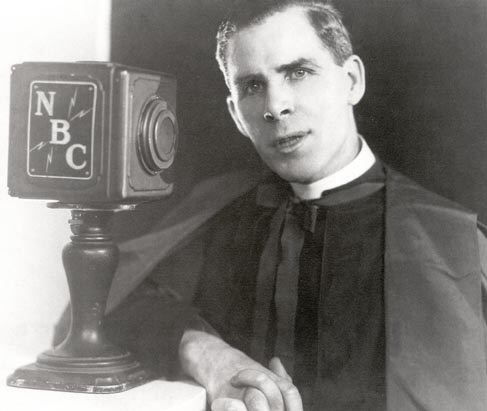
Fulton J. Sheen had a long tenure on radio hosting the Catholic Hour on NBC.
“To an extraordinary degree, his mind was on God,” Reeves wrote of Sheen (1895-1979), the prolific author and Catholic evangelist best remembered for his 1950s television series, “Life is Worth Living.” “This supernatural approach to life activated and sustained his enormous energy. He said late in life, ‘the secret of my power is that I have never in fifty-five years missed spending an hour in the presence of our Lord in the Blessed Sacrament. That’s where the power comes from. That’s where sermons are born. That’s where every good thought is conceived.’ ”











 The Hanneman Archive