This photograph has perplexed me for years. A baby in a diaper, lying on a pillow inside a steel wash tub. I strongly suspect this is my father, David D. Hanneman (1933-2007). The image raises many questions but provides no answers.
A strange place for a nap. This might be David D. Hanneman in the summer of 1933.
Why stick a baby in a wash tub? Was this the poor family’s playpen? The Depression-era bassinette? A brutal pre-Dr. Spock time-out? Freshly picked from the vine? In this day and age, such a photo might get you a visit from Child Services. I’m guessing my Grandma Ruby (Treutel) Hanneman (1904-1977) just thought it made a cute photo. She was known to dote on her “little Davey.”
If this was Dad in the tub, the photo was likely taken in Wisconsin Rapids, Wisconsin, where he was born in March 1933. The family did not move to Mauston until early 1936. Usually I can confirm my Dad’s ID in photos by the ears, but they are not visible in this image.
My memories of such a steel container at the house in Mauston had nothing to do with babies. I recall bluegill, sunfish and bass in such a tub, waiting for Grandpa Carl’s skilled fillet knife. Or the tub filled with ice and bottles of orange and grape soda (known as “pop” by some of you). But no babies.
This one is destined to remain a mystery. I’m sure it would tickle my grandma to know it was a conversation piece some 80 years later, and that no one called Child Services.
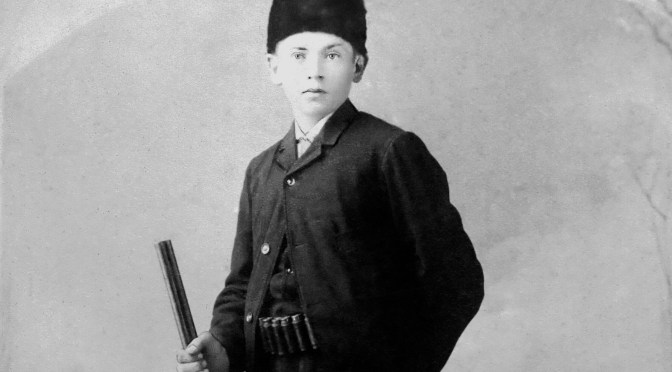
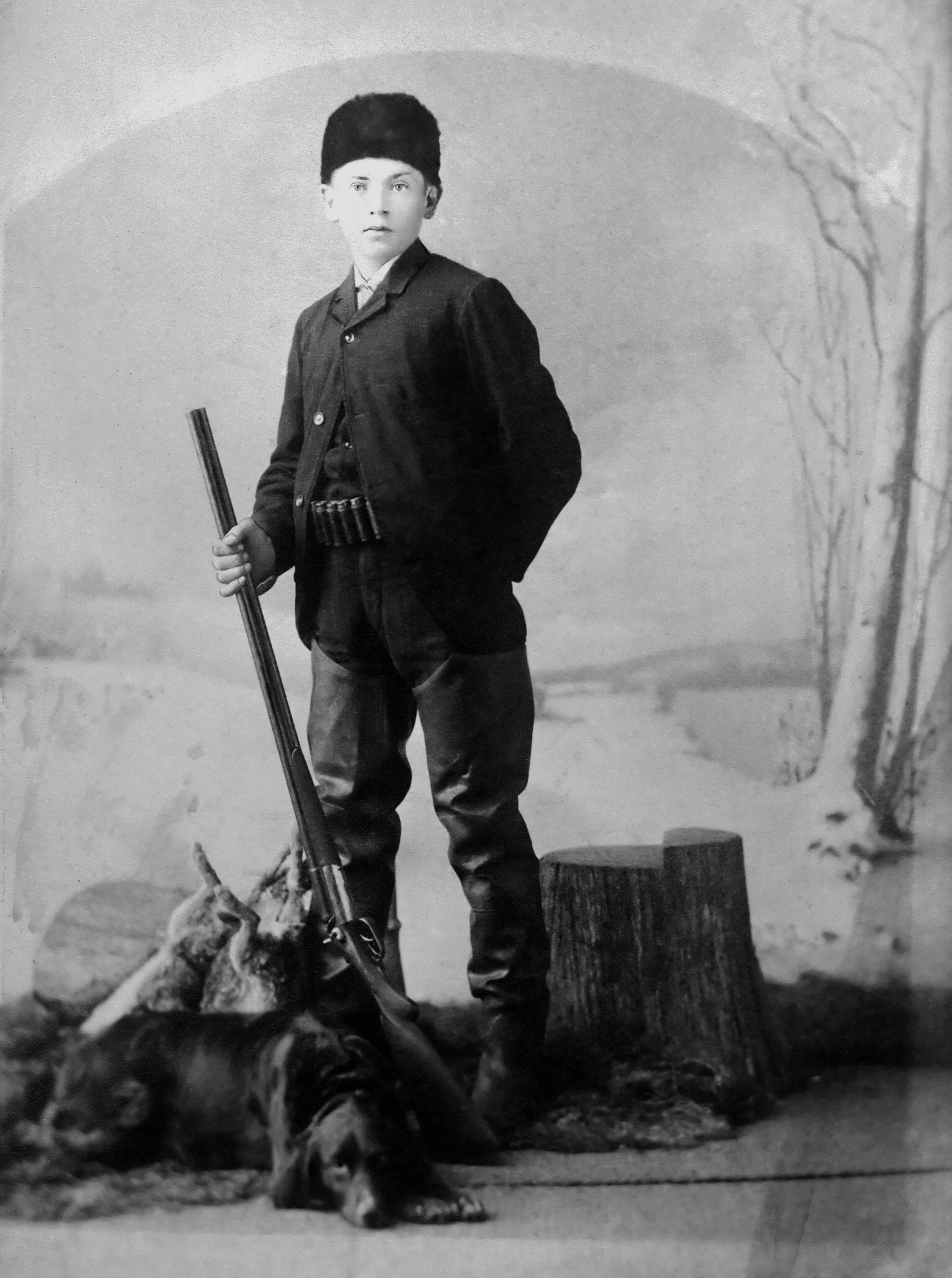
The more than century-old photo shows a stoic, proud young man wearing an ammunition belt and holding a shotgun in his right hand. At his feet lays a loyal hunting dog, seemingly tired from a day in the field. The young man is identified in the corner of the photo as Frank Hanneman, age 14. That dates the photo to 1909 or 1910.
The paper-mounted and framed portait, in nearly perfect condition, survived all of these years in the possession of Carl F. Hanneman, Frank’s brother, and later in the collection of David D. Hanneman, Carl’s son. It is one of the oldest existing photos of a Hanneman from Wood County, Wisconsin.
Frank Hanneman, 14, posed for this photo around 1910.
What do we know about this young hunter? Frank Herman Albert Hanneman was born July 7, 1895 near Grand Rapids, Wisconsin, the son of Charles and Rosine Hanneman. In his early years the family lived and worked on the farm of his uncle, William Hanneman, in the Town of Grand Rapids in Wood County. The 1900 U.S. Census lists Charles Hanneman, 33, as a farm laborer on the farm of William Hanneman. By 1905 the Charles Hanneman family moved to Baker Street in Wisconsin Rapids when Charles got work at the Consolidated Water Power & Paper Co.
The Hanneman boys enjoyed the great outdoors of central Wisconsin. We might assume by the photo, Frank enjoyed hunting birds. We have plenty of photos of a young Carl Hanneman fishing. On June 11, 1916, Frank married Irma Wilhelmine Louise Staffeld, and the couple took up residence on Baker Street in Wisconsin Rapids – a block away from his parents. The couple had five children between 1916 and 1929: Dorothy, Marjorie, Robert, Elizabeth and Joyce. Like his father, Frank had a long career working at Consolidated Water Power & Paper Co.
On July 14, 1947, Frank suffered a heart attack at home, and died shortly after arriving at Riverview Hospital. He was 52. His brother, Carl, was vacationing with his family in North Dakota, but returned for the funeral before rejoining the family vacation.
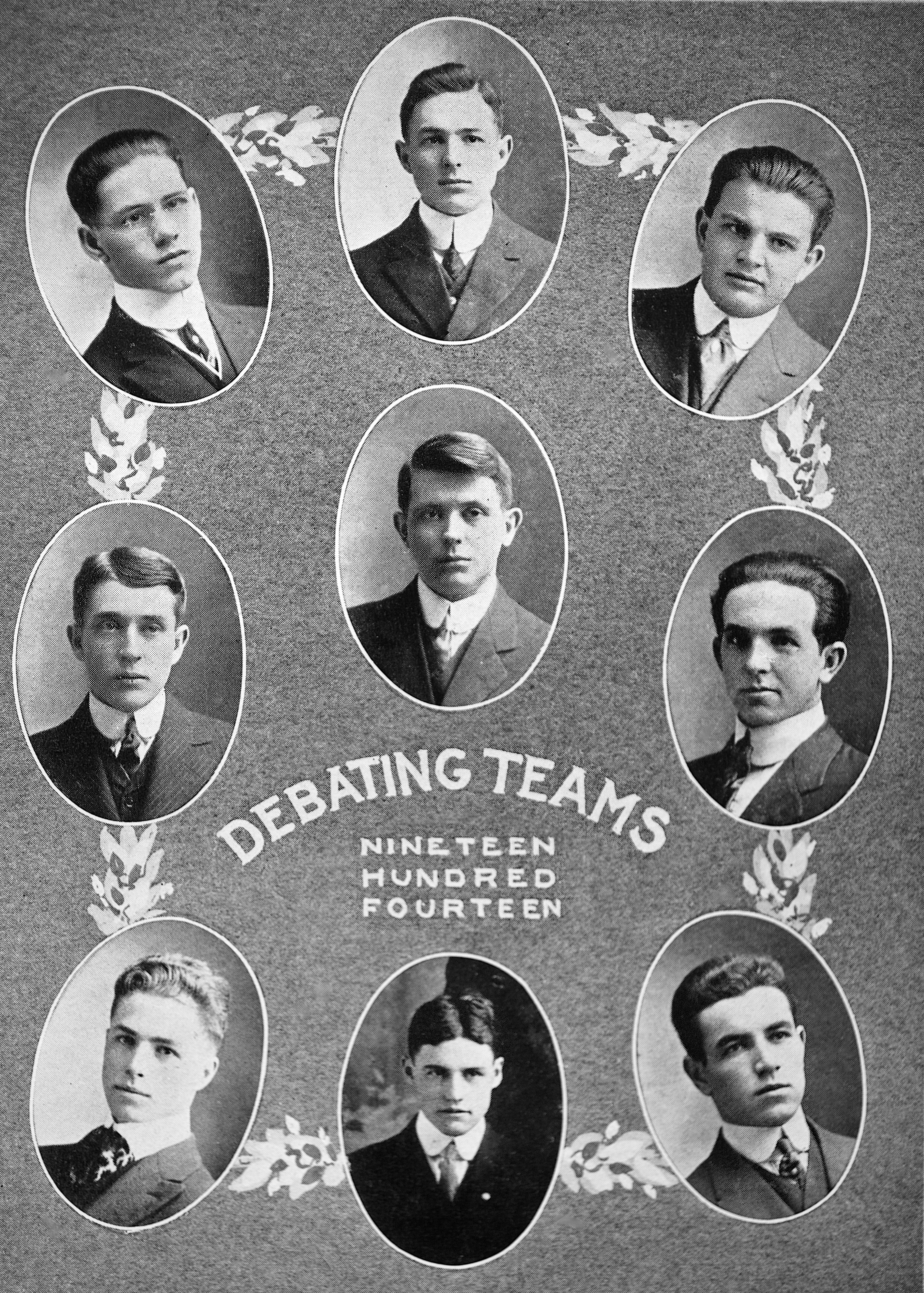
“The victory is not always with the strong.” Thus was the conclusion of the editors of the Ahdahwagam yearbook at Grand Rapids Lincoln High School, in recounting the 1914 performance of the school’s debate team versus nearby Marshfield.
The debate team represented the best Lincoln High School had to offer.
The young men were fully prepared and valiently presented their assigned negative proposition. The question at hand, the editors reasoned, simply lent itself more easily to the affirmative: “Resolved, that the policy of fixing a minimum wage by state boards is desirable.” Marshfield won the judges’ nod on this day. “It was merely on of those times when fortune turns her wheel, then closes her eyes, letting it stay where it may.”
The young men pictured in the image, the yearbook stated, were among the very best the school had developed. Participants in forensics tended to also be those involved in other worthy extracurricular pursuits, such as athletics, music and culture. “This is what every well-organized high school should stand for,” the yearbook read, “and we are proud of the boys who represented us in debate.” Indeed, several of them went on to serve their country as soldiers in World War I. The debate team lineup:
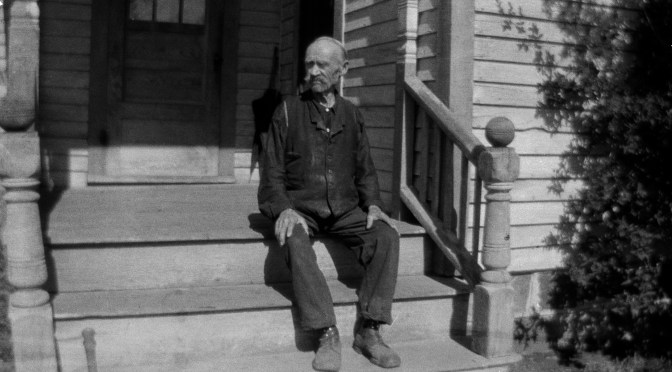
The photograph is very poignant. A frail man, sitting in the afternoon sun on the front porch steps. He looks haggard and tired, maybe ill. This image is the last known photograph taken of Karl Frederick Christian Hanneman, who was known around Wisconsin Rapids as Charles or “Chas” Hanneman. The photo likely dates to 1931 or 1932, when he suffered from prostate cancer that eventually took his life.
Charles Hanneman came to America in late November 1882 with his parents, Christian and Amanda Hanneman. He was just 15 when the family made its way from Stettin, Pomerania to Portage County, Wisconsin. Charles, his three brothers and two sisters settled on a 105-acre farm in the northwest corner of the Town of Grant, near the tiny hamlet of Kellner.
Nina and Elaine Treutel visit with Chas Hanneman, circa 1930.
Charles worked on the Hanneman farm for a time. His brothers would stay in farming (maps from that period show many Hanneman farms in Portage County), but eventually Charles left farming and found work in one of the area’s many sawmills.
At some point in his early 20s, Charles made the acquaintance of Rosine Ostermann, the eldest daughter of John and Mina Ostermann of the Town of Grand Rapids. They had many things in common. Both grew up on the family farm. Rosie’s parents were from Germany (Saxony and Prussia), and his were from Pomerania. Rosie’s grandfather George Ostermann was one of the pioneers of Portage County, listed on the earliest tax roll of the Town of Grant in 1864.
On April 2, 1891, Charles and Rosie were married atSt. John’s Evangelical Lutheran Church in Kellner in a divine service performed by A.G. Grimm. The witnesses were Charles’ father, Christian, and his brother, William. The bride’s attendants were her sister, Elsie Ostermann, and Emma Pribbernow. The groomsmen were cousins August Saeger and Herman Hanneman.
The young couple came to know heartache early in their marriage. Their firstborn, referred in the records only as “C.H. Hanneman,” died in infancy in 1892. They went on to have four sons: Arthur John (1893), Frank Herman Albert (1895), Wilbert George (1899), and our own Carl Henry Frank (1901).
Left to right: Christian Hanneman, Chas Hanneman, Carl Hanneman, David D. Hanneman.
Work in the sawmill must have been erratic, or Charles left that occupation for a time. In 1900, U.S. Census records show the family living and working on the farm of Charles’ brother, William Hanneman.
By 1905, Charles moved his family to the second ward in the city of Grand Rapids. He initially did manual labor for the city of Grand Rapids,possibly working on construction of the water and sewer works. The financial statements for the city in December 1907 show Charles worked 135 hours that month and earned 17.5 cents per hourfor a paycheck of $23.63.
By 1910 the family was living at 1774 Baker Street in Grand Rapids. The U.S. Census that year lists Charles as a laborer at a box factory. That may have referred to Consolidated Water, Power & Paper Co., where he later worked until his retirement, or the nearby Badger Box company.
On March 31, 1918, tragedy struck the Hanneman home when Rosine died suddenly at age 48. Her death notice, which ran on page 1 of the Daily Leader, said she was fine during the day but fell ill and died at 11 p.m. We know that she had diabetes, and that may have contributed to her death. Carl was 16 when his mother died.
Charles remarried in August 1919 and lived out his remaining years in his home at 1751 Baker Street. He became ill with prostate cancer in 1931 and was hospitalized numerous times in Wausau for surgery and treatments. He died at home on Oct. 11, 1932. He was 65. His death made front-page news in the Wisconsin Rapids Daily Tribune.
FAMILY LINE: Karl Frederick Christian Hanneman >> Carl F. Hanneman >> Donn, David & Lavonne Hanneman
Rosine Bertha Henrietta (Osterman) Hanneman (1870-1918), Frank Herman Albert Hanneman (1895-1947), Arthur James Hanneman (1893-1965), Carl Henry Frank Hanneman (1901-1982), Wilbert George Hanneman (1899-1987) and Carl Frederick Christian (Chas) Hanneman (1866-1932).
It is the only known photograph showing six of the seven children of Christian and Amanda Hanneman, pioneers of Portage and Wood counties in Wisconsin. The undated photo was probably taken around 1915 at a family event. Left to right are: William Friedrich Johann Hanneman (1856-1939) Bertha Auguste Ernestine (Hanneman) Bartelt (1860-1945) Albert Friedrich O. Hanneman (1863-1932) Herman Charles Hanneman (1864-1945) Carl Friedrich Christian Hanneman (“Chas,” 1866-1932) Ernestine Wilhelmine Caroline (Hanneman) Timm (1870-1930)
Hand tinted photograph of Chas Hanneman, location unknown.
Left to right: Christian Hanneman, Chas Hanneman, Carl Hanneman, David D. Hanneman.
Just three weeks after becoming a father for the third time, young pharmacist Carl. F. Hanneman took the extraordinary step of writing to the attorney general of Wisconsin to ask that he be granted full licensure as a registered pharmacist. It was a heartfelt letter, written by a young man feeling the weight of responsibility of a wife and three children. Written by a well-educated and accomplished man who felt he deserved what he as asking. The very future was at stake.
“I am writing this letter in all sincerity as what I am about to ask means everything to myself as well as my wife and three little kiddies,” Carl wrote to Attorney Gen. Orland S. Loomis on Sept. 3, 1937.“I am 35 years old and will be 36 this coming October and feel that obtaining my full registered papers will mean life itself to myself and my dear family.”
Carl explained that he was fully licensed as an assistant pharmacist, working at the Mauston Drug Store owned by Dr. J.S. Hess Jr. But he was unable to officially manage the drug store due to a quirk in state law.
Wisconsin Attorney Gen. Orland S. Loomis of Mauston
If Carl had worked in a smaller town with under 500 population, he could have legally managed the pharmacy. But Mauston population was about 2,100. Carl would need to be a registered pharmacist in order to manage the Mauston Drug Store.
“My capacity in the drug store is as an unofficial manager, as I do all of the buying etc., but legally cannot manage the store,” Carl wrote. “Dr. J.S. Hess Jr. has confidence in me and I a great deal in him, and as far as I am concerned am willing to stay here the rest of my life, dispensing for our own doctors.”
Carl reasoned that if he was qualified to own and manage a pharmacy in a small town (such as neighboring Lyndon Station, pop. 236), why could he not serve the same capacity in Mauston? “I have often wondered as has many others, are not the lives of 500 people in a small town just as valuable to their loved ones as those living in a town where there might be more than this amount?” Carl wrote.
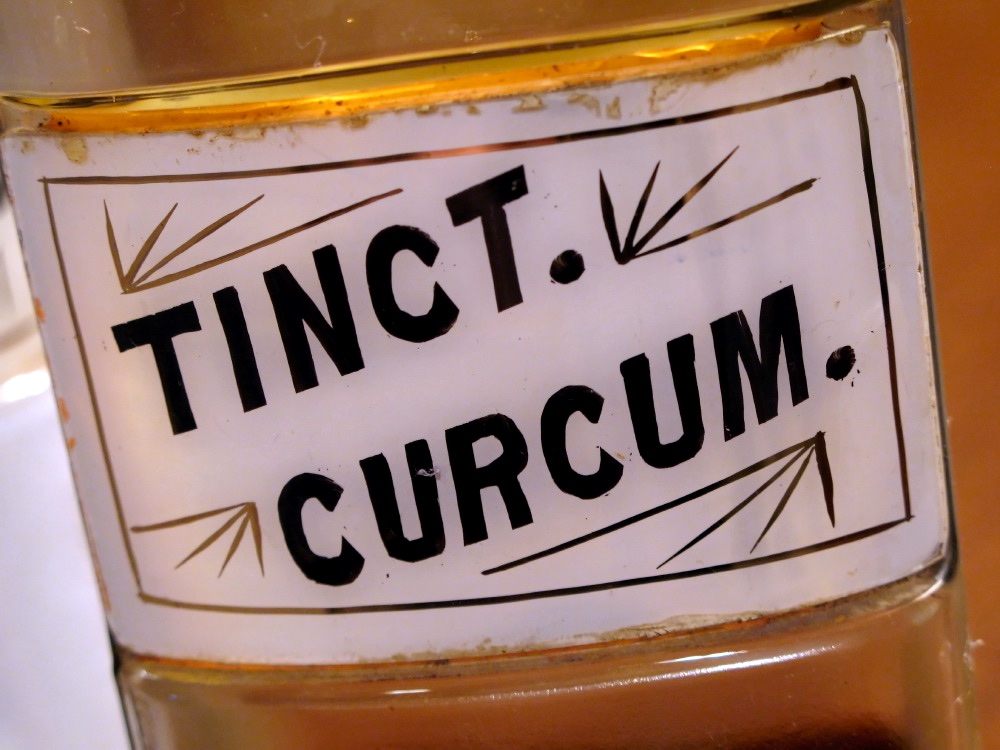
A label under glass from Carl F. Hanneman’s pharmacy collection.
By 1937, Carl had 16 years of experience in pharmacology, starting as an apprentice in 1921 at the Sam Church drug store in Wisconsin Rapids. Carl graduated from the pharmacy program at Marquette University in 1925 and became licensed as an assistant pharmacist. He wasn’t eligible to take the full pharmacist exam at the time because his apprenticeship fell just short of the required five years. Over the next decade he worked at drug stores in Janesville, Fond du Lac and Wisconsin Rapids, and even worked a three-year stint as a salesman for Consolidated Water Power & Paper Co.
“I knew my lifework was with the drug store as I truly love it and was very fortunate in securing a position with the Dr. Hess Hospital, Clinic and Drug Store organization on Feb. 1, 1936,” Carl wrote.
Carl said he would likely need three more years of study to pass the registered pharmacist board exams as they existed in 1937. With three children (including baby Lavonne born in August 1937), Carl figured that simply would not be possible. So he asked for help from Loomis, a Mauston native who served as city attorney from 1922 to 1931. Loomis was attorney general through 1938, and was elected governor of Wisconsin in 1942. He died before taking office. Eventually, Carl became good friends with Loomis and photographed him for the Wisconsin State Journal on the 1942 night of his election as governor of Wisconsin.
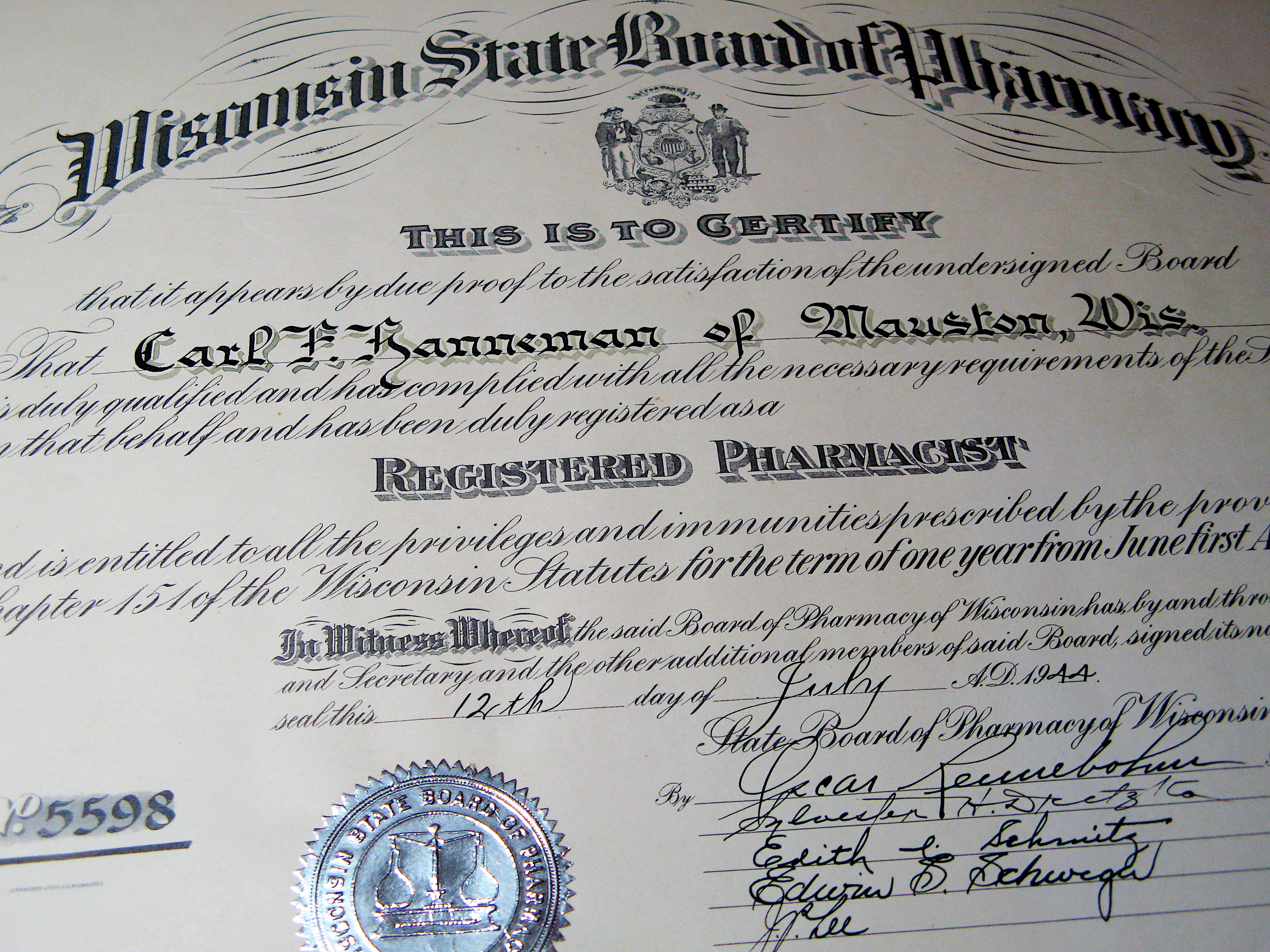
Carl F. Hanneman’s registered pharmacist license, issued in July 1944.
We don’t know if Loomis ever intervened on Carl’s behalf in his role as attorney general or governor-elect, or how he responded to the 1937 letter. A search of Loomis’ law-practice records at the Wisconsin Historical Society yielded no clues. Carl’s 1941 license from the Wisconsin State Board of Pharmacy still lists him as an assistant pharmacist. On July 12, 1944, the state of Wisconsin issued an ornate document certifying Carl as a full registered pharmacist. He worked under the new license number until his death in 1982. It would appear Carl secured his added credentials the hard way: he earned them.
We only have two photographs that show Carl F. Hanneman at school, and both appear to be from the same year. In the first, Carl is the second pupil in the second row at a school in Grand Rapids, Wisconsin. Wearing a tie and cardigan sweater, Carl is one of a half-dozen or so boys in the class. The clock reads 11:59, so the class photo was scheduled just before the lunch break. It is a well-kept and neatly appointed classroom. The girl sitting in front of Carl could easily be mistaken for his future bride, Ruby V. Treutel, although she went to school in nearby Vesper.
Carl F. Hanneman is third from the left in the first row. The photo was taken circa 1910.
The second photo was taken outdoors at an entrance to the school. Carl is third from the left in the first row. At the time, the Hannemans lived on Baker Street in Grand Rapids, so the Howe School would have been the closest public school. But the building in the photo does not match exterior details of the Howe School, so it’s unclear where Carl spent his elementary school years.
It seems the entire village of Vesper, Wisconsin came out for a banquet or other big event, and stayed for a photograph. The image appears to date to about 1913 or 1914. The large crowd spilled out of the village hall for a photograph. What was the occasion? A wedding? A dance? It is fun to imagine. The portrait was taken by Moore Photo of nearby Grand Rapids (now called Wisconsin Rapids).
What makes this image especially interesting is to zoom in and look at the details. See the little girl with the Dixie Queen plug cut tobacco lunch box? It’s strange to imagine a lunch tin with smoking tobacco advertised on the side, but this was before the age of comic books or movie stars. Lunch pails with tobacco ads were common.
In the front at left/center left is my grandmother, Ruby V. (Treutel) Hanneman, who appears to be about 10 years old. That would date the photo to 1914. In the sea of men back near the stairs appears to be Ruby’s father, Walter Treutel. He is sporting a mustache, which is something I’ve not seen in any family photos.
On the building next to the window is a large thermometer with the name “Hlasatel” on it. That was the name of a Bohemian/Czech newspaper. Vesper had a large population from Bohemia, including the family of my great-grandmother, Mary (Ladick) Treutel. Her parents emigrated from Bilina in what is now the Czech Republic.
Most of the men wore hats, so it is not easy to make identifications.
One little girl has a Dixie Queen tobacco lunch pail.
Judging by the dress, this must have been an important event.
Young Ruby V. Treutel is in the front row right, leaning on her right hand and tilting her head to her left.
Much of the village of Vesper came out for the photo.
“Memory of the Day of Confirmation.” Those German words are written in ornate lettering across a beautiful certificate commemorating the confirmation of Karl (we know him as Carl) Hanneman on June 11, 1916. The roughly11×17 inch document, found among the papers and photographs of David D. Hanneman, is remarkably well preserved and speaks to a time before Carl’s conversion to Catholicism. The certificate is written entirely in German and reads:
“Karl Hanneman received instruction in the Word of God on 11 June 1916 in the First Moravian Church, Grand Rapids, Wis.” At the bottom of the certificate it reads: Gottes Furcht is aller Weisheit Anfang, which roughly means “All Wisdom Begins with Fear of God.” The document was signed by the Rev C.A. Meilicke.
The confirmation certificate for Carl F. Hanneman from the First Moravian Church.
We know Carl’s father, Charles Hanneman, was raised as a Lutheran, as were most of the Hannemans. The marriage certificate for Charles and Rosine Hanneman (nee: Ostermann) only says their wedding was a “Divine Service” and does not indicate a church. In 1907, Charles and Rosine and their four sons joined the First Moravian Church of Wisconsin Rapids, a congregation of some 450 people in a brick church on First Avenue South.
The Moravian Church is one of the oldest Protestant denominations and traces its roots to the 1450s in Bohemia and Moravia. The area is now part of the modern day Czech Republic. It is possible the family’s connection to the Moravian Church came from Rosine (Ostermann) Hanneman, whose father emigrated from Saxony in what is now eastern Germany.
Carl and Ruby Hanneman were both converts to Catholicism, but we’ll save those stories for another entry.
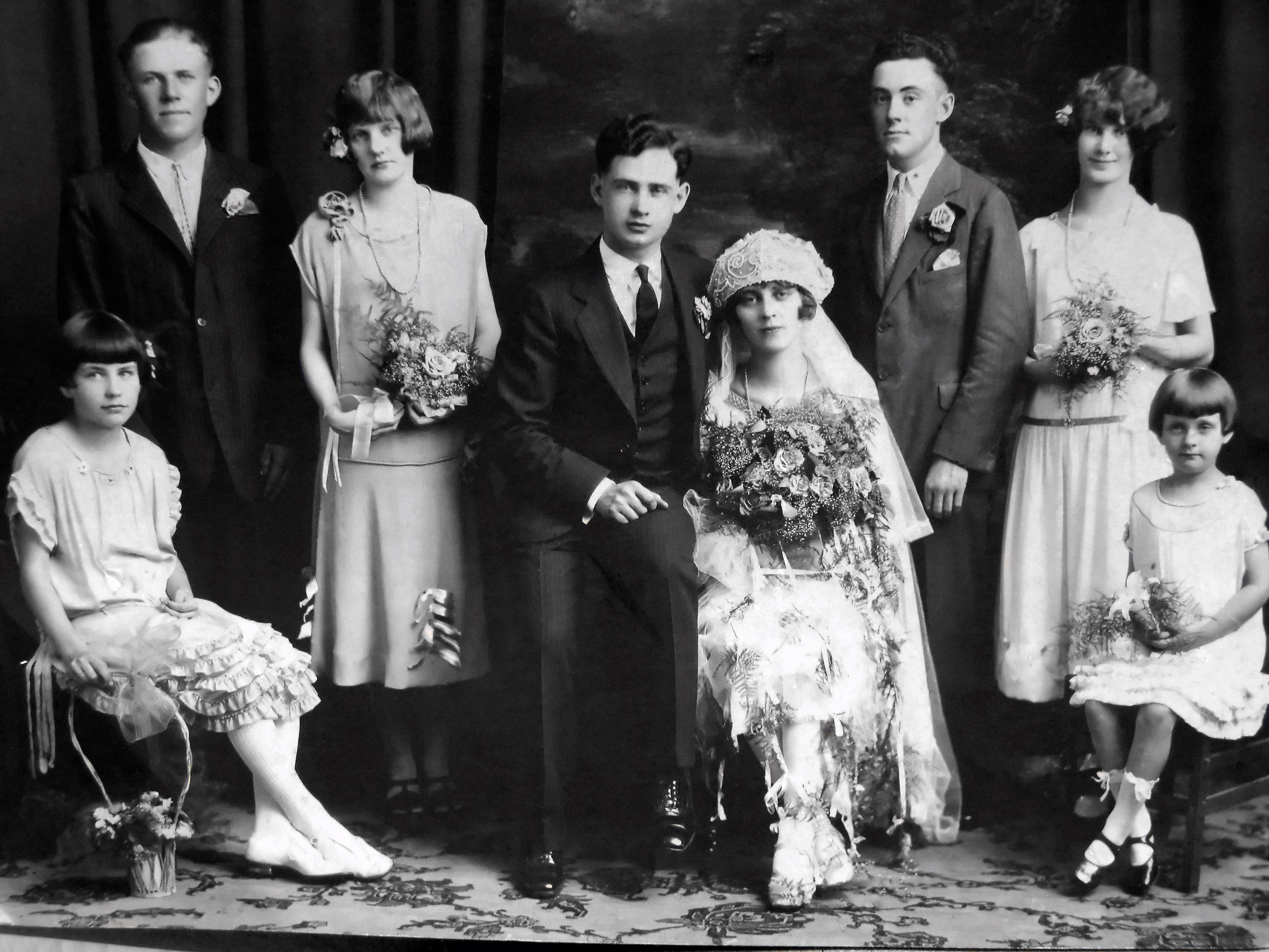
Nearly 90 years ago on a summer Tuesday morning, Ruby Viola Treutel and Carl Henry Frank Hanneman joined in marriage at St. James Catholic Church in Vesper, Wisconsin. The marriage, which would live on for more than 50 years and produce three children and 16 grandchildren, was described in detail in a story in the July 15, 1925 edition of the Wisconsin Rapids Daily Tribune:
TREUTEL-HANNEMAN One of the prettiest weddings of the summer was solemnized yesterday morning at nine o’clock at St. James church, Vesper, when Miss Ruby Treutel, daughter of Walter Treutel of Vesper, became the bride of Carl F. Hanneman, son of Mr. and Mrs. Charles Hanneman of this city. Rev. Father Gille officiated at the nuptial Mass.
The wedding party of groom Carl Henry Frank Hanneman, 23, and Ruby Viola Treutel, 21. Wedding was July 14, 1925 at St. James Catholic Church, Vesper, Wis. At front left is flower girl Nina Treutel, 11, sister of the bride. At front right is ring-bearer Elaine Treutel, 5, sister of the bride. Across the back, left to right, are Joe Ladick (bride’s cousin), Gladys Cole (bride’s cousin), groom Carl Hanneman, bride Ruby V. Hanneman, best man Wendell Miscoll, and maid of honor Esther Allbrecht.
The church was beautifully decorated with greens and the season’s flowers, making an appropriate setting for the wedding party. Miss Velma Doering of Stratford played the wedding march as the party entered the church and proceeded to the altar. Miss Gladys Cole of Nekoosa, and the groom’s attendant, Joseph Ladick, of Vesper, both cousins of the bride, were followed by two little sisters of the bride, Nina and Elaine, who acted as flower girl and ring bearer. The maid of honor, Miss Esther Albright, came next and was followed by the bride and her father, who gave her away.
Mr. Hanneman and his best man, Wendell Miscoll,awaited the party at the altar. The bride was very beautiful in her gown of white georgette trimmed with gold lace. She wore a coronet of pearls, with her veil falling from a beaded butterfly. She carried a shower bouquet of pink rose buds.
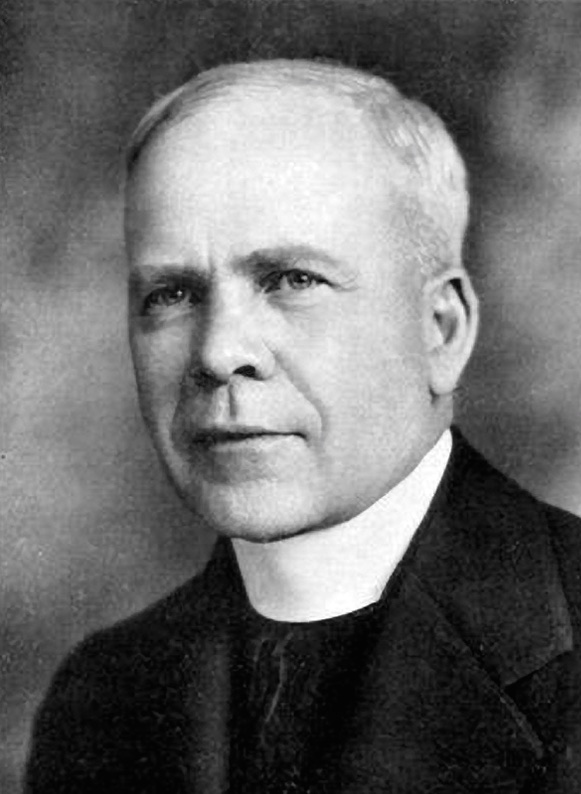
Rev. Charles W. Gille of St. James Catholic Church officiated at the wedding.
Miss Albright, the maid of honor, was gowned in orchid georgette and carried an arm bouquet of rose. Miss Cole, the bridesmaid, wore a gown of orange georgette, and also carried roses. Nina, the little flower girl, was in a little frock of yellow georgette, and Elaine completed the delightful color ensemble in a dress of pink georgette. She carried the ring in a white lily.
Following the service at the church, the bridal party and relatives came to this city, where the ten-thirty breakfast was served at the Witter Hotel. The bride is a graduate of Lincoln High School and the Stevens Point Normal. Since her graduation from the normal school she has been teaching at Vesper. The groom was graduated from Lincoln High and for some time following was employed at the Church Drug store. He later graduated from the pharmacy department of Marquette University at Milwaukee and is at present holding a position with Whitrock and Wolt.
Following a week’s outing in the northern part of the state, part of the time being spent as guests of Mr. and Mrs. Armand Bauer at their cottage at Hayward, they will return here and for the present make their home with Mr. Treutel at Vesper.
The bridal photo, hand retouched to restore color to the roses.
The bridal portrait of Ruby V. Hanneman in its original frame.
For their honeymoon in July 1925, Carl F. Hanneman (1901-1982) and Ruby Viola (nee: Treutel) Hanneman (1904-1977) took a camping trip to Wisconsin’s north woods. The couple are pictured at a camp site near Hayward, Wis. They were married July 14, 1925 at Vesper, Wis.
He could be carrying milk from the barn, but Carl F. Hanneman (1901-1982) is actually on a honeymoon camping trip in this July 1925 photo. Carl and bride Ruby (nee: Treutel, 1904-1977) took a camping trip near Hayward, Wis., after their wedding on July 14, 1925.
An unidentified boy sits outside of a cottage near Hayward, Wis., with Ruby V. (Treutel) Hanneman (1904-1977) in July 1925. Ruby and new husband Carl F. Hanneman (1901-1982) were on their honeymoon.
Carl F. Hanneman (at right) leans on his Ford near the camp where he and bride Ruby spent their honeymoon.
Carl F. Hanneman and an unidentified boy at the Hanneman picnic table.
The Hanneman honeymoon had a rustic theme at a cottage near Hayward, Wis.
Carl F. and Ruby V. Hanneman took these selfies on their honeymoon in July 1925.
Carl F. and Ruby V. Hanneman on their 25th wedding anniversary in July 1950.
Back of the photo: Carl F. and Ruby V. Hanneman on their 25th wedding anniversary in July 1950.
Carl F. and Ruby V. Hanneman on their 50th wedding anniversary, celebrated at Sun Prairie in July 1975.
Her reign may have been brief, but for one day in 1922, Ruby V. Treutel was front-page news as the most popular single woman in Wood County, Wisconsin. To help celebrate dedication of a new bridge across the Wisconsin River, the community organized a popularity contest to find the Queen of the Bridge.
The Queen of the Bridge contest invited the nomination of single women of Wood County. The contest winner would preside at the dedication of what came to be called the Grand Avenue Bridge, linking the east and west sides of Wisconsin Rapids over the Wisconsin River.
Queen of the Bridge wasn’t really a beauty contest, but Ruby Treutel would have fared well on that count alone.
Miss Ruby Treutel of Vesper was among the early nominees for the Bridge Queen, and she jumped to a lead after the first weekend of balloting in September 1922. The front-page headline in the Wisconsin Rapids Daily Tribuneon Sept. 25, 1922, proclaimed: Ruby Treutel and Mary Herron in Spirited Contest. “A spirited race between Miss Ruby Treutel of Vesper and Miss Mary Herron of this city developed as a result of the week end balloting in the Bridge Queen popularity contest,” the article read, “with Miss Treutel leading by slightly over 200 votes of the 43,000 cast for these two candidates.”
Ruby Treutel was in the thick of it at the beginning, but eventually fell behind in voting.
Ruby’s 22,570 vote total was more than twice that of the third-place contestant and far ahead of the 10 votes for Miss Pearl Brewster. But, like fame and money, the lead would not last as the contest balloting steamed along for two weeks at such a rapid pace the contest was ended early. In the first week, more than 1.3 million ballots were cast. The Bridge Committee had trouble keeping up with the tallying, which would exceed 20 million votes by the end of the contest.
By September 28, 1922, Ruby’s vote total had more than doubled, to 45,240. But this now paled in comparison to contest leaders Eva Manka and Mary Herron, who had more than 500,000 votes between them. On Sept. 30, Herron’s vote total ballooned to 989,000, far exceeding Manka’s new total of 640,000. Ruby was in a respectable fifth place with 171,000 votes. By the time the committee decided to cut voting short on Sept. 30, balloting was at a fever pitch. The final vote totals were:
Mary Herron, 5,336,570 votes
Mildred Bossert, 3,645,840 votes
Eva Manka, 1,763,360 votes
Manon Matthews, 1,016,510 votes
Margaret Galles, 711,550 votes
Alice Damon, 618,550 votes
Ruby Treutel, 608,050 votes
Maurine Dutcher, 492,410 votes
Pearl Possley, 486,600 votes
Ruth McCarthy, 460,510 votes
Miss Herron was crowned Queen of the Bridge. On Oct. 18, 1922, she attended the huge dedication ceremony and officially christened the span the “Grand Avenue Bridge.” It was indeed a grand event, with thousands of people, a parade and even aerial acrobatics performed by the Federated Flyers stunt team, which did loops in the sky with its planes, and thrilled the crowd with wing walking.
This 1940 postcard shows the Grand Avenue Bridge in Wisconsin Rapids, Wis.
The Grand Avenue Bridge has long been an important part of Wood County’s infrastructure. The 1922 version replaced an old wood and steel span. Bridges across the Wisconsin River date to the 1870s. In earlier times, bridge was an important link between the former towns of Grand Rapids and Centralia,which later joined to form the city of Wisconsin Rapids.










 The Hanneman Archive