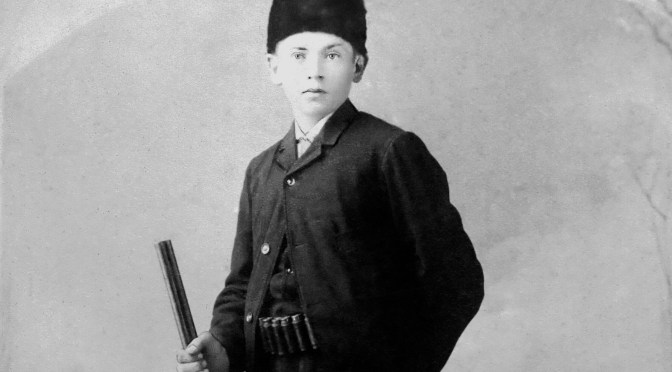
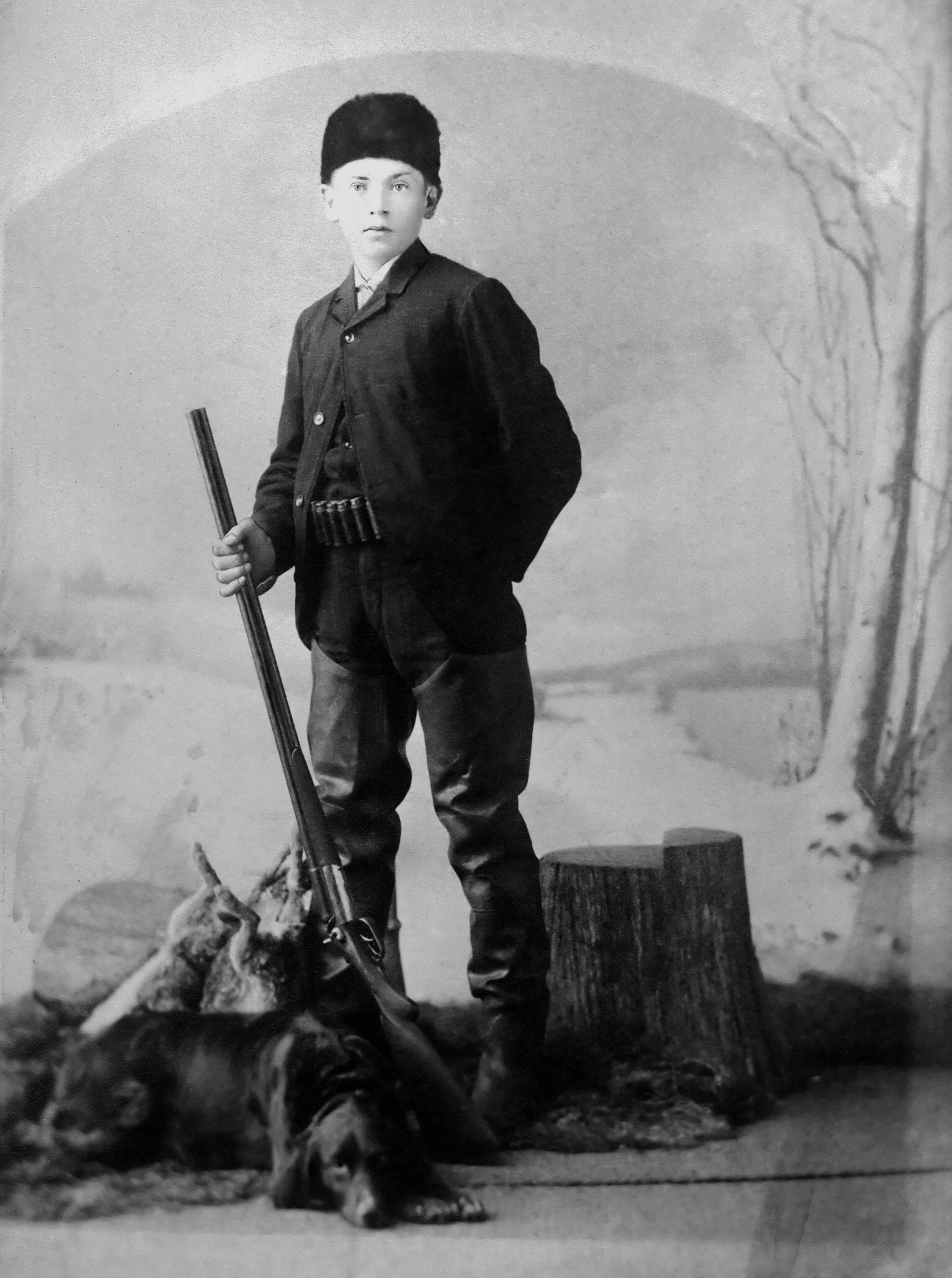
The more than century-old photo shows a stoic, proud young man wearing an ammunition belt and holding a shotgun in his right hand. At his feet lays a loyal hunting dog, seemingly tired from a day in the field. The young man is identified in the corner of the photo as Frank Hanneman, age 14. That dates the photo to 1909 or 1910.
The paper-mounted and framed portait, in nearly perfect condition, survived all of these years in the possession of Carl F. Hanneman, Frank’s brother, and later in the collection of David D. Hanneman, Carl’s son. It is one of the oldest existing photos of a Hanneman from Wood County, Wisconsin.
Frank Hanneman, 14, posed for this photo around 1910.
What do we know about this young hunter? Frank Herman Albert Hanneman was born July 7, 1895 near Grand Rapids, Wisconsin, the son of Charles and Rosine Hanneman. In his early years the family lived and worked on the farm of his uncle, William Hanneman, in the Town of Grand Rapids in Wood County. The 1900 U.S. Census lists Charles Hanneman, 33, as a farm laborer on the farm of William Hanneman. By 1905 the Charles Hanneman family moved to Baker Street in Wisconsin Rapids when Charles got work at the Consolidated Water Power & Paper Co.
The Hanneman boys enjoyed the great outdoors of central Wisconsin. We might assume by the photo, Frank enjoyed hunting birds. We have plenty of photos of a young Carl Hanneman fishing. On June 11, 1916, Frank married Irma Wilhelmine Louise Staffeld, and the couple took up residence on Baker Street in Wisconsin Rapids – a block away from his parents. The couple had five children between 1916 and 1929: Dorothy, Marjorie, Robert, Elizabeth and Joyce. Like his father, Frank had a long career working at Consolidated Water Power & Paper Co.
On July 14, 1947, Frank suffered a heart attack at home, and died shortly after arriving at Riverview Hospital. He was 52. His brother, Carl, was vacationing with his family in North Dakota, but returned for the funeral before rejoining the family vacation.
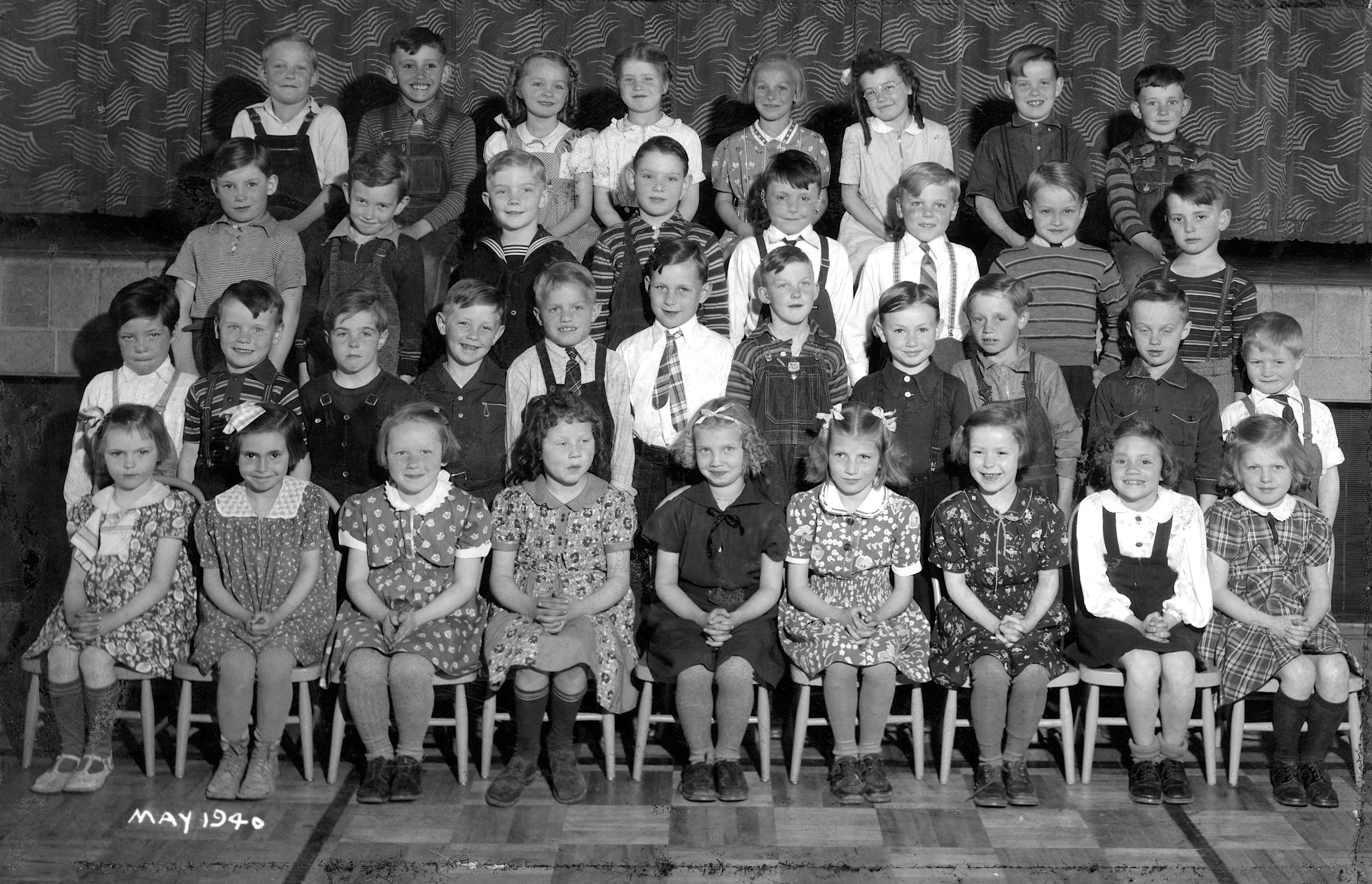
Many in this group photo from May 1940 would spend their entire pre-secondary education together in Mauston, Wisconsin. A few of the children in this MaustonGrade School photo had moved from Mauston by the time the 1940 U.S. Census was taken a month later. But many graduated together in the Class of 1951 at Mauston High School.
Bottom Row: Leah Reynolds, Clara Minor, Carol Quamme, Arlene Naglus, Alice Chilson, A. Longsdorf, Gladys Baldwin, Patricia Lane, Mary Crandall.
Second Row: Gerald Stout, S. Jones, Norman Pelton, Arnold Beghin, Almeron Freeman, Tommy Rowe, E. Roberts, Donald Millard, Harold Webster, George Lyons, Robert Randall.
Third Row: Donald Jax, Bernard Solberg, Wendell Smith, David Hanneman, Clayton ‘Ty’ Fiene, Robert Beck, Robert Firlus, Donald Clickner.
Fourth Row: H. Faulkner, Erhard Merk, Joy Smith, Lillian Ackerman, Jessie Hauer, Edith Shaw, Edwin Booth, O. Boldon.
It was the moving definition of a close call. A semi-trailer truck being driven by John N. Post flipped over in late June 1946 and slid right into the front of the Tourist Hotel on State Street in Mauston, Wisconsin. The semi ripped off the hotel’s screened porch and pushed it down the block.
The truck pushed parts of the porch 20 feet to the west.
Breaking glass exploded into the only unoccupied room at the inn. The room’s regular resident, a truck driver himself, was away on vacation. Post, 25, told police that he pulled out in order to pass a car driven by Charles A. Petrowitz, 15. Petrowitz started to make a left turn, forcing Post to veer and lose control of the truck. Post was treated at the Mauston hospital and released. No citations were issued in the accident. In addition to building damage, the truck also knocked over a light post, a mailbox and a fire hydrant.
Truck driver John N. Post suffered only minor injuries in the crash.
The photos were taken by Carl F. Hanneman for The Wisconsin State Journal, which ran two images and a short story on its State Page on June 25, 1946.
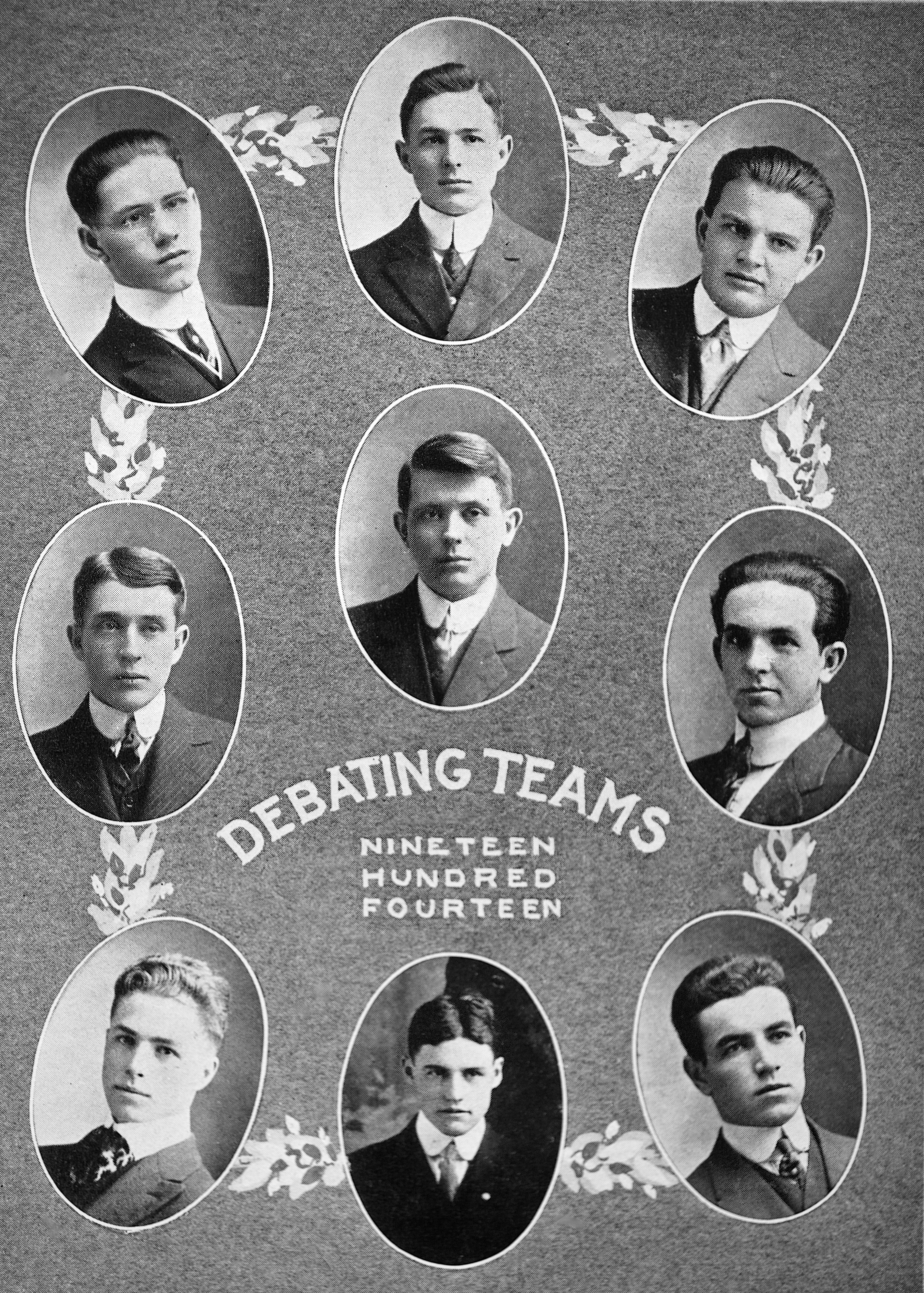
“The victory is not always with the strong.” Thus was the conclusion of the editors of the Ahdahwagam yearbook at Grand Rapids Lincoln High School, in recounting the 1914 performance of the school’s debate team versus nearby Marshfield.
The debate team represented the best Lincoln High School had to offer.
The young men were fully prepared and valiently presented their assigned negative proposition. The question at hand, the editors reasoned, simply lent itself more easily to the affirmative: “Resolved, that the policy of fixing a minimum wage by state boards is desirable.” Marshfield won the judges’ nod on this day. “It was merely on of those times when fortune turns her wheel, then closes her eyes, letting it stay where it may.”
The young men pictured in the image, the yearbook stated, were among the very best the school had developed. Participants in forensics tended to also be those involved in other worthy extracurricular pursuits, such as athletics, music and culture. “This is what every well-organized high school should stand for,” the yearbook read, “and we are proud of the boys who represented us in debate.” Indeed, several of them went on to serve their country as soldiers in World War I. The debate team lineup:
Historical documents and photographs are the heart of any good family archive. The Hanneman Archive is already well-populated with more than 700 photographic images. Now we have added a documents section featuring a variety of declarations from our collection. Examples include ship registries, church death records written in German, draft cards, professional certifications and more. The page is among the links at the top of our home page.
The gallery will be expanded frequently. For until it is shared, a document is but a mere sheet of paper.
By Joe Hanneman MAJ. JOSEPH SMALL III GREW CONCERNED as he peered out the windshield of his U.S. Marine Corps OV-10 Bronco reconnaissance plane, cruising low over enemy territory just inside Kuwait. It was early afternoon, Feb. 25, 1991, the second day of the Allied ground war. It was an all-out assault against Saddam Hussein’s Iraqi forces, who held the tiny oil-rich nation with an iron grip. But unlike the clear skies on the first day of the ground offensive, the weather had turned ominous.
Small lowered his twin-engine turboprop plane to about 4,500 feet. He was just beneath the low, stormy cloud ceiling and in the midst of thick, sooty smoke from the oil-well fires that scorched the earth below. He didn’t like being this low in a plane that flew only about one-fourth the speed of a U. S. fighter jet. He’d been the target of two Iraqi surface-to-air missiles on a previous mission, but was never low enough to really worry about being hit.
Today was different.
Small and his aerial observer, Marine Corps Capt. David Spellacy, were searching for an Iraqi tank column that had slowed the advance of the 1st Marine Division’s 1st Tank Battalion into southwest Kuwait. They set up a search pattern, and planned to call in air and artillery strikes on the tanks once they found them. While Spellacy surveyed the desert floor below, Small kept “jinking” the plane in erratic movements, hoping to make the aircraft a difficult target for Iraqi gunners.
Small snapped this photo from the cockpit of his Marine Corps OV-10 Bronco.
After a few minutes of searching, they came upon a large, trench complex dug into the sand below. They were close enough to see soldiers moving about on the ground.
SMALL QUICKLY REALIZED HE’D STUMBLED ONTO a hornet’s nest of Iraqi troops, and was flying low enough to get stung. While Spellacy took down target coordinates, Small thought about getting the plane out of there. It was too late.
Screaming from the ground at 5 o’clock, a shoulder-launched surface-to-air missile ripped into the right wing, killing Spellacy and crippling the aircraft. “I remember a loud explosion,” Small said. “It felt like a giant hand came out and smacked the airplane, like swatting a fly. I remember a brilliant, white light, coming from somewhere. The airplane was instantly, completely out of control.”
Not knowing Spellacy’s condition, or that the plane’s right wing had been blown off, Small tried to regain control of the craft. It didn’t work. Racing against time, Small pulled the eject handle. Within a second, both men rocketed free of the crippled airplane, 3-5 miles inside enemy territory. “I don’t remember any noise,” Small said. “My next conscious thought was when I was under the parachute.”
Small’s duty in Operation Desert Storm was the first combat assignment for the Racine native and 1975 UW-Parkside graduate. He’d arrived in Saudi Arabia on the first day of the air war, Jan. 17, with Marine Observation Squadron 1 from New River, N.C. Typically, he flew one mission per day. He’d leave the airstrip near the port city of Jubayl each day for a 4-hour flight, mostly patrolling the Kuwait-Saudi border and mapping enemy tank and troop locations.
IT WAS A LONG WAY FROM TINY SYLVANIA AIRPORT in Racine County, where Small fulfilled his dream of earning a pilot’s license on the day he graduated from UW-Parkside in December 1975. During his 17 years in the Corps, he’d flown other dangerous missions. He flew a helicopter on search-and-rescue missions to aid survivors of Hurricane David in the Dominican Republic in 1979. On one mission, his helicopter ended up belly-deep in mud as survivors rushed the craft to get at relief supplies.
He also flew drug interdiction missions in cooperation with the U.S. Customs Service and the Coast Guard in 1987. On one mission, he stumbled onto an air-to-boat drop of drugs, and guided law enforcement to the scene. The dealers were caught and convicted. Another time; another enemy. Now, floating into the hands of the Iraqis, Small pulled his survival radio from his vest and got off a quick mayday, noting his location. Now all he could do was wait to hit the ground.
When he landed, Small tore ligaments in his knee, and suffered a deep cut on his forearm. He laid on the ground, facing up. Within seconds, a dozen Iraqi soldiers were all over him. There was no running. “Evidently, the sound of my aircraft crashing got them out of their holes. Why they didn’t shoot – to this day I don’t know.”
After disarming him and removing his survival vest at gunpoint, the soldiers put Small in a land rover and drove north. A soldier in the front seat had his rifle pointed at Small’s face. A rival group of soldiers in another vehicle tried to run them off the road. Small looked to one of his captors for a clue to what was happening.
“He looked at me and said, ‘They’re crazy. They want to kill you.’ ”
SMALL WAS TAKEN TO AN UNDERGROUND BUNKER complex several miles away. He waited about 45 minutes as the Iraqis figured out what to do with him. One of the soldiers held a cigarette to his mouth for a few puffs. After taking his flight suit and gear, they dragged him up the stairs and stuffed him into another vehicle. This time, the destination was Kuwait City. At a building in the center of the Kuwaiti capital, the soldiers sat Small in the center of a room for another round of interrogation. The cloth strips used to bind his hands dug into his wrists, causing deep lacerations. The beating started off with cuffs to the ears and back of the head. They administered what Small called “a pretty good whooping,” but they never struck him in the face. After being led into another room, he was whipped with what he believed was a fire hose. One soldier hit him in the back of the head so hard it knocked him out cold.
“I figured they were going to beat me, then shoot me,” he said.
Small remembered what he had read about POWs in Vietnam, and how American soldiers answered questions by being vague or telling lies. It was a technique he would use often during his interrogation; a technique he later credited with saving his life. When the Iraqis found his flight map among his belongings and began questioning him about what it meant, Small said he told the “biggest, grandest lie I think I’ve ever told in my entire life.” It worked.
After that session ended, Small was again loaded into a vehicle and driven from Kuwait City to Basra in southern Iraq, headquarters of Saddam’s elite Republican Guard. They traveled up a darkened Highway 6, which would within two days become known as the “Highway of Death,” as Allied pilots destroyed scores of retreating Iraqi vehicles.
During the next interrogation, Small was not beaten, but was threatened with death if he didn’t cooperate. The next morning, Small was put into a car and driven to Baghdad. He was afraid during the daylong drive – afraid that U.S. planes might spot them on the highway and bomb the vehicle. Luckily for him, the weather was bad and no planes were visible. “Again,” Small said, “God was on my side. He kept the weather bad. Had the weather been nicer, I’m sure we wouldn’t have made it.”
SMALL ENDURED ONE LAST ROUND OF QUESTIONING before being sent to a POW prison. Guards who led him to the questioning hit him in the head, and purposely made him walk into walls or trip on the stairs. He was unsure what the Iraqis had in store for him. He had seen the pictures of captured Allied soldiers on CNN, soldiers who’d been beaten bloody and forced to read statements condemning the war. He knew what could happen. Then the questions ended. Small was taken to a dark, cold prison and left in a cell by himself. It had been 30 hours since he was shot down, and the impact of his ordeal caught up with him. He sat in his cell and wept.
He found only restless sleep that night, on a small square of foam padding that served as a bed. The night was interrupted by U.S. air raids that drew loud anti-aircraft fire from inside the prison compound. Having hit rock bottom emotionally, Small sat in his 12-by-12 cell and prayed. It was about the only comfort he’d found since being captured. He was making peace with God. “I figured that was it; I was done.”
Although his cell door had a blanket draped over it to keep him from seeing out, Small on occasion heard muffled whispers from other cells. At one point, he heard his name whispered. Someone must have heard him announce his name to the guards when he came in the night before. In between visits by his captors, Small discovered there were five other Allied pilots in his wing of the prison. Slowly, they exchanged information in whispers. He filled them in on the progress of the war. A couple days later, two more prisoners were brought in. The men worked to keep each others’ spirits up. On occasion, Small’s guard would give him a cigarette. He even brought him some hot tea on evening. “That was a good day,” Small said.
THE FIRST HINT THE WAR WAS OVER was when the bombing stopped. The prisoners heard the report of small arms fire in Baghdad, a traditional Muslim sign of celebration. On the night of March 4, all the prisoners were gathered, put on a bus and driven to another prison in Baghdad. A representative of the Red Crescent (similar to the Red Cross) was taking down everyone’s name. Prisoners were allowed to shave, then were blindfolded.
They were loaded onto a bus, and told they were now in the custody of the International Red Cross. It was finally ending. “That was the first time I really believed it,” Small said. They were put up at a luxury hotel for the night, and treated to hot showers and good food. The next day, they were loaded onto a Swissair plane and took off for Riyadh, Saudi Arabia.
Near Saudi airspace, the commercial jet was joined up by two American F-15 fighters, which flew in tight formation as an escort. The pilots raised their helmet shields and gave a thumbs up. They broke away and were replaced by two British Tornado fighters. Their first official welcome home was a stirring sight for all on board. “It was the happiest day of my life, boy. We let out a whoop.”
When Small descended the steps at the Riyadh airfield, U.S. Army Gen. H. Norman Schwarzkopf, the Allied commander, was waiting to greet the POWs. The big, burly four-star general had tears streaming down his face.
AFTER A CHECKUP ABOARD A U.S. HOSPITAL SHIP near Bahrain, Small and his comrades flew a VIP plane to Andrews Air Force Base, Md. Waiting there were thousands of people, including his wife, Leanne, their children Lauren, 10, and Michael, 8, his son, David, 17, and his parents, Joe and Dolores Small of Racine.
Maj. Joseph Small III (second from left) receives a medal from Marine Corps Commandant Gen. Alfred Gray at Bethesda Naval Medical Center in 1991.
Despite his valor and bravery, Small refuses to call himself a hero. And it’s not just modesty. He says many other soldiers have withstood much worse than he, including Vietnam POWs who didn’t come home to the adulation of the American public. That’s a message he’s carried to dozens of speaking engagements since the war ended. He’s also had difficulty dealing with the death of Spellacy – known as “Hank” in his unit – who left behind a wife and three young children. Small described his partner that day as the “greatest guy you’d ever want to know.”
Small has experienced “survivor guilt” and wondered if there’s anything he might have done to change the outcome. He knows there are no answers. “He was sitting three feet behind me. He got hit and I didn’t. God had something for me to do and God had something for Hank to do.”
Small, 41, was stationed in Florida after the war, training future Navy and Marine pilots at Pensacola Naval Air Station. (He retired from the Corps in early 1994 and started life as a civilian.) Small hopes his POW experience and willingness to talk about it will one day help some future soldier survive imprisonment in an enemy camp.
“If I can have some influence at some time on someone who may go through this 10, 15, 20 years from now … that’s what’s going to make it all worthwhile.” ♦
This story originally appeared in the Spring 1993 issue of Perspective magazine at the University of Wisconsin-Parkside
It was a basketball season for the ages at Grand Rapids Lincoln High School. After a 14-1 season, the team stormed into the 14th annual Wisconsin state basketball tournament held March 20-22, 1918 at Lawrence College in Appleton. By defeating Columbus (32-25), Marinette (34-25) and Wausau (27-15), Grand Rapids secured its first Wisconsin state championship. Three Rapids players made the All-State team.
Three members of the squad were named All-State after winning the championship.
In the team photo, back row:
William Smith (1900-1991)
Arthur H. Plahmer (1899-1984)
Coach Elmer J. Abrahamson (1891-1978)
Roy T. “Cap” Normington (1899-1960)
Raymond A. “Jock” Johnston (1900-1977)
In the front row:
Arthur “Worry” Kluge (1898-1974)
Stanley S. “Pudge” Stark (1900-1979)
Walter F. “Kaiser” Fritz (1898-1964)
Stark was the team captain and scoring champion with 205 points. He was named a forward on the All-State team. The other All-State honorees were Plahmer (center) and Smith (guard). The only defeat of the season came at the hands of Nekoosa during sectionals play. The season high score was achieved January 18, 1918 with a 64-12 drubbing of Wautoma. A week later, that same Wautoma team nearly knocked off Rapids before falling 18-16.
The irony of the 1917-1918 season is that the school year started with no basketball coach on the payroll at Lincoln High School. In short order, the services of Elmer J. Abrahamson were secured for the season. A 1915 graduate of Lawrence College, Abrahamson was a star college athlete in basketball, track and the pentathlon. Abrahamson only stayed for the championship season. He went on to a long teaching career in Oshkosh, Wisconsin. He died in 1978.
This is a blast from the past of the author of this blog. Reporter Joe Hanneman (skinny guy with hair at left) takes notes at a press event in Racine, Wisconsin, held by Wisconsin Gov. Tommy G. Thompson. The photo was taken around 1988. Hanneman covered Wisconsin state politics and the Wisconsin Legislature for The Journal Times, Racine’s daily newspaper. The event was likely some kind of economic development announcement from the governor’s office. Also visible in the photo are Racine County Executive Dennis Kornwolf, State Sen. Joseph Strohl of Racine and State Rep. E. James Ladwig of Caledonia. Some 27 years later, Hanneman has neither thick hair nor thin waist.
This photograph from my Grandmother Ruby V. Hanneman shows the interior of the State Bank of Vesper in the village of Vesper, Wisconsin, circa 1912. Scrawled on the back of the photo in pencil is the following notation: “First Vesper Bank. Jones Cashier, Martin President, Oliver V-P.”
George E. Martin was president of the State Bank of Vesper, chartered in December 1911 with capitalization of $10,000. Owen Oliver was vice president and Burton Jones was cashier. It is not clear if these are the three gentlemen shown in the photo. The bank made slow progress at first. A new management team was put in place in 1913, with Vesper hardware merchant George H. Horn serving as president, farmer Arthur P. Bean vice president and Fred Ellsworth cashier. According to the 1923 History of Wood County, Ellsworth sold his share in 1919 to three investors from Wisconsin Rapids. The bank subsequently grew from $55,000 in deposits to $140,000 and was considered one of the strongest country banks in the area.
Grandma Ruby (maiden name Treutel) grew up in Vesper. Her father Walter Treutel was a longtime postal carrier. Several uncles operated a butcher shop, general store and blacksmith/carpentry shop in the village. Her aunt Emma was postmistress for nearly a decade.
“Stentorian Voice.” Of all the notations in the Mauston High School yearbooks of David D. Hanneman, those two words truly stand out. In the “Report of Condition of the Students of Mauston High School” in 1950, David Hanneman’s asset is listed as “stentorian voice.” Not a common adjective, “stentorian” means “of powerful voice.” It can also mean “booming” and “loud.” No doubt the years 1947-51 were stentorian years for Hanneman, for he and his singing buddies at MHS earned accolades and medals for their singing.
David D. Hanneman’s medals from the Wisconsin Centennial Music Festival in 1948.
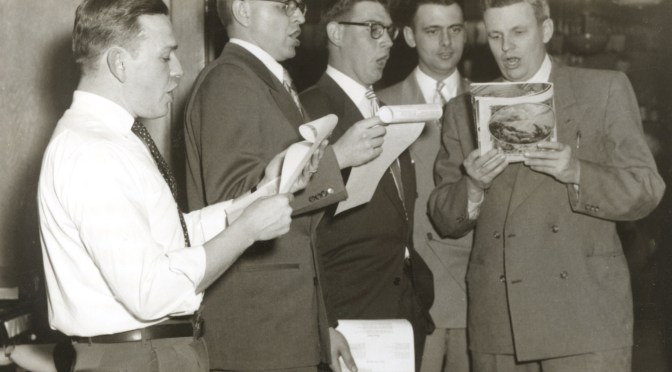
Mauston High School at the time was known for its quality vocal and instrumental music programs. The boys’ double quartet or octette was among the highest profile examples of that quality. The barbershop group regularly competed at the state level in competition sponsored by the Wisconsin School Music Association (WSMA).
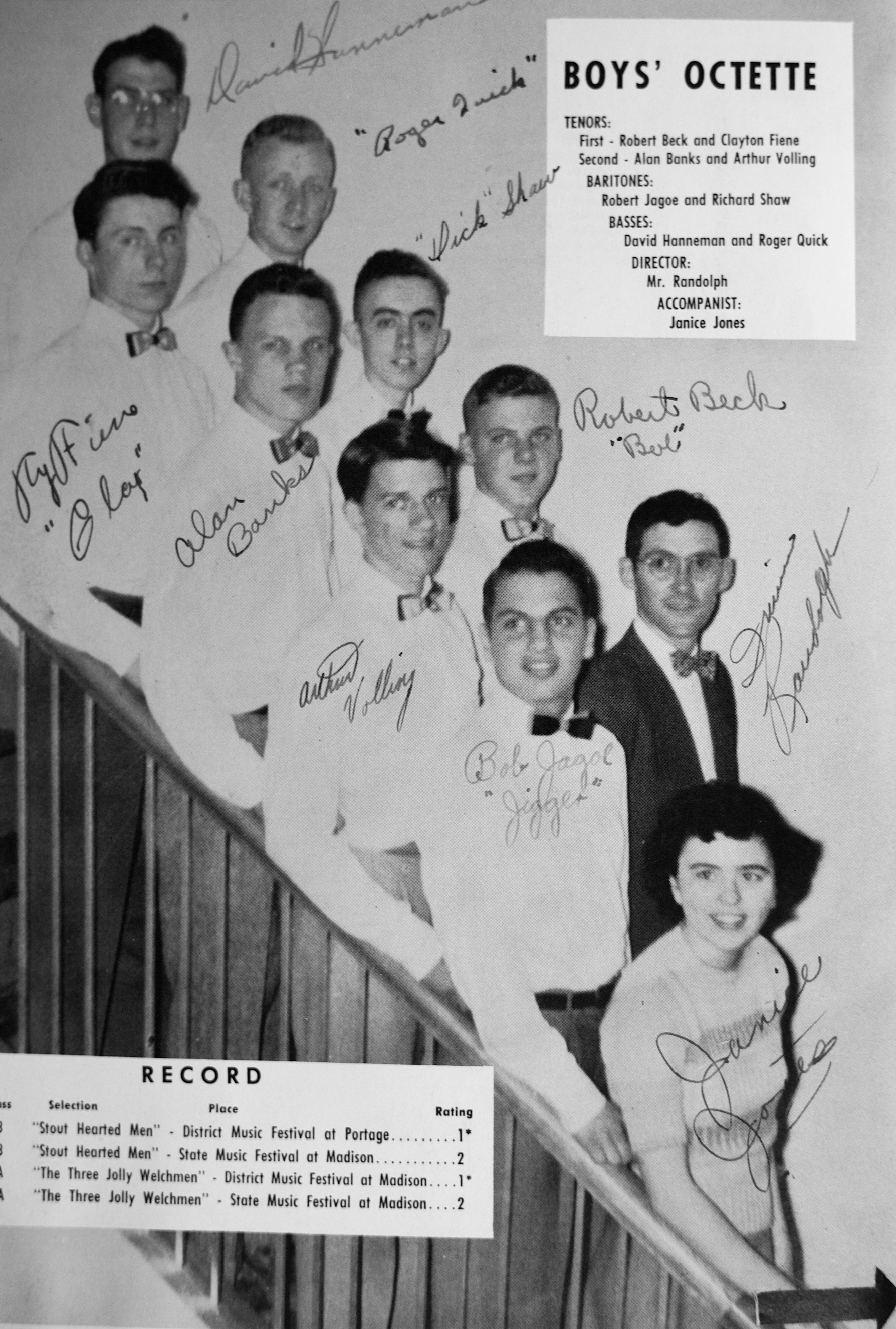
The group included Hanneman and Roger Quick at second bass, Bob Jagoe and Dick Shaw at first bass, Clayton “Ty” Fieneand Bob Beck at first tenor, and Alan Banks and Arthur Volling at second tenor. Self-dubbed the “State Men” for annual appearances in competition, the group had its own cartoon likeness drawn into the Mauston High School yearbook, The Hammer.
Members of the Mauston High School boys double quartet.
In the many WSMA competitions, David Hanneman also sang bass solos, duets and mixed quartets and double quartets. According to one of the judge’s score cards, a Mauston quartet was rated “excellent” for tone, “good” for intonation and “good” for technique. Another judge rated Hanneman “excellent” for his bass solo and noted “maturity of quality” as his greatest singing asset. Hanneman kept the dozens of medals he won at these competitions for many decades after high school.
The “State Men” had their own page in the Mauston High School yearbook in 1951.
Singing wasn’t Hanneman’s only musical interest, however. He played the trumpet for a time and was in the Mauston public school band. He appeared in numerous parades playing the bass drum for the band.
David got his love of song from his mother, Ruby V. Hanneman. As a youngster, Ruby often performed onstage at theaters in Wisconsin Rapids. The Hanneman home in Mauston had a beautiful pump organ and a Victrola record player with a large collection of music. Later in life he appeared in a number of community musicals and sang in the choir at Sacred Hearts of Jesus and Mary Catholic Church in Sun Prairie, Wisconsin. His deep voice could carry the entire parish in song, with enough volume to almost lift the church off its foundations.











 The Hanneman Archive