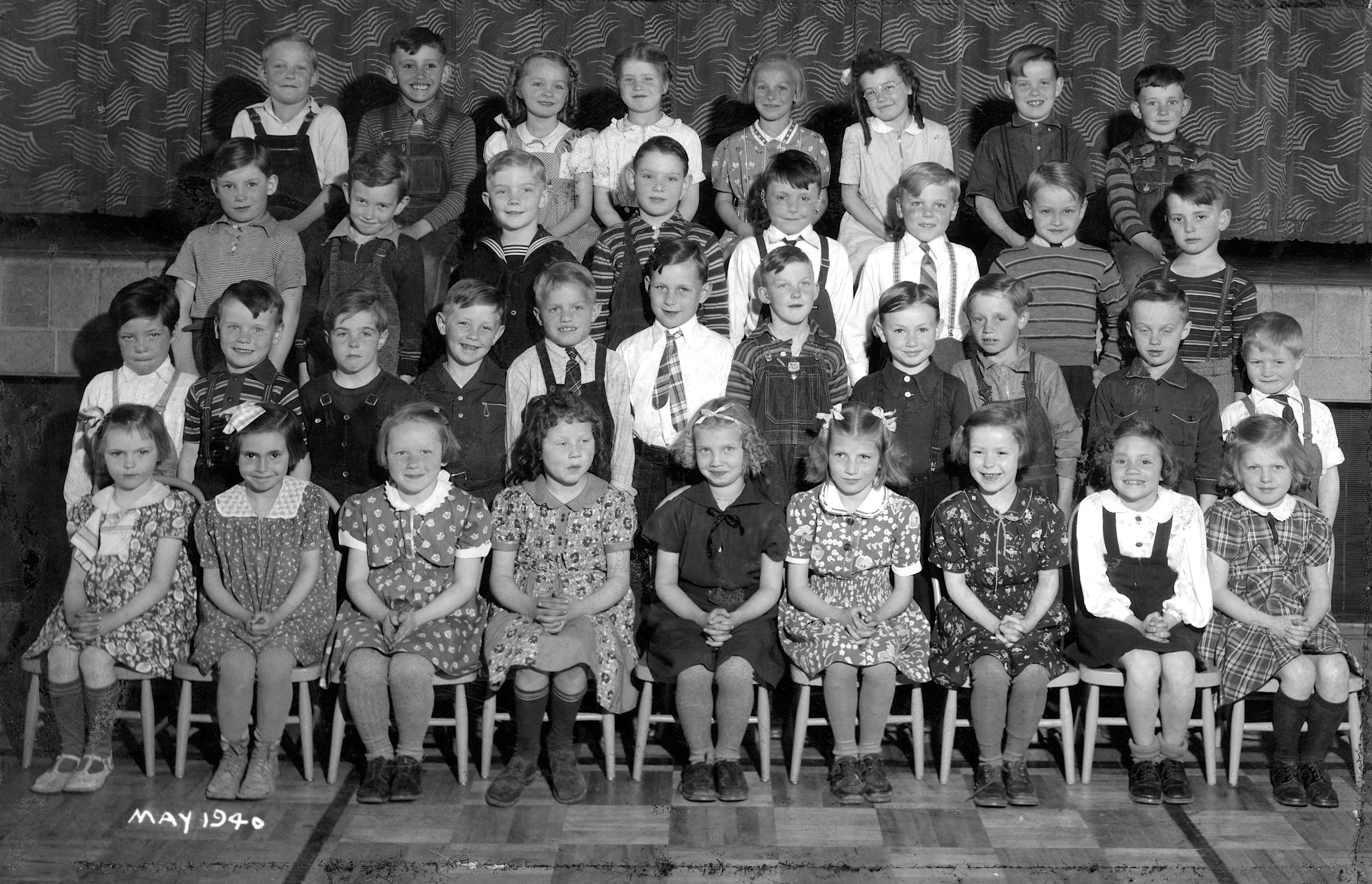
Many in this group photo from May 1940 would spend their entire pre-secondary education together in Mauston, Wisconsin. A few of the children in this MaustonGrade School photo had moved from Mauston by the time the 1940 U.S. Census was taken a month later. But many graduated together in the Class of 1951 at Mauston High School.
Bottom Row: Leah Reynolds, Clara Minor, Carol Quamme, Arlene Naglus, Alice Chilson, A. Longsdorf, Gladys Baldwin, Patricia Lane, Mary Crandall.
Second Row: Gerald Stout, S. Jones, Norman Pelton, Arnold Beghin, Almeron Freeman, Tommy Rowe, E. Roberts, Donald Millard, Harold Webster, George Lyons, Robert Randall.
Third Row: Donald Jax, Bernard Solberg, Wendell Smith, David Hanneman, Clayton ‘Ty’ Fiene, Robert Beck, Robert Firlus, Donald Clickner.
Fourth Row: H. Faulkner, Erhard Merk, Joy Smith, Lillian Ackerman, Jessie Hauer, Edith Shaw, Edwin Booth, O. Boldon.
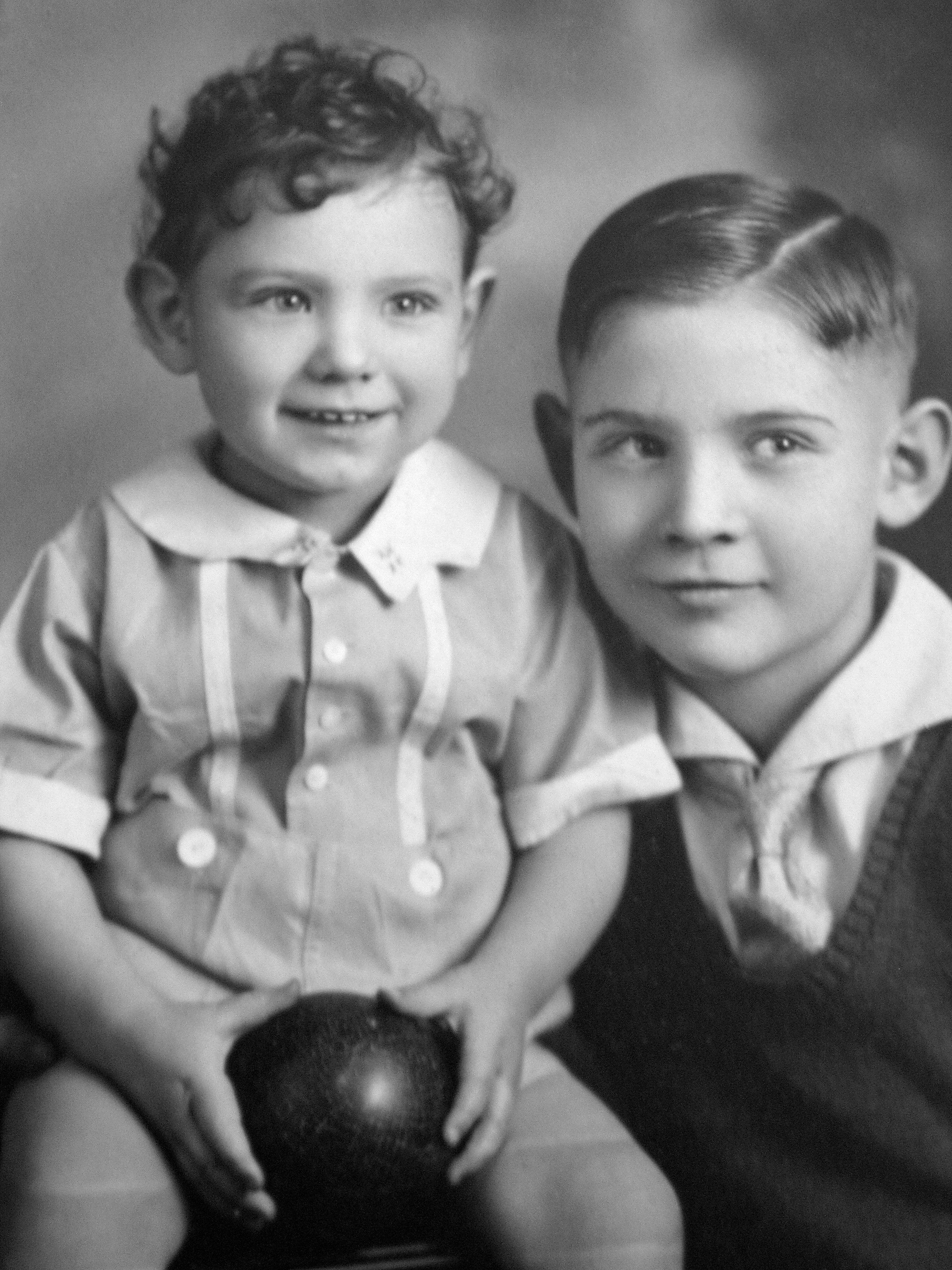
This is one of the earliest photos showing brothers David D. Hanneman (left) and Donn G. Hanneman, taken circa 1936. I believe this portrait was taken in Mauston, Wisconsin, where the family moved in early 1936. My Dad (David) was 3 years old that year. The family had a good relationship with Bauer Studios, so throughout the years there were always nice portraits of the Hanneman children.
David D. Hanneman (1933-2007) and brother Donn G. Hanneman (1926-2014).
I love the curly head of hair on Dad. He always had a great head of hair, right up to the day he lost it from chemotherapy in 2007. He asked me at the time if I thought it would grow back. I said yes, although Dad died before it had the chance. I imagine one day seeing him in Heaven, with either that distinguished-looking silver mane or the wavy jet-black hair from his youth.
It was mixed in with photographs and other documents — a colorful, torn ticket stub. I picked it up and examined it and was left wondering, what is the story behind it? The game was between the University of Wisconsin and Northwestern on November 10, 1945. I presumed that my Dad was the lucky holder of the $1.75 ticket. He was 12 at the time, so a trip from Mauston to Madison for a college football game would have been a big treat. I had to find out more about this game. So I dug right into it.
The ticket stub was like an invitation to re-live the 1945 homecoming game.
The weather forecast for the homecoming game called for a high of 39 degrees after an overnight low of 18. The Friday night calm on the UW campus was broken by roving mobs of teenagers who broke store windows and vandalized cars along State Street. Madison police made 49 arrests for curfew violations, according to The Wisconsin State Journal. Still, police considered the homecoming crowd on campus well-behaved overall, so they did not use the tear gas and water wagons that were held in reserve.
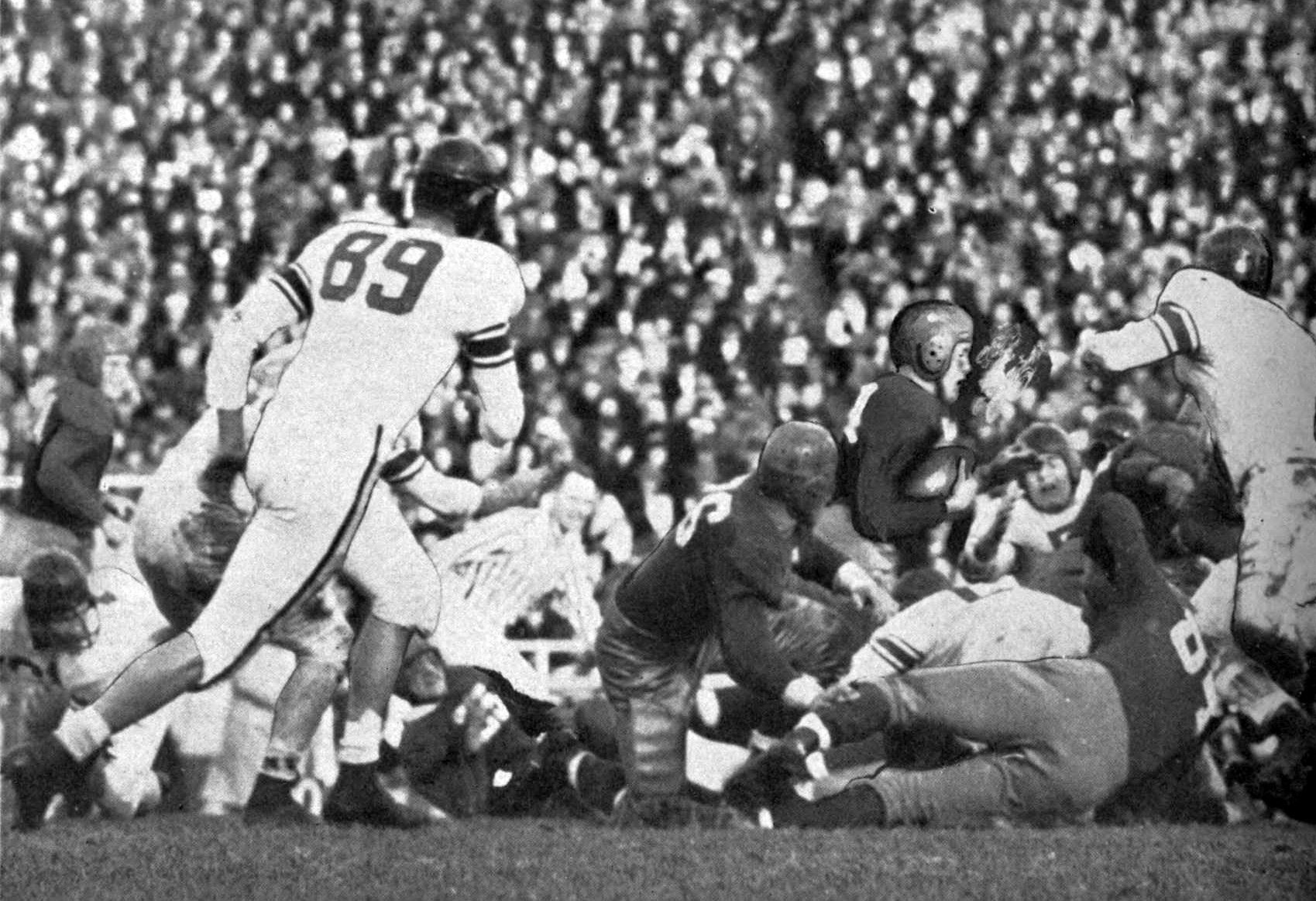
Scatback Jerry Thompson runs for 5 yards against Northwestern on November 10, 1945.
Camp Randall was packed with 45,000 fans when game time arrived on Saturday. Dad (or whomever held that ticket) sat in the south end zone, Section Z, Row 6, Seat 5. This is the end of the stadium backed against the UW Field House. I’ve sat in that section myself a few times over the years. Fans were treated to a great game. “This was a game with few dull moments, one in which each turned loose a devastating running attack,” wrote Henry J. McCormick, sports editor of The Wisconsin State Journal. The first quarter ended scoreless. Wisconsin’s initial drive ended on Northwestern’s 48 when Jerry Thompson’s pass was intercepted. Northwestern fared no better, as its drive ended on Wisconsin’s 25 when Badger Don Kindt intercepted a Jim Farrar pass.
‘Big Ben’ Bendrick slashed Northwestern for 133 rushing yards, but fumbled twice.
In the second quarter, Wisconsin scored a touchdown on a 16-play, 80-yard drive that ended with a reverse and a pass to the end zone. Northwestern answered with an impressive 73-yard touchdown drive. Wisconsin roared right back on the next drive. Halfback Ben Bendrick ripped off 17 of his 133 yards on one play. Kindt finished the drive by plunging into the end zone with only 8 seconds left in the half. Halftime score was 14-7 in favor of the Badgers. The second half opened with the same high tempo. Northwestern took the kickoff and moved right down the field with 70 yards on 11 plays. Farrar’s 25-yard pass to tight end Stan Gorski brought the game to a 14-14 tie. On the very next drive Wisconsin’s Bendrick tore off a 41-yard run, followed by an 11-yard scamper from Kindt. A fourth-down pass from Thompson was intercepted by Bill Hunt of Northwestern. When the Wildcats pounded down to the Wisconsin 1 yard line on the drive, the Badgers’ defense stiffened, stopping the Cats on a fourth-down pass play. As the third quarter ended, the score was still knotted at 14.
On the opening drive of the fourth quarter, Bendrick continued his punishing ground game. But lightning struck as Bendrick went around left end. The ball popped out, right into the hands of Northwestern’s Hunt, who returned the ball to the Wisconsin 9 yard line. After two running plays, Northwestern took it to the end zone for a 21-14 lead. The teams then traded unsuccessful drives. Wisconsin’s Thompson threw another pick at mid-field, but Northwestern’s ensuing drive stalled. When the Badgers got the ball back, Bendrick fumbled again. Northwestern pounced on the ball at the Wisconsin 24. Seven plays later, Northwestern scored to go up 28-14. That’s how the game ended.
When your team rolls up 244 yards rushing, it typically won’t lose. But on this day, the Badgers made too many mistakes, spotting the Wildcats 14 points with two fumbles. The headlines should have been about Bendrick’s stellar 133-yard rushing day. The Badger faithful left Camp Randall entertained, but unsatisfied. If my Dad, David D. Hanneman, was the ticket holder, I’m guessing he was there with his father, Carl F. Hanneman. The first Wisconsin game I can recall attending with my grandfather was a 1977 game vs. Michigan State. The Badgers lost that day, 9-7.
Don Kindt ran for 63 yards against Northwestern.
Hidden behind the headlines of the 1945 game was a compelling military story. It was just the third game back for Don Kindt, who shared halfback duties with “Big Ben” Bendrick. As just a 17-year-old, Kindt interrupted his Wisconsin football career in 1943 to enlist in the U.S. Army’s 10th Mountain Division during World War II. He saw extensive action in Italy and was awarded two bronze stars. He returned to the Badgers in October 1945. After his Wisconsin playing career, Kindt spent nine seasons with the Chicago Bears. He recounts his war experiences in an extensive interview conducted in 1994 by the Wisconsin Veterans Museum.
There are several great things about this image of my Dad and his two siblings, taken in 1956 at Nekoosa, Wisconsin. The colors from the Kodachrome slide film are vivid, from the blue sky to the slicked-back black hair. The clothes are natty and the hairstyles are so 1950s. Right to left are Donn Gene Hanneman (1926-2014), Lavonne (Hanneman) Wellman (1937-1986), and my Dad, David D. Hanneman (1933-2014).
The photo was taken at the home of the trio’s uncle and aunt, Marvin and Mabel Treutel. The occasion was a Treutel family reunion. Their mother and my grandmother, Ruby V. Hanneman (1904-1977), was a Treutel before marrying Grandpa Carl F. Hanneman (1901-1922). It’s sad to think all three of them are gone, but I find comfort in the hope they are together in Heaven.
“Stentorian Voice.” Of all the notations in the Mauston High School yearbooks of David D. Hanneman, those two words truly stand out. In the “Report of Condition of the Students of Mauston High School” in 1950, David Hanneman’s asset is listed as “stentorian voice.” Not a common adjective, “stentorian” means “of powerful voice.” It can also mean “booming” and “loud.” No doubt the years 1947-51 were stentorian years for Hanneman, for he and his singing buddies at MHS earned accolades and medals for their singing.
David D. Hanneman’s medals from the Wisconsin Centennial Music Festival in 1948.
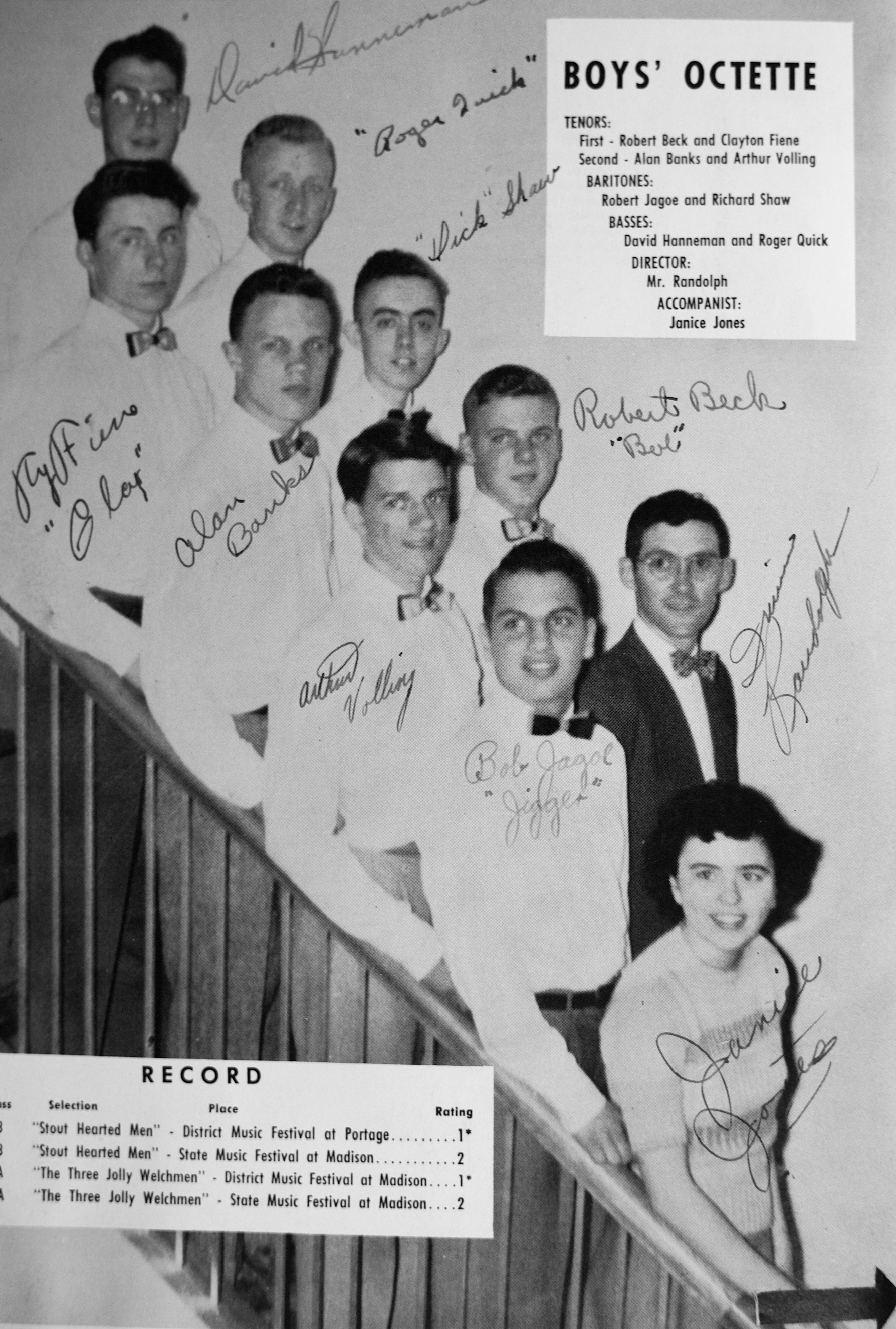
Mauston High School at the time was known for its quality vocal and instrumental music programs. The boys’ double quartet or octette was among the highest profile examples of that quality. The barbershop group regularly competed at the state level in competition sponsored by the Wisconsin School Music Association (WSMA).
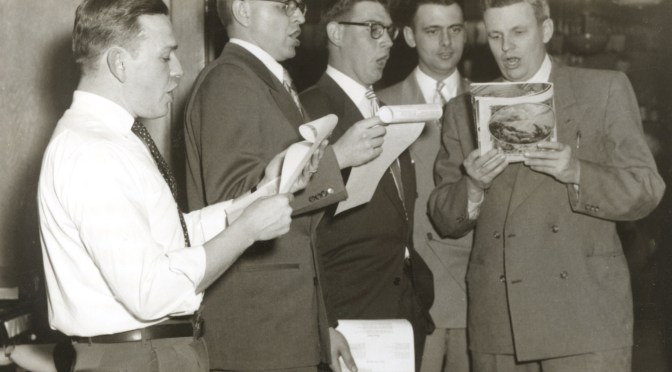
The group included Hanneman and Roger Quick at second bass, Bob Jagoe and Dick Shaw at first bass, Clayton “Ty” Fieneand Bob Beck at first tenor, and Alan Banks and Arthur Volling at second tenor. Self-dubbed the “State Men” for annual appearances in competition, the group had its own cartoon likeness drawn into the Mauston High School yearbook, The Hammer.
Members of the Mauston High School boys double quartet.
In the many WSMA competitions, David Hanneman also sang bass solos, duets and mixed quartets and double quartets. According to one of the judge’s score cards, a Mauston quartet was rated “excellent” for tone, “good” for intonation and “good” for technique. Another judge rated Hanneman “excellent” for his bass solo and noted “maturity of quality” as his greatest singing asset. Hanneman kept the dozens of medals he won at these competitions for many decades after high school.
The “State Men” had their own page in the Mauston High School yearbook in 1951.
Singing wasn’t Hanneman’s only musical interest, however. He played the trumpet for a time and was in the Mauston public school band. He appeared in numerous parades playing the bass drum for the band.
David got his love of song from his mother, Ruby V. Hanneman. As a youngster, Ruby often performed onstage at theaters in Wisconsin Rapids. The Hanneman home in Mauston had a beautiful pump organ and a Victrola record player with a large collection of music. Later in life he appeared in a number of community musicals and sang in the choir at Sacred Hearts of Jesus and Mary Catholic Church in Sun Prairie, Wisconsin. His deep voice could carry the entire parish in song, with enough volume to almost lift the church off its foundations.
United States Marine Cpl. Almeron A. Freeman was scheduled to finish his three-year military service in just a matter of months. After nearly 1½ years in Korea with the 1st Marine Division, Freeman was headed for California aboard a U.S. Navy transport in March 1955. He never made it home. The Douglas R6D airplane slammed into a mountain peak on the Hawaiian island of Oahu. All 66 aboard were killed.
The Bakersfield, California paper from March 22, 1955.
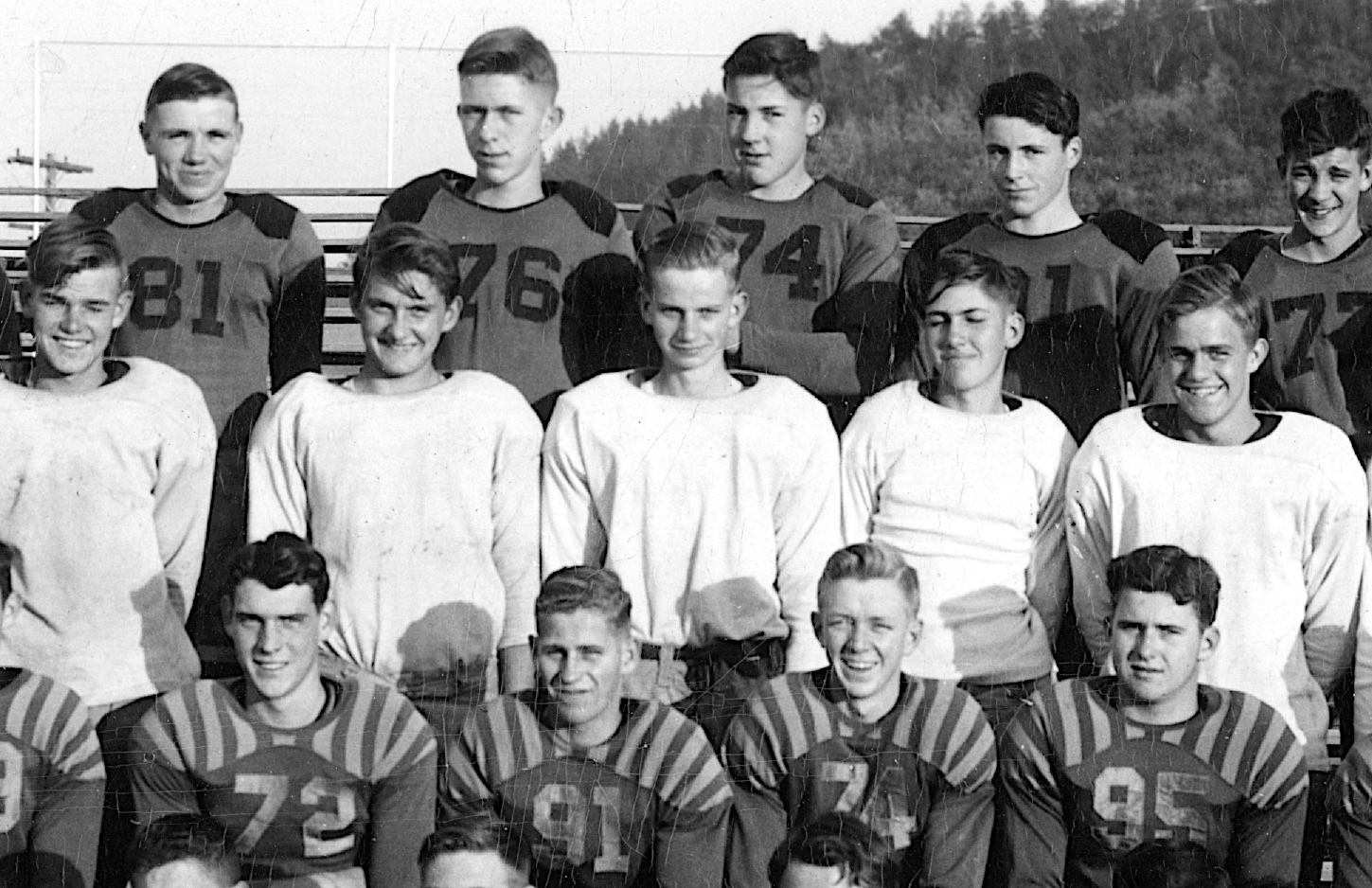
My father, David D. Hanneman, played football with Freeman at Mauston High School. Although Freeman was a year behind Dad in school, he was the same age. Freeman played left guard and wore No. 64 during the 1950 season. Dad played left tackle and wore No. 66. They were both muscular and athletic. Freeman’s death left a deep impression on Dad. In 2006, when planning the Mauston High School Class of 1951’s 55th reunion, Dad made sure Freeman’s photo was included in the program.
U.S. Marine Cpl. Almeron A. Freeman.
Freeman enlisted in the Marine Corps on August 27, 1952, directly after his graduation from Mauston High School. He was an infantry rifleman with the First Marine Division. He landed for duty in Korea just four months after an armistice ended Korean War combat and began a tense “peace” along the 38th Parallel.
At the end of his tour, he flew from South Korea to Tokyo, then to Hickam Field on the island of Oahu in the Hawaiian Islands. Just after 6 p.m. on March 21, 1955, Freeman was onboard a U.S. Navy R6D transport that left Hickam for Travis Air Force Base in California. Some 3½ hours into the flight, the plane developed radio problems and turned back for Oahu. Just after 2 a.m. on March 22, the plane was seen roaring low over the Navy’s Lualualei ammunition depot. Marine Pfc. Joseph T. Price, on guard duty at Lualualei, said the pilot turned on the landing lights and discovered the plane was headed straight into the Wai’ane Mountains. At the last second, the plane made a hard right, but slammed into the mountain about 200 feet below the tip of Pali Kea Peak. The explosion “lit up like daylight for about a minute,” Price said.
Almeron Freeman (farthest right in middle row), played for Mauston High School with David D. Hanneman (No. 72 in front row).
The resulting fire was so hot that it took rescuers nearly two hours to get close enough to confirm there were no survivors. The 66 killed included nine Navy crewmen and 57 passengers: 17 U.S. Air Force, four Navy, 12 Marines, 22 U.S. Army and two civilians (a mother and her baby daughter). It was the worst air disaster in Hawaii’s history. The U.S. Military Air Transportation System, which operated the flight, had flown 1.12 million passengers and crossed the Pacific nearly 42,000 times between January 1951 and March 1955 with no fatalities. The crash was caused by crew error. The plane was 8 miles off course when it struck the mountain.
Freeman’s junior class portrait.
Almeron Arthur Freeman was born February 3, 1933 in Dresbach Township, Minnesota, the son of Irvin M. Freeman and the former Lilah Jenks. Prior to 1940, the family moved from Houston County, Minnesota to Mauston. Irvin worked as a service station attendant. In addition to being a starting guard on the football team, Almeron was a member of the highly rated Mauston boxing team.
Freeman (at left in first row) pictured in 1951 with other letter winners in the M Club.
He came from a proud family military tradition. His great-grandfather and namesake, Almeron Augustus Freeman, served in the Civil War with the 1st Independent Battery, Wisconsin Light Artillery. The battery served under General William Tecumseh Sherman and General Ulysses S. Grant at the battle of Vicksburg, the battle of Port Gibson and later in defense of New Orleans. The elder Freeman later married and became a river pilot moving lumber on the waterways of Wisconsin.
Almeron Freeman (No. 30) played basketball for Mauston High School with David D. Hanneman (second from left in front row).
Marine Cpl. Freeman was buried May 17, 1955 at Jefferson Barracks National Cemetery in St. Louis. Due to the nature of the crash and fire, the remains of 40 service members were buried in a group grave site containing nine caskets. A memorial service for Freeman was held at Mauston High School on May 15, 1955.
The tragedy of the March 1955 air crash extended beyond the immediate victims and their families. Air Force Staff Sgt. Marion “Billy” Shackleford was scheduled to be on that flight, but because he forgot his travel papers, he was denied boarding. He was spared the fate of the 66 crash victims and returned home to Alabama to report for a new assignment. On April 19, 1955, the car he was driving was hit head-on by a Trailways Bus. He was killed instantly. His father, working on a nearby construction job, witnessed the accident. Like Freeman, Sgt. Shackleford was the great-grandson of a Civil War veteran.
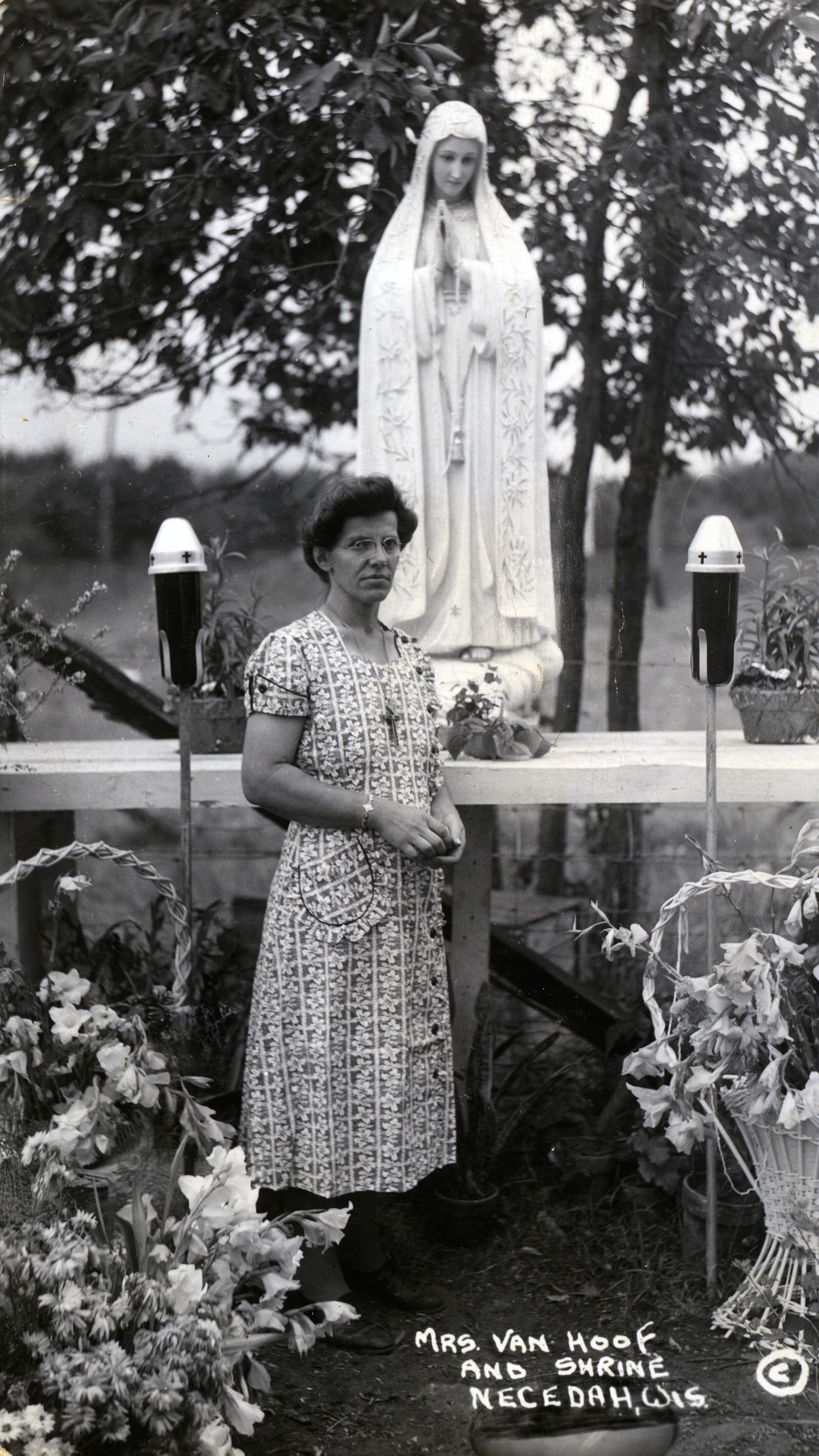
Nothing was bigger news in the fall of 1950 in central Wisconsin than Mary Ann Van Hoof and her claims of receiving visions from the Blessed Virgin Mary at the Van Hoof farm near Necedah. Members of the Hanneman family of Mauston, had great devotion to Mary, and they were among 50,000 people in Necedah on October 7, 1950, when Van Hoof received the eighth of her reported visions of Mary.
The front page of the Wisconsin State Journalthe next day recounted the alleged vision this way:
Mary Ann Van Hoof at her farm near Necedah, Wisconsin.
“Mrs. Fred Van Hoof said she saw the Virgin Mary in a vision for the eighth time Saturday and was told in a ‘last warning’ to pray for peace. The gaunt farm wife, who said last August that the Virgin would appear to her Saturday noon in a blinding light, walked from her shabby home at the appointed hour, knelt in prayer and raised a crucifix to a statue of the Virgin. At that moment, the sun burst through rain clouds which had hovered over the humble farm most of the morning, and a murmur swept through the crowd estimated by state police at 50,000 persons.After a few minutes, Mrs. Van Hoof arose and addressed the mingled throng of curious and claims to have done on previous visitations. ‘This is the battle for peace for all of you,’ she said. ‘Prayer, my dear children, will bring you peace.’ ”
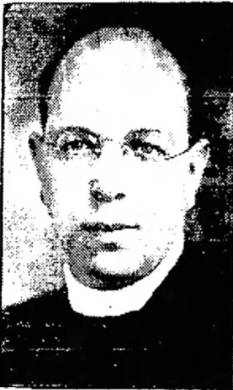
Rev. Father Victor A. Fortino
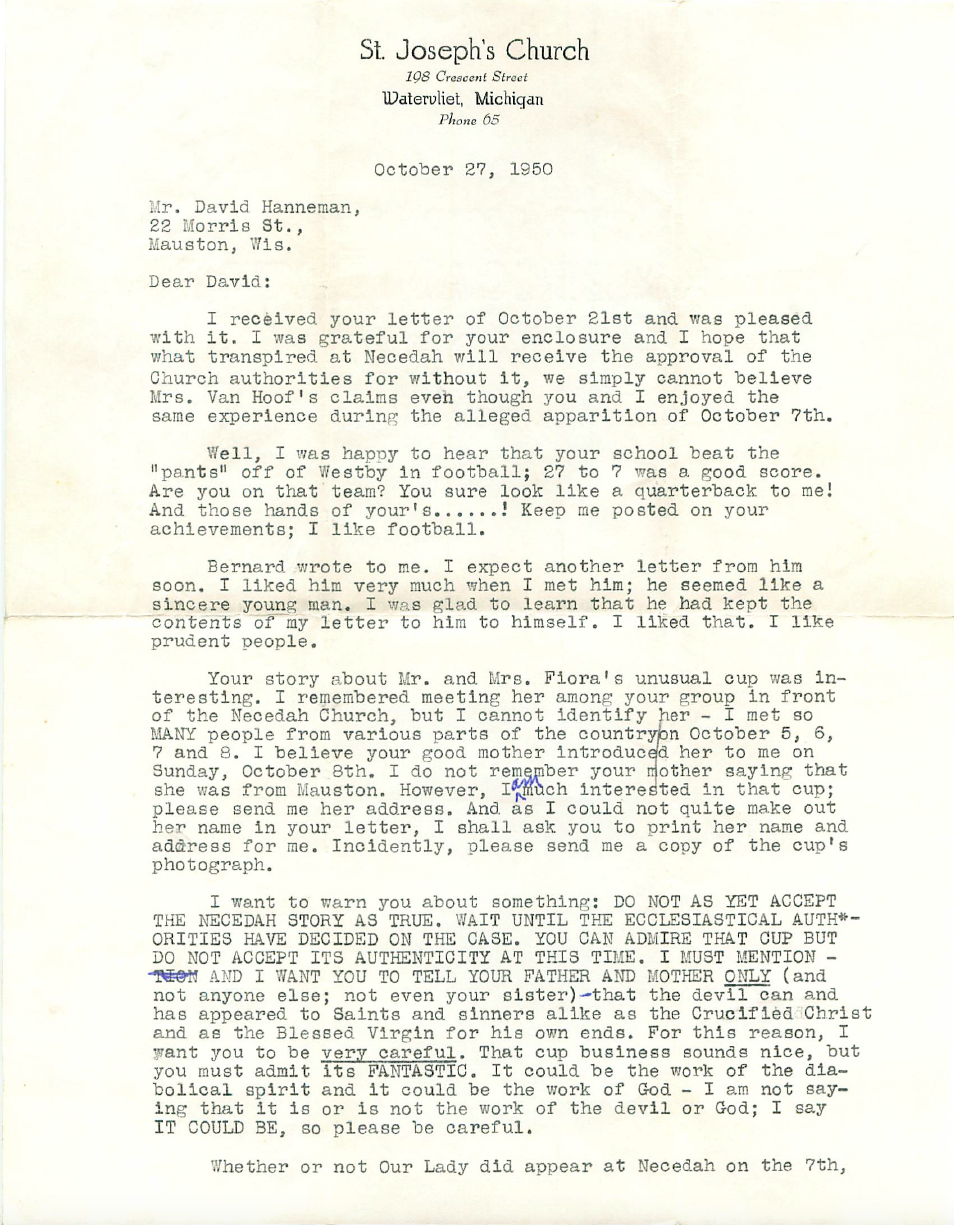
A priest from Watervliet, Michigan, who was also in attendance that day befriended the Hanneman family. Rev. Father Victor A. Fortino of St. Joseph’s Church in Watervliet, cautioned 17-year-old David D. Hanneman to wait for Catholic Church authorities to approve the alleged visions before he placed too much stock in them. “I hope that what transpired at Necedah will receive the approval of the Church authorities,for without it, we simply cannot believe Mrs. Van Hoof’s claims even though you and I enjoyed the same experience during the alleged apparition of Oct. 7,” Fortino wrote in a letter dated October 27, 1950.
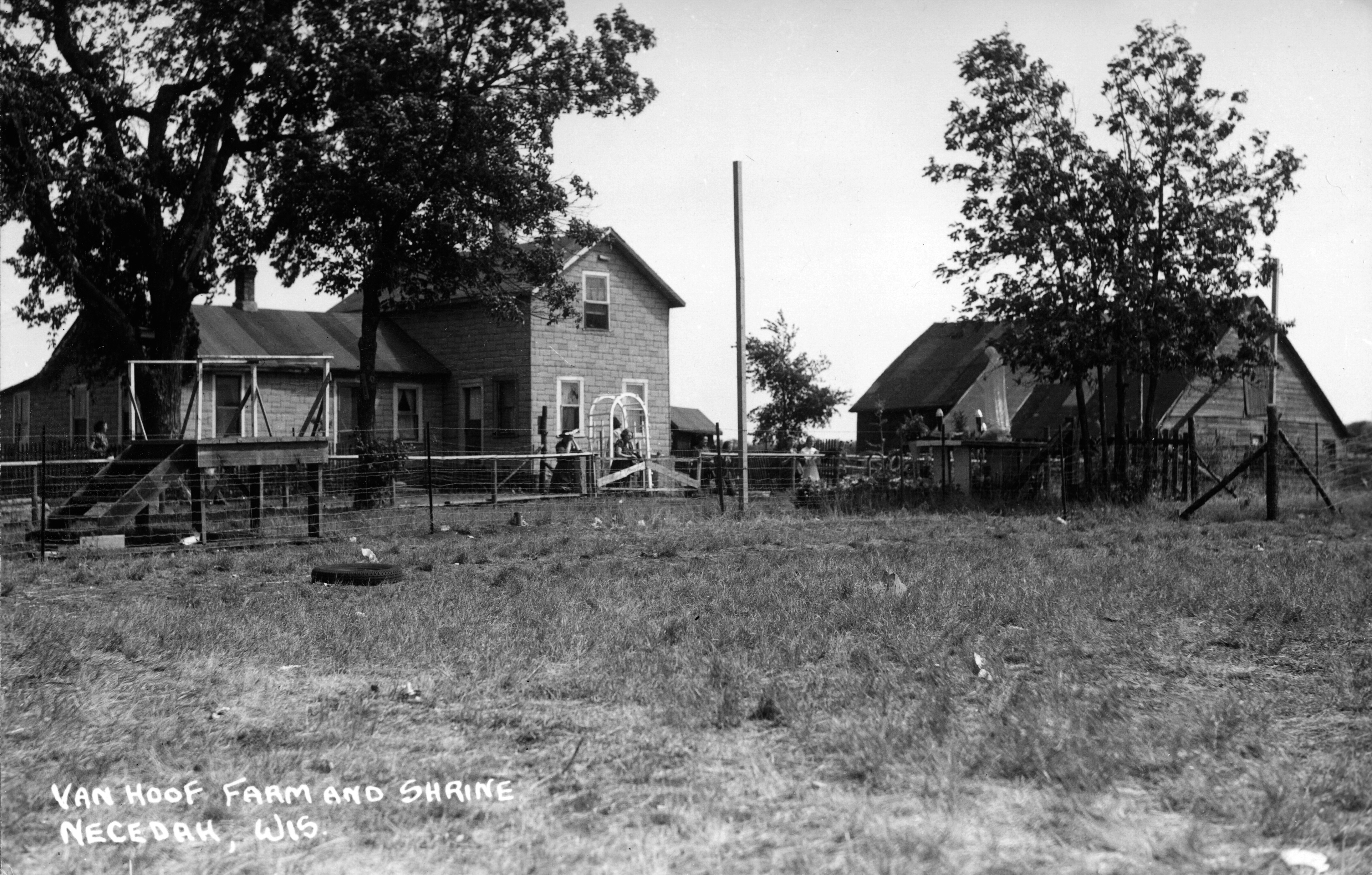
The Van Hoof farm near Necedah, Wisconsin, was the site of reported visions of the Blessed Virgin Mary.
Father Fortino warned that Satan has appeared to Saints and sinners alike posing as the Blessed Mother and as the Crucified Christ, so it is crucial that the Church rule on the Van Hoof apparitions. “I want to warn you about something,” Fortino wrote. “DO NOT AS YET ACCEPT THE NECEDAH STORY AS TRUE. WAIT UNTIL THE ECCLESIASTICAL AUTHORITIES HAVE DECIDED ON THE CASE.”
As it turned out, Fortino’s words were almost prophetic. In June 1955, Bishop John Treacy of the Diocese of La Crosse officially rejected Van Hoof’s visions.“Because of the continued promotion of the claims made by Mrs. Mary A. Van Hoof of Necedah, Wis., we, by virtue of our authority as bishop of the diocese of La Crosse, hereby declare that all claims regarding supernatural revelations and visions made by the aforementioned Mrs. Van Hoof are false. Further more, all public and private religious worship connected with these false claims is prohibited at Necedah, Wis.” As early as August 1950, Bishop Treacy had said Van Hoof’s claims “are of extremely doubtful nature.”
Father Victor Fortino urged David Hanneman: “be very careful.”
Father Fortino may have suspected the Necedah claims would turn out to be false, but he wrote that some good could come from the gathering that week in 1950 no matter what. “It seemed to me that Our Lady brought us together for Her own good purposes,” Fortino wrote. “What She intends for us, I do not know. But I hope that much good will come out of our chance meeting and our mutual experience in Necedah.”
Despite the controversy over Van Hoof and her claims, the Hanneman family maintained strong devotion to the Blessed Virgin Mary. Carl and Ruby Hanneman kept a beautiful porcelain statue of the Blessed Mother in their Mauston home. After their deaths that statue found a place at David Hanneman’s residence in Sun Prairie. And it sat in front of the altar at his funeral Mass on April 19, 2007.
My Dad’s family made several trips out West, to Arizona and the Dakotas. Sorting out and matching photos with cities has been a constant challenge. A couple of intriguing photos show Dad with a cowboy identified as Hiram Greene. I wondered, was Hiram Greene a famous rodeo rider, a film star or some other celebrity?
My first source of information was the caption on the back of one photo, written by my grandmother, Ruby V. Hanneman. It listed the name “Hiram Greene” and said he was from Billings, Montana. The photo, according to the caption, was taken at Canistota, Minnesota. As it turned out, that caption was problematic in several respects.
Hiram Greene with David D. Hanneman on July 14, 1945.
I took a chance by doing a generic search engine query and came up empty. I quickly ruled out the idea that Mr. Greene was a major celebrity. Using databases at Ancestry.com, I was unable to find anyone by that name near Billings, Montana. But I did find what appeared to be a good match right in South Dakota, where the Hanneman family vacationed several times in the 1940s.
Hiram Hoyt Greene was a farmer who lived much of his life around Mitchell, S.D. I ran a quick search and discovered the major tourist attraction in Mitchell is the Mitchell Corn Palace, home to world-famous murals made from corn. That quickly rang a bell with me. I had numerous photos of the Hannemans outside the Corn Palace. This led me to conclude that it was possible that Dad met Hiram Greene on the streets of Mitchell. Especially since there is no Canistota, Minnesota. There is a Canistota, S.D., another city the Hanneman family visited on vacation. Canistota is home to the famous Ortman Chiropractic Clinic. I could find no link between Hiram and Canistota, although it is only 40 miles from Mitchell. I took yet another look through the photo library and found an image of the Ortman Clinic. The building next to it appears to match the brick building that Dad and Mr. Greene are standing near. So it was Canistota after all.
According to the 1940 U.S. Census, Hiram Hoyt Greene was a livestock and grain producer. This made sense. A cattle rancher would certainly dress like a cowboy. Perhaps Dad saw Mr. Greene on the street and wanted to have his photo taken with a real cowboy. I wonder if that had happened to Mr. Greene before? I started out looking for a celebrity, but found a regular, hard-working cattle rancher. It was an even better story, in my opinion.
Hiram Hoyt Greene was born in May 1898. At the time of the World War I draft, he was a farmer in Mitchell, S.D. In May 1920, he married May Luella Moe. The couple had nine children. At various times in his working life, Greene farmed and lived in Mitchell, the Town of Beulah and Mount Vernon, South Dakota. He was hospitalized in November 1958, just a day after celebrating the wedding of one of his sons. He died on November 28, 1958 at age 60.
I learned several key lessons from this photo detective assignment. First, it is always a good idea to write down information on the back of photographs. Or in the case of modern digital images, to embed a caption and keywords in the photo files. But you can’t always trust the information on old photo prints. Sometimes captions are written long after the events shown in the photo. Memories can be jumbled, so it is good to check the information and correct it if necessary.
— This post has been updated with more information.
It was a tiny photograph, not much larger than an oversized postage stamp. It showed two boys, identified on the back as Bob Firlus and Sam Kaufman. Of course I was very familiar with Bob, my Dad’s lifelong friend from Mauston, Wisconsin. But Sam did not ring a bell. However, his presence in my Dad’s photo collection meant that he was a friend and likely a frequent guest at the home of my grandparents on Morris Street in Mauston. I wondered, what became of Sam?
Bob Firlus (at left) and Sam Kaufman on Morris Street in Mauston, circa 1940.
The photo detective in me kicked into high gear. My first check was with Mr. Firlus, who had some distinct and humorous early memories of Sam:
They had a nice house on Tremont Street. One day Sammy and I walked out to Coon Rock Bluff a few miles west of Mauston. We were near the bluff and Sammy said that he had to take a pee but he asked me not to tell his dad because his dad told him he should not pee outdoors.
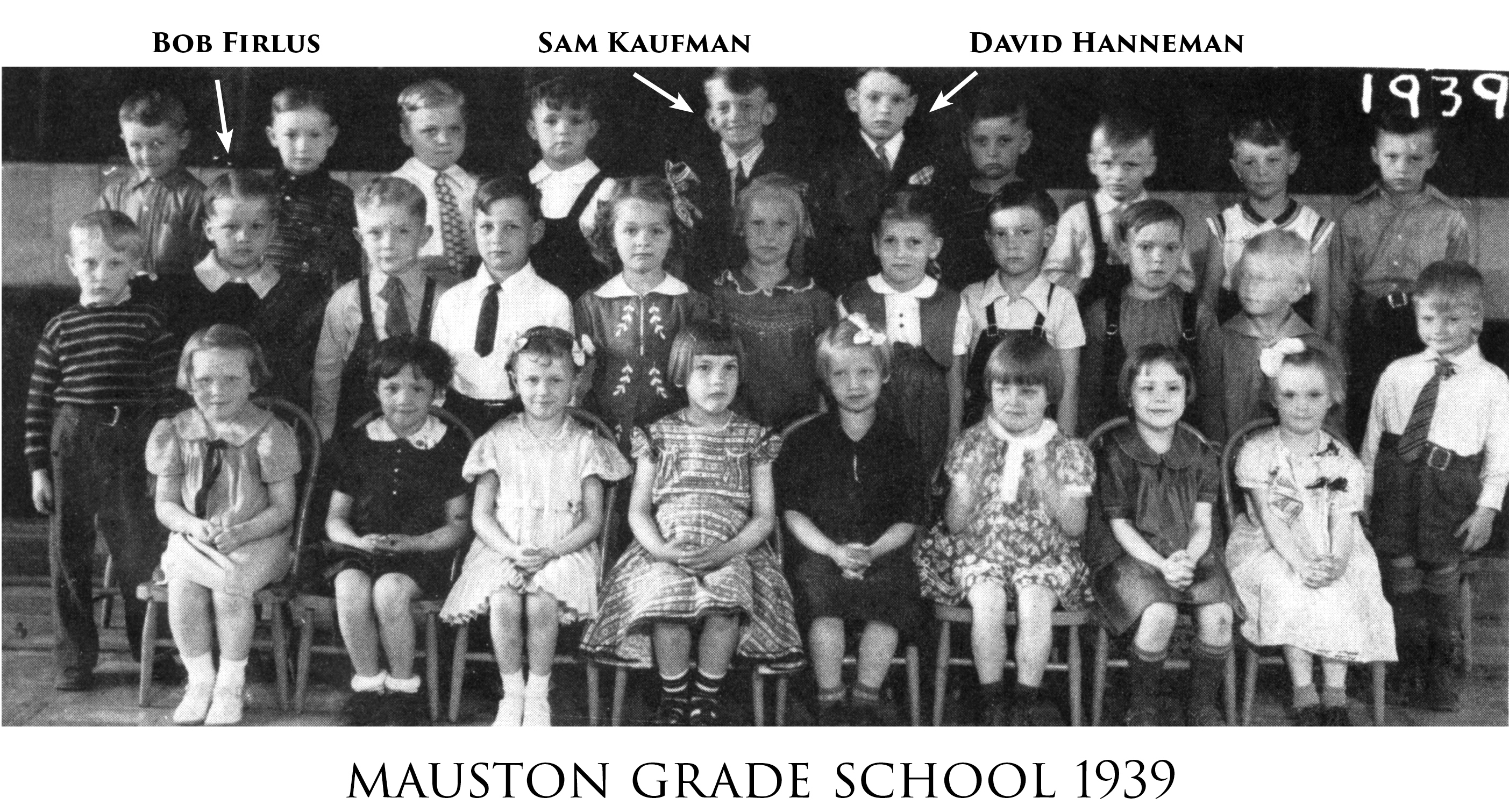
Ah, the troubles of youth! What a great story! Bob said he believed Sam had moved to Pennsylvania after leaving Mauston. I next dug out some of my Dad’s yearbooks and found Sam pictured with my Dad’s Mauston Grade School class in the late 1930s and early 1940s. He was one of the tallest boys in class, so was usually found in the back row. In the 1939 class photo, he was standing directly to my Dad’s right.
Bob Firlus, Sammy Kaufman and David Hanneman are shown in this early school photo.
I checked the U.S. Census and military records on Ancestry.com and found Sam’s father, Albert Ross Kaufman, a doctor at Mauston’s Hess Memorial Clinic. The elder Kaufman’s 1942 draft card showed he was 46 and living with his family at 214 Tremont Street in Mauston. That was fairly close to the Hess clinic, but not so close to the Hanneman house. So what was his connection to that photo taken on Morris Street? I looked up Sam’s mother, Ardis, and discovered her maiden name was Hess. OK, now we’re making progress. Hess was a very prominent name in Mauston, largely due to Dr. James Samuel Hess Sr., a pioneer doctor and founder of the hospital and clinic. Interestingly, Bob Firlus said he had recently thought about Sam and the name Ardis came to mind, although Bob hadn’t recalled that was Sam’s mother’s name.
Turns out that Dr. Ardis (Hess) Kaufman (also a physician) was the daughter of Dr. J.S. Hess Sr. and Maude (Robinson) Hess. She was the sister of Dr. J.S. Hess Jr., who lived directly across the street from the Hannemans. Dr. Sam, as the junior Hess was known, took over for his father at the hospital and clinic. That explained why Sammy was a frequent neighborhood visitor. My grandfather, Carl F. Hanneman, worked for Dr. Sam running the pharmacy attached to the Hess clinic. So it made sense that Bob Firlus and my Dad were buddies of Sam Kaufman. I dug into my photo archives and found another shot that appears to show Sam outside the Hess home around 1942.
A tall, thin young man believed to be Sam Kaufman outside the Hess home on Winsor Street.
Now that I had a good sense of Sam’s history in Mauston, I wanted to figure out where he went and what happened in his life. Again, Ancestry.com was a crucial source. I found listings for Dr. Albert R. Kaufman under city directories in New Kensington, Pennsylvania. Based on that, I ran search engine queries and located an obituary for Sam Kaufman. I reacted with sadness, since I always hope in doing this work to find a living person to track down. Sam died in October 2008 of lung cancer. Same cause as my Dad, and about 18 months later. From the obituary, it was clear Sam had lived an exemplary life.
The obituary described Sam’s college education, his longtime service in the U.S. Army, his 1957 marriage to Margaret “Meg” Floyd, and his career switch from salesman to high school teacher. He had a long teaching career at Baldwin High School in suburban Pittsburgh. The couple had two sons, James and Steve. From checking those names with search engines, it appears Steve has had a long career as an assistant U.S. attorney in Pittsburgh.
Even after I finished most of my research, Sam’s name stuck in my head. There was some other clue I was missing. Dad, could you give me some help here? Then it hit me. I vaguely recalled that Sammy accompanied my Dad’s family on one of their vacation trips to the Dakotas. But how to find the photo amidst the thousands in the archive? On this day, I had some help from above. The first archive box I opened had the photo for which I searched. The caption read: “Sammy Kaufman on right, David Hanneman on left.” It was in my Grandma Ruby’s handwriting.
David Hanneman (left) and Sam Kaufman outside the Ortman Chiropractic Clinic in Canistota, S.D., circa 1944.
It took a few days of work, but with a little effort I went from a tiny photo print with lots of questions to a decent understanding of Sam Kaufman and his life in and beyond Mauston. Well done, Sam, and thank you.
For a child growing up in the 1930s and 1940s, big adventure often came in small packages. Like many boys his age, David D. Hanneman (1933-2007) was an avid collector of Big Little Books. These chunky mini-books allowed adventure-seeking children to follow the action of Buck Rogers, Dick Tracy, Flash Gordon, Tarzan and other characters. All for 10 cents a book.
The original Big Little Books concept was pioneered by the Whitman Publishing Company of Racine, Wisconsin. Whitman was a subsidiary of Western Publishing, the creator of the famous Little Golden Books (think Poky Little Puppy). Big Little Books were roughly 3¾ inches wide by 4½ inches high. Thickness varied by page count. For example, the 1934 Buffalo Bill and the Pony Express had 380 pages and was 1¼ inches thick. The layout was one of the classic features of Big Little Books. Each page spread had text on the left side and a black-and-white illustration on the right.
Big Little Books had text on the left-facing pages and illustrations on the right pages.
Whitman Publishing came out with its first Big Little Book in 1932, The Adventures of Dick Tracy. Soon after, Whitman had titles with comic strip characters like Wash Tubbs, as well as a range of Walt Disney titles. The 1934 series alone included titles such as Chester Gump Finds the Hidden Treasure, Buck Rogers in the City Below the Sea, Reg’lar Fellers, Betty Boop in Snow White, Kayo and Moon Mullins, Mickey Mouse in Blaggard Castle and Dick Tracy and the Stolen Bonds.
Most of the books had hard covers, although my Dad had one Buck Rogers title that was softcover and in a slightly smaller format (only 4¼ inches high). This book had no page numbers. The inside back cover spread was a two-page ad for Cocomalt drink mix. The 1935 Tom Mix and Tony Jr. in Terror Trailwas a larger format (4 5/8 by 5¼ inches) and featured real photographs inside.
Ruby V. Hanneman wrote an inscription on the inside cover for my Dad’s 8th birthday.
For my Dad’s 8th birthday, he received a copy of the 1941 Tarzan the Untamed by Edgar Rice Burroughs. Ever the historian, my Grandma Ruby V. Hanneman wrote the particulars down in blue pencil on the inside front cover: “David Dion Hanneman, March 27, 1941, for 8th birthday, from Dad, Mother, Lavonne and Donn.” This title was from the Better Little Books series, also published by Whitman. In addition to the story and illustrations, it had a flip-book feature that showed an animation as the reader flipped the pages through his thumb and forefinger.
Titles in the 1941 Better Little Books series included Big Chief Wahoo and the Magic Lamp, Mickey Mouse on Sky Island, Popeye and a Sock for Susan’s Sake, G-Man and the Gun Runners, Dick Tracy and his G-Men, Red Barry Undercover Man, Ellery Queen and the Adventure of the Last Man’s Club, Inspector Charlie Chan Solves a New Mystery and others. By the time he was in high school, my Dad stopped adding to his collection. But they clearly held a special place in his heart, since he kept and safeguarded them for more than 50 years before passing them on.

















 The Hanneman Archive