Tag Archives: Carl F. Hanneman

Three Generations of Knights of Columbus

For 80 years, there has been a member of the Hanneman family in the Knights of Columbus, the world’s largest Catholic fraternal and charitable organization. The line of service runs from Carl F. Hanneman (1901-1982), who joined in 1934, to his son David D. Hanneman (1933-2007), who joined in 1953, to his son Joe Hanneman, who joined the order in April 2007.

The three generations share other things in common with respect to the K of C, based in New Haven, Connecticut, with more than 14,000 local councils across America. All three have been members of the Fourth Degree, which focuses on patriotism and love of country. All three served in the Fourth Degree Color Corps and Honor Guard. The Honor Guard, wearing tuxedos, colored capes, ceremonial swords and plumed chapeaux, is a ceremonial presence at Masses, funeral wakes, Flag Day ceremonies and other events. Joe Hanneman served on the Honor Guard for the installation of Archbishop Jerome Listecki in Milwaukee. Carl joined the Fourth Degree in the late 1930s or early 1940s, judging by the group portrait of his exemplification class. David joined in 1973 and Joe joined in 2008.

Carl F. Hanneman (left section, second row, second from center aisle), joined the Fourth Degree of the Knights of Columbus in the late 1930s or early 1940s. Exact date of this photo is unknown.

All three also served as Grand Knight of their respective local K of C council. The Grand Knight is leader of the local council. Carl Hanneman was Grand Knight of Solomon Juneau Council 2770 in Mauston, Wisconsin in the late 1960s. David Hanneman was Grand Knight of Holy Family Council 4879 in Sun Prairie, Wisconsin, from 2001 to 2003. Joe Hanneman was Grand Knight of Msgr. Stanley B. Witkowiak Council 697 in Racine in 2010 and 2011.

Altar server Joe Hanneman with his father David D. Hanneman (at right) and Bill Dziadosz.

The Knights of Columbus is a fraternal and charitable organization founded in 1882 by Venerable Father Michael J. McGivney, whose cause for sainthood is being considered at the Vatican. The Knights operate under the principles of charity, unity, fraternity and patriotism. Knights raise money and volunteer for a wide range of causes, from pro-life programs such as crisis pregnancy centers, to programs providing free wheelchairs to the disabled, to grants to local programs that support the mentally retarded. The K of C and local councils have provided more than 500 ultrasound machines to crisis pregnancy centers.

David D. Hanneman was part of a large class that became Fourth Degree Sir Knights on April 14, 1973 in Madison.

Knights provide free coats to needy children each winter. They run a variety of athletic events, including Punt, Pass and Kick, and a basketball free-throw competition. Knights also support and promote vocations to the priesthood, sponsoring seminarians and providing other material support for those studying for the priesthood. In 2013, Knights provided a record amount of charity, with over $170 million raised and 70.5 million hours of voluntary service provided. In 2014, the K of C provided more than $2 million to help persecuted Christians from Iraq and other Mideast countries being targeted by ISIS and other terrorist organizations.

Boy Scouts participate in a flag retirement ceremony run by the Knights in Racine. Speaking at the podium is Deputy Grand Knight Joe Hanneman.
Boy Scouts participate in a flag retirement ceremony run by Assembly 1207, the Fourth Degree Knights in Racine. Speaking at the podium is Deputy Grand Knight Joe Hanneman.

The Fourth Degree of the Knights is especially dedicated to patriotism and the idea that love of God and love of country go hand in hand. The Fourth Degree was founded in 1900 to combat the prejudiced notion that Catholics were not loyal Americans and could not be trusted in public office or with civic responsibility. The Fourth Degree provides free flags for schools and nonprofit organizations, supports veterans’ organizations,  provides material needs to local veterans’ hospitals, and sends faith materials and other assistance to members of the military serving overseas.

Sir Knight Joe Hanneman (left) in an honor guard at St. Rita Catholic Church in Racine.

Famous Knights include Venerable Archbishop Fulton J. Sheen, one of the Catholic Church’s all-time great authors and communicators; former Green Bay Packers coaching legend Vince Lombardi; baseball’s Sultan of Swat, Babe Ruth; Supreme Court Justice Samuel Alito; Ray Flynn, former U.S. ambassador to the Vatican; Cardinal Francis George, former archbishop of Chicago; Saint Rafael Guizar Valencia; and six martyrs of the Cristero War in Mexico: Father Luis Bátis Sáinz, Father José María Robles Hurtado, Father Mateo Correa Magallanes, Father Miguel de la Mora, Father Rodrigo Aguilar Alemán and Father Pedro de Jesús Maldonado Lucero. The K of C operates in the United States, Canada, Mexico, the Philippines, Poland, the Dominican Republic, Puerto Rico, Panama, the Bahamas, the Virgin Islands, Cuba, Guatemala, Guam and Saipan.

A number of other members of the extended Hanneman family have been members of the Knights of Columbus: Earl J. Mulqueen Sr. (my grandfather), Earl J. Mulqueen Jr., Donn G. Hanneman, longtime Wisconsin Rapids building inspector Arthur J. Hanneman, and former state representative Arthur Treutel.

— This post has been updated with a date correction and two new photographs.

©2014 The Hanneman Archive

Erinnerung An Den Tag Der Confirmation

“Memory of the Day of Confirmation.” Those German words are written in ornate lettering across a beautiful certificate commemorating the confirmation of Karl (we know him as Carl) Hanneman on June 11, 1916. The roughly 11×17 inch document, found among the papers and photographs of David D. Hanneman, is remarkably well preserved and speaks to a time before Carl’s conversion to Catholicism. The certificate is written entirely in German and reads:

“Karl Hanneman received instruction in the Word of God on 11 June 1916 in the First Moravian Church, Grand Rapids, Wis.” At the bottom of the certificate it reads: Gottes Furcht is aller Weisheit Anfang, which roughly means “All Wisdom Begins with Fear of God.” The document was signed by the Rev C.A. Meilicke.

The confirmation certificate for Carl F. Hanneman from the First Moravian Church.

We know Carl’s father, Charles Hanneman, was raised as a Lutheran, as were most of the Hannemans. The marriage certificate for Charles and Rosine Hanneman (nee: Ostermann) only says their wedding was a “Divine Service” and does not indicate a church. In 1907, Charles and Rosine and their four sons joined the First Moravian Church of Wisconsin Rapids, a congregation of some 450 people in a brick church on First Avenue South.

The Moravian Church is one of the oldest Protestant denominations and traces its roots to the 1450s in Bohemia and Moravia. The area is now part of the modern day Czech Republic. It is possible the family’s connection to the Moravian Church came from Rosine (Ostermann) Hanneman, whose father emigrated from Saxony in what is now eastern Germany.

Carl and Ruby Hanneman were both converts to Catholicism, but we’ll save those stories for another entry.

©2014 The Hanneman Archive

Wedding Wednesday: Carl and Ruby Hanneman

Nearly 90 years ago on a summer Tuesday morning, Ruby Viola Treutel and Carl Henry Frank Hanneman joined in marriage at St. James Catholic Church in Vesper, Wisconsin. The marriage, which would live on for more than 50 years and produce three children and 16 grandchildren, was described in detail in a story in the July 15, 1925 edition of the Wisconsin Rapids Daily Tribune:

TREUTEL-HANNEMAN
One of the prettiest weddings of the summer was solemnized yesterday morning at nine o’clock at St. James church, Vesper, when Miss Ruby Treutel, daughter of Walter Treutel of Vesper, became the bride of Carl F. Hanneman, son of Mr. and Mrs. Charles Hanneman of this city. Rev. Father Gille officiated at the nuptial Mass. 

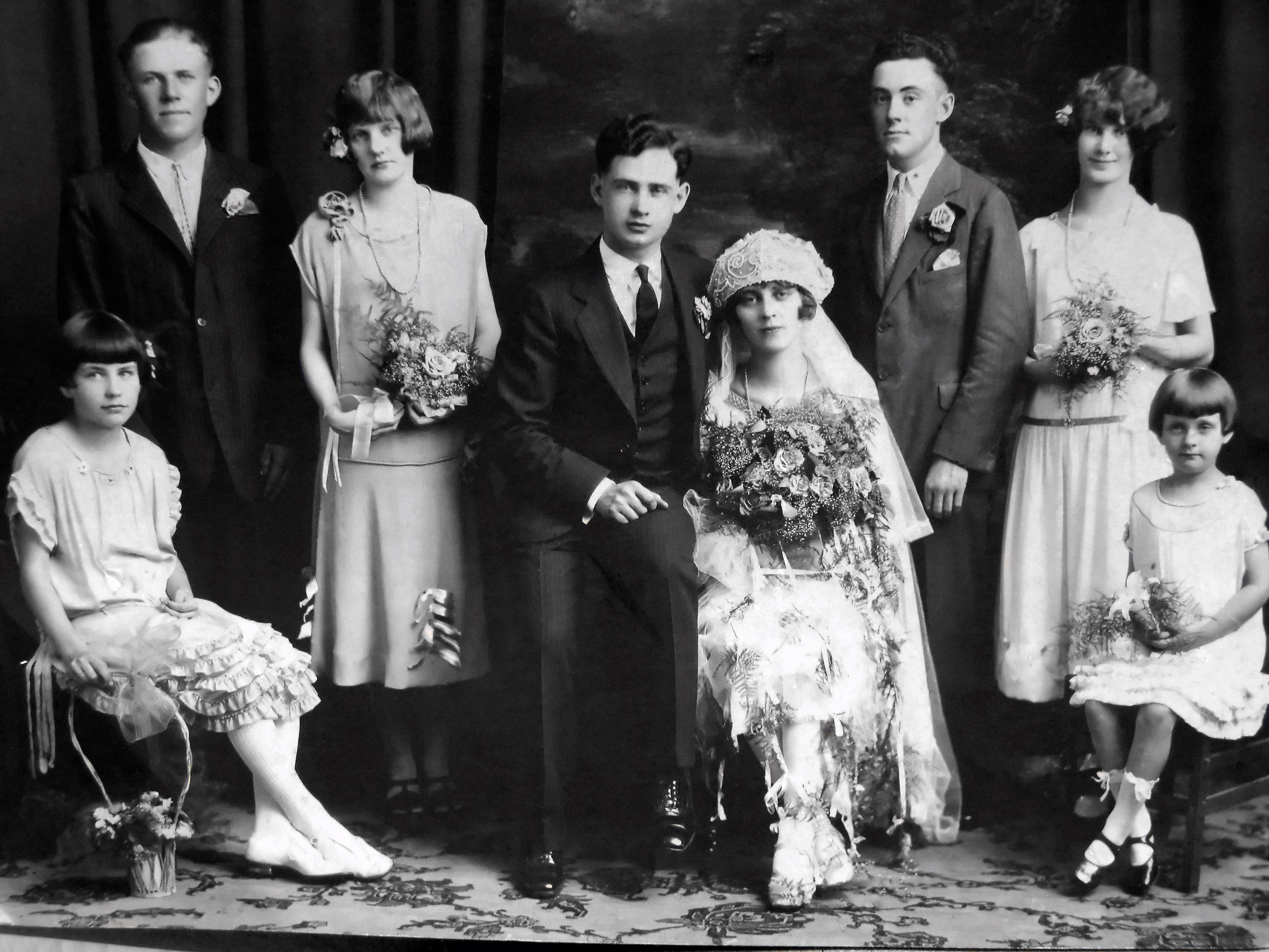
The wedding party of groom Carl Henry Frank Hanneman, 23, and Ruby Viola Treutel, 21. Wedding was July 14, 1925 at St. James Catholic Church, Vesper, Wis.  At front left is flower girl Nina Treutel, 11, sister of the bride. At front right is ring-bearer Elaine Treutel, 5, sister of the bride. Across the back, left to right, are Joe Ladick (bride's cousin), Gladys Cole (bride's cousin), groom Carl Hanneman, bride Ruby V. Hanneman, best man Wendell Miscoll, and maid of honor Esther Allbrecht.
The wedding party of groom Carl Henry Frank Hanneman, 23, and Ruby Viola Treutel, 21. Wedding was July 14, 1925 at St. James Catholic Church, Vesper, Wis. At front left is flower girl Nina Treutel, 11, sister of the bride. At front right is ring-bearer Elaine Treutel, 5, sister of the bride. Across the back, left to right, are Joe Ladick (bride’s cousin), Gladys Cole (bride’s cousin), groom Carl Hanneman, bride Ruby V. Hanneman, best man Wendell Miscoll, and maid of honor Esther Allbrecht.

The church was beautifully decorated with greens and the season’s flowers, making an appropriate setting for the wedding party. Miss Velma Doering of Stratford played the wedding march as the party entered the church and proceeded to the altar. Miss Gladys Cole of Nekoosa, and the groom’s attendant, Joseph Ladick, of Vesper, both cousins of the bride, were followed by two little sisters of the bride, Nina and Elaine, who acted as flower girl and ring bearer. The maid of honor, Miss Esther Albright, came next and was followed by the bride and her father, who gave her away. 

Mr. Hanneman and his best man, Wendell Miscoll, awaited the party at the altar. The bride was very beautiful in her gown of white georgette trimmed with gold lace. She wore a coronet of pearls, with her veil falling from a beaded butterfly. She carried a shower bouquet of pink rose buds. 

Rev. Charles W. Gille of St. James Catholic Church officiated at the wedding.

Miss Albright, the maid of honor, was gowned in orchid georgette and carried an arm bouquet of rose. Miss Cole, the bridesmaid, wore a gown of orange georgette, and also carried roses. Nina, the little flower girl, was in a little frock of yellow georgette, and Elaine completed the delightful color ensemble in a dress of pink georgette. She carried the ring in a white lily.

Following the service at the church, the bridal party and relatives came to this city, where the ten-thirty breakfast was served at the Witter Hotel. The bride is a graduate of Lincoln High School and the Stevens Point Normal. Since her graduation from the normal school she has been teaching at Vesper. The groom was graduated from Lincoln High and for some time following was employed at the Church Drug store. He later graduated from the pharmacy department of Marquette University at Milwaukee and is at present holding a position with Whitrock and Wolt.

Following a week’s outing in the northern part of the state, part of the time being spent as guests of Mr. and Mrs. Armand Bauer at their cottage at Hayward, they will return here and for the present make their home with Mr. Treutel at Vesper.

©2014 The Hanneman Archive

Eye on the Past: Jane Hanneman is 3 Years Old

Her look of delight really tells the whole story. Little Jane Patricia Hanneman, beholding a cake on her third birthday, shows a priceless expression. She celebrated her birthday in October 1958 with her paternal grandparents, Carl F. Hanneman (1901-1982) and Ruby V. Hanneman (1904-1977) at their home in Mauston, Wisconsin. In the background of the photo is her aunt and my Mom, Mary K. Hanneman. She could not have known it at the time, but Jane’s birthday falls on the same date as the 1819 wedding of her great-great-great grandparents, Matthias Hannemann and Caroline (Kuehl) Hannemann. The couple were married at Meesow, Regenwalde, Pomerania.

My Dad, David D. Hanneman, also shot some 8mm film at the celebration, which can be viewed below:

©2014 The Hanneman Archive

‘Pestle and Mortar’ Carl Hanneman Passes the Pill-Counting Test

In the first half of the 20th century, druggists in America were often called on to literally fill prescriptions, placing medications into gelatin capsules and then counting out the order. Mauston pharmacist Carl F. Hanneman was very efficient at the task. Maybe too much so, opined The Mauston Star in a rather humorous article in December 1953.

“Joe Dziewior and this muser, watching ‘pestle and mortar’ Carl Hanneman throw a prescription together the other evening, now know why pill or capsule counting machines not not necessary to the registered pharmacist,” read the article on December 11, 1953. “With bottle in hand, Carl was pouring capsules into his hands and counting them faster than an adding machine.” 

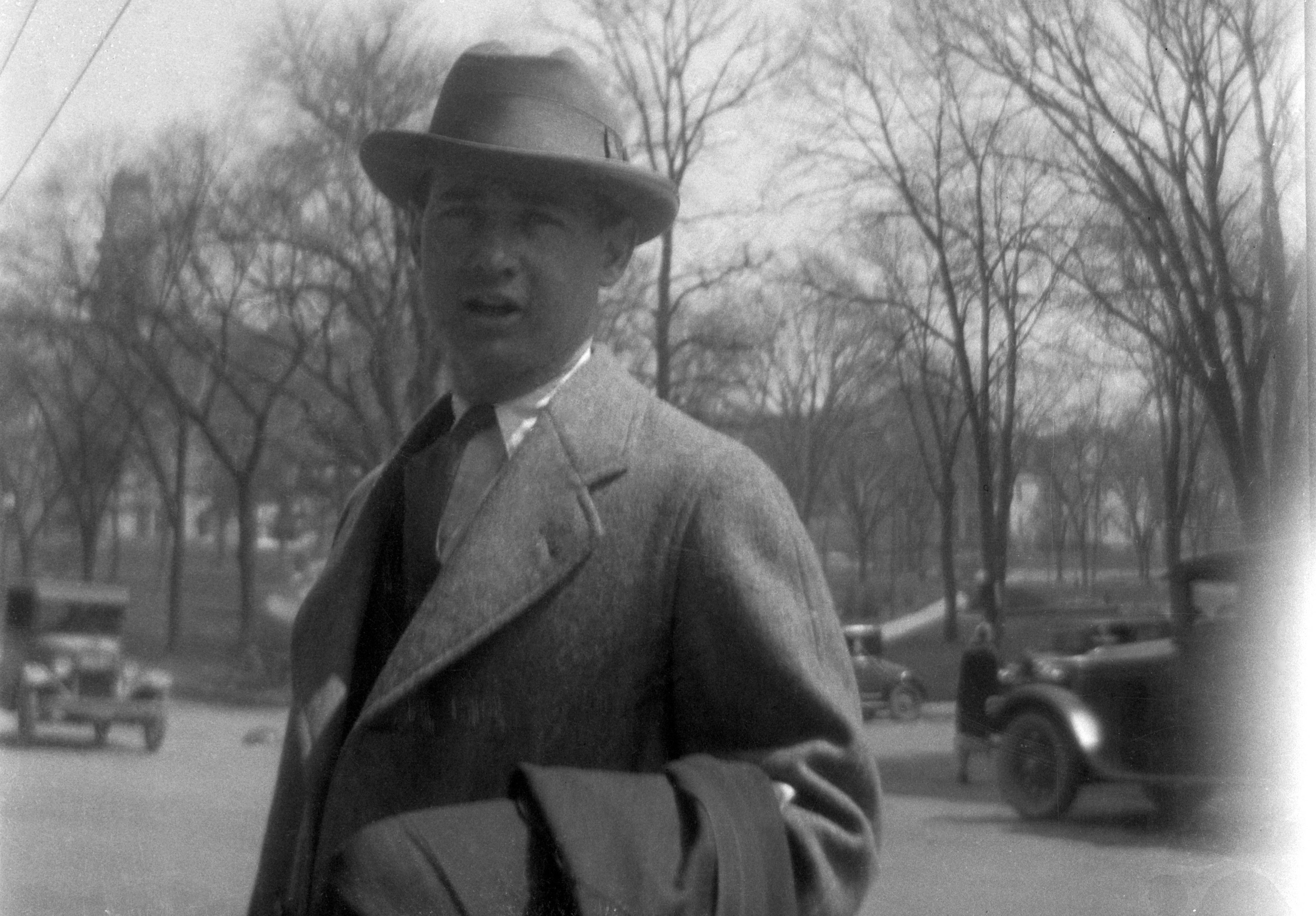
Carl F. Hanneman taking his suits to the cleaner at Janesville, Wis., on April 5, 1926. Carl and his wife, Ruby V. Hanneman, were on their way to dinner. Carl was a druggist at McCue & Buss Drug Co. at the time.
Carl F. Hanneman taking his suits to the cleaner at Janesville, Wis., on April 5, 1926. Carl and his wife, Ruby V. Hanneman, were on their way to dinner. Carl was a druggist at McCue & Buss Drug Co. at the time. He later moved to Mauston, Wis.

Carl was the registered pharmacist at the Mauston Drug Store on Division Street in Mauston. He had been the druggist there since moving his young family to Mauston in 1936 from Wisconsin Rapids. A graduate of Marquette University, Carl started as an assistant pharmacist, but obtained his full registered pharmacist license in the 1940s.

“After watching him for some time, we entertained a doubt as to the accuracy of the counts and Joe was inclined to agree with us,” the article continued. “But Carl said he could count pills time on end and whistle a tune at the same time, and still come out the a correct count. ‘Come, come, Carl!’ we exclaimed. ‘Isn’t that pulling our leg a bit?'”

Judging by these vials from McCue & Buss Drug Co., registered pharmacists packaged both pre-made pills and medicine capsules.
Judging by Carl F. Hanneman’s vials from McCue & Buss Drug Co., registered pharmacists packaged both pre-made pills and medicine capsules.

Carl told the men a story of a “kindly old lady” who regularly came in for prescriptions and doubted the counts doled out by the druggist. “It never failed, but that after we wrapped up her prescription, she’d sit in the chair out there, undo the package and count the pills in the box,” Hanneman said. “To this day, she hasn’t demanded a recount!”

The article concluded: “Maybe registered pharmacists should be made ballot clerks. Recounts wouldn’t be necessary!”

©2014 The Hanneman Archive
Family Line: Carl F. Hanneman >> David D. Hanneman, Donn G. Hanneman and Lavonne M. (Hanneman) Wellman

A Look Back at the ‘Plainfield Butcher,’ Grave Robber Ed Gein

While scanning my grandfather’s old slide collection, I came across two stray images from 1957 marked “Gein’s House.” I couldn’t get the slides on the scanner bed fast enough. It turns out the photos were indeed of the ramshackle farm house of the notorious killer and grave robber, Ed Gein.

For Carl F. Hanneman, the trip to Plainfield would have been a minor detour on one of the family’s many trips from Mauston to Wisconsin Rapids, Wis. He, like thousands of other Wisconsinites in the late fall of 1957, just had to see for himself the home where the unimaginable occurred from 1945 to 1957. For in that decrepit structure at the corner of Acher and 2nd avenues a few miles southwest of Plainfield, the handyman bachelor Gein committed unspeakable acts.

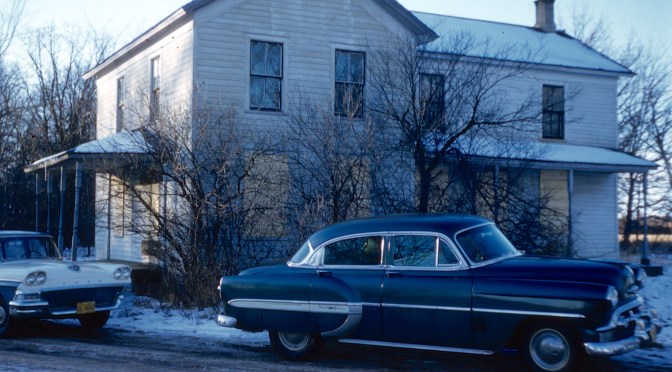
The boarded-up house of Plainfield handyman Ed Gein, who robbed nearby graves and made macabre souvenirs from the stolen remains.
The boarded-up house of Plainfield handyman Ed Gein, who robbed nearby graves and made macabre souvenirs from the stolen remains. The house was burned to the ground by an arsonist in March 1958. (Carl F. Hanneman photo)

The day of Gein’s undoing came on November 16, 1957, the opening day of the gun deer hunting season in Wisconsin. Gein made the trip into Plainfield to buy some anti-freeze at Worden’s hardware store. While there, he took a .22-caliber rifle from the store display and shot to death the owner, Bernice Worden, 58. After slitting her throat, he dragged her body out the back and put it into a truck. Later that day, sheriff’s deputies from several counties were searching for Worden, a well-known local who had run the Plainfield hardware store since her husband’s death in 1931.

Gein’s car had been spotted in the village that day, so police twice stopped at his 160-acre farmstead to talk to him. He wasn’t home. On the second trip, Waushara County Sheriff Arthur Schley peered into a shed that Gein used as a summer kitchen and was shocked. “My God, there she is!” he shouted. There was the body of Worden, hung upside down by the ankles, gutted and dressed out like a deer ready for the butcher. “There was a body hanging in the woodshed by the ankles,” said Captain Lloyd Schoephoester of the nearby Green Lake County sheriff’s department. “Tendons in the ankles had been cut and a rod and been placed through them. The body was drawn up in the air by a block and tackle. The body was dressed out and the head was missing.” Sheriff Schley went outside and vomited.

Police found the remains of nearly a dozen women in Ed Gein's farmhouse near the village of Plainfield, Wis.
Police found the remains of nearly a dozen women in Ed Gein’s farmhouse near the village of Plainfield, Wis.
Worden’s head was later found in a burlap sack nearby. Her internal organs were in a bucket. If that sight wasn’t enough to sicken responding police, a search of Gein’s home would put them over the edge. Inside the filthy and cluttered home they found five human heads wrapped in plastic bags, four skulls and 10 “death masks” made by removing the face and hair from a human head. “Some of them have lipstick on and look perfectly natural,” said Wood County sheriff’s deputy Dave Sharkey. “It you knew them, you’d be able to recognize them.”

There was more. Police found chairs and lampshades fashioned from human skin, four human noses, two sets of lips, a belt made of female nipples, and a collection of female genitals. Two of the vulvas in Gein’s collection belonged to teenage girls, and authorities concluded he likely murdered these girls. On the stove was a saucepan containing a human heart, later identified as belonging to Worden. There was a wastebasket made from skin, and skulls fastened to Gein’s bedposts. Bowls were made from the tops of human skulls.

At first, police thought they might be dealing with a prolific serial killer. After his arrest, Gein admitted killing Bernice Worden, but he said the grotesque artifacts in his home were from grave-robbing visits he made to the nearby Plainfield Cemetery, the Spiritland Cemetery in Portage County and the Hancock Cemetery in the Town of Hancock. Gein also admitted shooting and killing Portage County tavern keeper Mary Hogan on December 8, 1954. Her face was found among Gein’s collection of death masks.

Police were not initially inclined to believe Gein’s tales of grave robbing. On November 25, 1957, they exhumed the caskets of Eleanor Adams and Mabel Everson at Plainfield Cemetery. Both caskets were empty. In the soil above one casket they found dentures and a wedding ring. That was enough to convince police that Gein was indeed a grave robber. He told authorities he made the moonlight grave-robbing visits while in a daze. On some occasions, he awoke from the daze and stopped what he was doing. He said his grave robbing occurred between 1947 and 1952. He said he returned some bodies to their graves after experiencing remorse. Police did not dig up other graves, and ultimately don’t know just how many caskets Gein might have opened.

When interviewed by Wisconsin State Crime Lab officials, Gein said he would dress up with the women’s body parts. He would wear a death mask, a tanned skin shirt including women’s breasts, and a vagina placed over his own genitals, covered by a pair of panties. He would go out in the moonlight and prance about the farmyard in this sick getup. Although Gein was not a deer hunter, he was known to have given packages of “venison” to people in the community, who became sickened after Gein’s arrest at their unwitting cannibalism. Authorities became convinced that Gein practiced cannibalism, among his other grotesque crimes.

After a brief court hearing in January 1958, Gein was committed to the Wisconsin Central State Hospital for the criminally insane at Waupun, where he remained for 10 years. In early 1968, Circuit Court Judge Robert H. Gollmar ruled Gein was able to stand trial for the murder of Bernice Worden. In a November 1968 bench trial, Gein was convicted of first-degree murder for Worden’s death, but in a separate hearing found not guilty by reason of insanity. He was sent back to Waupun. He later was moved to the Mendota Mental Health Institute in Madison, where he died of cancer on July 26, 1984. He was buried next to his mother in the same Plainfield Cemetery that he plundered.

Gein suffered from schizophrenia. The death of his mother on December 29, 1945 apparently pushed him over the edge. Doctors said he had an unnatural Oedipus complex attachment to Augusta Gein. The women he killed and the graves he robbed represented substitutes for his mother. The women were plump and middle aged, doctors said. Gein had nursed his mother through two paralytic strokes. Gein’s father George died on April 1, 1940. His brother Henry was found dead after a marsh fire on the Gein property on May 16, 1944. It is widely believed that Gein killed his brother.

Based on the Worden convinction and Gein’s admission to killing Mary Hogan, Gein could not be considered a serial killer. But he was suspected of killing at least four other people. The teenage genitals found in his farmhouse might have belonged to Evelyn Hartley, 15, of La Crosse, and Georgia Jean Weckler, 8, of Fort Atkinson. Hartley disappeared in October 1953 and Weckler was abducted in May 1947. Neither crime was ever solved and the girls’ bodies were never found. In his 1982 book on the Gein case, Judge Gollmar wrote that if Gein did not kill these girls, then the abducted and killed two runaways, since his grave-robbing could not explain the presence of genitals belonging to young girls in Gein’s home. Gollmar also wrote that Gein might have killed two men who disappeared after visiting a Plainfield tavern. The disappearances of Victor Travis and a male companion were never solved. Travis’ jacket and his dog were found near the Gein farm, and neighbors noted a stench coming from Gein’s garden at the time.

Gein’s gruesome story created a cottage industry in macabre spinoffs. It was the inspiration for the book Psycho by Robert Bloch. The book was adapted into the 1960 Alfred Hitchcock film of the same name. Gein was said to be the inspiration for fictional characters in films including The Texas Chain Saw Massacre and Silence of the Lambs.

The Hanneman family has one link to Plainfield other than the photos of Gein’s house snapped by Carl Hanneman. Lisetta (Treutel) Moody (1861-1931), aunt of Ruby Hanneman, moved her family to Plainfield after living in Vesper in Wood County. She and her husband, Lewis Winfield Moody, are buried at Plainfield Cemetery. She testified at the trial of Frank Hinz after the 1902 shootout between the Moody and Hinz families.

This post has been updated with details from the 1982 book on Gein by Circuit Judge Robert H. Gollmar. The book, Edward Gein: America’s Most Bizarre Murderer, is a fascinating insider’s account of the Gein case.

©2014 The Hanneman Archive

A Mauston Reunion: Requiescat in Pace, Uncle Donn G. Hanneman

I just learned with sadness of the death of my Dad’s older brother, Donn Gene Hanneman, who died in Minneapolis at age 88. Uncle Donn was the last of the Mauston Hanneman family to pass away. My Dad, David D. Hanneman, died in 2007 at age 74.

I have many memories of my uncle. He was foremost the father of nine wonderful human beings, my cousins Diane, Caroline, Tom, Jane, Mary Ellen, John, Jim, Nancy and Thomas Patrick (March 1-4, 1949). The cousins were raised by a saintly mother, my aunt Elaine Hanneman.

Donn G. Hanneman

Donn was a veteran of World War II and served as a seaman-second class on the USS Hoggatt Bay. The USS Hoggatt Bay (CVE-75) was a Casablanca-class escort carrier (crew of 860) commissioned in December 1943.

Donn G. Hanneman lounges outside his Grandpa Treutel's home in Vesper, Wisconsin, circa 1930.
Donn G. Hanneman lounges outside his Grandpa Treutel’s home in Vesper, Wisconsin.

Donn was born on August 20, 1926, in Wisconsin Rapids to Carl Henry Frank Hanneman (1901-1982) and the former Ruby Viola Treutel (1904-1977). In 1936, the Hanneman family moved to Mauston in Juneau County, where Carl took a job as a pharmacist attached to the Mauston hospital and clinic. By that time, my father had come along (March 1933). In August 1937, the family expanded to include Lavonne Marie Hanneman Wellman (1937-1986).

As a boy, Donn had his share of illnesses and injuries. He spent more than a week in the Marshfield hospital in September 1929, then returned there in April 1930. Just before my Dad was born in March 1933, Donn was hospitalized in Wisconsin Rapids for more than a week, after an operation for appendicitis.

Donn Gene Hanneman, son of Carl F. Hanneman (1901-1982) and Ruby V. (Treutel) Hanneman (1904-1977), sits in an indoor baby swing at the Hanneman home in Fond du Lac, Wis, ca. 1927. Carl Hanneman was a pharmacist for the Staeben Drug Co. in Fond du Lac at the time.
Donn Gene Hanneman sits in an indoor baby swing at the Hanneman home in Fond du Lac, Wisconsin, ca. 1927. Carl Hanneman was a pharmacist for the Staeben Drug Co. in Fond du Lac at the time.

Just after his 11th birthday in August 1937, Donn was standing on the running board of a moving vehicle while leaving the Juneau County Fairgrounds when he fell and suffered a head injury. He was seen at the Mauston clinic and taken home, but soon after “lost his power of speech and all consciousness,” according to an account in The Daily Tribune in Wisconsin Rapids. “He was then rushed to the hospital.” Donn was diagnosed with a concussion and put on two weeks of bed rest, although that was extended. The September 8 edition of The Daily Tribune said Donn “is making a satisfactory recovery, although he will be confined to his bed for two more weeks.”

Back in those days, a family’s every move ended up in the newspaper. In the case of the Hannemans, it was thanks to the faithful correspondence of Ruby Hanneman. “Mr. and Mrs. Carl Hanneman and little son Don Gene were completely taken by surprise last evening when forty friends arrived to give them a house warming on the occasion of moving into their new home on Hale Street,” the Wisconsin Rapids Daily Tribune reported on April 8, 1932.

Some of the most charming photographs in our library are of a 5-year-old Donn dressed up as a cowboy playing with friends on the sidewalks on the 1200 block of Washington Avenue in Wisconsin Rapids. We detailed those photos in a previous post.

Donn in his cowboy threads at Wisconsin Rapids.

As a youth Donn enjoyed books, and collected enough that his father built him a bookcase that held up to 175 volumes. Carl wrote to my then 6-year-old father about it in August 1939. Dad was staying with an aunt and uncle in Waukegan, Illinois. “Say David, I made a book case for Donn for his birthday, and you know that you still have something coming,” Carl wrote, “so what would you like to have Dad make something for you too, if so tell mother and I will try to start it as soon as I can.”

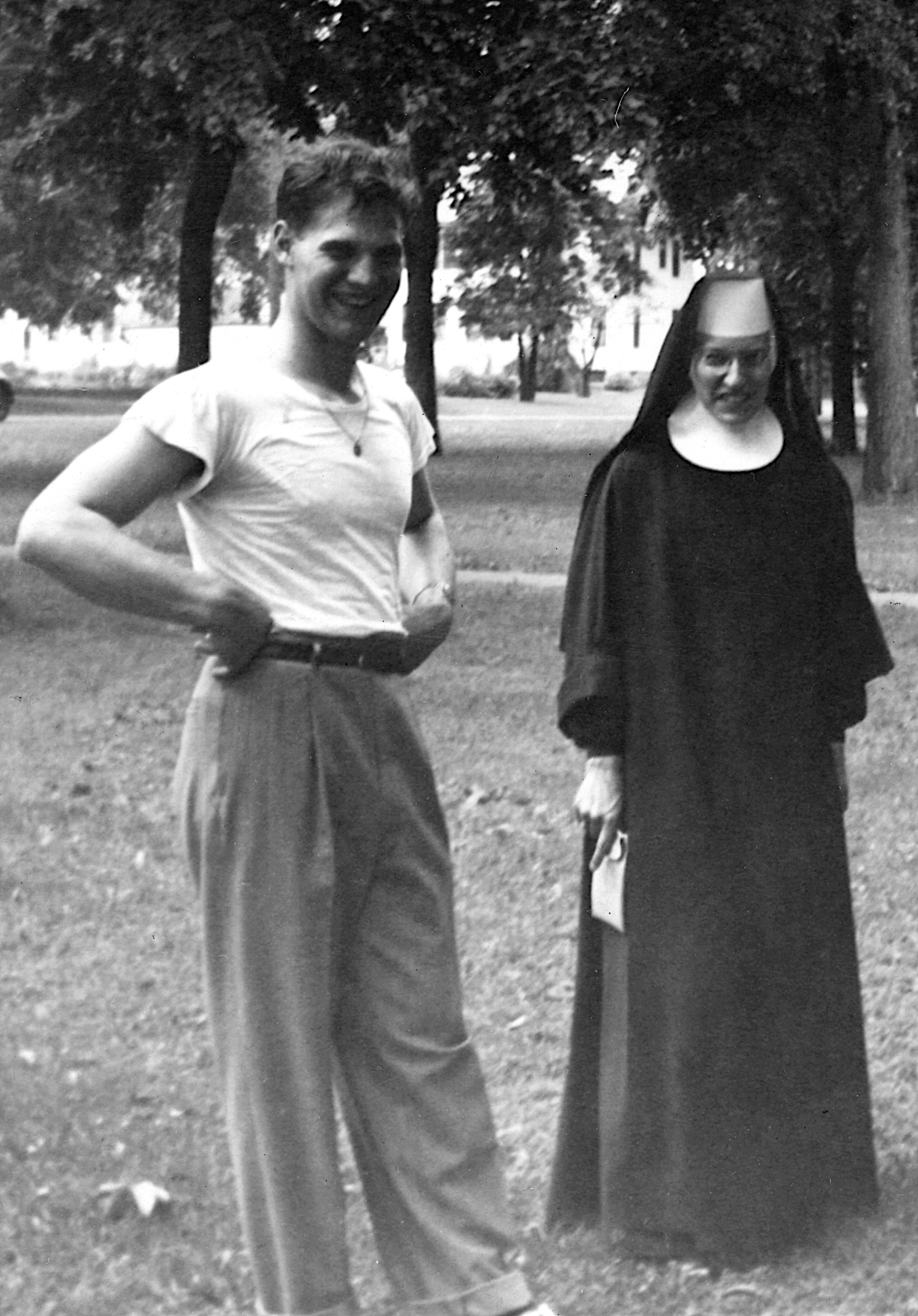
Donn G. Hanneman with Sister Emeric Weber of St. Patrick's Catholic Grade School, circa 1948.
Donn G. Hanneman with Sister Emeric Weber of St. Patrick’s Catholic Grade School,  1948.

For a time Donn attended St. Patrick’s Catholic Grade School in Mauston, then run by the Benedictine Sisters. He was among the graduates attending the school’s 100th anniversary in 1995. At the event, he ran into one of his teachers, Sister Emeric Weber, who was just 19 when she started teaching at St. Patrick’s.

“Sister Emeric, I’m sorry I’m late,” he quipped, to which the aged nun replied, “What’s your excuse now? What’s your excuse?”

Like his brother David and father Carl, Donn was a longtime Fourth-Degree member of the Knights of Columbus, the world’s largest Catholic fraternal and service organization. He most recently belonged to Council 1013 in Rochester, Minnesota.

There are many others better qualified to provide more recent stories about Donn. And even though he tossed my father through the bay window of their Mauston home when they were boys, my Dad didn’t hold it against him. When he was ill with cancer in the fall of 2006, Dad put it simply and succinctly: “He’s my brother and I love him.”

©2014 The Hanneman Archive


Photos with That Memorable Something

Sometimes a photograph will strike you in a certain way that makes it memorable. It has some intangible quality that makes it almost timeless. Of the thousands of images in our library, a handful qualify for this kind of distinction. Not for their physical clarity or skill of the photographer, but that certain look. You might describe it just a bit like looking at a Rockwell painting, or a black and white photograph by Ansel Adams.

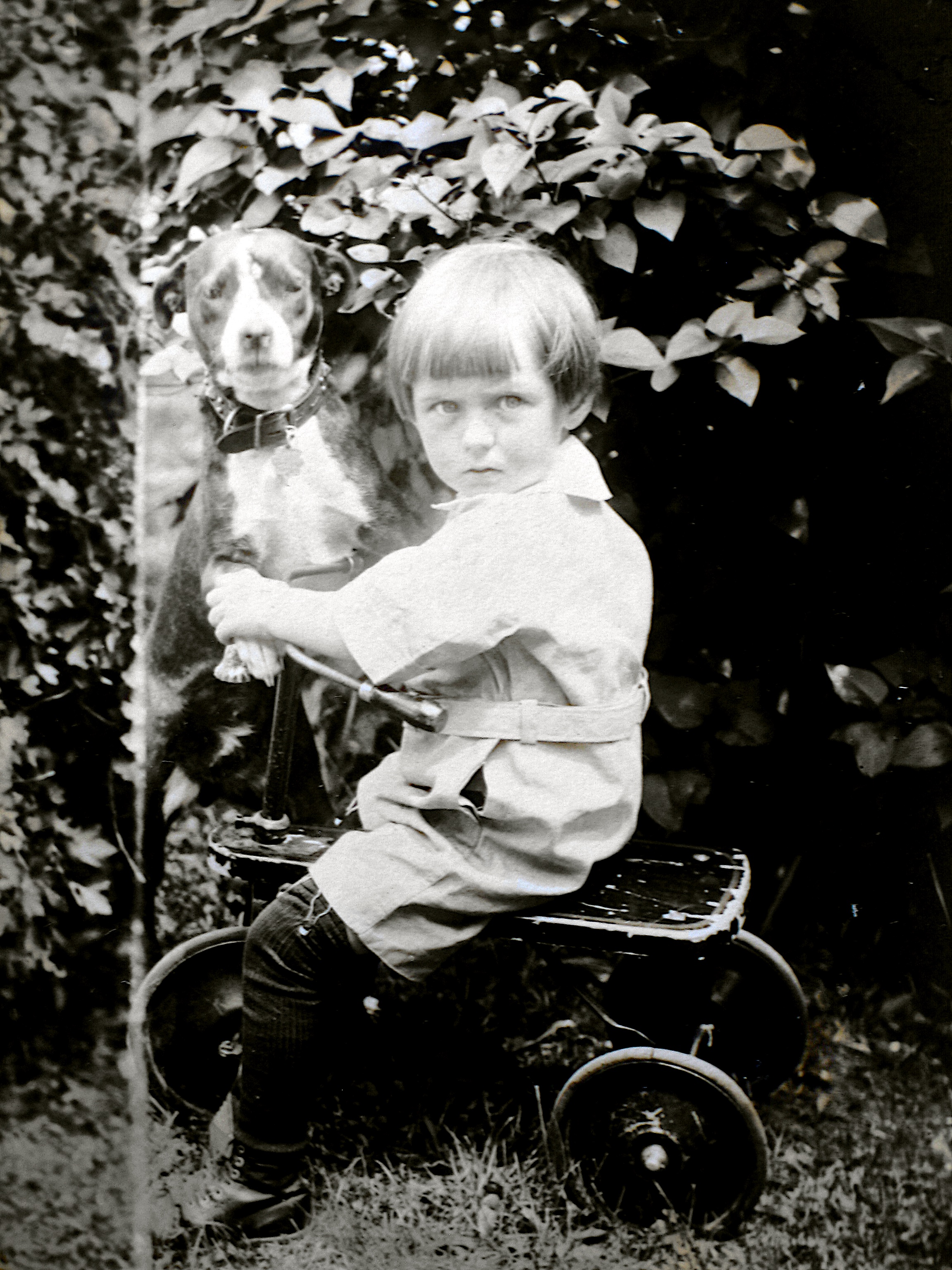
This image has a Little Rascals look and feel to it. Toddler Elaine Treutel and the family dog on her tricycle, circa 1922.
This image has a Little Rascals look and feel to it. Originally thought to be toddler Elaine Treutel and the family dog on her tricycle, circa 1922. Turns out this was actually one of the sons of Harry Cole.

View the whole collection in the gallery below:

Carl F. Hanneman’s Contribution to Public Television’s Wisconsin Hometown Stories

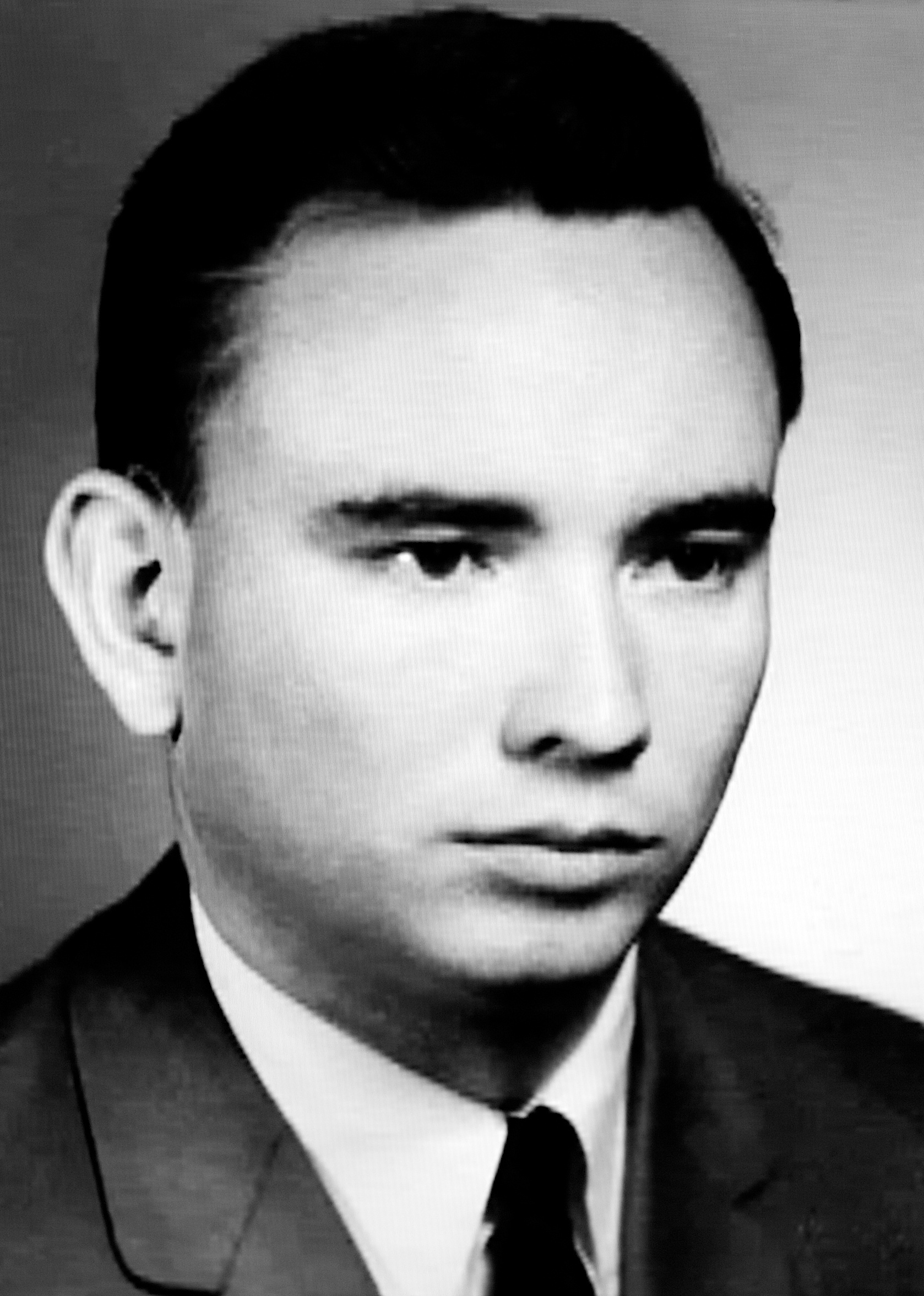
People often talk about getting 15 minutes of fame. For the late Carl F. Hanneman, it was closer to 15 seconds in a new Wisconsin Public Television documentary on Juneau County, Wisconsin.

Carl F. Hanneman filed this story with the Wisconsin State Journal on December 8, 1942.

The hourlong documentary, produced as part of Wisconsin Public Television’s Wisconsin Hometown Stories series, includes a section on the death of Governor-elect Orland S. Loomis of Mauston. Loomis died on December 7, 1942 after suffering a series of heart attacks. He was to be sworn into office in January 1943. As a local correspondent for the Wisconsin State Journal, Hanneman filed a story on December 8 detailing Mauston’s grief at the loss of their hometown hero. His news clipping was used as a graphic during the Loomis portion of the documentary.

Carl’s ties to Loomis went beyond the 1942 political obituary. On election night, November 3, 1942, he was one of the only photographers at Loomis’ home as the election results came in and Loomis was declared the winner over Gov. Julius P. Heil. Carl’s news photo ran above the fold on Page 1 of the State Journal on November 4, 1942.

Hanneman's election-night photo taken at Loomis' home in Mauston ran on Page 1 of the Wisconsin State Journal.
Hanneman’s election-night photo taken at Loomis’ home in Mauston ran on Page 1 of the Wisconsin State Journal.

Hanneman (1901-1982) had known Loomis since about 1936, when Carl came to Mauston from Wisconsin Rapids to be a pharmacist for Dr. J. Samuel Hess Jr. He sought Loomis’ help in 1937 in obtaining his full licensure as a registered pharmacist (an upgrade from his existing license as an assistant pharmacist). At the time, Loomis was Wisconsin’s attorney general. Hanneman also worked to help elect Loomis as attorney general and governor. In recognition of his efforts, Loomis gave Hanneman a large pastel painting that once hung in his office at the state Capitol in Madison. The large-format pastel, weighing some 100 pounds in its hand-carved ornate frame, hung in the Hanneman home in Mauston and later in the home of Sun Prairie Mayor David D. Hanneman, Carl’s son.

Orland S. Loomis gave this painting to Carl F. Hanneman for his help on the gubernatorial election in 1942.
Orland S. Loomis gave this painting to Carl F. Hanneman for his help on the gubernatorial election in 1942. It still hangs in the home of the late David D. Hanneman.

The fascinating Wisconsin Hometown Stories documentary, which first aired in April 2014 and is now available on DVD, covers much more than Loomis and his political career. It traces Juneau County’s history from its early days, when towns like Mauston sprung up around grist mills on the Lemonweir River. It details the county’s cranberry farms, the massive Necedah Wildlife Refuge, the heritage of the Winnebago (Ho-Chunk) Indians, creation of the huge manmade Petenwell Lake, and development of National Guard bases including Camp Williams and Volk Field.

Carl F. Hanneman befriended a young Tommy Thompson in 1966 when Thompson first ran for office.
Carl F. Hanneman befriended a young Tommy Thompson in 1966 when Thompson first ran for state office.

A prominent section of the documentary focuses on former Wisconsin Governor Tommy G. Thompson of Elroy. Thompson takes viewers on a tour of southern Juneau County where he grew up, including an old gas and grocery run by his father. Thompson served as Wisconsin’s 42nd governor from 1987 to 2001.

When he first ran for Wisconsin State Assembly in 1966, Thompson stopped in Mauston and met a pharmacist named Carl Hanneman. Carl was so impressed with the young lawyer from Elroy that he closed up shop for the afternoon and took Thompson all over Mauston, introducing him to other businessmen. From that day on, Hanneman always referred to him as “my friend Tommy Thompson.” It was a kindness Thompson never forgot.

Somehow the story of Carl’s early politicking for Thompson got left out of the Wisconsin Public Television documentary. Well, there’s only so much you can fit into an hour of television.

–The DVD version of the documentary can be purchased for $16.95 from Wisconsin Public Television. Wisconsin Hometown Stories is a joint project of WPT and the Wisconsin Historical Society.

– Read Hanneman’s 1942 Wisconsin State Journal article.

Grandma Ruby Collects Rocks, With a Snicker

It wasn’t such a curious hobby, collecting rocks, but more in how it was done. Ruby Viola (Treutel) Hanneman (1904-1977), simply could not resist picking rocks up off the ground wherever she went. And judging by the facial expressions of those around her, it became somewhat of a family joke.

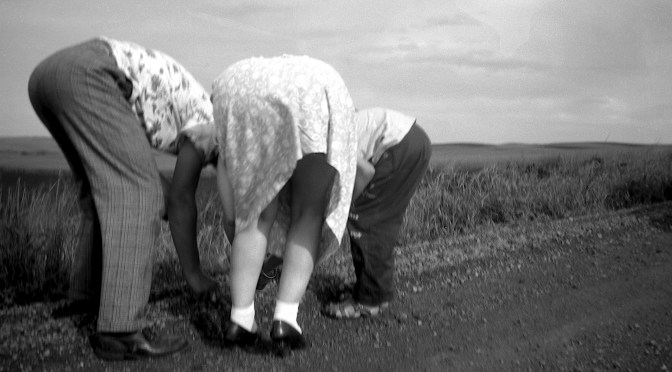
Lavonne Hanneman can't resist laughing as her mother Ruby bends down to pick up rocks on a trip to South Dakota in 1947.
Lavonne Hanneman can’t resist laughing as her mother Ruby bends down to pick up rocks on a trip to South Dakota in 1947.

Rock collecting was certainly a Hanneman tradition. Uncle Wilbert G. Hanneman (1899-1987) had a rock shop up in Wausau, from which many a Hanneman child procured varieties of colorful, polished rocks. I have a bag of them to this day. Ruby liked to get her collectibles the old fashioned way, by finding them. She’d bend down to grab the most interesting or unusual ones, and husband Carl F. Hanneman (1901-1982) was often nearby to capture the moment on film.

David D. Hanneman's priceless facial expression says it all, as his father Carl snaps yet another photo of mother Ruby picking up rocks.
David D. Hanneman’s priceless facial expression says it all, as his father Carl snaps yet another photo of mother Ruby picking up rocks.

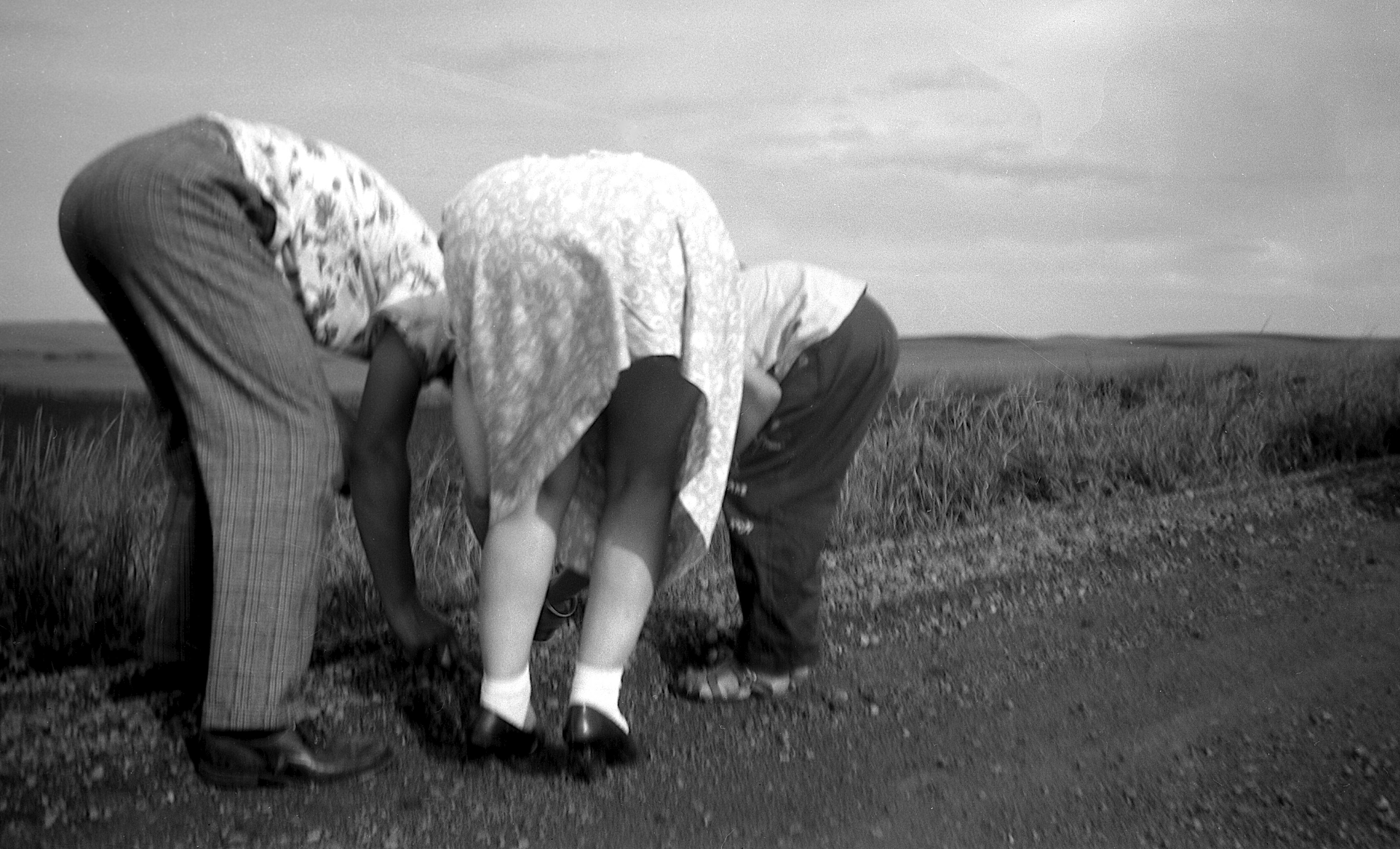
The best examples of this hobby (or habit) came on a family trip from Mauston, Wisconsin, to Williston, South Dakota in 1947. After getting caught all bent over on several photographic occasions, Ruby and the kids shot back. They put their heads together and gave old Carl Hanneman a two-cheek salute.

David and Lavonne Hanneman joined their mother Ruby in offering a rear-end salute to cameraman Carl F. Hanneman.
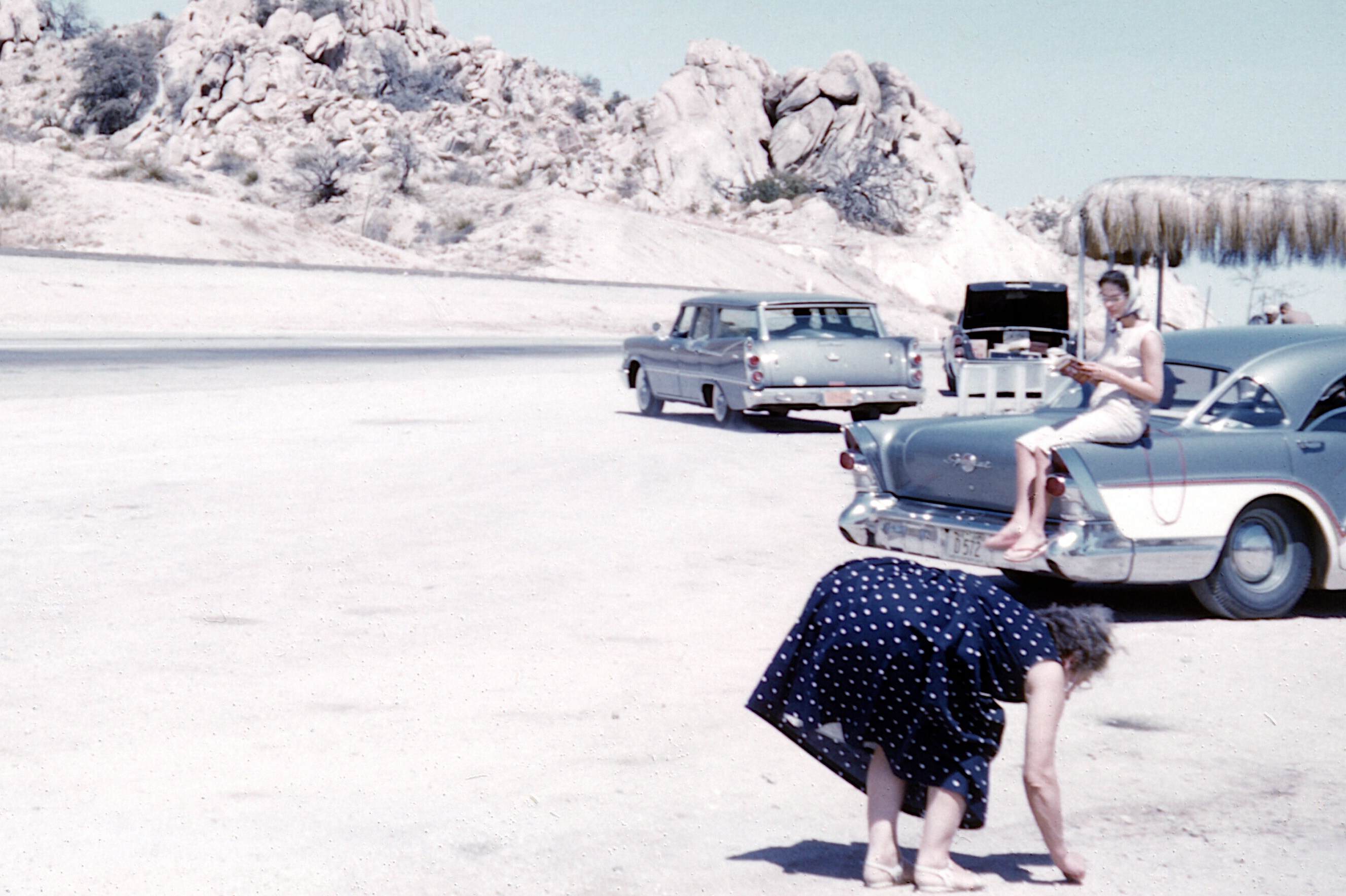
This photo proves Ruby’s habit was not a passing fad. Here she gathers samples on a trip to Phoenix in 1959.