Tag Archives: Carl F. Hanneman

Wedding Photo Draws a Following, 90 Years Later

I’m generally not a fan of social media page “likes” or shares or fan praise. While it is one metric of success in the online world, it also can set us up for easy disappointment. That being said, I was quite pleased to see my grandparents’ wedding photo draw such nice comments on an Instagram page dedicated to preserving the stories behind photos.

Saving Family Photos featured this 1925 wedding portrait today, along with the newspaper story published shortly after the marriage of Carl F. Hanneman and Ruby V. Treutel. As of this writing (less than one full day on display), the photo has 1,016 likes. A sampling of the viewer comments:

I have a similar picture of my grandparents. You’ve inspired me to frame it.”

“Wow! Beautiful picture!”

“A true treasure.”

“Stunning photo. Love every detail. A gift for you to have this.”

“Can’t love this enough…still looking for photos of my grandparents weddings.”

“That is now may favorite wedding photo! What a treasure!”

I submitted the photo to Saving Family Photos from Treasured Lives, our sister site. If you are on Instagram, find them @savefamilyphotos. You can also see the gallery on their web site.

©2016 The Hanneman Archive

Dueling Illustrator Brothers: Carl F. and Wilbert G. Hanneman

We’ve noted elsewhere on this blog the photography skills of Carl F. Hanneman, but lately we’ve discovered that he and his brother Wilbert G. Hanneman had talents with freehand illustration. Working on the yearbook at Lincoln High School in Grand Rapids, Wis., the brothers served almost as dueling artists.

Judging by the line drawings each made in high school and in years after, both men had artistic abilities. Wilbert (1899-1987) first served as an artist and editor for the Ahdawagam yearbook. Ahdawagam is an Indian word that refers to the “two-sided rapids” along the Wisconsin River. The yearbook was first published in 1916. Wilbert graduated from Lincoln in 1918, and Carl followed in 1921. Both Carl (1901-1982) and Wilbert drew the illustrations for the yearbook’s section pages, such as Alumni and Sports, and the various class sections.

Wilbert drew a stunning likeness based on Carl’s high school graduation picture. The latest example of hand illustrations we could find is from 1945, showing a U.S. service member next to the saying, “Keep off the Lifeline.” The Navy serviceman in the illustration bears a striking resemblance to Carl. His son Donn G. Hanneman (1926-2014) served aboard the USS Hoggatt Bay during World War II.

©2015 The Hanneman Archive

WWII Vet Escorts British Bride and Son to Furnished New Home

The feature story below was written by my grandfather, Carl F. Hanneman, and published in The Wisconsin State Journal on February 21, 1946. It relates the tale of a U.S. army medic, his British bride and baby, who were separated from him for more than six months at the end of World War II. Below the story I provide some more detail on Charles D. Grinolds and his World War II service.

Mauston Vet Escorts British Bride and Son
Into New Home Replete Even to Food on Table

By Carl F. Hanneman
State Journal Correspondent

MAUSTON — Thrilled with a surprise house, new and completely furnished, Mrs. Charles Grinolds, Ashwell, England, has joined her husband here and introduced him to his son, Charles Victor, who was born after his staff sergeant father left England last July.

The Wisconsin State Journal story featured the happily reunited Grinolds family.

When Mrs. Grinolds entered her new home at 4 a.m. Tuesday she found it furnished even to pictures and books, but in the basement were 187 quarts of fruit, 30 quarts of canned chicken, and other canned goods.

On the table in the modernistic kitchen was a large angel food cake with the inscription, “Welcome,” while the percolator was sputtering its tune upon a recently installed new electric range.

It all climaxed a separation which began early last July, when Grinolds left England just before his son was born. The long wait ended happily , too, for Charles Victor, Jr., was no worse off from the long, tedious journey, and laughed and cooed in his father’s arms as father and son inspected the comforts of their five-room bungalow.

The mother, the former Margaret Eley, although totally exhausted, prepared the baby’s formula before tucking him into his new little bed.

Charles, Margaret and baby Charles Victor Grinolds enter their new home at Mauston in 1946.

The couple was married in St. Mary’s church in Ashwell, the first Anglo-American wedding in the community during the war. The father served overseas for 33 months, then had to leave before his son was born.

Mrs. Grinolds left England on the American “Santa Paula,” formerly a hospital ship, and was on the water 11 days, arriving in New York last weekend four days overdue because of storms. She was confined to her quarters by seasickness for three days, but the baby appeared to enjoy the trip.

The sight of land, any land, was a great thrill after the rough voyage during which seas rolled over the decks. Upon leaving the ship in New York, the war brides and babies were taken on a sightseeing tour to acquaint the new Americans with their adopted land.

Grinolds, recently discharged, was waiting anxiously in a Chicago railroad station when his family arrived. His wife, who was not expecting her husband in Chicago and had never seen him in civilian clothes, was following a military police assigned to her and became frightened when her husband came up from behind and took the baby from her arms.

But then she was home. ♦


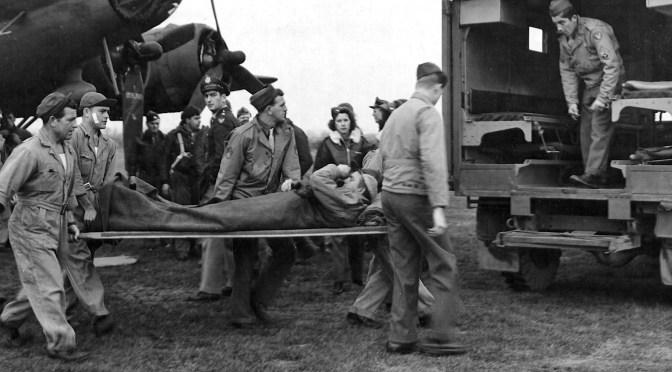
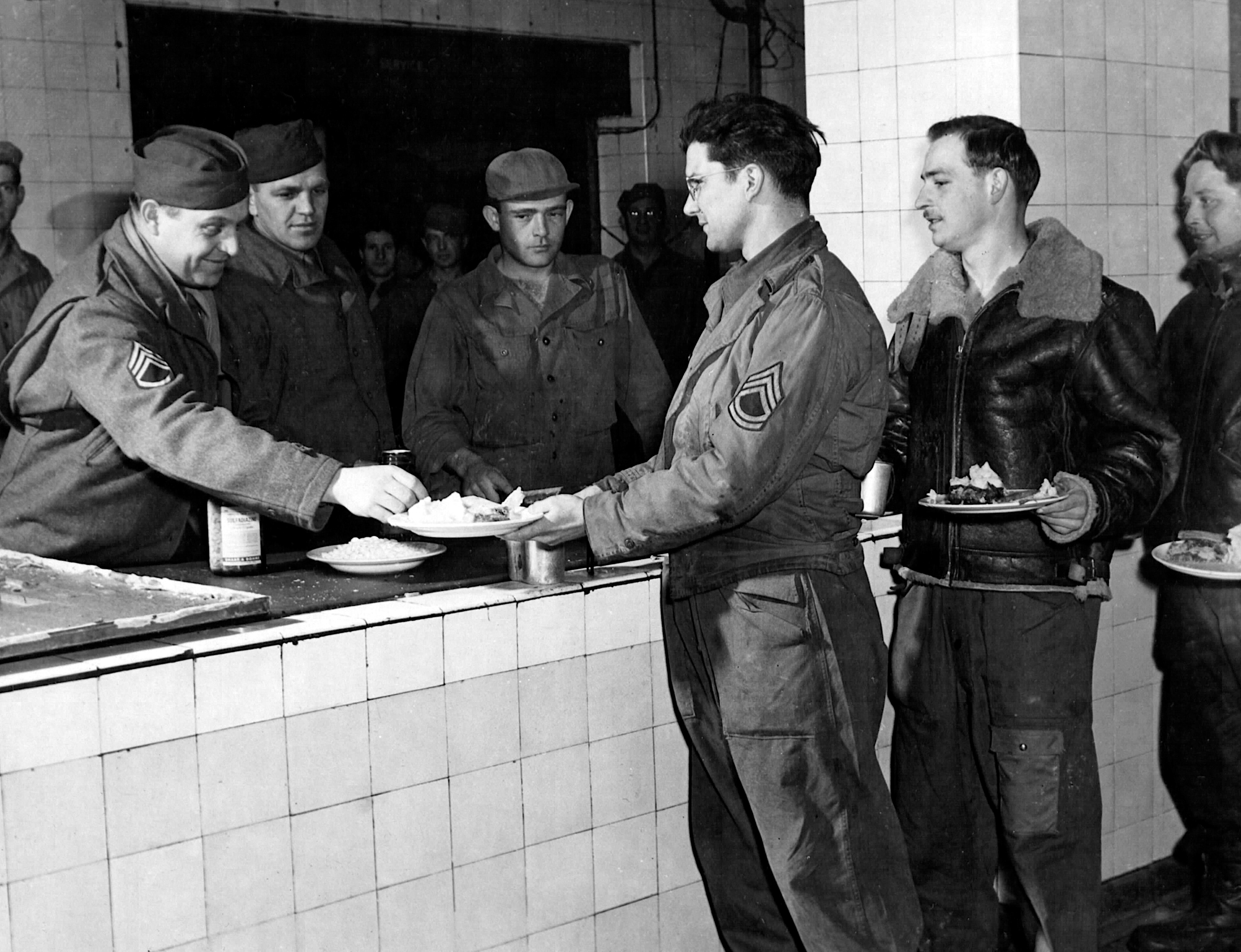
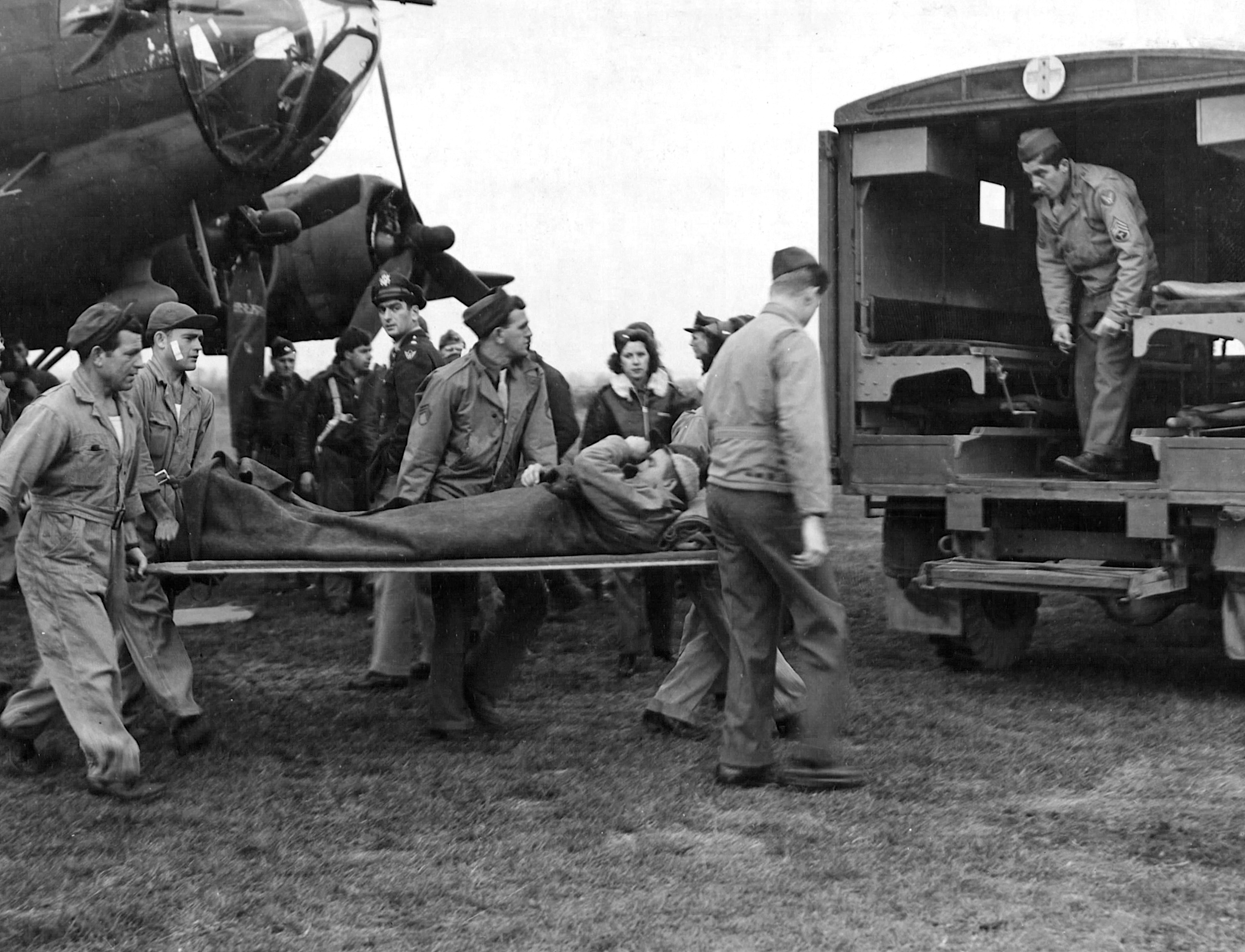
Richard Dockstader Grinolds was drafted into the U.S. Army in February 1942 at Fort Sheridan, Illinois. He became a staff sergeant in the Army Air Force and was stationed in England with the 324th Bomb Squadron, 91st Bomb Group. His specialty was medical technician. He was featured several times in U.S. Army news photos; twice carrying wounded and once for a feature on a rash of illnesses among troops in England. The 91st Bomb Group was home to the famous “Memphis Belle” B17 Flying Fortress.

Staff Sgt. Charles D. Grinolds of Mauston (second in line) waits to be administered a sulfa pill, part of a U.S. Army Air Force effort to reduce illness at the 91st Bomb Group in England during World War II.
Staff Sgt. Charles D. Grinolds of Mauston (second in line) waits to be administered a sulfa pill, part of a U.S. Army Air Force effort to reduce illness at the 91st Bomb Group in England during World War II. (U.S. Army photo)

Grinolds lost his father, McClellan Grinolds, in 1918, when the boy was just 4. He and his brother were raised by their mother, the former Ruby Elizabeth Dockstader. The Grinolds and Dockstaders were both pioneer Juneau County families. The Hanneman family lived just around the corner from Dockstader Street, named for pioneer Benjamin Dockstader.

Staff Sgt. Charles D. Grinolds (far right) helps carry Staff Sgt. Marion M. Walshe to an ambulance after the bombardier was injured on a mission over Europe.

The baby featured in the story above, Charles Victor Grinolds, was born in England on July 29, 1945, as his father was headed back to the United States. He was one of four children born to the couple. Sadly, Charles D. Grinolds died on July 30, 1950. He was just 36. He is buried at Oakwood Cemetery in Mauston. The firstborn son grew up to have a distinguished military career, serving in the U.S. Air Force in Vietnam, the Persian Gulf War and the Iraq War. He died on June 10, 2006 in Modesto, California. He was the father of six children.

©2015 The Hanneman Archive

Eye on the Past: Wash Tub Baby 1933

This photograph has perplexed me for years. A baby in a diaper, lying on a pillow inside a steel wash tub. I strongly suspect this is my father, David D. Hanneman (1933-2007). The image raises many questions but provides no answers.

A strange place for a nap, circa 1933.
A strange place for a nap. This might be David D. Hanneman in the summer of 1933.

Why stick a baby in a wash tub? Was this the poor family’s playpen? The Depression-era bassinette? A brutal pre-Dr. Spock time-out? Freshly picked from the vine? In this day and age, such a photo might get you a visit from Child Services. I’m guessing my Grandma Ruby (Treutel) Hanneman (1904-1977) just thought it made a cute photo. She was known to dote on her “little Davey.”

If this was Dad in the tub, the photo was likely taken in Wisconsin Rapids, Wisconsin, where he was born in March 1933. The family did not move to Mauston until early 1936. Usually I can confirm my Dad’s ID in photos by the ears, but they are not visible in this image.

My memories of such a steel container at the house in Mauston had nothing to do with babies. I recall bluegill, sunfish and bass in such a tub, waiting for Grandpa Carl’s skilled fillet knife. Or the tub filled with ice and bottles of orange and grape soda (known as “pop” by some of you). But no babies.

This one is destined to remain a mystery. I’m sure it would tickle my grandma to know it was a conversation piece some 80 years later, and that no one called Child Services.

©2015 The Hanneman Archive

Hospital Chart Documents 1939 Pneumonia Scare

It might seem a very odd thing to save, the pages of a hospital chart from 1939. But I suspect my father viewed his battle with pneumonia at age 6 as a defining moment. Perhaps his parents, Carl F. and Ruby Hanneman, feared they would lose their youngest son to an illness with a reputation for being deadly.

The trouble all started on Thanksgiving Day, November 23, when David D. Hanneman took ill with a high fever. The hospital chart says my Grandma Ruby “took care of him alone until Tues. night Dec. 5.” It’s not clear if this means Grandpa Carl, pharmacist at the Mauston clinic and hospital, was away on business or just working. Either way, on December 5, Caroline Denzien came to the Hanneman house on Morris Street to care for Dad and give Ruby a break.

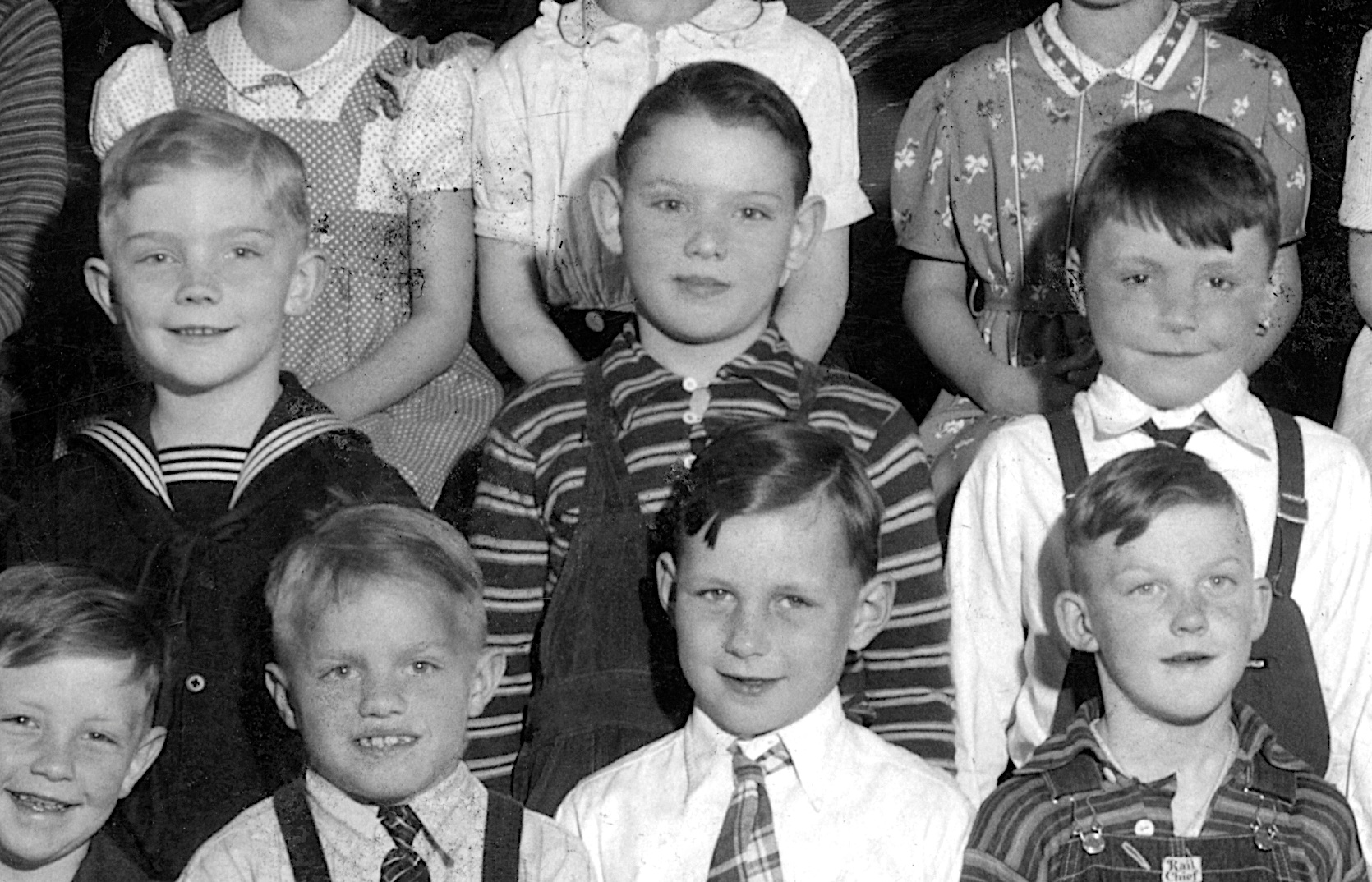
David D. Hanneman (center, in striped shirt) shown six months after his pneumonia scare.

Early on Wednesday, December 6, they took him to the Hess Memorial Hospital in Mauston. Upon arrival, his fever was 104.2 degrees. Dr. J. Samuel Hess Jr. ordered a course of calcidine, a decongestant, and quinine, a potent germicidal drug known today as an anti-malaria treatment. They had reason for concern, since the pneumonia had festered for nearly two weeks. That first day, Dad drank frequently, but he was restless and had a “considerable” cough. He was “perspiring freely” as a result of the fever, which stayed above 104 degrees all day.

Dad responded quickly to the treatment. By midday on December 7, he was eating sherbet and sipping on some broth. He even felt bright enough to play a little bit of checkers. The fever was down below 100 degrees, but still shot back up on occasion. By nighttime, he was drinking lemonade, tomato juice and some tea. Overnight, the nurse noted he was “irritable” and had several coughing spells. On December 8, the fever dropped below 99 degrees and Dad graduated to eating noodles and rice, and custard.

By the December 10-11 period on the chart, Dad’s fever was gone and he was resting comfortably. Nourishment included chicken broth, Jello and Ovaltine. It appears he stayed at the hospital into the late afternoon of Wednesday, December 12, since there are no other pages beyond that time.

©2015 The Hanneman Archive


Back from the World’s Ends, ‘Lucky 13’ Meet at Home Again

By Carl Hanneman
State Journal Correspondent

MAUSTON, Wisconsin — Mauston residents don’t believe in the “unlucky 13” superstition anymore. They can’t after seeing 13 familiar faces that have been absent so long once again through their city streets.

These 13 familiar faces belong to Mauston servicemen, all of whom have seen service overseas and all of whom arrived home at about the same time to vi‘sit their families.

The 13, whose service abroad totals 240 months, were feted at an informal dinner and dance at the Mauston American Legion hall, under the joint sponsorship of the American Legion post and the Mauston Rod and Gun Club, and for a time they once again became “that kid next door” or that “Joe’s boy” as they let the cares of the war drop from their uniformed shoulders.Part of Lucky 13

Their Record
The group includes a man who went through the entire New Guinea campaign with the famed 32nd Division; a man who stood guard over the Japanese at a prison camp overseas; a man who was taken a prisoner of war only to be released at the capitulation of Romania; a man who went through the invasions of Italy and Sicily with the Navy, and others whose heroic deeds were written in most any theater imaginable.

It also includes four airmen who have completed a total of 118 missions. The Lucky 13 are:

Capt. Riley D. Robinson, 31, whose wife and child live in Mauston, who served as supply officer and battery commander with the 32nd Division in Australia and throughout the New Guinea campaign for 30 months.

Corp. Edward Dwyer, 30, son of Mr. and Mrs. Burt Dwyer, a veteran of three and one-half years of service, two and a half years of which were spent in the southwest Pacific area.

Pfc. Harold Hagemann, 48, whose wife and child live in Mauston, who served 25 months in the south Pacific as a military policeman at a Japanese prisoner of war camp.

Pvt. Arnold L. Jobs, 20, son of Mrs. Emil Jobs, veteran of 21 months of service, of which from June 1943 to October 1944 was spent in Iceland.

First Lieut. Warren L. Hasse, 21, son of Mr. and Mrs. Louis Hasse, who completed 35 missions as a Flying Fortress bombardier navigator while serving seven months with the Eighth Air Force in England.

Corp. Clifford J. Flentye, 27, son of Mr. and Mrs. Henry Flentye, a veteran of 32 months in the southwest Pacific.

First Lieut. William R. Holgate, 21, son of Mrs. Roy Holgate, a Flying Fortress pilot who was taken prisoner in Romania after being shot down on his 13th mission and then released at the capitulation of that country.

Apprentice Seaman Robert Loomis, son of the late Gov. Orland and Mrs. Loomis, who has been in the Navy for two years, serving nine months of that time in the southwest Pacific.

First Lieut. Kenneth G. Buglass, 25, son of Mr. and Mrs. G.D. Buglass, a veteran of three years of service, who completed 50 missions as a bomber pilot in the North African and Italian theaters during 12 months of overseas duty.

Ripley Was Around
Ensign Burdette Ripley, 26, son of Mr. and Mrs. Eugene Kranz, who entered service in 1939, and went overseas in March 1943, hitting ports in England, Persia, Africa, Sicily, Italy, Australia, Arabia and Ceylon.—

Staff Sgt. Earl Standish, 30, son of Mr. and Mrs. Myron St. Claire, who entered service in October 1940 and spent two and a half years in the southwest Pacific.

Tech Sgt. Joseph A. LaBelle, 30, son of Mr. and Mrs. A.J. LaBelle, who completed 20 missions as engineer-gunner while service for a year with the Air Force is England.

Jack Downing, 20, yeoman third class, son of Mrs. Louis Hale, who entered the Navy in July 1942 and has been in active duty for the past year sailing in the Atlantic, Pacific and Mediterranean. He was engaged in the invasions of Sicily and Italy and had one destroyer sunk under him.

— Originally published in the November 6, 1944 editions of The Wisconsin State Journal in Madison.

Eye on the Past: Frank Hanneman, Frontier Hunter

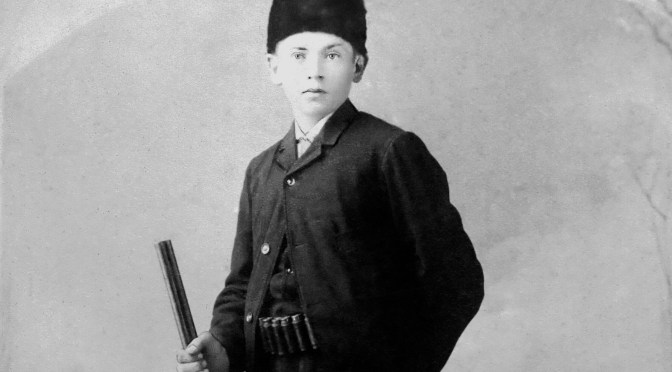
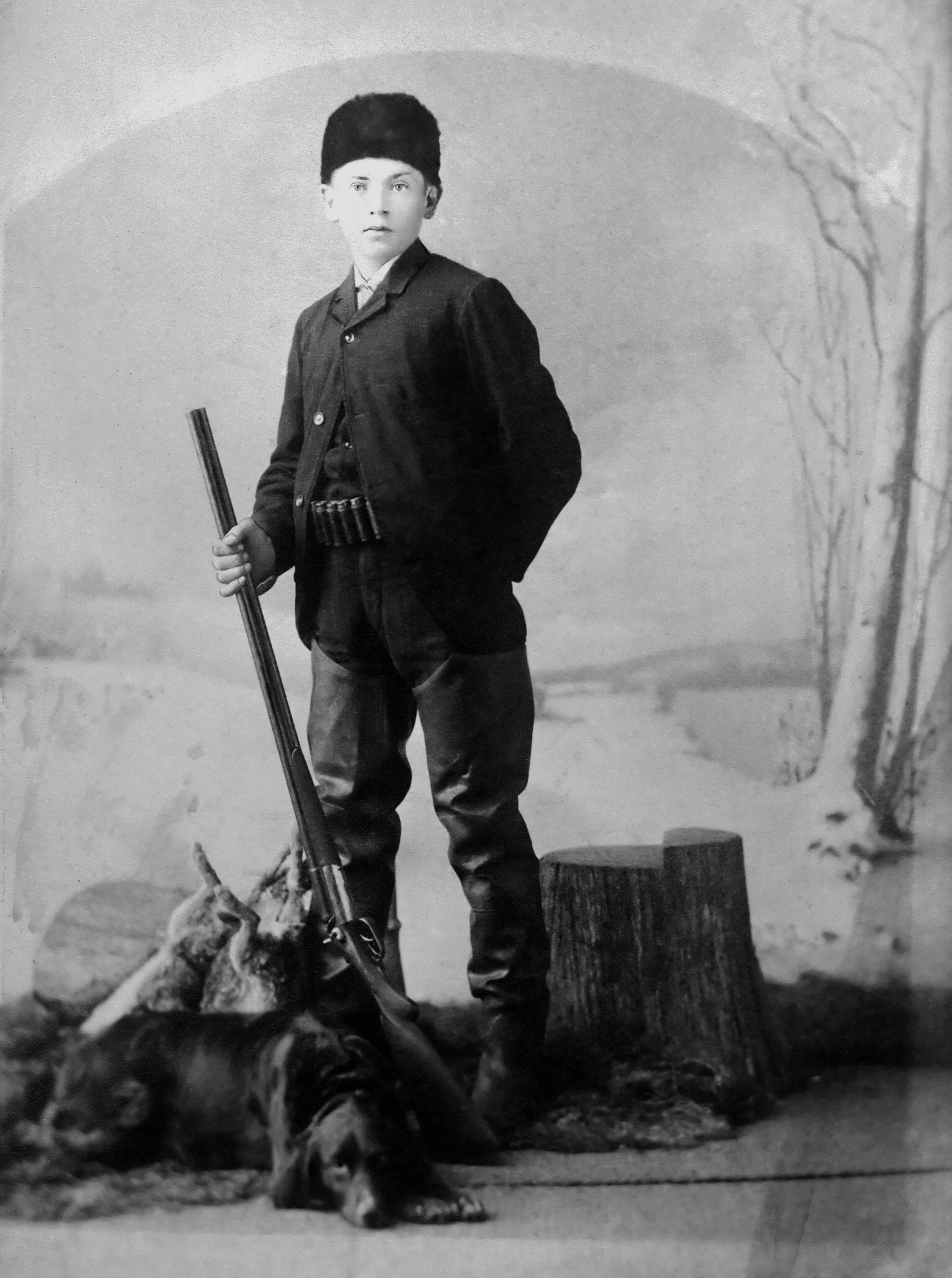
The more than century-old photo shows a stoic, proud young man wearing an ammunition belt and holding a shotgun in his right hand. At his feet lays a loyal hunting dog, seemingly tired from a day in the field. The young man is identified in the corner of the photo as Frank Hanneman, age 14. That dates the photo to 1909 or 1910.

The paper-mounted and framed portait, in nearly perfect condition, survived all of these years in the possession of Carl F. Hanneman, Frank’s brother, and later in the collection of David D. Hanneman, Carl’s son. It is one of the oldest existing photos of a Hanneman from Wood County, Wisconsin.
Frank Hanneman, 14, posed for this photo around 1910.

What do we know about this young hunter? Frank Herman Albert Hanneman was born July 7, 1895 near Grand Rapids, Wisconsin, the son of Charles and Rosine Hanneman. In his early years the family lived and worked on the farm of his uncle, William Hanneman, in the Town of Grand Rapids in Wood County. The 1900 U.S. Census lists Charles Hanneman, 33, as a farm laborer on the farm of William Hanneman. By 1905 the Charles Hanneman family moved to Baker Street in Wisconsin Rapids when Charles got work at the Consolidated Water Power & Paper Co.

The Hanneman boys enjoyed the great outdoors of central Wisconsin. We might assume by the photo, Frank enjoyed hunting birds. We have plenty of photos of a young Carl Hanneman fishing. On June 11, 1916, Frank married Irma Wilhelmine Louise Staffeld, and the couple took up residence on Baker Street in Wisconsin Rapids – a block away from his parents. The couple had five children between 1916 and 1929: Dorothy, Marjorie, Robert, Elizabeth and Joyce. Like his father, Frank had a long career working at Consolidated Water Power & Paper Co.

On July 14, 1947, Frank suffered a heart attack at home, and died shortly after arriving at Riverview Hospital. He was 52. His brother, Carl, was vacationing with his family in North Dakota, but returned for the funeral before rejoining the family vacation.

©2015 The Hanneman Archive


Eye on the Past: 1946 Tourist Hotel Crash

It was the moving definition of a close call. A semi-trailer truck being driven by John N. Post flipped over in late June 1946 and slid right into the front of the Tourist Hotel on State Street in Mauston, Wisconsin. The semi ripped off the hotel’s screened porch and pushed it down the block.

The truck pushed parts of the porch 20 feet to the west.

Breaking glass exploded into the only unoccupied room at the inn. The room’s regular resident, a truck driver himself, was away on vacation. Post, 25, told police that he pulled out in order to pass a car driven by Charles A. Petrowitz, 15. Petrowitz started to make a left turn, forcing Post to veer and lose control of the truck. Post was treated at the Mauston hospital and released. No citations were issued in the accident. In addition to building damage, the truck also knocked over a light post, a mailbox and a fire hydrant.

Truck driver John N. Post suffered only minor injuries in the crash.

The photos were taken by Carl F. Hanneman for The Wisconsin State Journal, which ran two images and a short story on its State Page on June 25, 1946.

©2015 The Hanneman Archive

Seven Decades Cutting and Shaving the Town

By Carl F. Hanneman
State Journal Correspondent

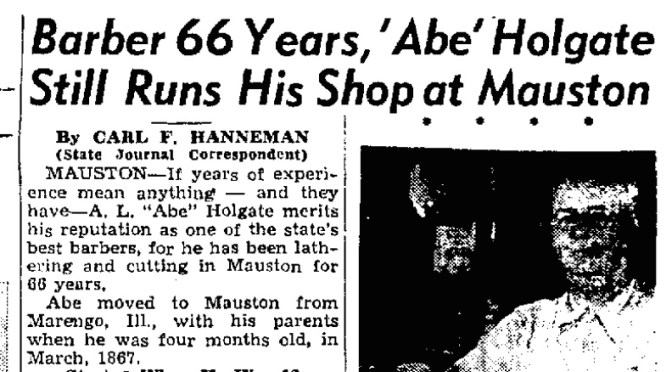
If years of experience mean anything — and they have — A.L. “Abe” Holgate merits his reputation as one of the state’s best barbers, for he has been lathering and cutting Mauston for 66 years.

Abe moved to Mauston from Marengo, Ill., with his parents when he was four months old, in March 1867. His father William was a barber, but barbering didn’t enter the little shaver’s mind until he was 12, when his father became seriously ill and the lad promised to learn the trade and look after his mother. When his father recovered, the lad kept his promise, and at the age of 12, back in 1878, he started the long hours of standing beside a barber chair.AbeHolgate

Now Abe is 78, but you’ll find him on the job in his shop across from the Juneau County Courthouse, even during the long Saturday hours.

The steps have decreased since the days of the old-time rack, which used to hold the treasured array of individual shaving mu.gs, bright with inscriptions and names.

Holgate is in excellent health, never missing a day at the shop and still enjoying a good schottische with the proper music. Musically inclined himself, he plays a wicked guitar. His favorite hobbies are hunting and fishing, and although many fine catches of large and small game fish are still caught in the Lemonweir River at Mauston, he claims that previous to construction of the dam it was nothing for an individual to catch a wagonload of bluegills before the game limit was established.

Mr. and Mrs. Holgate observed their golden wedding anniversary in 1936. Among his five grandchildren is First Lt. William Holgate, who as a pilot on a B-24 was shot down over Romania, later released from prison camp and now is home on leave.

(Published in the October 29, 1944 editions of The Wisconsin State Journal)

Postscript: Abe L. Holgate died on October 9, 1951 in Mauston. He was 84. In addition to his barber duties, Abe served for a time as chief of the volunteer Mauston Fire Department. His son, Roy E. Holgate, also worked as a barber in Mauston. Roy, who was at one time Mauston city clerk, died of pneumonia on February 7, 1937. He was 47 years old. Abe’s father, William Holgate, is buried next to his son and grandson at the Mauston cemetery. The family accounts for more than 80 years of barbering across three generations.

©2015 The Hanneman Archive

The Story Behind the 1945 Wisconsin Badgers Homecoming Ticket Stub

It was mixed in with photographs and other documents — a colorful, torn ticket stub. I picked it up and examined it and was left wondering, what is the story behind it? The game was between the University of Wisconsin and Northwestern on November 10, 1945. I presumed that my Dad was the lucky holder of the $1.75 ticket. He was 12 at the time, so a trip from Mauston to Madison for a college football game would have been a big treat. I had to find out more about this game. So I dug right into it.

The ticket stub was like an invitation to re-live the 1945 homecoming game.

The weather forecast for the homecoming game called for a high of 39 degrees after an overnight low of 18. The Friday night calm on the UW campus was broken by roving mobs of teenagers who broke store windows and vandalized cars along State Street. Madison police made 49 arrests for curfew violations, according to The Wisconsin State Journal. Still, police considered the homecoming crowd on campus well-behaved overall, so they did not use the tear gas and water wagons that were held in reserve.

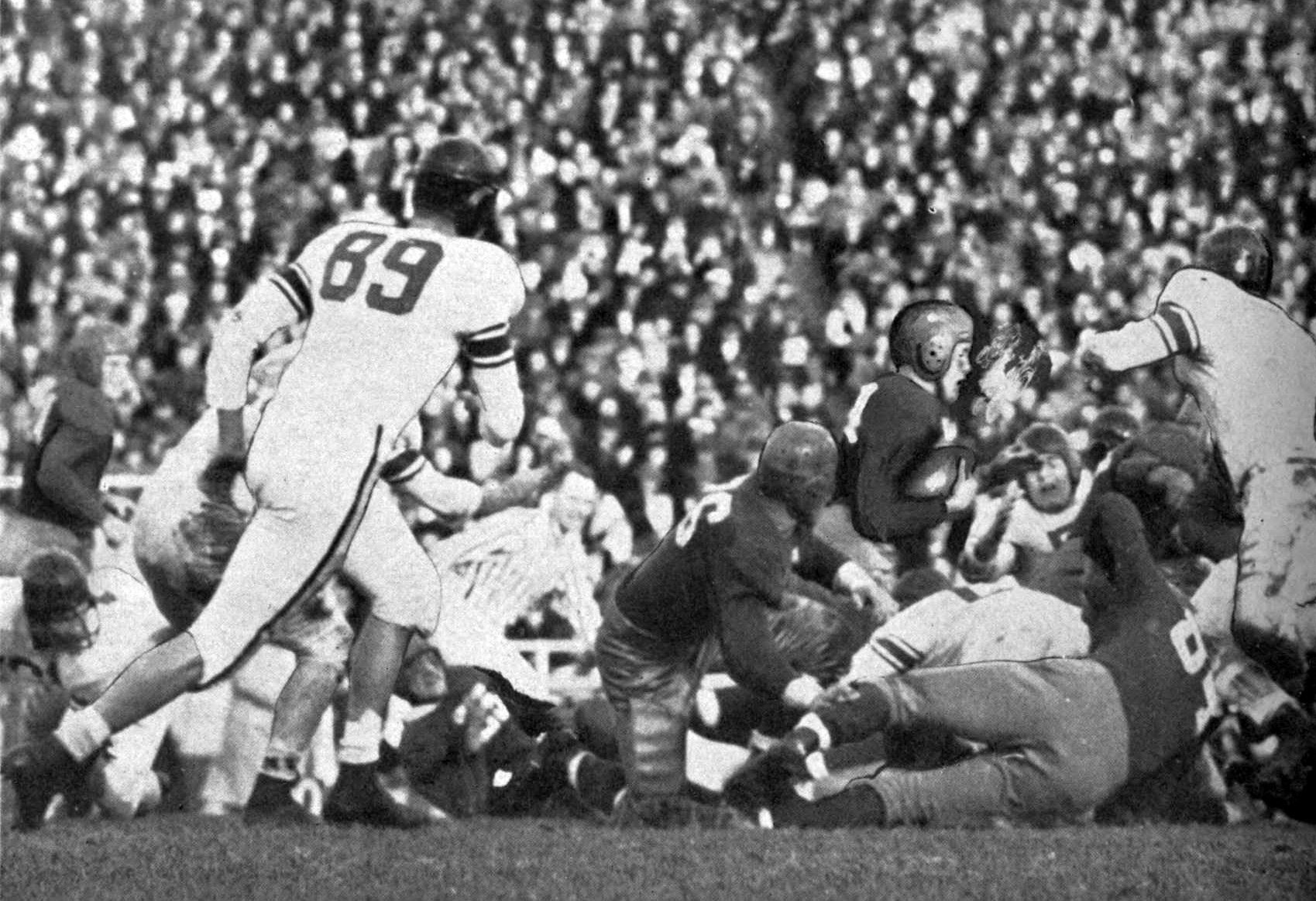
Scatback Jerry Thompson runs for 5 yards against Northwestern on November 10, 1945.

Camp Randall was packed with 45,000 fans when game time arrived on Saturday. Dad (or whomever held that ticket) sat in the south end zone, Section Z, Row 6, Seat 5. This is the end of the stadium backed against the UW Field House. I’ve sat in that section myself a few times over the years. Fans were treated to a great game. “This was a game with few dull moments, one in which each turned loose a devastating running attack,” wrote Henry J. McCormick, sports editor of The Wisconsin State Journal. The first quarter ended scoreless. Wisconsin’s initial drive ended on Northwestern’s 48 when Jerry Thompson’s pass was intercepted. Northwestern fared no better, as its drive ended on Wisconsin’s 25 when Badger Don Kindt intercepted a Jim Farrar pass.

'Big Ben' Bendrick slashed Northwestern for 133 rushing yards.
‘Big Ben’ Bendrick slashed Northwestern for 133 rushing yards, but fumbled twice.

In the second quarter, Wisconsin scored a touchdown on a 16-play, 80-yard drive that ended with a reverse and a pass to the end zone. Northwestern answered with an impressive 73-yard touchdown drive. Wisconsin roared right back on the next drive. Halfback Ben Bendrick ripped off 17 of his 133 yards on one play. Kindt finished the drive by plunging into the end zone with only 8 seconds left in the half. Halftime score was 14-7 in favor of the Badgers. The second half opened with the same high tempo. Northwestern took the kickoff and moved right down the field with 70 yards on 11 plays. Farrar’s 25-yard pass to tight end Stan Gorski brought the game to a 14-14 tie. On the very next drive Wisconsin’s Bendrick tore off a 41-yard run, followed by an 11-yard scamper from Kindt. A fourth-down pass from Thompson was intercepted by Bill Hunt of Northwestern. When the Wildcats pounded down to the Wisconsin 1 yard line on the drive, the Badgers’ defense stiffened, stopping the Cats on a fourth-down pass play. As the third quarter ended, the score was still knotted at 14.

On the opening drive of the fourth quarter, Bendrick continued his punishing ground game. But lightning struck as Bendrick went around left end. The ball popped out, right into the hands of Northwestern’s Hunt, who returned the ball to the Wisconsin 9 yard line. After two running plays, Northwestern took it to the end zone for a 21-14 lead. The teams then traded unsuccessful drives. Wisconsin’s Thompson threw another pick at mid-field, but Northwestern’s ensuing drive stalled. When the Badgers got the ball back, Bendrick fumbled again. Northwestern pounced on the ball at the Wisconsin 24. Seven plays later, Northwestern scored to go up 28-14. That’s how the game ended.

When your team rolls up 244 yards rushing, it typically won’t lose. But on this day, the Badgers made too many mistakes, spotting the Wildcats 14 points with two fumbles. The headlines should have been about Bendrick’s stellar 133-yard rushing day. The Badger faithful left Camp Randall entertained, but unsatisfied. If my Dad, David D. Hanneman, was the ticket holder, I’m guessing he was there with his father, Carl F. Hanneman. The first Wisconsin game I can recall attending with my grandfather was a 1977 game vs. Michigan State. The Badgers lost that day, 9-7.

Don Kindt ran for 63 yards against Northwestern.

Hidden behind the headlines of the 1945 game was a compelling military story. It was just the third game back for Don Kindt, who shared halfback duties with “Big Ben” Bendrick. As just a 17-year-old, Kindt interrupted his Wisconsin football career in 1943 to enlist in the U.S. Army’s 10th Mountain Division during World War II. He saw extensive action in Italy and was awarded two bronze stars. He returned to the Badgers in October 1945. After his Wisconsin playing career, Kindt spent nine seasons with the Chicago Bears. He recounts his war experiences in an extensive interview conducted in 1994 by the Wisconsin Veterans Museum.

©2015 The Hanneman Archive