A group of sparrows perched on the edge of the bird feeder outside Lloyd Miller’s window, pecking at the seeds like there was no tomorrow.
Oblivious to the man watching them from just feet away, the birds went about their business, then flew away. They are a living reminder of just how much Miller’s life has changed in the past four years.
This story was part of an award-winning 12-page special section published in The Journal Times on Dec. 1, 1991. The project won awards from the Wisconsin Newspaper Association, the American Cancer Society and the American College of Radiology.
For much of his life, the 71-year-old Miller never had time for little hobbies like bird watching. From his early days as a cavalry instructor in the U.S. Army to his career as a salesman and Racine’s city development director, Miller was a busy man.
Then came cancer.
“I never had a bird feeder before. Now, I’m feeding the birds at $10 a week,” Miller says with a chuckle. “I’ll have to win the lottery.”
Aside from the pinkish patch of scar tissue on his head and his lack of hair, you would never know this man tangled with a rare, life-threatening cancer.
He has a firm handshake, a hearty belly laugh and a warmth that twinkles from beneath his spectacles.
Life has changed
The bird feeder is one of the little ways Miller is a different man now. He isn’t bothered by the little things anymore. He’s more tolerant. He finds it a lot easier to tell his wife and friends that he loves them.
And although life has brought him persistent heart problems and a cancer that came back four times, Miller considers himself lucky.
Lloyd Miller never used to have time for hobbies. Now he’s a regular bird-feeder. — Journal Times photo by Mark Hertzberg
“I do not consider myself dying of cancer,” he says, softly tracing an invisible pattern on the kitchen table with his index finger, “but living despite it. I do not look at each day as a day closer to death, but another day to be appreciated and enjoyed.”
Lloyd Miller is a cancer survivor.
He is one of the 50 percent of cancer patients who live through the terrifying diagnosis, the fear, the uncertainty, the sickening treatments and the real risk of death. He is part of a growing group with a determination to live life fully, with a new appreciation for what was almost lost.
Miller’s rare form of cancer is in remission, four years after it was discovered. And although there still is a risk the cancer could come back and attack his lungs, he doesn’t let it worry him.
“I feel so comfortable, it’s almost a sin. I don’t think about it every day.”
But for much of the past few years, Miller had little choice but to think about cancer.
The first inkling of trouble came in 1987 while he was on a cruise with Sue, his wife of 16 years. A sunburn-like patch of blisters appeared on the left side of his scalp. It didn’t concern him, until his eye began to swell so badly he had to soak it to get it to open. Upon returning to Racine from Miami, Miller went to see his doctor in Kenosha. The doctor took a biopsy, then delivered the kind of heart-stopping news everyone fears.
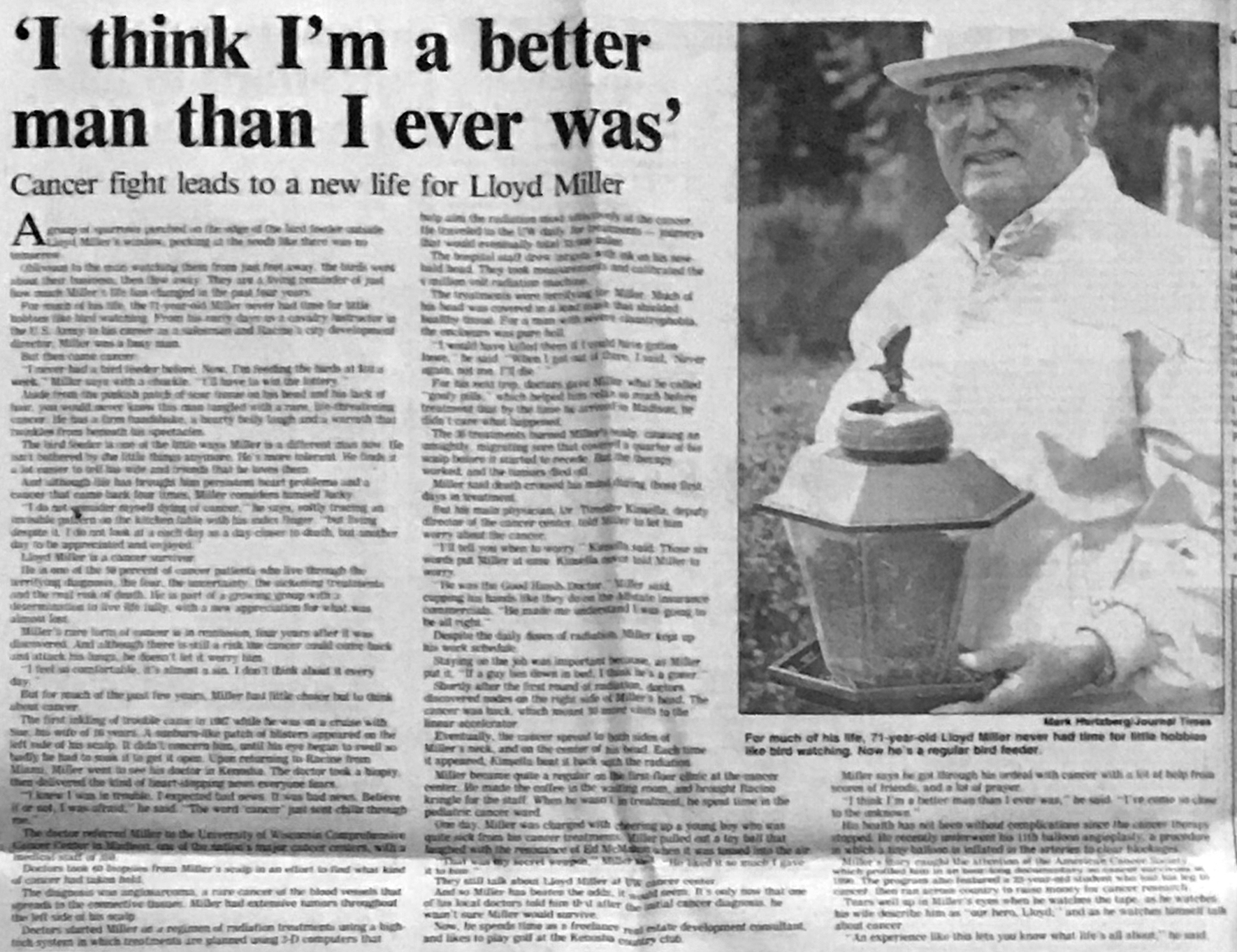
Lloyd Miller’s story as it appeared in the Journal Times on Dec. 1, 1991.
“I knew I was in trouble. I expected bad news. It was bad news. Believe it or not, I was afraid,” he said. “The word ‘cancer’ just sent chills through me.”
The doctor referred Miller to the University of Wisconsin Comprehensive Cancer Center in Madison, one of the nation’s major cancer centers, with a medical staff of 350.
Doctors took 60 biopsies from Miller’s scalp in an effort to find what kind of cancer had taken hold.
Rare cancer diagnosed
The diagnosis was angiosarcoma, a rare cancer of the blood vessels that spreads to the connective tissues. Miller had extensive tumors throughout the left side of his scalp.
Doctors started Miller on a regimen of radiation treatments using a high-tech system in which treatments are planned using 3-D computers that help aim the radiation most effectively at the cancer. He traveled to the UW daily for treatments — journeys that would eventually total 33,000 miles.
The hospital staff drew targets with ink on his now-bald head. They took measurements and calibrated the 6-million-volt radiation machine.
The treatments were terrifying for Miller. Much of his head was covered in a lead mask that shielded healthy tissue. For a man with severe claustrophobia, the enclosure was pure hell.
“I would have killed them if I could have gotten loose,” he said. “When I got out of there, I said, ‘Never again, not me. I’ll die.’ ”
For his next trip, doctors gave Miller what he called “goofy pills” that helped him relax so much before treatment that by the time he arrived in Madison, he didn’t care what happened.
Treatments burn the scalp
The 30 treatments burned Miller’s scalp, causing an unsightly, migrating sore that covered a quarter of his scalp before it started to recede. But the therapy worked and the tumors died off.
Miller said death crossed his mind during those first days in treatment.
But his main physician, Dr. Timothy Kinsella, deputy director of the cancer center, told Miller to let him worry about the cancer.
“I’ll tell you when to worry,” Kinsella said. Those six words put Miller at ease. Kinsella never told Miller to worry.
“He was the Good Hands doctor,” Miller said, cupping his hands like they do on the Allstate insurance commercials. “He made me understand I was going to be all right.”
Despite the daily doses of radiation, Miller kept up his work schedule.
Staying on the job was important because, as Miller put it, “If a guy lies down in bed, I think he’s a goner.”
Shortly after the first round of radiation, doctors discovered nodes on the right side of Miller’s head. The cancer was back, which meant 30 more visits to the linear accelerator.
Eventually, the cancer spread to both sides of Millers’ neck and on the center of his head. Each time it appeared, Kinsella beat it back with radiation.
Miller became quite a regular on the first-floor clinic at the cancer center. He made the coffee in the waiting room, and brought Racine kringle for the staff. When he wasn’t in treatment, he spent time in the pediatric cancer ward.
One day, Miller was charged with cheering up a young boy who was quite sick from his cancer treatments. Miller pulled out a toy ball that laughed with the resonance of Ed McMahon when it was tossed into the air. “That was my secret weapon,” Miller said. “He liked it so much I gave it to him.”
They still remember Lloyd Miller at UW Cancer Center.
Help and prayers
And so Miller has beaten the odds, it would seem. It’s only now that one of his local doctors told him that after the initial cancer diagnosis, he wasn’t sure Miller would survive.
Now he spends time as a freelance real estate development consultant and likes to play golf at the Kenosha country club. Miller says he got through his ordeal with cancer with a lot of help from scores of friends and a lot of prayer.
“I think I’m a better man now than I ever was,” he said. “I’ve come so close to the unknown.”
His health has not been without complications since the cancer therapy stopped. He recently underwent his 11th balloon angioplasty, a procedure in which a tiny balloon is inflated in the arteries to clear blockages.
Miller’s story caught the attention of the American Cancer Society, which profiled him in an hourlong documentary on cancer survivors in 1990. The program also featured a 23-year-old student who lost his leg to cancer, then ran across country to raise money for cancer research.
Tears well up in Miller’s eyes when he watches the tape, as he watches his wife describe him as “our hero, Lloyd,” and as he watches himself talk about cancer.
“An experience like this lets you know what life’s all about,” he said. •
EPILOGUE:Lloyd G. Miller died on March 6, 2004 at his retirement home in Orlando, Fla. He was 83.
Jeff Peterson will never forget Valentine’s Day 1985.
A battalion chief with the Racine Fire Department, Peterson was on his way to St. Mary’s Medical Center on a routine call that night. En route, he noticed a sharp pain in his groin, a pain that steadily worsened. By the time he arrived, he needed medical attention.
“By the time I got to St. Mary’s, I could hardly walk,” Peterson, 49, recalled.
Doctors who examined him originally thought he was suffering from torsion, a painful twisting of the vas deferens leading from the testicles. But efforts to relieve the pain were useless.
This story was part of an award-winning 12-page special section published in The Journal Times on Dec. 1, 1991. The project won awards from the Wisconsin Newspaper Association, the American Cancer Society and the American College of Radiology.
Peterson underwent exploratory surgery that night at St. Mary’s. He was under local anesthetic and was able to ask the surgeon what he saw. There were lumps on one of the testicles, he was told, and it could be cancer.
“I thought I was going to die,” he said. “I thought I had a death sentence.”
Surgeons removed the diseased testicle, which they believed was the original site of the cancer. He went home the next day, still reeling from the diagnosis.
Smoke inhalation a factor? Peterson did not smoke and he wondered how he could develop such a rare cancer, which strikes about 130 Wisconsin men a year. But he recalled his early days in the fire department, days when “you were a candy ass” if you wore an oxygen mask to a fire scene.
More than once, he recalled coughing up black phlegm after coming out of a fire. Now, he wonders what those early days did to him.
Peterson was admitted to the Mayo Clinic in Rochester, Minn., where doctors put him through a battery of tests. The news was not encouraging. The cancer had spread to Peterson’s lungs and the tumors were growing fast.
“They had grown from the size of the head of your pen to the size of a small orange in three weeks or so,” he said.
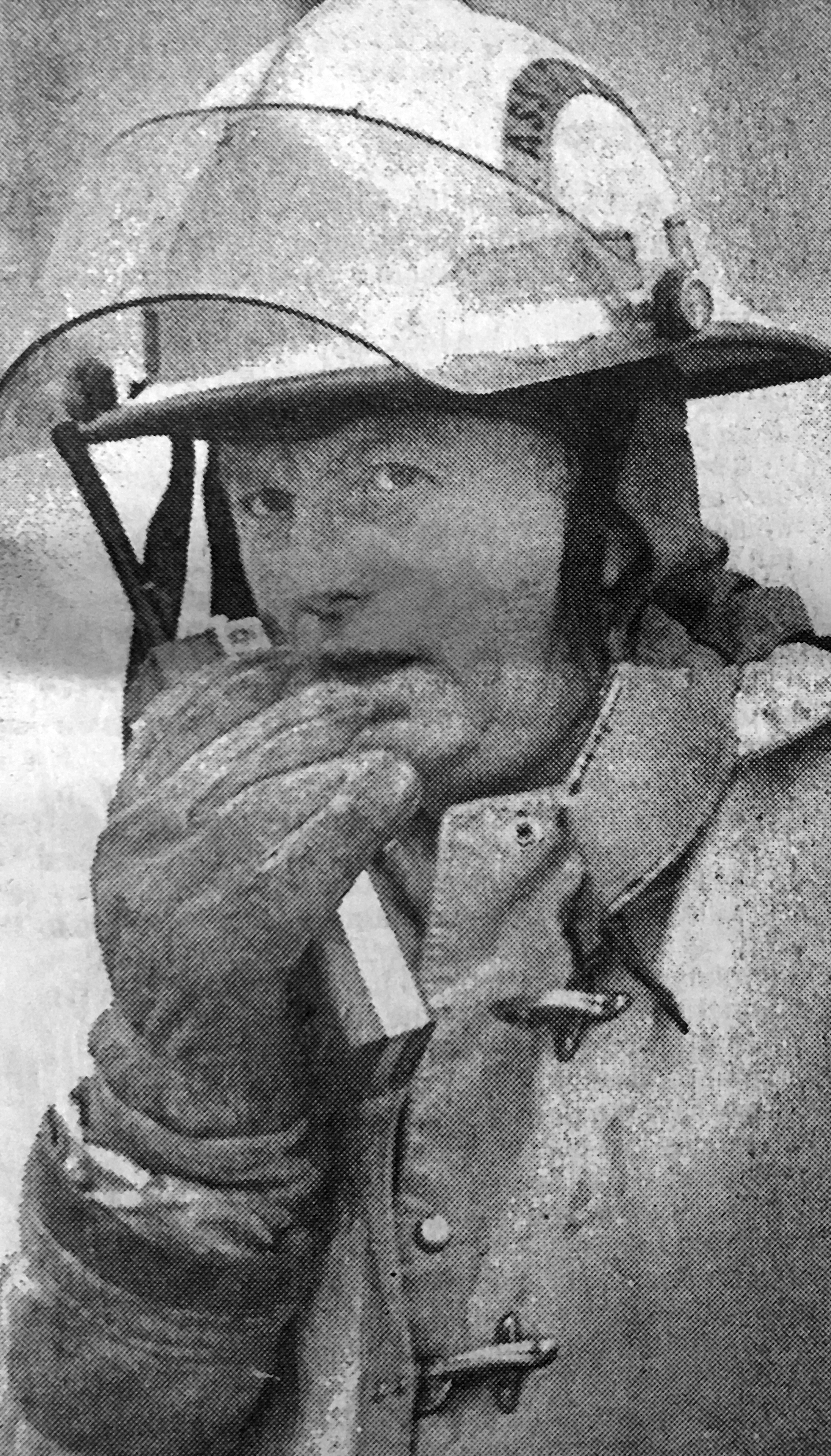
Jeff Peterson on duty with the Racine Fire Department. — Journal Times photo by Mark Hertzberg
Doctors decided to attack the lung tumors with chemotherapy. Peterson returned to Racine and went on a regimen of chemotherapy. One week of treatments was followed by three off weeks to let his body recover.
Peterson lost his hair from the nauseating treatments, but he decided to go back to work at the fire department, where he was in charge of training programs. Being at work was therapeutic.
“I found if I sat at home, the only thing I could think about is, ‘Am I going to die?’ ” he said. “I needed a diversion. That diversion was going to work.”
Diversion is not all he found at the fire department. He also found inspiration and the will to keep fighting.
Heroic inspiration The source of the inspiration was Dan Christensen. Christensen was always the first to greet Peterson and ask him how he was doing. Christensen told him things would work out, he’d be OK.
Encouraging words are always good to hear, but Christensen’s words carried extra meaning for Peterson, because his fellow firefighter was dying from amyotrophic lateral sclerosis — Lou Gehrig’s disease.
“It was just remarkable, a person could take life, so little of which he had left, and still give so much to the people he had around him,” Peterson said.
Even as Christensen lost his motion control as his muscles deteriorated from the disease, he kept up the pep talks for Peterson. He visited him in the hospital and always had an encouraging word. He may not have known it at the time, but Christensen, who died in August, helped save his friend’s life.
“He made me keep on fighting,” Peterson said. “That’s a major part of beating cancer. You have to take one day at a time.”
There was plenty of fight ahead for Jeff Peterson.
The nausea and vomiting from chemotherapy put him back in the hospital. He developed blood clots in his lungs. Then, he developed a fungus-like disease in his lungs that put his life in jeopardy.
Jeff Peterson’s story as it appeared in the newspaper on Dec. 1, 1991.
He remembers that meeting with doctors well. The combination of complications could be fatal. The doctor had tears in his eyes.
“ ‘You’re not rid of me yet,’ ” Peterson said he told the doctor. “I made up my mind I was not going to be that statistic. I was going to be a statistic on the positive side.”
Doctors started treating the lung fungus with steroids, but the going was still rough. Peterson got angry when some of his visitors treated him like he was a sure bet to die.
No giving up There were a few times in the hospital, when he was weary from the chemotherapy, that Peterson felt like giving up. Dying. But then sleep would come for a few hours, putting a little more fight in his soul.
By late 1985, Peterson turned the corner on his disease. The tumors responded to therapy and the fungus was subsiding. Peterson was winning.
That was six years ago. Peterson has been cancer-free ever since. The disease challenged him and nearly killed him, but it also gave him a sense of how precious life is.
“Cancer gives you a new outlook on life. Every day to me is a bonus,” he said. “I used to take a lot more things more seriously than I do now. You know the time here is so short, you should make the best of it every day.”
These days, Peterson spends part of his time delivering talks to high school boys about testicular self-exams, something even he was ignorant about before he got cancer.
“It’s a subject not many kids want to talk about, but it’s got to be done,” he said. “That’s one of the points I was extremely angry about. My own physician never told me to do a testicular exam.”
He also spends time whenever called upon to help cancer patients adjust to the disease. He won’t let them give up, just like Danny Christensen wouldn’t let him give up. One man he saw recently was ready to throw in the towel, but Peterson convinced him it was worth the fight. The man is doing fine now.
“That’s one of the boosts that makes me smile every day,” he said. •
EPILOGUE:Peterson retired from the Racine Fire Department in early 1999 after more than 30 years as a firefighter, including a stint as chief.
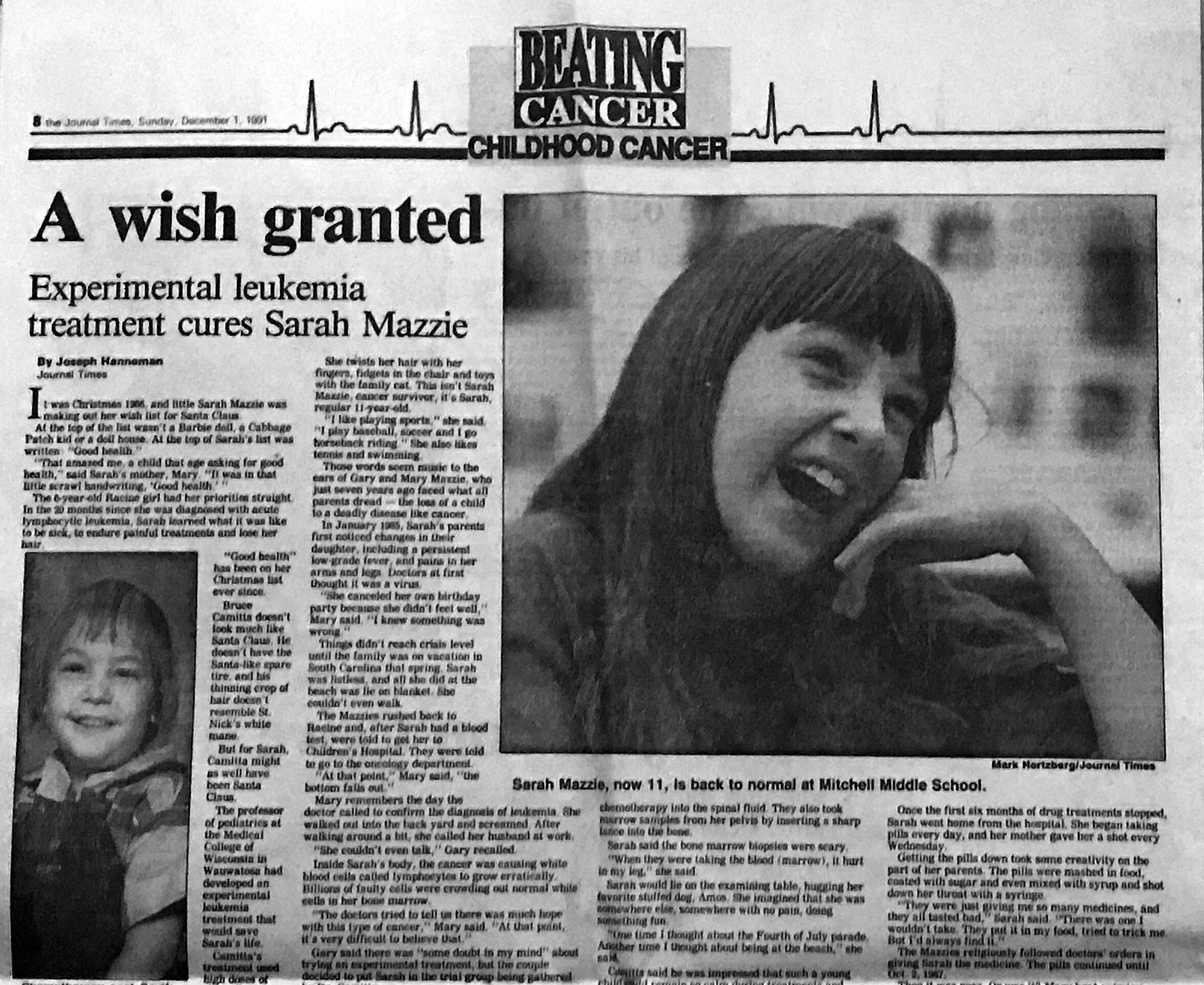
It was Christmas 1986, and little Sarah Mazzie was making out her wish list for Santa Claus. At the top of the list wasn’t a Barbie doll, a Cabbage Patch Kid or a doll house.
At the top of Sarah’s list was written: “good health.”
“That amazed me, a child that age asking for good health,” said Sarah’s mother, Mary. “It was in that little scrawl handwriting, ‘Good health.’ ”
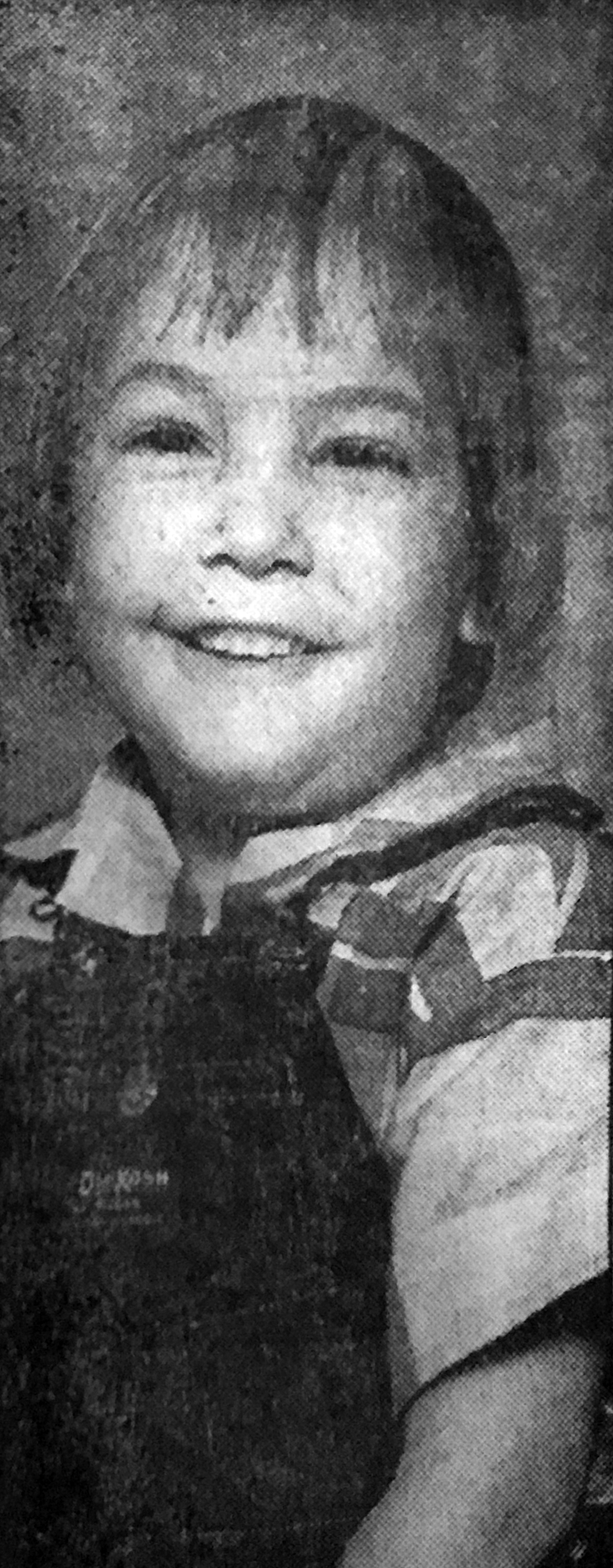
The 6-year-old Racine girl had her priorities straight. In the 20 months since she was diagnosed with acute lymphocytic leukemia, Sarah learned what it was like to be sick, to endure painful treatments and lose her hair. “Good health” has been on her Christmas list ever since.
This story was part of an award-winning 12-page special section published in The Journal Times on Dec. 1, 1991. The project won awards from the Wisconsin Newspaper Association, the American Cancer Society and the American College of Radiology.
Bruce Camitta doesn’t look much like Santa Claus. He doesn’t have the Santa-like spare tire, and his thinning crop of hair doesn’t resemble St. Nick’s white mane.
But for Sarah, Camitta might as well have been Santa Claus.
The professor of pediatrics at the Medical College of Wisconsin in Wauwatosa had developed an experimental leukemia treatment that would save Sarah’s life.
Preventing recurrence
Camitta’s treatment used high doses of chemotherapy, followed by an extended period of lower doses, administered after patients had gone into remission. Patients often respond well to initial treatment, but Camitta’s goal was to prevent recurrence of the cancer.
Sarah was his 27th patient in the trial at Children’s Hospital of Wisconsin in suburban Milwaukee, and one of the 80-plus percent for whom the treatment has worked. She has been cancer-free ever since.
“He says I’m a pioneer girl,” said Sarah, now a pretty 11-year-old sixth-grader at Mitchell Middle School. She’s proud that she helped break medical ground and beat the cancer that could have stolen her young life.
“I don’t think about it,” she said of the leukemia. “It’s not hard, I’m just lucky they had medicine.”
Wearing a red shirt, black jeans and deck shoes, Sarah sits in a director’s chair at her family’s home on Newman Road in Mount Pleasant. Her long, black hair, dark eyes and striking smile tell no tale of cancer.
Sarah’s story as it appeared in the newspaper on Dec. 1, 1991.
She twists her hair with her fingers, fidgets in the chair and toys with the family cat. This isn’t Sarah Mazzie cancer survivor, it’s Sarah, regular 11-year-old.
“I like playing sports,” she said. “I play baseball, soccer and I go horseback riding.” She also likes tennis and swimming.
Those words seem music to the ears of Gary and Mary Mazzie, who just seven years ago faced what all parents dread — the loss of a child to a deadly disease like cancer.
In January 1985, Sarah’s parents first noticed changes in their daughter, including a persistent low-grade fever, and pains in her arms and legs. Doctors at first thought it was a virus.
“She canceled her own birthday party because she didn’t feel well,” Mary said. “I knew something was wrong.”
Things didn’t reach crisis level until the family was on vacation in South Carolina that spring. Sarah was listless, and all she did at the beach was lie on blanket. She couldn’t even walk.
‘The bottom falls out’
The Mazzies rushed back to Racine and, after Sarah had a blood test, were told to get her to Children’s Hospital. They were told to go to the oncology department.
“At that point,” Mary said, “the bottom falls out.”
Mary remembers the day the doctor called to confirm the diagnosis of leukemia. She walked out into the back yard and screamed. After walking around a bit, she called her husband at work.
“She couldn’t even talk,” Gary recalled.
Sarah once cancelled her own birthday party because she felt ill. Her parents knew something was wrong.
Inside Sarah’s body, the cancer was causing white blood cells called lymphocytes to grow erratically. Billions of faulty cells were crowding out normal white cells in her bone marrow.
“The doctors tried to tell us there was much hope with this type of cancer,” Mary said. ‘At that point, it’s very difficult to believe that.”
Gary said there was “some doubt in my mind” about trying an experimental treatment, but the couple decided to put Sarah in the trial group being gathered by Dr. Camitta.
Sarah would he treated with standard chemotherapy until the disease was in remission, then undergo six months of intensive chemotherapy and two years of oral anti-leukemia drugs.
Intensive treatment
Camitta said the goal is to keep drug levels high over long periods to reduce the number of leukemic cells in the system. Treating a child who is in remission with intensive chemotherapy was considered a somewhat “rogue” idea in the medical community at the time, he said.
Mary stayed in the hospital with Sarah each night, and Gary visited after work. Sarah was hospitalized for 21 days, and after about two weeks of chemotherapy, her cancer was in remission.
Sarah then came back to the hospital every two weeks for an infusion of methotrexate and 6-mercaptopurine, the drug combination Camitta had chosen for the experiment. Every other week, she went to the clinic for a checkup.
Doctors periodically had to insert a needle into Sarah’s spine to check for leukemic cells, and to inject chemotherapy into the spinal fluid. They also took marrow samples from her pelvis by inserting a sharp lance into the bone.
Sarah said the bone marrow biopsies were scary.
“When they were taking the blood (marrow), it hurt in my leg,” she said.
Sarah would lie on the examining table, hugging her favorite stuffed dog, Amos. She imagined that she was somewhere else, somewhere with no pain, doing something fun.
“One time I thought about the Fourth of July parade. Another time I thought about being at the beach,” she said.
Making something positive
Camitta said he was impressed that such a young child could remain so calm during treatments and tests. “She was super,” he said.
The treatments during those first six months made Sarah sick. The drugs dropped her count of infection-fighting white blood cells. She got headaches, and mouth sores. And her hair fell out.
To help make something positive out of a bad situation, Sarah took the hair that had fallen out off of her pillow each morning, and strung it out on the bushes outside. She wanted the birds to use it to build their springtime nests.
Although she was “kind of scared” about her hair falling out, Sarah adjusted. Most of her friends knew why she was losing her hair.
“When I was in kindergarten, someone thought I was a boy,” she said. “I knew it was going to grow back. I wore a lot of hats.”
Sarah’s parent said she handled the treatments well. She didn’t cry, or fight with the doctors. Her only response was to become silent and withdrawn on the way to the hospital. Occasionally she shed a few quiet tears.
Drug treatments continue
Once the first six months of drug treatments stopped, Sarah went home from the hospital. She began taking pills every day, and her mother gave her a shot every Wednesday.
Getting the pills down took some creativity on the part of her parents. The pills were mashed in food, coated with sugar and even mixed with syrup and shot down her throat with a syringe.
“They were just giving me so many medicines, and they all tasted bad,” Sarah said. “There was one l wouldn’t take. They put it in my food, tried to trick me. But I’d always find it.”
The Mazzies religiously followed doctors’ orders in giving Sarah the medicine. The pills continued until Oct. 2, 1987.
Ordeal is over
Then it was over. Or was it? Mary kept quizzing doctors to see if any other children in the trial had a relapse of cancer. They told her not to worry.
Of the 73 children who underwent the treatment in the first two trials, more than 80 percent have remained cancer-free over long periods, Camitta said.
“That’s as good as anything else available, and we’re only using two drugs,” said Camitta, who has a giant teddy bear perched on a file cabinet outside his office. But many more children will have to be tested on the trial nationally to confirm the results, he said.
Camitta won three ardent believers on Newman Road in Mount Pleasant.
Gary said the family is stronger for the ordeal, and he realizes just how fragile life is. Whenever he has a bad day at work, he just looks at a picture of Sarah from back then, and is reminded of what is most important to him.
As for Sarah, she’s gotten on with her life, and will turn 12 in February. Asked if she has any advice for other children with cancer, she doesn’t hesitate in her response.
“I’d tell them you’d probably get better. If they cured me, they should probably be able to cure kids now.”
EPILOGUE:Sarah B. Mazzie graduated from the University of Wisconsin in 2002 and earned her Juris Doctor degree from the DePaul University College of Law in 2006. She was a partner in her own law firm and has worked for Immigration and Customs Enforcement in the U.S. Department of Homeland Security. Now 40, she is a U.S. immigration judge in Minneapolis. Her parents Iive in Racine.
Top photo: Sarah Mazzie in her classroom at Mitchell Middle School in Racine. — Journal Times Photo by Mark Hertzberg.
MILWAUKEE – Herman “Rocky” Espinoza has always wanted to be a police officer, but he will never get the chance to realize that dream.
“He’ll wear his police shirts every day,” says his mother, Deborah Exner of Monroe. “I even bought him a police siren for his bike.”
Rocky, 12, a Racine native, counts several police officers among his good friends and owns a toy gun and authentic handcuffs.
“He’s the good guy,” Exner said. “That’s probably straight from his mouth. He really holds that status so high.”
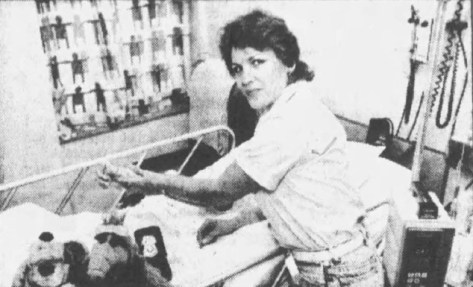
Deborah Exner holds her son’s hand at Children’s Hospital of Wisconsin. (Racine Journal Times photo by Mark Hertzberg)
Rocky has always been a boy full of life, rarely complaining and always looking out for his mother. But for seven years, Rocky has battled an inoperable cancerous tumor growing at the base of his brain.
Time after time he fights back from the effects of the tumor, but there is little doctors can do for him.
“I don’t think I ever put it to him that he’s going to die,” Exner said. “I put it to him that this is just a kind of stopping ground. The next stop is heaven. He understands that.”
Despite the troubles that have fallen upon him, Rocky shows the courage and optimism many adults would envy. On Friday, he lay in his bed at Children’s Hospital of Wisconsin, resting.
Pinned to his hospital gown was one of his favorite police badges. On the cassette stereo, a song from his idol, John Schneider, played softly.
Nice and simple, just how he likes it.
Exner walked around the side of the bed, leaned over and kissed him softly on the cheek. She took his hand, looked into his half-open eyes and said a few reassuring words.
Behind Exner’s kind eyes and smile lie the thoughts of a woman who knows her son’s illness is beyond her control. All she can do now is make him comfortable.
Threat of death
Last month, Rocky had to return to Milwaukee after he began having seizures caused by the pressure the tumor exerted on his brain.
“All through the seven years there’s always been the threat of death,” Exner said. “No matter how bad the doctors thought it was, he popped out of it. (Doctors) don’t believe it. They are just amazed.”
The disease is to the point that doctors cannot keep up with an expanding cyst caused by the tumor. He has had three operations in three weeks to relieve the pressure.
Despite Rocky’s strong will to live, the cancer is exacting its toll.
“He’s been through so much,” Exner said. “I think he’s just real tired of fighting. He’s not giving up – he’s just tired.”
Rocky has trouble responding when people talk to him, but not always. “When I came into the room, I bent over and kissed him and said, ‘I love you,’ ” Exner said. “He said, ‘I love you, mom.’ “
Herman picked up the nickname “Rocky” because his cancer was diagnosed when the “Rocky” movies were popular. Besides, Exner said, he has been a real fighter.
“I took it worse than he did. I cried,” she said. “He took it really well. He has always just said, ‘It’s OK, mom.’ He knew he was real sick. He knew it was something he would have to deal with the rest of his life.
“He used to wake up in the middle of the night, just screaming with incredible headaches. I thought it was nightmares.”
When the headaches would not go away, she took Rocky to a Racine doctor, who referred him to a neurosurgeon at Children’s Hospital.
“Dr. Dunn could tell that the tumor was quite large,” she said. “He told me right away that there wasn’t any hope at all. There wasn’t anything they could do.”
But Rocky kept fighting back and giving himself extra time.
‘I’m not a wimp’
Outgoing and charismatic, Rocky lever lets on if he has any fear of his illness, relatives say. Before he went in for a recent operation, he told the doctors, “I’m Rocky – I’m not a wimp.”
Bob Pitts, of Mount Pleasant, Rocky’s uncle, said he told the boy to get better so they could arm wrestle. But Rocky couldn’t wait – he stuck his arm out and put up a pretty good fight.
“When he was first diagnosed,” Pitts said, “he wasn’t supposed to make it three months. He’s fighting every inch of the way.”
Rocky also enjoys riding a bicycle. “He was just learning to ride the bike again, then he had to come back here,” she said.
Schneider, who played Bo Duke on the “Dukes of Hazzard” television series, met Rocky at a Janesville concert last year and gave him his ID bracelet, which is now one of Rocky’s “most prized possessions,” Exner said.
On Friday, Schneider heard Rocky was back in the hospital and telephoned the family to check on him, relatives said.
A former student at Trinity Lutheran School, Rocky was not real big on the books, but he did like school.
Financial toll, too
Exner said she has accepted Rocky’s illness, but admits it has been hard for her in many ways.
“I don’t work, because I stay home and take care of Rocky,” she said. “It’s very hard. Right now I’m trying to find some ways of getting some more financial support.”
Rocky’s medical bills are paid mostly by Medicaid. But Exner has to pay her way to Milwaukee and back, which she said is difficult on a very limited income.
“Financially, I’m very strapped,” she said. “I couldn’t get any help to buy a car” and had to take a loan. “Now, I’m a little worried about that.”
‘Going to heaven’
The biggest toll is emotional.
“It’s hard to face it,” Exner said. ‘What puts me at peace with death (is) he is definitely going to heaven. That gives me peace.
“Sometimes I just wish I could trade places,” she said. “God has always made me a promise that says ‘I’m not going to push you any more than you can handle.’ “
Exner’s adjustment to Rocky’s terminal illness has included hysteria, a lot of tears and anger. But she said her main concern is seeing that Rocky does not suffer.
“If his life is going to hurt him any more, with the love I have for him, I’d rather see him at peace in heaven, ” she said.
“If he does die, I guess a part of me will die too. But I don’t want to be selfish. He’s been through enough. We’ve done as much as we possibly can and now its time to stop.”
Exner’s pain seemed well hidden on Friday. She and her relatives were able to laugh and recall their favorite stories about Rocky. She knows the pain is not over.
“When he actually does die, I think I’m going to fall apart,” she said.
Instead of focusing on the bad things that have happened, Exner counts the good times she has had with her son.
“I’ve had 12 of the hardest but most wonderful years with that young man,” she said. “I’m just thankful for that.”
She said the mother-son bond between them could not be stronger.
“I think that kid is a miracle,” Exner said. “I’m just proud to be his mom. I don’t know what I did, but I’m glad he’s mine.” ♦
– Originally published on Page 1 of the October 10, 1987 edition of the Racine Journal Times. View the original news pages.
By Joseph Hanneman
Journal Times
Herman “Rocky” Espinoza, the former Racine boy who battled an inoperable brain tumor for several years, died Sunday in a Milwaukee hospital, wearing his favorite police shirt and badge.
Rocky, 12, who dreamed of growing up to be a police officer, died in his sleep Sunday morning at Children’s Hospital of Wisconsin.
Herman “Rocky” Espinoza
“I was able to hold him, just like I wanted,” said Deborah Exner, Rocky’s mother, who now lives in Monroe. “When it came right down to it, it was just Rocky and I.”
Exner said she was sleeping on a cot next to Rocky’s bed when a friend noticed his breathing getting shallow. Exner said she got up, put music from Kenny Rogers and John Schneider – two of Rocky’s favorites – on the cassette stereo, then held his hand and waited.
Rocky wore the police uniform Exner had trouble getting off him at home. He will be buried in it, she said.
“l just held his hand and tried to talk to him,” Exner said. “I believe he was very, very peaceful ….I talked him into heaven.”
Diagnosed with cancer at age 5, Rocky was in and out of the hospital many times, fighting the effects of a cancerous brain-stem tumor. Only expected to live months after the tumor was diagnosed, Rocky bounced back time and again
Most every day he would wear the police shirt and badge given to him by a family friend. He also owned a toy gun and a pair of authentic handcuffs.
Even in the hospital, dressed in only a green gown, he wore one of his badges. This time, it seems, the badge was one of courage.
He got the nickname “Rocky” because the Sylvester Stallone movies were popular at the time and because his family felt he was a fighter. Exner said Rocky dealt with the disease without much fear.
“He was a very brave boy,” she said. “There were no tears.”
Rocky’s corneas were donated to the Lion’s Club eye bank and doctors removed his brain to study the large tumor they were unable to stop, she said. Funeral arrangements are pending in Racine.
Relatives described Rocky as an a eternal optimist who was always looking out for other people. On Sunday, Exner recalled one such occasion.
Rocky was being examined at the Shriner’s Hospital in suburban Chicago, Exner said, when the doctor asked to speak to her in the hallway.
“Rocky just spoke up and said, ‘Wait a minute, I’ve got something to say,’ ” Exner said. ” ‘It doesn’t matter if you can do something for me. You just keep on helping all the other kids.’ “
Exner said although the seven-year ordeal has been painful for her, she was doing pretty well on Sunday.
“I’m very much at rest right now,” she said. “He went out like a champ and I was proud of him.”
Bob Pitts of Mount Pleasant, Rocky’s uncle, said, “I’m going to miss him very much. I think he was just a brave little boy. Now he’s at peace.
Late last week, Exner sat in the cafeteria at Children’s Hospital and described how Rocky would wake up screaming in the middle of the night, with what she thought were nightmares. When his headaches persisted, they sought medical help and the tumor was diagnosed.
At times on Friday, Exner laughed when recalling the good times she had with Rocky. At other times, pain seemed to well just beneath the surface when she discussed their pending separation.
“I get real angry sometimes,” she said. “At first I think, ‘Why me? Why not someone else?’ Then I get realistic about it, because who would I want to wish that on? Nobody.”
Exner, who described her son as “a miracle,” said she wants to write a book about the experience.
Family members attributed Rocky’s long survival with the massive tumor to a strong character, medical help and love.
“I think he made it this long because of his doctor (David Dunn) and this hospital,” Pitts said.
Exner thought about that statement for a moment, then added her own reason Rocky fought so hard:
“Because he loved me,” she said. ♦
– Originally published on Page 1 of the October 12, 1987 edition of the Racine Journal Times. View the original news pages.
By Joseph Hanneman
Journal Times
Herman “Rocky” Espinoza never realized his dream of becoming a police officer, but on Thursday, local police will give him a funeral escort usually reserved for their distinguished comrades.
At least four squad cars and officers from the Racine Police Department, the Racine County Sheriff’s Department and the Sturtevant Police Department will escort Rocky’s procession from the funeral home to the church and cemetery.
After reading newspaper accounts of Rocky’s seven-year fight with a brain-stem tumor, several officers had planned to present him with police badges and hats Monday at Children’s Hospital of Wisconsin.
Rocky died early Sunday in his mother’s arms.
Deputy Chuck Kwapil said officers then decided on the escort “to have an opportunity to show how he touched our lives.”
“I think it was the bravery,” Kwapil said. “He was a fighter all the way through. He cared about other people and I think that was touching.
“He would have been one heck of a policeman,” Kwapil said “It would have been nice to work with someone like that.”
Racine police provided an Officer Friendly hat and badge that will be placed in Rocky’s casket. The sheriff’s department will also present the family with an officer’s hat and badge.
“It has just been unbelievable,” said Bob Pitts, Rocky’s uncle, of the police response. “I think he would be the happiest little boy on earth.”
Pitts said when the family heard of the police offer of an escort, “We all had tears in our eyes.”
Pitts said Rocky “was always the good cop. To have a will that strong is something.”
A Racine native who most recently lived in Monroe, Rocky spent nearly every day at home wearing a Sturtevant police shirt he got from a family friend.
When a relative recently gave Rocky a bicycle, his mother bought him a police siren. Even when he was struggling for his life in the hospital, his favorite badge was pinned to his hospital gown. And the day he died, he wore the uniform in which he will be buried.
“I don’t know of anybody that read (news articles) that couldn’t be moved by his courage, what he was facing and his concern for others,” said Racine Police Sgt. Thomas Cooper.
“If somebody cared that much about being a police officer, it’s the least we can do, to show him the same respect we would show an officer,” said Sheriff’s Deputy Jim Aiello.
“I’ve never come across anything like this, and I’ve been on this department 14 years,” said Sturtevant Police Sgt. Robert Mallwitz.
“There you’ve got a real, legitimate hero.”
The escort will begin about 10 a.m. at Strouf-Sheffield Funeral Home, 1001 High St., then proceed to Trinity Lutheran Church, 2065 Geneva St. After a funeral service, the procession will head to Calvary Cemetery, 2510 Kinzie Ave. ♦
– Originally published on Page 1 of the October 14, 1987 edition of the Racine Journal Times. View the original news pages.
Racine area law enforcement officers form an honor guard for Rocky Espinoza. (Racine Journal Times photo by Mark Hertzberg)
By Joseph Hanneman
Journal Times
Herman “Rocky” Espinoza did not win his seven-year struggle with an inoperable brain tumor, but on Thursday, his dream came true.
The buoyant 12-year-old’s strongest wish in life was to serve the public as a police officer, but terminal cancer ended his life Sunday. Even in death, his wish was not forgotten.
Dressed in a blue police shirt, tan pants, badge, handcuffs and holster. Rocky was escorted to Calvary Cemetery by a procession of 13 law enforcement officers and eight squad cars.
The officers, representing the Racine County Sheriff’s Department and police from Racine, Mount Pleasant, Sturtevant and Caledonia, said they were not just honoring a courageous boy, but one of their own.
“He’s one of us now,” said Sturtevant police Sgt. Robert Mallwitz, a member of the escort. “It was just an honor to help a kid realize a dream.
“I was very proud, very honored to be there,” Mallwitz said.
At the funeral home, one officer stood at attention in a silent watch outside the visitation room. Others passed through the room in a show of solemn respect.
The procession to the church and cemetery was complete with a line of squad cars with emergency lights flashing. Nobody would have been prouder than Rocky.
At the cemetery, a police honor guard stood watch as Rocky was moved to his final resting place under a sugar maple. Atop the casket was perched a lone hat with the Racine Police Department logo on the front.
Inside the casket was Rocky’s collection of badges and hats from several other police departments. Even a teddy bear tucked inside wore a sheriff’s hat and miniature badge.
These were the symbols of a child’s very existence.
The officers who attended did not know Rocky, but the pain of loss was visible in their faces. They knew what their presence meant.
“We’re thinking that his dream did come true – finally,” said Racine Patrolman Scott Barrows, known to many children as Officer Friendly.
“He probably did see us there,” said Caledonia police dispatcher Pam Vanko. “I was glad that we could kind of help him with that dream.”
Mount Pleasant Patrolman Steve Swanson said he was proud that a young boy had such strong feelings for police.
“He came as close to being an officer as anyone has come without being sworn,” Swanson said. “(We) were in awe of his courage and strength.”
The escort was a fitting end to the story of a boy who, from the time he knew what the word police meant, wanted to be an officer. Despite a cancer that for seven years grew in his brain stem, Rocky spent his days and nights thinking of a time when he could wear the real uniform.
Officers in attendance Thursday believed Rocky wore the real thing.
“If he would have pulled through, he would have been one hell of a cop,” Mallwitz said. “It just seems unfair, a kid that’s so good gets taken so early.”
“I don’t think I could have gone through what Rocky went through for as long as he went through it and have the attitude he had,” Swanson said.
Students from Rocky’s former school, Trinity Lutheran, said goodbye with several songs at a funeral service. The school’s bell choir played music that for a brief moment drew a smile from Rocky’s mother, Deborah Exner.
The Rev. Patrick Baynes, of Trinity Lutheran Church, summed up what many in the church were undoubtedly feeling.
“Death can leave us helpless, because for once there is nothing we can do,” Baynes, said. “No treatments. And more frustratingly, no more words.” ♦
– Originally published on Page 1 of the October 16, 1987 edition of the Racine Journal Times. View the original news pages.
Deborah Exner visits the grave of her son, Rocky, at Calvary Catholic Cemetery. (Racine Journal Times photo by Paul Roberts)
By Joseph Hanneman
Journal Times
Deborah Exner knelt over her son’s grave, quietly arranging the fresh flowers she placed in a decorative orange jack-o’-lantern.
She carefully plucked blades of grass from around the small wooden cross that marks the site, pulled a daisy from the planter and slowly walked away.
The mixture of pain and acceptance on her face went a long way toward explaining what her life has been like for the past eight years.
For the mother who one year ago lost her only son, Rocky Espinoza, to an inoperable brain tumor, it is still hard to come to Calvary Cemetery. “I don’t go to the cemetery very often,” she said. “It doesn’t do anything for me at all. It’s a very empty feeling.”
Rocky died of cancer after a seven-year fight with the slow-growing tumor that expanded at the base of his brain.
An optimistic 12-year-old Racine native, Rocky lived a dream of one day becoming a police officer. He wore a police shirt, hat and holster every day at home. His bicycle was proudly outfitted with a siren. Even while at Children’s Hospital of Wisconsin, he wore a badge on his green gown.
But despite his strong dreams, the cancer proved to be stronger, claiming his life on Oct. 11, 1987.
Racine County’s law enforcement community was touched by Rocky’s respect for the badge. At the visitation service, dozens of Racine police officers filed past the boy’s casket during shift change.
And 13 officers gave him a police escort to the cemetery and a full honor guard – the kind of respect usually reserved for fallen colleagues.
Rocky was buried in his favorite police uniform.
Exner said she saw her son’s death coming, but was not prepared for the pain that would rack her existence and lead her to question the worth of her own life.
“I don’t think I really believed it was going to happen,” she said. “I felt, ‘It can’t happen to us – we’ve succeeded too many times.’ “
Those successes included Rocky’s recovery from numerous operations to relieve pressure from the tumor.
Exner recalled one day after Rocky was home from the hospital, he fought with determination to push his “police” bicycle up a steep hill in order to keep riding. Dreams of being an officer “motivated his whole life,” she said.
But trips to the hospital got more frequent. The tumor began exerting a heavy toll. One day, Exner told doctors enough was enough. She told her son it was OK to die.
Grieving process
Nearly one month after Rocky died in his sleep, that decision sparked doubts and guilt in Exner’s mind and began a tumultuous grieving process.
“I really felt like I was selfish,” Exner said. “I should have kept on doing everything I possibly could.
“Sometimes I even felt like he cheated me,” she said. “He shouldn’t have went, he should have fought harder “
After seven years of caring for a terminally ill child, the death left Exner without direction.
“I didn’t know what I was supposed to do with my life, and I still don’t,” she said. “He was all I knew.”
In November 1987, Exner hit rock bottom. All the calm she experienced directly after Rocky’s death gave way to painful emotions and thoughts of suicide.
“I felt there was nothing left in this world for me,” she said. “Everything I fought for and lived for was gone.”
Guilt continued to plague her.
“Did I do the right thing?” she asked rhetorically. “I felt like I had been selfish, because I wanted it to be over. I felt it was time to just stop and let God take over.”
Period of escape
There was a period she didn’t want to think about Rocky or be near children or hospitals.
She sought to have her fallopian tubes tied, but her doctor asked her to wait. She backed away from the idea and now says she might someday adopt children.
It took months to realize there was no blame to be laid for the cancer, Exner said. She became comfortable that she made the right decisions.
“The doubt is still there at moments,” she said. “But Rocky and I had this understanding about the whole thing. He trusted me and I trusted him.”
The healing has come slowly, but Exner said the grief is starting to ebb. She’s now able to remember the good times and can read news articles about Rocky without crying.
On his birthday last month, she bought toys and gifts – the kind Rocky liked – and gave them to sick children at a hospital in Monroe, where she now lives.
She cleaned out his room and donated much of his belongings to charity. She saved some favorite mementos, however.
‘Not really gone’
“Whenever I still feel real, real low, I’ll go in and open the trunk and look through that stuff,” she said. “I realize he’s not really gone, he’s inside of me.
“I think, ‘If I could have one more hug, or say, I love you, one more time,’ ” she said.
While it was Rocky’s illness and death that led to the pain Exner continues to endure, he may well be the key to healing.
Sense of pride
“The main thing that keeps me above water is that his life was for the good,” Exner said. “It makes me proud, he was such an understanding and caring child. It makes me feel I did my job as a mother. I don’t think I’ll ever meet anyone like him in my life.”
Asked whether she was starting to heal, Exner looked away in careful thought, seeming for a long moment to be somewhere else. “I feel more stable. I don’t think Rocky would have wanted me to quit,” she said. “He was always proud of me – it always made me feel good. I still have to go on.”
The future might well hold opportunities for working with the terminally ill and their families, she said. But for now, Exner is trying to remember.
She wants to someday write a book about her son and what they went through together. But first there are questions and conflicts to be resolved.
“I’m still searching for the reason all this happened to me,” she said. “I couldn’t see it being for nothing.” ♦
– Originally published on Page 1 of the October 16, 1988 edition of the Racine Journal Times. View the original news pages.
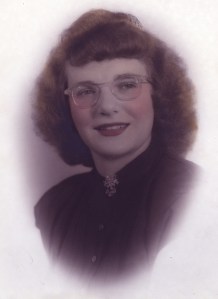
Before I embarked on this ongoing genealogy voyage in 2006, I’d never seen so much as a photograph of my Aunt Evelyn (Deutsch) Mulqueen. All I knew of her is that she died very young, leaving my Uncle Earl Mulqueen to try to raise six children. It was this tragedy that led to a blessing in my life, when Earl and Evelyn’s daughter Laura came to live with the Hanneman family in Sun Prairie, Wisconsin.
As I made my way through thousands of images in the photo collections from my father, my Grandpa Carl Hanneman and my maternal grandparents Earl and Margaret Mulqueen, I was happy to discover more about this forever young mother, gone too soon.
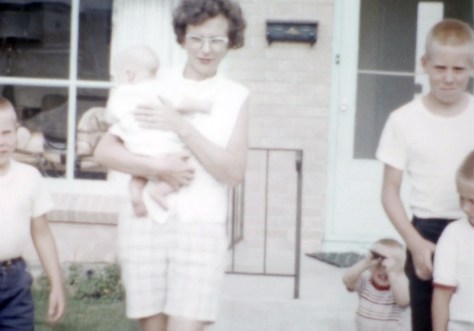
Evelyn Mulqueen holding son Mark, circa summer 1962.
Most recently, my project to digitize the 8mm film collection of Earl J. Mulqueen Sr. has brought forth the first moving pictures of Evelyn Mulqueen. The newest batch can be viewed below. These are very short glimpses of a beautiful young woman tending to her family in South Milwaukee. Carrying her infant son, Mark, or engaging with Laura, Tom, John, Brian and Earl Jr. (Bud). These are moments frozen in time. More than 50 years later, we get to witness the gathering in front of the Mulqueen home, the Christmas present opening, and the family barbecue. Normal family events, but now given such weight with the knowledge of how many of those pictured have died.
Evelyn A. Deutsch was born in Cudahy, Wisconsin, on April 24, 1929, the only daughter of Michael Deutsch (1882-1963) and the former Theresa Ulrich (1891-1967). Her parents, who emigrated from Austria, married in April 1917.
Evelyn married Earl James Mulqueen Jr. on December 14, 1949 in Cook County, Illinois. Her husband was a U.S. Marine war hero who lost a leg in May 1944 while preparing for the U.S. invasion of Saipan. The couple had a large family, with Bud (1950), Thomas (1953), John (1956), Brian (1959), Laura (1960) and Mark (1962) rounding out the bunch. An aggressive brain cancer took Evelyn from her family on February 2, 1963. She was just 33.
Evelyn Mulqueen (center) at a family wedding in the late 1950s. Earl J. Mulqueen Jr. is see at left in profile view.
The family experienced more than its share of suffering with and after the death of Evelyn. Earl died in August 1980 at age 57. The family also saw the premature deaths of Tom (age 51), Brian (age 40) and Mark (age 46). Those tragedies are in part what makes these video images so compelling and precious. Viewers get to share a time when these heartaches were far away, and only smiles graced the frames of the 8mm film.
The book about my father’s battle with lung cancer and his final months on this earth has been in print for nearly five years. It seems a good time to update the book’s official video trailer. The new version, posted below, is in high definition. Back when the original trailer was created, HD video was still fairly novel. But now HD is the norm on home televisions and computers, so it was time to upgrade this important promotional video. You can also view the video in a larger format here.
As kids growing up in Sun Prairie, any time we ventured into the back room of our basement we were likely to hear a voice from upstairs shout, “Don’t you go near those windows!” Of course we knew what that meant: the antique stained-glass behemoths covered in blankets in the farthest reaches of the basement, next to the furnace. I never gave a great deal of thought to them, until one day in 2006 when my father was dying of cancer.
The St. Mary’s Hospital chapel as it looked in the 1950s.
Founded in 1912, St. Mary’s Hospital in Madison always had a chapel as part of its facilities. In 1926, a new, ornate chapel was built as part of an expansion of St. Mary’s. The chapel had 10 window frames, each with two beautiful arched stained-glass windows that rose 20 feet from eye level to midway up the wall. In between each were two Stations of the Cross. The windows remained part of the chapel until 1973, when that section of the building was razed to make way for a new hospital wing on Mills Street. My Dad obtained two of the windows, a total of four panels, carrying them home in blankets to rest for more than three decades.
The windows are prominently visible in this newswire photo from 1946, from a Mass to celebrate presentation of a papal medal to Leo T. Crowley of Madison.
When Dad was being treated for lung cancer at St. Mary’s in the fall of 2006, he got an inspiration to give those windows back to St. Mary’s. He asked for my help in doing some research, but he was so impatient he wheeled himself down to the administrative offices to talk to someone about it. That someone, vice president Barbara K. Miller, was enthralled with the idea, but it was her last day on the job before retiring. She promised to get the ball rolling on the donation. “I want these windows to come home to St. Mary’s,” he told her.
The chapel window sections as they looked in 2007 in the Hanneman basement.
Dad was a little worried that his donation wouldn’t get done. The idea occupied his mind more than anything else in November 2006. He knew his time with us was short. He told the story and his idea to his physician, Dr. Gregory Motl. Dad made Dr. Motl promise that if he didn’t survive the cancer, the donation would be completed. Motl grasped Dad’s hand and said reassuringly, “I will Dave. I will.”
To say the hospital embraced Dad’s idea would be an understatement. His timing was perfect, since St. Mary’s was planning a $182 million expansion that would add a new east wing with operating rooms, a cardiac center, outpatient offices, patient rooms and more. St. Mary’s was looking for ways to tie the new facility to the hospital’s heritage. The architects designed special spaces for each of the four window sections. St. Mary’s had a new internal champion for the windows, Steve Sparks, public relations director.
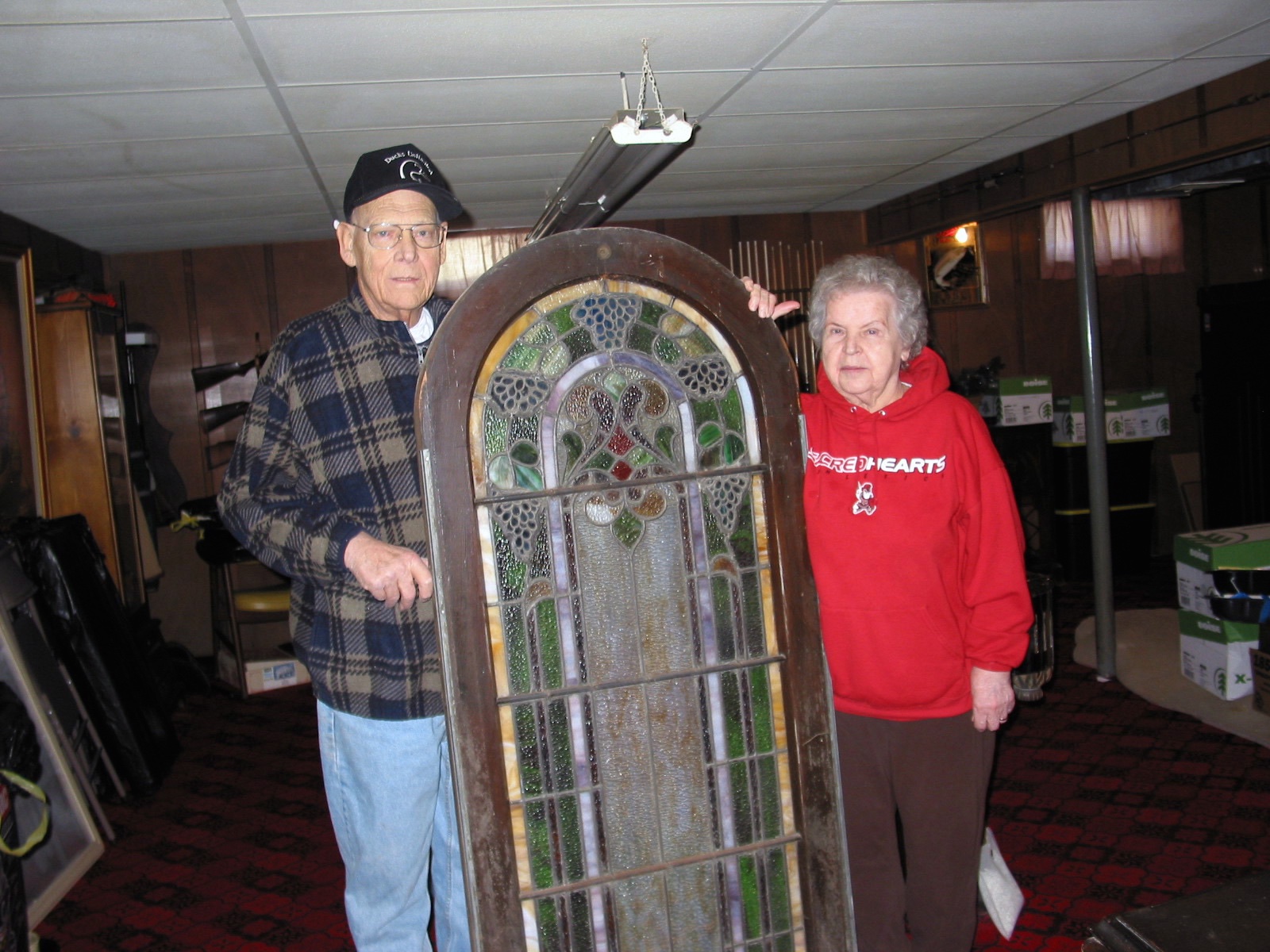
After months of planning, St. Mary’s was finally ready to take possession of the windows. On March 22, 2007, Sparks and workmen came to Sun Prairie to transport the windows. He snapped some photos of Mom and Dad with a window section. Dad looked pale and drawn, but I know he appreciated the milestone that day represented. “It was humbling for me,” Sparks recounted later. “This gift demonstrated exceptional courage and generosity. It is an experience I won’t forget.”
David and Mary Hanneman pose with one window section on March 22, 2007.
Tears were shed that afternoon as the windows were lovingly carried outside. It was the first daylight to penetrate the stained glass in more than three decades. For Dad, it was the accomplishment of a mission of giving. His part was finished; now St. Mary’s would take over. Not two weeks later, Dad was admitted to St. Mary’s and then discharged to HospiceCare Inc., where he died on April 14, 2007.
In early December 2007, Mom and I were invited to the dedication day at the new St. Mary’s east wing. We attended a luncheon and heard very kind words about Dad from Dr. Frank Byrne, president of St. Mary’s Hospital. They were similar to what Dr. Byrne wrote right after Dad’s death. “It is clear from Dave’s accomplishments that dedication to community was always a part of his priorities,” Byrne wrote, “and we will all benefit from that dedication for years to come. At this sad time, we hope it will be a reminder that though life may seem short, the contributions made by one individual have a significant impact in building a future for us all.”
The window section placed in the atrium of the new east wing at St. Mary’s Hospital.
When we walked into the atrium and first saw one of the window sections, it was enough to bring tears. There it was, set into the wall and brilliantly backlit in a way that brought out the green, red and amber hues of the glass. It was, as designed by the architects, a welcoming beacon for everyone visiting St. Mary’s. Mom posed next to the window, and even did an impromptu interview with Madison’s Catholic newspaper, The Catholic Herald. The three other window sections were placed on different floors of the east wing. One is in a waiting room. The others are in prominent spots.
The story of these chapel windows gives testimony that beauty can emerge from the depths of the darkest tragedies. Dad kept the windows safe for 35 years, and he got them safely home to St. Mary’s just weeks before he, too, made it home.
This post has been updated with additional window photos.
The windows are prominently visible in this newswire photo from 1946, from a Mass to celebrate presentation of a papal medal to Leo T. Crowley of Madison.
The St. Mary’s Hospital chapel as it looked in the 1950s.
This 1973 news clipping shows the exterior of the chapel building just prior to demolition.
The chapel window sections as they looked in 2007 in the Hanneman basement.
David and Mary Hanneman with a section of stained glass window on the day the windows were picked up for use at St. Mary’s Hospital.
The Wisconsin State Journal ran a front-page story on St. Mary’s in late 2007 and featured the stained glass windows.
The main window section in the St. Mary’s Hospital atrium as it looked at the dedication in December 2007.
A sign next to the window section in the St. Mary’s atrium told the story of the chapel windows.
Mary K. Hanneman next to one of the window sections she and the late David D. Hanneman donated to St. Mary’s Hospital.
St. Mary’s integrated many items from its history in the new east wing, including the original 1911 hospital cornerstone.
Mary K. Hanneman next to one of the window sections she and the late David D. Hanneman donated to St. Mary’s Hospital.
The beautiful windows were for decades a part of the chapel at St. Mary’s Hospital in Madison.
The window section placed in the atrium of the new east wing at St. Mary’s Hospital in Madison.
Mary Hanneman is interviewed by Kat Wagner of The Catholic Herald in December 2007.
A portion of the stained glass detail is used in a history display in the old lobby of St. Mary’s Hospital in Madison, Wis.
The second window crown section is on display in a third floor waiting room in the southwest wing of St. Mary’s Hospital in Madison, Wis.
CRACK! The sound of the first rifle shot left an echo that trailed onto the horizon. We flinched just a bit when the first volley was fired, then heard the barely audible jingle of the ejected brass shell dancing across the pavement. Then silence, followed by orders to fire again. CRACK! A third report rumbled across the landscape. Men and women alike clutched tissues and dabbed tears at the sights, sounds and emotion of the military honor guard that paid tribute Tuesday to my father-in-law, Ronald C. LaCanne.
Ronald C. LaCanne served in the U.S. Army from 1958-1961.
Darkness had already fallen outside of the Draeger-Langendorf Funeral Home in Racine, Wisconsin, adding to the drama. Everyone stood motionless as two uniformed veterans folded the American flag and presented it to my mother-in-law, Eileen. The slow, steady salute they gave before the flag was a sign of deep respect. It was followed by the playing of Taps. Everyone was choked up to witness such a moving ceremony.
Ron served in the United States Army in the late 1950s and early 1960s, the height of the Cold War era. He was an intelligence officer stationed somewhere in the hinterlands of Alaska, within listening distance of the Soviet Union. He never talked about the work he did there, not wanting in any way to betray national secrets, even 50 years later. He took his commitment that seriously. That is a man of honor.
If you know a veteran, take time today to thank them for serving the United States of America. It’s important that they know our nation is grateful for their sacrifices.
Ron LaCanne was entombed Wednesday at Southern Wisconsin Veterans Memorial Cemetery in Union Grove. Grandchildren Ruby Hanneman and Joshua LaCanne pause at the columbarium wall.
At the close of Ron’s visitation and the impressive military honors, my thoughts turned to things eternal. Considering his moving journey of faith while dying from cancer, I thought of two passages from the Gospels.
John Chapter 16 offers encouragement to those who have watched a loved one struggle with terminal illness. Jesus said, “In the world you will have trouble, but take courage. I have overcome the world.” Matthew Chapter 25 seemed so fitting as we turned to leave the memorial service. I could almost hear the words echo from Heaven: “Well done, my good and faithful servant. …Come, share your master’s joy.”
I remember well the first and last times I saw my father-in-law, Ron LaCanne.
In the nearly 25 years between these two events, I came to respect and love this man, whose story late in life became one of remarkable faith. I was incredibly moved by his quiet and steady faith in Christ and his hope of attaining glory in Heaven after his earthly journey, which ended earlier today at age 74.
It was such a long road away from the day I first met him. That was in early 1990, when I stopped at the LaCanne home on North Wisconsin Street in Racine to pick up his daughter Sue for a date. I was more than a bit nervous, because I had been told he was not fond of newspaper reporters. At the time, I was a reporter at The Journal Times, Racine’s daily newspaper. I sat on the couch and we chatted about the story I’d worked on that day, dealing with a Caledonia teenager who killed a dog, reportedly due to listening to heavy metal music. Somehow I survived the discussion and made a decent first impression on the man I would come to spend countless hours with over the next nearly 25 years.
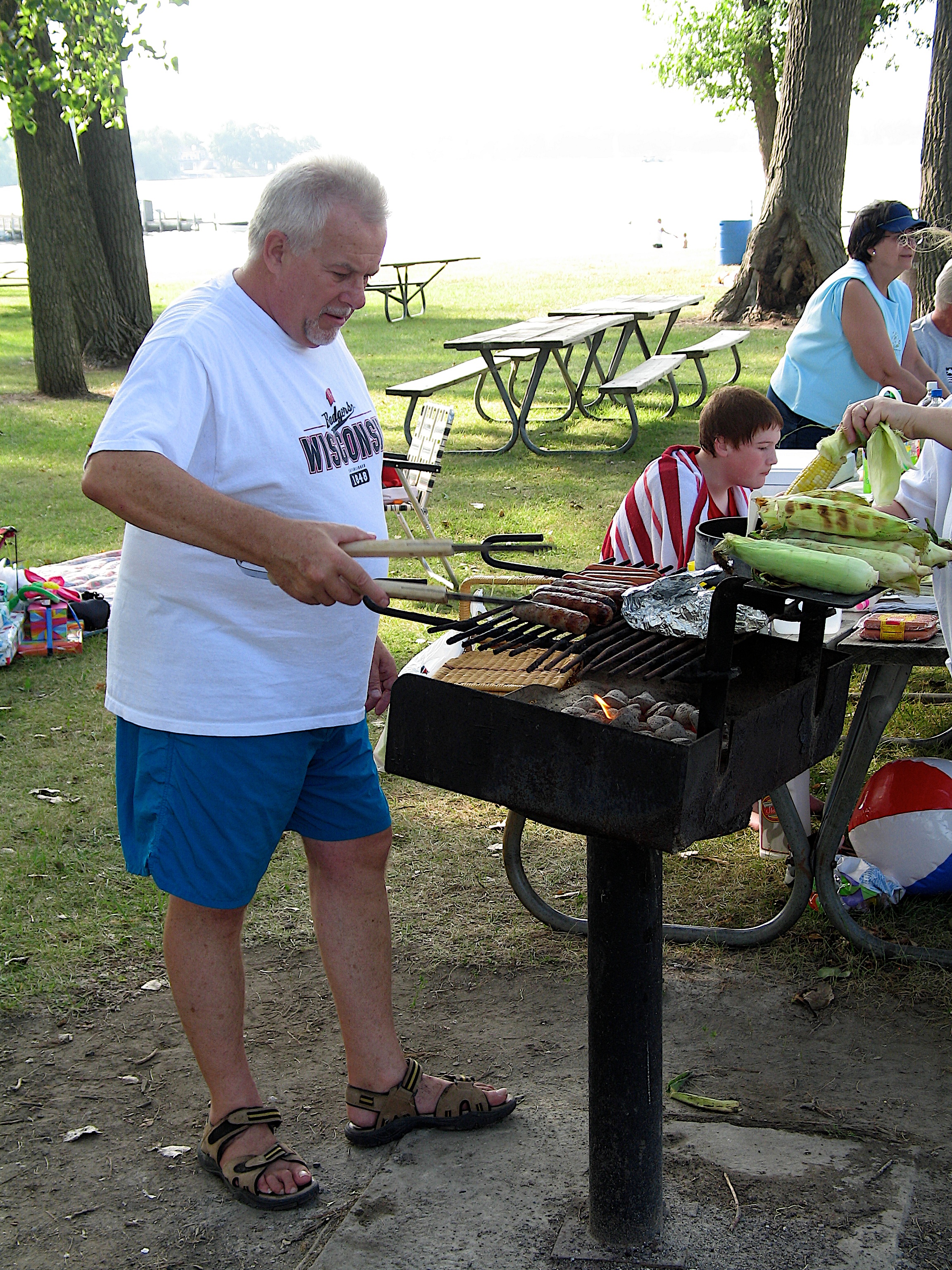
Ron in his favorite spot, working the grill.
My final and lasting impressions of him came in a series of visits this summer at the LaCanne apartment in Racine. Ron was thin, frail and dying from cancer. And although we’d been estranged in recent years, this time I was not nervous to visit. I presented him with a very special Rosary given to me by Catholic filmmaker Steve Ray. The Rosary had been placed on nearly a dozen sites in the Holy Land. This included Golgotha, the place of the crucifixion of Christ. He picked up the Rosary and felt the intricate carvings, then carefully laid it back in its olive wood box. I didn’t fully understand how much this touched him until a while later when the fire alarm went off in the apartment complex. He struggled to stand up from his recliner and grabbed two things: a hand-carved “comfort cross” given to him by a priest friend, and that Rosary. I struggled to hold back tears as my mother-in-law Eileen helped him out the door.
Two weeks later I visited again. This time he was confined to bed and drifted in and out of consciousness. We still had a nice talk, recalling stories and memories from across the years. I told him that many people were praying for him on his journey and that God would remain very close to him. “I sure hope so,” he said, squeezing my hand. A few minutes later, this solemn moment was replaced by laughter and joy. I told him that our oldest daughter Samantha was going to a concert that night. “A concert?” he said. He swung his hands out into the air and started singing the Alleluia Chorus from George Frideric Handel’s Messiah.We laughed at the joy and spontaneity of it. It seemed so appropriate, and so very beautiful. Wow.
Samantha, Stevie and Ruby with Gramps.
Several times we sat alone and talked about his final days on earth. He spoke freely and with stark honesty about his impending death. I encouraged him not to be afraid, since all of those who love him have complete faith that Jesus will not forsake him. “I’m not afraid to die,” he said. Then he asked me to do him a favor. “Can you help me identify the gentleman sitting on the couch over there?” There was no one on the couch. And since Ron had lost his sight over the past year, he would not have seen anyone there in the first place. But I could tell he was seeing something profound, even if it was beyond my vision. “Describe him to me,” I said. The visitor had dark hair and wore a cap. His expression was calm, peaceful and friendly. “He has been sitting there for the past two days,” Ron said. We talked a little more, and I suggested his visitor was a guardian angel sent by God to protect and comfort him. The idea was not foreign to me, as I’ve read a number of accounts by hospice workers of dying patients seeing angels.
We were on guard for weeks expecting Ron’s death, but he wasn’t about to follow any script. Just when we feared the worst, he would rally and have a great day or two. I recall one day pulling up to the apartment center and seeing him sitting outside in the sunshine, facing Lake Michigan. I asked him how he felt. “Doing great,” he said. “I feel really good.” On another visit, after listening to a preseason Packers game, we talked again about death and dying. “The time is near,” he said. I thanked him for the incredible witness he was providing to his grandchildren (and all of us). The Cross is heavy, and he knew it. But in his final months, weeks and days, he found peace. And now he is at peace.
I’ve always believed life is well-reflected in pictures, both on paper and ink and in the mind’s imagination. Many images of Ron come to me as I recall the last 25 years. Let me share just a few.
I remember the early afternoon of October 5, 2002. It was a very difficult day. I was driving Ron back to Racine from Children’s Hospital of Wisconsin in Wauwatosa. A short time before, his oldest son, Patrick, had died at the too-young age of 37. Ron exhaled loudly and struggled to find some words. “I’ll tell you, Joe, this is so hard. So hard. No one should have to experience the death of their child.” So very true. We drove and recalled favorite memories of Patrick. By the end of that drive, we both better understood the impact Pat had made on the family. It continues to this day. I can only imagine the embrace the two shared at their reunion earlier today!
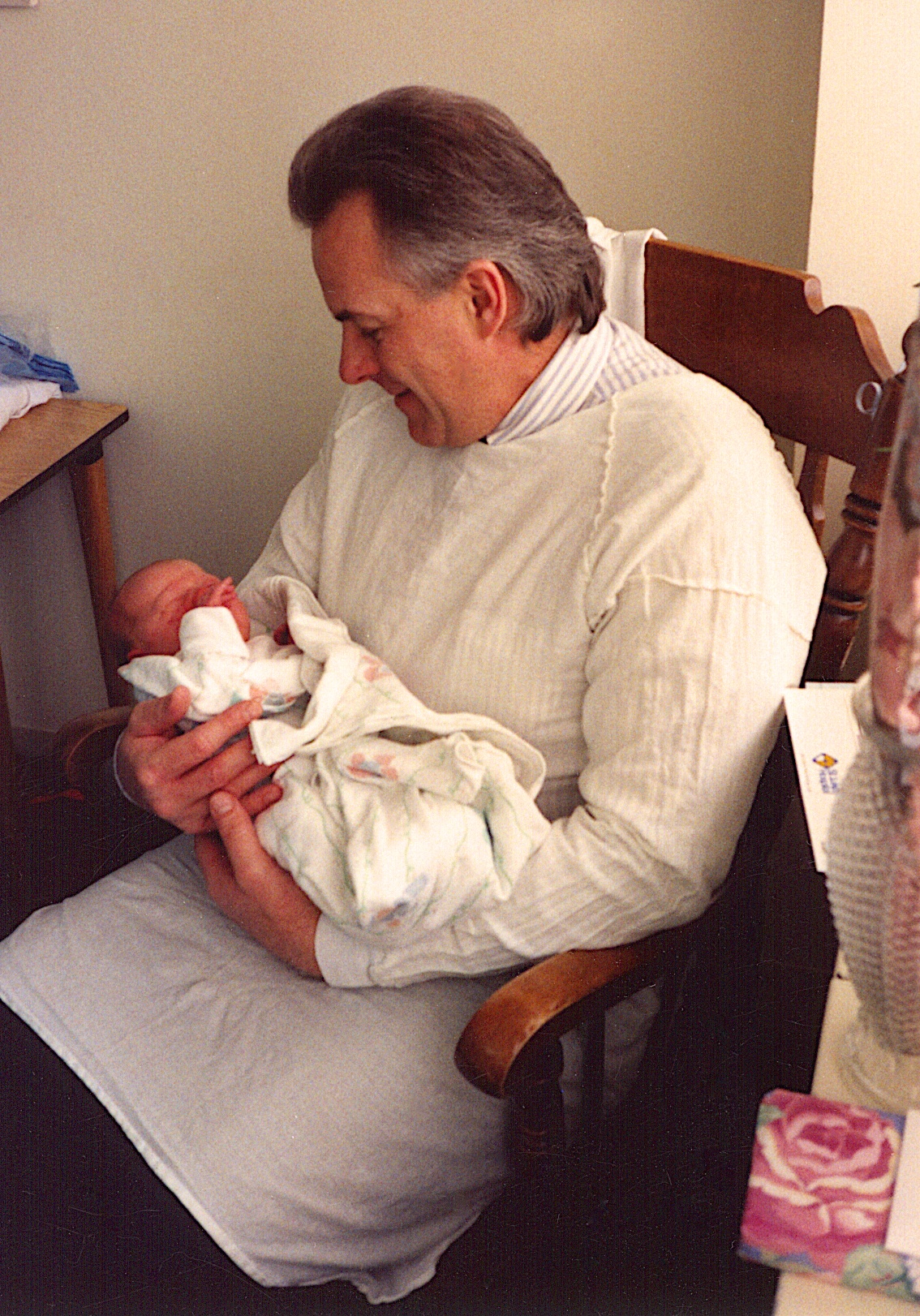
Ron LaCanne holds his first grandchild, Stevie, on January 21, 1992.
My mind rolls back to January 1992, when a well-dressed Ron stopped at St. Luke’s Hospital in Racine. He was on his way to his job at S.C. Johnson Wax, but had to stop first for some quality time with his first grandson, Stephen Patrick Hanneman. The photo my wife Sue snapped that morning tells of the joy and pride of a new grandpa. That day Ron earned the moniker he later awarded himself: “Gramps.”Gramps. He wore that title as well as anyone could, loving his five grandchildren like no one else.
Everyone always enjoyed July 4 at the LaCanne residence. While the grandkids were little, Ron went all out with a fireworks show as good as you’d see at the lakefront in Milwaukee or Racine. There were toy soldiers launched 100 feet in the air, returned to earth via parachute. And the Titanic, a huge brick of sound and color that should have come with its own fire department. On one occasion, one of the fireworks tipped over, firing projectiles across the gathered relatives. We all dove for cover under tables. “Incoming!” Over the years, Ron gave up the fireworks duty, but none of us could ever match those incredible displays.
Ron with grandchildren Samantha, Ruby, Josh and Geoffrey.
Speaking of displays, Ron was also the master of Christmas decorating. He always got two trees, one for the living room and one for the basement. His main tree was usually the tallest, fattest one on the lot, which he covered every square inch with ornaments, lights and beads. The rest of the house was festooned with lighted villages, Santa statues and a Nativity set that could reside at the Vatican. One year after a few seasons of collecting ceramic lighted Norman Rockwell houses, we put up an entire village on an expansive shelf space over our front door. After plugging it in, I danced down the upstairs hallway, singing, “Ron LaCanne, eat my dust!” Silly to be sure, but in a way, it was my own tribute to the master.
Every year, Ron played Santa at the LaCanne Christmas eve party. This was an event attended by dozens of family members. The food was diverse and plentiful, half the punch was spiked and the kids were all antsy in anticipation of Santa’s arrival. About 9 p.m., Ron would slip out of the living room, duck into a phone booth and emerge as Santa, always coming in through the front door. It was tradition that “Santa” would pick up the youngest grandchild for a photo. This often lead to either wide-eyed amazement or quivering tears. This was all followed by an orgy of gift opening for the kids. One year, an eagle-eyed granddaughter Samantha noticed that Grandpa was gone for a while, and when he returned, his hair was wet and he wore different shoes. Hmmmm. Another year, after Ron had retired from being Santa, youngest grandchild Josh LaCanne was determined to let Santa know the best gifts should be for him and not his brother, Geoffrey. When the red-clad bearded one (played by Ron’s son Chris) appeared at the party, young Josh got wide eyed and shouted, “Brother wants rocks!”
Ron and Eileen during an outing with Samantha and Stevie.
Ron and Eileen were always faithful attendees at the grandkids’ activities. Countless soccer games on chilly, windswept fields in Franksville, Christmas concerts, track meets, graduations. Ron was there with either a video camera or a still camera. Over the years he took thousands of photos and hours of video, often making commemorative books that he would present at birthdays or Christmas. I recall a time seeing a video that showed the family watching videos of the grandkids. Life imitates art.
As time went on and events in the world became more troubling, Ron decided he wanted his grandchildren to know about a simpler time, when right and wrong were easy to spot and traditional values where championed. So he started writing, tales of his childhood growing up as a Catholic boy in Racine. Stories, anecdotes and just things he wanted the kids to know, they were all included in this growing 100-page tome of Ronaldian wisdom. Occasionally he would share bits and pieces. What a gift these writings will be to his grandchildren and their children. I hope one day to be able to digitize them and format them into a book.
Ron was always willing to help out with a project. In 2007, after my father died of lung cancer, he helped me install a new floor in the upstairs hallway at my parents’ home in Sun Prairie. During my Dad’s illness, his little dog Chewy didn’t get as much attention and didn’t get put out as often. The result was he used the baseboards and the carpet for a bathroom. It was awful work pulling out the carpet, only to realize the baseboard, plaster and parts of the subfloor were contaminated. We worked for two days, first removing the mess, then treating the walls and subfloor with pure bleach to neutralize the smell. My eyes are still burning. When we were done, my Mom had a new wood floor and no more doggie smell.
We all gathered for a portrait at Nicholson’s in 2000.
When I was running my own marketing business, I tapped Ron’s business expertise and we worked together on some major projects for my client, Volvo Construction Equipment. I hired Ron to help me evaluate company financials, stock reports, annual reports and other business intelligence on prospective customers for Volvo. His analysis and detailed input allowed me to present market studies that were so well-received I still hear compliments about them, nearly a decade later.
I could go on for pages, but time is fleeting. Ron lived a very full 74 years. He gave much of his time, from his days in the U.S. Army, to volunteering in the community to groups such as the Opportunity Center and United Way. He rose high in the ranks at one of America’s great brand companies, SC Johnson Wax. But it was and is his family that was the love of his life. On Sunday evenings when everyone gathered in the living room after another of Eileen’s great dinners, Ron would pat his stomach and look around the room. “Mi familia!” he would say. Nothing can top having your family surrounding you. How he loved his wife Eileen, daughter Sue, sons Patrick and Chris (and wife Elise); and his grandkids, Stevie, Samantha, Ruby, Geoffrey and Josh.
My thoughts return to the man with the Rosary, clutching it and the Cross like an anchor during a time of fear and uncertainty. This will be Ron’s everlasting lesson and legacy. To carry the Cross through good and bad times in life, maintaining the hope of things unseen. As his life came to a close, Ron returned to his roots and his embraced his Catholic faith. It was his comfort and salvation. To use a phrase from his ancestors’ native tongue, La fede mi da vita:Faith gives me life.

















 The Hanneman Archive