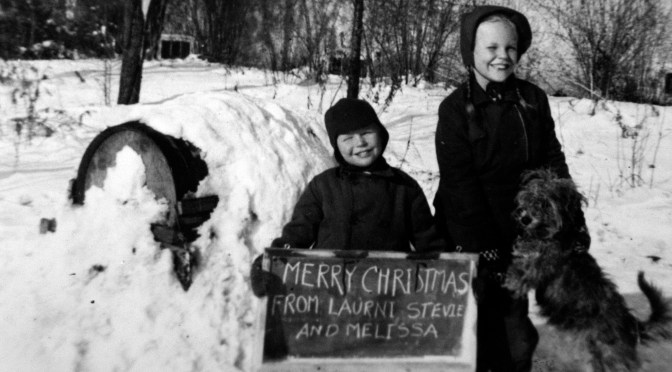
Stevie Wilson and Laurni Lee Wilson made their own Christmas greeting in December 1942 with this photograph sent to their Uncle and Aunt, Carl and Ruby Hanneman of Mauston, Wisconsin. They even included greetings from their dog, Melissa. The Wilsons lived in Waukegan, Illinois, where the Hanneman family often visited. Stevie and Laurni Lee are the children of Lawrence and Nina (Treutel) Wilson. Nina is Ruby (Treutel) Hanneman’s sister. Merry Christmas!
Milwaukee was a key industrial production hub during World War II, and there was concern that spies or saboteurs would attack defense contractors or the public utilities that supplied them with power. As a master mechanic at Wisconsin Electric’s huge Lakeside Power Plant in St. Francis, Earl J. Mulqueen Sr. worked under tight security to ensure the war effort continued uninterrupted.
Nicknamed “The Governor,” Mulqueen was well known around his home in Cudahy as a Mr. Fixit. Whenever the boiler would go out at St. Frederick’s Catholic Church or school, they would call the Governor to come over and get things working again. When World War II broke out in late 1941, Mulqueen was just starting his third decade working for Wisconsin Electric. He put his mechanical skills to work keeping the turbines and other equipment at Lakeside in good working order.
Earl Mulqueen Sr. worked at the Lakeside Power Plant in St. Francis for more than 35 years.
Signs on and around the Lakeside plant carried a warning: “National Defense Premises. No Entry.” Armed agents guarded the plant 24 hours a day — part of a force of more than 1,000 men providing security at Wisconsin power utilities during the war. Because of his key role in keeping Lakeside in operation, Mulqueen received his own security protection. He often stayed at the plant for long stretches. When he came home to fetch clean clothes and pay a quick visit, he was accompanied by FBI agents. On occasion, an agent came alone to pick up clothes or other supplies for Mulqueen.
Earl J. Mulqueen Sr. in 1944.
The security precautions were warranted. Milwaukee factories were converted to war production of artillery, fuel storage, engines, turbines and all sorts of mechanical parts. The build-up created huge demand for power. The nation could ill afford an attack that shut down a key plant like Lakeside. Even before the attack on Pearl Harbor, Wisconsin Electric officials expressed security concerns, and fears the Lakeside power plant could be attacked with explosives by boat from Lake Michigan.
Nazi Germany launched just such a plan when it landed eight special agents on the shores of New York and Florida in June 1942. The German agents carried explosives and were tasked with blowing up U.S. defense industries and terrorizing population centers. “They came to maim and kill,” said FBI Director J. Edgar Hoover. Codenamed Operation Pastorius, the plot was foiled when one of the saboteurs turned himself in to the FBI. Federal agents arrested the men and recovered high explosives disguised as pieces of coal.
Steam turbines at the Lakeside Power Plant in St. Francis, Wisconsin.
Such an attack could have been devastating. Manufacturers like Allis-Chalmers, Falk Corp., Ladish, Bucyrus Erie, Case, Heil Co. and many others produced components and finished goods for the U.S. military. Everything from engines, to fuel trailers, to cargo and transport ships were built in eastern Wisconsin during the war. Wisconsin utilities scrambled to add generating capacity to keep up. Opened in 1920, Lakeside carried the burden of power supply as the other generation plants were being built.
Ladish Drop Forge in Cudahy was one of many companies producing war materiel.
Mulqueen left his job as a machinist at the Case plow works in Racine in February 1920 to work for the Milwaukee Electric Railway and Light Co. (later called Wisconsin Electric) as a machinist helper in the utility’s Racine operations. In November of that year, he married Margaret Madonna Dailey at St. Joseph Catholic Church in Racine. A former teacher, Miss Dailey had graduated in June 1920 from Northwestern University. Earl worked in Racine until 1925, when he was transferred to the Lakeside Power Plant. The Mulqueen family then moved to Cudahy. The couple had 11 children; six of whom served in the U.S. military.
The Reminder-Enterprise in Cudahy carried a photo from Earl J. Mulqueen Sr.’s 40th anniversary with Wisconsin Electric in March 1960.
For a child growing up in the 1930s and 1940s, big adventure often came in small packages. Like many boys his age, David D. Hanneman (1933-2007) was an avid collector of Big Little Books. These chunky mini-books allowed adventure-seeking children to follow the action of Buck Rogers, Dick Tracy, Flash Gordon, Tarzan and other characters. All for 10 cents a book.
The original Big Little Books concept was pioneered by the Whitman Publishing Company of Racine, Wisconsin. Whitman was a subsidiary of Western Publishing, the creator of the famous Little Golden Books (think Poky Little Puppy). Big Little Books were roughly 3¾ inches wide by 4½ inches high. Thickness varied by page count. For example, the 1934 Buffalo Bill and the Pony Express had 380 pages and was 1¼ inches thick. The layout was one of the classic features of Big Little Books. Each page spread had text on the left side and a black-and-white illustration on the right.
Big Little Books had text on the left-facing pages and illustrations on the right pages.
Whitman Publishing came out with its first Big Little Book in 1932, The Adventures of Dick Tracy. Soon after, Whitman had titles with comic strip characters like Wash Tubbs, as well as a range of Walt Disney titles. The 1934 series alone included titles such as Chester Gump Finds the Hidden Treasure, Buck Rogers in the City Below the Sea, Reg’lar Fellers, Betty Boop in Snow White, Kayo and Moon Mullins, Mickey Mouse in Blaggard Castle and Dick Tracy and the Stolen Bonds.
Most of the books had hard covers, although my Dad had one Buck Rogers title that was softcover and in a slightly smaller format (only 4¼ inches high). This book had no page numbers. The inside back cover spread was a two-page ad for Cocomalt drink mix. The 1935 Tom Mix and Tony Jr. in Terror Trailwas a larger format (4 5/8 by 5¼ inches) and featured real photographs inside.
Ruby V. Hanneman wrote an inscription on the inside cover for my Dad’s 8th birthday.
For my Dad’s 8th birthday, he received a copy of the 1941 Tarzan the Untamed by Edgar Rice Burroughs. Ever the historian, my Grandma Ruby V. Hanneman wrote the particulars down in blue pencil on the inside front cover: “David Dion Hanneman, March 27, 1941, for 8th birthday, from Dad, Mother, Lavonne and Donn.” This title was from the Better Little Books series, also published by Whitman. In addition to the story and illustrations, it had a flip-book feature that showed an animation as the reader flipped the pages through his thumb and forefinger.
Titles in the 1941 Better Little Books series included Big Chief Wahoo and the Magic Lamp, Mickey Mouse on Sky Island, Popeye and a Sock for Susan’s Sake, G-Man and the Gun Runners, Dick Tracy and his G-Men, Red Barry Undercover Man, Ellery Queen and the Adventure of the Last Man’s Club, Inspector Charlie Chan Solves a New Mystery and others. By the time he was in high school, my Dad stopped adding to his collection. But they clearly held a special place in his heart, since he kept and safeguarded them for more than 50 years before passing them on.
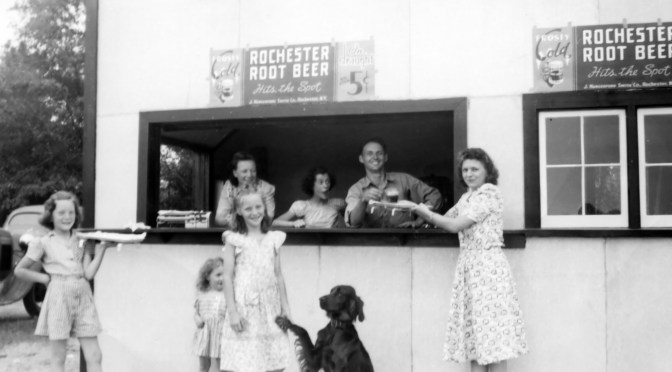
Marvin and Mabel Treutel operated a roadside root beer stand near their home on Wilhorn Road in Nekoosa, Wisconsin. Aside from 5-cent Rochester root beers, they served the “Best Roast Beef BBQ.” Pictured behind the counter in this late-1940s photo are Mabel Treutel (left), niece Lavonne Hanneman (center) and Marvin Treutel (right). Out front are daughters Bonnie Treutel (left), and Patricia Treutel (center, holding dog). The woman at right and the little girl at center are unidentified.
As kids growing up in Sun Prairie, any time we ventured into the back room of our basement we were likely to hear a voice from upstairs shout, “Don’t you go near those windows!” Of course we knew what that meant: the antique stained-glass behemoths covered in blankets in the farthest reaches of the basement, next to the furnace. I never gave a great deal of thought to them, until one day in 2006 when my father was dying of cancer.
The St. Mary’s Hospital chapel as it looked in the 1950s.
Founded in 1912, St. Mary’s Hospital in Madison always had a chapel as part of its facilities. In 1926, a new, ornate chapel was built as part of an expansion of St. Mary’s. The chapel had 10 window frames, each with two beautiful arched stained-glass windows that rose 20 feet from eye level to midway up the wall. In between each were two Stations of the Cross. The windows remained part of the chapel until 1973, when that section of the building was razed to make way for a new hospital wing on Mills Street. My Dad obtained two of the windows, a total of four panels, carrying them home in blankets to rest for more than three decades.
The windows are prominently visible in this newswire photo from 1946, from a Mass to celebrate presentation of a papal medal to Leo T. Crowley of Madison.
When Dad was being treated for lung cancer at St. Mary’s in the fall of 2006, he got an inspiration to give those windows back to St. Mary’s. He asked for my help in doing some research, but he was so impatient he wheeled himself down to the administrative offices to talk to someone about it. That someone, vice president Barbara K. Miller, was enthralled with the idea, but it was her last day on the job before retiring. She promised to get the ball rolling on the donation. “I want these windows to come home to St. Mary’s,” he told her.
The chapel window sections as they looked in 2007 in the Hanneman basement.
Dad was a little worried that his donation wouldn’t get done. The idea occupied his mind more than anything else in November 2006. He knew his time with us was short. He told the story and his idea to his physician, Dr. Gregory Motl. Dad made Dr. Motl promise that if he didn’t survive the cancer, the donation would be completed. Motl grasped Dad’s hand and said reassuringly, “I will Dave. I will.”
To say the hospital embraced Dad’s idea would be an understatement. His timing was perfect, since St. Mary’s was planning a $182 million expansion that would add a new east wing with operating rooms, a cardiac center, outpatient offices, patient rooms and more. St. Mary’s was looking for ways to tie the new facility to the hospital’s heritage. The architects designed special spaces for each of the four window sections. St. Mary’s had a new internal champion for the windows, Steve Sparks, public relations director.
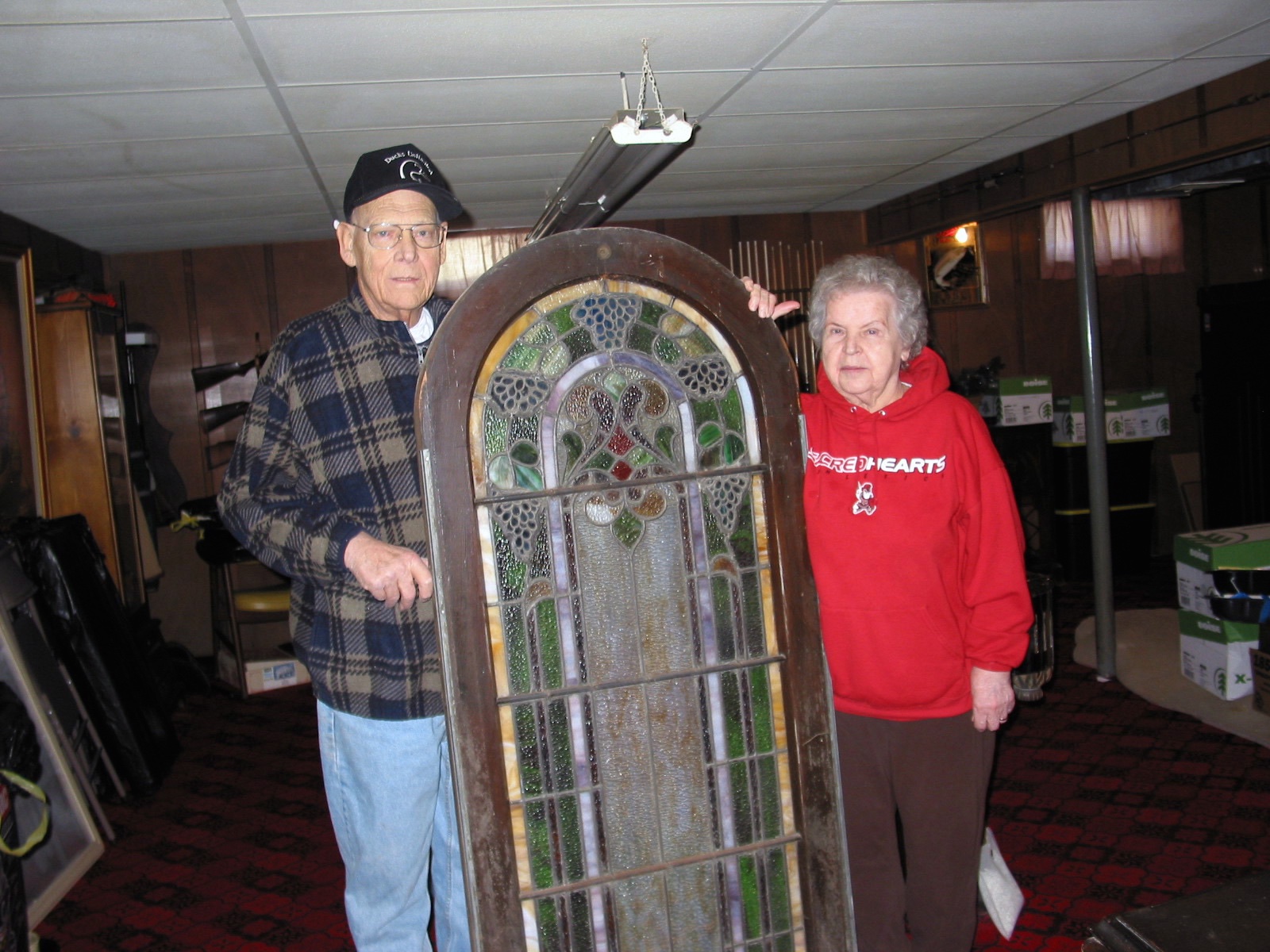
After months of planning, St. Mary’s was finally ready to take possession of the windows. On March 22, 2007, Sparks and workmen came to Sun Prairie to transport the windows. He snapped some photos of Mom and Dad with a window section. Dad looked pale and drawn, but I know he appreciated the milestone that day represented. “It was humbling for me,” Sparks recounted later. “This gift demonstrated exceptional courage and generosity. It is an experience I won’t forget.”
David and Mary Hanneman pose with one window section on March 22, 2007.
Tears were shed that afternoon as the windows were lovingly carried outside. It was the first daylight to penetrate the stained glass in more than three decades. For Dad, it was the accomplishment of a mission of giving. His part was finished; now St. Mary’s would take over. Not two weeks later, Dad was admitted to St. Mary’s and then discharged to HospiceCare Inc., where he died on April 14, 2007.
In early December 2007, Mom and I were invited to the dedication day at the new St. Mary’s east wing. We attended a luncheon and heard very kind words about Dad from Dr. Frank Byrne, president of St. Mary’s Hospital. They were similar to what Dr. Byrne wrote right after Dad’s death. “It is clear from Dave’s accomplishments that dedication to community was always a part of his priorities,” Byrne wrote, “and we will all benefit from that dedication for years to come. At this sad time, we hope it will be a reminder that though life may seem short, the contributions made by one individual have a significant impact in building a future for us all.”
The window section placed in the atrium of the new east wing at St. Mary’s Hospital.
When we walked into the atrium and first saw one of the window sections, it was enough to bring tears. There it was, set into the wall and brilliantly backlit in a way that brought out the green, red and amber hues of the glass. It was, as designed by the architects, a welcoming beacon for everyone visiting St. Mary’s. Mom posed next to the window, and even did an impromptu interview with Madison’s Catholic newspaper, The Catholic Herald. The three other window sections were placed on different floors of the east wing. One is in a waiting room. The others are in prominent spots.
The story of these chapel windows gives testimony that beauty can emerge from the depths of the darkest tragedies. Dad kept the windows safe for 35 years, and he got them safely home to St. Mary’s just weeks before he, too, made it home.
This post has been updated with additional window photos.
The windows are prominently visible in this newswire photo from 1946, from a Mass to celebrate presentation of a papal medal to Leo T. Crowley of Madison.
The St. Mary’s Hospital chapel as it looked in the 1950s.
This 1973 news clipping shows the exterior of the chapel building just prior to demolition.
The chapel window sections as they looked in 2007 in the Hanneman basement.
David and Mary Hanneman with a section of stained glass window on the day the windows were picked up for use at St. Mary’s Hospital.
The Wisconsin State Journal ran a front-page story on St. Mary’s in late 2007 and featured the stained glass windows.
The main window section in the St. Mary’s Hospital atrium as it looked at the dedication in December 2007.
A sign next to the window section in the St. Mary’s atrium told the story of the chapel windows.
Mary K. Hanneman next to one of the window sections she and the late David D. Hanneman donated to St. Mary’s Hospital.
St. Mary’s integrated many items from its history in the new east wing, including the original 1911 hospital cornerstone.
Mary K. Hanneman next to one of the window sections she and the late David D. Hanneman donated to St. Mary’s Hospital.
The beautiful windows were for decades a part of the chapel at St. Mary’s Hospital in Madison.
The window section placed in the atrium of the new east wing at St. Mary’s Hospital in Madison.
Mary Hanneman is interviewed by Kat Wagner of The Catholic Herald in December 2007.
A portion of the stained glass detail is used in a history display in the old lobby of St. Mary’s Hospital in Madison, Wis.
The second window crown section is on display in a third floor waiting room in the southwest wing of St. Mary’s Hospital in Madison, Wis.
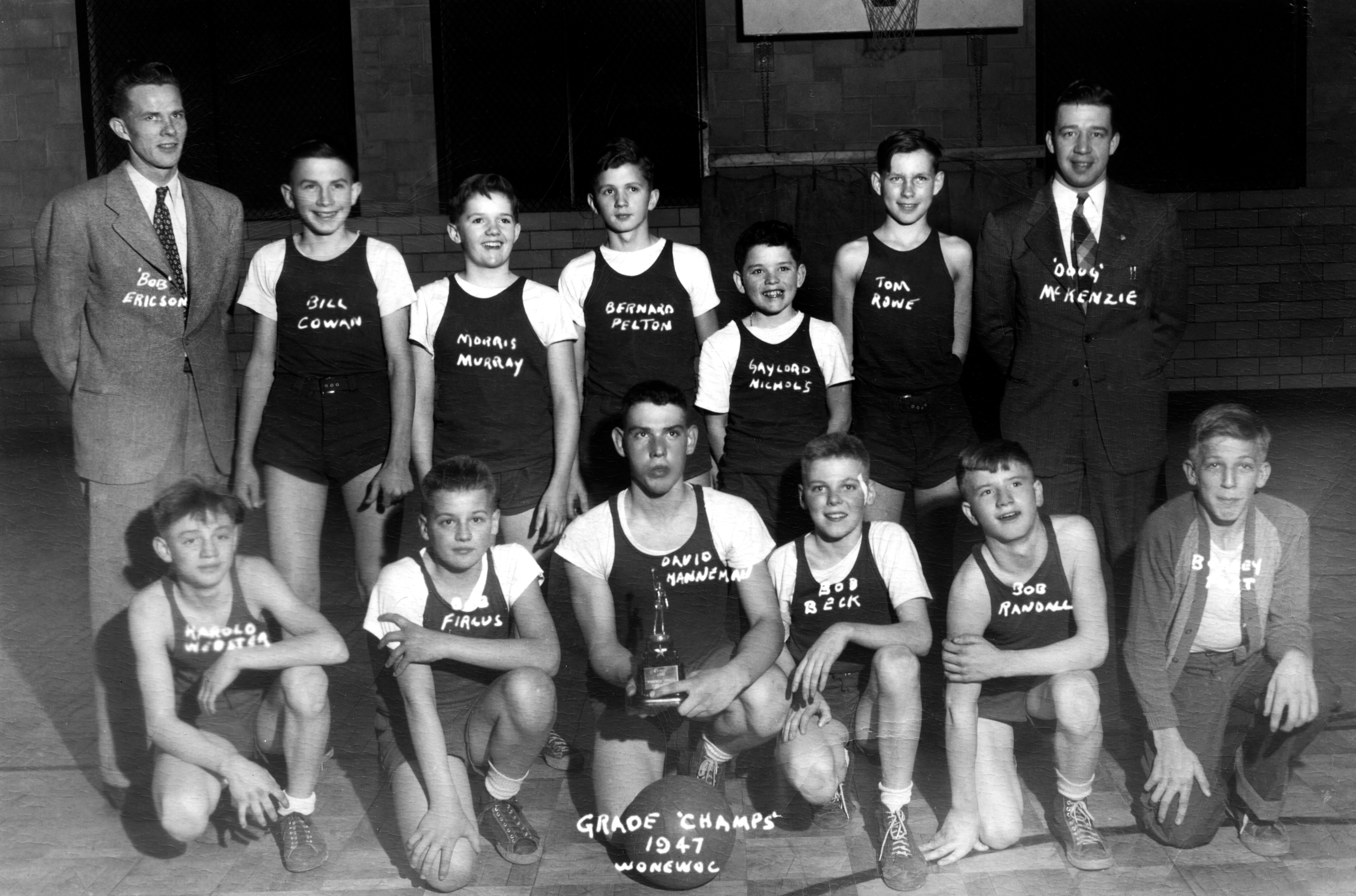
There he was, front and center in the photograph, holding the championship trophy. My Dad, David D. Hanneman and his 8th grade Mauston teammates had just won the 12-team basketball tournament held at Wonewoc in the spring of 1947. It was no small feat, considering the competition from Camp Douglas, Cazenovia, Elroy, Kendall, Lavalle, Necedah, New Lisbon, Ontario, Reedsburg, Union Center and Wonewoc.
The Mauston 8th grade boys basketball team won the 1947 Wonewoc tournament.
The championship team photo includes, rear, left to right: Coach Bob Erickson, Bill Cowan, Morris Murray, Bernard Pelton, Gaylord Nichols, Tom Rowe and Coach Doug McKenzie. Front row, left to right includes: Harold Webster, Bob Firlus, David Hanneman, Bob Beck, Bob Randall and Whitey Post. Although the photo does not show jersey numbers, Dave wore No. 1 that day.
The 12 teams and players were listed on the event program from 1947.
Occasionally prints of this photo will appear on eBay, erroneously listing the team as from Wonewoc. That is understandable given how the photo was hand labeled, but to be clear, the winners were from Mauston.
When the United States was drawn into World War II by the Japanese attack on Pearl Harbor, the war effort was put forth by everyone from soldiers at the front to school children at home. Young Edward J. Mulqueen of Cudahy, Wisconsin, wanted to do his part, so he donated his prized hunting knife to the U.S. military.
An 11-year-old student at St. Frederick’s Catholic School, Mulqueen read about the shortages of materials for the war effort. Newspapers carried pleas for donation of quality knives, since the hardened steel used in the blades was scarce. Eddie didn’t hesitate. In late 1942, he carefully packaged up his knife and mailed it to the address published in the newspaper. He was proud to do his part. After all, with two brothers headed for the Pacific theater (and later a third) he had a personal stake in the fight.
He might have forgotten about the donation, but two letters from the U.S. military, one from a general and one from a corporal, set his heart to soaring. The first letter, dated January 21, 1943, thanked Eddie for his thoughtfulness. “Words themselves cannot fully express our gratitude,” wrote Maj. Gen. Barney M. Giles, commander of the Fourth Air Force. “However, when the battles are over and our boys are home again, we all will thrill at the tales of how they were used.”
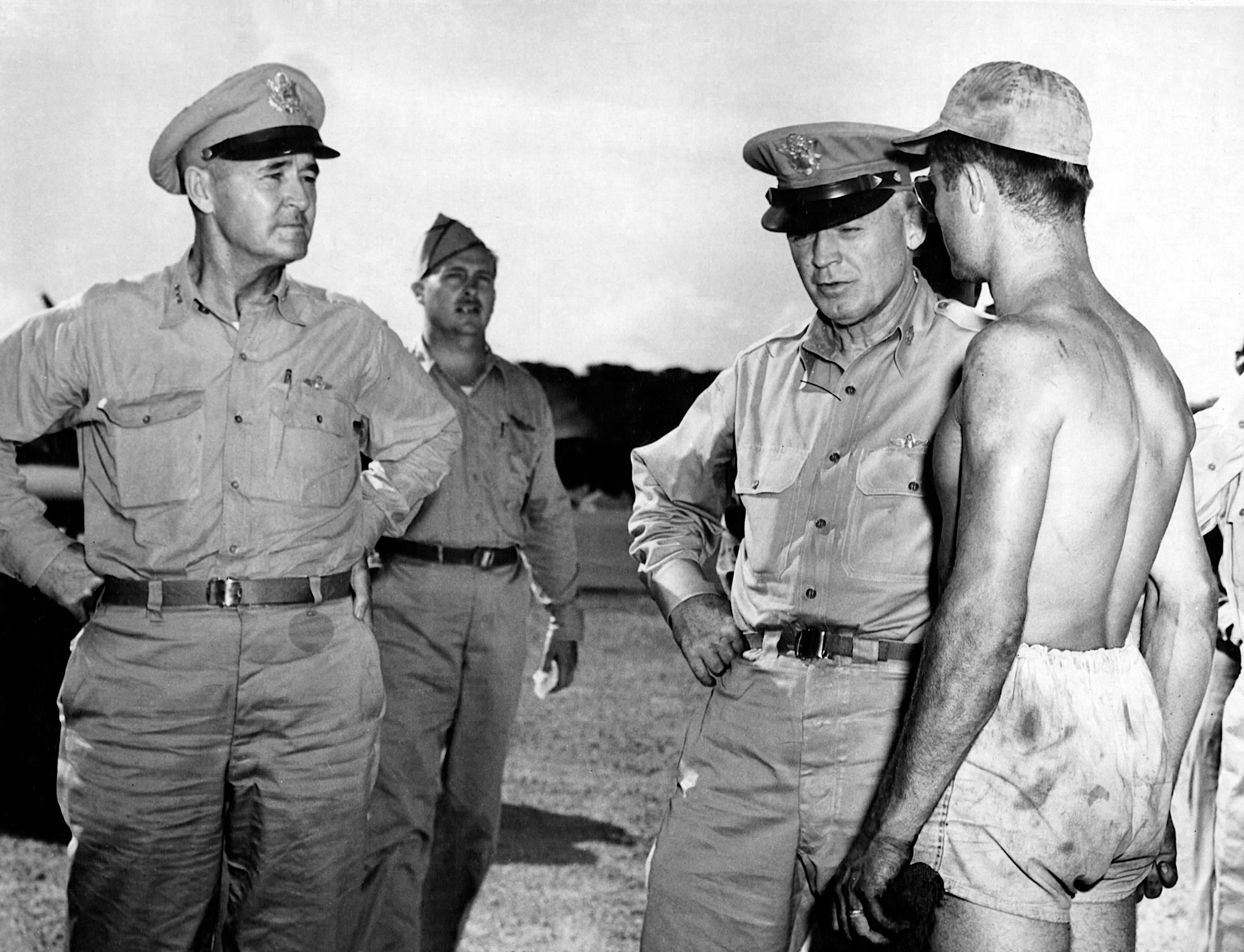
Gen. Barney M. Giles (left) sent a letter to Edward Mulqueen thanking him for donating a knife to the war effort. Here, he and Gen. Henry H. “Hap” Arnold speak with S/Sgt. Leo Fliess of Sturtevant, Wis., on Guam in 1945. (Army Air Force Photo)
Giles was not just some Army bureaucrat. He was commanding general of the U.S. Army Air Force in the Pacific, who later became deputy commander of the entire U.S. Army Air Force. Giles worked alongside legendary war heroes, including Adm. Chester Nimitz,Lt. Gen. James Doolittle and Gen. Henry H. “Hap” Arnold. He closed his letter to Mulqueen this way: “This much I know. With your gift goes another weapon that will certainly do much to help our boys slap the Japs into a complete and lasting tailspin.”
The next letter, from a U.S. Army Air Force officer in February 1943, was especially meaningful to Eddie. “He wished he had a hundred, yes even a thousand knives to donate,” read an article in the Cudahy Reminder/Enterprise. “His knife was seeing action and was being useful to one of our service men fighting in the Pacific.”
U.S. Army Air Force Cpl. Lucas R. Boyson wrote to thank Eddie Mulqueen for the donated knife in February 1943.
Stationed in the Fiji Islands, Cpl. Lucas R. Boyson was glad to receive the knife sent all the way from Wisconsin. Boyson, 29, was even more impressed that an elementary school student was behind the donation. “I was fortunate to receive your knife and to say it was a treat would be to put it mildly,” Boyson wrote in a letter to Mulqueen on February 14, 1943. “It is grand to cut stalks of sugar cane or bamboo sticks and for that matter general miscellaneous uses. I shall carry it with me always and each time I use it, I’ll whisper a ‘thanks to Eddie.’ ”
A married enlistee from Elyria, Ohio, Boyson was serving with the 375th Air Base Squadron, part of the U.S. Army air corps. He was among the first wave of men from Lorain County, Ohio to volunteer for service in January 1941. He wrote to Eddie that the natives on the islands were impressed with the knife, compared with the “hand-pounded, crude machetes they carry with them in the jungles.”
We don’t know if Boyson ever used the knife in combat, but we do know he survived the war and returned to Ohio, where he lived an exemplary life of faith and public service. On February 28, 1946, Lucas and WilhelminaBoyson welcomed a baby daughter, Mina. Lucas was an attorney who became actively involved with his American Legion post, St. Jude Catholic Church and a variety of civic groups and causes. At one time he headed the Lorain County Bar Association. He was also a Fourth Degree member of the Knights of Columbus, a group with a special focus on patriotism. Boyson died on December 5, 1992 at age 78.
Inspired by the wartime service of three brothers and one sister, Eddie joined the U.S. Navy and served during the Korean War. After the war, he got married and started a job at Wisconsin Electric Power Co. He was an electrician for many years. Eddie and his wife Marie had three children. The couple later moved to Michigan, where Eddie died in August 1991 at age 60.
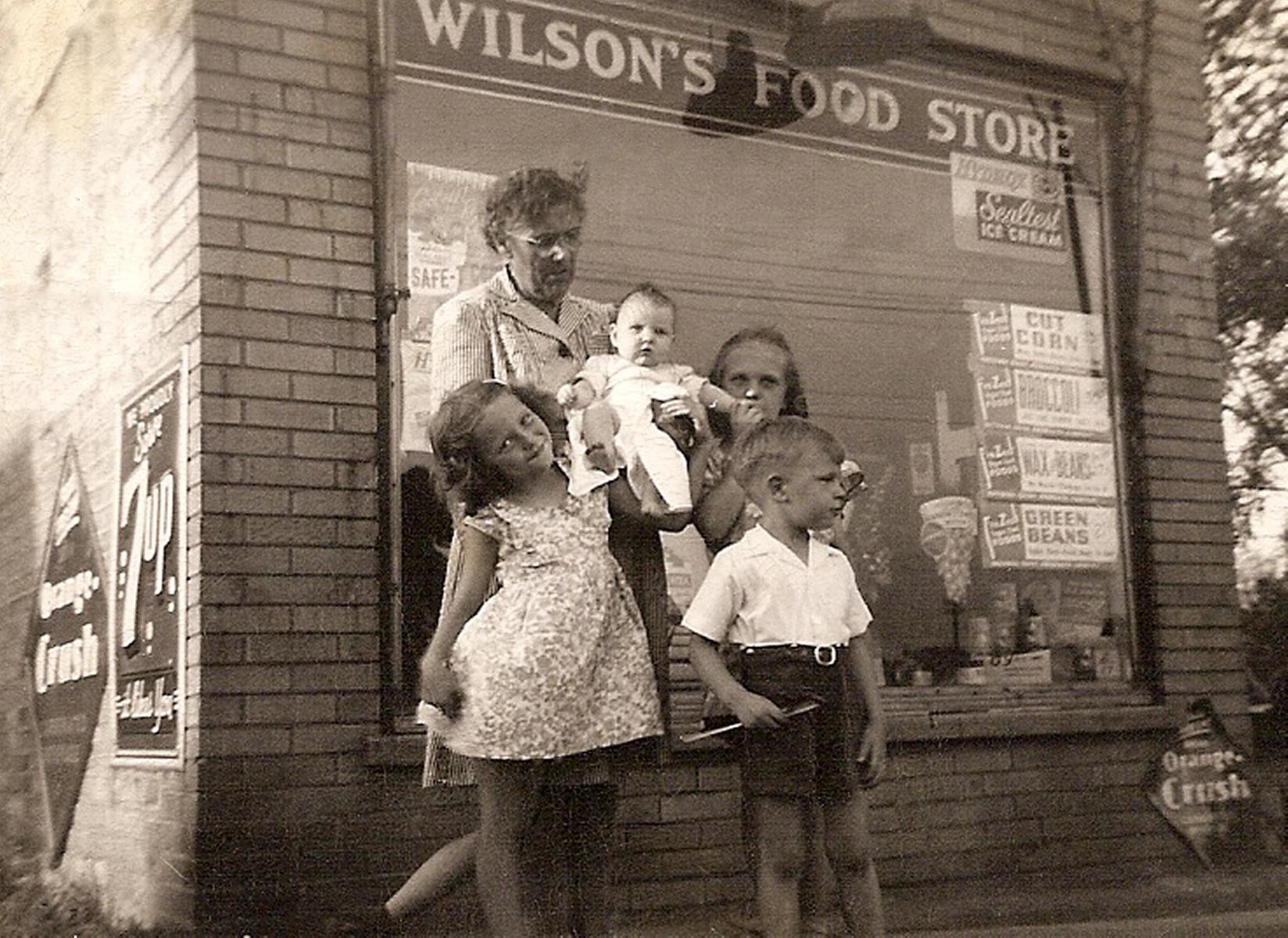
Our newest “Eye on the Past” feature photo shows a charming little grocery store located about 1.5 miles west of Lake Michigan in Waukegan, Illinois. Wilson’s Food Store was located at 1814 Grand Avenue, operated by my Dad’s aunt and uncle, Nina (Treutel) Wilson and Lawrence Wilson. Nina was a younger sister of my Grandmother Ruby (Treutel) Hanneman.
The Wilson family, including children Steve and Laurni Lee, operated the grocery in the late 1940s and early 1950s. The family living quarters were behind the store. Any time someone entered, a bell rang in the back and family members took turns waiting on customers. Shown on the right side of the photo are Laurni Lee (Wilson) Breedlove and Steve Wilson. Emma (Treutel) Carlin (1877-1962) is holding baby Bonnie (Treutel) Young. In front of them is Bonnie’s older sister, Patricia (Treutel) Anderson. Emma was Nina and Ruby’s aunt from Arpin, Wisconsin. Bonnie and Patricia are Laurni Lee and Steve’s cousins.
Lawrence Wilson was a longtime chemist and plant superintendent at Pfanstiehl Laboratories in Waukegan. I distinctly remember Uncle Laurie and Aunt Nina coming to my wedding in December 1990 in Racine, Wisconsin. Somewhere I have a video of them arriving at the reception at Racine’s Memorial Hall. After retirement, the couple moved to Arizona. Lawrence died in 2001, and Nina passed away in 2005.
The little brick building in the photo still stands, although over the years it was extended on both sides to include other businesses. The vintage metal signs in the photo advertised Orange Crush and 7up soda. Window stickers promoted Sealtest ice cream, Hydrox sandwich cookies, and produce (cut corn, green beens, wax beans and broccoli).
It was just the kind of wartime story that made an emotional impact on Milwaukee and the state of Wisconsin. Three Irish brothers serving in World War II appeared together to promote the sale of war bonds at a series of rallies in November 1944. Two were home on leave from the front and one was about to embark on his first overseas tour of duty.
There they stood on stage, the baby-faced Thomas “Tinker” Mulqueen still in naval training, the serious Marine Cpl. Earl J. Mulqueen Jr., on crutches due to the loss of his left leg above the knee, and the curly-haired redhead, Patrick J. Mulqueen, home from more than 18 months at sea with the U.S. Navy.
The Milwaukee Journal carried a front-page story on the Mulqueen brothers and the war bond drive in November 1944.
“Maybe it is because they are Irish, or maybe it is because they look so much like little boys—or maybe it is because everyone at one time or another, lost his heart to an Irish grin,” wrote The Milwaukee Journal in a front-page story on November 10, 1944. “But no matter what the reason, more and more persons every day are agreeing that the Mulqueen brothers, Tommy, Earl and Patrick, are among the greatest things which ever happened to Milwaukee.”
The impact the boys had was most evident at a bond rally at Schuster’s Department Store on Milwaukee’s North 3rd Street. The event got off to a slow start. Ben Barkin, head of the local war finance committee (later a legendary Milwaukee PR man and founder of the Great Circus Parade) was worried. That all changed when the Mulqueen boys took to the stage. “They are so cute,” one woman said. “They look like little boys playing soldier.”
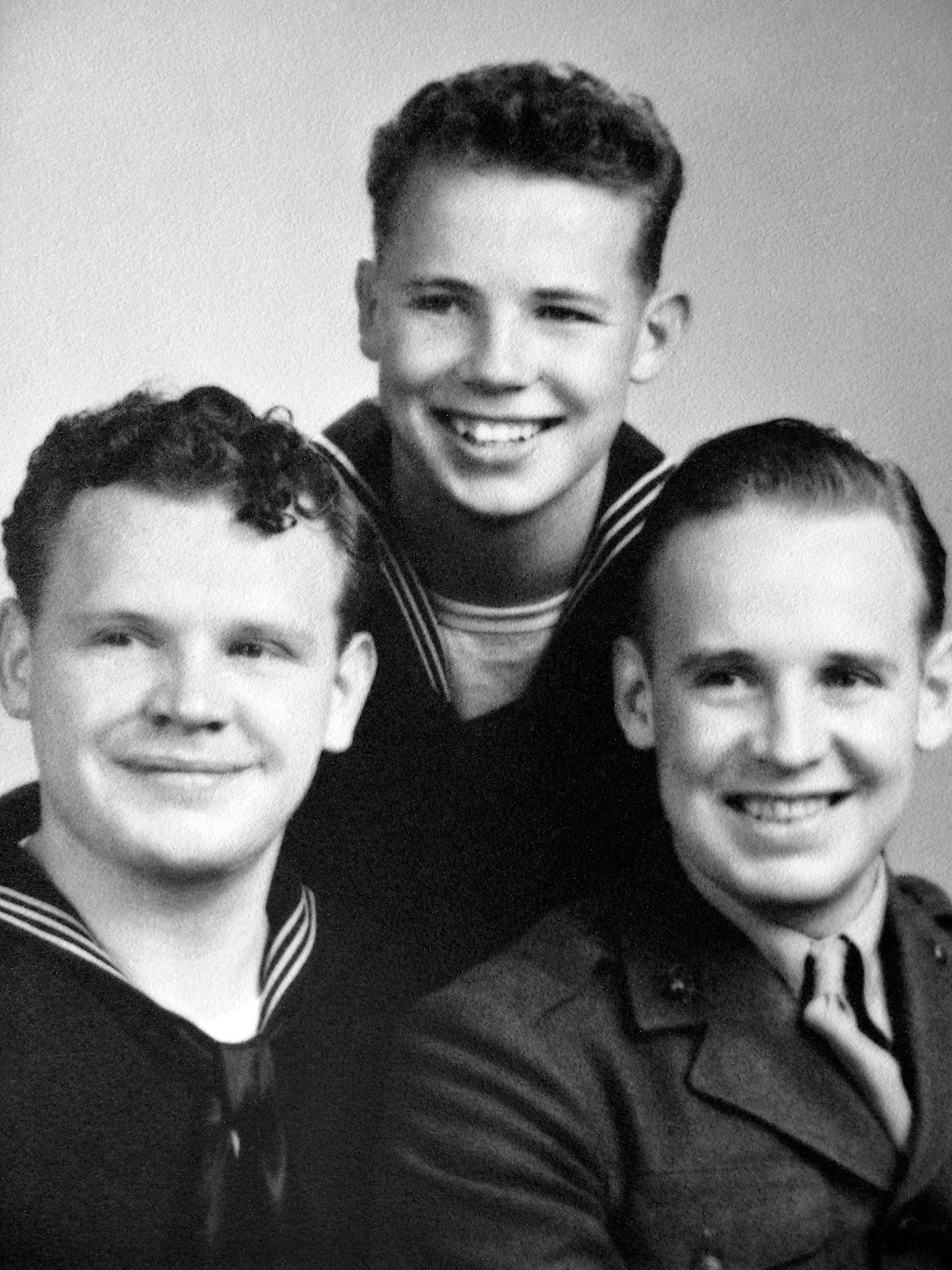
Three Mulqueen brothers appear at a Milwaukee war bond rally in November 1944. Left to right are Michael Thomas Mulqueen, Earl James Mulqueen Jr. and Patrick Joseph Mulqueen. Behind the group is war bond chairman Ben Barkin.
Now the crowd was interested. Barkin introduced the lads. The 17-year-old Tommy was first to step forward and said simply, “You buy the bonds and the Mulqueens will win the war.” Considering he had yet to set foot in a combat zone, such as statement could have been viewed as a “wisecrack by a fresh kid,” The Journal wrote. But it wasn’t. “When Tommy said it, you knew he was telling the solemn truth,” the paper wrote. (Tinker went on to serve as a sailor on the fleet oiler USS Mattaponi.)
Earl talked about the war. At 21, he had seen more fierce combat than most would ever see. He fought at Guadalcanal and Tarawa with the 2nd Marine Division. Those were two of the bloodiest, deadliest battles of the entire Pacific war. Earl was a mortar crewman, so he was right at the front.
This hazy snapshot from the Pacific shows U.S. Marine Cpl. Earl J. Mulqueen Jr. next to the mortar he took into combat during World War II.
Earl was helping prepare an invasion fleet for the 1944 assault on the Mariana Islands when his landing ship-tank (LST) blew up at Pearl Harbor. The massive chain explosion caused the loss of many ships and resulted in hundreds of casualties. Because of the preparations underway for the invasion of Saipan, the Pearl Harbor disaster was a classified secret until the 1960s. So Earl was only able to say that he “almost made it to Saipan.” (Details of Earl’s war service and loss of his leg in the West Loch disaster will be the focus of a future Archive story.)
U.S. Marines storm Tarawa, Gilbert Islands, November 1943. (National Archives Photo)
Patrick spoke of his experience as a firemanaboard the light cruiser USS Concord (CL-10). He enlisted on August 7, 1942 and by March 1943 was among the compliment of 700 aboard the Concord. The ship escorted reinforcement convoys in the southern Pacific, and prowled the dangerous, icy waters of the north Pacific. The Concord was involved in numerous bombardments of the Kurile Islands. During 1943, the Concord was on a surveying mission of the South Pacific with retired Rear Admiral Richard E. Byrd, the famous explorer. The ship visited Tahiti, Bora Bora and the Easter Islands. A huge explosion onboard on October 7, 1943 took the lives of 22 crewmen. Caused by ignition of gasoline fumes at the rear of the ship, the explosion threw some men overboard, while others were killed from concussion, burns, fractured skulls and broken necks. On October 8, those men were buried at sea. After participating in bond rallies in Milwaukee, Patrick was assigned duty on the USS Crockett (APA148), a Haskell class amphibious attack transport. The USS Crockett had just been commissioned on November 28, 1944.
The crowd at Schuster’s quickly figured out that these “boys” had seen and experienced the horror of war. “It was simple and short,” The Journal wrote. “No frills. No hero stuff, no dramatics—nothing but a couple of kids, one on crutches, asking people to buy and sell bonds.” The stories of the Mulqueen boys had the desired effect. Barkin exclaimed, “You know, the bond drive is going to come out all right.” He was right, for the Schuster’s bond drive raised more than $500,000.
The Mulqueen brothers even appeared at war bond rallies with their mother, Margaret Mulqueen, who was active in the Marine Corps League.
Schuster’s was just one of many venues at which the Mulqueen boys spoke. At some rallies, they were joined by their mother, Margaret “Madge” Mulqueen, who was deeply involved with the war effort through the Wisconsin chapter of the Marine Corps League. She had four blue stars displayed in the window of the Mulqueen home at 3854 E. Cudahy Avenue in Cudahy — one for each of the three boys and one for her daughter Margaret, a Navy nurse based in San Diego.
The bond drives were a crucial part of the home-front effort in World War II. Across the nation, eight war-bond drives between 1942 and 1945 raised more than $190 billion. Investors purchased $25 bonds for $18.25. Bonds were redeemable after 10 years. Companies sponsored in-house bond rallies, and employees pledged purchases through payroll deduction. Children were encouraged to buy 25-cent war stamps to save up for their own war bond. Special sections of local newspapers were dedicated to promoting bond sales. On the radio, popular programs such as Fibber McGee and Molly dedicated entire episodes to war bonds and other home-front efforts.
Sgt. Louis C. Koth (left) and Marine Cpl. Earl J. Mulqueen Jr. are introduced by company president Earl W. Wyman at the Oshkosh B’Gosh Inc. bond rally on November 30, 1944.
Earl Mulqueen and Army T/Sgt. Louis C. Koth appeared at such a corporate event at Oshkosh B’Gosh Inc. on November 30, 1944. They were introduced by company president Earl W. Wyman. Koth was a radio operator aboard a U.S. Army Air Force B-17 bomber that was shot down during a mission over Schweinfurt, Germany. Koth was on his third mission in a B-17 Stratofortress when he was forced to parachute into enemy territory. Taken prisoner and repatriated 11 months later, Koth lost his right arm. Koth began participating in the bond tours shortly after being released from a hospital in Madison in the fall of 1944.
Koth and Earl Mulqueen toured Oshkosh Motor Truck Inc. and Universal Motor Co. Later they were interviewed live on radio station WOSH by local bond chairman Richard J. White. “Both of these boys are giving freely of their time to help the sixth war loan campaign,” White said. “They have made sacrifices beyond any that we are being asked to make, and although they will not see action again, they are both anxious to do whatever they possibly can to see that ammunition does not have to be rationed at the front.”
The bond rallies helped explain the costs of supplying the troops. Toothbrushes cost 8 cents each. A hand grenade was $1.56. An anti-tank shell cost nearly $3. A Garand rifle was $55. A 1,000-pound bomb cost $250, while a 75-mm Howitzer cost $11,350. A PT boat cost the military $145,000, while a 1,630-ton destroyer had a price tag of $10 million. A fully outfitted battleship cost $97 million. Bond drives supplied the U.S. government with needed cash, while giving ordinary citizens a concrete way to participate in the war effort.
Ads like this one from First Wisconsin promoted sale of war bonds during World War II.
Largely due to Barkin’s tireless efforts, Milwaukee’s World War II war-bond drives became a model for the nation. Described by The Milwaukee Journal as an “ace ward bond salesman,” Barkin was honored as Milwaukee’s man of the year in 1945 by the Milwaukee Junior Chamber of Commerce. For his $1 annual salary, Barkin popped up just about everywhere in Milwaukee: schools, churches, civic clubs and businesses. The 28-year-old was unable to enlist due to a disability, so he threw his energy into raising money for the war effort. Doctors told him to slow down, but the pitchman didn’t listen. He gave more than 1,000 speeches each year as head of the community division of the war finance committee.
“Let’s show Milwaukee what their money is buying,” Barkin said in 1943. He organized a “Wings for Victory” parade of tanks, jeeps, artillery and other hardware to do just that. Funds from the rally after the parade were used to buy military transport planes for Mitchell Field. Barkin convinced Milwaukee to rename Wisconsin Avenue “War Bonds Drive” for the duration of World War II, a practice later adopted in dozens of other cities. He understood the importance of having soldiers, sailors, airmen and Marines tell their stories. The results were often heart-rending. He told the story of a Milwaukee woman who stood in line for two hours to buy a war bond for her boy, serving in North Africa. Her husband had just died two days prior. “Doggone it,” Barkin told Walter Monfried of The Milwaukee Journal,“that kinds of gets you, doesn’t it?”
Three Mulqueen brothers served in World War II: Patrick (left), Thomas (center) and Earl.
So Barkin knew when the Mulqueen boys stepped on stage, the people would dig deeply into their pockets to support the war. “No matter what the mood of the meeting before the kids talk,” The Journal wrote, “when they finish, that meeting is sure of going over the top.
“Everyone who has heard the Mulqueen brothers agrees,” the paper wrote, “that the kids are among the best in the world.”
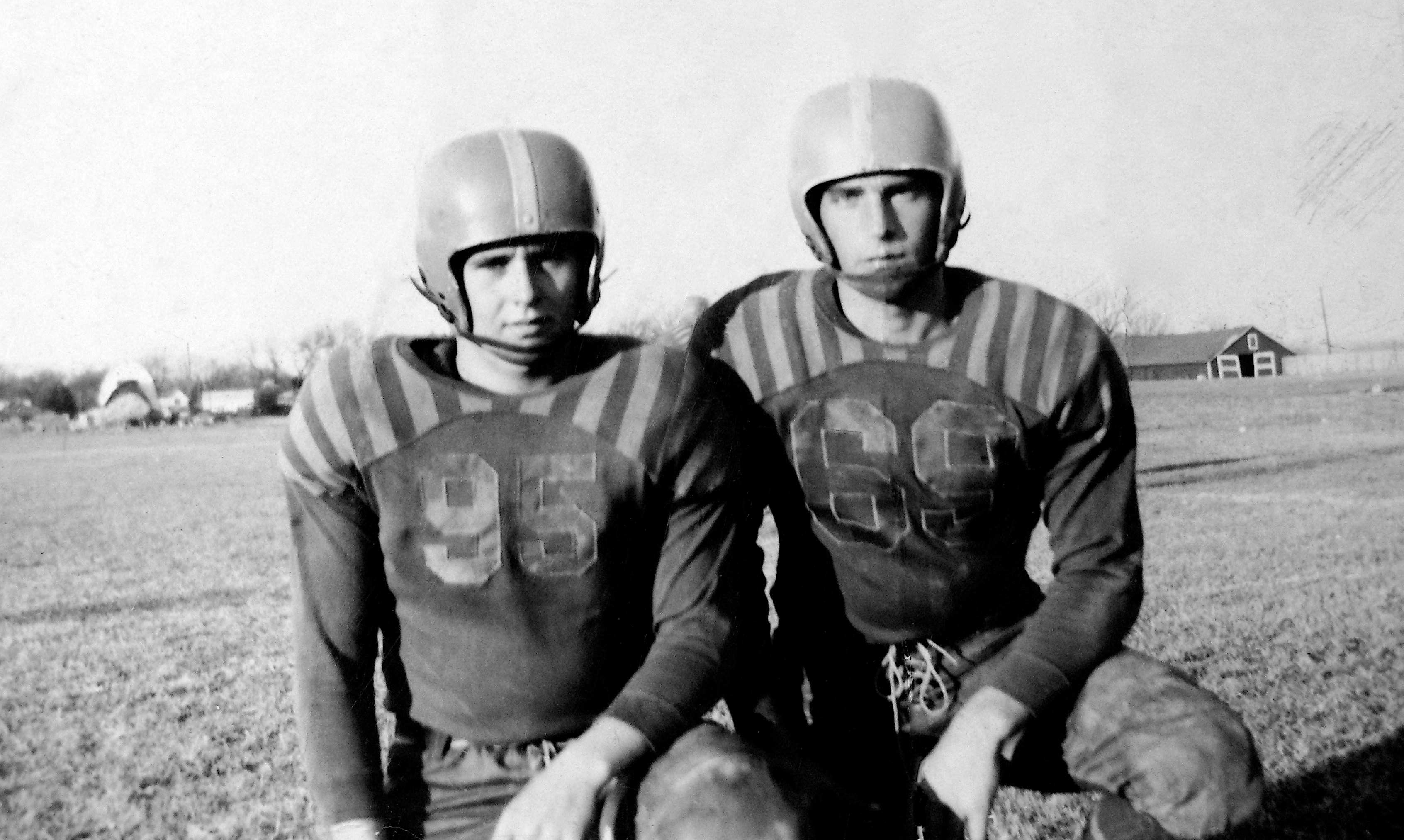
The 1947 football campaign was destined to be one for the ages at Mauston High School. The photo gallery below could be from that championship season, based on the youthful appearance of my Dad, David D. Hanneman (1933-2007). Dad was a starter for the Mauston Bluegold, even in his freshman year.
David D. Hanneman (center) played tackle, guard and on occasion, running back, for Mauston High School during the 1947-50 football seasons.
Dad played guard and tackle throughout his high school football career. But as is the case on small-town football teams, boys play both offense and defense. Many of the players would switch positions, depending on the opponent and game conditions.
Mauston ran up a 7-1 record in the 1947 football campaign, gaining them a share of the West Central Conference championship crown. Mauston was 3-1 in conference play. Midway through the season, Mauston ranked as one of the state’s highest-scoring teams. Here’s the 1947 season recap:
Sept. 12 Mauston 12, Reesdburg 0
Sept. 19 Mauston 25, Middleton 6
Sept. 26, Mauston 20, New Lisbon 12
Oct. 3, Mauston 13, Tomah 0
Oct. 10, Mauston 45, Westby 6
Oct. 17 Sparta 14, Mauston 7
Oct. 24 Mauston 37, New Lisbon 0
Nov. 1 Mauston 13, Viroqua 0
Dave Hanneman (at right) in one of his early years in Mauston football.
Bob “Jigger” Jagoe, who played quarterback for Mauston starting in the 1948 season, recalls how Dave’s mother, Ruby V. Hanneman, was zealous in her cheering.
You could hear her in the stands, shouting. She was so proud. Of course we used to kind of make a mockery of it, because she was so adamant, letting everybody know who her son was out there who made the tackle. They announced, ‘Tackle made by Dave Hanneman’ and she said, ‘That’s my Davey!’
In the 1950s, home football games were played at Veterans Memorial Park on the south end of Mauston. This locale looks much closer to downtown, so I’m betting these 1940s games were played in Riverside Park along the Lemonweir River. In several of the photos you can see the distant spire of St. Patrick’s Catholic Church.
— This post has been updated with quotes and other information.
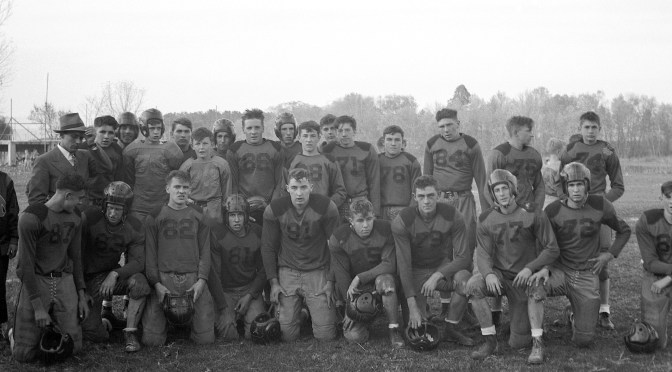
Dave Hanneman can be seen in the last row at left, second in from Coach McKenzie. Bob Jagoe is on his left. Front and center (91) is Dick Hale.
Mauston coach Doug McKenzie and players follow the on-field action.
A great view of the crowd at Riverside Park in Mauston.
It’s not clear if this galloping ghost is David D. Hanneman. He usually played at the line.
The Mauston Bluegold huddle before the play.
This appears to be a victory celebration.
Game action from this 1947 football contest at Mauston.
A good look at the spectators at Riverside Park. Recognize anyone?
Game action from this 1947 football contest at Mauston.
Dad’s conference crown medal from the 1947 championship season.
Another group shot of the team. On this one, Dave Hanneman (back row left, second from coach) has his tongue sticking out. Front and center (91) is Dick Hale.
A U.S. Navy recruit, probably a graduate of Mauston High School, watches the action.
A Mauston game program from September 1950. Note the team plays at Veterans Park instead of Riverside as in earlier years.
















 The Hanneman Archive