When was the last time your visit to the Cineplex included live entertainment? (The bratty 5-year-old in front of you throwing popcorn at his brother does not count.) The movie theater was once about much more than movies, and the price of admission included live performances, newsreels, comedy shorts and more. For years our own Ruby V. Hanneman was a featured performer at some of Wisconsin Rapids finest cinemas, and her name appeared in ads right alongside Silent Era stars of the day like Neal Hart, Ricardo Cortez,Doris Kenyon and Jack Holt.
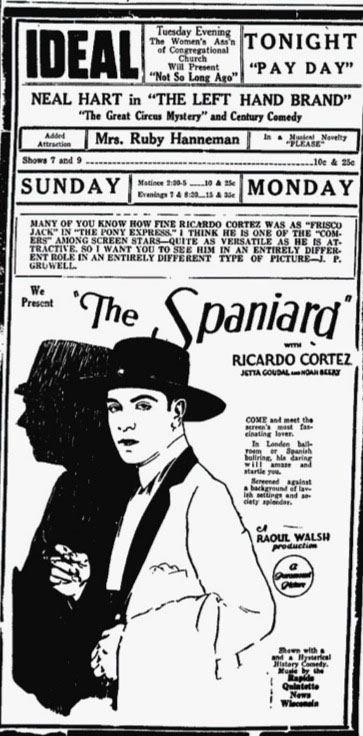
Ruby Treutel Hanneman was the musical attraction during the showing of The Spaniard in October 1925.
Ruby often appeared at theIdeal Theatre at 220 E. Grand Ave., Wisconsin Rapids. She sang a “musical novelty” at two shows on Halloween night 1925. The main attraction was The Thundering Herd, a movie based on the 1925 novel by Zane Grey. (Zane Grey happened to be a favorite author of Carl F. Hanneman and his son David, but we digress.) Seats that night were just 10 cents or 25 cents, half off the typical ticket prices.
On Thanksgiving 1925, Ruby sang for the audience at Paramount Pictures In the Name of Love, starring Ricardo Cortez and Greta Nissen. Ruby sang two numbers, “Lonesome, That’s All,” and “In the Garden of Tomorrow.” The 15 cent and 35 cent admission also included the Wisconsin Rapids Quintette, newsreels and a Will Rogers comedy.
Ruby Treutel sang as a prologue to The Dressmaker from Paris.
Ruby got perhaps her most prominent billing for the October 17, 1925 showing ofThe Spaniard. Her name was most prominent in the ad in the Wisconsin Rapids Daily Tribune.“Added Attraction, Mrs. Ruby Hanneman in a Musical Novelty,Please, the ad read. On Aug. 25, 1925 she appeared at the New Palace Theater singing, “I Wonder What’s Become of Sally.” The feature film that night was Born Rich starring Bert Lytell and Claire Windsor.
Ruby V. Treutel dressed for her lead role in the operetta ‘Sylvia’ in 1922.
By the time she starred at the New Palace and the Ideal, Ruby was a veteran singer. According to the April 4, 1921 edition of the Daily Tribune,Ruby Treutel “brought down the applause of the house time after time” for her performance in the play “The Fire Prince” at Daly’s Theater. Ruby was 17 at the time.
Now known as Mrs. Carl Hanneman, Ruby sang before the showing of Zane Grey’s “The Thundering Herd.”
When she graduated from Lincoln High School in Wisconsin Rapids in 1922, Ruby had years of experience in music and drama. She played the female lead in the operetta Sylvia during her senior year. She was also president of the Glee Club. Under her senior class portrait in the yearbook The Ahdawagam read the motto, “Music hath charms and so does she.”
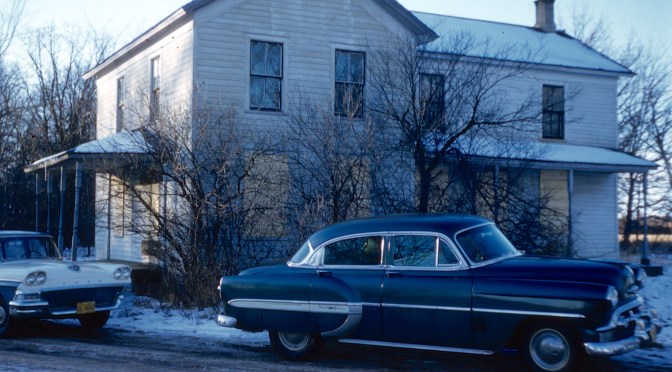
While scanning my grandfather’s old slide collection, I came across two stray images from 1957 marked “Gein’s House.” I couldn’t get the slides on the scanner bed fast enough. It turns out the photos were indeed of the ramshackle farm house of the notorious killer and grave robber, Ed Gein.
For Carl F. Hanneman, the trip to Plainfield would have been a minor detour on one of the family’s many trips from Mauston to Wisconsin Rapids, Wis. He, like thousands of other Wisconsinites in the late fall of 1957, just had to see for himself the home where the unimaginable occurred from 1945 to 1957. For in that decrepit structure at the corner of Acher and 2nd avenues a few miles southwest of Plainfield, the handyman bachelor Gein committed unspeakable acts.
The boarded-up house of Plainfield handyman Ed Gein, who robbed nearby graves and made macabre souvenirs from the stolen remains. The house was burned to the ground by an arsonist in March 1958. (Carl F. Hanneman photo)
The day of Gein’s undoing came on November 16, 1957, the opening day of the gun deer hunting season in Wisconsin. Gein made the trip into Plainfield to buy some anti-freeze at Worden’s hardware store. While there, he took a .22-caliber rifle from the store display and shot to death the owner, Bernice Worden, 58. After slitting her throat, he dragged her body out the back and put it into a truck. Later that day, sheriff’s deputies from several counties were searching for Worden, a well-known local who had run the Plainfield hardware store since her husband’s death in 1931.
Gein’s car had been spotted in the village that day, so police twice stopped at his 160-acre farmstead to talk to him. He wasn’t home. On the second trip, Waushara County Sheriff Arthur Schley peered into a shed that Gein used as a summer kitchen and was shocked. “My God, there she is!” he shouted. There was the body of Worden, hung upside down by the ankles, gutted and dressed out like a deer ready for the butcher. “There was a body hanging in the woodshed by the ankles,” said Captain Lloyd Schoephoester of the nearby Green Lake County sheriff’s department. “Tendons in the ankles had been cut and a rod and been placed through them. The body was drawn up in the air by a block and tackle. The body was dressed out and the head was missing.” Sheriff Schley went outside and vomited.
Police found the remains of nearly a dozen women in Ed Gein’s farmhouse near the village of Plainfield, Wis.Worden’s head was later found in a burlap sack nearby. Her internal organs were in a bucket. If that sight wasn’t enough to sicken responding police, a search of Gein’s home would put them over the edge. Inside the filthy and cluttered home they found five human heads wrapped in plastic bags, four skulls and 10 “death masks” made by removing the face and hair from a human head. “Some of them have lipstick on and look perfectly natural,” said Wood County sheriff’s deputy Dave Sharkey. “It you knew them, you’d be able to recognize them.”
There was more. Police found chairs and lampshades fashioned from human skin, four human noses, two sets of lips, a belt made of female nipples, and a collection of female genitals. Two of the vulvas in Gein’s collection belonged to teenage girls, and authorities concluded he likely murdered these girls. On the stove was a saucepan containing a human heart, later identified as belonging to Worden. There was a wastebasket made from skin, and skulls fastened to Gein’s bedposts. Bowls were made from the tops of human skulls.
At first, police thought they might be dealing with a prolific serial killer. After his arrest, Gein admitted killing Bernice Worden, but he said the grotesque artifacts in his home were from grave-robbing visits he made to the nearby Plainfield Cemetery, the Spiritland Cemetery in Portage County and the Hancock Cemetery in the Town of Hancock. Gein also admitted shooting and killing Portage County tavern keeper Mary Hogan on December 8, 1954. Her face was found among Gein’s collection of death masks.
Police were not initially inclined to believe Gein’s tales of grave robbing. On November 25, 1957, they exhumed the caskets of Eleanor Adams and Mabel Everson at Plainfield Cemetery. Both caskets were empty. In the soil above one casket they found dentures and a wedding ring. That was enough to convince police that Gein was indeed a grave robber. He told authorities he made the moonlight grave-robbing visits while in a daze. On some occasions, he awoke from the daze and stopped what he was doing. He said his grave robbing occurred between 1947 and 1952. He said he returned some bodies to their graves after experiencing remorse. Police did not dig up other graves, and ultimately don’t know just how many caskets Gein might have opened.
When interviewed by Wisconsin State Crime Lab officials, Gein said he would dress up with the women’s body parts. He would wear a death mask, a tanned skin shirt including women’s breasts, and a vagina placed over his own genitals, covered by a pair of panties. He would go out in the moonlight and prance about the farmyard in this sick getup. Although Gein was not a deer hunter, he was known to have given packages of “venison” to people in the community, who became sickened after Gein’s arrest at their unwitting cannibalism. Authorities became convinced that Gein practiced cannibalism, among his other grotesque crimes.
After a brief court hearing in January 1958, Gein was committed to the Wisconsin Central State Hospital for the criminally insane at Waupun, where he remained for 10 years. In early 1968, Circuit Court Judge Robert H. Gollmar ruled Gein was able to stand trial for the murder of Bernice Worden. In a November 1968 bench trial, Gein was convicted of first-degree murder for Worden’s death, but in a separate hearing found not guilty by reason of insanity. He was sent back to Waupun. He later was moved to the Mendota Mental Health Institute in Madison, where he died of cancer on July 26, 1984. He was buried next to his mother in the same Plainfield Cemetery that he plundered.
Gein suffered from schizophrenia. The death of his mother on December 29, 1945 apparently pushed him over the edge. Doctors said he had an unnatural Oedipus complex attachment to Augusta Gein. The women he killed and the graves he robbed represented substitutes for his mother. The women were plump and middle aged, doctors said. Gein had nursed his mother through two paralytic strokes. Gein’s father George died on April 1, 1940. His brother Henry was found dead after a marsh fire on the Gein property on May 16, 1944. It is widely believed that Gein killed his brother.
Based on the Worden convinction and Gein’s admission to killing Mary Hogan, Gein could not be considered a serial killer. But he was suspected of killing at least four other people. The teenage genitals found in his farmhouse might have belonged to Evelyn Hartley, 15, of La Crosse, and Georgia Jean Weckler, 8, of Fort Atkinson. Hartley disappeared in October 1953 and Weckler was abducted in May 1947. Neither crime was ever solved and the girls’ bodies were never found. In his 1982 book on the Gein case, Judge Gollmar wrote that if Gein did not kill these girls, then the abducted and killed two runaways, since his grave-robbing could not explain the presence of genitals belonging to young girls in Gein’s home. Gollmar also wrote that Gein might have killed two men who disappeared after visiting a Plainfield tavern. The disappearances of Victor Travis and a male companion were never solved. Travis’ jacket and his dog were found near the Gein farm, and neighbors noted a stench coming from Gein’s garden at the time.
Gein’s gruesome story created a cottage industry in macabre spinoffs. It was the inspiration for the book Psycho by Robert Bloch. The book was adapted into the 1960 Alfred Hitchcock film of the same name. Gein was said to be the inspiration for fictional characters in films including The Texas Chain Saw Massacre and Silence of the Lambs.
The Hanneman family has one link to Plainfield other than the photos of Gein’s house snapped by Carl Hanneman. Lisetta (Treutel) Moody (1861-1931), aunt of Ruby Hanneman, moved her family to Plainfield after living in Vesper in Wood County. She and her husband, Lewis Winfield Moody, are buried at Plainfield Cemetery. She testified at the trial of Frank Hinz after the 1902 shootout between the Moody and Hinz families.
This post has been updated with details from the 1982 book on Gein by Circuit Judge Robert H. Gollmar. The book, Edward Gein: America’s Most Bizarre Murderer, is a fascinating insider’s account of the Gein case.
Sometimes a photograph will strike you in a certain way that makes it memorable. It has some intangible quality that makes it almost timeless. Of the thousands of images in our library, a handful qualify for this kind of distinction. Not for their physical clarity or skill of the photographer, but that certain look. You might describe it just a bit like looking at a Rockwell painting, or a black and white photograph by Ansel Adams.
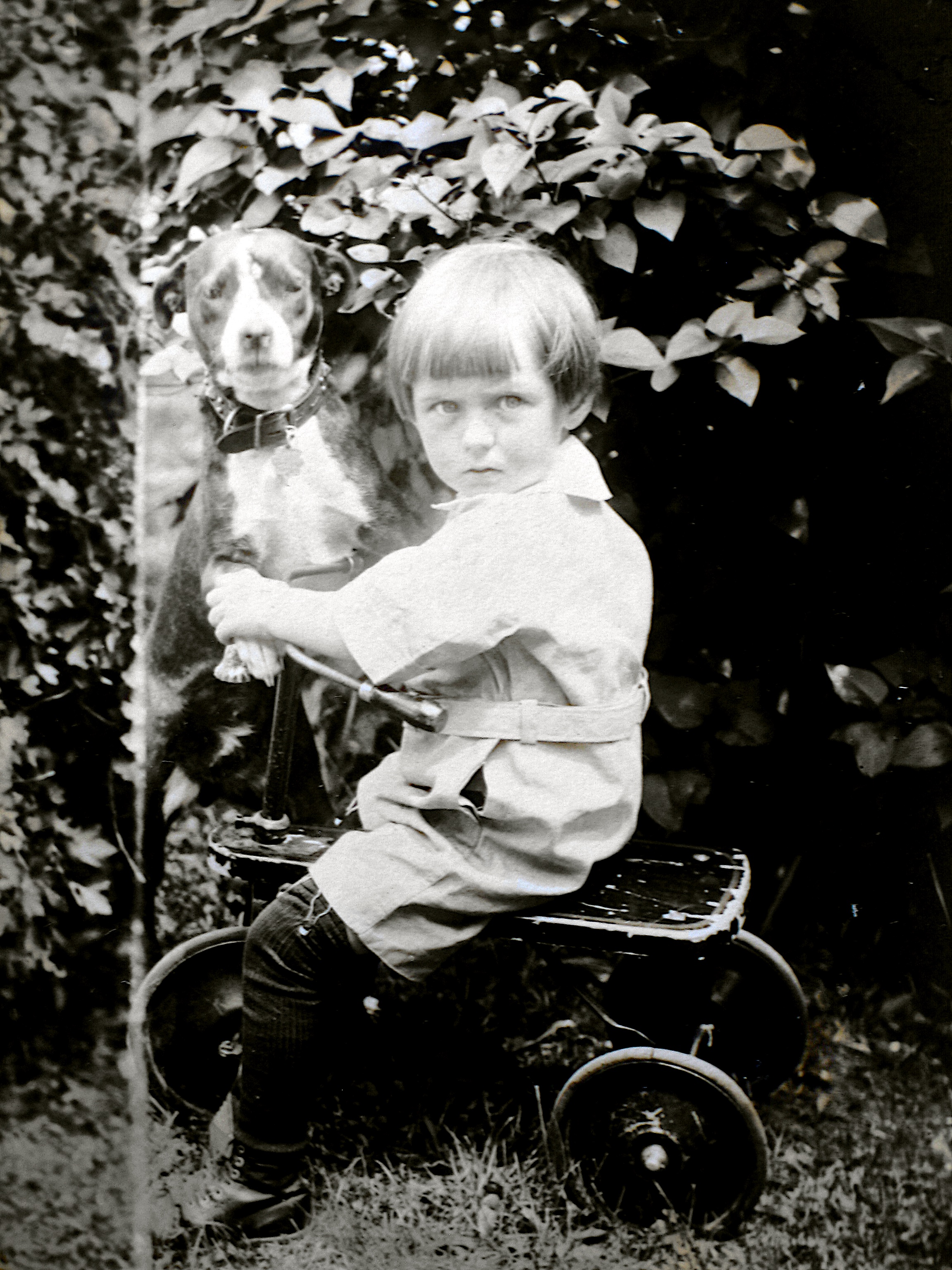
This image has a Little Rascals look and feel to it. Originally thought to be toddler Elaine Treutel and the family dog on her tricycle, circa 1922. Turns out this was actually one of the sons of Harry Cole.
View the whole collection in the gallery below:
Elaine Treutel poses with the family dog in this ca. 1923 photo near Vesper, Wis. Directly behind her is older sister Ruby V. Treutel. Sitting on the bumper of the car is father Walter Treutel (1879-1948). The others are unidentified.
This image has a Little Rascals look and feel to it. Toddler Elaine Treutel and the family dog on her tricycle, circa 1922.
David D. Hanneman with his toe in the sand at Madeline Island, circa 1942.
Ruby V. Treutel (center) relaxes with the Sunday paper near Milwaukee’s Juneau Park in 1924. Ruby was visiting her fiance, Carl F. Hanneman (1901-1982), who was studying pharmacy at Marquette University. At front is Ruby’s sister, Nina H. Treutel (1914-2005). The woman near the car is unidentified.
A formal portrait of Elaine Treutel of Vesper, Wis., circa 1938. Born in January 1920 to Walter and Mary (Ladick) Treutel of Vesper, Elaine attented Lincoln High School in Wisconsin Rapids. She married Max Clark in October 1938. The couple lived for many years in Madison, then relocated to suburban Phoenix, Arizona.
Frank Herman Albert Hanneman (1895-1947) of Grand Rapids, Wis., posed for this studio photo with a shotgun, ammunition belt and even a hunting dog. The photo was taken ca. 1909. Frank was the son of Carl Frederick Christian Hanneman (1866-1932) and Rosine B. H. Ostermann (1874-1918).
Nina Treutel of Vesper, Wis., is about 18 months old in this circa 1916 photograph. Nina’s parents are Walter Treutel and Mary Helen (Ladick) Treutel.
A beautiful portrait of Lavonne Hanneman, circa 1955.
Ruby Treutel poses for an informal photo, circa 1922.
Ruby Treutel with her siblings Marvin, Elaine and Nina, circa 1921.
Carl F. Hanneman’s high school portrait, 1921.
Lavonne and David Hanneman examine a monument on a vacation trip to South Dakota in 1947.
Ruby Treutel holds her baby brother Gordon, circa 1910. Gordon died of pneumonia in February 1911.
Patricia Treutel is having a great time on the tree swing, circa 1943.
We don’t have an ID on this beautiful young lady. Photo appears to be from 1920s.
David D. Hanneman watches over his little sister, Lavonne, circa 1938.
David D. Hanneman and sister Lavonne Marie Hanneman, circa 1942.
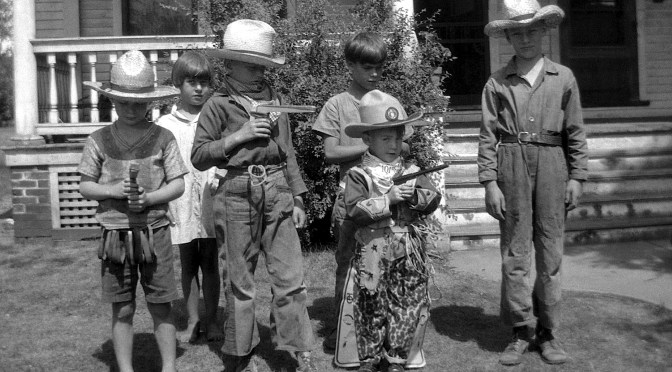
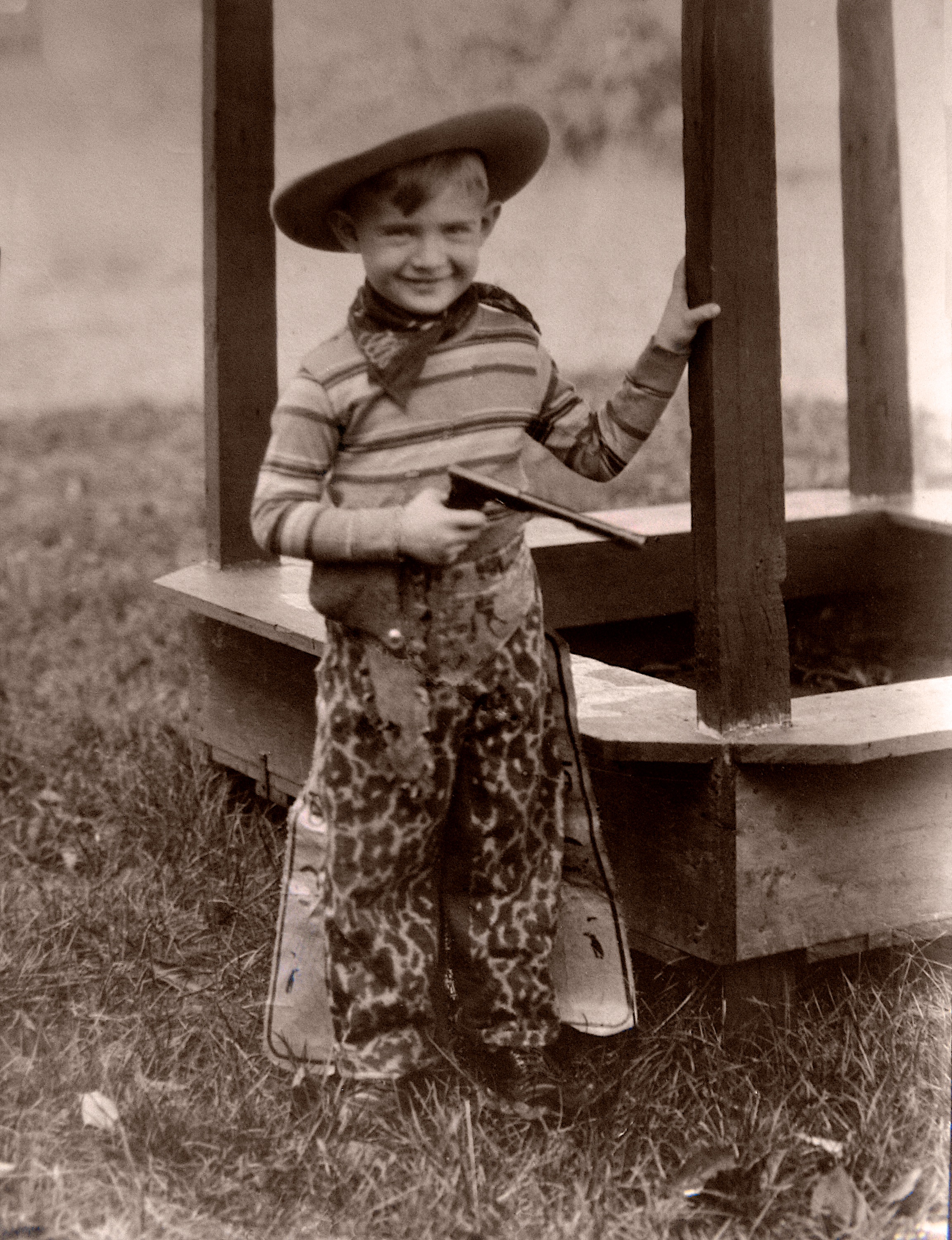
Even in the late 1920s, it was a time-honored tradition for the neighborhood boys to dress up as their favorite cowboy hero. The priceless image above shows a group of youthful cowpokes hard at play on Wisconsin Avenue in Wisconsin Rapids. The smallest cowpoke in front is Donn G. Hanneman, and judging by his spiffy cowboy getup, it might have been sometime near his August birthday.
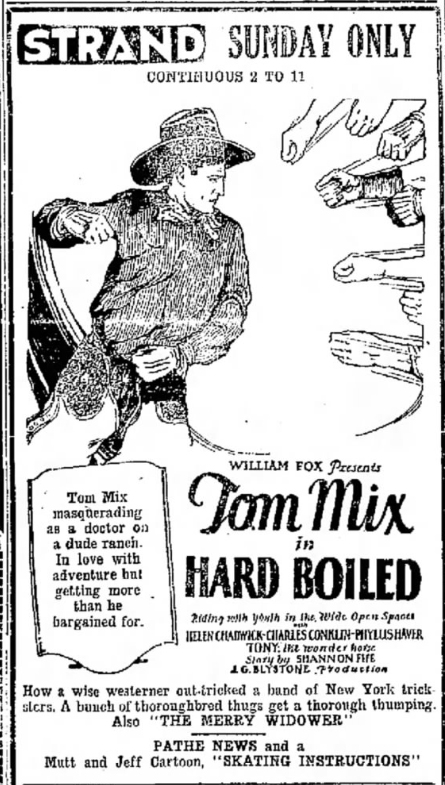
Youth flocked to see their hero Tom Mix and his steed, Tony the Wonder Horse.
So just which movie stars would these boys (and one perplexed young lady) be imitating while hard at play? The photo dates to around 1930, so it was well before the days of Red Ryder played by Red Barry and Rocky Lane, and long before the Lone Ranger. But no worries, the cowboy genre was well established at the movie house by such stars as Hoot Gibson, Tom Mix and even a very young John Wayne. These tykes might have gone off to see Fred Thompson in The Two-Gun Manor John Wayne in The Big Trail. It was still a few years before Gene Autry would be the star of In Old Santa Fe.
A bit older Donn Hanneman in his latest cowboy getup, circa 1933.
So here’s a tip of our 40-gallon hat to all of the aspiring cowboys of that era, with their chaps, shiny lawman’s badge, wooden gun and all the swagger a 5-year-old could muster. Let’s ride!
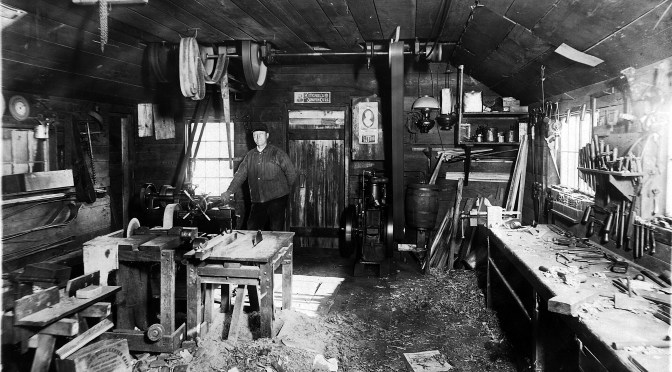
Charles Treutel (1869-1958) poses in the Treutel Bros. Shop at Vesper, Wisconsin, in 1911. Charles and his brother Henry A. Treutel (1864-1962) opened a blacksmith operation in Vesper after moving to Wood County from Mukwonago, Wis., in 1901. As can be seen in the photo, the Treutels also did carpentry work. The brothers later expanded their shop and made the transition from shoeing horses to tuning up engines and selling agricultural implements.
A 1911 book, Vesper, Wisconsin: A Sketch of A Model City, described the business this way:
Charles and Henry Treutel, skilled mechanics, have operated the blacksmith and wagon shop at Vesper since Nov. 1901 and have built up a large and prosperous business by courtesy and excellent workmanship. They are masters of every line of their business and are especially skilled in horseshoeing and repair work. In addition to their shop work the Messrs Treutel carry a large line of farm implements and their mechanical knowledge has enabled them to select the best makes in all the lines of machines they carry. They have a model shop fully equipped for their work.
The Treutel Bros. learned their trade from their father, Philipp Treutel (1833-1891), who came to America from Germany in 1854. As detailed in a previous post, the Treutels were blacksmiths, carpenters, tallow chandlers and tailors from near Darmstadt, Germany. Philipp Treutel is buried at North Prairie, Wisconsin.
— This post has been updated with additional information.
Another newly discovered photograph from 1905 shows the Chas. Hanneman family of Grand Rapids, Wisconsin. It is the earliest known photo of this family, and the only clear photograph we have of mother Rosine Bertha Henrietta (Osterman) Hanneman.
This photo is a real treasure for its clarity and detail. Often prints this old have many flaws and defects, but this is one of the best in the Hanneman Archive collection. We received it courtesy of Tom Hanneman of Minneapolis. It was originally from the photo collection of one of the boys in the photo, Carl Henry Frank Hanneman (1901-1982).
It is also one of perhaps three photos we have that show Rosine “Rosie” Hanneman. This mother of five (her firstborn died in 1891) died on Easter Sunday 1918 of diabetes. She was just 47 years old. She lived in the days before availability of insulin.
The father of the family, Carl Frederick Christian (“Chas”) Hanneman (1866-1932) worked many jobs in central Wisconsin. He was initially a farmer after emigrating to Wisconsin from Meesow, Kreis Regenwalde, Pomerania, in November 1882. He worked in the timber industry before moving his family to the city of Grand Rapids (now called Wisconsin Rapids). There he worked as a laborer (17 cents per hour) digging and installing the city’s new sewer system in the early part of the 20th Century. Eventually, Chas took on work in a paper mill. He died of prostate cancer shortly after retiring from the mill.
One of Chas’ grandchildren, Donn G. Hanneman, recalled sitting on the hospital bed when Chas was being treated for his cancer. “I’m going to heaven soon,” Chas told the 6-year-old. “I’d like it if you would put flowers on my grave.”
Rosine Bertha Henrietta (Osterman) Hanneman (1870-1918), Frank Herman Albert Hanneman (1895-1947), Arthur James Hanneman (1893-1965), Carl Henry Frank Hanneman (1901-1982), Wilbert George Hanneman (1899-1987) and Carl Frederick Christian (Chas) Hanneman (1866-1932).
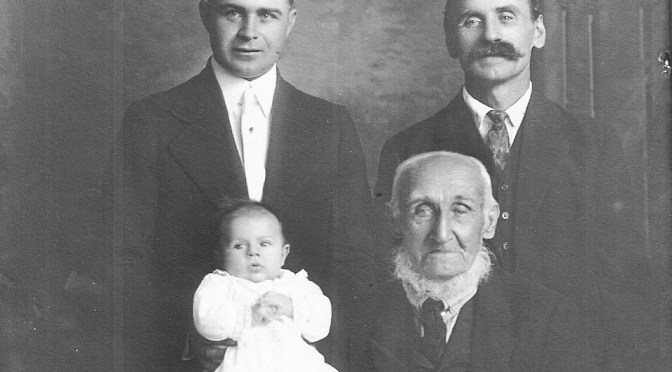
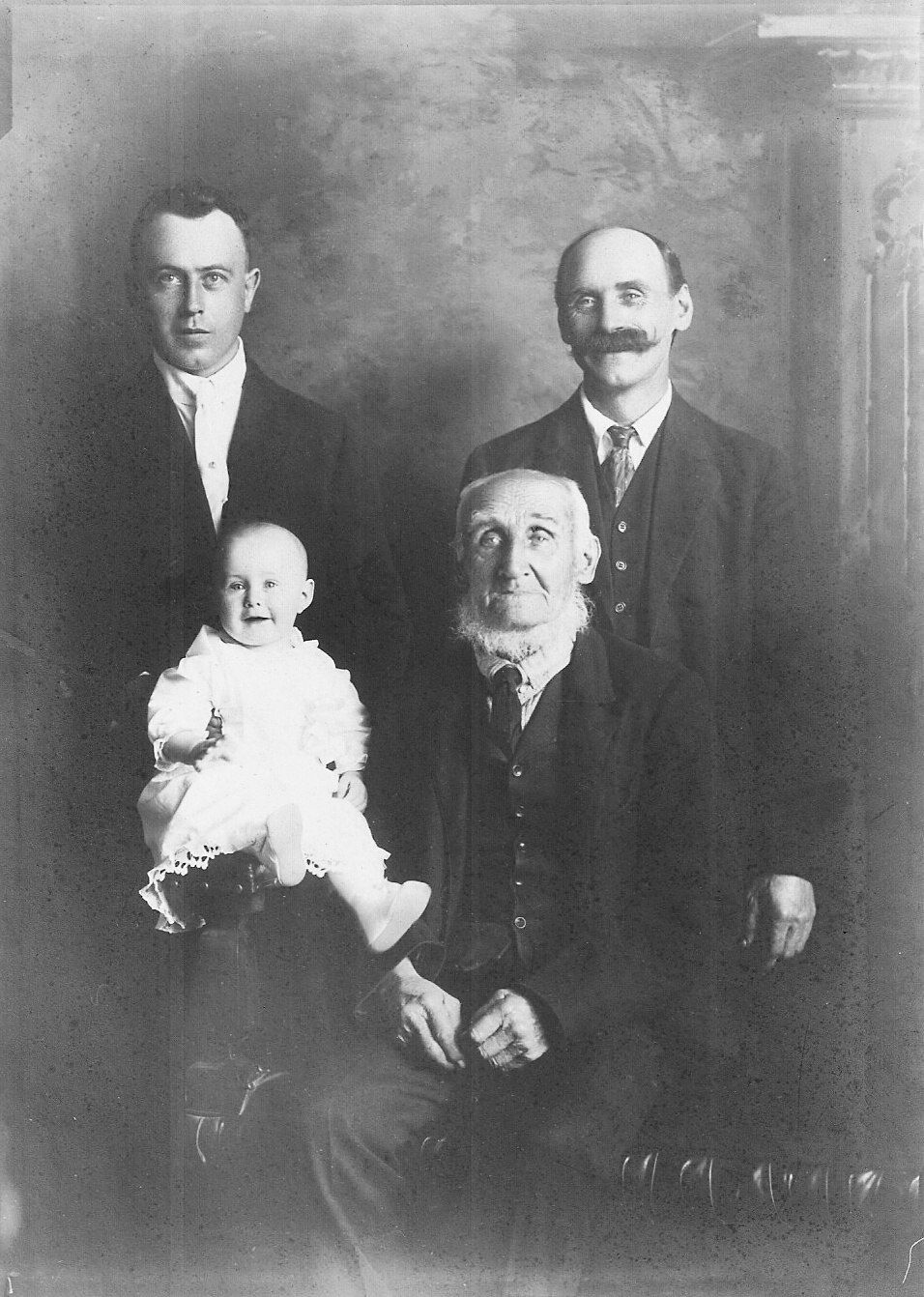
Two newly discovered photographs show four generations of Hannemans, starting with Christian Hanneman, who came to America in 1882. The photographs were supplied by Richard Swanson, grandson of Wilbert G. Hanneman (1899-1987).
One of the photographs shows Arthur J. Hanneman and his then-infant son, James A. Hanneman; along with family patriarch Christian Hanneman and Art’s father, Charles F. A. Hanneman. Christian Hanneman is identified in the photographs as Cristofer. The other photograph shows Frank H. Hanneman and baby daughter Dorothy. The photos date to approximately 1917.
A recently discovered copy of the 1921 yearbook “Ahdawagam” from Wisconsin Rapids Lincoln High School revealed that Grandpa Carl Henry Frank Hanneman played right end for the Lincoln varsity football team.
Carl was one of 10 young men on the first string football team that opened season on September 18,
1920 at Wisconsin Rapids. It was an up-and-down season as the Rapids team racked up a 4-3 record. Highlights included a 39-0 victory over New Lisbon and a 28-0 win at Stevens Point. The team took a 56-0 drubbing at the hands of Antigo and suffered a 26-6 loss to Merrill.
Carl was one of the smaller members of the team, but that did not reflect his playing ability. “What he lacked in size he surely made up for in playing,” the yearbook said. “Carl was right there when it came to breaking up end runs. Often he would run in and stop the opponents’ play before they had got well started.”
One thing Carl did not have that his teammates did was a nickname. Other young men on the team had nicknames such as “Cyclone,” “Butch,” “Tubby,” “Kid” and “Murphy.” Carl did not have a football nickname, but he did have the nickname “Oswald” next to his high school senior portrait. We’re not sure what to make of that one.












 The Hanneman Archive