In the first half of the 20th century, druggists in America were often called on to literally fill prescriptions, placing medications into gelatin capsules and then counting out the order. Mauston pharmacist Carl F. Hanneman was very efficient at the task. Maybe too much so, opined The Mauston Star in a rather humorous article in December 1953.
“Joe Dziewior and this muser, watching ‘pestle and mortar’ Carl Hanneman throw a prescription together the other evening, now know why pill or capsule counting machines not not necessary to the registered pharmacist,” read the article on December 11, 1953. “With bottle in hand, Carl was pouring capsules into his hands and counting them faster than an adding machine.”
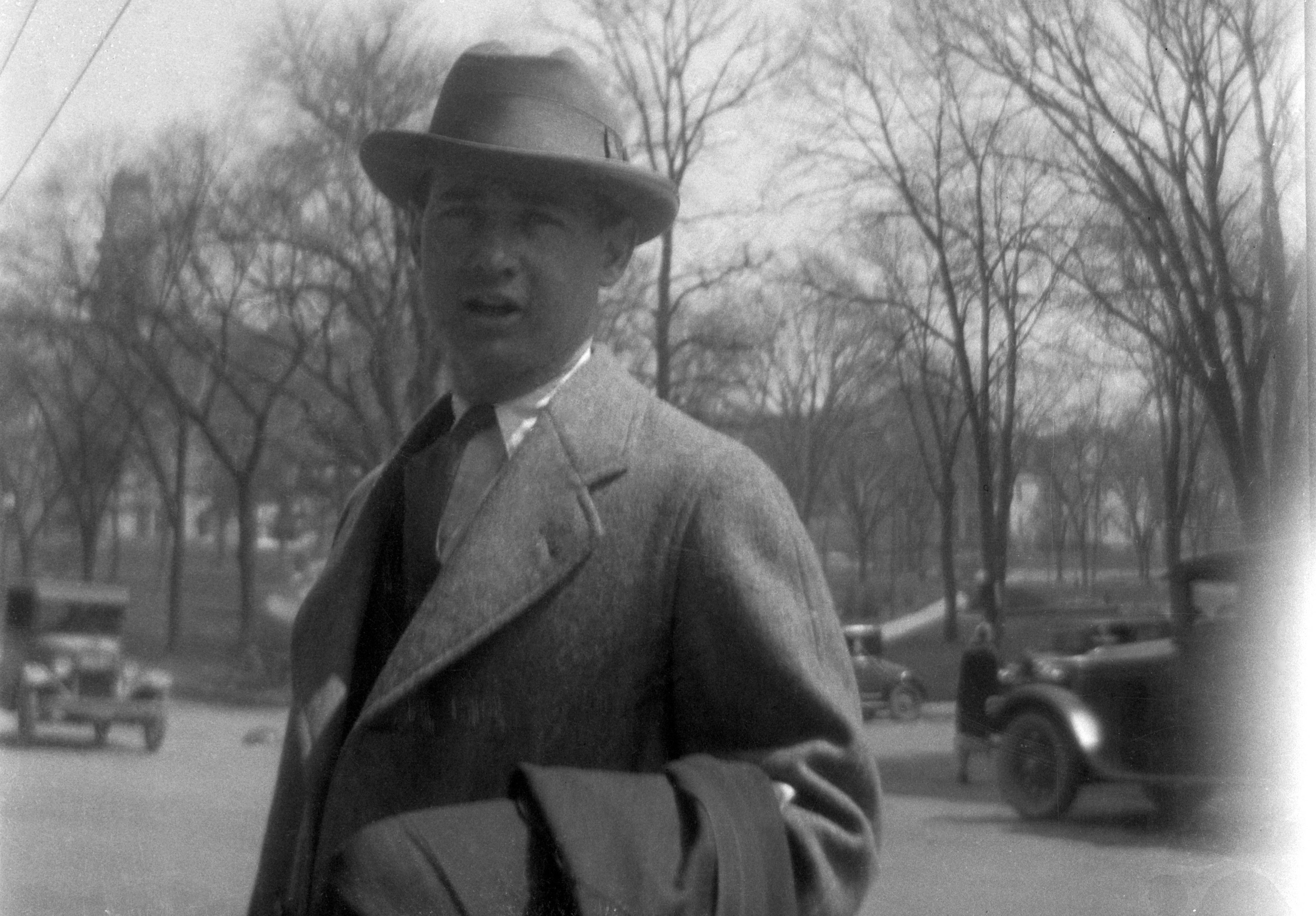
Carl F. Hanneman taking his suits to the cleaner at Janesville, Wis., on April 5, 1926. Carl and his wife, Ruby V. Hanneman, were on their way to dinner. Carl was a druggist at McCue & Buss Drug Co. at the time. He later moved to Mauston, Wis.
Carl was the registered pharmacist at the Mauston Drug Store on Division Street in Mauston. He had been the druggist there since moving his young family to Mauston in 1936 from Wisconsin Rapids. A graduate of Marquette University, Carl started as an assistant pharmacist, but obtained his full registered pharmacist license in the 1940s.
“After watching him for some time, we entertained a doubt as to the accuracy of the counts and Joe was inclined to agree with us,” the article continued. “But Carl said he could count pills time on end and whistle a tune at the same time, and still come out the a correct count. ‘Come, come, Carl!’ we exclaimed. ‘Isn’t that pulling our leg a bit?'”
Judging by Carl F. Hanneman’s vials from McCue & Buss Drug Co., registered pharmacists packaged both pre-made pills and medicine capsules.
Carl told the men a story of a “kindly old lady” who regularly came in for prescriptions and doubted the counts doled out by the druggist. “It never failed, but that after we wrapped up her prescription, she’d sit in the chair out there, undo the package and count the pills in the box,” Hanneman said. “To this day, she hasn’t demanded a recount!”
The article concluded: “Maybe registered pharmacists should be made ballot clerks. Recounts wouldn’t be necessary!”
When David D. Hanneman was elected mayor of the city of Sun Prairie, Wisconsin in April 2003, it continued a Hanneman family tradition that stretches back more than 400 years to the county Regenwalde in the Baltic Duchy of Pomerania. Hanneman’s election as mayor on April 1, 2003 capped his nearly 40-year public service career — and put him in good family company.
The Hanneman family from Kellner, Wisconsin — from which David Hanneman descends — traces its roots to Pomerania, a picturesque land of Germanic peoples that dates to the 1300s. His earliest known ancestor, Matthias Hannemann, was from the village of Zeitlitz in the kreis, or county, of Regenwalde. Regenwalde means “woods of the Rega River,” referring to the picturesque waterway that ambles 100 miles through the county and empties into the Baltic Sea. This area has long been known for agriculture, fishing and forests, and it bears strong geomorphic similarities to the state of Wisconsin. The village of Zeitlitz covered about 2,200 acres and had approximately 100 households.
Mayor Dave Hanneman cuts the ribbon at opening of the Sun Prairie fire station. (Sun Prairie Star Photo)
Records trace the Hannemann (the original spelling had two ‘n’s at the end) family back at least to 1582 in Zeitlitz. The Hannemanns made up one of the predominant families in Zeitlitz, based on the number of entries found in the Lutheran church register. Many church records were destroyed in a fire in Stramehl in 1720, but the register from 1582 survived. At that time, there were a number of Hannemann families in Zeitlitz, and they owned some of the larger farms in the village. One of these men, likely the eldest brother, held the title of schulze, or mayor of Zeitlitz. Being the schulze was unlike the elected political position of mayor found in modern-day American communities. It was an inherited job, and the duties centered on making sure work was performed equitably in the village, and that the taxes of grain, goods or money were collected for the estate owner. The term schulze can have various related meanings, including “village headman,” mayor or even constable.
Mayor Hanneman speaks at a veterans’ event. (Sun Prairie Star Photo)
As farmers, the Hannemanns were also involved in providing financial support for the local minister and the church. Each tenant farmer paid his taxes in measurements of grain. The unnamed mayor Hannemann and Peter Hannemann were each responsible for taxes on two Hufen in Zeitlitz in the year 1582. A Hufe was the amount of land needed to sustain a family. There could have been more Hannemann families living on those four Hufen, but the church records only listed the major land tenants who paid taxes.
In the nearby village of Groß Raddow (about 6 miles from Zeitlitz), the Hannemann family had a similar history. A tax list from 1666 includes the names of Tews Hannemann (the schulze, or village mayor), Heinrich Hannemann, Chim Hannemann and Peter Hannemann. For at least several generations, it appears the Hannemann family inherited and passed on the office of mayor in Groß Raddow. In 1717, Hans Hannemann was the mayor, so we believe Hans is a descendant of Tews Hannemann.
Mayor Dave Hanneman cuts the cake at the 5th birthday of the new Sun Prairie Public Library.
The Matthias Hannemann family began emigrating to Wisconsin in 1861. Matthias left his home in 1866 and came to Wisconsin through Quebec. The family settled in and around Kellner, a tiny hamlet that straddles the Wood-Portage county line southeast of Wisconsin Rapids. At one time, the Hannemanns owned and farmed more than 1,000 acres in Wood and Portage counties. David’s great-grandfather, Christian Hanneman (Matthias’ son) was the last of this clan to come to America in November 1882.
Dave Hanneman (1933-2007) was first elected to public office on April 2, 1968 when he became Fourth Ward alderman in Sun Prairie. He served only one term as alderman, but stayed active in city politics, pushing the city to upgrade its sewer system to prevent backups into residential homes. He again ran successfully for alderman in 1988 and stayed on the Sun Prairie City Council until 1996, when he was elected to the Dane County Board of Supervisors. He held that post until being elected Sun Prairie mayor in 2003.
The Sun Prairie Star Countryman carried news of Hanneman’s election as Fourth Ward alderman in April 1968.
“Dave was involved in the growth of Sun Prairie and believed in progress for the community. He worked and helped champion the Highway 151/County Highway C project, which included working with the state Department of Transportation,” said Bill Clausius, who served on the city council and county board with Hanneman. “Dave was involved with the West Side Plan, which brought the Sun Prairie Community together to envision the future of the West Side. Dave supported and worked to begin the West Side Community Service Building. This facility includes a west side location for police, fire and EMS. His vision was to provide essential services to Sun Prairie residents and to shorten response times in case of an emergency.”
Clausius continued: “In 2003, Sun Prairie won the ‘Champions of Industry’ Award of Excellence as one of the best managed small cities in America. Dave personally raised $32,000 in donations from area businesses to fund production of a video featuring Sun Prairie, and highlighting Sun Prairie’s achievements.”
When the United States was drawn into World War II by the Japanese attack on Pearl Harbor, the war effort was put forth by everyone from soldiers at the front to school children at home. Young Edward J. Mulqueen of Cudahy, Wisconsin, wanted to do his part, so he donated his prized hunting knife to the U.S. military.
An 11-year-old student at St. Frederick’s Catholic School, Mulqueen read about the shortages of materials for the war effort. Newspapers carried pleas for donation of quality knives, since the hardened steel used in the blades was scarce. Eddie didn’t hesitate. In late 1942, he carefully packaged up his knife and mailed it to the address published in the newspaper. He was proud to do his part. After all, with two brothers headed for the Pacific theater (and later a third) he had a personal stake in the fight.
He might have forgotten about the donation, but two letters from the U.S. military, one from a general and one from a corporal, set his heart to soaring. The first letter, dated January 21, 1943, thanked Eddie for his thoughtfulness. “Words themselves cannot fully express our gratitude,” wrote Maj. Gen. Barney M. Giles, commander of the Fourth Air Force. “However, when the battles are over and our boys are home again, we all will thrill at the tales of how they were used.”
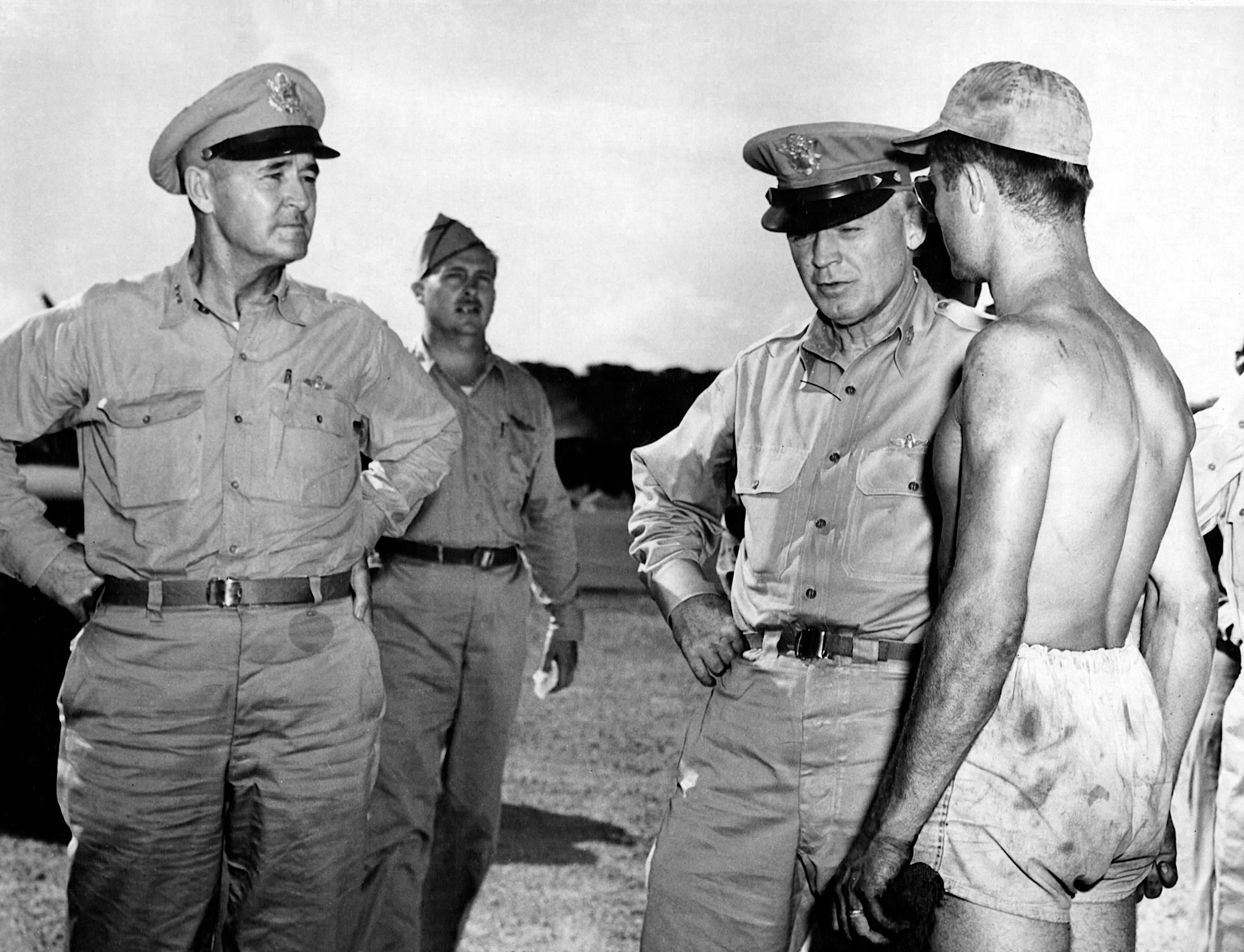
Gen. Barney M. Giles (left) sent a letter to Edward Mulqueen thanking him for donating a knife to the war effort. Here, he and Gen. Henry H. “Hap” Arnold speak with S/Sgt. Leo Fliess of Sturtevant, Wis., on Guam in 1945. (Army Air Force Photo)
Giles was not just some Army bureaucrat. He was commanding general of the U.S. Army Air Force in the Pacific, who later became deputy commander of the entire U.S. Army Air Force. Giles worked alongside legendary war heroes, including Adm. Chester Nimitz,Lt. Gen. James Doolittle and Gen. Henry H. “Hap” Arnold. He closed his letter to Mulqueen this way: “This much I know. With your gift goes another weapon that will certainly do much to help our boys slap the Japs into a complete and lasting tailspin.”
The next letter, from a U.S. Army Air Force officer in February 1943, was especially meaningful to Eddie. “He wished he had a hundred, yes even a thousand knives to donate,” read an article in the Cudahy Reminder/Enterprise. “His knife was seeing action and was being useful to one of our service men fighting in the Pacific.”
U.S. Army Air Force Cpl. Lucas R. Boyson wrote to thank Eddie Mulqueen for the donated knife in February 1943.
Stationed in the Fiji Islands, Cpl. Lucas R. Boyson was glad to receive the knife sent all the way from Wisconsin. Boyson, 29, was even more impressed that an elementary school student was behind the donation. “I was fortunate to receive your knife and to say it was a treat would be to put it mildly,” Boyson wrote in a letter to Mulqueen on February 14, 1943. “It is grand to cut stalks of sugar cane or bamboo sticks and for that matter general miscellaneous uses. I shall carry it with me always and each time I use it, I’ll whisper a ‘thanks to Eddie.’ ”
A married enlistee from Elyria, Ohio, Boyson was serving with the 375th Air Base Squadron, part of the U.S. Army air corps. He was among the first wave of men from Lorain County, Ohio to volunteer for service in January 1941. He wrote to Eddie that the natives on the islands were impressed with the knife, compared with the “hand-pounded, crude machetes they carry with them in the jungles.”
We don’t know if Boyson ever used the knife in combat, but we do know he survived the war and returned to Ohio, where he lived an exemplary life of faith and public service. On February 28, 1946, Lucas and WilhelminaBoyson welcomed a baby daughter, Mina. Lucas was an attorney who became actively involved with his American Legion post, St. Jude Catholic Church and a variety of civic groups and causes. At one time he headed the Lorain County Bar Association. He was also a Fourth Degree member of the Knights of Columbus, a group with a special focus on patriotism. Boyson died on December 5, 1992 at age 78.
Inspired by the wartime service of three brothers and one sister, Eddie joined the U.S. Navy and served during the Korean War. After the war, he got married and started a job at Wisconsin Electric Power Co. He was an electrician for many years. Eddie and his wife Marie had three children. The couple later moved to Michigan, where Eddie died in August 1991 at age 60.
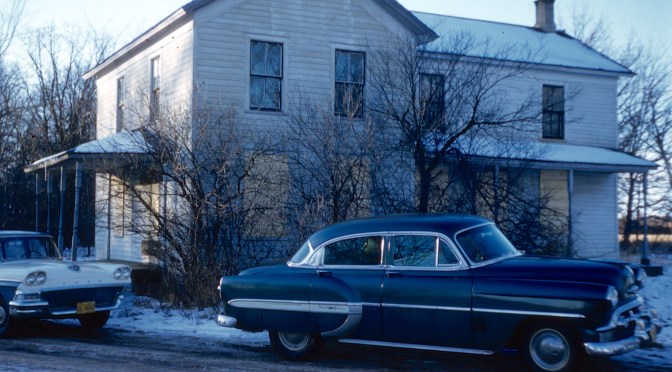
While scanning my grandfather’s old slide collection, I came across two stray images from 1957 marked “Gein’s House.” I couldn’t get the slides on the scanner bed fast enough. It turns out the photos were indeed of the ramshackle farm house of the notorious killer and grave robber, Ed Gein.
For Carl F. Hanneman, the trip to Plainfield would have been a minor detour on one of the family’s many trips from Mauston to Wisconsin Rapids, Wis. He, like thousands of other Wisconsinites in the late fall of 1957, just had to see for himself the home where the unimaginable occurred from 1945 to 1957. For in that decrepit structure at the corner of Acher and 2nd avenues a few miles southwest of Plainfield, the handyman bachelor Gein committed unspeakable acts.
The boarded-up house of Plainfield handyman Ed Gein, who robbed nearby graves and made macabre souvenirs from the stolen remains. The house was burned to the ground by an arsonist in March 1958. (Carl F. Hanneman photo)
The day of Gein’s undoing came on November 16, 1957, the opening day of the gun deer hunting season in Wisconsin. Gein made the trip into Plainfield to buy some anti-freeze at Worden’s hardware store. While there, he took a .22-caliber rifle from the store display and shot to death the owner, Bernice Worden, 58. After slitting her throat, he dragged her body out the back and put it into a truck. Later that day, sheriff’s deputies from several counties were searching for Worden, a well-known local who had run the Plainfield hardware store since her husband’s death in 1931.
Gein’s car had been spotted in the village that day, so police twice stopped at his 160-acre farmstead to talk to him. He wasn’t home. On the second trip, Waushara County Sheriff Arthur Schley peered into a shed that Gein used as a summer kitchen and was shocked. “My God, there she is!” he shouted. There was the body of Worden, hung upside down by the ankles, gutted and dressed out like a deer ready for the butcher. “There was a body hanging in the woodshed by the ankles,” said Captain Lloyd Schoephoester of the nearby Green Lake County sheriff’s department. “Tendons in the ankles had been cut and a rod and been placed through them. The body was drawn up in the air by a block and tackle. The body was dressed out and the head was missing.” Sheriff Schley went outside and vomited.
Police found the remains of nearly a dozen women in Ed Gein’s farmhouse near the village of Plainfield, Wis.Worden’s head was later found in a burlap sack nearby. Her internal organs were in a bucket. If that sight wasn’t enough to sicken responding police, a search of Gein’s home would put them over the edge. Inside the filthy and cluttered home they found five human heads wrapped in plastic bags, four skulls and 10 “death masks” made by removing the face and hair from a human head. “Some of them have lipstick on and look perfectly natural,” said Wood County sheriff’s deputy Dave Sharkey. “It you knew them, you’d be able to recognize them.”
There was more. Police found chairs and lampshades fashioned from human skin, four human noses, two sets of lips, a belt made of female nipples, and a collection of female genitals. Two of the vulvas in Gein’s collection belonged to teenage girls, and authorities concluded he likely murdered these girls. On the stove was a saucepan containing a human heart, later identified as belonging to Worden. There was a wastebasket made from skin, and skulls fastened to Gein’s bedposts. Bowls were made from the tops of human skulls.
At first, police thought they might be dealing with a prolific serial killer. After his arrest, Gein admitted killing Bernice Worden, but he said the grotesque artifacts in his home were from grave-robbing visits he made to the nearby Plainfield Cemetery, the Spiritland Cemetery in Portage County and the Hancock Cemetery in the Town of Hancock. Gein also admitted shooting and killing Portage County tavern keeper Mary Hogan on December 8, 1954. Her face was found among Gein’s collection of death masks.
Police were not initially inclined to believe Gein’s tales of grave robbing. On November 25, 1957, they exhumed the caskets of Eleanor Adams and Mabel Everson at Plainfield Cemetery. Both caskets were empty. In the soil above one casket they found dentures and a wedding ring. That was enough to convince police that Gein was indeed a grave robber. He told authorities he made the moonlight grave-robbing visits while in a daze. On some occasions, he awoke from the daze and stopped what he was doing. He said his grave robbing occurred between 1947 and 1952. He said he returned some bodies to their graves after experiencing remorse. Police did not dig up other graves, and ultimately don’t know just how many caskets Gein might have opened.
When interviewed by Wisconsin State Crime Lab officials, Gein said he would dress up with the women’s body parts. He would wear a death mask, a tanned skin shirt including women’s breasts, and a vagina placed over his own genitals, covered by a pair of panties. He would go out in the moonlight and prance about the farmyard in this sick getup. Although Gein was not a deer hunter, he was known to have given packages of “venison” to people in the community, who became sickened after Gein’s arrest at their unwitting cannibalism. Authorities became convinced that Gein practiced cannibalism, among his other grotesque crimes.
After a brief court hearing in January 1958, Gein was committed to the Wisconsin Central State Hospital for the criminally insane at Waupun, where he remained for 10 years. In early 1968, Circuit Court Judge Robert H. Gollmar ruled Gein was able to stand trial for the murder of Bernice Worden. In a November 1968 bench trial, Gein was convicted of first-degree murder for Worden’s death, but in a separate hearing found not guilty by reason of insanity. He was sent back to Waupun. He later was moved to the Mendota Mental Health Institute in Madison, where he died of cancer on July 26, 1984. He was buried next to his mother in the same Plainfield Cemetery that he plundered.
Gein suffered from schizophrenia. The death of his mother on December 29, 1945 apparently pushed him over the edge. Doctors said he had an unnatural Oedipus complex attachment to Augusta Gein. The women he killed and the graves he robbed represented substitutes for his mother. The women were plump and middle aged, doctors said. Gein had nursed his mother through two paralytic strokes. Gein’s father George died on April 1, 1940. His brother Henry was found dead after a marsh fire on the Gein property on May 16, 1944. It is widely believed that Gein killed his brother.
Based on the Worden convinction and Gein’s admission to killing Mary Hogan, Gein could not be considered a serial killer. But he was suspected of killing at least four other people. The teenage genitals found in his farmhouse might have belonged to Evelyn Hartley, 15, of La Crosse, and Georgia Jean Weckler, 8, of Fort Atkinson. Hartley disappeared in October 1953 and Weckler was abducted in May 1947. Neither crime was ever solved and the girls’ bodies were never found. In his 1982 book on the Gein case, Judge Gollmar wrote that if Gein did not kill these girls, then the abducted and killed two runaways, since his grave-robbing could not explain the presence of genitals belonging to young girls in Gein’s home. Gollmar also wrote that Gein might have killed two men who disappeared after visiting a Plainfield tavern. The disappearances of Victor Travis and a male companion were never solved. Travis’ jacket and his dog were found near the Gein farm, and neighbors noted a stench coming from Gein’s garden at the time.
Gein’s gruesome story created a cottage industry in macabre spinoffs. It was the inspiration for the book Psycho by Robert Bloch. The book was adapted into the 1960 Alfred Hitchcock film of the same name. Gein was said to be the inspiration for fictional characters in films including The Texas Chain Saw Massacre and Silence of the Lambs.
The Hanneman family has one link to Plainfield other than the photos of Gein’s house snapped by Carl Hanneman. Lisetta (Treutel) Moody (1861-1931), aunt of Ruby Hanneman, moved her family to Plainfield after living in Vesper in Wood County. She and her husband, Lewis Winfield Moody, are buried at Plainfield Cemetery. She testified at the trial of Frank Hinz after the 1902 shootout between the Moody and Hinz families.
This post has been updated with details from the 1982 book on Gein by Circuit Judge Robert H. Gollmar. The book, Edward Gein: America’s Most Bizarre Murderer, is a fascinating insider’s account of the Gein case.
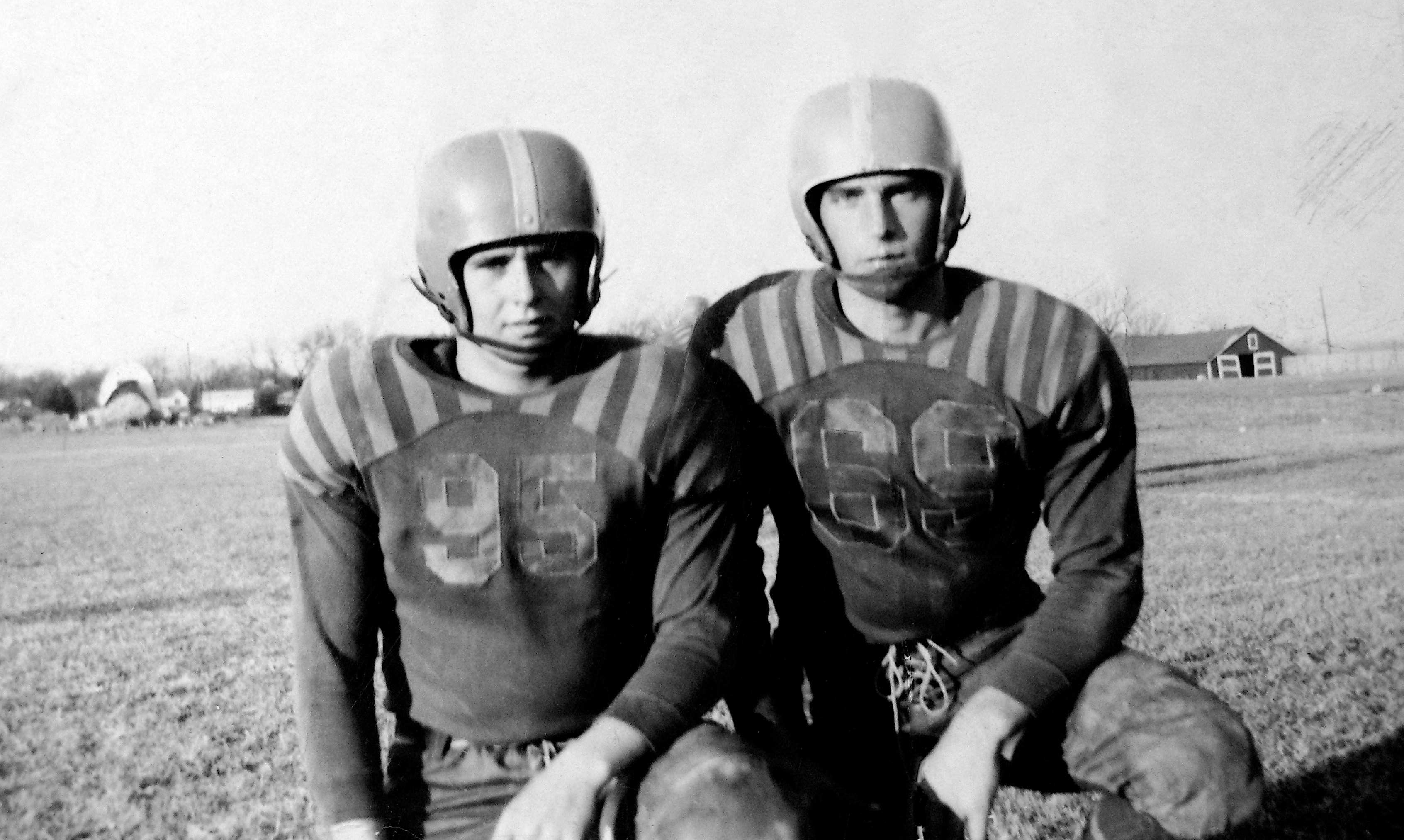
The 1947 football campaign was destined to be one for the ages at Mauston High School. The photo gallery below could be from that championship season, based on the youthful appearance of my Dad, David D. Hanneman (1933-2007). Dad was a starter for the Mauston Bluegold, even in his freshman year.
David D. Hanneman (center) played tackle, guard and on occasion, running back, for Mauston High School during the 1947-50 football seasons.
Dad played guard and tackle throughout his high school football career. But as is the case on small-town football teams, boys play both offense and defense. Many of the players would switch positions, depending on the opponent and game conditions.
Mauston ran up a 7-1 record in the 1947 football campaign, gaining them a share of the West Central Conference championship crown. Mauston was 3-1 in conference play. Midway through the season, Mauston ranked as one of the state’s highest-scoring teams. Here’s the 1947 season recap:
Sept. 12 Mauston 12, Reesdburg 0
Sept. 19 Mauston 25, Middleton 6
Sept. 26, Mauston 20, New Lisbon 12
Oct. 3, Mauston 13, Tomah 0
Oct. 10, Mauston 45, Westby 6
Oct. 17 Sparta 14, Mauston 7
Oct. 24 Mauston 37, New Lisbon 0
Nov. 1 Mauston 13, Viroqua 0
Dave Hanneman (at right) in one of his early years in Mauston football.
Bob “Jigger” Jagoe, who played quarterback for Mauston starting in the 1948 season, recalls how Dave’s mother, Ruby V. Hanneman, was zealous in her cheering.
You could hear her in the stands, shouting. She was so proud. Of course we used to kind of make a mockery of it, because she was so adamant, letting everybody know who her son was out there who made the tackle. They announced, ‘Tackle made by Dave Hanneman’ and she said, ‘That’s my Davey!’
In the 1950s, home football games were played at Veterans Memorial Park on the south end of Mauston. This locale looks much closer to downtown, so I’m betting these 1940s games were played in Riverside Park along the Lemonweir River. In several of the photos you can see the distant spire of St. Patrick’s Catholic Church.
— This post has been updated with quotes and other information.
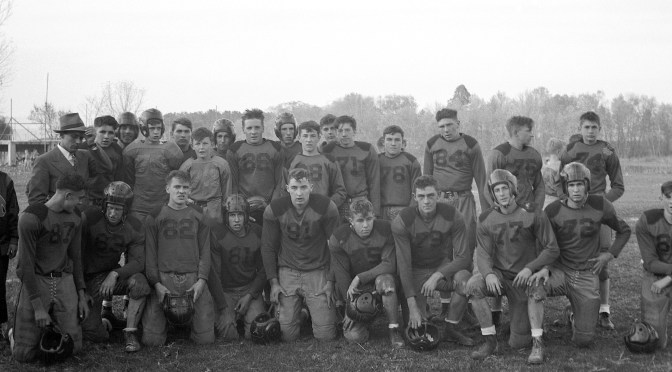
Dave Hanneman can be seen in the last row at left, second in from Coach McKenzie. Bob Jagoe is on his left. Front and center (91) is Dick Hale.
Mauston coach Doug McKenzie and players follow the on-field action.
A great view of the crowd at Riverside Park in Mauston.
It’s not clear if this galloping ghost is David D. Hanneman. He usually played at the line.
The Mauston Bluegold huddle before the play.
This appears to be a victory celebration.
Game action from this 1947 football contest at Mauston.
A good look at the spectators at Riverside Park. Recognize anyone?
Game action from this 1947 football contest at Mauston.
Dad’s conference crown medal from the 1947 championship season.
Another group shot of the team. On this one, Dave Hanneman (back row left, second from coach) has his tongue sticking out. Front and center (91) is Dick Hale.
A U.S. Navy recruit, probably a graduate of Mauston High School, watches the action.
A Mauston game program from September 1950. Note the team plays at Veterans Park instead of Riverside as in earlier years.
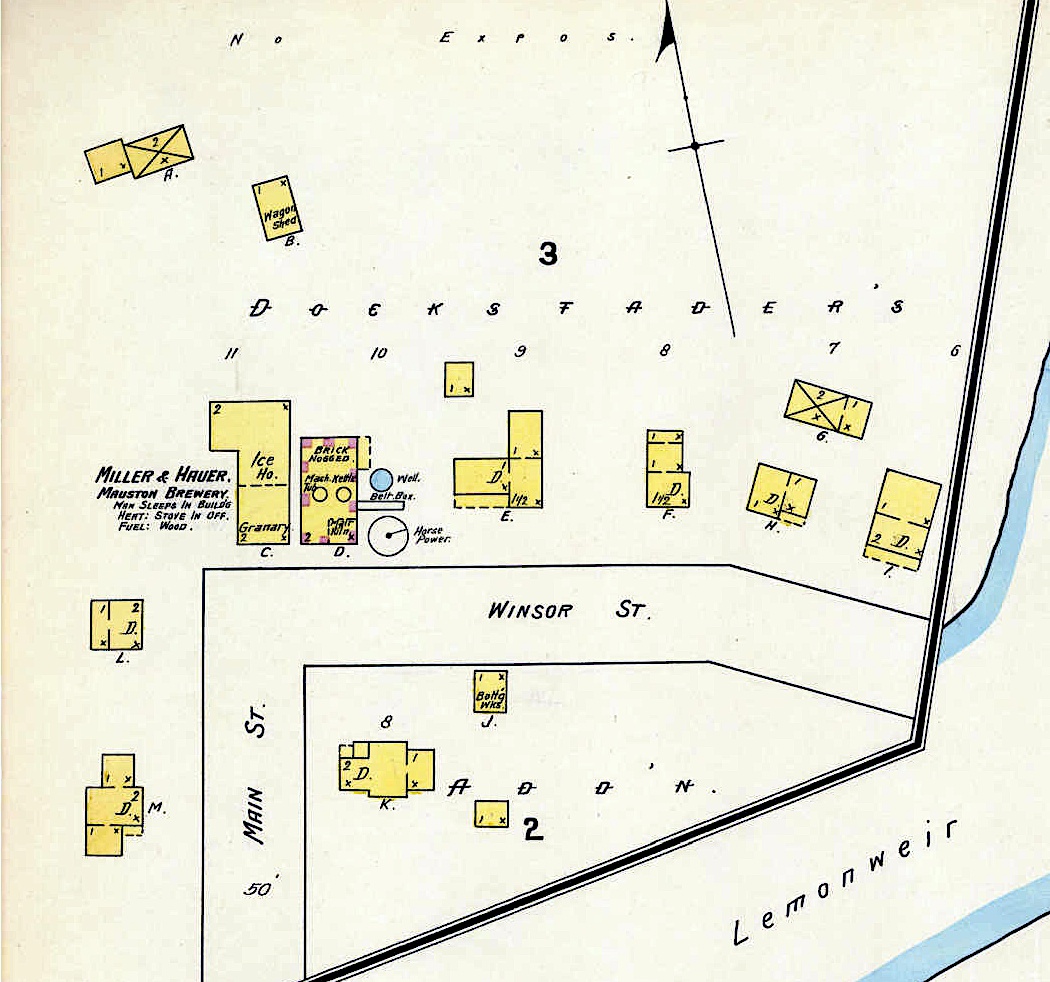
Newly digitized Sanborn Fire Insurance maps of Mauston, Wisconsin, provide more detail of the sprawling Mauston Brewery complex that once covered much of the land at the corner of Morris and Winsor streets along the Lemonweir River.
We previously wrote about the Mauston Brewery as detailed in a book by Mauston native Richard D. Rossin Jr. The Wisconsin Historical Society recently digitized hundreds of maps from the Sanborn Map Company that show intricate detail of the brewery complex. “Sanborn Fire Insurance maps are meticulously detailed, large-scale lithographed, color-keyed street maps,” the Wisconsin Historical Society wrote on its web site. “Sanborn Maps helped insurance agents in the late 19th and early 20th centuries determine the degree of fire hazard associated with a particular property.”
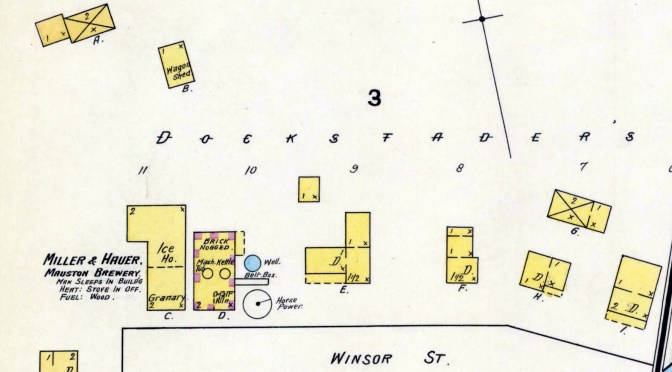
The 1894 fire map shows two Mauston Brewery buildings near the home at 22 Morris.
The old Hanneman home at 22 Morris Street was built around 1893 by Charles F. Miller, owner of the Mauston Brewery. Many of the details he put in the home — stained glass, hand-carved woodwork — remain to this day. The Sanborn maps show that the land around the home once included a bottling works and another out building related to the brewery. It is interesting that Morris Street is incorrectly labeled as Main Street on the 1894 version of the Sanborn map. By 1909, the bottling building near the Miller home was gone.
Across Winsor Street, the map shows a malt kiln, mash kettles, a well, a granary, an ice house and other outbuildings. The map notes that the buildings area heated by a wood stove, and a brewery employee sleeps in the building. The 1909 version of the Sanborn map shows addition of a second ice house on the shore of the Lemonweir River. Brewery workers cut ice blocks on the river in the winter, then moved them on a slide to the ice house.
The 1909 version of the map shows a second ice house near the river.
Charles Miller died in 1907, ending that family’s involvement in the brewery. Charles Ellison continued operating the brewery. By 1916, the brewery had ceased operation, according to Rossin’s book. A pickle factory started operation on the property, but it burned to the ground in 1922. Dr. J. Samuel Hess Jr. bought the land and built a brick ranch home in 1928.
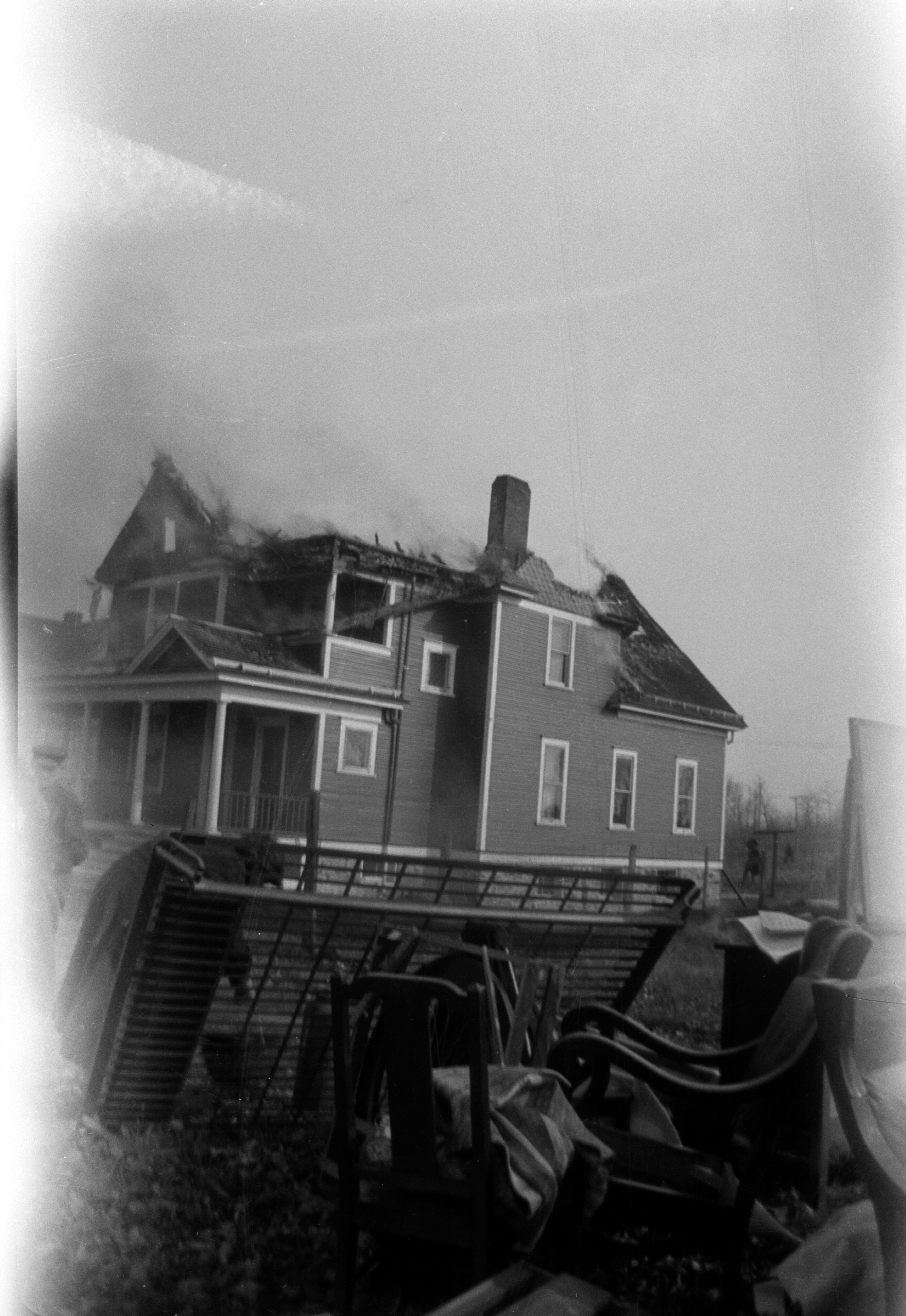
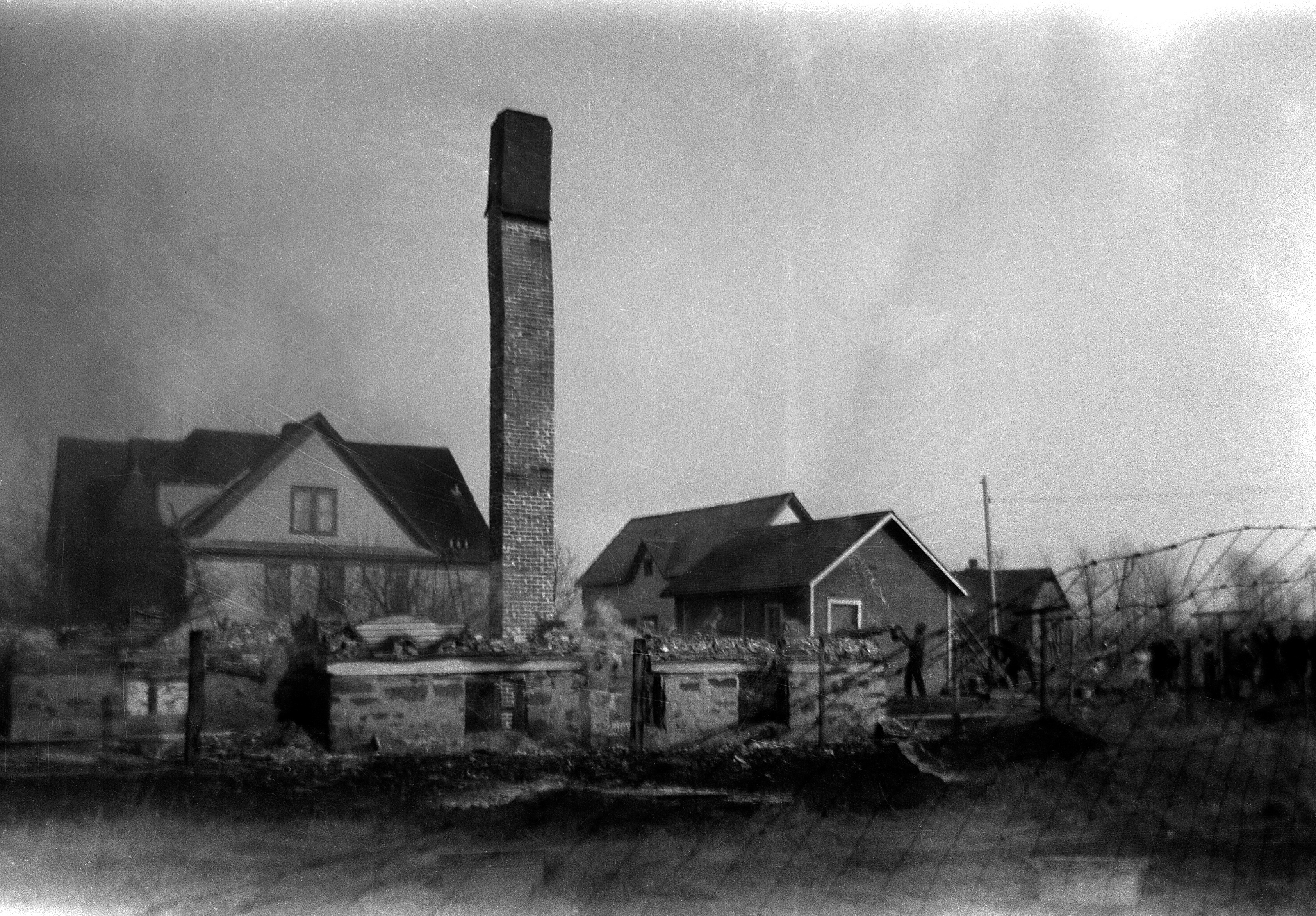
A fire in April 1926 at the parish priest’s residence in Vesper, Wisconsin, spread so fast that the building was reduced to its foundation before firefighters arrived.
Rev. Charles W. Gille
Fire broke out in the rectory of St. James Catholic Church on Monday, April 19, 1926. Calls went to the Wisconsin Rapids fire department, but its firemen were all out battling grass fires. Villagers were on their own.
Belongings from the burning home can be seen in the foreground.
Neighbors rushed into the burning building to pull out as much as possible before the home was lost to the flames. It’s not known if the parish priest, Rev. Charles W. Gille, was at home when the fire broke out. Within a matter of minutes, the home was, as firefighters say, “totally involved.” The buckets of water thrown at it were of no use. By the time firemen from Marshfield arrived, it was too late.
As the fire reduces the home to its foundation, a man is seen tossing water on the roof of a nearby building.
The former residence of the Henry Stahl family on Benson Avenue was purchased by the St. James parish in 1919 to serve as a home for the parish priest. The loss from the fire was estimated at more than $4,000. The photos were taken by Carl F. Hanneman, whose father-in-law, Walter Treutel, lived just down the block from the fire scene.
This double exposure appears to show a man walking through the remains of the fire.
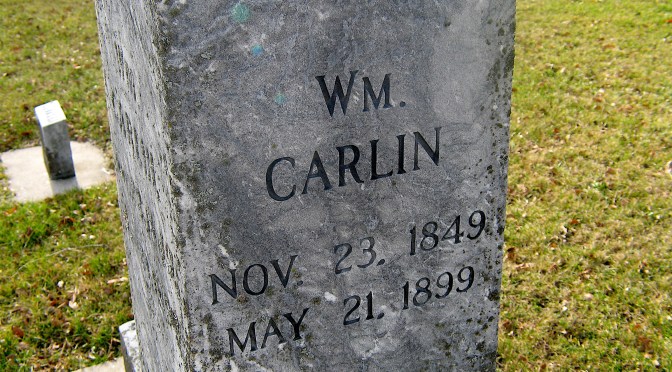
Society’s obsession with weight is not a new phenomenon, but it seems a most curious detail to include in an obituary. William Carlin of the Town of Ottawa in Waukesha County, Wisconsin, suffered such a fate when newspapers made his girth the top fact in his obituary.
“Weighed 385 Pounds,” read the Page 1 headline in the The Waukesha Freeman on May 25, 1899. “Mr. Carlin weighed 385 pounds and was doubtless the heaviest man in the county,” the article said. “His death was caused by fatty degeneration of the heart.” Doubtless. It’s unclear how the newspaper reached such a conclusion. Carlin, who was just 50 when he died, was not part of a circus. He didn’t seek fame as the state’s fattest man. Yet the newspaper deemed his life should boil down to the fact he was heavy. The Weekly Wisconsin newspaper in Milwaukee also found Carlin’s weight newsworthy, but relegated it to Page 5.
The Waukesha Freeman carried the death of William Carlin on Page 1 in May 1899.
So history won’t remember him only for his body size, we’ll shed some more light on the life of William Carlin. Born November 23, 1849 in the Town of Ottawa, he was the son of Christopher Carlin and the former Elizabeth Cobb. Christopher Carlin died at age 37 in June 1858, when William was 8 years old. The Carlins were farmers on land northwest of tiny North Prairie. Christopher Carlin emigrated from England. At one time in the 1890s, William Carlin owned 300 acres of farmland in Waukesha County.
William Carlin married the former Annie Jones, and they had two children. Orville Walter Carlin, husband of Emma (Treutel) Carlin, was born February 5, 1874. Elizabeth J. “Lizzie” Carlin was born in January 1881. Their mother died in May 1889 at the young age of 37. Orville and Lizzie suffered a second tragedy in May 1899 when their father died, as newspapers said, from “fatty degeneration of the heart.” Orville married Emma Treutel and moved to Vesper, Wisconsin, where he operated a butcher shop. He died in 1934 at age 60. Lizzie married Jacob F. Supita. She died in 1944. William’s brother, Thomas Carlin, died in 1903 at age 52, so it seems genetics worked against the Carlin men.
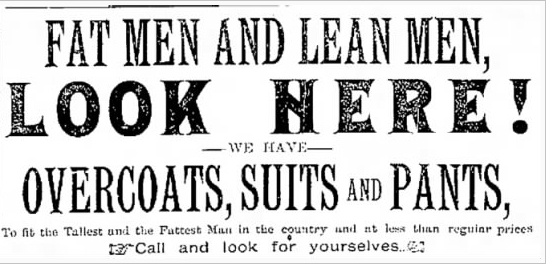
The Waukesha Journal carried this ad in November 1889.
Newspapers have long carried stories about record-setters, be it for height or weight. Often the subject of the stories sought the publicity. But what of those who didn’t? Did La Crosse businessman Samuel P. Welsh approve of his moniker as Wisconsin’s fattest man? When he married Grace Dutzel in June 1911, newspapers across the Midwest carried stories on how he weighed 400 pounds, while his bride “tipped the beam” at just 100 pounds. The Indianapolis News ran a Page 1 wire story on the Welshes arriving in Milwaukee for their honeymoon.
The Green Bay Republican carried this tidbit in December 1843: “The fattest man in the world lives in Connecticut. He is so thick through that he must lie down when he wishes to look tall.”
Dave McGuire of Silver Lake, Wisconsin, posed for a newspaper photograph in May 1921. It ran under the caption, “World’s Fattest? Who Knows?” “Dave McGuire of Silver Lake, Wis., doesn’t belong to a circus, nor does he ever expect to enter one,” one newspaper caption read. “He’s six feet seven inches tall and weighs 744 pounds, but he doesn’t care to go to the trouble of finding out whether he’s the fattest man in the world or not. He’s satisfied with the simple farm life.“
In a state where the one-room schoolhouse was quite the norm in the early 1900s, tiny Vesper, Wis., boasted an impressive two-story brick school building that was the center of learning for area children for decades.
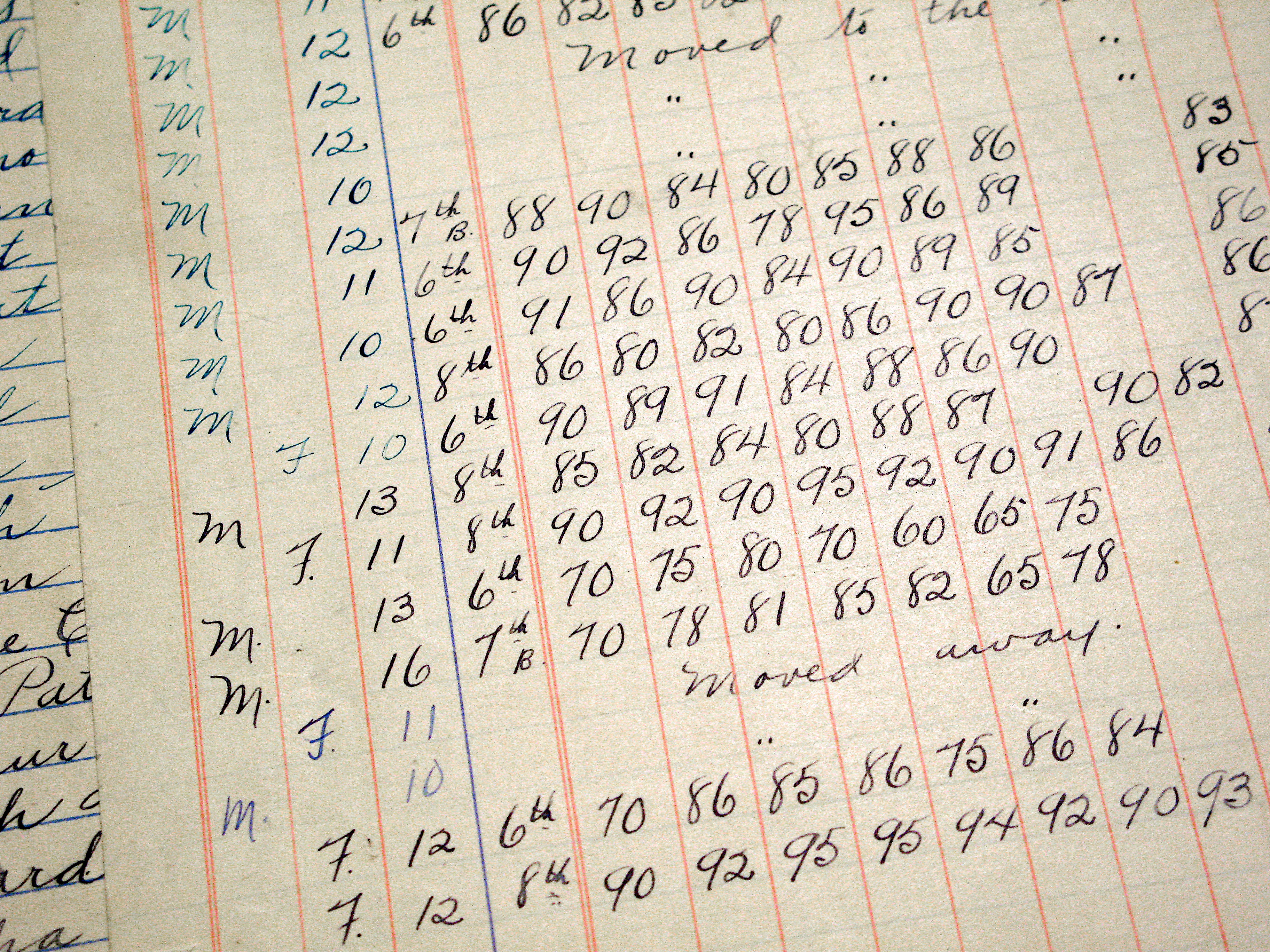
Built in 1906 just off of Main Street in Vesper, the Vesper Graded School was home to students of District No. 1, Town of Hansen. We get an interesting look at life inside the school from a teacher’s record book covering the years 1911-1917. The “Welch’s System Attendance, Classification, Gradation and Close Supervision” book belonged to Ruby (Treutel) Hanneman, who attended Vesper school starting in 1913 and later taught at the school.
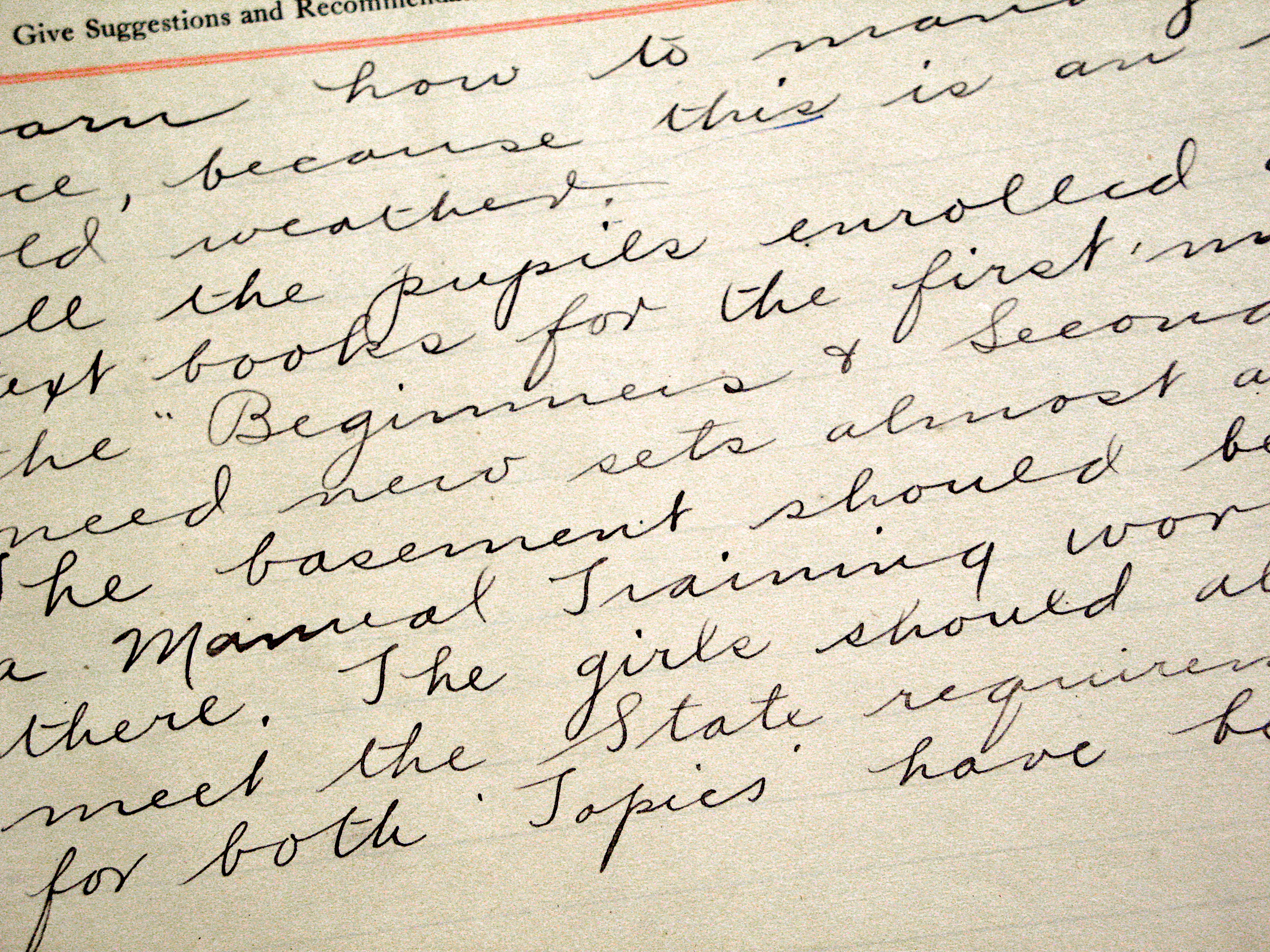
The teacher kept detailed notes on conditions at the school, in addition to records of student performance and attendance.
The detailed notes in the book make one thing very clear: the teacher had her hands full each school year. Not only did one woman handle teaching duties for lower and upper grades, but she had to manage the building and contend with a cranky, bulky coal furnace each winter.
During the years covered in the record book, Vesper had three teachers: Mabelle Rowland in 1911-1912, Ella H. Hessler from 1912-13 to 1914-15, and Sara Icke in 1915-16 and 1916-17. Teachers were paid between $50 and $60 per month. Ruby’s uncle, Henry Treutel, served on the school board in early years (his son Harold attended classes during that time). In the late 1920s, another uncle, Charles Treutel, was also on the board.
It seems the biggest challenge for the teachers was not in the classroom but the furnace room. The coal-fired furnace often belched smoke and gases into the clean-air intake and into the classrooms. “Before you begin school learn how to manage the drafts of furnace and cold air shafts,” wrote Mabelle Rowland in her 1912 “Teacher’s Report to Successor.” “The inspector is very critical on this work.” Teacher Ella Hessler wrote one year later: “The furnace needs repair. The smoke enters the fresh air. The furnace work in cold weather is too heavy for a woman.” Similar notations were made in subsequent years.
Each student’s attendance and academic performance were tracked in detail.
The school typically served from 25 to 40 students per term. Primary grades were on one level and upper grades on the other. The teacher staggered the subjects so she could get lessons started for one group and then move to the other.Classes started at 9 a.m. and students were dismissed for the day at 4 p.m. Course work included arithmetic, history, language, reading, grammar, physiology, domestic science for girls, manual training for boys, civics and geography.
Some of the children walked to school from homes nearby in the village, while others came in from the countryside. Tardiness was common, due to distance walked, duties at home or a pokey walking pace. In 1911-1912, Alfred and Agnes Peterson were the brother-sister tardiness champs with 20 and 17 instances, respectively. Clara Zieher had 18 tardy notations, followed by Erma Dassow with 15 (her brother Elmer had just 4). Absence from school was also common due to illness or duties helping at home. On occasion a student or two left school for a month or two to perform farm work. Arnold Conklin had best attendance in 1911-1912, only missing one day out of 180.
Absences were common from illness or need to stay home and work on farm chores.
The book tracked each student’s attendance and progress on a range of subjects. Teachers made notations for some students that ranged from “fair worker,’“weak eyes” and “slow” to “hard worker,” “irregular and very nervous,” and “dull.”
In the 1911-1912 school year, the school library had a mere 50 volumes. The school invested in books each year, and by June 1917 the library’s holdings included 144 books. For obvious reasons, the boys’ and girls’ out buildings regularly needed repairs and painting. The number of trees on school grounds that were in “thrifty condition” ranged from four to seven.
Ruby Treutel enrolled at Vesper Graded School in November 1913, when she was 10. There was some indication she had attended a parochial school prior to that. During her first year, Ruby missed 21.5 days and was tardy six times. Her cousin Harold Treutel had a mere three sick days. Ruby received good grades for the term: orthography, 91; reading, 95; writing, 90; arithmetic, 70; grammar, 89; geography, 83; and constitutions, 90. During the 1914-1915 school year, Ruby was out sick 20 days, but she still maintained As and Bs in all of her subjects.
The teacher’s annual summary provides interesting detail on all conditions at the school.
During the 1915-1916 term, Ruby excelled in all of her courses, scoring solid ‘A’s in orthography, reading, grammar, U.S. history and physiology. Her lowest grade was a ‘B’ in geography and arithmetic.
Harold Treutel graduated from Vesper Graded School in 1917 and enrolled at Lincoln High School in Grand Rapids.Ruby graduated from Vesper in 1918, also enrolling at Lincoln High School. That may be where she first met Carl F. Hanneman, whom she would marry in July 1925.
The old Vesper Graded School is now a private home, shown here in 2006.

















 The Hanneman Archive