They always said it playfully, like it was the best inside joke.
My Dad (1933-2007) and his brother Donn (1926-2014) used to sometimes refer to their pops as “Heinie-Frantz.” I recall an occasion or two they said it directly to him. I don’t think he minded. Maybe his own parents used the pet name.
I was reminded of this nickname recently as my grandfather Carl’s 123rd birthday came and went on the late October 2024 calendar.
Heinie-Frantz almost didn’t have a birthday. Or at least not one he could prove back in 1946 when he needed to.
The David D. Hanneman family with Dad’s parents, Ruby and Carl, on their 50th wedding anniversary, July 14, 1975.
As we documented elsewhere on this site, Carl Henry Frank Hanneman wrote to the Wood County (Wis.) register of deeds on Feb. 22, 1946, asking for a copy of his Oct. 28, 1901 birth certificate.
Register of Deeds Henry Ebbe wrote back to say there was no birth certificate on file. He returned Grandpa’s 50 cents.
There was a record for a Ruben Hanneman born a week earlier. To the same parents, Chas. and Rosine Hannemann. Well, there’s your problem. A week off with the wrong name.
Heinie-Frantz went on a mad scramble to find evidence of his birth. He found an indirect record in the Moravian Church of Wisconsin Rapids. The 1910 U.S. Census incorrectly listed his name as “Harold.”
Wood County Health Officer Frank Pomainville finally fixed the record in 1960, crossing out the errors in red ink and writing in the correct information.
I’m so glad Mr. Pomainville corrected this small but important piece of history.
Cover images: Inset photos show Carl “Heinie-Frantz” Hanneman after a fishing outing in the late 1950s, Carl as a toddler in the early 1900s, and on a fishing expedition with son David in 1942.
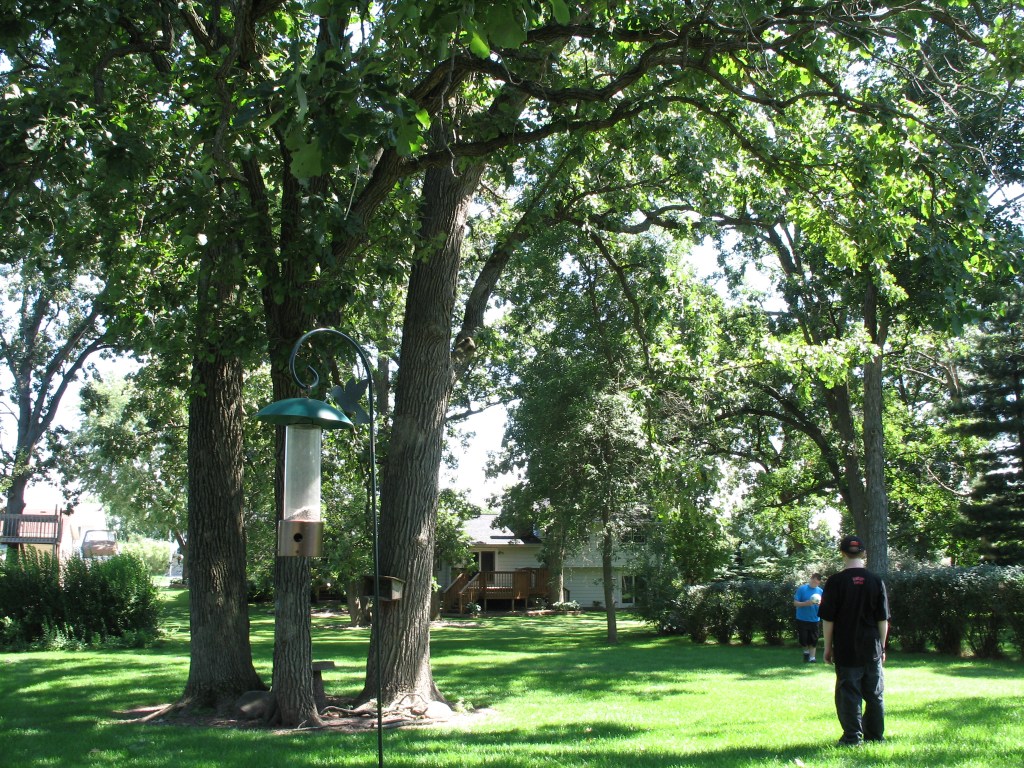
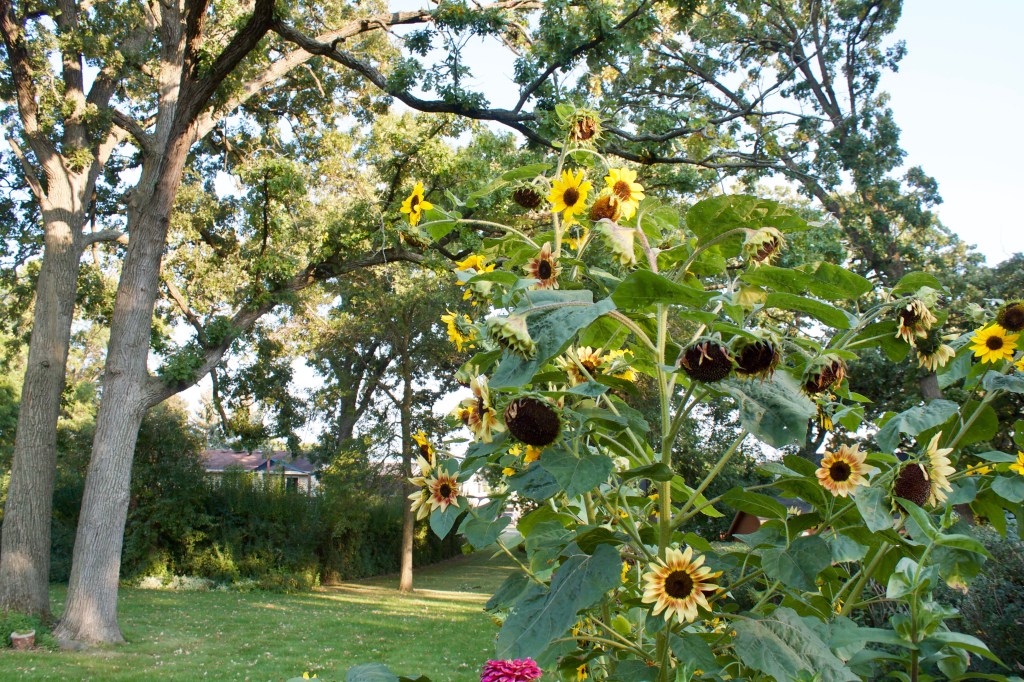
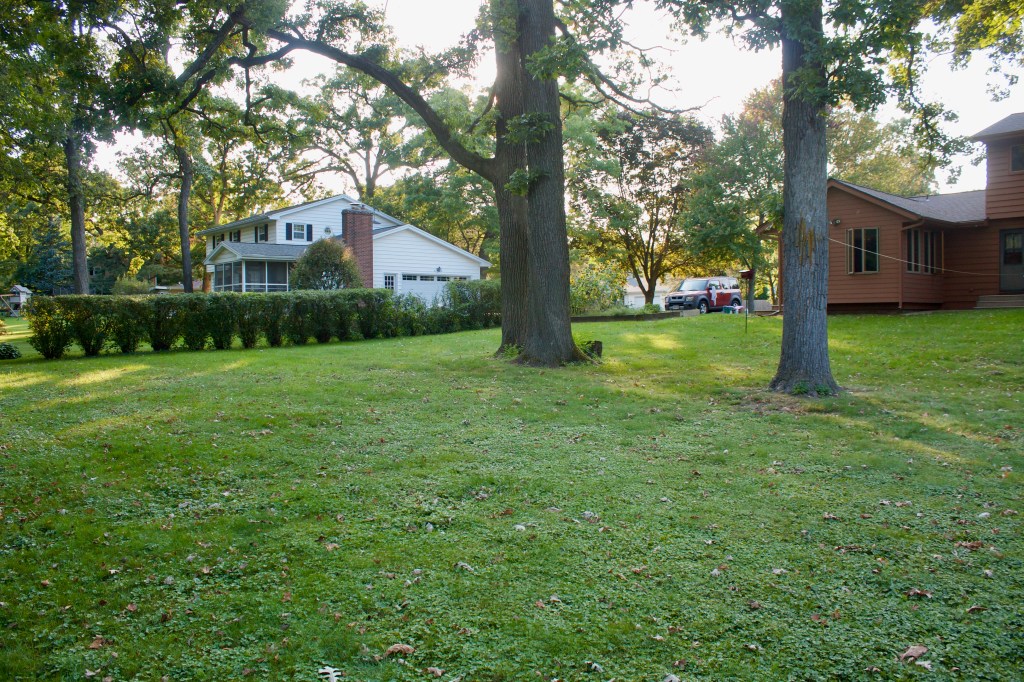
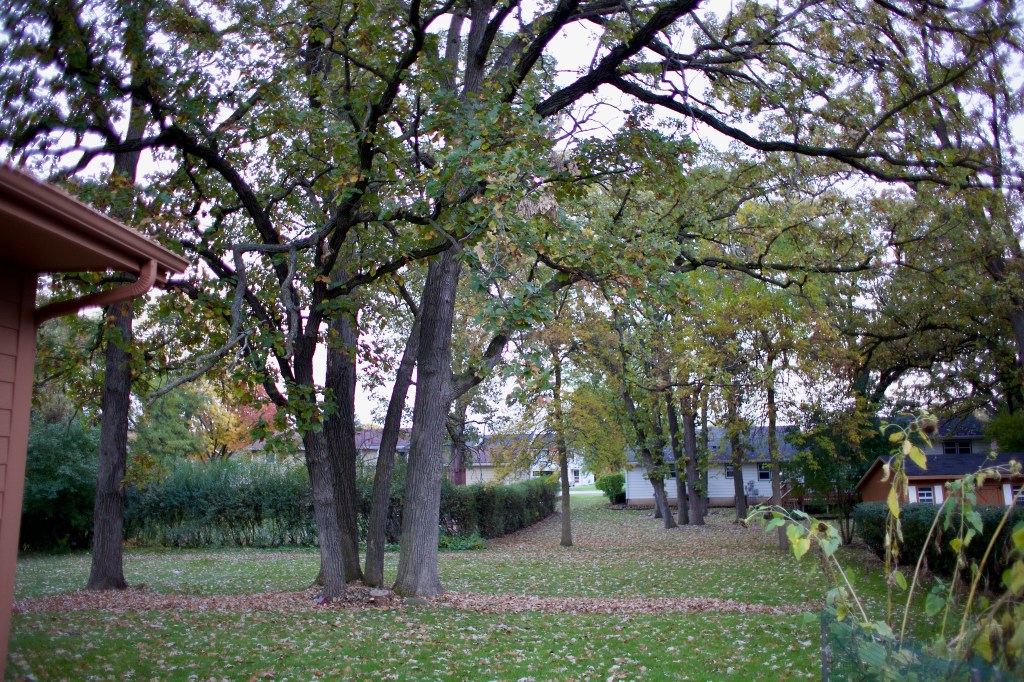
I was fortunate growing up to have a large backyard to play in, covered by a canopy of mature oak trees. In the earliest days in our family home (1965-1975), you could walk into the backyard and stroll right into an oak forest untouched by encroaching residential development.
Some of my earliest memories in this wooded wonderland were of summer days when I would take a bedroom pillow, lay down on the grass, and peer up at the giant, leafy limbs swaying in the breeze. I can still hear the whispers of the trees as they gestured, bowed, and danced at the insistence of the summer winds.
I was convinced as a child if I could punt a football high enough to hit those lofty branches, I could try out as a punter for the Green Bay Packers. I never got the chance. Then again, I never kicked the football high enough to bounce off the branches.
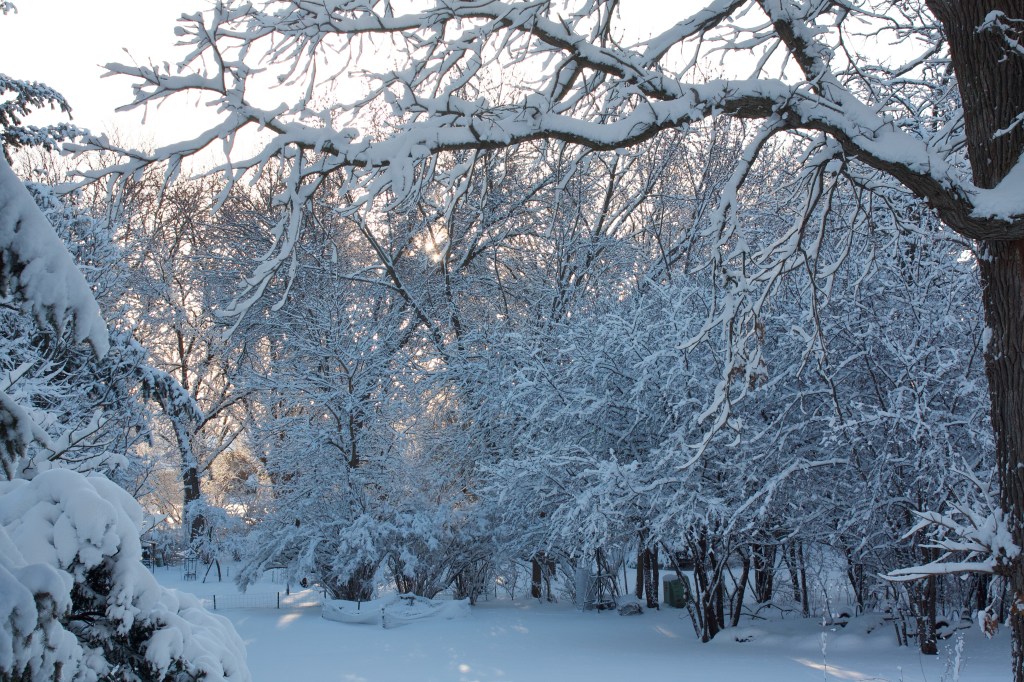
We lost quite a few of the original 17 oak trees over the decades, but the backyard still looked resplendent in 2017.
A prominent feature of the property was a limestone patio built into the hill on the north side of the lawn. My Dad built a curved wall out of flat limestone rocks, which also paved the patio floor and served as steps up to the sidewalk that led into the house.
There were small gaps between the rocks on the patio floor. They sprouted weeds every year. We hated being assigned the task to pull weeds in the patio. After picking up the detritus, we had to use a whisk broom to carefully guide the pebbles back into place between the rocks.
At the picnic table on the rock patio, circa 1971.
The ground just beyond the asphalt driveway was home to numerous garden plots over the years. In the 1970s when the economy hit the skids, we had a serious garden stocked with green and yellow beans, green peppers, strawberries, onions, cucumbers, and tomatoes. From those harvests came pickles, strawberry jam, and vegetables for the dinner table.
Land farthest to the west had a couple of buried boulders that peeked out from the ground just enough to make perfect bases for a very tight baseball field. We never dug them up. Perhaps they still serve as bases for another generation of children.
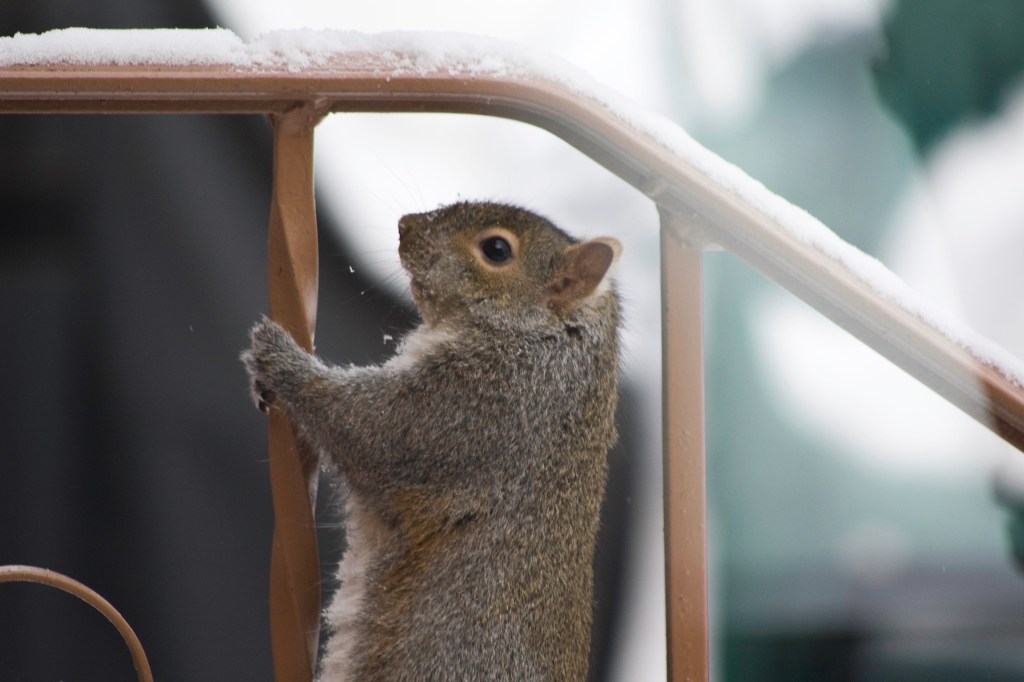
The backyard was host to a wealth of critters from chipmunks and gophers to field mice, occasional deer, and even a snapping turtle. I don’t know if we ever figured out how a large snapping turtle found its way up to the house. A friend of Mom and Dad came over from Carriage Hills and captured the creature. I recall some comments about turtle soup. I did not want to think about that.
The large oak trees needed occasional maintenance. In the 1970s we had one of the worst ice storms ever seen in this part of Wisconsin. The house was without power for three days. My Dad was stranded someplace and could not get home. The eerie calm outside was often interrupted by the sickening crack of a branch giving way under the weight of the ice.
An ice storm for the record books struck Wisconsin in early March 1976.
Later that year I distinctly remember Dad pruning some of the large, dead branches using a rope thrown from below. He attached a fairly hefty rock to a heavy-gauge rope, then swung it like David when he felled Goliath. Up the rock went, the rope wrapped around the branch and Dad pulled the dead weight down.
Dad wore a white terry cloth sweatband on his head. It’s funny the details that stick with me so many years later. That’s how I saw my father while growing up. Slaying the biggest problems, seemingly unafraid of the size or complexity of the task at hand.
For decades we had a “bird feeder” that was in reality a squirrel feeder. It was a wooden box nailed to perhaps the largest oak tree on the property. Sometimes we had bird food to put in it, but more often we were sent out with stale bread.
The backyard was home to improvised ice rinks during a few winters. In the early years, we could peer through the woods all the way to the corner of Wisconsin Avenue and Broadway Drive. At the time it was an empty lot. The city would come and open the fire hydrant to flood the lot and make a perfect ice rink.
I don’t know which shocked me more: Dad zooming around the perimeter of the rink in speed skates, or Mom showing some unexpected skill on her white figure skates. I have an image in my mind of us all skating on that rink under nothing but moonlight. I’m not sure if that ever happened, but that’s how I remember it.
Those skates, like the memories they held, got tucked into boxes in the basement. More than 50 years later, the skates, winter clothes, the house, and the frozen empty lot are all gone.
Yet the images in my mind remain.
The biggest challenge that came with such a wooded lot was the blizzard of leaves that laid down a thick carpet every October and November. A half-acre of fall leaves usually required four to six able-bodied souls armed with bamboo rakes.
Some years we all raked the bounty into a massive pile, then spent an hour romping through the leaf mountain. That practice was eventually abandoned when we had golden retrievers, whose golden nuggets inevitably got mixed in with the leaves.
Our backyard “hill” wasn’t huge, but we always made the most of it for winter fun, circa 1974
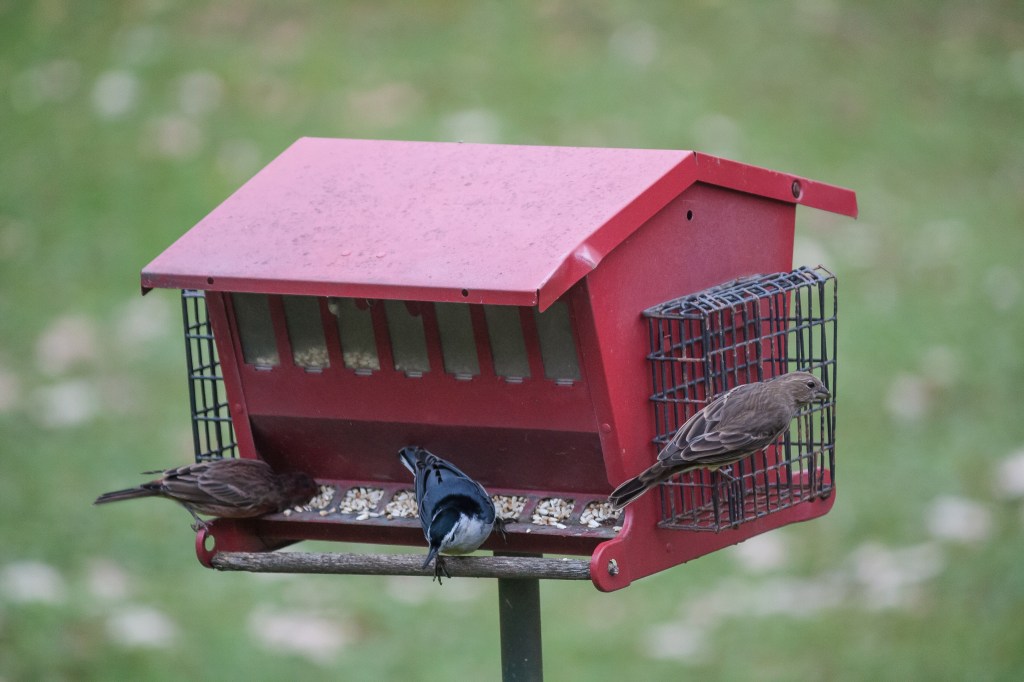
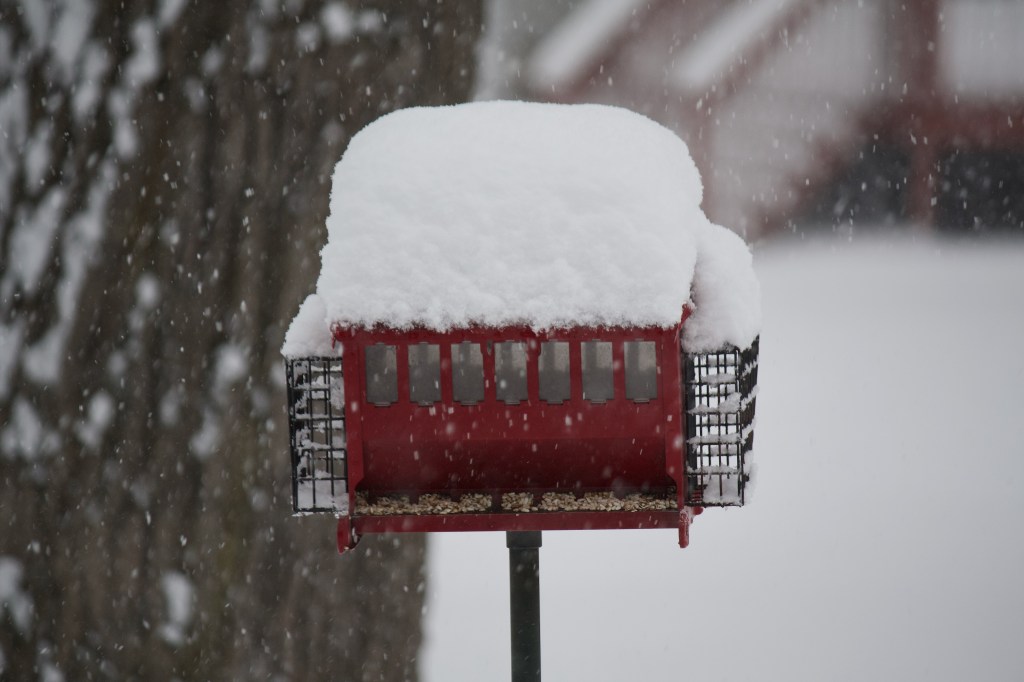
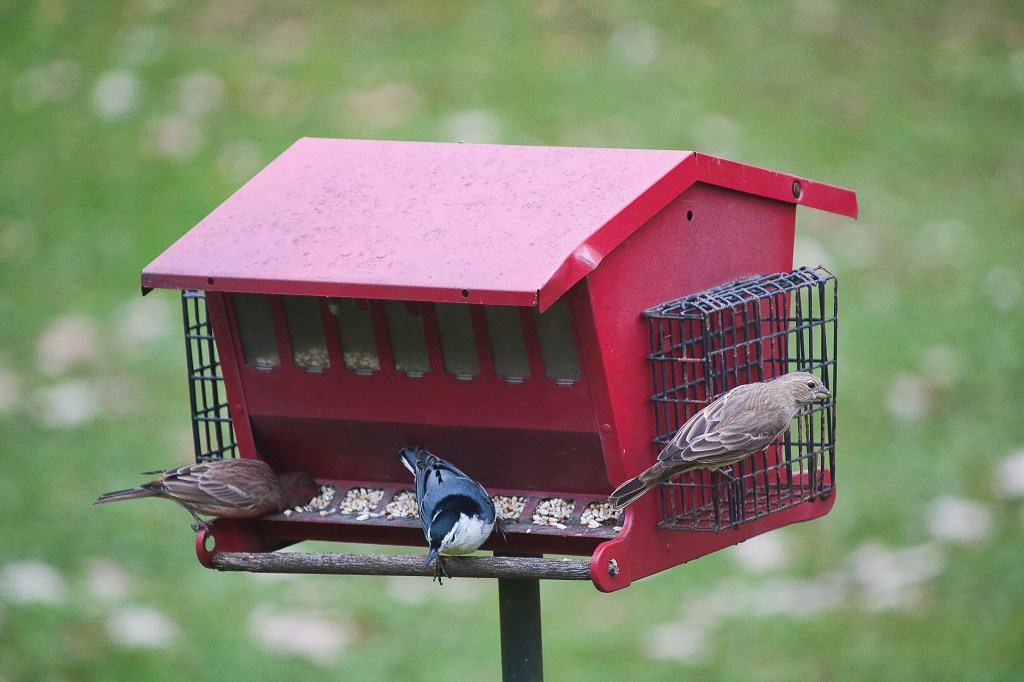
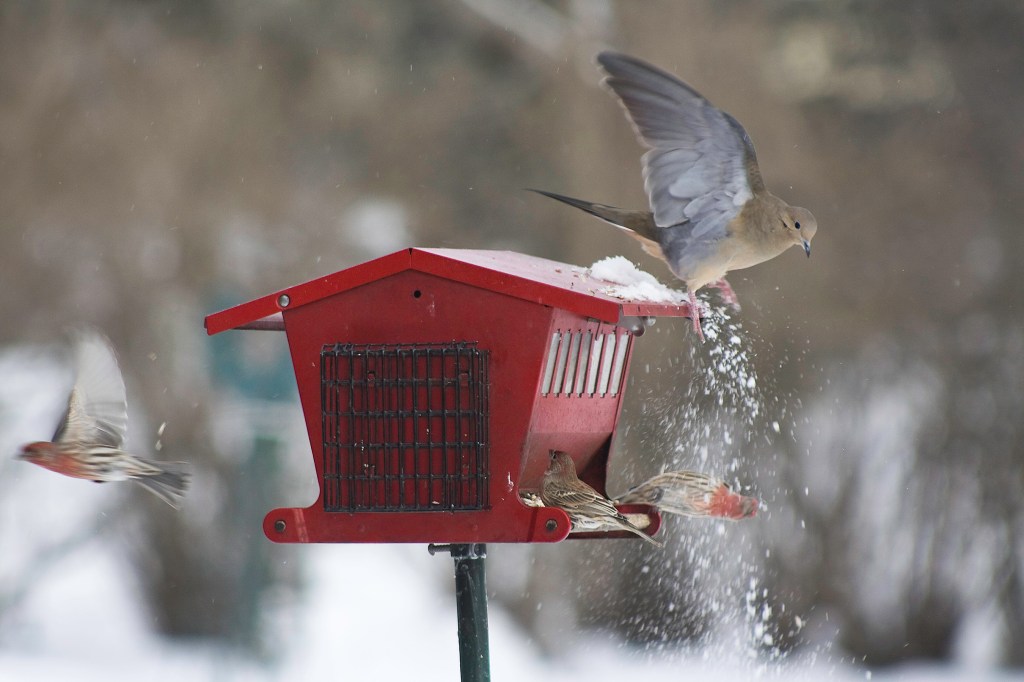
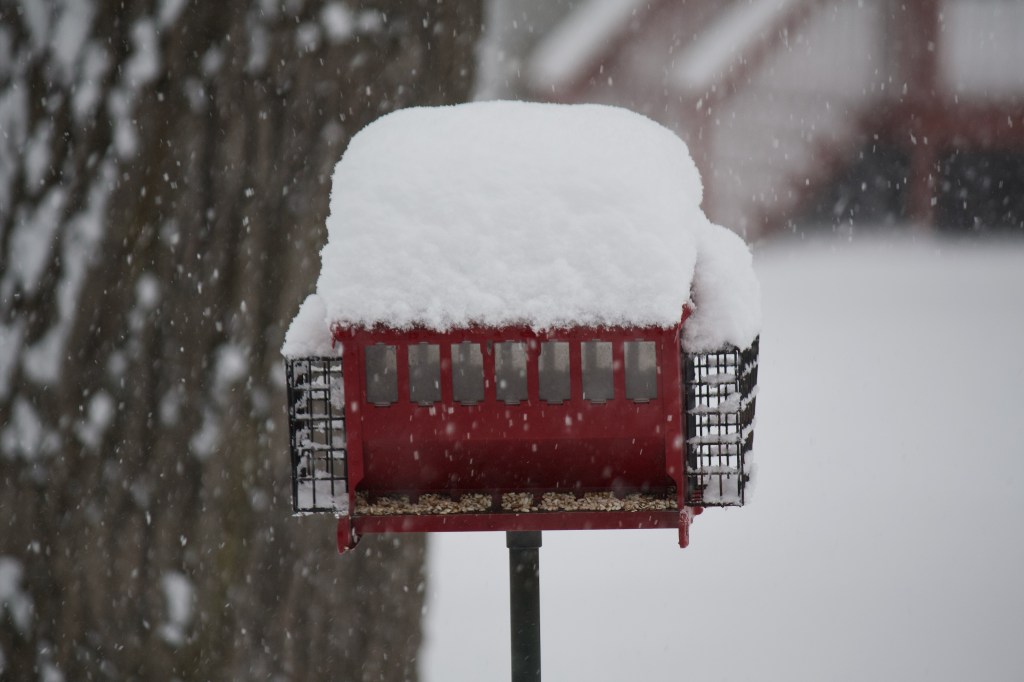
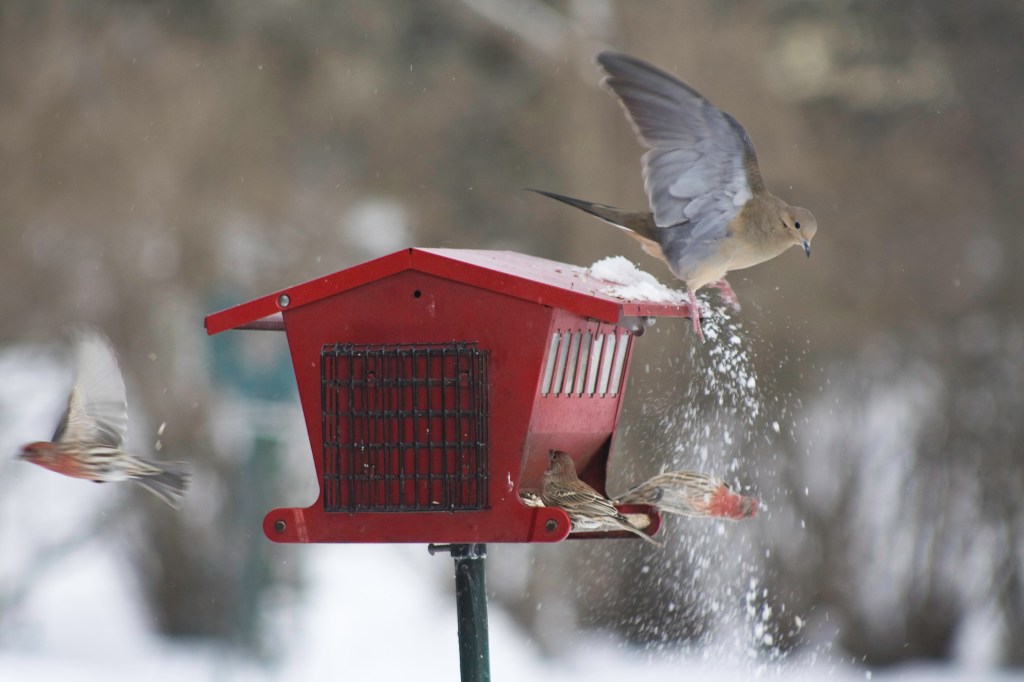
With such a bounty of trees, the backyard also attracted a bounty of birds. In later years, Mom had a birdfeeder that looked like a little red schoolhouse atop a 5-foot pole. The cardinals were partial to safflower seeds, so that was the staple stocked in the feeder.
When living at Mom’s house for a year when she was in a care center, I set up a tripod and camera in the sunroom and shot photos of the birds through the windows. It was fascinating to see which ones ruled the roost and which others were able to feed unnoticed when the big guys and gals were around.
Since his creative talents included photography, hand illustration and writing, it only makes sense that Carl F. Hanneman (1901-1982) also showed skill and promise as a painter.
We’ve covered in many places on this site Carl’s ventures in photojournalism,freehand illustration and professional writing. At least two of his framed paintings have also survived, and reside in Hanneman family homes nearly 30 years after his death.
Both paintings depict nature scenes, one in winter and one in late summer or fall. It would make sense that the scenes depicted were in Wisconsin, likely Mauston and Carl’s native home in Wisconsin Rapids.
A winter scene painted by Carl F. Hanneman.
The first shows a winter setting along a stream that is surrounded by a mature forest. A moderately deep snowfall dusts the landscape, although the stream does not appear frozen. The second scene shows a variety of trees hanging over the shore of a lake or river.
It looks like many of the properties along the Lemonweir River in Mauston, where Carl brought his family to live in 1936. The property across the street and down the hill from the Hanneman home looks out onto LakeDecorah, where the river widens before flowing over the dam. It also resembles land along Petenwell Lake and Castle Rock Lake just northeast of Mauston, where Carl was known to fish.
A lake or river scene painted by Carl F. Hanneman (1901-1982). Date of the work is unknown.
It is likely Carl painted other works that found their way into private collections. My Dad believed there were still a number of works in the basement at Mauston at the time of Carl’s death. The fall scene above at one time hung in the study of the Hanneman home in Mauston.
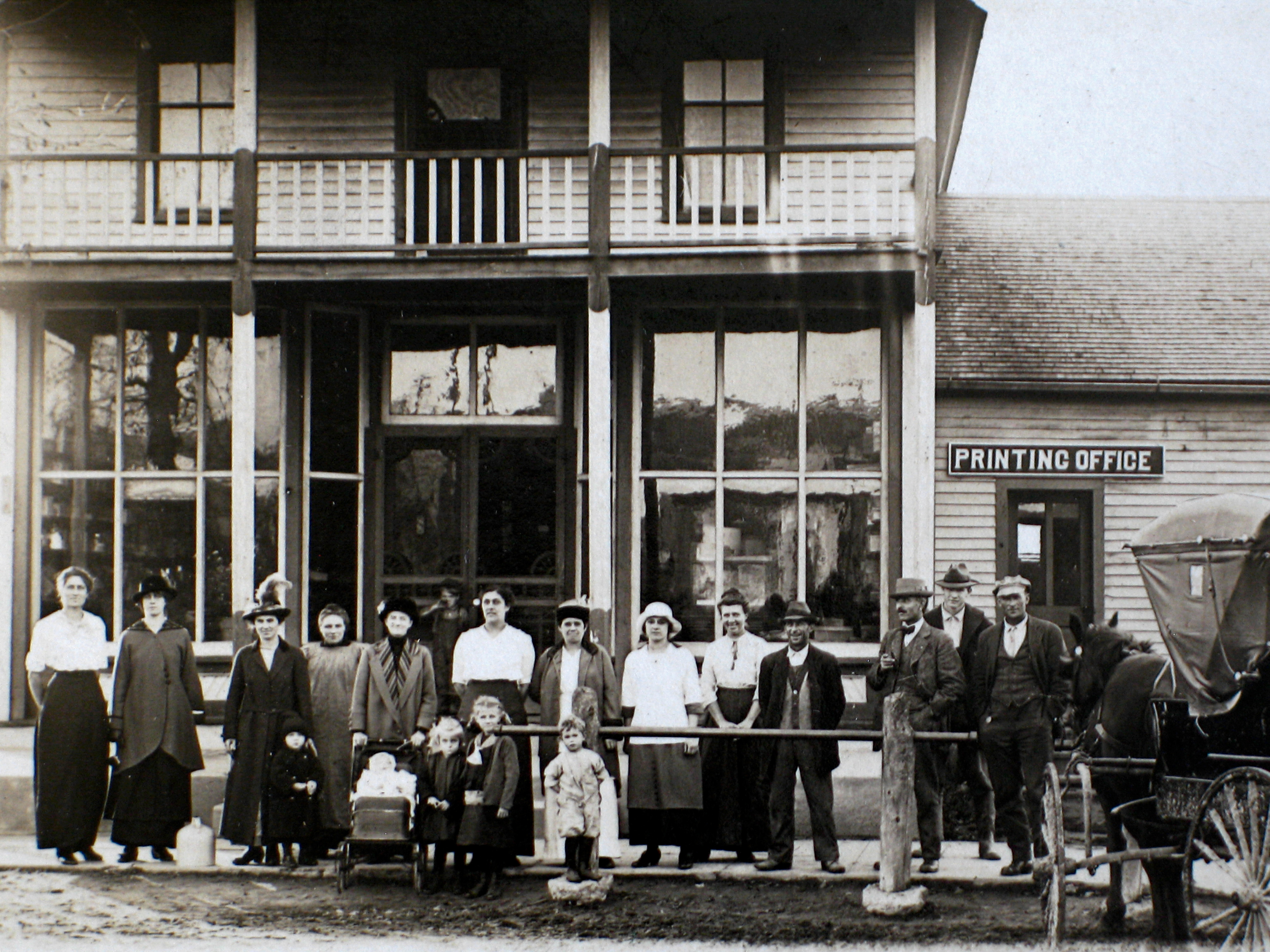
The real estate surrounding Cameron Park in the tiny village of Vesper, Wisconsin, played an important role in the histories of the Hanneman and Treutel families. This village square was the nexus of commerce and family life at the dawn of the 20th century. It was home to a number of Treutel families, who came from Germany through Waukesha County seeking a new start.
A hand-drawn map made by Elaine (Treutel) Clark has surfaced that adds detail to how the town square was laid out and where the family homesteads sat more than a century ago. The map, likely drawn sometime in the 1980s, was provided to us by Elaine’s daughter, MaryClark. Because all of the old Treutel homesteads in Vesper are now gone, the map provides missing detail on what the village looked like in the early 1900s.
As documented elsewhere on this site, the family of Johann Adam Treutel and the former Katharina Geier emigrated from Bremerhaven, Germany, to New York between 1849 and 1854. The family initially settled in Milwaukee before it began to branch out into other areas of Wisconsin and in the deep South of Louisiana, Alabama and Mississippi. Henrietta (Krosch) Treutel, the widow of Philipp Treutel, moved north with her children after Philipp died in 1891 near North Prairie, Wis.
We’ve overlaid photos on the hand-drawn map created by Elaine (Treutel) Clark.
Most of the Treutels lived on properties along Anderton Avenue in Vesper, along the western side of Cameron Park. Most also had their places of business along the same street, including a general store, a butcher shop and a smithy (blacksmith shop). The first of the Treutels to come to Vesper was Adeline B. (Treutel) Moody, who settled on a farm outside of the village. Her family was involved in the Moody-Hinze shootout incident.
In late 1898, Charles W. Treutel made a trip to Vesper to “look after his landed interests,” according to the Wood County Reporter. Charles and his brother Henry A. Treutel later established a blacksmith shop that eventually became a service station and auto-repair shop. Treutel Brothers was located on the Hemlock Creek, just across from the northern edge of Cameron Park.
The former Goldsworthy’s store became the Treutel general store in 1901.
The Treutels purchased what had been known as Goldsworthy’s store at the corner of Anderton and Cameron avenues. Oscar and Walter Treutel bought the store from C.R. Goldsworthy, one of the major land owners in the area. Oscar was the main proprietor, as Walter became a rural mail carrier for the U.S. Postal Service. The post office was originally located in Treutel’s store. Emma (Treutel) Carlin was the seventh postmaster of Vesper, starting her 11-year tenure in the fall of 1906. Just south of the Treutels’ general store was the butcher shop of Orville Carlin, Emma’s husband.
The map also shows the “priest house,” which was the home of Father C.W. Gille in April 1926 when a fast-moving fireleveled the building before firefighters could reach the scene. Carl Hanneman or wife Ruby (Treutel) Hanneman documented the fire in photographs. Father Gille presided at Carl and Ruby’s nuptial Mass on July 14, 1925 at St. James Catholic Church.
Along the east side of Cameron park we see a village hall, the location of a community gathering documented in an “Eye on the Past” feature on this web site. The building hosted a lot of functions over the years. For a time it was home to a roller rink operated by Harry Cole.
A crowd gathers outside the village hall, circa 1914.
The southeast corner of the map shows the Vesper Graded School, where my grandmother, Ruby (Treutel) Hanneman went to school and later taught for a time after earning her teaching license. The well-built structure still stands, now serving as a private home.
The center of the park shows a bandstand, which many times was the center of activity with band and string concerts. The Vesper Cornet Band played in the park on more than a few occasions. The talented group of musicians included Charles Treutel,Henry Treutel and Orville Carlin, the husband of Emma (Treutel) Carlin.
Not far from the bandstand is an indicator where the Ku Klux Klanburned a cross sometime in the mid- to late 1920s. It was one of Elaine’s vivid memories from early childhood. We could find no reference to it in the Wisconsin Rapids papers. The Klan was certainly active during that time period. If this occurred before April 1926, it would have been directly across from the home of Father Charles W. Gille, the pastor of St. James Catholic Church.
The Vesper Cornet Band. Orville Carlin and Charles Treutel are the first two from the left in front; Henry Treutel is second from right in rear.
Last but not least is the Walter Treutel homestead, along the western side of Cameron Park with its rear facing the Hemlock Creek. The Treutel children had lots of space to play in the field behind the house. The map says they went ice skating on the Hemlock Creek on winter days. We have many photos showing the home’s exterior, but no images from the inside of the house.
Mary(Ladick) Treutelon the stepsof the Treutel home with her children Nina, Marvin and Ruby.
There was a time when letters were the primary means of long-distance communication for families and friends. Even short updates were dashed off on a card or a sheet of special stationery. Long-distance telephone calls were expensive and typically reserved for special occasions or emergencies. For family historians, finding old letters can unearth all sorts of details about life way back when. Sometimes the reveal big details, but often the small things that are otherwise lost to time.
I recently scanned a series of letters my mother wrote to her in-laws, my grandparents, Carl and Ruby Hanneman, who lived in Mauston, Wis. At the time, Mom was living in her hometown, Cudahy, Wis. In the first note, she was not yet married to Dad, but in the other ones they were newlyweds. They were married on Aug. 9, 1958 at St. Veronica Catholic Church in Milwaukee, where Mom was a teacher. I’m sure Mom kept up this correspondence beyond 1959, but only these letters survived (no doubt they were kept safe by my Grandma Ruby Hanneman).
Mom at one of their early residences; possibly their Layton Avenue apartment.
The letters reveal that my Dad had a temporary job at Sears before he started his career selling pharmaceuticals. It sounds like it was a bit of a grind with regular night and weekend hours. Sometime in mid-1959, he got a new job in sales. I can’t tell from these letters, but I know back in that time frame Dad started working for E.R. Squibb & Co. Mom and Dad had an apartment on East Layton Avenue in Cudahy, which they later traded for a brick ranch home in Greenfield before moving to Grand Rapids, Mich.
The letters contained some good chuckles, too, like this train wreck of a sentence: “I hope this restful letter finds you all rested, at least a little bit rested, as well as I am rested.” Not what you’d expect from a woman who taught reading. But I considered the possibility that it was intended as a joke.
The regulars mentioned in these letters include my maternal grandparents, Earl J. and Margaret M. Mulqueen; Mom’s younger brother Joey Mulqueen; Dad’s sister Lavonne (Hanneman) Wellman; Evelyn Mulqueen, wife of my Mom’s brother Earl J. Mulqueen Jr.; Donn and Elaine Hanneman (Dad’s brother and sister-in-law); Mom’s sister Ruth (Mulqueen) McShane and her husband Tom; Mom’s sister Joanie (Mulqueen) Haske and her husband Dick; Mom’s sister the nun, Sister Madonna Marie; and Jack Richards, one of three groomsmen in Mom and Dad’s wedding.
The text of the letters is below:
Undated letter (prior to Aug. 1958)
Dear Mr. Hanneman,
This was the cover of the card containing this undated letter to Mauston.
I hope you’re fine and dandy – Lavonne and Mrs. Hanneman too! The reason for this little note is to ask a favor of you. Would you please order the man’s matching wedding band & my rings? I don’t know which catalog it was from but it’s an Honor ring. I’m sure Lavonne will know which set it is! As far as size is concerned, Dave’s ring is at Novak’s in Mauston to have the size adjusted. I’m quite sure it’s an eleven. You could check there on size. It’s just the plain silver band. If you run into any difficulty please call me – Sh. 4-5862 any nite about 5:30 or 6:30. I will then pay you as soon as I see you.
Also, my folks will be coming up this week-end if nothing unforeseen comes up. They will leave here about noon on Saturday. Joe would come with them. I don’t know if David & I will get there. We’ve been busy getting our place ready. I got sick from the paint. Ugh!!
Dave is fine – his foot is okay. Last Friday he had a wisdom tooth pulled. Don & Elaine & the kids are fine too. I must close now as I want to get this in today’s mail. I would certainly appreciate you ordering Dave’s ring. If you are unable to get it, I’ll match one as close as possible from a store here in Milwaukee. Tell Lavonne the dresses are in at Boston Store, but there’s no hurry to try hers on. So long for now,
Love,
Mary
Nov. 11, 1958 (postmark)
Milwaukee, Wis.
Mr. and Mrs. C. Hanneman
22 Morris Street
Mauston, Wisc.
Dear folks,
Hi! Hope all is well with you. Everything is fine down our way. I’m writing this at school at noontime, so one of my “monsters” can run it to a mailbox.
Dave plans on coming up this week-end to get in some deer hunting. We probably will get there on Friday night about 9:00. If for some reason our plans are changed, we will call you.
This photo could be from the deer hunting trip mentioned in the November 1958 letter.
My mom is doing very well. Will have to leave all news for the week-end, as I don’t have too long a lunch period. Love to you both again.
See you soon,
Mary and Dave
Dec. 31, 1958 (postmark)
Milwaukee, Wis.
Mr. and Mrs. C. Hanneman
22 Morris Street
Mauston, Wisc.
Dear Folks,
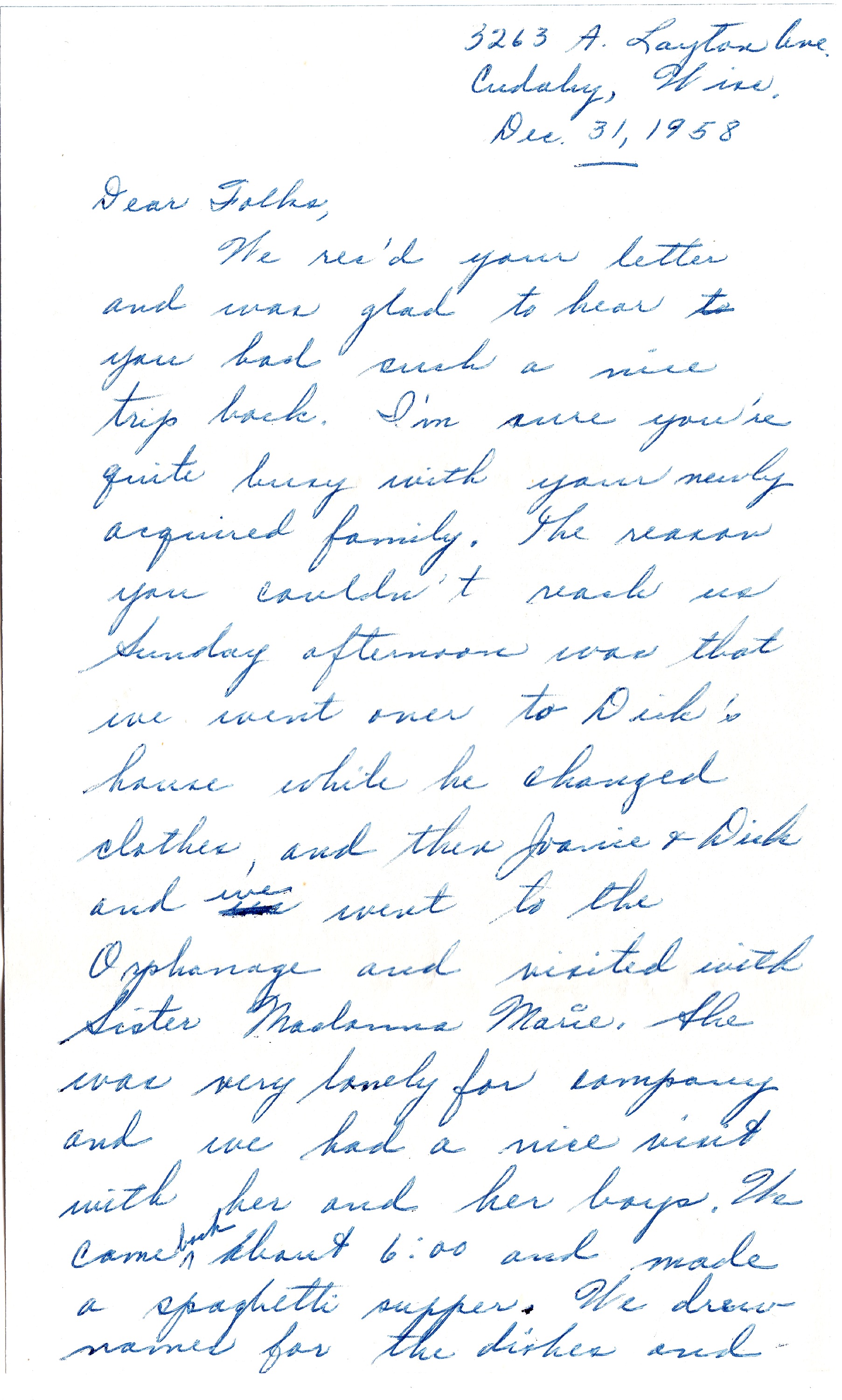
We rec’d your letter and was glad to hear too you had such a nice trip back. I’m sure you’re quite busy with your newly acquired family. The reason you couldn’t reach us Sunday afternoon was that we went over to Dick’s house while he changed clothes, and then Joanie and Dick and we went to the orphanage and visited with Sister Madonna Marie. She was very lonely for company and we had a nice visit with her and her boys. We came back about 6:00 and made a spaghetti supper. We drew names for the dishes and Joanie & Dick won. It was all Joanie’s idea.
The first page of the Dec. 31 letter to Mauston.
Well, the main reason for my my writing is to inform you that Dave & I won’t be able to be with you this week-end. Hamilton at first said he could even have Friday off, but later changed his mind & said he wanted to take inventory on Friday & Saturday. That means Dave will even work Saturday. We’re disappointed because we did so want to do something different. We may, if he’s not too beat, drive to Madison and see Jack Richards, but even that is just a maybe!
I’m very happy you all enjoyed your visit with us as really the pleasure was all ours. You know you’re welcome anytime. That bed is up permanently, so there’s always plenty of room. I talked to Donn & he & Elaine are cleaning house like mad as long as there are six feet less to be underfoot the broom!!
Today (Dec. 31) Dave is working and I want to go downtown with my mom and just look around, then do grocery shopping, and then press our clothes for the party tonight. I must close now, wishing you & Carl a very Happy New Year filled with the best of health & happiness.
Tell the kids Happy New Year from us too. Carl, here’s to you (drawing of a drink glass) cheers!!! Hope to see you before too long. Still want to ice fish & skate on the Lemonweir!
xxxxx,
Mary
Apr 29, 1959 (postmark)
Milwaukee, Wis.
Mr. & Mrs. C. Hanneman
22 Morris Street
Mauston, Wisconsin
Hi folks,
I’d been intending to write sooner than this as I knew you probably were wondering how the dedication went. Well, all went very well indeed! Sister’s visit also but she was coming down with the flu bug that’s been hitting everybody. I wasn’t feeling too sharp that day either and was sick by ten that night. I missed the first three days of school last week & dragged myself back on Thurs. & Fri. I still have bronchitis or something. I’m seeing the doctor this week-end. Ten children from the class were out today, so that “bug” is really getting around. Some nice sunshine might help the situation, though.
We can’t thank you enough for being so thoughtful to remember to send the films & slides along. We were most anxious. They don’t look too bad at all.
Dad at their Cudahy apartment.
We’ve been very busy with choir rehearsal two nites a week. I’ve had to have a dress made for the concert & had to “run out” for fittings. I’ll be glad when it’s over, because it has involved so much chasing. I’m just not in a “chasing” mood.
Dave & I were both very surprised to hear about Jack Richards. If you hear anything else, let us know.
Dave has been busy at his temporary job & much busier answering ads, having interviews and weighing advantages & disadvantages. Nothing is definite yet & I feel he should take his time, as there’s no reason at all for a rush!
We hope Bob & Ruth Schroeder had a good time here. They seemed to. Too bad both games were called because of rain.
We also hope this letter finds you both feeling well and in good spirits. We haven’t talked to Vonnie yet but should tomorrow (Wed.) or Thursday. Dave doesn’t get home until 6:15 or so, by the time we eat and relax a bit, it’s time for choir. He works nites a few nites a week & Sat. until 6:00. Sometimes we go to choir at 9:30, practice until 11:30 & don’t get home until midnite. We’re both tired.
Ruth & Tom are back from Florida and had a wonderful time.
I must close now and get ready for bed. David is writing a letter to some friends from Davenport, Iowa. This is catch up on letters nite.
I don’t know when we’ll be coming to Mauston since Dave works Saturdays. I may have a Monday off soon & we could come Sun. & Mon. or when the job he wants comes through & he quits Sears. Til then, take good care of yourselves, enjoy life & remember we think of you often! Carl, don’t work too hard – go fishing! Catch me a big one & eat it all!
Love,
Mary
May 20, 1959 (postmark)
Milwaukee, Wis.
Mr. & Mrs. C. Hanneman
22 Morris Street
Mauston, Wisconsin
Dear people,
I hope this restful letter finds you all rested, at least a little bit rested as well as I am rested. What I’m trying to figure out right now is where the fine line is drawn between resting and being plain lazy!! I’m close to one or the other.
Dave arrived home quite excited about his job and week in Minneapolis, but very tired. He really is impressed with the company, their policies & all the people he’s met. This week he’s working with his boss from Minn. in the Milw. area and doing quite well.
He thinks he will be going up into Green Bay and Escanaba next week, but isn’t too sure. We sold the car to Lou Ehlers Buick (where he bought it) on Monday. On Sun. we picked up his company car. It’s a beautiful bronze Bel-Air Chevrolet. He’s very pleased with it. Tonite we’re having dinner with his boss. They’re letting me pick the spot. I can’t decide where to go, but I want to go someplace where I haven’t been.
I have to get a desk for Dave, take the bed out of the spare room & set him up a place to work with a filing cabinet for his records.
We got our TV back and it works very fine, finally!
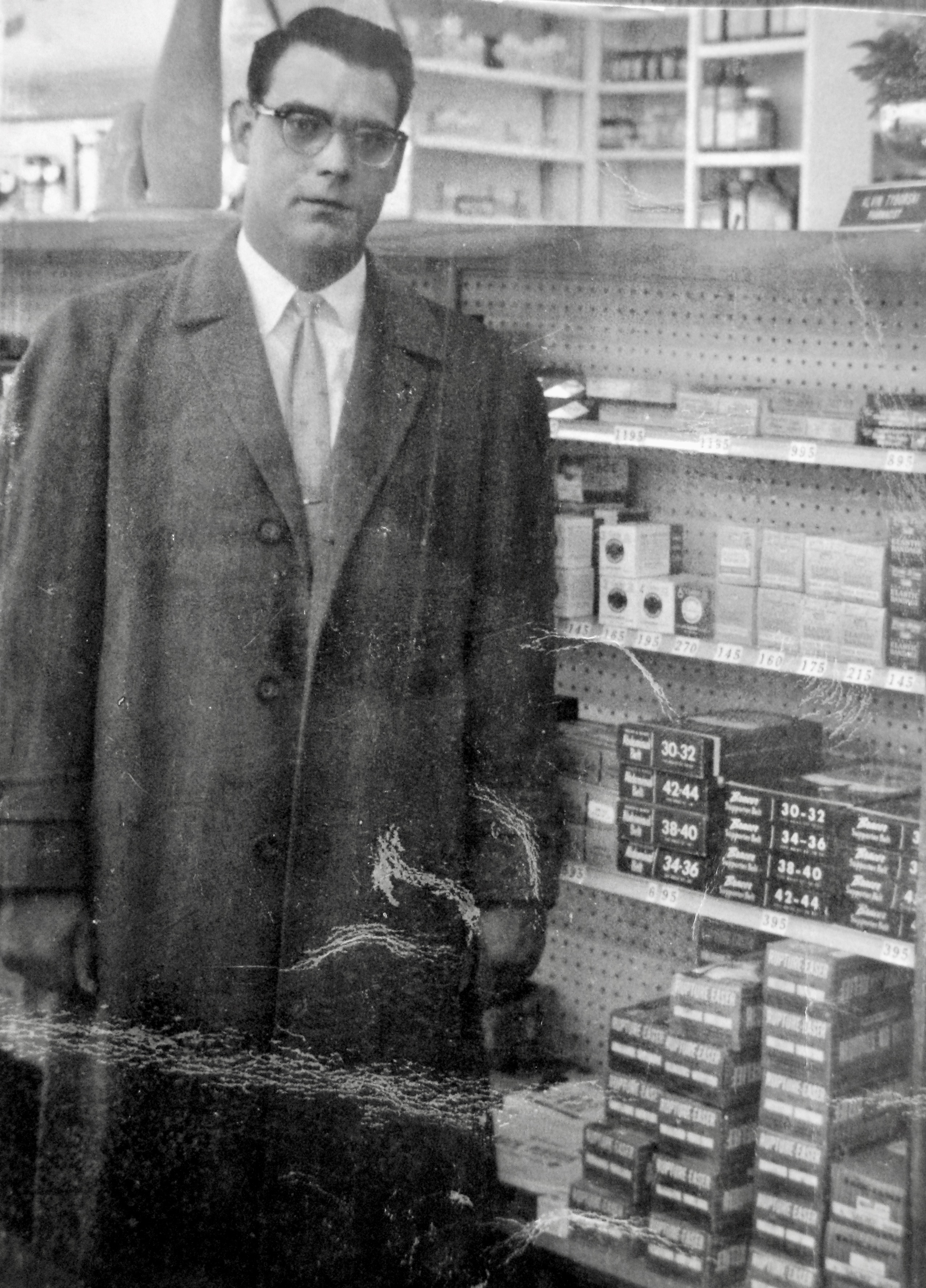
Dad on one of his pharmacy sales calls.
Elaine came down for supper last nite. She left the children home. She really seemed to enjoy the evening very much. She looks at bit thin, but says she and the kids feel fine. Donn called her from New York here. The Mason girl sat with the kids.
I must close now and wash my hair & try to make myself beautiful for this evening. Thank you again Vonnie for coming down last week with me. I don’t know what I would’ve done without you.
I probably will be going back to school next week. I hope so. I have to have some blood tests done which will tell exactly how the liver situation is, but I feel pretty good. I hope everybody home there feels fine too! We probably won’t be up to see you folks until the first or second week of June. I will write before then & let you know what’s happening.
Til then, so long. Enclosed is a check for films. Carl, don’t argue about it!! (Teacher speaking)
Love,
Mary
Sept. 1, 1959 (postmark)
Cudahy, Wis.
Mr. & Mrs. Carl Hanneman
22 Morris Street
Mauston, Wisc.
Dear folks,
Thought I would write and say “thank you” both again for your generous hospitality shown Joe and myself when we visited you. He really was quite excited telling of the good time he had fishing running the boat on the river!
It’s Monday evening, the end of the month as I write this. It has finally cooled down here. I hope you people have had relief too! Dave’s hay fever has been quite bothersome this past week. But he left for Michigan this a.m., which means he’ll have relief while there.
I had intended to go with him but didn’t, since I’m helping Evie with the new one – (a boy, 9 lb. 3 oz – last Wed.,), a beautiful contented baby. I kept house for her from last Wed. thru Sat. while she was in the hospital. They’ve asked Dave and I to be sponsors this coming Sunday – his name will be Brian David Mulqueen. Also, I didn’t go with him because I’m going to teach 5th grade for a good part of September for a sick teacher, and so I’m busy this week getting the class room in good shape for the big day – September 9.
I hope you’re still coming down over the Labor Day week-end. Would be very nice to return some hospitality to you for a change!!
I’m going to help my mom tomorrow a.m. She’s having her Jesuit mission club for a luncheon. I have plenty to do during the day – but right this moment I’m kind of lonely for Dave. I think though I’ll survive until Friday. Must close now – I hope I hear from you if you don’t come down. We would much prefer the latter!
This story appeared on Page 1 of the Jan. 26, 1991 edition of the Racine Journal Times. It was based on observations during my second trip to Germany during the Persian Gulf War.
By Joseph Hanneman
Racine Journal Times
U.S. BASE, SOUTHERN GERMANY — Some of the first casualties of the Persian Gulf War were the emotions U.S. troops and families stationed in Europe, as they worried about loved ones in Saudi Arabia and expressed resentment toward anti-war protests back home.
In the first-week of combat between U.S.-led allies and Saddam Hussein’s Iraqi forces, one U.S. base in Germany displayed fear, anguish, anticipation and a host of other emotions.
People at the base clearly were in anguish. Many of them have relatives deployed in Saudi, as they call it here. Most of the deployed soldiers are in combat units.
Members of the Army’s VII Corps artillery units from this base are now at forward positions in Saudi Arabia. They would be in the thick of it if the United States starts a ground offensive into Kuwait.
“God Bless our Soldiers in Saudi Arabia,” proclaimed a banner inside one of the many post exchange shops on base. Employees wore yellow ribbons in remembrance.
At the U.S. Army hospital here, one nurse in the outpatient clinic said her husband was just deployed to the front lines.
Page 1 story from Jan. 26, 1991.
“I’ve just been pulling my hair out,” she said, adding that she has been glued to the TV set, watching Cable News Network’s coverage of the war. She said she fears a ground war is inevitable.
Discussion on the Army’s base shuttle bus turned to one active-duty soldier, who was supposed to be sent home last week because his unit was deactivated as the United States prepares to shut down some of its bases.
Three days before his plane was supposed to leave, he was told to report for duty in Saudi Arabia.
Fear has also become a staple in the daily routine.
The threat of terrorist attacks on U.S. bases is considered very real, and the military has employed many tools to reduce the risks.
Commercials on Armed Forces Radio and Television warn against speaking about military matters in public, for fear terrorists could be listening. It was reminiscent of the old war slogan, “Loose lips sink ships.”
Soldiers were also warned that Arab terrorists may try to buy military uniforms or identification cards.
Military families were told to venture off base sparingly, and try to blend into the German population as much as possible, lest they attract undue attention.
The Gulf War dominated global news in January 1991.
But the post commander appealed to parents not to pull their children from Defense Department schools on base. Many families here and elsewhere in Europe kept their children home in the wake of hostilities and terrorist threats.
Security was at a peak level, called “Threatcon Charlie.” That puts scores of heavily armed military police at every entrance, checking IDs and searching for bombs. At least two forms of photo identification were required, and every bag and package was searched.
There was growing resentment among soldiers and families as they watched news reports of anti-war protests at home.
Some soldiers who oppose Operation Desert Storm wondered aloud where the protesters were over the past 5 ½ months, when the United States built its war force in the Gulf. Others said it hurt knowing while they were overseas serving their country, some back home didn’t appreciate it.
The growing number of military reservists shipped here to fill in for regular troops sent to the Middle East complained of shabby treatment by regular Army personnel.
Some reservists said regular troops seem to resent the citizen-soldiers, and treat them accordingly. Reservists are performing a host of support duties, such as medical care, transportation and administration.
“The sacrifices we have made are not acknowledged by the regular army,” one reservist said. “They seem to consider us a burden.”
One thought was universal here — a desire for the war to end quickly. For military families, that will mean loved ones come back to Germany. For reservists, it will mean going home.
(Reporter Joseph Hanneman, who covers government and higher education for the Journal Times, travelled to Germany to visit his wife, Susan, an Army reservist called to active duty at the U.S. base in Germany.)
—
Feature image atop the story: A sculpture outside the museum at the former concentration camp near Dachau, Germany. Photo taken during my second trip to Germany in 1991.
I just love this image. Back in 2007 I was photographing a variety of things from Mom and Dad’s house, at my mother’s request. I came across this birthday card from October 1979. It was from my grandfather, Carl F. Hanneman, to my Mom, on her 47th birthday.
Carl F. Hanneman (1901-1982)
What I found touching was that Grandpa Carl still sent a little cash gift to a daughter-in-law who was nearly 50. He signed the card “Grandpa” even though he was her father-in-law. I loved that my mother never cashed the check — not wanting Carl to spend the money from his very fixed income. She kept the card and the check. Precious.
It’s funny how these memories pop up so unexpectedly. I saw this photo two days ago while searching for something totally unrelated. Mom has been gone to Heaven for 18 months. Grandpa Carl for 38 years. Yet finding this photo brings them right back to me, just as if this card were received earlier today.
This story appeared on Page 1 of the Jan. 18, 1991 edition of the Racine Journal Times. I filed the story from the U.S. Army base in Augsburg, Germany.
By Joseph Hanneman
Racine Journal Times
U.S. BASE, SOUTHERN GERMANY — Heavily armed military police patrolled in front of a U.S. Army base elementary school Thursday, with battle helmets on their heads and M-16 semiautomatic rifles slung over their shoulders.
It was an unmistakable sign that the United States had entered a war with Iraq, and that any U.S. citizen — even children — was a potential target for terrorists.
As Germany slept Wednesday night and early Thursday, U.S. and allied war planes screamed into Iraq as the offensive began to drive Saddam Hussein’s forces from Kuwait.
And overnight, this large military base in southern Germany transformed from a bustling community into an armed camp, where tension was high and fear so palpable you could almost taste it.
The Army was taking no chances amid terrorist threats against U.S. facilities around Europe and the Middle East.
At every housing facility, school and entrance to the base, military police were out in force. The grim-faced soldiers wore bullet-proof vests and carried high-powered weapons. The protective gas masks were clipped to belts at their sides.
An MP, his rifle on the seat next to him, rode the school bus with children as the vehicle darted off and on base, taking students home. This military base is home to more than 2,500 children.
And while children were being zealously protected, they also were not beyond suspicion. Youngsters returning home from school were required to show ID cards before entering housing complexes.
The author in the German countryside during one of two trips to Germany.
At each gate leading to the base, cars were stopped and searched. Guards looked in trunks and under hoods; they pushed large mirrors under vehicles to check the undercarriages for bombs.
No one, soldiers of all ranks included, escaped scrutiny.
At the entrance to the post exchange, 55-gallon drums filled with concrete were lined up to prevent cars or trucks loaded with explosives from reaching the building, which is usually filled with soldiers and family members.
Barbed razor wire was laid along the length of the sidewalk. Visitors had to pass through an armed checkpoint and were only allowed in the building with two forms of photo identification. Bags were searched.
Inside the PX, yellow ribbons hung fro the ceiling outside the cafeteria. Many soldiers from this base — including medical units and some of the heaviest armor units in the U.S. Army — were sent to Saudi Arabia as part of Operation Desert Shield, transformed Wednesday into Operation Desert Storm.
At the commissary (the Army’s version of the grocery store) aisles normally crowded on a weekday were deserted. Families, it seemed, preferred to stay home this day.
Area car dealerships that cater to U.S. soldiers closed early, and one U.S. club posted a sign that it would not be open Thursday, a day the sign labeled “Doom’s Day.”
Even the Burger King just outside the boundaries of the post was surrounded by armed guards. Only persons with military ID cards were allowed to eat.
At the U.S. Army Hospital, soldiers, nurses and visitors crowded around a television set in the internal medicine department, watching live cable news network accounts of the air attacks on Iraq and Kuwait.
Faces were stern. No one spoke. The expressions told of concern and relief that the operation had finally started.
Hospital officials refused to discuss the hospital’s role as a possible airlift treatment center for wounded soldiers. A reporter was told he could have access to medical staff only if he did not discuss Operation Desert Storm.
But it is widely expected here that the medium-size hospital would be pressed into service if casualties in the Middle East become heavy.
Soldiers said mobile hospital beds arrived in recent days to expand the facility’s capability.
And members of the 44th General Hospital, an Army reserve unit from Madison, began arriving here Thursday to fill in for medical staff shipped to the Middle East.
Bases all over Germany were setting up temporary hospital facilities to handle the wounded. German hospitals say they would assist with casualties. And the U.S. Veterans Administration was making ready 25,000 beds in the United States for possible casualties, according to local news accounts.
Elsewhere on base, soldiers listened to Armed Forces Radio for news about the start of the war. In between news dispatches, soldiers called in to request songs. Some were love songs for family members stationed in Saudi Arabia. Others, with titles like “We Will Rock You” and “Heads Will Roll” were dedicated to combat soldiers at the front.
(Joseph Hanneman is the state government/higher education reporter for the Journal Times. He flew to Germany last week to visit his wife, Susan, who is a reservist called to active duty there. Both live in Racine.)
This article sat atop Page 1 of the Racine Journal Times on December 25, 1990. It was one of the few times I wrote about my personal life in the pages of the newspaper. The memories are still vivid nearly 30 years later.
By Joseph Hanneman
Racine Journal Times
For many Americans, Christmas Eve was spent gathered around the tree with family members, exchanging gifts and enjoying the holiday spirit.
But for my family, there really is no Christmas this year.
Instead of wrapping gifts, toasting with a glass of eggnog or listening to Bing Crosby sing “White Christmas,” my wife of three weeks, Susan, and I spent our first Christmas Eve together saying goodbye.
Tears streamed down my face as I watched her board a bus Monday at Fort Sheridan, Ill., as her Army Reserve unit shipped out on its way to Europe and Operation Desert Shield.
It seems for the U.S. Army, there is no Christmas either.
The Persian Gulf crisis could not wait.
Fort McCoy, Wis., where my wife’s plane will depart today -— Christmas Day — could not wait.
Reserve units from Illinois and Wisconsin, which will board planes and leave on the one day of the year that symbolizes peace and brings together families, could not wait.
It could not be Dec. 26, or 27. It had to be on Christmas.
It was necessary, they say. I just wish I could believe that.
If I have just one Christmas wish this year, it is that the people of this country think about what is happening in the Persian Gulf.
As you open your gifts today and hear songs about “Peace on Earth, Good Will to Men,” think about it. This year, those words should carry extra meaning.
As Christmas dinner is served, don’t forget what this crisis is doing to the citizen-soldiers of the military reserves, or the sacrifice they are making. Remember their families, who this year spend the holidays filled with worry and uncertainty.
And realize that the impacts of this crisis go well beyond what most people have heard.
When George Bush decided to turn up the heat and mobilize more reservists than have been called since the Korean War, he affected more people than most of you will ever know.
My situation is painful, but I am very lucky. My wife will not be in Saudi Arabia, scorched by heat, bored by the desert and worried about war. I thank God for that every day.
Our story is far from unusual. Since the reserves were first called up in August, our lives have been under a cloud.
The specter of being sent to Saudi Arabia filled every day with worry. Every day that should have been full of excitement as we planned our wedding was shadowed by fear that the ceremony would not take place.
We heard a million ticks of the clock during those months, but we made it to our wedding day, Dec. 1. We forgot about the Army for a while. We went on our honeymoon.
But we cut it short and came home when her unit was activated.“That’s all right,” we said, “we will still have Christmas.”
Between scrambling to put wedding gifts away and move into our home, our days have been filled with tension and bureaucracy. Power of attorney had to be decided, many forms filled out.
She will take a more than 40 percent pay cut from her job by being on Army pay. Forty percent cut, but no relief from creditors. Our interest rates are reduced a bit by Uncle Sam, but the bills keep coming.
So we will sell one of our cars. We don’t have to, but we have this crazy idea about having enough money for phone bills, and for plane tickets when I go to visit.
But again, we are lucky. She will be stationed where there are phones, and where a husband can fly in and see his wife.
We are lucky, because we don’t yet have children who will see their mother taken away on Christmas Day. She’s not one of the single mothers who was forced to find care for her baby because the Army called her to duty.
We don’t have a new house to worry about, or mortgage payments to make, like many reservists.
And we have had time together. It took getting up at 4 a.m. each day to make sure she reported promptly by 5:30 for duty, but we had time. Time to talk, and prepare, and pray for the day this whole thing ends and everyone comes home.
We got so close to Christmas, we felt sure we would be safe for the holiday. Surely, I thought, even the Army believes in Christmas. Now, I know better.
But we are lucky, I keep telling myself. And in the end, I know I will see the wisdom in those words.
But standing on the wind-whipped pavement of a cold military base on Christmas Eve, I don’t feel very lucky.
(From the Dec. 25, 1990 issue of The Journal Times, Racine, Wis.)
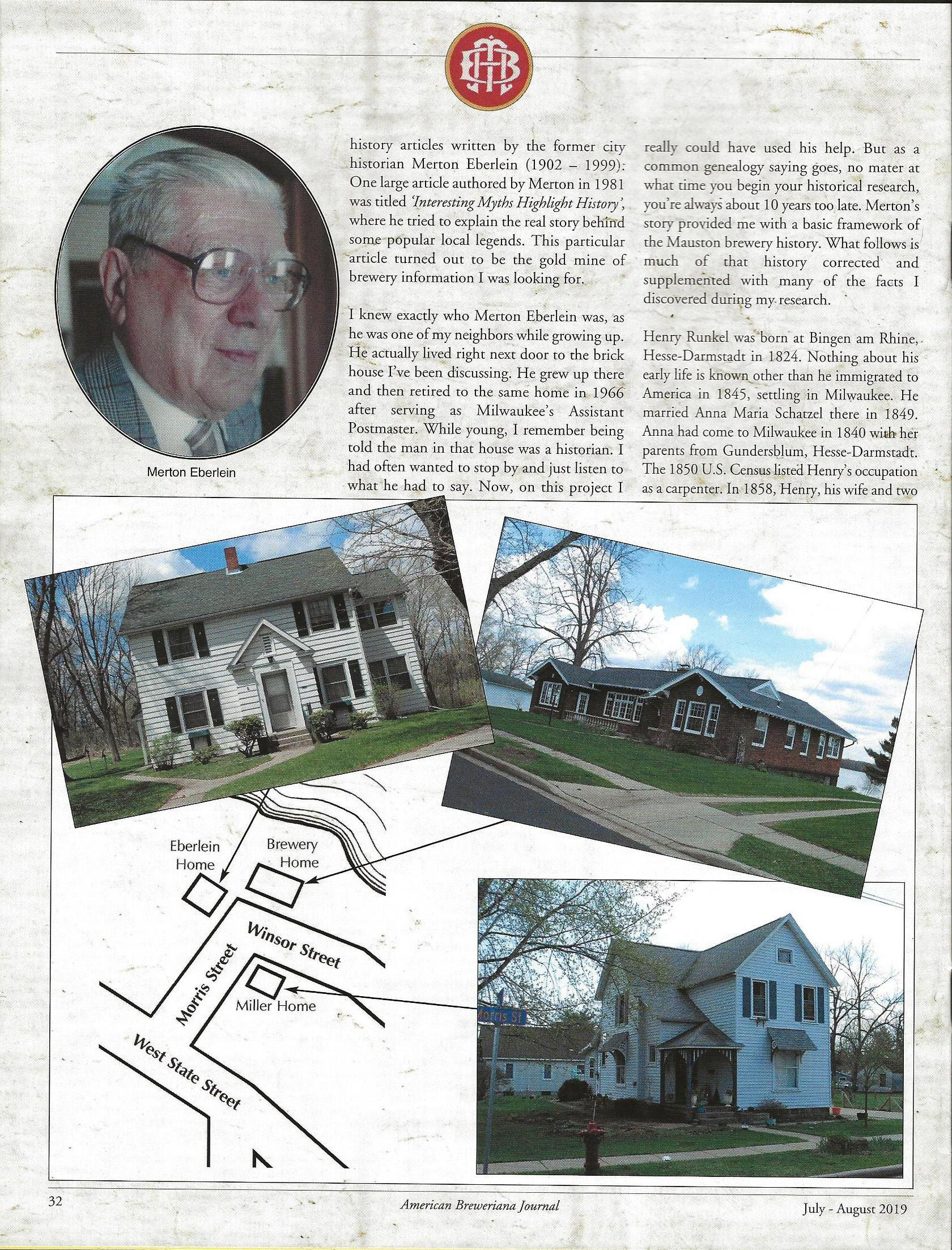
The story of the Hanneman house in Mauston and its ties to the historic Mauston Brewery was retold in a 2019 issue of Breweriana magazine. The article was written by Mauston historian Richard D. Rossin Jr., a friend of these pages.
In the brewery history magazine, Rossin tells the story of the Mauston Brewery, which operated at the corner of Morris and Winsor streets from 1868 to 1916. He also recounts the Hanneman family story of a tunnel that was said to run from the house at 22 Morris Street under Winsor Street to the former brewery site.
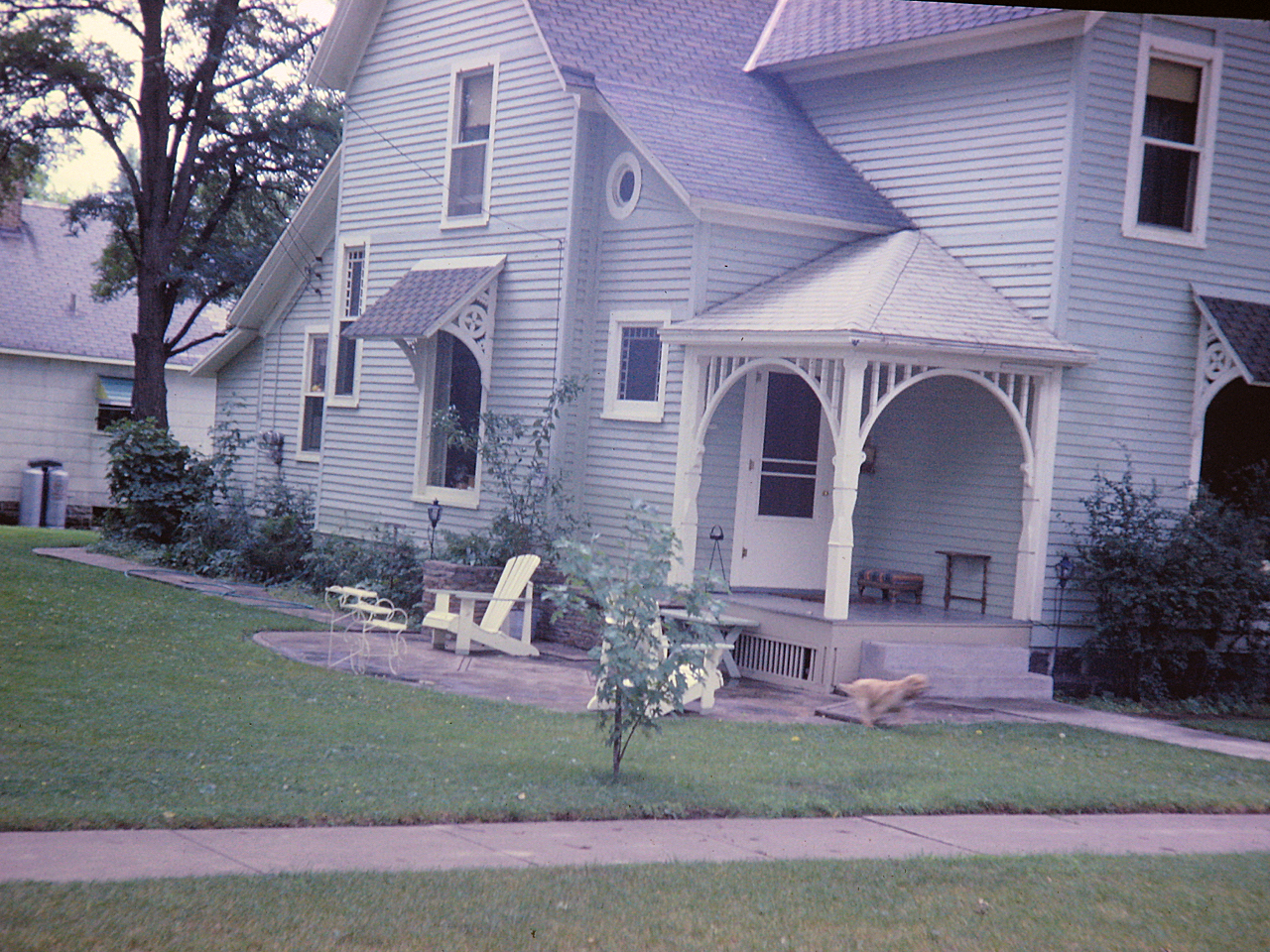
Rossin said when he first encountered the tunnel story, he and a group of friends rang the doorbell at the Hanneman house to ask about it. My grandmother, Ruby V. (Treutel) Hanneman (1904-1977), answered the door. She took the children back to the pantry just off the kitchen. She showed a trap door in the floor, which was slightly different in color from the surrounding floor boards. Ruby told the children the tunnel ran from a cistern beneath the pantry across the street, Rossin recalled.
The Hanneman house is shown at lower right in the brewery magazine. (Image courtesy of Richard D. Rossin Jr.)
That’s a slightly different tale than the one I recall hearing from Grandpa Carl F. Hanneman (1901-1982) and my Dad, David D. Hanneman (1933-2007). I recall as a child going down very steep stairs into the basement, where Carl had a bar. He showed us a large archway in the north wall. It was filled in with bricks. He said behind the wall was a tunnel that at one time ran across the street. I don’t remember any mention of the Mauston Brewery. According to Rossin’s research, the home across the street once owned by Dr. Samuel Hess Jr. had a beer cellar with a similar stone archway.
I recall as a child someone pulling up that trap door in the pantry and allowing us to peer down into the deep darkness of the cistern. I think we were told it had been used to store rainwater but was no longer functional. It only added to the allure of the old house, with its stained glass accent windows, four-footed bathtub and a “secret” servant’s staircase from the kitchen to the upstairs.
What we know as the Carl and Ruby Hanneman home was built around 1893 by Charles F. Miller, owner of the Mauston Brewery. Miller took full control of the brewery in 1888, according to Rossin’s article, and sold his interest in 1901. Miller and his wife Frederica had six children. Miller died in August 1907 at age 54. Mrs. Miller lived in the home for nearly two more decades. She remarried in the 1920s and sold the Morris Street property.
The Mauston Brewery was located across Winsor Street from what later became the Hanneman house.
Myrtle Price bought the house in 1932 and began renting it to Carl Hanneman in 1936. The Hannemans bought the home from the Price estate in the 1950s. They raised three children there: Donn Gene (1926-2014), David Dion and Lavonne Marie(1937-1986).







































 The Hanneman Archive