Tag Archives: Pioneers

Cemeteries Offer Great Lessons in History

As any serious genealogist will tell you, a visit to a cemetery can provide a wealth of family history information. But it can be much more than that. Each year as we approach All Souls Day (November 2), the season presents an opportunity to renew and maintain family connections, just by walking through a cemetery.

Southeastern Wisconsin Veterans Memorial Cemetery in Union Grove, Wisconsin.
Southern Wisconsin Veterans Memorial Cemetery in Union Grove, Wisconsin.

One of the most touching scenes I’ve encountered was at a small cemetery in Augsburg, Germany. Walking past after dark, I looked through the small gate to see dozens of flickering vigil candles. These were not solar lights but real candles. Someone cared enough to visit there each night and light the votives.

A 20-minute walk through any cemetery will provide you access to family stories. Parents who lived long, full lives. Others who died much too young. Babies, some just one day old. Some who were never born. John and Jane Does, victims of murder. And in many older cemeteries, some of the departed rest with no visible monuments. Their markers were damaged or swallowed up in soft ground or by encroaching woods.

This anchor-themed monument is at St. Mary's Catholic Cemetery in Portage, Wisconsin.
This anchor-themed monument is at St. Mary’s Catholic Cemetery in Portage, Wisconsin.

Observe the different monuments. Some are massive obelisks, others plain, square markers. A few are made from unusual materials. Some display incredible artistry. In many German cemeteries you will see monuments with engraved hands pointing to Heaven. Angels, crosses and even anchors are common subject of monument carvings.

Oak Grove Cemetery in Eagle, Wisconsin, is itself a monument to neglect.

Some cemeteries are known more for their infamy, such as Oak Grove Cemetery in Eagle, Wisconsin. We chronicled that story earlier in “A Sad Resting Place for Little Ida.” It is sad to see a cemetery fall into neglect and disrepair. It’s especially angering when a cemetery is targeted by vandals. A few years back, thugs toppled more than 100 monuments at Calvary Cemetery and Old Holy Cross Cemetery in Racine, Wisconsin. My Knights of Columbus council spent several weekends righting the monuments and making extensive repairs. Most of the damage was fixed, but some especially old stones were beyond repair.
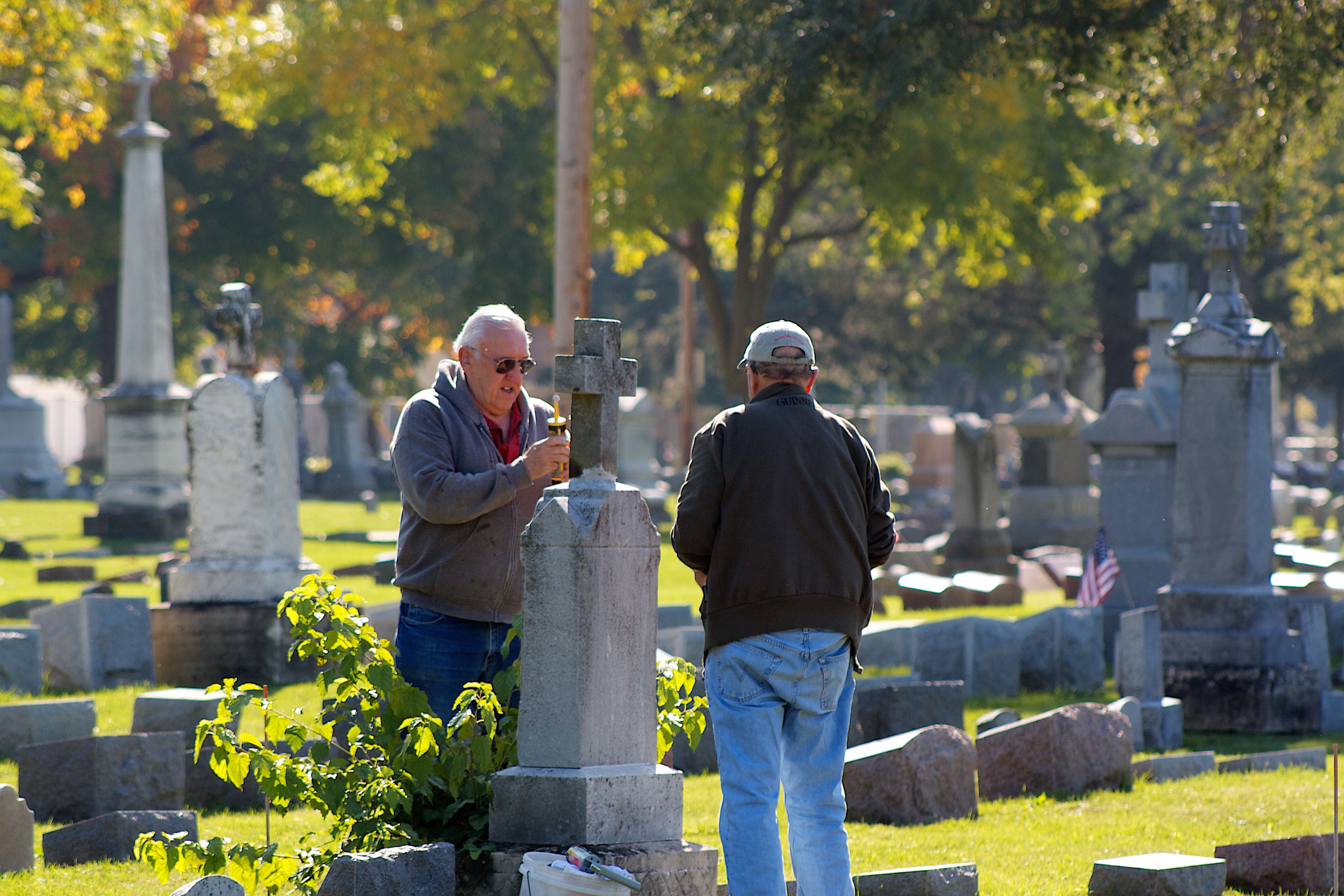
John Clark and John Murphy of the Knights of Columbus repair vandalized monuments in Racine, Wisconsin.

Military cemeteries and the graves of soldiers are especially touching. I recall walking row after row of World War I grave markers in Ypres, Belgium, where the famous poem In Flanders Fields was composed in 1915. All of those young lives cut short by “the war to end all wars.” Such sacrifice. World War I cemeteries dot the landscape in Belgium; some in the middle of farm fields.
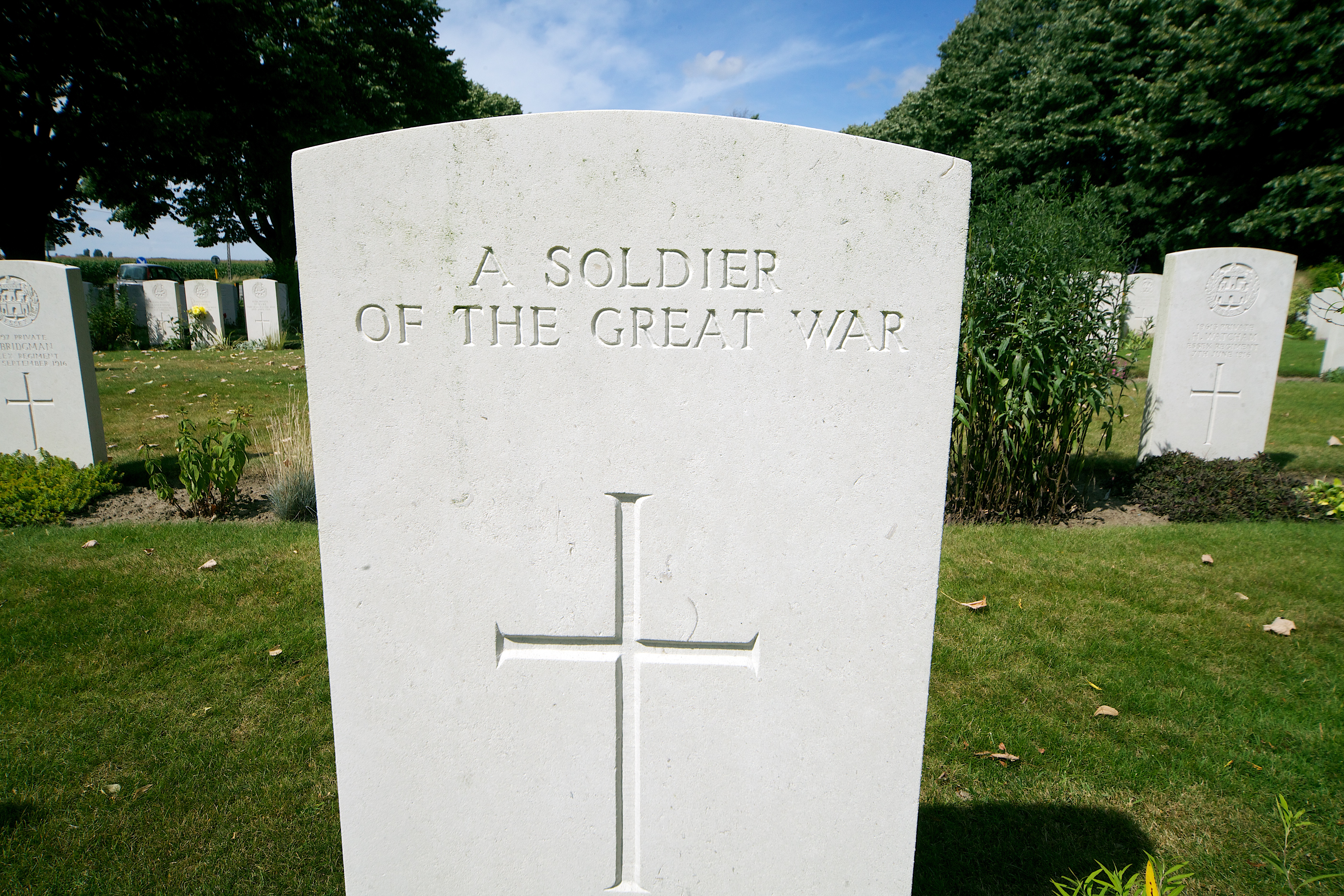
Grave of an unknown soldier near Ypres, Belgium.

While our loved ones are gone, they can teach us still. There are great resources available to help you find where your relatives are buried. My favorite online database is the Find A Grave web site. Take a camera along on your next trip to the cemetery and help your fellow genealogists document history.

©2014 The Hanneman Archive

Oscar Treutel Goes Back to School in August 1942

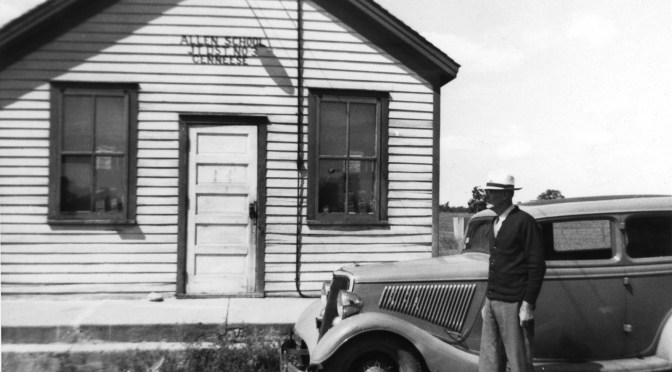
School must have seemed just a bit smaller when Oscar Treutel went back for a visit on August 24, 1942. In the 1880s, Oscar was a student at “Allen School” in Joint District No. 3 in the Town of Genesee in Waukesha County, Wisconsin. Let’s hope Oscar wasn’t returning for a spelling lesson, since the building has Genesee misspelled as “Genneese.” Perhaps the building lettering was a class project.

A young Oscar Treutel, circa 1899, when he was a college student in Waukesha, Wisconsin.

The school was in the southwest corner of the town on the E. Allen property, near the Saylesville Mill Pond. We should distinguish this one-room school from the Ethan Allen School for Boys, a reformatory in nearby Delafield that operated from 1959-2011.

Oscar traveled to school from the Treutel home in nearby North Prairie. He was the fifth child of Philipp and Henrietta Treutel, born Oct. 9, 1874 in Waukesha County. He moved with his family to Vesper in Wood County just after the turn of the century. He spent his sunset years in nearby Arpin. He died in 1967 at age 92.

©2014 The Hanneman Archive

Maps Show Detail of Old Mauston Brewery

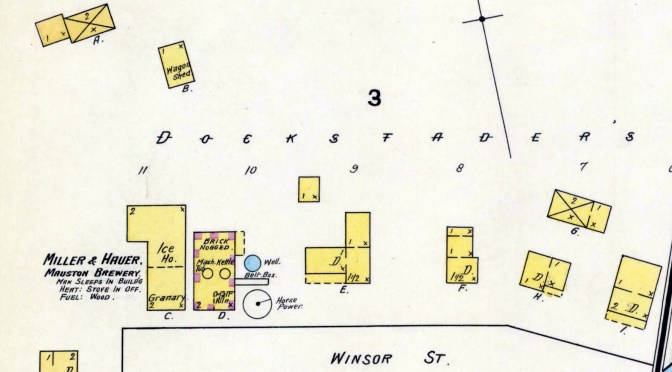
Newly digitized Sanborn Fire Insurance maps of Mauston, Wisconsin, provide more detail of the sprawling Mauston Brewery complex that once covered much of the land at the corner of Morris and Winsor streets along the Lemonweir River.

We previously wrote about the Mauston Brewery as detailed in a book by Mauston native Richard D. Rossin Jr. The Wisconsin Historical Society recently digitized hundreds of maps from the Sanborn Map Company that show intricate detail of the brewery complex. “Sanborn Fire Insurance maps are meticulously detailed, large-scale lithographed, color-keyed street maps,” the Wisconsin Historical Society wrote on its web site. “Sanborn Maps helped insurance agents in the late 19th and early 20th centuries determine the degree of fire hazard associated with a particular property.”

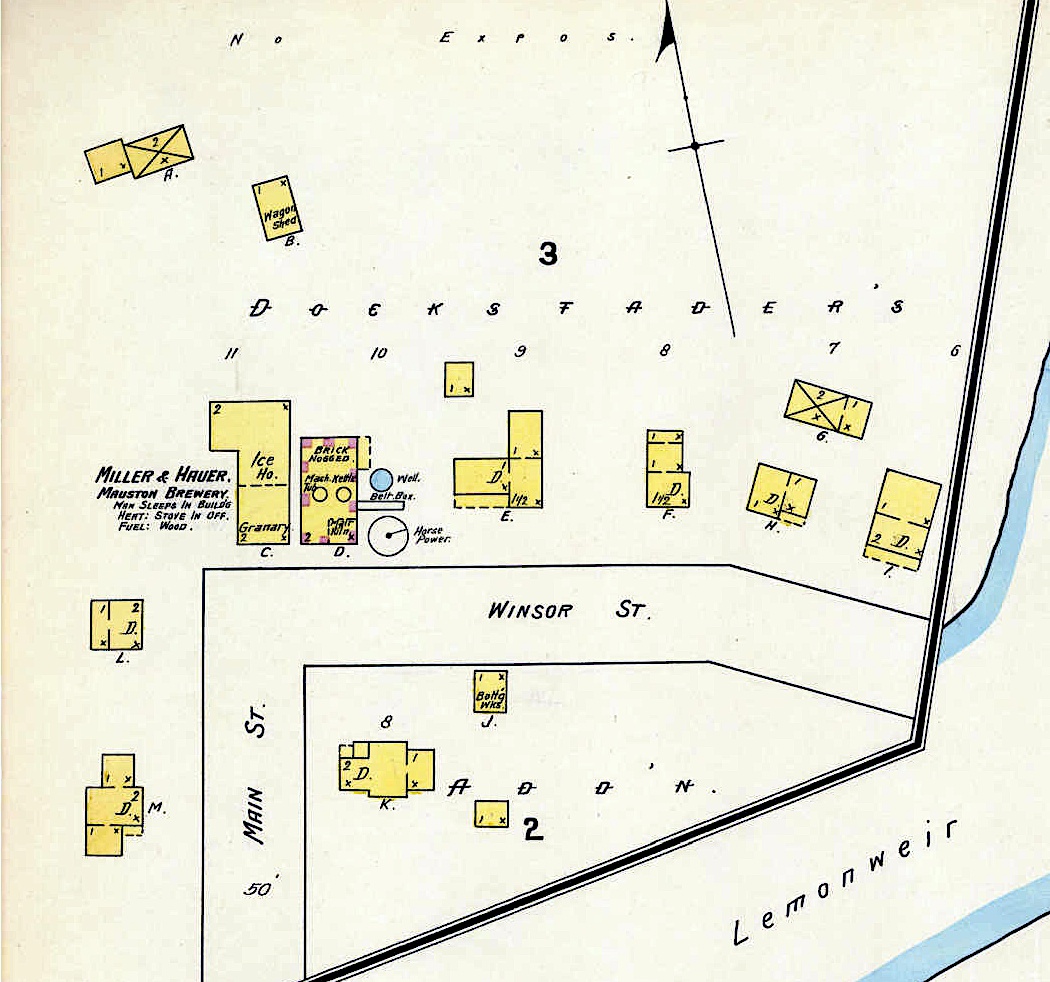
The fire map shows two Mauston Brewery buildings near the home at 22 Morris.
The 1894 fire map shows two Mauston Brewery buildings near the home at 22 Morris.

The old Hanneman home at 22 Morris Street was built around 1893 by Charles F. Miller, owner of the Mauston Brewery. Many of the details he put in the home — stained glass, hand-carved woodwork — remain to this day. The Sanborn maps show that the land around the home once included a bottling works and another out building related to the brewery. It is interesting that Morris Street is incorrectly labeled as Main Street on the 1894 version of the Sanborn map. By 1909, the bottling building near the Miller home was gone.

Across Winsor Street, the map shows a malt kiln, mash kettles, a well, a granary, an ice house and other outbuildings. The map notes that the buildings area heated by a wood stove, and a brewery employee sleeps in the building. The 1909 version of the Sanborn map shows addition of a second ice house on the shore of the Lemonweir River. Brewery workers cut ice blocks on the river in the winter, then moved them on a slide to the ice house.

The 1909 version of the map shows a second ice house near the river.

Charles Miller died in 1907, ending that family’s involvement in the brewery. Charles Ellison continued operating the brewery. By 1916, the brewery had ceased operation, according to Rossin’s book. A pickle factory started operation on the property, but it burned to the ground in 1922. Dr. J. Samuel Hess Jr. bought the land and built a brick ranch home in 1928.

©2014 The Hanneman Archive

William Carlin: Waukesha County’s Heaviest Man

Society’s obsession with weight is not a new phenomenon, but it seems a most curious detail to include in an obituary. William Carlin of the Town of Ottawa in Waukesha County, Wisconsin, suffered such a fate when newspapers made his girth the top fact in his obituary.

“Weighed 385 Pounds,” read the Page 1 headline in the The Waukesha Freeman on May 25, 1899. “Mr. Carlin weighed 385 pounds and was doubtless the heaviest man in the county,” the article said. “His death was caused by fatty degeneration of the heart.” Doubtless. It’s unclear how the newspaper reached such a conclusion. Carlin, who was just 50 when he died, was not part of a circus. He didn’t seek fame as the state’s fattest man. Yet the newspaper deemed his life should boil down to the fact he was heavy. The Weekly Wisconsin newspaper in Milwaukee also found Carlin’s weight newsworthy, but relegated it to Page 5.

The Waukesha Freeman carried the death of William Carlin on Page 1 in May 1899.

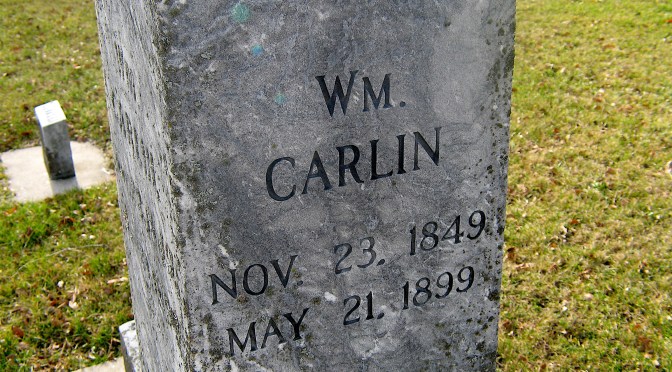
So history won’t remember him only for his body size, we’ll shed some more light on the life of William Carlin. Born November 23, 1849 in the Town of Ottawa, he was the son of Christopher Carlin and the former Elizabeth Cobb. Christopher Carlin died at age 37 in June 1858, when William was 8 years old. The Carlins were farmers on land northwest of tiny North Prairie. Christopher Carlin emigrated from England. At one time in the 1890s, William Carlin owned 300 acres of farmland in Waukesha County.

William Carlin married the former Annie Jones, and they had two children. Orville Walter Carlin, husband of Emma (Treutel) Carlin, was born February 5, 1874. Elizabeth J. “Lizzie” Carlin was born in January 1881. Their mother died in May 1889 at the young age of 37. Orville and Lizzie suffered a second tragedy in May 1899 when their father died, as newspapers said, from “fatty degeneration of the heart.” Orville married Emma Treutel and moved to Vesper, Wisconsin, where he operated a butcher shop. He died in 1934 at age 60. Lizzie married Jacob F. Supita. She died in 1944. William’s brother, Thomas Carlin, died in 1903 at age 52, so it seems genetics worked against the Carlin men.

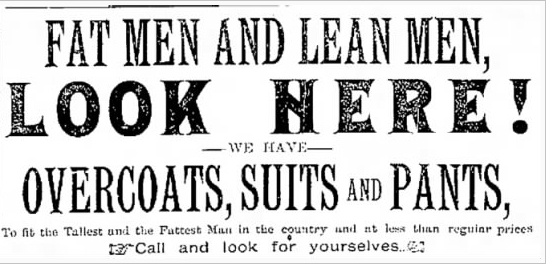
The Waukesha Journal carried this ad in November 1889.

Newspapers have long carried stories about record-setters, be it for height or weight. Often the subject of the stories sought the publicity. But what of those who didn’t? Did La Crosse businessman Samuel P. Welsh approve of his moniker as Wisconsin’s fattest man? When he married Grace Dutzel in June 1911, newspapers across the Midwest carried stories on how he weighed 400 pounds, while his bride “tipped the beam” at just 100 pounds. The Indianapolis News ran a Page 1 wire story on the Welshes arriving in Milwaukee for their honeymoon.

The Green Bay Republican carried this tidbit in December 1843: “The fattest man in the world lives in Connecticut. He is so thick through that he must lie down when he wishes to look tall.”

Dave McGuire of Silver Lake, Wisconsin, posed for a newspaper photograph in May 1921. It ran under the caption, “World’s Fattest? Who Knows?” “Dave McGuire of Silver Lake, Wis., doesn’t belong to a circus, nor does he ever expect to enter one,” one newspaper caption read. “He’s six feet seven inches tall and weighs 744 pounds, but he doesn’t care to go to the trouble of finding out whether he’s the fattest man in the world or not. He’s satisfied with the simple farm life.

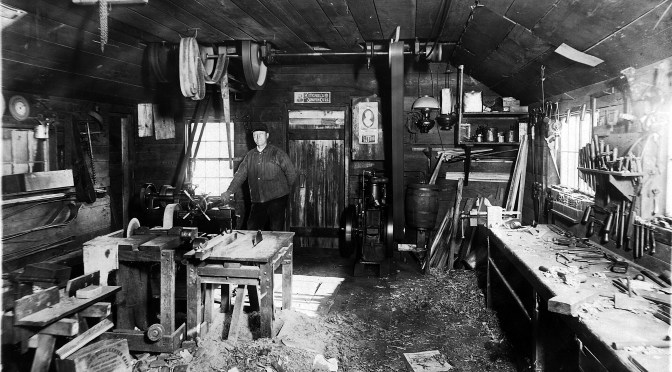
Treutel Bros. Blacksmith Shop at Vesper, Wisconsin

Charles Treutel (1869-1958) poses in the Treutel Bros. Shop at 
Vesper, Wisconsin, in 1911. Charles and his brother Henry A. Treutel 
(1864-1962) opened a blacksmith operation in Vesper after moving to Wood County from Mukwonago, Wis., in 1901. As can be seen in the photo, the Treutels also did carpentry work. The brothers later expanded their shop and made the transition from shoeing horses to tuning up engines and selling agricultural implements.

A 1911 book, Vesper, Wisconsin: A Sketch of  A Model City, described the business this way:

Charles and Henry Treutel, skilled mechanics, have operated the blacksmith and wagon shop at Vesper since Nov. 1901 and have built up a large and prosperous business by courtesy and excellent workmanship. They are masters of every line of their business and are especially skilled in horseshoeing and repair work. In addition to their shop work the Messrs Treutel carry a large line of farm implements and their mechanical knowledge has enabled them to select the best makes in all the lines of machines they carry. They have a model shop fully equipped for their work.

The Treutel Bros. learned their trade from their father, Philipp Treutel (1833-1891), who came to America from Germany in 1854. As detailed in a previous post, the Treutels were blacksmiths, carpenters, tallow chandlers and tailors from near Darmstadt, Germany. Philipp Treutel is buried at North Prairie, Wisconsin.

— This post has been updated with additional information.

©2014 The Hanneman Archive

A Village with its Own Song: Vesper on the Hemlock Creek

The tiny village of Vesper in Wood County, Wisconsin engendered such good feelings among its early residents that someone penned a tribute song to the village along the Hemlock Creek. The Hemlock Creek runs from just north of Arpin and flows south to the Wood County line. It includes more than 80 miles of streams.

The Treutel family enjoys a picnic lunch on their property along the Hemlock Creek, circa 1924.
The Treutel family enjoys a picnic lunch on their property along the Hemlock Creek at Vesper, Wisconsin, circa 1924. Pictured, L to R, are Elaine Treutel, Walter Treutel and Ruby Treutel. Marvin Treutel is partially hidden.

From the ashes of a massive sawmill fire in 1894, Vesper became a prosperous farming and manufacturing village 10 miles northeast of Wisconsin Rapids. Many of our relatives found work here and raised families. The village had a number of factories, general stores, a meat market, a locally owned bank, blacksmith shops, a community theater, a roller rink and more.

On warm summer days in the early 1900s, folks came from miles around to gather at the bandstand in Cameron Park. They enjoyed a variety of live music by the Vesper Cornet Band and other area musicians. It is not surprising such a place would win the hearts of its 300 residents.

The old Goldsworthy's Store in Vesper, which later became the Treutel Bros. store.
The old Goldsworthy’s Store in Vesper, which later became the Treutel Bros. store.

We don’t know the author of the Vesper song, or even the musical score. But its lyrics tell a story of how the pioneer residents believed in their little community on the winding creek. And if you need confirmation that it is a genuine Wisconsin song, just look at the pronunciation of the word “creek.” Or is that “crick?”


Vesper, Wisconsin on the Hemlock Creek

1) You can rave about your cities with their glitter and their show,

And the interesting places where people like to go

But to come to solid comfort we can show you all a trick,

Where? Vesper, Wisconsin on the Hemlock Creek

Chorus

Vesper for mine, yes it’s Vesper for mine,

She isn’t very big, but she’s the best on the line,

They can travel where they want to

But we’ll try our best to stick,

Where? Vesper, Wisconsin, on the Hemlock Creek.

2) It’s the home of dandy people and their children not a few,

It’s the home of cheese and butter and a big condensery, too,

They make drainage tile and silos, have a band and park that’re slick

Where? Vesper, Wisconsin, on the Hemlock Creek.

3) Now the people are so busy that it keeps them on the go,

So they haven’t got a bit of time to stop and watch her grow,

It’s the town where things are doing and we aim to do them quick,

Where? Vesper, Wisconsin, on the Hemlock Creek.

4) To each stranger who is seeking for a place to build his roost,

We extend an invitation to the town for which we boost,

We’ll be glad to have you with us and we know you’ll want to stick,

Where? Vesper, Wisconsin, on the Hemlock Creek.

The Vesper Cornet Band performed at the Cameron Park band shelter and other locales around Vesper, Wisconsin. Oscar, Charles and Henry Treutel were band members.

The Treutel Family: From Königstädten to Wisconsin

They were craftsmen — blacksmiths, tailors, chandlers, carpenters — the clan of Treutels who came to Wisconsin from the Darmstadt area of Germany starting in 1849. The Johann Adam Treutel family left the village of Königstädten between 1849 and 1854 and headed for America. They were part of a huge wave of German emigrants that changed the face of Wisconsin and the United States.

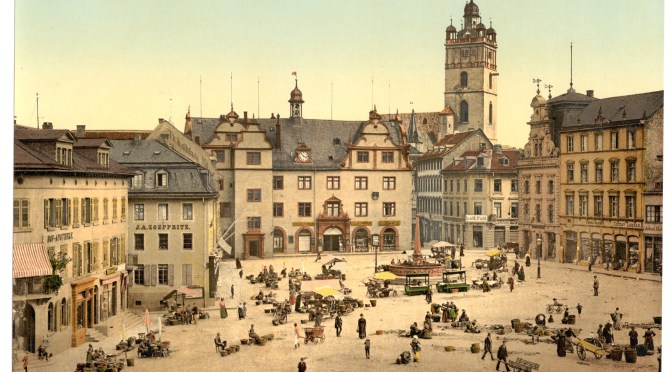
The Wisconsin branch of the Treutel family tree is from Königstädten, a village just northwest of the city of Darmstadt. From this “king’s village” came Johann Adam Treutel and his wife, Elizabetha Katharina (Geier) Treutel. According to the Hessisches Staatsarchiv in Darmstadt, Adam, Katharina and at least some of their children left for America in July 1854. The emigration index simply lists that the eldest Treutel traveled “with his family.”

Their son John Treutel had already been in Wisconsin for some two years when they departed Germany. We believe the 1854 traveling party included at least three other Treutel children: Philipp Treutel, 21; Sebastian Treutel, 19; and Henry J. Treutel, 13. Their destination was Milwaukee. In May 1849, the eldest Treutel child, Adam, left for America, living in New York for a time before moving to Milwaukee.

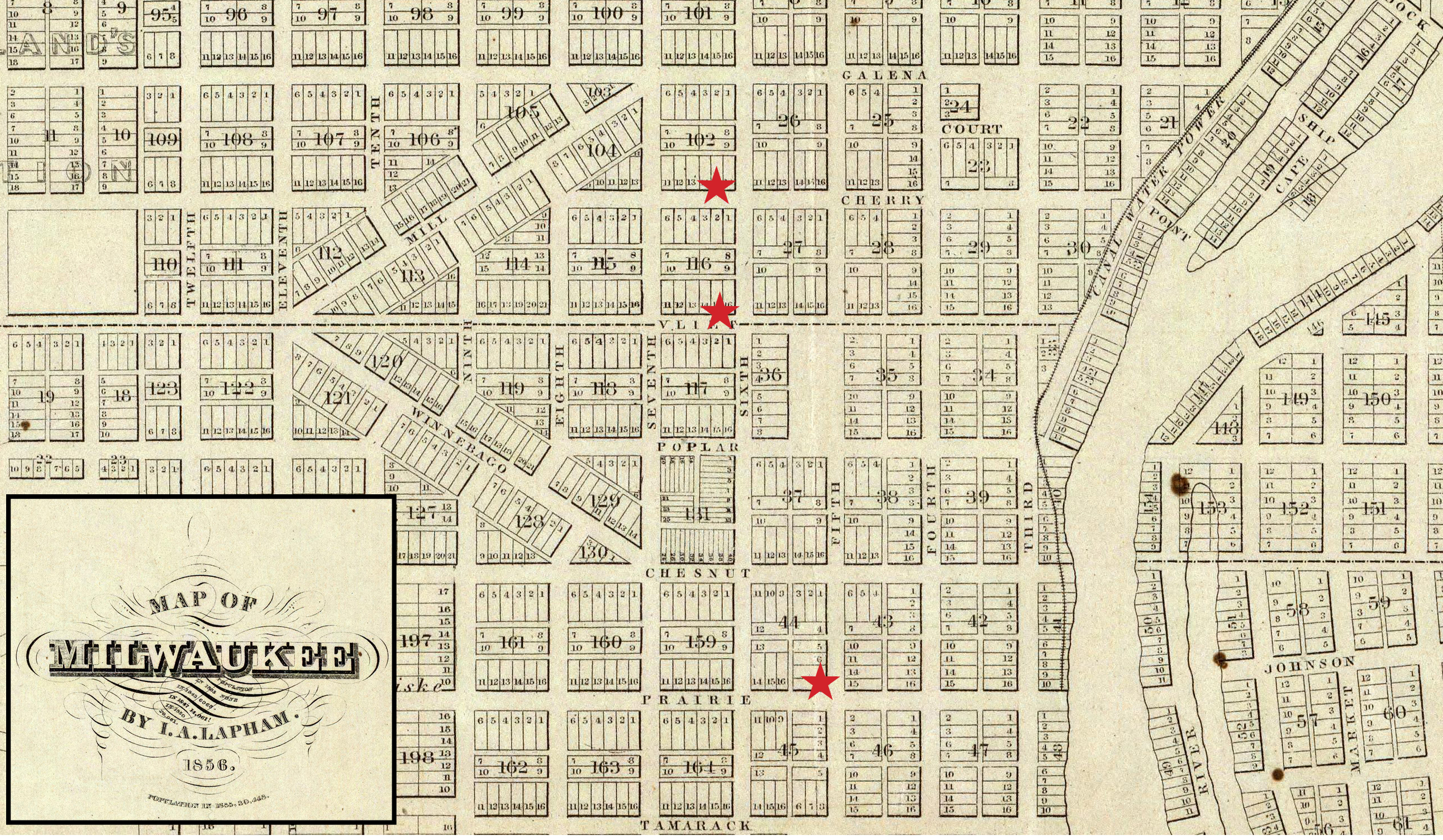
The red stars show locations where members of the Treutel family operated blacksmith and chandler shops in Milwaukee. At right is the Milwaukee River.

The Treutel family ran a tallow chandler shop near downtown Milwaukee. The shop sold soap and candles made from animal fat and other ingredients. At various times in the 1860s and 1870s, Adam Jr. worked as a railroad man, a tallow chandler and a tailor. The Treutels, some of whom lived in Milwaukee’s Second Ward, had good Darmstadt neighbors, including master brewers Joseph Schlitz and Phillip Best. When their father Johann Adam died in Milwaukee in 1859, some of the Treutel sons took up residence with other German families in Milwaukee.

Although his primary residence was in Mukwonago in Waukesha County, Philipp Treutel is listed in the 1863 Milwaukee city directory as having a blacksmith shop at the southwest corner of Fifth and Prairie in downtown Milwaukee. He is listed in the 1867 directory as living at 517 Cherry St., next door to his younger brother, Henry. So it appears Philipp moved between Milwaukee and Waukesha counties, probably based on availability of work.

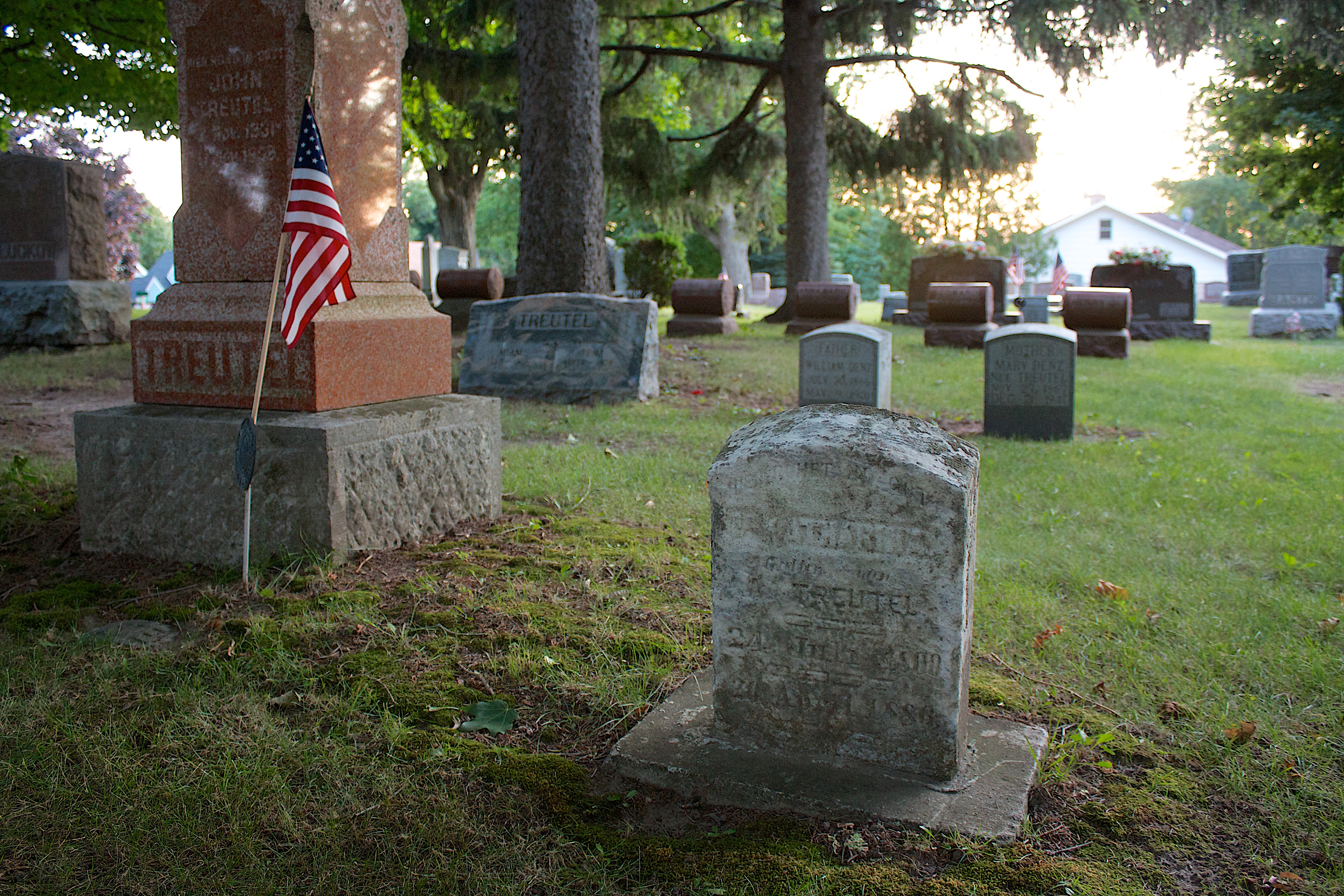
The tombstone of Katharina (Geier) Treutel sits in the shadow of the monument to her son, John, at Union Cemetery in West Bend, Wis.

Katharina Geier Treutel was born on July 24, 1800 in Hesse-Darmstadt, the daughter of Nicolaus and Elizabetha Geier. She married Johann Adam Treutel sometime around or just after 1820. She died on April 26, 1886 in the Town of Addison, Washington County, Wis., and is buried at Union Cemetery in West Bend. The cause of death was listed as marasmus senilis, which basically means old age. She had eight children, five of whom (along with 42 grandchildren) survived her. Her tombstone reads:

Hier Ruht in Gott (Here Rests in God)

Katharina

Gattin von (Wife of)

A. Treutel

Philipp Treutel settled in Mukwonago in Waukesha County, where he married Henrietta Krosch and fathered seven children, including Walter Treutel (father of Ruby Treutel Hanneman). He was a blacksmith, and probably learned the trade from his father. After Philipp’s death in 1891, Henrietta moved the Treutel family to Vesper in Wood County, Wisconsin.

Henry J. Treutel enlisted in the 26th Wisconsin Infantry Regiment during the Civil War, and fought at the Battle of Gettysburg. Sebastian also joined the 26th Wisconsin, but was given a disability discharge in August 1863, possibly from wounds during the war. We don’t believe Philipp or John Treutel were called into service.

Henry, Sebastian and John Treutel eventually settled in the Town of Addison, Washington County. John was a carpenter. The 1870 U.S. Census for the Town of Addison shows a Jacob Treutel, 31, living at the John Treutel homestead. It is possible that Jacob, who would have been born about 1839, was a younger brother. Sebastian was also a carpenter, but he later worked hauling the U.S. Mail in Washington County. Henry operated a blacksmith shop, a store, a saloon and a cheese factory near the village of Aurora. He later moved to Wausau.

Based on all of the evidence we’ve gathered, it appears the Johann Adam Treutel family included Adam (1822), John (1831), Philipp and deceased twin brother (1833), Sebastian (1835) and Henry (1841). Other possible children are Peter and Jacob, but more research is needed to establish their lineage.

Family Line: Johann Adam Treutel >> Philipp Treutel >> Walter Treutel >> Ruby Treutel Hanneman >> Donn, David and Lavonne Hanneman.

Monument of Philipp Treutel, grandfather of Ruby (Treutel) Hanneman, at North Prairie Cemetery in Waukesha County, Wis.
Monument of Philipp Treutel, grandfather of Ruby (Treutel) Hanneman, at North Prairie Cemetery in Waukesha County, Wis. Philipp died in 1891.

Treutels in Good Pioneer Company in 1850s Mukwonago, Wisconsin

When the Johann Adam Treutel family emigrated to America from Darmstadt, Germany, they spread out across Eastern Wisconsin. Young Philipp Treutel and his wife settled in rural Waukesha County and became neighbors of some of the area’s best known pioneers. The young blacksmith set up shop in the heart of the village of Mukwonago, former Potawatomi Indian lands on the banks of what was then called Mill Pond.

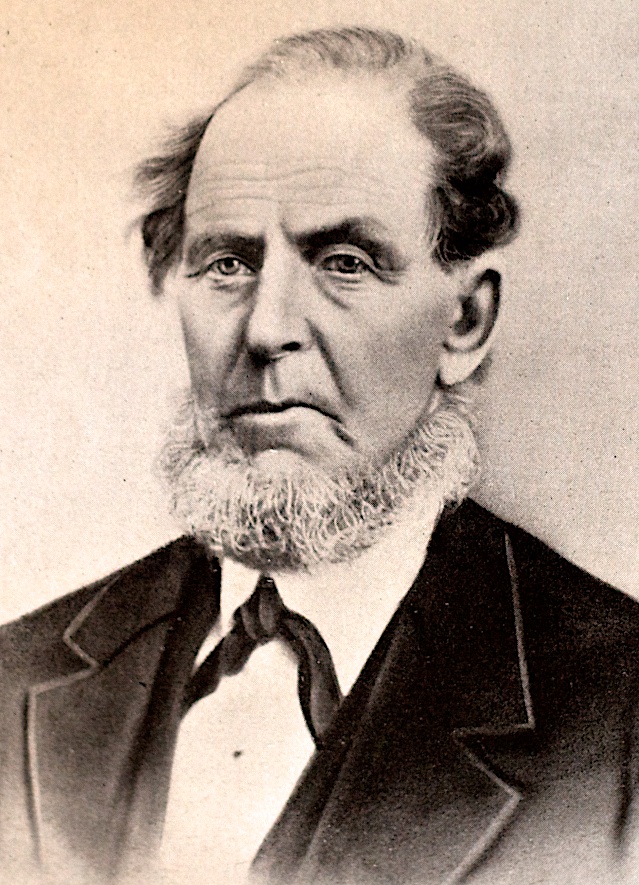
Sewall Andrews
Sewall Andrews

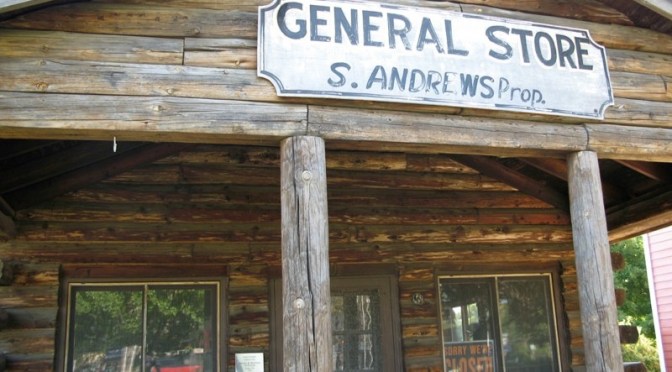
According to the 1860 U.S. Census, Philipp, Henrietta and baby Adeline Treutel lived in the same area as Sewall Andrews, the founder of Mukwonago and a major Wisconsin land owner. Andrews built a general store in 1837 that became a major trade center for the county. He built his own red brick house at the village center in 1842. The brick house still stands today along Main Street in Mukwonago and now houses the local museum. It is listed on the National Register of Historic Places.

Sewall Andrews built his red brick house in Mukwonago in 1842.


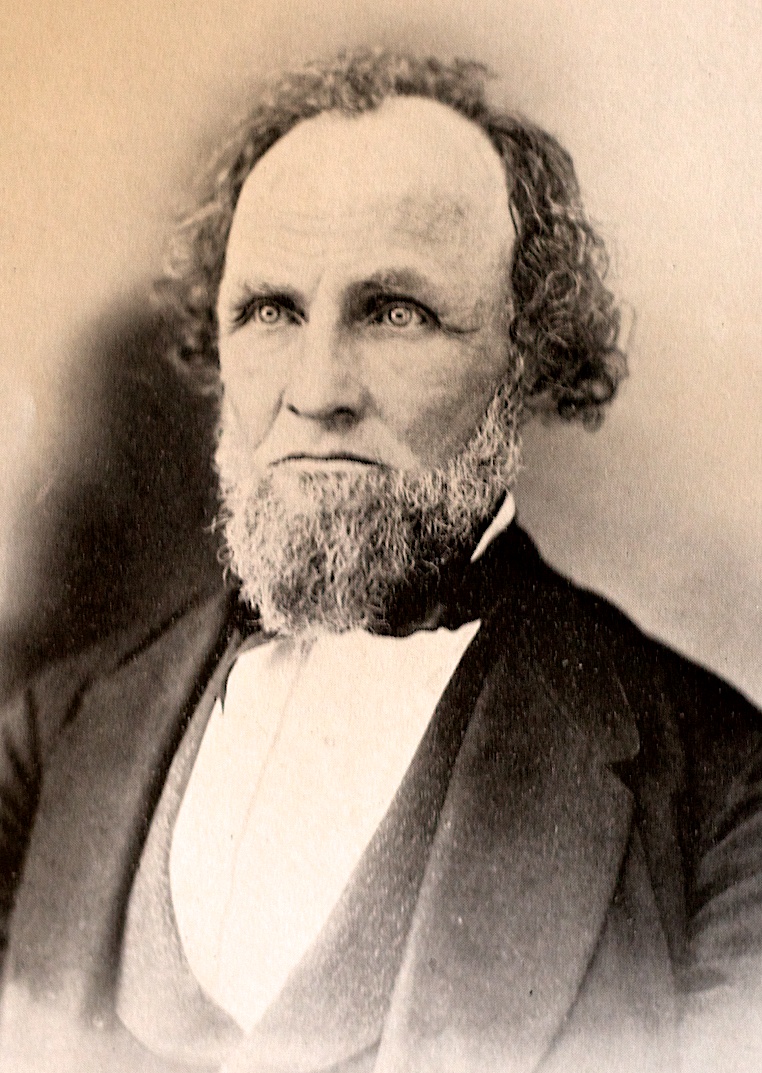
The Treutel residence is listed as No. 379 made during census visits in Mukwonago. The Andrews’ home was No. 372. Other nearby residents included Samuel Worthman, the village cooper (barrel maker); Martin Field, who owned the saw mill; Hezekiah Job, the tailor; and Melvin Gibson, who ran the livery stable. Field was also an attorney who became town justice of the peace and later a Waukesha County judge. The village park is named in his honor.

Judge Martin Field
Judge Martin Field

The 1870 plat map for Waukesha County shows Philipp Treutel’s blacksmith shop and residence mere blocks from Andrews’ famous red brick home. The Treutel shop was near the intersection of Fox and Mill streets, close to the office of H.A. Youmans M.D., the town’s physician and surgeon. Nearby was Mukwonago House, the hotel run by Adolph Platner. Just to the south were the E.H. Kellogg saw mill and grist mill on the banks of the Mukwonago River.

Cropped view of portrait of Henrietta (Krosch) Treutel (1838-1908). Henrietta Krosch came to America in July 1854 at age 16 from the town of Jessnitz, Saxony, Germany. Her family settled at Mukwonago, where her father, John Frederick Krosch, became a well-known farmer. She met and married blacksmith Philipp Treutel and lived the next 35 years in Mukwonago and North Prairie. Widowed in 1891, she moved her family to Vesper in Wood County in 1901, where she died on Feb. 6, 1908. She is buried at North Prairie Cemetery.

We know the Treutel family moved from Mukwonago to the crossroads village of North Prairie, since obituaries and other newspaper accounts referred to the family homestead at North Prairie. However, the family name is not shown on the 1891 plat map for North Prairie. It is possible they had a homestead on some of the property owned by the Carlin family.

The family included Adeline Barbara (1859-1928), Lisetta (1861-1931), Henry Adam (1864-1962), Charles (1869-1958), Oscar (1874-1967), Emma (1877-1962) and Walter (1879-1948).

After Philipp Treutel died in June 1891, his widow moved the family north to tiny Vesper, in Wood County. Her sons worked as blacksmiths, retail merchants and a U.S. Postal Service carrier. Emma Treutel Carlin served as postmistress of Vesper in the early 1900s. Henrietta Treutel died in 1908. Philipp and Henrietta are buried at North Prairie Cemetery.

Walter Treutel’s 240,000-mile Journey Through Wood County, Wisconsin

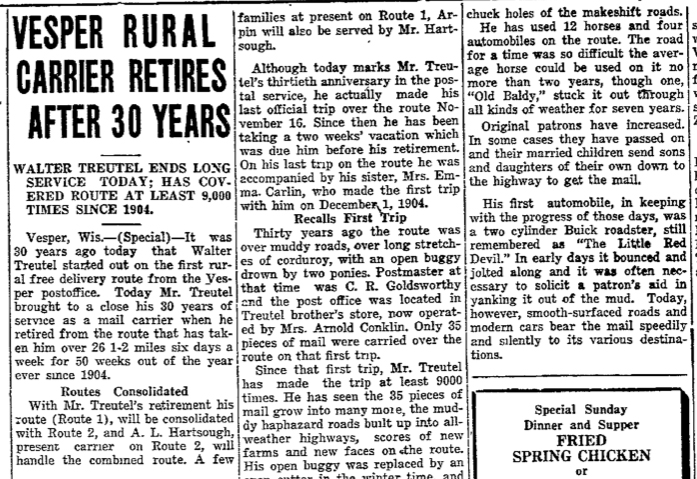
It would be hard not to respect a man who worked diligently at his job six days a week for 30 years. For Walter Treutel, the job record was even more impressive. His career as a rural letter carrier took him on a nearly 240,000-mile journey making sure the people of Vesper, Wisconsin received their mail and packages from 1904 to 1934.

Walter Treutel of Vesper, Wisconsin.

“The new rural mail carriers who will begin carrying mail on the 10 new routes on December 1st received their appointment from Washington last week,” the local Grand Rapids, Wis., newspaper announced in November 1904. “These carriers all took the competitive examination in this city four weeks ago and those fortunate to receive an appointment will now only have to file their bond for the faithful performance of their duty.” Walter’s first day as a letter carrier was Dec. 1, 1904. He was just two years married to the former Mary Ladick, and their firstborn child, Ruby, was just six months old.

His first trip over Rural Route 1 was made in an open buggy pulled by two ponies. He and his sister, Emma Carlin, rode that first 26.5-mile run together to deliver just 35 pieces of mail. At the time, the Vesper postal station was located inside the Treutel Bros. store, run by Walter’s brothers, Charles and Henry Treutel. Walter’s official postal substitute was his wife, Mary.

Walter Treutel picnics with children Nina, Elaine and Marvin, circa 1925. Behind the camera is Ruby (Treutel) Hanneman.

The dirt roads were rough and filled with chuckholes. The buggy rode over corduroy — soft or swampy sections that were shored up by placing logs  across the path. Roads were so punishing in those early days that horses typically lasted only two years in service.

The first open postal buggy was eventually replaced by a covered postal wagon. Walter used a dozen horses on his  route over the years. One of the toughest, “Old Baldy,” served for seven years in all sorts of weather. His first automobile, a two-cylinder Buick roadster, was nicknamed “The Little Red Devil.” Three other postal vehicles served on the route during his tenure.

He served under five postmasters during his 30 years, including his sister Emma Carlin, who was Vesper postmistress for nine years starting in 1906. In November 1934, Walter took his overdue two-week vacation, then returned for one final route on Dec. 1 — thirty years to the day after his first day on the job.

Walter Treutel with second wife Vera (at left), sister Emma Carlin, daughter Ruby Hanneman and grandchildren Lavonne and David D. Hanneman.

Walter was born July 23, 1879 in Mukwonago, Wisconsin, the son of Philipp and Henrietta (Krosch) Treutel. Walter’s wife, the former Mary Helen Ladick, died in 1925 after suffering a post-operative infection. She was just 41. They had five children, four of whom (Ruby, Nina, Marvin and Elaine) survived into adulthood. Walter died Feb. 15, 1948 of lingering heart disease. He was 68.

The Wisconsin Rapids Daily Tribune wrote about Walter Treutel's last day on the job in 1934.
The Wisconsin Rapids Daily Tribune wrote about Walter Treutel’s last day on the job in 1934.

FAMILY LINE: Johann Adam Treutel >> Philipp Treutel >> Walter Treutel >> Ruby (Treutel) Hanneman >> Donn, David and Lavonne Hanneman.

Earliest Known Photo Shows Chas. Hanneman Family in 1905

Another newly discovered photograph from 1905 shows the Chas. Hanneman family of Grand Rapids, Wisconsin. It is the earliest known photo of this family, and the only clear photograph we have of mother Rosine Bertha Henrietta (Osterman) Hanneman.

This photo is a real treasure for its clarity and detail. Often prints this old have many flaws and defects, but this is one of the best in the Hanneman Archive collection. We received it courtesy of Tom Hanneman of Minneapolis. It was originally from the photo collection of one of the boys in the photo, Carl Henry Frank Hanneman (1901-1982).

It is also one of perhaps three photos we have that show Rosine  “Rosie” Hanneman. This mother of five (her firstborn died in 1891) died on Easter Sunday 1918 of diabetes. She was just 47 years old. She lived in the days before availability of insulin.

The father of the family, Carl Frederick Christian (“Chas”) Hanneman (1866-1932) worked many jobs in central Wisconsin. He was initially a farmer after emigrating to Wisconsin from Meesow, Kreis Regenwalde, Pomerania, in November 1882. He worked in the timber industry before moving his family to the city of Grand Rapids (now called Wisconsin Rapids). There he worked as a laborer (17 cents per hour) digging and installing the city’s new sewer system in the early part of the 20th Century. Eventually, Chas took on work in a paper mill. He died of prostate cancer shortly after retiring from the mill.

One of Chas’ grandchildren, Donn G. Hanneman, recalled sitting on the hospital bed when Chas was being treated for his cancer. “I’m going to heaven soon,” Chas told the 6-year-old. “I’d like it if you would put flowers on my grave.”

Rosine Bertha Henrietta (Osterman) Hanneman (1870-1918), Frank Herman Albert Hanneman (1895-1947), Arthur James Hanneman (1893-1965), Carl Henry Frank Hanneman (1901-1982), Wilbert George Hanneman (1899-1987) and Carl Frederick Christian (Chas) Hanneman (1866-1932).