Her look of delight really tells the whole story. Little Jane Patricia Hanneman, beholding a cake on her third birthday, shows a priceless expression. She celebrated her birthday in October 1958 with her paternal grandparents, Carl F. Hanneman (1901-1982) and Ruby V. Hanneman (1904-1977) at their home in Mauston, Wisconsin. In the background of the photo is her aunt and my Mom, Mary K. Hanneman. She could not have known it at the time, but Jane’s birthday falls on the same date as the 1819 wedding of her great-great-great grandparents, Matthias Hannemann and Caroline (Kuehl) Hannemann. The couple were married at Meesow, Regenwalde, Pomerania.
My Dad, David D. Hanneman, also shot some 8mm film at the celebration, which can be viewed below:
In the first half of the 20th century, druggists in America were often called on to literally fill prescriptions, placing medications into gelatin capsules and then counting out the order. Mauston pharmacist Carl F. Hanneman was very efficient at the task. Maybe too much so, opined The Mauston Star in a rather humorous article in December 1953.
“Joe Dziewior and this muser, watching ‘pestle and mortar’ Carl Hanneman throw a prescription together the other evening, now know why pill or capsule counting machines not not necessary to the registered pharmacist,” read the article on December 11, 1953. “With bottle in hand, Carl was pouring capsules into his hands and counting them faster than an adding machine.”
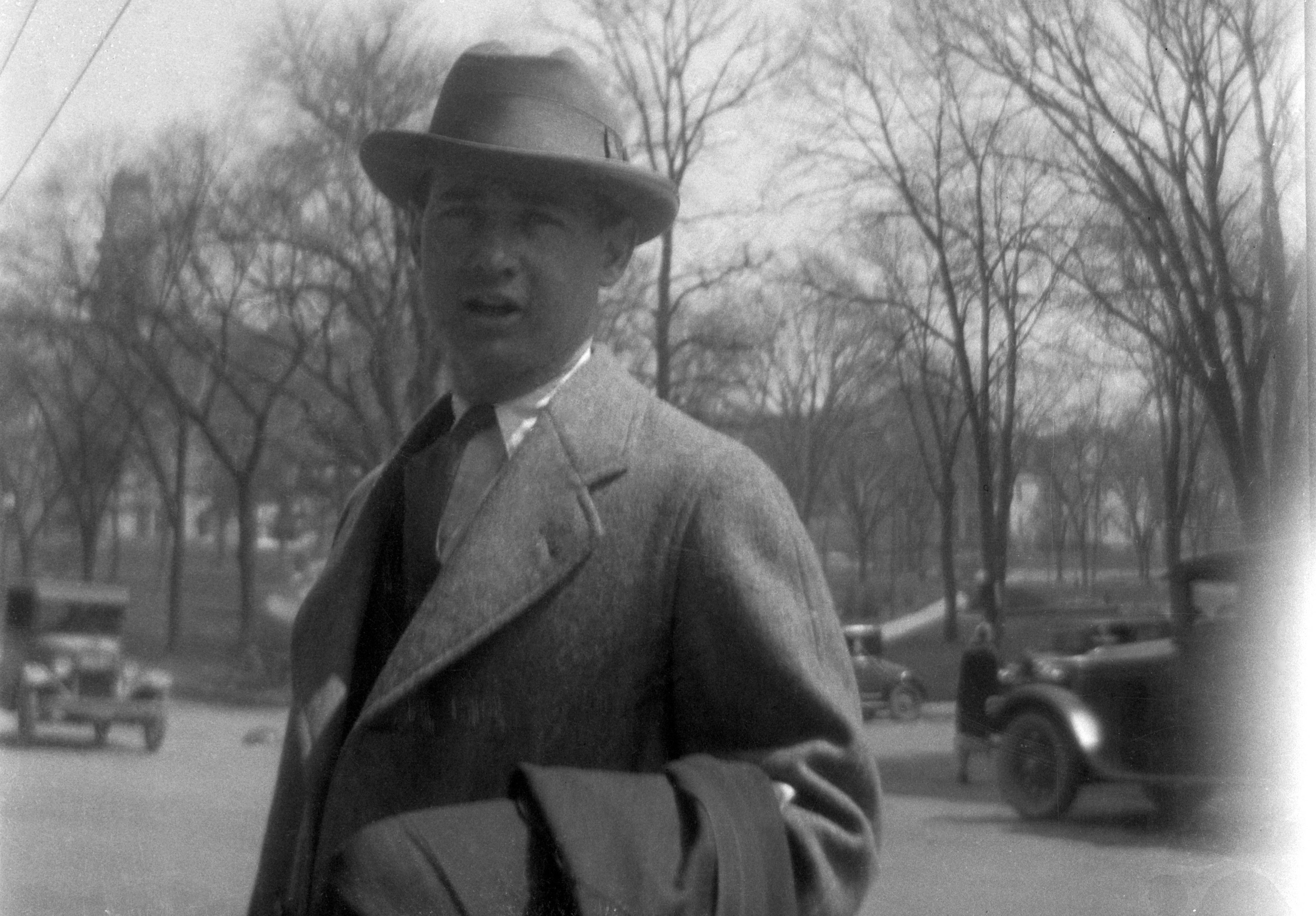
Carl F. Hanneman taking his suits to the cleaner at Janesville, Wis., on April 5, 1926. Carl and his wife, Ruby V. Hanneman, were on their way to dinner. Carl was a druggist at McCue & Buss Drug Co. at the time. He later moved to Mauston, Wis.
Carl was the registered pharmacist at the Mauston Drug Store on Division Street in Mauston. He had been the druggist there since moving his young family to Mauston in 1936 from Wisconsin Rapids. A graduate of Marquette University, Carl started as an assistant pharmacist, but obtained his full registered pharmacist license in the 1940s.
“After watching him for some time, we entertained a doubt as to the accuracy of the counts and Joe was inclined to agree with us,” the article continued. “But Carl said he could count pills time on end and whistle a tune at the same time, and still come out the a correct count. ‘Come, come, Carl!’ we exclaimed. ‘Isn’t that pulling our leg a bit?'”
Judging by Carl F. Hanneman’s vials from McCue & Buss Drug Co., registered pharmacists packaged both pre-made pills and medicine capsules.
Carl told the men a story of a “kindly old lady” who regularly came in for prescriptions and doubted the counts doled out by the druggist. “It never failed, but that after we wrapped up her prescription, she’d sit in the chair out there, undo the package and count the pills in the box,” Hanneman said. “To this day, she hasn’t demanded a recount!”
The article concluded: “Maybe registered pharmacists should be made ballot clerks. Recounts wouldn’t be necessary!”
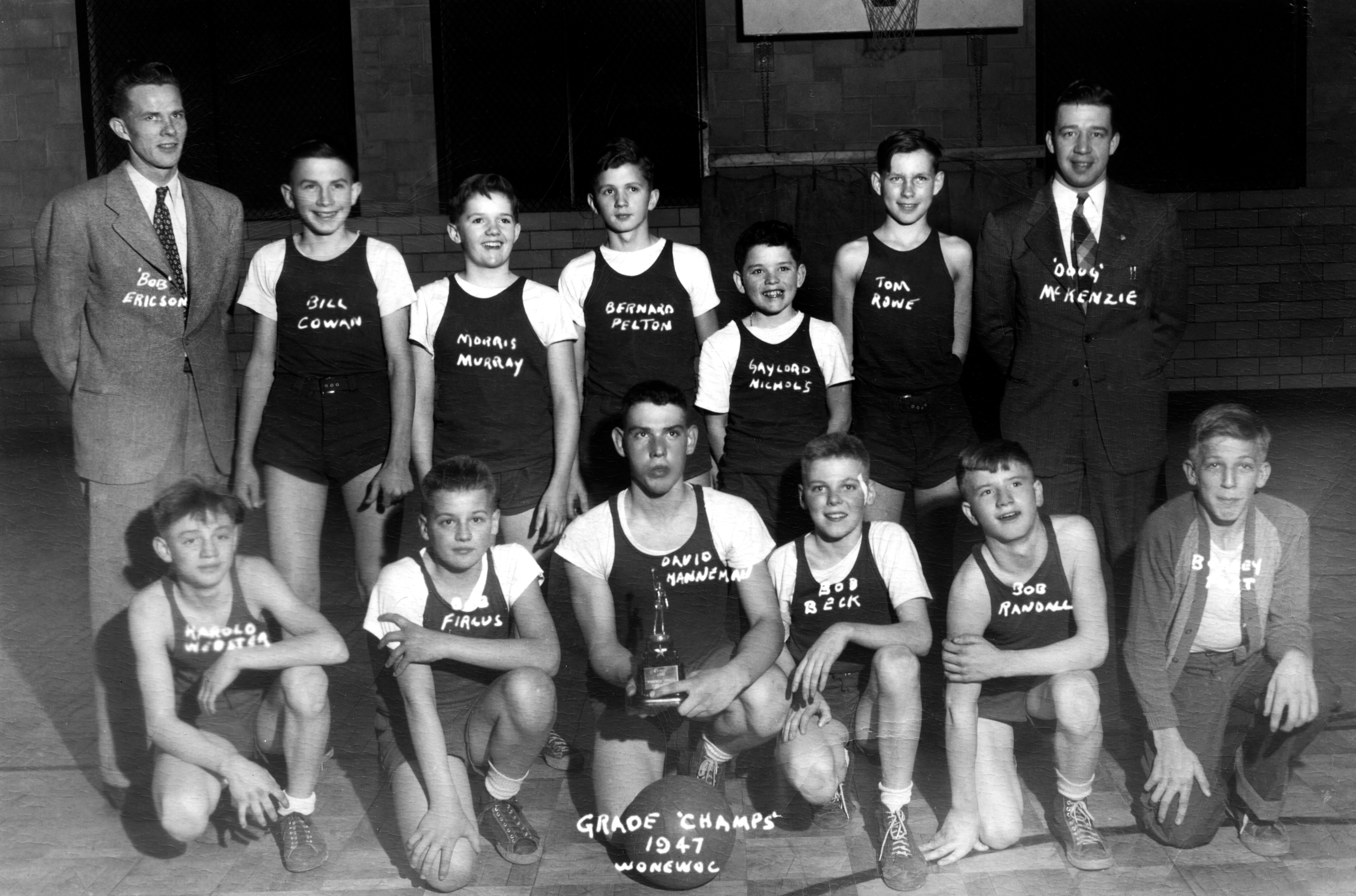
There he was, front and center in the photograph, holding the championship trophy. My Dad, David D. Hanneman and his 8th grade Mauston teammates had just won the 12-team basketball tournament held at Wonewoc in the spring of 1947. It was no small feat, considering the competition from Camp Douglas, Cazenovia, Elroy, Kendall, Lavalle, Necedah, New Lisbon, Ontario, Reedsburg, Union Center and Wonewoc.
The Mauston 8th grade boys basketball team won the 1947 Wonewoc tournament.
The championship team photo includes, rear, left to right: Coach Bob Erickson, Bill Cowan, Morris Murray, Bernard Pelton, Gaylord Nichols, Tom Rowe and Coach Doug McKenzie. Front row, left to right includes: Harold Webster, Bob Firlus, David Hanneman, Bob Beck, Bob Randall and Whitey Post. Although the photo does not show jersey numbers, Dave wore No. 1 that day.
The 12 teams and players were listed on the event program from 1947.
Occasionally prints of this photo will appear on eBay, erroneously listing the team as from Wonewoc. That is understandable given how the photo was hand labeled, but to be clear, the winners were from Mauston.
The 1947 football campaign was destined to be one for the ages at Mauston High School. The photo gallery below could be from that championship season, based on the youthful appearance of my Dad, David D. Hanneman (1933-2007). Dad was a starter for the Mauston Bluegold, even in his freshman year.
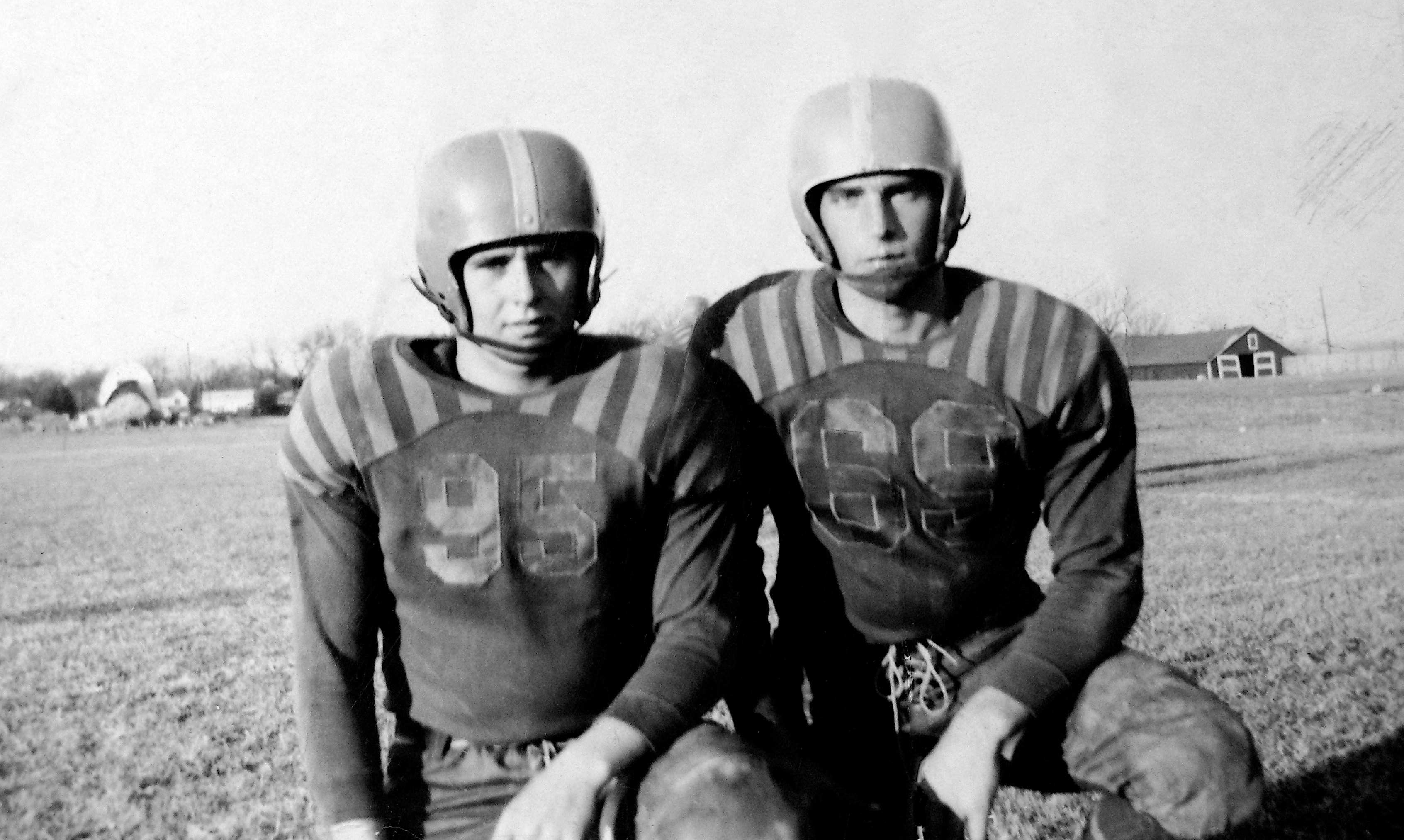
David D. Hanneman (center) played tackle, guard and on occasion, running back, for Mauston High School during the 1947-50 football seasons.
Dad played guard and tackle throughout his high school football career. But as is the case on small-town football teams, boys play both offense and defense. Many of the players would switch positions, depending on the opponent and game conditions.
Mauston ran up a 7-1 record in the 1947 football campaign, gaining them a share of the West Central Conference championship crown. Mauston was 3-1 in conference play. Midway through the season, Mauston ranked as one of the state’s highest-scoring teams. Here’s the 1947 season recap:
Sept. 12 Mauston 12, Reesdburg 0
Sept. 19 Mauston 25, Middleton 6
Sept. 26, Mauston 20, New Lisbon 12
Oct. 3, Mauston 13, Tomah 0
Oct. 10, Mauston 45, Westby 6
Oct. 17 Sparta 14, Mauston 7
Oct. 24 Mauston 37, New Lisbon 0
Nov. 1 Mauston 13, Viroqua 0
Dave Hanneman (at right) in one of his early years in Mauston football.
Bob “Jigger” Jagoe, who played quarterback for Mauston starting in the 1948 season, recalls how Dave’s mother, Ruby V. Hanneman, was zealous in her cheering.
You could hear her in the stands, shouting. She was so proud. Of course we used to kind of make a mockery of it, because she was so adamant, letting everybody know who her son was out there who made the tackle. They announced, ‘Tackle made by Dave Hanneman’ and she said, ‘That’s my Davey!’
In the 1950s, home football games were played at Veterans Memorial Park on the south end of Mauston. This locale looks much closer to downtown, so I’m betting these 1940s games were played in Riverside Park along the Lemonweir River. In several of the photos you can see the distant spire of St. Patrick’s Catholic Church.
— This post has been updated with quotes and other information.
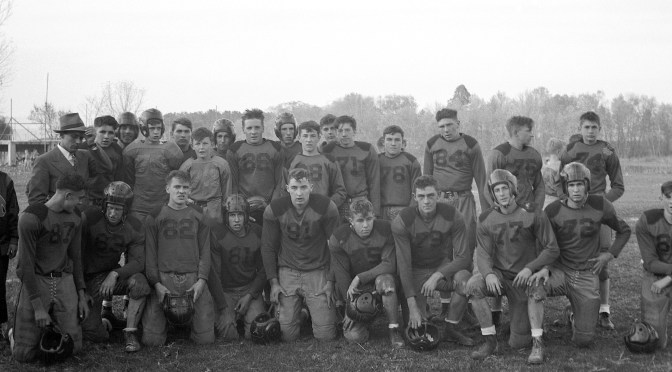
Dave Hanneman can be seen in the last row at left, second in from Coach McKenzie. Bob Jagoe is on his left. Front and center (91) is Dick Hale.
Mauston coach Doug McKenzie and players follow the on-field action.
A great view of the crowd at Riverside Park in Mauston.
It’s not clear if this galloping ghost is David D. Hanneman. He usually played at the line.
The Mauston Bluegold huddle before the play.
This appears to be a victory celebration.
Game action from this 1947 football contest at Mauston.
A good look at the spectators at Riverside Park. Recognize anyone?
Game action from this 1947 football contest at Mauston.
Dad’s conference crown medal from the 1947 championship season.
Another group shot of the team. On this one, Dave Hanneman (back row left, second from coach) has his tongue sticking out. Front and center (91) is Dick Hale.
A U.S. Navy recruit, probably a graduate of Mauston High School, watches the action.
A Mauston game program from September 1950. Note the team plays at Veterans Park instead of Riverside as in earlier years.
I just learned with sadness of the death of my Dad’s older brother, Donn Gene Hanneman, who died in Minneapolis at age 88. Uncle Donn was the last of the Mauston Hanneman family to pass away. My Dad, David D. Hanneman, died in 2007 at age 74.
I have many memories of my uncle. He was foremost the father of nine wonderful human beings, my cousins Diane, Caroline, Tom, Jane, Mary Ellen, John, Jim, Nancy and Thomas Patrick (March 1-4, 1949). The cousins were raised by a saintly mother, my aunt Elaine Hanneman.
Donn G. Hanneman
Donn was a veteran of World War II and served as a seaman-second class on the USS Hoggatt Bay. The USS Hoggatt Bay (CVE-75) was a Casablanca-class escort carrier (crew of 860) commissioned in December 1943.
Donn G. Hanneman lounges outside his Grandpa Treutel’s home in Vesper, Wisconsin.
Donn was born on August 20, 1926, in Wisconsin Rapids to Carl Henry Frank Hanneman (1901-1982) and the former Ruby Viola Treutel (1904-1977). In 1936, the Hanneman family moved to Mauston in Juneau County, where Carl took a job as a pharmacist attached to the Mauston hospital and clinic. By that time, my father had come along (March 1933). In August 1937, the family expanded to include Lavonne Marie Hanneman Wellman (1937-1986).
As a boy, Donn had his share of illnesses and injuries. He spent more than a week in the Marshfield hospital in September 1929, then returned there in April 1930. Just before my Dad was born in March 1933, Donn was hospitalized in Wisconsin Rapids for more than a week, after an operation for appendicitis.
Donn Gene Hanneman sits in an indoor baby swing at the Hanneman home in Fond du Lac, Wisconsin, ca. 1927. Carl Hanneman was a pharmacist for the Staeben Drug Co. in Fond du Lac at the time.
Just after his 11th birthday in August 1937, Donn was standing on the running board of a moving vehicle while leaving the Juneau County Fairgrounds when he fell and suffered a head injury. He was seen at the Mauston clinic and taken home, but soon after “lost his power of speech and all consciousness,” according to an account in The Daily Tribune in Wisconsin Rapids. “He was then rushed to the hospital.” Donn was diagnosed with a concussion and put on two weeks of bed rest, although that was extended. The September 8 edition of The Daily Tribune said Donn “is making a satisfactory recovery, although he will be confined to his bed for two more weeks.”
Back in those days, a family’s every move ended up in the newspaper. In the case of the Hannemans, it was thanks to the faithful correspondence of Ruby Hanneman. “Mr. and Mrs. Carl Hanneman and little son Don Gene were completely taken by surprise last evening when forty friends arrived to give them a house warming on the occasion of moving into their new home on Hale Street,” the Wisconsin Rapids Daily Tribune reported on April 8, 1932.
Some of the most charming photographs in our library are of a 5-year-old Donn dressed up as a cowboy playing with friends on the sidewalks on the 1200 block of Washington Avenue in Wisconsin Rapids. We detailed those photos in a previous post.
Donn in his cowboy threads at Wisconsin Rapids.
As a youth Donn enjoyed books, and collected enough that his father built him a bookcase that held up to 175 volumes. Carl wrote to my then 6-year-old father about it in August 1939. Dad was staying with an aunt and uncle in Waukegan, Illinois. “Say David, I made a book case for Donn for his birthday, and you know that you still have something coming,” Carl wrote, “so what would you like to have Dad make something for you too, if so tell mother and I will try to start it as soon as I can.”
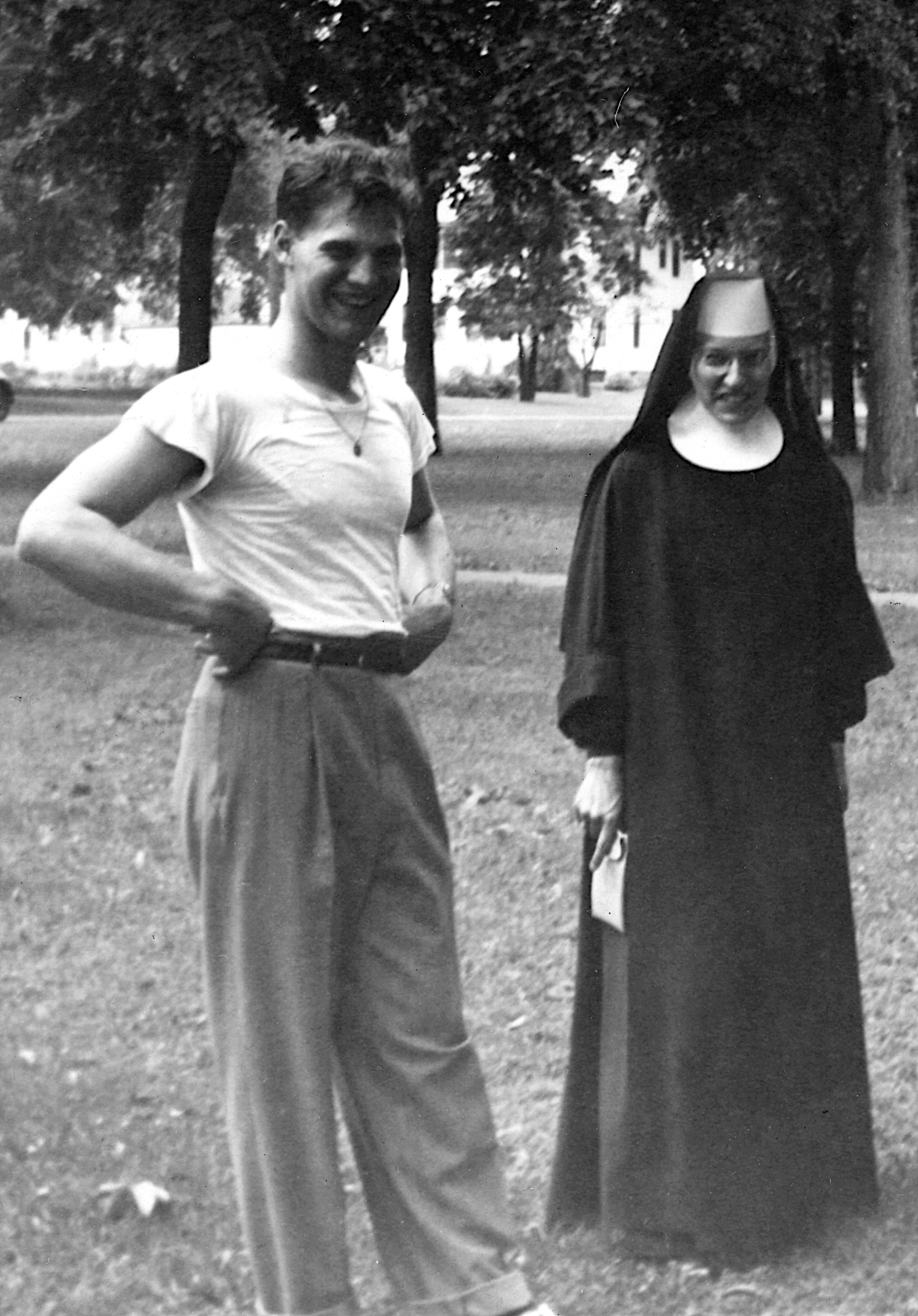
Donn G. Hanneman with Sister Emeric Weber of St. Patrick’s Catholic Grade School, 1948.
For a time Donn attended St. Patrick’s Catholic Grade School in Mauston, then run by the Benedictine Sisters. He was among the graduates attending the school’s 100th anniversary in 1995. At the event, he ran into one of his teachers, Sister Emeric Weber, who was just 19 when she started teaching at St. Patrick’s.
“Sister Emeric, I’m sorry I’m late,” he quipped, to which the aged nun replied, “What’s your excuse now? What’s your excuse?”
Like his brother David and father Carl, Donn was a longtime Fourth-Degree member of the Knights of Columbus, the world’s largest Catholic fraternal and service organization. He most recently belonged to Council 1013 in Rochester, Minnesota.
There are many others better qualified to provide more recent stories about Donn. And even though he tossed my father through the bay window of their Mauston home when they were boys, my Dad didn’t hold it against him. When he was ill with cancer in the fall of 2006, Dad put it simply and succinctly: “He’s my brother and I love him.”
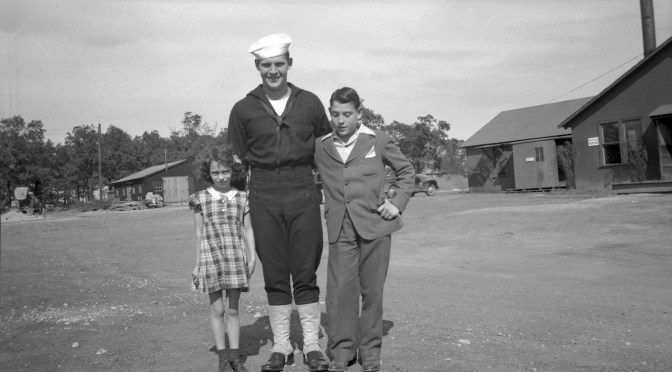
Donn G. Hanneman (center) in his U.S. Navy uniform, with sister Lavonne and brother David in 1944.
David D. Hanneman and older brother Donn G. Hanneman, circa 1935. Read more about the photo: http://wp.me/p4FxQb-v7
Donn G. Hanneman lounges outside his Grandpa Treutel’s home in Vesper, Wisconsin, circa 1930.
Donn G. Hanneman in the world’s smallest swimming pool.
Donn at the family home in Fond du Lac.
Donn Gene Hanneman, son of Carl F. Hanneman (1901-1982) and Ruby V. (Treutel) Hanneman (1904-1977), sits in an indoor baby swing at the Hanneman home in Fond du Lac, Wis, ca. 1927. Carl Hanneman was a pharmacist for the Staeben Drug Co. in Fond du Lac at the time.
Donn in his cowboy threads at Wisconsin Rapids.
Donn G. Hanneman wears a convincing looking police uniform, perhaps a Halloween costume.
Donn G. Hanneman looks like a lonely cowpoke with his wagon, circa 1930.
David D. Hanneman on the shoulders of brother Donn.
Donn G. Hanneman towers over his little sister, Lavonne Marie, circa 1941.
Donn G. Hanneman at the Mauston rail station, circa 1944.
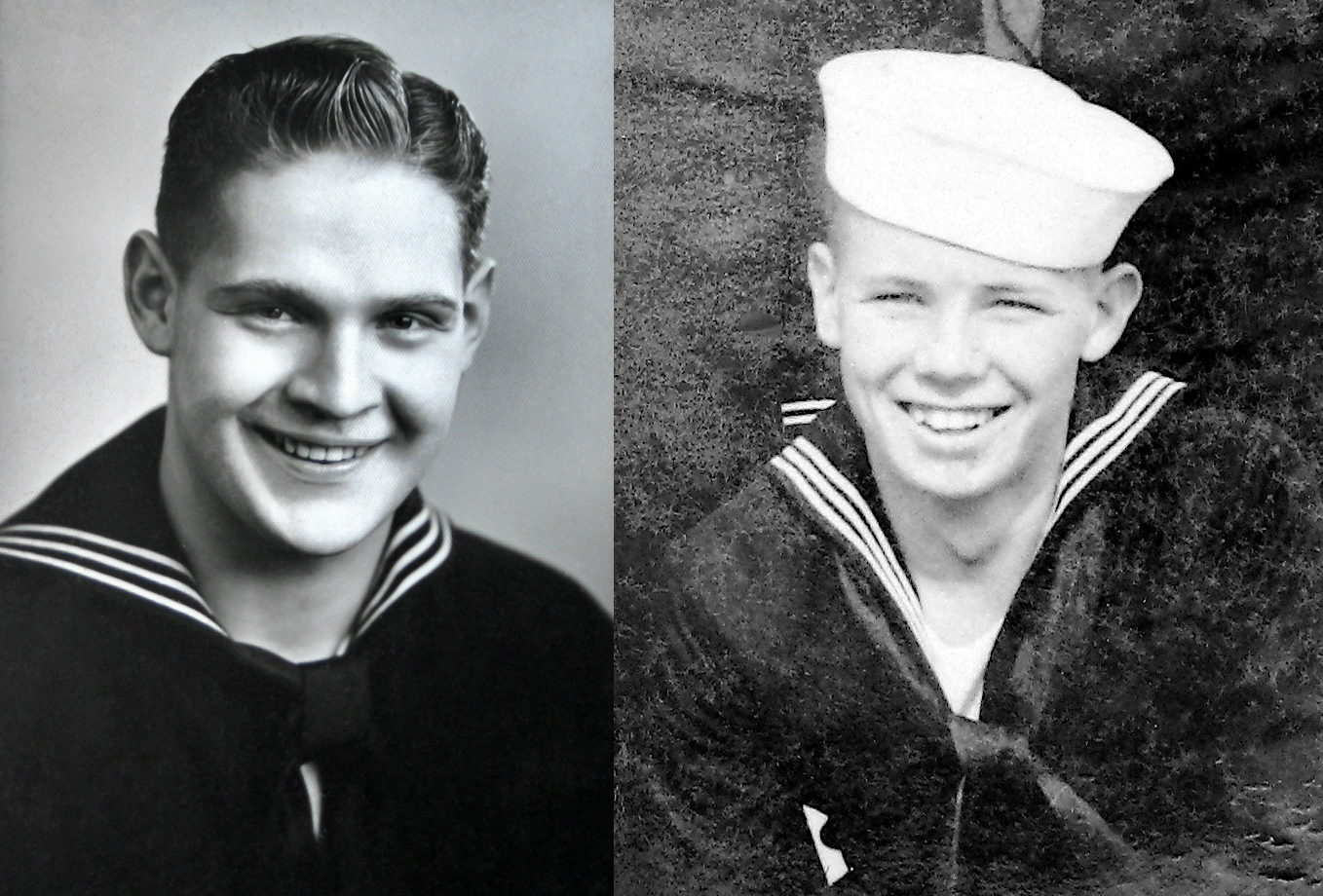
Donn G. Hanneman in his U.S. Navy uniform in 1944.
Few things in the American experience are held so dear by so many as the parade. From the smallest rural towns to the heart of New York City, Americans have long held celebrations by parade.
Members of the American Legion prepare to march in a parade in Mauston, circa 1942.
Reasons for parades are as varied as the communities in which they take place. Perhaps the most widely celebrated type of parade is the Independence Day or July 4 parade. New York has its St. Patrick’s Day Parade and the famous Macy’s Thanksgiving Day Parade. The Left Coast has its parades of bacchanalia and pride. America’s heartland gathers for high school homecomings, Memorial Day, Christmas, Thanksgiving and special-themed parades such as the old Circus World parade in Milwaukee.
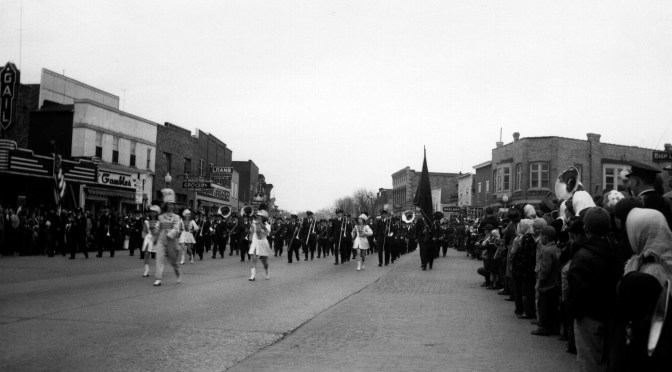
The Wisconsin Dells marching band parades down State Street in Mauston, circa 1942.
High school and college marching bands are a frequent source of parade entertainment. Other favorite parade participants include brigades of toddlers on tricycles, doll buggies pushed by little girls and the myriad parade floats and displays honoring the nation’s military.
Parades have long been used as a way to project military might, such as the goose-stepping Nazis of Germany or the show of ballistic missiles in Communist Russia. In America, ticker-tape parades became a favorite way to welcome home troops and war heroes such as Gen. Dwight D. Eisenhower and Admiral Chester Nimitz. The original ticker-tape parade was held in New York to celebrate dedication of the Statue of Liberty. A memorable parade in summer 1969 honored the Apollo 11 astronauts.
David D. Hanneman prepares to ride a horse in a Mauston parade, circa 1942.
David D. Hanneman (at right) and other boy scouts before a parade in Mauston in the early 1940s.
Mauston Boy Scouts enter the parade line, circa 1943. The town’s military honor roll can be seen on the side of the building.
A marching band in downtown Mauston in the late 1960s.
A fire truck heads down the parade route in Mauston in the late 1960s.
Residents of Mauston, Wis., mill about the downtown area during a parade or community festival in the mid-1940s. Smith’s IGA market is visible across the street.
David D. Hanneman (1933-2007), a member of the Mauston High School Marching Band, poses outside his Mauston home in 1948. Hanneman, who later in life became mayor of Sun Prairie, Wis., played bass drum and trumpet.
The Mauston High School Marching Band performs in a parade in downtown Portage, Wis., ca. 1948. In the foreground is bass drummer David D. Hanneman (1933-2007) of Mauston.
Sun Prairie Mayor David D. Hanneman waits to enter the parade route in Sun Prairie, circa 2003.
Sun Prairie Mayor David D. Hanneman rides in a local parade, circa 2004.
David D. Hanneman in what appears to be a drum and bugle corps uniform, circa 1948.
The Mauston High School Band after leaving the football field during a homecoming game in the 1940s.
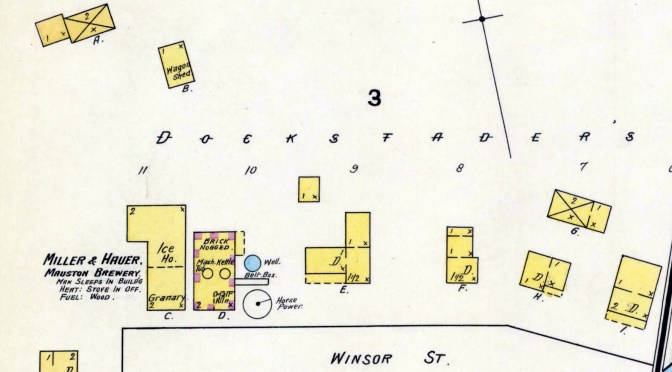
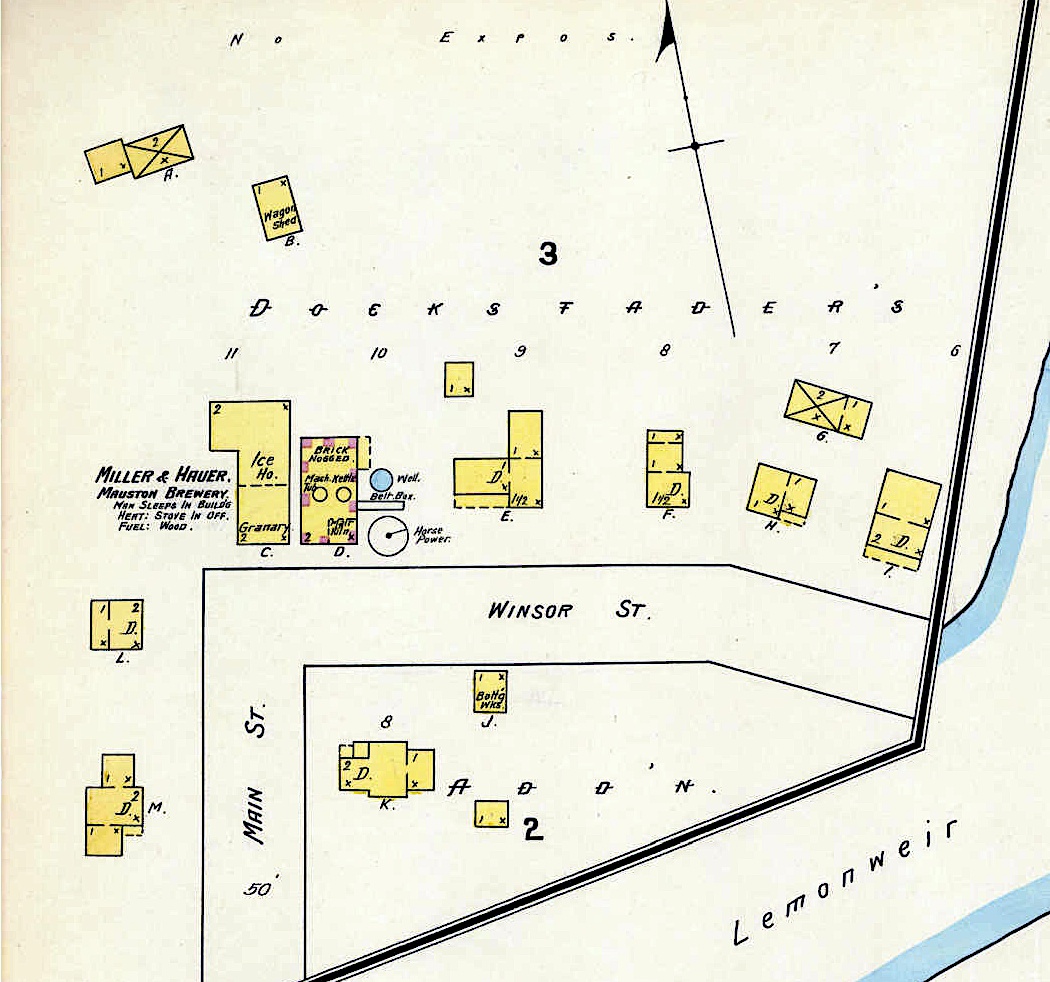
Newly digitized Sanborn Fire Insurance maps of Mauston, Wisconsin, provide more detail of the sprawling Mauston Brewery complex that once covered much of the land at the corner of Morris and Winsor streets along the Lemonweir River.
We previously wrote about the Mauston Brewery as detailed in a book by Mauston native Richard D. Rossin Jr. The Wisconsin Historical Society recently digitized hundreds of maps from the Sanborn Map Company that show intricate detail of the brewery complex. “Sanborn Fire Insurance maps are meticulously detailed, large-scale lithographed, color-keyed street maps,” the Wisconsin Historical Society wrote on its web site. “Sanborn Maps helped insurance agents in the late 19th and early 20th centuries determine the degree of fire hazard associated with a particular property.”
The 1894 fire map shows two Mauston Brewery buildings near the home at 22 Morris.
The old Hanneman home at 22 Morris Street was built around 1893 by Charles F. Miller, owner of the Mauston Brewery. Many of the details he put in the home — stained glass, hand-carved woodwork — remain to this day. The Sanborn maps show that the land around the home once included a bottling works and another out building related to the brewery. It is interesting that Morris Street is incorrectly labeled as Main Street on the 1894 version of the Sanborn map. By 1909, the bottling building near the Miller home was gone.
Across Winsor Street, the map shows a malt kiln, mash kettles, a well, a granary, an ice house and other outbuildings. The map notes that the buildings area heated by a wood stove, and a brewery employee sleeps in the building. The 1909 version of the Sanborn map shows addition of a second ice house on the shore of the Lemonweir River. Brewery workers cut ice blocks on the river in the winter, then moved them on a slide to the ice house.
The 1909 version of the map shows a second ice house near the river.
Charles Miller died in 1907, ending that family’s involvement in the brewery. Charles Ellison continued operating the brewery. By 1916, the brewery had ceased operation, according to Rossin’s book. A pickle factory started operation on the property, but it burned to the ground in 1922. Dr. J. Samuel Hess Jr. bought the land and built a brick ranch home in 1928.
People often talk about getting 15 minutes of fame. For the late Carl F. Hanneman, it was closer to 15 seconds in a new Wisconsin Public Television documentary on Juneau County, Wisconsin.
Carl F. Hanneman filed this story with the Wisconsin State Journal on December 8, 1942.
The hourlong documentary, produced as part of Wisconsin Public Television’s Wisconsin Hometown Stories series, includes a section on the death of Governor-elect Orland S. Loomis of Mauston. Loomis died on December 7, 1942 after suffering a series of heart attacks. He was to be sworn into office in January 1943. As a local correspondent for the Wisconsin State Journal, Hanneman filed a story on December 8 detailing Mauston’s grief at the loss of their hometown hero. His news clipping was used as a graphic during the Loomis portion of the documentary.
Carl’s ties to Loomis went beyond the 1942 political obituary. On election night, November 3, 1942, he was one of the only photographers at Loomis’ home as the election results came in and Loomis was declared the winner over Gov. Julius P. Heil. Carl’s news photo ran above the fold on Page 1 of the State Journal on November 4, 1942.
Hanneman’s election-night photo taken at Loomis’ home in Mauston ran on Page 1 of the Wisconsin State Journal.
Hanneman (1901-1982) had known Loomis since about 1936, when Carl came to Mauston from Wisconsin Rapids to be a pharmacist for Dr. J. Samuel Hess Jr. He sought Loomis’ help in 1937 in obtaining his full licensure as a registered pharmacist (an upgrade from his existing license as an assistant pharmacist). At the time, Loomis was Wisconsin’s attorney general. Hanneman also worked to help elect Loomis as attorney general and governor. In recognition of his efforts, Loomis gave Hanneman a large pastel painting that once hung in his office at the state Capitol in Madison. The large-format pastel, weighing some 100 pounds in its hand-carved ornate frame, hung in the Hanneman home in Mauston and later in the home of Sun Prairie Mayor David D. Hanneman, Carl’s son.
Orland S. Loomis gave this painting to Carl F. Hanneman for his help on the gubernatorial election in 1942. It still hangs in the home of the late David D. Hanneman.
The fascinating Wisconsin Hometown Stories documentary, which first aired in April 2014 and is now available on DVD, covers much more than Loomis and his political career. It traces Juneau County’s history from its early days, when towns like Mauston sprung up around grist mills on the Lemonweir River. It details the county’s cranberry farms, the massive Necedah Wildlife Refuge, the heritage of the Winnebago (Ho-Chunk) Indians, creation of the huge manmade Petenwell Lake, and development of National Guard bases including Camp Williams and Volk Field.
Carl F. Hanneman befriended a young Tommy Thompson in 1966 when Thompson first ran for state office.
A prominent section of the documentary focuses on former Wisconsin Governor Tommy G. Thompson of Elroy. Thompson takes viewers on a tour of southern Juneau County where he grew up, including an old gas and grocery run by his father. Thompson served as Wisconsin’s 42nd governor from 1987 to 2001.
When he first ran for Wisconsin State Assembly in 1966, Thompson stopped in Mauston and met a pharmacist named Carl Hanneman. Carl was so impressed with the young lawyer from Elroy that he closed up shop for the afternoon and took Thompson all over Mauston, introducing him to other businessmen. From that day on, Hanneman always referred to him as “my friend Tommy Thompson.” It was a kindness Thompson never forgot.
Somehow the story of Carl’s early politicking for Thompson got left out of the Wisconsin Public Television documentary. Well, there’s only so much you can fit into an hour of television.
Army Pvt. Rudolph Mika Jr. (at left) of Mauston, Wisconsin, talks to livestock buyer John Randall at the Juneau County Fair at Mauston in the summer of 1942. Mika went into the Army glider corps and took part in the invasion of North Africa during World War II. He was taken prisoner by German troops in Holland in September 1944 and repatriated in June 1945.
Army Pvt. Rudolph Mika (at left) of Mauston, Wis., talks to livestock buyer John Randall at the Juneau County Fair at Mauston in the summer of 1942.
The 1940 U.S. Census showed Mika working at the Mauston pickle factory and living at home with his parents, Rudolph Mika Sr. and Anna Mika. The elder Mika was a carrier for the local ice dealer. The Mikas lived on Winsor Street, just a few houses away from the Carl F. Hanneman family and the home of Dr. J. Samuel Hess Jr. Hanneman was on the Juneau County Fair Board for many years. He snapped the photo of Mika and Randall.
Rudy Mika enlisted in the U.S. Army in March 1942 at Madison. His occupation was listed as a carpenter. After the war, he returned to Mauston. He died on January 6, 2001 at Mauston, age 89. Randall died in January 1971 at age 74.
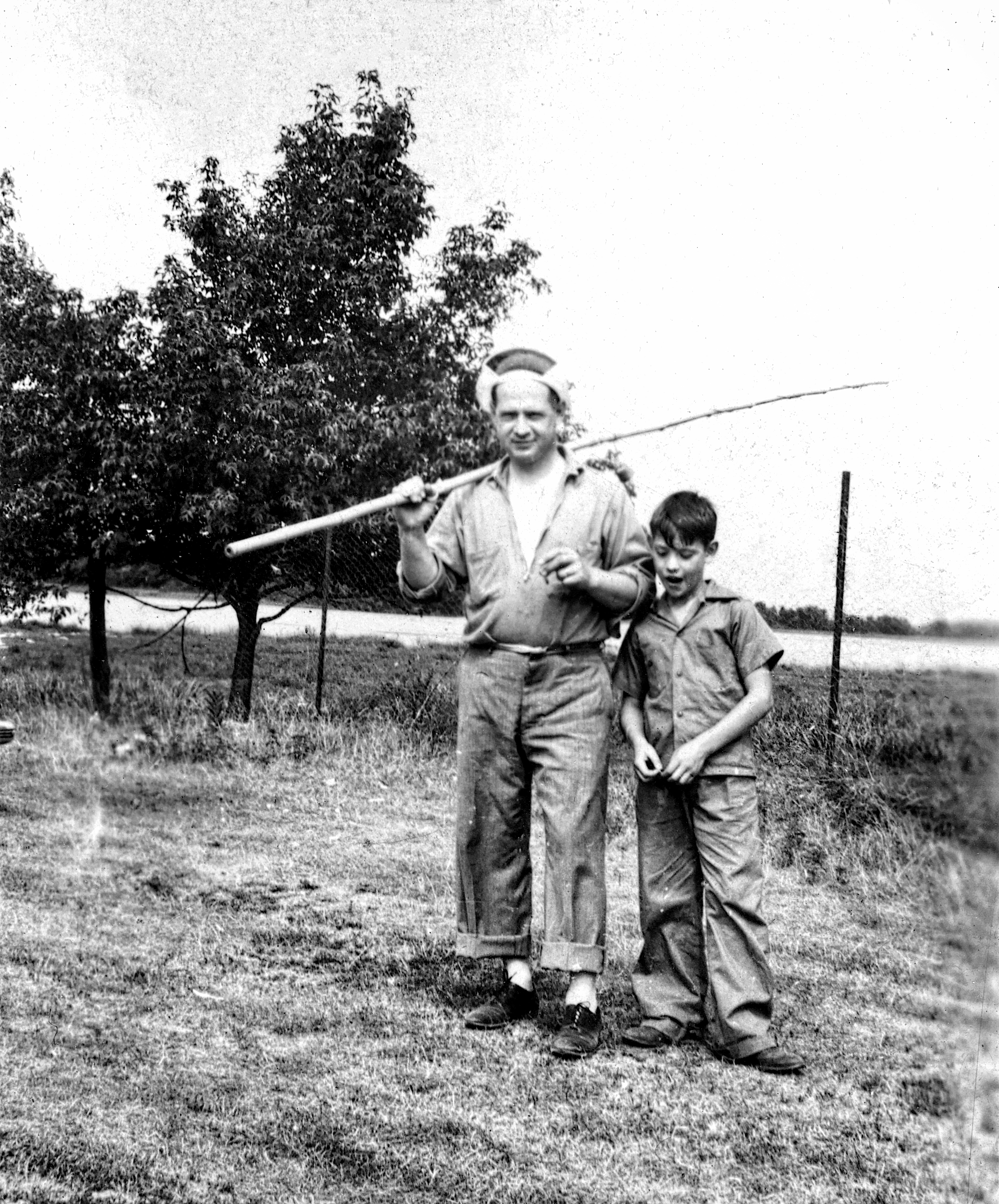
Photographs can document history in many ways, so it’s fun to look deeper into historical images to learn what they can tell us. The image atop this post shows a man and a boy. The man has a cane pole, so we can assume the pair has gone or is going fishing. Look a little deeper. The photo has a Rockwell-esque quality to it. Set in the summer of 1942, the photo shows Carl Henry Frank Hanneman (1901-1982) and his youngest son, David D. Hanneman (1933-2007). You can see Carl’s love for fishing — something he shared with his children and grandchildren who learned to fish on Mauston’s Lemonweir River.
The son is following along, asking questions of the fishing expert. What is he asking? Perhaps, “Hey, Dad, why don’t I have a cane pole?” It’s a time-honored tradition,passing on a love for fishing from one generation to the next. We’ll cover more of that in a future installment.



















 The Hanneman Archive