Tag Archives: Hanneman

The Story Behind the 1945 Wisconsin Badgers Homecoming Ticket Stub

It was mixed in with photographs and other documents — a colorful, torn ticket stub. I picked it up and examined it and was left wondering, what is the story behind it? The game was between the University of Wisconsin and Northwestern on November 10, 1945. I presumed that my Dad was the lucky holder of the $1.75 ticket. He was 12 at the time, so a trip from Mauston to Madison for a college football game would have been a big treat. I had to find out more about this game. So I dug right into it.

The ticket stub was like an invitation to re-live the 1945 homecoming game.

The weather forecast for the homecoming game called for a high of 39 degrees after an overnight low of 18. The Friday night calm on the UW campus was broken by roving mobs of teenagers who broke store windows and vandalized cars along State Street. Madison police made 49 arrests for curfew violations, according to The Wisconsin State Journal. Still, police considered the homecoming crowd on campus well-behaved overall, so they did not use the tear gas and water wagons that were held in reserve.
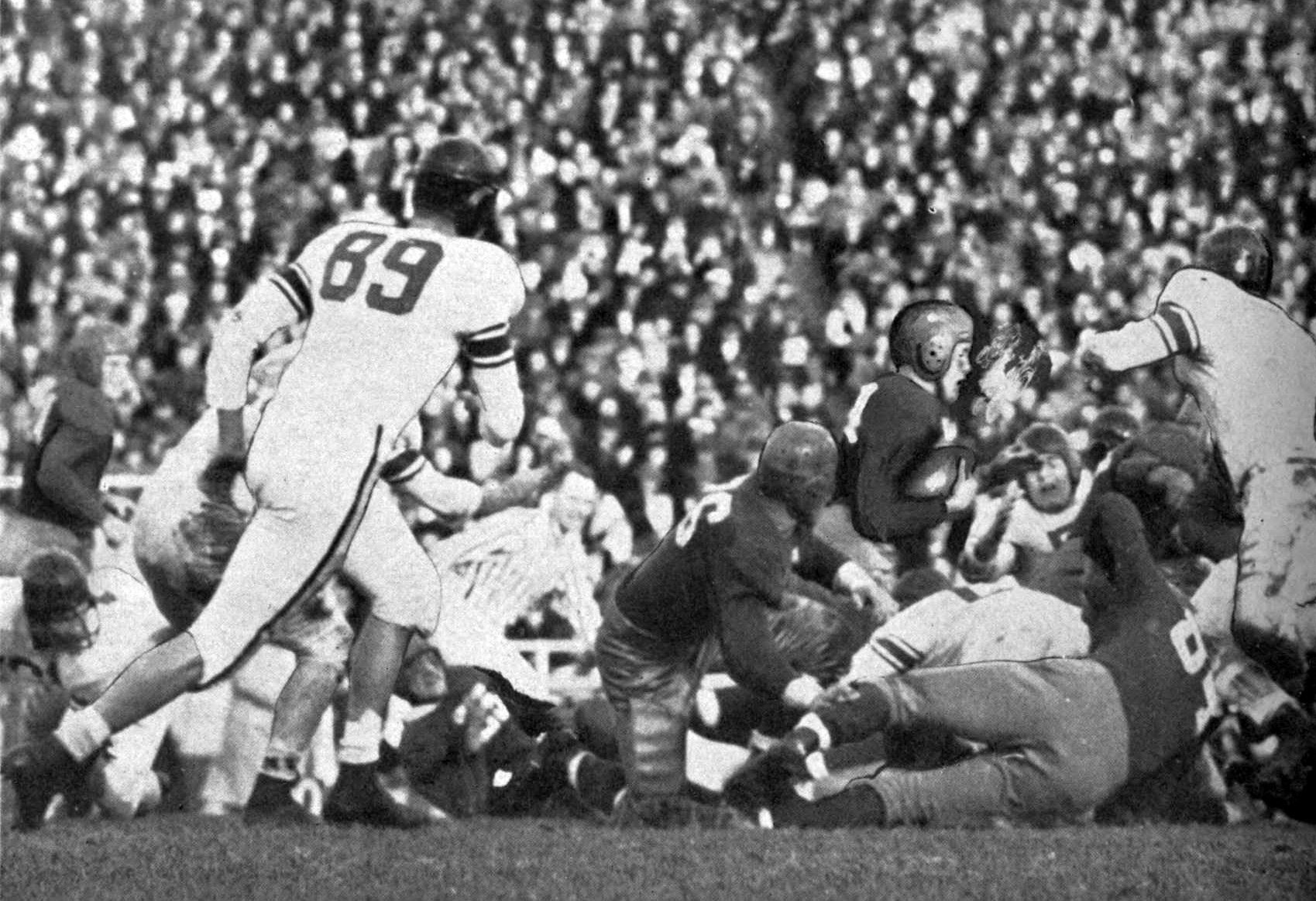
Scatback Jerry Thompson runs for 5 yards against Northwestern on November 10, 1945.

Camp Randall was packed with 45,000 fans when game time arrived on Saturday. Dad (or whomever held that ticket) sat in the south end zone, Section Z, Row 6, Seat 5. This is the end of the stadium backed against the UW Field House. I’ve sat in that section myself a few times over the years. Fans were treated to a great game. “This was a game with few dull moments, one in which each turned loose a devastating running attack,” wrote Henry J. McCormick, sports editor of The Wisconsin State Journal. The first quarter ended scoreless. Wisconsin’s initial drive ended on Northwestern’s 48 when Jerry Thompson’s pass was intercepted. Northwestern fared no better, as its drive ended on Wisconsin’s 25 when Badger Don Kindt intercepted a Jim Farrar pass.

'Big Ben' Bendrick slashed Northwestern for 133 rushing yards.
‘Big Ben’ Bendrick slashed Northwestern for 133 rushing yards, but fumbled twice.

In the second quarter, Wisconsin scored a touchdown on a 16-play, 80-yard drive that ended with a reverse and a pass to the end zone. Northwestern answered with an impressive 73-yard touchdown drive. Wisconsin roared right back on the next drive. Halfback Ben Bendrick ripped off 17 of his 133 yards on one play. Kindt finished the drive by plunging into the end zone with only 8 seconds left in the half. Halftime score was 14-7 in favor of the Badgers. The second half opened with the same high tempo. Northwestern took the kickoff and moved right down the field with 70 yards on 11 plays. Farrar’s 25-yard pass to tight end Stan Gorski brought the game to a 14-14 tie. On the very next drive Wisconsin’s Bendrick tore off a 41-yard run, followed by an 11-yard scamper from Kindt. A fourth-down pass from Thompson was intercepted by Bill Hunt of Northwestern. When the Wildcats pounded down to the Wisconsin 1 yard line on the drive, the Badgers’ defense stiffened, stopping the Cats on a fourth-down pass play. As the third quarter ended, the score was still knotted at 14.

On the opening drive of the fourth quarter, Bendrick continued his punishing ground game. But lightning struck as Bendrick went around left end. The ball popped out, right into the hands of Northwestern’s Hunt, who returned the ball to the Wisconsin 9 yard line. After two running plays, Northwestern took it to the end zone for a 21-14 lead. The teams then traded unsuccessful drives. Wisconsin’s Thompson threw another pick at mid-field, but Northwestern’s ensuing drive stalled. When the Badgers got the ball back, Bendrick fumbled again. Northwestern pounced on the ball at the Wisconsin 24. Seven plays later, Northwestern scored to go up 28-14. That’s how the game ended.

When your team rolls up 244 yards rushing, it typically won’t lose. But on this day, the Badgers made too many mistakes, spotting the Wildcats 14 points with two fumbles. The headlines should have been about Bendrick’s stellar 133-yard rushing day. The Badger faithful left Camp Randall entertained, but unsatisfied. If my Dad, David D. Hanneman, was the ticket holder, I’m guessing he was there with his father, Carl F. Hanneman. The first Wisconsin game I can recall attending with my grandfather was a 1977 game vs. Michigan State. The Badgers lost that day, 9-7.

Don Kindt ran for 63 yards against Northwestern.

Hidden behind the headlines of the 1945 game was a compelling military story. It was just the third game back for Don Kindt, who shared halfback duties with “Big Ben” Bendrick. As just a 17-year-old, Kindt interrupted his Wisconsin football career in 1943 to enlist in the U.S. Army’s 10th Mountain Division during World War II. He saw extensive action in Italy and was awarded two bronze stars. He returned to the Badgers in October 1945. After his Wisconsin playing career, Kindt spent nine seasons with the Chicago Bears. He recounts his war experiences in an extensive interview conducted in 1994 by the Wisconsin Veterans Museum.

©2015 The Hanneman Archive

Maj. Julius R. Hannemann: Washington’s Ceremonial Cannon Man

It would be easy to say that Julius Rudolph Hannemann lived his life with a boom. There were likely many in Washington, D.C. in the 1870s and 1880s who wished he hadn’t created so many of them. As president of the district artillery corps, Maj. Hannemann provided the ceremonial explosive huzzahs at civic events from decoration day to the inauguration of presidents.

Although Hannemann had a distinguished record of service with Union Army units during the Civil War, one senses just a bit of resentment at the noise created by his artillery men. Hannemann commanded the artillery for Decoration Day at Arlington National Cemetery one year. A local newspaper quipped, “All persons residing in the vicinity are advised to have their lives insured.” The article ran under the headline: “The Poisoned Major to the Front.” Another article said he “has broken millions of panes of glass, the peace of the capital, more often than can be computed, by firing cannon.”

On New Year’s Eve 1875, his corps fired a 37-volley salute to the new year in Judiciary Square. According to one news account, “the ammunition for this purpose having been furnished by the War Department.” On September 18, 1880, a platoon fired a 200-gun salute to commemorate the Republican victory in Maine, according to a front-page article in the The Evening Star. In 1879, President Rutherford B. Hayes approved Hannemann’s promotion from second lieutenant to captain. Hannemann was later promoted to major.

The Evening Critic carried the news on Page 1.
The Evening Critic carried the news of the major’s death  on Page 1.

Hannemann was struck with apoplexy (possibly a stroke) at the inauguration of President James A. Garfield in early March 1881. It was this condition that eventually took his life on the morning of January 28, 1885. He was just 43 years old. “His death had been expected for some time,” wrote the The Evening Critic. “A well-known and efficient militia officer and a prominent member of the G.A.R. passes to that bourne where military parades are unknown and the weary are at rest.”

Hannemann was born in Prussia in 1842 to a military family. Upon emigrating to the United States, he volunteered for duty in the Civil War on May 17, 1861. He served with the 39th New York Volunteer Infantry Regiment, known as the “Garibaldi Guard.” He started as a private, but by March 1865, he was a 2nd lieutenant with the 7th New York Infantry Regiment. In June of that year, he was named adjutant of the 7th.

We don’t know of any link between Julius Rudolph Hannemann and the Hanneman family that came from Pomerania to Wisconsin in the 1860s. The major seems to have come from an area in the  Kingdom of Saxony, south and west of Pomerania.

©2015 The Hanneman Archive

Historical Documents Section Added to Hanneman Archive

Historical documents and photographs are the heart of any good family archive. The Hanneman Archive is already well-populated with more than 700 photographic images. Now we have added a documents section featuring a variety of declarations from our collection. Examples include ship registries, church death records written in German, draft cards, professional certifications and more. The page is among the links at the top of our home page.

The gallery will be expanded frequently. For until it is shared, a document is but a mere sheet of paper.

©2015 The Hanneman Archive

Eye on the Past: Covering Gov. Thompson 1988

This is a blast from the past of the author of this blog. Reporter Joe Hanneman (skinny guy with hair at left) takes notes at a press event in Racine, Wisconsin, held by Wisconsin Gov. Tommy G. Thompson. The photo was taken around 1988. Hanneman covered Wisconsin state politics and the Wisconsin Legislature for The Journal Times, Racine’s daily newspaper. The event was likely some kind of economic development announcement from the governor’s office. Also visible in the photo are Racine County Executive Dennis Kornwolf, State Sen. Joseph Strohl of Racine and State Rep. E. James Ladwig of Caledonia. Some 27 years later, Hanneman has neither thick hair nor thin waist.

©2015 The Hanneman Archive

2014 Review: 7,100 Page Views at The Hanneman Archive

The WordPress.com stats helper monkeys prepared a 2014 annual report for The Hanneman Archive.

Here’s an excerpt:

A New York City subway train holds 1,200 people. This blog was viewed about 7,100 times in 2014. If it were a NYC subway train, it would take about 6 trips to carry that many people.

Click here to see the complete report.

Life of Chas. Frederick Christian Hanneman

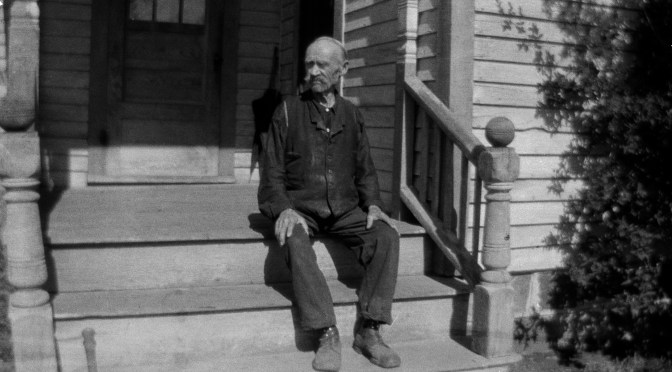
The photograph is very poignant. A frail man, sitting in the afternoon sun on the front porch steps. He looks haggard and tired, maybe ill. This image is the last known photograph taken of Karl Frederick Christian Hanneman, who was known around Wisconsin Rapids as Charles or “Chas” Hanneman. The photo likely dates to 1931 or 1932, when he suffered from prostate cancer that eventually took his life.

Charles Hanneman came to America in late November 1882 with his parents, Christian and Amanda Hanneman. He was just 15 when the family made its way from Stettin, Pomerania to Portage County, Wisconsin. Charles, his three brothers and two sisters settled on a 105-acre farm in the northwest corner of the Town of Grant, near the tiny hamlet of Kellner. 

Nina and Elaine Treutel visit with Chas Hanneman, circa 1930.

Charles worked on the Hanneman farm for a time. His brothers would stay in farming (maps from that period show many Hanneman farms in Portage County), but eventually Charles left farming and found work in one of the area’s many sawmills.

At some point in his early 20s, Charles made the acquaintance of Rosine Ostermann, the eldest daughter of John and Mina Ostermann of the Town of Grand Rapids. They had many things in common. Both grew up on the family farm. Rosie’s parents were from Germany (Saxony and Prussia), and his were from Pomerania. Rosie’s grandfather George Ostermann was one of the pioneers of Portage County, listed on the earliest tax roll of the Town of Grant in 1864.

On April 2, 1891, Charles and Rosie were married at St. John’s Evangelical Lutheran Church in Kellner in a divine service performed by A.G. Grimm. The witnesses were Charles’ father, Christian, and his brother, William. The bride’s attendants were her sister, Elsie Ostermann, and Emma Pribbernow. The groomsmen were cousins August Saeger and Herman Hanneman.

The young couple came to know heartache early in their marriage. Their firstborn, referred in the records only as “C.H. Hanneman,died in infancy in 1892. They went on to have four sons: Arthur John (1893), Frank Herman Albert (1895), Wilbert George (1899), and our own Carl Henry Frank (1901). 

Left to right: Christian Hanneman, Chas Hanneman, Carl Hanneman, David D. Hanneman.

Work in the sawmill must have been erratic, or Charles left that occupation for a time. In 1900, U.S. Census records show the family living and working on the farm of Charles’ brother, William Hanneman.

By 1905, Charles moved his family to the second ward in the city of Grand Rapids. He initially did manual labor for the city of Grand Rapids,possibly working on construction of the water and sewer works. The financial statements for the city in December 1907 show Charles worked 135 hours that month and earned 17.5 cents per hour for a paycheck of $23.63.

By 1910 the family was living at 1774 Baker Street in Grand Rapids. The U.S. Census that year lists Charles as a laborer at a box factory. That may have referred to Consolidated Water, Power & Paper Co., where he later worked until his retirement, or the nearby Badger Box company.

On March 31, 1918, tragedy struck the Hanneman home when Rosine died suddenly at age 48. Her death notice, which ran on page 1 of the Daily Leader, said she was fine during the day but fell ill and died at 11 p.m. We know that she had diabetes, and that may have contributed to her death. Carl was 16 when his mother died.

Charles remarried in August 1919 and lived out his remaining years in his home at 1751 Baker Street. He became ill with prostate cancer in 1931 and was hospitalized numerous times in Wausau for surgery and treatments. He died at home on Oct. 11, 1932. He was 65. His death made front-page news in the Wisconsin Rapids Daily Tribune.

FAMILY LINE: Karl Frederick Christian Hanneman >> Carl F. Hanneman >> Donn, David & Lavonne Hanneman

©2015 The Hanneman Archive

Carl’s Heartfelt 1937 Plea for a Brighter Future

Just three weeks after becoming a father for the third time, young pharmacist Carl. F. Hanneman took the extraordinary step of writing to the attorney general of Wisconsin to ask that he be granted full licensure as a registered pharmacist. It was a heartfelt letter, written by a young man feeling the weight of responsibility of a wife and three children. Written by a well-educated and accomplished man who felt he deserved what he as asking. The very future was at stake.

“I am writing this letter in all sincerity as what I am about to ask means everything to myself as well as my wife and three little kiddies,” Carl wrote to Attorney Gen. Orland S. Loomis on Sept. 3, 1937. “I am 35 years old and will be 36 this coming October and feel that obtaining my full registered papers will mean life itself to myself and my dear family.” 

Carl explained that he was fully licensed as an assistant pharmacist, working at the Mauston Drug Store owned by Dr. J.S. Hess Jr. But he was unable to officially manage the drug store due to a quirk in state law.

Wisconsin Attorney Gen. Orland S. Loomis
Wisconsin Attorney Gen. Orland S. Loomis of Mauston

If Carl had worked in a smaller town with under 500 population, he  could have legally managed the pharmacy. But Mauston population was about 2,100. Carl would need to be a registered pharmacist in order to  manage the Mauston Drug Store. 

“My capacity in the drug store is as an unofficial manager, as I do all of the buying etc., but legally cannot manage the store,” Carl wrote. “Dr. J.S. Hess Jr. has confidence in me and I a great deal in him, and as far as I am concerned am willing to stay here the rest of my life, dispensing for our own doctors.”

Carl reasoned that if he was qualified to own and manage a pharmacy in a small town (such as neighboring Lyndon Station, pop. 236), why could he not serve the same capacity in Mauston? “I have often wondered as has many others, are not the lives of 500 people in a small town just as valuable to their loved ones as those living in a town where there might be more than this amount?” Carl wrote. 

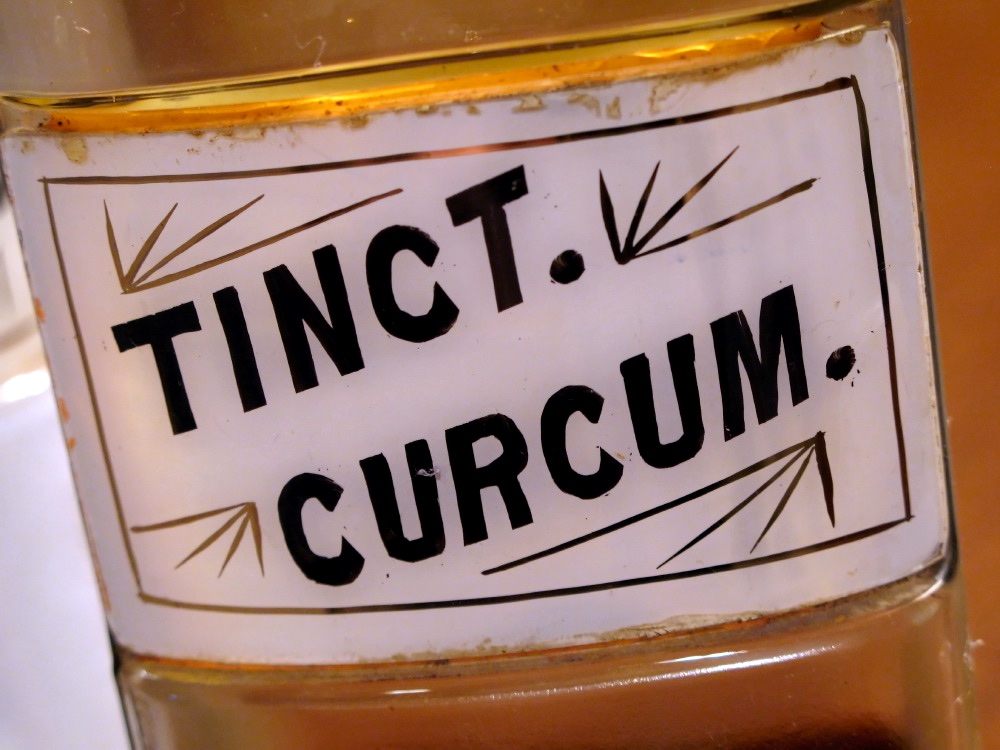
A label under glass from Carl F. Hanneman's pharmacy collection.
A label under glass from Carl F. Hanneman’s pharmacy collection.


By 1937, Carl had 16 years of experience in pharmacology, starting as an apprentice in 1921 at the Sam Church drug store in Wisconsin Rapids. Carl graduated from the pharmacy program at Marquette University in 1925 and became licensed as an assistant pharmacist. He wasn’t eligible to take the full pharmacist exam at the time because his apprenticeship fell just short of the required five years. Over the next decade he worked at drug stores in Janesville, Fond du Lac and Wisconsin Rapids, and even worked a three-year stint as a salesman for Consolidated Water Power & Paper Co.

“I knew my lifework was with the drug store as I truly love it and was very fortunate in securing a position with the Dr. Hess Hospital, Clinic and Drug Store organization on Feb. 1, 1936,” Carl wrote.

Carl said he would likely need three more years of study to pass the registered pharmacist board exams as they existed in 1937. With three children (including baby Lavonne born in August 1937), Carl figured that simply would not be possible. So he asked for help from Loomis, a Mauston native who served as city attorney from 1922 to 1931. Loomis was attorney general through 1938, and was elected governor of Wisconsin in 1942. He died before taking office. Eventually, Carl became good friends with Loomis and photographed him for the Wisconsin State Journal on the 1942 night of  his election as governor of Wisconsin. 

Carl F. Hanneman's registered pharmacist license, issued in July 1944.
Carl F. Hanneman’s registered pharmacist license, issued in July 1944.


We don’t know if Loomis ever intervened on Carl’s behalf in his role as attorney general or governor-elect, or how he responded to the 1937 letter. A search of Loomis’ law-practice records at the Wisconsin Historical Society yielded no clues. Carl’s 1941 license from the Wisconsin State Board of Pharmacy still lists him as an assistant pharmacist. On July 12, 1944, the state of Wisconsin issued an ornate document certifying Carl as a full registered pharmacist. He worked under the new license number until his death in 1982. It would appear Carl secured his added credentials the hard way: he earned them.

©2014 The Hanneman Archive
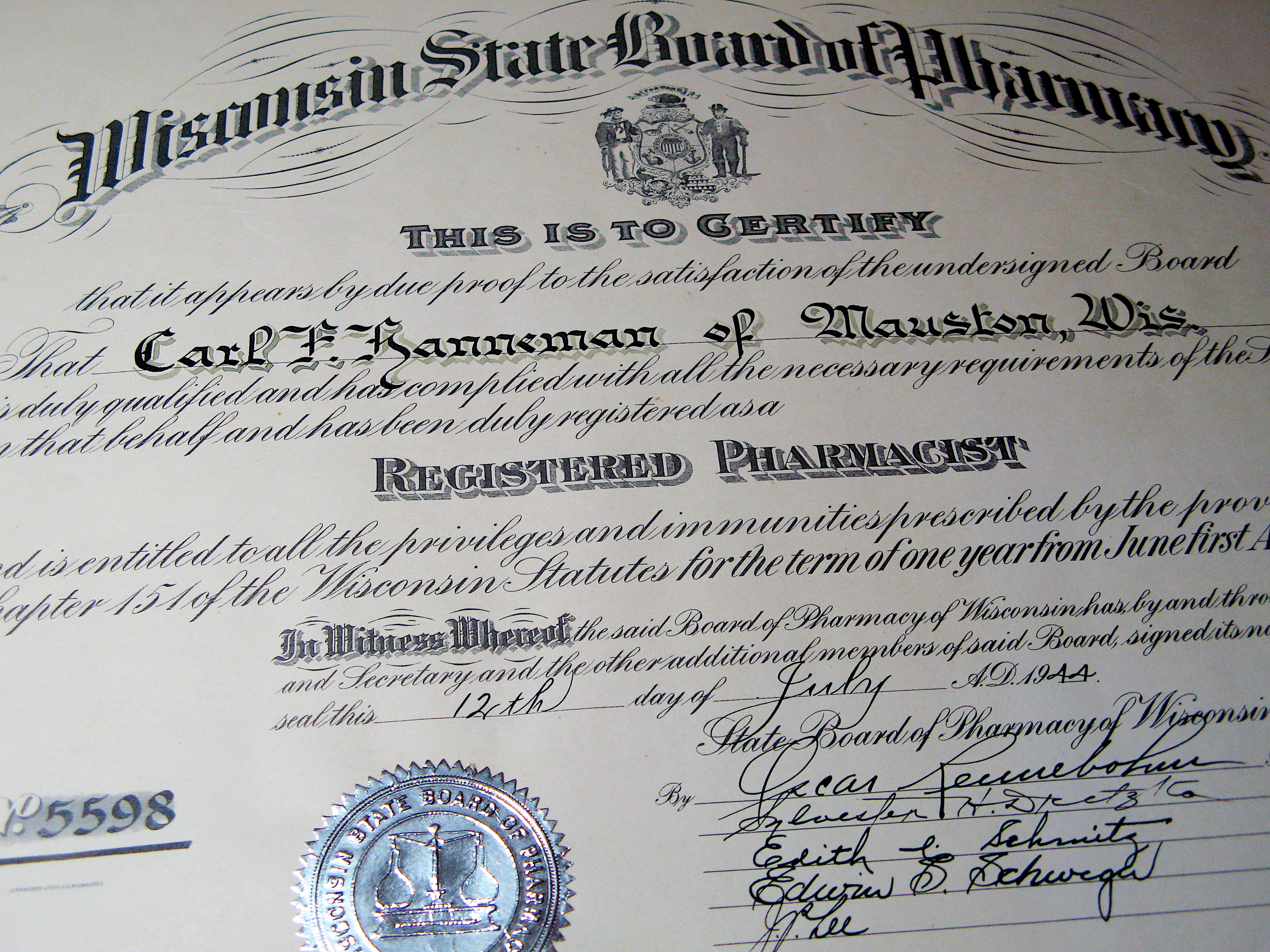
Photo Detective: Cowboy Hiram Greene

My Dad’s family made several trips out West, to Arizona and the Dakotas. Sorting out and matching photos with cities has been a constant challenge. A couple of intriguing photos show Dad with a cowboy identified as Hiram Greene. I wondered, was Hiram Greene a famous rodeo rider, a film star or some other celebrity?

My first source of information was the caption on the back of one photo, written by my grandmother, Ruby V. Hanneman. It listed the name “Hiram Greene” and said he was from Billings, Montana. The photo, according to the caption, was taken at Canistota, Minnesota. As it turned out, that caption was problematic in several respects.

Hiram Greene with David D. Hanneman in July 1945.
Hiram Greene with David D. Hanneman on July 14, 1945.

I took a chance by doing a generic search engine query and came up empty. I quickly ruled out the idea that Mr. Greene was a major celebrity. Using databases at Ancestry.com, I was unable to find anyone by that name near Billings, Montana. But I did find what appeared to be a good match right in South Dakota, where the Hanneman family vacationed several times in the 1940s.

Hiram Hoyt Greene was a farmer who lived much of his life around Mitchell, S.D. I ran a quick search and discovered the major tourist attraction in Mitchell is the Mitchell Corn Palace, home to world-famous murals made from corn. That quickly rang a bell with me. I had numerous photos of the Hannemans outside the Corn Palace. This led me to conclude that it was possible that Dad met Hiram Greene on the streets of Mitchell. Especially since there is no Canistota, Minnesota. There is a Canistota, S.D., another city the Hanneman family visited on vacation. Canistota is home to the famous Ortman Chiropractic Clinic. I could find no link between Hiram and Canistota, although it is only 40 miles from Mitchell. I took yet another look through the photo library and found an image of the Ortman Clinic. The building next to it appears to match the brick building that Dad and Mr. Greene are standing near. So it was Canistota after all.

According to the 1940 U.S. Census, Hiram Hoyt Greene was a livestock and grain producer. This made sense. A cattle rancher would certainly dress like a cowboy. Perhaps Dad saw Mr. Greene on the street and wanted to have his photo taken with a real cowboy. I wonder if that had happened to Mr. Greene before? I started out looking for a celebrity, but found a regular, hard-working cattle rancher. It was an even better story, in my opinion.

Hiram Hoyt Greene was born in May 1898. At the time of the World War I draft, he was a farmer in Mitchell, S.D. In May 1920, he married May Luella Moe. The couple had nine children. At various times in his working life, Greene farmed and lived in Mitchell, the Town of Beulah and Mount Vernon, South Dakota. He was hospitalized in November 1958, just a day after celebrating the wedding of one of his sons. He died on November 28, 1958 at age 60.

I learned several key lessons from this photo detective assignment. First, it is always a good idea to write down information on the back of photographs. Or in the case of modern digital images, to embed a caption and keywords in the photo files. But you can’t always trust the information on old photo prints. Sometimes captions are written long after the events shown in the photo. Memories can be jumbled, so it is good to check the information and correct it if necessary.

— This post has been updated with more information.

©2014 The Hanneman Archive


Photo Detective: Finding Sammy Kaufman

It was a tiny photograph, not much larger than an oversized postage stamp. It showed two boys, identified on the back as Bob Firlus and Sam Kaufman. Of course I was very familiar with Bob, my Dad’s lifelong friend from Mauston, Wisconsin. But Sam did not ring a bell. However, his presence in my Dad’s photo collection meant that he was a friend and likely a frequent guest at the home of my grandparents on Morris Street in Mauston. I wondered, what became of Sam?

Bob Firlus (at left) and Sam Kaufman, circa 1940.
Bob Firlus (at left) and Sam Kaufman on Morris Street in Mauston, circa 1940.

The photo detective in me kicked into high gear. My first check was with Mr. Firlus, who had some distinct and humorous early memories of Sam:

They had a nice house on Tremont Street. One day Sammy and I walked out to Coon Rock Bluff a few miles west of Mauston. We were near the bluff and Sammy said that he had to take a pee but he asked me not to tell his dad because his dad told him he should not pee outdoors.

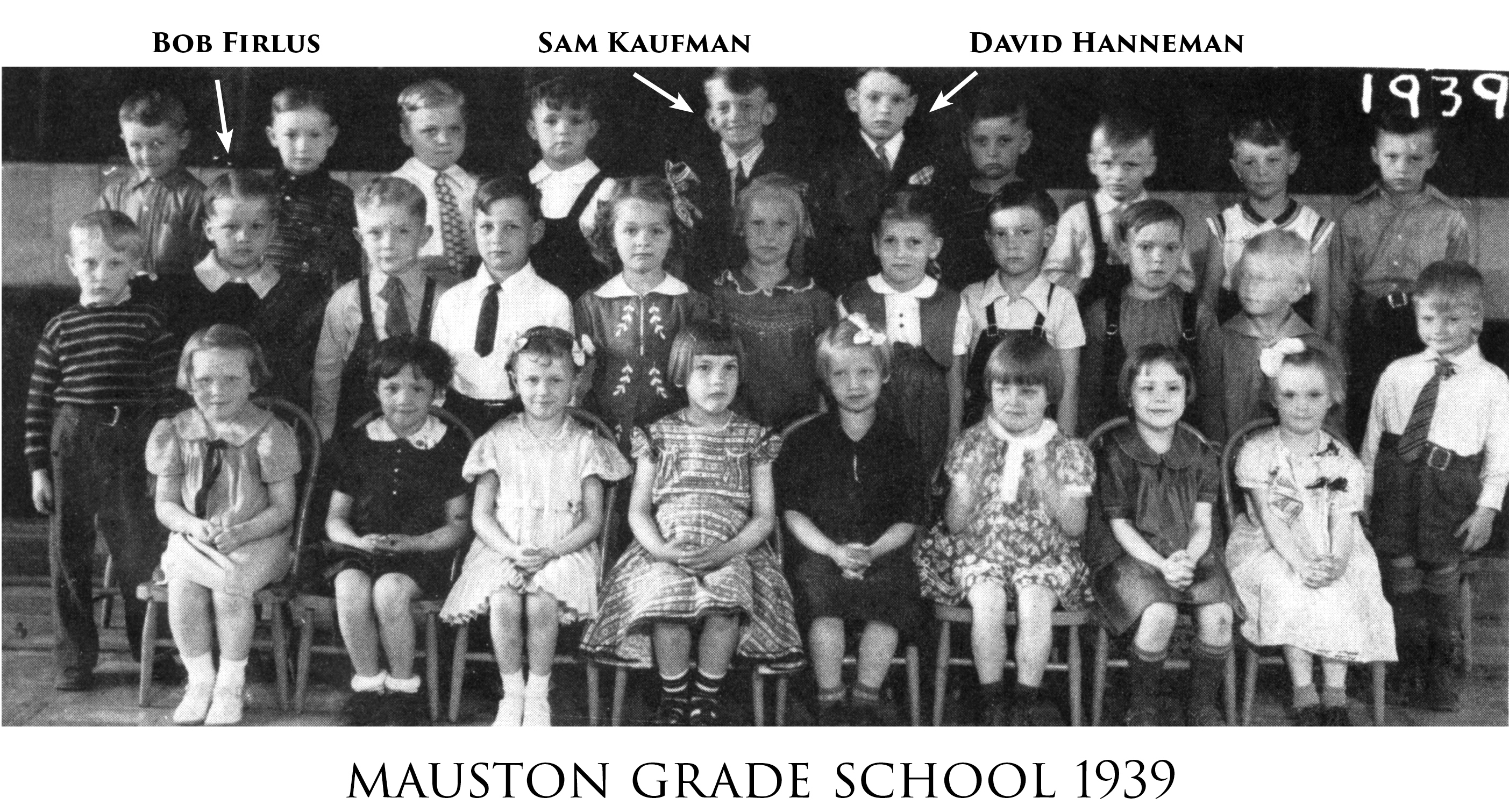
Ah, the troubles of youth! What a great story! Bob said he believed Sam had moved to Pennsylvania after leaving Mauston. I next dug out some of my Dad’s yearbooks and found Sam pictured with my Dad’s Mauston Grade School class in the late 1930s and early 1940s. He was one of the tallest boys in class, so was usually found in the back row. In the 1939 class photo, he was standing directly to my Dad’s right.

Bob Firlus, Sammy Kaufman and David Hanneman are shown in this early grade school photo.
Bob Firlus, Sammy Kaufman and David Hanneman are shown in this early school photo.

I checked the U.S. Census and military records on Ancestry.com and  found Sam’s father, Albert Ross Kaufman, a doctor at Mauston’s Hess Memorial Clinic. The elder Kaufman’s 1942 draft card showed he was 46 and living with his family at 214 Tremont Street in Mauston. That was fairly close to the Hess clinic, but not so close to the Hanneman house. So what was his connection to that photo taken on Morris Street? I looked up Sam’s mother, Ardis, and discovered her maiden name was Hess. OK, now we’re making progress. Hess was a very prominent name in Mauston, largely due to Dr. James Samuel Hess Sr., a pioneer doctor and founder of the hospital and clinic. Interestingly, Bob Firlus said he had recently thought about Sam and the name Ardis came to mind, although Bob hadn’t recalled that was Sam’s mother’s name.

Turns out that Dr. Ardis (Hess) Kaufman (also a physician) was the daughter of Dr. J.S. Hess Sr. and Maude (Robinson) Hess. She was the sister of Dr. J.S. Hess Jr., who lived directly across the street from the Hannemans. Dr. Sam, as the junior Hess was known, took over for his father at the hospital and clinic. That explained why Sammy was a frequent neighborhood visitor. My grandfather, Carl F. Hanneman, worked for Dr. Sam running the pharmacy attached to the Hess clinic. So it made sense that Bob Firlus and my Dad were buddies of Sam Kaufman. I dug into my photo archives and found another shot that appears to show Sam outside the Hess home around 1942.

A tall, thin young man believed to be Sam Kaufman outside the Hess home on Winsor Street.

Now that I had a good sense of Sam’s history in Mauston, I wanted to figure out where he went and what happened in his life. Again, Ancestry.com was a crucial source. I found listings for Dr. Albert R. Kaufman under city directories in New Kensington, Pennsylvania. Based on that, I ran search engine queries and located an obituary for Sam Kaufman. I reacted with sadness, since I always hope in doing this work to find a living person to track down. Sam died in October 2008 of lung cancer. Same cause as my Dad, and about 18 months later. From the obituary, it was clear Sam had lived an exemplary life.

The obituary described Sam’s college education, his longtime service in the U.S. Army, his 1957 marriage to Margaret “Meg” Floyd, and his career switch from salesman to high school teacher. He had a long teaching career at Baldwin High School in suburban Pittsburgh. The couple had two sons, James and Steve. From checking those names with search engines, it appears Steve has had a long career as an assistant U.S. attorney in Pittsburgh.

Even after I finished most of my research, Sam’s name stuck in my head. There was some other clue I was missing. Dad, could you give me some help here? Then it hit me. I vaguely recalled that Sammy accompanied my Dad’s family on one of their vacation trips to the Dakotas. But how to find the photo amidst the thousands in the archive? On this day, I had some help from above. The first archive box I opened had the photo for which I searched. The caption read: “Sammy Kaufman on right, David Hanneman on left.” It was in my Grandma Ruby’s handwriting.

David Hanneman and Sam Kaufman outside the Ortman Clinic in Canistota, S.D., circa 1944.
David Hanneman (left) and Sam Kaufman outside the Ortman Chiropractic Clinic in Canistota, S.D., circa 1944.

It took a few days of work, but with a little effort I went from a tiny photo print with lots of questions to a decent understanding of Sam Kaufman and his life in and beyond Mauston. Well done, Sam, and thank you.

©2014 The Hanneman Archive

Big Little Books Delivered Pint-Size Childhood Adventures

For a child growing up in the 1930s and 1940s, big adventure often came in small packages. Like many boys his age, David D. Hanneman (1933-2007) was an avid collector of Big Little Books. These chunky mini-books allowed adventure-seeking children to follow the action of Buck Rogers, Dick Tracy, Flash Gordon, Tarzan and other characters. All for 10 cents a book.

The original Big Little Books concept was pioneered by the Whitman Publishing Company of Racine, Wisconsin. Whitman was a subsidiary of Western Publishing, the creator of the famous Little Golden Books (think Poky Little Puppy). Big Little Books were roughly 3¾ inches wide by 4½ inches high. Thickness varied by page count. For example, the 1934 Buffalo Bill and the Pony Express had 380 pages and was 1¼ inches thick. The layout was one of the classic features of Big Little Books. Each page spread had text on the left side and a black-and-white illustration on the right. 

Big Little Books had text on the left-facing pages and illustrations on the right pages.

Whitman Publishing came out with its first Big Little Book in 1932, The Adventures of Dick Tracy. Soon after, Whitman had titles with comic strip characters like Wash Tubbs, as well as a range of Walt Disney titles. The 1934 series alone included titles such as Chester Gump Finds the Hidden Treasure, Buck Rogers in the City Below the Sea, Reg’lar Fellers, Betty Boop in Snow White, Kayo and Moon Mullins, Mickey Mouse in Blaggard Castle and Dick Tracy and the Stolen Bonds. 

Most of the books had hard covers, although my Dad had one Buck Rogers title that was softcover and in a slightly smaller format (only 4¼ inches high). This book had no page numbers. The inside back cover spread was a two-page ad for Cocomalt drink mix. The 1935 Tom Mix and Tony Jr. in Terror Trail was a larger format (4 5/8 by 5¼ inches) and featured real photographs inside.

My Grandmother Ruby V. Hanneman wrote an inscription on the inside cover for my Dad's 8th birthday in 1941.
Ruby V. Hanneman wrote an inscription on the inside cover for my Dad’s 8th birthday.

For my Dad’s 8th birthday, he received a copy of the 1941 Tarzan the Untamed by Edgar Rice Burroughs. Ever the historian, my Grandma Ruby V. Hanneman wrote the particulars down in blue pencil on the inside front cover: “David Dion Hanneman, March 27, 1941, for 8th birthday, from Dad, Mother, Lavonne and Donn.” This title was from the Better Little Books series, also published by Whitman. In addition to the story and illustrations, it had a flip-book feature that showed an animation as the reader flipped the pages through his thumb and forefinger.

Titles in the 1941 Better Little Books series included Big Chief Wahoo and the Magic Lamp, Mickey Mouse on Sky Island, Popeye and a Sock for Susan’s Sake, G-Man and the Gun Runners, Dick Tracy and his G-Men, Red Barry Undercover Man, Ellery Queen and the Adventure of the Last Man’s Club, Inspector Charlie Chan Solves a New Mystery and others. By the time he was in high school, my Dad stopped adding to his collection. But they clearly held a special place in his heart, since he kept and safeguarded them for more than 50 years before passing them on.

©2014 The Hanneman Archive