Tag Archives: Hanneman

Hanneman Farm in the Library of Congress

Nestled within the two dozen photo collections in the Library of Congress American Memory project is an image of grain threshing on a Hanneman farm in central Nebraska in the opening years of the 20th century.

Work on the grain threshing stopped just long enough for the farm laborers to pose for a photograph taken by Solomon D. Butcher. The caption reads: “Threshing crew on farm of E.F. Hanneman, Watertown, Buffalo County, Nebraska.” The year was 1903. The image was submitted to the Library of Congress by the Nebraska State Historical Society. 

A cropped section of the Library of Congress photo. It might be Ernest Hanneman standing at center.
A cropped section of the Library of Congress photo. It might be Ernest Hanneman at center.

The glass-plate negative photo is interesting for several reasons. One is the hand-drawn accents, such as the smoke coming from the steam engine and the straw pouring from the chute of the thresher. In the age of Adobe Photoshop and digital photo manipulation, these details might cause a chuckle. The “smoke” hardly looks real. But these details are charming nonetheless, a look at how photographers created detail and motion in photographs of that era.
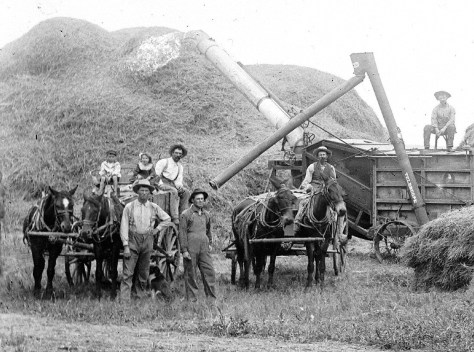
Another detail section of the Library of Congress image. Note the hand-drawn grain coming from the thresher chute.

The photo is not only of a Hanneman family farm, but it also has ties to Wisconsin. The “E.F. Hanneman” mentioned in the caption refers to Edward F. Hanneman, who lived much of his life in Buffalo County, Nebraska. Edward was born in Wisconsin in October 1880, presumably in Columbia County north of Madison. His family lived there for a time before moving west to Nebraska.

Ernest and Maria Hanneman from FindAGrave.com (submitted by Charmaine Becker).
Ernest and Maria Hanneman photo  from FindAGrave.com (submitted by Charmaine Becker).

Edward’s father, Ernest Ludwig Friedrich Hanneman, was born in Pomerania in 1843. He came to America in 1861. Ernest’s parents, Dietrich and Maria Hanneman, settled in Columbia County, but had both died by 1880. Dietrich and Maria are buried in Hillside Cemetery in Columbus, Wis. By the time of the 1900 U.S. Census, the Ernest Hanneman family had settled in Amanda Township in Buffalo County, Nebraska.

We’ve noted on these pages before that Columbia County, Wisconsin, was one of the Wisconsin Hanneman enclaves in the late 1800s. There were others in Dane, Fond du Lac, Dodge, Marathon, Wood, Portage, Racine, Winnebago and Outagamie counties. My Hanneman line settled in Portage and Wood counties, starting in 1861. There could be a connection between the Dietrich Hanneman line and my line (Matthias Hanneman, 1794-1879). More research is needed.

Many, if not most, of the Hannemans who settled the U.S. Midwest in the 1800s came from the Duchy of Pomerania, a long-ago Baltic state which is now part of Poland and Germany. My family line goes back to at least 1550 in Kreis (county) Regenwalde, Pomerania. Some of the Marathon County Hannemans moved west and settled in Lake County, South Dakota. Some Hannemans who emigrated to Wisconsin later settled in Minnesota, Iowa, South Dakota, North Dakota and Nebraska.

The American Memory project was one of the Library of Congress’ early efforts to digitize some 5 million images from its trove of priceless photographs. It invited submissions from libraries and historical societies around the nation. The Edward F. Hanneman farm photo was part of the collection “Prairie Settlement: Nebraska Photographs and Family Letters.”

©2016 The Hanneman Archive

Wedding Photo Draws a Following, 90 Years Later

I’m generally not a fan of social media page “likes” or shares or fan praise. While it is one metric of success in the online world, it also can set us up for easy disappointment. That being said, I was quite pleased to see my grandparents’ wedding photo draw such nice comments on an Instagram page dedicated to preserving the stories behind photos.

Saving Family Photos featured this 1925 wedding portrait today, along with the newspaper story published shortly after the marriage of Carl F. Hanneman and Ruby V. Treutel. As of this writing (less than one full day on display), the photo has 1,016 likes. A sampling of the viewer comments:

I have a similar picture of my grandparents. You’ve inspired me to frame it.”

“Wow! Beautiful picture!”

“A true treasure.”

“Stunning photo. Love every detail. A gift for you to have this.”

“Can’t love this enough…still looking for photos of my grandparents weddings.”

“That is now may favorite wedding photo! What a treasure!”

I submitted the photo to Saving Family Photos from Treasured Lives, our sister site. If you are on Instagram, find them @savefamilyphotos. You can also see the gallery on their web site.

©2016 The Hanneman Archive

We’ve Launched Treasured Lives

Doing research on family history is an exciting journey. That is the whole idea behind Treasured Lives, a small business dedicated to helping you map out and progress on your history journey. We invite all of the readers of the Hanneman Archive to visit and follow Treasured Lives.

There are lots of online databases and services out there dedicated to genealogy and history. If that all seems overwhelming to you, Treasured Lives is a good place to start. If you’ve started your research and need a boost from a professional researcher, Treasured Lives is also for you. Even if you’re an expert and want to put some more brawn behind your projects, we can help.

We not only offer a full-range of services, but we will also deliver interesting, useful content on our blog. We specialize in:

  • Genealogy Research
  • Biographical Writing
  • Photo Restoration & Retouching
  • Tribute Videos
  • Oral History
  • Gravestone Preservation
  • Collections Care
  • Photography

Treasured Lives grew out of a love for history. Joe Hanneman, our chief researcher and owner, has been doing genealogy research for more than a decade. He runs the popular Hanneman Archive web site, and has been a professional writer and communicator for more than 30 years. In 2010, he published his first book, The Journey Home: My Father’s Story of Cancer, Faith and Life-Changing Miracles. His first history project was helping his father start piecing together his family roots from Germany and Pomerania. That grew into a major undertaking. The Hanneman Archive holds more than 15,000 images and thousands of historic documents.

History is a journey and an ever-changing destination. As we like to say, every story deserves a voice, and a champion. We are here to be your partner in history.

Click here >> to view and download the Treasured Lives brochure.

Dueling Illustrator Brothers: Carl F. and Wilbert G. Hanneman

We’ve noted elsewhere on this blog the photography skills of Carl F. Hanneman, but lately we’ve discovered that he and his brother Wilbert G. Hanneman had talents with freehand illustration. Working on the yearbook at Lincoln High School in Grand Rapids, Wis., the brothers served almost as dueling artists.

Judging by the line drawings each made in high school and in years after, both men had artistic abilities. Wilbert (1899-1987) first served as an artist and editor for the Ahdawagam yearbook. Ahdawagam is an Indian word that refers to the “two-sided rapids” along the Wisconsin River. The yearbook was first published in 1916. Wilbert graduated from Lincoln in 1918, and Carl followed in 1921. Both Carl (1901-1982) and Wilbert drew the illustrations for the yearbook’s section pages, such as Alumni and Sports, and the various class sections.

Wilbert drew a stunning likeness based on Carl’s high school graduation picture. The latest example of hand illustrations we could find is from 1945, showing a U.S. service member next to the saying, “Keep off the Lifeline.” The Navy serviceman in the illustration bears a striking resemblance to Carl. His son Donn G. Hanneman (1926-2014) served aboard the USS Hoggatt Bay during World War II.

©2015 The Hanneman Archive

Entire Richard Rickman Family Killed in 1960 Plane Crash in Chicago

As he prepared his six-seat Beechcraft C35 Bonanza airplane for takeoff, Richard E. Rickman asked airport manager John Stedman if he should take the most direct route, across expansive Lake Michigan to Detroit. Stedman cautioned against it, telling the pilot to fly east across Wisconsin to the lake, then hug the shore and make his way over to Michigan. This approach would presumably be safer, and provide great views for Rickman, his wife and four children.

It was just after the dinner hour on Labor Day 1960. The Rickman family packed themselves into the aircraft at Alexander Field in Wisconsin Rapids, ready to make the flight home to Detroit. The family had been to Drummond, Wis., to visit Helen Rickman’s parents, then flew to the Rapids to visit other relatives.

Richard, the son of a longtime shoe-store proprietor, grew up in Wisconsin Rapids. He was a descendant of pioneer resident Matthias Hanneman, who came to Wisconsin in 1866 from Pomerania. A factory representative for the Ogden Manufacturing Co., Rickman married the former Helen Anderson in December 1949 and they later moved to Michigan. Their first child, Richard Edward, was born in Lansing in May 1953. Robert John was born in Lansing in March 1955. Catherine Helen was born in Detroit in June 1956; and Patricia Ann joined the family in Detroit in September 1957.

The Richard E. Rickman family, shown in a 1960 newspaper photograph. Left to right are Richard, 7; Patricia, 3; Richard Sr., 35; Robert, 5; Helen, 34; and Catherine, 4.

The final day of the Rickmans’ visit was spent at the airfield. Rickman gave plane rides to his sister, Elvira Pluke, her husband Nolan and their five children. Rickman primarily used the single-engine aircraft for business trips. The family had recently flown to California in the plane, and then used it for the Labor Day weekend visit.

The wheels of the Beechcraft left the ground of Alexander Field at 6:30 p.m. The Rickman family flew along the western shore of Lake Michigan. They were treated to an incredible view of the Chicago skyline as the aircraft flew less an a mile offshore. The first sign of trouble came near 7:30 p.m., when Rickman issued distress calls that were heard by ships and aircraft as far north as Milwaukee. Rickman radioed Meigs Field in downtown Chicago and asked permission to make an emergency landing because the plane’s engine was cutting out.

Officials at Meigs Field gave Rickman permission for an emergency landing. He veered the aircraft out over the lake and circled to attempt a landing. Witnesses at nearby Oak Street Beach saw sparks trailing from the airplane. The 185-horsepower Continental engine caught fire and became enveloped in smoke. Suddenly, the 25-foot-long airplane turned straight down and plunged headlong into the lake. Hundreds of horrified beach-goers saw a blinding explosion as the plane hit the water.

The Wisconsin Rapids Daily Tribune carried the horrifying news on September 6, 1960.

William J. Cempleman saw the fiery crash from aboard the yacht Playtime. “The whole lake looked afire. Flames soared twenty-five to thirty feet,” Cempleman said. “When we got to the scene, a big circle of water was flaming. All we could see was an airplane wheel floating.” As the Playtime circled the crash site, Cempleman saw the charred body of little Catherine Rickman, 4, floating about 15 feet from the flames. Newspapers across America later published a dramatic Associated Press photograph of a police marine officer carrying the lifeless body of Catherine to shore. Resuscitation efforts failed.

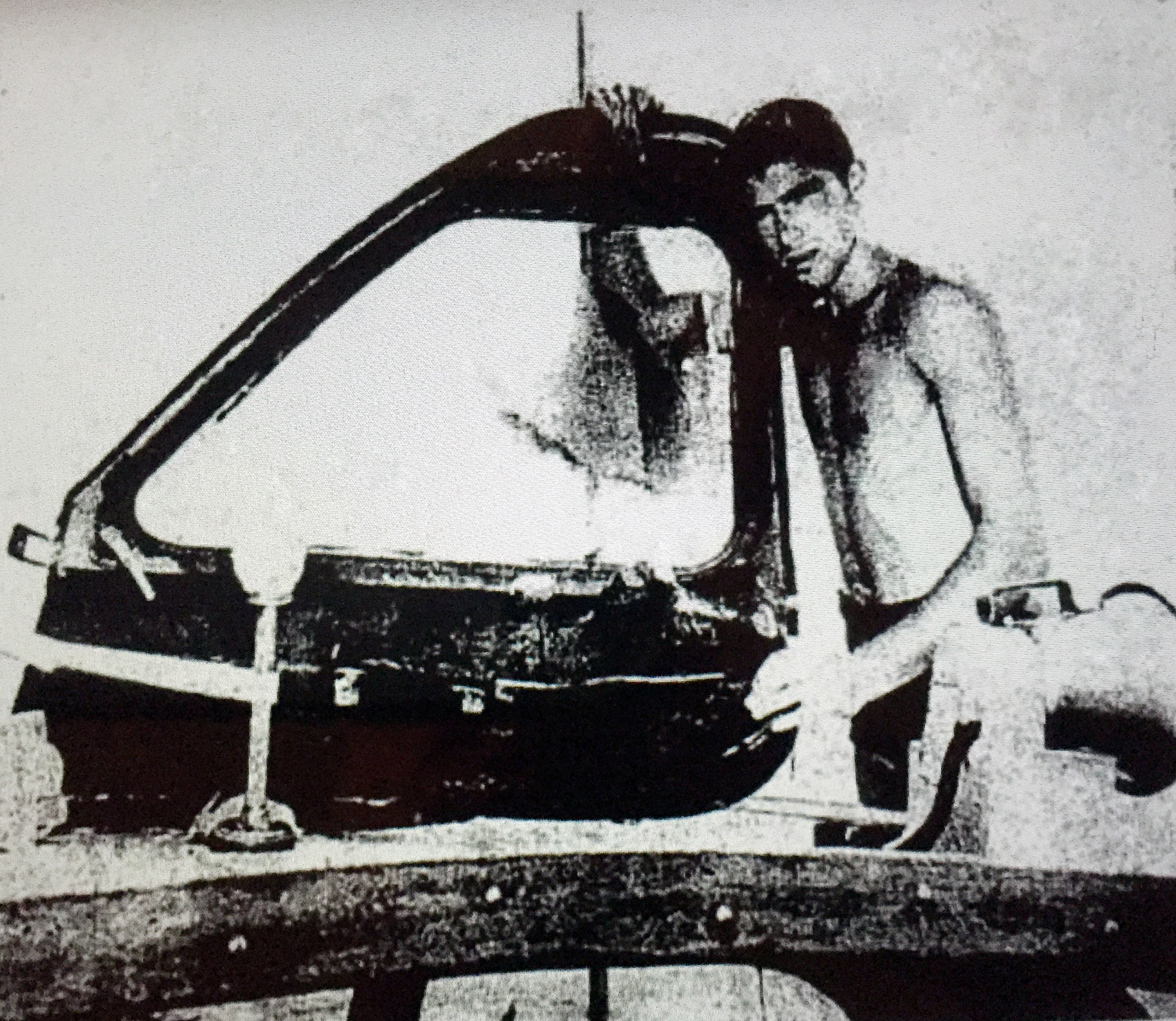
Lifeguard Bill Zimmerman with a door from the doomed Beechcraft C35 Bonanza. (Chicago Tribune)
Lifeguard Bill Zimmerman with a door from the doomed Beechcraft C35 Bonanza piloted by Richard E. Rickman. (Chicago Tribune)

Police and Coast Guard vessels searched the waters off Oak Street Beach into the night. Divers used underwater lights to aid in the search, but found no trace of the aircraft or the other members of the Rickman family. Divers resume the search on September 6, but did not locate the wreckage or the other victims until September 7. Diver Jeff Daxe, a commercial pilot, was the first to reach the bodies. The Chicago Daily Tribune reported that one body was found 50 feet from the fuselage, while the other four were inside the wreckage. After the victims were recovered and taken to Burnham Harbor, it was discovered that Richard Rickman’s watch stopped at 7:38 p.m. 

The impact sheared off both wings, but only one was found. The engine and propeller were found some distance from the rest of the wreckage in about 30 feet of water. Two weeks after the crash, the Civil Aeronautics Board issued a preliminary opinion that engine failure had caused the crash. In late October the CAB confirmed that opinion, but said the engine would be sent back to the manufacturer for testing. It’s unknown if that ever happened.

The six members of the Rickman family were memorialized at a funeral service on Saturday, September 10, 1960 at Immanuel Lutheran Church in Wisconsin Rapids. They were buried at Forest Hill Cemetery.

The six members of the Richard E. Rickman family are buried at Forest Hill Cemetery in Wisconsin Rapids.
The six members of the Richard E. Rickman family are buried at Forest Hill Cemetery in Wisconsin Rapids. (Photo courtesy of Ben Chitek)

Richard Edwin Rickman was born on April 27, 1926, the youngest child of Edwin and Renata (Rathke) Rickman. Edwin John Rickman was the son of Christian Wilhelm Ludwig Theodor and Amelia Bertha Emilie Auguste (Hannemann) Rickman. Amelia’s father was August Friedrich Hanneman, the son of family patriarch Matthias Hannemann. Richard Rickman graduated from Lincoln High School in 1943 and enlisted in the U.S. Navy in July 1943. He served more than three years in the Navy during World War II and was discharged as an ensign in September 1960. He graduated from Northwestern University with a degree in business administration.

©2015 The Hanneman Archive

A Time for Fall Memories

The change from summer to fall always reminds me of leaves. Lots and lots of leaves. With more than a dozen huge oak trees in our back yard in Sun Prairie, we always had mountains of leaves to romp through during fall. On windy days, the air in our back yard was filled with falling leaves. Before the days we had to help rake and bag the leaves, we dove into the pile with reckless abandon.

My own children had a similar experience in our first home on the north side of Racine. We had maple and apple trees that left plenty of seasonal detritus across the landscape. I have some precious video (see below) of our oldest, Stevie, running through the leaves at my childhood home in about the year 1995.

Fall always meant trips to the pumpkin farm, huddling around the fire pit on the back deck, picking fresh apples at local orchards, and of course getting the snowblower tuned up and ready for winter. It is a season of change, of color, of transitions. As the years pass, it also becomes a season of reflection and wistfulness.

©2015 The Hanneman Archive

‘Rock Hounds’ Wib and Irma Hanneman Ran Wausau Gift Shop

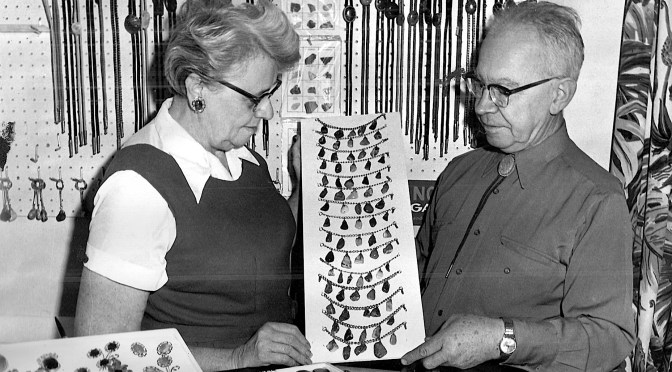
As a boy, I often got to travel with my Dad on his sales routes across Wisconsin to sell veterinary pharmaceuticals and supplies. One of his routes took him to Wausau, so we got to pay a visit to Hanneman’s Rock and Gift Shop, run by my great uncle and aunt, Wilbert G. and Irma Hanneman. Visits to the shop always resulted in getting to pick out something made from the most exquisite polished rocks and colorful crystals.

Over the years, I developed a nice collection of treasures from the rock shop. I came to believe that Uncle Wilbert (nicknamed “Wib”) had made a career out of selling rocks and crystals. Actually, he and Aunt Irma took it up as a post-retirement labor of love after Wib’s long career in banking. They sold gifts from the shop in their home at 130 Ninth Avenue in Wausau in the 1960s and early 1970s, but also attended craft shows and other events to peddle their intricately patterned wares.

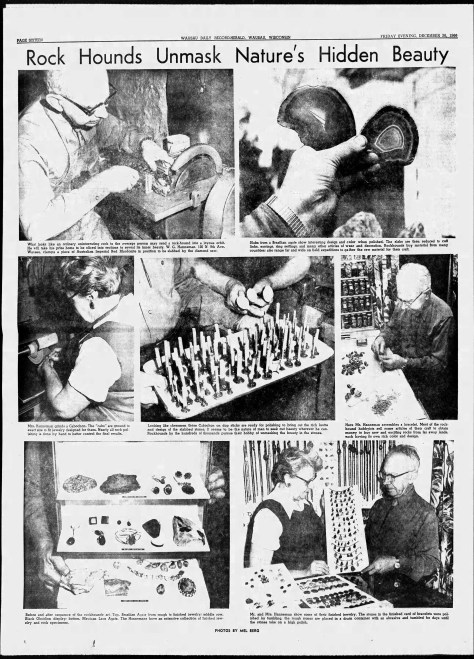
Wilbert G. Hanneman uses a diamond saw to cut slabs of Australian imperial red rhodomite.
Wilbert G. Hanneman uses a diamond saw to cut slabs of Australian imperial red rhodonite.

In December 1966, the Wausau Daily Herald-Record ran a photo page featuring the Hannemans and their rock shop. “What looks like an uninteresting rock to the average person may send a rock-hound into a joyous orbit,” read one of the captions. The photo showed Wib using a diamond saw to slice Australian red rhodonite into slabs. Another photo showed polished slabs of Brazilian agate, which were later used to make cuff links, ring settings and other items.

Although Wib and Irma used tumblers to polish many of the smaller rocks, much of the rock polishing was done by hand “to better control the final results,” the newspaper wrote. The craft has its aim to “unmask the beauty in the stones.”

Wausau_Daily_Herald_1966_12

Wilbert G. Hanneman was born May 1, 1899 in Merrill, Wisconsin, the third of five boys born to Charles and Rosina Hanneman. He was the older brother of my grandfather, Carl F. Hanneman. In June 1923, Wib married Irma Pagels and the couple moved to Wausau. Wib had a long career working for the Citizens State Bank and Trust Co., from which he retired in 1964. Wib was a graduate of the School of Banking at the University of Wisconsin-Madison.

Wib overcame a bout of polio that left him with a pronounced limp. Late in life he suffered a heart attack that forced him to give up his beloved cigars. Wib and Irma celebrated their 50th wedding anniversary in 1973. Carl, who was the best man, attended the anniversary doings. The couple had two children, Richard D. Hanneman and Lynn (Hanneman) Swanson Zarnke. Wib died in 1987 and Irma died in 1996.

(This post has been updated with the full newspaper page image)

©2015 The Hanneman Archive
New Video Trailer for ‘The Journey Home’

The book about my father’s battle with lung cancer and his final months on this earth has been in print for nearly five years. It seems a good time to update the book’s official video trailer. The new version, posted below, is in high definition. Back when the original trailer was created, HD video was still fairly novel. But now HD is the norm on home televisions and computers, so it was time to upgrade this important promotional video. You can also view the video in a larger format here.

Here is a 1992 Letter for Your 23rd Birthday

Jan. 20, 2015

Dear Stevie,

I wish I could get you a big birthday gift this year, like prepaid college tuition or a new car. But I can’t. I think I have something much more valuable to share, though. I wrote the letter below almost 23 years ago, when you were barely two weeks old.

Much has changed in our lives and in the world since then. You grew up and overcame big challenges on your way to high school, and then college. You’ve gone out into the work work and supported yourself as you pay for your own education. I know that has been hard, but it is a great credit to you, and I’m very proud of you.

When I wrote the letter, we had no idea who you would become. You were at times a cranky baby, with lots of colic. But you were mostly happy. It was a sheer delight watching you grow up. As I see you ready to celebrate your 23rd birthday, I can say that I could not be a more proud Dad of my only son. Just like the letter says, you’ve grown up to be a good man. I love you.

Dad


Feb. 2, 1992

Dear Stevie —

You probably don’t like us calling you Stevie anymore, but right now, it fits you perfectly. It’s 10:30 p.m. on a Sunday. I’m watching a rerun of M*A*S*H on television as your Mom naps on the couch. You are asleep in your crib down the hall. I can hear you breathing over the nursery monitor.

There are a lot of things I want to say to you. The first is that your Mom and I love you very  much. You’re only 2 weeks old, but you’ve added so much to our lives. And now we sit and imagine what kind of a person you will grow up to be. We know you’ll be a good boy, and eventually, a good man.

The letter sat in the bottom of my dusty Sentry safe for 23 years.

First, some history. You were born at 8:41 p.m. on Jan. 20. You weighed 7 pounds 13 ounces. I’ll never forget your little hand clutched around my finger as you lay on the incubator table. You were so alert as you waited to be put in a blanket.

The day you were born, George Bush was President of the United States. Tommy Thompson (a good friend of your great Grandpa Carl) was governor of Wisconsin. Your Dad works as a reporter for the Racine Journal Times, covering state government and politics. Your Mom works for Communications Concepts in Racine, doing graphic arts on a computer. The top TV shows are Cheers, Murphy Brown and L.A. Law.

You are a beautiful baby. You have dark eyes, red hair and soft, rounded cheeks. You’re only 2 weeks old, but already you can lift your head in the crib. I wonder what you are thinking when you gaze up at us while you’re feeding or playing. We nicknamed you “Popeye” because when you want your bottle, you look up with only 1 eye open and open your mouth.

You were conceived at the end of the 1991 Persian Gulf War. Your Mom was in the Army Reserves and was called off to war in Dec. 1990. She was stationed in Augsburg, Germany, as a food inspector. When she came home from war in April 1991, we had you. You were part of what was called “Operation Desert Stork,” named after the war, “Operation Desert Storm.”

As I write this your Mom and I are looking forward to seeing you crawl, take your first steps, and all the things that come after. But for now, there’s one thing we’re sure of — how happy we are you’re here.

Love,

Dad


Eye on the Past: Two Brothers in 1936

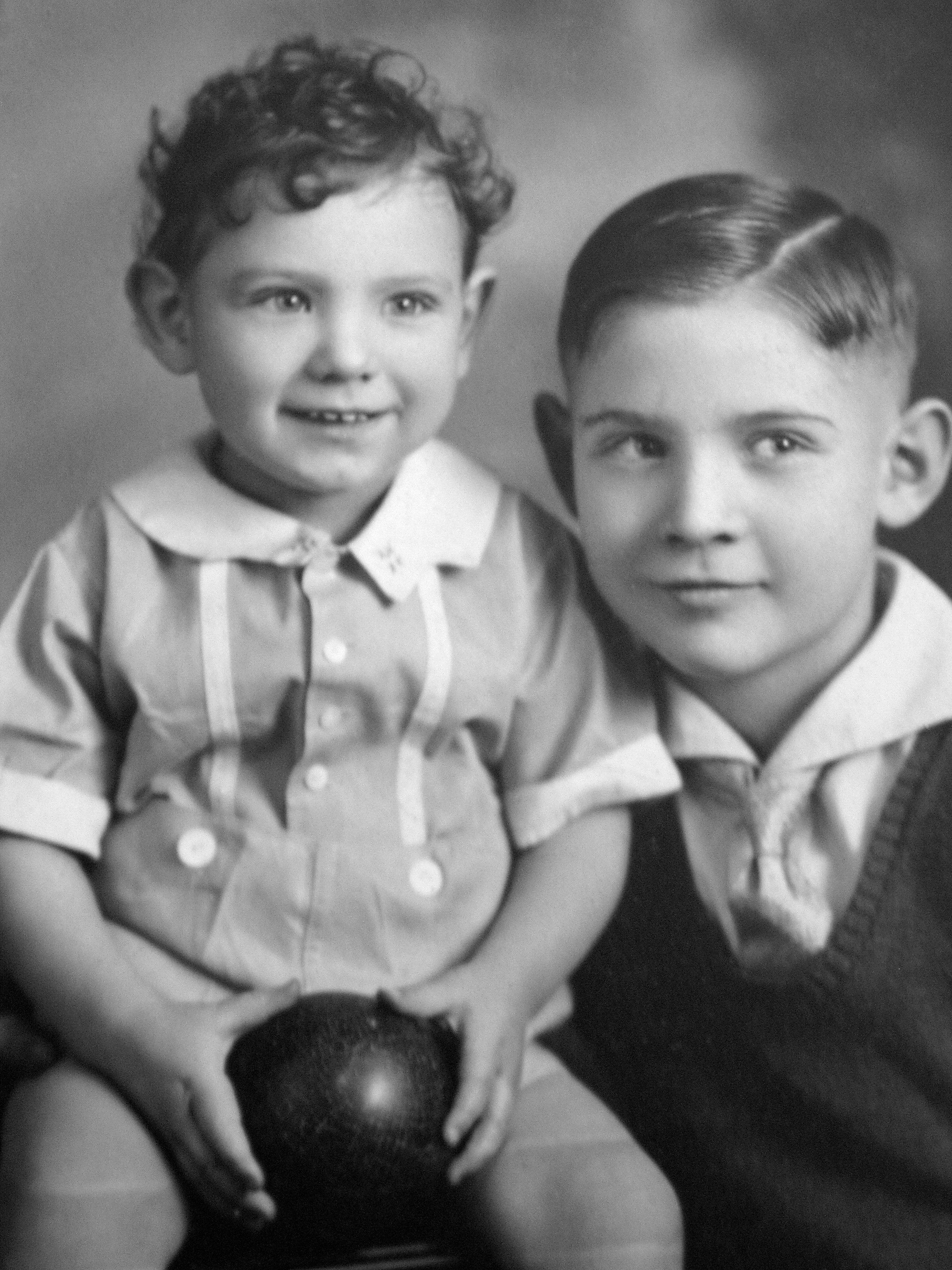
This is one of the earliest photos showing brothers David D. Hanneman (left) and Donn G. Hanneman, taken circa 1936. I believe this portrait was taken in Mauston, Wisconsin, where the family moved in early 1936. My Dad (David) was 3 years old that year. The family had a good relationship with Bauer Studios, so throughout the years there were always nice portraits of the Hanneman children. 

David D. Hanneman (1933-2007) and brother Donn G. Hanneman (1926-2014).

I love the curly head of hair on Dad. He always had a great head of hair, right up to the day he lost it from chemotherapy in 2007. He asked me at the time if I thought it would grow back. I said yes, although Dad died before it had the chance. I imagine one day seeing him in Heaven, with either that distinguished-looking silver mane or the wavy jet-black hair from his youth.

©2015 The Hanneman Archive