Growing up in an Irish family of 11 children during the Great Depression and World War II left Mary K. (Mulqueen) Hanneman with vivid memories. The seventh child born to Earl James Mulqueen Sr. (1895-1965) and Margaret Madonna (Dailey) Mulqueen (1895-1982), she has tender memories of her parents and life in Cudahy, a southern suburb of Milwaukee.
In April 2009, she sat down for an oral history interview with granddaughter Ruby Hanneman, 9, and son Joe Hanneman. The discussion covered subjects like how the big family made ends meet during the Great Depression, how having four siblings serving in World War II changed family life at home, and the lasting impressions left by her late parents. The presentation lasts 23 minutes 6 seconds.
The photo above shows Margaret Mulqueen and husband Earl across the table for Sunday dinner in the late 1950s. The photo embedded in the SoundCloud player shows Mary with sisters Ruth (Mulqueen) McShane and Joan (Mulqueen) Haske outside the Mulqueen home on East Cudahy Avenue.
During his two years as mayor of Sun Prairie, Wisconsin, David D. Hanneman made several appearances on the local television public-affairs program called “City Talk.” You might think that local cable access programming would be uninteresting, but in this case, you would be wrong. Hosted by former Sun Prairie alderman Don Hooser, the show on KSUN always featured thought-provoking, in-depth discussions of issues facing the city. Topics included the city’s master plan to develop its west side, something that has beautifully come to fruition in the years since.
When Dad passed away in 2007, Hooser arranged to re-run theses programs in Dad’s memory. Hooser still hosts a local public-affairs program, now called “Talk of the Town.” The program below was taped on September 24, 2003.
In an effort to put my family history audio recordings to better use, we’re adding a new post category: audio history. In this inaugural audio clip, my Dad shares recollections of childhood visits to Vesper and Arpin, Wisconsin. The Hanneman family from Mauston often visited Dad’s maternal grandfather, Walter Treutel (1879-1948), in Vesper. A short distance away was the home of Aunt Emma (Treutel) Carlin (1877-1948). Listen carefully for the description of dinner preparation in Arpin, where Uncle Oscar Treutel lopped a few heads off to get things started. This was recorded in November 2006, just as Dad started treatment for the cancer that would end his life five months later.
I often heard the yarn that the Treutel family that came to Wisconsin in the 1850s was descended from royalty back in the old country.Dad would regale us with the story of the “Von Treutelers,” and he pronounced Von like the sound of “fawn.” It sounded royal. I spent more than a few research hours trying to track down the origin of this story. Yes, there were Treutelaars and Treutelers back in Germany. I found nothing to trace them or any relatives to a royal family. Until now.
While searching for something else, I was paging through a scrapbook kept by Emma (Treutel) Carlin (1877-1962), Dad’s beloved Aunt Emma from Arpin, Wisconsin. Emma was a faithful letter writer and keeper of family history. One of the pages of her scrapbook, provided to me courtesy of Bonnie (Treutel) Young, sketches out a bit of a family tree. Down in the lower right corner is a short treatise on Treutel royalty.
Handwriting from the scrapbook of Emma (Treutel) Carlin, 1877-1962.
“The name Treutel originally was Von Treuteler,” Emma wrote. “Royalty in Germany. The name in this country goes by the name Treutel. Some Von Treuteler married out of his class in Germany and I believe lost his title or ‘Von.’ ” On another section of the page, Emma wrote: “Any persons having the name Treutel or Von Treuteler are positive relatives some way or another.”
Not exactly a certificate of royal pedigree, I realize, but an indication that the royalty story was passed through the family for some time. Back in July 1854, Johann Adam Treutel (1800-1859) brought his family to America from Darmstadt, Germany (part of the Grand Duchy of Hesse). He and his wife, Katharina (Geier) Treutel, lived at least part of their marriage in Königstädten, just north of Darmstadt near the city of Russelsheim. A rough translation of Königstädten is “king’s village.” So who was the king? Was he a Von Treuteler? That will have to be the subject of more research.
A few pages later in Emma’s scrapbook, I found another item that led me to discover another of Adam and Katherine Treutel’s children who came to America. It was an obituary clipped from the Milwaukee Journal or Milwaukee Sentinel in August 1940. The deceased was named Edward Bredel, age 67. I wondered what the connection was, and why Emma clipped this obituary.
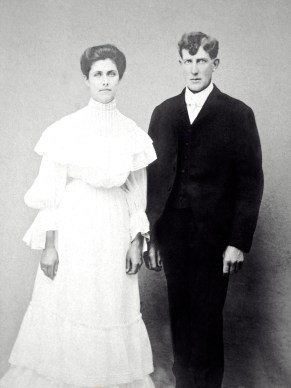
The 1904 wedding portrait of Emma Treutel and Orville Carlin.
I ran a search for the surnames of Treutel and Bredel at the FamilySearch.org web site and got a very quick answer. By looking at marriage records of a number of people, I discovered parents Christoph Bredel and Margaretha Treutel. A little more reading and I found a death record for Anna M. Treutel Bredel, with parents listed as “A. Treutel” and “Catherina T.” Looked like a match.
I had a Margaret Treutel listed as one of Johann Adam Treutel and Elizabeth Katharina (Geier) Treutel’s children. But I never found any details related to her. Until now. Margaret and Christoph Bredel had at least seven children between 1861 and 1881. It appears Margaret met Mr. Bredel when her parents came to Milwaukee sometime after July 1854. The Treutels established a number of businesses near downtown Milwaukee, including tailor, tallow chandler and blacksmith shops. Christoph Bredel was a shoemaker with a shop located at 313 State Street (now called Wisconsin Avenue). In the Civil War, he served with both the 14th and 17th Wisconsin Infantry regiments. Margaret died at age 59 on 24 April 1898 in Milwaukee. She was buried the next day at Union Cemetery in West Bend, Wis. Many of the original Treutel emigrants are buried in West Bend. Christoph died in January 1916. He was 83.
The discovery of Margaret’s family details puts us one step closer to filling out the history of the Treutel family that came to America from Darmstadt between 1849 and 1854. Katharina (Geier) Treutel’s obituary said she had eight children. I have eight in my database: Adam, John, Philipp, a twin of Philipp who died as an infant, Sebastian, Margaret,Henry and Peter. The only one I have no information on is Peter. Emma’s scrapbook has a notation next to his name: “Southern.” I know some Treutels settled near New Orleans, so perhaps I will find the answer there.
Every family historian has come up against the dreaded brick wall. Something that stops or stalls a genealogy search and prevents you from making progress in writing your family history. So it’s a joyous occasion to smash down one of those brick walls, which is just was I did this week related to my maternal grandfather, Earl J. Mulqueen (1895-1965).
I had been stymied for years trying to learn about Earl’s parents and other ancestors. The story I’d been told was that his parents both died before he was 4 years old and he was raised by two bachelor uncles on a farm near Green Bay, Wisconsin. I was able to find him and his younger sister on the 1900 and 1910 U.S. Census in the Town of Holland, Brown County. But despite years of searching, I could not find any record of his parents, who I was told were named Charles Mulqueen and Mary Chase.
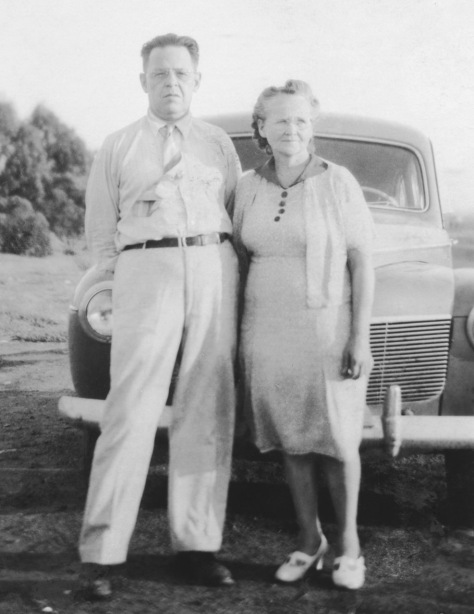
Earl James Mulqueen (1895-1965) and his wife, Margaret M. (Dailey) Mulqueen (1895-1982), in a photo from summer or fall of 1944.
Fast forward to this week. I met with two of my mom’s younger sisters, to see what information they might have about their father. Only three of 11 siblings in the Mulqueen clan of Cudahy, Wisconsin are still alive, so I was eager to finish this research now. One of the things we reviewed was a family bible originally belonging to my grandmother, Margaret Madonna (Dailey) Mulqueen (1895-1982). A small notation in the family tree section of the bible listed Earl’s parents as Charles Chase and Elizabeth McQueen. McQueen is a common spelling variant of the surname Mulqueen, and the Wisconsin branch of this family used the names almost interchangeably.
At this point, the information started to make sense. If Earl took his mother’s maiden name, it would explain my difficulty finding his parents in the records. On his 1965 death certificate, Earl’s parents were listed as Charles Mulqueen and Mary Chase. Was that information incorrect? I was about to find out. I turned to my trusty subscription to Newspapers.com, a subsidiary of Ancestry.com. I ran the obvious name searches, but turned up nothing. Then I tried a search just for the words “Chase” and “Askeaton,” the latter being the hamlet in Brown County settled by Irish families in the 1850s. Up popped a headline from the March 15, 1897 issue of the Green Bay Gazette: “Death of Mrs. Charles Chase of This City.” Bingo. One brick in the wall fell.
From the March 15, 1897 issue of the Green Bay Gazette.
According to the article, Mrs. Chase died of fever after giving birth. I knew my grandfather’s younger sister was born in 1897, so this made sense. Next I turned to the Wisconsin Historical Society and its index of pre-1907 death records. Again, the typical name searches did not find anything useful. I then did a broad search for all Brown County deaths from 1890 to 1900 and manually looked through them. There I found a death record for Bridget E. Chase on March 12, 1897. Bridget? I recalled the U.S. Census records for a McQueen family in the Town of Holland, Brown County, had a Bridget listed. Her age was a close match for Bridget Chase. The Elizabeth McQueen listed in grandma’s Bible was actually Bridget Elizabeth McQueen.Boom. Down came more bricks.
I used the same search strategy with the Wisconsin Historical Society’s marriage records. I found a Charles Henry Chase who got married on September 4, 1894. This sounded promising. But when I clicked on the “search for possible spouse matches” feature on the web site, it came up blank. That usually does not happen. So I again took the long road, calling up all Brown County marriages from 1890 to 1900 and zeroing in on the letter M. There I found two matches, both with the same September 1894 wedding date as Charles H. Chase. The first was for “Bridget Micgreen” and the second was for “Bridget E. Mcinween.” Whoa. What merciless butchering of the McQueen/Mulqueen name! As I quickly ordered paper copies of these documents from the WHS, I could hear that brick wall rumbling and crumbling.
Based on the information in these documents, Bridget Elizabeth was pregnant with my grandfather at the time of her September 1894 marriage to Charles H. Chase. Grandpa was born on 7 January 1895. Now I had confirmation of my grandfather’s parents, whom he never really knew. I’m still waiting for the marriage and death certificates from Madison, and I hope they shed further light on this couple. There are still big questions needing answers. Why did Earl take his mother’s maiden name, Mulqueen, rather than his father’s name, Chase? Again, this is not typical, so there must be a significant story behind it. What happened to Charles H. Chase? I had often been told he died while my grandfather was young. But I had also been told his surname was Mulqueen. I am in the process of tracking down his story.
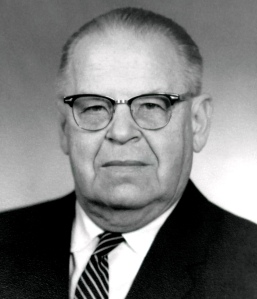
Earl J. Mulqueen, circa 1964.
While I was on a research roll, I turned to Elizabeth Mulqueen’s parents. I easily located them on the 1860 U.S. Census for the Town of Holland in Brown County. Daniel and Mary Mulqueen, parents to James, 9; Thomas, 5; Margaret, 3; and Michael, 1 month old. On the 1870 U.S. Census, new children appeared, including Margaret, 7; Daniel, 5;Bridget, 4; and Mary, 1. That makes two Margarets with different ages, so either the 1870 Census is in error, or the first Margaret died and a new daughter bore the same name. The Census put Earl’s mother’s birth year at around 1866.
I next used my Family Tree Maker software (powered by Ancestry.com databases) to look for more information on this family. I found little Mary Mulqueen’s Wisconsin birth record, which listed the mother’s maiden name as Corcoran. So now I knew Daniel Mulqueen married Mary Corcoran, likely prior to 1851, when the family lived in Ohio. But I could find no birth or death records on file for any of the couple’s other children.
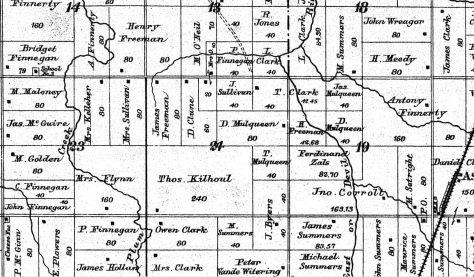
This 1889 plat map shows the farms of Dan Mulqueen, James, Mulqueen and Thomas Mulqueen in the Town of Holland, Brown County, Wisconsin. The family owned 200 acres just to the northwest of the village of Askeaton.
By digging more through news microfilm, I discovered that Daniel Mulqueen spent his final years at the Brown County Asylum, having been judged “insane.” Unfortunately, I have no information on his case, which could have simply been dementia. People with infirmities that could not be handled at home often ended up in county asylums, sometimes called “poor farms” or “insane asylums.”
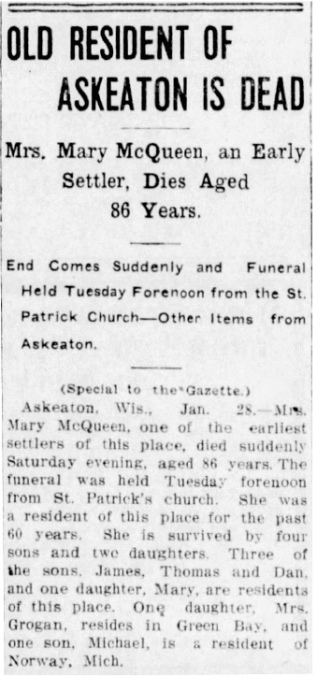
Mary (Corcoran) Mulqueen died on the family farm near Askeaton, Wisconsin. This 1913 news article is from the Green Bay Gazette.
Dan first entered the asylum on June 7, 1888. He was in and out of the institution over the next few years. He died at the Brown County Asylum on March 30, 1893. The only obituary, in the Daily State Gazette of Green Bay, read thusly: “Daniel McQueen, an insane man, died at the county asylum yesterday afternoon. He was 74 years of age. The funeral will be held tomorrow in the town of West Holland.” How sensitive. This man emigrated to America from Ireland, raised a large family on a successful farm in Wisconsin, yet the local paper only remembers him for an illness in his final years.
My Grandpa Earl and his sister moved to the Mulqueen farm near Askeaton after their mother died in March 1897. Their grandmother, Mary, lived on the farm until her death in 1913. The men of the farm included Daniel Mulqueen Jr. and his older brother James. I believe Dan and James are the bachelor uncles about which I’d been told.
Determined to start a life of his own, Earl left the Mulqueen farm and moved south to Racine County around 1916. He spent time as a farm hand in Kansasville, where his good friend Howard Gilson lived. Earl later moved to Racine and worked for J.I. Case before starting a long career for Wisconsin Electric. He met and married my grandmother, the former Margaret Madonna Dailey, at Racine on Nov. 23, 1920. They moved to Cudahy, Wisconsin, in the mid- to late 1920s.
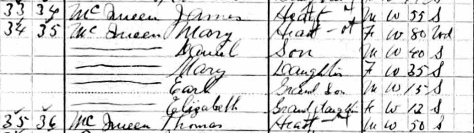
The 1910 U.S. Census for the Town of Holland shows Earl and Elizabeth Mulqueen.
The little hamlet of Askeaton, Wisconsin, is named for a village in County Limerick, Ireland. Farmers from County Limerick emigrated to America starting in 1844 and eventually made their way to Brown County, Wisconsin. Askeaton, Ireland, has a fascinating history, with ruins of a medieval castle that dates to about the year 1200 and a Franciscan abbey founded in 1389. It was once a large walled town, but in 1846 was described in an Irish gazetteer as “a poor lumpish village.” The population at the time the group of farmers left for Wisconsin was about 4,400.
In the span of just a few days, I’ve unearthed more information on Earl Mulqueen’s ancestry than I found in more than 10 years of searching. Now that the brick wall has come down, I look forward to fruitful research in the coming days and months.
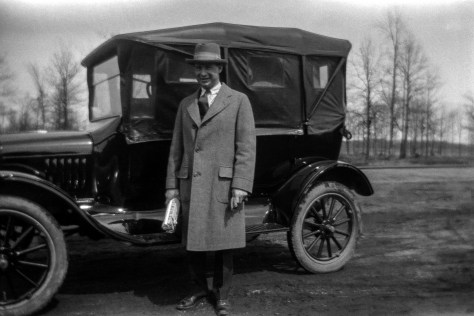
Carl F. Hanneman has that thrilled schoolboy look on his face in this vintage photograph from about 1925. And why not? It appears he is posing next to his new purchase: a Ford Model T, which came in any color a customer wanted “as long as it’s black.” Although there is no snow on the ground, the Ford is outfitted for inclement weather with a pretty nice canopy.
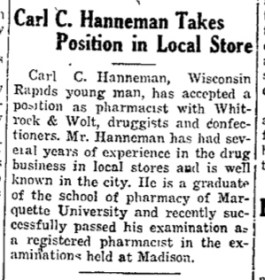
Carl’s first job as a licensed pharmacist made front-page news in the Feb. 14, 1925 issue of the Wisconsin Rapids Daily Tribune. The paper incorrectly stated his middle initial.
We don’t have any notes that went with this image, so we will have to surmise some things to gain the proper context. Based on Carl’s apparent age and his natty threads, it would be safe to assume if he indeed purchased this auto, it was after he landed his first post-graduation job at the Whitrock & Wolt pharmacy in Wisconsin Rapids. That event made front-page news in February 1925.
After Carl married his longtime sweetheart, Ruby V. Treutel, in July 1925, a Model T was visible in photos from their honeymoon near Hayward, Wisconsin. That does not appear to be the same automobile as the one pictured above and below. So some mystery remains surrounding Carl’s early vehicular habits. If only we could still ask him about it.
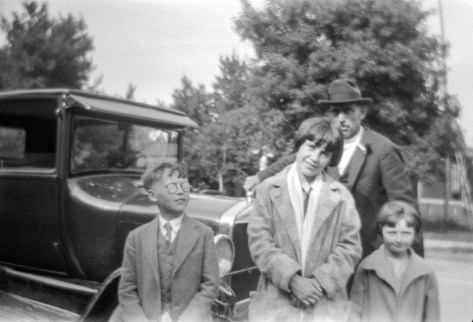
One of the privileges (or burdens) of being the oldest child, is you often are behind the camera and not one of the subjects featured by it. At least that was the case the day this photo was snapped of the Walter Treutel family of Vesper, Wisconsin.
Walter Treutel (1879-1948) leans on his Ford automobile. In front are his children Marvin R. Treutel (1916-2005), Nina H. (Treutel) Wilson (1914-2005), and Elaine M. (Treutel) Clark (1920-2010). The photographer that day was Ruby (Treutel) Hanneman (1904-1977).
The image was likely from 1925. That was a monumental year for the Treutel family. It opened with a tragedy: the death of Walter’s wife, Mary Helen (Ladick) Treutel, who was just 41. Mary died after undergoing surgery at a Marshfield hospital, but a postoperative infection set in, leading to her death. Later that year, Ruby married Carl F. Hanneman (1901-1982) at St. James Catholic Church in Vesper.
The other member of the Treutel family, Gordon Treutel, died of pneumonia in February 1911. He was just shy of 11 months old.
It hardly seems ten years could have passed since the night of April 14, 2007. How fortunate we were to be present to witness my father draw his last breath and step from the troubles and sicknesses of this world into eternity. Around 11:30 p.m. that night, Dad left us, just after we stood around his bed and prayed the Our Father and the Hail Mary. The world will never be the same.
For David D. Hanneman, that night was the end of his journey through life, through lung cancer, and pain. For everyone who knew him, it was the start of a new path, one without those silvery locks, that dulcet baritone or those big, strong hands that built and fixed so many things in this world. On that day, I learned a death is like a fork in the road. It changes everyone. The path forward is suddenly different. Those left behind feel an immense loss, even while comforted at the though their loved one has received the crown of righteousness from Our Blessed Lord, the just judge.
Over the past ten years, I lost track of the number of times I’ve thought, “I wonder what Dad would think of that?” or wondered what advice he might impart on issues in my life. I often ask him just those questions. But since 2007, the answers do not come so directly as a spoken word, a laugh or a hand on the shoulder. But with the ears tuned to heaven, the answers still come.
It has been a long ten years, Dad. We miss you more than ever.
Looking just a little overwhelmed with granddaughters Ruby and Maggie Hanneman
August 1992 with grandson Stevie and sons David (left) and Joe.
At his favorite station.
With mother Ruby Hanneman, circa 1943.
At Calvary Cemetery, Wisconsin Rapids, Wis.
Early days in Sun Prairie, circa 1966.
Dad with parents Carl and Ruby Hanneman, and dog Cookie.
Dad (right) as a gunslinger in Mauston, circa 1938.
Carl and Ruby Hanneman, David Hanneman, Mary (Mulqueen) Hanneman, Margaret Mulqueen and Earl J. Mulqueen Sr.
Dad with beloved sister Lavonne, circa 1944.
David D. Hanneman, circa 1939.
High school graduation portrait, 1951.
No. 72 for the Mauston Bluegold.
One of the photos he used in his real estate business.
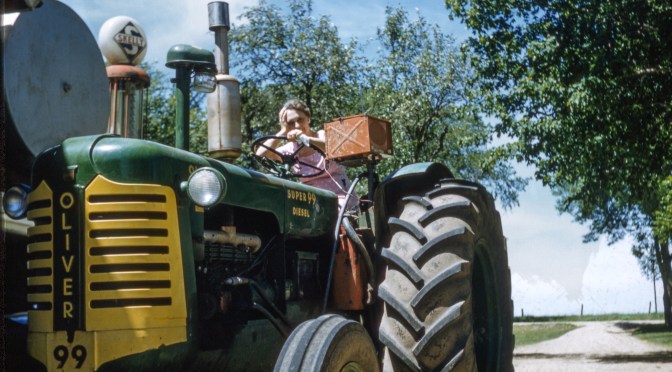
The look on Ruby V. Hanneman’s face in this classic photo says it all. “I have NO idea how to run this rig!” This image was scanned from a Kodachrome slide taken by Ruby’s husband, Carl F. Hanneman. The year is about 1958.
Ruby Hanneman does not seem quite ready to hit the fields on this Oliver 99 diesel tractor.
Judging by the other slides in the batch, the Hanneman family was attending a wedding in the Wausau or Wisconsin Rapids areas when this photo was taken.
According to a variety of equipment-collector blogs we sampled, the Oliver 99 diesel tractor was produced from 1955 to 1958. The color slide film really brings out the brilliance of the green paint. Well done, Grandma Ruby! Now get down before you hurt someone.
If you’ve spent much time sifting through collections of vintage photographs, no doubt you’ve seen samples of the hand-crafted art of photo colorization. For many decades, various techniques were used to colorize parts of all of a photographic image. When done well, the process created a rich, high-end look that stands the test of time. It is possible to digitally apply these effects to images today, but there’s something about these old photos that make them heirlooms.
As you will see in the gallery below, samples from our photo archive vary in sophistication. Some look almost like watercolor paintings, others like pastels and some appear to be airbrushed.
Marvin R. Treutel, circa 1938.
Helen E. Northcott
The colors used on this image are brighter than most in our collection.
Skin tones were the focus on this portrait. Pictured are Laura Mulqueen, David C. Hanneman and Joe Hanneman.
Most of this photograph of Charles F.C. Hanneman was hand tinted.
This U.S. Marine Corps portrait of Earl J. Mulqueen Jr. looks like colored pencil.
David D. Hanneman’s Boy Scouts uniform, as well as the surrounding grass, received tinting.
Lynne and Richard Hanneman, children of Wilbert G. and Irma Hanneman.
The roses in this bridal portrait of Ruby V. Hanneman were tinted. This digital restoration punched up the colors from the now-faded original from 1925.
This Hanneman family vacation portrait was somewhat clumsily done, with colors spilling onto skin and other areas. At front and center is David D. Hanneman. In the back are Donn G. Hanneman, Ruby V. Hanneman, Carl F. Hanneman and baby Lavonne M. Hanneman. Photo circa 1940.










 The Hanneman Archive