By any standard, it was a pretty smooth sales job. In early December 1920, little Nina Treutel of Vesper, Wisconsin, was writing one of her regular letters to her Aunt Emma (Treutel) Carlin. After some regular business, the 6-year-old slipped in a postscript in hopes it would help her obtain a treasured toy doll.
“Oh! Yes Aunt Emma I have 23¢ cents all saved up ready for that dolly,” Nina wrote. (A cute aside: the cents sign was written backwards.) “Just think Aunt Emma, Uncle Oscar said I could have it for $1.50¢.” (Backwards dollar and cents signs.)
One can just imagine in that little girl’s mind, Aunt Emma was just waiting to learn of the 23 cents to seal the whole deal. Maybe even in time for Christmas 1920! It reminds me of the 1983 film, A Christmas Story,in which a young boy works on his own marketing pitch to obtain a Red Ryder carbine action 200-shot range model air rifle. Set in the 1940s in small-town Indiana, much of the plot revolves around little Ralphie’s efforts to get that rifle for Christmas only to be told by various adults, “You’ll shoot your eye out.”
Nina Treutel (right) with brother Marvin (left), baby sister Elaine and older sister Ruby, circa 1922.
In the film, Ralphie gets his rifle, but we don’t know if Nina ever got that cherished dolly. It’s logical to assume she not only wrote her letter of suggestion, but perhaps augmented it with some face-to-face discussion with dear Aunt Emma and her brother, Uncle Oscar Treutel. You will get good odds if, like me, you believe Nina got her dolly.
Aunt Emma Carlin was a favorite of all the children in the Treutel/Hanneman families. She was the second-youngest child of Philipp and Henrietta Treuel. Her family moved to Vesper in 1900 after the death of her father. Emma was a prolific letter writer and kept a detailed scrapbook from which this letter came.
Nina Treutel grew up and married Lawrence Wilson. They spent most of their married life in Waukegan, Illinois, for a time operating a small grocery store detailed elsewhere on this blog. She was one of the younger sisters of my grandmother, Ruby (Treutel) Hanneman. Nina died in 2005 in Arizona.
Perhaps the most charming part of that 1920 letter came before the sales pitch for the dolly. “Why didn’t you come down Sunday?” she wrote. “Well I must shut up because pa wants to close his letter with love from mama.”
I’m generally not a fan of social media page “likes” or shares or fan praise. While it is one metric of success in the online world, it also can set us up for easy disappointment. That being said, I was quite pleased to see my grandparents’ wedding photo draw such nice comments on an Instagram page dedicated to preserving the stories behind photos.
Saving Family Photos featured this 1925 wedding portrait today, along with the newspaper story published shortly after the marriage of Carl F. Hanneman and Ruby V. Treutel. As of this writing (less than one full day on display), the photo has 1,016 likes. A sampling of the viewer comments:
“I have a similar picture of my grandparents. You’ve inspired me to frame it.”
“Wow! Beautiful picture!”
“A true treasure.”
“Stunning photo. Love every detail. A gift for you to have this.”
“Can’t love this enough…still looking for photos of my grandparents weddings.”
“That is now may favorite wedding photo! What a treasure!”
I submitted the photo to Saving Family Photos from Treasured Lives, our sister site. If you are on Instagram, find them @savefamilyphotos. You can also see the gallery on their web site.
Doing research on family history is an exciting journey. That is the whole idea behind Treasured Lives, a small business dedicated to helping you map out and progress on your history journey. We invite all of the readers of the Hanneman Archive to visit and follow Treasured Lives.
There are lots of online databases and services out there dedicated to genealogy and history. If that all seems overwhelming to you, Treasured Lives is a good place to start. If you’ve started your research and need a boost from a professional researcher, Treasured Lives is also for you. Even if you’re an expert and want to put some more brawn behind your projects, we can help.
We not only offer a full-range of services, but we will also deliver interesting, useful content on our blog. We specialize in:
Genealogy Research
Biographical Writing
Photo Restoration & Retouching
Tribute Videos
Oral History
Gravestone Preservation
Collections Care
Photography
Treasured Lives grew out of a love for history. Joe Hanneman, our chief researcher and owner, has been doing genealogy research for more than a decade. He runs the popular Hanneman Archive web site, and has been a professional writer and communicator for more than 30 years. In 2010, he published his first book, The Journey Home: My Father’s Story of Cancer, Faith and Life-Changing Miracles. His first history project was helping his father start piecing together his family roots from Germany and Pomerania. That grew into a major undertaking. The Hanneman Archive holds more than 15,000 images and thousands of historic documents.
History is a journey and an ever-changing destination. As we like to say, every story deserves a voice, and a champion. We are here to be your partner in history.
We’ve noted elsewhere on this blog the photography skills of Carl F. Hanneman, but lately we’ve discovered that he and his brother Wilbert G. Hanneman had talents with freehand illustration. Working on the yearbook at Lincoln High School in Grand Rapids, Wis., the brothers served almost as dueling artists.
Judging by the line drawings each made in high school and in years after, both men had artistic abilities. Wilbert (1899-1987) first served as an artist and editor for the Ahdawagam yearbook. Ahdawagam is an Indian word that refers to the “two-sided rapids” along the Wisconsin River. The yearbook was first published in 1916. Wilbert graduated from Lincoln in 1918, and Carl followed in 1921. Both Carl (1901-1982) and Wilbert drew the illustrations for the yearbook’s section pages, such as Alumni and Sports, and the various class sections.
Wilbert drew a stunning likeness based on Carl’s high school graduation picture. The latest example of hand illustrations we could find is from 1945, showing a U.S. service member next to the saying, “Keep off the Lifeline.” The Navy serviceman in the illustration bears a striking resemblance to Carl. His son Donn G. Hanneman (1926-2014) served aboard the USS Hoggatt Bay during World War II.
As he prepared his six-seat Beechcraft C35 Bonanza airplane for takeoff, Richard E. Rickman asked airport manager John Stedman if he should take the most direct route, across expansive Lake Michigan to Detroit. Stedman cautioned against it, telling the pilot to fly east across Wisconsin to the lake, then hug the shore and make his way over to Michigan. This approach would presumably be safer, and provide great views for Rickman, his wife and four children.
It was just after the dinner hour on Labor Day 1960. The Rickman family packed themselves into the aircraft at Alexander Field in Wisconsin Rapids, ready to make the flight home to Detroit. The family had been to Drummond, Wis., to visit Helen Rickman’s parents, then flew to the Rapids to visit other relatives.
Richard, the son of a longtime shoe-store proprietor, grew up in Wisconsin Rapids. He was a descendant of pioneer resident Matthias Hanneman, who came to Wisconsin in 1866 from Pomerania. A factory representative for the Ogden Manufacturing Co., Rickman married the former Helen Anderson in December 1949 and they later moved to Michigan. Their first child, Richard Edward, was born in Lansing in May 1953. Robert John was born in Lansing in March 1955. Catherine Helen was born in Detroit in June 1956; and Patricia Ann joined the family in Detroit in September 1957.
The Richard E. Rickman family, shown in a 1960 newspaper photograph. Left to right are Richard, 7; Patricia, 3; Richard Sr., 35; Robert, 5; Helen, 34; and Catherine, 4.
The final day of the Rickmans’ visit was spent at the airfield. Rickman gave plane rides to his sister, Elvira Pluke, her husband Nolan and their five children. Rickman primarily used the single-engine aircraft for business trips. The family had recently flown to California in the plane, and then used it for the Labor Day weekend visit.
The wheels of the Beechcraft left the ground of Alexander Field at 6:30 p.m. The Rickman family flew along the western shore of Lake Michigan. They were treated to an incredible view of the Chicago skyline as the aircraft flew less an a mile offshore. The first sign of trouble came near 7:30 p.m., when Rickman issued distress calls that were heard by ships and aircraft as far north as Milwaukee. Rickman radioed Meigs Field in downtown Chicago and asked permission to make an emergency landing because the plane’s engine was cutting out.
Officials at Meigs Field gave Rickman permission for an emergency landing. He veered the aircraft out over the lake and circled to attempt a landing. Witnesses at nearby Oak Street Beach saw sparks trailing from the airplane. The 185-horsepower Continental engine caught fire and became enveloped in smoke. Suddenly, the 25-foot-long airplane turned straight down and plunged headlong into the lake. Hundreds of horrified beach-goers saw a blinding explosion as the plane hit the water.
The Wisconsin Rapids Daily Tribune carried the horrifying news on September 6, 1960.
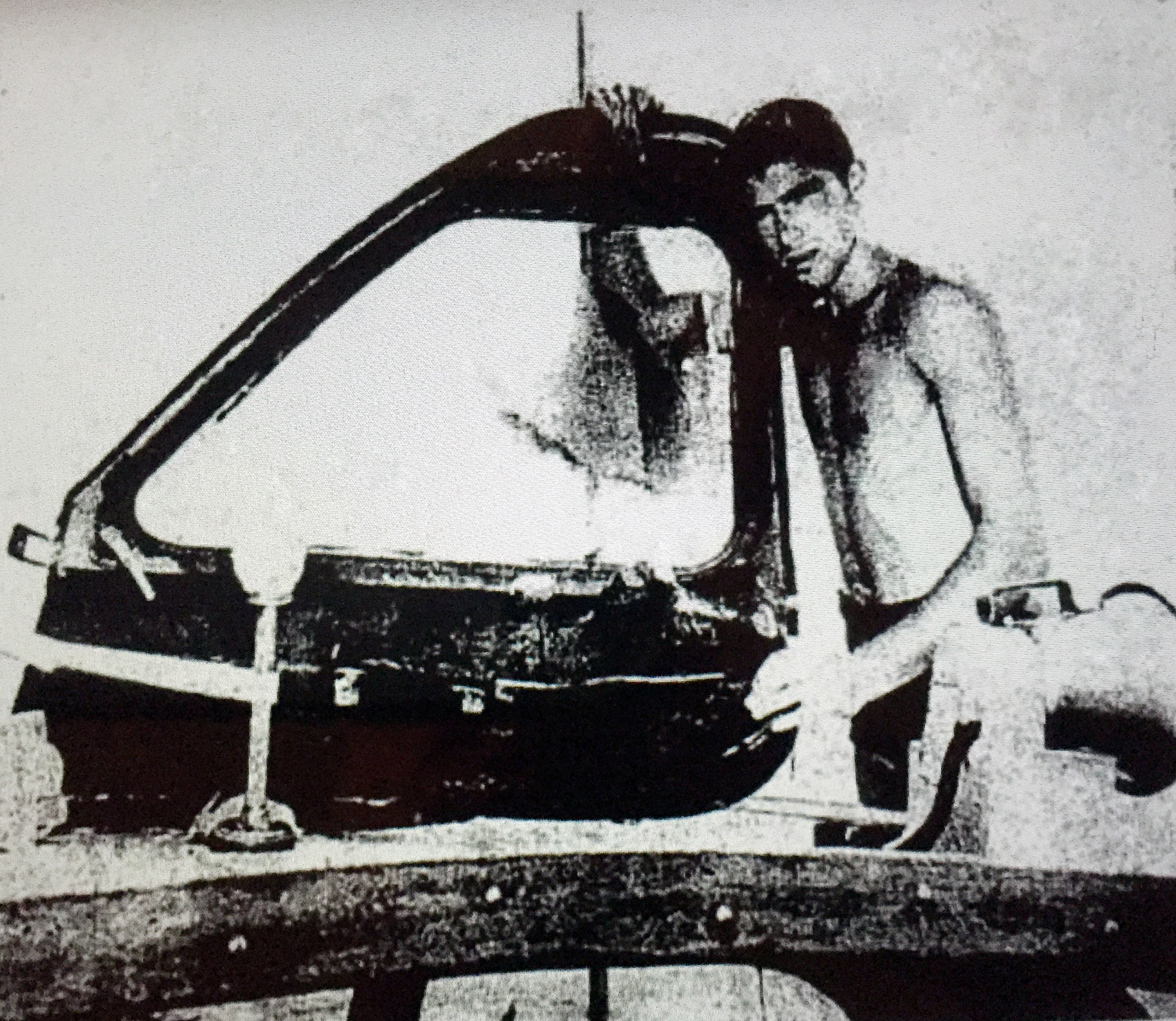
William J. Cempleman saw the fiery crash from aboard the yacht Playtime. “The whole lake looked afire. Flames soared twenty-five to thirty feet,” Cempleman said. “When we got to the scene, a big circle of water was flaming. All we could see was an airplane wheel floating.” As the Playtime circled the crash site, Cempleman saw the charred body of little Catherine Rickman, 4, floating about 15 feet from the flames. Newspapers across America later published a dramatic Associated Press photograph of a police marine officer carrying the lifeless body of Catherine to shore. Resuscitation efforts failed.
Lifeguard Bill Zimmerman with a door from the doomed Beechcraft C35 Bonanza piloted by Richard E. Rickman. (Chicago Tribune)
Police and Coast Guard vessels searched the waters off Oak Street Beach into the night. Divers used underwater lights to aid in the search, but found no trace of the aircraft or the other members of the Rickman family. Divers resume the search on September 6, but did not locate the wreckage or the other victims until September 7. Diver Jeff Daxe, a commercial pilot, was the first to reach the bodies. The Chicago Daily Tribune reported that one body was found 50 feet from the fuselage, while the other four were inside the wreckage. After the victims were recovered and taken to Burnham Harbor, it was discovered that Richard Rickman’s watch stopped at 7:38 p.m.
The impact sheared off both wings, but only one was found. The engine and propeller were found some distance from the rest of the wreckage in about 30 feet of water. Two weeks after the crash, the Civil Aeronautics Board issued a preliminary opinion that engine failure had caused the crash. In late October the CAB confirmed that opinion, but said the engine would be sent back to the manufacturer for testing. It’s unknown if that ever happened.
The six members of the Rickman family were memorialized at a funeral service on Saturday, September 10, 1960 at Immanuel Lutheran Church in Wisconsin Rapids. They were buried at Forest Hill Cemetery.
The six members of the Richard E. Rickman family are buried at Forest Hill Cemetery in Wisconsin Rapids. (Photo courtesy of Ben Chitek)
Richard Edwin Rickman was born on April 27, 1926, the youngest child of Edwin and Renata (Rathke) Rickman. Edwin John Rickman was the son of Christian Wilhelm Ludwig Theodor and Amelia Bertha Emilie Auguste (Hannemann) Rickman. Amelia’s father was August Friedrich Hanneman, the son of family patriarch Matthias Hannemann. Richard Rickman graduated from Lincoln High School in 1943 and enlisted in the U.S. Navy in July 1943. He served more than three years in the Navy during World War II and was discharged as an ensign in September 1960. He graduated from Northwestern University with a degree in business administration.
The change from summer to fall always reminds me of leaves. Lots and lots of leaves. With more than a dozen huge oak trees in our back yard in Sun Prairie, we always had mountains of leaves to romp through during fall. On windy days, the air in our back yard was filled with falling leaves. Before the days we had to help rake and bag the leaves, we dove into the pile with reckless abandon.
My own children had a similar experience in our first home on the north side of Racine. We had maple and apple trees that left plenty of seasonal detritus across the landscape. I have some precious video (see below) of our oldest, Stevie, running through the leaves at my childhood home in about the year 1995.
Fall always meant trips to the pumpkin farm, huddling around the fire pit on the back deck, picking fresh apples at local orchards, and of course getting the snowblower tuned up and ready for winter. It is a season of change, of color, of transitions. As the years pass, it also becomes a season of reflection and wistfulness.
As a boy, I often got to travel with my Dad on his sales routes across Wisconsin to sell veterinary pharmaceuticals and supplies. One of his routes took him to Wausau, so we got to pay a visit to Hanneman’s Rock and Gift Shop, run by my great uncle and aunt, Wilbert G. and Irma Hanneman. Visits to the shop always resulted in getting to pick out something made from the most exquisite polished rocks and colorful crystals.
Over the years, I developed a nice collection of treasures from the rock shop. I came to believe that Uncle Wilbert (nicknamed “Wib”) had made a career out of selling rocks and crystals. Actually, he and Aunt Irma took it up as a post-retirement labor of love after Wib’s long career in banking. They sold gifts from the shop in their home at 130 Ninth Avenue in Wausau in the 1960s and early 1970s, but also attended craft shows and other events to peddle their intricately patterned wares.
Wilbert G. Hanneman uses a diamond saw to cut slabs of Australian imperial red rhodonite.
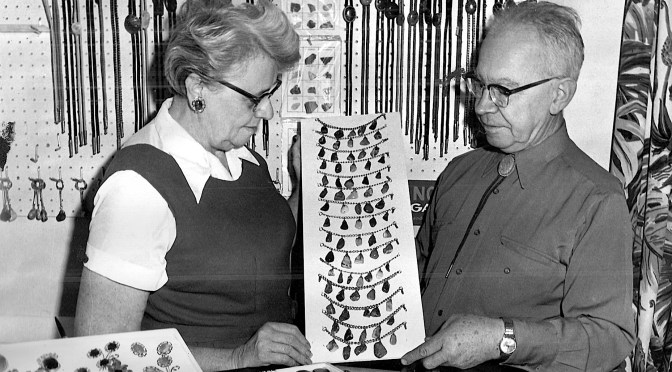
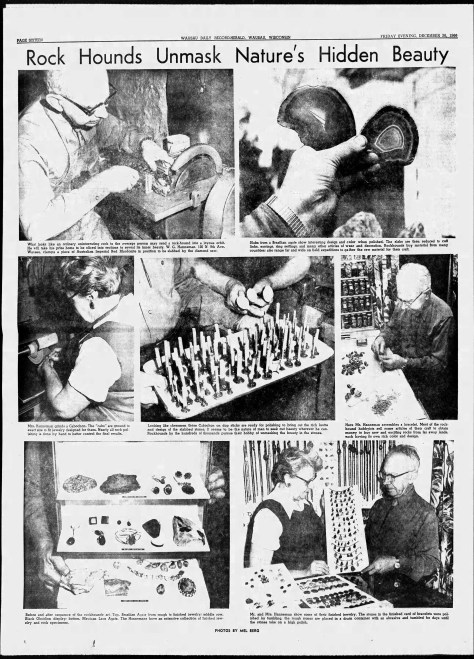
In December 1966, the Wausau Daily Herald-Record ran a photo page featuring the Hannemans and their rock shop. “What looks like an uninteresting rock to the average person may send a rock-hound into a joyous orbit,” read one of the captions. The photo showed Wib using a diamond saw to slice Australian red rhodonite into slabs. Another photo showed polished slabs of Brazilian agate, which were later used to make cuff links, ring settings and other items.
Although Wib and Irma used tumblers to polish many of the smaller rocks, much of the rock polishing was done by hand “to better control the final results,” the newspaper wrote. The craft has its aim to “unmask the beauty in the stones.”
Wilbert G. Hanneman was born May 1, 1899 in Merrill, Wisconsin, the third of five boys born to Charles and Rosina Hanneman. He was the older brother of my grandfather, Carl F. Hanneman. In June 1923, Wib married Irma Pagels and the couple moved to Wausau. Wib had a long career working for the Citizens State Bank and Trust Co., from which he retired in 1964. Wib was a graduate of the School of Banking at the University of Wisconsin-Madison.
Wib overcame a bout of polio that left him with a pronounced limp. Late in life he suffered a heart attack that forced him to give up his beloved cigars. Wib and Irma celebrated their 50th wedding anniversary in 1973. Carl, who was the best man, attended the anniversary doings. The couple had two children, Richard D. Hanneman and Lynn (Hanneman) Swanson Zarnke. Wib died in 1987 and Irma died in 1996.
(This post has been updated with the full newspaper page image)
From very little on, my grandmother, Ruby Viola Hanneman, had a beauty that radiated in the many photographs taken of her. Her grandchildren no doubt recall the housecoat-type of outfits she often wore around the house. But make no mistake, Ruby was a fashion icon in her day. Our photo gallery bears ample testimony.
My grandparents were anything but wealthy. They worked hard to provide a middle-class home to their three children, Donn, David (my Dad) and Lavonne. Grandpa Carl F. Hanneman was a pharmacist at the Hess clinic and hospital. As we detailed in another post, he wrote to the attorney general of Wisconsin for help in upgrading his pharmacist license so he could better care for his family.
Regardless of the family’s financial circumstances, the Hanneman children were always dressed in nice clothing. Carl had nice suits for work and Sunday Mass. If you met Ruby at a family event, you might think she descended from royalty. Actually, there was a longstanding family yarn that said the Treutel family from which Ruby came was from a royal line in Europe. I’m still researching that one. Nevertheless, Ruby was always sharply dressed. The main photo above shows her in a Life Magazine pose during a 1950s trip out West. Classic stuff.
Far be it for me to offer detailed commentary on women’s fashion, but I am struck by Ruby’s fashion sense as shown in the photo gallery below. Dresses, hats, gloves, shoes and coats, nicely coordinated. This was evident at different events, from weddings to the common Sunday visit to family and extended family in the Wisconsin Rapids area. So many decades later, these photos are a real treat, although also reminders of the hole in our lives left by the absence of loved ones like Dad (1933-2007) and Grandma Ruby (1904-1977).
Ruby E. Hanneman has her great-grandmother’s keen sense of fashion.
I am quite tickled that my youngest daughter, not coincidentally named Ruby, is also very interested in fashion and interior decorating, just like her great grandma. I marvel at her discussions of colors, styles and fabrics — things I know little about. One thing is for sure: Ruby V. Hanneman is no doubt pleased to look down and see Ruby E. Hanneman, a young lady after her own heart.
This photograph has perplexed me for years. A baby in a diaper, lying on a pillow inside a steel wash tub. I strongly suspect this is my father, David D. Hanneman (1933-2007). The image raises many questions but provides no answers.
A strange place for a nap. This might be David D. Hanneman in the summer of 1933.
Why stick a baby in a wash tub? Was this the poor family’s playpen? The Depression-era bassinette? A brutal pre-Dr. Spock time-out? Freshly picked from the vine? In this day and age, such a photo might get you a visit from Child Services. I’m guessing my Grandma Ruby (Treutel) Hanneman (1904-1977) just thought it made a cute photo. She was known to dote on her “little Davey.”
If this was Dad in the tub, the photo was likely taken in Wisconsin Rapids, Wisconsin, where he was born in March 1933. The family did not move to Mauston until early 1936. Usually I can confirm my Dad’s ID in photos by the ears, but they are not visible in this image.
My memories of such a steel container at the house in Mauston had nothing to do with babies. I recall bluegill, sunfish and bass in such a tub, waiting for Grandpa Carl’s skilled fillet knife. Or the tub filled with ice and bottles of orange and grape soda (known as “pop” by some of you). But no babies.
This one is destined to remain a mystery. I’m sure it would tickle my grandma to know it was a conversation piece some 80 years later, and that no one called Child Services.
It might seem a very odd thing to save, the pages of a hospital chart from 1939. But I suspect my father viewed his battle with pneumonia at age 6 as a defining moment. Perhaps his parents, Carl F. and Ruby Hanneman, feared they would lose their youngest son to an illness with a reputation for being deadly.
The trouble all started on Thanksgiving Day, November 23, when David D. Hanneman took ill with a high fever. The hospital chart says my Grandma Ruby “took care of him alone until Tues. night Dec. 5.” It’s not clear if this means Grandpa Carl, pharmacist at the Mauston clinic and hospital, was away on business or just working. Either way, on December 5, Caroline Denzien came to the Hanneman house on Morris Street to care for Dad and give Ruby a break.
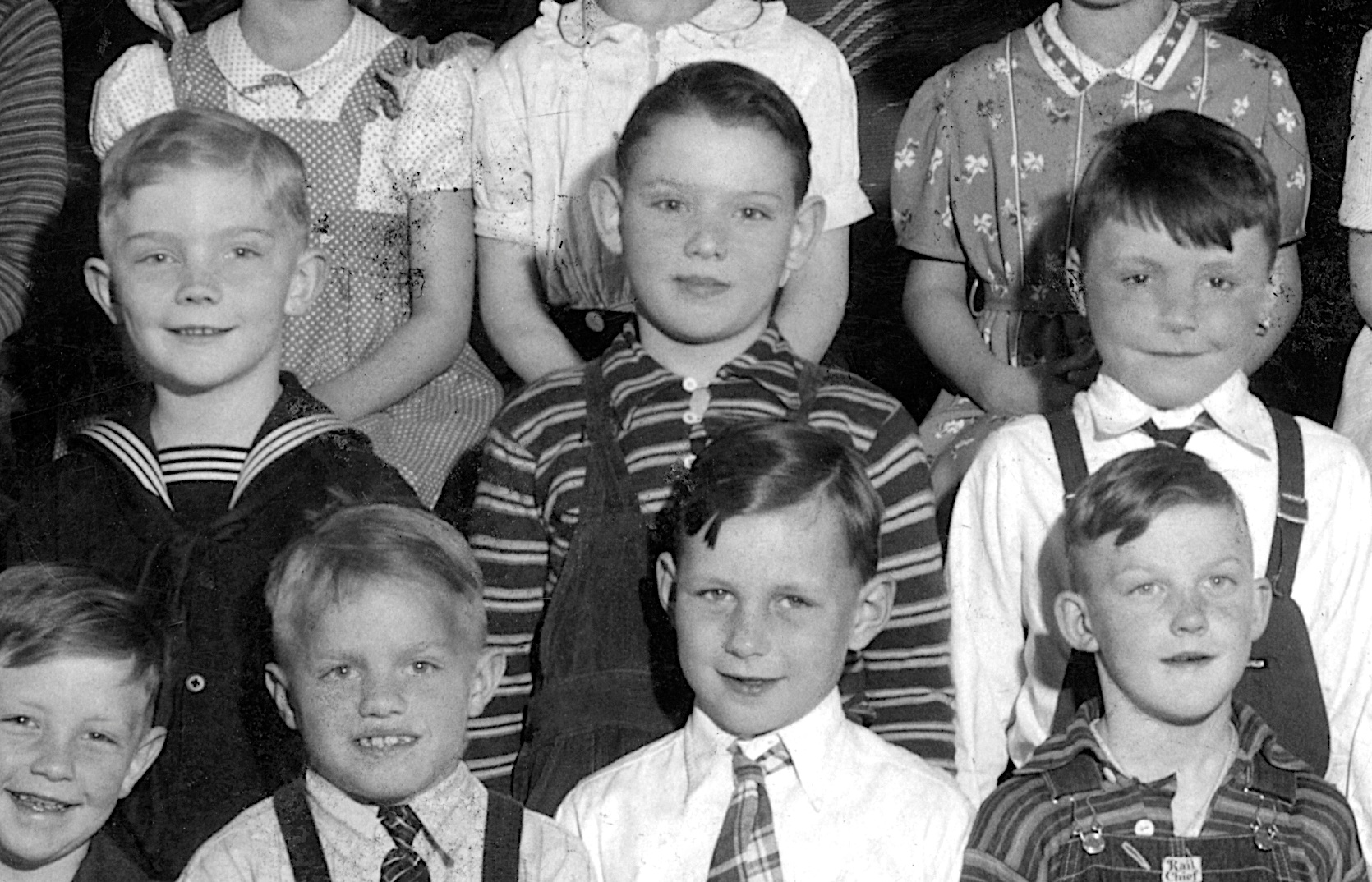
David D. Hanneman (center, in striped shirt) shown six months after his pneumonia scare.
Early on Wednesday, December 6, they took him to the Hess Memorial Hospital in Mauston. Upon arrival, his fever was 104.2 degrees. Dr. J. Samuel Hess Jr. ordered a course of calcidine, a decongestant, and quinine, a potent germicidal drug known today as an anti-malaria treatment. They had reason for concern, since the pneumonia had festered for nearly two weeks. That first day, Dad drank frequently, but he was restless and had a “considerable” cough. He was “perspiring freely” as a result of the fever, which stayed above 104 degrees all day.
Dad responded quickly to the treatment. By midday on December 7, he was eating sherbet and sipping on some broth. He even felt bright enough to play a little bit of checkers. The fever was down below 100 degrees, but still shot back up on occasion. By nighttime, he was drinking lemonade, tomato juice and some tea. Overnight, the nurse noted he was “irritable” and had several coughing spells. On December 8, the fever dropped below 99 degrees and Dad graduated to eating noodles and rice, and custard.
By the December 10-11 period on the chart, Dad’s fever was gone and he was resting comfortably. Nourishment included chicken broth, Jello and Ovaltine. It appears he stayed at the hospital into the late afternoon of Wednesday, December 12, since there are no other pages beyond that time.










 The Hanneman Archive