Some of the most memorable images in our archive are old black-and-white photographs that were hand tinted to add color to parts of or the entire photo. Color film eliminated the novelty of that practice. Today we can do the process in reverse to create special, stunning images from even ordinary color prints.
A couple of years ago, I created a hardcover photo book for my three children, made up largely of black-and-white images with the color “repainted” onto key parts of the subject. This is made refreshingly simple with a very affordable app called ColorStrokes from Macphun Software. Available for iPad, iPhone and the Mac, ColorStrokes makes it fun and easy to “color splash” your photos. You can use the native color of the photos, or create new colors and apply them to the images.
ColorStrokes basically converts your color images to monochrome, then allows you to paint the…
As kids growing up in Sun Prairie, any time we ventured into the back room of our basement we were likely to hear a voice from upstairs shout, “Don’t you go near those windows!” Of course we knew what that meant: the antique stained-glass behemoths covered in blankets in the farthest reaches of the basement, next to the furnace. I never gave a great deal of thought to them, until one day in 2006 when my father was dying of cancer.
The St. Mary’s Hospital chapel as it looked in the 1950s.
Founded in 1912, St. Mary’s Hospital in Madison always had a chapel as part of its facilities. In 1926, a new, ornate chapel was built as part of an expansion of St. Mary’s. The chapel had 10 window frames, each with two beautiful arched stained-glass windows that rose 20 feet from eye level to midway up the wall. In between each were two Stations of the Cross. The windows remained part of the chapel until 1973, when that section of the building was razed to make way for a new hospital wing on Mills Street. My Dad obtained two of the windows, a total of four panels, carrying them home in blankets to rest for more than three decades.
The windows are prominently visible in this newswire photo from 1946, from a Mass to celebrate presentation of a papal medal to Leo T. Crowley of Madison.
When Dad was being treated for lung cancer at St. Mary’s in the fall of 2006, he got an inspiration to give those windows back to St. Mary’s. He asked for my help in doing some research, but he was so impatient he wheeled himself down to the administrative offices to talk to someone about it. That someone, vice president Barbara K. Miller, was enthralled with the idea, but it was her last day on the job before retiring. She promised to get the ball rolling on the donation. “I want these windows to come home to St. Mary’s,” he told her.
The chapel window sections as they looked in 2007 in the Hanneman basement.
Dad was a little worried that his donation wouldn’t get done. The idea occupied his mind more than anything else in November 2006. He knew his time with us was short. He told the story and his idea to his physician, Dr. Gregory Motl. Dad made Dr. Motl promise that if he didn’t survive the cancer, the donation would be completed. Motl grasped Dad’s hand and said reassuringly, “I will Dave. I will.”
To say the hospital embraced Dad’s idea would be an understatement. His timing was perfect, since St. Mary’s was planning a $182 million expansion that would add a new east wing with operating rooms, a cardiac center, outpatient offices, patient rooms and more. St. Mary’s was looking for ways to tie the new facility to the hospital’s heritage. The architects designed special spaces for each of the four window sections. St. Mary’s had a new internal champion for the windows, Steve Sparks, public relations director.
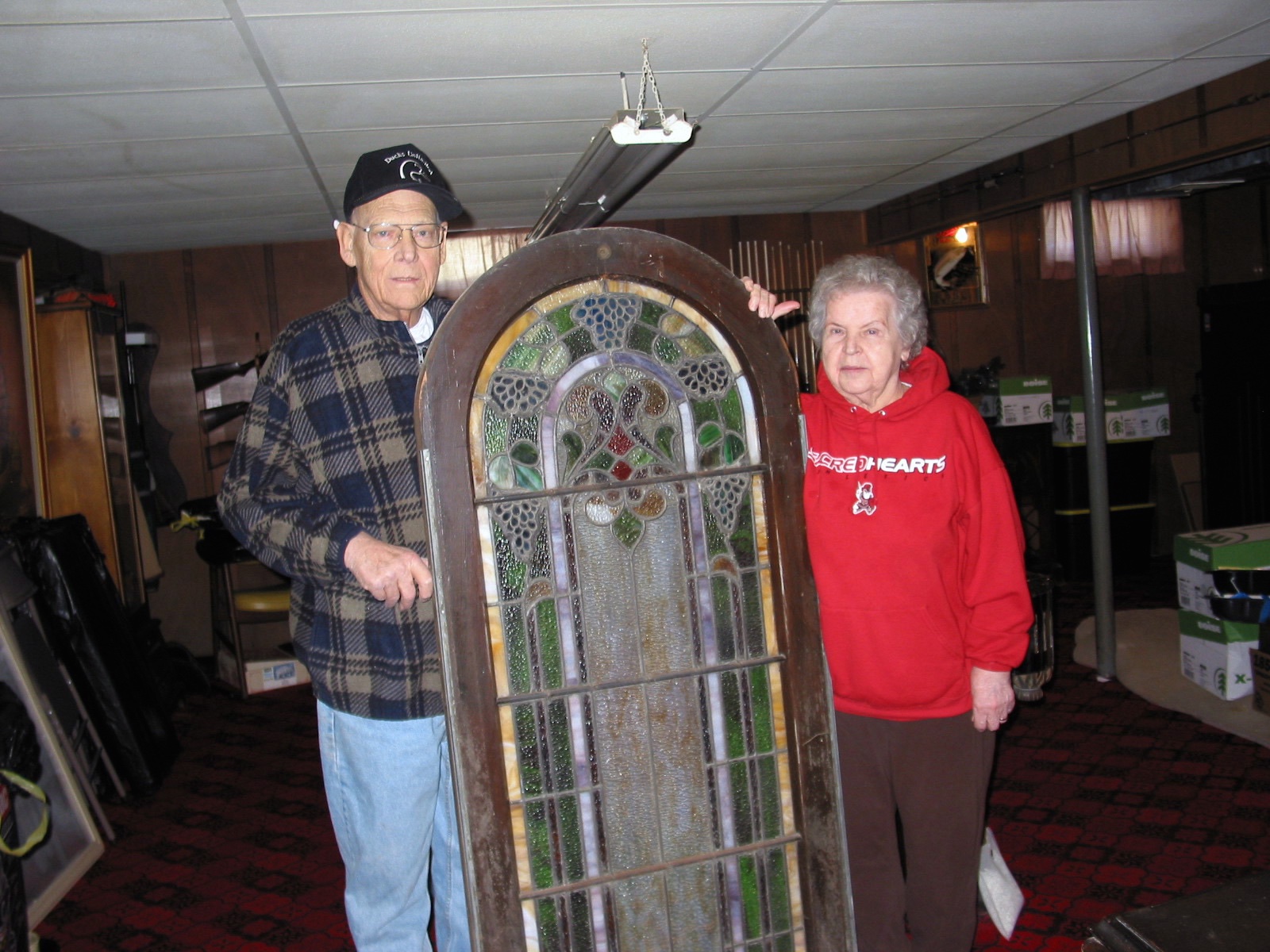
After months of planning, St. Mary’s was finally ready to take possession of the windows. On March 22, 2007, Sparks and workmen came to Sun Prairie to transport the windows. He snapped some photos of Mom and Dad with a window section. Dad looked pale and drawn, but I know he appreciated the milestone that day represented. “It was humbling for me,” Sparks recounted later. “This gift demonstrated exceptional courage and generosity. It is an experience I won’t forget.”
David and Mary Hanneman pose with one window section on March 22, 2007.
Tears were shed that afternoon as the windows were lovingly carried outside. It was the first daylight to penetrate the stained glass in more than three decades. For Dad, it was the accomplishment of a mission of giving. His part was finished; now St. Mary’s would take over. Not two weeks later, Dad was admitted to St. Mary’s and then discharged to HospiceCare Inc., where he died on April 14, 2007.
In early December 2007, Mom and I were invited to the dedication day at the new St. Mary’s east wing. We attended a luncheon and heard very kind words about Dad from Dr. Frank Byrne, president of St. Mary’s Hospital. They were similar to what Dr. Byrne wrote right after Dad’s death. “It is clear from Dave’s accomplishments that dedication to community was always a part of his priorities,” Byrne wrote, “and we will all benefit from that dedication for years to come. At this sad time, we hope it will be a reminder that though life may seem short, the contributions made by one individual have a significant impact in building a future for us all.”
The window section placed in the atrium of the new east wing at St. Mary’s Hospital.
When we walked into the atrium and first saw one of the window sections, it was enough to bring tears. There it was, set into the wall and brilliantly backlit in a way that brought out the green, red and amber hues of the glass. It was, as designed by the architects, a welcoming beacon for everyone visiting St. Mary’s. Mom posed next to the window, and even did an impromptu interview with Madison’s Catholic newspaper, The Catholic Herald. The three other window sections were placed on different floors of the east wing. One is in a waiting room. The others are in prominent spots.
The story of these chapel windows gives testimony that beauty can emerge from the depths of the darkest tragedies. Dad kept the windows safe for 35 years, and he got them safely home to St. Mary’s just weeks before he, too, made it home.
This post has been updated with additional window photos.
The windows are prominently visible in this newswire photo from 1946, from a Mass to celebrate presentation of a papal medal to Leo T. Crowley of Madison.
The St. Mary’s Hospital chapel as it looked in the 1950s.
This 1973 news clipping shows the exterior of the chapel building just prior to demolition.
The chapel window sections as they looked in 2007 in the Hanneman basement.
David and Mary Hanneman with a section of stained glass window on the day the windows were picked up for use at St. Mary’s Hospital.
The Wisconsin State Journal ran a front-page story on St. Mary’s in late 2007 and featured the stained glass windows.
The main window section in the St. Mary’s Hospital atrium as it looked at the dedication in December 2007.
A sign next to the window section in the St. Mary’s atrium told the story of the chapel windows.
Mary K. Hanneman next to one of the window sections she and the late David D. Hanneman donated to St. Mary’s Hospital.
St. Mary’s integrated many items from its history in the new east wing, including the original 1911 hospital cornerstone.
Mary K. Hanneman next to one of the window sections she and the late David D. Hanneman donated to St. Mary’s Hospital.
The beautiful windows were for decades a part of the chapel at St. Mary’s Hospital in Madison.
The window section placed in the atrium of the new east wing at St. Mary’s Hospital in Madison.
Mary Hanneman is interviewed by Kat Wagner of The Catholic Herald in December 2007.
A portion of the stained glass detail is used in a history display in the old lobby of St. Mary’s Hospital in Madison, Wis.
The second window crown section is on display in a third floor waiting room in the southwest wing of St. Mary’s Hospital in Madison, Wis.
When David D. Hanneman was elected mayor of the city of Sun Prairie, Wisconsin in April 2003, it continued a Hanneman family tradition that stretches back more than 400 years to the county Regenwalde in the Baltic Duchy of Pomerania. Hanneman’s election as mayor on April 1, 2003 capped his nearly 40-year public service career — and put him in good family company.
The Hanneman family from Kellner, Wisconsin — from which David Hanneman descends — traces its roots to Pomerania, a picturesque land of Germanic peoples that dates to the 1300s. His earliest known ancestor, Matthias Hannemann, was from the village of Zeitlitz in the kreis, or county, of Regenwalde. Regenwalde means “woods of the Rega River,” referring to the picturesque waterway that ambles 100 miles through the county and empties into the Baltic Sea. This area has long been known for agriculture, fishing and forests, and it bears strong geomorphic similarities to the state of Wisconsin. The village of Zeitlitz covered about 2,200 acres and had approximately 100 households.
Mayor Dave Hanneman cuts the ribbon at opening of the Sun Prairie fire station. (Sun Prairie Star Photo)
Records trace the Hannemann (the original spelling had two ‘n’s at the end) family back at least to 1582 in Zeitlitz. The Hannemanns made up one of the predominant families in Zeitlitz, based on the number of entries found in the Lutheran church register. Many church records were destroyed in a fire in Stramehl in 1720, but the register from 1582 survived. At that time, there were a number of Hannemann families in Zeitlitz, and they owned some of the larger farms in the village. One of these men, likely the eldest brother, held the title of schulze, or mayor of Zeitlitz. Being the schulze was unlike the elected political position of mayor found in modern-day American communities. It was an inherited job, and the duties centered on making sure work was performed equitably in the village, and that the taxes of grain, goods or money were collected for the estate owner. The term schulze can have various related meanings, including “village headman,” mayor or even constable.
Mayor Hanneman speaks at a veterans’ event. (Sun Prairie Star Photo)
As farmers, the Hannemanns were also involved in providing financial support for the local minister and the church. Each tenant farmer paid his taxes in measurements of grain. The unnamed mayor Hannemann and Peter Hannemann were each responsible for taxes on two Hufen in Zeitlitz in the year 1582. A Hufe was the amount of land needed to sustain a family. There could have been more Hannemann families living on those four Hufen, but the church records only listed the major land tenants who paid taxes.
In the nearby village of Groß Raddow (about 6 miles from Zeitlitz), the Hannemann family had a similar history. A tax list from 1666 includes the names of Tews Hannemann (the schulze, or village mayor), Heinrich Hannemann, Chim Hannemann and Peter Hannemann. For at least several generations, it appears the Hannemann family inherited and passed on the office of mayor in Groß Raddow. In 1717, Hans Hannemann was the mayor, so we believe Hans is a descendant of Tews Hannemann.
Mayor Dave Hanneman cuts the cake at the 5th birthday of the new Sun Prairie Public Library.
The Matthias Hannemann family began emigrating to Wisconsin in 1861. Matthias left his home in 1866 and came to Wisconsin through Quebec. The family settled in and around Kellner, a tiny hamlet that straddles the Wood-Portage county line southeast of Wisconsin Rapids. At one time, the Hannemanns owned and farmed more than 1,000 acres in Wood and Portage counties. David’s great-grandfather, Christian Hanneman (Matthias’ son) was the last of this clan to come to America in November 1882.
Dave Hanneman (1933-2007) was first elected to public office on April 2, 1968 when he became Fourth Ward alderman in Sun Prairie. He served only one term as alderman, but stayed active in city politics, pushing the city to upgrade its sewer system to prevent backups into residential homes. He again ran successfully for alderman in 1988 and stayed on the Sun Prairie City Council until 1996, when he was elected to the Dane County Board of Supervisors. He held that post until being elected Sun Prairie mayor in 2003.
The Sun Prairie Star Countryman carried news of Hanneman’s election as Fourth Ward alderman in April 1968.
“Dave was involved in the growth of Sun Prairie and believed in progress for the community. He worked and helped champion the Highway 151/County Highway C project, which included working with the state Department of Transportation,” said Bill Clausius, who served on the city council and county board with Hanneman. “Dave was involved with the West Side Plan, which brought the Sun Prairie Community together to envision the future of the West Side. Dave supported and worked to begin the West Side Community Service Building. This facility includes a west side location for police, fire and EMS. His vision was to provide essential services to Sun Prairie residents and to shorten response times in case of an emergency.”
Clausius continued: “In 2003, Sun Prairie won the ‘Champions of Industry’ Award of Excellence as one of the best managed small cities in America. Dave personally raised $32,000 in donations from area businesses to fund production of a video featuring Sun Prairie, and highlighting Sun Prairie’s achievements.”
As any serious genealogist will tell you, a visit to a cemetery can provide a wealth of family history information. But it can be much more than that. Each year as we approach All Souls Day (November 2), the season presents an opportunity to renew and maintain family connections, just by walking through a cemetery.
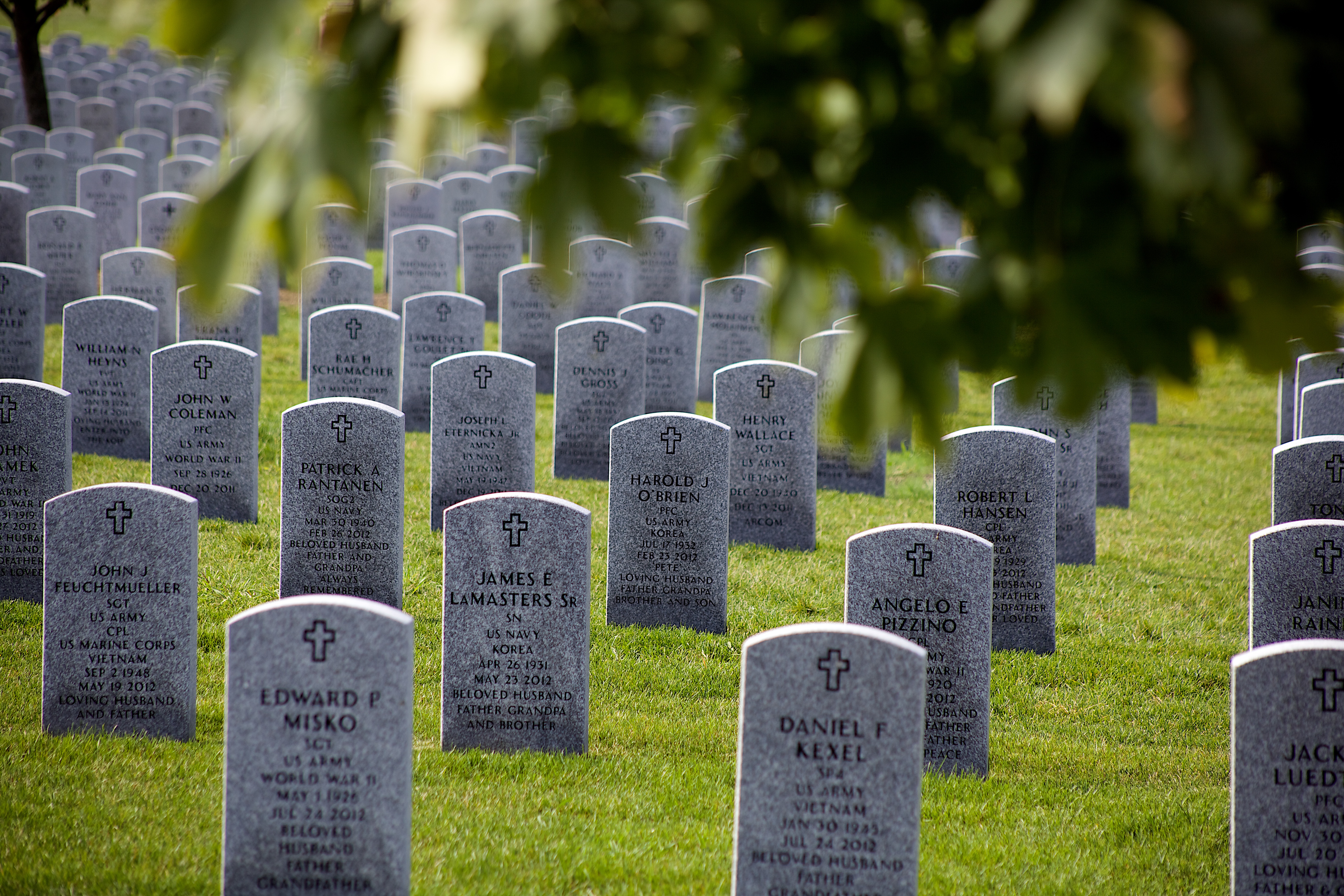
Southern Wisconsin Veterans Memorial Cemetery in Union Grove, Wisconsin.
One of the most touching scenes I’ve encountered was at a small cemetery in Augsburg, Germany. Walking past after dark, I looked through the small gate to see dozens of flickering vigil candles. These were not solar lights but real candles. Someone cared enough to visit there each night and light the votives.
A 20-minute walk through any cemetery will provide you access to family stories. Parents who lived long, full lives. Others who died much too young. Babies, some just one day old. Some who were never born. John and Jane Does, victims of murder. And in many older cemeteries, some of the departed rest with no visible monuments. Their markers were damaged or swallowed up in soft ground or by encroaching woods.
This anchor-themed monument is at St. Mary’s Catholic Cemetery in Portage, Wisconsin.
Observe the different monuments. Some are massive obelisks, others plain, square markers. A few are made from unusual materials. Some display incredible artistry. In many German cemeteries you will see monuments with engraved hands pointing to Heaven. Angels, crosses and even anchors are common subject of monument carvings.
Oak Grove Cemetery in Eagle, Wisconsin, is itself a monument to neglect.
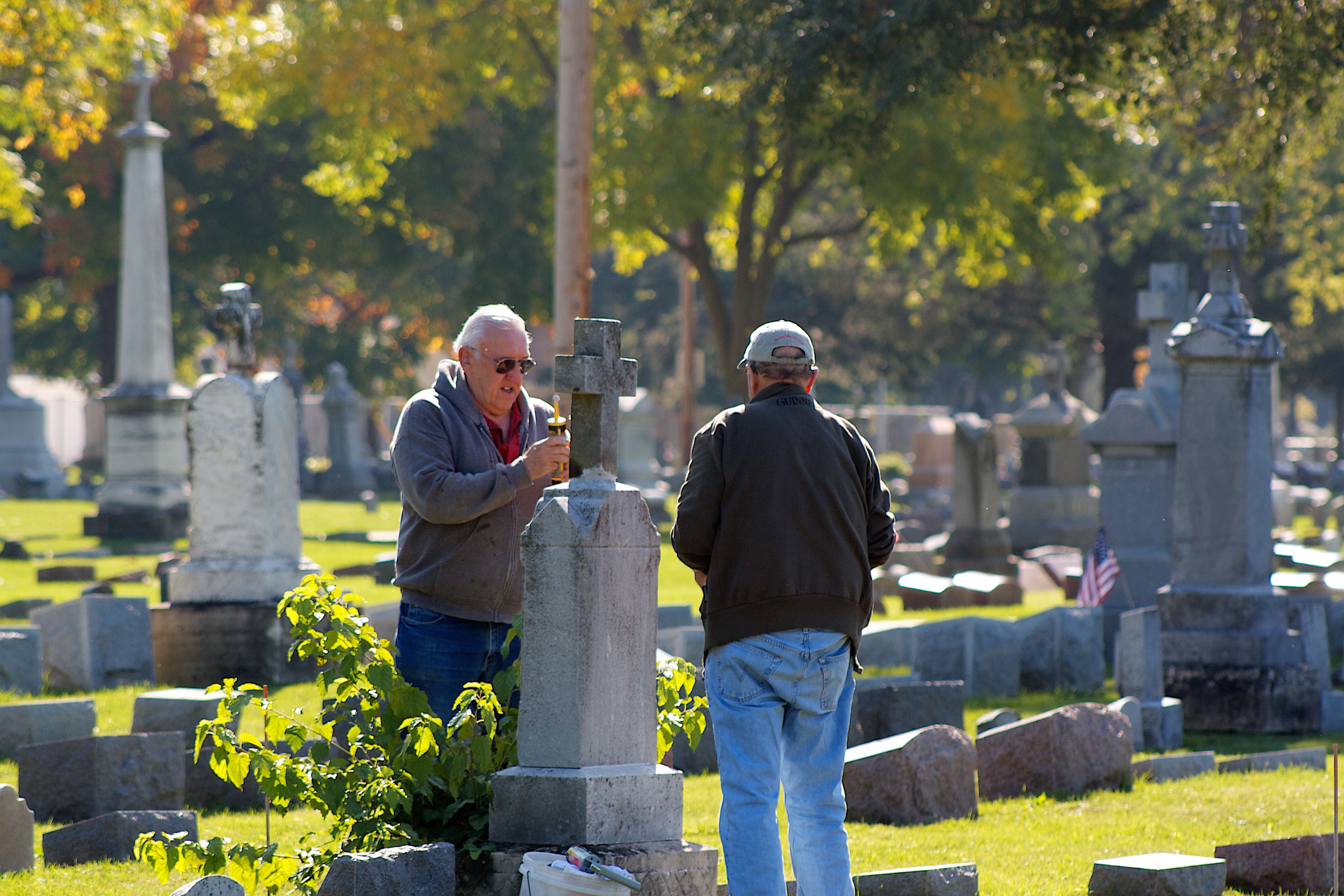
Some cemeteries are known more for their infamy, such as Oak Grove Cemetery in Eagle, Wisconsin. We chronicled that story earlier in “A Sad Resting Place for Little Ida.” It is sad to see a cemetery fall into neglect and disrepair. It’s especially angering when a cemetery is targeted by vandals. A few years back, thugs toppled more than 100 monuments at Calvary Cemetery and Old Holy Cross Cemetery in Racine, Wisconsin. My Knights of Columbus council spent several weekends righting the monuments and making extensive repairs. Most of the damage was fixed, but some especially old stones were beyond repair.
John Clark and John Murphy of the Knights of Columbus repair vandalized monuments in Racine, Wisconsin.
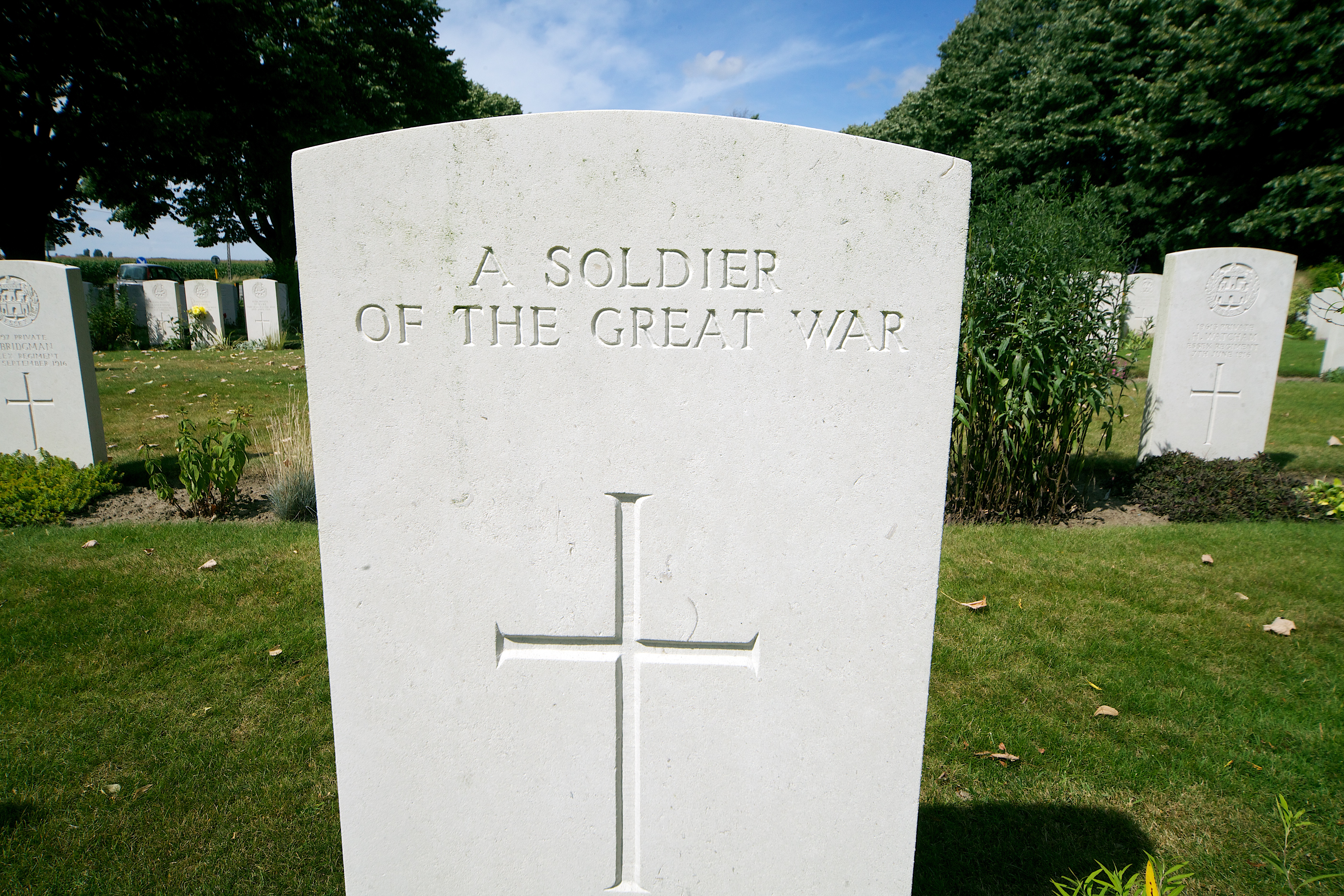
Military cemeteries and the graves of soldiers are especially touching. I recall walking row after row of World War I grave markers in Ypres, Belgium, where the famous poemIn Flanders Fields was composed in 1915. All of those young lives cut short by “the war to end all wars.” Such sacrifice. World War I cemeteries dot the landscape in Belgium; some in the middle of farm fields.
Grave of an unknown soldier near Ypres, Belgium.
While our loved ones are gone, they can teach us still. There are great resources available to help you find where your relatives are buried. My favorite online database is the Find A Grave web site. Take a camera along on your next trip to the cemetery and help your fellow genealogists document history.
Our photo library is a bit thin on photos from my mother’s Mulqueen side of the family, but we do have some nice images worth sharing. My Mom grew up in Cudahy (we always pronounced it coo-da-hi, although it’s actually cuh-dah-hay) and comes from a family of 10. The matriarch and patriarch were Margaret Madonna (Dailey) Mulqueen (1895-1982) and Earl J. Mulqueen Sr. (1895-1965).
Left to right are Uncle Joe Mulqueen, Aunt Lavonne (Hanneman) Wellman, Uncle Patrick Mulqueen, Grandma Ruby Hanneman and (I believe) Uncle Pat’s wife Ruth.
In the foreground is Grandma Margaret Madonna (Dailey) Mulqueen (1895-1982), and in the back is Grandpa Earl J. Mulqueen Sr. (1895-1965)
Grandma Margaret M. Mulqueen and Grandpa Earl J. Mulqueen Sr., on a visit to my folks’ house in Grand Rapids, Mich.
Sunday dinner at the Mulqueen house in Cudahy.
David C. Hanneman and Laura Mulqueen Curzon, circa 1965.
David C. Hanneman and Laura Mulqueen Curzon, circa 1965.
Looks like Laura Mulqueen Curzon got what she wanted for Christmas. In the background is Grandma Ruby Hanneman.
Looks like a dinner party at my parents house in Greenfield in the late 1950s.
I’m ashamed to say I’m not sure which of cousin Laura Mulqueen Curzon’s brothers this is. Taken in Colorado.
Grandma Margaret M. Mulqueen along with Aunt Evelyn Mulqueen.
Sister Madonna Marie Mulqueen holds baby David C. Hanneman, while Laura Mulqueen Curzon looks bored.
One of the last Mulqueen family reunions. Back row left to right are Aunt Ruth (Mulqueen) McShane, Uncle Patrick Mulqueen, Uncle Joe Mulqueen and Aunt Joanie (Mulqueen) Haske. Front row includes Sister Madonna Marie Mulqueen and Mom, Mary K. Hanneman.
A nice artsy shot of Mom, Mary K. (Mulqueen) Hanneman at the Hanneman house in Mauston, Wis.
Coming in the door are Grandma Margaret Mulqueen and Grandpa Earl J. Mulqueen Sr., along with Mom and Dad, David D. and Mary K. Hanneman.
Easter Sunday in the 1970s with Grandma Margaret Mulqueen, Laura Mulqueen Curzon, Mary Hanneman, yours truly, David C. Hanneman, and in front Margret Hanneman and Amy Hanneman Bozza.
Sometimes a photograph will strike you in a certain way that makes it memorable. It has some intangible quality that makes it almost timeless. Of the thousands of images in our library, a handful qualify for this kind of distinction. Not for their physical clarity or skill of the photographer, but that certain look. You might describe it just a bit like looking at a Rockwell painting, or a black and white photograph by Ansel Adams.
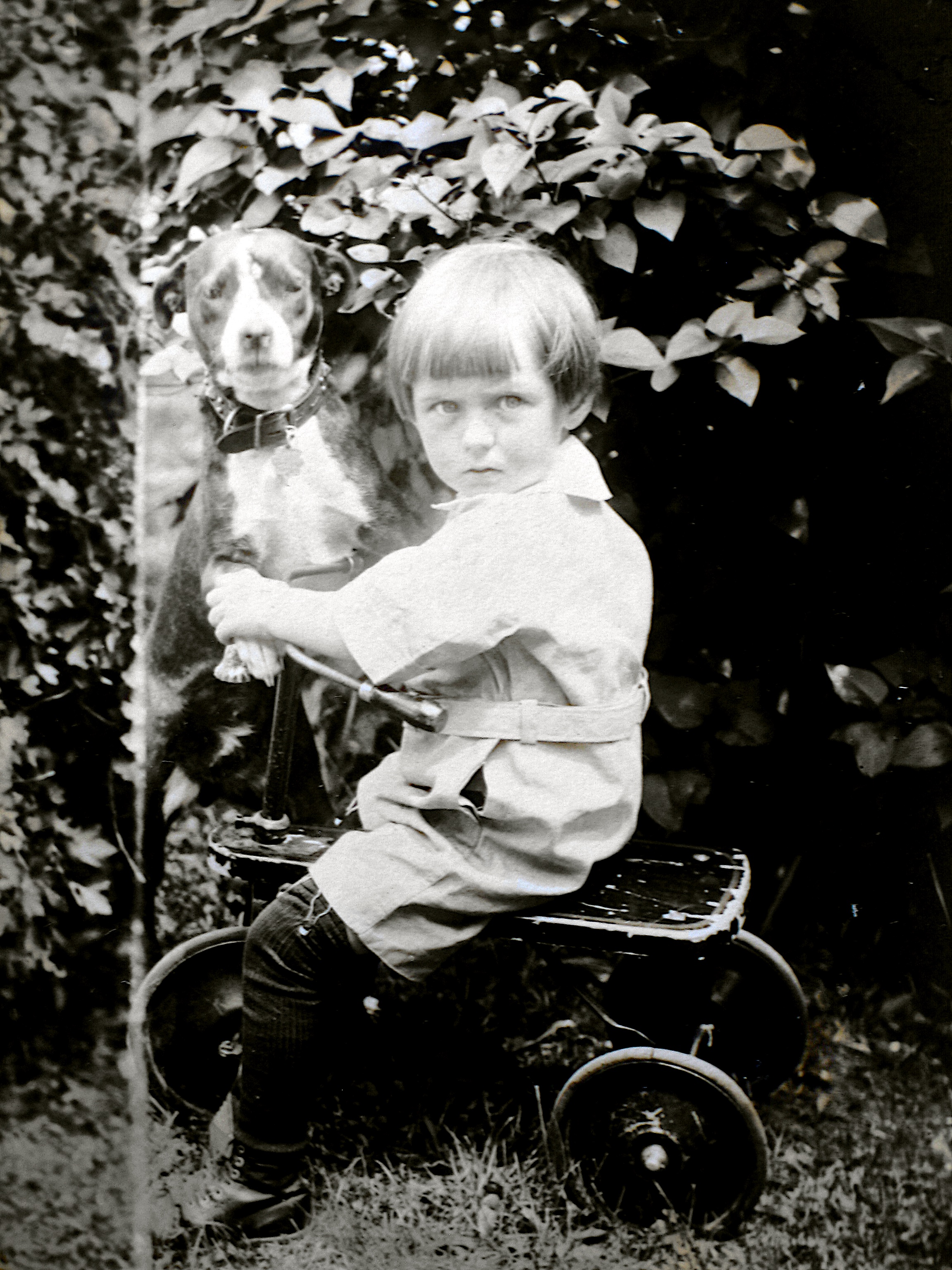
This image has a Little Rascals look and feel to it. Originally thought to be toddler Elaine Treutel and the family dog on her tricycle, circa 1922. Turns out this was actually one of the sons of Harry Cole.
View the whole collection in the gallery below:
Elaine Treutel poses with the family dog in this ca. 1923 photo near Vesper, Wis. Directly behind her is older sister Ruby V. Treutel. Sitting on the bumper of the car is father Walter Treutel (1879-1948). The others are unidentified.
This image has a Little Rascals look and feel to it. Toddler Elaine Treutel and the family dog on her tricycle, circa 1922.
David D. Hanneman with his toe in the sand at Madeline Island, circa 1942.
Ruby V. Treutel (center) relaxes with the Sunday paper near Milwaukee’s Juneau Park in 1924. Ruby was visiting her fiance, Carl F. Hanneman (1901-1982), who was studying pharmacy at Marquette University. At front is Ruby’s sister, Nina H. Treutel (1914-2005). The woman near the car is unidentified.
A formal portrait of Elaine Treutel of Vesper, Wis., circa 1938. Born in January 1920 to Walter and Mary (Ladick) Treutel of Vesper, Elaine attented Lincoln High School in Wisconsin Rapids. She married Max Clark in October 1938. The couple lived for many years in Madison, then relocated to suburban Phoenix, Arizona.
Frank Herman Albert Hanneman (1895-1947) of Grand Rapids, Wis., posed for this studio photo with a shotgun, ammunition belt and even a hunting dog. The photo was taken ca. 1909. Frank was the son of Carl Frederick Christian Hanneman (1866-1932) and Rosine B. H. Ostermann (1874-1918).
Nina Treutel of Vesper, Wis., is about 18 months old in this circa 1916 photograph. Nina’s parents are Walter Treutel and Mary Helen (Ladick) Treutel.
A beautiful portrait of Lavonne Hanneman, circa 1955.
Ruby Treutel poses for an informal photo, circa 1922.
Ruby Treutel with her siblings Marvin, Elaine and Nina, circa 1921.
Carl F. Hanneman’s high school portrait, 1921.
Lavonne and David Hanneman examine a monument on a vacation trip to South Dakota in 1947.
Ruby Treutel holds her baby brother Gordon, circa 1910. Gordon died of pneumonia in February 1911.
Patricia Treutel is having a great time on the tree swing, circa 1943.
We don’t have an ID on this beautiful young lady. Photo appears to be from 1920s.
David D. Hanneman watches over his little sister, Lavonne, circa 1938.
David D. Hanneman and sister Lavonne Marie Hanneman, circa 1942.













 The Hanneman Archive