Tag Archives: Waukesha County

Walter Treutel’s 240,000-mile Journey Through Wood County, Wisconsin

It would be hard not to respect a man who worked diligently at his job six days a week for 30 years. For Walter Treutel, the job record was even more impressive. His career as a rural letter carrier took him on a nearly 240,000-mile journey making sure the people of Vesper, Wisconsin received their mail and packages from 1904 to 1934.

Walter Treutel of Vesper, Wisconsin.

“The new rural mail carriers who will begin carrying mail on the 10 new routes on December 1st received their appointment from Washington last week,” the local Grand Rapids, Wis., newspaper announced in November 1904. “These carriers all took the competitive examination in this city four weeks ago and those fortunate to receive an appointment will now only have to file their bond for the faithful performance of their duty.” Walter’s first day as a letter carrier was Dec. 1, 1904. He was just two years married to the former Mary Ladick, and their firstborn child, Ruby, was just six months old.

His first trip over Rural Route 1 was made in an open buggy pulled by two ponies. He and his sister, Emma Carlin, rode that first 26.5-mile run together to deliver just 35 pieces of mail. At the time, the Vesper postal station was located inside the Treutel Bros. store, run by Walter’s brothers, Charles and Henry Treutel. Walter’s official postal substitute was his wife, Mary.

Walter Treutel picnics with children Nina, Elaine and Marvin, circa 1925. Behind the camera is Ruby (Treutel) Hanneman.

The dirt roads were rough and filled with chuckholes. The buggy rode over corduroy — soft or swampy sections that were shored up by placing logs  across the path. Roads were so punishing in those early days that horses typically lasted only two years in service.

The first open postal buggy was eventually replaced by a covered postal wagon. Walter used a dozen horses on his  route over the years. One of the toughest, “Old Baldy,” served for seven years in all sorts of weather. His first automobile, a two-cylinder Buick roadster, was nicknamed “The Little Red Devil.” Three other postal vehicles served on the route during his tenure.

He served under five postmasters during his 30 years, including his sister Emma Carlin, who was Vesper postmistress for nine years starting in 1906. In November 1934, Walter took his overdue two-week vacation, then returned for one final route on Dec. 1 — thirty years to the day after his first day on the job.

Walter Treutel with second wife Vera (at left), sister Emma Carlin, daughter Ruby Hanneman and grandchildren Lavonne and David D. Hanneman.

Walter was born July 23, 1879 in Mukwonago, Wisconsin, the son of Philipp and Henrietta (Krosch) Treutel. Walter’s wife, the former Mary Helen Ladick, died in 1925 after suffering a post-operative infection. She was just 41. They had five children, four of whom (Ruby, Nina, Marvin and Elaine) survived into adulthood. Walter died Feb. 15, 1948 of lingering heart disease. He was 68.
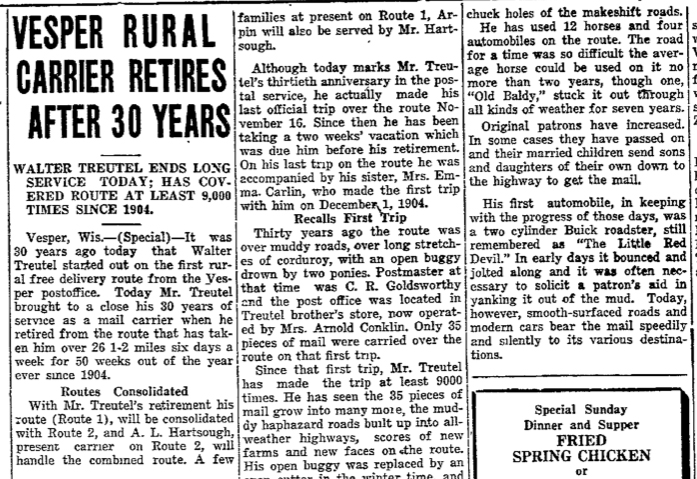
The Wisconsin Rapids Daily Tribune wrote about Walter Treutel's last day on the job in 1934.
The Wisconsin Rapids Daily Tribune wrote about Walter Treutel’s last day on the job in 1934.

FAMILY LINE: Johann Adam Treutel >> Philipp Treutel >> Walter Treutel >> Ruby (Treutel) Hanneman >> Donn, David and Lavonne Hanneman.
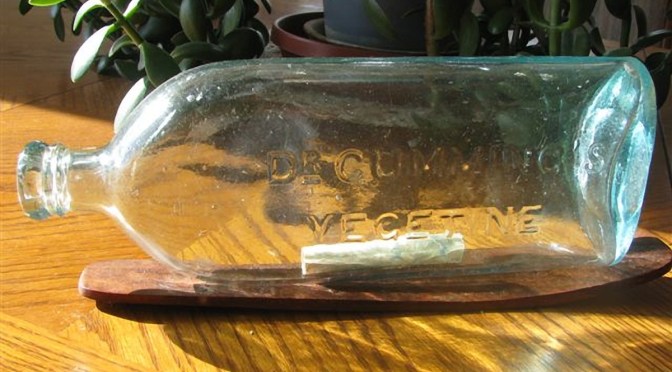
Frederick Krosch Water Bottle Dates to the Mid-1800s

Like most hard-working farmers of his day, Frederick Krosch spent a lot of time toiling in the fields. First in Germany and then on an 80-acre farm north of the village of Mukwonago in Waukesha County, Wisconsin.

It’s amazing to realize that the water bottle he carried with him into the fields has survived to this day, more than 130 years after his death. The glass bottle, embossed with lettering that reads “Dr. Cummins Vegetine,” has been in the possession of Bonnie (Treutel) Young, the elder Krosch’s great-great granddaughter.

Bonnie has had the bottle on display at her home, but only recently removed a handwritten note that had been placed inside in 1944.The note reads: “This is the bottle in which our grandfather Krosch, ‘mother’s father,’ used to take drinking water to the fields with him. It’s perhaps near 100 years old.”

The note was written by Emma (Treutel) Carlin (1877-1962), Frederick Krosch’s granddaughter, who no doubt inherited it from her mother, Henrietta (Krosch) Treutel (1839-1908).

As documented in a previous article,the Krosch family came to America inJuly 1854 and settled into farming in Waukesha County. Frederick Krosch farmed 80 acres of land that is now home to a bank and a Culver’s restaurant. The Krosch farm was adjacent to land owned by Judge Martin Field, for whom Field Park in Mukwonago is named. Krosch’s farmland was valued at $1,500,according to the 1870 U.S. Census.

Krosch continued his farming as his daughter Henrietta marriedblacksmith Philipp Treutel and started her own family. The elder Krosch died Aug. 7, 1876. He is buried at Oak Knoll Cemetery in Mukwonago.Krosch Water Bottle Note

As for the original contents of that bottle, Vegetine was sold for years as a “blood purifier.” It laid claim to curing and preventing maladies from pimples to cancer and neuralgia to “female weakness,” gout and sciatica. Vegetine was made from bark, roots and herbs.

Given Vegetine’s wild curative claims, perhaps Frederick Krosch figured out he was better off sticking to water.

FAMILY LINE: John Frederick Krosch (1799-1876) >> Henrietta (Krosch) Treutel >> Walter Treutel >> Ruby V. (Treutel) Hanneman >> Donn, David and Lavonne Hanneman.

Cemetery Neglect: Sad Resting Place for Little Ida Krosch

William and Crystal Krosch faced unthinkable tragedy during their first years in Wisconsin. The joy at the birth of their daughter Ida Clara Krosch in February 1858 turned to dread and sadness just a few years later. Sick with diphtheria, little Ida died two days after Christmas 1861 at the family home in the town of Eagle in Waukesha County, Wisconsin.

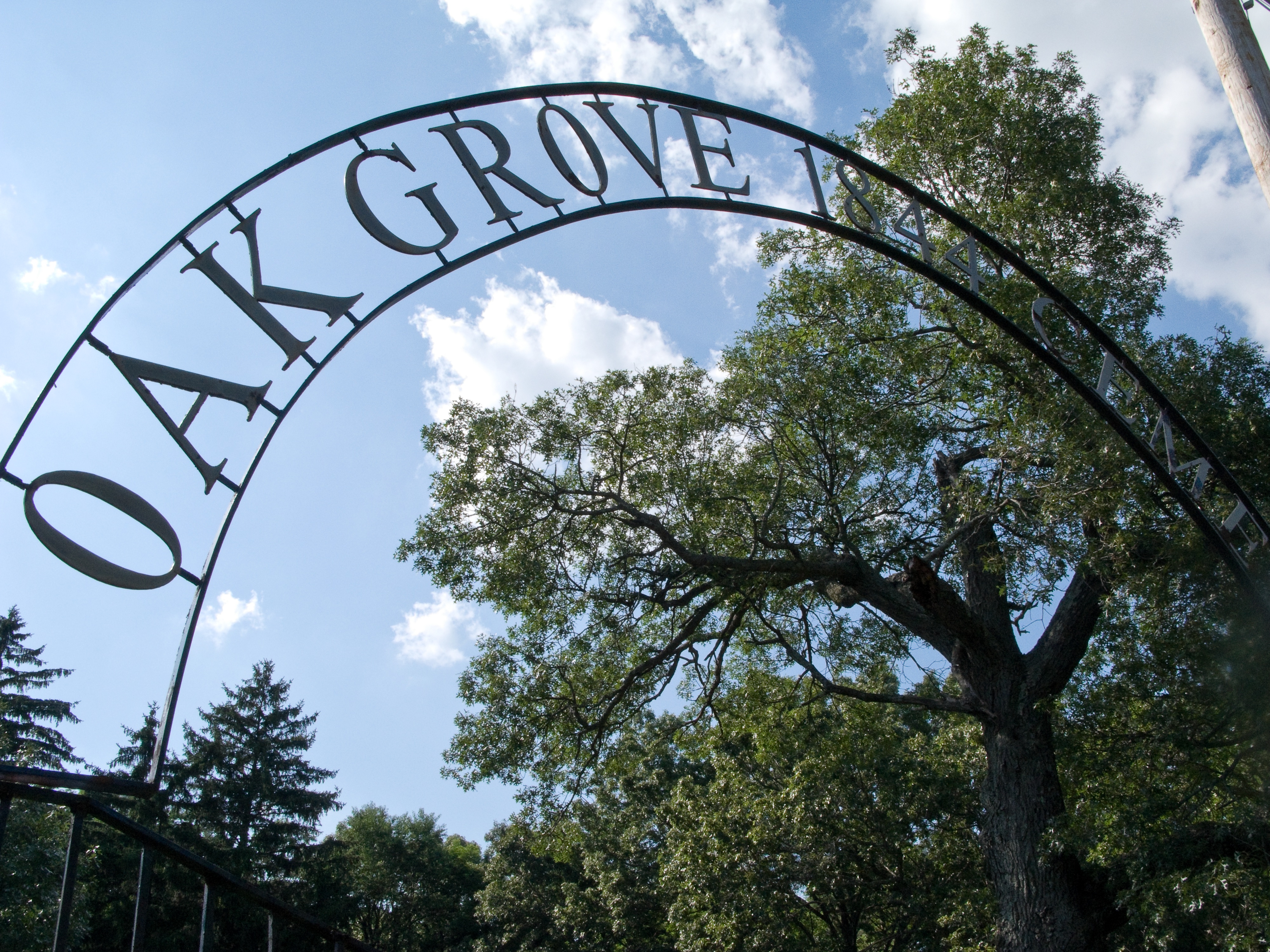
Ida Krosch was laid to rest at Oak Grove Cemetery about a mile south of the village of Eagle. A 2-acre parcel carved out of the Kettle Moraine Forest, the cemetery was a scenic, peaceful place that no doubt brought some comfort to the family during visits to the little girl’s resting place. What shock they would feel if they witnessed what would become of the little country cemetery long after the family had moved to Minnesota.

What was going on in the world in December 1861? “It looks now as if we are to have good sleighing for Christmas, as several inches of snow fell during Sunday last,” wrote the Waukesha Freeman on Dec. 24, 1861. The newspapers were promoting a Waukesha visit by Gen. Tom Thumb, “America’s Man in Miniature” made famous by P.T. Barnum. And many local men were leaving their businesses to join Wisconsin troops in the Civil War.

The arch over entrance to Oak Grove Cemetery, Eagle, Wisconsin.


The burial records of Oak Grove Cemetery are testament to the hardships of pioneer life in rural Waukesha County. It was common for families to lose young children to diseases such as diphtheria or typhoid fever. Ironically, an article run in the Waukesha Freeman the week Ida died wrongly predicted that diphtheria would be fatal in just one of 100 cases. Diphtheria would become the No. 1 killer of children in America during the coming decades.

The cemetery is replete with stories of the sadness of youth lost. James Lowry died at age 5 in 1858. Ada Severance died at age 4 in 1855. Arden Baldwin died at age 3 just months before Ida Krosch. Oscar Jaycox was just 1 when he died in 1858. Arthur Bigelow was 2 when he died in 1855. Orlando Cook was a mere 8 months old when he died in 1852.

‘Gone but not forgotten?’

Peter Grems, reported to be the first veterinarian in the Wisconsin Territory, is buried here. Charles Kilts, a bugler for Company K of the 1st Wisconsin Volunteers in the Civil War, is buried here, too. He died in September 1862.

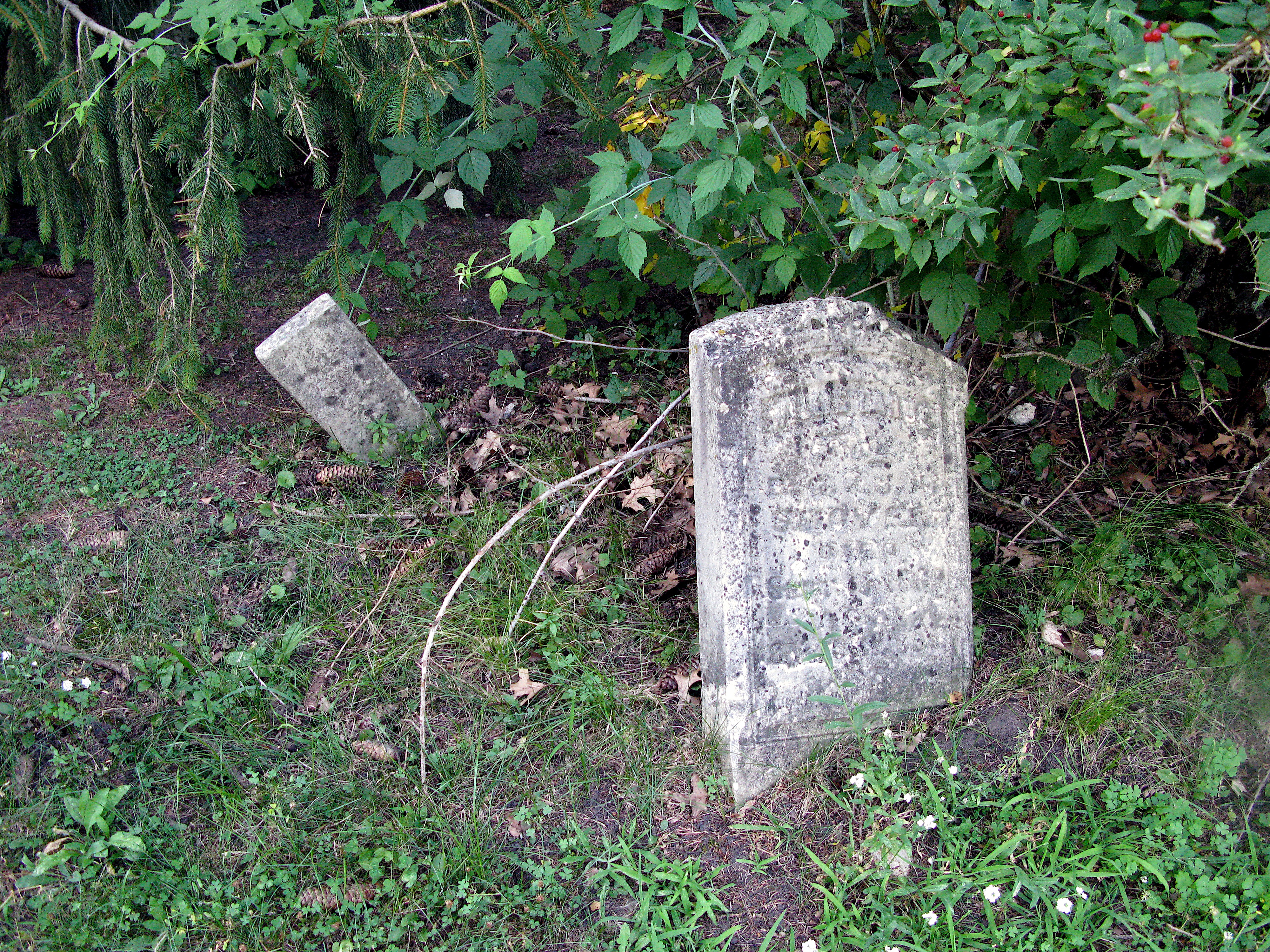
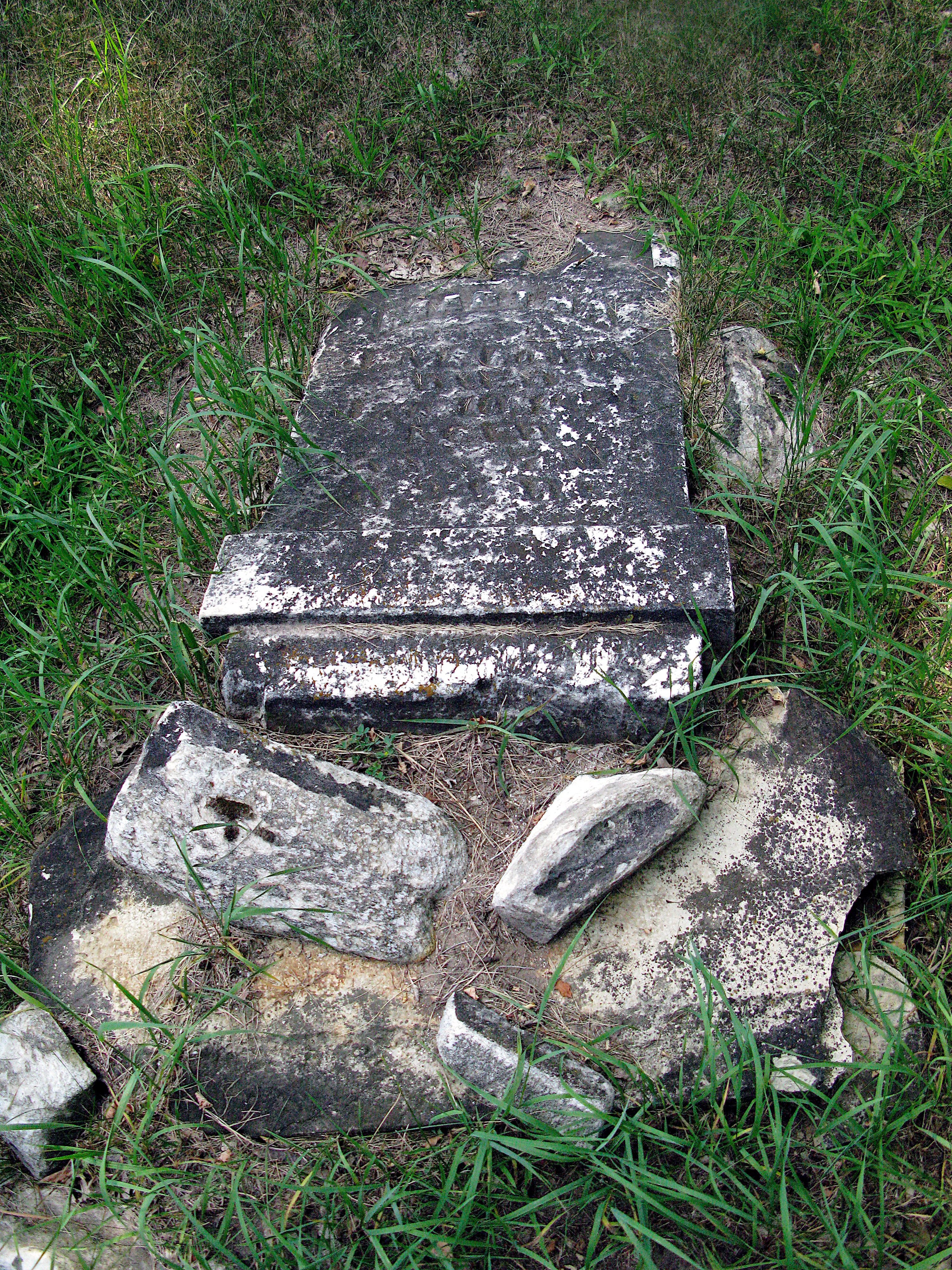
No doubt the graves of these folks were tended to with care for many decades, but Oak Grove Cemetery has now become a sad monument of neglect and abandonment. Monuments have been toppled. Headstones lie in pieces. Many headstones are leaning badly. Grave sites are covered in thicket. Some have been swallowed by the encroaching forest. The wrought iron fence that separates the cemetery from nearby Highway 67 is rusty and listing. No doubt the families of these souls would be heartsick to see the state of this burial ground.

Broken tombstone of Eliza Mead, who died in 1870
Broken tombstone of Eliza Mead, who died in 1870.

Ironically, Oak Grove Cemetery is just across the road from Old World Wisconsin, the world’s largest museum on the history of rural life. Old World Wisconsin is run by the Wisconsin Historical Society. Maybe if they included their neighboring cemetery on their tours this hallowed ground would not be in such deplorable shape.

For the most part, burials stopped at Oak Grove in 1967, 125 years after the cemetery was founded. We did find one interment at Oak Grove in 2007. Since the cemetery association that cared for the land disbanded long ago, upkeep of the cemetery falls to the local government. It appears the grass gets mowed, but that is no doubt where the maintenance stops.

Graves of Mary and William Reeves, d. 1856 and 1857.
Willie Larue Snover, who died at age 8 in 1869.

Under Wisconsin law, circuit courts can compel local municipalities to care for abandoned cemeteries, or even order the reinterment of the deceased in new cemeteries. Given that Oak Grove is a pioneer cemetery with the remains of the founding families of Eagle, as well as many Civil War veterans, it is very sad that more pride is not taken in preserving it.

Little Ida Clara Krosch’s tombstone can no longer be found at Oak Grove Cemetery. Maybe that’s just as well. Her parents and their descendants would no doubt hang their heads in sadness and shame to see what became of little Oak Grove Cemetery.

FAMILY LINE: 
John Frederick Krosch >> William F. Krosch >> Ida C. Krosch

Grave of Martha Lowry, who died in 1873.
Grave of Martha Lowry, who died in 1873.

Henrietta: A Rare Photographic Discovery

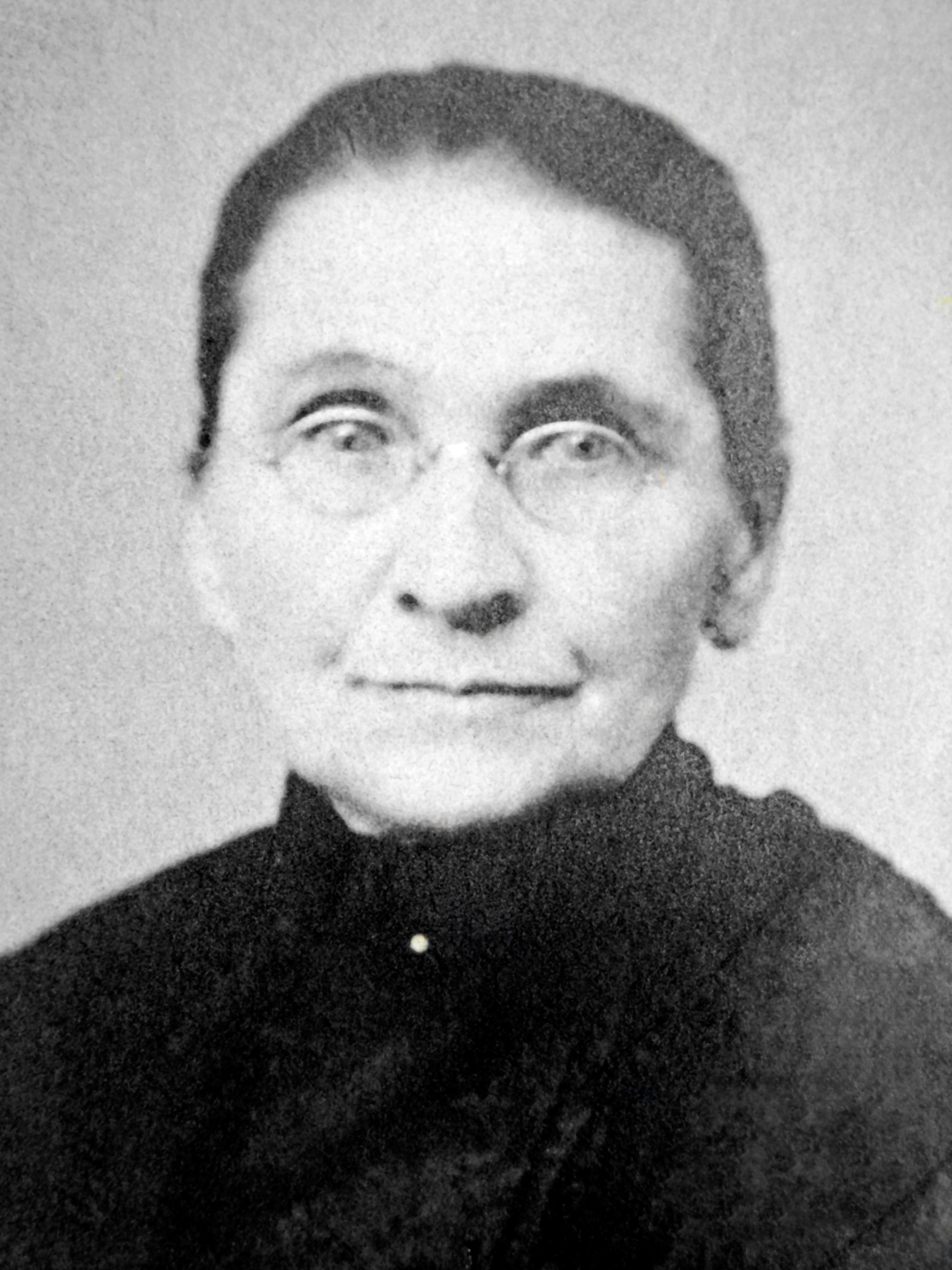
When 16-year-old Henrietta Krosch embarked on a long ship journey from Jessnitz Germany to America, she could not have known that her memory would echo in family history for more than 150 years. When she and her family stepped off the ship Bertha in New York in July 1854, they were  headed for Waukesha County, Wisconsin. She would meet a young blacksmith named Philipp Treutel, get married and become mother to many generations. And now we discover her photograph is still a part of living history.

Portrait of Henrietta (Krosch) Treutel, taken about 1906 in Nekoosa, Wisconsin.

Henrietta’s great-grandson, David D. Hanneman, was a pack rat. Over many decades during his 74 years, David (my Dad) tucked away countless family items, from scraps of letters to an extensive collection of old photographs. After his death in April 2007, the photograph shown above was found in his collection. Mounted on photo board with a black oval matte, the photo has the following written on the back:

“Henrietta Krosch Treutel. Married to Philipp Treutel. Parents of Lena Treutel Moody (Wm); Lisetta Treutel (Winfield); Henry Treutel (married to Josephine Garlack); Charles (Mary Miller); Oscar; Emma Treutel Carlin (Orville); Walter Treutel (Mary Helen Ladick).

The photograph likely dates to between 1901 and 1908. The Treutels moved to Wood County in 1901 and Henrietta died in 1908. The photographer’s imprint on the photo is from Nekoosa in southern Wood County.

Family Line: John Frederick Krosch >> Henrietta (Krosch) Treutel >> Walter Treutel >> Ruby (Treutel) Hanneman >> David D., Donn and Lavonne Hanneman

©The Hanneman Archive