Category Archives: Mulqueen

1898 Flood Killed 25, Stranded Hundreds

SHAWNEETOWN, Illinois — Children skipped happily along the streets of this southern Illinois town on the afternoon of Sunday, April 3, 1898. Sunday school had let out and the rest of the sunny day was theirs to claim. A large crowd of adults ambled along the walk, crossing Market Street and continuing on their way home. At the north end of Market Street, the levee that protects the town from the Ohio River was badly strained by rising water. But if the townsfolk were worried, it did not show on this spring day.

About 4:45 p.m., a 10-foot section of the levee collapsed and river water began pouring through the breach onto Market Street. The hole in the levee quickly grew to a half-mile wide, exploding into a wall of onrushing flood water that raced into the center of town. The flood rush hit the town like a blast from a double-barrel shotgun. Dozens of homes in the immediate path, many nothing more than shanties, were suddenly swept away. The small buildings were thrust along, some of them smashing against sturdier structures like the courthouse. Within mere moments, a quarter of Shawneetown’s homes were gone, the remains of which tumbled along in the rolling boils of a massive flood.
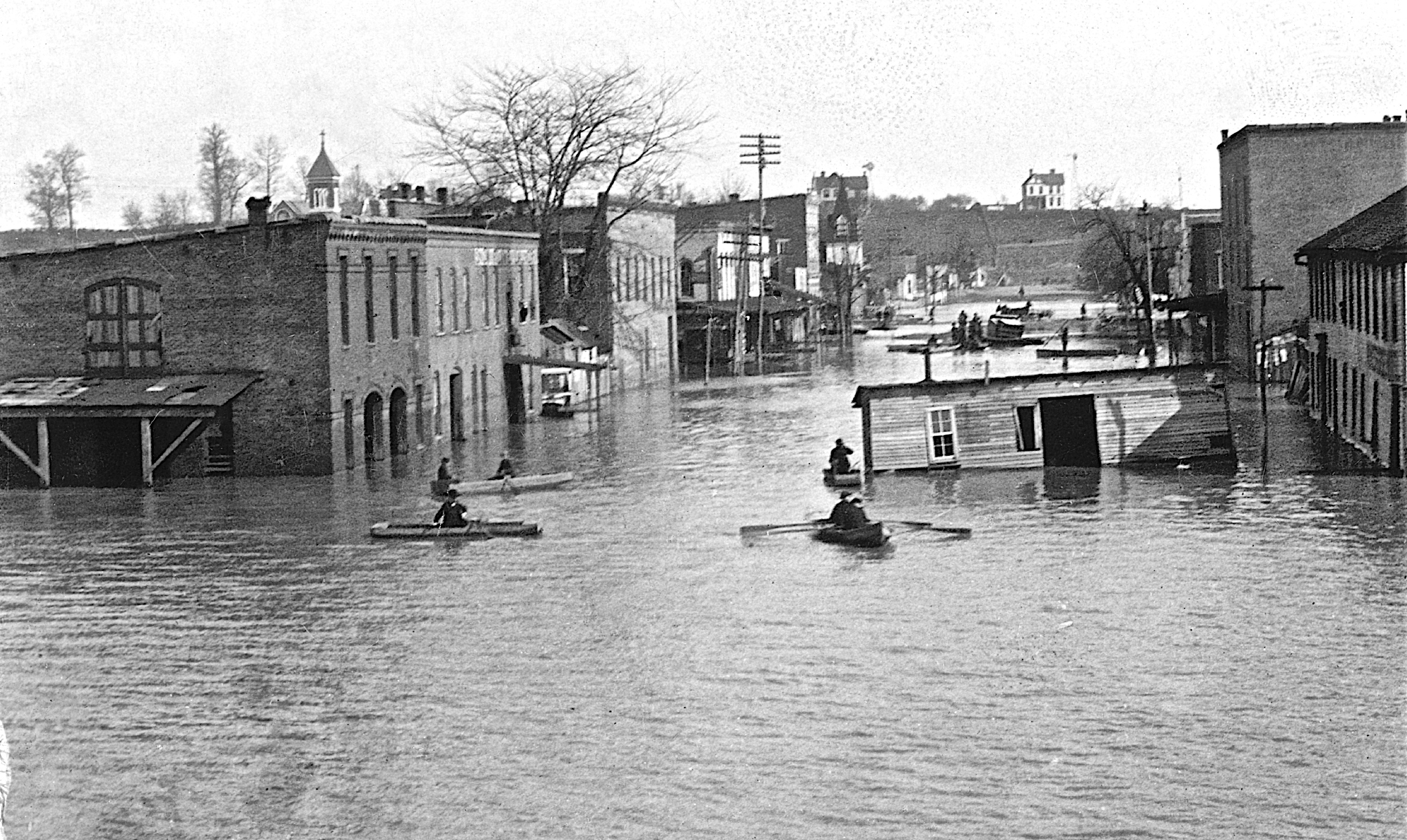
Floodwaters reached more than 12 feet deep in much of the town in April 1898.
Floodwaters reached more than 12 feet deep in much of Shawneetown and surrounding areas in the April 1898 flood. This photo of the floodwaters at Uniontown, Ky., was taken by B.L. Singley, president of the Keystone View Company, for a stereoscopic card.

The people of Shawneetown were no strangers to floods. They had waged war with the Ohio River for generations. The Ohio always won the battle, but the people rebuilt time and again. As heavy spring rains swelled the Ohio again in March 1898, the older folks in town knew it could mean big trouble. But the relatively new levees were supposed to prevent it. Levees were built in 1884 after back-to-back years of devastating floods that twice wiped out much of the town. Today, the Ohio River again claimed its superiority with the ferocity of a jungle cat.

Headlines
The Decatur newspaper feared the worst, proclaiming 400 dead. The actual number was 25.

“About 50 small frame houses along the line of the levee to the south were crushed like toys,” witness T.J. Hogan of Omaha, Illinois said. Stunned residents scrambled for higher ground. Women on the streets struggled through the muddy waters, holding their babies aloft as the flood waters reached neck level. “The strongest houses, built especially to resist floods, went down like corn stalks,” wrote photographer Benneville L. Singley. “There was a wild rush for the hills. None had time to secure either treasure or clothing.”

A few miles northwest of Shawneetown, the Daniel J. Dailey Jr. family was preparing for Sunday supper on their farm in North Fork Township. Florence (White) Dailey, 30, prepared the meal while the children helped ready the table. The Dailey home was a busy place, with Delia, Millie, Daniel and Maggie scuttling about. Maggie, just 2 ½, grew up to become our own Margaret Madonna (Dailey) Mulqueen of Cudahy, Wisconsin.
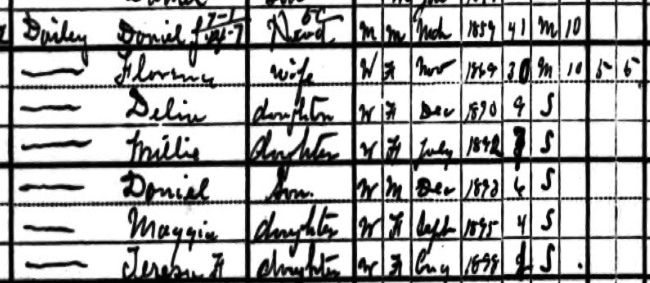
The 1900 U.S. Census shows the Dailey family.
The 1900 U.S. Census shows the Dailey family in Gallatin County, Illinois.

The Dailey and White families had farmed this area of Gallatin County since the early 1860s. Daniel J. Dailey Sr. brought his young family from Ohio about 1860. The 1860 U.S. Census shows the Dailey family consisted of Daniel, 30, Hannah, 26, Mary, 4, and Daniel J., 2. The White family, from which Florence (White) Dailey came, settled in Gallatin County nearly a decade before her birth. The 1860 census showed the White family included father Don, 24, mother Sarah, 24 and children Mary, 5, Wiley, 3, and James, 6 months. Florence was born in November 1869.

We don’t know how long it took word to reach North Fork about the massive breach in the levee. It was most likely the next morning. The news no doubt sent Daniel Dailey towards Shawneetown with other area farmers, while Florence (White) Dailey gathered supplies for what would soon become a massive relief effort. By nightfall on April 3, the river had flooded dozens of square miles in and around Shawneetown with water up to 15 feet deep.

By morning, the town was devastated. Those who could scrambled to the roofs of their homes to escape the rising terror. Dozens raced into the Gallatin County Courthouse, the Riverside Hotel and the Ridgway Bank, seeking shelter on the upper floors of these sturdy structures. A few early rescue boats and canoes drifted into town and began rescuing the stranded. “Hundreds of those who escaped the rush of water were perched on roofs, trees and along the top of the levee,” a newspaper dispatch read. “They were taken from their dangerous positions as rapidly as possible.” Survivors were taken to nearby Junction City, where an emergency camp was established.

Upstream, carpenters, farmers and any able-bodied men began building flat boats that would be used to ferry supplies and people. When word reached dry land in nearby towns, frantic wires were sent to Springfield for help. The situation was pure panic. Newspapers across America carried dramatic headlines; FLOOD AT SHAWNEETOWN. Some predicted hundreds of deaths. One paper even pegged the toll at 1,000.

Meanwhile, rescuers shortly had weather to battle. The cold rains had started again, whipped by 30-mile-per-hour winds that made the sheets of rain cut like glass. Relief efforts were being coordinated at Ridgway, some 12 miles from Shawneetown. The governor sent more than 100 tents and rations for more than 1,000 people, but initially the displaced could rely only on the charity of neighbors and strangers. It would be weeks before the deep flood waters began to recede. Doctors hurried to the area to help prevent sanitary conditions from sickening the townsfolk.

On April 5, the Shawneetown relief committee released a statement and called for donations: “The whole town is submerged. One tract of twelve acres is about 15 feet under water; this was formerly covered with small dwellings and is now absolutely bare. On this tract the greatest loss of life occurred. It is evident that bodies cannot be recovered, nor any absolute knowledge of the number of deaths obtained until the waters abate.”

When the waters finally receded, the full toll of the disaster could be chronicled. There were 25 killed by drowning. Some 143 houses were demolished or rendered untenable. About half of those floated away on the rising river. The relief committee distributed more than $22,000 and helped rebuild many homes. Losses were estimated at in excess of $300,000.
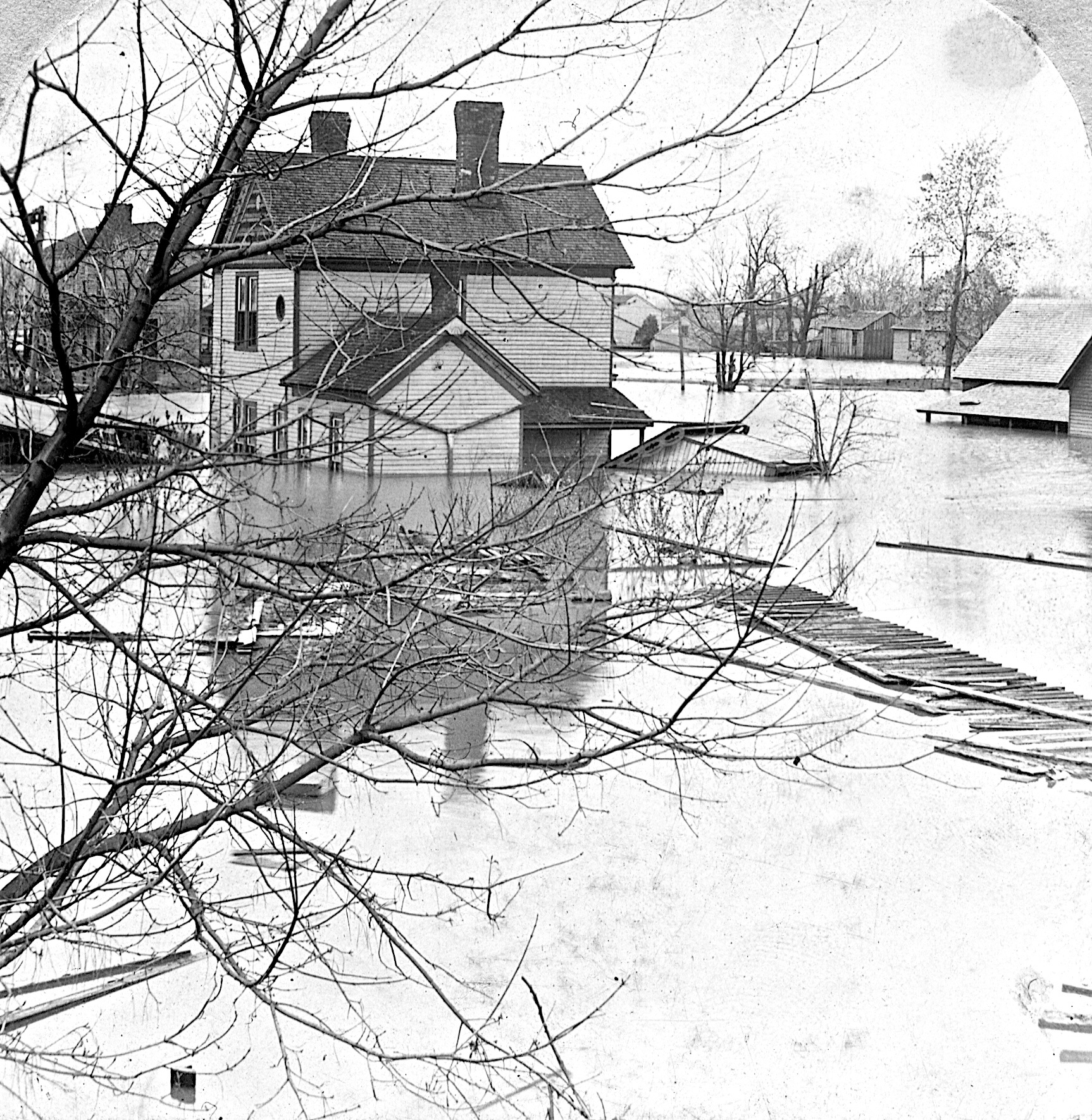
Another image shot by B.L. Singley shows the devastation from the flood.
Another image shot by B.L. Singley shows the devastation from the flood at Shawneetown.

Gallatin County Sheriff Charles R. Galloway suffered particularly stunning personal loss. After learning his daughters Dora, 19, and Mary, 12 were killed in the flood, he then learned of the drowning of his wife, Sylvester. Photographer Singley wrote that the sheriff’s hair “turned suddenly white from grief at the loss of his wife and two daughters.” In some cases, entire families were wiped out, such as Charles Clayton, his wife and their four children.

Until 1883, Shawneetown was completely at the mercy of the river. That year, after floods had again wiped out much of the village, construction was begun on a levee system. The levee was still incomplete in February 1884 when the river overpowered it, pouring floodwaters into the town. “Within 24 hours from that time, all the poorer people of Shawneetown were homeless, their houses drifting about and away in the turbulent flood,” read a report prepared for the Illinois legislature.

There was something in the community’s DNA that willed the folks to rebuild. This was a longstanding feature of life in Shawneetown. Morris Birbeck, writing his 1817 Notes on a Journey in America, remarked: “As the lava of Mount Etna can not dislodge this strange being from the cities which have been repeatedly ravished by its eruptions, the Ohio, with its annual overflowings, is unable to wash away the inhabitants of Shawneetown.”

As true as Birbeck’s observation was, the Ohio struck at Shawneetown with disastrous results again in 1913. That year, more than 1,000 people took up residence in tent cities built on the nearby hills. An emergency hospital was built to care for the injured and sick. In 1932, the levee was raised to 5 feet above the high-water mark from 1913. But nothing would hold back the flood waters in 1937, when what was called a 1,000-year flood swamped the town. After more than a century of floods and destruction, Shawneetown would not rebuild on the lowlands. The state and federal governments helped move the village onto hills 4 miles back from the river.

Margaret Dailey, who was referred to in Census documents as Maggie and Madge, moved away from North Fork and went to school at Northwestern University. She finished her studies in June 1920, and shortly after married a young man named Earl James Mulqueen in Racine, Wisconsin. The Mulqueen family home, which eventually relocated to Cudahy, welcomed 11 children between 1921 and 1944.

— This post has been updated with an additional photo of the flood, and a correction on the location of the first photo to Uniontown, Ky., rather than Shawneetown.

To see other photos of flood devastation at Shawneetown over the years, visit the Ghosts of Old Shawneetown.

©2015 The Hanneman Archive

‘Governor’ Mulqueen Helped Keep WWII Electric Power on in Milwaukee

Milwaukee was a key industrial production hub during World War II, and there was concern that spies or saboteurs would attack defense contractors or the public utilities that supplied them with power. As a master mechanic at Wisconsin Electric’s huge Lakeside Power Plant in St. Francis, Earl J. Mulqueen Sr. worked under tight security to ensure the war effort continued uninterrupted.

Nicknamed “The Governor,” Mulqueen was well known around his home in Cudahy as a Mr. Fixit. Whenever the boiler would go out at St. Frederick’s Catholic Church or school, they would call the Governor to come over and get things working again. When World War II broke out in late 1941, Mulqueen was just starting his third decade working for Wisconsin Electric. He put his mechanical skills to work keeping the turbines and other equipment at Lakeside in good working order. 

Earl Mulqueen Sr. worked at the Lakeside power plant in St. Francis for more than 40 years.
Earl Mulqueen Sr. worked at the Lakeside Power Plant in St. Francis for more than 35 years.

Signs on and around the Lakeside plant carried a warning: “National Defense Premises. No Entry.” Armed agents guarded the plant 24 hours a day — part of a force of more than 1,000 men providing security at Wisconsin power utilities during the war. Because of his key role in keeping Lakeside in operation, Mulqueen received his own security protection. He often stayed at the plant for long stretches. When he came home to fetch clean clothes and pay a quick visit, he was accompanied by FBI agents. On occasion, an agent came alone to pick up clothes or other supplies for Mulqueen.

Earl J. Mulqueen Sr. in 1944.

The security precautions were warranted. Milwaukee factories were converted to war production of artillery, fuel storage, engines, turbines and all sorts of mechanical parts. The build-up created huge demand for power. The nation could ill afford an attack that shut down a key plant like Lakeside. Even before the attack on Pearl Harbor, Wisconsin Electric officials expressed security concerns, and fears the Lakeside power plant could be attacked with explosives by boat from Lake Michigan.

Nazi Germany launched just such a plan when it landed eight special agents on the shores of New York and Florida in June 1942. The German agents carried explosives and were tasked with blowing up U.S. defense industries and terrorizing population centers. “They came to maim and kill,” said FBI Director J. Edgar Hoover. Codenamed Operation Pastorius, the plot was foiled when one of the saboteurs turned himself in to the FBI. Federal agents arrested the men and recovered high explosives disguised as pieces of coal.

Steam turbines at the Lakeside Power Plant.
Steam turbines at the Lakeside Power Plant in St. Francis, Wisconsin.

Such an attack could have been devastating. Manufacturers like Allis-Chalmers, Falk Corp., Ladish, Bucyrus Erie, Case, Heil Co. and many others produced components and finished goods for the U.S. military. Everything from engines, to fuel trailers, to cargo and transport ships were built in eastern Wisconsin during the war. Wisconsin utilities scrambled to add generating capacity to keep up. Opened in 1920, Lakeside carried the burden of power supply as the other generation plants were being built.

Ladish Drop Forge in Cudahy was one of many Milwaukee-area companies in war production.
Ladish Drop Forge in Cudahy was one of many companies producing war materiel.

Mulqueen left his job as a machinist at the Case plow works in Racine in February 1920 to work for the Milwaukee Electric Railway and Light Co. (later called Wisconsin Electric) as a machinist helper in the utility’s Racine operations. In November of that year, he married Margaret Madonna Dailey at St. Joseph Catholic Church in Racine. A former teacher, Miss Dailey had graduated in June 1920 from Northwestern University. Earl worked in Racine until 1925, when he was transferred to the Lakeside Power Plant. The Mulqueen family then moved to Cudahy. The couple had 11 children; six of whom served in the U.S. military.

The Cudahy Reminder-Enterprise carried a photo from Earl J. Mulqueen Sr.'s 40th anniversary with Wisconsin Electric.
The Reminder-Enterprise in Cudahy carried a photo from Earl J. Mulqueen Sr.’s 40th anniversary with Wisconsin Electric in March 1960.

Earl Mulqueen Sr.’s role was part of a family effort in World War II. His daughter Margaret and sons Earl Jr., Patrick and Tommy were in the military. Mrs. Mulqueen did volunteer work, including appearances at war bond drives with her one Marine and two sailor sons. Son Eddie, wishing he could serve with his brothers, donated his prized hunting knife to the war effort. All considered, the Mulqueens did more than their share to win the war.

©2014 The Hanneman Archive
Mulqueen’s Donated WWII Knife Makes it to War in the Pacific

When the United States was drawn into World War II by the Japanese attack on Pearl Harbor, the war effort was put forth by everyone from soldiers at the front to school children at home. Young Edward J. Mulqueen of Cudahy, Wisconsin, wanted to do his part, so he donated his prized hunting knife to the U.S. military.

An 11-year-old student at St. Frederick’s Catholic School, Mulqueen read about the shortages of materials for the war effort. Newspapers carried pleas for donation of quality knives, since the hardened steel used in the blades was scarce. Eddie didn’t hesitate. In late 1942, he carefully packaged up his knife and mailed it to the address published in the newspaper. He was proud to do his part. After all, with two brothers headed for the Pacific theater (and later a third) he had a personal stake in the fight.

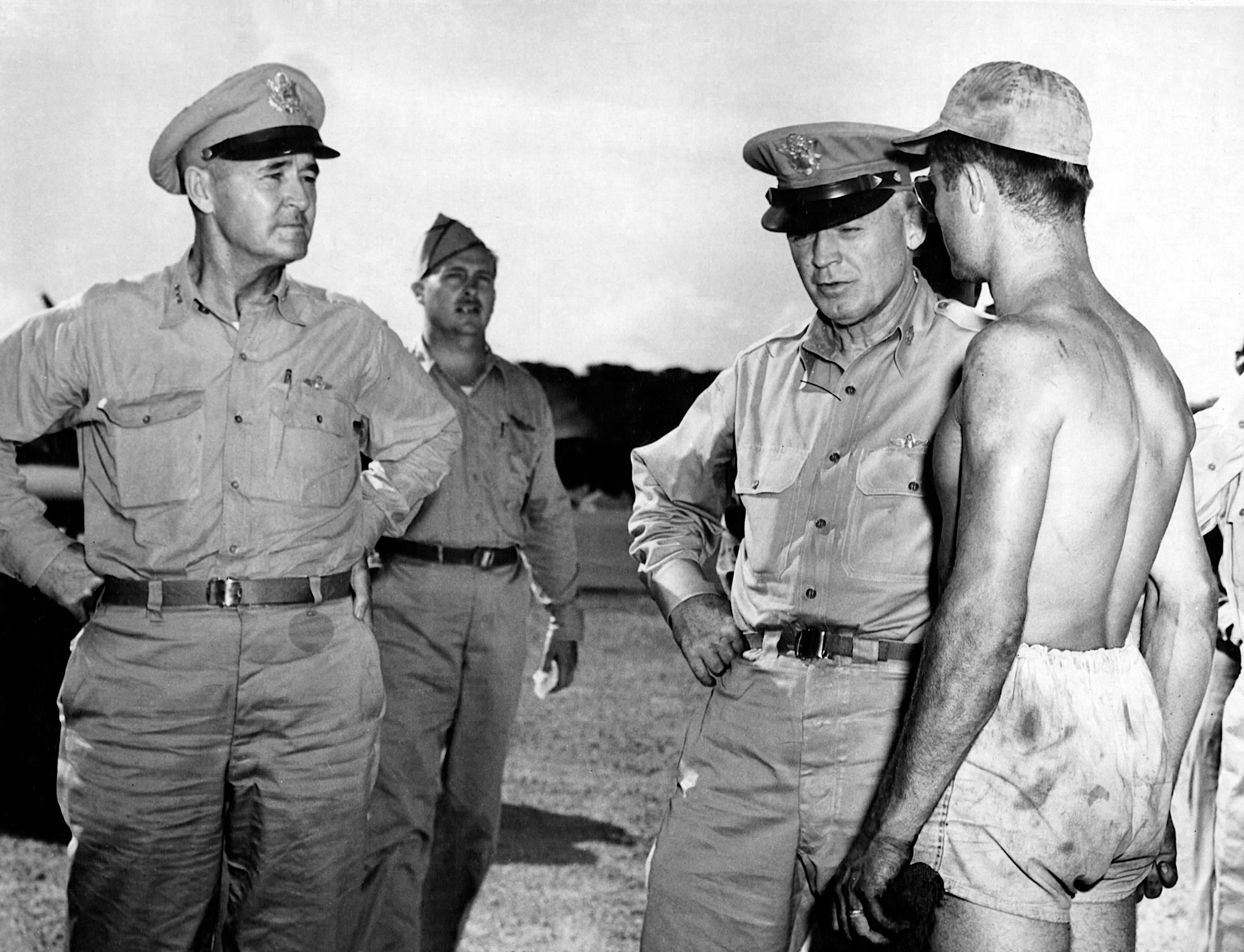
He might have forgotten about the donation, but two letters from the U.S. military, one from a general and one from a corporal,  set his heart to soaring. The first letter, dated January 21, 1943, thanked Eddie for his thoughtfulness. “Words themselves cannot fully express our gratitude,” wrote Maj. Gen. Barney M. Giles, commander of the Fourth Air Force. “However, when the battles are over and our boys  are home again, we all will thrill at the tales of how they were used.”

Lt. Gen. Barney M. Giles (left) sent a letter to Edward Mulqueen thanking him for donating a knife to the war effort. Here, he and Gen. Henry H. "Hap" Arnold speak with S/Sgt. Leo Fliess of Sturtevant, Wis., on Guam in 1945. (Army Air Force Photo)
Gen. Barney M. Giles (left) sent a letter to Edward Mulqueen thanking him for donating a knife to the war effort. Here, he and Gen. Henry H. “Hap” Arnold speak with S/Sgt. Leo Fliess of Sturtevant, Wis., on Guam in 1945. (Army Air Force Photo)

Giles was not just some Army bureaucrat. He was commanding general of the U.S. Army Air Force in the Pacific, who later became deputy commander of the entire U.S. Army Air Force. Giles worked alongside legendary war heroes, including Adm. Chester Nimitz, Lt. Gen. James Doolittle  and Gen. Henry H. “Hap” Arnold. He closed his letter to Mulqueen this way: “This much I know. With your gift goes another weapon that will certainly do much to help our boys slap the Japs into a complete and lasting tailspin.”

The next letter, from a U.S. Army Air Force officer in February 1943, was especially meaningful to Eddie. “He wished he had a hundred, yes even a thousand knives to donate,” read an article in the Cudahy Reminder/Enterprise. “His knife was seeing action and was being useful to one of our service men fighting in the Pacific.”

U.S. Army Air Force Cpl. Lucas R. Boyson wrote to thank Eddie Mulqueen for the donated knife in February 1943.

Stationed in the Fiji Islands, Cpl. Lucas R. Boyson was glad to receive the knife sent all the way from Wisconsin. Boyson, 29, was even more impressed that an elementary school student was behind the donation. “I was fortunate to receive your knife and to say it was a treat would be to put it mildly,” Boyson wrote in a letter to Mulqueen on February 14, 1943. “It is grand to cut stalks of sugar cane or bamboo sticks and for that matter general miscellaneous uses. I shall carry it with me always and each time I use it, I’ll whisper a ‘thanks to Eddie.’ ”

A married enlistee from Elyria, Ohio, Boyson was serving with the 375th Air Base Squadron, part of the U.S. Army air corps. He was among the first wave of men from Lorain County, Ohio to volunteer for service in January 1941. He wrote to Eddie that the natives on the islands were impressed with the knife, compared with the “hand-pounded, crude machetes they carry with them in the jungles.”

We don’t know if Boyson ever used the knife in combat, but we do know he survived the war and returned to Ohio, where he lived an exemplary life of faith and public service. On February 28, 1946, Lucas and Wilhelmina Boyson welcomed a baby daughter, Mina. Lucas was an attorney who became actively involved with his American Legion post, St. Jude Catholic Church and a variety of civic groups and causes. At one time he headed the Lorain County Bar Association. He was also a Fourth Degree member of the Knights of Columbus, a group with a special focus on patriotism. Boyson died on December 5, 1992 at age 78.

Inspired by the wartime service of three brothers and one sister, Eddie joined the U.S. Navy and served during the Korean War. After the war, he got married and started a job at Wisconsin Electric Power Co. He was an electrician for many years. Eddie and his wife Marie had three children. The couple later moved to Michigan, where Eddie died in August 1991 at age 60.

©2014 The Hanneman Archive

‘You Buy the Bonds and the Mulqueens Will Win the War’

It was just the kind of wartime story that made an emotional impact on Milwaukee and the state of Wisconsin. Three Irish brothers serving in World War II appeared together to promote the sale of war bonds at a series of rallies in November 1944. Two were home on leave from the front and one was about to embark on his first overseas tour of duty.

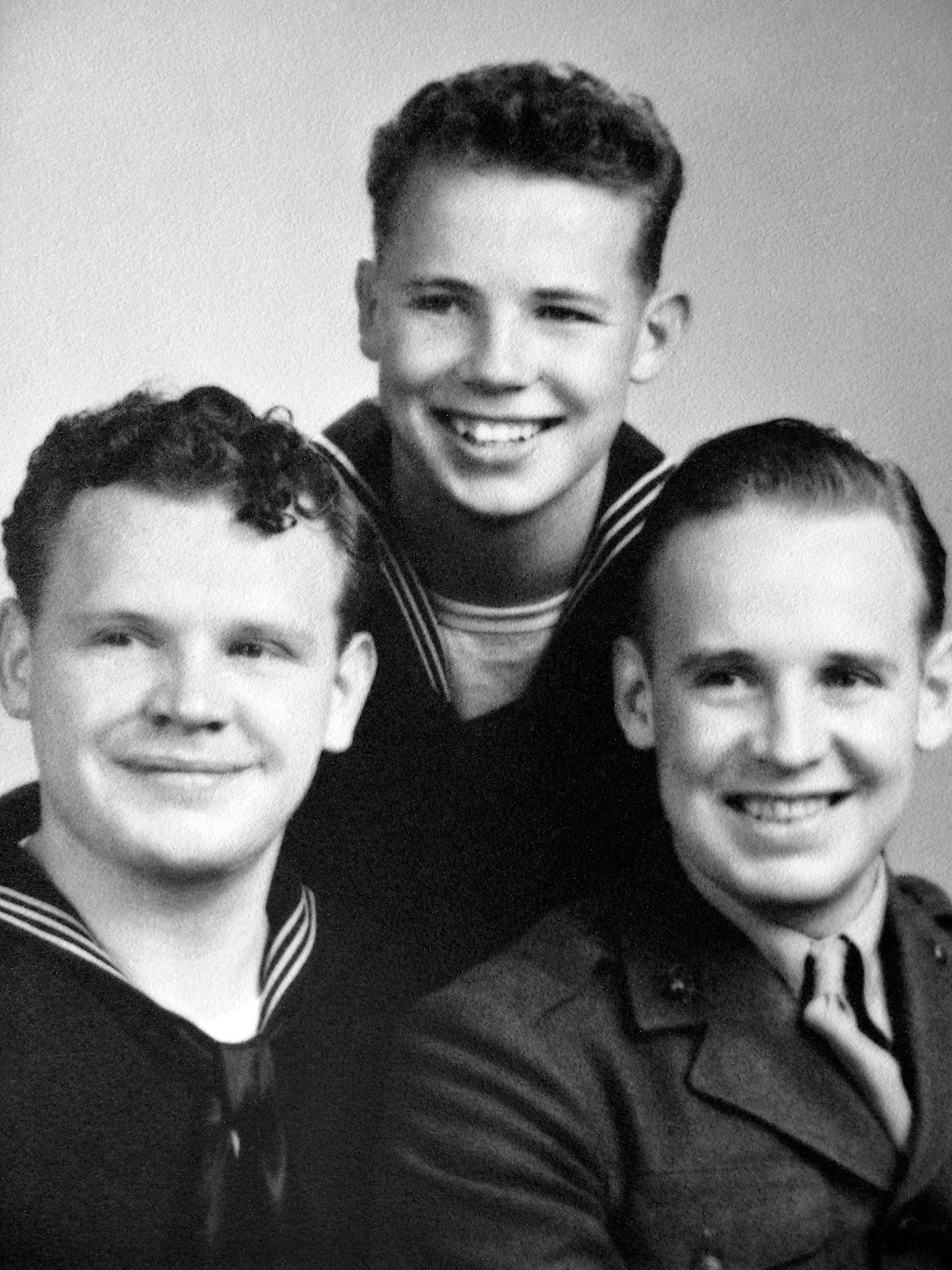
There they stood on stage, the baby-faced Thomas “Tinker” Mulqueen still in naval training, the serious Marine Cpl. Earl J. Mulqueen Jr., on crutches due to the loss of his left leg above the knee, and the curly-haired redhead, Patrick J. Mulqueen, home from more than 18 months at sea with the U.S. Navy.

The Milwaukee Journal carried a front-page story on the Mulqueen brothers and the war bond drive in November 1944.

“Maybe it is because they are Irish, or maybe it is because they look so much like little boys—or maybe it is because everyone at one time or another, lost his heart to an Irish grin,” wrote The Milwaukee Journal in a front-page story on November 10, 1944. “But no matter what the reason, more and more persons every day are agreeing that the Mulqueen brothers, Tommy, Earl and Patrick, are among the greatest things which ever happened to Milwaukee.”

The impact the boys had was most evident at a bond rally at Schuster’s Department Store on Milwaukee’s North 3rd Street. The event got off to a slow start. Ben Barkin, head of the local war finance committee (later a legendary Milwaukee PR man and founder of the Great Circus Parade) was worried. That all changed when the Mulqueen boys took to the stage. “They are so cute,” one woman said. “They look like little boys playing soldier.”

Three Mulqueen brothers appear at a Milwaukee war bond drive in November 1944. Left to right are Michael Thomas Mulqueen, Earl James Mulqueen Jr. and Patrick Joseph Mulqueen. Behind the group is war bond chairman Ben Barkin.
Three Mulqueen brothers appear at a Milwaukee war bond rally in November 1944. Left to right are Michael Thomas Mulqueen, Earl James Mulqueen Jr. and Patrick Joseph Mulqueen. Behind the group is war bond chairman Ben Barkin.

Now the crowd was interested. Barkin introduced the lads. The 17-year-old Tommy was first to step forward and said simply, “You buy the bonds and the Mulqueens will win the war.” Considering he had yet to set foot in a combat zone, such as statement could have been viewed as a “wisecrack by a fresh kid,” The Journal wrote. But it wasn’t. “When Tommy said it, you knew he was telling the solemn truth,” the paper wrote. (Tinker went on to serve as a sailor on the fleet oiler USS Mattaponi.)

Earl talked about the war. At 21, he had seen more fierce combat than most would ever see. He fought at Guadalcanal and Tarawa with the 2nd Marine Division. Those were two of the bloodiest, deadliest battles of the entire Pacific war. Earl was a mortar crewman, so he was right at the front.

This hazy snapshot from the Pacific shows U.S. Marine Cpl. Earl J. Mulqueen Jr. next to the mortar he took into combat during World War II.

Earl was helping prepare an invasion fleet for the 1944 assault on the Mariana Islands when his landing ship-tank (LST) blew up at Pearl Harbor. The massive chain explosion caused the loss of many ships and resulted in hundreds of casualties. Because of the preparations underway for the invasion of Saipan, the Pearl Harbor disaster was a classified secret until the 1960s. So Earl was only able to say that he “almost made it to Saipan.” (Details of Earl’s war service and loss of his leg in the West Loch disaster will be the focus of a future Archive story.) 

U.S. Marines storm Tarawa, Gilbert Islands, November 1943. (National Archives Photo)

Patrick spoke of his experience as a fireman aboard the light cruiser USS Concord (CL-10). He enlisted on August 7, 1942 and by March 1943 was among the compliment of 700 aboard the Concord. The ship escorted reinforcement convoys in the southern Pacific, and prowled the dangerous, icy waters of the north Pacific. The Concord was involved in numerous bombardments of the Kurile Islands. During 1943, the Concord was on a surveying mission of the South Pacific with retired Rear Admiral Richard E. Byrd, the famous explorer. The ship visited Tahiti, Bora Bora and the Easter Islands. A huge explosion onboard on October 7, 1943 took the lives of 22 crewmen. Caused by ignition of gasoline fumes at the rear of the ship, the explosion threw some men overboard, while others were killed from concussion, burns, fractured skulls and broken necks. On October 8, those men were buried at sea. After participating in bond rallies in Milwaukee, Patrick was assigned duty on the USS Crockett (APA148), a Haskell class amphibious attack transport. The USS Crockett had just been commissioned on November 28, 1944.

The crowd at Schuster’s quickly figured out that these “boys” had seen and experienced the horror of war. “It was simple and short,” The Journal wrote. “No frills. No hero stuff, no dramatics—nothing but a couple of kids, one on crutches, asking people to buy and sell bonds.” The stories of the Mulqueen boys had the desired effect. Barkin exclaimed, “You know, the bond drive is going to come out all right.” He was right, for the Schuster’s bond drive raised more than $500,000.

The Mulqueen brothers even appeared at war bond rallies with their mother, Margaret Mulqueen, who was active in the Marine Corps League.

Schuster’s was just one of many venues at which the Mulqueen boys spoke. At some rallies, they were joined by their mother, Margaret “Madge” Mulqueen, who was deeply involved with the war effort through the Wisconsin chapter of the Marine Corps League. She had four blue stars displayed in the window of the Mulqueen home at 3854 E. Cudahy Avenue in Cudahy — one for each of the three boys and one for her daughter Margaret, a Navy nurse based in San Diego.

The bond drives were a crucial part of the home-front effort in World War II. Across the nation, eight war-bond drives between 1942 and 1945 raised more than $190 billion. Investors purchased $25 bonds for $18.25. Bonds were redeemable after 10 years. Companies sponsored in-house bond rallies, and employees pledged purchases through payroll deduction. Children were encouraged to buy 25-cent war stamps to save up for their own war bond. Special sections of local newspapers were dedicated to promoting bond sales. On the radio, popular programs such as Fibber McGee and Molly dedicated entire episodes to war bonds and other home-front efforts.

Sgt. Louis C. Koth (left) and Marine Cpl. Earl J. Mulqueen Jr. are introduced at the Oshkosh B'Gosh Inc. bond rally on November 30, 1944.
Sgt. Louis C. Koth (left) and Marine Cpl. Earl J. Mulqueen Jr. are introduced by company president Earl W. Wyman at the Oshkosh B’Gosh Inc. bond rally on November 30, 1944.

Earl Mulqueen and Army T/Sgt. Louis C. Koth appeared at such a corporate event at Oshkosh B’Gosh Inc. on November 30, 1944. They were introduced by company president Earl W. Wyman. Koth was a radio operator aboard a U.S. Army Air Force B-17 bomber that was shot down during a mission over Schweinfurt, Germany. Koth was on his third mission in a B-17 Stratofortress when he was forced to parachute into enemy territory. Taken prisoner and repatriated 11 months later, Koth lost his right arm. Koth began participating in the bond tours shortly after being released from a hospital in Madison in the fall of 1944.

Koth and Earl Mulqueen toured Oshkosh Motor Truck Inc. and Universal Motor Co. Later they were interviewed live on radio station WOSH by local bond chairman Richard J. White. “Both of these boys are giving freely of their time to help the sixth war loan campaign,” White said. “They have made sacrifices beyond any that we are being asked to make, and although they will not see action again, they are both anxious to do whatever they possibly can to see that ammunition does not have to be rationed at the front.”

The bond rallies helped explain the costs of supplying the troops. Toothbrushes cost 8 cents each. A hand grenade was $1.56. An anti-tank shell cost nearly $3. A Garand rifle was $55. A 1,000-pound bomb cost $250, while a 75-mm Howitzer cost $11,350. A PT boat cost the military $145,000, while a 1,630-ton destroyer had a price tag of $10 million. A fully outfitted battleship cost $97 million. Bond drives supplied the U.S. government with needed cash, while giving ordinary citizens a concrete way to participate in the war effort.

Ads like this one from First Wisconsin promoted sale of war bonds during World War II.

Largely due to Barkin’s tireless efforts, Milwaukee’s World War II war-bond drives became a model for the nation. Described by The Milwaukee Journal as an “ace ward bond salesman,” Barkin was honored as Milwaukee’s man of the year in 1945 by the Milwaukee Junior Chamber of Commerce. For his $1 annual salary, Barkin popped up just about everywhere in Milwaukee: schools, churches, civic clubs and businesses. The 28-year-old was unable to enlist due to a disability, so he threw his energy into raising money for the war effort. Doctors told him to slow down, but the pitchman didn’t listen. He gave more than 1,000 speeches each year as head of the community division of the war finance committee.

“Let’s show Milwaukee what their money is buying,” Barkin said in 1943. He organized a “Wings for Victory” parade of tanks, jeeps, artillery and other hardware to do just that. Funds from the rally after the parade were used to buy military transport planes for Mitchell Field. Barkin convinced Milwaukee to rename Wisconsin Avenue “War Bonds Drive” for the duration of World War II, a practice later adopted in dozens of other cities. He understood the importance of having soldiers, sailors, airmen and Marines tell their stories. The results were often heart-rending. He told the story of a Milwaukee woman who stood in line for two hours to buy a war bond for her boy, serving in North Africa. Her husband had just died two days prior. “Doggone it,” Barkin told Walter Monfried of The Milwaukee Journal, “that kinds of gets you, doesn’t it?”

Three Mulqueen brothers served in World War II: Patrick (left), Thomas (center) and Earl.

So Barkin knew when the Mulqueen boys stepped on stage, the people would dig deeply into their pockets to support the war. “No matter what the mood of the meeting before the kids talk,” The Journal wrote, “when they finish, that meeting is sure of going over the top.

“Everyone who has heard the Mulqueen brothers agrees,” the paper wrote, “that the kids are among the best in the world.”

[This post has been updated with more details on the Oshkosh bond drive on November 30, 1944]
©2014 The Hanneman Archive

A Little Mulqueen Family Photo Flashback

Our photo library is a bit thin on photos from my mother’s Mulqueen side of the family, but we do have some nice images worth sharing. My Mom grew up in Cudahy (we always pronounced it coo-da-hi, although it’s actually cuh-dah-hay) and comes from a family of 10. The matriarch and patriarch were Margaret Madonna (Dailey) Mulqueen (1895-1982) and Earl J. Mulqueen Sr. (1895-1965).

©2014 The Hanneman Archive